




Abstract
There is contemporary interest in drawing practice as a research method in geography. This paper gathers aligned insights from visual studies and geography to deconstruct humanistic processes involved in researcher seeing and representation. Seeing is critiqued as a socio-cultural practice that can affirm intersectional injustices and suffering. I argue that to resist humanist interpretations of the more-than-human world, it is necessary to both de-territorialise the researcher self, and the research practice. I demonstrate that drawing performed as a becoming practice, offers one way to move towards a de-territorialisation approach and to conduct field research with a posthuman sensibility. The research is an example of a feminist research assemblage involving processual toggling between theory, practice and reflexive analysis. The discussion illuminates the problems of researching emplaced animals elucidated through two case studies that describe drawing a zoo tiger and a city farm cow. The drawing vignettes are introduced as experiments in the capacity for geographical research to attend to subjects through loosening the humanistic regimes of seeing and representation.
Introduction
Drawing offers the potential to conduct research in ways that integrate body, mind and exterior world, and is therefore a valuable tool for developing posthuman research methodologies. 1 This paper illuminates the value of knowledge making as practice through accounts of drawing emplaced animals. 2 Two empirical vignettes elucidate how drawing can involve becoming sensitised to the capacities, as well as the limitations, of conducting field research with a zoo tigress and a city farm cow. The research is situated in the field of animal geographies and provides insight into ways to develop posthuman geographical practices. 3 I explain how drawing as research encouraged the deconstruction of anthropocentrism entwinned within the hierarchical structures of humanist knowledge making. 4
The paper contributes empirical descriptions of drawing presented as routes into destabilising the human subject, and human-animal binaries. 5 Anthropocentric processes are interrogated to illuminate the situatedness of seeing, raising questions about the value and possibility of attempting to represent another being. 6 The vignettes illustrate how drawing as research can integrate theory, practice and analysis, in ways that reduce the normative dominance of the human cognitive register. I present research that reflexively toggles between states of immersion, of knowing and not knowing, of anthropomorphism and of becoming animal. Crary and Gruen argue that investigating and recording animal (and human) suffering and injustice is not enough to elicit change and further state that ‘if we want to see the world clearly, we need urgently to interrogate and develop our attitudes, interests, and empathic capacities’. 7 Presenting research and analysis as toggling between different registers and processes elucidates ways to conduct posthuman research that can involve reflexive engagement with interior and exterior aspects of knowledge making practice.
Introducing the vignettes
The paper utilises case studies from data gathered during 2015. The research aimed to discover how visitor engagement with emplaced animals in organised urban nature settings affects how people experience nature connectedness. 8 Animal geographies have embraced performative research (often utilising ANT and multispecies ethnographies) to destabilise human-centred approaches, however it is less well understood how to practically develop normative research methods for posthuman enquiries. 9 The two case studies are selected for the current paper because taken together they illuminate a shift from representational to non-representational drawing research practice: The first case describes making and reflexively reviewing a figurative sketch of Melati, a zoo tigress. The vignette explores how the researcher’s embodied anthropomorphism became evident and then led to a decision to change the drawing practice. The second vignette describes the methodological response to drawing as anthropomorphic representation, and focusses on drawing Shirley, a city farm cow. The vignette explores the resulting shift towards drawing as becoming. Together the cases provide reflexive processual analysis on drawing as a lively research practice.
Introducing the field-sites and animal subjects
At The London Zoo and the Kentish Town City Farm the animal encounters are rooted in anthropocentric engagement practices and pedagogies organised around human education and leisure. The animals are presented as specimens, and spectacles. 10 The zoo and the city farm share several crosscutting themes: the animals are emplaced; presented as spectacles; organised through top-down ontologies and pedagogies; categorised as objects, for example as specimens or food. 11 Zoo and farm animals are regarded as representations of other more ‘real’ yet abstracted animals living elsewhere either in the ‘wild’ or on working farms. 12
Scholars have critiqued multispecies research for not attending to animals as individuals and for retaining a human-centred focus. 13 In this paper the focus remains primarily on the human researcher experience and explores the potential of drawing as research to dissolve the cultural coding imposed upon the zoo tigress and farm cow in order for them to be seen openly. 14 Whilst the animal ‘voice’ is lacking, the research premise instead follows Clary and Gruen’s ‘politics of sight’ arguing that without first understanding and de-territorialising human ways of seeing and representing, animal subjects cannot be acknowledged. 15
The first drawing experiment took place at The London Zoo tiger enclosure and was followed by a second experiment at a city farm in London. Both sites were selected as examples of urban curated-nature places where animals are emplaced. 16 Whilst there is a long scholarship in relation to zoos that are roundly criticised less attention has been given to animal individuals who live in such places. 17 Although, there is a small scholarship on city farms, attention is instrumentally focussed on human concerns in relation to the work animals do for human wellbeing. 18 Research attention into the lives of individual city farm animals is lacking as is research on city farms more generally. 19
During the original research many animals were involved at both the zoo and the farm. The tiger and the cow are both commodified and as Acardi et al argue such categories of animals are often ignored as worthy research subjects. 20 The zoo tigers and city farm cow are two of the most commodified ‘exhibits’, and in both cases the subjects are living far from normal lives. Both the tigers and the cow are presented as charismatic flagship exhibits in their respective organisations. 21 Attempting to engage with emplaced animal subjects as a visitor presents problems that need to be addressed if such animals are not to be ignored. Firstly, there are ethical concerns because the research attention could be enacted as another unwanted gaze. 22 Secondly, seeing the animal outside of the zoological and farm constructions of zoo tiger and city farm cow requires the researcher to de-territorialise the self from normative ways of seeing. 23 As the vignettes later explore, the drawing could not achieve engagement with the tigers or cow as if they were removed from their environmental constructions. However, the sensory and reflexive ways that the drawing revealed such practical engagement difficulties, in turn, challenges the arguments made by organisations, that keeping animals captive is a way of making animals available for people. 24
Drawing as becoming as posthuman method
The distinctions and alignments between the critical animal studies and posthumanism are at once overlapping, distinct and fluid. Critical animal studies is concerned with the ethical and political dimensions of how humans treat and construct animals and their environments. 25 Investigating the interconnections between humans and other animals is part of the posthumanist aim to destabilise human exceptionalism. 26 Critical animal scholars demonstrate the ways that intersectional structures include animals, and posthuman scholars critique speciesism. 27 Deconstructing and overcoming intersectional suffering and injustice is an aim of both critical animal studies and posthumanism. But whereas critical animal scholars are centrally interested in animal justice and recognition of the intersectional dynamic between animal and human injustices, posthumanism is focussed upon moving beyond humanist structures towards multispecies non-hierarchical theories and practices. 28
The next section provides a brief explanation of how seeing and representation are normatively enacted as humanist practices. I then introduce Deleuzian becoming as a practice to loosen the self from humanist representational of ways of seeing. Finally I argue that the forms of attention available through immersive drawing offer a way to become animal in the sense of de-territorialising the self from both exterior and embodied anthropocentric ways of seeing and making representations. I argue that de-territorialisation offers a more ethical and responsible approach to conduct research.
Seeing and representation
There are intersectional linkages between colonial and expert hierarchical gazes (imposed upon both humans and other animals) and patriarchal white western oppression. 29 The politics of visual representation (the making of visual objects and forms of gaze) are discussed widely in humanities and visual culture in relation to typologies of gazes as practices of objectification, power and consumption. 30 Franklin introduced the ‘zoological gaze’ to describe how zoo animals are seen as specimens for visual consumption. 31 Urry defined the ‘tourist gaze’ to describe the ways tourists regard views and vistas as spectacle objects, often consuming them through taking a snapshot to capture the scene. 32 The postmodern zoological gaze includes feelings of involvement with zoo animal subjects and can pivot between all forms of gazes. 33
Animals in zoos and city farms are regarded through different forms of gazes but seeing is deeply entangled with sense making in that we auto-select and consciously see what makes sense to us. 34 As Carey Wolfe explains: ‘“not seeing” is crucial to the human being’s (and to any being’s) organisation of an overwhelming flood of visual input into a field of meaning’. 35 To deconstruct seeing it is necessary to also consider sense making processes. Seeing is entwinned with representational processes that are both internal thought-images and external constructions, expressions or articulations. One way humans understand animals is through like me anthropomorphism, defined as the internal cognitive or sensory processes of observing an experience in an other being, and matching it against something one has a direct human experience of. 36 However, Lori Gruen critiques the notion that animals are like us instead pointing out that animals are not like us because their sentient feelings and lifeworlds are not like ours and cannot be aligned to human registers. 37 Gruen’s critique destabilises human-centred reasoning. From a posthuman research perspective seeing an animal subject, in part entails developing an awareness of the normative humanist practices involved.
Drawing as becoming
Both Wolfe and Baker among many have explored Deleuzian concepts of becoming understood as practices to de-territorialise and destabilise humanism.
38
Wolfe argues that through creative practice artists engage in becoming:
artists, because of the intensive involvement they have with the media in which they work, start with an understanding that “normate” human ways of perceiving and experiencing are just one way of experiencing the world of light, sound, smell, taste, and touch that involves the potentialities of a much broader nonhuman, “animal” sensorium. There’s a way in which art - even the traditional, humanist art- is always already “animal” in this sense.
39
Wolfe’s point is that creative practice involves an understanding that in the doing of looking there are many variants, and in the doing of making, there are also many potential lines and marks, with multiple possible aspects to see and to think about. Moreover even humanist art is construed as already animal because in that making of representational art, (such as the depictions of animal suffering by Sue Coe, discussed at length by both Wolfe and Steve Baker in this regard), there is still an awareness that what is produced is one version of the many possible ways of representing the subject. 40 However, as Wolfe argues whilst humanist art can portray animal suffering and human cruelty, if it remains within a humanist representational regime, it is not posthuman art. 41 From this perspective whether or not the artwork is posthuman or humanist, the creative process involves becoming; that in turn, challenges the ethical continuum that retains humans at the top of a hierarchy of rights. 42
Whilst creative practice involves becoming in the sense of comprehending that there are many variants to both seeing and to representational decisions, art-objects can nevertheless remain orientated within humanist representational regimes. This is relevant to geography firstly because it affords the opportunity to understand the value of creative practices such as drawing for research. Drawing can be performed as a field research method to de-territorialise both the researcher and the researched from fixed ways of seeing, in order to develop posthuman research practice. Secondly it suggests that to do posthuman geography involves developing tools to shift the normate ways of researcher seeing and engaging with research subjects.
Drawing as research method
Berger pointed out that ‘A drawing of a tree shows, not a tree, but a tree-being-looked-at’. 43 Berger’s comment illustrates that what is seen is always mediated by the one who does the seeing. Further it foregrounds the seeing is a doing that, during drawing is entangled with exterior representative processing. The drawing practices outlined in this paper are not about painterly questions, such as golden arcs, horizon lines or the paint on the brush. Rather the focus is on how the body connects through the pencil, paper, bench, glass, fur, concrete, towards multiple ways, of being and seeing. Drawing involves interactions between inner and exterior worlds that can be difficult to disentangle because often a range of processes are active. 44 In observational drawing, the lines that are made make visible the interactions between different knowledge and experience registers. 45
There are many types and styles of drawing with differing intentions and traditions. One way to think about both drawing as practice and drawings as objects is through following one of John Berger’s distinctions between a sketch and a finished work or painting. 46 Berger points out that whereas paintings exist as complete objects, of themselves, drawings always hold traces, suggesting other lines and evidence the process of making each mark. To embark on drawing as research from this definition opens up several possibilities. Firstly, sketches therefore exist as reflexive data, with the human drawer’s subjective response to the drawn other, available to review and analyse. Secondly the process is investigative, in the moment and an open means to comprehend research subjects.
In thinking about how to loosen from representations of the world as humanistic facts, as statements about what is there, drawings readily evidence the situatedness of the process. This is true for all drawings. For example, technical drawings evidence that a particular regime of rules have been followed in order to produce a certain kind of representation of what is seen. Moreover, the research aim of loosening from anthropocentric ways of seeing, regarded as becoming animal, is also evident through the drawings.
Research design
Drawing as research does not require technical skill and is described by Martikainen and Hakokonga as ‘low-threshold’. 47 It can be carried out with limited tools (subject, artist-eye, hand, pencil, paper). Instead, drawing as research requires entering into what Despret termed ‘“making available,” an experience by which both the body and what affects it produce each other’. 48 So rather than thinking of creative methods through step by step toolbox typologies and framings, what is instead suggested, is that the attention turns towards engagement with a creative practice of becoming available (in this case through drawing). Moreover becoming available can potentially be achieved through many different material engagements.
The original field research took place at The London Zoo, a Kentish Town City Farm and Camley Street Natural Park 2015–2016. The research design followed Fox and Alldred’s explanation of a research assemblage and utilised autoethnographic visual methods, participant observation, informal interviews and participatory arts experiments. 49 The methodological approach set up an ongoing processual dialogue between the different data types involving an understanding of some data produced as firm lines of rationalistic knowledge in dialogue with the experimental phenomenological data. 50 The processual, toggling rotations between methods, enabled the analysis to work through exploratory concepts during auto-ethnography and participatory tasks.
Over the course of the fieldwork, I took photographs with medium format and SLR cameras. I drew with pencils and pens, and painted in A5 sketch books, on A4 and larger rolls of paper. When working alone I carry one camera and a sketch book with pencils and pens for sketching and ink and paint for more gestural practice. However, when working in public spaces, I need to feel a certain physical agility because it helps to forget myself and dissolve into my surroundings. I often used a combination of soft pencil and felt tips as a compromise to achieve both cognitive and sensory engagement. In the first case below I used A4 paper, pencils and pens, which was my standard kit for working in public spaces. However, in the second case I used a cartridge paper sketch book and black ink with a brush as I aimed to liberate myself from technical concerns, whilst being forced to work differently through the faster more fluid medium of ink.
There were shifts in my intention and tools, as well as differences between engaging with the different animal subjects, and different settings. The analysis was an ongoing response to emergent data and methodological developments. 51 The analysis focussed on evidence of anthropomorphisms and phenomenological direct experiencing suggesting de-territorialising practices of becoming. 52 For example, the analysis considered in what ways the sketching produced a sense of drawing as becoming and in what ways remained constrained within representational and anthropocentric dynamics. 53 I interpreted becoming as an active process of becoming affected by, or sensitised to, a form of animality – in me, the human. Finally, attention was given to whether the animal subjects involved were impacted in any perceptible way, and if they responded to being observed or drawn.
In the vignettes that follow I explore how drawing as becoming de-territorialised the research from a humanist framing of Melati the tigress to a posthuman sense of Shirley the cow.
Melati
I had visited The London Zoo Sumatran tiger enclosure repeatedly over 2 years ethnographic fieldwork. I was familiar with the routines of the tigers, their keepers and the volunteer explainers who talked to visitors in ways described by Franklin as a ‘zoological Gaze’. 54 The tigers were generally presented in two ways: firstly, as subjects who live the life of being a zoo-tiger, enjoying family concerns and pass-times. They were described in familiar terms by the zoo, oftentimes involving human trait, and like me anthropomorphism. Secondly, (during keeper presentations, and through the enclosure signage), the tigers were portrayed as representatives for other, wild Sumatran tigers who need saving through breeding programmes and conservation projects in Sumatra conducted by zoos. 55 I had also observed the ways visitors tended to stop, photograph and then proceed through to the next exhibit. 56
I have no reason to think the tigers were interested in me at all, or that I was anything other than one more person who would not feed them or be useful in any way. During the many visits I observed how they scanned the crowd for the keeper, and after a while I developed confidence that (the male tiger) Jae Jae’s gaze lingered on me for a split second of recognition as he scanned past looking for the keeper. Perhaps identifying me with a passing interest because of the frequency of my visits. During the drawing, I did not detect any tiger interest in what I was doing.
After months of visits, and inspired by ethological field accounts, I decided drawing as an immersive practice might help develop a closer understanding of the zoo-tiger-animal position and ways of being. 57 I was unsure how to approach the tigers without objectifying them, and enacting research as a further denial of their subjecthood. The aim was to discover if through drawing I could comprehend the tiger individuals beyond the cultural coding and diminishing emplacement imposed upon them.
I went to the tiger enclosure with A4 paper, pencils and pens. I was accompanied by my daughter and a friend. The zoo was hot, noisy and busy. As we started drawing some visitors came up to us thinking I was running a workshop. I felt stifled and self-conscious due to the performative nature of settling into the space which drew attention from other visitors. Whereas Brice articulates other people as ‘curious’ in the drawing. 58 I felt pressure, perhaps in part because I was also trying to settle my companions. The soundscape of the zoo environment felt deafening, a combination of visitor chatter, layers of announcements bleeding between different enclosures and animal sounds. The animal sounds were a combination of free birds flying over, and emplaced animals. The smell of the camels drifted across the top end of the enclosure. I wondered what the tigers made of the constellations of sensoria that I found stressful. Attending to drawing the tiger involved becoming more sensitised to the environment and produced an uncomfortable affective tension. Working also with a heightened awareness of being watched acted as a contagion that became an awareness of myself as human-drawing- zoo-tiger: every stroke evidenced the relation between (human)eye-(tiger)body-(human)hand-pen-paper. Conducting field observation requires feeling settled, becoming embedded into the field, and this was challenging. Drawing the tigers involved having to both become immersed in the difficult zoo environment, whilst also not ceding to it in order to connect to the tiger subject.
Melati, the tigress, was laid out, high up on a large heated plastic rock (Figure 1). From her position she could survey the human crowds, and I had seen her do this on many occasions waiting for the keeper to appear. I made some gestural sketches, trying to find her lines and trying to ignore my own discomfort. I managed to swing from moments of attunement, letting go and finding a sense of discovery and back again to awareness of myself, awkwardly trying.
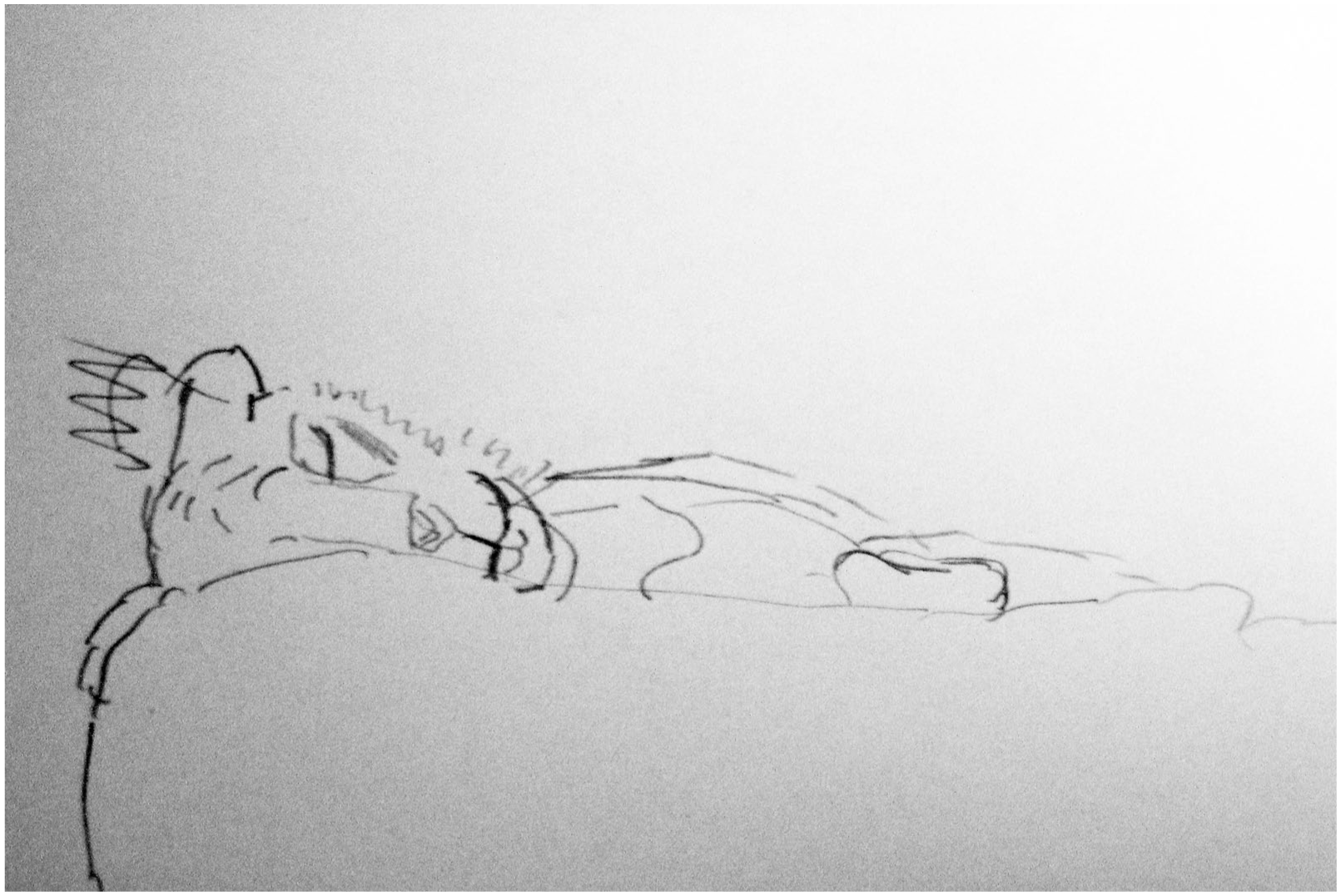
My drawing of Melati snoozing on a heated plastic rock. Photo by Harriet Smith.
During making the tiger sketches a moment emerged, where there was no referent: the hand and eye did not know what to do and fell to finding a more familiar referent and drew a human eye shaped line. It is not the drawing of a preconceived stylised line that is of import; it is the fact that it was a human line. The moment when I met the edge of my understanding, my hand and eye colluded in an embodied anthropomorphic strategy. The human eye on the page was inferring that the tiger is like me. Through the act of drawing, the tiger eye was formed as a human eye, enforcing a quasi-empathy. The drawing momentarily enacting as a form of what could be understood as a mirroring of a trait. 59 Making the human eye was an act that erased the tiger in order that I could complete my drawing. Of course, this all happened in an instant, through a strike of my pen without any conscious planning. But the drawing remains with the anthropomorphic moment materialised. The sketch revealed how anthropomorphism occurred unconsciously as an action through my body (Figure 2).
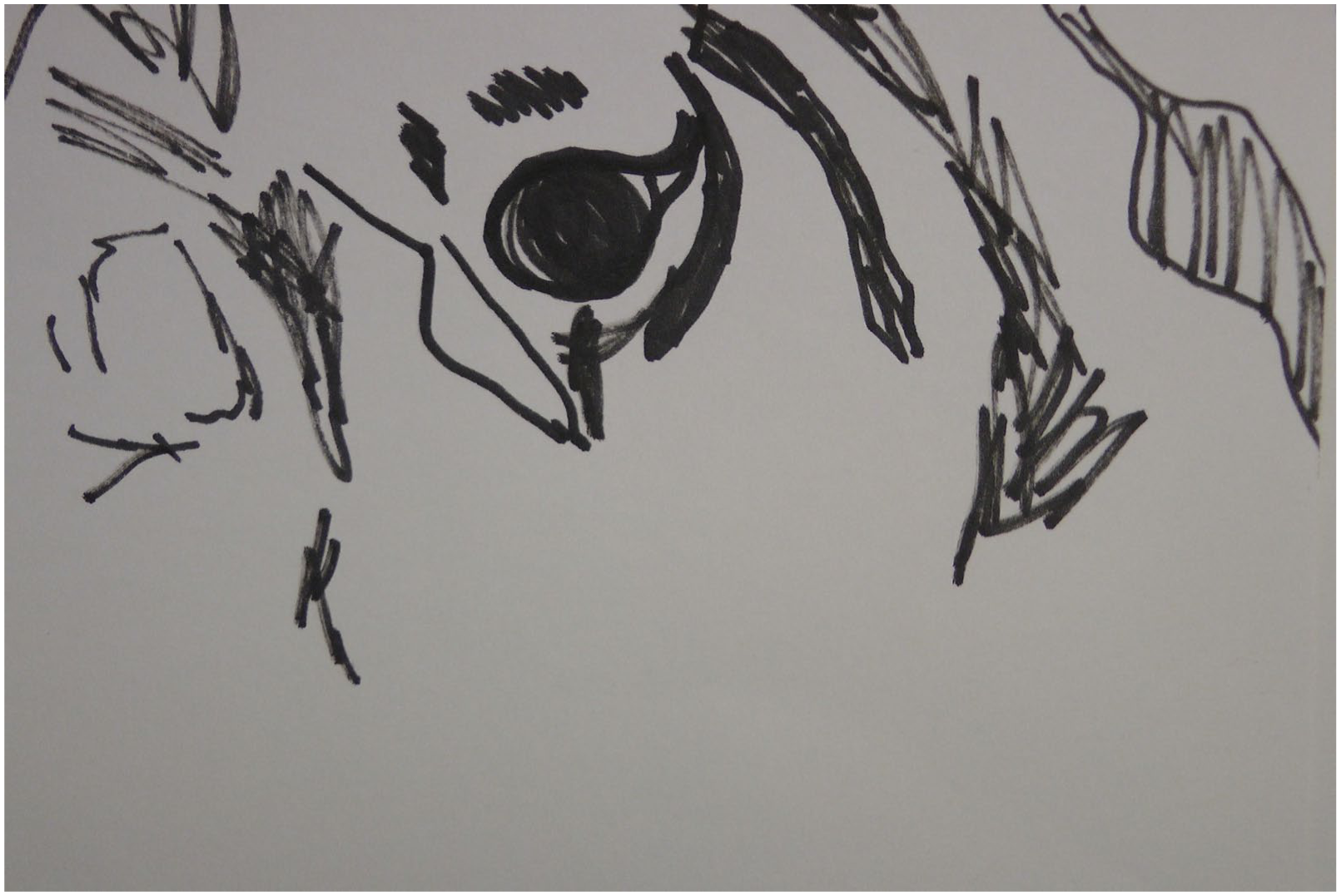
My drawing of Melati with a ‘human’ eye. Photo by Harriet Smith.
For example, in my notes I wrote about how difficult I found the process, and the fact that it made more apparent how my drawing mind slipped into human trait anthropomorphism when I felt challenged and found sense-making difficult:
I remember looking at Jae Jae [the male zoo tiger] and trying to understand how to transfer his head onto the page—but the shape of his skull suddenly felt too alien. When I looked at the picture of Melati, I remembered the feeling of putting in an eye shape line that wasn’t really there—and looking retrospectively, I saw that the line, whilst making the drawing read, and have more form, also humanized her form—it was a human line. (Field notes, 2015)
The drawing process made apparent embodied strategies that involve anthropomorphising as a form of visual practice for filling in the gaps between knowing and unknowing. Infilling a space where there was no thread, no connection or understanding on my part. This emergent relationship is what Deleuze refers to as a haptic relation between hand and eye, where the hand is not subordinated to the eye-mind. 60 The lines demonstrate shifting between conscious and unconscious attempts at feeling the tiger and making human lines. Drawing became a tension between making haptic, gestural lines and making what Deleuze refers to as digital drawing, where the hand is reduced to a mechanical finger. 61
I was not drawing a human eye because there are no tiger lines to draw. The fragility of the practice relies upon attending to the other and being true to the subject, as an individual being. 62 To make gestural marks requires a practice of remaining both immersed and open to risk, as a creative practice of becoming. 63 When the practice failed, style crept in.
But then, as discussed earlier, drawing is a reflexive tool, and the sketches evidence processual strategies (through the resulting marks) that viscerally speak back to the body memory of the anthropomorphic moment. 64 What becomes manifested visually upon the page is an opportunity for re-feeling the encounter and returning to the corporeal animal with the aim of articulating its specific subjecthood. The reflexive reflections of the sketches invite a type of becoming (introduced earlier in ‘drawing as research’) because each mark suggests alternative marks and choices that could have been made. 65 This is also what Berger describes in relation to sketches because each line describes a decision or a feeling. 66
The human-tiger eye line could be understood as a visceral expression of my discomfort in confronting my relationship to the zoo-tiger- placing myself into the frame. The attempt to do drawing as becoming through figurative gestural sketching at the tiger enclosure was fraught with both internal and external difficulties. However, I did become sensorily aware of the tiger’s situation beyond a zoological gaze or a distanced ethical disapproval. As time went by the zoo atmosphere became unbearable, drowning out the hope of encountering Melati or Jae Jae as individual beings with their own lifeworlds. 67 I was barely any closer to seeing Melati than if I had looked at a photograph in a magazine.
Stripes
Later when I reflected on the corporeal tigers and the tiger drawings, I realised that stripes are potentially more than a surface pattern on a static form (Figure 3). The idea of a static tiger representation is humanist in that sleeping tigers move, breath, respond to air, sound and light. The tiger form is not static, nor bounded by the skin surface. Stripes on a leg can conjoin with stripes on another body part, or even a different body part, or grass for example. The capability of stripes for hybridising, dissolving and shape-shifting was not something I had considered. I had understood the tiger as a being whose body has an outline that cuts between tiger and the none-tiger world. I had decided to draw Melati laid out on a rock because she was relatively still. But the plastic rock and artificial background emplaced her tightly as a tiger in a zoo enclosure. A different form of knowing the tiger can be experienced when observing the tigers moving around the grass area of the enclosure. In motion the tigers evoke the notion of body without image that became apparent during the process of reading the drawings. 68 I relate this form of knowing to Massumi’s concepts of mirror and movement vision. 69 In movement vision we perceive things differently: we do not see a series of stills (mirror vision), but rather, we employ a tactile eye that feels the intensities of gesture and subliminal movements that we do not consciously perceive. 70 The failure of the drawing suggested that notion of a fixed tiger body is a humanist version of a tiger erased through anthropocentric mirror vision. Upon reflection Melati resting is an entanglement of body and stripes and body in motion. Attempting to make a figurative representation of the tiger demanded (I thought) foregrounding body parts, limbs, torso tail as one distinct form, as a still-life. But a change of focus requires a far more fluid sense of bodies that are embedded in the world through motion and affect. 71
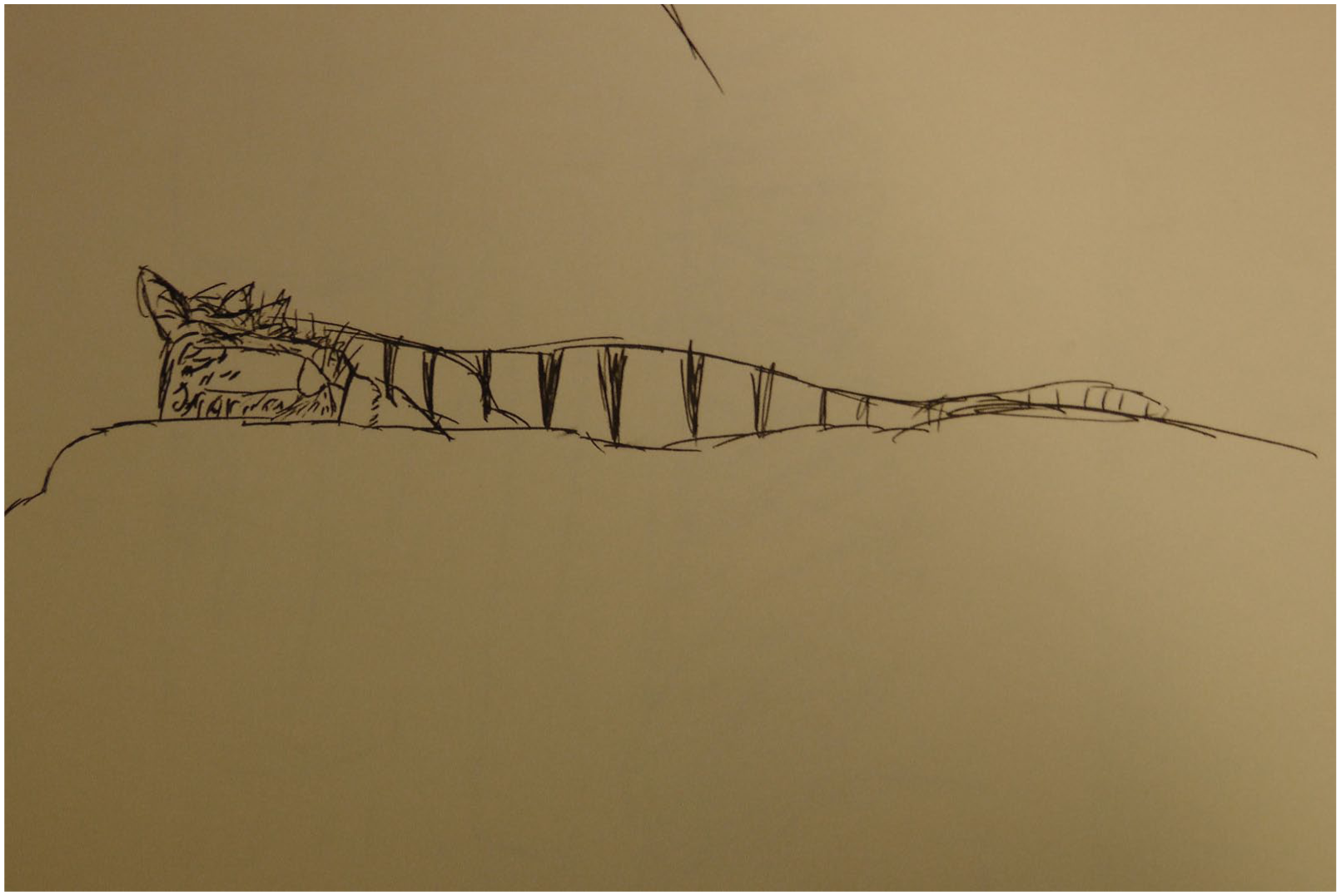
Drawing of Melati with stripes by my daughter. Photo by Harriet Smith.
As I thought back to the tiger drawing, I realised that I had assumed I would make portrayals of the animals as complete. I had envisaged the drawing as a reworking of naturalist immersive experiences and thought little about the relationship between drawing immersion and representation. Even so, it had not been my intention to make ‘like me’ anthropomorphic representations of animals. The moments of attunement manifested when the drawing process became embodied, which, as illustrated with the tiger example, became lost when a cognitive judgement about how to represent the animal was privileged. 72 In a sense, then, the drawing in these contexts was a process of finding and losing connection to the potential of comprehending Melati as a subject. Critical posthumanism proposes that humanism is a tool for thinking and communicating with, that is, after all, inevitably how humans make sense of the world. But simultaneously it is necessary to become open and responsible to, the multiple other ways to comprehend life. 73 The process of drawing offers a method of becoming open to the multiple ways of seeing and representing (Figure 4).
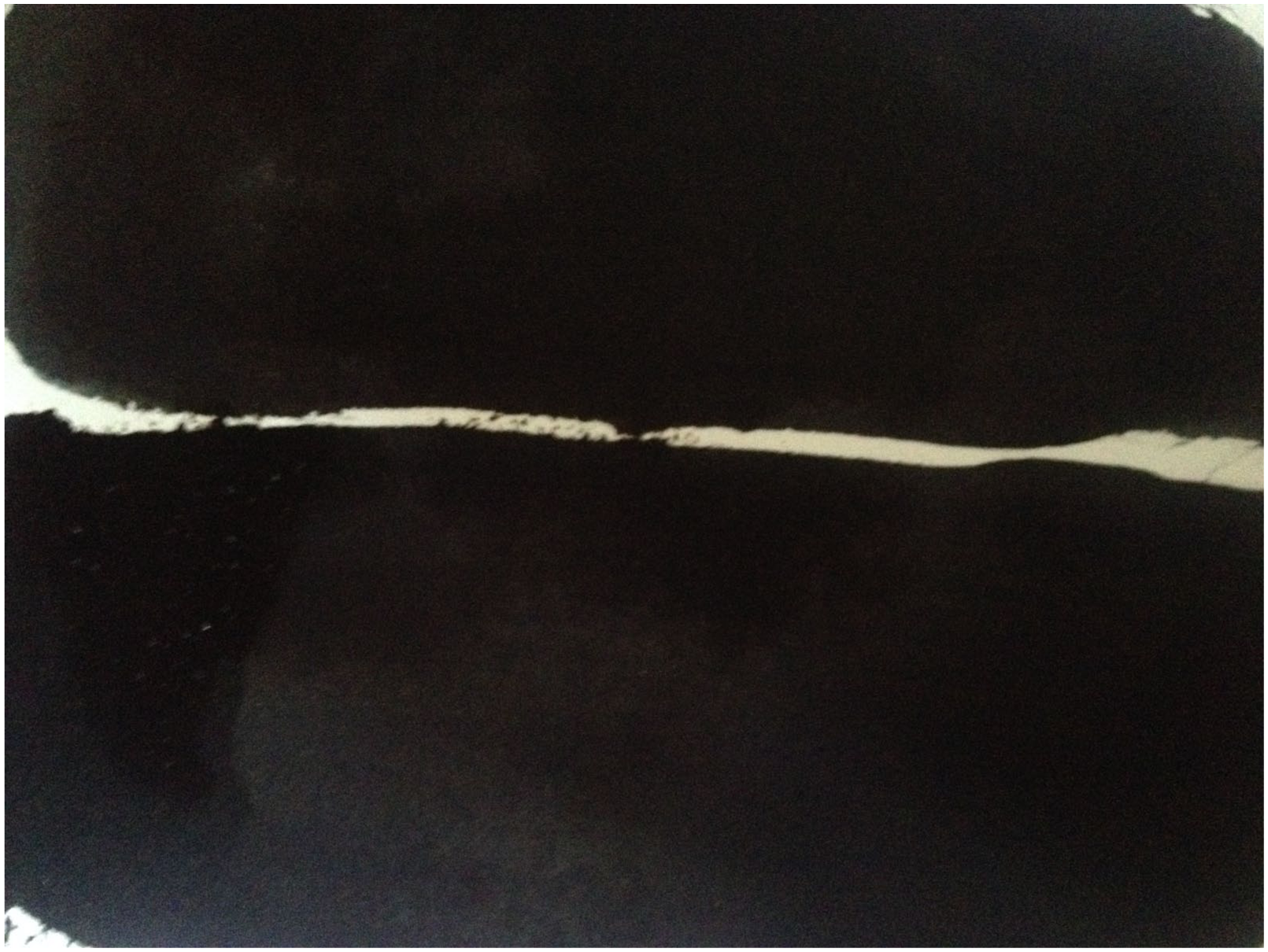
Ink drawing: Shirley’s mouth. Photo by Harriet Smith.
Shirley
The atmosphere at the city farm was of a different order to the zoo. The farmyard was messy, with concrete ground, a railway line running down one side and a housing estate on the other. The cow, a black Aberdeen Angus heifer, called Shirley, lived alone between a concrete stable block (with some sheep at night for company) and a small grass slip of a meadow. One of the main roles she performed was teaching people that cows are different from horses. Shirley was often mistaken for being a horse by people who had never had the privilege of seeing farm animals. So, like the zoo tigers, she was also an ambassador – for Cow-folk of all kinds. 74 The farm visitors and volunteers watched and interacted closely with other animals for example riding the horses and playing with the goats, ducks and chickens. Shirley could not interact in such ways and spent her days alone either on the grass or in the concrete yard.
I went to the city farm alone, with ink, a brush and a sketchbook with thick paper ready to soak up the black liquid. The farm was a much more relaxed place for me. I was well acquainted with the farm community from conducting participant observation over the past year. I found Shirley standing in her concrete yard. It was a hot day and she stamped her hooves periodically, waiting I think, for bedding down, but also perhaps enjoying the last of the evening sun. I wanted to liberate myself from the constrains of the drawing experiment with the tigers, and to forget trying to draw. To forget being a human, and a researcher, and just see what happened. The ink moved fast, almost with a life of its own and I worked easily once I got going. I made drawings of only parts of Shirley: her back, her eye, her head and front torso. Much of the time I just stood, brush and paper ready, but waiting to feel ready. The Shirley parts were an experiment in non-anthropomorphic drawing – giving attention to texture, to an eyelid: this experiment seemed to make it easier to sensitise to her without getting bogged down in figurative representation. Through focusing on my experience of Shirley what came through were expressions relating to her scale, her fur texture and lines as contours without beginning or end. I felt more direct access to the affective registers of her cow-body. I thought of a scientist dissecting a body in order to learn about it and wondered how that practice might feel. Perhaps a processual connection occurs. In any case, loosening from my understanding and expectations of how to draw, brought Shirley’s beingness into sharper focus. The aim was not to make accurate records of her body parts; I paid no attention to proportion or figurative accuracy. Instead, I recorded the experience of being affected.
75
I felt a tactile attention to the haptic tufty depths of fur, the largeness of her head, the rhythm of her body. There was something extreme in the solid weight of flesh of her large upper eyelid sitting over her eyeball. I related this attention to the way Schneckloth describes how gesture operates as a distilled experience:
a distillation of an experience both internal and external; it is a physical and psychological extension of the act of seeing, a somatically felt impulse to inscribe with a particular pressure, direction, duration and speed.
76
In this sense, through practice I was discovering how to utilise drawing as means of connecting to the other, through a form of abstraction and gestured marking that enabled a ‘distillation of an experience’ with Shirley the cow. This process helped to eradicate the cultural codes of segmentation. 77 The body without image is a way to understand the abstracted experiences of becoming animal. 78 There is no cognitive image thought that exists as a static image or belief just as there is no there is no body segmented from the world to catalogue or represent.
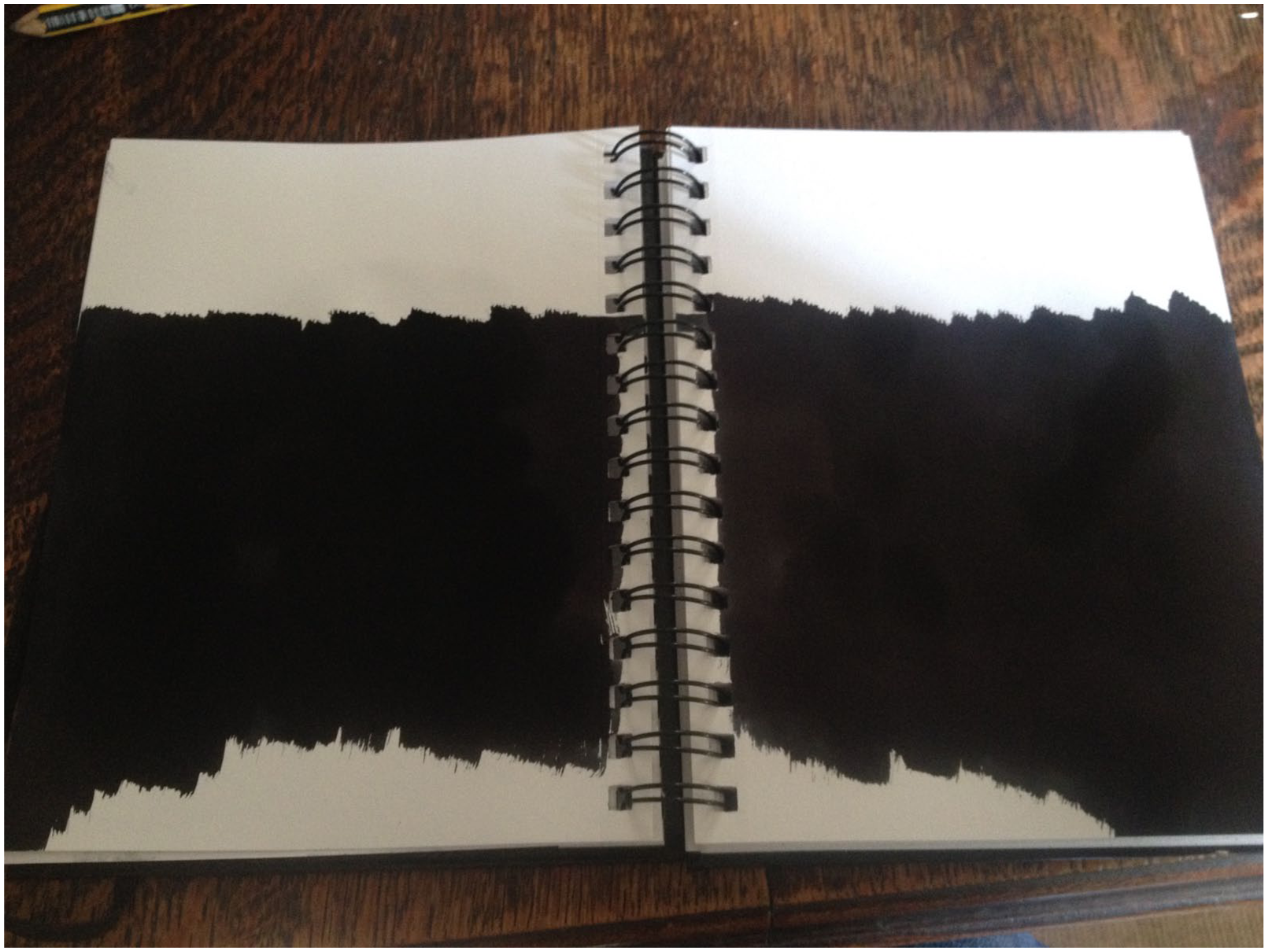
Whilst I drew in a sensitised state, I felt Shirley’s attention and noticed her minute movements, for example, the way her head tosses up and down when trains go past and people come by. I was beginning to feel the sense of attunement that comes from relaxing into a form of drawing that has no agenda, other than doing drawing with her. I was returning to my ‘ability to sense and respond’ and Shirley, it seemed to me, became more attentive and responsive to me in return (Figure 5). 79
Ink drawing of Shirley. Photo by Harriet Smith.
Through finding a way round my encoded and embodied conceptions, I was learning to draw in a way that enabled me to become more attentive and attuned to Shirley. Both the difficulties and the moments of immersion that occurred during the sessions at the tiger enclosure at the city farm were steps that Deleuze and Guattari term a line of flight, as a way towards becoming animal. 80
I had succeeded in becoming sensitised to Shirley through the affective force that pushes through as becoming, as a desire that loosens one away from the fixity of one’s own being. Through responding to Shirley, and through allowing play and openness into the drawing practice, tactile cues (her breath, her muscles and her vital rhythm), signalled in how I experienced her cow-body, sensitised me to a different, larger, sense of her as a cow- being. But just as drawing the tiger had imposed an understanding of my embodied anthropomorphic strategies, attuning to Shirley in this way involved sensing her distress. Now I understood how living next to the trains disturbed her. I had not previously noticed how her body moved in relation to these everyday sounds. I began to pay her closer attention and to advocate with the farm staff for Shirley to have a better life situation, perhaps moving to a herd, or a larger enclosure (Figure 6).
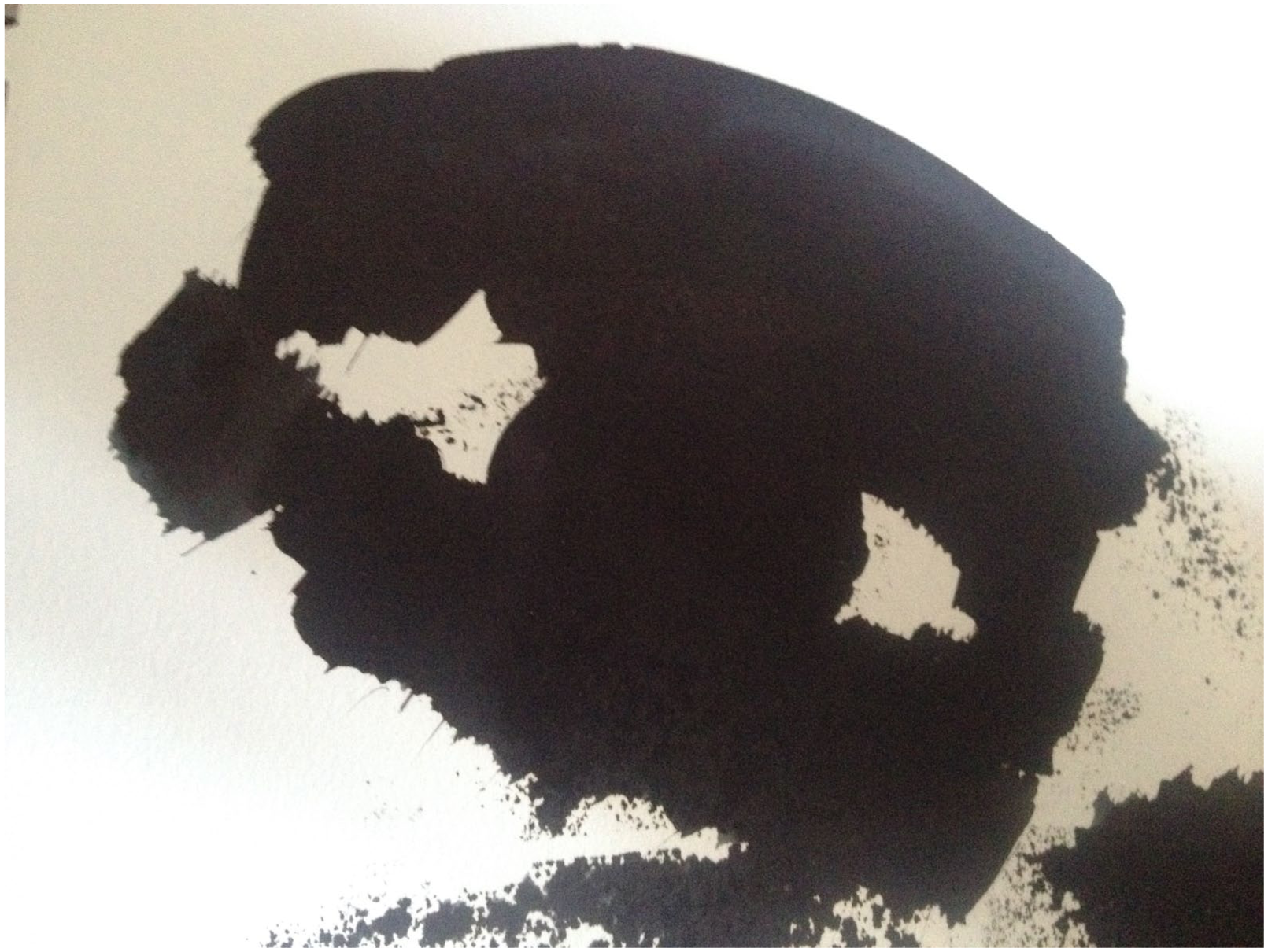
Ink drawing: feeling Shirley. Photo by Harriet Smith.
Concluding comments
The aim of this telling has been to show that drawing is a research method that sensitises and deconstructs both the research and the researcher. The first vignette revealed a crisis in drawing, demonstrating how representational strategies are embodied. Further the drawing illuminated humanist expectations in terms of figuration, whilst at the same time offering insight into posthuman attention to creative process, understood as forms of becoming. Although drawing at the zoo achieved immersion to a point where the weight and visceral impact of the cultural coding of the zoo atmosphere increased, it remained a challenge to pay due attention to the emplaced tigers.
The second vignette took place at the city farm, which was a much calmer, and less tightly curated setting. Here the capacity of drawing as becoming emerged through seeing and representing Shirley the cow with a posthuman sensibility of body without image. The value of this kind of drawing for geography is to support moves away from humanist knowledge making methodologies that limit research to anthropocentric regimes.
Drawing representations of other animals involves types of anthropomorphism that at times result in erasure of the animal subject, but that also may enact as visceral forms of at least coming to know the spaces between self and knowing an other. Attentive drawing can foreground the gap between species, producing sensory engagement with not knowing and in doing so provoke an undoing of the normative anthropocentric lenses and embodied ways of encountering subjects during research.
Following a feminist methodology understood as a research assemblage constructed a working framework that brought together theory, reflection, practice and analysis as toggling and processual states. So the vignettes above were part of a broader research assemblage that also accumulated data through more accepted ethnographic and participatory methods. Although this paper has only alluded to the original research, the drawings detailed here were a central navigational force. The practice of drawing as becoming was valuable in that it physically demonstrated and attended to the problems of the human and the nonhuman animal in relation to seeing and representation. The drawing practice succeeded in moving the research assemblage from representational knowledge making to a loser destabilised involvement with the other, and at times becoming animal.
Through developing awareness of the embeddedness of anthropocentrism, ethical dimensions emerged as argued by Crary and Gruen’s politics of sight. 81 The research illuminates the likely experiences visitors may have at organised nature places such as the zoo and the city farm raising questions about how people encounter the more-than-human world within such coded environments.
Taking this process forward invites the opportunity to explore the more-than-human world through registers that open up reductive constructs of the external world. Moreover, I have shown that drawing is one way to become sensitised not only to the environments of others, but also to hear and see one’s own (at least some) inner processes active in the making of knowledge.
Footnotes
Ethics statement
The field research discussed in this paper involved observing zoo tigers and a city farm cow. None of the animals were put at risk or asked to do anything different to their everyday life practices. I was accompanied by my daughter and a friend whilst drawing the tigers and have included a drawing by my daughter with her permission and following her request to remain anonymous. Ethics protocols from Goldsmiths College were followed at all times.
Funding
The author received no financial support for the research, authorship, and/or publication of this article.
