




Abstract
Over the past two decades, cultural geographers have been paying increasing attention to the performative, habitual, affective and atmospheric qualities of nations, nationalist movements and national identities. In this paper I utilise the concept of the refrain (ritournelle) from the writings of Gilles Deleuze and Fèlix Guattari to trace the very different rhythmic refrains and movements which may or may not gain a certain consistency in the world and affect bodies of different kinds. Refrains may be material, embodied and/or vibrational perturbations which attain a certain rhythm and consistency, and I examine how they are central to the processes of individuation and collective individuation by which nations, national subjects and national identities become crystallised and unfold. In the latter part of the paper I draw upon archival research on the Festival of Britain 1951 to argue that it can usefully be approached through the refrain. In contrast to accounts which present the Festival as a largely London affair which positioned Welsh, Scottish and Irish narratives as reflective of the regional diversity of Britain, I reveal the different responses of Welsh individuals and organisations to the idea of a Festival of Britain. I trace the importance of the Welsh language in setting a different tone or refrain for national events, and I examine how a range of material infrastructures, one-off staged events, and celebrations functioned as refrains of Welshness and/or Britishness. The paper outlines the reactions of Welsh nationalists and republicans for whom British refrains were seen as negative affective forces that would continue to subordinate Wales under a nation-state ruled from England (and specifically London).
Introduction
. . . institutional, habitual and synchronic temporalities all contribute to what, following [Henri] Lefebvre . . ., we might call national rhythms, replete with refrains, variations of tempo, pace and pulse, and produced by a legal, bureaucratic framework, a multitude of shared conventions and habits, and the shared narratives and representations which circulate throughout quotidian life, in the media and in convivial talk. These rhythms are folded into national space in the practice of everyday life.
1
Over the past 10 to 20 years, scholars have been paying increasing attention to the dynamic, processual, performative, habitual and affective practices associated with nations, nationalist movements and national identities. Studies have highlighted the different cultural practices entailed in the performance of nations and national identities,
2
the affective and atmospheric qualities of national moods, feelings, infrastructures and events,
3
and the everyday habits, routines and rhythms which are central to the constitution, apprehension, reshaping and contestation of nations and nationhood.
4
Particular attention has been paid to the ‘affective atmospheres of nationalism’
5
and the constitution of ‘national atmospheres’.
6
This work builds upon two decades of geographical writings which draw upon Deleuzian and Spinozan understandings of affect as ‘a prepersonal intensity’,
7
where affects circulate between and may relate to or be apprehended by bodies of different kinds. Bodies are, here, understood in a Deleuzian-Spinozan sense: A body is not defined by the form that determines it nor as a determinate substance or subject nor by the organs it possesses or the functions it fulfills [sic.]. On the plane of consistency, a body is defined only by a longitude and a latitude: in other words the sum total of the material elements belonging to it under given relations of movement and rest, speed and slowness (longitude); the sum total of the intensive affects it is capable of at a given power or degree of potential (latitude). Nothing but affects and local movements, differential speeds.
8
Bodies of various kinds (human, nonhuman, virtual, actual, material, imagined, hybrid) are deemed to be in process and subject to forces of individuation which may be apprehended and identified as individual subjects and things, or as more complex haecceities. 9 It is this ‘pre-personal’ understanding of affect, its apparent abstraction from specific human bodies, and its separation from bodily expressions of emotions, which has drawn particular criticism. In the mid-2000s, a few scholars remarked upon the emergence of an opposition between studies of affect (often undertaken by men) which privileged seemingly universal, unmarked pre-personal ‘bodies’ and scholarship on emotions grounded in psychoanalysis, feminism, queer theory or critical race theory and focussed on the ‘racialized, gendered and sexualised markedness’ of different bodies. 10 The danger is that affect theories and approaches in feminism and critical race theory are constructed as incompatible, overlooking work which traverses these two domains of thinking. 11 Indeed, some of the most influential research integrates thinking on both affect and emotions, including Ben Anderson’s ‘pragmatic-contextual’ understanding of the relations between affect and emotion, 12 and Sara Ahmed’s incorporation of ‘bodily processes of affecting and being affected’ into her theory of emotions. 13 This synthetic approach is apparent in Angharad Closs Stephens’ writings on national affects, atmospheres and emotions, providing instructive lessons for scholars seeking to apprehend and analyse the cultural and political processes by which nations are ‘anchored in structures of feeling’ and gain an ‘affective force’. 14 As with scholars such as Edensor and McCormack, Closs Stephens advances the idea that national communities can be produced through rhythmic, repetitive and performative processes, including the repetition of ‘images and songs’. 15 In a number of places, she notes the occurrence of repeating refrains, as well as highlighting the political importance of ‘loosening the possibility of resistance from that figure of the active agent and instead looking for dispersed, less spectacular efforts at altering the refrains’. 16 Despite the reoccurrence of the concept of the refrain in a number of places in her book National Affects, it remains theoretically undeveloped.
In this paper I focus attention on Deleuze and Guattari’s concept of the ritournelle (or refrain), 17 building upon the few studies which hint at its usefulness for understanding the heterogeneous processes through which nations and feelings of nationhood and national identity emerge, unfold, repeat, transform and dissipate. 18 I suggest that the concept may articulate some of the very different rhythmic and repetitious forces (physical, visual, sonorous, vibrational, molecular, molar, etc.) which may or may not gain a certain consistency and contribute to processes of individuation, territorialisation and deterritorialisation in the world. One advantage of focussing on repetitive refrains is that such an approach de-centres pre-figured individual ‘bodily’ subjects, and does not focus on binary understandings of affective relations between two discrete individuals, or constructivist logics centred around the building and dismantling of singular worlds. While theories of affect and assemblage are sometimes incorporated into neo-structuralist accounts of relations, attachments and socio-spatial ordering, 19 the concept of the refrain focuses primarily on mobile actions, forces and processes, even if these actions and movements are said to gain a certain consistency. In the remainder of the paper I outline how the concept of the ritournelle (or refrain) might be beneficial to scholars of nations, nationalisms and national identities, before using this conceptual lens to understand events organised in Wales as part of the 1951 Festival of Britain.
Nations as refrains
The concept of the ritournelle (translated as ritornello or refrain) first emerges in Félix Guattari’s psychoanalytic practice at La Borde clinic, where he becomes interested in how individuals focus on repetitive, rhythmic refrains as a means of self-assurance and self-comforting.
20
While the concept can serve as a lens for examining the distinct differences between Guattari’s schizoanalysis and the psychoanalytic theories of Freud and Lacan,
21
many of his examples relate to fairly ordinary or mundane, embodied and expressive refrains – such as children’s games and lullabies, bird song and repetitive songs or jingles hummed by adults – which function as minor political acts of deterritorialisation and reterritorialisation. What unites these examples, is a sense of repetition with variation, and of practices which involve a combination of ‘sonorous, gestural, [and] motor’ aspects.
22
In his 1979 monograph The Machinic Unconscious, Guattari positions refrains as ‘concrete machines’ or ‘concrete operators’ which traverse and undercut any neat distinction between ‘material processes and semiotic processes’, and are key to the ongoing, repetitious production of spaces and times as they are lived by assembled actors.
23
A year later, the refrain is further developed by Deleuze and Guattari in A Thousand Plateaus, where the ‘territorial refrain’ becomes key to their theorisation of processes of deterritorialisation and reterritorialisation: The passage of the Refrain. The refrain moves in the direction of the territorial assemblage and lodges itself there or leaves. In a general sense, we call a refrain any aggregate of matters of expression that draws a territory and develops into territorial motifs and landscapes (there are optical, gestural, motor, etc., refrains).
24
Refrains are positioned in an intricate relationship with the concepts of milieu, rhythm, territory and assemblage, where refrains may act as both deterritorialising and reterritorialising forces, for ‘it may be the most deterritorialized component, . . . the refrain, that assures the consistency of the territory’. 25 Refrains are often presented as catalytic or constructive, 26 gaining consistency as ‘territorial assemblages’. For me, though, it is more useful to understand the refrain as being like a ‘glass harmonica’ or ‘prism’. 27 In this sense, refrains generate plural spaces, times, territories and senses of nationhood through reverberating and refractive actions which generate an array of different affects, simultaneously territorialising and deterritorialising, and hence they cannot simply be framed as constructive or destructive.
The heterogeneous and plural, molar and molecular qualities of refrains – which may show up in specific musical sequences, embodied movements, architectural motifs, military manoeuvres, prejudicial slurs, enactments of genocidal state policies (to name a few examples) and generate different affective charges – hint at the multiple actions and practices through which territories may be simultaneously demarcated, effaced and reinscribed by different forces. Given this, it is no surprise that the concept has been seen as useful for understanding nations, nationalist movements and national identities. Writing in The Machinic Unconscious, Guattari suggested that ‘every individual, every group, every nation is . . . “equipped” with a basic range of incantatory refrains’. 28 In A Thousand Plateaus, Deleuze and Guattari even suggest that – or ask whether – refrains might be key to understanding the formation and ‘collective subjectification’ of nations and nation-states. 29 However, their comments on nations and nationalisms remain brief. Deleuze scholars have added a little more, with geographer Arun Saldanha remarking that ‘the concept of refrain is extremely useful for studying the aural components of patriarchy, religion, the state, and nationalism, the most powerful territorializing forces in society’. 30 Building upon Deleuze and Guattari’s warning of ‘the potential fascism of music’, 31 Saldanha remarks that refrains can generate a dangerous nostalgia, as when ‘the romantic territorialization of music onto landscape and nation prepared Europeans for fascism’. 32 As a way forward, Saldanha instead looks to the revolutionary political potential of newer forms of music – underpinned by ‘routes and trajectories instead of roots and spirit’ 33 – to ‘overcome refrains’ and ‘the heaviness national identity lent it, in order to create its own new people’. 34 While Deleuze and Guattari’s discussions of musical refrains take in key ‘national’ composers such as Richard Wagner (Germany), Alban Berg (Austria), Claude Debussy (France) and Robert Schumann (Germany), they also discuss more ordinary or everyday refrains (including renditions of ‘rockabye baby’ and ‘Frère Jacques’) as well as what they term the ‘bad or mediocre refrain, or the bad usage of the refrain’. 35
Scholars of nationalism and national identity have also done much to refocus attention on more everyday and banal performances of national identity, 36 and it is these that take centre-stage in what is probably the most sustained discussion of national refrains to-date, by Derek McCormack in his book Refrains for Moving Bodies. In a short chapter on live radio commentating of Gaelic sports matches, McCormack provides a powerful account of the commentator’s role in ‘semiconducting the refrain of the national event’, capturing an atmosphere and mood, allowing ‘accent to become musical’, inserting sustained pauses and repeating names and phrases. 37 McCormack’s example, here, focuses on the sonic refrain, but throughout the rest of the book he examines their kinaesthetic, material and sonorous dimensions. In doing this, his approach is often quite different to that of Deleuze and Guattari, who remain wedded to the idea that ‘the refrain [is] eminently sonorous’, as ‘sound invades us, impels us, drags us, transpierces us’. 38 Turning to the use of sound by ‘established powers’, they remark that ‘flags can do nothing without trumpets’, 39 a somewhat flippant remark that reminds me of Michael Billig’s observations on the unnoticed, unwaved flag in Banal Nationalism. 40 Indeed, if we were to weave an understanding of the refrain through Billig’s account, then rather than dismiss these ‘unwaved, unsaluted and unnoticed’ flags as Deleuze and Guattari do, 41 we might trace the different material, motor and visual refrains which lend affective force to ‘waved’ and ‘unwaved’ flags, not to mention flags accompanied by the sounds of trumpets. Such an approach would not only need to focus on the functions of different kinds of refrain, but it would also need to take account of the capacities of particular bodies to be affected and animated by those refrains and events, and the affective atmospheres which gather around and circulate in particular events, in particular spaces and times.
As a final consideration, I want to turn to the issue of how refrains may gain a certain consistency, appearing settled, stable, aggregated, familiar and – in the case of material refrains – permanent. In A Thousand Plateaus, refrains are clearly positioned in a theoretical schema that includes milieux, territories, rhythms and assemblages, and we could follow a thinker such as Manuel DeLanda and approach nations and nation-states as assemblages. 42 The danger, I would argue, is that refrains become conceptualised within a rather mechanistic ‘building block’ approach to nations and places which focuses on the construction of singular worlds, rather than foregrounds the politicised processes, forces and movements entailed in the incessant, plural becoming and unbecoming of nations – or, to put it more bluntly, the transversal cultural and political processes of becoming nationalised, renationalised and denationalised. 43 Rather than seeing refrains as constructing or deconstructing ‘territorial assemblages’, I see them as fundamental to the processes of individuation by which nations, national subjects and national identities become crystallised, defracted and unfolded. 44 For me this is important, for while some critics may associate ‘building perspectives’ with a progressive, critical and broadly realist ontology which can narrate the construction of worlds, the question remains, ‘whose worlds are they?’ and whether very different assemblages may be apprehended by other people. Engaging with Deleuze and Guattari’s political ontology of molar and molecular refrains can enable us to trace the unfolding of multiple, plural, resonant worlds populated by a broad array of minor and major subjects/objects-in-becoming.
Wales and the Festival of Britain 1951
In December 1947, Labour’s Deputy Prime Minister Herbert Morrison announced his government’s intention to organise a series of events celebrating Britain’s ‘contribution to civilisation, past, present and future, in the Arts, in science and technology, and in industrial design’ to mark the centenary of the Great Exhibition of 1851. 45 Morrison insisted that the Festival of Britain must include events across the whole of the UK, and this resulted in ‘12 official exhibitions’ and ‘23 official Festivals of the Arts’ being staged across all four nations between May and September 1951, 46 as well as hundreds of locally organised events which received no central funding. 47 While much of the public and press attention and government funding was focussed on London’s South Bank exhibition, 48 two ‘travelling exhibitions’ took condensed versions beyond London: a ‘Land Traveller’ exhibition, which visited Birmingham, Leeds, Manchester and Nottingham; and a repurposed aircraft carrier – Festival Ship Campania – which took a ‘Sea Traveller’ exhibition to Southampton, Dundee, Newcastle, Hull, Plymouth, Bristol, Cardiff, Belfast, Birkenhead and Glasgow. 49 Belfast hosted an official ‘Ulster Farm and Factory exhibition’, Glasgow hosted the exhibition of ‘Industrial Power’, and book exhibitions were held in London, Edinburgh and Glasgow. The ‘official’ events in Wales included one exhibition – the Welsh Hill Farm Scheme at Dolhendre – and four Festivals of Arts, in St Davids, Llangollen, Llanrwst and Swansea.
Refrains of Britishness
Narratives of British history, achievements, identity and ambition were placed at the heart of official accounts of the Festival, and a large number of scholars have approached and interpreted the exhibitions and events through well-established theoretical approaches to nationalism and national identity, focussing on the role of Festival exhibitions, media and events in cultivating a sense of British national community and in representing the British nation.
50
As the organisers of the Festival soon realised, trying to define and represent British national identity was far from easy, and in the case of many ‘English Festival events . . . a discourse of Britishness . . . [was] subsumed within that of Englishness’.
51
In a lecture to the Royal Society of Arts, the Director-General of the Festival, Gerald Barry, explained how the intention had been to ‘project the British contribution to civilization in the realm of the humanities’, but while ‘easy enough to state’ it was ‘far from easy to define’, requiring Festival storytellers to ‘catch and cage’ a ‘spirit and tradition’ that was active and dynamic: These again are not easy to analyze, but some at least of them emerge clearly in the record of our national achievement in the arts, in science, in sociology. Among them are such things as love of country, love of freedom, love of nature, pride in craftsmanship, tolerance and fair-play. These, though abstractions, are recognizable British traits . . . They are not passive conceptions; they express themselves dynamically in the kind of Britain we have built or want to build.
52
Barry was keen to harness, portray and foster what could be characterised as the affective, emotional, performative and atmospheric refrains of Britishness, and it was at the level of locally organised events across ‘the whole nation’ that The Official Book of the Festival of Britain suggested ‘the autobiography of the nation’ would be authored by ‘millions of . . . British people’
53
: As this whole Festival is an act of national autobiography, cities and towns throughout the country are presenting their own account of themselves, of the industries, trades and crafts in which their citizens are employed, their local traditions and entertainments, their practice and appreciation of the arts, their sports and hobbies . . . Many public buildings, roads, parks, recreation grounds will bear the figure “1951” as a witness of the inspiration which this Festival will have given to projects already in progress . . . Every town and village has its annual cycle of local events, those occasions which not only provide entertainment and the opportunity for friendly competition, but are the spontaneous expression of their life and interests . . . The pattern varies from region to region, from county to county, but these occasions are as much a part of the national year as the Lord Mayor’s Show or the Opening of Parliament.
54
‘Over 2000 places’ across the UK were said to have staged a ‘Festival event on their own initiative’ in the Summer of 1951, 55 and the organisers were keen to ensure these included familiar, annual local events badged as Festival events, as well as one-off events based upon ‘spontaneous local enterprise and voluntary effort’. 56 The familiar embodied, material and multi-sensory refrains of the local swimming gala, carnival, village agricultural show, county athletics competition and local Eisteddfodau – organised by a mixture of voluntary organisations, religious institutions and local government authorities – were accompanied by one-off pageants and specially-written local history booklets, as well as more ‘permanent amenities’ such as ‘a new playground for . . . children’, ‘seats put on the green or by the bus stops, trees and gardens planted by voluntary labour’ and ‘a new park laid out’. 57 In official narratives, such ‘local’ and ‘regional’ events and traditions (and the differences they reveal) were positioned as fundamental to British national life and character. 58 However, as a number of Festival of Britain historians have shown, these are refrains of Britishness which include some forms of difference and exclude others, very deliberately marginalising narratives of empire, and explicitly ignoring histories of non-white immigration from colonial or former colonial nations. 59
In official UK-level Festival guides, the constituent nations of the United Kingdom of Great Britain and Northern Ireland are rarely identified as being nations whose residents may not identify – or primarily identify – as British, but as Welsh, Scottish or Irish. The presence of a ‘Welsh committee’, ‘Scottish committee’ and ‘Northern Ireland committee’ seemed to acknowledge that these were not merely ‘regions’ of the UK, like the regions of England, but the authors and editors of official publications were careful not to identify them as nations whose people’s may identify differently, or who may generate alternative refrains and advance counter-narratives to official accounts of Britain and Britishness. Wales is occasionally referred to as a region, country or as a principality in articles or speeches by officials, and the Official Guide to the Festival of Britain even made reference to Cardiff as ‘the Capital of Wales’, 60 just a month or so after the Council for Wales and Monmouthshire had recommended that Cardiff should fulfil this role. 61 In both the Official Guide and the Official Story the distinctive cultural traditions of Wales are presented as examples of the diverse national refrains which make up Britain and Britishness. Culture is divorced from politics, here, and the distinctly nationalist and at times republican politics that was resurgent in Wales at the time of the Festival received no treatment in any official exhibitions. Historians of the Festival of Britain have also paid relatively little attention to both the official exhibitions and official arts festivals that were held in Wales, 62 as well as the significant number of locally organised events. 63
Festive refrains in Wales
Official events in Wales were overseen by a Welsh Committee comprised of men and women from across Wales, as well as the London-Welsh community. The Committee was chaired by Sir Wynn Wheldon and included politicians like Huw Thomas Edwards, Lady Megan Lloyd George and former Cardiff mayor Sir Herbert Hiles, as well as figures representing key institutions such as the National Library of Wales, National Eisteddfod, National Museum, the University Council of Music, the BBC and the Arts Council in Wales. All held prominent positions in Welsh political and cultural life, and at least seven of the eighteen members were fluent Welsh speakers. One member, Reverend Albert Evans-Jones (‘Cynan’) was a noted Welsh poet and Archdruid who was influential in transforming the pageantry of the National Eisteddfod, 64 while Lady Megan Lloyd George was a prominent advocate for self-governance in Wales, leading the Parliament for Wales Campaign from 1950 to 1956. 65 All of the members appeared to have a passion for the history, culture and people of different parts of Wales, demonstrating an intimate understanding of the rhythmic refrains associated with more elite strands of Welsh arts, music and cultural life. Indeed, the Committee’s guidance to Welsh local authorities appears in marked contrast to official British narratives, stressing the importance of ‘our distinctive way of life’ and ‘background of nationality’ in Wales, and the opportunity for local organisers to ‘plan such activities as are appropriate’ to Wales’ ‘character, customs and traditions’. 66 National differences are highlighted by the Welsh Committee, but their willingness to showcase Wales in a Festival of Britain was not to the liking of some nationalists and republicans.
Writing in the Plaid Cymru (Welsh Nationalist Party) newspaper The Welsh Nation in October 1950, the acclaimed Welsh novelist and Plaid member Islwyn Ffowc Elis launched an attack on a committee which should have been comprised of members who had ‘achieved something for Wales as Wales’.
67
The result, for Ffowc Elis, was that the Festival of Britain was simply another tool of British (read ‘English’) oppression: I have the misfortune to be a Welshman “somewhere in Britain”, and the shameless oppression of my country by the London bureaucracy is slowly driving me to the verge of either rebellion or despair. Finally, the fact that Wales is now being reminded that she is a part of the nation of Britain, and that she should show her thanks by doing her best in the show, is merely adding insult to injury.
68
Welsh cultural refrains were being colonised, repackaged or subsumed under a British banner, and The Welsh Republican news-sheet published more fervent criticisms of the Festival, chastising it as a ‘bottomless pit of Cockney rapacity’
69
organised by a man – Herbert Morrison – ‘whose attitude to Wales earns him the title of “Cockney Canute”’.
70
The Welsh Committee’s Lady Megan Lloyd George and Sir Wynn Wheldon also came in for criticism by The Welsh Republican for conspiring with the British/English state. Amidst a lengthy personal attack on Wheldon following his knighthood in 1952, the publication stated: The great part of his life has been spent in the company of the “London Welsh,” whose fidelity to English middle-class interests is unsurpassed. . . . Chairman of the “Welsh Committee” of the “Festival of Britain” celebrations, Wheldon, aided by his worthy son, saw to it that things Welsh were subordinated to the theme of “British unity”.
71
The official actions associated with the Welsh Committee are seen to be controlled by middle-class, middle-aged, London-focussed Welsh men and women who are nepotistic and conspire with the British state and crown. These individuals are seen to establish and perpetuate British national refrains while simultaneously subordinating or marginalising Welsh national refrains which might challenge narratives from London. While these Welsh republicans criticised the Welsh Committee, the London-Welsh community and the Honourable Society of Cymmrodorian for their ‘fidelity to English middle-class interests’, 72 these influential groups consistently emphasised the cultural difference of Wales within Britain, while also ensuring that Welsh cultural performances featured in London during the Summer of 1951. Indeed, Wales’ only commissioned Festival film – David (1951) – was shown on 43 occasions at the South Bank Cinema in London, while on 19th May, the London Welsh Association sponsored a major concert at the Royal Festival Hall, including the newly formed Welsh Festival Choir, supported by the London Philharmonic Orchestra. 73 Through the significant efforts of prominent Welsh men and women, minor Welsh refrains resonated at the heart of the South Bank, acting to deterritorialise the Britishness of the event, if only for a short while. BBC Radio and Television programmes also brought Wales and Welsh refrains into the homes of the British public. Radio broadcasts covering events at St Fagans, Dolhendre, St Davids, Swansea, Llangollen, Cardiff and Llanrwst were broadcast nationwide, while a four-part BBC television documentary for the Festival – titled ‘We in Britain’ – included shots of Black children playing and ‘restaurants with foreign names’ from the Tiger Bay area of Cardiff Docks as evidence of maritime links and ‘Imperial contraction’, with commentator Clifford Dyment remarking that ‘the British . . . have a capacity for assimilating strangers’. Imperial refrains, Black refrains and the multicultural refrains of ‘West Indians, Africans, Chinese, Italians, Malays, Lascars and the refugees of the world’ are presented as progressive, if foreign, presences in Wales and Britain. 74
Despite criticisms from some nationalist political and cultural figures, the Festival’s Welsh Committee worked in cooperation with local authorities and many Welsh cultural organisations (including many Welsh-language institutions). The National Eisteddfod, Llangollen International Eisteddfod and Swansea Festival of Music were all recognised as official Arts Festivals, while a new Festival of Music and Worship at St. Davids was put on at the Cathedral by the Church in Wales. The Welsh Committee’s representative from the University Council of Music, J. Morgan Nicholas, established a Welsh Festival of Britain Choir with over 180 members who performed across Wales. The Welsh Folk Museum at St. Fagans, near Cardiff, organised a festival of Welsh folk songs, plays, folk dancing and lecture-recitals, including a staging of ‘Blodeuwedd’ by the Welsh poet, playwright and former President of Plaid Cymru Saunders Lewis, and talks by prominent Welsh academics on ‘The Welsh language’, ‘Welsh literature’, ‘Welsh History’ and ‘the Welsh society and the Welsh way’. 75 In the 1940s and 1950s, the museum was pioneering in its presentation of folk cultural life in Britain, being led by the Welsh nationalist and internationally-renowned folklorist Dr Iorwerth Peate. Here were familiar Welsh folk-cultural refrains – relating to the rhythmic, repetitive embodied movements of dancing, acting and public-speaking – being staged for the museum’s visitors, but Peate made no attempt to celebrate Britain or Britishness, focussing squarely on Welsh history, language, culture, music and crafts.
More surprising was the projection of explicitly Welsh nationalist refrains in the two official ‘About Britain’ guide books on South Wales and the Marches and North Wales and the Marches, 76 which were commissioned by the Festival of Britain’s ‘Tours Advisory Committee’ in the hope of encouraging domestic and foreign tourists to travel around Britain and spend money in Festival year. 77 When the Tours committee suggested an Englishman – writer and naturalist John C. Moore – to write the volumes, the Welsh Committee insisted that a Welsh author or authors must be employed, proposing instead the prominent Welsh historian, poet and Chairman of the National Eisteddfod council, Professor W.J. Gruffydd. 78 Gruffydd’s guides were underpinned by ‘steering scripts’ commissioned from experts in archaeology, geography, natural history, town planning and industrial development, but it is a series of written refrains about the Welsh language, history and culture which shine through in the books.
Gruffydd’s refrains of historical interpretation and narration – articulating a minor Welsh perspective rather than a majoritarian English or British perspective – included accounts of English invasions, immigration and political influence in Wales, the impacts of increasing anglicisation upon the Welsh language, and recent developments which had negatively impacted upon the Welsh landscape and its people – including afforestation plans, hydroelectric schemes and reservoirs constructed for the benefit of English local authorities. 79 While many Festival officials saw the English language as a key ‘instrument for asserting a singular, cohesive British identity’ 80 – ignoring the presence of other languages spoken by the nation’s citizens – Gruffydd’s guide books, as well as official Arts festivals such as the Royal National Eisteddfod, complicated the story, placing the Welsh language centre-stage, generating and proliferating refrains in a different language, tone and key, with a very different ‘national’ framing. Indeed, Gruffydd – in his role as Chair of the Eisteddfod council – was one of the key architects of ‘the all-Welsh Eisteddfod at Llanrwst’, which being in ‘the very year of the Festival of Britain . . . roused the Anglicizers of Wales to resort to a last desperate expedient – the parrot-cry of “politics”’. 81 Welsh language refrains could be experienced as part of a Festival of Britain, and they were positioned by some observers as the key differentiator between Welsh and English cultural life, and as an inalienable sanctuary from English influence. With Gruffydd’s ‘all-Welsh’ eisteddfod rules, Welsh language refrains are interpreted by critics as being political as well as cultural.
The kinaesthetic, sonic, embodied, choreographed, creative refrains of musical performances, dance and sports matches formed a key strand of the hundreds of events put on by local Festival organising committees, which ranged from eisteddfodau to young farmers’ rallies. An analysis of the official Festival Calendar for Wales reveals that horticultural and agricultural shows were the most frequent events to be organised by local committees, the majority of which (if not all) would have been familiar annual events (see Figures 1 and 2). 82 By including popular pre-existing annual local events in the programme, local organising committees could harness the personnel, material infrastructures and public interest to stage what were likely to be successful Festival events, with the hope that the affective refrains of familiar local materials, cultural spaces and performances might have national resonances, whether Welsh, British or both. Of course, the ‘national’ resonances of such refrains would have invariably depended on the capacity of particular individuals to become affected, as well as the capacity of particular refrains to gain consistency and become territorialised. Welsh language events – eisteddfodau, historical pageants and cymanfaoedd canu (singing competitions) – were held across Wales, with the acclaimed poet, Archdruid and Welsh Committee member ‘Cynan’ penning a bilingual pageant about Anglesey, titled Pasiant Môn Mam Cymru. 83
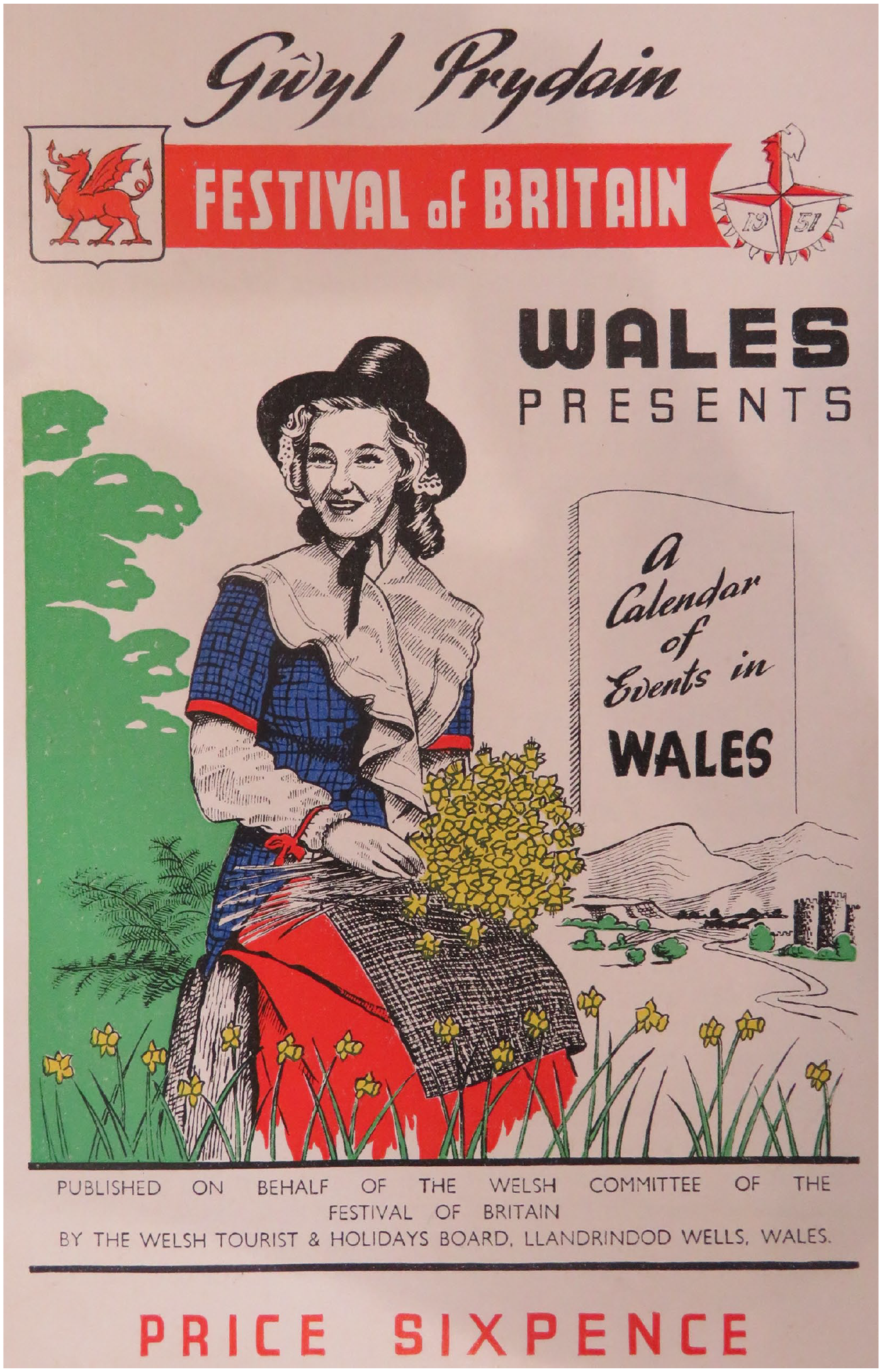
Cover to ‘Festival of Britain. Wales Presents. A Calendar of Events in Wales’, published on behalf of the Welsh Committee of the Festival of Britain by the Welsh Tourist and Holidays Board, 1951. Author’s Collection.
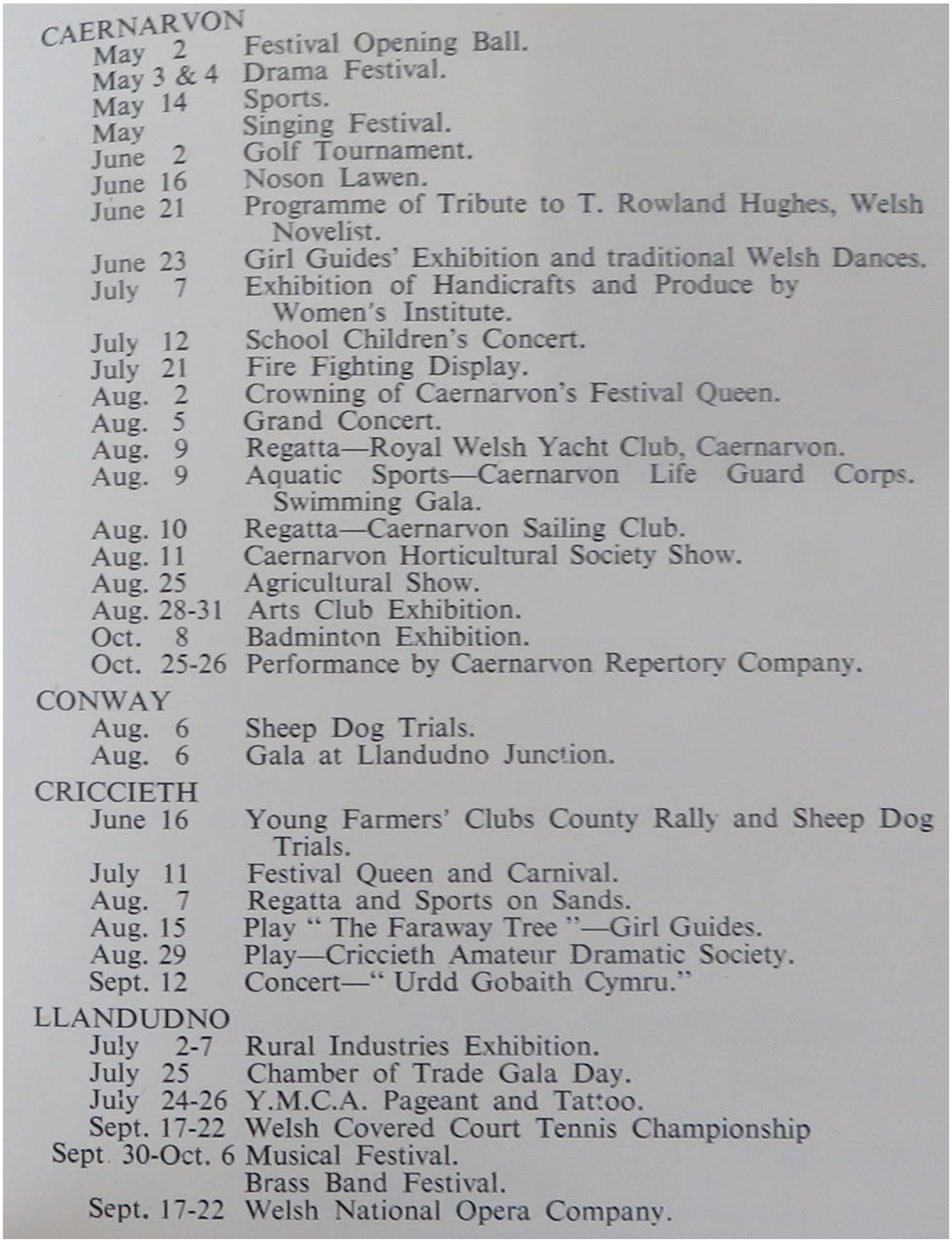
Events held in Caernarfon, Conwy, Criccieth and Llandudno, from ‘Festival of Britain. Wales Presents. A Calendar of Events in Wales’, published on behalf of the Welsh Committee of the Festival of Britain by the Welsh Tourist and Holidays Board, 1951, p. 17. Author’s Collection.
The Welsh Committee, like the London-based Festival Executive and Council, were keen that ‘1951 should leave a permanent mark on places great and small’, something reiterated by Gerald Barry when he attended a Welsh Committee meeting in Cardiff on 22nd October 1948. 84 Minor ‘permanent’ memorials that would act as consistent material reminders of the Festival were proposed by many local authorities, while a few permanent buildings emerged around Wales – although nothing on the scale of the South Bank. It would, of course, be easy to read such structural ‘installations’ as static material traces of the Festival, but my preference is to treat them as material-architectural refrains which are not static, stable or permanent, but become tied into affective relations with embodied subjects of different kinds – resonating, repeating, differentiating. In Cardiff, the City Council built the steel-framed Sophia Gardens Pavilion as their key permanent contribution to Wales for Festival year. The Pavilion hosted a number of events in 1951, including a Land of My Fathers ‘national’ pageant, the 1951 Welsh Industries Fair, and a series of concerts, 85 and it would go on to host a large number of exhibitions, conventions, sports matches and pop concerts until the collapse of its roof under heavy snow in 1982. 86
The ongoing use of these architectural environments points to how the material-embodied refrains of inhabitation resonate both locally and nationally, in fairly ordinary and extraordinary ways. Welsh Committee funds were allocated to the Welsh Folk Museum, via the Ministry of Works, to enable the relocation of a series of historic buildings from Breconshire, Flintshire and Gower to St Fagans, which were accompanied by Festival of Britain signs until the 1970s. 87 Another notable, permanent architectural contribution of the Festival’s Welsh Committee was what became the only official ‘national’ Exhibition in Wales, the Dolhendre Hill Farm Scheme near Llanuwchlyn in Meirionnydd, which appears to have been a late addition to the ‘official’ programme. Its inclusion was proposed by Dr Llewelyn Wyn Griffith who was serving on a committee managing the 39,000 acre estate of the late Sir Herbert Watkin Williams-Wynn after it was transferred to the government in lieu of death duties in 1946. Griffith had been inspired by the proposals for a ‘live architecture’ exhibition at Poplar in East London, 88 suggesting that an area of the Glanllyn Estate could be selected to demonstrate how farms might be modernised in the future, forming ‘an integral part of the Festival of Britain 1951, capable of attracting the attention of all who are interested in rural life’. 89 The Dolhendre Scheme was intended to serve as a live demonstration of the future of Welsh hill-farming, farm house design and afforestation practices. 90 Modern farm buildings would support modern farming practices, generating material-embodied refrains which could ensure a progressive future for rural Wales.
The 1951 Festival of Britain was planned and choreographed by a vast number of actors based in many different institutions and places, and a mixture of British, Welsh and local refrains reverberated through the events of the year, taking many forms and affecting people in different ways. Transitory material refrains, choreographed embodied performances, well-established Eisteddfod ceremonies, fluttering Welsh flags and Union Jacks, poetry recitals, BBC broadcasts, local newspaper articles, bilingual historical pageants, local cricket matches and guide books underpinned by warnings about threats to the Welsh landscape and people, would have affected Festival attendees and non-attendees in different ways. These events were not assembled or staged as static symbols of Festival year. Rather, they would have been caught in an array of affective relations with local people and visiting tourists, generating an incalculable number of circulating refrains and atmospheres with very different national associations and resonances.
Conclusions
nationalism remains a culturally specific, limited and violent way of seeing and organizing the world around us.
91
Writing in National Affects, Angharad Closs Stephens reminds us of the violent consequences of nationalist movements, ideologies and cultural-political practices as they unfold around us. National identities and nationalist movements are frequently grounded in exclusionary (as well as inclusionary) rhetorics which define external threats and undesirable others, as well as being closely aligned with seemingly banal and benign cultural practices and refrains. For sub-state movements, and nations under imperial rule and subjugation, nationalist resistance and revolutionary actions have been ideologically grounded in very different ways, inspiring cultural movements and peaceful transitions of power, as well as violent genocide (and everything in between). Welsh nationalism and patriotism have largely been non-violent, and rather than label all nationalist movements as exclusionary, it is important to consider how nationalist ideologies and national identities can also be figured in more open, inclusive and plural ways. While nations can serve as useful scales for forging collective affiliations and establishing cultural institutions, ‘national’ actors in Wales and elsewhere have often tried to forge a more open and progressive ‘global sense of the nation’ which is similar to that envisaged by Doreen Massey: If space is a product of practices, trajectories, interrelations, if we make space through interactions at all levels, from the (so-called) local to the (so- called) global, then those spatial identities such as places, regions, nations, and the local and the global, must be forged in this relational way too, as internally complex, essentially unboundable in any absolute sense, and inevitably historically changing.
92
Massey’s more open, progressive and plural approach to place-making highlights why we should not simply approach places or nations in static, closed, polarised, binary or oppositional terms, for the relational and plural performance of nations, nationalist movements and national identities are cross-cut by a vast array of plural refrains with varying capacities to affect bodies, territorialise, gain consistency and deterritorialise. During the Festival of Britain in 1951, an intricate array of minor/molecular and molar/majoritarian national refrains were generated, circulated and cross-cut one another as a result of very particular embodied practices, material movements, sonorous vibrations and more-or-less familiar visual spectacles – giving rise to different understandings of Welshness, Britishness and their entangled relations, separation and co-dependence.
Footnotes
Acknowledgements
I would like to thank colleagues from the Department of Geography and Earth Sciences at Aberystwyth University for their feedback on material from this paper which was presented at a research seminar in early February 2025.
Ethics statement
This study draws upon an analysis of publicly available archival records held in the National Archives of the UK (Kew), National Library of Wales (Aberystwyth), and BBC Written Archives Centre (Caversham). All materials are referenced according to those institutions’ access guidelines and in line with standard conventions.
Declaration of conflicting interests
The author declared the following potential conflicts of interest with respect to the research, authorship, and/or publication of this article: I am a member of the Editorial Board of ‘cultural geographies’.
Funding
The author received no financial support for the research, authorship, and/or publication of this article.
