




Abstract
Clootie Ribbons was commissioned for the Art Park Gallery on Rhodes, Greece in 2021. The text is both an elegy for and invocation of ‘lost’ deer, curated from lines in poems that cross centuries and continents. As a series of typed ‘wishing ribbons’, the work is designed to be tied into a tree so that branches, leaves and ribbons form a collaborative ecopoetic installation. In my creative practice research, I analyse poetries and visual representations of deer and make poetic works that seek to question human attitudes towards them. Every year, hundreds of thousands of deer are killed in the UK alone through culling and road traffic accidents. In the US, deer have been culled in their millions. While some deer species are currently endangered, burgeoning populations of others are frequently cast as a problem for conservation. Poetry has long formed part of memorial culture and this article reflects on Clootie Ribbons as an ecopoetic memorial situated in the sixth mass extinction and biocultural context of Rhodes. Drawing on Anna Tsing’s term, I consider this material work as a form of ‘polyphonic assemblage’ that raises questions about which nonhuman lives are valued. I extend the interest and possibilities of ecopoetry to mark ongoing ecological losses.
Introduction
In 2021, I was commissioned to create a poetic installation for the Text-Isles group show at the Art Park Gallery in Rhodes, Greece. This was during a time of continuing national lockdowns in the UK and travel restrictions due to Covid-19. My engagement with the place of the installation, near the village of Archipoli in the central north of the island, was necessarily remote and indirect: through conversations, digitally shared photographs and website articles.
In my creative practice research, I have been analysing poetries and visual representations of deer, and making poetic works that seek to question and challenge human attitudes towards and treatment of other beings. Rhodes is known for its long-established population of Dama dama or fallow deer, known locally as platoni, and I was interested in creating a piece that would bring textiles and deer together with the site of the gallery and its ecologies, in a time of precarity. Rather than ‘moments of direct encounter’, my interactions with deer would be through ‘a sensitivity to the traces they left’: in this case, literary traces in the works of human poets. 1
The resulting work, Clootie Ribbons [Rhodes Edition], is both an elegy for and an invocation of deer who have been ‘lost’: through hunting, culling, illness, road traffic accidents and habitat destruction. It consists of 25 linen ‘wishing ribbons’, designed to be tied into a tree (see Figure 1). At the Art Park Gallery, they were knotted into a large olive tree near the entrance; visitors could handle and read the ribbons in any order. The textual element is a collage poem that I curated from phrases in the works of many poets across continents and centuries. For instance, the installation’s starting point – ‘a song to call the deer’ – is a fragment from Joy Harjo’s ‘Song for Myself and the Deer to Return On’. 2 When the words are typed on to the 60-centimetre ribbons, the end of each poem line is dictated by the number of characters that will fit (see Figures 2 and 3). This means that some phrases are split randomly, and some words hyphenated. A central gap – or line break – allows for each length of linen to be tied on to a branch (see Figure 5).
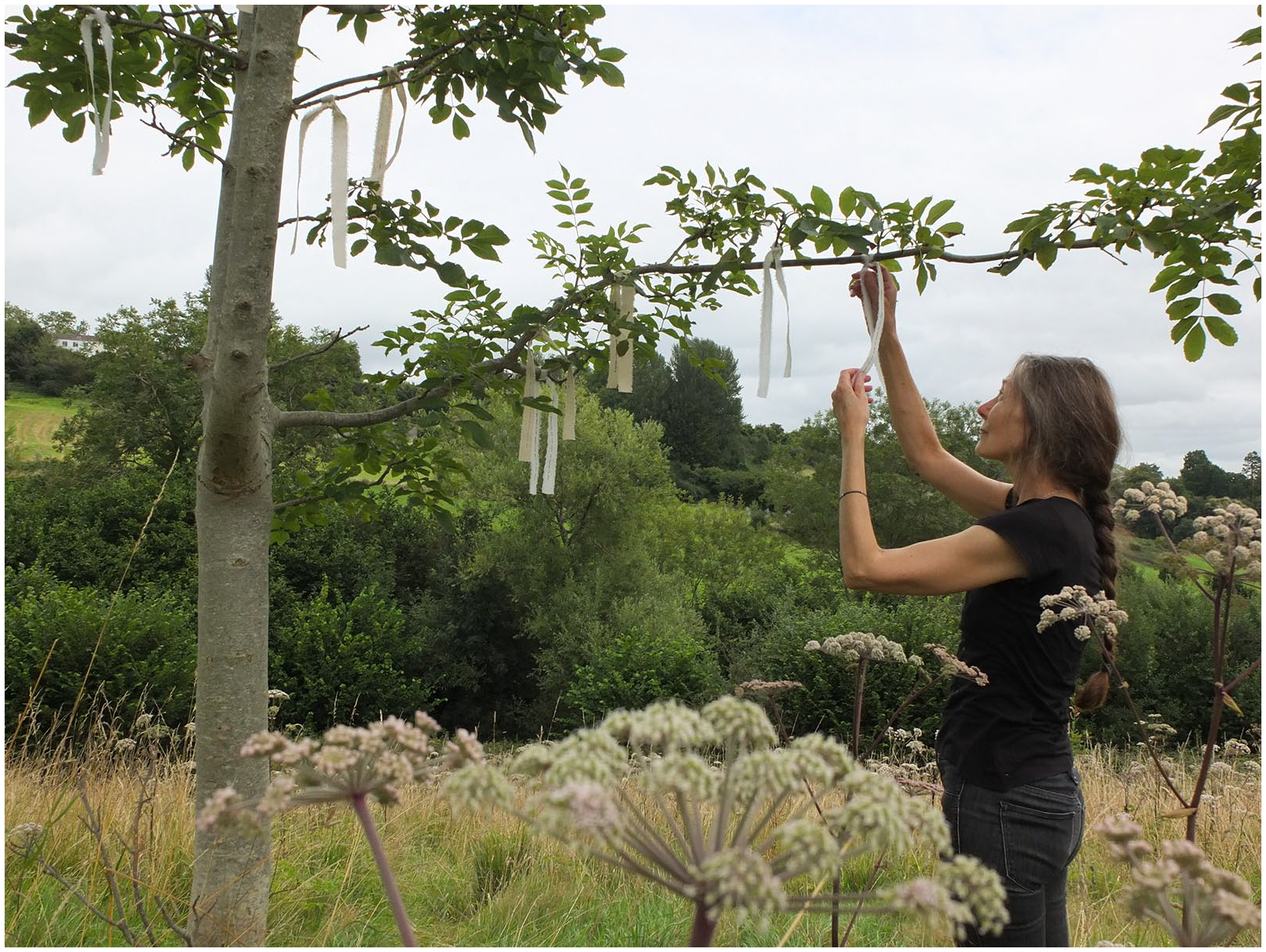
The author tying prototype ribbons into an ash tree. Photograph by Ethan Wilson.

The first two lines of the Clootie Ribbons text, showing how the phrase breaks to allow equal length lines. Text by Caroline Harris.
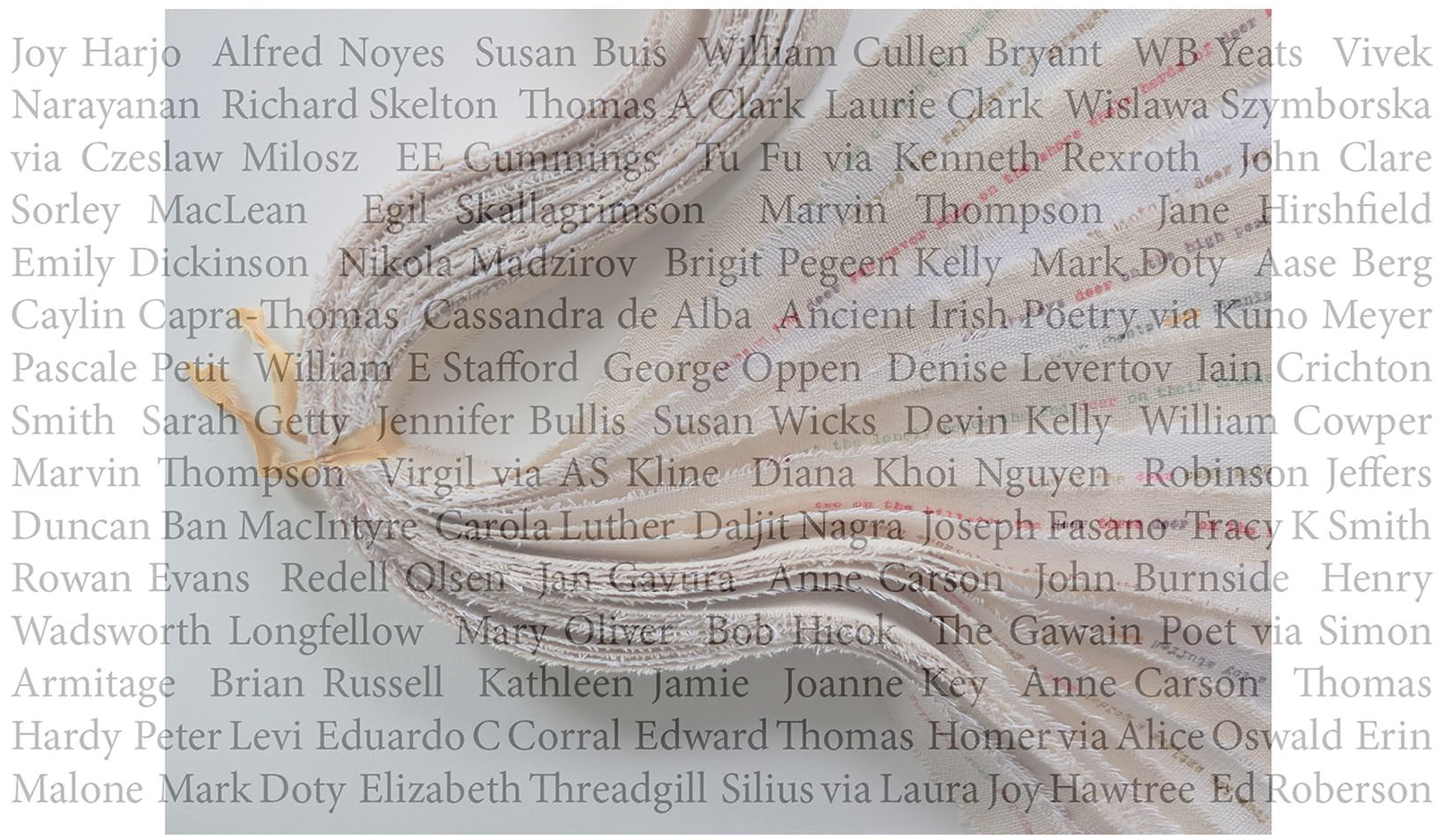
Still from a performance film showing names of the poets whose words are curated in the poem text. Photograph by Caroline Harris.
This reflection on my poetic practice first considers some of the complexities in marking the losses of creatures simultaneously valued and seen as problematic in terms of biodiversity loss and extinction threat to other beings. It then explores Clootie Ribbons as memorial and speculation set within the biocultural context of Rhodes, and, drawing on Anna Tsing’s term, considers this material work as a ‘polyphonic assemblage’. 3 In recent years, ‘geopoetics’ has become an established practice in creative geographies, and ecopoetry recognised as a distinct literary genre. 4 This project draws from and extends emerging trends in sculptural ecopoetry and aims to inform the memorial cultures of loss and extinction, adding innovative material poetics to established and traditional methods such as photography, drawing, sculpture, storytelling and museum practices. 5
The liminality and killability of deer
The rich and complex histories of deer have been entangled with those of humans for at least 30,000 years and possibly for as long as 1.8 million years (Figure 4). 6 For humans, they have been food, clothing, symbol, god and totem. Some deer species, such as the Florida Key deer in the US, are endangered, while Schomburgk’s deer in Thailand became extinct due to industrial rice production. 7 As a transported and ‘invasive’ species, deer are implicated in the damages of settler colonialism. Burgeoning deer populations from North America and Europe to Tasmania are widely cited as having a negative impact on biodiversity and native species, forest regeneration and, with the increasing incidence of Lyme disease, human health. 8

A couplet from the Clootie Ribbons text. Text by Caroline Harris.
The position of deer is liminal, their valuation often paradoxical and certainly unstable. Creative practice offers a way to explore some of these complexities in an open-ended way. Deer have been enclosed in parks (especially in the UK and Europe) but not domesticated. They are simultaneously prized and killable; seen today as both elusive and overabundant. While a stag may be revered as regal and sublime, as in Edwin Landseer’s ‘Monarch of the Glen’ (c. 1851), it is also the quarry of the hunt, its value transformed once killed into that of inanimate trophy. Fawns may be cooed over as cute ‘Bambis’, but culling of deer has become a norm in the UK and elsewhere, including the US, Ireland and Japan. 9 Around 350,000 deer are culled annually in the UK and each year they are involved in up to 74,000 traffic collisions. 10 Critical animal geographies question the hierarchies that make some creatures more killable than others and highlight how ‘the terrain of killability is dynamic and contested’. 11 Clootie Ribbons aims to question the (lack of) valuation of nonhuman lives by memorialising losses that might otherwise be unmarked and unremarkable (Figure 5).
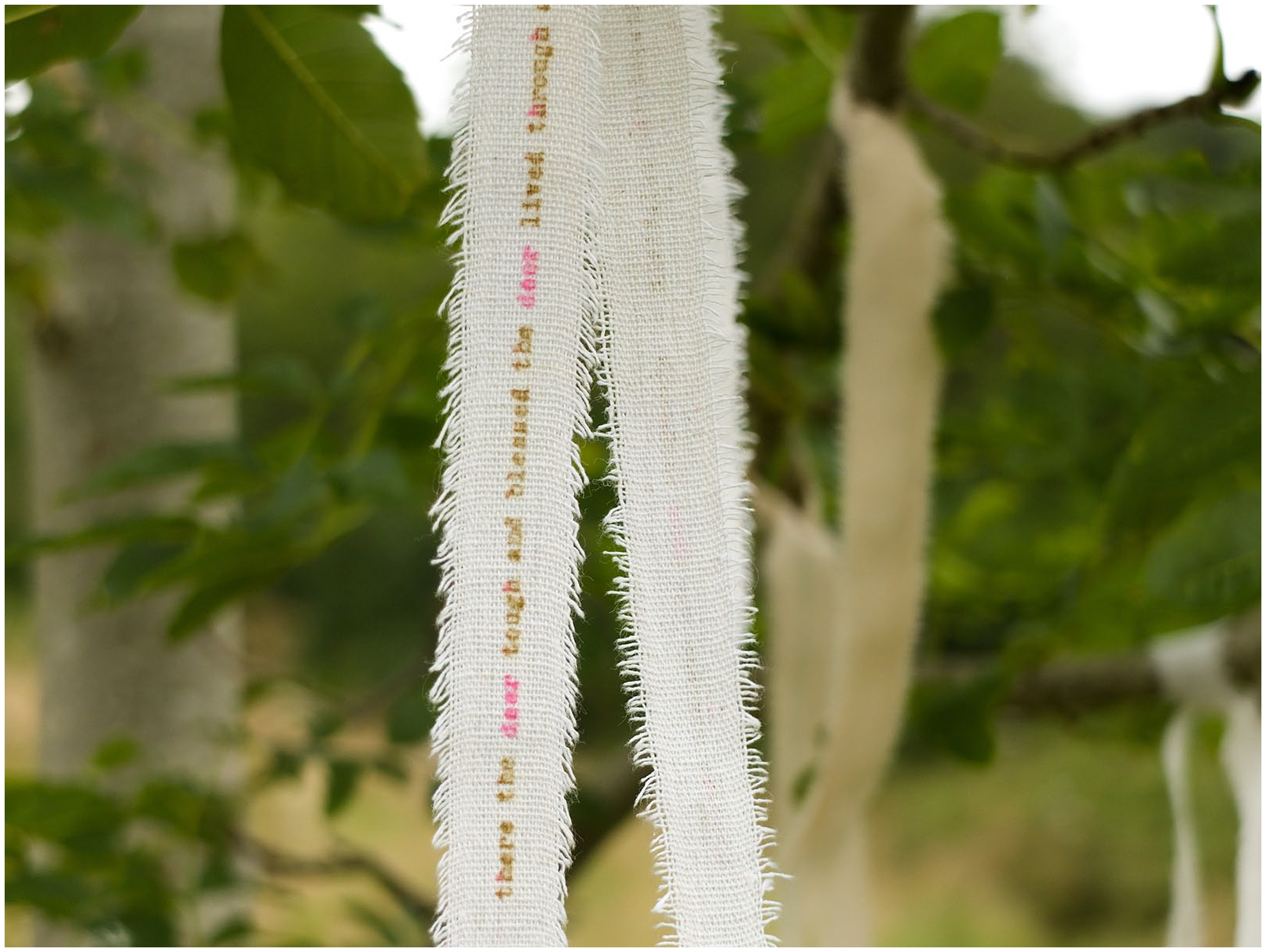
The lines from Figure 4 as they appear typed on the ribbons. Photograph by Ethan Wilson.
Poetry as memorial and post-extinction speculation
There is a long history of poetry as memorial. Homer’s Iliad, for example, lists soldiers who fell in the battle of Troy. Contemporary poet Alice Oswald’s Memorial intercuts interpretations of Homer’s character sketches with translations of the epic’s similes of rural life. 12 Many of these describe the deaths of nonhuman beings, as when a wounded doe runs through the hills, ‘To the very breaking of her being’, but these are often read, both in Homer and by Oswald, as pastoral ‘pauses’ in the human bloodshed. 13
Companion animals and endlings – the last of their species – may be given names and even accorded celebrity status, like Martha the Passenger Pigeon or Lonesome George the Galapagos tortoise (memorialised in a poem by Isabel Galleymore). 14 However, such recognition is less frequently accorded to nonhumans who are more numerous. The text that is typed on to the Clootie Ribbons lists deer who may or may not have existed outside the poems that contain them: ‘the bustling deer the lightheaded deer the highland deer’; ‘a deer dead on the edge of the Wilson River Road’. Though unnamed, most are characterised by an attached adjective or phrase. The poem could be seen as subverting the usual litanies of remembrance by according this treatment to individual nonhumans, rather than acting on the species level. 15
Where the first half of the Clootie Ribbons poem is elegy, the latter part is an invocation: a calling-back or calling-into-being (Figures 6). The lines in this part of the poem could be read as a wish for these deer not to have died, or for an increasing abundance of deer. The sheer numbers of (literary) deer in the poem – ‘always a deer breaking from a thicket the deer came spinning’ – are potentially threatening. The lines shown in Figure 6 could even suggest a planet where deer, not humans, are dominant. In this way, Clootie Ribbons could be seen as engaging with speculative futures, by inviting debate about which species will survive and thrive in a post-extinction world.

These lines might suggest a planet where deer, not humans, are dominant. Text by Caroline Harris.
Making in the biocultural context of Rhodes
Clootie Ribbons is designed as an adaptative project that can evolve through interactions with and collaborations in different locations. To situate the Rhodes Edition (at the time of writing the only iteration completed), I spoke with Text-Isles curator Astra Papachristodoulou to ensure links with the Rhodian biocultural context. 16 The entrance to Mandraki harbour, in the island’s capital city, is marked by two bronze statues depicting a fallow buck and doe. The platoni are thought to have been transported to Rhodes in the Neolithic period and they have become a symbol of the island, protected by Greek law (Figure 8). 17 The genetic uniqueness of these deer also makes them significant for conservation. They have historically been free roaming in the Rhodian pine and cypress forests. 18 However, much of this habitat and many deer have been lost in the wildfires of recent years. In 2024, plans were announced for five national deer parks. 19
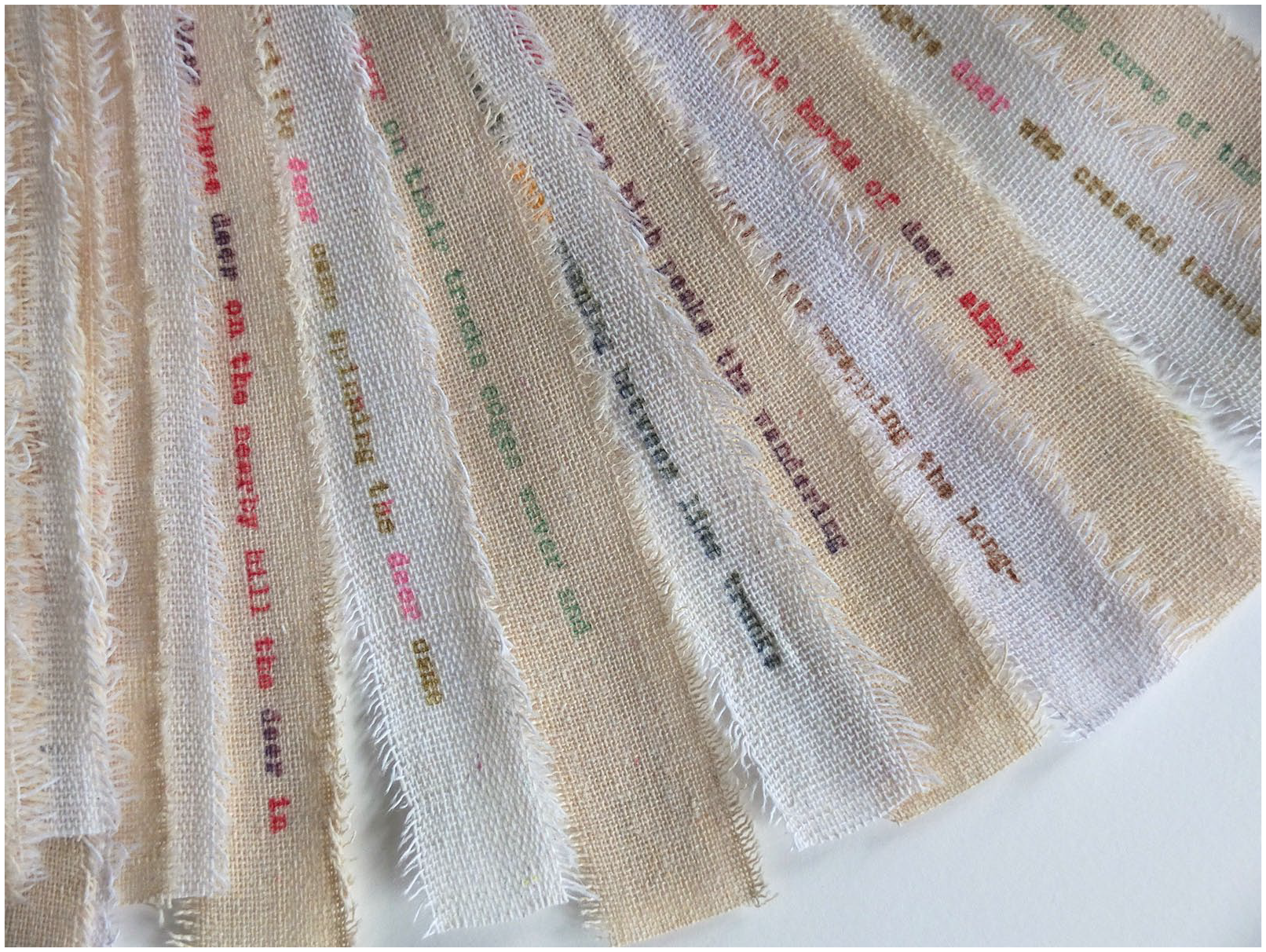
The decision to type in multiple colours was inspired by traditional Rhodian embroidery. Photograph by Caroline Harris.

Fallow deer, or platoni, have become an emblem of Rhodes. Text by Caroline Harris
‘Clootie trees’ form part of traditional Gaelic practices, where pieces of cloth were tied by a spring as a healing cure, but practices of placing cloth, ribbons and other items in trees have become more widespread as a way to mourn or memorialise lost lives, or signal support and empathy. 20 Affective responses to climate emergency, catastrophic biodiversity loss and individual extinctions often, and understandably, involve wishing that things were otherwise. The Clootie Ribbons might be seen as a material manifestation of this kind of wish. In making the ribbons for Rhodes, I chose linen because the fibre would biodegrade if ribbons became detached from the tree or accidentally left in situ, and because the traditional dress of Rhodes includes a linen or cotton chemise, or poukamiso. 21 The poukamiso is embroidered around the edges, which led me to type the poem lines in bright colours, as a kind of printed needlework (see Figures 7, 9 and 10).
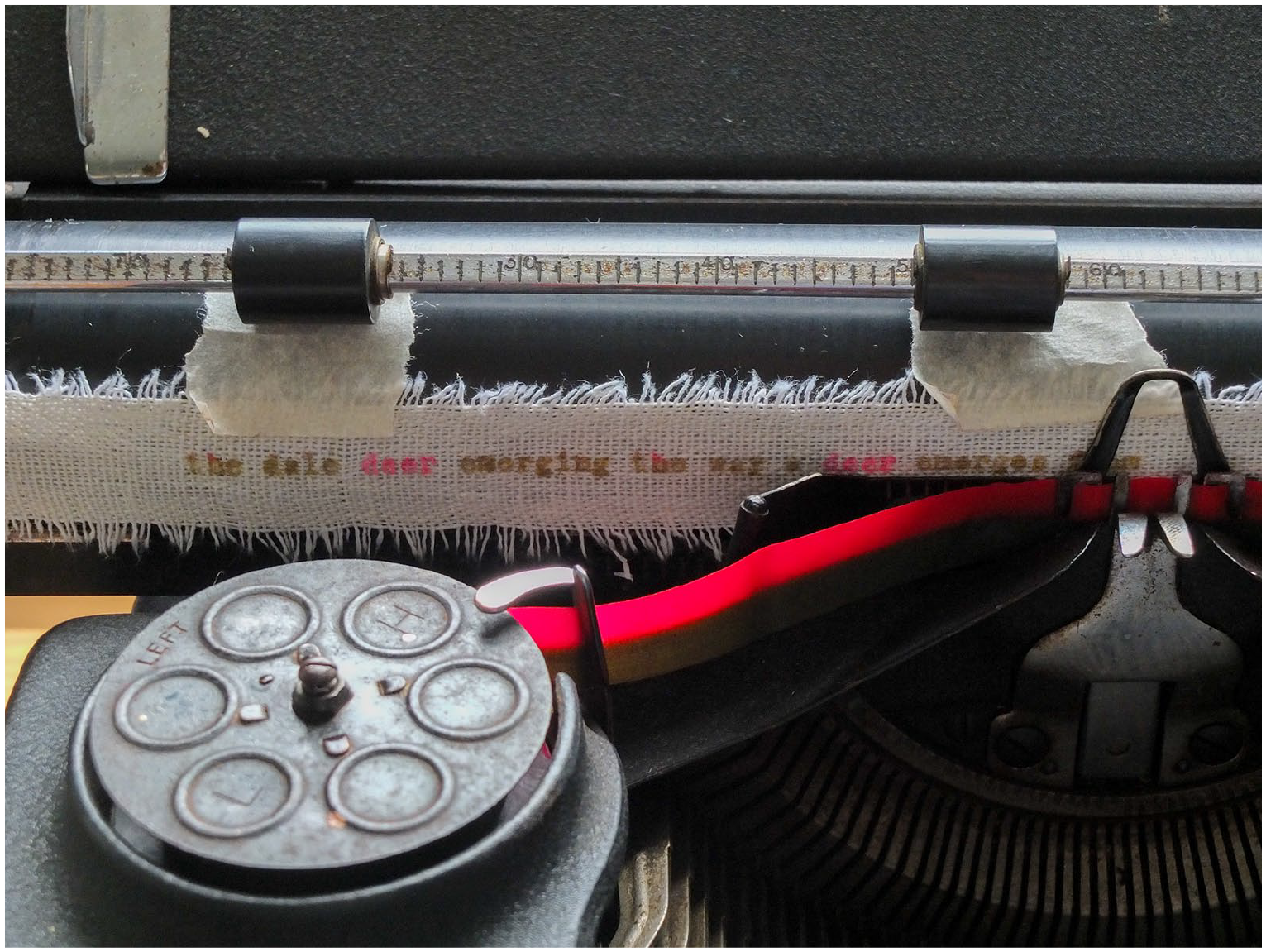
The process of typing the linen ribbons. Photograph by Caroline Harris.
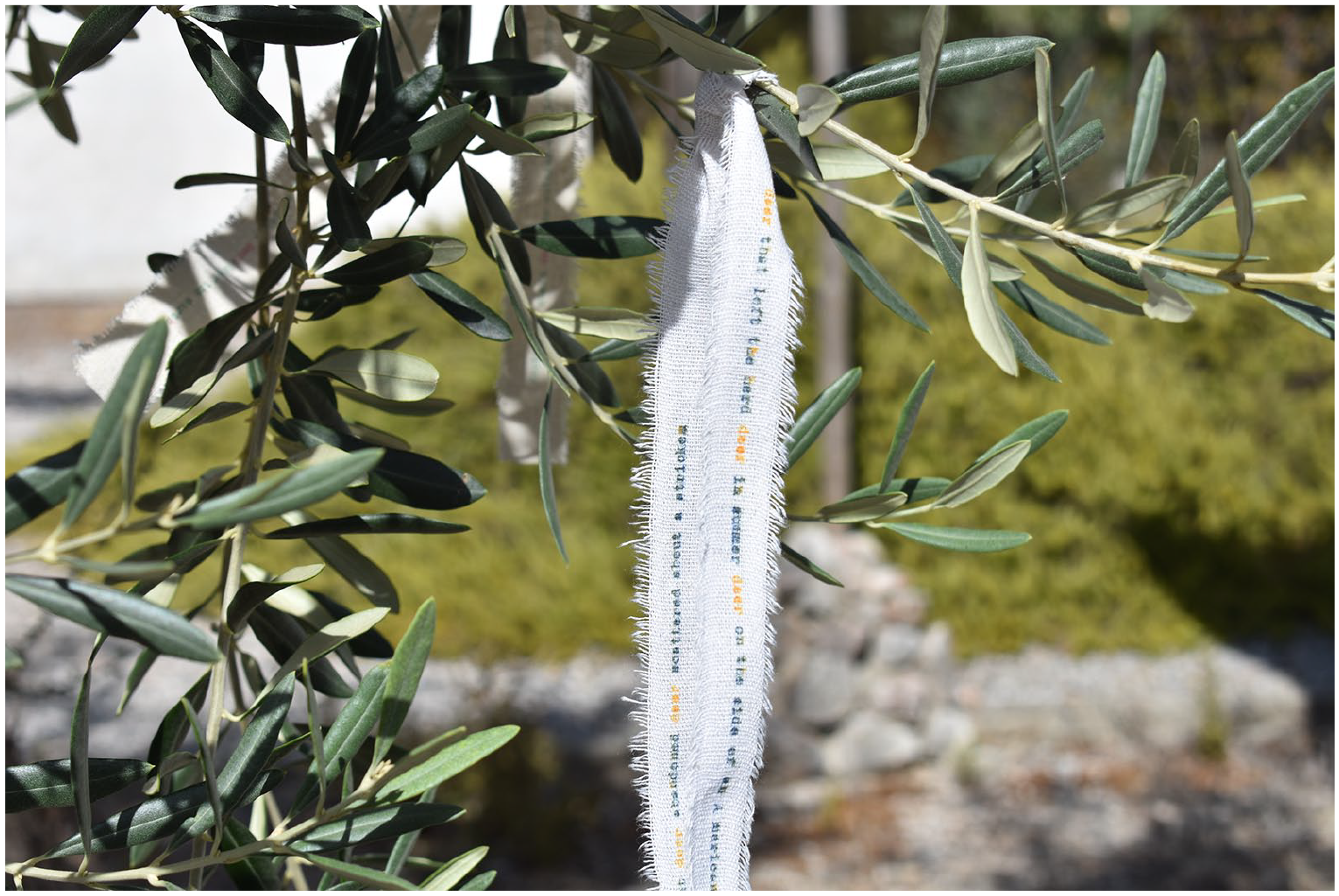
Photograph by Astra Papachristodoulou.
A practice of polyphonic assemblage
Focusing on the narrative of one species or taxonomic family – like deer (Cervidae) – has been criticised for failing to recognise the many entangled relationships within ecosystems, as well as the anthropocentrism and colonialism inherent in such categorisations. Anna Tsing argues that there is a need to tell stories of ‘landscape-based assemblages’, not just one creature at a time. However, as Tsing writes, ‘landscape thinking’ also involves listening to ‘separate melody lines’ that make up a ‘polyphonic assemblage’. 22 The Clootie Ribbons poem forms a literary ‘polyphonic assemblage’ in its curation of different poets’ words about deer: their ‘melody lines’. As tied ribbons, there is an interaction between language, fabric, tree, the persons who stage the ribbons, weather systems, human readers, other visitors to and inhabitants of the tree, and the site itself, that makes this a collaborative ecopoetic installation. Clootie Ribbons [Rhodes Edition] was a performance: it will never be the same collaboration in different stagings (Figure 12).
As a site-responsive as well as site-specific and material ecopoetic work, I hope that the Clootie Ribbons project can extend the interests of cultural geographers in ecopoetry (Figure 11). 23 The piece aims to inform ecopoetic and cultural geography practices by exploring ways to acknowledge and honour the losses not only of species but of individual nonhuman beings and geographically located groups. 24 Its poetics of collage also suggests how multiple voices might be entangled in works that address and respond to extinction. Clootie Ribbons is an ephemeral piece, a performance and an invocation or wish as well as elegy. As such it can offer cultural geographers novel forms of practice that mark nonhuman losses not with a static monument, but with mutable and responsive memorials (Figure 12).

The Clootie Ribbons project aims to extend interest in ecopoetic practices. Text by Caroline Harris.
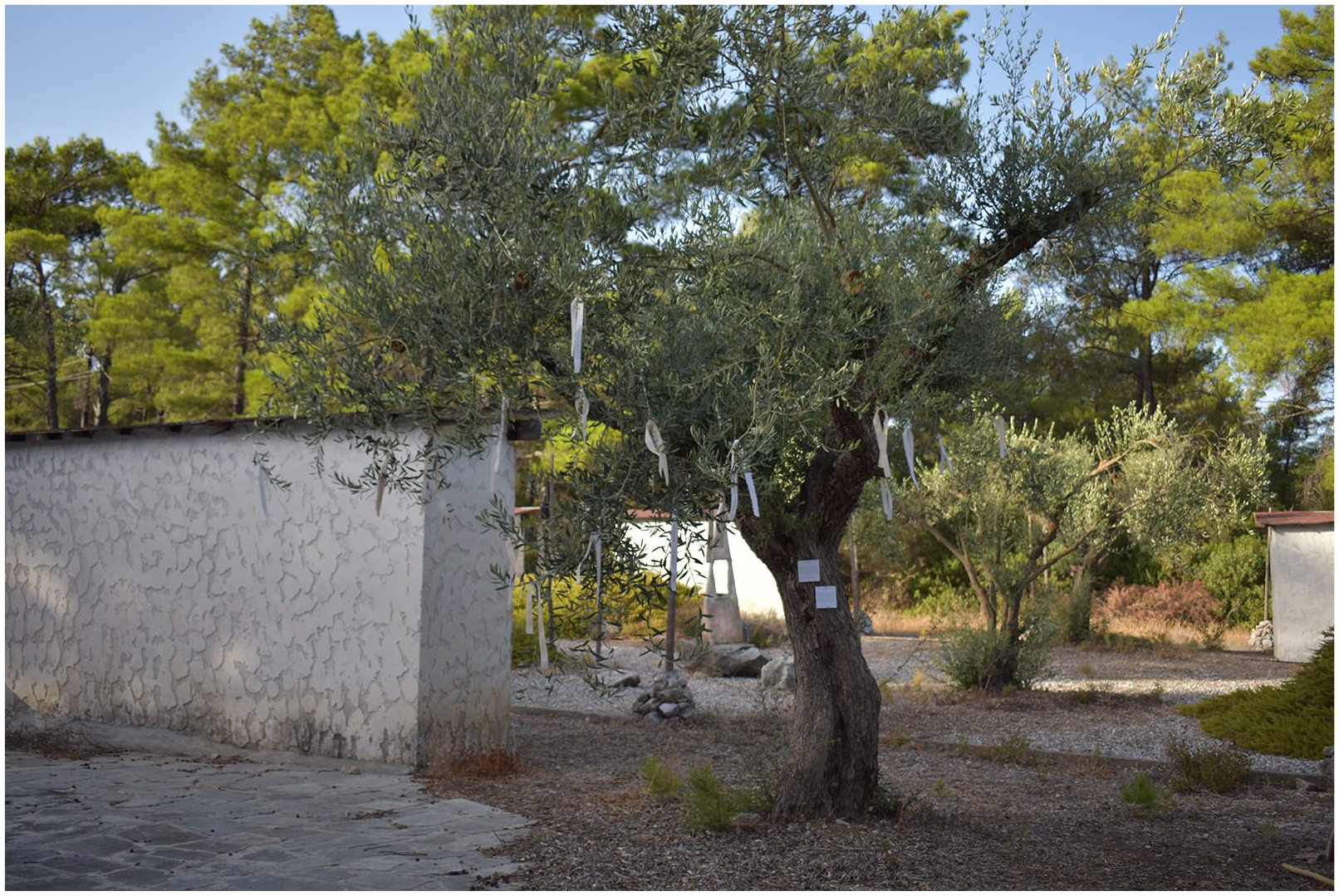
Photograph by Astra Papachristodoulou.
Footnotes
Acknowledgements
The Clootie Ribbons [Rhodes Edition] formed part of my PhD thesis, ‘Aww-struck poetics: deer and poems as “cute objects”’, completed at Royal Holloway, University of London (2024). I would like to thank my supervisor, Professor Redell Olsen, Text-Isles curator Astra Papachristodoulou and all the poets whose work has informed the Clootie Ribbons. My thanks to Astra Papachristodoulou and Ethan Wilson for use of their photographs.
Data availability statement
Research data availability not applicable. My PhD thesis is embargoed for two years from March 2024.
Funding
The author received no financial support for the research, authorship, and/or publication of this article.
Ethics statement
Ethical approval was not required.
Consent to participate
No consent to participate was required.
Consent for publication
Astra Papachristodoulou and Ethan Wilson have given consent for the photographs they took to be used for publication.
