




Abstract
This article explores the Wrecks-Landings exhibition at the Giorgio Franchetti Gallery, Ca’ d’Oro, in Venice, Italy, a city profoundly shaped by waves of migration. The exhibition features works by (dis)abled artists that poignantly reflect on the contemporary experiences of forced migrants. Together, these pieces form an evocative, site-specific installation that urges empathetic understanding and fosters informed dialogue. This installation demonstrates how artistic and creative methodologies, augmented by academic expertise, can offer nuanced insights into the complex political issues surrounding the ongoing forced migrant crisis – a crisis that continues to compel desperate individuals to undertake perilous journeys across the Mediterranean Sea.
The forced migration crisis and art advocacy
Migration and border control have become highly politicised issues at both the European and national levels. 1 European leaders often express their commitment to addressing the Mediterranean migrant crisis, as seen in Martin Schulz’s calling the 2014 Lampedusa tragedy ‘a stain on our European conscience’ or Ursula Von der Leyen’s more recent acknowledgement that the crisis ‘needs a European answer’. 2 Despite these calls for an effective response supporting forced migrants, European leaders also continue to prioritise border security over addressing the specific needs of individual migrants. 3
This dissonance raises critical questions for cultural geographers. How can this dynamic crisis be understood and represented? How can cultural practices effectively convey the embodied experiences of forced migrants navigating the Mediterranean? Here, I reflect on my encounter with the Wrecks-Landings exhibition, curated by Professor Alessandro Zuccari at the Giorgio Franchetti Gallery, Ca’ d’Oro, Venice, Italy (19 April–15 September 2024). The exhibition features works that invite critical reflection on the experiences of forced migrants, with a particular focus on the Humanitarian Corridors initiative, while also shedding light on the often-overlooked experiences of (dis)abled forced migrants. 4 Through an exploration of the intersection of art and activism in the exhibition, this article highlights how arts-based and creative methods, including methods involving interdisciplinary collaboration – here, between a professor of art history, a conceptual artist and (dis)abled artists participating in workshops – can deepen understandings of forced migration and its urgent social implications.
The exhibition presents a cohesive narrative through three interconnected works. The first, a digital storytelling piece by César Meneghetti, evokes the perilous small boat journeys experienced by forced migrants. The second, a triptych by Roberto Mizzoni, advocates for the Humanitarian Corridors initiative, which offers safer migration routes across the Mediterranean for vulnerable groups seeking refuge in EU member states, including minors, (dis)abled individuals, those with serious illnesses, single parents with children, individuals with mental conditions, and the elderly. The third, Marianna Caprioletti’s reinterpretation of The Raft of the Medusa by Théodore Géricault, serves as a potent metaphor for how (dis)abled people, particularly (dis)abled forced migrants, are frequently neglected in societal and political systems. Together, these works form a powerful mixed-media construction – a ‘storying’ sequence encompassing digital storytelling, painting and drawing. As Hubbard and Wilkinson observe, ‘cultural geography has a long and fruitful tradition of working at the intersections between geography and performance art’. 5 This article builds on that tradition by considering how the exhibition, as a site-specific installation with performative visitor participation, vividly evokes the lived experiences of forced migrants and serves as a subtle yet effective piece of political activism.
New arrivals in Venice: historical context and contemporary significance
Venice was born from necessity, established in the fifth century within a lagoon by refugees fleeing invasions by northern tribes. 6 Between the 14th and 16th centuries, migrants from regions like Greece, Albania and Dalmatia, along with Jewish migrants from mainland Italy, Germany, the Iberian Peninsula and the Levant, played a crucial role in Venice’s rise as a Mediterranean power. 7 In the 1990s, the Venetian town council organised public meetings to discuss how to welcome and integrate around 500 forced migrants fleeing the Balkan wars. 8 Today, Venice continues its legacy as a refuge, this time through art. The exhibition venue, Ca’ d’Oro, a majestic palace-warehouse on the Grand Canal, bears witness to Venice’s rich history (Figure 1). Built in 1412 by Venetian patrician Marino Contarini, with intricate Gothic arches, loggias and marble revetments, this ‘Golden House’ was named for the gold leaf and ultramarine pigment that once adorned its façade. 9 The exhibition takes place within the androne, a space once used for unloading goods, bathed in watery light. Here, Baron Giorgio Franchetti (1865–1927), who donated the house and its art collection to the Venetian state in 1916, is interred beneath a broken porphyry column. 10 Hence, it is a fitting setting for exploring themes of arrival, expectation and remembrance.
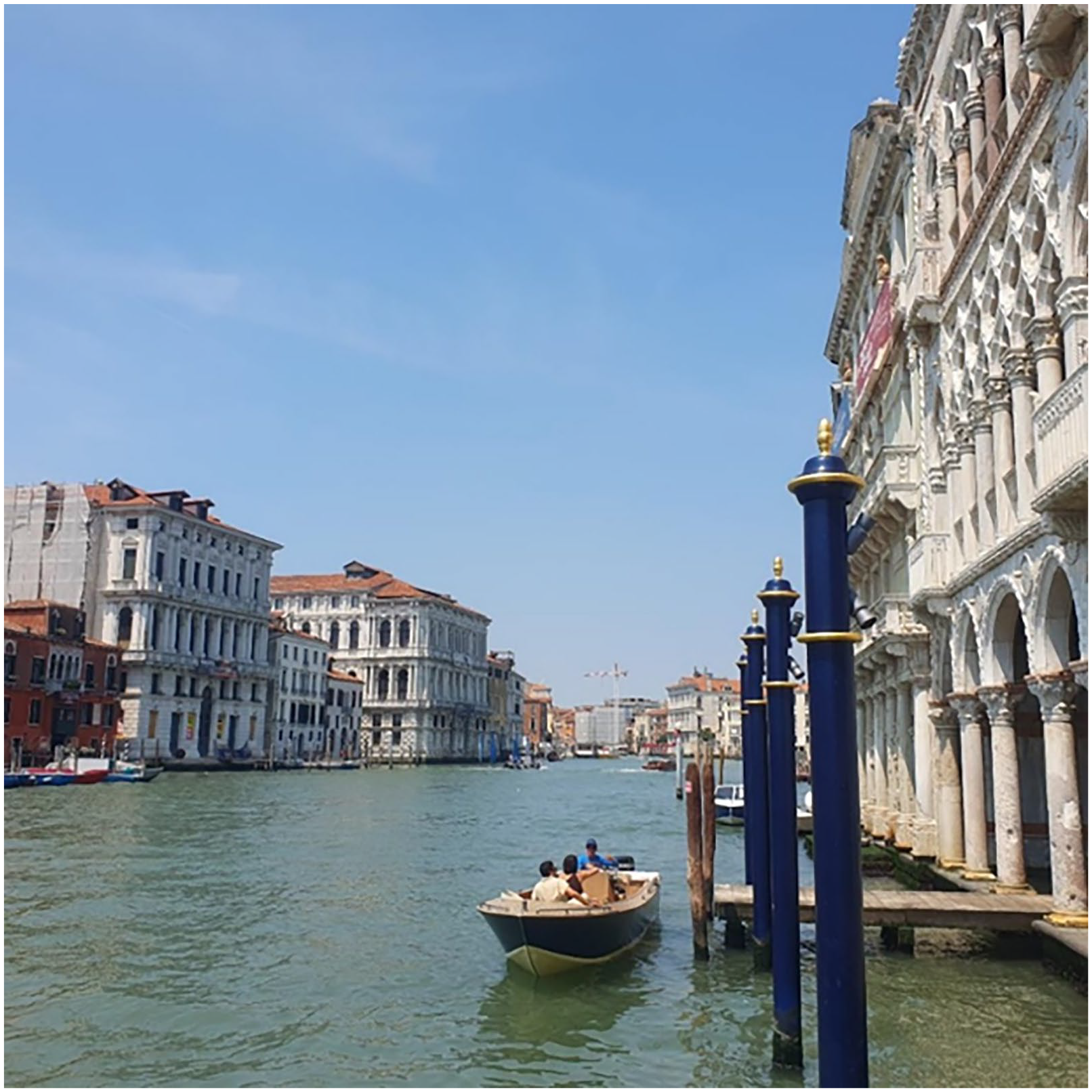
A boat arrives at Franchetti Gallery, Ca’ d’Oro, Grand Canal, Venice.
Wrecks and landings: artistic reflections on forced migrant journeys
The first work by César Meneghetti, created in collaboration with the Disability Art Workshops of Sant Egidio, uses digital storytelling to evoke the dangers faced by forced migrants. Digital storytelling immerses viewers in a visual and auditory experience, including a ‘digital sea’ of 240 migrant names, commemorating identified victims lost on the Mediterranean and Balkan migration routes during 2023. 11 Fictive voices of lost migrants rise into a chorus, crescendoing before the sea turns red and silence falls. In remembrance of all migrants lost during 2023, (dis)abled participants in Sant’Egidio Art Workshops crafted 3,129 small paper boats, each containing a personal reflection on the migrant experience. 12 Reflections were recorded in different ways, including digitally (recordings, typing on the computer, writing). 13 Visitors are invited to place these boats on the gallery’s patterned marble floor and participate in a collective act of remembrance that honours those lost while also protesting society’s rejection and isolation of marginalised groups, such as forced migrants and (dis)abled individuals.
Humanitarian corridors and forced (dis)abled migrants
The second work, Roberto Mizzoni’s Humanitarian Corridors (HC), celebrates a programme that has offered refuge in Europe to 7,000 vulnerable individuals from countries such as Lebanon, Ethiopia and Libya. 14 His striking triptych contrasts dark turbulent seas with a golden trajectory, symbolising both the perilous journey of forced migrants and the hope of safe passage. Led by faith groups and civil society, HC facilitates legal and secure routes for particularly vulnerable forced migrants, providing essential social, cultural, and linguistic support to help them integrate into new communities. 15 (Dis)abled people, who face unique vulnerabilities as forced migrants, are a key focus of HC’s mission, but specific data on their experiences remain sparse. Whilst HC reporting does not provide specific data for (dis)abled forced migrants, the personal stories that emerge from the programme are compelling and deeply moving. 16 The first migrant to arrive in Italy via the initiative was a young girl, at risk of blindness in Lebanon due to an untreated tumour, accompanied by her parents and brother. 17 Later HC trips provided refuge for a woman with one arm and a man disabled by severe polio, both parents to a 9-year-old boy. 18 These accounts highlight the critical importance of initiatives like HC in providing support to (dis)abled forced migrants.
Mizzoni’s work embodies the duality of hope and peril, drawing on the symbolism of gold. Gold has, for centuries, been associated with divinity, sanctuary, and power in Venetian art, as seen in the glistening mosaics of St. Mark’s Basilica, the gilded altarpiece of the Pala d’Oro, and the once-golden mercantile palazzo that houses the exhibition. In Mizzoni’s triptych, gold not only represents the HC routes’ promise of sanctuary but also marks the tragic reality of loss and the hereafter. The identification number of the youngest migrant to die in the Mediterranean is included, written in gold. Further left, a vivid splash of red commemorates the 2023 boat disaster off Calabria, where 94 migrants tragically perished. 19 This powerful visual contrast emphasises the stark reality: while a few forced migrants are saved through initiatives like HC, many others continue to face treacherous and often-fatal journeys. Despite HC’s notable successes, its scope remains limited, constrained by the reluctance of national governments to develop new policies. 20 Political support among European electorates for humanitarian corridors is often lacking, preventing wider adoption. 21 Mizzoni’s triptych encapsulates this tension, forcing the viewer to confront the broader migrant crisis and the choice European societies face of whether to extend or withhold support for new, urgently needed programmes.
(Dis)abled forced migrants cast adrift
Born with Pendred’s Syndrome, Marianna Caprioletti developed her artistic practice by portraying her childhood classmates at a deaf institute. 22 Her work, The Raft, reimagines Théodore Gericault’s The Raft of the Medusa (Figure 2) as a symbol for how (dis)abled people, and more specifically (dis)abled forced migrants, are often those ‘cast adrift’ without adequate support.
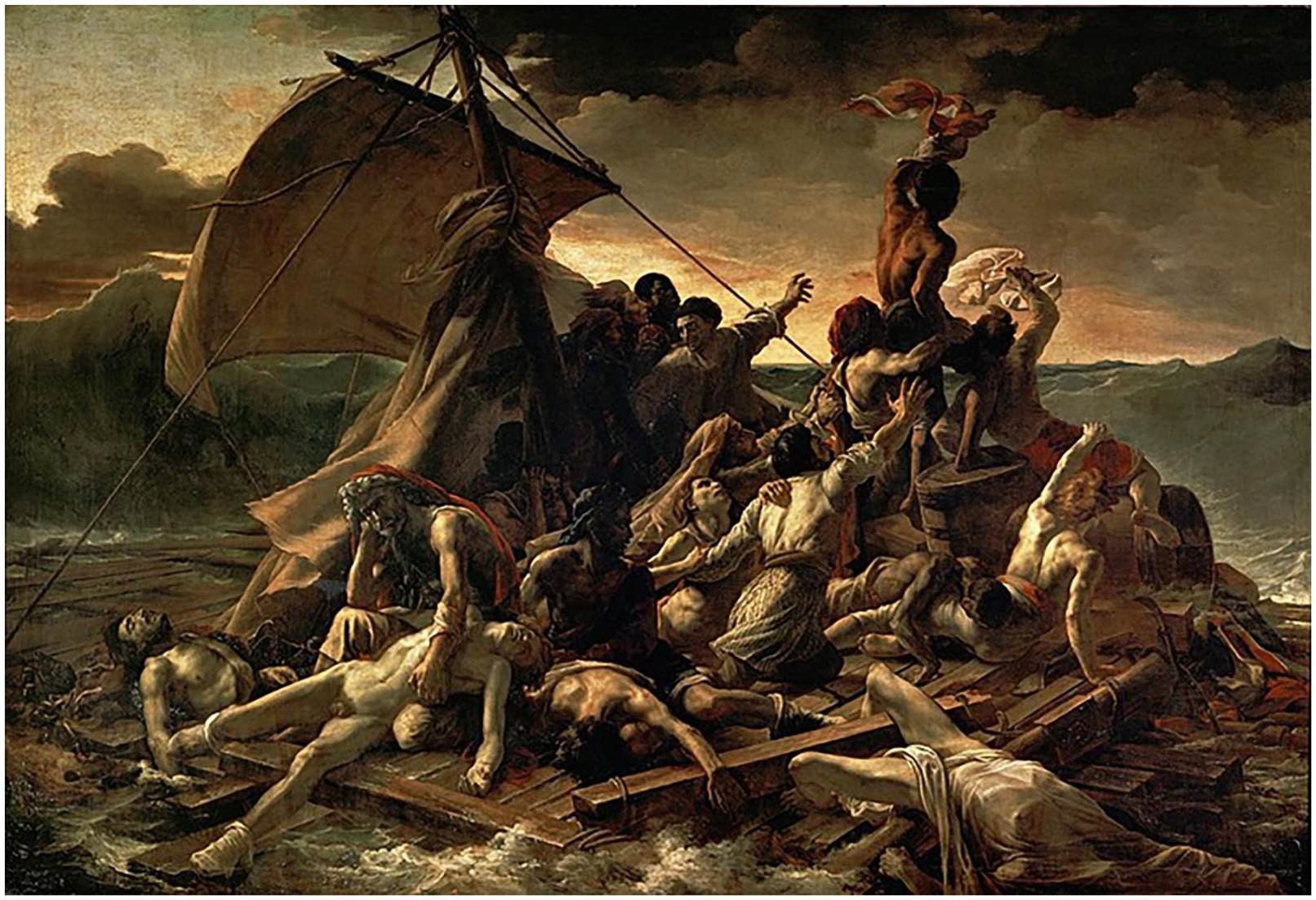
The Raft of the Medusa. 1818–1819, Théodore Géricault, Louvre, Paris.
Géricault’s painting memorialised the 1816 shipwreck of The Medusa and depicts the horrors that unfolded after the ship sank. Doomed by their captain’s incompetence, passengers without a berth in the lifeboats were left stranded on a makeshift raft, succumbing to starvation and cannibalism. 23 The physically strongest survived by killing the weakest, with only 15 passengers rescued by a passing ship after 13 days. 24 This shocking event, and Géricault’s portrayal of it, became political allegories for societal oppression and governmental neglect.
Géricault’s original painting was informed by the real experiences of survivors of the raft. 25 In a similar vein, Caprioletti draws on her personal experience of (dis)ability to reframe the metaphor of the raft. Her ‘translation’, an enlarged canvas print of a pencil drawing, portrays figures with varied physiognomies, suggesting migrants from different regions. While their distorted forms and missing limbs could symbolise distress and cannibalism, the thematic context and Caprioletti’s own identity as a (dis)abled artist point to a deeper reading: these figures represent (dis)abled individuals, marginalised and left adrift by society. The raft metaphor highlights how (dis)abled forced migrants suffer neglect within systems designed without their needs in mind. 26 Caprioletti’s work functions as both art and advocacy, spotlighting and humanising the struggles of (dis)abled forced migrants in ways that policy discussions often fail to achieve. As some scholars have noted, (dis)abled forced migrants are ‘cast in a shadow of epistemological, ontological, and practical invisibility’, situated in a blind spot between the disciplines of disability studies and migration studies, both of which frequently overlook the unique, intersecting struggles of this group. 27
Géricault’s painting was controversial when it was first exhibited at the 1819 Paris Salon for depicting the horror of the event and for depicting a Black man prominently waving a flag to signal a distant rescue ship – an abolitionist statement against colonialism and the slave trade. 28 In Caprioletti’s version, the flag is held by a (dis)abled women, possibly a self-portrait, offering a defiant critique of ableism and positioning (dis)abled forced migrants at the forefront of a call for recognition and support. Through this subtle yet powerful gesture, Caprioletti links her work to historical struggles for justice, broadening the conversation to include not only the plight of (dis)abled forced migrants but also our shared responsibility to ensure that no one is abandoned, regardless of identity or circumstance.
Conclusion
At the heart of Venice, a city with a rich history of migrant stories, the Wrecks-Landings exhibition at Ca’ d’Oro (Figure 3) critically explores the profound challenges faced by forced migrants, particularly those with (dis)abilities. César Meneghetti’s digital storytelling immerses viewers viscerally in the perilous journeys undertaken by forced migrants, journeys that frequently end in tragedy. Roberto Mizzoni’s Humanitarian Corridors presents a vision of hope, representing safe migration routes for vulnerable groups, including (dis)abled forced migrants, while also critiquing the limited scope of current initiatives assisting forced migrants. Finally, Marianna Caprioletti’s reinterpretation of The Raft of the Medusa starkly portrays how (dis)abled forced migrants are often ‘cast adrift’ without adequate support. By fostering empathy and understanding through these artistic expressions, whilst challenging viewers to reflect on their collective responsibility in addressing the migrant crisis, the exhibition showcases how cultural geographical practices can be a vital tool in critically revealing the complex emotional, spatial and social dimensions of forced displacement.
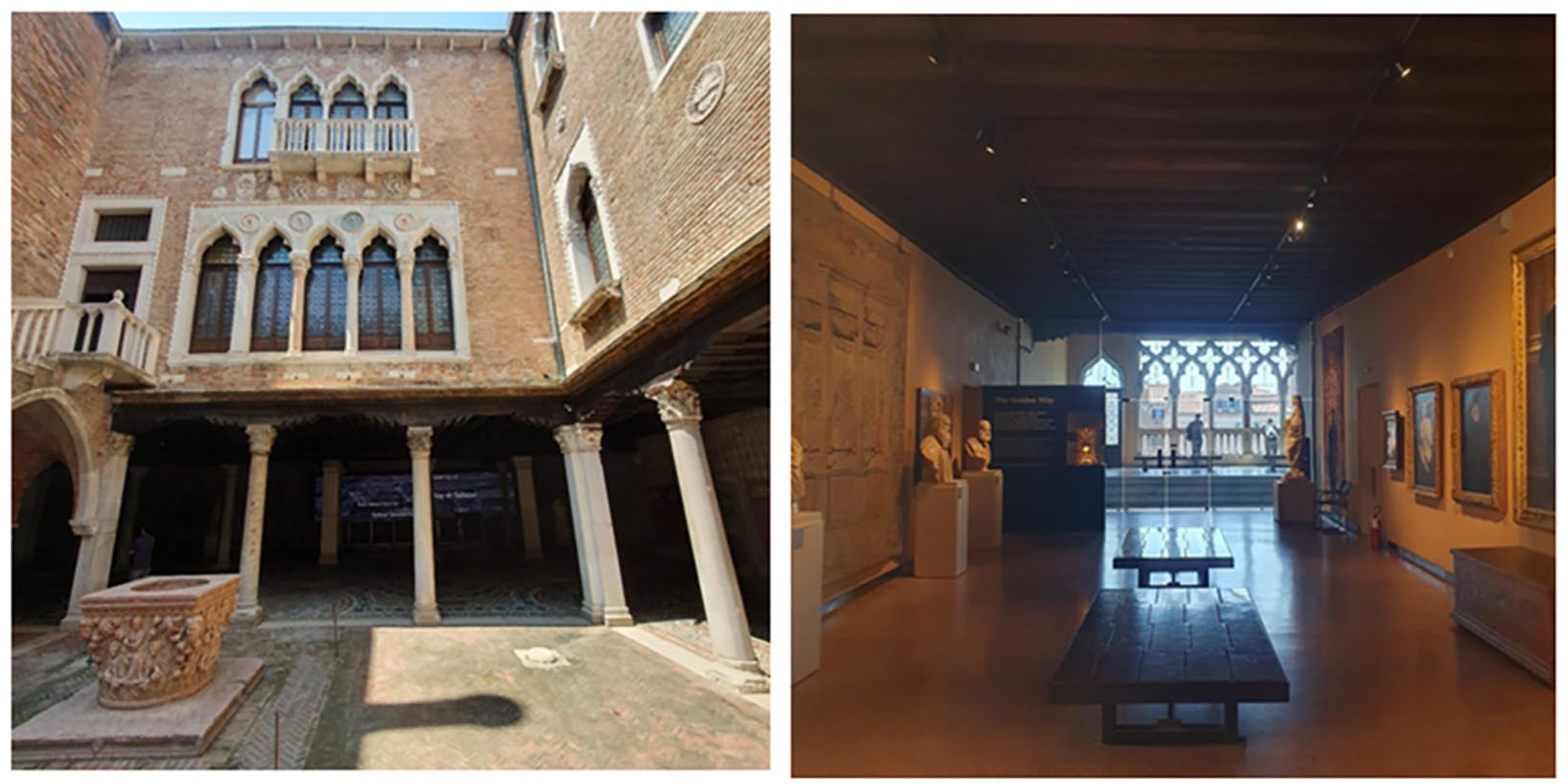
The courtyard and upper floor gallery at Franchetti Gallery in Ca’ d’Oro, Venice.
Footnotes
Funding
The author received no financial support for the research, authorship, and/or publication of this article.
