




Abstract
This article reflects on an interdisciplinary research project between a cultural geographer and practising artists in documenting the changing landscape of the mountain Yr Wyddfa (Snowdon), Wales. The project draws on archival materials in the form of 19th-century visitors’ books housed in summit ‘hotel’ huts. The visitor books provide a point of departure for research which references the historic insights of the varying tourist encounters of the mountain landscape. By physically retracing the footsteps of 19th-century tourists, the team employed image-making practices to (re)imagine how the mountain is experienced today. This led to a curated exhibition that juxtaposed 19c. visitor book extracts and photographs to communicate the historical and contemporary social-spatial and environmental changes and tensions within the landscape. This paper critically reflects on the retrieval, selection and exhibition of text and image and argues how this process offers new geographical interpretations and forms of dissemination of past and present understandings of human encounters with landscapes.
Introduction
Standing 1,085 m above sea level, Yr Wyddfa (Snowdon) is the highest mountain in Wales. 1 Located in Eryri (Snowdonia) National Park, the mountain attracts over 600,000 tourists annually who ascend via the six main tourist paths or the Rheilffordd yr Wyddfa (Snowdon Mountain Railway), alighting at the summit centre Hafod Eryri. The pressures this footfall puts on the mountain are well-documented, with longstanding concerns over increasing visitor numbers, environmental degradation, and socio-economic issues impacting local communities, which continue to threaten the sustainable future of the mountain. However, the desire to reach the summit is not a new phenomenon. The first recorded ascent by the botanist Thomas Johnson in 1639 marks a prolonged historical engagement with the mountain.
The origin of this project draws on Bos’ ongoing research into historical accounts of ascents of Yr Wyddfa recorded in visitor books housed in summit huts between 1845 and 1889. These books provide a fascinating insight into everyday Victorian tourist encounters with the mountain, the local people, and the surrounding landscape of North Wales. Counter to the singular narratives evident in the Welsh tour literature of the time, 2 visitor books offer an alternative vernacular account of the material and symbolic engagements with past lived experiences of the landscape. They parallel the history of the sublime encounter in the context of the growing commercialisation and commodification of the summit and the embodied experience of ascending the mountain today.
Our project adopted an interdisciplinary approach, acknowledging recent calls for cultural-historical geographers to embrace creative and arts-based methods in reimagining landscapes that ‘trouble and subvert the past and presents of landscape’. 3 As part of the project, Quayle deployed a research-based art photography approach and curatorial practice indebted to the artist walking practices of Robert Smithson, Richard Long and Hamish Fulton. This shared interest in documenting and conveying a contemporary reading of the sublime worked at the intersection of visual art and human geography.
By combining historical texts with image-making (photography), we extend geographers’ creative work with archival materials to offer new cultural and aesthetic responses to landscape. This article critically reflects on the process of juxtaposing photographs and archival text, culminating in a public exhibition conceived and curated by Daniel Bos (a cultural geographer) and artist Cian Quayle. The pair were joined by two photography students, which led to different creative responses to the changing landscape of the mountain.
Collaboration and context
In 2023, Quayle and Bos received ‘Breaking Boundaries’ funding from the University of Chester to undertake an interdisciplinary project involving student participation. By adopting a ‘students-as-partners’ approach, 4 BA Photography students (now graduates) Emma Petruzzelli and Jane Evans contributed to the research by incorporating their photographic perspectives in (re)imaging and (re)presenting the landscape. In May 2023, we organised a workshop in which group members engaged in a study of the visitor books to identify emergent themes that would inform our subsequent fieldwork activities.
Between May and July 2023, we undertook four full-day visits to Yr Wyddfa. The routes for the visits were determined in advance, drawing on the group’s research of the visitor book extracts. During our visits, we noted significant sites and locations en route, the changing weather conditions, and the embodied experience of making the ascent, which echoed the historic experiences recorded in the visitor books. After each field visit, the group met to discuss and reflect upon their walking experience and how this was documented in our photographs and field notes. These discussions fed into the collaborative design and curation of an exhibition in the Castlefield Gallery New Art Spaces, Chester, December 2023, which presented past and present encounters with Yr Wyddfa through carefully selected photographs and visitor book extracts.
Fieldwork and practice
The 19c. visitor books housed at the summit of Yr Wyddfa are reminiscent of the ‘bothy book’ found in simple shelters in rural Scotland. For Rachel Hunt, such books are important historical, material artefacts which offer insights into the past and present practices of dwelling in the landscape and ‘the lifeworld of those who spend time in and around these buildings’. 5 Up to this point, seven visitor books dating from 1845 to 1889 have been studied in their documentation of visitors’ comments upon reaching the summit. The visitor books vary from 250 to 450 pages, and each page contains entries which vary in style, form and length. Whilst the most common entries involve the recording of names, addresses of individuals, and date of ascent, other extracts provided more fulsome accounts detailing their experiences through prose, poetry, sketches and humorous commentaries (see Figure 1). For our project, visitor book entries were electronically transcribed, documenting individual names of visitors, origin locations, dates and the comments made. We aimed to be as accurate as possible to the original entries, considering the challenges presented with the legibility and worn condition of the books. The transcribed entries were then organised in a database, which allowed us to identify emerging themes and areas of interest that informed the field trips.
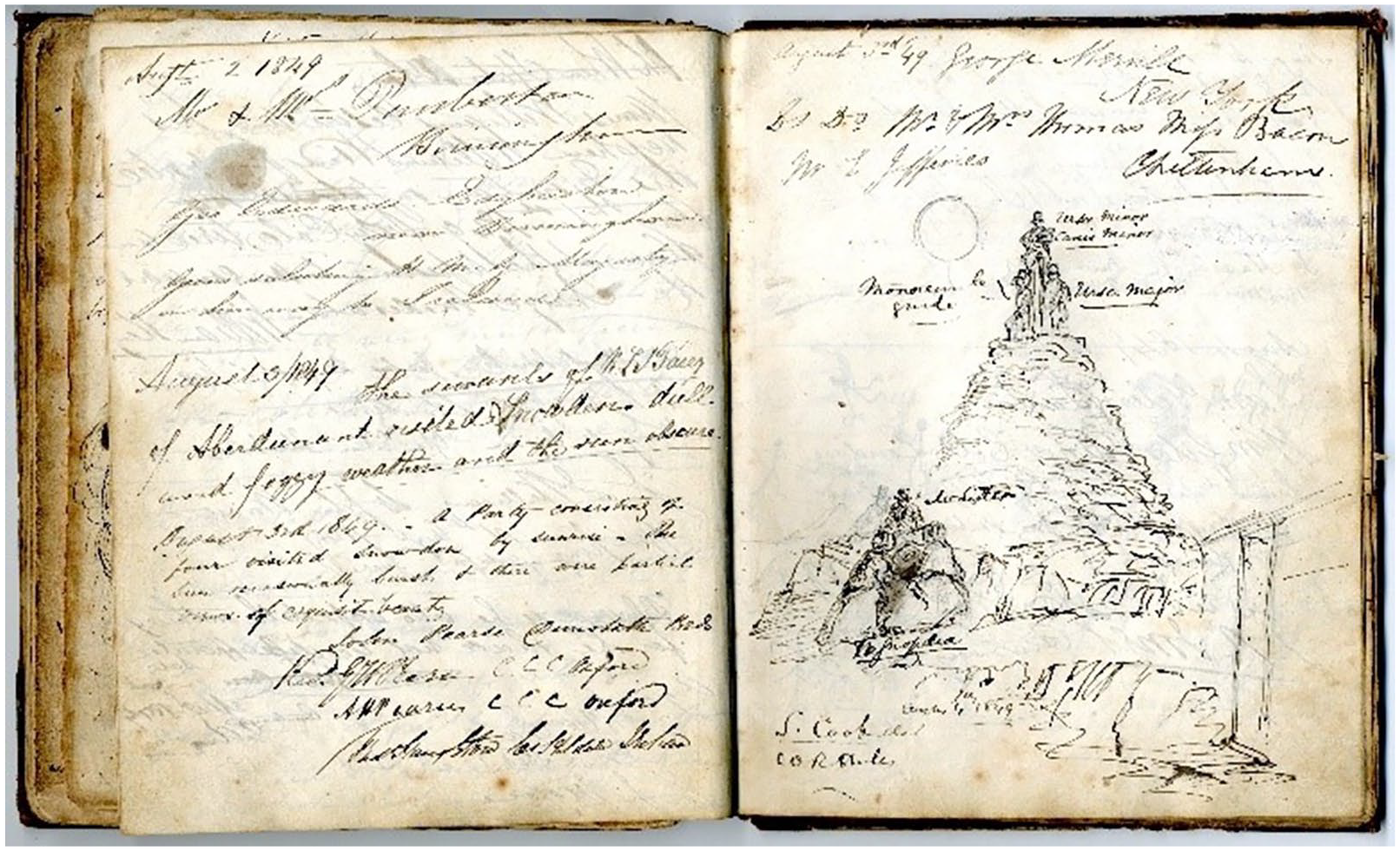
Image taken from the Visitors’ Book of the Victoria Hotel, Llanberis, 1848. Photo by, and courtesy of, the Archives and Special Collections, Bangor University.
The visitor book extracts, fieldwork and image-making practices provided an opportunity to reimagine past and present encounters with the mountain. Rather than photography being seen simply as an illustrative accompaniment to the text, our approach considered the performative capacity of image-making and how ‘geographers may use photographs to destabilise our understandings of place and question established hierarchies’. 6 Each of the three photographers contributed their own perspective and practice, based on the convergence of formal, documentary and conceptual strategies, to invite new ways of responding to the landscape. Emma Petruzzelli’s use of black and white images conveys the drama of the landscape in their monochrome minimalism informed by an interest in folklore, myths and legends (see Figure 3). Jane Evans’ panoramic photographs offer an expansive overview of space and a sense of scale, distance and elevation. This wider field of view is evocative of the privileging of the vision and the desire for elevated perspectives (see Figure 4). Cian Quayle’s photographs embody the experience of walking and seeing in their proximity to others and bring specific attention to people and material things which are lost or otherwise disposed of en route. Each photographers’ practice brought different perspectives, styles and interpretations of how the mountain was historically recorded in the visitors’ books.
Documentation and curation
The selection of images and extracts for the exhibition was developed during collaborative workshops. Initially, 120 images were chosen by the artists (40 each), and the team then reviewed the results. This was eventually reduced to 24 images (8 for each photographer) to be framed and captioned with extracts from the visitor books. The selection process sought to highlight associations which reveal a continuity of engagement with the physical features of the terrain and how it is encountered at each stage of the ascent and descent. Here, the visitor books referred to key staging points on the journey and the physical features observed (when weather permitted) in the surrounding landscape. As visitor books were housed at the summit, many accounts focused on the experience of the summit huts and presented reviews of the hospitality of the proprietors and the refreshments served. Entries also noted the summit’s popularity and visitors’ central motive to see the sunset and/or sunrise which remains a popular practice today. Figure 2 shows how crowds at the summit remain a feature as visitors await their turn to climb the summit plinth in a continuity of the long-established tourist presence on the mountain.
Don’t come to see the sunrise on a Saturday morning if you like it quiet. We slept here and were aroused at 2.30am by a crowd!!
W. Lawrence and E. Lawrence, London, September 14th, 1883.
7
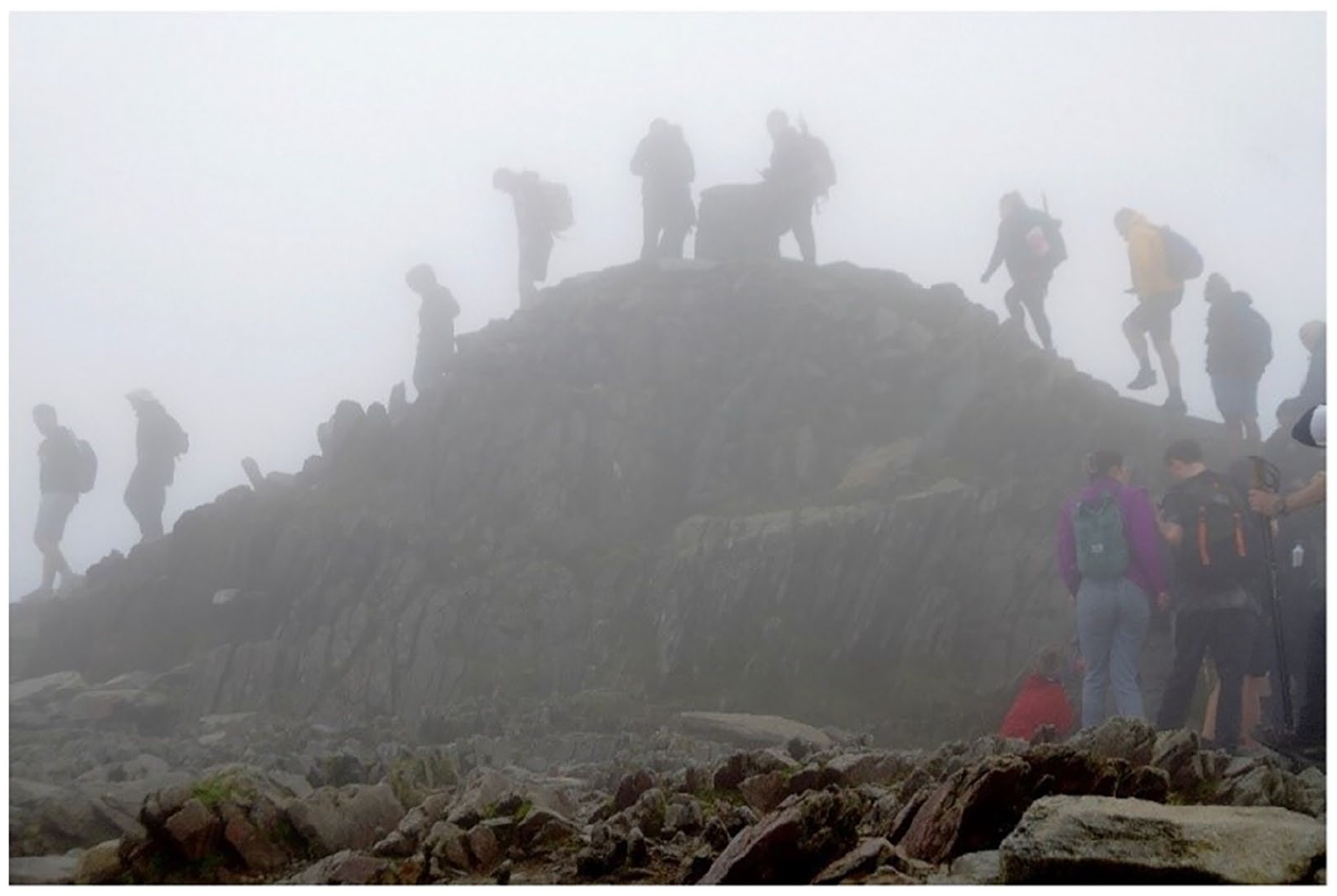
C-type, colour photograph of visitors queuing for the summit plinth. The image was presented in the exhibition alongside an extract from the visitor book. Photograph by Cian Quayle, 2023.
The combination of text and image also evidences how the transformation of the landscape has shaped how visitors ascend the mountain. Figure 3 shows a terminated train at the Hafod Eryri summit centre. The Rheilffordd yr Wyddfa predated the visitor books and began operating from Llanberis to the summit in 1896. In the visitor books, the use of ponies and accompanying guides highlight past means by which the summit was reached, which, in turn, informed the rising commercialisation and development of tourist infrastructure at the summit. As outlined in the following extract, visitor books also revealed the public appetite for a railway to ease the journey to the mountaintop.
September 17
th
1865 ascended with the old pony called Jack and John Jones as guide from the Padarn Villa Hotel smoked cigars had a glass of hot brandy and water. Pleased with the ride, pleased with the entertainment, pleased with the view, pleased with everything.
Fred Snaith, Boston, Lincolnshire, September 17th, 1865.
8
Came up here and enjoyed the bread and cheese and bitter beer very much indeed. Nothing else to enjoy. It took us 2 hours and 20 minutes to walk up quickly. Hope to get down all right again and don’t intend to try it again now unless they make a railway.
Richard Daggett, July 13th, 1865.
9

C-type, black and white photograph of a terminated train at the summit with visitor book extract. Photograph by Emma Petruzzelli, 2023.
Finally, the project also afforded an experimental and playful engagement with archival texts and images. This strategy speaks to cultural geographers’ recent interest in enlivening and animating the archive through creative reinterpretation and recontextualisation of objects, texts and images that can present alternative narratives. 10 Artists and photographers have engaged in archive based practices in the use of vernacular materials and artefacts in their reuse or reconfiguration, and which was already a feature of Quayle’s practice. This playfulness mirrored the use of humour found throughout the visitor books through puns, jokes and satire, which became a ‘key strategy for travellers to process their disappointment’, 11 often due to the capricious weather conditions. These extracts acknowledge how humour was used in everyday tourist encounters with the mountain, paralleling the reverence of the sublime as a mode of seeing and engaging with the landscape (see Figure 4).
Ascended Snowdon with the hope of a sunrise but evidently, the sun has been late for the train or else it must have been up before this.
Henry Fitzgerald, Maperton House, Somerset, June 18-19th, 1850.
12
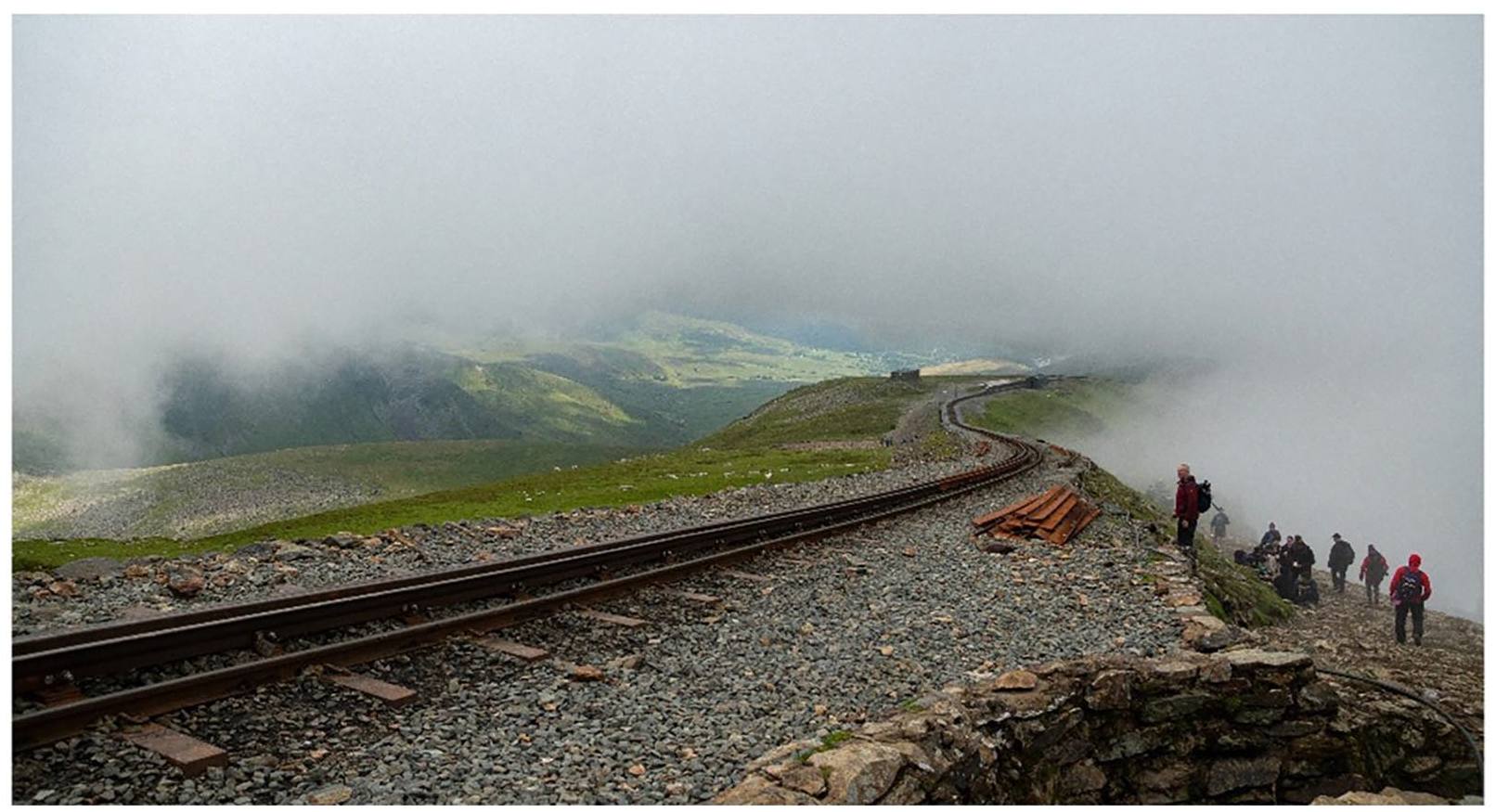
C-type, colour photograph of mist over the Llanberis path and railway line with visitor book extract. Photograph by Jane Evans, 2023.
Audience and interpretation
Our work was exhibited in the Castlefield Gallery New Art Spaces in Chester between November and December 2023. This former retail unit within a shopping centre was appropriated as a gallery space in September 2023, and its central urban location encouraged a diverse audience of over 600 visitors.
The exhibition included photographs by Quayle, Petruzzelli and Evans, juxtaposed with the visitor book spreads and extracts, and a moving image piece by Bos, documenting the duration of the Llanberis railway journey to the summit. The photographs were exhibited alongside transcribed extracts, which were typeset by designer Daren Prior and printed onto fine art (book) paper. Quayle’s decision to use Albertus font, originally designed by Bernard Wolpe in the 1930s, retains a modern, timeless yet contemporary quality, complementing the curated images for which Bos carefully selected the extracts. Each set of extracts offered a different means of interpreting and contextualising historical and contemporary encounters with the mountain (see Figure 5). The exhibition format also encouraged audiences to pause and read the extracts concerning the photographs, activating a mode of attention and engagement beyond that of a caption or explanatory text.
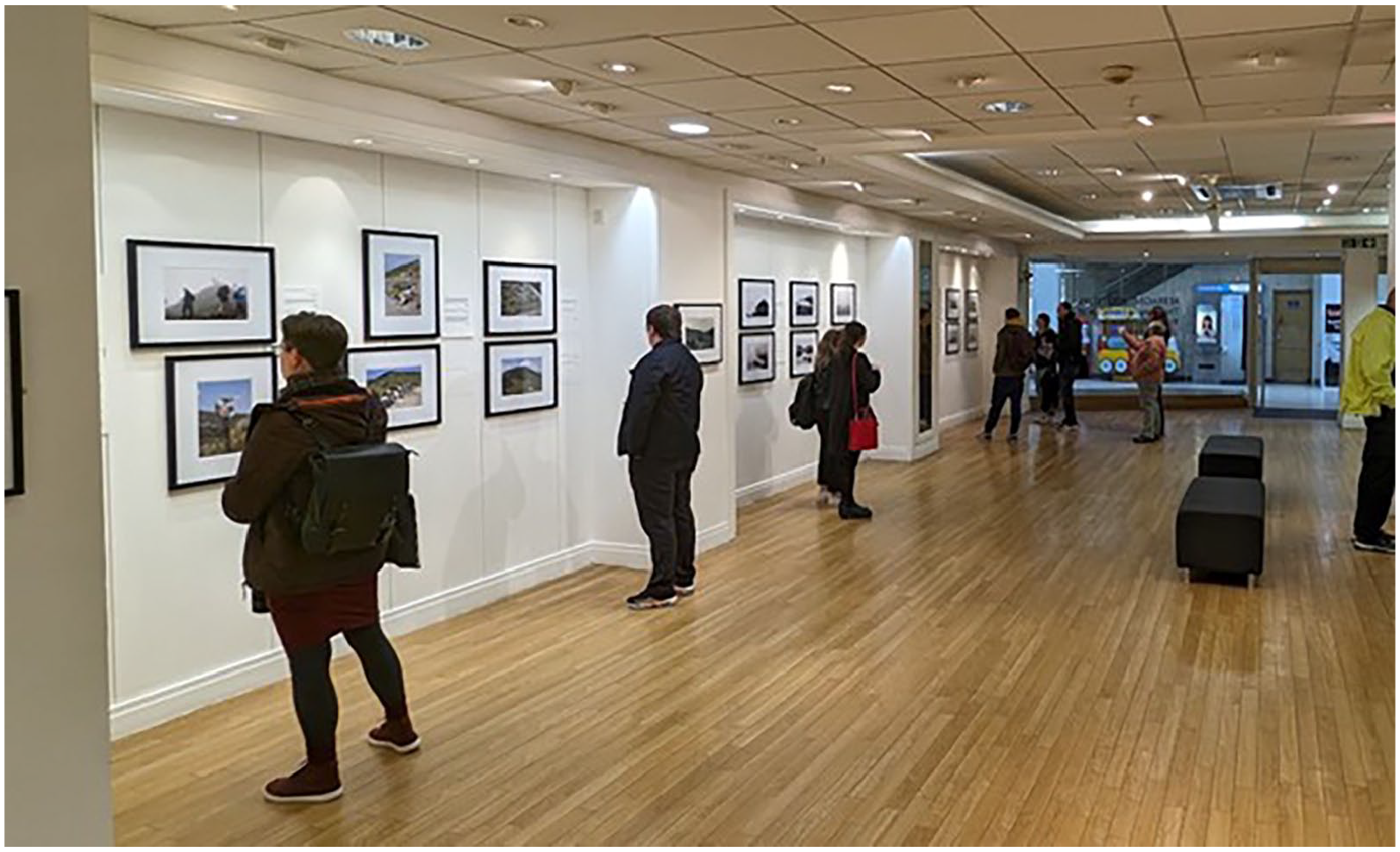
Visitors at the opening of the exhibition. Photographs (left to right) by Cian Quayle, Emma Petruzzelli and Janes Evans. Photograph by Daniel Bos.
Concluding remarks
This article reflects on an interdisciplinary project which seeks to reanimate historical archival testimony in conjunction with artist practices. The synergy between cultural geography, art and photography presents opportunities to expand perspectives on how landscape is encountered, experienced and embodied in practice across space and time. The curation of a ‘research-based exhibition’ offers an alternative means of disseminating and presenting research for cultural and historical geographers and establishing collaboration with art practitioners. 13 Likewise, the project demonstrates new opportunities to connect contemporary audiences to archival materials that have long remained dormant. By reanimating archival materials, this work opens the interpretative potential of how the landscape can be reimagined and otherwise understood by providing practical insights into past and present encounters through the juxtaposition of image and text. This project activated new insights into how the landscape is shaped by political-economic developments, how such geographical encounters and art-based practice and research coincide, and, subsequently, how our experience and understanding of the landscape are manifest today.
How the past is reimagined and reconfigured is significant in its ethical consideration of power and representation. Artist approaches can challenge and highlight how the landscape is shaped by its historical legacies and how this is represented in art and photography. The ubiquity of ‘taking’ rather than ‘making’ photographs can reaffirm the ‘tourist gaze’. This is an important distinction that reflects upon how the landscape is encountered set against the environmental and socio-economic issues that jeopardise any hope of a sustainable future. However, we argue that the intersection of cultural geography and photography practices, which reanimate existing and contemporary archives, lead to new ways of walking, seeing and reading the landscape. These strategies also question and expose the continuities, departures, and tensions between human-environmental relations and the mountain landscape of Yr Wyddfa as a contested site of experience in relation to identity, place and the environment, and the narratives which continue to shape its story.
Footnotes
Acknowledgements
The authors would like to thank and acknowledge the work of Emma Petruzzelli and Jane Evans, whose photographs are featured in this article. We would also like to thank Caleb Johnston for his support and constructive feedback in earlier iterations of the article.
Ethics statement
This study relied on publicly available archival materials. All sources have been properly cited in accordance with academic standards.
Funding
The author(s) disclosed receipt of the following financial support for the research, authorship, and/or publication of this article: The research was funded by the Breaking Boundaries Fund 2023, Culture and Society Research Knowledge Exchange Institute, University of Chester.