




Abstract
Contemporary cultural geographies have increasingly addressed subterranean and deep spaces through questions of access to earthly materials and the politics of resource extraction. This article engages with these themes through an investigation into the ‘doings’ or practices of seabed access. It does so by following the embodied and material experiences of two human geographers, an artist, a scientific coordinator and a microbiologist, who together undertook a day trip to learn shallow sediment coring in the Wadden Sea mudflats of Northern Germany. Stemming from a research project concerned with the accessibility of the seabed in international waters (how society can access its ‘common heritage’), we examine how taking samples from even the most accessible type of seabed – a shallow coastal mudflat within national waters that is not covered by seawater during low tide – presents a myriad of considerations, challenges and complications. We argue these are vital in examining the cultures of access – the embodied and material limits that define and shape participation in environments in which you and I have rights. These considerations, challenges and complications ranged from physical strength and balance requirements to an understanding of tidal movements, access to simple but specific equipment, appropriate clothing and private transport. We use ethnographic reflections and our photographic engagements to consider sedimentary relations: how we can and do relate to the seabed.
Curiosities
Why might a motley crew: two human geographers, Kim and Amelia, one artist, Anna, a science coordinator, Kristin, and professor of microbiology, Thorsten, venture out to practice shallow seabed coring, together, on a spring morning in North-West Germany?
The excursion was organised as an intersection of two independent projects: the first, a research project examining public access to the international seabed as the common heritage of (hu)mankind (Kim, Kate, Amelia) and the second, an artistic endeavour creating connection or access of audiences to the deep seabed through scent and touch (Anna). Thorsten acted as teacher, guide and coring enthusiast. With Thorsten’s expertise, we wanted to understand cultures of seabed access, the very ‘doing’ of seabed access – at a time at which access to earthly materials, the politics of resource extraction and aesthetic and embodied engagements with the subterranean and other deep spaces are increasingly crucial topics of and sites for consideration in contemporary cultural geographies. 1 We sought to understand how attempting to access the seabed – even the shallowest of areas – raised questions related to socio-cultural engagement with material spaces to which we have legal rights, as national citizens (for spaces within state boundaries) or as planetary stewards (for seafloor spaces beyond).
Here, we offer insights into our interdisciplinary sedimentary relations – the practices of spatial engagement and the sensory dimensions of encounter with the seabed. Our exploration of these relations through seabed coring comes at a moment where planetary relations, earthly matter and its resonances are in the geographic spotlight, albeit often through a geopolitical gaze. 2 It comes at a moment, too, at which the seabed is highly politicised 3 but its cultural dimensions remain under-examined. What do these challenges for access mean for our engagement with wider ‘earthly’ issues? In reflecting on the process of shallow seabed coring, we pose cultural questions of who (which bodies and abilities) can access seabeds, when, and how. The following short sections consider the act of shallow core sampling in relation to time, matter and embodiment. We begin with the process of preparing for our trip.
Accessing the seabed: purpose and preparedness
The Wadden Sea is ‘the largest unbroken system of intertidal sand and mud flats in the world’ 4 spanning the Netherlands, Germany and Denmark and forming part of their national waters (over which they have sovereignty). We were interested in the Wadden Sea seabed as a proxy location that could indicate some of the material properties of the deep seabed as well as demonstrate some of the scientific processes of sampling as a means of access. Our precise destination was Dangast, a rural coastal village with a long history of fishing, farming and art. 5 More recently, it has become a domestic tourism destination and boasts a small harbour with a strip of beach that, at low tide, blends into the extensive mudflats.
The field trip formed an avenue for direct encounter with fresh, in situ seabed sediments – earthly matter that signals a world in the flux of climate change, to which we have rights to steward, but have difficulties accessing. Shallow sediment sampling (as a means of access) relies on a simple scientific method of push coring, designed to capture undisturbed stratigraphic layers of soft sediments from the surface up to around 50 cm into the earth. The operator takes a long, hollow tube, one end of which is bevelled, and pushes the bevelled end as far as possible into the sediment (Figure 1). They, then, place a rubber stopper over the end of the tube not embedded in the sediments and pull the tube back out of the ground, placing a hand under the unstoppered end when it emerges to prevent the material escaping (Figure 2). The filled corer is then placed atop a solid tube the width of the corer’s interior (Figure 3), the stopper is removed and downward pressure is applied until the sediment is forced up through the tube and emerges as a core at the top (Figure 4). The operator can then take samples of the material as it becomes accessible. We examine three elements of access via coring in the following sections.
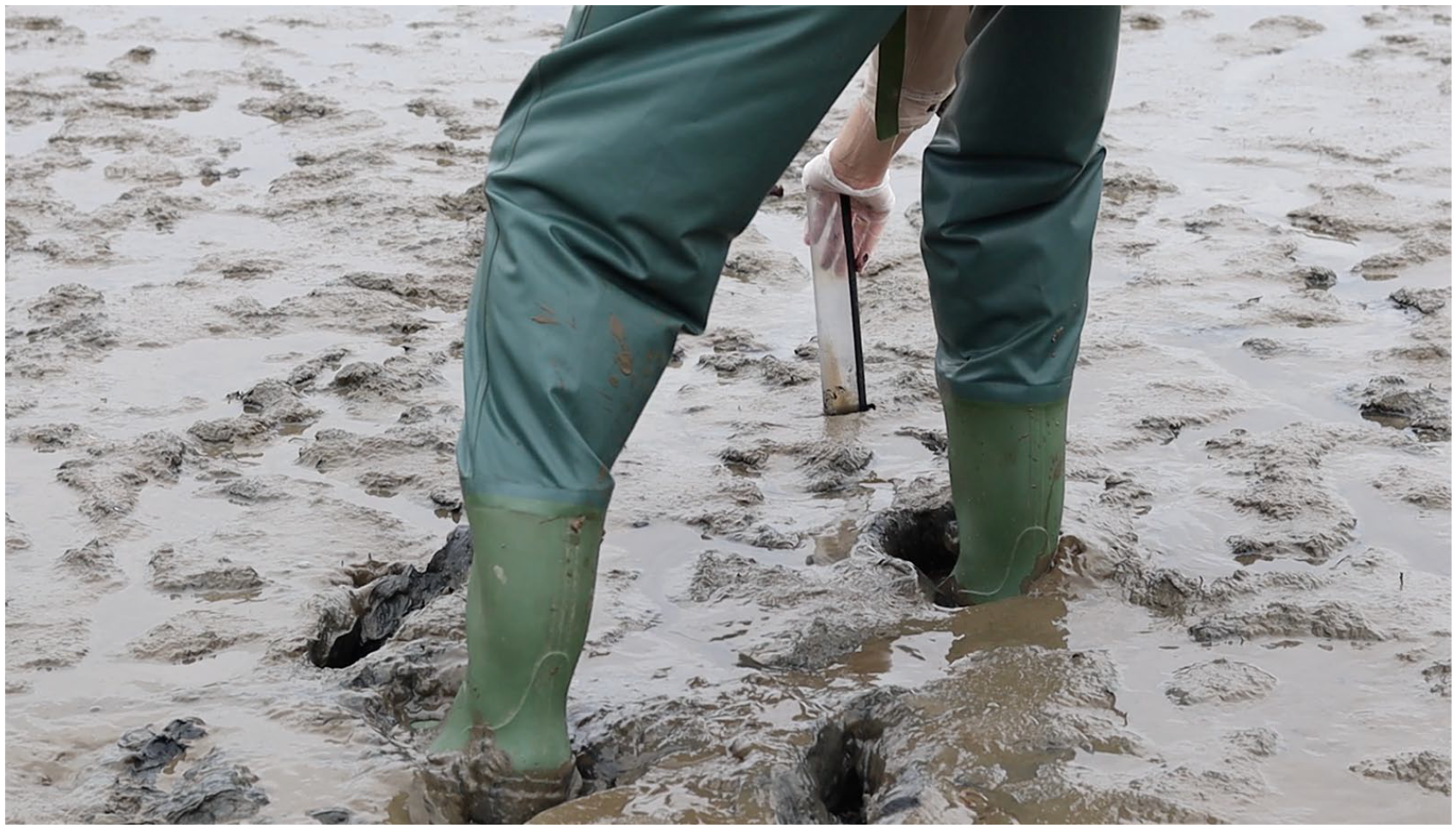
Thorsten pushing the corer into the sediment. Video still by Amelia Hine.
The rubber stopper sealing the top of the corer after extraction. Photograph by Amelia Hine.
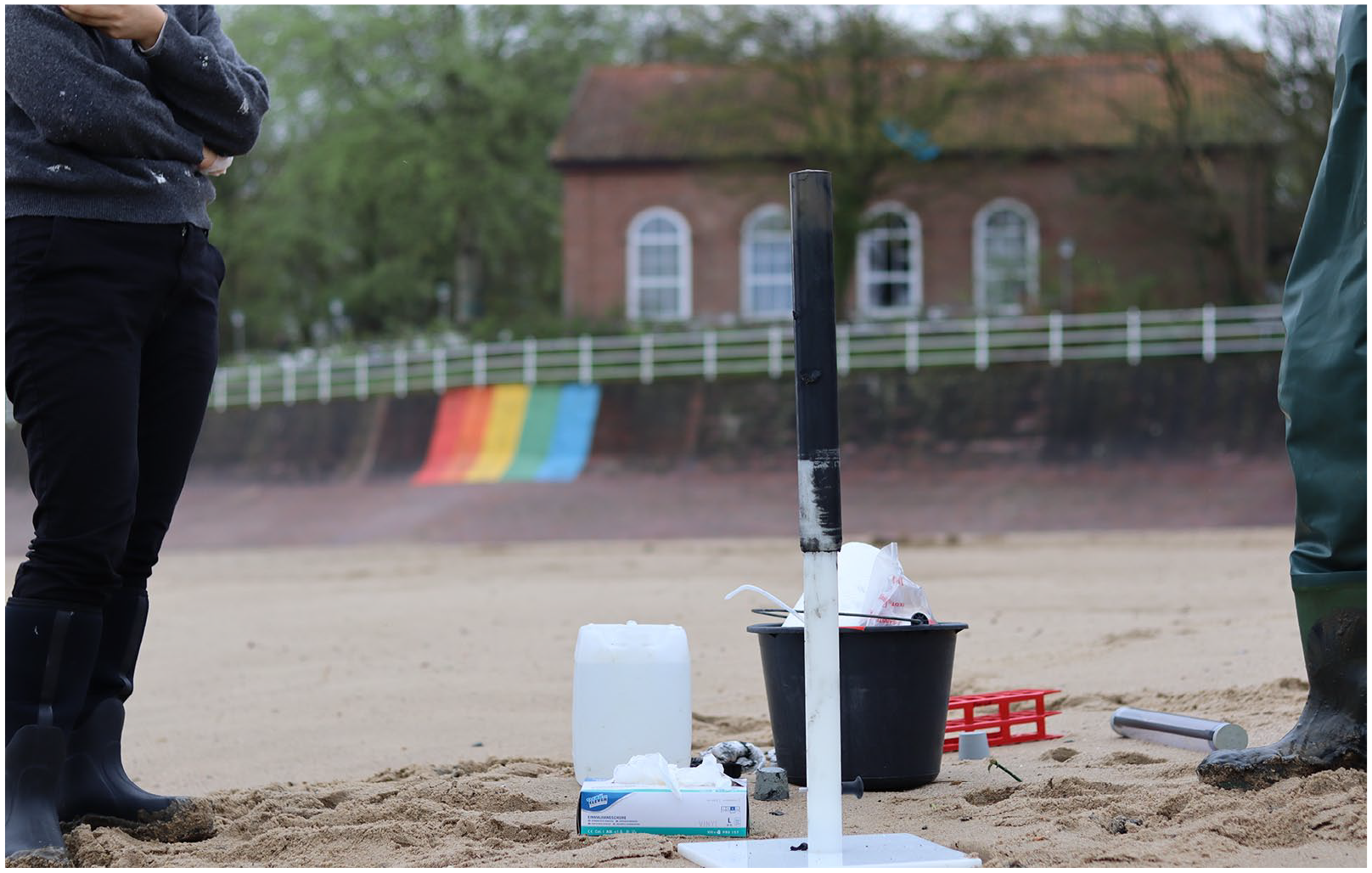
The corer filled with sediment atop the solid tube used to push the sediment out. Photograph by Amelia Hine.
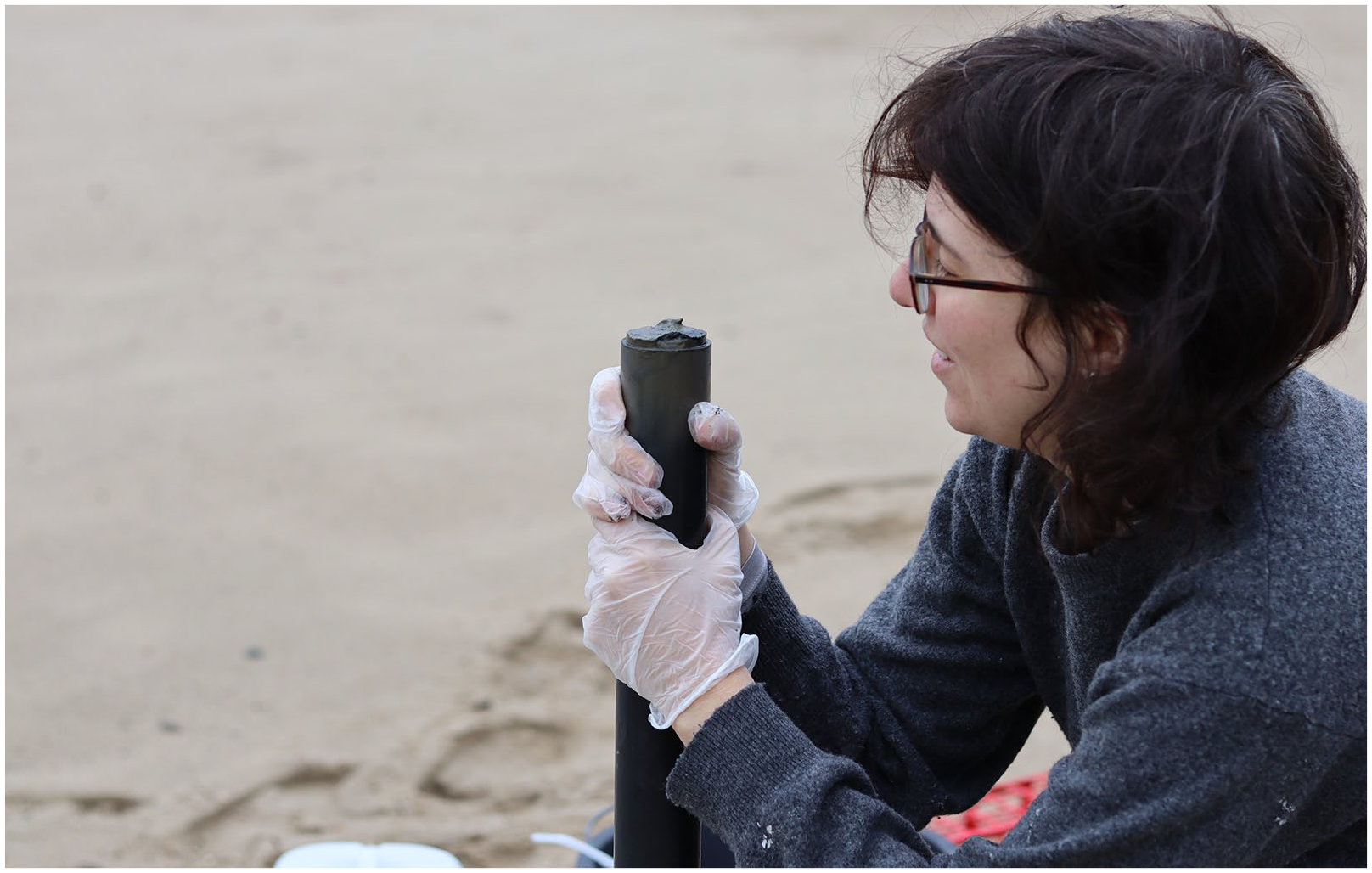
Anna pushing the corer slowly down the solid tube to expose the topmost layers of sediment. Photograph by Amelia Hine.
Time
Our rights to space are temporally constrained. After we had decided a date for our seabed excursion, Thorsten consulted a tidal chart to determine the window of time in which the water would be at its lowest. This timing was critical for direct access to the seabed without the visual and physical impediment of the water column. The same is not possible in the deep sea, of course. The calculations were readily accessible because of their predictable regularity. Yet as Jones writes 6 that tidal processes are ‘rhythmpatterns’ where the viewing of a pattern is, at any one time, only a ‘snapshot of a fixed moment of space/place’. In other words, the seabed is wrapped up in when it is: its temporality. There was an unevenness to the speed or rhythm of the ‘rising’ tide as it started to cover our sampling zone while we were still practising with the equipment (Figure 5). As Choi remarks ‘we might just as easily ask when the tidal flats are’. 7 Our access to the seabed was a matter of temporal access. Seabed access, then, is a matter of time.
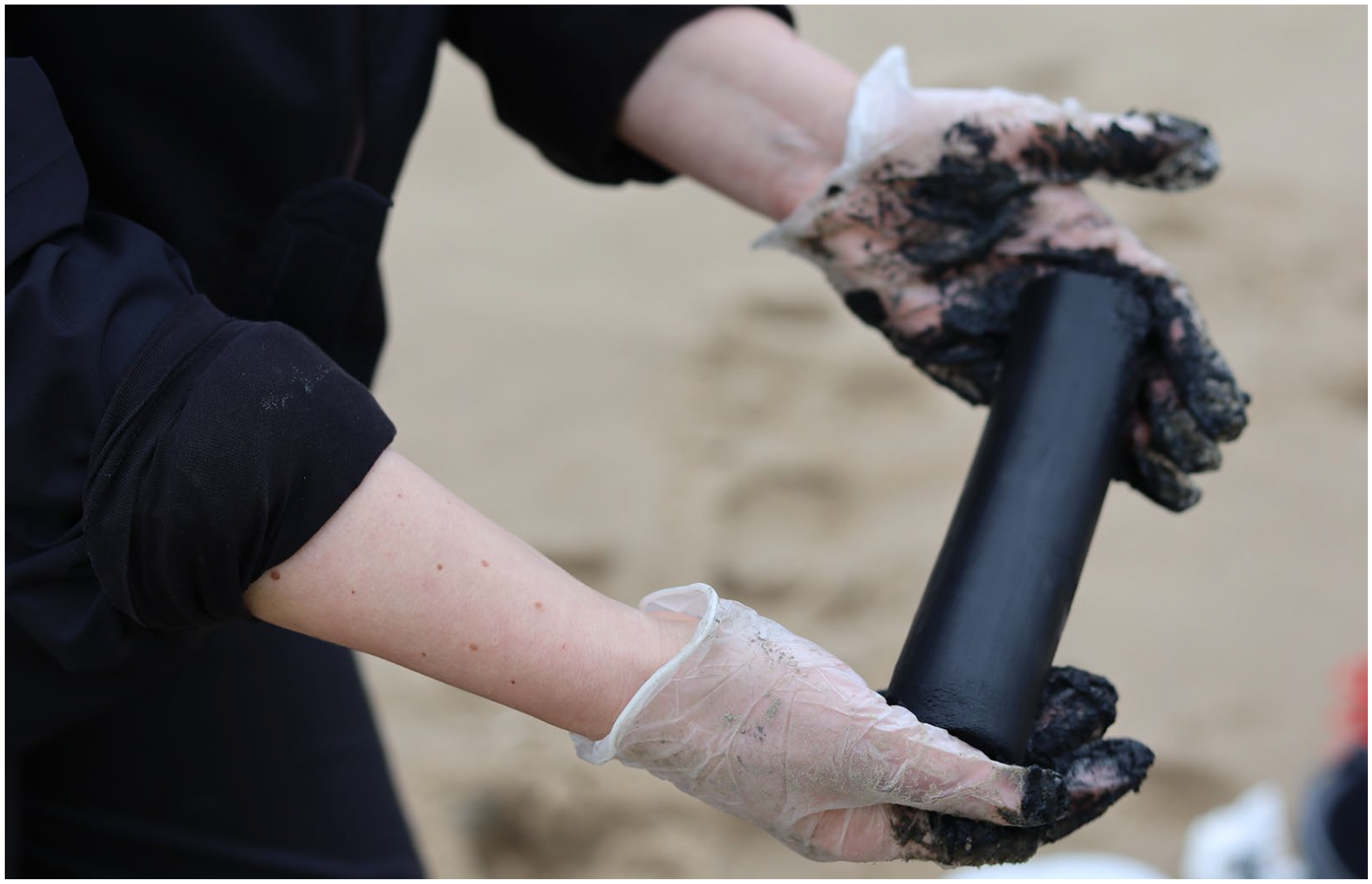
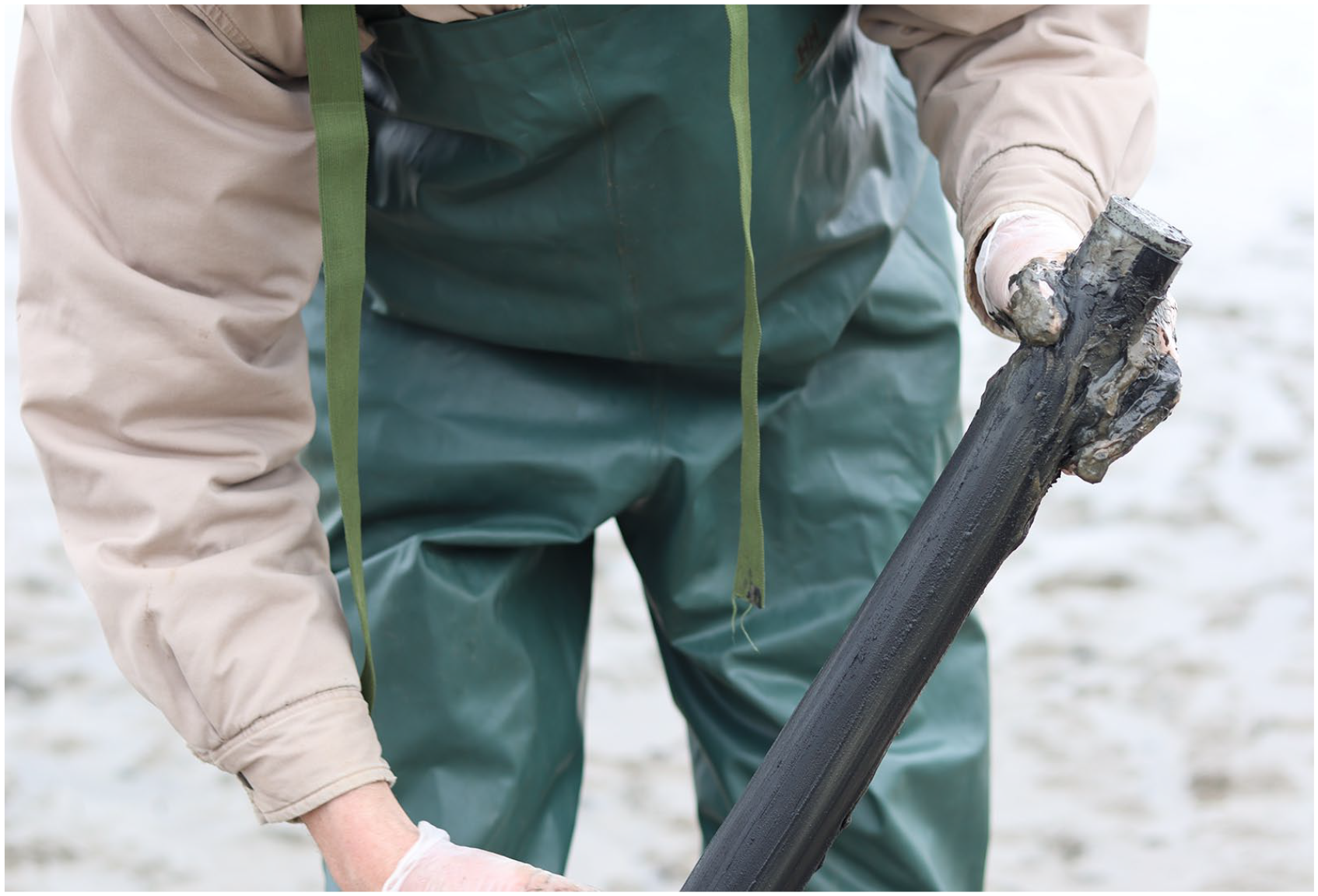
Kristin holding a length of core comprised of the black, anoxic sediment. Photograph by Amelia Hine.
Matter
The seabed we encountered (at the time of low tide) took the form of mud, where sediments and water mixed together, resulting in a tacky, sticky texture. 8 It was less dense or softer at the surface, and as we walked further out into the bay, this liquid-like mud extended deeper below the surface and our boots sank further down before resting on firmer sediments. This was a matter of surprise and a matter that moved. We found that in addition to the mud, we also collected it on the outside of the coring tube (Figures 6 and 7), on our boots and up our legs. Mud splashed onto our faces and into our hair as we worked. It became embedded in the zippers of our raincoats and encrusted under our fingernails. Its stickiness was an active reminder of what we were attempting to enact in accessing the seabed – to replicate access routes from the sciences – a specific ontological perspective of mud as object. It also reminded us that access is not simply something that happens in place. Traces of our access carry with us. We brought it into the car with us and took it back to our workplaces and houses. Access is not restricted to place through the mobility of matter.
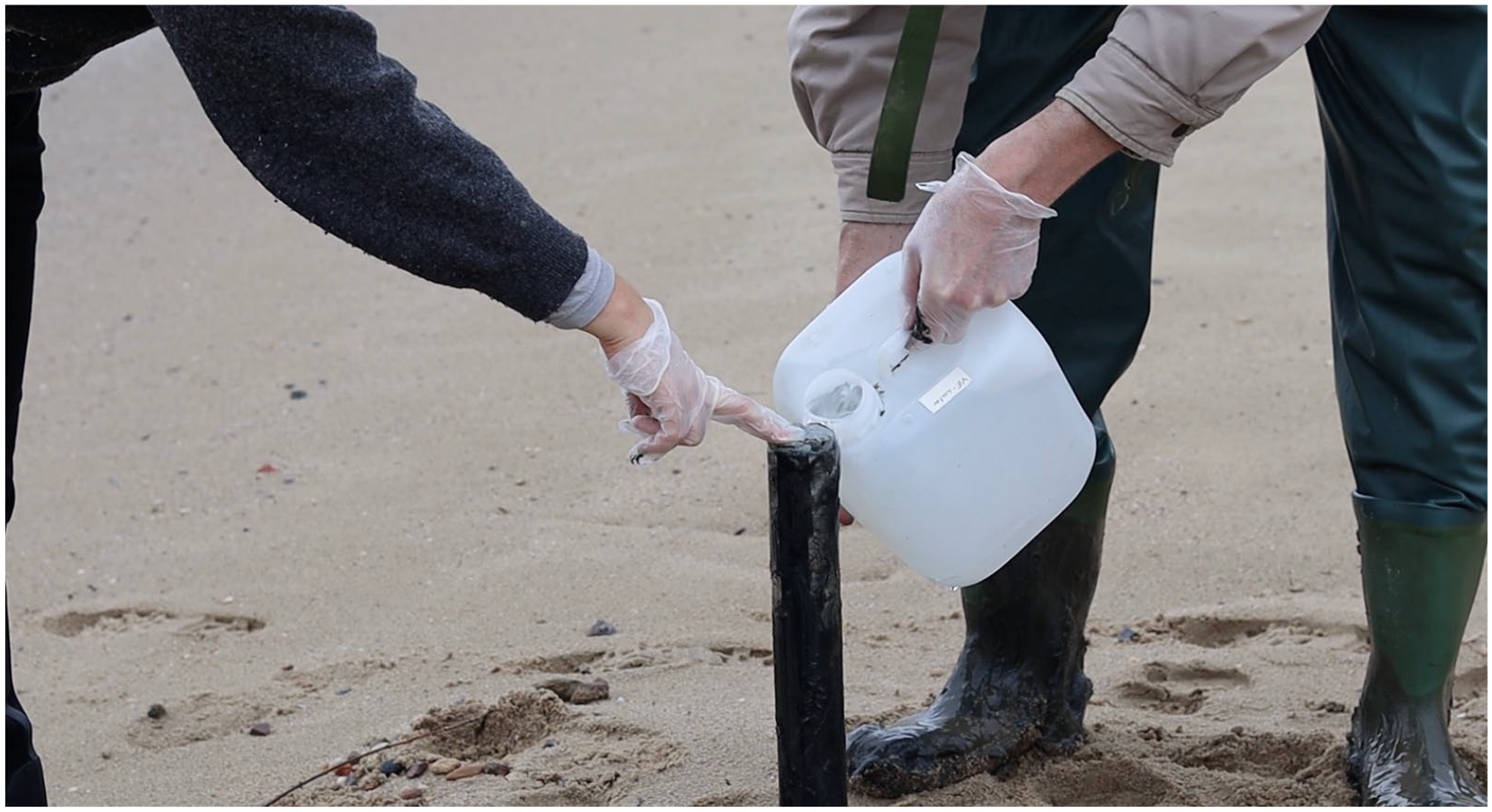
Thorsten and Anna using clean freshwater to try to wash the mud off the push corer exterior. Video still by Amelia Hine.
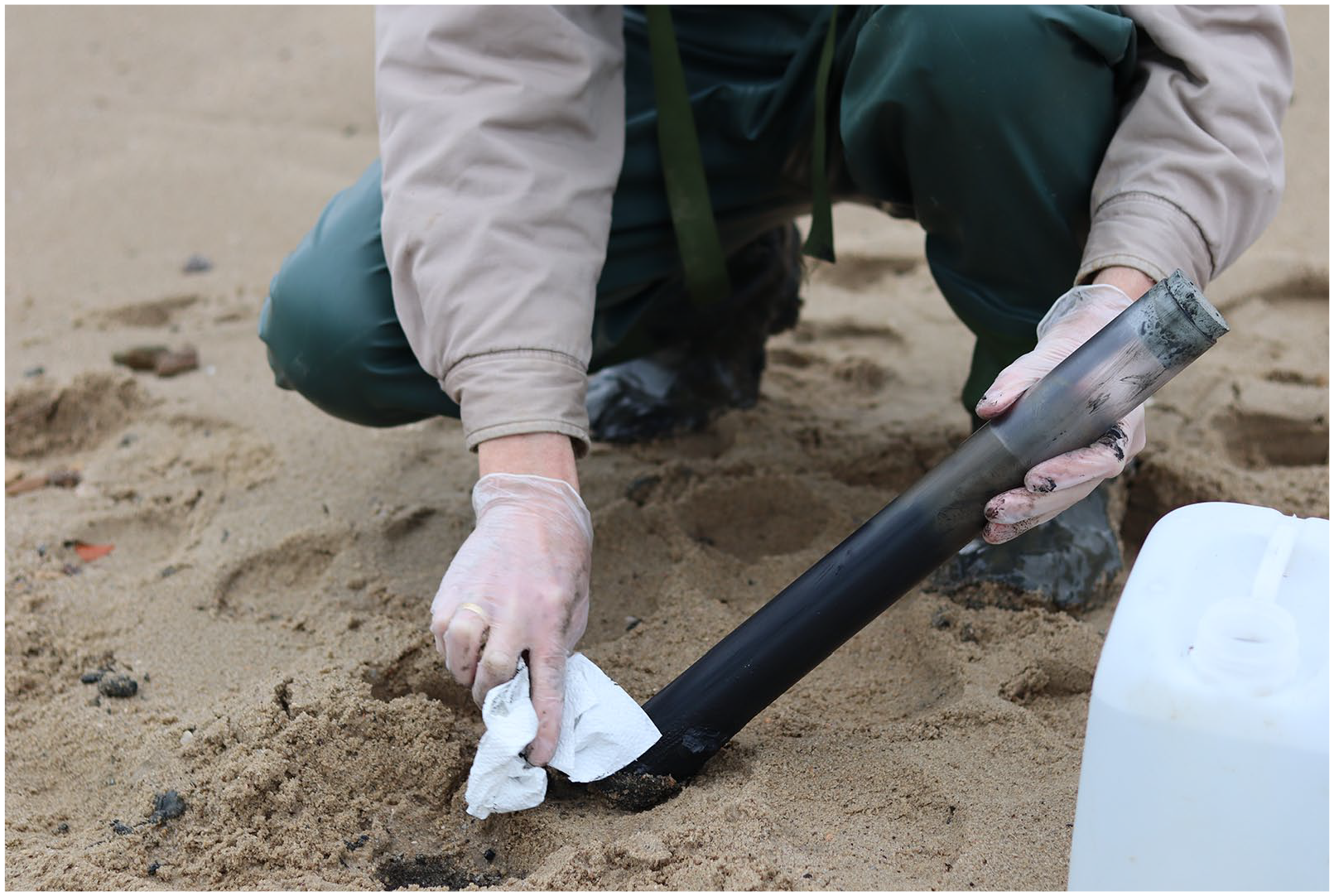
Thorsten using a paper towel to clean the last of the sticky mud off the push corer exterior. Photograph by Amelia Hine.
Embodiment
Yet this process of extracting cores required not only that we think about the mud’s materiality but also that we take stock of our own bodily engagement with environment and equipment. Choi points out that mud makes mudflats ‘particularly sensuous places for corporeal experiences’. 9 Walking out into the bay required balance and the agility to stay upright and steady enough to push the corer into the mud. We had to negotiate the limits of our own stability as we sought out areas with softer, deeper mud where we could more easily collect cores of a substantial depth. When we miscalculated the depth or were unable to venture far enough out to softer mud, we found that we needed to apply significant force on the corer to penetrate the sediments. At one point, Kim was using her entire body weight (see Figure 8), one leg in the air, to try – with limited success – to push through particularly hard sediments close to the edge of the beach. Our ability to judge the mud’s relative penetrability was limited, indicating our lack of familiarity with this kind of environment. This also indicated a certain ‘able bodiedness’ that was needed to access the seabed.
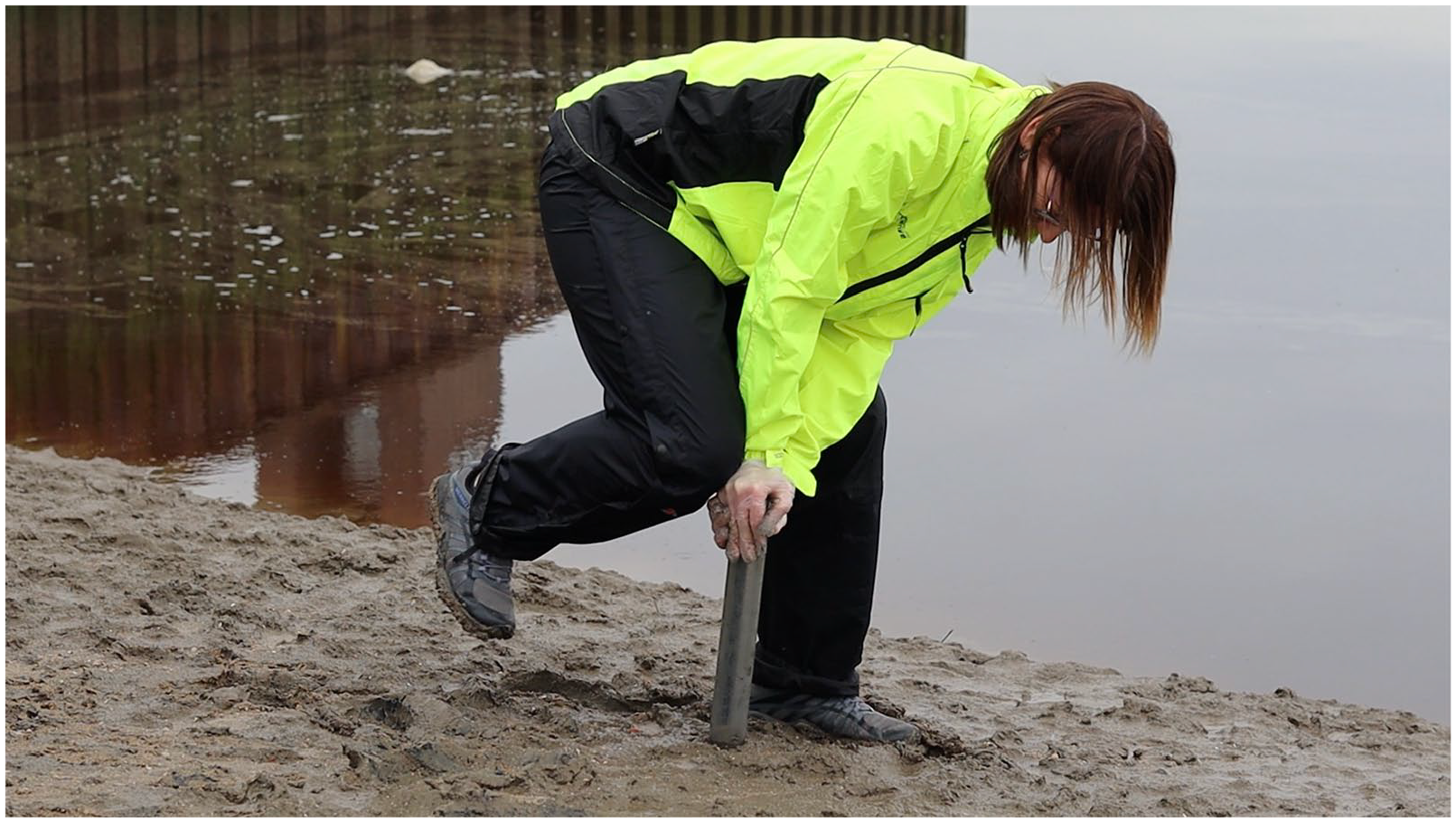
Kim putting her entire body weight onto the corer to try to collect a sample of more solid sediments. Video still by Amelia Hine.
At the same time, the experience of being within the mud made clear that our bodies are not somatically prepared for such materiality. Unlike the worms that burrow within or the wading birds whose feet have adapted to sit atop the mud, we sink unevenly through it (Figure 9). We easily becoming stuck or lose our balance. For some of us, our bodies’ lack of adaption for such an environment reinforced the feeling of being within a different world.
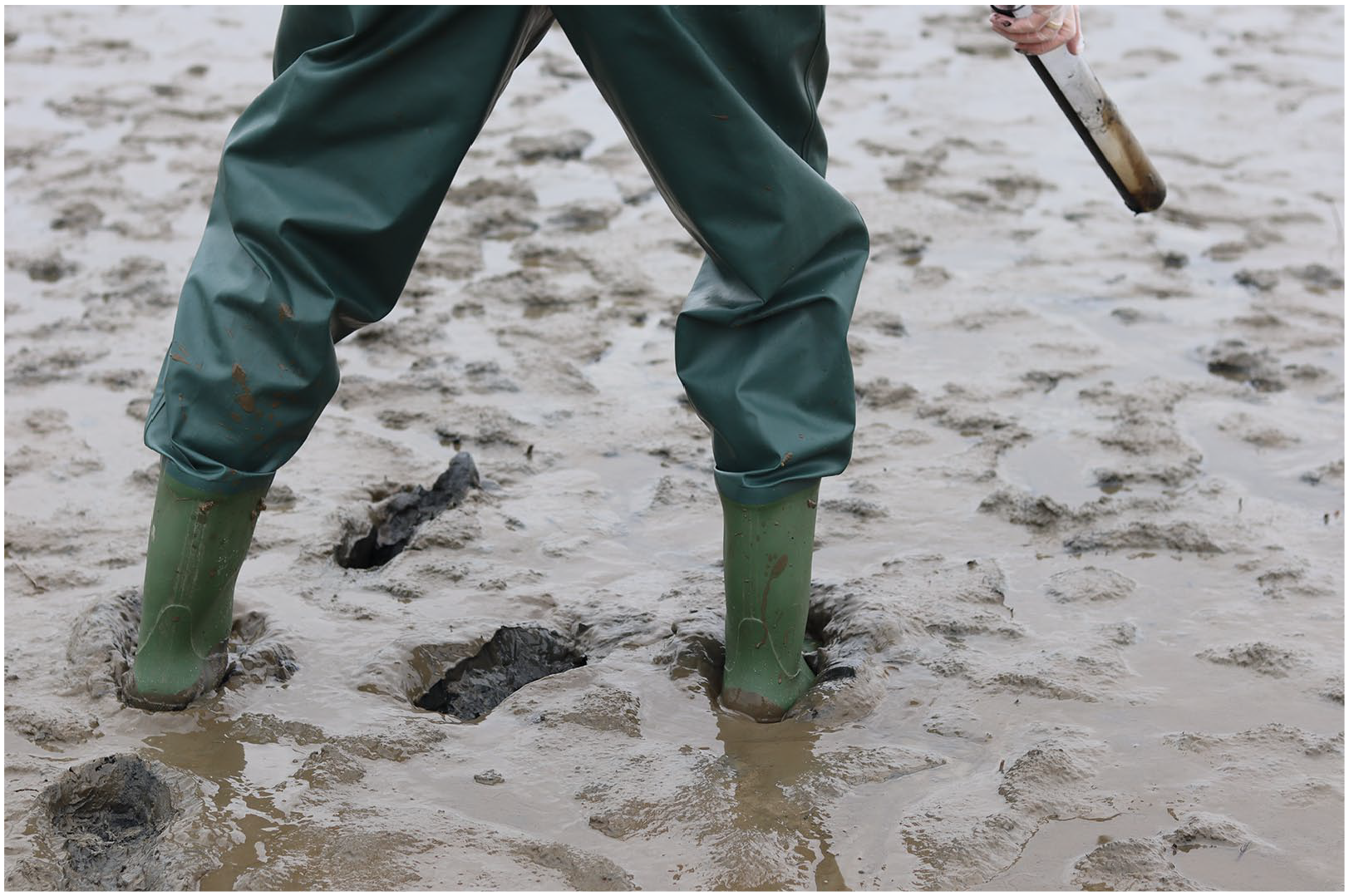
Maintaining our balance as we sink into and carefully move across the slippery mud. Photograph by Amelia Hine.
Unsettling conclusions
In taking soft sediment core samples, we encountered the limits and constraints of accessing the seabed even in a liminal zone. Our samples would enable future access to the seabed – to those in the office, lab or studio who would engage with our collected materials. Our work had stretched the seabed from the sea. In broadening our own sedimentary relations through sensory encounters with the seabed we simultaneously increased our understanding of how accessibility to such spaces is restricted through factors such as bodily strength and stability, access to appropriate equipment and clothing and even guidance in how to collect, observe and interpret the sediments. Having identified many challenges to meaningful shallow seabed access it is apparent that despite legal tenets that profess rights to such spaces, the application of those rights through the avenue of access is deeply uneven. If such issues of access exist in relation to sites as simple as shallow coastal seabed, there is a need for further focus on how rights are culturally and materially enacted in increasingly complex and deep spaces.
Footnotes
Ethics statement
This project was conducted with ethics approval (Drs.EK/2023/084) from the Kommission für Forschungsfolgenabschätzung und Ethik at Carl von Ossietzky Universität Oldenburg.
Funding
The author(s) received no financial support for the research, authorship, and/or publication of this article.
