




Abstract
This paper engages with a key trope of landscapes as representation: their mirroring capacity. Contextualising the concept of ‘landscape’ within art history, the paper invokes several technologies that have been functional in the recognition of landscapes while themselves remaining invisible. One such technology is a 17th century technology known as the ‘Claude Glass’, which is analysed with the help of Lacanian concepts. The aim of the ensuing analysis is to advance the use of landscapes in public discourses, better to understand the work done by landscapes in different contexts. To illuminate this work, the paper deploys material landscapes formed in Ireland around so-called cilliní – unmarked graves of what were undesirable bodies in bygone decades.
Introduction
The world of Lacanian geographies has become varied and multilayered over the last two decades. Geographers and other spatially minded scientists have embraced a specific kind of psychoanalytical approach in attempts to situate the interface between world in general and human beings not just where skin meets the material world but elsewhere as well. The nature of this ‘elsewhere’, what is does and how we can learn from its composition, structure and actions, is the matter of fruitful debates, as are the consequences of its embrace. Anna Secor, Paul Kingsbury and Lucas Pohl have expanded on earlier engagements with psychoanalytic methods and theories by Steve Pile, David Sibley, Heidi Nast, Felicity Callard and others towards an explicitly ‘Lacanian’ form of engagement with space. 1
Readers not thoroughly familiar with the writings of Lacan may nonetheless recall, first, his opening gambit in Écrits, a collection of 35 essays that made his name in 1966, in which Lacan reckons that ‘man is no longer so sure a reference point’. 2 It is this ‘absence’ of a fixed form of gendered subjectivity as either the point of departure or the goal of any psychoanalytical intervention that makes Lacan’s work unique. Secondly, his infamous statement that positioned ‘the unconscious as a language’ 3 firmly anchored the field of psychoanalysis within the world of structuralism. Finally, he radicalised a spatiality already inherent in the thinking of Hegel and Freud by refuting the epistemological ability to close (or heal) any ‘thesis/antithesis’ or ‘consciousness/subconsciousness’ dialectical division. While all three key insights are present in this paper, it is the last of these that has the most far-reaching consequences for any thinking about and every work accomplished through ‘landscapes’.
The paper will expand on the body of literature mentioned above through an engagement with the material reality of landscapes as reflected in and through mirrors. If the former require little by way of introduction to readers of this journal, it is the nexus with mirrors that requires explanation. Long held to be a metaphorical approximation of what language and knowledge should aspire towards: facilitating a mirroring relationship with reality, decades of post-foundationalist discourse and practice have rendered ‘mirrors’ less innocent and passive than they may previously have appeared to be. 4 But if ‘landscapes’ do not mirror and thereby express social and cultural realities, what do they do? And what of the mirrors themselves in the process of critical reflection – a term that itself embodies ‘mirror-like’ properties? It is at this point in our engagement that the work of Jacques Lacan can arguably offer fruitful avenues for future geographic encounters, which are explored in the pages to follow. A key point of departure emerging from the meeting of Lacan’s œuvre and landscape geographies is what Myung In Ji has fittingly described as ‘the fantasy of authenticity’ – the demarcation of a representational impossibility that nonetheless brings about consequential realities. 5 Inflected towards a Lacanian analysis of landscapes, this ‘fantasy’ resides in the recognition that as an object borne of a subject’s active or passive engagement with ‘world’, any landscape is beholden to that subject’s constitutive structures and registers. Mirrors, as we argue, are an integral element in the construction and maintenance of ‘fantastical landscapes’.
On ‘landscapes’, again
In choosing to focus on landscapes, we do not centre our attention on any old concept. Rather, we acknowledge that ‘landscapes’ hold a particular value across the social spectrum and within virtually all known cultures. Walking towards or within, driving across or simply looking at a ‘landscape’ counts as one of the more universally appreciated activities on this planet of ours, so much so that renditions of landscapes fill our collective imaginations in the form of artistic, lay and everyday representations using different tools and technologies across the ages. Unsurprisingly, therefore, landscapes can be approached in different manners: they can be thought of as ‘positive’ representations of reality, 6 as identifiable dynamisms within space, 7 as the end result of work done on the land, 8 as moods and embodied sensations, 9 veils, 10 as psychological topographies 11 and can be approached with the help of so many more and different conceptual approaches. 12 More recent engagements with landscape have furthermore adopted a more overtly ‘political’ focus by developing moral claims towards the ‘right to landscape’ 13 while restrictions on individual mobilities imposed in recent memory at the onset of the CoVid-19 pandemic in 2020 have heightened the appreciation of locally accessible landscapes, especially in the form of parks located within walking distance from home. 14
Our concern in this paper, however, is neither to advance, challenge nor to rehash debates of old or to mitigate between them; rather, we will develop and argue for a different kind of engagement with the ‘work’ involved in the construction of landscapes. ‘Work’ here involves not merely straightforward analytical labour but an encounter with the conditions of possibility of such labour 15 ; our interest in this matter is thus a decidedly epistemological one that queries its own ‘constructed’ nature.
At the same time, engaging with landscapes often entails a public gesture: more than many other material items deployed in public engagements, ‘landscapes’ have an innate and embodied quality that rhymes with the everyday practices of most citizens. As many geographers have experienced, beginning a journey with a shared and concrete ‘landscape’ and from whence embracing ‘landscape’ as a concept yields constructive results. Starting from here, it often proves to be productive to query backwards, to critique ideas and practices associated with landscapes. Key to this analytical encounter is the starting proposition that ‘landscapes’ seemingly require the registers of both singularity (or identity: ‘something’) and repetition (or language: ‘something else’) for them to be present. When using landscapes publicly, we use representations of landscape; in so doing, we engage in a double act of figurative replacement by highlighting the constructed nature of landscapes with the help of embodying materials – paintings, postcards, photographs, collages, films and other representational technologies. This is as it should be – and is both enjoyable and occasionally effective. But it requires something to work which itself is not present in any public setting: a gesture associating differences through the postulation of correspondences; in short, as we’ll argue in a little while: a ‘mirror’ of sorts.
We use the term ‘gesture’ deliberately: we usually bridge these differences by pointing towards that which we mean to imply and by associating words with that pointing gesture. In this manner the quintessential Hegelian insight into difference – the ‘this is this because it is not that’ – is temporarily overcome (the ‘synthesis’ in Hegel’s dialectic) by entering a referential relationship aimed at bridging what is a constitutive distinction. But like all gestures, this one can be deceiving: for us to know what we are pointing towards and are identifying in language, some property of ‘it’ has to be lodged already on the other side of the divide – an unacknowledged anchor of sorts, so to speak. The ‘lodging’ of ‘it’ is the work of culture: we understand pointing gestures because their practical validity is confirmed to us daily in our practices and communication within a world of shared reference points. We do not question them because they work.
None of this will be news to readers attuned to post-foundational engagements in cultural geography and beyond. Most of the work presently undertaken in that sub-discipline of geography bears some mark of this formative insight: we dare not speak in absolutes, preferring instead to refer to the always constructed character of what we write about. In so doing, we set aside or bracket the gesture itself, the formation of a bridge between ‘this’ and ‘that’; in its stead, we prefer to embrace its situated, embodied and pragmatic resolution into something that serves whatever purpose we designed. Here and for the time being, the bridging gesture we discussed a moment ago thus becomes its own foundational practice.
It is this systematised, local, and always already positioned relationship that exists between us and landscapes that forms the heart of this paper. It asks two perceptively simple questions: what is implied to be ‘at work’ when we posit or develop a relationship between a landscape, its representation and us? And, complementing the first question, how do we approach constitutive silences and absences woven into landscapes, their representations and the work they accomplish?
Mirroring effects
Whatever it is that is ‘at work’ here is not itself visible or perceptible. In fact, if it were it would only get in the way of any aesthetic or contemplative engagement with landscapes. From an epistemological point of view, however, to accept, however implicitly, that because something works it does not require explanatory labour is foolhardy at best and neglectful at worst. Such neglect can originate, for instance, in not acknowledging the effect that a frame will bestow onto the representation of a landscape, creating inclusions and exclusions, establishing relations and a sense of scale. Furthermore, just like a mirror really is no more than a glass plane coated with a reflective material (silver or aluminium) attached on one side, so the bridging gestures we deploy when explaining landscapes depend on something itself not visible but ‘in play’. Crucial for the purpose of this paper is the recognition that when a mirror works, what it reflects is not necessarily what is seen. As anyone struggling with their gender identity or body-shamed persons know all too well, mirrors often fail those looking into them. 16 We know of no better approximation of this reflexive challenge than the work of Gillian Wearing: her 2017 photographs Me and Claude in the Mirror and Between a Mask and Mirror in particular express the conundrum at work and in play in a mirroring relationship (Figure 1). 17
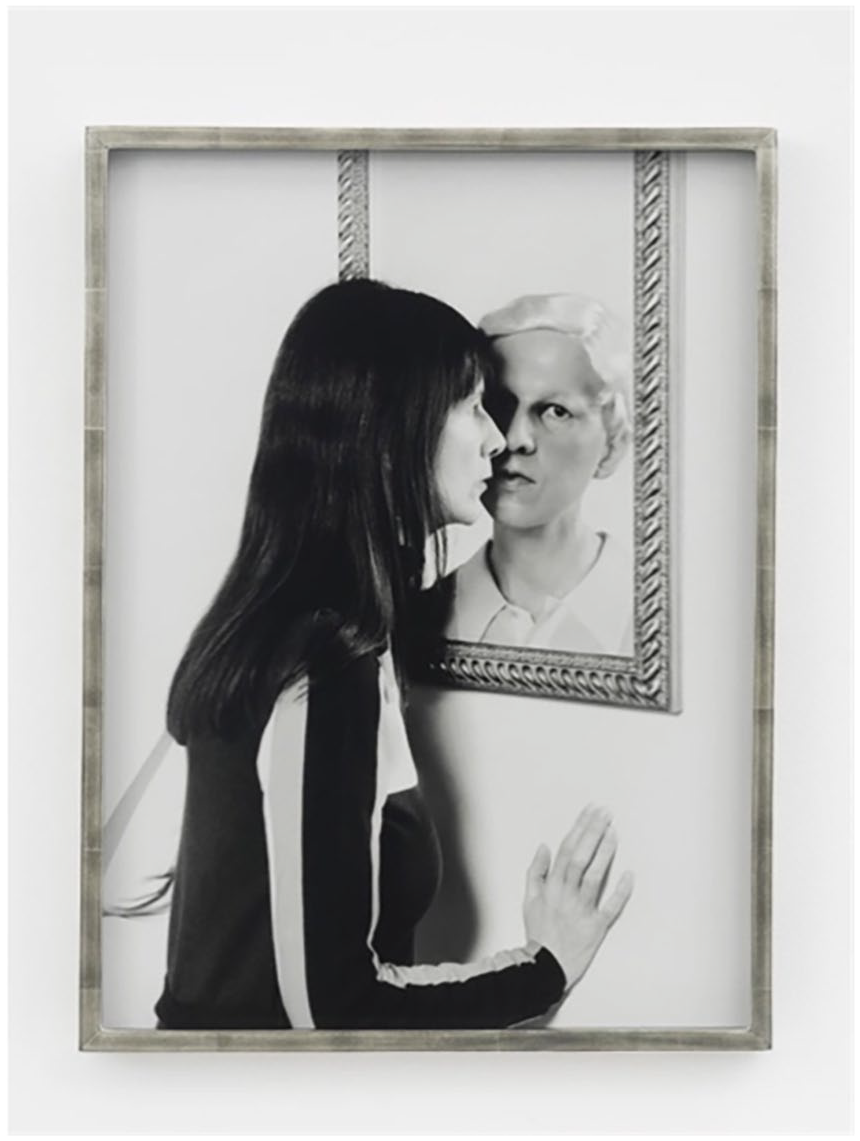
Gillian Wearing, Me and Claude in the Mirror, 2017 (framed bromide print, 52.4 × 39.4 cm; © Tanya Bonakdar Gallery, New York, NY, USA; used with permission).
Equally, mirrors do not merely reflect what can intuitively be recognised as such, they also actively interfere with what is being reflected – from the infamous ‘objects in mirrors are closer than they appear’ to other, often not innately perceptible distortions. Teaching landscapes qua representations anchored in Western art history, for instance, is to become aware of effects created by several such contraptions, starting with the adaptation of the vanishing point in Western painting during the 15th century 18 and extending towards cubist answers to the very same problem of representing three dimensions on a two-dimensional plane. Famous amongst such technologies is the so-called ‘Claude Glass (or “black mirror”)’, a name purposefully invoked by Wearing. A technical apparatus of the pre-photographic era named after the French Baroque landscape painter Claude Gellée (called ‘Claude Lorrain’, 1600–1682), the ‘Claude Glass’ was a mirror positioned between an artist and an object about to be captured. Its convex nature created a representation of landscapes in which a loss of detail (of colour in particular) was matched by an increase in perceptive focus, thereby augmenting those picturesque or ‘pleasing’ qualities sought in the respective representation of landscapes. William Gilpin, one of the inventors of the notion of the ‘picturesque’ in the English language, likened the effect created by the Claude Glass to ‘the visions of the imagination, or the brilliant landscapes of a dream’. 19 This effect is not merely a result of the convex nature of the mirror but moreover owes something to the slightly oval shape of its frame corresponding anatomically to the human eye. The translation of such an image into a rectangular picture frame arguably leaves us, the onlooker, with the sense that more exists beyond a painting’s parameters; all we have to do, we think, is move our head and we will discover what else is there. 20 Although there is no firm evidence to support Claude Lorrain ever using such a contraption, its effect is readily apparent in his many paintings of landscapes; here, then, a potentially absent technology creates a mirrored effect that mimics its presence (Figure 2).
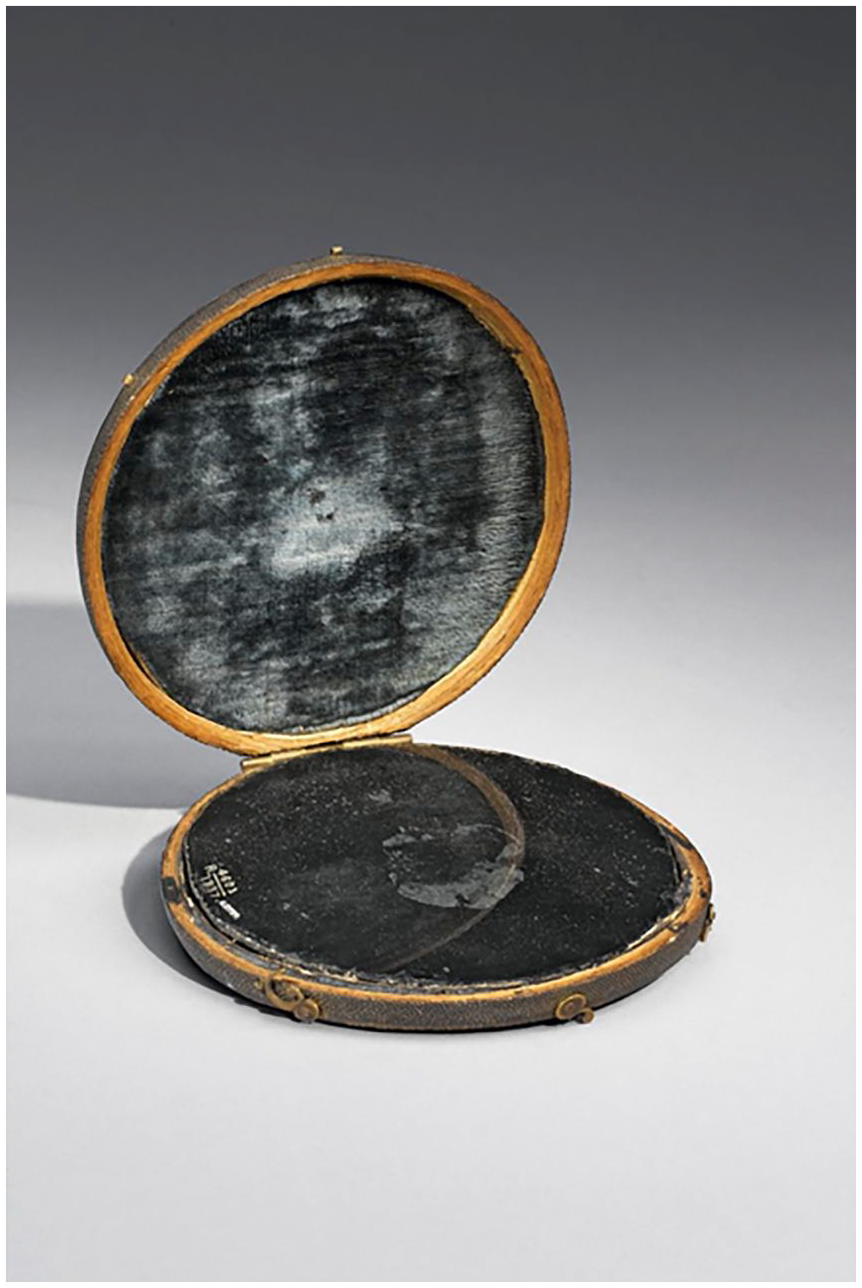
The ‘Claude Glass’, (© The Board of Trustees of the Science Museum, London, UK).
To appreciate this ‘mirroring’ effect, we need to place it within two interrelated contexts. First is the fact that historically, the surge of representations of landscapes during the Baroque area owes a lot to the gradual emergence of ‘land’ as a commodity, moving away from erstwhile stable apportionments of land in feudal societies towards more fluid, validated and tradable notions of land. This is the story told in the late Denis Cosgrove’s 1984 landmark study Social formation and symbolic landscape. Second and with a more overt epistemological bend, the Claude Mirror [. . .] draws attention to the complex mediation between looking and mark-marking, framing and representation, as well as the many interventions that occur between apprehending and understanding landscape.
21
Geographers would likely refer to the above processes as the ‘social construction’ of the emerging ‘represented landscapes’, which have since become a staple in most art museums around the globe. It is important initially to differentiate the effect created with the help of a Claude Mirror from outright distortions like the ones created by highly convex, fisheye lenses in photography. Rather, the drifts created here denote more subtle shifts in how landscape are produced to become an effect, an impression, a result. Combined, these two contexts brought about a profoundly different appreciation of symbolised landscapes, which in turn began to shape the creation of landscapes themselves: 18th European gardens in particular became increasingly moulded in accordance with the image produced in a Claude Glass, effectively reversing the relationship between ‘real’ and ‘imagined’ landscapes. 22
But there is another quite distinct quality of representational practice that we can see emerge in the Claude Mirror: it reminds us of a potential loss of control over what emerges ‘in the mirror’ and ‘from the mirror’. Traditionally Western conventions had us believe that the relationship between ‘landscape’ and ‘representation’ was one controlled by an artist working within certain traditions. Hence the many, often regionalised, ‘schools’ that can be found within the annals of art history. The Claude Mirror adds another layer to this way of engaging with represented landscapes: by absorbing the gaze and supplementing it, the mirror becomes prosthesis and generates its own unspecified surplus of meaning. Not that this comes as a surprise given that such ‘surplus generation’ has been in play in represented landscapes from cave paintings onwards – but it is in the mirror that the production of such a surplus acquires a novel intermediary that is itself invisible. In other words: the represented landscape simulates independence from its own production when it is possibly the act of observation through the mirror and entangled with the mirror that creates it in the first place. Arguably, it is this independence that requires analytical labour most – and nowhere more so than in public engagements everywhere.
Through a glass: visions of self and landscape
Why should we concern ourselves with the Claude Mirror? After all, the invisibility of a structure in the results it achieves is nothing new to analysists of landscapes who know well how to uncover the implied workings of class, 23 gender 24 or race 25 in historical and contemporary landscapes. The Claude Mirror, however, also affords us with the opportunity to explore a different kind of relationship across the mirror, a relationship that is less mono-causal and which resonates within a different kind of register: that of epistemology.
It is at this precise juncture, we argue, that a psychanalytical analysis of landscapes can yield novel insights in the field of tension between linguistic and material turn. [Such an analysis] would question neither that there is a physical world beyond the subject nor does it suggest a way towards approaching that world independent from a subject. In contrast to both these propositions, [such an analysis] would query how ‘things’ are enabled to influence our actions, thinking and sensing [. . .].
26
Lucas Pohl’s move towards a reorientated epistemology directly challenges a topographical understanding of landscapes. Focussing on the work accomplished in the Claude Glass, positioned between a looking subject and an emergent landscape, affords us with the opportunity metaphorically to understand that concepts, too, are never more than the work they accomplish. 27 In other words, the Claude Glass invites us to shift our attention from the constructedness of landscapes towards the conditions of their construction. Such a broadly structural understanding of the process of landscape generation allows for analyses of landscapes that no longer require the postulation of highly questionable subject-positions. Instead, ‘subject’ and ‘object’ become fragile and situated positions within that creation, positions usefully analysed by psychoanalysis given the immanent entangling of both. If the stability of this ‘immanence’ can no longer be maintained, what remains? The resulting psychoanalysis of landscapes, we contend, is both richer and more relevant in a host of contexts.
Note, however, that such a deployment of psychoanalysis is not per se interested in the adaptation and subsequent utilisation of concepts from that field of inquiry; rather, it uses the structural architecture of psychoanalytical discourses as a form of epistemological critique. Here we follow Kingsbury’s call, which draws on the work of Joan Copjec, for a recognition that cause and effect ‘cannot occupy the same phenomenal terrain’ and that consequently, ‘observable fact and relations’ and ‘generative principles’ ought not to be accorded an identical epistemological realm.
In other words, language speaks volumes about its incompleteness and inconsistencies via, for example, the symbolic practices of hesitation, distortion, deviation, evasion, stumbling, and so on. Psychoanalysis suggests that these inscriptions of negation and quashing of force or functional blockages evince the repression of their generative principle.
28
Translated from the world of subject-interrogating methods into a context attentive to landscape-generating practices, we can thus appreciate that the work accomplished by the Claude Glass in the process of landscape creation emulates the process of subject formation in psychoanalytical traditions in that the constructed result (‘landscape’/‘(bodily)ego’) is defined by a lack – the withdrawal of its own constructedness that is at once inevitable and incomplete. 29 Following Pohl we could call the result as arising from an ‘object-disorientated ontology’ – but more importantly in the present epistemological context is that it allows for a critique of the naturalness of the mirroring gesture itself. 30
Echoing Lacan’s deconstruction of the ‘interior’ – ‘exterior’ differentiation in favour of what he christened ‘extimacy’, ‘to account for something being “nearest to us, while at the same time being outside us”’, 31 the Claude Glass thus becomes a landscape-creating technology by crafting a rapport between either side of the mirror. Traditional accounts of the production of landscapes have tended to focus on the relationship between a positioned, creating subject and the outcome of their labour, that is, ‘landscapes’. We propose to stay a little longer with, indeed: in the mirror, better to understand what its construction can tell us about the conditions of possibility of such labour. As we have noted above, the Claude Glass reminds us that we cannot understand the process as simply expressing a linear relationship. ‘Linearity’ can take on many forms, involving notions of ‘intentionality’ and extending towards any fit we deem likely to exist between a subject’s position and the outcome of their engagement with landscape. By contrast, the Claude Glass invokes a relationship that is more topological than topographical in kind and orientation 32 : the relationship that emerges across the mirror comes to resemble any of those late Lacanian figures, the Möbius strip and the Borromean knot. 33 In the metaphor of the knot, the affiliation between represented and representation ceases to be a simple enough causal arrow that produces an outcome or an accomplishment and becomes a mutually constitutive relationship that remains incomplete: what we see in the mirror is both ‘there’ and different because it is mediated. In this, the construction of landscapes brings to mind Lacan’s renowned ‘Mirror Stage’, 34 by placing an overt emphasis on the uncontrollable incompleteness of the relationship between represented and representation. The latter thus emerges as part of what Lacan labelled the ‘Imaginary’: unable to shake off the fact that it is incapable fully to engage with its own emergence, a subject will continuously defer its completion elsewhere (where it will find itself furthermore tied up with, indeed supported by, the ‘Symbolic’ – pre-existing structures, rules, culture and the like) and thus becomes more akin to an ‘object’ than the agent in control enlightenment-inspired modes of thinking would wish it to be. For Lacan this process of ‘objectification’ in the Symbolic that is already at work in the Mirror Stage therefore explicitly requires an ‘Other’ to confirm the unity of represented and representation 35 : the unity we presume to be a ‘natural’ one present in a landscape can thus never completely shake off its production, its ‘being made’, its remaining incomplete and dependant on something else not readily available in an act of recognition.
Not coincidentally, Lacan’s depiction of an incomplete process of subject-formation echoes Cosgrove’s process of land-formation in the early capitalist period as briefly discussed above: like ‘land’ begot ‘landscape’ in order to acquire a stable, commodifiable identity, so the modern individual, faced with demands to adopt a stable identity from within a multitude of possible selves, had to find itself on either side of the mirror, emulating ‘yes, that’s me there!’ all the while forgetting (and thus repressing) the work of the mirror in-between. Landscapes across from the mirror are recognisable because modern subjectivity has positioned itself in such manner as to be able to recognise its labour despite its proven inability to control the production process itself. But what if we part company with this ‘modern’ shortcut? What if we acknowledge, with Lacan, that subject and landscape are mutually constitutive in an altogether incomplete manner? What, in other words, if we accepted the logical predominance of epistemology over ontology?
We keep returning to Lacan and topological reasoning in this context because we are reminded of a key contribution psychoanalytic modes of reasoning can offer to anyone interested in landscape: rather than conceive ‘the fundamentally imaginary, specular origin of the ego’ 36 purely in terms related to the construction of subjects, we can follow the lead of geographically inspired research and extend it into areas concerned with the construction of spatially minded learning and engagements. Again, Lacan’s own deployment especially of the Borromean knot is congruent with such a gesture given that its thoroughly spatial approximation of the mutually constitutive emergence of both subject and object through a process that lacks control of its own emergence. In the context of landscapes we can immediately see two distinct if interrelated fields worthy of further analysis: (1) the advent, as it were, behind our backs, 37 of the constructed nature of landscapes and (2) the transient vacuity of the pointing gesture: the ‘can’t you see, that’s [x] there’ that is always open to misrecognition, not the least because the materiality of the ‘eye’ and every image-creating ‘gaze’, as Lacan reminded us, 38 take place in differently embodied registers that meet in space. It is this ‘meeting’ that concerns us here, defining and relying on a space that simultaneously belongs to us in the form of the 2-m extension into space that clear-sighted humans command in every effort to see without consciously focussing (known as an ‘empirical binocular horopter’, or, in ophthalmology as the ‘Vieth-Müller circle’) and which simultaneously envelopes and elopes us, as famously depicted in Lacan’s 1955 ‘L’ scheme (Figure 3):
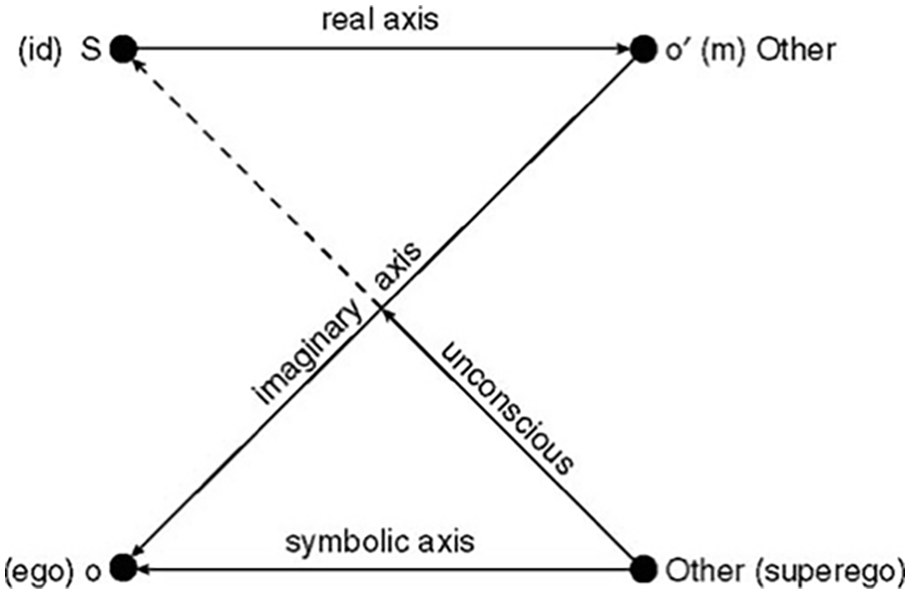
Lacan’s ‘L’ (or ‘lambda’ = λ) schema [1954–1955; the ‘imaginary axis’ is customarily associated with the ‘mirror phase’; Lacan, J,1977, Écrits, trans A Sheridan, New York, Norton, 193]. Photo taken by the authors.
Lacan’s scheme is helpful here – and in the context of our empirical landscape later – because it unpacks a relationship normally assumed to exist in the singular only: the rapport between a seeing subject and any ‘given’ landscape. In the process, subject and landscape become embedded within processes of gestation that leave an indelible and formative mark on both. Incidentally, the very mention of ‘2 metres’ conjures up images of ‘social distancing’ enacted daily during the CoVid-19 pandemic; it is hence a good time to be reminded of different forms of ‘distancing’ that abound in other social contexts as well – including those that dominate the construction of landscapes. To put this epistemological insight succinctly: we never ‘own’ or ‘author’ landscapes; rather: we are what we are because we enter a relationship with objects – which may form landscapes in the case of a geographically informed curiosity.
Beyond the Claude Glass: landscaping technologies
The Claude Glass (or Mirror) is of course but one technology that invites an analysis of the kind attempted above. The topological reasoning expressed in both the Borromean knot and the Möbius strip is equally at work in the historically subsequent early photographic ‘capture’ of landscapes. Daguerreotypes, or the act of exposing silver-plated copper surfaces polished to mirror, finished and sensitised to light through halogen fumes, also embody a doubling of the mirroring gesture that cannot eliminate its original production and must therefore remain ‘other’ and potentially ‘alienating’. No surprise, therefore, to note that this latter technology, from its first outdoor application in the context of urban landscape generation on the Pont Neuf 1837 in Paris by Louis Daguerre himself 39 has produced ghosts galore given its inability to render moving persons other than as striated, blurred images. Metaphorically, the recognition of such ghosts 40 serves to remind us of an often-uncanny non-linearity at the heart of ‘mirroring’ affiliations: a sublime form of spatiality attaching to the mobility that forms such relationships, and which has not surprisingly been worked over time and again in literature, the arts – and especially in films from Jean Cocteau to Star Wars (Figures 4 and 5).
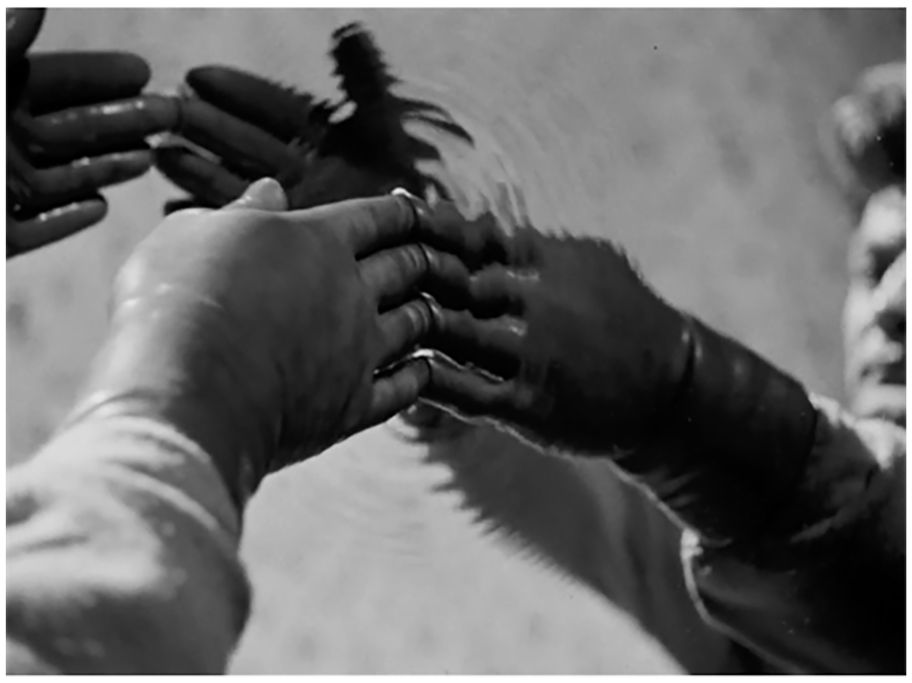
Jean Marais in Jean Cocteau’s Orphée (1950). Photo taken by the authors.
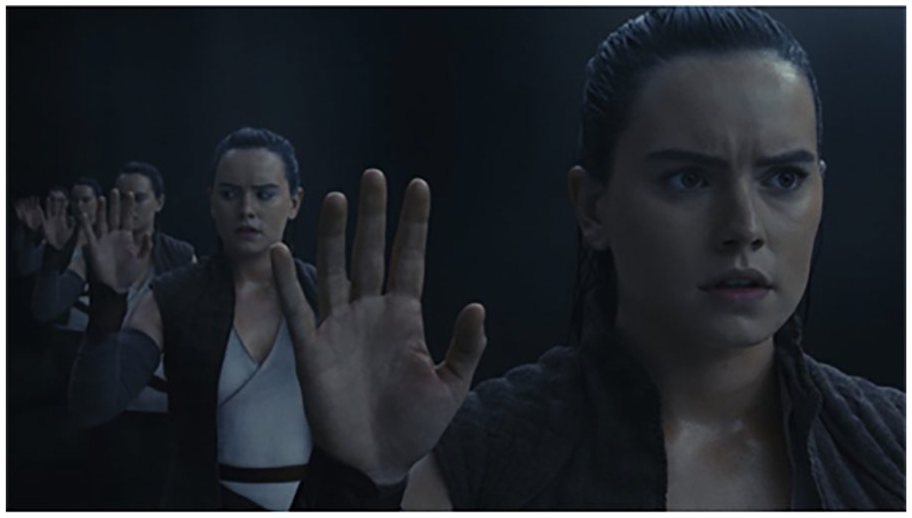
Daisy Ridley as Rey in Rian Johnson’s Star Wars VIII, The Last Jedi (2017). Photo taken by the authors.
What unites such cultural and pop-cultural refences is not merely the occasionally playful invocation of Lacanian knots in the construction of psychologically resonating narratives but the practice of making an invisible and often silent mirror – the engine of the constructed landscapes – recede behind that very narrative. As consumers of pop culture, we often appreciate the sophistication of the emerging landscapes, as well as the hidden nature of the deceiving mechanism.
In public settings like the ones that prevail on social media, appreciation is not the only, indeed: is not the main game in town. When approaching landscapes we ought to communicate their constructed nature in all its facets, technological embeddings and self-supporting mechanisms. Where and when a metaphorical ‘mirror’ is thus at work in the creation of possible landscapes, it ought to be our responsibility as scholars to render its absent constructive apparatus open to democratic scrutiny through the application of epistemological rigour. This is all the more important given that hidden mechanisms are operational because they remain hidden. Once again Lacan provides valuable insights at this juncture: as in the ‘mirror stage’, mirrors like the Claude Glass give birth to a highly mobile materialisation of that which we are not (and which is thus external to us) but which defines us nonetheless – nation, work, family, nature, sport, fashion, etc – qua desire. Recall that for Lacan the symbolic order temporarily supersedes the possibility of misrecognition (expressed most readily in his famous statement quoted at the outset of this paper that ‘the unconscious is structured like a language’), 41 resulting in the naturalisation of ‘objective’ constructs that are at once collective – a copy – and ours solely; it is from this combination that such constructs derive their power because we literally cannot turn away from them without getting lost. Here ‘landscape’ becomes a metaphor for that which we see but see partially, obliquely and as if in a mirror, see with the help of technologies like the Claude Glass. Between the visible and the conditional, landscapes arguably hold a privileged position: they emulate the spectacular origin of the subject outside the subject and thereby objectify our position within a world not at all of our making. Lacan himself attempted to capture this doubling of the constitution of the subject in his first published seminar, stressing ‘the fundamentally imaginary, specular origin of the ego’, making object and subject ‘correlative [. . .] because their appearance is truly contemporaneous’. 42
Irish landscapes ‘beyond the mirror’
To exemplify insights facilitated by a psychoanalytical approach to landscapes, we will use the concluding part of this paper to an exploration of a landscape that straddles divisions between both ‘object/subject’ and ‘absence/presence’. Such a focus, we contend, can meaningfully complement other readings of landscapes that are more overtly anchored in critiques of ideology, aesthetics or political motifs. In the context of this paper, ‘absences’ are different from that which does not appear in a mirror; instead, they denote the reflected otherness that dare not speak its name. In this precise sense, our use of the term ‘absence’ is thus different from the one customarily employed by scholars working in the cultural sciences: it is not the diachronic absence of a presence, where the one replaces the other in time, but a constitutive blind spot, a synchronic altarity that is integral for the apperception of a landscape. It is different, too, from its implied Hegelian cousin ‘negativity’ in that it does not adhere to the mechanical, mirror-like logic of othering. 43 In the sense deployed here, ‘absence’ is thus not epistemologically dissimilar from ‘presence’ in that both are produced through structural processes that are, in turn, at least partially invisible.
Devoting attention to ‘absences’ is but a choice made in this paper: the dynamism inherent in landscapes no matter their respective medium of expression, renders any landscape a likely candidate for providing anchorage to more durable symbolic ambitions. If these latter presently materialise in the context of Irish landscapes through commonly identified tropes in the form of sectarian murals, 44 idealised representations of the non-modernised ‘West’, 45 landscapes of remembrance, 46 place names appearing on maps 47 or gendered depictions of bodies, 48 there are other components of such landscapes not customarily accorded a presence in Irish landscapes.
One such present absence materialises in what are known in Ireland as cilliní. Denoting locally recognised but not officially acknowledged burial sites for non-conforming bodies and lives and often indicated by the presence of a seemingly random assortment of rocks and boulders in the landscape, cilliní are thus signifying an underbelly to Irishness that literally dare not speak its name and has consequently yet to be translated into the more widely practiced colonial language. For bodies there are: the bodies of stillborn babies, of suicides, unmarried mothers, murderers, ‘foreign’ bodies often arriving on Irish shores because of shipwreck, mentally ill, excommunicates and other such undesirable lives cut short, buried here because their final resting place could not be allocated within the consecrated space that is an official cemetery. In Irish, the word cillin symbolises a small (prison or monastic) ‘cell’, occasionally even referring to a small church. 49 Geographically, cillíní are placed away from paths or roads, they are often awkward to reach, out in the middle of bogs, up mountainsides, in dense thickets, set far back from any paths. Or, they are hidden in plain sight, in a location that is so familiar that we do not notice it, like at a crossroad, or the neglected-looking corner of a local field. There is often very little to see. 50
As far as the Irish were led to believe, those buried in a cillín were not to be remembered, and, acting as the repository for these ‘unimagined’ souls, the site that contained them was ideally not to exist either – at least, not to the untrained eye. The wish to absent those buried is thus manifest in the cillín’s placement and its non-descript topography. It clearly aims to deflect attention, not attract it. In that respect, the cillín was never intended to be a ‘landscape’; the site itself is a black hole, a blind spot of the psyche. Efforts that were made to ensure the evidence of a cillín’s exact whereabouts would be physically compressed under a heavy blanket of humus, worn down by erosion or washed away by the sea, and psychologically suppressed under the weight of shame, denial and repulsion. The process of ‘absenting’, and the denial of their realness, has thus relied on the chaotic, ‘topologically impossible’ materiality of organic matter camouflaging the organised, patriarchal structure that has sustained it, forever inventing ways to banish its shadows – including those buried in cillíní. But, the fact that cillíní do continue to exist, as does our – albeit hazy – awareness of the bodies interred in them, presents us with a problem.
Over millennia, we have learned to invert, obvert and divert, rendering the unspeakable unseeable. But despite being almost eliminated from our consciousness (and thus from our conscience), cillíní continue to be; they are literally part of the ground we walk on, they are embedded somewhere in our inherited memory and have found their way into the foundations of our cultural values. When acknowledging their existence, Ireland can only bring itself to turn its back and look at them through a dark mirror. The problem, however, is that even a dark mirror rendered invisible did not show much by way of a ‘landscape’ given that the act of representation comes into head-on conflict with the ultimate purpose; to ensure that the burial site and its interred do not leave an impression on us or the land, neither physical nor in memory. The language of these invisible but material burial sites thus, to pick up an earlier quote from Paul Kingsbury, ‘speaks volumes about the incompleteness’ of Irish identity; more than that: their absence from Irish landscapes has become formative in the construction of both, colonial and post-colonial identities.
When attempting to represent the cillín, one of us faced the question of how to represent ‘it’ in its invisibleness, its absence and nominal epistemological nothingness. The Claude Glass was used to transform a reflected landscape into ‘a thing’. In the case of representing the cillín however, it must be rematerialised; brought back from the projection of nothing- and no-bodiness that led to its formation in the first place (and in which form it contributed to the formation of those identities). This ‘bringing back from nothingness’, is thus unlike a Claude Glass transforming an imagined landscape (the artist’s view) into something real (the artwork); by representing the cillín, one is reimagining the unimagined by rematerialising its immateriality (Figure 6).
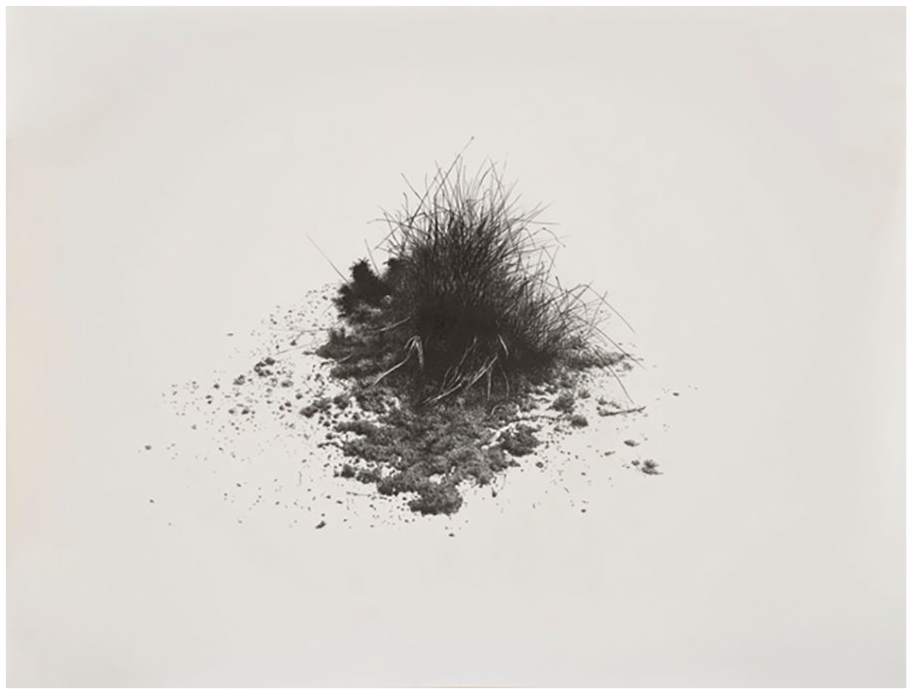
Miriam de Búrca, Anatomy of Chaos IV: Amnesia Sampled (Ink drawing), 2018. Photo taken by the artist.
Rather than expressing pre-existing or assumed identities, cilliní articulate identities denied. Or rather, since no agency was ever involved: identities overlooked, neglected, supressed. They become what Lacan referred to as the ‘objet petit a’, the leftover of the encounter between the Imaginary and the Symbolic which serves as a reminder of an unattainable and unrepresentable ‘Real’. Cilliní thus become unacknowledged objects of desire, material reminders of incompleteness, perhaps best thought of as open wounds.
The result is a landscape that is, to paraphrase Lacan, unlike a language we know how to handle: unreadable, often undecipherable to the uninitiated eye or in mirrors of whatever kind and utterly knotty. Our approach to such a landscape of ‘the real’, to use Lacan’s designation of that which we stumble into, often without fully appreciating its existence, never mind importance, is not accidentally an artistic one. The shift towards art may seem like a departure from an epistemological pursuit. It is not. Our unpacking of the structural properties of knowing earlier on, with their unavoidable dependencies on shifting, uncontrollable mirror-like constructs, with the erosion of the subject-object delineation and the folding of possible manners of differentiating between represented and representation comes an epistemological expansion in the ways we can legitimately approach landscapes.
To make sense of this move, we finally turn to Lacan’s contemporary, the semiotician Roland Barthes’ engagement with art – literature in the case of his late lectures at the Collège de France. In his inaugural lecture in 1977, and having confirmed the post-structuralist insight that ‘human language has no exterior: there is no exit’, Barthes went on to state that for us, who are neither knights of faith nor supermen, the only remaining alternative is, if I may say so, to cheat with speech (langue), to cheat speech. This salutary trickery, this evasion, this grand imposture which allows us to understand speech (langue) outside the bounds of power, in the splendour of a permanent revolution of language, I for one call literature.
51
Barthes goes on to refer to this linguistic act of resistance as a ‘topological impossibility’ 52 and was attempting to systematise its practices underneath the concept of the ‘Neutral’ in the years before his untimely death in 1980. 53 For Barthes, ‘literature’ was thus part of semiology, the teaching of which was specifically aimed at studying the social uses of linguistic constructs – what Barthes, following Brecht, referred to as ‘the Great Habit’. 54 Researching such routine practices by scrutinising that which does not adhere to its innermost logic of creating, maintaining and justifying a given habit is the core social function of such a Barthesian semiology, with ‘literature’ forming its focus. We propose to cast the net of such critique of habitual engagements wider and advocate for a legitimisation of more and differently articulated forms of engagement.
In such an appreciation, ‘art’ thus comes to resemble Lacanian psychoanalysis by aiming to render visible, but never successfully substituting, for the impossibility that is the foundational gesture of the subject and her/his/their identity. In our example, cilliní are a material mementos to the construction of Irish identities through constitutive practices of not thematising, of forgetting, repressing and silencing lives. A landscape of cilliní can therefore never aspire to be a landscape of cilliní; at best, it can endeavour to become cognisant of its own constructedness and of the absence it aims to map.
Faced with the task of exemplifying a ‘topologically impossible’ landscape of cilliní starts and arguably ends with the act of naming that which functions as a reminder of the Real – beyond mirrors and similarly self-reflective tropes. We encountered a glimpse of such a practice in our referral to an Irish landscape with the help of an Irish word. But beyond the well-worn trope of the impossibility of translation, our invocation of art in general, art freed from the twin weights of the representational order, apophatic art, approximates or ‘samples’ a collective amnesia that has been characterising part of Irish identities – and continues to do so into the present. We argue that an engagement with ‘landscapes’ through lenses crafted by psychoanalytical labours can provide helpful approximations here, not the least by tracing the repressions that contributed so centrally to the making of cilliní in the first place.
Given that the invalidation of lives and bodies we encounter in and through cillini has shaped the history of Ireland in other ways as well, including the silencing of ‘fallen women’ in the infamous Magdalene laundries, the invisibility of abused and murdered children in churches, cemteries and schools or countless maimed bodies as a result of sectarian violence, we regard such hopeless Barthesian acts as crucial in the context of endeavours of the kind we customarily engage in, wherever they may take place. As such, our argument in this paper has not primarily been informed by a critique of ideology (note the absence of terms like ‘alienation’ from our discussion) but aimed at rendering the constitutive importance of ‘silences’ visible: like we have demonstrated in the Claude Glass, that which is invisible is often centrally ‘at work’ in shaping realities, however twisted and knotty the emerging engagement with landscapes and identities may be.
Footnotes
Funding
The author(s) received no financial support for the research, authorship, and/or publication of this article.
Ethics statement
This study relied exclusively on publicly available archival materials. No human subjects were involved in the research process. All sources have been properly cited in accordance with academic standards. The researchers have made every effort to interpret the archival materials accurately and in their appropriate historical context.
