




Abstract
This article examines how discomforts shape the endurance of practices in two Catalan eco-communities. Despite the common perception of sustainable practices as uncomfortable, scant empirical attention has hitherto been paid to how residents in alternative spaces cope with discomfort-inducing practices. While cultural geographies have typically emphasised the co-adaptation of bodies and environments as necessary to ensure the comfortable endurance of practices, this article introduces three additional elements in the context of eco-communities: values, repetition and community dynamics. It demonstrates this by first examining how residents initially navigated the winter cold, demonstrating the efficacy of bodily adaptations and guiding values. Second, considering more slowly emerging discomforts, this article foregrounds the impact of a practice’s repeated performance on ever-changing bodies, that oftentimes led to their abandonment. Finally, it emphasises the impact of community dynamics, revealing that tendencies to abandon more ‘radical’ practices were always contested. By underscoring the interplay between values, embodied affects and community dynamics over time, this article contributes to geographies of comfort by showcasing the generativity of eco-communities as valuable spaces for theorisations of dis/comfort and the endurance of practices.
Introduction
Sustainable practices are frequently understood as uncomfortable, 1 especially in comparison to the putatively highly comfortable lifestyle of Western capitalist society. This is particularly true for eco-communities, that is, ‘places of collaborative, collective and communal living’ that seek to minimise their environmental impact 2 through a myriad of atypical and potentially uncomfortable practices. Indeed, in the two Catalan eco-communities examined in this paper, Can Masdeu and Calafou, potentially discomfort-inducing practices included using compost toilets, heating with wood, sharing bathrooms and kitchens, using pedalling washing machines and repair work.
Yet despite the potential for discomfort in eco-community living, there has been little empirical focus on embodied discomforts in such sites (excepting Pickerill, and Vannini and Taggart 3 ), though Spinney et al. and Hitchings et al. consider the intersection of comfort and sustainable living practices generally. 4 Therefore, examining how discomforts are negotiated in spaces explicitly committed to building alternative worlds can be useful for informing interventions to effect change towards sustainable living. This concern with dis/comfort resonates with recent cultural geographical work which has emphasised comfort as an inherently political matter, 5 with worlds being ‘actively made and unmade processually in pursuit of comfort’, 6 based on shared norms around bodies. 7
While much of this work has focused on (ephemeral) experiences of discomfort as potential sources of transformative change or on dis/comfort-inducing practices in a largely synchronic vein, 8 eco-communities constitute useful case studies to explore more slowly emerging discomforting practices, given that their endurance over time is crucial for efforts to combat climate change. Similarly, while the collective character of dis/comfort is often emphasised, 9 what this means for eco-communities as places of collaborative living and the communal negotiation of everyday life deserves further examination.
Considering these elements, this article asks: How do discomforts shape the endurance of everyday sustainable practices in eco-communities? How do eco-community residents negotiate discomforting practices? Building on non-representational theories, I understand the comfortable endurance of practices in eco-communities as the result of continuous re-compositions of variable bodies and their proximate environment (technologies, objects, spatial settings) as well as (evolving) socio-political values, that require collective negotiation. Crucially, to endure, practices require continuous adaptation, based on an ‘intricate mixture of stability and change’. 10 Therefore, what requires examination is not simply ‘if’ practices endure, but how.
I situate this article within the disparate eco-communities literature and the cultural geographical literature on dis/comforts and embodiment, before elaborating on my conceptual framework and presenting my case studies. I then focus on how uncomfortable practices were initially approached by newer practitioners, focusing on thermal discomfort and wood-heating practices and highlight the importance of continued bodily and technological adaptation to achieve comfort, ‘guided’ by value sets. This is followed by a more diachronic examination of practices’ (lack of) endurance by considering more slowly emerging discomforts, which I demonstrate through an in-depth examination of one Calafou resident’s experiences. Finally, I turn to community dynamics on site, and examine how differentially evolving bodily capabilities and value orientations shaped whether and how practices endured, emphasising the collective nature of this process and revealing different ways that such evolutions were managed.
I contribute to cultural geographies and specifically the emerging geographies of comfort in three key ways. First, I provide a diachronic account of discomfort, adding to existing literatures by considering the impact of repetition on sustainable practices, foregrounding potential difficulties when maintaining sustainable practices over time. Second, I emphasise the relevance of socio-political values, that, along with embodied affects, co-shape the endurance of practices over time, with their interaction thus far only implicitly explored in the literature thus far. Finally, I underscore the potential of eco-communities as spaces in which questions of endurance and dis/comfort can be meaningfully explored, particularly with regards to collective negotiations of (differentially) discomforting practices, that have been thus far more alluded to in the literature than empirically examined. Here, I show that the ways in which communities addressed discomforts and in particular, whether such questions were individualised or collectivised, further shaped how and whether practices endured, and indeed impacted more broadly the sites’ spatial, material and ideological fabric.
Endurance in eco-communities
Although three quarters of eco-communities dissolve within 5 years, 11 only a few authors have thus far examined how eco-communities endure over time. They have done so by providing an implicitly historical view of eco-communities and drawing attention to various ‘external’ challenges to their longevity, for example, the resistance of mainstream local actors, the 2008 economic crisis and a fear of ‘losing one’s identity’ and radical edge through pragmatic compromises. 12 The latter seems to demonstrate a tendency of eco-communities to becoming ‘less radical over time’. 13 Others have emphasised ‘internal’ challenges such as lacking technological systems and decision-making procedures, communication issues, ideological purity and ‘emotional fatigue, isolation and power imbalances’. 14 Rather unusual is the stronger focus in Forster and Wilhelmus’ and Davis and Warring’s work on residents’ changing bodies and ‘more diverse and complete lifestyles’, including ‘children, illness, disabilities, old age, and death’, that either led to significant alterations of practices or a return to ‘nuclear family life’, 15 though without going into much empirical depth.
Recent literature on practices in eco-communities has focused on their initial take-up rather than their endurance. Roysen and Mertens highlight the importance of social norms, leading to ‘new circuits of reproduction’ and eventually becoming a ‘structure’. 16 This implies a single transformation from mainstream to sustainable alternative, neglecting subsequent evolutions of practices. Meanwhile, some have foregrounded conflict around practices: Boyer mentions disagreements around car-sharing in Dancing Rabbit Ecovillage (USA), while Binay et al. show how tensions between ideals and practice were frequently ignored in a Turkish eco-community. 17 Here, some practices did not endure, such as cleaning with lye, hinting at the ways in which discomfort-eliciting objects shape eco-communities as sites.
By contrast, cultural geographical literatures have increasingly focused on dis/comforts, empirically examining more-than-human relations, sustainable living practices, mobilities, local belonging, art and the body. 18 Here, the ‘absence, presence and pursuit of comfort’ have been emphasised as crucial to how worlds are made and unmade, particularly in our comfort-oriented society. 19 This builds on more general insights on embodied life as world-making and mutually constitutive of places, 20 with the ‘specificity of embodiments gained through the material practices of everyday spaces’. 21 Importantly, studying dis/comforts through an embodied lens means attending to the ways in which embodied practice exceeds ‘social and cultural dimensions’ 22 and works through visceral and affective registers. 23
Others have underscored the generativity of uncomfortable ‘encounters’ as producing meaningful change towards more just worlds, unsettling ‘established norms’, 24 though with uncertain long-term results. 25 This work has privileged shorter-lived encounters over repeated practice, for example, Straughan et al. 26 interrogate ‘processes of becoming attached via experiences of comfort’ to trees but do not study how the latter may fizzle out. Similarly, work focused on (un)comfortable practices, such as Price on knitting, De Vet on coping with weather conditions and Ward on swimming, 27 have not yet considered evolutions in practices or comfort levels.
This concern for (initially) achieving comfort, rather than its endurance, is similarly apparent in the limited work focusing on dis/comforts in alternative living arrangements: Jenny Pickerill has examined how comfort was reconceived around bathing practices in British eco-communities, with comfort understood as ongoing ‘negotiation between different elements; climate, materials, bodies in a particular place’, rather than a predetermined, fixed attribute. 28 Whilst Pickerill emphasises ‘a need to explore how people negotiate and overcome’ barriers to reconceive comfort, 29 there is scope to investigate these questions more thoroughly, particularly considering how reworkings of comfort may be partial or reversed over time.
Meanwhile, Vannini and Taggart have focused on how domestic warmth is achieved in off-the-grid housing in Canada, requiring greater effort as off-gridders reassembled infrastructures and technologies to enable everyday bodily comfort. 30 They view residents as willing participants in this reworking of comfort, with ‘moral and practical obligations and orientations woven into ordinary routines and accepted and even embraced as inevitable necessities of one’s everyday existence’. 31 While working in a similarly synchronic vein, the emphasis on ‘moral’ obligations emphasises the importance of values in impelling such significant transformations in everyday practice and concomitant experiences of dis/comfort.
Bodies as sites of endurance
Given these limitations, I argue that a more diachronic perspective on bodily dis/comforts, that is, taking evolutions over time into account, can further illuminate how practices endure. Here, David Bissell’s understanding of comfort, namely, as affective resonance achieved as an ‘embodied contingency forged between the body and the proximate environment’, is instructive. 32 Comfort ‘circulates’ between and through objects and bodies as a ‘non-intense sensation of relaxation and reassurance’, 33 with both bodies and objects active and agentive, and their interrelationship requiring ongoing readjustments. In Bissell’s example of sitting on a chair, too much stillness becomes painful, so bodies tend to reposition themselves to find a comfortable position anew. 34 Discomforts are thus always emergent, as bodies and their environments evolve.
In subsequent work, Bissell examines how habits change bodies over time, showcasing ‘subtle, slow creep transformations’, that build up to ‘tipping points’ or thresholds of ‘bearability’, that are retroactively recognised as a point after which a particular practice can no longer be endured. 35 Thus, the repetition of a particular practice, in a Deleuzian vein, produces ‘mini-metamorphoses’ in the elements that constitute them, in ways that may eventually alter the practice itself. 36 This also demonstrates the ‘limits of the body’ in terms of its ‘boundaries, capacities and thresholds’, with the body defined here relationally, following Deleuze and Guattari, by what ‘it can do’ rather than ‘by any essence or self-contained entity’. 37 The body’s limits can also be understood temporally, since bodies change over time, past experiences inevitably leave bodily ‘traces’, and conversely, abandoned practices may re-emerge. 38 And yet, considering bodies’ thresholds implies the possibility that these can be exceeded, perhaps by experimenting with practices commonly perceived as uncomfortable. 39 This conceptualisation therefore allows for a diachronic account of how discomforts in eco-communities emerge.
The comfortable endurance of practices in eco-communities
Bissell’s work is useful for a diachronic conceptualisation of (uncomfortable) practices, however, two concerns require further attention in the context of eco-communities: firstly, the ways in which value sets (co)shape what is experienced as comfortable/endurable. While unexplored in Bissell’s work, 40 the importance of values in reshaping notions of comfort features strongly in Vannini and Taggart’s and Pickerill’s contributions. 41 Given the importance of values in choosing an eco-community life, 42 I suggest that further attention must be paid to the specific ways in which socio-political values influence practices’ endurance.
Secondly, Bissell’s conceptualisation does not account for how residents’ differential capabilities to endure discomfort are actively collectively negotiated: In building a common living project, eco-communities imply much discussion of everyday life, with expectations and the lived experience of comfort constituting a more collective rather than individual process. Indeed, Bissell (like other cultural geographers) has frequently emphasised that comforts are shared and collective. However, his own work has hitherto squarely focused on individuals, sitting on a chair, engaging in long-distance air travel and being slowly worn out by a long commute. 43 Similarly, researching alternative spaces, neither Pickerill nor Vannini and Taggart explore potential disagreements around discomforting practices. 44 Approaching my concern for collective negotiations of embodied sensibilities, Chappells has underscored comfort in shared spaces like offices as ‘socially, culturally and collectively negotiated experiences’, 45 that become nonetheless obdurate through particular technological configurations. Given this relative oversight, I seek to foreground collective negotiations of comfort in the endurance of practices.
Field sites and methodology
This paper draws on ethnographic research conducted between April 2018 and January 2019 in the ‘rurban’ squat Can Masdeu in greater Barcelona and Calafou, a ‘post-capitalist eco-industrial colony’ in Vallbona d’Anoia, in rural Catalonia (Figure 1).
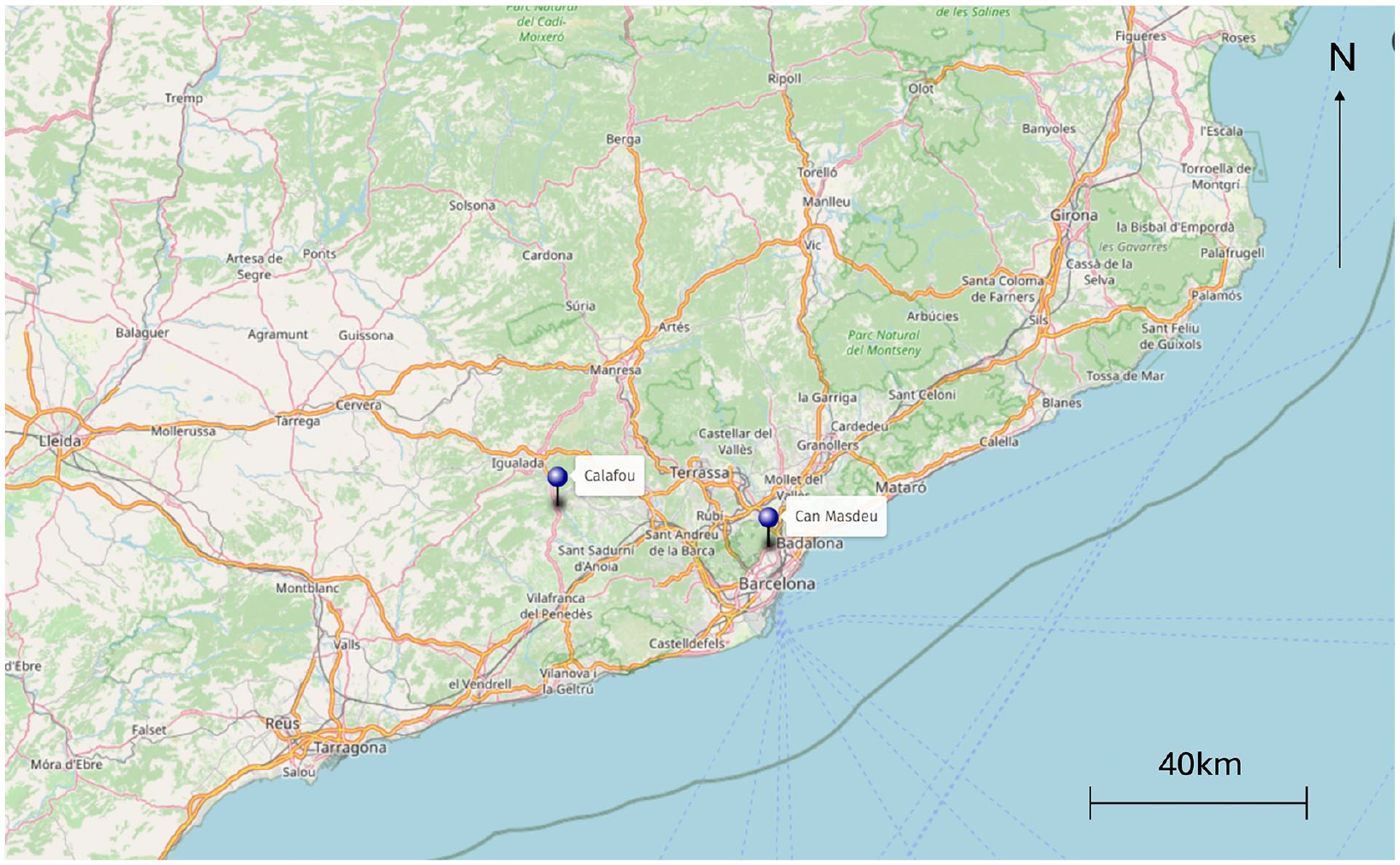
Map of the two sites.
Can Masdeu is a former leper colony, first squatted in 2001, initially to host a climate change gathering. Their history is not only linked to anti-capitalist, anti-globalisation and squatting movements but also to climate change movements, a rather unusual combination at the time. The squatters survived an eviction attempt in 2002 and have since then claimed ‘social legitimacy’ through the opening of community gardens, visitor days and environmental education. 46 Unusually, there have been no further eviction attempts, with residents perceiving their living situation as relatively permanent. It describes its ideational background in environmentalism, communitarian anarchism and self-management, housing 25–30 residents who hold relatively clearly defined responsibilities such as workdays, general assemblies and commissions.
Calafou, founded in 2011, was set up in the spacious ruins of a former textile by members of the ‘Integrated Catalan Cooperative’ (CIC), an umbrella cooperative organisation. Its stated principles are transfeminism, self-management, free culture, degrowth and permaculture. Its historical origins date back to the anti-globalisation, housing and (anti-Bologna) student movements of the early 2000s, with a significant minority of members having squatted in Barcelona. 47 It consists of a housing block with 27 individual flats, ample space (28,000 m2) for a social centre and multiple workshops, for example, for plastic recycling, woodwork and electronics. Calafou is being collectively purchased and set up as a housing cooperative, with residents either renting or buying the ‘right to use’ individual flats paying 180€/month. Most of its 30 members participated in collective projects such as beer-brewing, mushroom-growing, soap-making, ceramics or carpentry, seeking to contribute towards a wider net of autonomous economic relations.
I conducted participant observation for around 1 month in each site, focusing both on material practices to ‘enskill’ myself 48 and on participating in daily life and/or activities organised for visitors, including gardening, repair work, beer-brewing and olive harvesting. I conducted 44 interviews with visitors and long-term residents, concentrating on everyday practices, including potential issues, conflicts, negotiations and changes over time.
Initial discomforts: negotiating affect and values in place
When residents first arrived on site, they were confronted with a myriad of new, potentially discomforting practices, including enduring the winter cold, heating with wood, using compost toilets (Figure 2) and sharing bathroom and kitchen facilities, often located relatively far from residential buildings.
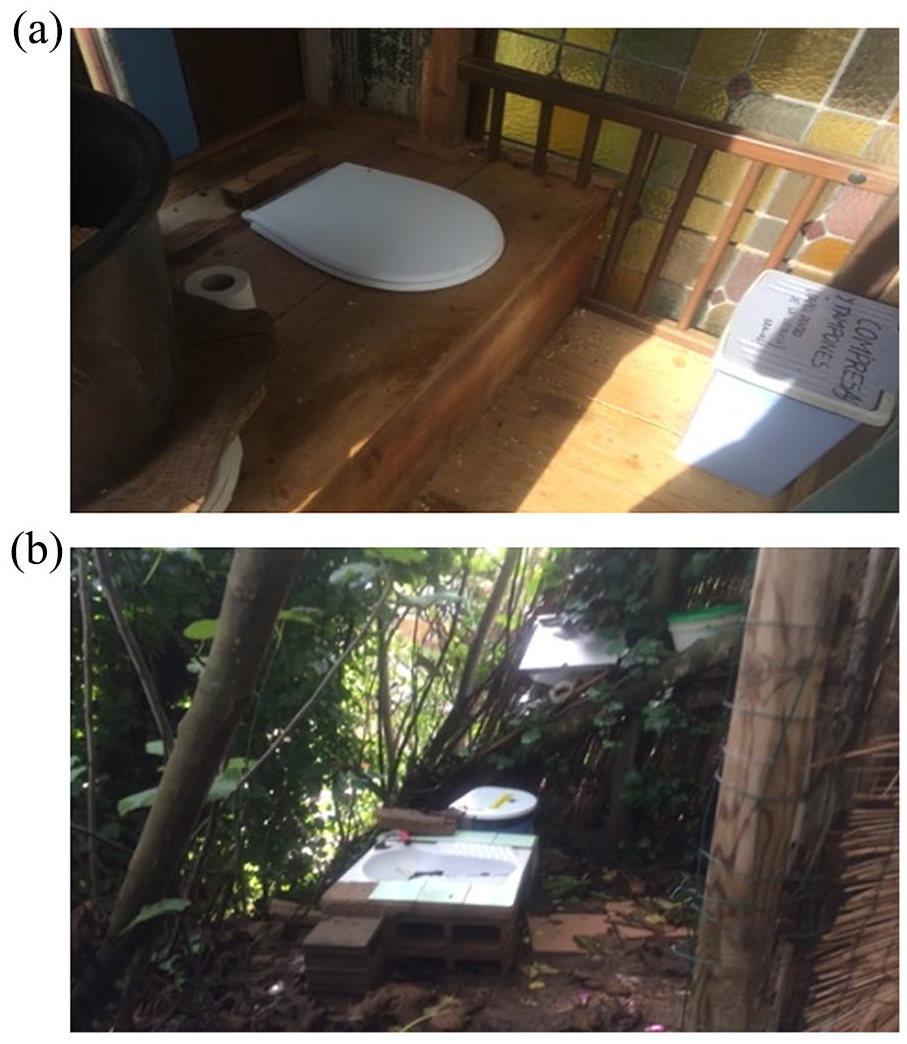
(a) Inside a compost toilet in Can Masdeu and (b) an outdoor urinary in Can Masdeu.
How did new residents and visitors cope with these potentially uncomfortable practices? I argue that the mutually constitutive relationship between socio-political values and body-environment adaptations was conducive to the enduring take-up of practices in earlier stages and demonstrate this by using the example of thermal discomfort and wood-heating.
I consider thermal discomfort a particularly ‘thorny’ issue, because it is arguably very viscerally felt, with nightly temperatures in Catalonia typically dropping below 10°C between November and March, though this observation is not meant to denote any essentialised understanding of ‘comfortable’ temperatures. Simultaneously, the most common solution to the winter cold, heating with wood stoves, implied the residents’ ‘direct, embodied and permanent involvement’, 49 and therefore a potential additional source of discomfort.
In this context, my host Yolanda’s experience with wood-heating practices is illustrative: Hailing from another Spanish region, now in her mid-30s, she had moved to Catalonia for university, where she got involved in social centres, hacklabs and activism against the Iraq war and the Bologna student reforms. She had squatted intermittently in and around Barcelona, which had eventually motivated her to set up a more permanent home in Calafou. Importantly, she mentioned ‘not getting cold’ as one of few basic comforts that she required, rendering wood-heating a necessity for her. She described her relationship with wood-heating as follows: ‘Sometimes, it’s like, what a drag, no? Having to deal with this every day and especially having to maintain it [. . .] then I got passionate about lighting the fire and then when the moment of absolute passion passed, it was like if I focus too much on one thing for a few hours, the fire extinguished. So, I decided to get a stove that allows me to light it in a way that I don’t have to feed it for at least two hours. Like the ones with small sticks give me the feeling of lighting the fire which I really like, but in January, February, from 6 in the evening, if you have to put in a stick every ten minutes, I’ll go crazy, you can’t [computer] program like that and (laughs), so I chose the format that allows me to enjoy the fire, and simultaneously not have to feed it continuously, because it’s big enough to generate the system of the architecture of the fire [sic]’.
Here, Yolanda first remembered overcoming an initial sense of nuisance. Through repeated practice, she developed a fascination for fire’s particular affordances, with my fieldnotes noting that ‘she loves to watch the flames and is quite absorbed by it’. 50 The practice’s comfortable endurance depended here on a ‘growing openness’ 51 towards the fire’s particularities, enabling the development of new capacities. Nonetheless, her relationship to wood-heating practices evolved as some discomforts emerged due to the frequency of intervention necessary to maintain the fire. Here, off-the-grid heating implied rather demanding rhythms, 52 interrupting her computer-based work. Her decision to acquire a bigger stove (Figure 3), allowing her to pragmatically circumvent the wood-heating’s specific rhythms, highlights the importance of such mundane technological changes. 53 Wood-heating practices’ endurance therefore depended on working-with particular objects’ affordances, 54 and adapting the latter to Yolanda’s evolving affective relations with fire – from apprehension to fascination to mild annoyance. These affective changes also highlight the continuous process of getting used to a practice, requiring re-adjustment over time.
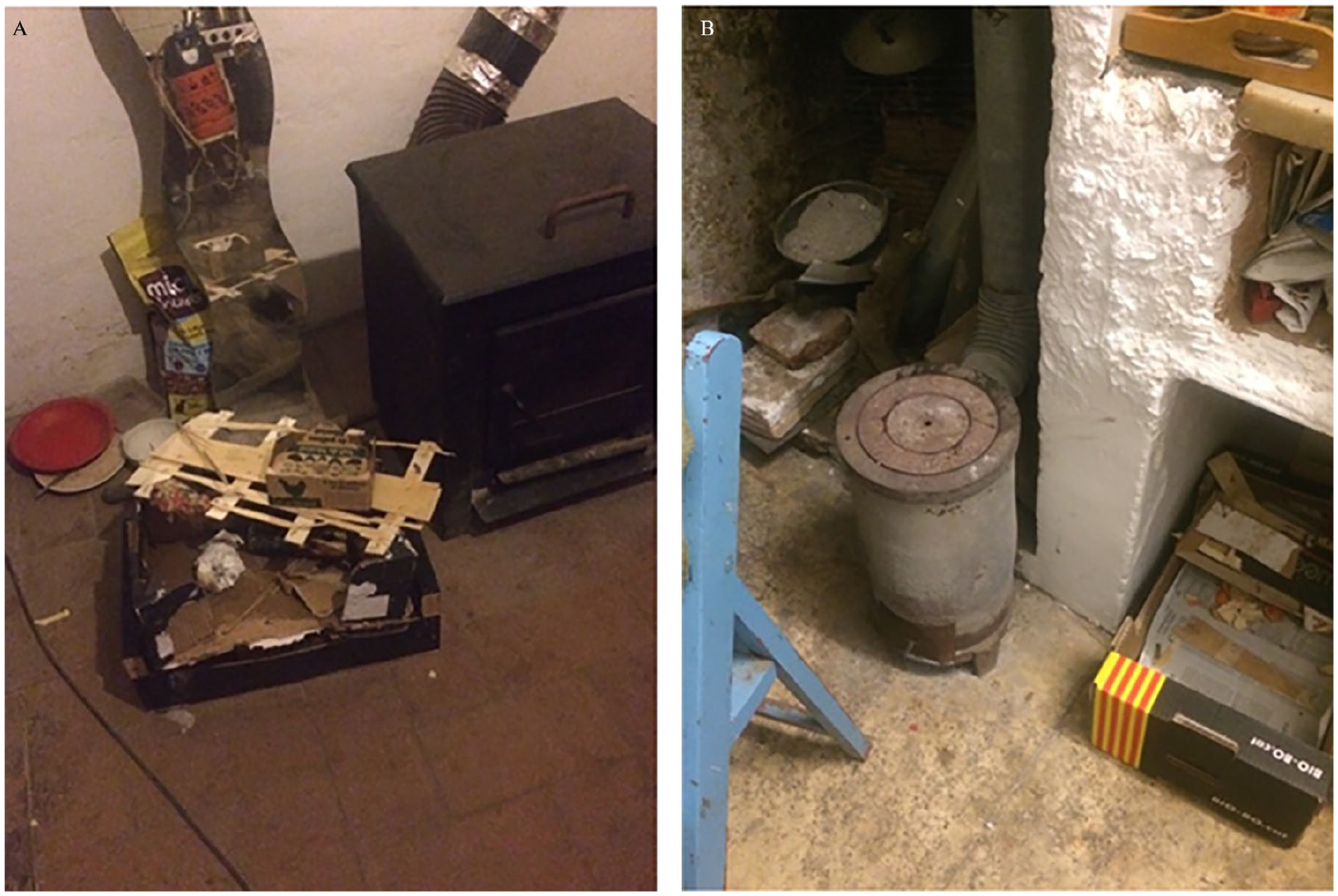
Yolanda’s bigger stove compared (left) to and a small to regular-sized stove (right).
These practices were arguably undergirded by value orientations that made her receptive to such practices to begin with. Thus, next to a concern for sustainability, Yolanda argued that after becoming disenchanted with direct action: ‘I became more interested [. . .] in living in a place where the things I do daily are – the issue of autonomy – are part of my political life. I’m someone who values personal transformation a lot. How we relate to others, how we deconstruct attitudes. And the only way that occurs to me is to hack everyday life’. Read in this light, replacing her wood stove appears as an ‘everyday hack’, enabling a sustainable and autonomous lifestyle.
That this specific value orientation appears to have facilitated a willingness to repeatedly readjust bodies and technologies becomes apparent when considering when this was not the case: In Can Masdeu, a minority seemed to squarely refuse to address the winter cold. Long-term resident Enzo argued in this context that another resident deemed that ‘anything done professionally or done well, is capitalist. So, to be warm and comfortable is capitalist and consumerist, and then the hard and dark, that’s proper squatting’. Here ‘comfort’ and warmth were ‘deliberately invested’ with political and moral capacities, 55 in this case with a capitalism they sought to resist. There was perhaps also a sense that it was necessary to ‘suffer for a cause’, as an ‘environmental politics of sacrifice’. 56 This also fits Pickerill’s observations concerning sparsely arranged bathrooms in British ecovillages, 57 with some ‘actively seek[ing] discomfort’, 58 which further highlights the role of values and/or ‘thermal conventions’ in maintaining practices that are not conducive to winter warmth. 59 Put differently, particular value sets stymied some residents habituating themselves to potentially comforting practices. Whereas for Yolanda heating with wood constituted a basic comfort and an important part of her specific political positioning, for some Can Masdeu residents any form of heating represented an unacceptable concession to capitalist norms. This also highlights that the specific values embraced by residents shaped whether and how practices were performed.
This seems to suggest that values alone were sufficient to enabling the endurance of non-heating as a practice. Yet some residents’ eschewal of wood-heating had in fact adverse consequences in that ‘sometimes, some people [were] using the electricity’ from the municipal network (Rafael, another resident) – undermining attempts at autonomy and lower emissions, whilst refusing to ‘put clothes on, have the window [open], don’t close the door, don’t have insulation, causing havoc all around’ (Enzo). It is unclear how closely electricity consumption and ethical convictions aligned, especially given that some of the more ‘wasteful’ residents appeared less politically minded to me and nobody actively admitted to such behaviour in interviews. It suggests, however, that previous on-grid heating practices had not been fully abandoned by some residents, who in moments of acute thermal discomfort resorted to old habits. 60 In this context, Yolanda’s refusal to resort to other sources of heating appears perhaps more significant: she had easy access to gas heating which she organised for the purposes of my stay in a separate bedroom. 61 This further highlights the efficacy of both her particular political positioning and her willingness to continuously be affected.
Still, the preponderance of electric heating practices in Can Masdeu should not be overstated, as Casandra, another resident explained: ‘If three people start putting on electric heating, that will ruin the electricity supply’. Nonetheless, these inconsistencies highlight that wood-heating practices’ endurance depended largely on a willingness to repeatedly ‘learn to get affected’ 62 by the variable elements composing these practices, guided by specific value sets, that appear to ‘buffer’ against the variability of affective states. The fact that some in Can Masdeu refused to attune themselves to wood-heating suggests that a reliance on solely value-based dismissals of embodied discomfort was insufficient to ensure practices’ endurance. This in turn demonstrates the importance of alignment between specific values and embodied adaptations in shaping how and whether practices endured. Finally, contrarily to Vannini and Taggart’s characterisation of ‘onerous consumption’ as an ‘enjoyable burden’ for off-gridders, 63 heating-practices in the two eco-communities provoked a wider range of body-environment relations and ethical positionings.
Slow creep transformations: repetition and endurance
While the previous section was concerned with earlier discomforts, I now consider how practices emerged as increasingly uncomfortable over time and were subsequently abandoned. Following Bissell, I consider discomforts in a diachronic vein, but seek to demonstrate that practices’ endurance was inextricably entwined with evolving bodies and values. I examine these transformations by focusing on Ana Maria’s experiences, a Calafou resident in her late 30s from Barcelona.
Born to an anarchist mother, Ana Maria shared a similar background to Yolanda in terms of values and formative experiences, though she had been much more involved in the housing movement, occupying various houses around Barcelona, from which she had been evicted with some regularity. Here, she had encountered extreme levels of precarity and discomfort, explaining for instance that ‘the toilet in the first house I occupied didn’t have a door, it had a curtain, and it was in the middle of the living room [. . .] with people passing by around the curtain, how little privacy! And when I first came, we went a winter without electricity, from December until May. You see it as an adventure. I’ve never felt bad about this’.
Her decision to move to Calafou was partly predicated on a sense of fatigue with squatting life, which may have further heightened the intensity with which she experienced emerging discomforts, contributing to ‘slow creep transformations’ 64 : ‘When I came, everything seemed fine to me [. . .] I have a lot of capacity to adapt but now there are things that start to tire me. Like, a year ago, we didn’t have water inside the house. We had to go out with water jugs [. . .]. But now you want to take a shower, you want hot water at home. I really don’t feel like having to constantly gather firewood. I want things to be easier. I want to have good heating and drains and to be able to use the bathroom at home. Now I am starting to have the desire of not spending all day struggling for my basic needs [. . .] I’ve always been very tolerant of everything but now it’s starting to weigh on me a little more, the wear and tear of not having water at home, not having a shower. Having to bring down the dry toilet every week, bringing up firewood, because I want to have comforts’.
A strong sense of increasing attrition, fatigue and discomfort runs through Ana Maria’s narrative. Next to the lack of indoor plumbing and the effort of gathering wood, Calafou’s significant size and the distances this implied emerged as increasingly burdensome over time (Figure 4), with the housing block ca. 150 m away from the nearest outhouse; and 200 m away from the showers and community kitchen. And though she did not mention it, she was 8 months pregnant at the time of our interview, which may have further magnified her fatigue.
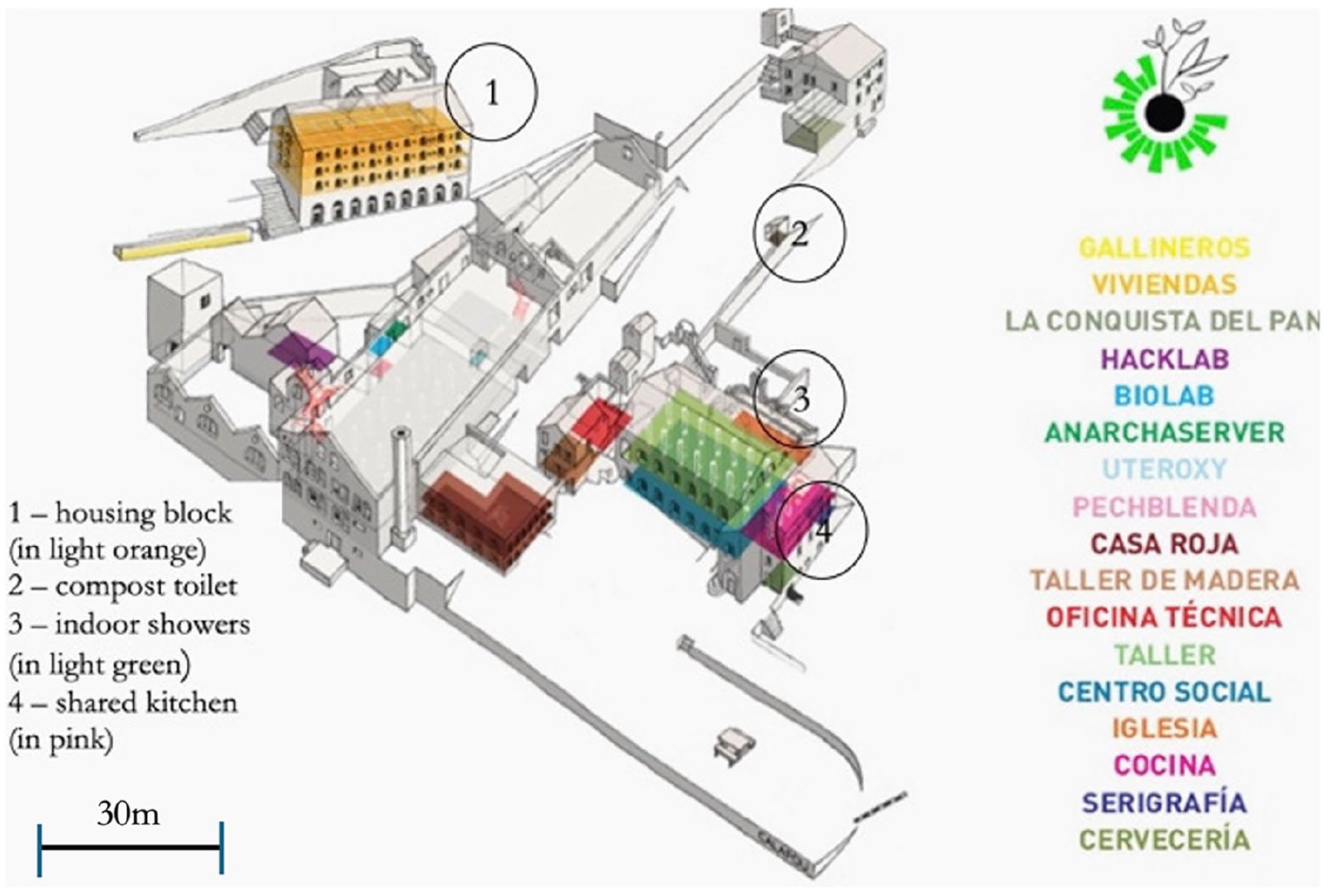
Drawing of Calafou.
This creeping sense of discomfort led her, like many others, to build dry toilets and showers in their own flats, which may constitute, following Bissell, small ‘tipping points’, when ‘a threshold of bearability’ was crossed. 65 Ana Maria presented this changing corporeal disposition implicitly as an inevitable development, noticeable in her shift of pronoun to an impersonal ‘you’ to mark a generalisation. While such household additions may seem somewhat innocuous and commonsensical, this tendency signified a move towards a multiplication of private facilities, away from the ‘onerous consumption’ 66 of shared resources and facilities and concurrently, a higher material use. A diachronic account of discomforts shows that the repetition of certain practices, performed by changing bodies rendered them increasingly uncomfortable, eventually leading to their abandonment.
What role did Ana Maria’s values play in this process? The repetition of practices appeared to induce similarly an evolution of values and indeed of political strategies, as Ana Maria immediately followed the above account up with more value-based reasoning: ‘I think we have matured a lot as a group, we are ready to achieve more ambitious goals. Not so much in the day-to-day management but thinking about the future. Like saying Calafou is going to be a project where there are workshops that work really well, and [where we] focus on organising events that we find politically interesting’. Here, Ana Maria describes a shift away from what might be termed prefigurative politics, 67 towards an attention to effecting greater political change beyond the project. Rather than presenting this change as a kind of deradicalization, as has been argued elsewhere, 68 Ana Maria actually understood this as a ‘greater ambition’ politically-speaking.
As such, the question of whether to endure certain practices became a trade-off, a consideration of where to invest time and effort. Put differently, the repetition of practices did not only bring about sensations of discomfort, but also contributed to an evolution in values, both of which imperilled practices’ endurance. Specifically, it led to a reassessment of the value of ‘personal transformation’ (Yolanda), which implied a capacity to be continuously attuned to and adapting one’s environment and body. If the previous section has emphasised the importance of specific values and a continued commitment to bodily and/or technological adaptations, this section shows the productive force of practices’ repetition, bringing about, with Bissell, changes in sensations of comfort, but also exceeding this, by contributing to changes in values, both of which impacted practices’ endurance. Concerns for sustainable energy and material use notwithstanding, the abandonment of certain practices for example, the sharing facilities appeared less straightforwardly as a failure to adapt bodies (as in the previous section), but arose partially as a strategic choice, whereby different forms of political engagement were weighed off against one another, in consideration of emerging discomforts.
Uncomfortable practices and community dynamics
Above, I have shown that for practices to endure comfortably over time, the successful negotiation of ever-evolving body-environment relations and of values was necessary. In this context, I have focused mainly on individuals. While the previous sections have only hinted at disagreements around uncomfortable practices, this section seeks to foreground them. Concretely, I will examine processes of ‘deradicalization’, that played out as a conflictual ‘dialectics’ in Can Masdeu and an uneasy juxtaposition of different comfort levels in Calafou. I will show that processes’ apparent deradicalization were by no means unilinear and predetermined, but rather contested and negotiated at a community-level.
Can Masdeu
In Can Masdeu, residents shared most facilities, excepting bedrooms, and co-managed most tasks, including cooking, cleaning, maintenance and repair work as well as some social activities for visitors. However, over time, a tendency towards increased material consumption involving primarily white goods appeared to emerge. For instance, they had recently disposed of their pedalling washing machine, because as long-term resident Rafael explained: ‘We didn’t use it, it was like a museum [. . .] it was more comfortable having an electric washing [sic], and we have only 2 for 25 people, so I think it’s ecological enough [. . .] also we had no fridge for years. Now, we have 5 fridges and 2 frozen [freezers], so of course we became less radical, and more comfortable.
how do you explain that change?
I think, one side is aging, another side is feeling that it is not provisional, it could be permanent [. . .] But also, because in some aspects, we were too radical, it doesn’t change the world that you don’t have a fridge. You can have a fridge, but maybe a communitarian fridge’.
In line with previous sections, he qualified these changes as the result of changing (i.e. ageing) bodies, implying that this required an adjustment in their proximate environment, leading to significant adaptations or the abandonment of practices, that is, with Bissell ‘tipping points’ following ‘subtle slow creep transformations’ within bodies. 69 Relatedly, Rafael mentioned a widespread feeling of ‘settledness’ in Can Masdeu, necessitating more comforts, which can be read as an anticipation and/or response to the attrition that builds up through repetition over time. Simultaneously, values around sustainability continued to shape how practices were imagined as apparent in his nuanced reflections around the sustainability of specific objects.
Beyond this, Rafael implied that this renegotiation of practices had been a collective process (‘we were too radical’), albeit a rather conflictual one: When asked how he felt about this increasingly comfortable lifestyle change, Rafael argued:
‘I feel it’s necessary, but it’s necessary also to control it, kind of a balance.
and you said some people kind of push some other people to become more comfortable?
but also the other way around. So, so, we have to, we need this dialectics [sic]’.
These dialectics’ ‘antithesis’ element was perhaps most prominently embodied by Enzo and Alba, a British couple, who had been extensively involved in environmental activism. Enzo bemoaned for instance that ‘what’s hard for me is this the incremental change back to normal’, while Alba observed that: ‘I feel like I’m pushing against the tide. [. . .] The feeling of the group is towards being more efficient, so that people don’t have to do so much. And that’s kind of the opposite direction to what I want to move it, I want to want to have more energy for looking for what could Can Masdeu do better’. In this context, instead of abandoning onerous consumption practices, Enzo and Alba added to them, spearheading new initiatives, for example, a DIY beer-brewery and solar-run outdoor showers. While Alba had only moved to Can Masdeu 4 years prior, Enzo was involved from the start, and had additionally sustained back injuries from violent encounters with the police. Despite this, his values and ability to adapt body and environment appeared stable, demonstrating that deradicalization was not an inevitable process, but rather a variable tendency between residents.
These ‘dialectics’ seemed at play when an additional fridge (Figure 5) was acquired by a resident shortly after my stay: As Axel, a visitor, told me later ‘now there’s a big debate about taking collective space’, linked to different ‘visions’ for the site. While one resident had reached a ‘tipping point’, 70 this was palpably not the case for everyone. Although unresolved at the time of my departure, this illustrates the ‘push-and-pull’ dynamics that determined whether and how practices endured in Can Masdeu’s communal setting, depending on the negotiation of differentially evolving values and bodies over time.
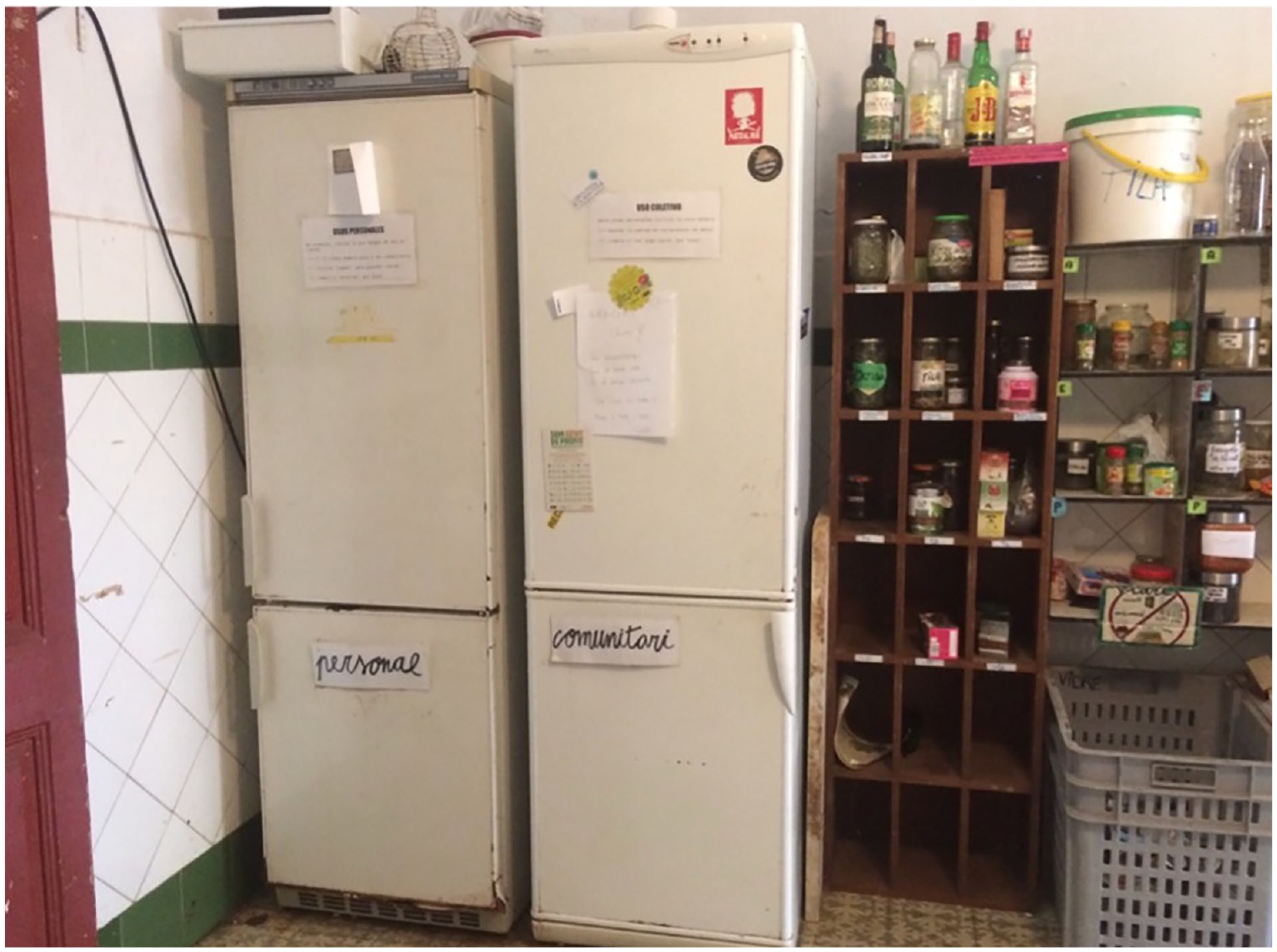
Two fridges in Can Masdeu’s common areas, for personal and communal use, respectively.
More broadly speaking, Can Masdeu residents were at the time of my fieldwork formulating a common vision, an attempt to reconcile different approaches to eco-community practices, or ‘our priorities as a group, what are we here for, and what are we most interested in trying to do’ (Alba). This common visioning process arguably sought to (re)impose coherence on these ‘dialectics’, providing an active forum for disagreements, apparently attempting to ‘synthesise’ antithetical elements within the group. However, this processed seemed to operate primarily through discursive and value-based means, as a ‘structured process[es] of visioning’, ‘guid[ing] actor behaviour’, 71 which appears to neglect embodied sensibilities and therefore may not fully resolve disagreements (as with the heating practices above).
Calafou
If Can Masdeu operated through conflictual ‘dialectics’ of deradicalization, Calafou seemed to work through uneasy juxtapositions of differing ideas of comfort, which led to a greater diversity in everyday practices between residents. This was entwined with the site’s physical layout as important elements in the ‘proximate environment’, 72 including the long distances between the residential block and other facilities (see above), which contributed to emerging discomforts. However, since the numerous flats were typically under the responsibility of individuals (or flatmates/couples), they simultaneously provided opportunities to remedy these discomforts. As such, questions of comfort were effectively individualised, subject certainly to collective trends but not to the vigorous mutual interrogation that occurred in Can Masdeu. This concurrently brought up questions of the degree to which dis/comforts were deemed an individual or collective concern.
Here, ‘spillovers’ between residents seemed to generate trends shaping everyday practices. Early on, Joaquín, a South American man in his 40s, born to activist parents and with significant involvement in social movements of both socialist and anarchist stripes, was an outlier, in that ‘I was the first person in Calafou to have a kitchen, a stove, and a bathroom. I came here to build a collective project, but not to share every detail of daily life in a community. What I like about Calafou is that it’s a housing cooperative, the idea that I buy the right to use this space [. . .] But because my house is very nice, sometimes I’ve been called individualistic, and I say, “no, every time there is common work, I’m here, I’m doing it.” But at other times, I work on my home because I want to live here for many years, and I want to live comfortably’. Joaquin demonstrated here a value orientation towards cooperativism, that appeared to exclude some potentially arduous everyday practices from ethical consideration, contrasting for instance with Yolanda’s commitment to personal transformation. Yet, by the time of my fieldwork, a tendency towards more material comfort seemed commonplace – many residents equipped their flats more elaborately over time and held an expectation of increasing comfort. Fernando, a former squatter in his 40s from Barcelona, explained for instance: ‘There is no comfort, [. . .] one day we’ll have it, and increasingly we have it a bit more. Right now, in my house, I feel comfortable, but I built the shower only a year ago’. More obviously concerned with interior design involving higher levels of material consumption, I described Juan and Pedro’s flat as ‘splendidly arranged [. . .], with lots of cooking utensils, a frying machine for fish. I get chai tea served in exquisite glasses. A serrano ham is standing on the table. They have just put in wooden floors; a chimney is happily churning away’. 73
Still, like in Can Masdeu, these ‘spillovers’ did not determine the extent to which individual comfort was practiced. My host Yolanda remained somewhat immune to these trends, choosing ‘not to invest too much time in making the house pretty (it is dark and dirty) [. . .] Others have spent a lot of time on their homes, and they look like city flats – Yolanda says: why would I live here, in the ruins of capitalism, if I want a nice flat?’ 74 Here, dynamics of comparison, distinction and mutual influence underscore the degree to which (experiences and expectations of) comforts are inherently social and shared. 75 However, more than acknowledging their shared character, implying largely uniform or at least nonconfrontational experiences and expectations of comfort, the specific social dynamics at play, especially those of contestation and negotiation, can further explain the ways in which particular practices endure, showcasing how comforts emerge as a ‘negotiation between individuals, social groups and institutions’. 76
One important trend that emerged therefore was the tendency in Calafou to cast dis/comforts as matters of concern to individuals, rather than the collective. Where eco-communities set this boundary between collectively and individually managed discomforts appears decisive to the ways in which discomfort-inducing practices endure on site. More specifically, this analysis suggests that greater individualisation may be more conducive to deradicalizing tendencies, since individuals may take the decision to abandon discomfort-inducing practices without necessarily being subjected to collective interrogation. Conversely, a greater collectivisation of questions of comfort around differentially discomfort-inducing practices shows potential to counter-act such tendencies, rendering dis/comfort’s world-making capabilities the result of active processes of deliberation around bodily dispositions and values.
Importantly, this question also concerns the infrastructures that facilitate or constrain particular practices. For instance, the individualised construction of showers and toilets makes the endurance of practices of sharing presumably less likely, given that, as Chappell argues, such technological configurations are usually more ‘obdurate’, 77 shaping more decisively the degree of sustainability and comfort. While eco-communities are particular as places of collective living, the construction and management of at least some infrastructures and spaces is necessarily collective, both in eco-communities and society at large (e.g., libraries or offices). This points to the potential of apprehending comforts as collective negotiations, rather than simply an embodied sensibility that need to be accommodated for individual comfort. The latter is especially pertinent considering the importance of enduring sustainable practices on an increasingly climate-ravaged planet.
Conclusion
In this article, I have sought to trace discomforts and the ways in which they have shaped the endurance of sustainable practices in eco-communities. In so doing, I have contributed in three key ways to emerging cultural geographical work around discomforts, particularly as they relate to sustainable practices.
First, I have emphasised the interplay between embodied affects and socio-political values in shaping experiences around the comfortable endurance of practices over time. While cultural geographical literature has thus far not explicitly conceptualised the importance of values in shaping comfort in alternative spaces, both eco-community residents and scholars often emphasise values but appear to overlook embodied dimensions. By tracing how discomforts around cold winter temperatures and wood-heating practices were attended to through bodily and technological adaptations, facilitated by specific value sets, I have demonstrated how potentially uncomfortable practices were reconceived in more favourable terms. Notably, by resorting to latent habits of electric heating, a minority avoided such adaptations in contradiction to self-professed values. Relying on discourse or values alone to find comfort was therefore insufficient and sometimes actively hindered practices’ endurance over time. This article therefore emphasises the importance of explicitly attending to differential bodily capabilities as a key consideration for eco-community residents in their negotiations of uncomfortable practices, for example, in developing common visions. In line with Abrahamson and Simpson’s concern with ‘boundaries, capacities, thresholds’, 78 it may be worth defining acceptable ‘ranges’ of acceptable sustainable or autonomous practices, to actively accommodate such differences.
Second, I have provided a diachronic approach to study more slowly emerging discomforts in everyday eco-community life, a topic thus far unexamined in the literature. I have highlighted that the comfortable endurance of practices is the result of dynamic, repeated interactions of ‘bodies and their proximate environment’, along with socio-political values. Focusing on one resident’s narration, I have shown how some radical practices were abandoned, whilst others significantly evolved through ‘slow creep transformations’, 79 cumulating in ‘tipping points’, when for example, new material objects were acquired. These changes triggered reflections on their political significance, leading to renegotiations of socio-political positionings around these practices, further underscoring the generative force of repetition in transforming not only, with Bissell, bodily capabilities but also values.
Whilst this paper has suggested that the endurance of sustainable practices is desirable in the context of climate change, it may be worth taking a more agnostic stance towards which practices should endure in the context of alternative spaces. This involves taking seriously the reasons, both bodily and value-based, why eco-community residents abandon certain practices which may include evolving political (and personal) priorities. Put differently, countering accounts that imply deradicalisation’s undesirability, it behoves researchers to look more closely at the specific politics behind practices’ abandonment, for example, if the latter signals a change in political strategy away from prefigurative politics and transformation of everyday living practices and towards wider sociopolitical transformations.
Third, I have demonstrated the potential of exploring eco-communities as meaningful places in which questions of sustainable practices’ endurance can be explored, particularly concerning community dynamics. While discomforts are experienced individually, in shared living sites like eco-communities, the collective and often conflictual evaluation of different practices is inextricably bound up in practices’ endurance. Considering the specific ways in which communities collectively handle differences in experiences of dis/comforts therefore further illuminates how particular practices endure, particularly with regards to where boundaries between collective or individual resolutions of discomforts are set. As such, discomforts in Can Masdeu were approached through a conflictual mutual interrogation of shared practices, while Calafou’s many small flats enabled a greater individualisation of questions of comfort, though also triggering some degree of ‘spillovers’.
These insights are an important addition to cultural geographical literature, that has hitherto more hinted at than thoroughly examined the collective negotiation of discomforts. While comfort levels and their mediation are always collective to some degree, for example, with norms about appropriate room temperatures, eco-communities as sites of communal living lend themselves particularly well to examinations of the collective negotiation of everyday practices. One upshoot for eco-community residents to consider more explicitly is the boundary between the individual and the collective in the context of how uncomfortable practices are mediated. Importantly, conflictual tendencies in this context are not inherently problematic, but altogether positively impact practices’ endurance, and may be preferable to less deliberate processes of evolution or deradicalisation. Finally, the conduct and the results of such collective negotiations around discomforting practices directly speaks to eco-communities’ purpose, both in terms of their political missions (e.g., more focused on personal transformation or on activism) and the specific ways alternative ‘worlds’ are made in these sites.
Footnotes
Acknowledgements
I want to thank all participants in Calafou and Can Masdeu for their efforts at experimenting with better futures as well as engaging in my research. I am also thankful to Tim Schwanen and Beth Greenhough, for many years of guidance that have helped shape this article. I am grateful to the editorial input from Harriet Hawkins as well as the two anonymous reviewers of the original version of this article, that helped improve it significantly. Finally, I want to thank Joshua Hill, Matilda Becker and Tommaso Calzolari for their help in preparing the manuscript.
Funding
The author(s) disclosed receipt of the following financial support for the research, authorship, and/or publication of this article: financial support from the German National Academic Foundation for the research conducted for this article at the University of Oxford. This article was completed with the support of the PROSPERA project, European Council Grant agreement ID: 947713 as well as the Circular Grassroots subproject of the Circular Urban Economies project of the DUT (Driving Urban Transitions) partnership.
Ethics statement
This research was approved by the Central University Research Ethics Committee (CUREC) of the University of Oxford.
