




Abstract
The contents and aims of this paper derive from an autoethnographic exploration of the porticoes of Bologna, which in 2021 became part of the UNESCO World Heritage List. It was the difficulty of their candidacy process, which is not usual for Italian urban heritage, that shaped my concern with them. I conducted empirical research by walking under the porticoes in order to understand the reasons behind their otherness as official heritage and how these reasons can represent an interesting case for current geographical debates on heritage in its cultural dimension. Drawing first of all on the fact that my embodied experience of the porticoes was a liminal experience, I argue here that their otherness lies in being heritage as threshold by developing this idea in two ways. The first way consists of interpreting the spatiality of the porticoes in the light of the concept of threshold. To the extent that a threshold, as conceived here, is not a boundary but a zone of transition where binary terms are held together and interact with each other, the spatial nature of the porticoes as thresholds challenges the sedentary certainties and sharp boundaries of ‘authorized heritage discourse’. The second way in which I conceive and develop the idea of heritage as threshold consists of relating it, through the example of the porticoes, to the process of heritage-making. From this point of view, the idea of heritage as threshold is a spatial interpretation of the process of construction, deconstruction, reconstruction of heritage, whenever based on the interweaving of official discourses and everyday experiences, on their reciprocal influence and transformation. The construction of the narrative on the porticoes as heritage represents a perfect example of this process of transition and interchange between different perspectives – a process closely associated with the spatiality of thresholds.
Introduction: the porticoes of Bologna and the aims of this paper
‘Bologna is an ideal place to hide yourself’ 1 : this is the explanation that contemporary novelist John Grisham gave about the choice to set his thriller The Broker, focused on a person who has to flee, in Bologna. As Grisham has written in the very novel: ‘It’s all fiction [. . .]. Bologna, however, is very real’. 2 In fact, in The Broker there is an accurate description of Bologna, made by a novelist who walked through and observed its streets before setting a suspence novel there. 3 Bologna is an Italian city where to hide yourself mainly because, as Grisham himself has written, ‘the walkways on both sides of the street’ are ‘covered with porticoes’ and ‘long shadows’ are ‘falling through the porticoes’. 4 This paper also stems from an exploration – my exploration – of Bologna’s urban space by walking under its porticoes.
Bologna has 62 km of porticoes, built from the Middle Ages till the last century (Figure 1). The architectural origin of the porticoes, in the Medieval period, derived from the ‘amplification of the private space on the upper floors of the buildings’: in fact, the columns of the porticoes functioned as a support for ‘the volumes’ of the private buildings ‘dangerously projected into the public space of the street’. 5 ‘First developed in an unplanned and illegal fashion’, the Bolognese portico ‘was so appreciated for its utilitarian and formal qualities that the municipal statutes made it mandatory for all new constructions starting in 1288. From that moment onward, the porticoes gradually spread in a capillary fashion’ 6 along the city’s streets. Today, the most usual definition of the porticoes is ‘covered walkways’. 7
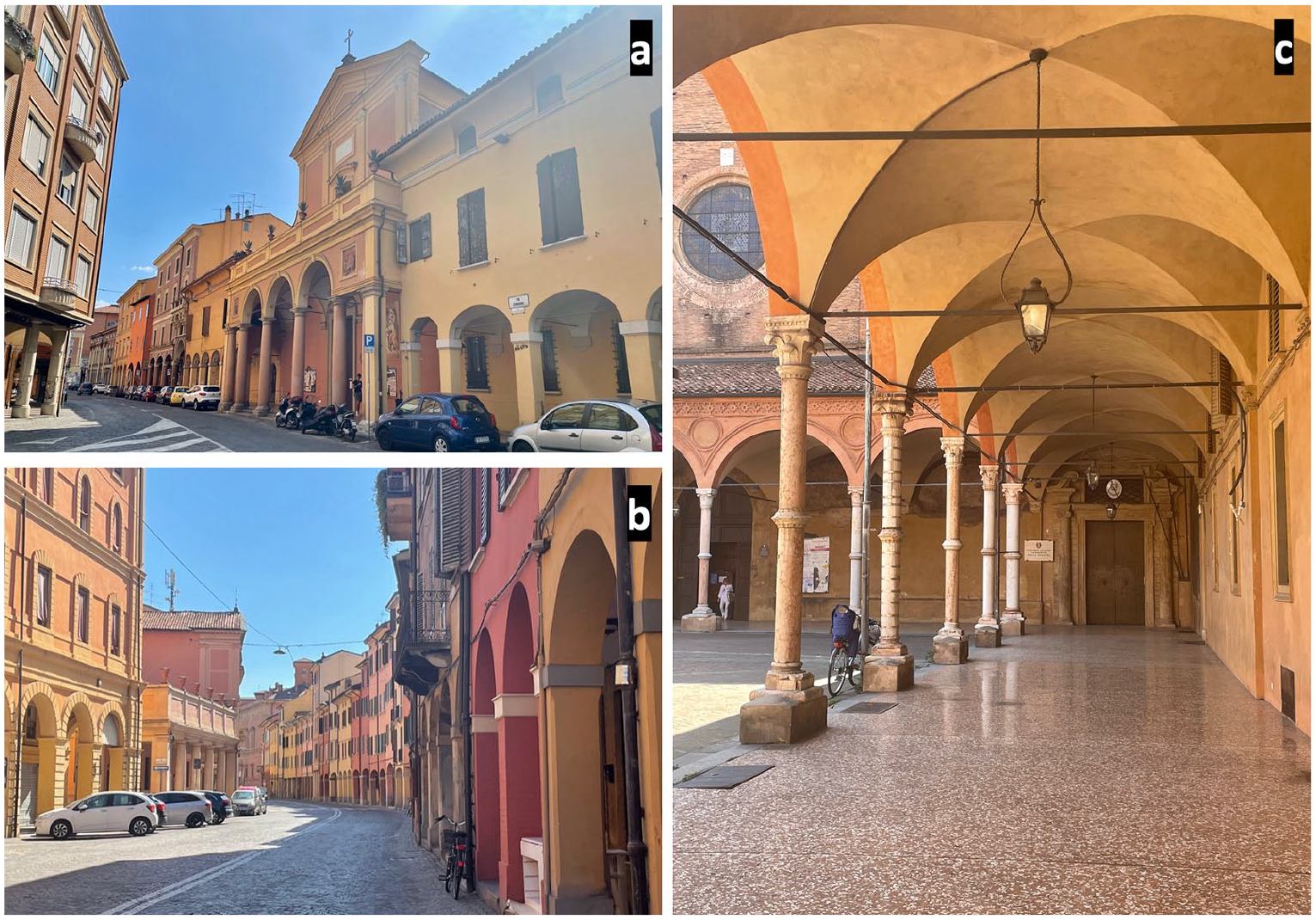
Three sections of the Bolognese porticoes, seen from outside (a, b) and inside (c).
In July 2021 the porticoes became part of the UNESCO World Heritage List. They were inscribed on the UNESCO List unexpectedly, after a long and difficult candidacy process, especially in its final steps (see the section ‘Challenging heritage’s boundaries: everyday practices under the porticoes’). Following the candidacy of the porticoes, I was interested in why it was so difficult, since this is not usual for Italian urban heritage. On one hand, for the Municipality of Bologna, which coordinated the candidacy, this nomination was ‘with no equals among the UNESCO sites’. 8 On the other, ICOMOS – the International Council on Monuments and Sites, which serves as an advisory body associated with UNESCO and whose role consists of reviewing the nominations of cultural heritage – ‘expressed its difficulty to clearly understand the nature of what is being nominated’. 9 It was this difference of opinion, and the question raised about the nature of what was being nominated that shaped my concern with the porticoes as heritage. With the aim to understand the spatial nature of the porticoes, as well as their ‘otherness’ as UNESCO heritage, I chose to conduct field research by walking under them. Walking under the porticoes, as a form of autoethnographic methodology, let me develop a further narrative of them, which I compared with the two aforementioned official narratives as well as with other narratives such as Grisham’s. This comparison allowed me to understand the reasons behind the difficult candidacy of the porticoes. At the same time, walking under the Bolognese porticoes allowed me to investigate their spatial nature, their otherness as ‘official’ heritage, and thus to derive from the autoethnographic exploration some theoretical reflections on the porticoes as heritage and their spatialities.
The idea of heritage as threshold, which is part of the title of this paper, precisely arises from my embodied experience of the porticoes to the extent that it was a liminal experience. In the body of the paper I will thus explore the porticoes as thresholds, focusing on the geographies of thresholds and their link to the concept of liminality. 10 More specifically, I will investigate them in relation to the idea of the threshold as a zone of transition where binary terms are held together and interact with each other. Furthermore, considering the porticoes as thresholds allows one to understand the reasons behind Grisham’s idea of Bologna as a ‘place to hide yourself’ as well as those behind the difficult nomination process of the porticoes to the UNESCO World Heritage List. I will investigate how the ambiguous spatialities of threshold challenge the cartographic certainties and boundaries of the ‘authorized heritage discourse’. 11 In other words, I will argue that the otherness of the porticoes as UNESCO heritage lies in their spatial nature, that is, consists of being heritage which must be spatially conceived as a threshold.
Such a spatial conception of heritage as threshold relates to several existing ideas of heritage within the field of cultural geography. Chronologically, the first of these important understandings of heritage concerns a focus on meaning. Here heritage, ‘like language, […] is one of the mechanisms by which meaning is produced and reproduced’ 12 : that is to say, heritage, regarded as ‘the contemporary use of the past’, 13 is narrative qua production of meaning. The idea of heritage as threshold also derives from the analysis and comparison of different narratives of the porticoes. One of such narratives – rather, the main narrative in this paper – arises from my embodied experience of the porticoes. The embodied experience of heritage is an approach that more recently has come to the fore, deeply influenced by concerns with more-than-representational theories, 14 which, in the field of heritage studies, stress ‘the importance of human interaction with heritage, through embodied processes and practices within relational, contingent and dynamic spaces in everyday life’. 15 The concern with practice, process, and experience is also shared by heritage-from-below perspectives, which shed light on the fact that the construction of heritage ‘may also be materialized [. . .] by individuals and communities within erstwhile everyday spaces, or manifested in more embodied [. . .] ways’. 16 Taking into account that ‘there is no single “heritage”’ 17 but, rather, the processes of heritage-making may be ‘dissonant’ 18 and involve plural, sometimes conflicting constructions of the past, heritage from below (HFB) is conceived as ‘both a means to and manifestation of counter hegemonic practices’. 19 Whereas dominant heritage discourses are seen as top-down imposed, counter hegemonic narratives are instead regarded as ‘from below’ interpretations. While acknowledging that HFB ‘may be seen as a threat to’ authorized heritage discourse (AHD), HFB perspectives nevertheless emphasize that ‘there is no clear line in these days to separate what is AHD from HFB, be it in terms of what of the past is made valuable or who is doing the valuing, [. . .] such that clear-cut distinctions are frequently blurred’. 20 In line with these reflections, other recent non-representational and affective approaches to heritage underline the need to move ‘the debate beyond an authorized heritage/alternative heritage binary’. 21 Accordingly, many current debates are concerned to explore how different perspectives ‘often overlap and constantly interact with one another’ 22 in the process of heritage-making. In response to these calls, this paper aims to explore through the example of the porticoes how a spatial perspective on heritage as threshold can help mediate that interaction between official and alternative interpretations of heritage.
Methods
Methodologically, the field research I conducted in Bologna, under the city’s porticoes, was based on autoethnography and observation. Walking as a form of autoethnography is a method already taken into consideration in geographical debates, especially in relation to the investigation of urban spaces. Furthermore, an autoethnographic approach ‘brings together theory and experience at the site of the investigation’. 23 My walking through the porticoes was an embodied experience of heritage, closely associated, as written above, with ongoing approaches to heritage in terms of everyday life and non-representational theories. 24 The idea of autoethnography which underpinned my empirical research under the porticoes is grounded on some feminist interpretations of such a methodology, according to which: (i) ‘autoethnography, although “an autobiographical genre of writing and research,” is all about placing the “I” firmly within a cultural context’ 25 ; (ii) ‘autoethnography is a methodological tool that combines the experience of embodiment with the agency of narrative’. 26 The following sections of this paper will include the first-person narrative of some meaningful moments or details of my embodied experience of the porticoes. As an autoethnographer I wrote about some moments of the life flowing under the porticoes ‘from a situated, reflexive authorial position’. 27 I did it with the awareness of the complexity of my positionality. First, I was an insider to the extent that I was studying my own culture. Second, my observation of the life and atmosphere flowing under the porticoes – on which I took notes and photos in the way I will describe in the following section – can be defined ‘participant’ to the extent that I was part of that life while I was walking.
In order to conduct my empirical research, I walked under the Bolognese porticoes in 2021, for five non-consecutive months, for at least 6 hours a week. I walked through most of these porticoes, trying to cover with my walking all the areas of the city where they were present, in the historic center (where most sections of them are concentrated) as well as in the suburban and peripheral areas. I walked through porticoes built in different periods, from the Middle Ages to the 20th century, both along wide and crowded streets and along narrow and silent streets, and under both aristocratic and working-class houses. Before embarking on each walk, I chose the area to be covered a priori but I never decided in advance which routes to take under the porticoes in a given area. Only once I was under the porticoes, I chose and varied my paths based on what I was experiencing and seeing. This is why I did not build a map of my walking or calculate the distances covered exactly: this investigation, both in its methods and epistemic perspectives, has aimed at challenging cartographic certainties and boundaries as well as any a priori and from above vision of the city provided by maps (see all the following sections). The only tool I carried with me during the fieldwork was my cell phone, on which I took notes and photos. To the extent that my experience of the porticoes was an embodied experience of heritage, the notes I took were primarily about practices: what I was doing and what other people were doing under the porticoes. In addition, I noted the trajectories of my and other people’s paths, in order to understand how they could contribute to constructing the spatial meanings of the porticoes. When, after the end of the fieldwork, I analyzed all the notes and photos taken, I realized that they testified to an overall homogeneity of the use of the porticoes in all areas of the city, even if the areas were very different from one another.
It is from the analysis of the notes I took during my empirical research that the first-person narrative of my experience of the porticoes and the spatial conception of the porticoes as thresholds derive. The outcomes of my fieldwork will be theoretically reinforced with the analysis of – and comparison with – secondary sources on the porticoes: some other narratives on them, whether official, such as ICOMOS’, or taken from art and literature, such as Grisham’s. Furthermore, my interpretation of the porticoes in the light of the idea of heritage as threshold engages with two main debates: the debate on the spatialities of threshold and the debate focused on the geographies of heritage in its cultural dimension.
Challenging heritage’s boundaries: everyday practices under the porticoes
In July 2021 the porticoes were inscribed on the UNESCO List unexpectedly, because just a few months before their nomination had been deferred by ICOMOS, according to which it was difficult to understand ‘the nature of what is being nominated: a series of porticoes or the historic city?’ 28 Since there are 62 km of porticoes, the Municipality of Bologna, together with all the institutions involved in the candidacy, chose to nominate twelve portions of them, selected on the basis of their representativeness of the whole system. These portions are both in the center and the suburbs of Bologna; hence, they represented a problem for ICOMOS, since they are not circumscribed within the boundaries of a homogeneous area. In fact, ICOMOS’ perspective is a meaningful example of the interpretation of heritage conveyed by the ‘authorized heritage discourse’ (AHD). As argued by Smith, 29 who coined this expression, the idea of ‘boundedness’ characterizes AHD, within which heritage is a site ‘with identifiable boundaries that can be mapped’. This is also stressed by Harvey’s analysis of some AHDs at a local scale: the notion of boundedness has ‘a profound effect on the heritage process’, ‘since heritage is often found at the very root’ of ‘the construction of stable, bounded and reactionary senses of place’. 30 Hence, the idea of heritage arising from AHDs entails a modern ‘sedentary’ perspective, in Cresswell’s 31 terms. On one hand, in fact, it involves a static sense of place, 32 dealing with roots and boundedness; on the other, it involves a static conception of space, exactly that built by maps, that is, by modern ‘cartographic reason’ 33 and its stable certainties, grounded on the definition of homogenous areas by means of clearcut boundaries.
During the 44th session of the World Heritage Committee (July 2021), the porticoes of Bologna were inscribed on the UNESCO list because the representatives of some State Parties argued that, despite ICOMOS’ evaluation, the Nomination Text had provided sufficient proof of the outstanding value of the porticoes. 34 However, also now that the porticoes are part of the World Heritage list, UNESCO continues to request the revision of ‘the boundaries’ of ‘the portico system’. 35 Such a request remains on the UNESCO website dedicated to the Bolognese porticoes, as further evidence of a challenging dialogue between different ideas of heritage. The Municipality of Bologna itself recognized that ‘much of the debate surrounding Bologna’s candidacy focused on the appropriateness’ of the choice ‘to deviate from the idea of nominating the entire historic center’ and select some portions of the porticoes also in peripheral areas. 36 Hence – in my view – the otherness of this candidacy consisted of dissociating the idea of heritage from the boundaries of a homogeneous area. This is particularly close to a constant detail that emerges from the notes I took during my fieldwork: the embodied experience of the porticoes continuously questions any idea of heritage grounded on boundaries and definition/delimitation, as I will try to show immediately below.
During my autoethnographic exploration, I wrote several notes on the trajectories of the paths that I and the other people I encountered took under the porticoes. Such trajectories were often not linear at all, as one may enter and leave the porticoes wherever they want between the columns, such as the people indicated by the arrows in Figure 2. Therefore, the notes taken during my walking under any section of the porticoes led me to ask: where does a portico begin or end? My answer is the following: a portico begins and ends where each walk makes it begin and end. This means that the very spatial form of the porticoes is decided – and re-decided each time – by the relation between them and the trajectories of the paths that each person takes under them. Hence, each person’s portico, as walkway, is different. Furthermore, each everyday practice of walking is different from any other. This entails that the boundaries of the porticoes as well as their meanings and relationships with streets, buildings, the entire city, are continuously in change, because they are continuously constructed, deconstructed, and reconstructed by the embodied practices of all subjects passing through them every day. This also entails that walking under the porticoes challenges and overcomes any static interpretation of them grounded on sharp boundaries.
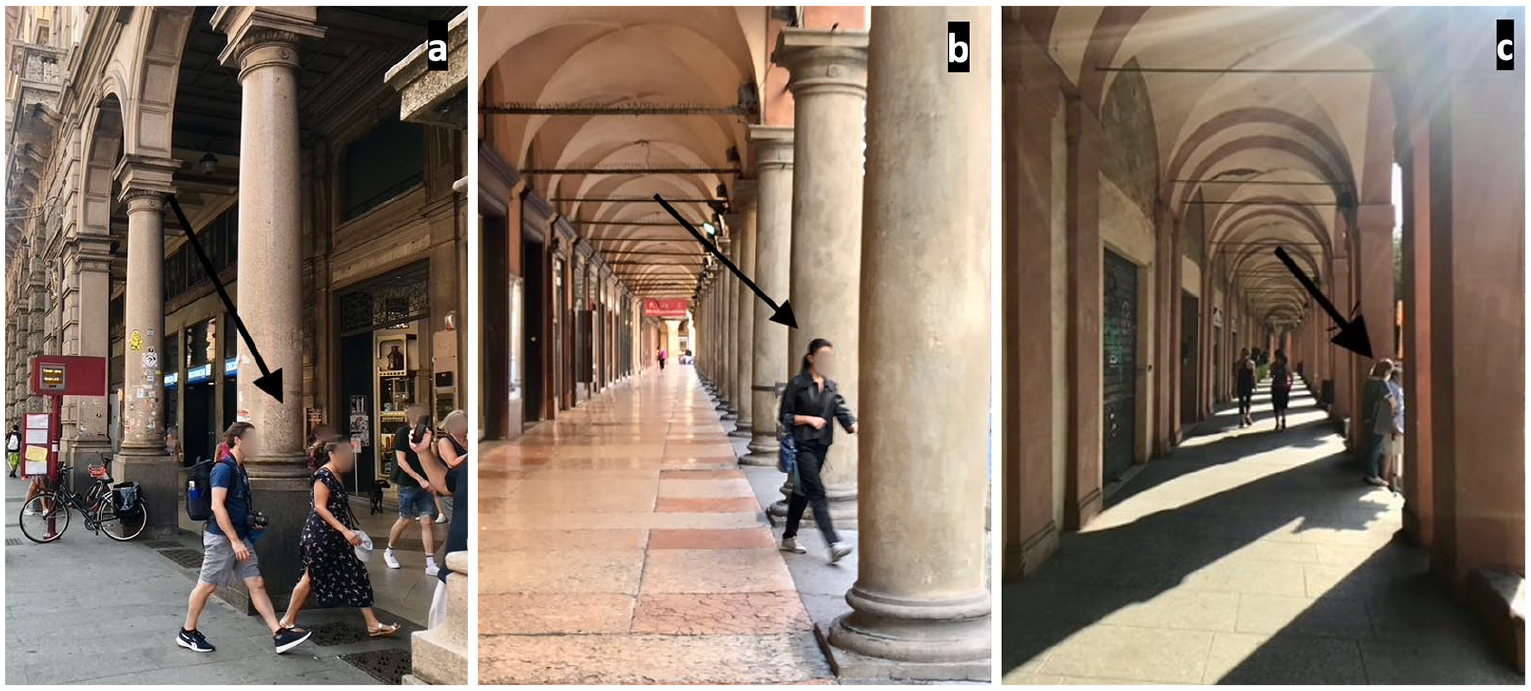
Non-linear trajectories of the paths through the porticoes of Bologna.
Another constant detail that I have found in my notes is the following: under the porticoes people not only walk, but also, among many other practices, stop and chat, windows-shop, sit at the table of a bar or restaurant, on the very floor of the portico, read a book, draw pictures (Figure 3), play music, and so on. People also dance under the porticoes. I would like to deepen this issue by narrating the most unusual thing I happened to see during my empirical research. A few months before the inscription of the porticoes on the UNESCO list, in March 2021, in times of Covid-19, while I was walking through the portico in Figure 1c, I saw a dance class – with some children and a dance teacher – taking place under it. They were performing under the porticoes since, during that period, theatres and dance studios were closed due to the pandemic. Watching this dance class, I observed that it involved a way of re-signifying the space of the porticoes through movement. For instance, sometimes the columns and the internal wall of that section of portico served as a support for dance exercises – a sort of barre, though vertical instead of horizontal; sometimes, by contrast, the same columns and wall served as a support to lean against when the children were tired or bored. Since it was able to re-signify the space of the porticoes, this dance class had a tactical nature, à la de Certeau. For de Certeau, 37 tactics are practices to be conceived as ‘an art of the weak’, an art of everyday expression. Based on this definition derived from de Certeau, I regard tactics as everyday practices that interweave with art. In my view, a dance class is exactly a way to perform art and everyday life at the same time, it is art which becomes part of everyday life and vice versa. Although art luckily transcends any definition, the idea of art arising from this example is an idea of art as practice 38 qua process of re-signification through lived experiences.
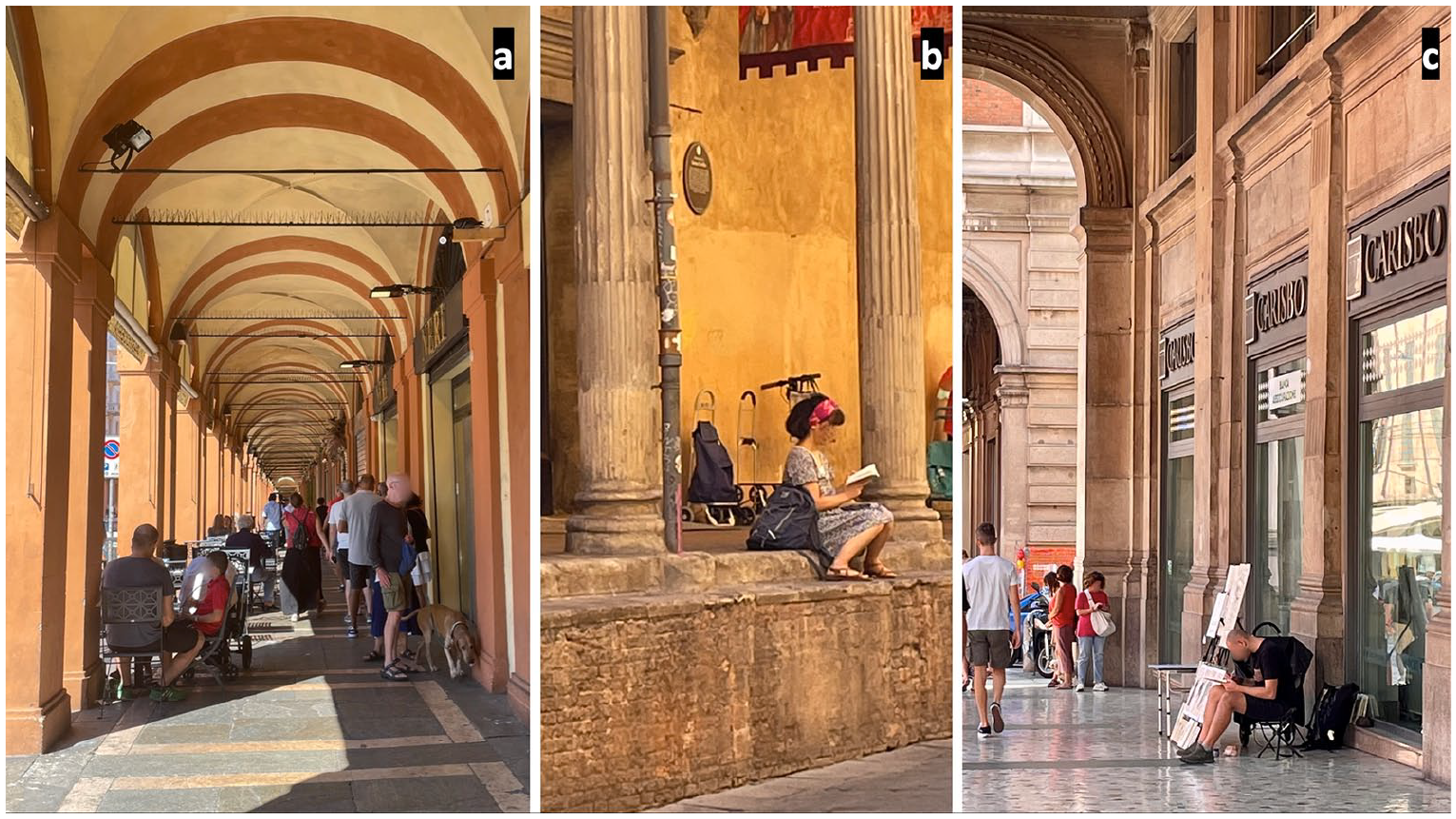
Everyday practices under the Bolognese porticoes.
Rather, all everyday practices I observed under the porticoes were actually tactics, as they were able to re-signify urban spaces in contrast to hegemonic, top-down strategies. Top-down strategies of urban planning share with AHD a vision of the city from above, that is the vision provided by maps, by the clearcut boundaries of cartographic representations. By contrast, as de Certeau argues, the ‘ordinary practitioners of the city’ live ‘down below’. 39 The porticoes are an integral part of a city lived and experienced down below, in de Certeau’s words. Since the porticoes of Bologna are considered heritage, these words immediately recall HFB perspectives inasmuch as HFB has been conceptualized as ‘a process practised and experienced on the ground by the people themselves’. 40
Everyday practices such as walking and reading are exactly experiences of heritage on the ground, whose tactical nature, as an art of everyday life, is able to continuously re-signify the space of the porticoes by challenging their boundaries. I have argued above that each everyday practice of walking is able to construct, de-construct, and re-construct the spatial form and boundaries of the porticoes. This is just one of the ways in which the space of the porticoes challenges heritage’s boundedness. There is at least another way to interpret this challenge, linked to the fact that walking is not the only activity practiced under the porticoes. In fact, all the other lived experiences that continuously give new meanings to the porticoes as heritage – dancing, sitting, and so on – challenge and overcome the boundaries of their most usual definition: that of ‘covered walkways’. In other words, the myriad of tactics that re-signify the space of the porticoes as heritage clearly show that their meanings cannot be (de)limited within the boundaries of a simple definition such as walkways. Any embodied experience of the porticoes, mine included, is much more complex and varied than a simple walk.
Hence, the crucial details emerging from my fieldwork notes can be synthetized as follows: the tactics that construct and re-construct the meaning of the porticoes as heritage represent a challenge to boundaries. Due to this challenge, I believe that these embodied practices are able to highlight and continuously renew that spatial nature and function which the porticoes also derive from their historical genesis, as I will show in the following section.
The porticoes as thresholds
An ‘intrusive’ experience of liminality
While walking under the porticoes I sometimes felt like I was intrusive, or rather involuntarily intrusive toward the lives of others, and that embarrassed me. The reason is the following: under the Bolognese porticoes one finds shops, bars, street art, and so on; however, what one sees most frequently consists of house doors, doorways of houses (Figure 4). In fact, the etymology of the word ‘portico’ dates back to the Latin term porticus, which, in turn, derives from the Latin porta, whose meaning is door, doorway, entrance. In some cases, these doors provide direct access to private houses/apartments; in others, to stairwells. To those who, walking under the porticoes, happen to bump into some of these doors the instant they are opened, a private space is suddenly revealed. That is to say, the moment a door is opened, those walking under the porticoes find themselves sharing the private lives of others, which flow just beyond that door. This feeling of sharing something is accentuated by one of the characteristics of the porticoes that most amazes those who walk through them: their floors are the same as those of the houses beyond the doors (Figure 4). Accordingly, those who pass through the porticoes share and step on the same floor as those who live in the houses that are accessed from the porticoes. This continuity created by the floor is due to the fact that the porticoes are a spatial extension into the street of the entrances of houses, or rather of the floor of the entrances of houses. ‘The floor of an entrance’ or ‘the floor in the doorway’ is the literal definition the dictionaries provide for the concept of threshold. Hence, the entire space of the Bolognese porticoes, as an extension of the floor of the entrances of houses, can be understood as a threshold.
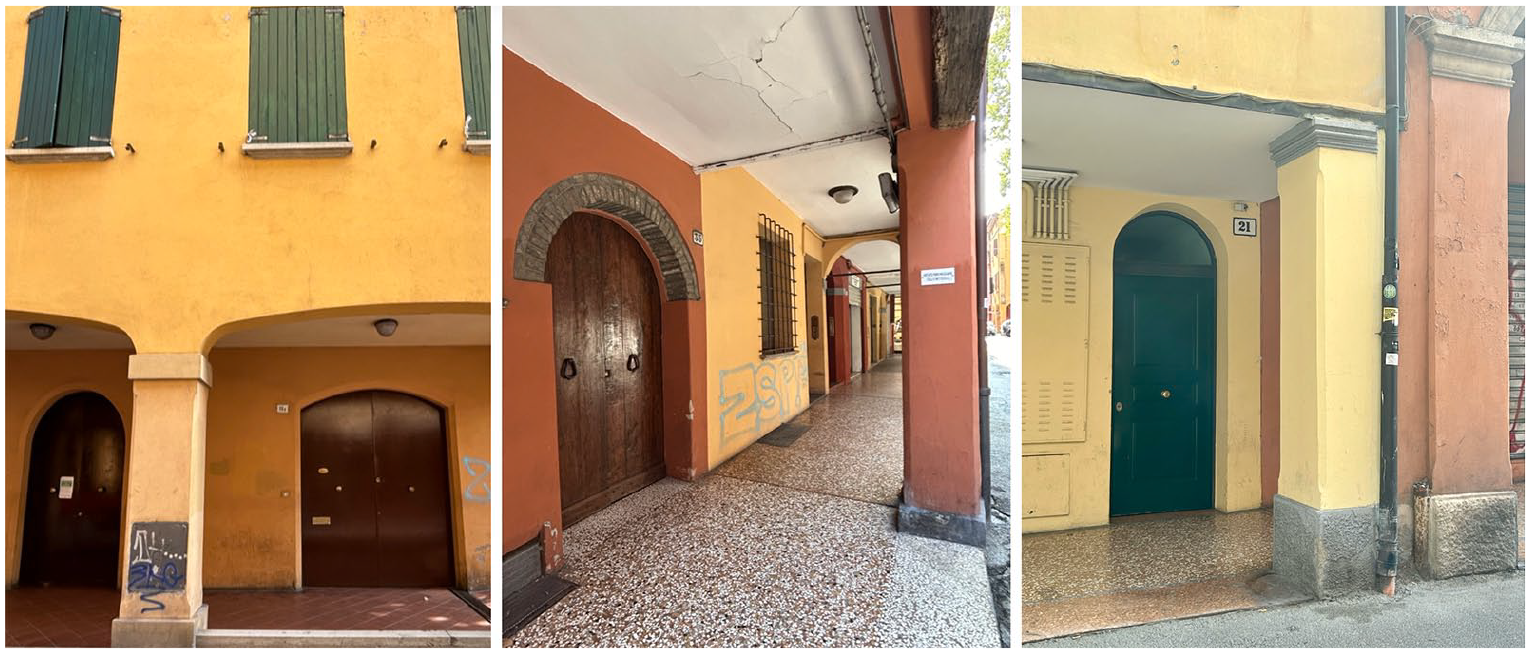
Doorways of houses under the porticoes of Bologna.
An investigation into the spatial nature of thresholds is made necessary by their fundamental link to the porticoes and can start from the historical genesis of the porticoes, dating back to the Middle Ages. In 1288 a law of the Municipality of Bologna obliged all building owners to construct a portico on the ground floor of their private properties, but the portico had to be built for public use, as covered walkway. This is why from the Middle Ages onwards and still today the nature of the porticoes is that of private property for public use. 41 The description of the porticoes as spaces that hold together several binaries, such as private and public, inside and outside, also characterizes some official narratives on them. For instance, in the Nomination Text of the porticoes to the UNESCO list one reads that they ‘have a connecting function between private and public space’. 42 To give another example, a video devoted to the porticoes as heritage – published on some official websites linked to the Municipality of Bologna – underlines that under them ‘you’re simultaneously on the street while also within the familiar confines of a private space’. 43
The porticoes are thresholds as in-between spaces where one walks on the floor of the houses beyond the doors while being in the street. They hold together private and public space, house and city since they are an ‘undefined zone between the inside and the outside’: the quoted expression just represents one of the most famous definitions of threshold, that provided by Genette. 44 Genette’s interest in the idea of threshold is linked to semiotic perspectives, thus associated with meaning, and also for this reason is close to the topic of the present paper. In fact, my analysis of the porticoes in the light of the concept of threshold represents a re-construction of their spatial meaning arising from an embodied experience of them. People walking under the porticoes are neither entirely outside nor entirely inside since they at the same time outside and inside, both on the street and at home. The porticoes are thresholds insofar as they make possible an experience of liminality, given that such an experience is understood, following Turner’s foundational interpretation, as being ‘betwixt and between, neither here nor there’. 45 The concept of liminality cannot be dissociated from that of threshold also because its etymological root is limen, the Latin world exactly meaning ‘threshold’ (see also below).
The very concept of liminality is able to explain the embarrassment and sense of intrusiveness I felt during my empirical exploration of the porticoes. While walking under them I was betwixt and between street and home, public and private, outside and inside. While making this experience of liminality, I was sharing spaces and life moments with the people who lived in the houses whose doors were under the porticoes.
Thresholds as zones
Some doors under the Bolognese porticoes remain open throughout the day: these are the doors that, especially in the aristocratic buildings of the historic center, do not give direct access to apartments but rather to wide entrance halls and inner courtyards overlooked, in turn, by the doors of apartments and offices as well as the stairs leading to the upper floors. Many times I happened to deviate from my path or stop walking in order to go in, or cast my gaze into, entrance halls leading to beautiful courtyards (Figure 5). Each time I was reminded of John Grisham’s perception of Bologna: a city where you can hide (see ‘Introduction’). All these entrance halls and inner courtyards are perfect hiding places to slip into when walking – or fleeing, such as in The Broker – under the porticoes. I have already written about the non-linear trajectories that characterize the paths under the porticoes and question their boundaries: this applies not only to the trajectories between the columns of the porticoes, but also to the ‘zigzag’ trajectories in and out of the doors of the aristocratic buildings in the historic center. Such zigzag trajectories allow us, once again, to experience the absolute continuity between the interior and the exterior, between the houses and the street. As one can see in Figure 5, there is no difference between walking through the porticoes outside the doors and walking through, or hiding inside, the entrance halls and courtyards beyond the doors: the floor, as usual, is the same, the ‘shadowy’ atmosphere is the same (see below), the arches and columns are the same, since even the inner courtyards are often surrounded by porticoes.
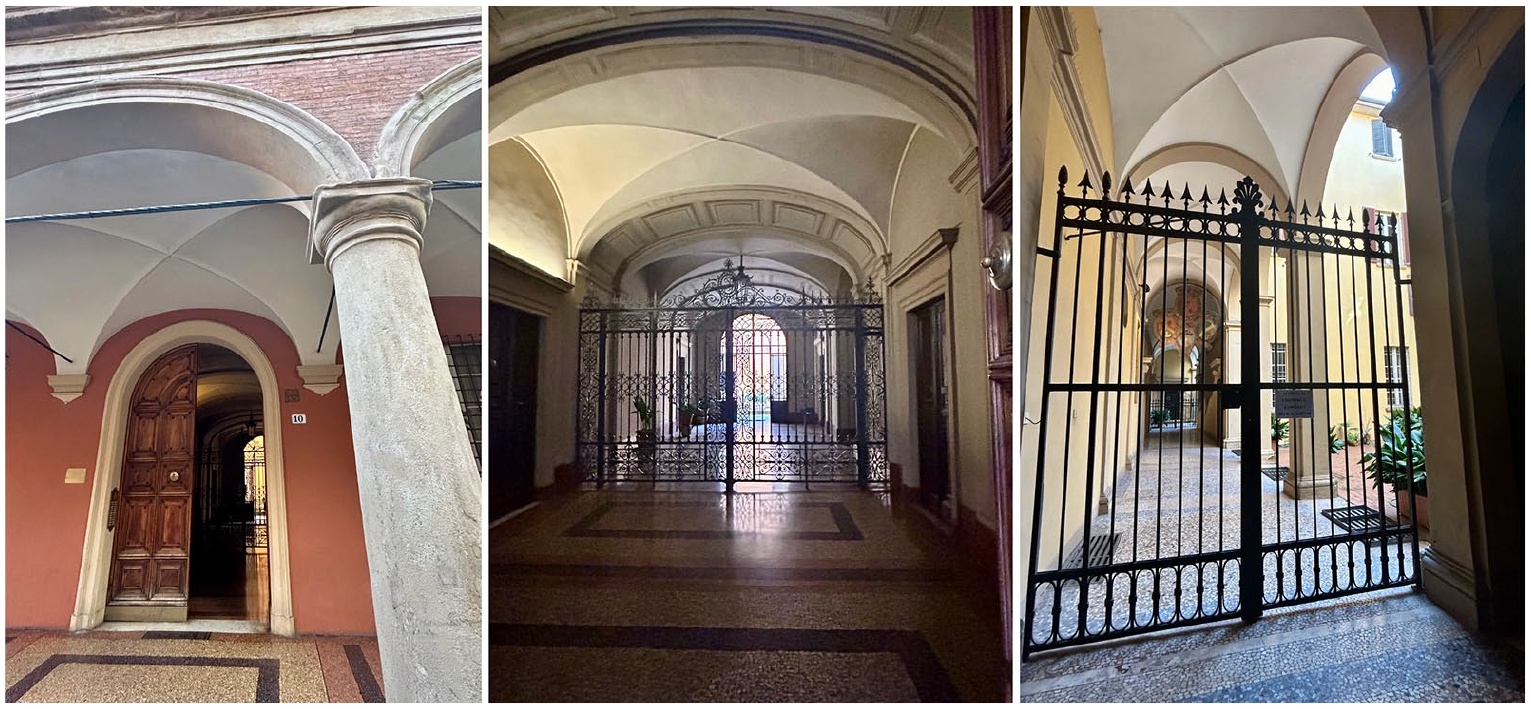
From left to right: a door (of a building) that remains open throughout the day under the Bolognese porticoes; the entrance hall of this building; an inner courtyard.
Such a continuity between the interior and exterior is at the base, once more, of the spatial nature of thresholds, conceived as zones of ‘transition’ and ‘transaction’, in Genette’s words. 46 As a threshold, a Bolognese portico is a zone of transition and trans-action/inter-change to the extent that it is a house which enters the street and, at the same time, a street which enters the houses; it is a private space which becomes part of the public space and, simultaneously, a public space which becomes part of a private space.
The idea of threshold as a transitional zone is reinforced by the idea of the liminal qua associated with experiences of transition. According to van Gennep’s historical perspective, liminal rites were linked, for instance in classical antiquity, to the spatial practice of passing ‘from one territory to another through a neutral zone’, that is a ‘spatial area of transition’ between two territories. The ‘zigzag’ trajectories in and out of the doors of the aristocratic buildings are exactly liminal experiences qua spatial practices of transition through a neutral zone between two territories, such as the private and the public. The idea of neutral zone is at the base of that of threshold to the extent that, for van Gennep, the ‘neutral zone’ of liminal rites ‘shrinks progressively till it ceases to exist except as [. . .] a threshold’. 47 Hence, a threshold is but a neutral zone, or a space of transition, which has progressively shrunk. In line with this interpretation, a Bolognese portico is a threshold which extends itself to return to clearly show its spatial nature of zone, of area of transition. This also means that a threshold has never ceased entirely to evoke its spatial genesis as a transitional zone, though progressively shrunk. In other words, the porticoes, which are but an extension of the floor in the doorways, are the concrete demonstration of the fact that a threshold, by virtue of its spatial genesis, is first and foremost a zone, be it shrunk or reextended. I underline this because van Gennep, despite having explained their spatial genesis in the aforementioned way, defines thresholds also as boundaries. 48 Due to its spatial genesis, instead, a threshold is ‘a zone without any [. . .] boundary’, 49 or rather ‘must be carefully distinguished from the boundary’. 50
Whereas a boundary is a line 51 whose primary function consists of a clearcut separation and distinction of two terms/poles/territories, a threshold, instead, is an inter-mediary zone that inter-weaves binaries and ‘holds them together’. 52 Both boundaries and thresholds involve binary terms; however, it is the spatial reason of boundaries in relation to binaries that is very different – I believe – from that of thresholds. The sedentary reason of boundaries, such as those drawn on maps, consists of clearly distinguishing binary terms from each other and keeping them as two separated domains. By contrast, the reason of thresholds consists of holding binaries in tension and making them interact and reciprocally influence, which is what exactly happens in the case of the porticoes. Bologna’s porticoes are houses which become streets and streets which become houses because they are thresholds and, as such, make binary terms – outside and inside, public and private – interact with each other to the extent that one becomes the other, in some respects, and vice versa.
The spatial reason of thresholds is different from that of boundaries since a threshold is a zone 53 and a zone, in turn, ‘designates something of uncertain status, unclear delineation, unsettling atmosphere’, according to Latour and Weibel’s interpretation of the concept (one of the very rare interpretations of ‘zone’). 54 A threshold is a zone whose uncertain status consists, once more, of being but the spatialization of the idea of the liminal, conceived as ‘that which is neither this nor that, and yet is both’. 55 Concerning the Bolognese porticoes, they are thresholds qua zones since they are neither entirely public spaces nor entirely private spaces, and yet they are both street and home. Furthermore, for Latour and Weibel a zone ‘is exactly what you need to redirect attention away from “territory” [. . .], and above all, from the Earth viewed from the outside as can be seen in countless atlases’. 56 This idea of zone can help us understand something more about the porticoes not only qua thresholds but also qua heritage, or rather qua heritage as threshold. The unclear delineation of zone also depends on its being far from the modern certainties associated with the sedentary logic of maps and their sharp boundaries. The very territoriality of modern states, evoked by Latour and Weibel in opposition to ‘zone’ and founded on inside versus outside, represents one of the main outcomes of this sedentary logic related to clearcut boundaries. 57 The uncertain status of ‘zone’ leads away from sharp boundaries as well as from the view from outside – from above – that is peculiar to modern cartography. Hence, the idea of zone – as well as that of threshold as a zone – questions all the certainties characterizing AHD, from its use of maps to its sedentary conception of heritage grounded on the notion of boundedness (see above). In other words, understanding the porticoes in terms of heritage as threshold makes evident, once again, why their spatial nature challenges the certainties of ICOMOS’ official narrative. To the extent that thresholds are not boundaries but transitional zones, and the uncertain status of zones, in turn, questions modern cartographic certainties, the spatial nature of the porticoes – which are heritage as threshold – challenges the clear boundaries of AHD’s sedentary and top-down imposed perspective.
Light and shadow
My liminal and embodied experience of the Bolognese porticoes could not be dissociated from another pair of terms whose interplay, continuously in change, is peculiar to the porticoes: light and shadow (Figures 2c, 3a, and 6). As Banfield argues, ‘the spatiality of liminality’ is characterized by ‘the multiple ways in which [. . .] binaries can act in combination’. 58 The interaction between the binaries that the porticoes as thresholds hold together is characterized either by simultaneity, such as in the case of private/public, outside/inside, or by a sort of ‘fluctuation’, 59 such as in the case of light/shadow. Walking in Bologna, due to its porticoes, means exactly exploring how this interplay ‘shapes the experience of movement across space, influencing the performance of particular urban choreographies’. 60 The shadows of human and more-than-human bodies in motion play with those of the columns and all the objects that are under the porticoes (chairs, tables, bicycles, and so on). Actually, in most cases it depends on how one chooses to walk under the porticoes: one may walk totally in shadow/in the shade (like the person in Figure 7a and the people on the right in Figure 7b) or through the continuous alternation of light segments and shadow segments created by the sequence of the columns (like the people on the left and at the center in Figure 7b). This alternation cannot be avoided at certain hours of the day (Figure 7c). Many times I realized that I was playing with the shadow of my body which appeared, disappeared, and reappeared between the columns. Hence, to walk under the porticoes means to stand continuously on the threshold between light and shadow, that is, to have an uninterrupted experience of liminality in fluctuating between these binaries. The shadow of my body, together with those of all bodies under the porticoes, constantly wove new light-and-shadow embroideries on their floor – just that floor which, thanks to its continuity between inside and outside, lies at the base of my idea of the porticoes as thresholds. Such an interaction between bodies on the move and architectural bodies continuously creates new light-and-shadow drawings (Figures 7b and 7c) and, consequently, new spatial meanings on the floor of the porticoes, insofar as these embroideries are significant forms qua outcomes of everyday practices. Participating in the creation of such embroideries in motion, by virtue of my body shadow, made me feel even more part of the construction and reconstruction of the meanings of the porticoes.
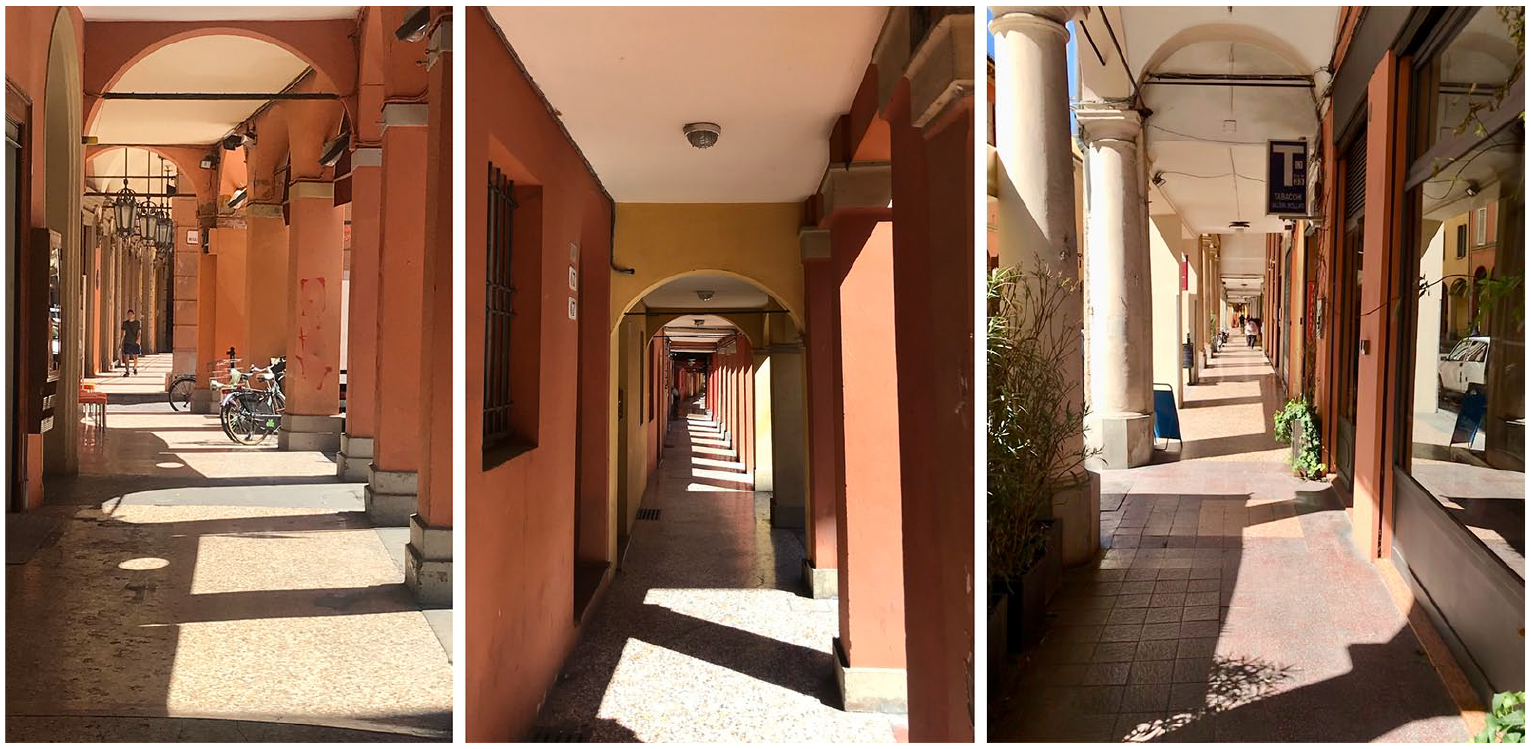
The interplay of light and shadow under the porticoes of Bologna.
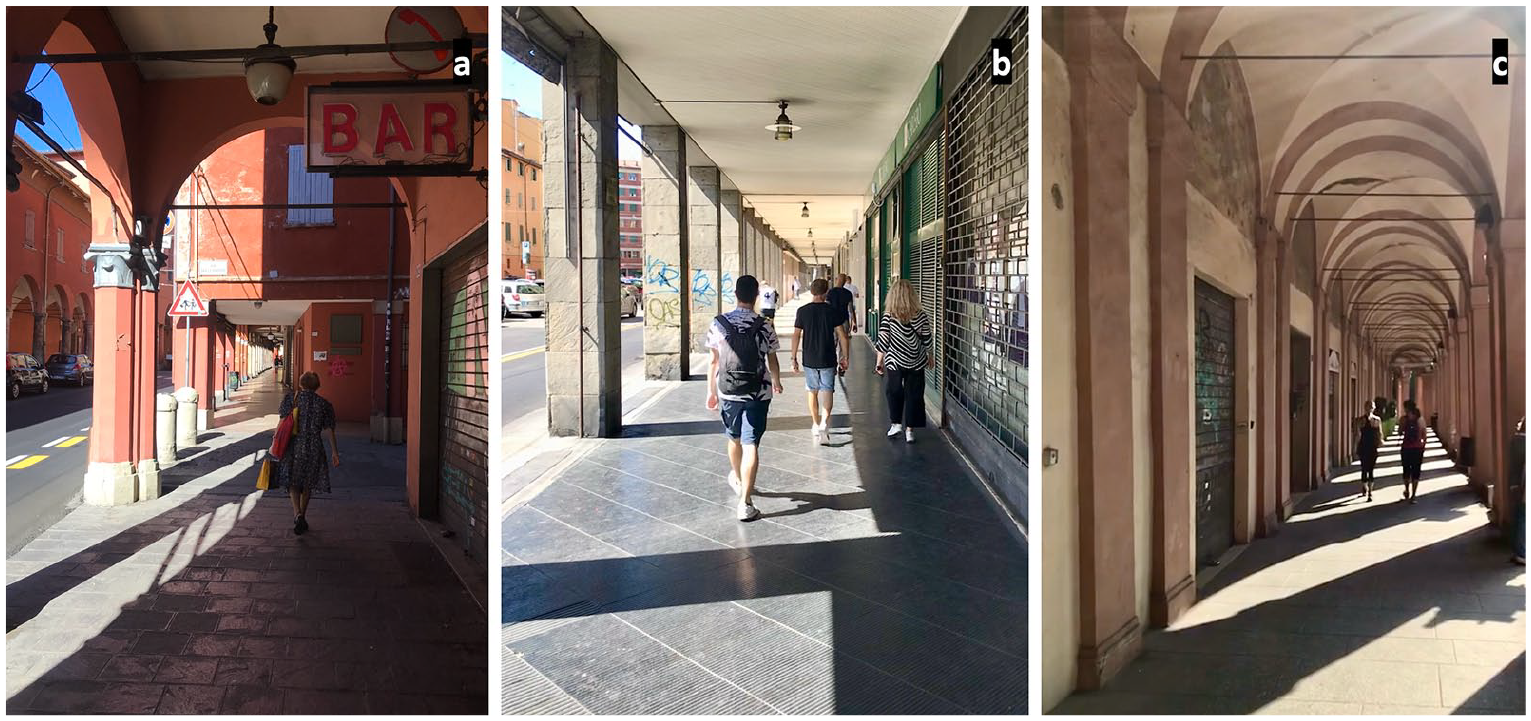
Walking in shadow/in the shade or through the continuous alternation of light and shadow under the porticoes of Bologna.
The dynamic play of light and shadow under the porticoes, as a key constituent of the urban atmosphere of Bologna, has determined, in various eras, the co-existence of emotions and feelings very different from each other, or rather opposite and contradictory, according to what is possible to grasp from the writings of many foreign travelers. 61 I myself, during my autoethnographic exploration, had very different impressions of the atmosphere of Bologna in relation to its porticoes. The very idea of atmosphere, which combines ‘the affectual, the emotional, and the sensory’, 62 is considered a concept and experience of in-betweenness 63 as it ‘holds a series of opposites – presence and absence, materiality and ideality, definite and indefinite, singularity and generality – in a relation of tension’. 64 The atmosphere of Bologna is twice in-between since it cannot be dissociated from its porticoes, which, per se, are thresholds qua in-between zones holding several pairs of opposites in a relation of tension. The spatial nature of the porticoes determines, in turn, the tension between opposite feelings and emotions.
Some of these opposite impressions are summarized in a description of the city’s porticoes offered by the 19th-century traveler Charles Dickens: Bologna is ‘a sombre town [. . .] with heavy arcades over the footways of the older streets, and lighter and more cheerful archways in the newer portions of the town’. 65 As for the grave air that the porticoes give Bologna, this is the impression I had of the city during my zigzag trajectories in and out of the doors of the aristocratic buildings in the center. In particular, the shadowy atmosphere of the wide entrance halls leading to inner courtyards surrounded by porticoes gave me the impression of a city made austere like a cloister by the shadows of a myriad of arches and columns. During these zigzag trajectories I shared with Grisham the impression of Bologna as a city to which the ‘long shadows’ falling under the porticoes give an atmosphere of concealment and mystery. For other travelers, however, Bologna is a welcoming city, where it is pleasant to walk and meet people under the porticoes. This is the impression of Bologna as a cheerful and noisy city that I had whenever I observed and participated in the life flowing under the porticoes – a life made of a myriad of daily practices. The idea of Bologna as a welcoming city is closely linked to the porticoes also because their shade recalls, in my view, the intimate atmosphere of house interiors. In this case, the interpretation of the porticoes as thresholds between light and shadow/shade and that of the porticoes as thresholds between outside and inside perfectly coincide since both recall the idea that ‘the porticoes are the city that becomes home and the house that becomes a city, welcomes and welcomes us’. 66 This is why for most travelers the shade of the porticoes means protection, also from the sun and the rain. This is also why, on the other hand, during my liminal experience under the porticoes, between home and city, I sometimes felt like I was involuntarily intrusive toward the private spaces and lives of others.
The fluctuation of light and shadow under the porticoes even created a ‘way of seeing’ 67 the world, which became a pictorial technique adopted by some renowned Bolognese artists, like Guercino, between the 16th and 17th centuries: this technique was exactly the chiaroscuro (light-dark). As a porticoed city, Bologna was defined the city of the chiaroscuro. 68 Still concerning urban choreographies, the shifting light and shadow under the porticoes creates a ‘natural theatre stage. Its plays of light always seem to have been set up by a cinematographer’, according to a 2021 video 69 (already cited above about the relation private/public) that has been published on some official websites linked to the Municipality of Bologna to promote the porticoes as UNESCO heritage. If, due to the columns of the porticoes and their shadows, Grisham perceived Bologna as an ideal city to hide yourself, due to the same architectural reasons Bonifacci and Accorsi, the authors of the aforementioned video, consider the city an ideal place to play hide-and-seek. Rather, they consider the city’s porticoes as ‘heritage for all children playing hide-and-seek’. This idea was certainly inspired by the two 20th-century short films on Bologna from which the images in motion that the video assembles are taken: all these images, deriving from the artistic gaze of the directors of the shorts, represent Bologna as a chiaroscuro city and in one of the two shorts some children play and run under the porticoes. 70 Furthermore, the idea of the porticoes associated with hide-and-seek is narrated in the video as a childhood memory, and it could really be since the authors of the video were born in Bologna and I, during my fieldwork, saw several children playing hide-and-seek between the columns of the porticoes. Hence, my autoethnographic exploration has confirmed to me that playing hide-and-seek may represent a real individual memory of the porticoes, linked to everyday practices that have built the meaning of the porticoes themselves, whether or not this memory is actually and specifically associated with Bonifacci and Accorsi’s childhood.
According to HFB perspective, this kind of childhood memory belongs to those individual memories, deriving from everyday affective experiences of heritage, that remain ‘in the shadows’ 71 since, in most cases, AHD neither includes nor sheds light on them. By contrast, in the above-mentioned video devoted to the promotion of the porticoes as UNESCO heritage, some of these memories in the shadows as well some artists’ individual gazes permeate the official discourse on the porticoes and, consequently, strongly contribute to co-constructing their meanings qua heritage. In other words, some individual memories and perspectives float from shadow to light to enrich a more widely shared discourse on the porticoes as heritage. Hence, the fluctuation of light and shadow under the porticoes can be considered a concrete materialization of the interaction and transition between meanings/memories in light and meanings/memories in shadow. From this perspective, the porticoes are doubly thresholds: they are thresholds qua concrete zones that make possible a liminal experience between light and shadow and, at the same time, they are heritage as threshold, that is, heritage – rather, heritage-making – conceived as a zone of transition and reciprocal interaction between memories in light and memories in shadow (see below).
Conclusion: heritage as threshold
The autoethnographic exploration of Bologna’s porticoes as well as the investigation of their historical genesis and function, together with the analysis of some secondary sources, lead to the same conclusion: the otherness of the porticoes as UNESCO heritage lies in being heritage as threshold. The idea of heritage as threshold is a spatial sense of heritage that, in relation to the porticoes, can be understood in two ways. The first way consists of the interpretation of the spatiality of the porticoes in the light of the concept of threshold. To the extent that a threshold, as interpreted here, is a zone of transition, interchange, and interweaving, it cannot be a boundary. Hence, the spatial nature of the porticoes as thresholds challenges any narrative of them founded on boundedness, starting from ICOMOS’ discourse, which perfectly represents AHD’s static certainties and sharp boundaries. The spatial conception of the porticoes as thresholds derives first of all from the embodied experience of them, since this experience is always liminal, that is, in between several pairs of opposites, and, as such, is able to determine – and hold in tension – opposite impressions of the urban atmosphere created by the porticoes. At the same time, all everyday experiences of the porticoes continue to strengthen the idea that their spatiality – here conceived as a threshold also based on their historical genesis – is constantly questioning any boundary: on one hand, the very spatial boundaries of the porticoes are constructed and re-constructed each time by the trajectories, often non-linear, of the paths that each person takes under them; on the other, the myriad of daily practices which continuously re-signify the porticoes lead to overcome the boundaries of any exhaustive definition of them, starting from their main definition, which is ‘walkways’.
The second way of understanding the idea of heritage as threshold consists of relating it to the process of heritage-making, that is, the construction and re-construction of meanings and discourses concerning heritage. Let us go back to the otherness of the porticoes as official heritage: on the UNESCO website dedicated to them it is possible to read, on one hand, AHD’s ‘sedentary’ reasons, linked to the idea of boundedness: from ICOMOS’ doubts on what had been nominated 72 to UNESCO’s request, after the inscription on the World Heritage List, to revise the boundaries of the portico system. 73 On the other hand, however, on the same website one can read the Nomination Text characterized by the choice of the Municipality of Bologna, and all the candidacy committee, not to circumscribe the porticoes as heritage within the boundaries of a homogeneous area. In addition, the Nomination Text underlines the ‘connecting function’ that the porticoes have ‘between private and public space’ (see above). Although not through the spatial lens of thresholds, the idea of mediation between binaries, intrinsically associated with historical and everyday function of the porticoes, has become part of the Nomination Text and, through it, of the official discourse on the porticoes as heritage that can be read on the UNESCO website. This means that an alternative discourse on the porticoes, founded on their in-betweenness, has challenged AHD’s boundaries also to the extent that it has permeated and become part of the official narrative on the porticoes as heritage. This is even more evident in Bonifacci and Accorsi’s video: the video promotes the porticoes as UNESCO heritage but, at the same time, enriches the official narrative – or rather, influences and modifies it – through childhood memories, linked to daily experiences, and individual artistic gazes. The construction of the porticoes as heritage is thus based on the interaction and reciprocal influence between official and alternative/individual/embodied interpretations, that is, on the dynamic interplay between memories in light and memories in shadow. Conceiving heritage as threshold means exactly interpreting, from a spatial point of view, this process of heritage-making as a dynamic process of transition and interchange between different/opposite perspectives.
It is the spatial reason of threshold that allows us to explore the process of heritage-making by overcoming the sharp distinction – or boundary – between official and alternative interpretations. As argued above, the need to go beyond clear-cut divisions between authorized and affective interpretations of heritage is considered a central issue in today’s cultural geographical debates on the topic. The reason of thresholds can represent a sort of spatial model that allows us to overcome such clear distinctions to the extent that it questions the reason of boundaries. Both boundaries and thresholds can be associated with binary terms. However, what could be argued differentiates the spatialities of boundary from those of threshold is the nature of the relation between binaries. Whereas a boundary clearly distinguishes binary terms as two separated domains, a threshold holds them together. The nature of the relation constructed by the spatialities of boundaries is characterized by clearcut opposition, polarization, mutual exclusion; by contrast, that constructed by the spatialities of threshold involves interweaving and reciprocal influence between binaries as well as a process of transition and transformation. In other words, what the spatial reason of thresholds questions and overcomes is the idea of distinction and mutual exclusion – for instance, the mutual exclusion of opposite/different interpretations – peculiar to the spatial reason of boundaries.
Hence, the idea of heritage as threshold is a spatial interpretation of the process of construction, deconstruction, reconstruction of heritage, whenever based on the interweaving of official discourses and everyday experiences, on their reciprocal influence and transformation. The construction of the narrative on the porticoes as heritage represents a perfect example of this process of transition and interchange between different perspectives – a process closely associated with the spatiality of thresholds. From such a spatial point of view, it is thus possible to argue that the reason why the candidacy of the porticoes has been so difficult to be understood by some AHD representatives lies in the fact that this process of heritage-making has been founded, at least in some respects, on the questioning of the reason of boundaries.
It was precisely the complexity of this nomination process that prompted me to investigate the spatial nature of the porticoes by walking under them. My autoethnographic exploration of the porticoes let me realize that Bologna is an ideal place to live liminal experiences.
Footnotes
Acknowledgements
I would like to thank the editors, Harriet Hawkins and Dydia DeLyser, for their constructive comments.
Funding
This work was partly supported by Alma Idea 2022 Programme / the European Union – NextGenerationEU (research project acronym: SELFZone; Principal Investigator: Stefania Bonfiglioli). Open access has been financed through RFO funds (University of Bologna).
