




Abstract
This article features an interview with Jennifer Tosch, the founder of Amsterdam’s Black Heritage Tours. Since 2013, Tosch has offered walking and boat tours, leading thousands of people through a colonial reading of Amsterdam’s topography and celebrated institutions. As a cultural historian, Tosch deploys ‘critical fabulation’ to redress the erasures of historical archives. These efforts are part of a wider Mapping Slavery project that brings together Dutch scholars, activists, and artists who are revealing the Netherland’s links to slavery and reclaiming early Black presence. As geographers, we hope this conversation informs collaborative anti-racist work in our field (and elsewhere) and furthers anti-colonial practices in the teaching of cultural geography beyond the classroom.
When we spoke to Jennifer Tosch in April 2024, she was busy getting ready to travel to New York City to present her work at an event: Slavery in New Netherland and the Dutch Atlantic World. Bringing together leading historians, the 2-day conference was sold out. It was an exciting time. With ancestral roots in Suriname, Tosch’s family has lived in the Netherlands for generations. Tosch is a cultural historian and central member of the Mapping Slavery Project, 1 a Dutch network and movement committed to mapping the country’s links to slavery and reclaiming early Black presence of free and not-free peoples. Members of the Project are re-narrating Black histories through different cultural productions and public engagements: oral testimony, maps, brochures, guidebooks, site-specific performances, 2 and book publications. 3
In 2013, Tosch founded Black Heritage Tours, 4 which offers guided walking and boat tours in Amsterdam. These tours are important decolonial interventions that allow immersive experience, history-telling, and what Michael Huss describes as ‘transcultural memory activism’. 5 Reclaiming and repositioning the geographies of enslaved people in Amsterdam is challenging work; enslaved people rarely scripted their own histories or spoke for themselves and are often absent or marginalized in historical records. 6 There are also painful gaps and echoing silences in the archives themselves (e.g. Stadscarchief Amsterdam, notary records, family wills, ship logs). Over the past decade, Tosch and her colleagues have been slowly stitching together the stories of Amsterdam’s enslaved people through a melange of artefacts. They analyze the paintings of Rembrandt, Jan Steen, Jan Verkolje, and others (Figure 1). They connect histories through public records and birth certificates. They search through gravestones and marriage records and through the archives of the city’s most prominent families. Their searching and critical uncovering continue.
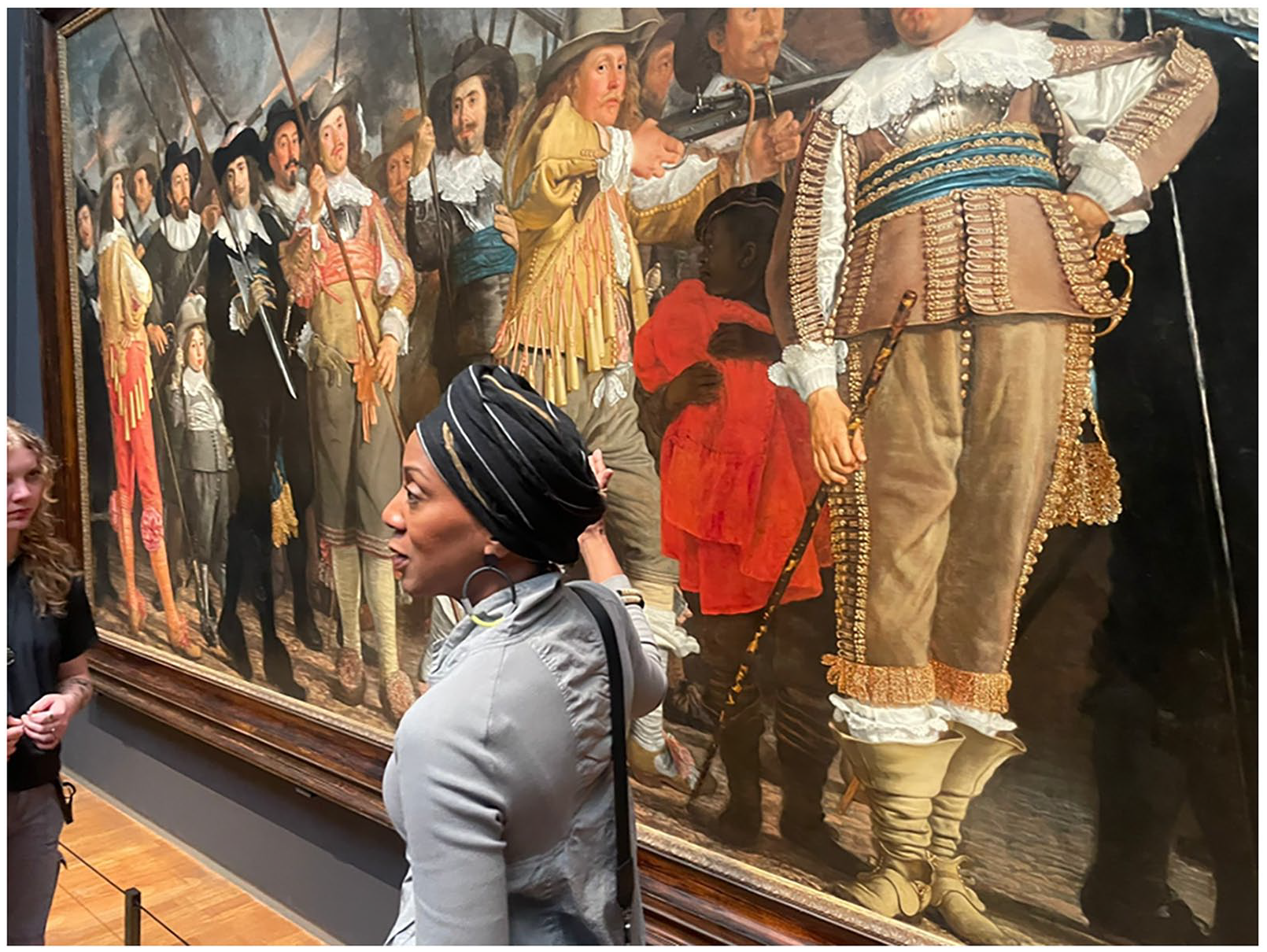
Rereading Militia Company of District VIII in Amsterdam under the Command of Captain Roelof Bicker, Bartholomeus van der Helst, c. 1640 – c. 1643.
At other points, Amsterdam’s colonial past is ever present. It is literally etched onto the city’s very fabric: sculpted African heads framing the doorway of what was once the 18th-century home of the Van Hoorn brothers or the enslaved Black boy sculpted over the doorway of Cornelis Tromp. Tosch’s work with Black Heritage Tours decodes this landscape – a reclaiming often demanding long-term and incredibly patient engagement and dialogue with some of the city’s most prominent institutions. In 2023, Tosch was invited by the Royal Palace Amsterdam, King Willem-Alexander’s official reception palace, to construct a guided tour and colonial re-reading of the palace itself. Since 2017, she has also been guiding visitors through art objects in the Rijksmuseum, the Netherlands’ national museum. Yet tracing links to slavery remains an incomplete project, as gaps and fissures in the historical record necessitate new methods, new collaborations, new imaginations, and new ways of teaching. In her retelling of history, Tosch often deploys what Saidiya Hartman describes as ‘critical fabulation’, 7 or the weaving together of historical materials, critical theory, and narrative fiction to redress and counteract profound archival violence and its obliterations of lives.
Since 2021, we 8 have travelled by ferry with undergraduate human geography students from Newcastle University to Amsterdam, where we participate in Tosch’s guided tours and encounter substantive moments of (re)learning. We offer the following conversation with Tosch to excite the pedagogical imaginations and teaching practices of cultural (and other) geographers. We hope the following (edited) conversation extends disciplinary work on anti-racist and decolonial teaching 9 beyond the classroom and bolsters our partnership and collaboration with public scholars.
Interview with Jennifer Tosch 26 April 2024
Introductions
Maybe we could start with you introducing yourself and describing how you ended up working on African heritage and cultural memory in Amsterdam.
Great. Thanks for doing this. I think this is great. My name is Jennifer, and I’m a cultural historian. I’ve been living in Amsterdam, Netherlands, now for 11 years. My roots go back several generations to Suriname. My parents and my ancestors are from Suriname. My family has lived in the Netherlands now for five generations, since the mid-1940s, 1944. My great-great-uncle was a sailor and a seaman working on Dutch ships, not only in the Netherlands but around the world.
My mother lived in the Netherlands until after World War II. She ran a training school for teachers in Suriname in what was called the Kweekschool. Both sides of my family history had this parallel path that merged when my parents met in Aruba, another former Dutch colony, and together, immigrated to New York, where I was born.
The tours that I started were inspired by what was missing in plain sight. I was doing courses as an international student in 2012 in the Netherlands, and I was so struck because the discourse was so centered around this notion of the ‘Golden Age’, which is referring to the rise of the Dutch Empire and its global colonial mission around the world. That teaching was dispossessing the descendants of enslaved people and ignoring how the Dutch enriched themselves through waging war against Indigenous people and their land, exploitation, colonialism, slavery, etc. That disturbed me. I felt the education I was provided in the Netherlands was centered around knowledge that was amenable to international students coming into the metropole. Of course, most nations have their glory stories that center around what they were proud of and not what they were ashamed of.
I decided to deepen my research and look for hidden histories and try to see how we can make them more visible. How could I deepen my understanding of the colonial past in my own family heritage, and how could we use other methods and an interdisciplinary approach to talking back to history? That’s really how these Black Heritage tours evolved. I had no plan of ever leaving my home in California and moving to the Netherlands, which, as you know, has happened since then.
It is nothing short of miraculous that the tours evolved and grew as Amsterdam’s history of slavery continues to be excavated. My intention has been to make this broad, complex, layered history more accessible to a wider audience. A lot of what has been written has been written in a very difficult academic language which isn’t really intended to be accessible to people who are just curious: seekers who are doing their own family research or trying to understand the deeper meanings behind their colonial heritage.
Methods
Great. I want to ask about method: how do you approach reclaiming those (mostly) Black histories in Amsterdam? So much of that labor involved in reclaiming those histories (based on my experience of the tours) seems to rely on the physical fabric of the city. It depends on interpretations of visual art, monuments, and the iconography of the city. Its built environment. Maybe you could talk a little bit about the importance of those materials and that approach. It's fascinating.
Yes. We deployed several interdisciplinary approaches to unpack this built environment. What makes Amsterdam and the Netherlands one of the most unique places to study and to do this kind of work is the fact that so much of the colonial past is preserved in the material heritage, monuments, and canal houses. In all these material places, symbols have been carved for centuries on buildings to signify a family’s coat of arms or industry or symbols of products like sugar and tobacco. All of this colonial iconography remains embedded in the material; that heritage is tangible.
My co-writer, Nancy Jouwe, talks about how the city is an archive. It is in the city’s built environment where we can trace back the historical steps of people who were not European, who were not White, who were often hidden in plain sight or invisible or wilfully forgotten or ignored because the dominant historical narrative is written from the victors or the producers of Dutch colonial knowledge. This geography was just buried beneath the surface; it needed just a little peeling away to access it.
Now, it’s also interesting that there are so many fragments; there are so many gaps because our knowledge of Amsterdam’s so-called ‘Black community’ is mostly formed from what was recorded or written about them. Very little was written by them [enslaved and emancipated Black people in Amsterdam]. There is a tension and space in the intersection between what we know – what is written or recorded – and what we don’t know. We don’t fully know the lived experiences of people who had to navigate a place where race and culture and identity and belonging were still being worked out in proximity to each other.
Reclaiming the histories of enslaved people has required a different approach. How do we have conversations with the lived experiences of the people when we know hardly anything about them? Sometimes, we don’t know their names. Sometimes, we only have a first name, not a last name. We know where they lived, but we don't know what their life was like. It’s very challenging to try to curate their experiences.
Materials
What materials have been most useful to you as you try and patch together that history?
I think it’s been a combination of things. Archivists, one stands out, his name is Mark Ponte. He is an archivist and historian at the City Archives. He was, almost at the same time as I was developing the tour narratives, reconstructing a map and a database of Amsterdam’s early Black community in the 17th century. His archival work has traced the early presence of Black peoples in the city, through marriage certificates, people of color written into wills, people being given their freedom or enslaved, in police reports, baptismal records, etc.
It’s through these materials that we started piecing together the fabric of what might have been the experience of Amsterdam’s Black community living in the 17th century. There is a method that I deploy called ‘critical fabulation’ which we use to imagine what might have been. Saidiya Hartman coined that phrase, which allows us to use historical research and documents and to fill in gaps with storytelling, visual arts, and performance.
The performance practice transforms, and in many ways, that’s what I’m doing on the tours. I’m embodying the parallels between what we know and what we don’t know. I’m weaving that together. That’s really important. Critical fabulation is very important. I mean, when you’re doing this type of research, you’re excavating facts and figures and information from a variety of sources, and then, in my case, I’m weaving a lot of those sources together to create a story.
That’s really interesting.
At the same time, it’s critical to ground the tour and my work in a theoretical framework. It can’t just be making stuff up. It must be grounded in reason. That’s really important.
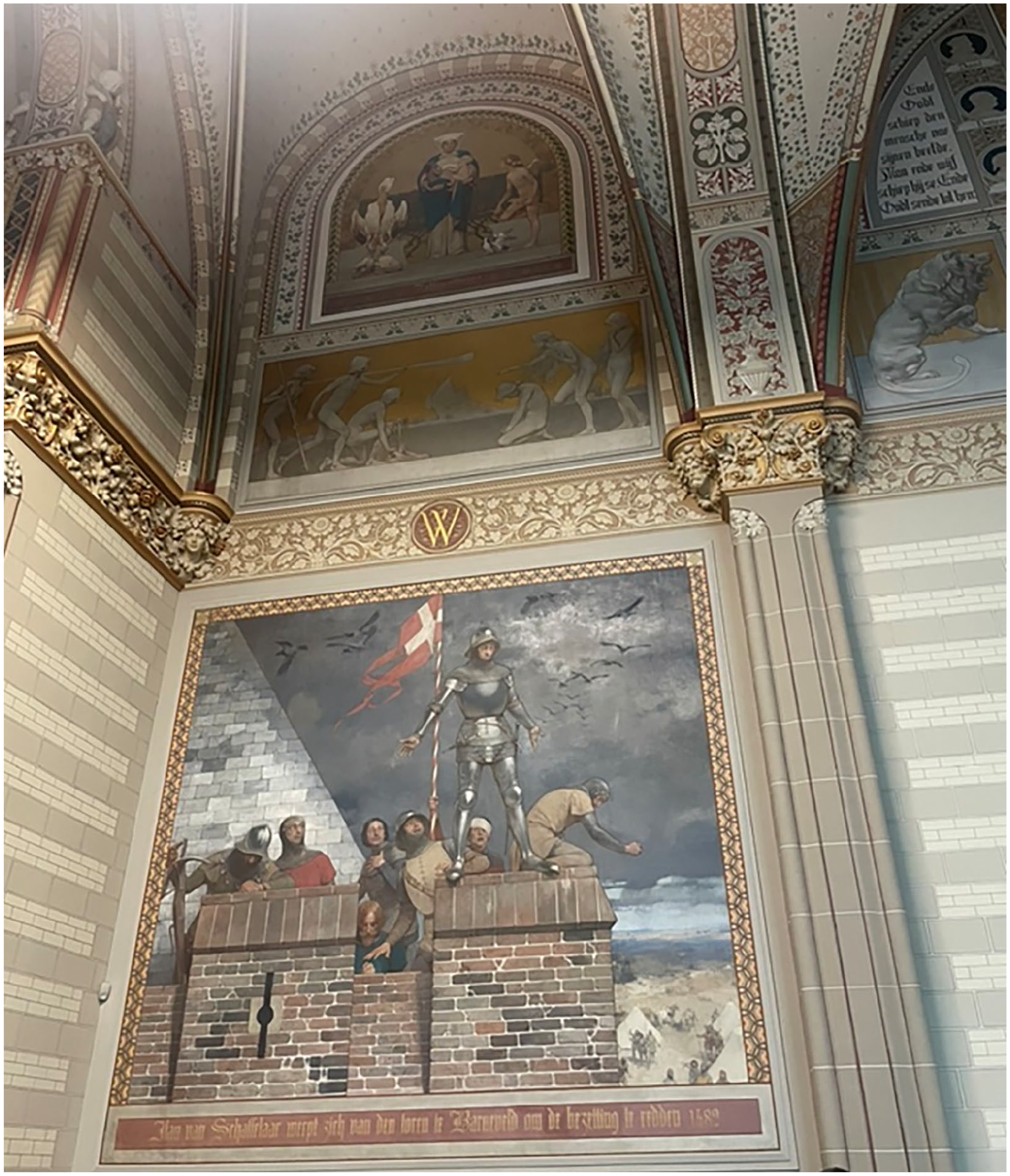
Rijksmuseum: Jennifer points to an upper relief of the Dutch nation-state (embodied by a woman) nursing a Black and white baby. Photography by Jen Bagelman.
Institutions
One thing that really strikes me about your work in Amsterdam is the great amount of patience [laughs] that is required not only to stitch together those materials and to build an interpretive narrative around them but also the patience it must take to engage with state institutions and specific individuals. I’m very curious to hear you talk a little about those engagements.
Well, that’s a great question because in the very beginning [of developing the guided tours], there was a lot of reluctance from institutions to engage with Amsterdam’s history of slavery. And then, eleven years ago, there was the 150th year of the legal abolition of slavery in the Dutch Kingdom. The first wave of that was being commemorated in 2013, to be exact. When the Mapping Slavery Project first approached some of these national institutions, like the National Maritime Museum or the Rijksmuseum, there was reluctance because they weren't yet ready to really turn the page and start to uncover, recover their own deeper histories and to be more self-reflective. There was this pushback that we now refer to as historical distancing or wilful forgetfulness.
It took quite a lot of time and patience to develop the relationship with institutions that could trust that we weren’t trying to dissolve or dismantle Dutch nationalism, its glory story. We’re trying to add to it. Because we don’t see this national narrative as wrong; it’s just incomplete. It only centers the victors, if you will, or the colonizers, and not the colonized. Over time, we built a level of trust when individuals at specific state institutions started to see that the work we were producing did not diminish their dominant positions but expanded and made them more interesting and engaging, quite frankly.
Then, wider things were happening in history, like Black Lives Matter becoming a global platform; this also helped accelerate self-reflection in the Netherlands because every nation that's grappling with institutional racism is now trying to confront it in different ways. We took advantage of the changing tide around the world in terms of activism and knowledge production. We were really looking to the Global South for inferences: how do we confront the clashes between what was written about people versus what is written by people? That took time and is still evolving. More and more institutions are starting to come on board, if you will, and want to have these multiple narratives told.
I can’t pass up the opportunity to ask you how you negotiated access to the Royal Palace.
Oh, that’s another journey that took many years. When I started 11, 12 years ago, the Royal Palace was completely like, ‘Oh, no, we are not talking about slavery or colonialism. This is the Royal Palace that really centers around the telling of the Dutch Golden Age’. That was a no-go. Well, again, times changed. And I must give credit to all the epistemic activism and frontline activists fighting against racism in the Netherlands, the country’s anti-racist movement.
Last year was pivotal. In 2023, King Willem Alexander of the Netherlands formally apologized for the Dutch royal family’s role in and financial benefit from its investments and direct involvement in the Dutch colonial system. That came about because the Royal House commissioned researchers to examine its financial records, its historical documents, and archives to really quantify how the royal family was implicated in Dutch imperialism. That research informed the royal family’s official apology. There was a lot that went into that moment.
At this time, the Royal House foundation commissioned me to create a tour inside the Royal Palace. Traces of Slavery takes place in the palace, which was actually built as a city hall in the 17th century. The conversation had radically changed from 11 years ago. From a complete ‘no, we’re not interested’ to ‘please help us curate a story inside of this building that helps us see the invisible that’s in plain sight’.
That moment was life changing. I took the opportunity and extended the invitation to other experts in the field because this building is filled with floor maps, carvings, statues, paintings, symbols that represent so many different things that I alone felt inadequate to read and interpret. We created a network of experts that helped each other learn to see beyond our disciplines. And oh my God, it was very exciting to see and hear other historians talk about botanical history and how those symbols are represented in the building or to listen to cartographers reading the symbols on maps from the 17th century (Figure 3).
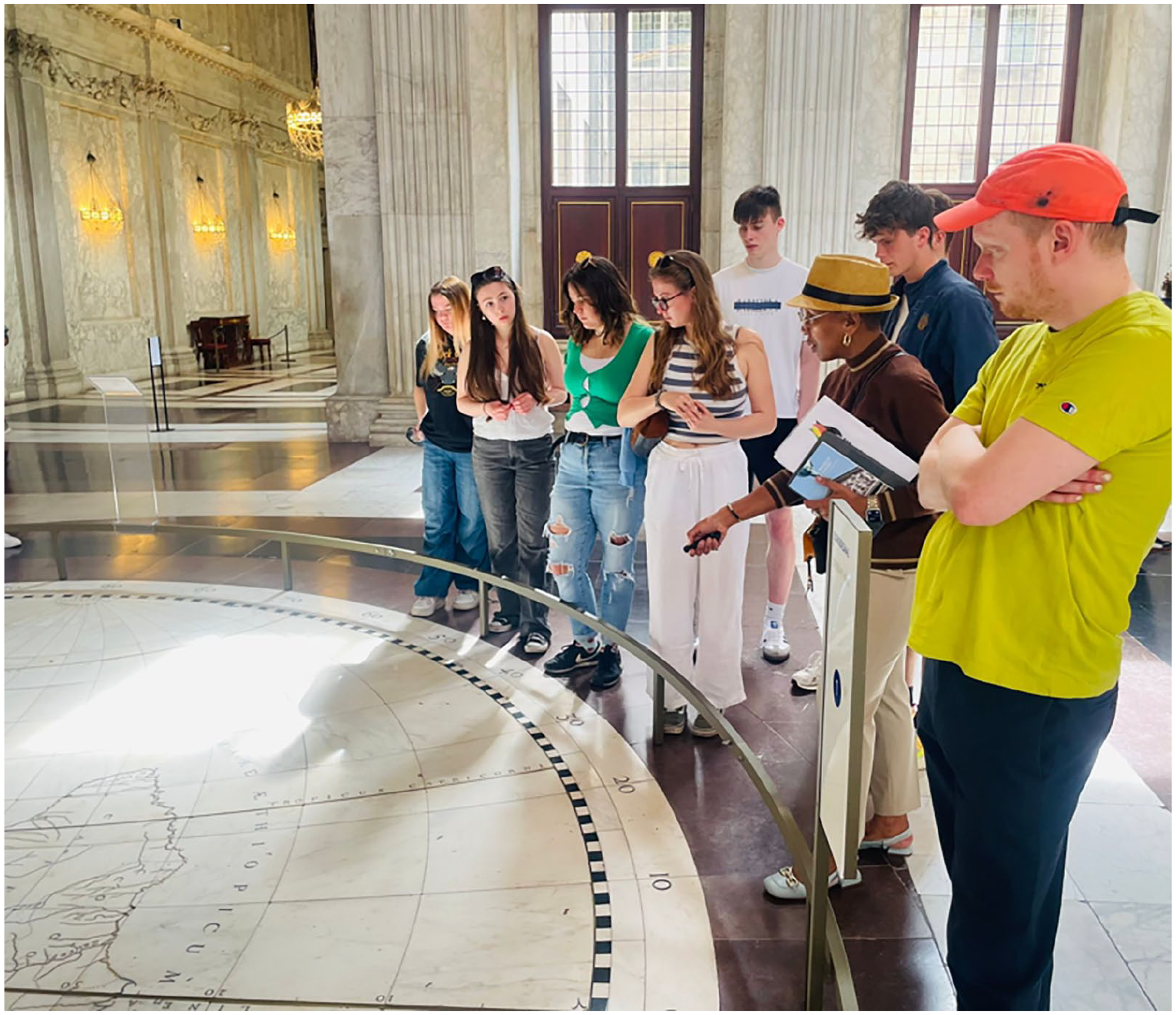
Deciphering a 17th century floor map carved in marble in Royal Palace. Photograph by Jen Bagelman.
From the collaboration with other historians, I curated the tour narrative of the palace, which is what we use now. It was a process. It took almost a year to do. We published a booklet that the Royal Palace foundation is still giving out for free. I did training sessions with their guides to help them incorporate this narrative into their existing tours. The palace also participated in keti koti (chains are broken), which celebrates the abolition of slavery in the Dutch America and West Indies in 1863. They gave full access to the palace kitchen for the organization Kip Republic to cook 10,000 heri heri, which is a traditional Surinamese meal. The palace has made a complete 180-degree turn and continues to evolve the narrative and partnership. It's been incredible.
Difficult conversations and pedagogies
It’s fascinating. Is it fair then to say that there’s a window that’s opened in Amsterdam for difficult conversations around the city’s very intimate connections to empire and slavery? If so, how tenuous is that opening? Is this a fad? Or is something more durable happening?
That’s a good question. I don’t think it is a fad, definitely not. I do think it’s a result of the changing times and activism on many different fronts that have been pounding on this door for a very long time. Much longer than I can speak to. I think that the changing time and the elevated attention and awareness have created an opening. I believe that it’s not just a window that’s open and that will close. Of course, there is a risk as political climates and structures change that we’ll have a backlash. But I have seen a steady increase of the work and research and awareness and interest from society at large and a broader audience beyond our own borders. I want to believe that the movement is afoot, that it’s sustainable because we are reaching and teaching the next generation to pick up the mantle and keep it moving forward.
We continue to press for more. We continue to press, let’s go deeper. Let’s continue to explore these categories of race and history and memory and heritage. As long as we keep pushing for that and insisting that we collaborate and co-create these histories together, I don’t see it going away. Too much is at stake. There are too many people invested in the changing of society and making it more just, more historically just, if you will. It’s not going to just end tomorrow.
Part of what’s so interesting about the work you’re doing is how it’s complicating the national narrative and that foundational cultural narrative of the Netherlands. We know that these narratives are very difficult to shift and evolve and that they reproduce themselves.
Yes, absolutely.
In all sorts of ways, in sites like the Rijksmuseum, like the Royal Palace. I was very struck by your tours where we’re following you through the Palace and meanwhile, other visitors are listening to the official story and audio tour on their headphones. I don’t know really what the question is, but what is the next step for you in this work? How do you make the interventions that you and others are doing stick?
We like to say that we’re disrupting the dominant narrative. We must continue to disrupt that dominant colonial narrative and nostalgia, if you will, of this so-called Dutch Golden Age. And we are constantly producing new knowledge. For example, through the Mapping Slavery Project, two new books are coming out. One is about South Africa and the Netherlands, that’s with Nancy Jouwe. The other one is with Annemarie de Wildt, who recently retired as a curator at the Amsterdam Museum. Continuing to create and produce new historical knowledge is important.
Also, accessing oral histories and other methods of critical fabulation is important because they help us create more lived experiences of people. You can’t deny someone’s personal story. Members of descendent communities, including myself, are doing our own familial research and trying to incorporate this into public memory to make it stick. Again, you cannot deny someone’s own personal story. It’s a combination of different actions which is the way forward to continue to make us more aware of the complexities and the layers that we are engaging in.
One thing that doesn’t change is the built environment. In Amsterdam, it is what it is. What does continue to evolve is what we’re learning behind the facades of the people’s lives, from people situated on different sides of the histories, who have lived in these places of memory. So, we are invoking new memories that cannot be unremembered. The political climate has changed in the Netherlands, where there is now a much more conservative political landscape, which runs the risk of rolling back some of the progress we’ve made, as we see happening in the United States. There is always that danger. But I don't see that happening. So long as the people lead, leaders will follow, to quote a very old saying.
I see the progress. I see that we are reaching more and more audiences outside the academic sphere, outside a city or a region. We’re reaching people in Africa, in Indonesia, in the Caribbean, in North America, and more and more people are hearing about the work we’re doing. This is not to say it is a utopia, by any stretch; it’s not. We struggle with a lot of different issues daily, but it’s a movement that is committed.
If people believe in the mission of making society more just, more equitable, of righting historical wrongs, then I think we will. Wouldn’t it be great, though, if we get to a point where there's no need for a Black Heritage tour because it is so ingrained in society? That would be the ultimate goal. I don’t see that happening any time soon, but it would be incredible to think, ‘Oh, we don’t need that because it’s taught in schools. It’s compulsory’.
That’s interesting.
Everybody that you encounter knows these histories and can speak about them. Just as you’re taught certain histories as a child, which embed and shape your national identity, wouldn’t that be great if these histories were part of that shaping as well?
You must get surprises when Dutch people go on your tours.
In the beginning, very surprising. There was a strange irony that when I first started, only Dutch white people were taking my tours. There was a bit of scepticism, especially in my family, some saying: ‘Dutch white people are not going to allow you to say these things about their history’. I’m emphasizing ‘these’ because even my own family, who’ve been in the Netherlands for generations, are still grappling with the sense of belonging and ownership of identity.
When I started the tours, I only got people from the Netherlands. I hadn’t yet reached a broader audience. People were wondering, ‘What am I going to say? I have these Surinamese roots, I have these American roots, I have these Netherlands roots. What narratives am I going to use to try to frame or reframe the dominant narrative of the Dutch Golden Age?’ And then the media started paying attention to the tours and responding in a very positive way. That was helpful.
The tours have become sustainable because they are not just for international travellers. They engage schools in the Netherlands, locals, families who are participating. I get calls daily or emails requesting tours for families who were born and raised in the Netherlands. That tells me that we continue to reach new audiences who are being told, ‘Hey, do this tour if you really want a deeper understanding of our shared histories’. This is how we continue to grow. I see it more and more. And it’s not surprising really to have full tours with just Dutch white people because no one taught them these different perspectives of colonial history in school, quite frankly.
A final question then: How do you view encounters with students at home and abroad in relation to the work that you're doing?
The most encouraging and inspiring thing for me is the generation that’s coming now, including students you bring to Amsterdam each year. They’re being very critical, asking the right questions. When we talk about decolonizing history, it’s become such a buzzword that it can lose its meaning. What does that really mean? I think it means that we’re starting to unpack and recover and retrieve some of the histories that have been ignored or forgotten or just not known.
It’s important to keep questioning the production of knowledge and how knowledge has been transmitted through time and space. Using this somewhat-comparative analysis to say, ‘Hey, well, I’m from the UK and I see a parallel history to what I just encountered here in Amsterdam’.
Students who are exploring these different categories of history and race, that just lets me know that there’s a future for the past, which is one of the central questions I grapple with. What is the future for the past? There’s going to be a next generation who’s going to write and produce even more provocative knowledge, more critical analysis, more stories about the lived experiences that keep getting uncovered and recovered and unpacked.
Students are the ones that give me the most pause, ‘Hey, you know what? This is actually working’. I’ve had students who’ve done my tour 5 years ago and who are now in the field come back to me and say, ‘Hey, your tour was central to helping me to think more critically about how to analyze or to look at historical data and position myself’. That is something I often talk about: the importance of doing academic work but also positioning yourself within the work because we all have a perspective. No one is neutral.
The work that you do in really encouraging students to be more critical about research is essential. We’re not just relying on the more traditional ways of looking at archives or looking at documents. We must see the human beings behind the story, behind the artifacts. And I see that understanding in students and in their conversations with me.
Well said.
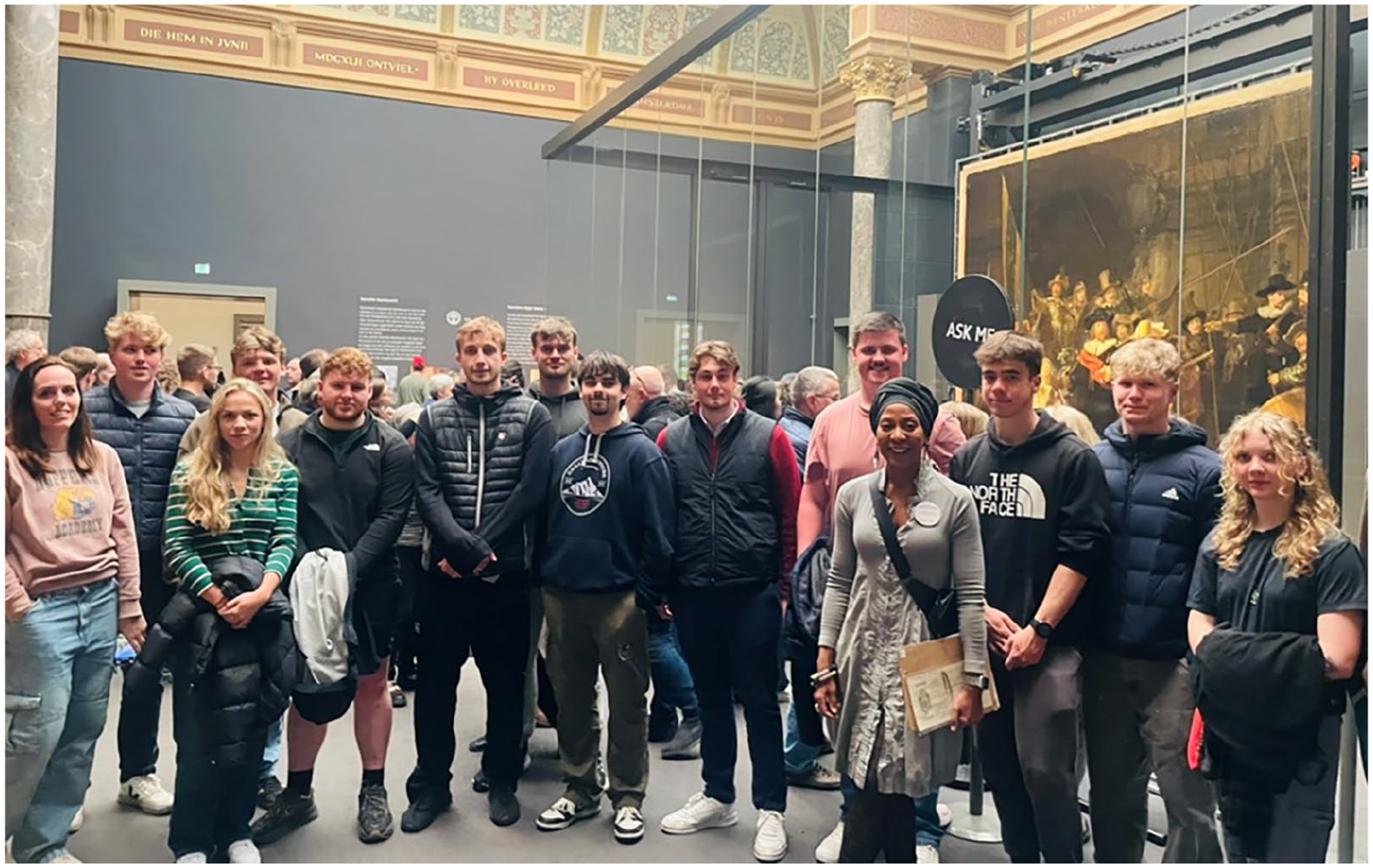
Jennifer Tosch leading our students through the Rijksmuseum. Photograph by Jen Bagelman.
Footnotes
Funding
The author(s) received no financial support for the research, authorship, and/or publication of this article.
