




Abstract
In this article, I examine the concept of shared or ‘distributed’ agency between humans and non-humans in the context of coastal environments. Drawing on critical theory from the environmental humanities and cultural geography, I begin by situating distributed agency within a relational paradigm for human existence in a more-than-human world, building on the idea of receptivity to bridge the gap between an ontological and a moral-political understanding of the other-than-human capacity to act. I subsequently bring the concept of distributed agency into dialogue with the idea of ‘working with nature’, notably examples of the ‘sand motor’ coastal landscape intervention found in the Netherlands, United Kingdom, and Ireland. The sand motor is a method for beach nourishment that operates on the basis of autonomous sediment dispersal, and that is meant to replace existing approaches to coastal protection that are labor-intensive and have a much shorter lifespan. Using the different cases, I demonstrate how planned and accidental deployments of the sand motor can be tied to varying paradigms for human/nature relationships, which may either contradict or support the principles of distributed agency. With regard to the latter, I highlight the importance of agential indeterminacy and human accountability for the long-term sustainability of pluriagential collaborations. Ultimately, by engaging productively with other-than-human expressions of agency through an ongoing practice of receptivity, important steps can be taken toward a more resilient future for all.
Keywords
Introduction
A key paradox of the Anthropocene is that human actors have come to exercise influence at every physical scale from the subatomic to the planetary, but lack control over the consequences of many of these actions. 1 This is aptly illustrated in Tsing et al.’s Feral Atlas, which traces the potentially harmful behaviors of non-human entities that have spun beyond human control, yet are enabled by global human infrastructure and trade networks. 2 Bearing in mind the many potentially negative influences of such ‘feral’ entities, it nevertheless remains possible to engage productively with other-than-human expressions of agency by practicing receptivity. 3 This includes finding value in non- and more-than-human interventions in the landscape, and specifically, acknowledging their capacity to co-determine human lifeworlds. 4 In the following article, I critically explore the idea of ‘distributed agency’ and its implications for the growing trend of ‘working with nature’. To substantiate this argument, I draw on leading theory at the intersection of the environmental humanities and cultural geography (specifically relating to more-than-human studies), both to develop the concept of distributed agency itself and to explain how it opens new avenues for pluriagential collaboration, each with attendant ontological and moral-political implications. I also discuss existing criticisms of distributed agency. Multiple case studies are used to illustrate the argument, characterizing varying interpretations of ‘working with nature’ in coastal regions and how these relate to distributed agency. Some fail to align with key principles of the relational paradigm, while others demonstrate the long-term value of human, non-human, and more-than-human interactions. The cases themselves all relate to the ‘sand motor’ method for beach nourishment, and help contextualize and critically assess the recent and increasingly prevalent turn to site-specific ‘Nature Based Solutions’ (NBS) for adapting landscapes to the challenges of climate change. 5
Conceptualizing distributed agency
Many environmental theorists have argued that Western epistemological frameworks tend to rely on untenable human/non-human dichotomies and attendant relationships of dominance and subordination. For example, ecofeminists Plumwood, Braidotti, and Caputi find traits of the ‘master’ model of male Western human rationality that date back to Plato, Aristotle, and Descartes (among others), and that continue to find traction today, yet are complicated by social and technological advances and the question of ‘who’ or ‘what’ constitutes a human being in the first place. 6 With regard to the latter, science and technology scholar Latour argues that human thinking and acting subjects (‘Culture’) have been contrasted with non-human, externalized objects (‘Nature’) since at least the Enlightenment. 7 These dichotomies elevate (some) human beings to a plane of significance and authority, and cast aside any suggestion that the human and non-human world may be intertwined. 8 However, Latour shows that ‘moderns’ fail to recognize the fact that life on Earth consists of a ‘proliferation of hybrids’: subject-objects that do not fit neatly into either the category of ‘Culture’ or ‘Nature’, but rather bridge the gap between them. 9 These hybrids make up the ‘very substance of our societies’ and can include anything from disease agents (tying together biology, healthcare, social networks, transportation, and global politics, among others) to computer chips (think mineral exploration and extraction, engineering, information technology) and more. 10 Tracing a similar argument in urban geography, Braun demonstrates how non- and more-than-human entities co-shape both urban and rural spaces, highlighting the material embeddedness of cities and structures in natural settings (e.g. within a nature-culture continuum rather than a dichotomy). 11 This constitutes an example of the material turn (or ‘series of returns’) signaled by Whatmore in (cultural) geography more generally, which ‘shifts the register of materiality from the indifferent stuff of a world “out there” (. . .) to the intimate fabric of corporeality that includes and redistributes the “in here” of human being’. 12
Human life evidently does not unfold in an agential vacuum; it exists in a wide playing field of agencies, which includes the non-human (animals, objects) and the more-than-human (including phenomena such as the weather and complex technical systems). 13 The existence of these agencies invites a shift toward a relational worldview, in which every single actor exists in a network configuration of meaningful relationships with numerous others. 14 In this context, Bennett speaks of a world filled with a ‘vital materiality’, and suggests that ‘[t]he ethical task at hand (. . .) is to cultivate the ability to discern nonhuman vitality, to become perceptually open to it’. 15 More radically yet, Barad maintains that ‘[i]ndividuals do not preexist their interactions’. 16 Instead, she confirms the absence of an agential vacuum by positing that existence is an active process, the simultaneous emergence of different entities as a result of their constant interactions (or ‘intra-actions’). 17 There are no static units of being that can be referred to as individual actors; there is only the process of ‘becoming’, which all actors in the world do together. 18 This hyperrelational (re)conception of the world challenges the common understanding of cause and effect as initiated and intentioned by human beings, since it is often unclear who first started the interaction that renders participant actors into existence. 19 In this way, Barad invalidates any lingering belief that human beings are in full control over the natural environment. 20 Agency is unpredictable, and non- and more-than-human entities have the ability to intervene in carefully constructed human lifeworlds at the most unexpected times. 21
The constituent human, non-human, and more-than-human elements of the continuum between ‘Nature’ and ‘Culture’ both enjoy their own agency and exercise significant levels of influence over one another. 22 As a result, human beings are part of an animated world that operates according to the logic of a network of interagential relationships, and in which agency is evenly yet randomly distributed. 23 Adopting this relational paradigm allows us to understand how certain types of interactions between humans, non-humans, and more-than-humans may stand to benefit all participant actors. 24 It also means that we should become open to patterns of collaboration previously unseen or ignored, especially those that extend beyond the human realm. 25 Such a relational paradigm for human-nature interactions feeds into patterns of parallel contribution and simultaneous emergence, with shared inputs from human, non-human, and more-than-human actors rendering interlinked, communal rewards rather than isolated benefits. 26
The process of co-creation has been referred to as a ‘practice turn’ (in cultural geography) or a mode of ‘becoming-with’ (new materialism). 27 This constitutes an inherently complex dialectic warranting new critical tools for analysis. 28 For example, as demonstrated by both Lorimer and Ginn, practicing receptivity requires innovative methodologies for other-than-human engagement (e.g. more affectively-oriented modes for human/animal interactions), which may also serve to acknowledge the experiential gaps that exist and cause conflict or friction between humans, non-humans and more-than-humans. 29 These gaps do not disavow relational principles, but rather complicate them. 30 From another angle, receptivity to other-than-human agential capability is entangled with a moral and political imperative for non- and more-than-human public participation and representation (e.g. as part of a ‘Parliament of Things’ or ‘cosmopolitics’). 31 Meanwhile, within human geography, criticism has been lodged by Hornborg against the concept of distributed agency specifically (and by Malm and Hornborg against non-dichotomous epistemologies, more generally) due to concerns that it undermines the capacity for critical analysis of the social inequalities that generate, and are exacerbated by, climate change. 32 The shift toward a relational paradigm for human/non-human collaboration, and by extension the concept of distributed agency, must be done with critical attention to all these concerns, asking who stands to benefit and who does not across the trajectory of interaction(s).
Distributed agency and ‘working with nature’
Landscapes tie together cultural, ecological, and social values across time and space, fostering a process of belonging and creating a ‘sense of place’ for participant actors, while themselves being actively inscribed with meaning. 33 The key role played by different non- and more-than-human actors in this process has been described as the ‘agentic capacity of landscapes in co-constituting cultures’, and helps understand how and why different human/nature interactions, and the paradigms in which they develop, enter formal and informal cultural registers. 34 Meanwhile, due to their entangled character, the human, non-human, and more-than-human actors that inhabit these landscapes can positively or negatively affect one another, warranting close attention to past, present, and future patterns of interaction. 35 In this context, it is worth examining the connections that exist between distributed agency and the idea of ‘working with nature’, including various NBS that promise a systemic and mimetic approach to landscape conservation and restoration. 36 Many NBS leverage change on the basis of an existing local disposition toward the agency of the landscape, which is evident from various cultural registers. Yet, they do not necessarily operate within a relational paradigm of human/nature interactions, for example failing the test of receptivity or insufficiently extending agential autonomy to other-than-humans. To examine this issue, I will critically assess several examples of the ‘sand motor’ method for beach nourishment as found in the Netherlands, United Kingdom, and Ireland.
Modern sand motors in the Netherlands and the United Kingdom
Close to The Hague (NL) lies ‘De Zandmotor’ (‘The Sand Motor’), a large-scale beach nourishment project created in 2011 (Figure 1). In contrast with traditional interventions in the coastal landscape that rely on a strategy of frequent manual sediment replenishment, this NBS operates on the basis of gradual autonomous dispersal. To achieve this, a large volume of sand (21.5 million cubic meters) was deposited at a single near-shore location, which is now slowly distributed along the coast by longshore drift processes. 37 De Zandmotor has been promoted as a ‘boldly innovative’ intervention, and is generally understood to be the first real-world deployment of the concept. 38 Along with several river flood risk management schemes, it can be said to mark a shift in the Dutch approach to landscape management, away from the assumption of control that characterizes the mammoth Delta Works (a series of 20th-century flood defense systems in the southwest of the country) and toward a willingness to collaborate across agential boundaries. As Rijkswaterstaat, part of the Dutch Ministry of Infrastructure and Water Management puts it: ‘[De Zandmotor] works with water, instead of against it’. 39 There is a greater sense of continuity at the cultural level, where De Zandmotor effectively serves as the latest iteration in a longstanding national tradition of reckoning with an unpredictable coastal and marine environment. 40 Key events in this history include the reclamation of the Flevopolder from the Zuiderzee (South Sea) in the mid-1900s, as well as the 1953 North Sea flood, which claimed several thousands of lives and provided the impetus for the construction of the Delta Works. Echoing the motto of Zeeland, one of the lowest-lying Dutch provinces, Lotte Jensen has characterized this history as ‘luctor et emergo’ (‘I struggle and emerge’); a narrative that readily incorporates new landscape innovations to defend against old and new threats, including rising sea levels. 41
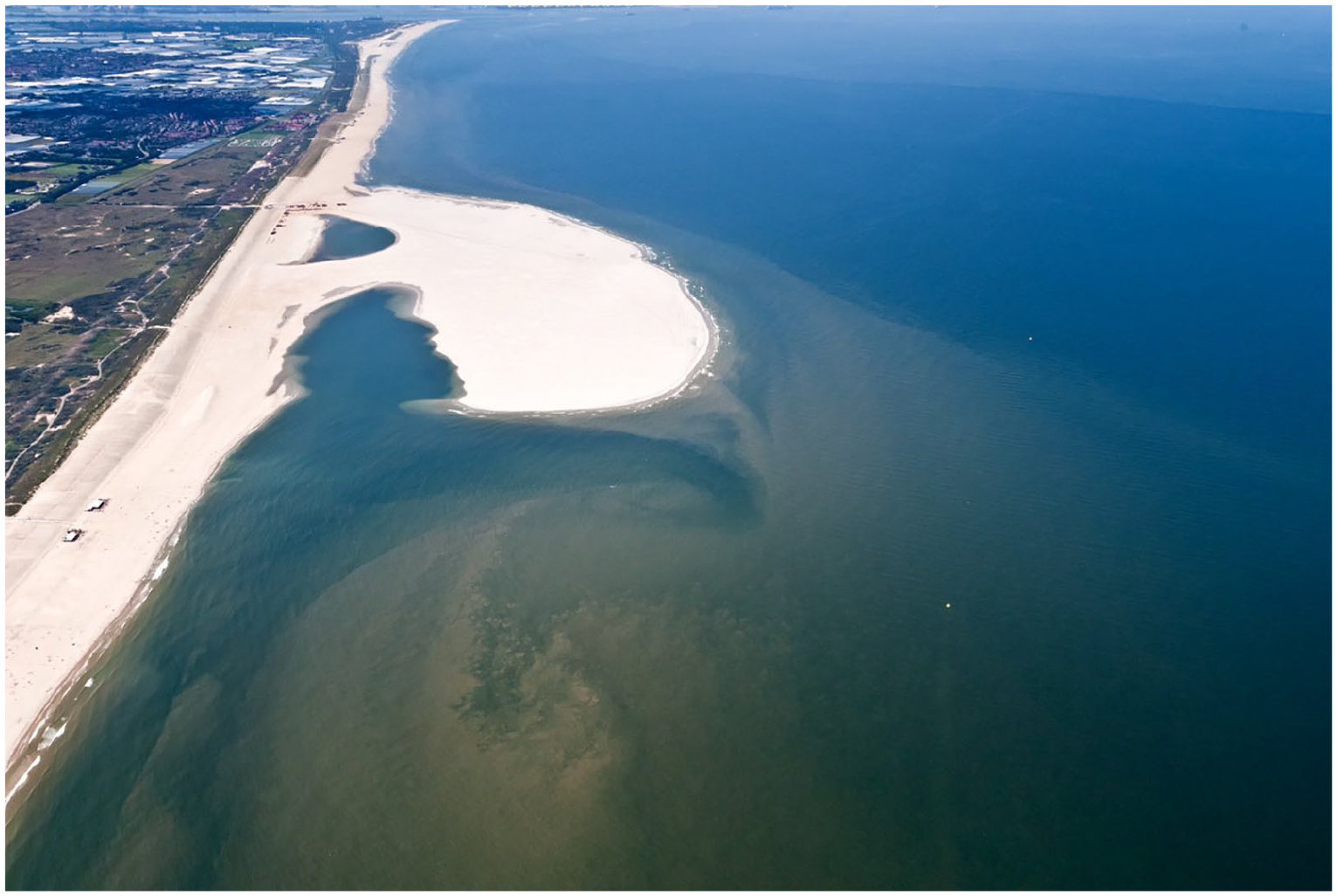
Aerial view of De Zandmotor showing characteristic recurve caused by longshore drift processes. (Photograph by Rijkswaterstaat. Reproduced with permission of the owner).
Considered positively, De Zandmotor has been a catalyst for parallel contribution and the simultaneous emergence of cultural and ecological benefits, drawing together human, non-human, and more-than-human actors in the (re)creation of the landscape. Among other things, the sand deposits have promoted increases in local biodiversity while also building stronger coastal defenses. 42 The site has become popular with the general public for a range of activities including (kite) surfing, walking, fishing, and bird watching, and has served as a backdrop for various artistic and cultural interventions (Figure 2). 43 Many fossils have appeared at De Zandmotor, a direct result of the process by which sand was transported to the site from locations further offshore, where these items lay undisturbed for centuries. 44 The artefacts provide new insight into ways of life in the North Sea basin when parts of the shallow Doggerbank formed a permanent landmass, and highlight the multiscalar impact of De Zandmotor by putting into perspective the longstanding connection between people and the landscape. Among other things, the fossils have inspired several museum exhibitions and publications, in which the climate link between the creation of De Zandmotor and the disappearance of the Doggerbank is emphasized. 45
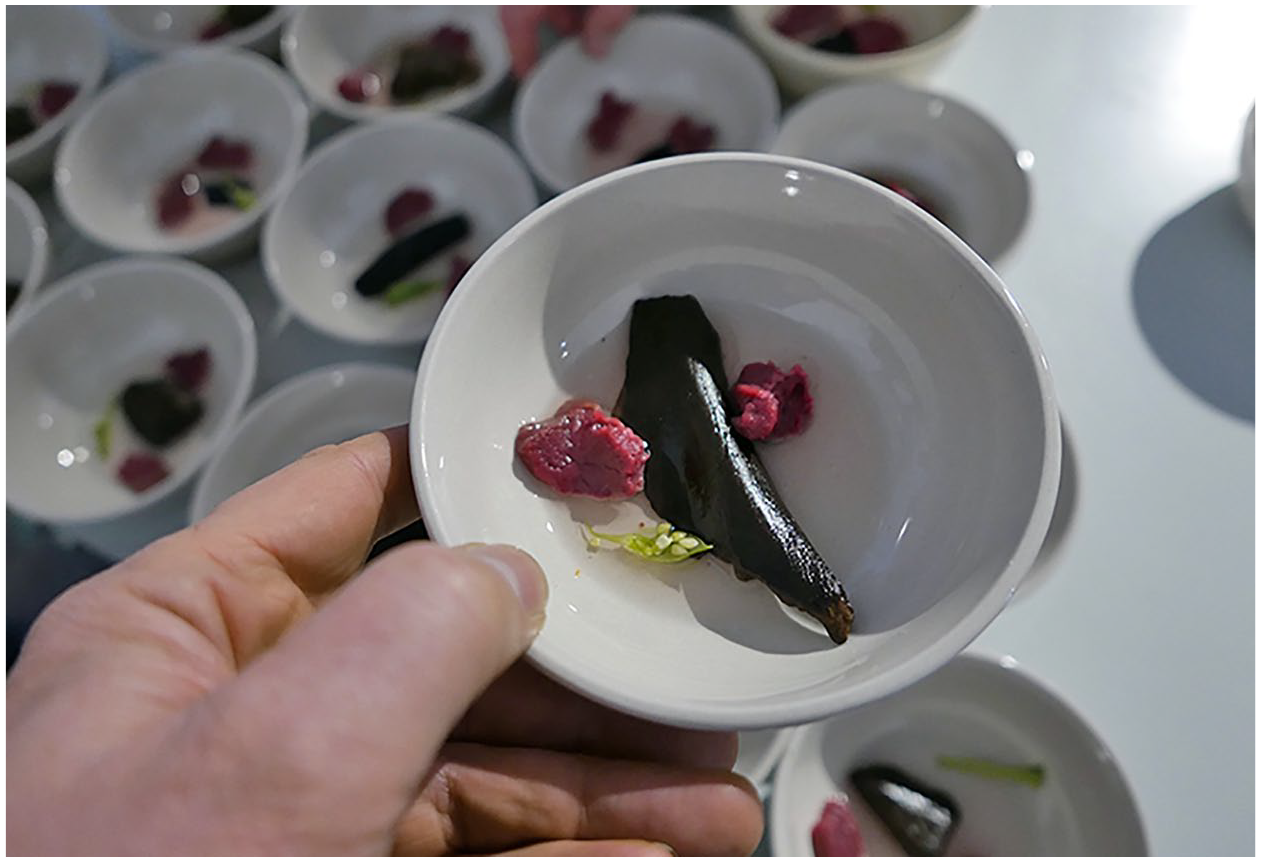
‘Mammoth Soup’ made from fossils found at the site of De Zandmotor. (Photograph by Theun Karelse. Exhibition ‘Mammoth Soup’ by Theun Karelse in collaboration with Sjim Hendrix, created for the Badgasten residency program hosted by Sattelietgroep. Reproduced with permission of the owner).
Yet, despite emergent patterns of collaboration across agential borders, the construction and present management of De Zandmotor negate key principles of distributed agency, most notably human participation in pluriagential collaborations on the basis of receptivity rather than control. Indeed, the motto ‘luctor et emergo’ speaks more directly to the prevalent Western paradigm for human/nature relations based on the domination and exploitation of nature, than receptivity to other-than-human agency and their capacity for autonomous expression. 46 In this context, De Zandmotor and similar climate adaptation measures have been criticized as techno-utopian solutions to climate change that obscure the need for more fundamental changes in human behavior. 47 Closer scrutiny of the climate link also brings into focus several compromises and questions related to the construction of De Zandmotor, including the temporary disturbance of the Doggerbank and coastal ecosystems (negatively affecting existing local biodiversity), and the project’s potentially large carbon footprint. 48 Furthermore, evidencing the risk of overlooking social injustices by focusing exclusively on human-nature relations and collaborations, Malm and Hornborg point out that there are ‘realities of differentiated vulnerability on all scales of human society (. . .) [for example] sea level rise in Bangladesh and the Netherlands’, with landscape interventions such as De Zandmotor criticized as ‘lifeboats for the rich and privileged’. 49
A second, smaller deployment of the sand motor concept (using 1.8 million cubic meters of sand) exists on the coast of Norfolk (UK), where it is known as a ‘sandscaping’ scheme. 50 The aim of this particular scheme is to protect the villages of Bacton and Walcott. 51 Much like De Zandmotor, a relational analysis of the Bacton intervention provides several positive cues; the two sand motors have together been described as landscaped examples of Haraway’s ‘staying with the trouble’, or what Tsing calls places of ‘contaminated diversity’. 52 This is due to the various contributions made by these NBS to human and non-human flourishing, even as they interrupt previous coastal living arrangements. 53 But the Norfolk sandscaping scheme is above all a contested intervention: along with the two coastal villages, it is meant to safeguard the vulnerable Bacton gas terminal, and was co-funded by industry and government. 54 There is great irony in protecting a fossil fuel power plant from the impacts of global warming, keeping the terminal in operable condition so it can continue to emit CO2. Moreover, the use of public funds for this purpose stands in stark contrast to the lack of intervention elsewhere in the UK, including around East Anglia, where houses and roads are destroyed by coastal erosion at an alarming rate. 55 Many in the area are familiar with Dunwich, once a landmark town that is now almost entirely lost to the waves. 56 Indeed, cultural and historical registrations of human/nature interactions along the East Anglia coastline underscore the futility of the Bacton sandscaping scheme, seeking as it does to delay centuries-old processes of erosion and denying the catalytic role played by anthropogenic climate change. 57 Viewed through the lens of distributed agency, there is an immediate sense that the Bacton sand motor contradicts key processes of human receptivity to other-than-human capability, and negates the moral and political imperative(s) to foster the right conditions for participation and representation. By extending the lifetime of fossil fuel infrastructure, the scheme also indirectly furthers social and environmental injustices. 58
An accidental sand motor in Dublin Bay, Ireland
Despite the claim that De Zandmotor is the first of its kind (and the Bacton sandscaping scheme the second), a shift in perspective away from the precondition of human intention and toward the idea of distributed agency reveals that this is only partially true: a much older, largely inadvertent sand motor can be found in Dublin Bay in Ireland (see Figure 3). North Bull Island (or simply Bull Island), as it is known today, was accidentally created in the early 1800s as an indirect result of the construction of a seawall, the North Bull Wall. The latter was one of a number of measures taken to prevent the entrance to Dublin Port from silting over, which at the time was a key obstruction to the normal operation of the port and a barrier to the development of the city as a global hub. 59 After the wall was built, sediment began to deposit against its northeast face, in a part of Dublin Bay that was already quite shallow and that featured a recurrent dry sandbank at low tides. 60 The bank eventually became a permanent land feature, and not long afterward the first flora and fauna started to appear. 61 Today, North Bull Island is firmly established as a valuable part of the city of Dublin and the surrounding area. Measuring over 5 km in length, between 200 m and 1 km in width, and with close to 10 m of elevation, it features a number of complex ecosystems, including salt marsh, extensive dune landscape, and the renowned Alder marsh. 62 Along with the rest of Dublin Bay, it forms a key link in the annual migration of many different bird species, at times hosting more than 30,000 individuals. 63 From a social and cultural point of view, North Bull Island has long been celebrated as a retreat from the hustle and bustle of the city. It boasts two golf courses and a visitor center, hosts the annual international Dublin Kite Festival, and welcomes sea swimmers, surfers, (dog) walkers, amateur and professional ornithologists, and other visitors year-round. The island has been depicted in numerous works of fiction, film, poetry, and visual art, including James Joyce’s Portrait of the Artist as a Young Man and Finnegans Wake. 64
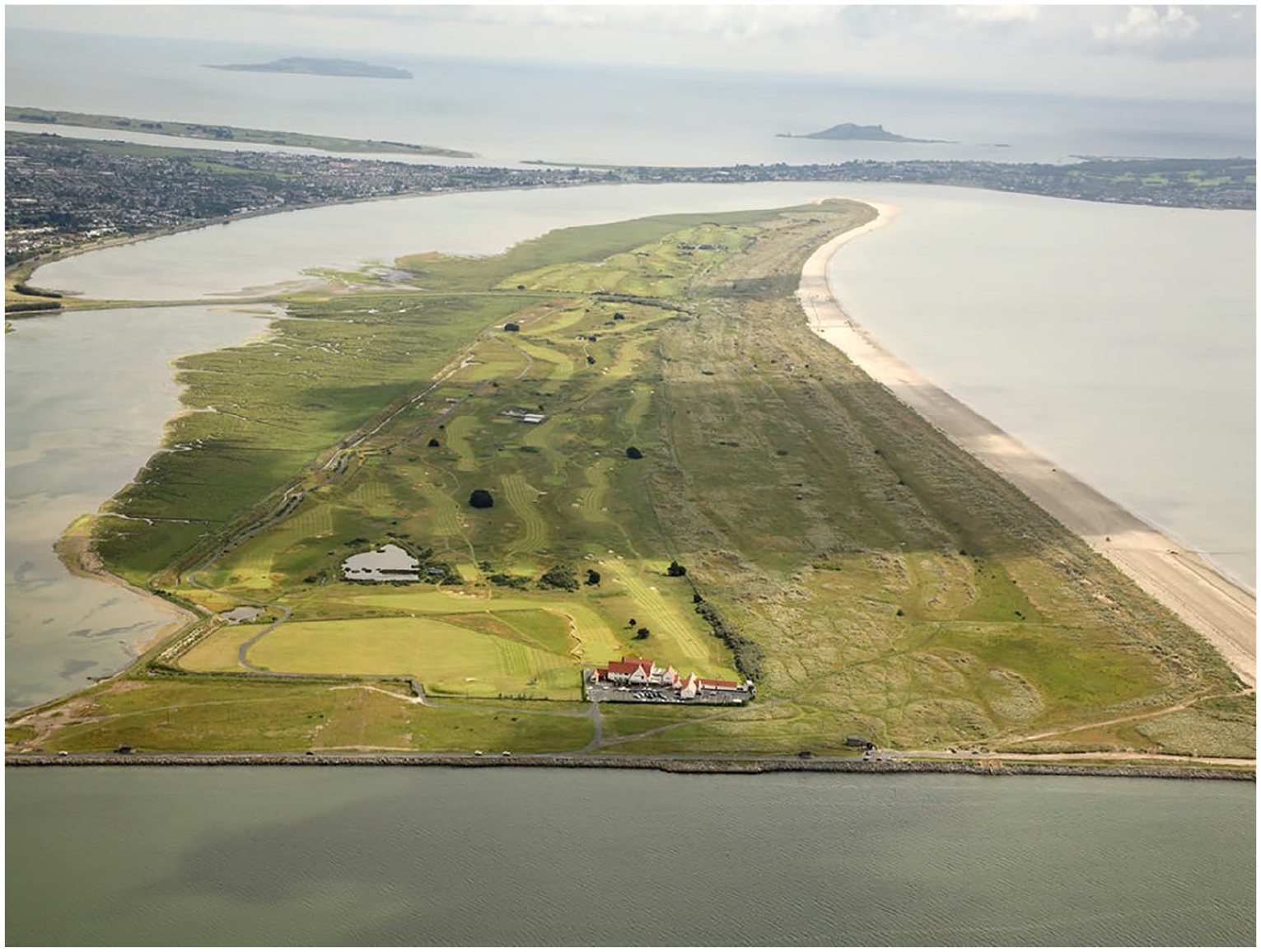
Aerial view of North Bull Island. The North Bull Wall is visible at the front. Recurve growth can be seen in the far distance, at the tip of the landmass. (Photograph by Dublin Bay Biosphere. Reproduced with permission of the owner).
The Dublin Bay ‘sand motor’ functions in a different manner than the ones found in the Netherlands and the United Kingdom: specifically, the island has emerged as a result of a gathering pattern of sediment, rather than its dispersal. Nevertheless, North Bull Island appears to display similar geomorphological characteristics as De Zandmotor, notably in its trend of successive recurve growth constrained by local currents (compare Figures 1 and 3). 65 Perhaps more remarkable are the patterns of pluriagential collaboration that led to the genesis of this accidental ‘sand motor’, which directly contrast with those underpinning the coastal management schemes in the Netherlands and the United Kingdom. The case of North Bull Island proves that an indeterminate locus of agency during collaborations between humans and other-than-humans is key for the adoption of a distributed sense of agency. A lack of predetermined outcomes has created space for other-than-human capability to unfold, further enabled by human receptivity to an emergent and largely unexpected mode of ‘working with nature’. The result is a productive collaboration with far greater longevity than modern sand motors and only limited need for active human management. In this way, North Bull Island has become an outstanding example of working across agential boundaries, achieving parallel increases in cultural, ecological, and social value(s).
Yet the ability of non-human others to take the lead in reconfiguring the landscape does not excuse human beings from accountability, in particular to the principle of good neighborship during co-creation. 66 For North Bull Island as much as any other sand motor, (potential) harm to the landscape follows directly from actions that maintain an illusion of human control or exception over the natural environment, thus defying the very principles of distributed agency that allowed the area to flourish in the first place. For example, the island has previously been threatened by proposals to turn the area into a landfill site or recreational resort, and remains affected to this day by past mistakes in environmental management, such as the introduction of invasive flora. 67 Climate change has also fueled concerns for the long-term wellbeing of the area: there is a chance that the ‘island imagined by the sea’ will one day be lost to it again. 68 Indeed, given the multifaceted nature of distributed agency, and the looming backdrop of the Anthropocene, the exploration of agential boundaries through ongoing dialogue is necessary to ensure the long-term sustainability of any collaboration between humans and other-than-humans. It is vital to keep the pulse of emergent ecosystems and landscapes; not because humans are in control, but rather because they carry a shared responsibility, or what Haraway calls ‘response-ability’, helping to nurture the right conditions for shared existence. 69 Such attunement to the requirements for productive co-existence with other-than-human beings provides a way forward for life in a time of climate change, and makes ‘working with nature’ a complex but instructive learning platform for how to be human in a post-Anthropocene time.
Conclusion
Nature Based Solutions have been embraced as a promising new way of ‘working with nature’, suggesting an equal human/nature partnership that stands in contrast to previous, control-based approaches to landscape management. However, it is often unclear to what extent landscape planners adopting NBS situate these interventions in a relational paradigm, where agency is and can be exercised by humans, non-humans, and more-than-humans alike; and whether they practice receptivity to unexpected landscape configurations that emerge as a result of other-than-human expressions of agency. In this article, I have used the concept of distributed agency to critically assess multiple coastal NBS. From this analysis, it emerges that modern landscape interventions are often still based on the illusion of human mastery over a malleable natural environment; a ‘deagentization’ that rejects the hybrid and entangled nature of human lifeworlds in favor of the promise of keeping nature at bay. 70 The distributed agency model goes against this and adopts what may be called an ‘amphibian’ attitude to the borders between land and water, human and other-than-human, self and other, which become less strictly defined (or permeable) and shift over time according to the needs of the pluriagential ensemble. 71 Fortunately, examples of NBS that align much more closely with the relational paradigm in which distributed agency proliferates also exist, albeit in places where we may not have looked before. Not only do historical-accidental NBS create a long-term evidence base for the idea of ‘working with nature’, they also help test the parameters for successful pluriagential collaboration, including longevity and the simultaneous emergence of benefits for participant actors. Such ways of living and creating together are key to the future of human society on a more-than-human planet, and will become increasingly pertinent as new types of agency emerge around us.
Footnotes
Acknowledgements
The author would like to thank Brian McMahon at Dublin City Council for facilitating a visit to the North Bull Island Interpretive Centre. The author would also like to thank John Brannigan and Tasman Crowe at University College Dublin for their extensive feedback on earlier drafts of this article. Finally, thanks are due to the editor at cultural geographies, Matthew Wilson, and two anonymous reviewers for their insightful comments, which helped improve the article tremendously.
Funding
The authors disclosed receipt of the following financial support for the research, authorship, and/or publication of this article: This research was carried out in the context of the Ecostructure project, which is part-funded by the European Regional Development Fund (ERDF) through the Ireland-Wales Cooperation Programme 2014-2020 (EU WEFO Grant 80939).
Ethics statement
‘The author declares that they have no conflict(s) of interests to disclose.
