




Abstract
This paper is a reflective discussion of the research method developed by a small research team over a 5-year period as it intra-acted with the south Asian monsoon in three south/southeast Asian cities. It reflects on how the team’s practice was transformed from being research on or about the monsoon as a discrete unit of analysis, to research in the monsoon and with its agential materiality. The paper first outlines the theoretical resources from cultural geography, anthropology, feminist theory, posthuman theory, and science and technology studies that the project drew from. After this theoretical section, the paper then discusses the practical implications of the method and the two emergent strands of research (‘weather matters’ and ‘construction matters’) that were followed in Chennai, Dhaka, and Yangon. The final section of the paper reflects on the extension of the method into the formatting of a book and an online exhibition. The paper concludes by arguing that what the method offers to cultural, weather-based research in monsoonal and other climes, is a situated, non-formulaic method that recognizes the affordances of the Earth’s agency, of matter and of other-than-human lives for generating knowledge of and ways of being in changing weather-worlds.
Introduction
What are we talking about when we talk about the weather? We are talking about the rain, the clouds, the air, the breath, the fog, the gas, the dust, the soil, the carbon, the climate, the bomb, the border, the math, the sensor, the sensorium, the satellite, the snow, the ice, the exorcist, the shaman, the gods, the future, the good fortune, the bad luck, and the better times ahead.
1
This paper reflectively examines the processes and outcomes of a research method developed by a small interdisciplinary research team studying the monsoon in south Asia over a 5-year period. The team was made up of three architects, an anthropologist, a landscape architect, and a political scientist, and toward the end of the project we were joined by a digital humanities scholar. While none of us identify as cultural geographers, we have chosen to publish this paper in cultural geographies, because of our interests in how the rhythms, materialities, and spatialities of monsoon weather are known and embedded in everyday lives, social practices, and urban imaginaries; because of the critical and interpretative methodology we developed, and because of the methods of observation and conversation that we used, all of which speak to the themes of the journal. In addition, we acknowledge our debt to the work of cultural geographers and anthropologists on weather and place, which is where our work began and makes its primary contribution. Influences include the seminal works of Tim Ingold on the ‘weather-world’, Mike Hulme on ‘cultures of climate’, and Phillip Vannini et al., on ‘everyday weather’, as well as scholars who took up Vannini’s call to understand weather as somatic work, including Jennifer Mason, Marie Vestergaard Madzak, Heid Jerstad, Eliza de Vet, Jacquelyn Allen-Collinson, and Stine Simonsen Puri. 2 We also acknowledge the influence of Tim Edensor’s idea of vital materialism, Tim Cresswell on the politics of mobility, and Marijn Nieuwenhuis’s elemental geography, as well as George Marcus’s multi-sited ethnography and Eben Kirksey and Stefan Helmreich’s multispecies ethnography, developed intuitively by our anthropologist into a ‘monsoonal ethnography’. 3 All of these scholars influenced and contributed to shaping the multidisciplinary approach to the study of urban monsoons that we called ‘monsoon as method’.
The paper is a reflection on human relationships with the earth, its hydrosphere, and its atmosphere; with weather, with matter, with each other, and with other species. At a time when the dominant image of the monsoon is of disrupted cycles and catastrophic events, the paper is an invitation to think it differently. It invites readers to think of the monsoon as what Anna Tsing called an ‘open-ended gathering’, an assemblage of human and more-than-human ways of being, knowing, doing, and intra-acting across difference; a dynamic multiplicity whose story humans are part of, but by no means author. 4 The monsoon is a reminder that the earth ‘is a grand, volatile world of multiple forces, perhaps worthy of our admiration even if we now construe ourselves as minor agents in it’, as William Connolly put it. 5 The paper hopes to provide a hospitable place for readers to intra-act with our monsoonal method and to find a position or trace a path for themselves within its complexity.
The paper is divided into five sections. This introduction familiarizes readers with key features of the monsoon and sketches out the basic contours of our research methodology. The second section (‘assemblages, multiplicities, weathering, and how matter comes to matter’) outlines the theoretical resources that framed our thinking while developing monsoon as method. It is followed by a more empirical section (‘situated practice’) in which we discuss how the method worked in practice and some of its findings and, in the following section (‘formatting the monsoon’), how the method informed the design of a book and an online exhibition. The paper concludes by identifying the two key contributions we think monsoon as method makes to cultural geographies of weather.
The word monsoon, from mausim in Arabic, meaning season, was originally used by sailors in the Arabian Sea to refer to the seasonal reversal of prevailing winds occurring at relatively fixed times each year that made the earliest transoceanic trading systems in the world possible. 6 This occurred, and still does, because the solar energy absorbed by land masses in the northern hemisphere in spring produces temperature differentials between land and sea. Temperature differentials eventually grow large enough to trigger low level southwesterly winds that carry moist air from the Arabian Sea toward the west coast of India. The winds heat up and rise as they reach the coast and, forced upwards by the Western Ghats, the saturated air condenses out as rain. Latent heat released by the air as it rises pulls in additional moisture, which maintains the rainfall as the monsoon progresses across the subcontinent attracted by the summer heat of the Tibetan Plateau. As winter approaches and the Plateau cools, the winds turn and blow from the northeast toward the southwest over the Bay of Bengal and the Arabian Sea, attracted by their now warmer-than-land sea temperatures. Over the sea, these cold winds mingle with convective air currents, frequently producing violent storms and cyclones. 7 This giant sea breeze system is relatively stable, but moderated by many factors including the timing and depth of snowfall in the Himalayas, the salinity of the Indian Ocean, the El Niño Southern Oscillation, the Indian Ocean Dipole, and human activity, such as the burning of rice stubble in North India at the end of summer.
This brief sketch of the monsoon is drawn from accounts put together by scientists on the basis of data accumulated from thousands of observation stations on land, in the ocean, and in the atmosphere, and, more recently, using the mathematical representations of atmosphere-land-ice systems known as numerical climate models. But the monsoon is more than an annual weather cycle and abstract scientific data only partially account for it. For more than half the Earth’s human population and nonhuman populations, the monsoon is a way of being, a matter of birth and growth, of life and death. It is registered by cultures, lifestyles, politics, and economics that revolve around its cycles and are disrupted by its ways. It is embodied aesthetic, cultural ritual, fertile land, reproductive cycle, political clock, and economic indicator. Cities in monsoonal regions are lively more-than-human political ecologies that are shaped by the monsoon’s uncanny energies from within. They are seasonal, sometimes wetter, sometimes drier places, overshadowed each year by towering rain-bearing cumulonimbus clouds driven by immense winds, inundated by torrential rains that seep, soak, spread, pool, and flow and then evaporate and dry out, blurring boundaries between ground, water, and air in continuous wet to dry, hot to hotter cycles. Such cities do not exist in relation to the monsoon, they are configured within it. They cannot be climate-proofed against it and its vagaries (what an absurd idea!) for they are thrown together within it in intricate, knotted entanglements.
While, like Sarah Wright and Matalena Tofa, we were mindful of the fact that the monsoon has its own modes of world making and is entirely indifferent to the questions we might ask of it or think or feel about it, monsoon as method was a mode of enquiry into ways the monsoon’s liveliness comes about, is lived, loved, feared, and entangled in human and other species’ life worlds. 8 It was an approach to learning not only about, but also with the monsoon’s agential materiality – its cyclical temporality, its wetness and dryness, its saturated air, the heat build-up that precedes the arrival of the rains, its powerful winds and currents, its downpours and disruptions, its excesses and scarcities, its refusal to conform to expectations or predictions – and the intra-actions with other agential materialities, human and otherwise, with which it designs life worlds.
Monsoon as method was a concept and a methodology for troubling both scientific and constructivist epistemologies of the monsoon from within. Whilst science offered indispensable knowledge about the monsoon, it presented such knowledge as empirical facts about an externalized nature. Whilst cultural theory enabled critical engagement with the monsoon as material-discursive practice, it did not allow for the idea of the monsoon as a material agent whose volatile movements shape human and nonhuman life. Counter to this, monsoon as method recognized the monsoon as not only an object of study and a material-discursive construct, but also as a subject of world making, a ‘noteworthy actor’ in the world, not in a positivist, human-centric way, but as an elusive, vibrant, inhuman other. 9 At times nurturing, at times recalcitrant, at times overwhelming, the monsoon follows logics that have little, if anything to do with what humans make of it, think of it, or do with it. It is a restless, material multiplicity intra-acting with itself and the human and nonhuman bodies and practices that respond to and configure it from within in countless divergent ways. Monsoon as method was a way of attempting to think with the monsoon’s agential materiality and with its ongoing transformative power as it intra-acted with matter and human and nonhuman bodies and practices. It eschewed epistemology and political ecology for ontology, abstraction for material relations.
An early touchstone for the project was Sarah Whatmore’s ‘Materialist returns: practicing cultural geography in and for a more-than-human world’, which inaugurated an approach to the monsoon as a lively, more-than-human agent of social and ecological relations, a ‘modality of connection between bodies and worlds’. 10 At the same time, Tim Ingold’s ‘Earth, sky, wind, weather’ and ‘Footprints through the weather world: walking, breathing knowing’ introduced us to the idea of dwelling not on the earth but in the weather. 11 The project was further influenced by Ingold’s argument that things have agency not because humans imbue them with it, but because of the ‘ways they are caught up in the currents of the lifeworld’. 12 Subsequent ideas of ‘weathering’ 13 or ‘weather ways’, 14 as embodied practices, and of weathering as a ‘situated phenomenon embedded in social and political worlds’ 15 brought our understanding of the monsoon into conversation with Haraway’s idea that knowledge, like weather, is always situated and material and socially differentiated. 16
Assemblages, multiplicities, weathering, and how matter comes to matter
Never is a plateau separable from the cows that populate it, which are also the clouds in the sky.
17
Monsoon as method was premised on Deleuze and Guattari’s concept of assemblage, a translation of the French word agencement, which means an arrangement, layout, or fitting together of parts. Deleuze and Guattari used assemblage to challenge empirical assumptions that reality is made up of discrete, individuated, measurable entities, and to theorize it as an interminable becoming of promiscuous, entangled, intra-acting intensities. Assemblages are multiplicities, complex ensembles generated solely out of the forces at work within them with no reference to a transcendent unity or set of co-ordinates. 18
Multiplicity, which replaces the one no less than the multiple, is the true substantive, substance itself. . . . Even the many is a multiplicity; even the one is a multiplicity. . . . Everywhere the differences between multiplicities and the differences within multiplicities replace schematic and crude oppositions. . . . Instead of the enormous opposition between the one and the many, there is only the variety of multiplicity - in other words, difference.
19
Within an assemblage, a haecceity (a term Deleuze and Guattari borrowed from medieval scholastic philosophy, meaning an object with unique, individual properties or an identity) ‘has neither beginning nor end, origin nor destination; it is always in the middle. It is not made of points, only of lines’. 20 Assemblages and multiplicities, while they might appear to individuate or congeal into coherence or unity for a time, are always provisional; they are processes of perpetual becoming brought about the intra-actions between their constituent parts, themselves also multiplicities: ‘there are only multiplicities of multiplicities forming a single assemblage’ extending to the entire Universe. 21 Thinking the monsoon through the notion of assemblage overcame thinking of it as a discrete unit of meteorological space-time and transformed it into a multiplicity of interpenetrating, intra-acting ways of being, knowing, and doing, some of which are human, most of which are in- or nonhuman, some of which are vastly distributed in space and time, others of which are proximate. While the monsoon might congeal into something recognizable for a time, such as a cloud or a downpour or an onset date, the complexity of the intra-actions at play within it ensure that ‘becoming other than itself’ is all that one can be sure about it. 22
The concept of assemblage enabled us to distance our work from British historian Rhoads Murphey’s concept of ‘Monsoon Asia’, which he took from fellow historian C.R. Boxer and used to define a ‘unit of study’ of Asia. 23 Murphey’s Monsoon Asia was a more or less rigid container defined by geographic boundaries in which rainfall had produced population densities and cultures with common features. But, going with Deleuze and Guattari, unities are deceptions, designed to obscure rather than reveal the nature of reality. 24 Along with other geographical units such as the Middle East or Sub-Saharan Africa, Monsoon Asia is a remnant of a European epistemological spatial imaginary that organizes knowledge of the world in rigid categories as they appear from the colonial center, reinforcing fantasies of power, dominance, otherness, and peripheralization. 25 The monsoon in our method was not a signifier of otherness, but of a multi-positionality that moved from outside to inside, pushed the global abstractions of science up against the situated knowledge of everyday experience and changed the monsoon itself from being an object of study into a forceful subject of world making.
Karen Barad’s work was instrumental in further shifting our conceptions of the monsoon from a thing or metaphor to the material-discursive life world in which our research practice took shape. She argued that western culture and knowledge practices have been premised since Democritus on the separation of the ontologically disjointed domains of words with inherent meanings on one side and things with inherent properties on the other; of humans, and only certain humans, who do the thinking and the representing, versus everything else. 26 Barad rejected this representationalist metaphysics, replacing it with what she called a ‘performative metaphysics’, in which matter comes to matter through intra-actions between material-discursive components (or what she calls the relata) of phenomena. 27 ‘Reality is not composed of things-in-themselves’, she wrote, ‘but of things-in-phenomena’. 28
The primary ontological units are not things but phenomena – dynamic topological reconfigurations / entanglements / relationalities / rearticulations. And the primary semantic units are not words but material-discursive practices through which boundaries are constructed within phenomena.
29
Barad invented the word ‘intra-action’, as opposed to interaction, to capture what takes place in phenomena. 30 Interaction, like hybridity, she argued, assumes that there are separate individual agencies that precede their interaction. Intra-action on the other hand suggests that the components of phenomena do not pre-exist their relations, but emerge through intra-actions within phenomena. 31 Intra-action, in other words, is the mutual constitution of entangled agencies, or what Barad referred to as ‘the iterative becoming of spacetimemattering’. 32
Within the entangled intra-actions of phenomena, components become differentiated and intelligible to one another through the enactment of what Barad called ‘agential cuts’.
33
Agential cuts are material-discursive practices that emerge through intra-action to determine the boundaries and properties of components of a phenomena and to make particular embodied concepts meaningful. Barad made it clear that agential cuts are not imposed from without, they emerge through intra-action, and they are not only the remit of humans: ‘discursive practices are not placeholders for human concepts, but are specific material articulations of the world’.
34
In fact, human concepts and practices are not foundational to the nature of phenomena at all. Here we are reminded of Merlin Sheldrake’s observations of how truffle fungi interpret their environments by sensing the chemical emissions of the organisms around them and arranging and rearranging their own in response.
35
In this way they negotiate complex interchanges with tree roots, extract nutrients from soils, procreate, hunt, fend off attackers and offer themselves up to be devoured.
36
While they might not be conscious or articulate in a human sense, truffles use a chemical vocabulary to give meaning to their world and to enact iterative changes to ensure their survival. Chemistry is their agential cut. Vicky Kirby proposed that the earth’s materiality is ‘actively literate, numerate and inventive as anything we might include within Culture’.
37
This claim suggests that the Earth, in its materiality, thinks, articulates, and self-differentiates. To refer to Sheldrake on fungi again – ‘mycelium is a living, growing, opportunistic investigation – speculation in bodily form’.
38
Matter is alive and intelligent, not because we humans bestow intelligence on it, but because of the material-discursive intra-actions through which it engages with its surroundings. Tim Ingold put it like this: Things are alive and active not because they are possessed of spirit – whether in or of matter – but because the substances they comprise continue to be swept up in circulations of the surrounding media that alternately portend their dissolution or . . . ensure their regeneration.
39
Matter is not inert substance, but material-discursive intra-action all the way down. ‘The world is an ongoing open process of mattering, through which mattering itself acquires meaning and form in the realization of different agential possibilities’. 40 In attributing this kind of liveliness to matter and material intelligence to the world, named things (nouns) become active beings (verbs); matter matters, hills hill, aerosols aerosol, walls wall, monsoons monsoon, and it is only through hilling that hills are hills and monsoons are monsoons etc. It also means that there is no such thing as research, only researching, through material-discursive intra-actions within the reverberating doings of the world, through which agential cuts emerge to make the world provisionally intelligible. In other words, epistemology is inseparable from ontology, knowing from being and doing. Barad reminded us that separations are a consequence of a representationalist metaphysics that assumes an inherent difference between human and nonhuman, subject and object, mind and body, matter and discourse. 41 She replaced representationalism with onto-epistem-ology – the study of practices of knowing-in-being as a better way for understanding the world in its emergent becoming. Deleuze and Guattari referred to this as thinking ‘not from the root up, but rather only from somewhere about the middle’. 42
As a practice of knowing-in-being and in keeping with the idea that intra-activity transforms nouns into verbs, Astrida Neimanis, Rachel Loewen Walker, and Jennifer Mae Hamilton developed the idea of weathering, as opposed to weather, as a ‘critical response concept and practice for our time’. 43 The concept of weathering drew on an earlier idea of trans-corporeality developed by Tracy Alaimo to describe relations between bodies and their environments as intra-active material exchanges. 44 Trans-corporeality dissolved the figure ground relation (an image familiar to architects) between bodies and their environments, proposing that ‘all creatures, as embodied beings, are intermeshed with the dynamic material world, which crosses through them, transforms them and is transformed by them’. 45 Neimanis, Hamilton, and Walkers’ weathering was a trans-corporeal frame to imagine bodies, human and otherwise, as implicated in the weather. Our bodies, Neimanis and Walker wrote, are ‘weather-bodies . . . thick with climatic interactions . . . makers of climate time’. 46 What they meant by this was that we are the weather and the weather is us. Climate and weather are not backgrounds to our lives, but time that we make together, just as we are made by the time makers all around us – the earth’s rocks and soils, decaying buildings, polluting smoke stacks. 47 This proposition counters linear narratives of climate change encapsulated in graphs and statistics and exposed the futility of the idea that humans can somehow slow it down or fix it as if we were not fully implicated within it. It engendered possibilities for responsibly imagining and intervening otherwise in the climatic entanglements of which human bodies are a part. Given that weathering is neither metaphor nor analogy, but a material-discursive practice, it enabled Neimanis, Hamilton, and Walker to think about the ethics of exposure to weather in relation to the political economies of place. For, while all bodies weather, ‘not all bodies weather the same - weathering is a situated phenomena embedded in social and political worlds’. 48 In other words, weathering, or ‘learning to live with the changing conditions of rainfall, drought, heat, thaw and storm’ is ‘never separable from the “total climate” of the social, political and cultural existence of bodies’. 49
Having thus elaborated some of the theoretical ideas that emerged from our intra-actions with the monsoon, the following section discusses, more empirically, how monsoon as method was developed in practice, in three cities in in south and southeast Asia – Chennai, Dhaka, and Yangon.
Situated practice
Monsoon as method emerged from iterative circulations between our workplace in London and field sites in south and southeast Asia; between engaging with the monsoon remotely and engaging with monsoonal phenomena directly through embodied experience, acknowledging Donna Haraway’s proposition that all knowledge is situated and partial. 50 In London we developed a provisional understanding of the monsoon through what Clark and Szerszynski call ‘interdisciplinary interloping’ – immersing ourselves in scientific literature from fields as diverse as meteorology, geology, history, politics, and urban studies. 51 We visited colonial archives and libraries; we scoped out cities and field sites; we developed collaborative partnerships in the places we were to visit and planned field work. We started a reading group to read, talk, and think through the theoretical questions our work raised. We hosted and contributed to symposia to engage in dialogue with other scholars from a range of disciplinary backgrounds. We taught an architecture design studio to test ways that design might be transformed if ideas of monsoonal agency activated design processes. We developed techniques to translate atmospheric data into maps that visualized monsoonal mattering at a range of scales. Our thinking began to take shape around the key authors, key texts, and key words discussed in the previous section: assemblage, multiplicity, matter, weathering, weather worlds, weather ways. We printed these out and pinned them to our office wall as a way of building a common framework from which we could work both collectively and individually.
After reading Sunil Amrith’s Crossing the Bay of Bengal, the significance of the Bay of Bengal to the turbulent monsoonal dynamics of the north east, returning monsoon, became clear. 52 Instead of Chennai, Dhaka, and Delhi as field sites as originally proposed, we decided to work in Chennai, Dhaka, and Yangon, three Bay of Bengal cities, in order to explore the monsoonal intra-relationships, intra-connections, and dis-connections the Bay afforded them (Figure 1). Our field work took the form of short, multi-sited, iterative engagements at different times of the year (four each to Chennai and Dhaka and three to Yangon), with a lengthier period of approximately a month in each city in July/August. In addition, because the monsoonal, human, and non-human geographies of these cities far exceeded their urban boundaries, we also visited Kanyakumari and Ladakh in India, Chandpur, Khulna, and Sylhet in Bangaldesh, and Bagan, Mandalay, and Minbu in Myanmar, significant sites in the monsoon’s regional geography. In Chennai our work was assisted by an environmental agency, in Dhaka by an architectural education institute and grassroots action research organization, and in Yangon by an architecture firm. We conducted 37 interviews in Chennai, 40 in Dhaka, and 26 in Yangon, including with academics, activists, architects, artists, bloggers, city planners, civil servants, engineers, geologists, hydrologists, jade traders, meteorologists, photo journalists, ngo staff, and others, and learned from countless informal conversations with cab drivers, tour guides, and other citizens. We traveled, walked, breathed, observed, listened, looked, smelled, touched, and ate. We used calendars and maps as participatory research tools. We undertook ethnographic studies of infrastructure, material substances, and other-than-human creatures. We captured our impressions in field notes, photographs, sound recordings, and videos.
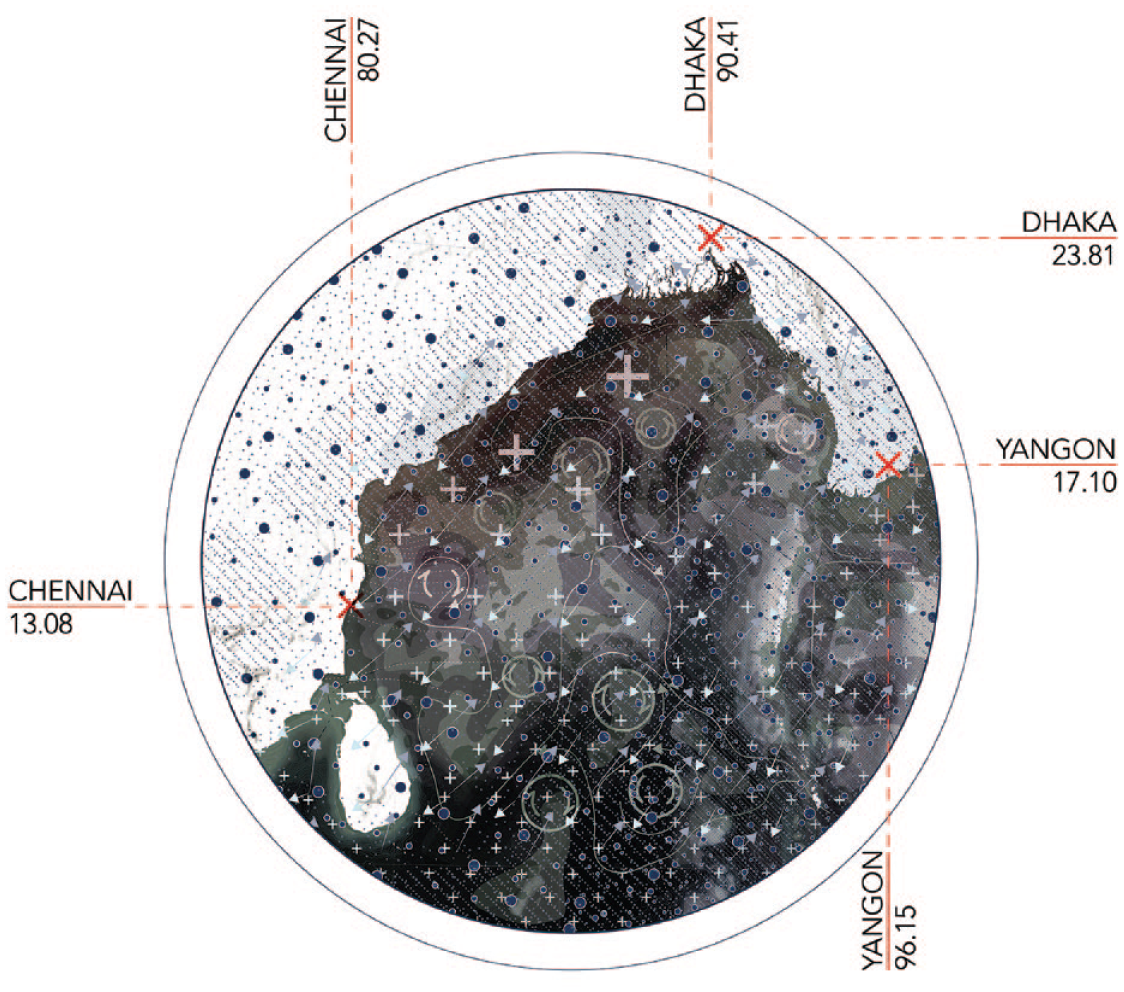
Chennai, Dhaka, and Yangon, three Bay of Bengal Cities. Drawing by Christina Geros.
Our guide in each place was to go where the monsoon took us. Although it is frequently stated that monsoonal rhythms influence the economics, politics, and cultures of south Asia, there is little research on how this influence materializes in specific urban contexts. In response to this, our starting point was to approach urban life in the cities we studied as monsoonal entanglements being reworked by urban development processes. When our work began in Chennai in 2016, the city was still haunted by memories of the floods of a year earlier, which had been brought about by excessive rain over a prolonged period, the political decision to release large volumes of water from one of the city’s reservoirs, and the encroachment of real estate projects onto wetlands and waterbodies that had previously held and absorbed monsoonal floodwaters. 53 In this context, our attention was drawn to the Pallikaranai Marsh, a sprawling, though shrinking, wetland in the south of the city, which had been extensively encroached on by the development of an IT Corridor and its attendant infrastructure, and where flooding had been particularly severe the year before (Figure 2). We began by compiling all that we could find about the marsh, the IT Corridor and south Chennai’s urban hydrology. 54 This scoping work and an initial site visit in November 2016 formed the basis of a research plan that took shape around two parallel but interlinked strands: ‘Weather Matters’ and ‘Construction Matters’. ‘Weather Matters’ investigated how the monsoon-as-weather was understood, experienced, and acted on by urban residents, how daily life was assembled around weather, and how weather and lived environments had altered over time. Research was focused on Perungudi Lake (Figure 3), an urban waterbody connected to the Pallikaranai Marsh, and its surrounding neighborhoods, inhabited by a mix of new migrants and long-term settlers, middle-class, lower middle-class, and slum communities. A neighborhood association provided a potential first point of contact and specific research participants were identified based on self-selection and snowballing. ‘Construction Matters’ focused on understanding how urban development, both historic and current, had disrupted and reconfigured human-monsoonal relations, taking as its starting point the widespread assertion in the media that urban development policies, plans, and practices, in particular those associated with the IT Corridor, were the ‘architects’ of the 2015 floods. This research strand was centered on Perumbakkam, a peripheral neigbourhood in the far south of the city adjoining the southern reaches of the Pallikaranai Marsh that had been rapidly transformed by the construction of middle class family housing for IT corridor employees (Figure 4). The key informants for this strand were planners, architects, real estate developers, and residents, identified through professional contacts and snowballing. Out of these two research strands came a number of findings about the habits of monsoonal flows, what happens when they are blocked or redirected (at macro and micro scales), and the contested meanings of urban water and its infrastructure to different sectors of human society and other species. 55
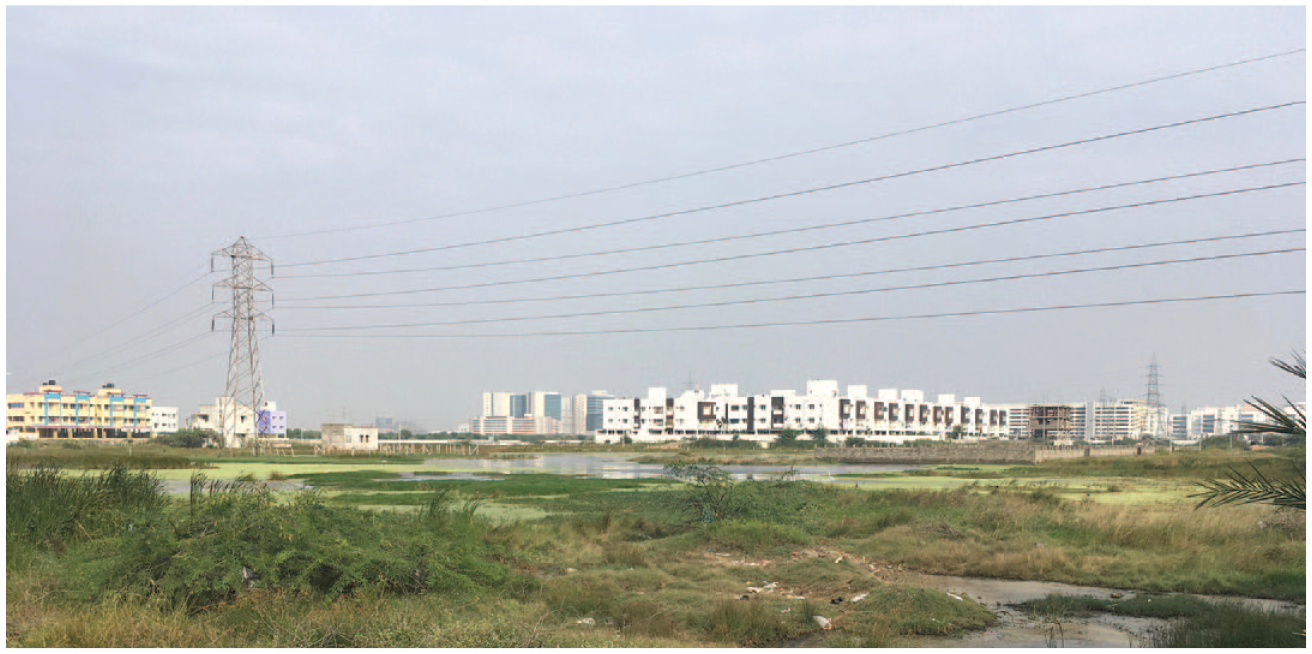
The Pallikaranai Marsh in south Chennai. Photograph by Beth Cullen.
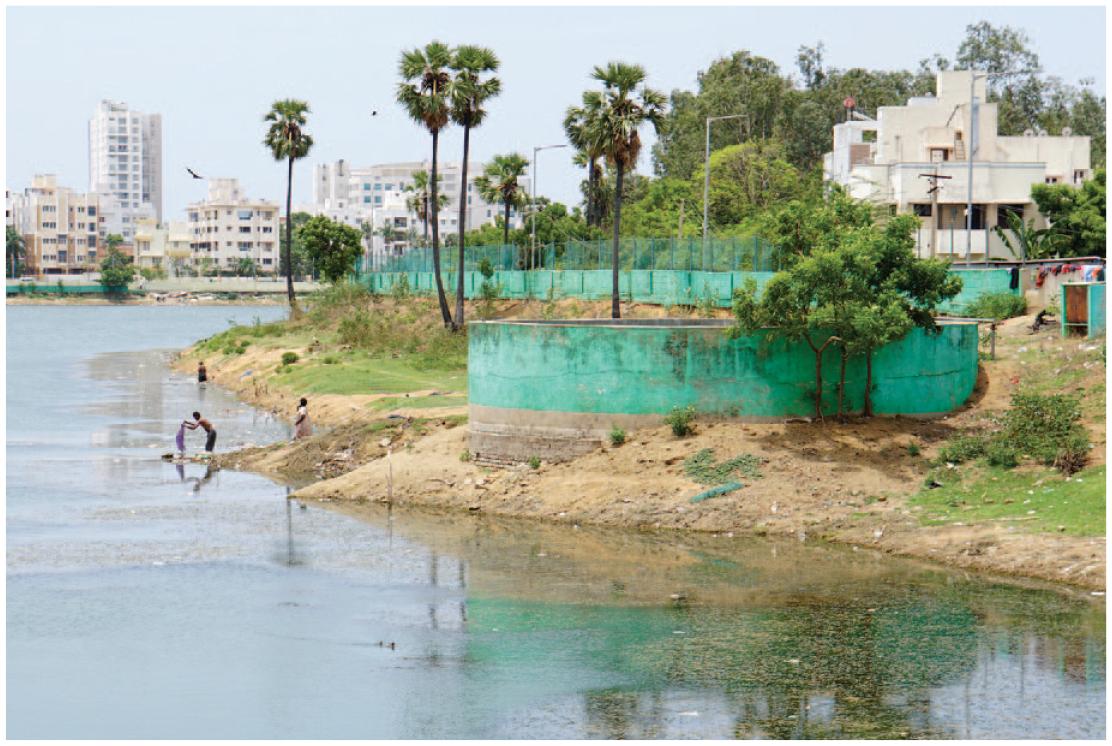
Perungudi Lake in south Chennai. Photograph by Lindsay Bremner.
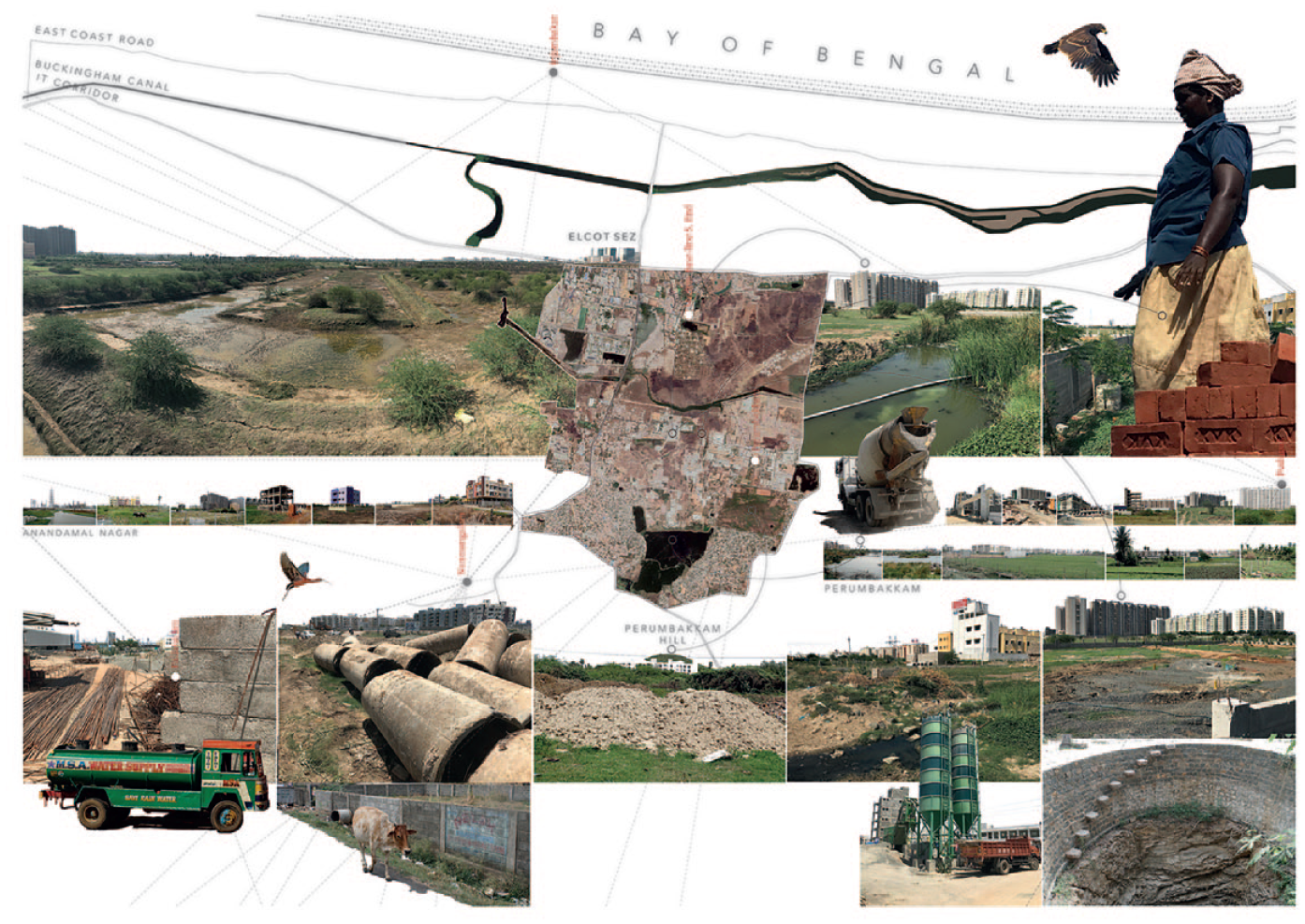
Composite image showing the transformation of Perumbakkam in south Chennai by housing. Collage by Lindsay Bremner.
Fieldwork in Chennai also threw up other unanticipated research trajectories, or what Deleuze and Guattari might call ‘lines of flight’. 56 The field spoke back, causing us to modify or change our research plans. We became aware not only of monsoon water on the ground, but also of the vastness and liveliness of the sky, and of subterranean groundwater (sometimes sweet, sometimes brackish, always moving), and that the sky and the underground were animated and connected by monsoon rains (or lack thereof). The monsoon began to take on aerial and geological agency in concert with the pluvial agency with which it had initially been associated. We began developing a technique for photographing sky-earth relationships by turning the pano feature of our phones through 90° and panning upwards (Figure 5), and groundwater and air became the focus of investigation for our two PhD research candidates. 57 It was in Chennai too that our anthropologist first noticed the Pantala flavescens (globe skimmer) dragonfly hovering in humid air about a water tank, and was told by a local resident that its presence often coincides with the arrival of monsoon rains (Figure 6). The dragonfly appeared again everywhere that we went, giving us glimpses into its monsoonal life world, and prompting research into the life worlds of other monsoonal creatures and plants – snakes, hilsa fish, jackfruit, and weeds, both as co-inhabitants of human worlds and clues to alternative monsoonal life worlds. 58 At an entirely different scale, it was during field work in Chennai, that our landscape architect made the observation that how the monsoon manifested as experience in the city was informed by far wider meteorological dynamics, leading us to think and draw the city as part of the monsoon as well as the monsoon as part of the city.
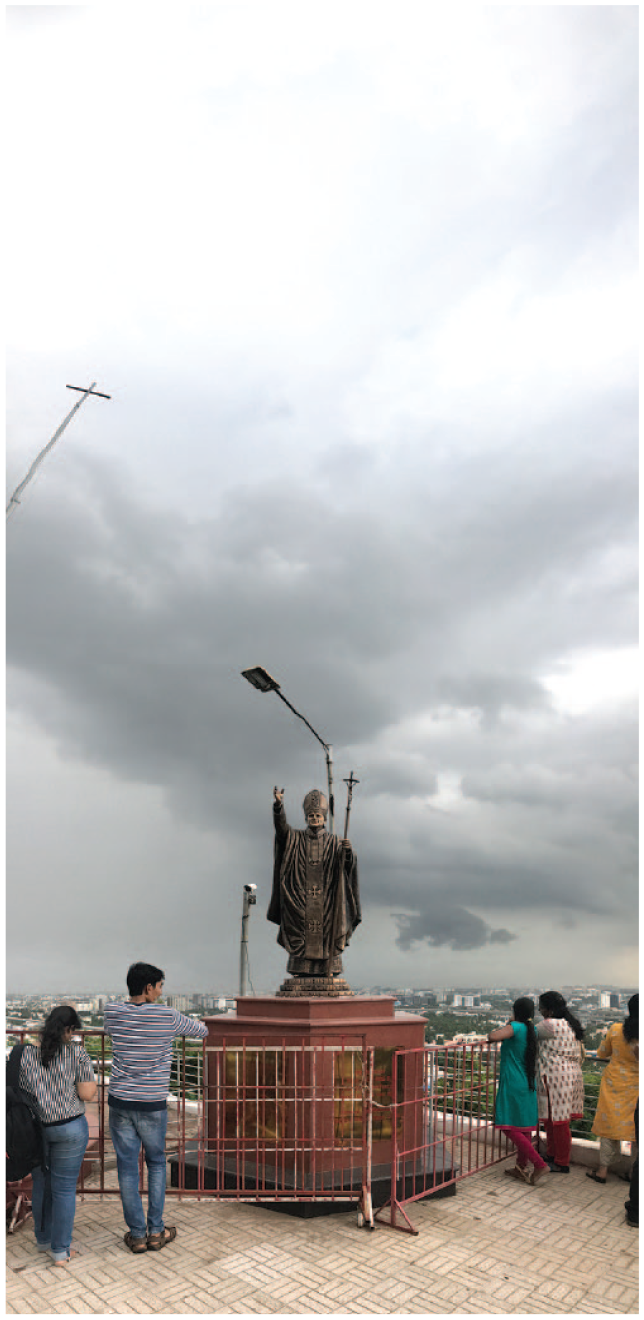
Vertical pan of a monsoon downpour approaching St. Thomas Mount, Chennai. Photograph by Lindsay Bremner.
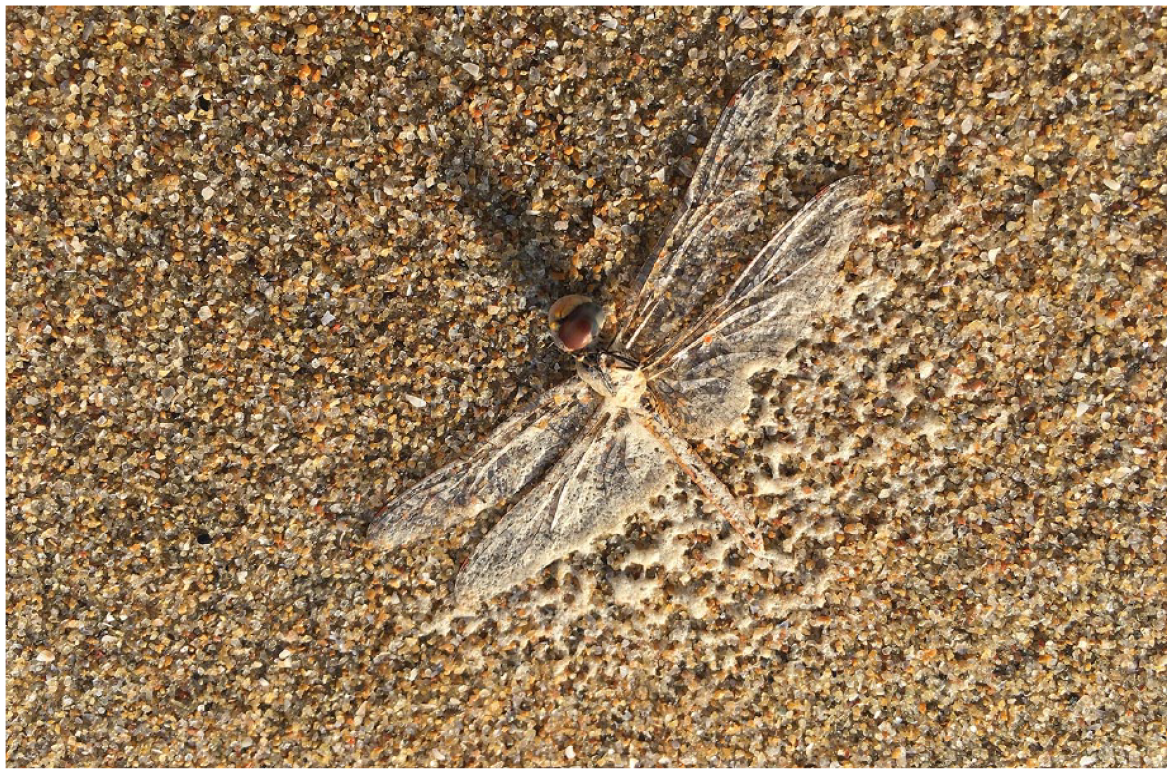
A Pantala flavescens dragonfly washed up on Elliots Beach in Chennai. Photograph by Beth Cullen.
The two initial research strands developed in Chennai were followed through in Dhaka and Yangon, passing between us and back again, but also, as was the case in Chennai, opening other research directions. In Dhaka, a trip along Madani Avenue in the east of the city during an early field trip, revealed an armature of terraformed real estate made by pumping sediment from adjacent rivers to form terraces for development in otherwise low-lying wetlands (Figure 7). From this initial observation, we were introduced to the sediment-heavy monsoonal waters that blanket Bangladesh each year on their journey from the Himalayas to the sea, and to their complex intra-actions with Dhaka’s garment and real estate industries, materialized not only through dredgers, sediment barges, and pumping tubes, but also as contaminated rivers, a depleting aquifer, and the ubiquitous Bangla brick. 59 At this point, following-the-sediment became a research method to trace this mobile monsoonal material through its entanglements in everyday, material, political, and socio-economic life, not only in Dhaka, but in all three of the cities we worked in. 60 Sediment took us back to Chennai, drawing our attention to the annual pre-monsoon practices of desilting storm-water drains and resurfacing roads. It informed our first engagement with Yangon, after finding a map in the British Library that revealed how the colonial city had been aligned with the porous sedimentary terraces of the Ayeyarwady River around the base of the laterite crest on which the Shwedagon Pagoda stands. Subsequent research suggested that socio-political life in Myanmar had for centuries been co-constitutive with intra-actions between geological and monsoonal dynamics. Earthquakes and cyclones, droughts and floods had frequently destroyed human lives and left its settlements in ruins. 61 At other times the relationship between geology and the monsoon had materialized into lucrative extractive economies timed with monsoonal cycles. This insight led to the jade economy becoming one of our main research strands in Yangon (Figure 8). Thinking with jade, we were able to establish relations between military companies, Yangon’s luxury real estate – its shopping malls, hotels, office blocks and luxury apartments, Chinese interests, and the country’s ongoing geo-monsoonal fluctuations. 62
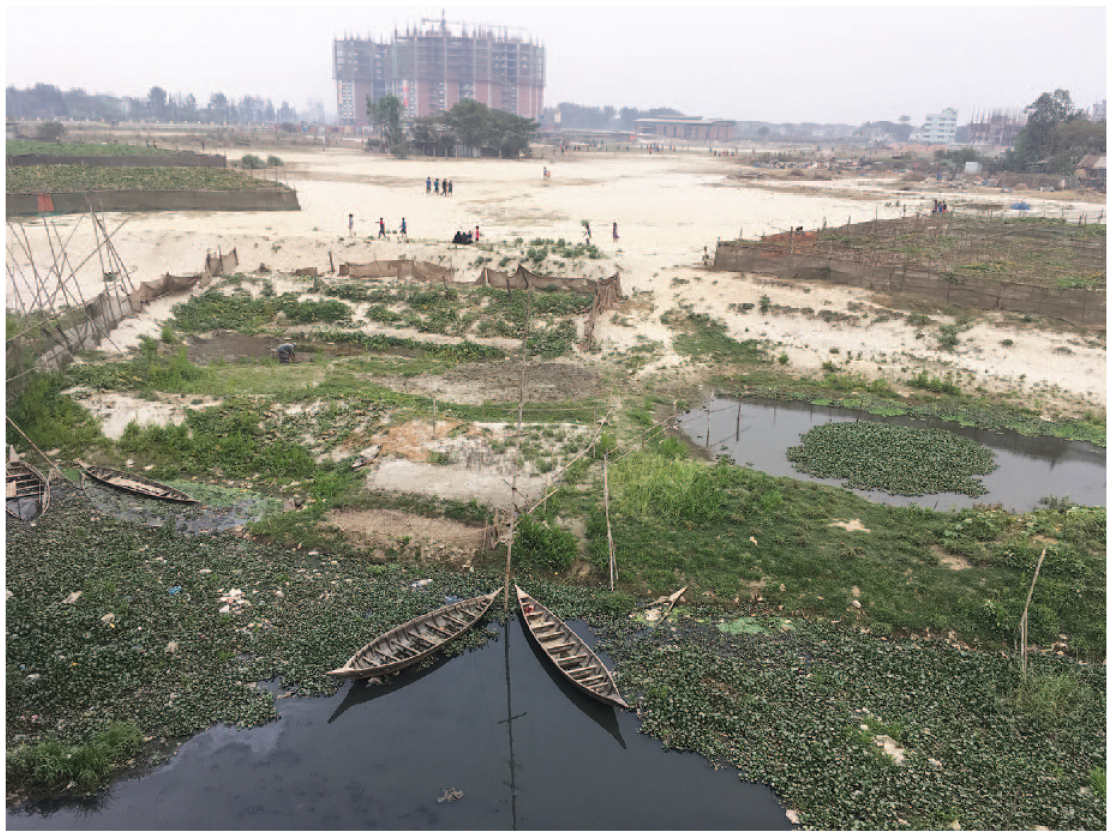
Sand filled land along Madani Avenue in Dhaka. Photograph by Beth Cullen.
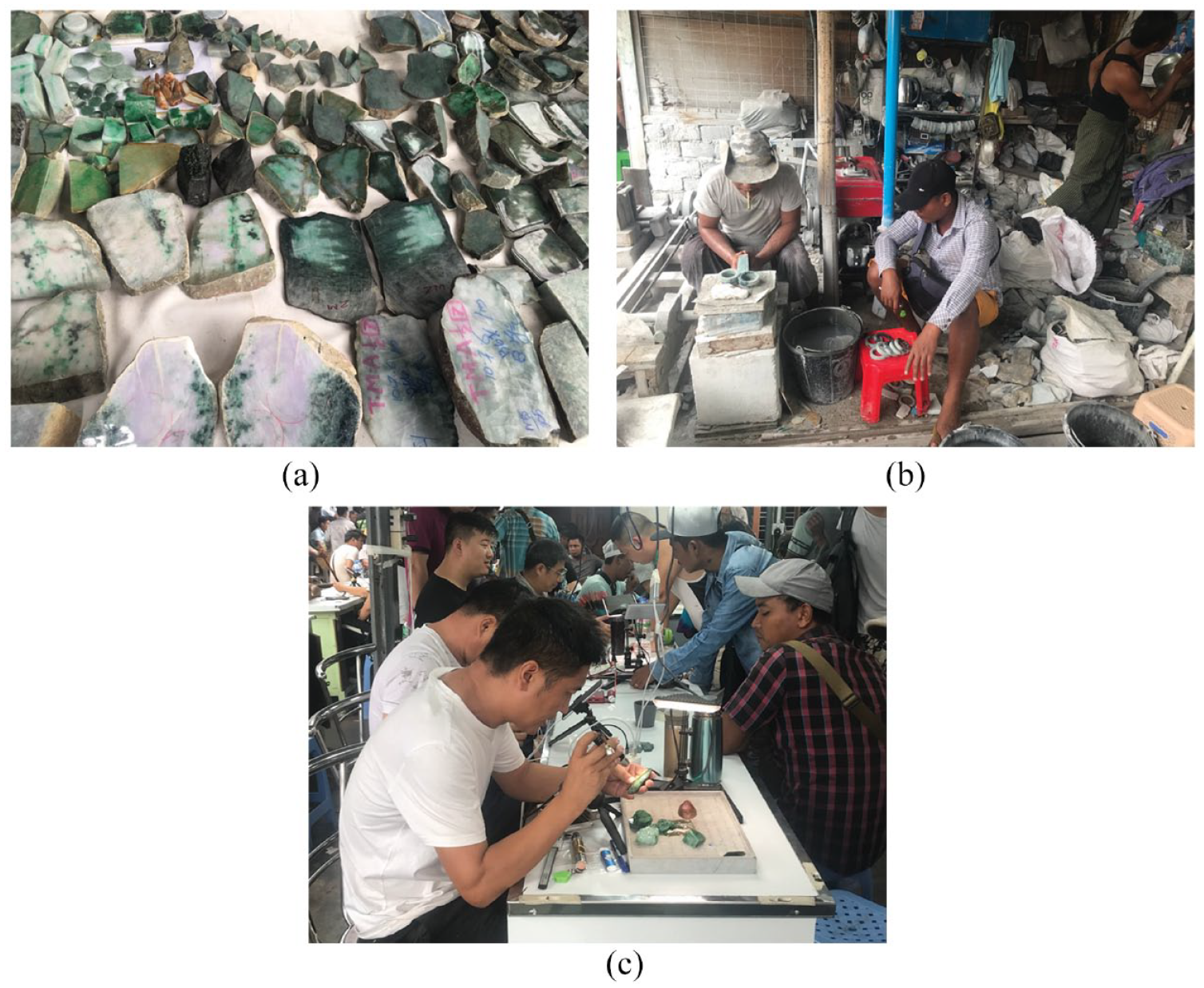
(a) Jade stones in the Maha Aung Myay Jade market in Mandalay. Photograph by Lindsay Bremner. (b) Polishing jade in the Maha Aung Myay Jade market in Mandalay. Photograph by Lindsay Bremner. (c) Selling jade in the Maha Aung Myay Jade market in Mandalay. Photograph by Lindsay Bremner.
Each year after returning from fieldwork, we reflected on, talked about, analyzed, edited, mapped, and archived our material. For 5 years, we thought, read, talked, walked, ate, dreamt, and slept the monsoon. It seeped onto our bodies and changed not only how we did research, but who we were and how we saw and intra-acted with the world. Eventually, through brainstorming sessions and research meetings, scouring over maps at different scales, using notes, trace-paper, post-it notes, doodles, keywords, and bullet points we realized that what our research practice had done was to inaugurate an array of improvised conversations with the monsoon, in which a range of subjects – human, inhuman, nonhuman, infrastructural, and material – had participated, not as objects of study, but as intra-locuting subjects of monsoonal weather worlds. At the same time, as western researchers, we were acutely aware of the history of research as a colonial encounter and of the extractive legacies and violence of the western eye. Linda Tuhiwai Smith reminded us that research is ‘one of the ways in which the underlying code of imperialism and colonialism is both regulated and realised’. 63 It turns places into field sites and people into objects of study. Transmogrified in this way, colonized sites and subjects are appropriated as raw material for knowledge production, denied any agency in the research process and their own forms of situated knowledge either appropriated or rendered irrelevant. Monsoon as method attempted to construct knowledge differently, seeing places, people, and nonhuman lives not as resources, but as actors and agents in intra-active processes of knowledge production. It was a mode of intra-locutionary research practice, producing a form of ‘partial, locatable, critical knowledge, and sustaining the possibility of webs of connections called solidarity in politics and shared conversations in epistemology’. 64
While interlocution is an interchange of speech or a conversation between responding, autonomous agents, intra-locution by contrast, like Barad’s intra-action, suggests that conversations are agential in producing subjects and that knowledge emerges relationally through conversational practice. In our practice, intra-locutors were not only human, but also the material substances and dynamics of atmospheres, air, groundwater, ocean, plastic, salt, and sediment; they were monsoonal infrastructures – bricks, khals, pipes, pots, and tanks, and nonhuman species – dragonflies, hilsa fish, jackfruit, snakes, and weeds. These subjects drew our attention during fieldwork as material-discursive phenomena caught in flows of monsoonal spacetimemattering. It was through them that our knowledge of the entanglements of the monsoon in the composition of urban life took shape. For us, intra-locution served as Galison’s theory machine, Haraway’s relational matrix, or Barad’s apparatus. 65 It was how we made sense of the entangled material-discursive flows in which we and our intra-locutors were mutually entangled. Like all conversations, our intra-locutions were inconclusive, riddled by relations of power, and full of gaps and inconsistencies, but situated and potent. Knowledge followed from who the conversants were, where, how, and in what language the conversation was conducted, how parties attuned to what was being said, what the power relations were between them, who or what else participated in the conversation, what misunderstandings it generated, how positions changed during the conversation, and so on. The monsoon that emerged from these improvised conversations was not universal or replicable, but situated and onto-epistemological. Monsoon as method was an intra-actionist onto-episetomology producing situated, embodied knowledge of the monsoon through material entanglements between ourselves and the people and stuff of monsoonal life worlds.
Formatting the monsoon
The outcomes of our research were in part political economy, in part agential materialism, in part ethnography, in part cartography; textual, graphic, and photographic stories told in conferences, academic papers, book chapters, and exhibitions. Our own book and online exhibition were approached not only as representational media, but as formats for further thinking with the monsoon. 66
The book was thought of as a three dimensional monsoonal volume of essays, drawings, maps, and photographs, partly inspired by nonrepresentational approaches that seek to convey the ‘vitality, performativity, corporeality, sensuality, and mobility’ of life worlds (Figure 9). 67 Instead of being divided into a series of sequential chapters, the pages of the book were conceptualized as spatio-material cuts through monsoonal mattering, from underground to surface to air. We proposed to lay the writing out in parallel layers across each page, according to whether it narrated aspects of the monsoon as air, surface, or underground, possibly using different fonts for each. This format would have enabled readers to either follow a single monsoonal element as a thread throughout the book, or to move between one and another and back again. Texts would have been interspersed with images and maps that cut across the spatio-material divisions, tying them together. The contents page would have been organized as a geographic map in which texts were geolocated and cross referenced. In this way we hoped that readers would experience something of the mobility and indivisibility of the monsoon as it circulated between land, sea, and sky and back again, and of monsoonal dimensionality as an entanglement of scales and matters, rhythms and times, imaginaries and lived practices, in which they, the reader were now a part. 68 When the time came to work with a publisher however, we were reminded of the role that traditional publishing formats play in reinforcing linear Western epistemological frameworks and ways of thinking. The book, as published, is organized into typical chapters and sub-chapters, interspersed with maps, drawings, and photographs, with small icons at the top of each page all that remains of the coding of the monsoon’s spatio-materiality as aerial, surficial, or subterranean.
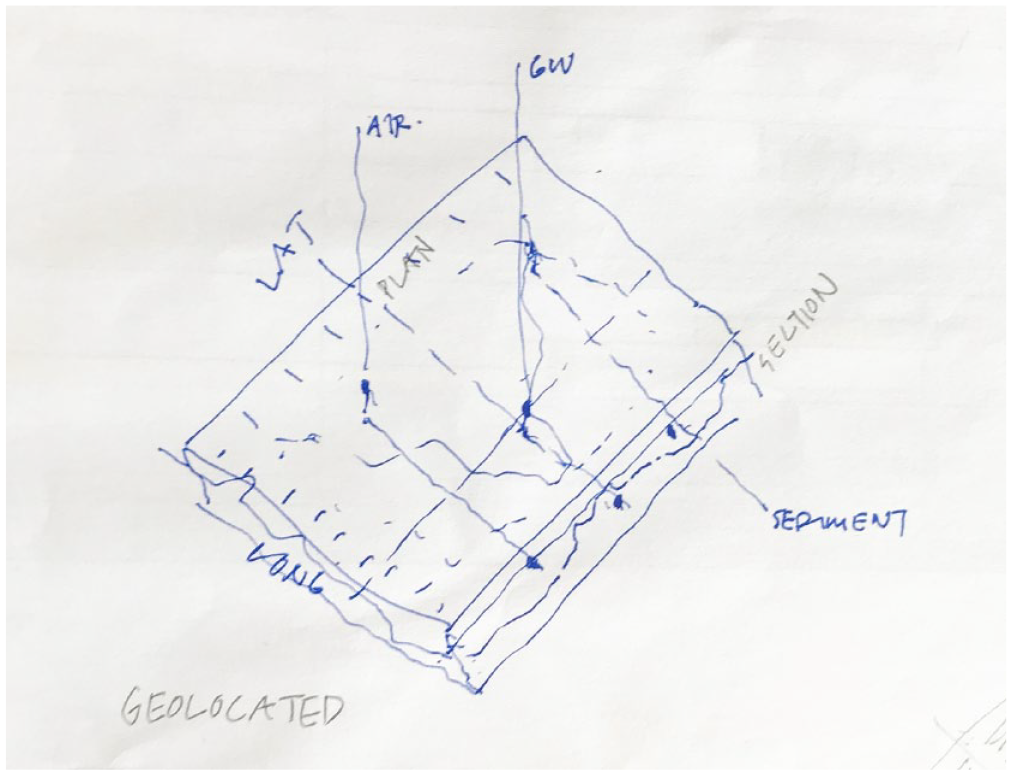
Early sketch of an idea for a book as a monsoonal volume. Drawing by Lindsay Bremner.
The online exhibition offered alternative approaches to thinking non-representationally with the monsoon. 69 The exhibition was not incidentally digital; that is to say it was not an online version of an analogue argument. A huge amount of data that had been generated by the project was digital-first and digitally archived – 5 years of research, teaching, analysis, simulation, and proposition had generated thousands of digital files: photographs from cameras and phones, screengrabs and downloaded files, data driven maps, videos; pdfs, jpgs, pngs, tiffs; photos and scans of analogue drawings, archival scans, sounds files, generated gifs. The process of design was iterative and required analysis, transfer and formatting of digital files, and collaborative conversations about meaning, argument, and function. The exhibition, like the broader monsoonal method, engaged seriously with what might be called a ‘digital monsoon’. This included, for example, dialogue with the Facebook forecasts of R. Pradeep John, the ‘Tamil Nadu Weatherman’, an independent Chennai-based weather forecaster and blogger. 70 In addition to working with digital weather ontologies, the project had deployed digital computational and design software in innovative and experimental ways to explore the digital logics of the monsoon. For example, a speculative sectional drawing from the Himalayas to the Bay of Bengal, through the city of Dhaka, simulated complex intra-actions between climatic and tectonic forces through computation fluid dynamics software (Figure 10). In this sense then, the online exhibition attempted in multiple ways to not only represent the monsoon digitally but think with the monsoon digitally and as digital.
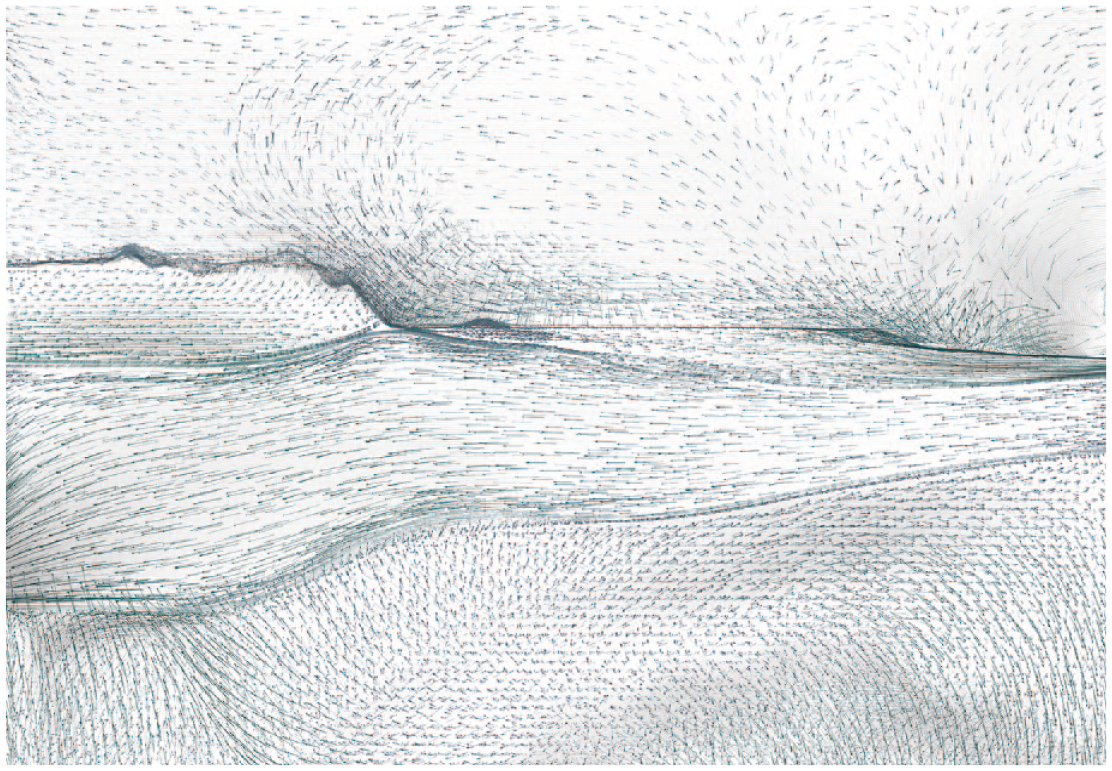
A speculative sectional drawing from the Himalayas to the Bay of Bengal through the city of Dhaka. Drawing by John Cook.
The design of the exhibition was not tempted by metaphors of the monsoon that pursued a visual style of rain and deluge, or a watery, windy design language. Neither were we interested in digital navigation, website structures, interfaces or affordances that were monsoon-like – muddy, flooded, or wet. Instead we set out with a strategy to use digital media to explore and articulate the multiplicity and simultaneity of the monsoon. At all points, the visitor should be able to explore and be confronted by its multiple scales, methods, experiences, and orientations. 71 This strategy meant that entry into the exhibition be as open-ended as possible with no correct or preferred monsoonal itinerary. The themes and subcategories of the exhibition were simply alphabetized: infrastructures, interspecies interlocutors, framings, matters, and urban assemblages. As we explained in the exhibition text: ‘The website has been designed to enable visitors to navigate rhizomatically through the stories and themes – to scroll down, leap across, return, zoom in, pause, or in other ways interact with their content without ever having to return to a home page. Navigation becomes a way of constructing circulations and cross-cutting relations, providing visitors a virtual experience of the monsoon in all its multiplicity’. Because of way the navigation was designed, at all points the viewer could see alternative scales, methods, experiences, or orientations (Figure 11). In this sense, the exhibition was openly assembled, and that assembling was an open secret (in a similar way the spine of the book was left exposed, a design choice which acknowledged the assembling of the project). And while we prioritized clarity and usability, there were dramatic moments curated to overwhelm the arbitrary boundaries of the themes we had set up as heuristics. These managed moments of interruption gesture to the excess of the monsoon and its agency.
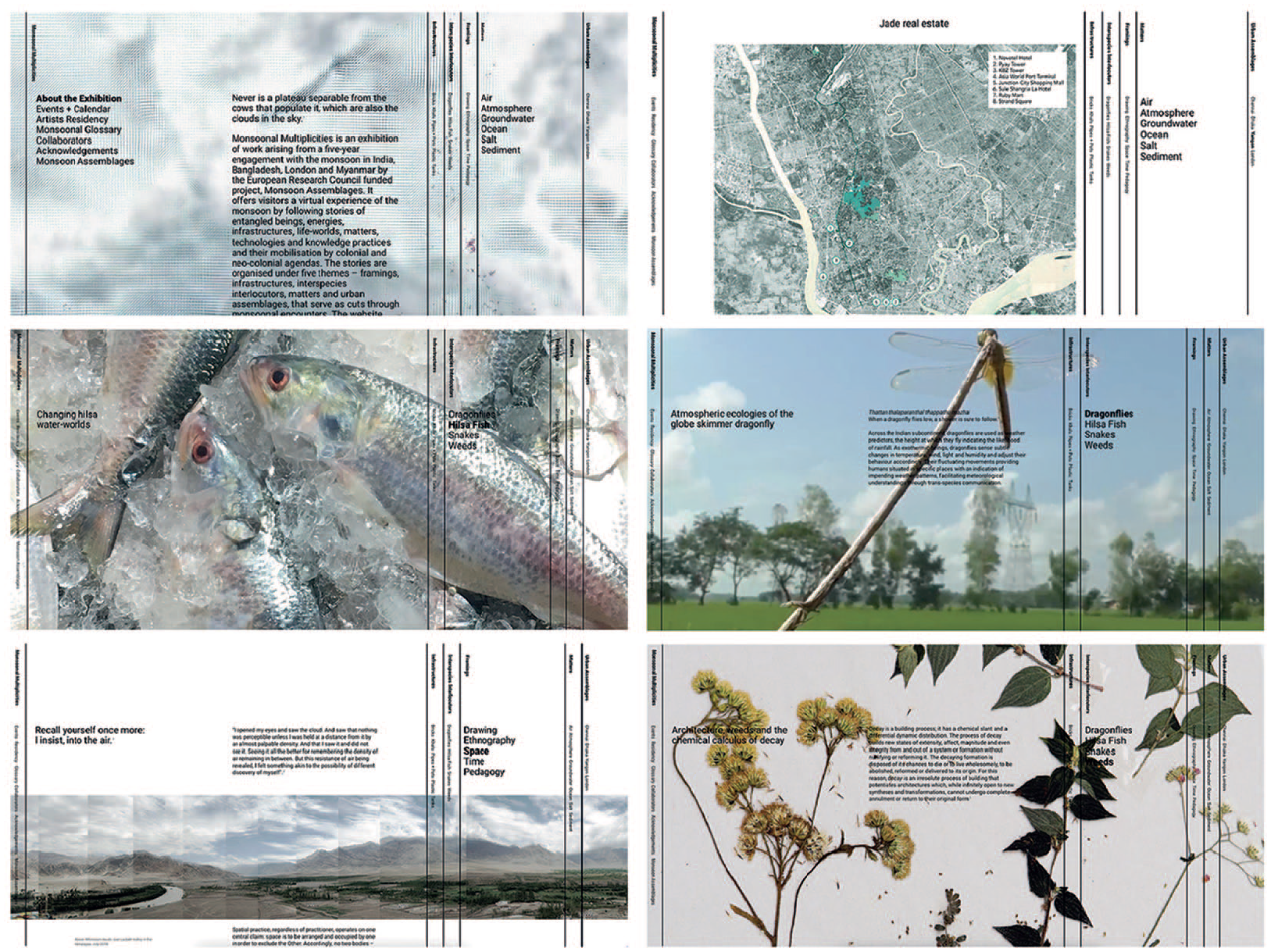
Composite of screen shots of the Monsoonal Multiplicities exhibition. For an introduction to the exhibition go here: https://youtu.be/K_1Fy6gnmhY and to visit the exhibition go here: http://exhibition.monass.org/.
Conclusion
This paper has discussed a non-formulaic, situated, relational method for researching the monsoon in three cities in south and southeast Asia, with replicable potential in other monsoonal contexts and indeed, other weather climes. The theoretical framework the paper elaborated has much in common with other cultural geographies of weather, but it differs from them in some key respects.
Firstly, it sheds doubt on the human-centric idea of the weather as a medium of human existence. 72 Instead, the paper has argued that material, human and more-than human existence and the weather are mutually constituted, entangled agencies, in what Barad calls ‘the iterative becoming of spacetimemattering’. 73 The earth is demonstrably alive and does not exist solely, or incidentally, as a stage or a medium for the enactment of human history. 74 Whilst the weather always exists, to some extent, as a byproduct of human actions, whether at micro- or macro-scales, the ‘beings and becomings of weather have their own knowledges, their own survivances and their own sovereignties’, and its self-organizing and self-differentiating tendencies contribute to all [human] modes of being, doing, and knowing. 75 Weather, in Clark and Szerszynski’s view, is a response to unresolvable tensions that arise from the interplay of forces set up by the revolution of the Earth around the sun and the need to dissipate solar energy and the build-up of energy from its molten core. 76 Volcanos and earthquakes, air fronts, circulations, convections, winds, breezes, currents, storms, cyclones, and so forth are incomplete solutions to the interplay of these never-ending forces. In never quite solving the Earth’s problems, the weather’s partial solutions exert agency and transformative power within the complexity of the material, discursive, human, and more-than-human relations that make up urban worlds, which reshape them in turn. As the pressures that extractive human economies are putting the Earth under increase, the weather’s solutions are changing, and with them, the weather worlds and weather ways of those living within them. 77
Secondly, in researching our three sites, and in contrast to many other cultural geographies of weather, monsoon as method recognized the affordances offered by matter and other-than-human lives for generating knowledge of weather. It eschewed an exclusively human lens, recognizing that it is not only humans who experience, are weathered by and change the weather; everything on this planet weathers, and in doing so, thinks, acts, responds to, and becomes entangled with weather differently. We suggest that thinking with the more-than-human matter and other-than-human species of changing weather worlds is necessary to overcome human exceptionalism and to contribute to the profound epistemological, ontological, political, and economic shifts that are going to be required for humans to weather the ravages of climate change, with its ‘fearsome capacity . . . to undo sustaining connections and footings’, and to build a more equitable, caring, multispecies world. 78
Footnotes
Acknowledgements
The authors would like to acknowledge the following organizations which supported the research on which this paper is based: Care Earth Trust and the Perungudi Lake Area Neighborhood Association in Chennai, the Bengal institute of Architecture Landscapes and Settlements, and Research Initiatives Bangladesh in Dhaka; Blue Temple Architecture Design in Yangon, as well as many others who gave of their time for interviews and conversations during the course of our research. We would also like to thank the editors of the journal and reviewers of the paper for their generous and helpful comments.
Funding
The author(s) disclosed receipt of the following financial support for the research, authorship, and/or publication of this article: undertaken as part of Monsoon Assemblages, European Research Council grant number 679873.
