




Abstract
This article reflects on an audio-movement project produced during the Covid-19 pandemic by London-based performance collective Exit Map. It explores how the physicality of somatic experience might be translated and expanded through the medium of sound, and what movement improvisation might offer as a practice for inhabiting uncertainty and meeting the unknown.
A gap
I walk into the wide-open grassy space. My body welcomes the spongy ground. The milky November light. Spindly branches reach skywards as people criss-cross on tarmac paths. I see someone in full waterproofs. Another with headphones on. Are they here for this too? 11.59. . .12. I press play. A quiet background hum. A voice. Hello, welcome to this Moving On guide. . .Let’s begin with a walk. . .
Between September 2020 and March 2022, I made my way often to a park in South-East London to move – with the sky, with the ground, with others. This weekly practice was part of Moving On, a movement project created by the London-based performance collective Exit Map. 1 The project brought dance artists together in remote collaboration to create audio guides for somatic movement exploration in outdoor space. Participants engaged individually and, when regulations allowed, in physically distanced events where we moved in a synchronised shared practice. Beginning where I encountered the project, in the open green space of London’s Hilly Fields, the initiative grew to include nodes in Liverpool, Marseille, Athens and elsewhere – a shifting sonic-somatic network in which we moved alone and – at 2 metres or 2,000 miles – together.
Many of the artists contributing to the guides were influenced by Contact Improvisation, a practice exploring the physical relations of touch, sensation and momentum that emerge between bodies moving through contact with one another. As the pandemic forced a prolonged pause in its practice, audio work presented a way to keep moving in the gap. Contact improviser Nancy Stark Smith talks of ‘the gap’ in improvisation as a moment where you experience ‘a temporary absence of reference’, a feeling of not being sure ‘what’s happening or what to do’. 2 In this situation, she suggests, it can be useful to adopt a relaxed listening attention to your inner and outer environment, with a suspension of judgement that allows you to eschew expectation and attend to what is.
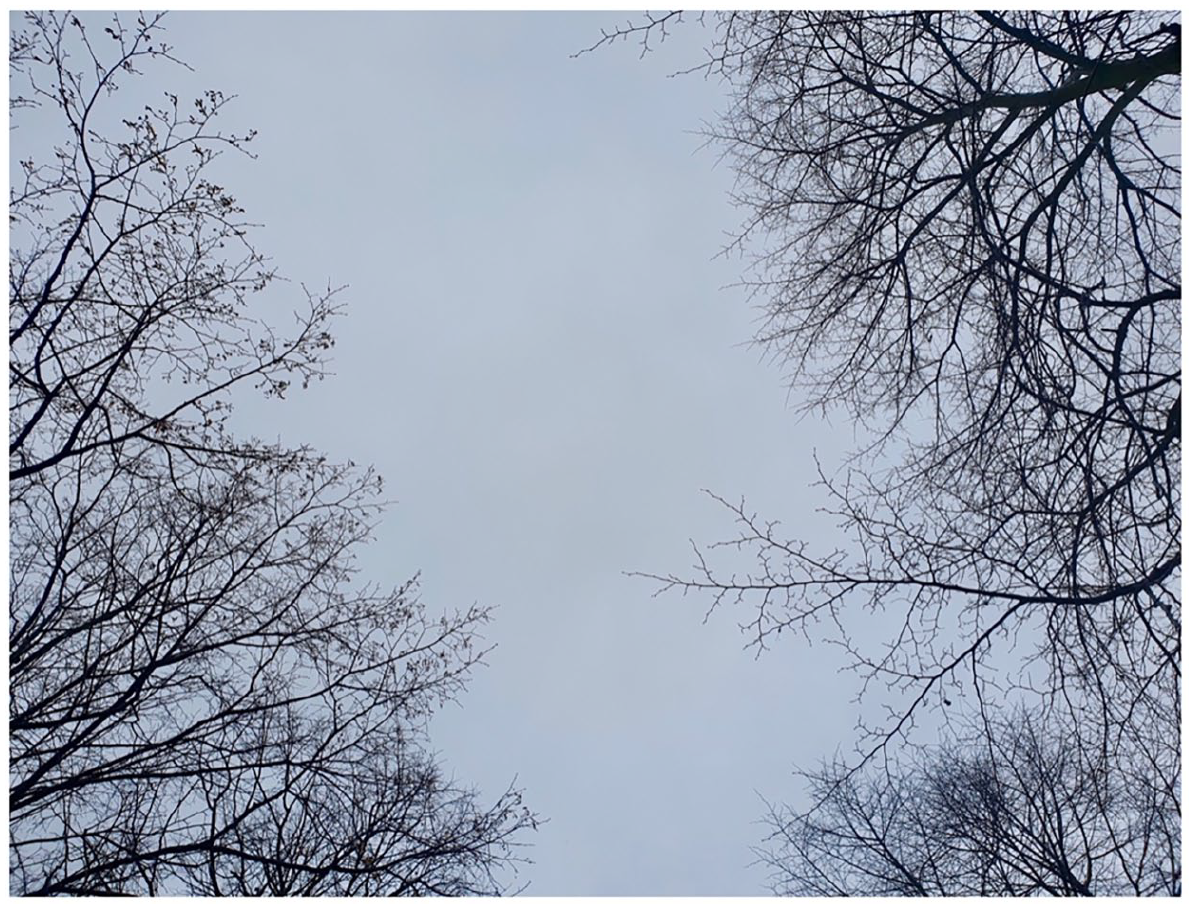
A gap in the trees. Photo by Sofie Narbed.
In this piece, I explore how artists cultivated this listening attention in the Moving On guides, and the questions that arose in the process. What does it mean to facilitate sensory-somatic relation at a distance? How does its material liveness translate into audio work? And how might this expand possible experiences of body, environment and the relation between? I draw on the audio guides (extracts shown in italics), creative guidance to artists, 3 shared conversations and my own reflections from a year of practice and collaboration with the project to think through these questions. In doing so, I consider how, at a time of profound uncertainty, the audio series supported practitioners to move, imagine, attune and connect – embodied acts of relation that, in their ‘intelligent not-knowing’, 4 became collective tactics for moving in the gap.
move
I ask my body:
What if my pelvis has the right to move in public?
Moving freely in public space takes a certain kind of confidence, even for those well-practised in improvisation. Letting your body spin and bounce and roll. Standing with eyes closed. It can feel conspicuous, vulnerable, even transgressive. How to accompany someone on this journey into movement? How to support a gradual letting go, an incremental risk-taking, that might lead to something new? In a relationship conducted via sound, the voice does a lot of this work. Artists adopt a directness, a certain throw-away-ness, aimed at inspiring a confidence to move. Tones encourage action and ease, allowing the intonation to be the invitation. Words emerge from outdoor experiments where artists track their changing curiosities in the moment. They move – write – move. In recording too, they move for words that arise from a ‘body-space’. They experiment with modes of address. You, I, we. Pronouns that hint at possible solo directions or those of an invisible synchronous collective. Accompanying. Suggesting. Invitations that might be taken, adapted or ignored. Words train attention inwards as they trace kinaesthetic paths through the body. A slow, repeating unfolding that builds a gradual sensitisation of perception.
I’m feeling my foot roll along the sole / the ball of my foot / and my toes push into the ground.
How does that push travel / from my foot / through the long bones of my legs
and into my pelvis?
A kind of ripple from the ground
through my foot
through my leg
into my pelvis. . .
A moving body needs time to integrate what it hears. To test out, to feel. Just as important as repetition, then, are the gaps that let the listener’s attention go deep, go elsewhere, come back. Temporary absences that encourage you to move in the space left behind. In these moments, other sounds become the accompanying presence. The muted crunch of leaves; the rustle of clothing; the background crackle of artists’ home recordings. Textured soundscapes that give a sense of space and steady momentum. Sometimes speech turns to hum or rhythmic breath. Sometimes music lifts and animates. At others, both artist and listener learn to trust the silence. Sensing. Expanding. An embodied curiosity that grows with this sonic companionship and its playful questioning of how we might allow ourselves to move in public.
What happens if I play with the push into the ground?. . .
Could I find a rise?
Or a bounce?
. . .I can play with rhythms.
Slow, fast, fast, slow. . .
How little does it take
for walking to feel like dancing?
5
imagine
As words guide, they conjure. A blue sea’s open horizon. Feet trailing thick yellow paint. Your diaphragm an elastic flying carpet. Images that shift perception. The ground, your body, are everyday no longer. They are exciting. Surprising. Dreamscapes that, in this somatic imagining, open new relational possibilities.
A cold January day in Hilly Fields brings an audio invitation to explore our fats and oils. We imagine seals swimming in a freezing sea, protected by insulating layers of fat. Like them, we too are keeping warm in the cold. We are invited to put a hand to our bellies and feel for a soft fluid sensation under our skin. How deep does it go / this warm oily texture / connecting everything? / If you are not really feeling it / imagine it / Enjoy the warmth of your touch. Exploring, grounding in the pleasure of sensation, we encounter anatomy as experience. A liquid presence under our fingertips. A quietly shifting sea.
Words track this sensing attention, moving it through the body: thighs / calves / ankle joints. . .oiling yourself from within. Inner body visions slowly materialise in an emergent dance between the experiential and the imagined, until we are dancing from our fats. Buoyant. Oily. Fluid. Can your fats be your main storage of energy, rather than your muscles? / Can you let them lead the dance? Soon, our fats take us out into space. Mmmm fats / sensuous fats / seal-like beautiful powerful fats. 6 I feel a fluidity reverberate from my tissues into rock, tree, air. A sensing attention that colours the touch between my material body and the material earth. I am seal. Freed from the ground, spiralling in 360° space. Feeling my spine supple, I twist and dive in joyous elastic loops. I watch others flow in their multiple lines of flight. Acts of material physicality, and of a deeply embodied poetics. Each expanding our experience of the other.
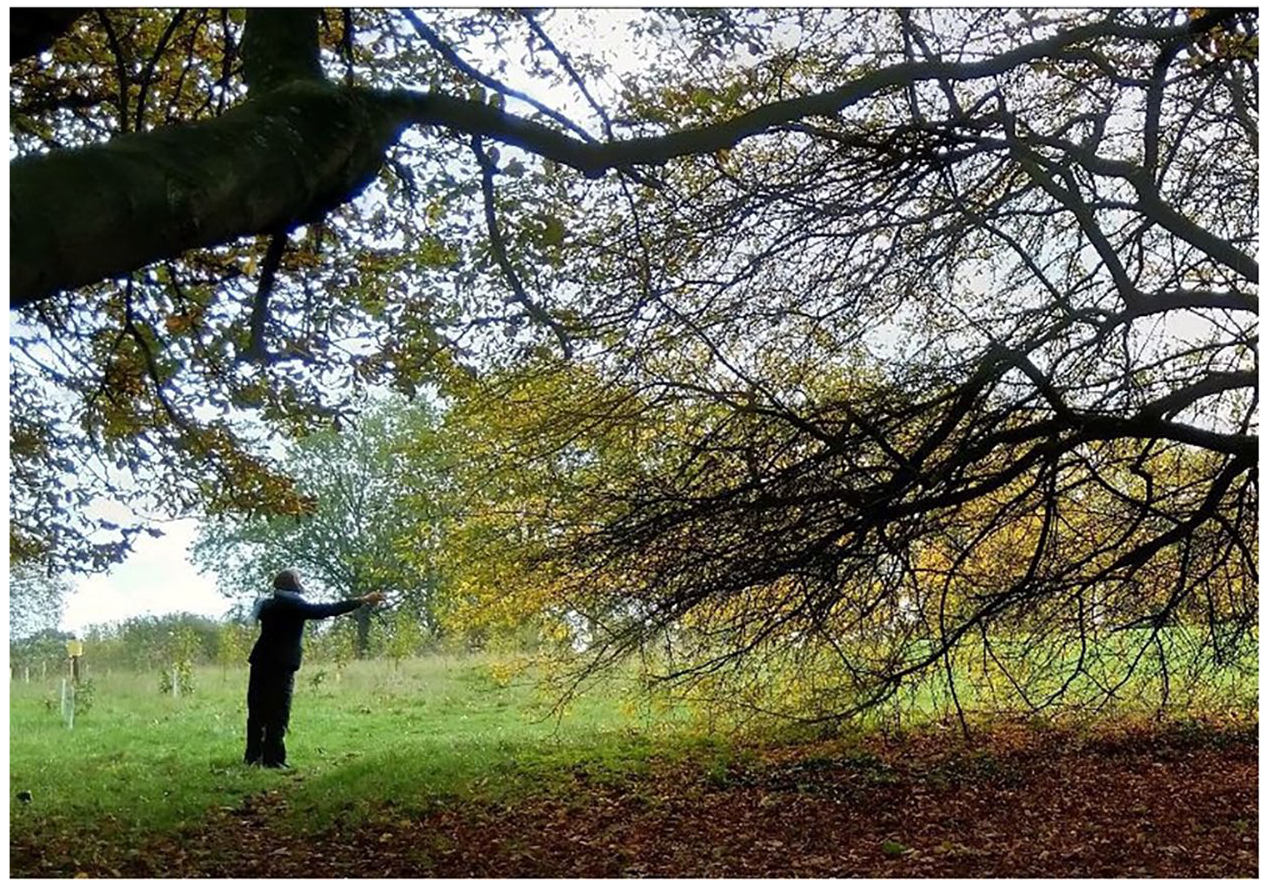
Dancer Cléo Tabakian in Hilly Fields. Photo by Laura Doehler.
attune
A still February afternoon in the park. I stand, grounding in the steady rhythm of my breath. Imagine the edges of you expanding slightly / Every inch of you answering ‘present’ to the register. . ./ Notice what the place you are in brings. . ./ Can [it] be a sort of frame in which your entire organism radiates? 7 I feel an internalised attention expanding and blurring with the twiggy canopy suspended above my head. My cells tuning to its delicate shelter. Its vibrating co-presence.
Shifting attention away from human touch makes space to notice other kinds of relation. What you already touch and touches you. Feeling it animate and articulate. Receiving impulses from another kind of aliveness. The Moving On audios take us into this expansive state of eco-somatic 8 relation. We feel it through form, observing how horizon-like domes – feet, pelvis, diaphragm, mouth, skull connect us to the encompassing dome of the sky. 9 Through materiality in the mineral connection between bones, rocks and stars, light shining and dimming as we flex wrists and elbows. Star joints. . .ancient architecture moving. 10 We feel it through a quiet cellular awareness of our skin and journeying breath. Made membrane, we feel the permanent porosity that connects inside and out. In solo practice, these relations sustain. Let objects, trees, lines echo within you / You are part of a very wide, breathing, vibrating orchestra. 11 We dance not alone but in permanent relation.
This practice of attunement brings a porous sensitivity. A receptive curiosity. And an appetite to stretch a little the edges of our comfort. One afternoon, a voice invites us to close our eyes as we walk. Can your senses become the seeing? My attention goes inwards to micro-adjustments of bone and tissue as I navigate slight shifts of terrain underfoot. Outwards to sounds sketching a map of distance. What filters through your skin? In this sensory landscape, the voice talks of a subtle letting go. A softening of the urge to see. Let yourself be surprised. I feel an unfolding consciousness of existing connection. A deepening trust of reflex. Caution mixes with a desire to run. Being with the unknown / also tells of what you do know and have / Remaining faculties that guide you. . .protect you / Without naming them / How do you move now? 12 I feel a trusting bodyful curiosity calm the edges of fear and discomfort. An expanding perceptual field that supports me to act in this space of unknowing. Recognising the comfort you need / And the one you feel you can stretch / How far can you unsee? 13
These are explorations that, in my immersive audio world, feel deeply intimate. In the park’s open space, they are also inherently public, my moving body witnessing and being witnessed. Somatic threads weave emergent choreographies with human, tree, insect, dog. Encounters that bring kinaesthetic and affective transformations. It sometimes feels like a public performance, this dance of affecting and being affected. Other times it becomes an active invitation to move otherwise, a passer-by joining in, tentatively spreading on the grass beside us to face the sky.
connect
. . .feeling the connections and interconnections dancing the connections and interconnections. . .
14
Experiences of somatic listening take you into touch with a deeply embodied sense of self. They also take you outwards, to others, to world. Into a body that is always extending beyond its skin. This simultaneous inhabiting of ‘inside’ and ‘out’ is not just something experienced in place but something that actively connects us to it. And over time, I feel somatic maps colour my experience of Hilly Fields. The dark corner of crunchy leaves that one day turned my frustration into play. The quiet curve of bark that fit comfortingly into the small of my back. Affective imprints, muscle memories, from a sonic-somatic world that, in deepening attention and sensation, slows time and allows us to ‘incorporate space’. 15
In this physical experience of organic exchange, the audios foster a sense of ‘grounding’: a bodily and existential rooting that turns space into place. 16 They encourage an improvised, roaming engagement of site led by bodily curiosities and desires. They give us permission to wander/wonder. Under lockdown restrictions, this sensory inhabiting is also a hyperlocal practice of repeated return - we occupy and re-occupy nearby space. These small, disparate journeys bring singular experiences of place as rhythm, vibration, texture and light. But sonically, somatically, we also move in each other’s places. The echoing hubbub of Athens streets drifts on a London wind. Feet on frozen earth feel the heavy shift of tide-damp sand underfoot. As we share these experiences in synchronised time, they weave felt connections that matter. A multi-sited sensory travelling. A sense of invisible collective accompanying us as we move. A collaborative network responding to uncertainty with collective work. In the situated immediacy of outdoor improvisation, the practice also forces a shift in focus from planning (and its futility) to changing sensation in the present. At a time when much felt ‘grounded’, ground to a halt, ground down, this physical shift was also a shift in perspective that brought us to inhabit our bodies as ‘our mooring and support for action’. 17
practising, relating
Recent geographical scholarship has turned to practices of attunement to explore the bodily and affective encounters and vulnerabilities through which we relate to human and non-human others. Much of this work highlights the significance of attuning practices for new kinds of conviviality, political action and research method. 18 In its use of audio to bring artists together remotely in synchronised somatic explorations of site, Moving On demonstrated the creative possibilities of voice, language, sound and silence to reimagine our relations with non/human others and to expand how we might experience intimacy, agency and connection. This creative work moves us away from bodily attuning understood as a unified ‘knowing’ (cultivating harmony/sameness) to instead explore it as an emergent, situated sense-making; an act of improvisation that encourages us to take risks, to deepen our listening and to connect with a physical and existential training for facing the unknown. 19
Footnotes
Acknowledgements
Thank you to all those involved in Moving On for the stimulating conversations in words and movement. Special thanks to Laura Doehler and Anne-Gaëlle Thiriot for their collaboration in the preparation of this article.
Funding
The author(s) disclosed receipt of the following financial support for the research, authorship, and/or publication of this article: This research was supported by a British Academy Postdoctoral Fellowship, grant number PF19\100111.
