




Abstract
In his work and creative practice, Anishinaabe artist Michael Belmore shows that materials have language and rock tells a story. Belmore’s land-based installation on Manitoulin Island, a three-part granite series titled, Replenishment, tells a story about place that is activated by relationship and reciprocity between people and with the Earth. It reinscribes Indigenous presence on the land, rewrites settler-colonial narratives about place, and broadens the scope and intent of ecological restoration. Drawing on my interactions with the artist and his work during the 2017 Manitoulin Island Summer Historical Institute, a field school on Anishinaabe history, I explore the circulation of knowledge and agency in an Anishinaabe world and consider relationship as essential to decolonizing geography’s engagement with Indigenous peoples and territories. Through rock as mnemonic device, Belmore demonstrates the restorative power of subtle and not so subtle acts of interconnection and relationship.
Keywords
As a week-long field school on Anishinaabe history, the inaugural Manitoulin Island Summer Historical Institute (MISHI) was driven by the question: Does Wisdom Sit in Places? Drawing on Keith Basso’s study of place names employed by the Western Apache in the American Southwest, MISHI 2017 participants were asked to listen to and think about how Anishinaabe knowledge inhibits landscape on Mnidoo Mnising (Manitoulin Island), the largest freshwater island in the world, located in Lake Huron, one of the Great Lakes. 1 The call for participants referenced Anishinaabe historian Alan Corbiere, one of the Institute’s main instructors: ‘when the pictographs have faded or have become inaccessible and unvisited, the bark scrolls locked in a museum, the place names supplanted, the stories untold. . .will the Anishinaabe still be able to summon [manidoog] in times of strife?’ 2 In the Anishinaabe world, manidoog, or spirits, are summoned to intervene, solicited for assistance, and they act of their own accord; they are ‘active agents’ in history, with significant power in Anishinaabe society. 3 The call invited participants to explore if knowledge and power are embedded in space, move around, or can be transported and transplanted.
Renowned artist Michael Belmore, a MISHI 2017 presenter and participant, makes work about land, water, and what it is to be Anishinaabe. In recent years, his practice has focused on stone carving and traditional metal smithing techniques. ‘The North American landscape’, he writes, ‘especially its watersheds, continues to be shaped by our divergent tendencies to that of nature. Rivers have been dammed, streams redirected and wetlands drained all in order to better satisfy the demands of western society. [. . .] Through the arduous process of hammering copper, I have continued to map out waterways through calculated and miscalculated blows’. 4
In this essay, I reflect on Michael Belmore’s three-part sculpture series on Mnidoo Mnising. Replenishment is a semi-permanent triptych work consisting of three carved granite boulders placed along the Kagawong River. It was created in conjunction with 4elements Living Arts, Billings Township, and Manitoulin Streams Improvement Association as part of the Kagawong River rehabilitation project. 5 During the 2015 summer, as Belmore was on site as an artist in residence, the Kagawong River restoration project focused on three key areas near the river mouth to improve habitat and riparian vegetation, repair bank erosion, and accommodate flow fluctuations due to hydro dams. Site designs use the water and in-stream structures such as boulder clusters and root wads to create carving pools and clean sediment off prime spawning habitat (Figure 1). Belmore’s stone sculptures were installed as part of the project’s bioengineering design as land-based art and are thematically centered on ecological restoration—one of the boulders provides new fish spawning habitat in the river; however, the work goes much further. Replenishment is about restoring relationships. It depicts the power animating Anishinaabek landscapes, and relationality animating Indigenous cosmologies, onto-epistemologies, and geographies, what Robin Wall Kimmerer calls, ‘the deep reciprocity that renews the world’. 6 Belmore’s creative vision of restoration is holistic, life-affirming, and transformative, one that does not ignore, erase, or attempt to replace Indigenous presence.
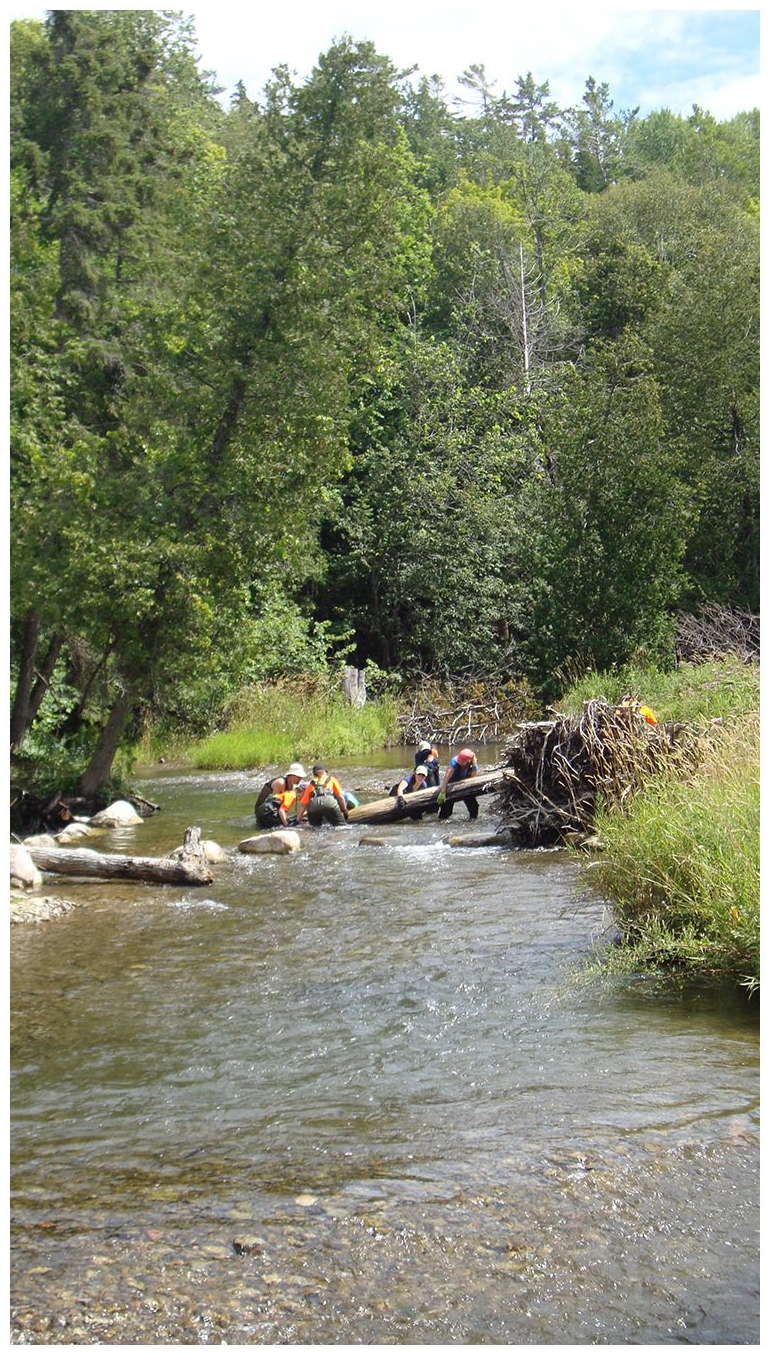
Bioengineering techniques such as root wads and boulder clusters are used in the Kagawong River to stabilize streambanks and create new habitat. Photograph by Nicole Latulippe, 2017.
During MISHI 2017, I had the opportunity to interact with Michael and his work. The field school is part of a process of drawing academic and Anishinaabeg communities and knowledge systems together. 7 A central component involved participants volunteering their time to work for the Ojibwe Cultural Foundation (OCF) on their historical collections and curriculum materials in reciprocity for the program of lectures, workshops, tours, and demonstrations. These activities were co-sponsored by the OCF, an organization devoted to Anishinaabe history and culture located on Manitoulin Island, and the History of Indigenous Peoples (HIP) Network, a research cluster based at York University. In what follows, I draw on site visits, personal communication, and a resource booklet I prepared for the OCF on Belmore’s Kagawong River work. Grounded in the questions and bridging work prompted by MISHI, I focus on the circulation of knowledge and power (agency, change, and transformative potential) depicted in the stone series, and on relationship as central to decolonizing geography’s engagement with Indigenous peoples and places.
Replenishment, the series
The first stone sculpture sits in the water at the mouth of Kagawong River. In acknowledgment of the restoration project, water currents, fish, and eggs are carved into the boulder. Additional features are discernable only up close, such as a beaded treaty wampum belt. Belmore symbolizes the purple and white wampum beads traditionally made from quahog shells by polishing some of the granite ‘beads’ smooth and leaving others unpolished, lighter in color, and rough to the touch. The design invokes the silver Covenant Chain alliance that was renewed and extended at the Treaty of Niagara 1764, a founding constitutional moment and the basis of subsequent settlement and law in Canada. 8 As a silver chain requires polishing so that it does not tarnish, the Covenant Chain wampum belt records a promise made by the British to the 24 Nations assembled at Niagara to annually ‘polish’ or renew the Nation-to-Nation relationship. According to Alan Corbiere during a MISHI site visit to Manitowaning, the British and Anishinaabek did renew the Covenant Chain treaty in 1836 on Manitoulin Island, and until 1854, Manitowaning was the site of annual gift-giving ceremonies (payment) by the British Crown to the area’s Anishinaabe Nations to renew their alliance (Figures 2 and 3). 9
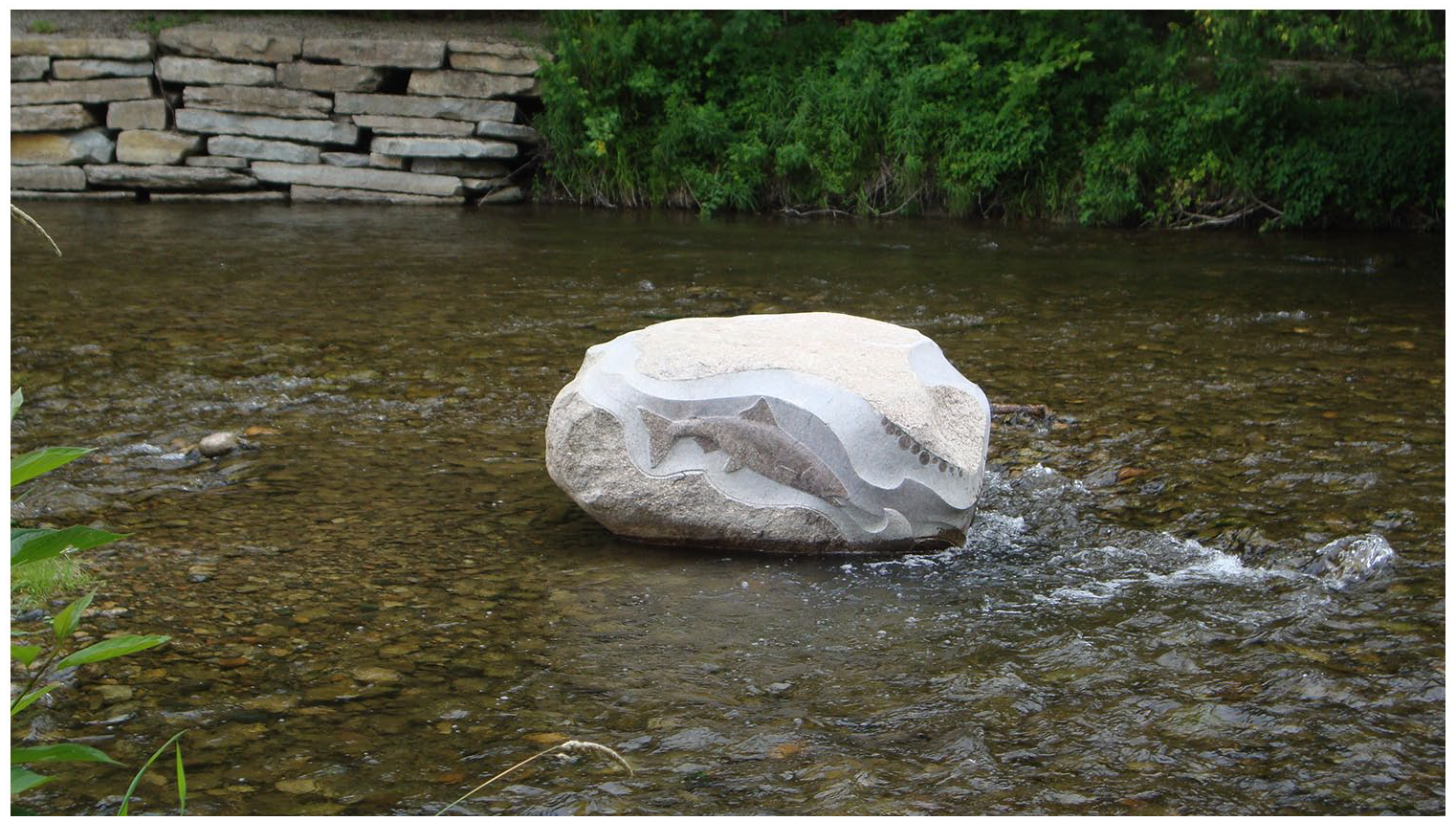
River rock. Photograph by Nicole Latulippe, 2017.
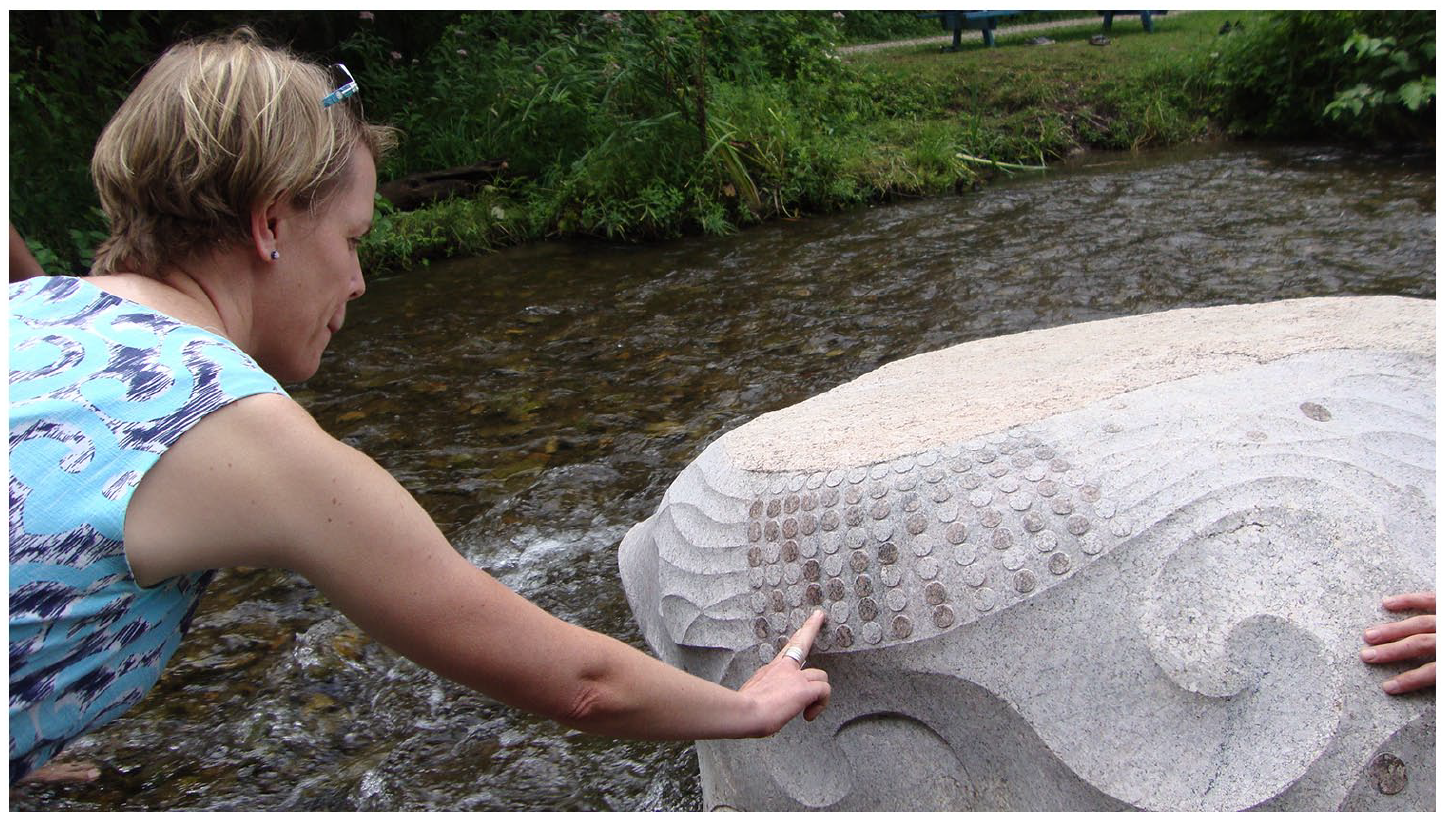
Beaded wampum belt. Photograph by Nicole Latulippe, 2017.
However, we know that British and Canadian governments did not uphold their treaty obligations. The Anishinaabek were dispossessed, their economies expropriated, and fish and wildlife habitats destroyed. Belmore’s artwork signifies the interconnection between the restoration of the river and the healing and wellbeing of the people – it uses the polished/unpolished granite beads to write ‘replenishment’ in ASCII code, the binary language of 0’s and 1’s. In so doing, he conjures copper, a powerful cultural referent and conductor of electricity that is used in communications and virtual networking. To the Anishinaabe, natural red copper is the blood of both sky and underwater manidoog, blood that ‘flows freely between the realms of water, earth, and sky, [and] embodies the continual interplay of the landscape’s contrasting forces’. 10 As beads break off the end of the treaty belt and transform into fish eggs, the death of the spawning parent and renewal of the young depict the cycle of life. 11 These motifs imply connectivity, power, and transformation. Reflecting on Replenishment, MISHI co-organizer and history professor Carolyn Podruchny writes: ‘[the carved boulders] draw attention to Anishinaabe people (represented by the water) washing away the social and environmental effects of colonialism’. 12 The artist encourages direct and embodied engagement with these forces. To get a good look (and feel) of the beads, for example, one must wade through shallow water, while the artist’s use of texture invites tactile engagement with the river rock. Bringing people into the river and involving all the senses, Belmore challenges normative Western conservation ideology, which separates humans from nature and alienates Indigenous peoples from their lands.
The second sculpture takes the form of a turtle making her way up the riverbank. Placed in the liminal space where water meets land, it communicates relationship. First, it speaks to work along the Kagawong River to restore sensitive riparian areas. These transition zones found along stream banks, lakeshores, and wetlands, perform key ecological functions such as filtering water and providing wildlife habitat. The turtle also tells a story about social relationships—which are not limited to the realm or agency of human beings. 13 The Anishinaabe Creation Story explains that all aspects of life are the fruition of creation’s thoughts, and that First Woman (Earth) is an alive and agentic being. 14 In the re-creation of the world, spirit and the sacrifice of animals regenerate the Earth, which is supported on the back of a turtle. 15 Human beings are both ‘influenced and influential’ members of an interconnected and interdependent spiritual-socio-natural world. 16 Within Anishinaabe and other Indigenous cosmologies and related governance systems, humans have an obligation to maintain communication and reciprocity with an animate and intelligent landscape, a relational field comprised of beings, entities, and forces in constant motion and flux (Figure 4). 17
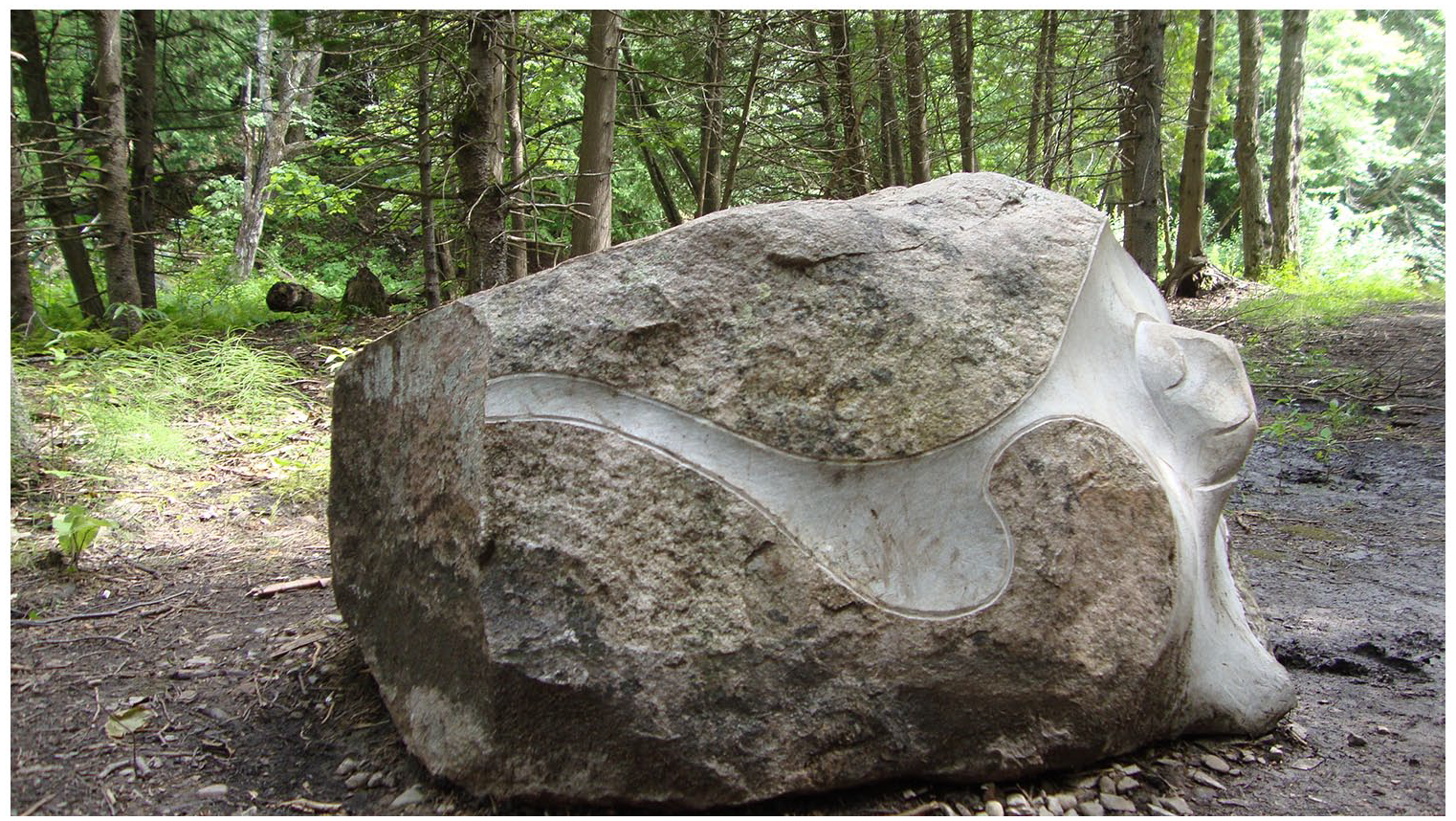
Turtle rock. Photograph by Nicole Latulippe, 2017.
The sculpture’s three-dimensional form suggests its animacy. It depicts movement and intent: turtle rock is traveling up the bank to lay her eggs. In fact, all three stones are sculpted from rock on the move, from glacial erratics. These granite boulders were glacially eroded from the Canadian Shield thousands of years ago, transported, and deposited on the sedimentary limestone that forms Manitoulin Island. Even the flat, exposed limestone depicts mobility, recording the movement of glaciers, history of once-living organisms, Earth’s dynamism, and geologic time. In carving rock, Belmore imitates how the story of Earth is recorded in the land itself.
The third stone forms a rocky outcrop in the vegetation. On it, Belmore has reproduced a rock carving from Kinoomaagewaabkong (The Teaching Rocks), a petroglyphs site near Peterborough, Ontario. Kinoomaagewaabkong is a sacred site that has long been visited by Indigenous peoples. 18 One of the largest concentrations of Indigenous rock carvings in Canada, it is located in another transition zone: where the Canadian Shield meets the Great Lakes-St Lawrence Lowland. 19 Exceeding linear conceptualizations of time and settler space, the sculpture connects past, present, and future together in place (Figure 5).
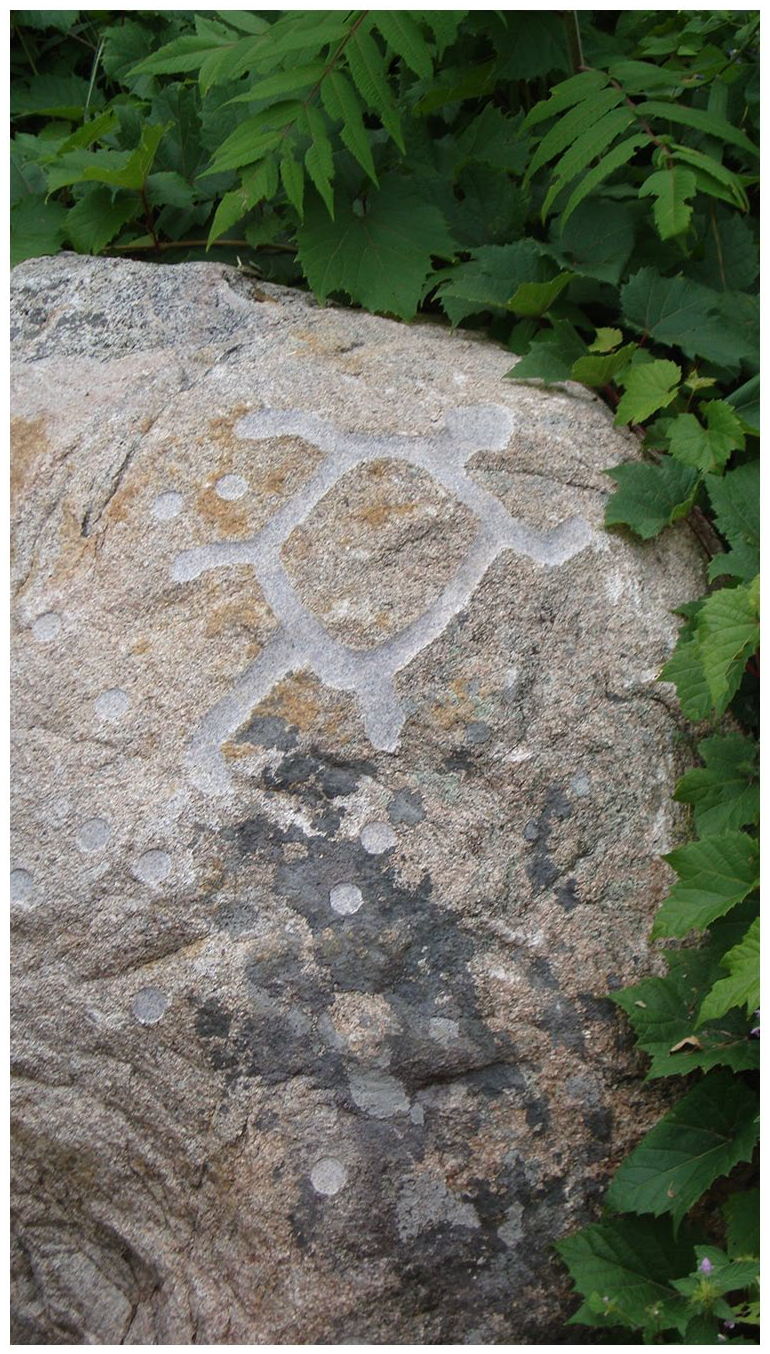
Petroglyph rock. Photograph by Nicole Latulippe, 2017.
Like Kinoomaagewaabkong, Belmore’s petroglyph is a visualization of Anishinaabek cosmology, history, culture, and environmental knowledge. Origin stories explain that spirit continues to animate the land because creation (and re-creation) is ongoing. This is depicted in Belmore’s carving of a turtle and 13 eggs, which signify the 13 moons of creation and 13 plates that together make up a turtle’s shell. The 13 moons of the Anishinaabe calendar are the gifts of creation expressed each month, across the seasons, years, and Earth itself. Thus, Belmore explains, his petroglyph speaks to a universal teaching. This universality is not about linear time or absolute knowledge from a Western paradigm, but in reference to shared values and legal principles that are sometimes referred to as Original Instructions, Sacred Law, or the First Treaty: ‘the long-standing agreement between the Creator and all orders of creation that all beings are relatives of one another, will be interdependent upon one another, and honor, respect, and care for each other’. 20 These relationships and obligations to care for the gifts of creation are ‘timeless’. 21 Like other petroglyph and pictograph sites, Belmore’s petroglyph nurtures what Ruth Wilson Gilmore calls ‘an antecedent future sense’ 22 and Robin Kimmerer, ‘deep time’, wherein knowledge about how to live well with the Earth (proper conduct) moves cyclically across the generations and between human and non-human beings across space and time. 23
During MISHI 2017, we learned that Kagawong itself is an Anglicized version of the Anishinaabemowin word, Gaag’gewang. The late Anishinaabe Elder and MISHI 2017 co-organizer, Lewis Debassige, explained that the word means river in the spring creates mist. Good fish spawning grounds, the Anishinaabek have always used the area, and the right to fish and hunt was initially recognized by the British Crown as inherent to the Anishinaabek, who were gifted fishing and hunting implements by their treaty partners at Niagara. However, stipulations in the 1862 Manitoulin Treaty removed Anishinaabek from all river mouths and excluded them from emerging settler economies. 24 Gaag’gewang is still enmeshed in these violent relations of power. Native fish species such as lake trout were decimated and replaced with coho salmon transplanted from the west coast, a fighting fish favored by sports fishers. Today, stream rehabilitation has been tailored to benefit introduced fish species and non-Indigenous uses. 25 Belmore’s sculptures invoke and name this colonizing history and ongoing legacy in subtle ways. Across the triptych, Belmore has incorporated the recurring motif of 10 bubbles, which is a direct reference to the song, 10 Little Injuns – a racist and violent representation of Indigenous people. His reappropriation of the popular colonial narrative is incorporated as a relatively small component of Replenishment’s overall form and design, a move that limits the reach and contains the power of colonial relations within ‘a bigger story’ about the Earth (Figures 6 and 7). 26
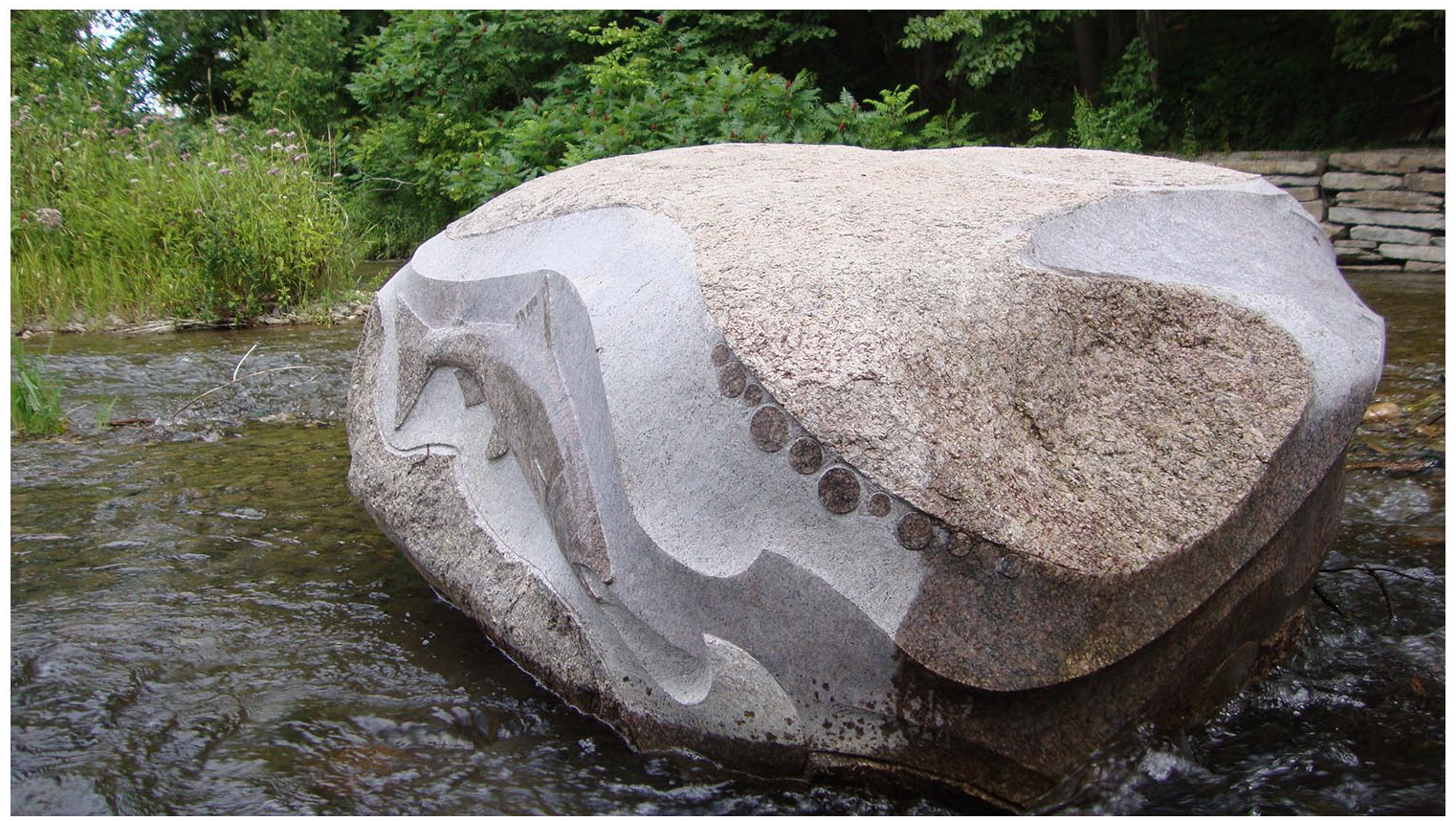
10 bubbles. Photograph by Nicole Latulippe, 2017.
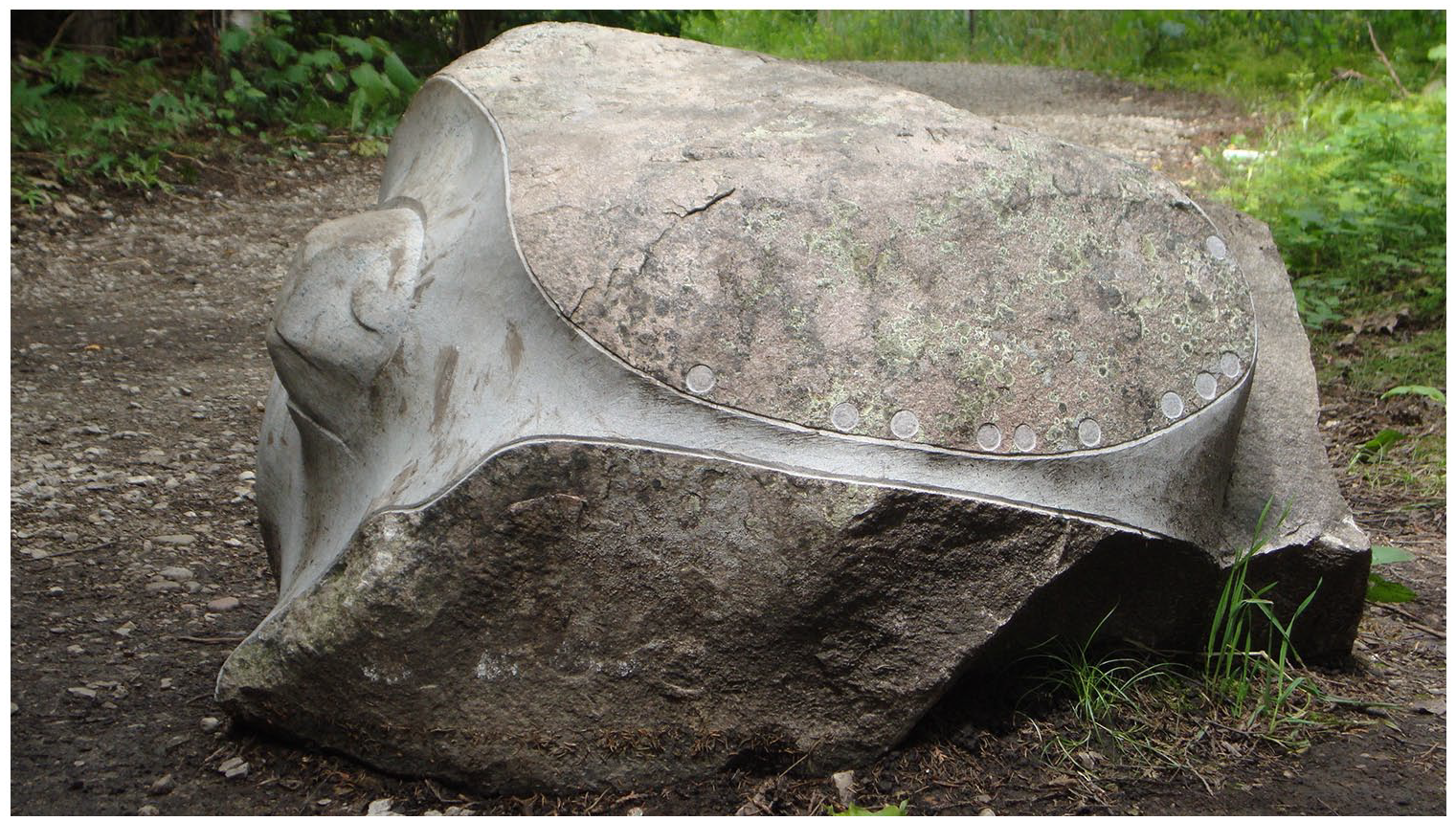
10 bubbles. Photograph by Nicole Latulippe, 2017.
Created in public space and installed at a popular tourist destination, Replenishment challenges public memory and sense of place. Rock becomes a mnemonic or teaching tool narrating very old stories about the Earth, stories that are still unfolding. 27 Subject to wind, water, ice, tectonic pressure, heat, and the hand of the artist, rock is dynamic and responsive. Belmore’s river rock is being moved around by currents, turtle is climbing the riverbank, and the petroglyph connects sites across time and space. For thousands of years, Anishinaabek altered and deliberately shaped environments; and like the glacial erratics, people, plants, and animals have been displaced. But whether they are forgotten, obscured, or not yet know, teachings about relationship, reciprocity, renewal, and responsibility are inscribed in the land itself and in its transformations. This is the scope of restoration and ‘replenishment’. 28 Belmore represents this in his subtle use of ASCII code, imbuing his artworks with hidden (yet pervasive) information that has the potential to do work if we look for it. 29
Cultural geographies in practice
Corbiere writes: ‘history as told by the Anishinaabeg uses the land as text book and bible. The land is named, the cliff faces painted, and points along the land serve as portals to summon powerful assistance in times of strife’. 30 Anishinaabe geographies mark history, spirituality, and environmental knowledge. Against the eliminatory forces and logics of settler-colonialism, MISHI asks, Does Wisdom Sit in Places?
Replenishment suggests that place-based knowledge and transformative power are not necessarily place-bound. It makes visible what Vanessa Watts, who draws on Anishinaabe and Haudenosaunee Creation histories, calls Place-Thought, an embodied understanding of the world wherein place and thought cannot be separated: ‘land is alive and thinking, and human and non-human beings derive agency through the extensions of these thoughts’. 31 Knowledge and spiritual power are active in the smallest forms (a shell, bead, blood) and largest landscape feature (a cliff face), in liminal spaces and across thresholds. Across his work, Belmore ensnares in ‘brief moments’ the animacy of this multi-layered Anishinaabe landscape and cosmology. 32 The stone series speaks to transition zones, scale, and motion; to the four elements and material/spiritual twinness of life. It evokes vision, trajectory, and Indigenous futurities. In his practice, Belmore’s use of ‘persistent, deliberate, and careful’ construction suggests that the wisdom in places and traversing space and time is activated through subtle and not so subtle acts of interconnection and relationship. 33 He makes visible the ‘profound epistemic, ontological, [and] cosmological violence’ caused by disruptions to Indigenous relationships with land, but also the form and content of colonialism’s ‘elsewhere’. 34 MISHI models respectful engagement with this Indigenous present and future possibility.
The signature image of MISHI 2017 was Michael Belmore’s Bridge, a wampum belt made of copper and aluminum beads arranged to represent the binary coding used in the operations of computers, cell phones, and video game consoles. 35 Rock, wampum, and digital language contain codes, materials have language, and they gather us together as people. 36 During the 2017 field school, participants bridged institutions, communities, and knowledge systems. 37 Elder Lewis Debassige emphasized the concept and practice of Nbwaach’ding, roughly translated as visiting together, a pedagogy for sharing Indigenous knowledge and building a team. 38 Belmore’s stone series was supported by institutional partnerships, as was my engagement with the work. There is a long history of relationship on Manitoulin Island and across all Indigenous territories from which to draw and learn. By weaving wampum and other mnemonic symbols together, the artist attends to broken legal agreements but also to precolonial treaty relationships and enduring covenants between orders of creation. 39 As Anishinaabe and allied initiatives continue bringing people into relationship with and across the territory—into active engagement that ‘insists on a responsibility in that interaction’, 40 the principles, practices, and relationships conveyed in Replenishment stand out as essential to community, world building, and renewal.
Footnotes
Acknowledgements
Chi-miigwech to MISHI organizers, facilitators, and participants, especially Michael Belmore, the late Elder Lewis Debassige, Carolyn Podruchny, Alan Corbiere, and Anong Beam. Michael Belmore and Caleb Johnston generously reviewed drafts of this paper (any errors are mine alone). Alan Corbiere provided helpful feedback on an early version, which I developed during a writing retreat at Artscape Gibraltar Point on Menecing, the Toronto Islands.
Funding
The author(s) disclosed receipt of the following financial support for the research, authorship, and/or publication of this article: The History of Indigenous Peoples (HIP) Network, based at York University and housed in the Robarts Centre for Canadian Studies, and the Ojibwe Cultural Foundation (OCF), located in M’Chigeeng on Manitoulin Island, provided support to participate in the 2017 Manitoulin Island Summer Historical Institute (MISHI). The University of Toronto in partnership with The Canadian Research Knowledge Network supported the publication of this article in hybrid open access format.
