




Abstract
Infrastructure has proven a polyvalent concept in human geography and anthropology for exploring the intersection of the social and technical. However, the ‘below’ of infrastructure, the infra, has remained underexamined in its relationship to the state, territory and the earth. This article proposes that infrastructure is better understood as a geophilosophical relation that renders a set of relations a subsurface for the propagation of another: it designates a socio-natural ground for political-economic figuration. It outlines the geophilosophical relations of infrastructure through thinking with the project SEA STATE by Singaporean artist Charles Lim, a series of artworks which document Singapore’s infrastructural underside, which Lim terms the sea-state, and provides a conceptual elaboration of SEA STATE’s aesthetic figures. In positing the continuity of figures across the sea-state’s varied infrastructures, SEA STATE exposes the colonial trajectory of its infrastructural systems, the contingencies it churns up as it endeavours to maintain its place in the world market, and the fundamental inversion of figure and ground the sea-state has effectuated. This inversion is all the more evident when we consider the expansive land reclamation projects of modern Singapore, wherein its territory has become infrastructure for bespoke logistical and petrochemical concerns, and will continue until the end of the century under the auspices of mitigating sea level rise. As the geological imaginary of the Anthropocene begins to seep into infrastructural anxieties of maintenance, breakdown and inundation, with governments and policymakers demanding that nature itself become infrastructure, it is critical to trace the longue durée of these infrastructural formations, how their continuities are remade and reiterated by the demands of subsequent historical-geographical junctures, and how the designation of figure and ground can ultimately result in the figure becoming the condition of possibility for its ground, requiring its continual reproduction.
Introduction
In SEA STATE, a series of artworks by the Singaporean artist Charles Lim, infrastructure is encountered as a reckoning between the state and the sea. It begins with the innocent-enough premise that, for a city-state with such rich maritime history, and the ongoing geostrategic importance of its ports, the sea is curiously absent, both culturally and geographically. 1 Since Singapore achieved independence in 1965, the sea has been pushed back through vast land reclamation projects that has seen the city-state expand its land mass from 585 km2 to around 725 km2. Land reclamation was the cutting edge of the nascent city-state’s modernisation and nation-building, consolidating heterogeneous religious and ethnic groups into citizens, and resettling coastal and rural kampongs into Housing Development Board flats. 2 While the colonial continuity of the state’s territory-production cannot be understated, with the first reclamation projects conducted by the British East India Company, independence, and the subsequent 1966 amendment of the Foreshores Act, was the moment when land reclamation became not simply a tool for opportunistically siting ports or industry, but the production of ground upon which the city-state itself could be projected decades in advance. 3 However, the focus of SEA STATE is not the familiar tale of Singapore’s developmental trajectory, mythologised in the figure of the founding Prime Minister Lee Kuan Yew. While human figures recur ambiguously throughout SEA STATE, some silent and some speaking, the subject is the infrastructural underside of the city-state itself: its sea-state. Avoiding the pitfalls of hagiography any human story of the city-state’s infrastructural and developmental trajectory would entail, the ‘Singapore Story’ that was written by the ‘Pioneer Generation’, SEA STATE opts instead for a more problematic and undeniably productive mythopoesis. The sea-state is the totality of interlocking infrastructures that permits the exponential reinvention and reproduction of the city-state, from colonial entrepot to Global City, and whatever lies beyond that. This article seeks to think with the artworks of SEA STATE to reconceptualise the term ‘infrastructure’ as a geophilosophical relation between the state and the earth.
SEA STATE was initiated in 2007, with the film ‘it’s not that I forgot rather I chose not to mention’, followed by ‘all the lines flow out’. Remaining rooted primarily in film, subsequent SEA STATE works engage with photography, cartography, interviews and installation throughout its 10 iterations. Lim’s background as an Olympic sailor recurs throughout SEA STATE, the project germinating with his frequent collisions with clumps of reclaimed land throughout Singapore’s waters not yet marked on the map. 4 Notable in its international reception, forming part of the first Singaporean pavilion at the Venice Biennale in 2015, SEA STATE is the product of a decades-long research project that has had unparallelled access to Singapore’s infrastructure, as well as interviews with key civil servants and actors involved in the establishment of these infrastructural spaces and methods. Lim’s acclaim and promotion by the state is intriguing, as his works tread the boundary between critique and complicity: no other project has engaged with the infrastructural underside of modern Singapore and been granted such access to the cutting edges and critical seams of its reproduction. This article thinks with SEA STATE to reconceive infrastructure as a geophilosophical relation that takes the earth as a ground for political and economic figuration, and hence the subsurface of political-economic order; this political-economic figuration itself becomes the condition of possibility for this ground, and as we shall see through SEA STATE, will require the production of ground where there was none before.
In his 2019 National Day Speech, Prime Minister Lee Hsien Loong announced that as part of a strategy to mitigate anthropogenic sea level rise, extensive land reclamation must be undertaken, which will simultaneously permit the creation of new freshwater reservoirs. 5 In this context, SEA STATE has acquired an unsettling prescience in its portrait of the city-state’s infrastructural totality, the sea-state. The exteriority of the sea has recently been restated and reformulated as an enduring threat to national survival, requiring continuous geographic expansion to allay. SEA STATE is not only as a series of aesthetic works but a conceptual project that, while embedded in the geographic and political exception of Singapore, this article will think with to situate the concept of infrastructure geophilosophically. It will do so by unfolding SEA STATE’s aesthetic figures into the conceptual apparatus of Singapore’s infrastructural underside, the sea-state. Figures populate, infiltrate and potentially recompose concepts, as Deleuze and Guattari suggest, but never entirely determine them, for ‘figures become parts of concepts because they constitute the aspect through which the concept is created by and in consciousness’. 6 For this article, SEA STATE exposes how infrastructure recomposes territory for the state once the political-economic order it seeks to surface becomes the condition of its ground.
Infrastructure is a concept which configures a subsurface to produce a political-economic surface, consolidating a ground to be populated by figures. In infrastructure studies, infrastructural inversion constitutes the opening analytic move through which infrastructure can be detected 7 in a reversal of figure and ground. 8 This article will present inversion as a geophilosophical relation through three aesthetic figures that recur through several of Lim’s works, whereby the surface then comes to condition the subsurface, and the ground of political-economic order becomes subsumed by the conditions it was initially configured to produce.
Before we come to infrastructure’s geophilosophical relations, this article first probes the possibilities and limits of infrastructure as it has proliferated as an analytic in human geography and anthropology.
Genealogies of infrastructure
While infrastructure as a concept has been thoroughly explored in its polyvalence, 9 this article will investigate its geophilosophical relations. As a concept, infrastructure has proven fertile if slippery ground in geography and anthropology, cited by Carse as a promiscuous term that has been shaped by the historical phenomena it seeks to describe. 10 While taken to be the ‘subordinate parts of. . . the built systems that move water, sewage, people and power’ 11 that is characteristic of the calculative reasoning behind modern logistical systems, communication and transport networks, as well as managerial and technical standards, 12 Carse traces the depth denoted by the ‘infra’ to the construction of French railways in the 19th century, where the infrastructure was the portion of the project built by the state and the superstructure constructed by private enterprise. For Carse, the utility of the term lies in its invocation of the ‘logics of depth and hierarchy that manifest in design, management and maintenance’. 13 Infrastructure, as the geophysical interface between capital, earth and state becomes a pervasive phenomenon and category of analysis in the latter half of the 20th century, through the multilateral military and financial treaties and organisations that begin to propagate ‘infrastructure’ as a way of structuring a unilinear model of development and debt. 14
One of the common tropes of infrastructure is that it is necessarily invisible, and only becomes visible upon breakdown. 15 For Bowker, to understand infrastructure one must perform an ‘infrastructural inversion’ 16 and foreground ‘the truly backstage elements’. 17 While infrastructures have always been intermittently foregrounded in the service of national spectacle, 18 the logic of the infrastructural inversion is marked by a totalising suspicion; infrastructure is always that which is concealed and requires prising out of its shell by the social scientist. While a crucial initial gesture, the shortfall of the mere inversion is that infrastructure as ‘extrastatecraft’, that is, as a suite of techniques that encodes spaces and relations simultaneously and reciprocally becomes diffuse and analytically incoherent. 19 To follow-through with Star’s theatrical metaphor, the problem is precisely the idea of someone or something ‘behind the curtain’, infrastructure lurking everywhere one looks. Infrastructure, as a concept contemporaneous with the international financing of modernisation programmes and the imperial enforcement of developmentalism, 20 is a product of economic history and geopolitical hegemony, a movement in the globalisation of capitalism. Infrastructure, in its production of economic order, cannot be analogised to a theatrical representation as simply what is happening backstage, for abstraction and ideology aren’t scripts that are written and performed, but reproduced through social practice. Ballestero takes inversion a step further, probing the limits and leaky ambiguities of infrastructure’s designation of figure and ground 21 as the obduracies of geology resist figure/ground schematisation in the conceptual modelling of an aquifer. The ideological underpinning of infrastructure lies in its demarcation of figure and ground, requiring that its study also accounts for what is left over as excessive or unintelligible to that demarcation. For this article, however, we take inversion as infrastructure’s geophilosophical operation, through which a political-economic order comes to determine the conditions of its subsurface in the production of a figure/ground dyad.
Infrastructures are how forms of sociality are enacted and their externalities are mitigated, with certain forms of relations excluded, foreclosed or otherwise rendered a subsurface for others. Larkin clarifies infrastructure as a categorising relation, and, whether designed or ad hoc, refers to a sociotechnical subordination of one form of life to another 22 . Berlant posits the term as neither wholly system nor structure, but the ‘living mediation of what organizes life’, 23 a conduit between system and structure, encompassing both the built environment and the ‘lifeworlds’ that inhabit them. It is both between and below, referring to a mode of mediation and the logic of that mediation. Infrastructure is a preoccupation with thickness, depth, but most importantly of all, and what appears most absent in Berlant’s account, geography: the earth. Perhaps this is what gives infrastructure its ubiquity in human geography: it concerns the geo as a potential organising principle. It is in this presupposition of infrastructure’s ancillary operation that the whole earth becomes abbreviated as a subsurface for those lifeworlds. Infrastructure inhumes relations as ground to surface others as figures, but as numerous scholars point towards, this act of demarcation and subordination is more porous than the state would prefer, and under the right conditions, can invert the very terms of that relation.
As the urgency of the Anthropocene begins to seep into infrastructural anxieties of maintenance, breakdown and inundation, with some demanding that nature itself become infrastructure, 24 it is critical to trace the longue durée of these infrastructural formations, and how their continuities are remade and reiterated by the demands of subsequent global economic orders. Even those infrastructures made in the wake or the break of the state’s absence, obsolescence or outright malevolence tells us something crucial of how those orders are manifested through the infrastructural designation of surface and subsurface, of figure and ground, what is primary and what is merely mundane, impromptu or even simply made difficult to see. Infrastructure’s designation of subsurface and surface is the hinge of its geophilosophical relations whose trajectories we will proceed to outline.
Geophilosophical trajectories of infrastructure
This article conceives of infrastructure as a geophilosophical relation. Geophilosophy broadly as a practice that takes the earth as the ground of thought, takes seriously its forces and relations, and seeks to explain the emergence of forms of thought geographically but not deterministically. 25 While incorporating aspects of Deleuze and Guattari’s outline of geophilosophy and the geographical dimensions of their wider collaboration, this article wishes to engage geophilosophical relation more broadly, and identify infrastructure as an implicit geophilosophical relation that intimately reckons with the forces of the earth as the horizon and problematic of its continued operation on behalf of the state. The contours and habits of this geophilosophical relation, as part of its historical emergence, have not yet been surfaced. The earth, in Deleuze and Guattari’s estimation, is ‘not one element among others but rather brings together all the elements within a single embrace while using one or another of them to deterritorialize territory’. 26 Infrastructure’s relation to the earth, then, can be considered one of reterritorialisation, the instrumentalisation of elements into a territory; ‘territory and earth are two components with two zones of indiscernibility: deterritorialization (from territory to the earth) and reterritorialization (from earth to territory)’. 27 Through a situated reading of Lim’s SEA STATE, this article poses infrastructure as a geophilosophical relation that designates figure and ground for the perpetuation of political-economic order. By doing so, it invites the possibility of figure recomposing ground, reorienting the concept of territory for the state under capitalism.
However, Deleuze and Guattari’s outline of geophilosophy is preoccupied with the domain of Western philosophy proper and its immanent relation to the earth while, at the same time, attempting to deterritorialise the rooting of thought to territory. Elsewhere in their work, they turn to figures outside of the canon as exemplary vectors of ‘deterritorialisation’, recapitulating orientalist and settler-colonial tropes, such as the nomad, or the ‘Indian without ancestry’. These figures and conceptual personae, as Byrd illumines, are ultimately reliant upon erasures and taxonomies mobilised in the course of legal and political arguments for colonisation and imperialism. 28 The figure of the ‘Indian without ancestry’ is the product, not precondition of Indigenous genocide. 29 As Saldanha notes, Deleuze and Guattari’s ‘geographical parochialism’ 30 stems partly from an attempt to salvage Western philosophy from its Eurocentricity by bolstering it with appropriations from without the tradition. 31 Glissant was perplexed by their exaltation of the nomad as a figure of freedom, for he saw nomadism as ‘a form of obedience to contingencies that are restrictive’. 32 In taking tropes and caricatures as exemplary forms of deterritorialisation, they effected a reterritorialisation of thought to territory, rooting it in limited Eurocentric anthropologies. I introduce these critiques of geophilosophy in order to retrieve what may still be adequate for a critical investigation of infrastructure through the artworks of SEA STATE. To think of infrastructure geophilosophically is to unfold its relation to the state in the formation of territory, and remain on geographical terrain, as opposed to the terrain of philosophy proper. For geophilosophy, ‘geography wrests history from the cult of necessity in order to stress the irreducibility of contingency. It wrests it from the cult of origins in order to affirm the power of a “milieu”’. 33
To that end, this article does not offer a critical reconstruction of the concept, seeking instead to adopt elements of geophilosophy and apply them to a critical conceptualisation of infrastructure in its relation to the state and territory. In particular, it seeks to understand how infrastructure as a concept produces territory for the state as a ground commensurate with its sovereignty, and how through SEA STATE this becomes complicated as Singapore’s postcolonial sovereignty is bound to its reproduction as a global city, operating within the legal and logistical ley lines engraved by British colonialism. If figure and concept are geophilosophical forms of thought, whereby the former infiltrate, recompose, but never quite constitute the latter, then the grounding infrastructure provides for political-economic figures demands our attention, and the inversions infrastructure entails have much to contribute to conceptualisations of territory in the Anthropocene.
Geophilosophical approaches to territory have yet to consider the role of infrastructure in the production of territory as a political technology. 34 The geophilosophical permutations of infrastructure for territory as a mediation between the state and the earth is manifest as a tension throughout SEA STATE. Because in the reproduction and expansion of Singapore’s infrastructure, the sea-state makes visible the state’s attempt to (re)produce itself as a totality that balances the whims and impulses of global capitalism against its own internal governance. It can only accommodate itself to the transcendental demands of the world market by reconstituting itself within the limits of its maritime boundaries: that is, immanently. This contradiction manifests itself geographically: as a postcolonial state, Singapore began undertaking immense land reclamation projects in 1966, when the Foreshores Act was amended to allow the government to compulsory purchase seafront land without providing commensurate compensation, 35 and will continue expanding at least until the end of this century. 36
Singapore sandlines
The line, as the archetypal cartographic figure, is the closest figure to a protagonist in SEA STATE. From the titular trajectory of the longkangs towards the sea in ‘SEA STATE 0: all lines flow out’ (Figure 1), to the ‘Line in the Chart’ of SEA STATE 4 (Figure 2), to the overlapping prosthetic coastlines of ‘SEA STATE 7: sandwich’ (Figure 3), the transposition of the line across Singapore’s infrastructure reveals the rudimentary function of the sea-state. For the sea-state, the function enacted by its lines is a fundamental one of demarcation, the drawing of the boundary which distinguishes the sea-state from the sea, allowing it to be incrementally manipulated and incorporated by the sea-state.
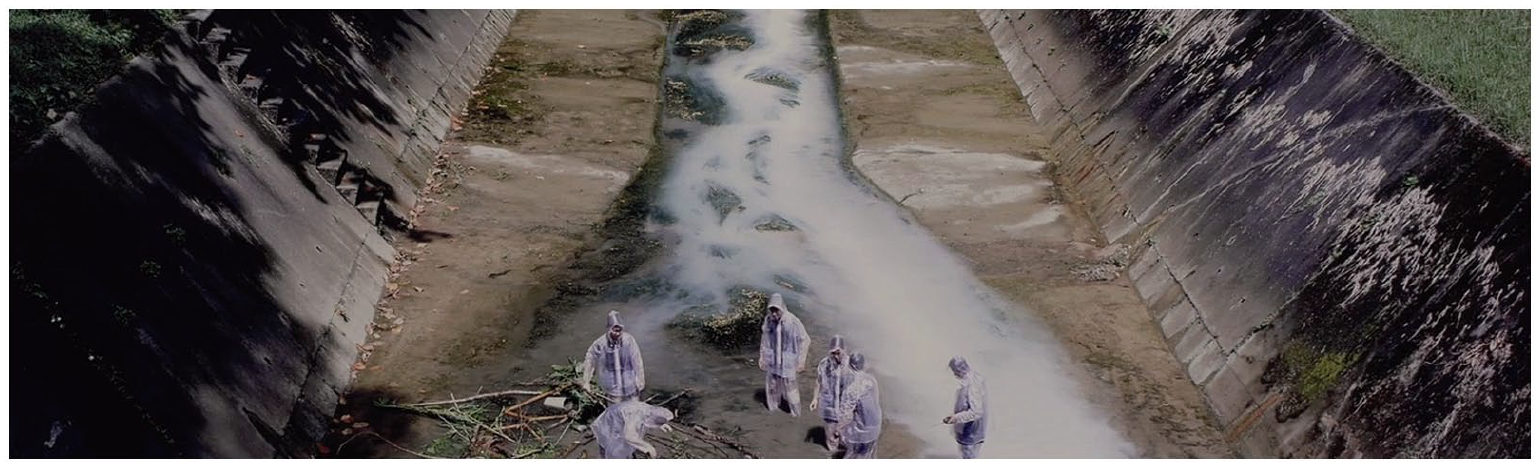
SEA STATE 0: all lines flow out.
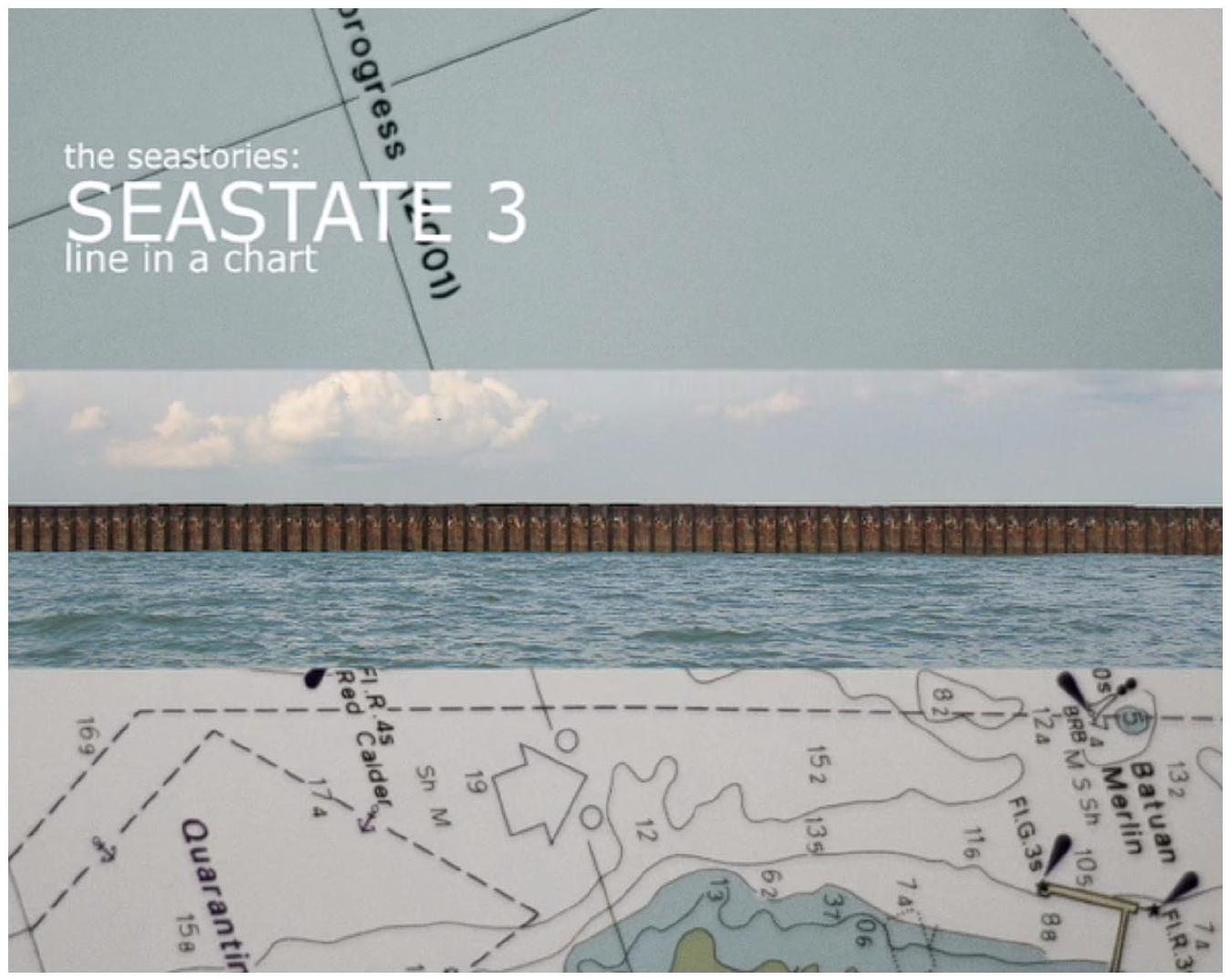
SEA STATE 4: line in the chart.

SEA STATE 7: sandwich.
The line is what originally evacuates the tropical excess of the interior of the city-state through the longkangs in ‘All Lines Flow Out’, the labyrinthine drainage system that mitigates flooding, traversed by human figures wearing rain jackets, conducting mournful yet scientific study of the structure. The sea is an ominous figure obscured by the gates of the longkangs themselves, with the effluence ebbing from the drains forming the connective tissue. The moulds, mosses and other traces of climatic warp and weft fur the line as it funnels rainwater, becoming embossed with the tropical decay it allays. Lim establishes the line as the mark of a colonial hostility to the tropical environment that becomes precisely the site of its predatory opportunism in subsequent works of SEA STATE.
The line is infrastructure as ‘temporal bind’, 37 a foundational figure that colonial and postcolonial infrastructure projects remade and reiterated. For infrastructure, territory is nothing more than a vessel cleared by and for the perpetuation of the line, a meal to be masticated by infrastructure’s patchwork of schematic knowledge. The line demarcates and confines both tropical excess and effluence so that even the sea is simply another profligacy to be attenuated. The continuity between colonial entrepot and postcolonial city-state is made explicit by the rewritten shorelines of reclamation projects, first beginning under the commercial diktats of colonial rule, and then transformed by political independence into an endemic governing principle of the city-state. The line pushed the sea away using oceanographic mapping, land reclamation, ports and shipping lanes, rationalising the maritime sociality of the Straits into commercial rigidity. The line’s regimentation of territory for the city-state entails a further ‘deepening’ of infrastructure into the production of geophysical ground. ‘SEA STATE 7: sandwich’ completes the line as infrastructure’s demarcation of ground, where what is infrastructuralised by the sea-state is the precise point where land meets sea. Taking the form of a film composed of vertical slivers of prosthetic coast, ‘sandwich’ presents the shoreline is the prime real estate of the sea-state, and through land reclamation becomes the site of its most extreme intervention, entailing the wholesale eviction of sea and its subsequent conversion into dry, solid and economically viable land. The stack of vertical horizons simply exaggerates what is already known: the sea has been upended for political-economic consumption. The function of the prosthetic coastline is clear when we briefly consider how some of the largest reclamation projects conducted by the Singaporean state are dedicated towards claiming and maintaining Singapore’s prominence as a global logistics and petrochemical hub, where the extension of the line becomes a necessity of international capital circulation.
These reclamation sites, such as the seaport of Pasir Panjang or the future Tuas Megaport, or the airport of Changi, were designed decades in advance to accommodate economic and technological shifts in global trade. The anticipatory temporality of the sea-state allows the city-state to adeptly manage and manipulate international supply chains to its benefit through the extension of the line; however, in the process, a tension develops between the line as figure and the line as ground. Modern logistics knot together the attendant geoeconomic shifts in commerce and security that Cowen, Smith and Chua have noted 38 as critical for the maintenance of global political-economic order in the late 20th and early 21st century, and one in which Singapore has deftly negotiated prime position through the extension of the (coast)line. Economic and geopolitical irrelevance have been characterised by the Singaporean state as a chronic vulnerability, tantamount to the death of the nation, 39 thereby rendering the speculative incorporation of future logistical capacity and technological standards a pragmatic necessity. The sea-state demarcates its own surface from the chaotic volume of the sea, and transposes it through land reclamation simultaneously into logistical ground and figure that recomposes territory for the state. The line as infrastructural figure becomes a temporal orientation through the extension of productive territory necessitated by the sea-state, with bespoke land parcels left to ripen for decades into productive consumption, which is simultaneously an atemporal designation; it erases the history and relations of a coastline through infrastructural inundation, its socio-ecological difference flattened into a tabula rasa. 40 While extension of the line is more geopolitically conspicuous in the ire reclamation has provoked from Malaysian and Indonesian governments, the subtler economic arrangements the extension of the line convenes through the Singapore-Johor-Riau ‘growth triangle’ belies the wider geoeconomics interests at stake. 41 A tension is then created between the line as a figure which recomposes the concept of territory for the city-state, becoming a means of grafting itself to the world market, which is then inverted as the production of ground for logistical figures.
The line between the sea and the sea-state, established as the foundational gesture of SEA STATE, is then systematised into THE GRID, which uncovers the contingencies of the line’s extension and infrastructure’s slippage between figure and ground.
The inarticulate grid and the inverted shore
Throughout SEA STATE 7 and 8, which take the form of interviews with ‘the inarticulate sand man’ (Foo Say Juan) and Captain Chua in ‘The GRID (intimations of a chart)’, the Grid figures as both the object of the artist and researcher’s curiosity and admiration, and the reticence of the informant. Foo Say Juan was a surveyor for sand deposits in the 90s, voyaging around the surrounding archipelago for sand of sufficient quality to be consumed in reclamation. The Grid was a simple enough innovation in mapping, inasmuch as it consisted of plot square nautical miles onto the GPS, and gathering samples at each point on the grid to be able to plot an exact granular taxonomy of the waters surrounding Singapore. Foo Say Juan’s grid is then revealed to have been devised by Captain Chua, consisting of each square mile being subdivided into A, B, C and D, creating a chart for Singapore’s waters that was far more precise than conventional longitude and latitude navigation by GPS.
The novelty of the Grid is repurposed as a bespoke surveying tool, its points determining whether the sand beneath is nutritionally viable for the reproduction of the sea-state, and expansion of the city-state. When the artist and curator ponder the possibility that the Grid could be extended across all the waters of the world, Captain Chua responds, ‘What for you want to be kaypoh to other people?’
42
; why pry into other people’s business? The Grid only extends as far as Singapore’s appetite for sand reached, up until 2007 when it had to extend its granular frontier after their regional neighbours banned the export of reclamation sand to Singapore. Captain Chua’s admonishment stems from exceeding the bounds of the sea-state, both an admission of Singapore’s geopolitical position and a reminder that the sea-state depends on the coordinates of the Grid bearing fruit in the form of reclamation sand, as well as its true purpose: delimiting the enclosure of the sea-state. To extend the Grid beyond the informal mining grounds would unnecessarily implicate the sea-state in the fraught business of transnational sand mining. Foo Say Juan is asked if he kept any memorabilia from his days on the sea: ‘No, I do not keep any No mementos, nothing? No.’
43
The Grid, as the systematic mapping of the line, is so thoroughly enmeshed with the sea-state that it is instrumentalised in the harvesting of reclamation sand around its maritime boundary, its shared waters with Malaysia and Indonesia. The supposed inarticulacy and reticence of both Foo Say Juan and Captain Chua are object lessons in the geophilosophy of the sea-state; both touch upon how the Grid was originally instrumentalised by the sea-state as a tool of nation-building and neocolonial expansion, and then lost its relevance: since 2007, Singapore has been importing sand from afar afield as Cambodia, Vietnam, Myanmar and Bangladesh. There is no need for the Grid to be used to map these waters for territorial alimenation, because sand mining has effectively been outsourced. The inversion performed by these interviews, foregrounding the imbrication of oceanography and sand extraction in the infrastructural figure of the Grid, makes explicit the dual nature of infrastructural inversion and the role it plays throughout SEA STATE, as both hermeneutic and geophilosophical relation.
In ‘SEA STATE 3: inversion’, we see Lim fashion his own version of the Grid (Figure 4). An installation originally a part of the Singapore Pavilion at the 2015 Venice Biennale, ‘inversion’ is a scale model of Singapore’s foreshore. 3D-printed from archival composites and hydrological surveys, and combined with incomplete maps, anecdotal rumour and stories, ‘inversion’ surfaces the surfacing of the foreshore while eliding the singularity of the sea which is its condition for modelling in the first place. ‘Inversion’ is the completion of the Grid in the sense that it realises the entirety of the foreshore as a fully visually realised and modelled, and hence entirely plastic, space. Like with the Grid, the traces of rumour and overlapping and incomplete maps are undetectable; in its 3D-printed folds and fleshly detail it is as inarticulate as Foo Say Juan or as reticent as Captain Chua. It is a grid collapsed into a singular line stretched over the entire foreshore. The smooth and skeletal 3D model of ‘inversion’ gracefully emblematises the sea-state: the murky informalities and contrivances of its contact with the sea are not erased but coaxed into a naturalistic model, purged of aquatic inconsistency and rendered as an object of pure cartographic science. The sea-state has as its projective point a moon colony nested in a future of climatic absence. And climate has become the future ground that necessitates the projection and extension of the sea-state; 4 degrees of warming globally is baked into the future 2100 reclamation plan, infrastructural redundancy occulting the worst projected outcome for sea level rise. By inverting the ground of the foreshore into a figure of simultaneous cartographic delight and historical inarticulacy, ‘inversion’ recapitulates Ballestero’s intuition about the necessity for seeing ‘conceptually’ to prise a figure from its ground. 44 However, in this conceptual figuration, the sea-state inverts ground into figure, and back to ground. Geophysical ground becomes an artefact and production of infrastructural performance, and then in turn grounds a set of national, territorial and logistical operations which tether that ground to their respective conditions of possibility.
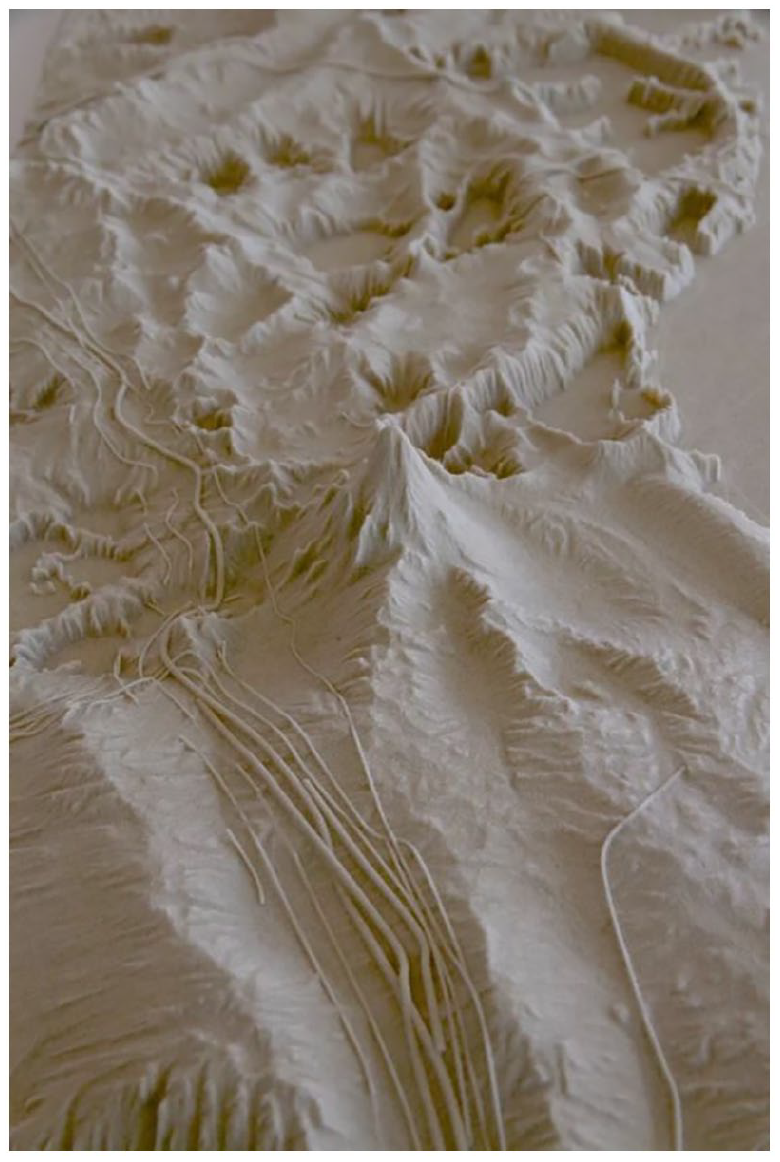
SEA STATE 3: inversion.
The figure of the Grid recomposes the city-state’s territory so that geophysical space caught within its mesh becomes grafted to the sea-state (any prior ephemera falling through this conceptual net), and with sufficient tonnes of imported sand, constructs a shifting internal frontier for negotiating the place of the city-state within the world market. The opacity of these sources of sand is another strategic ambiguity that becomes a shifting ground for the sea-state. In the next section, the act of reclamation, as the mapping of the line by the grid that transforms sea into land, can only be consummated by Proclamation itself, the legal document which incorporates reclaimed land into the city-state’s planning system, marking the uneasy point of transition between the city-state and the sea-state.
Proclamations and excavations
The suppression of the Grid’s utility as a surveying tool for sand mining is demonstrably upturned throughout the film ‘SEA STATE 9: proclamation’, where sand is the landscape-cum-protagonist. Again, the line recurs and collides with the Grid as seams of sand stream into a reclamation site, pale agglomerations that barely rise above the waterline, unsettling the distinction between figure and (literal) ground (Figure 5). Vertical shots of dredging boats and barges full of sand, as well as jets of sand streaming onto larger reclamations, embroidering the pile with the collapsing and reforming of countless grains, set up wider, panoramic glimpses of land surfacing from the flow of sand and seemingly nothing else, water frothing helplessly at the endless and sere abundance (Figure 6). Trucks and excavators traverse the sandy floor, shifting piles around other piles on top of an even greater pile like insects. Lines of sand demarcate and unfold territory as future grids of land parcels to be incorporated into the planning system. Stately ambient music begins wafting through the panoramic views of sandscapes at around the 2-minute mark. Inserts of Housing Development Board blocks, finished and under construction, imply that nation-building is taking place. It most certainly is. However, the only people who will live on or near this land are mostly migrant workers, as several dormitories are sited alongside the Tuas Mega Port Reclamation. This oddly grandiloquent turn for the SEA STATE series consolidates the curious knotting of critique and complicity present throughout; while it stylistically resembles boutique nationalist propaganda depicting a city-state’s ability to build itself in its own image, it does so by foregrounding the most opaque and underexamined tool of its nation-building, one that has caused it geopolitical headaches and bad press, 45 and the one which it most explicitly downplays as the outcome of its pragmatism.
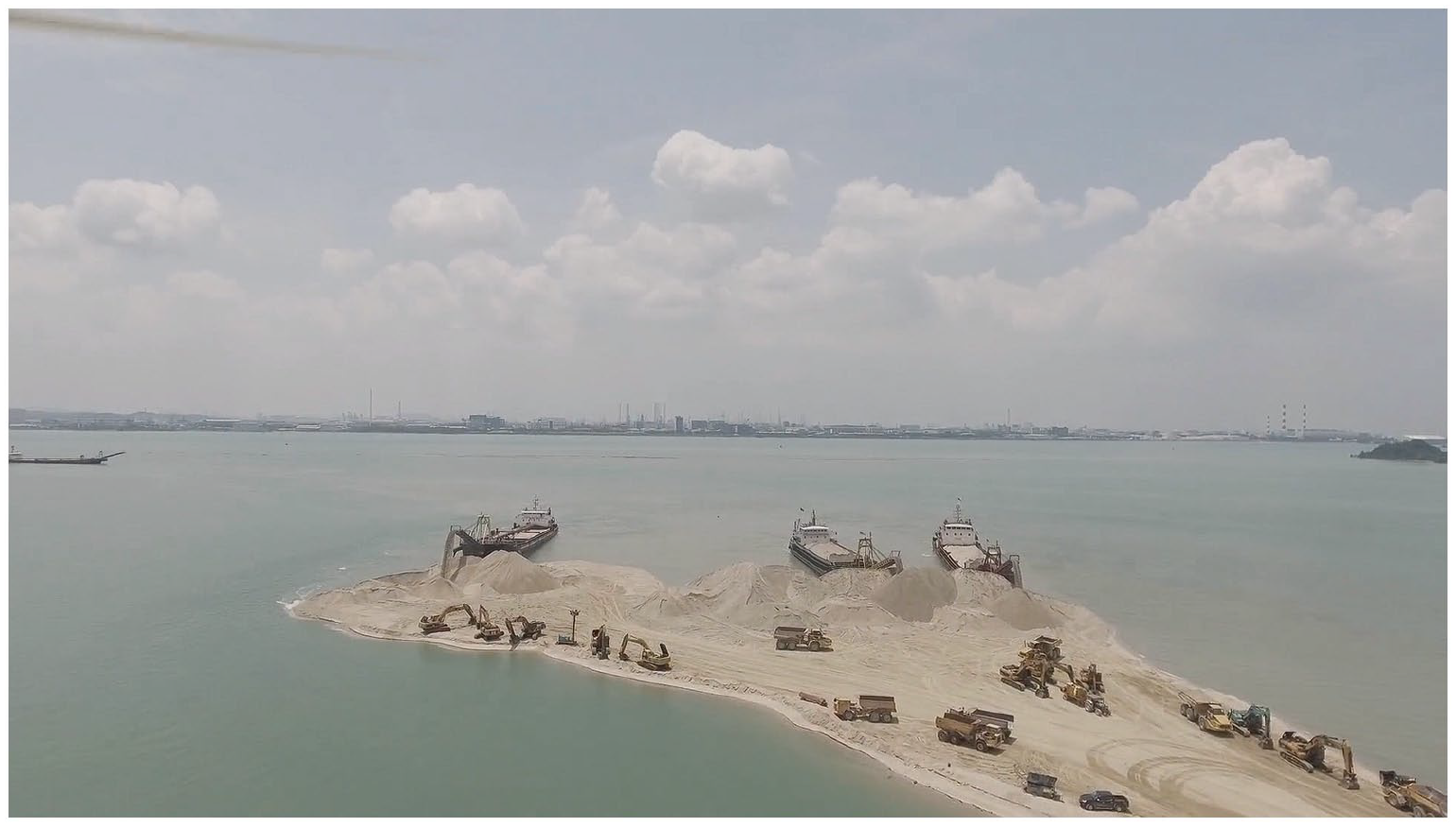
SEA STATE 9: Proclamation.
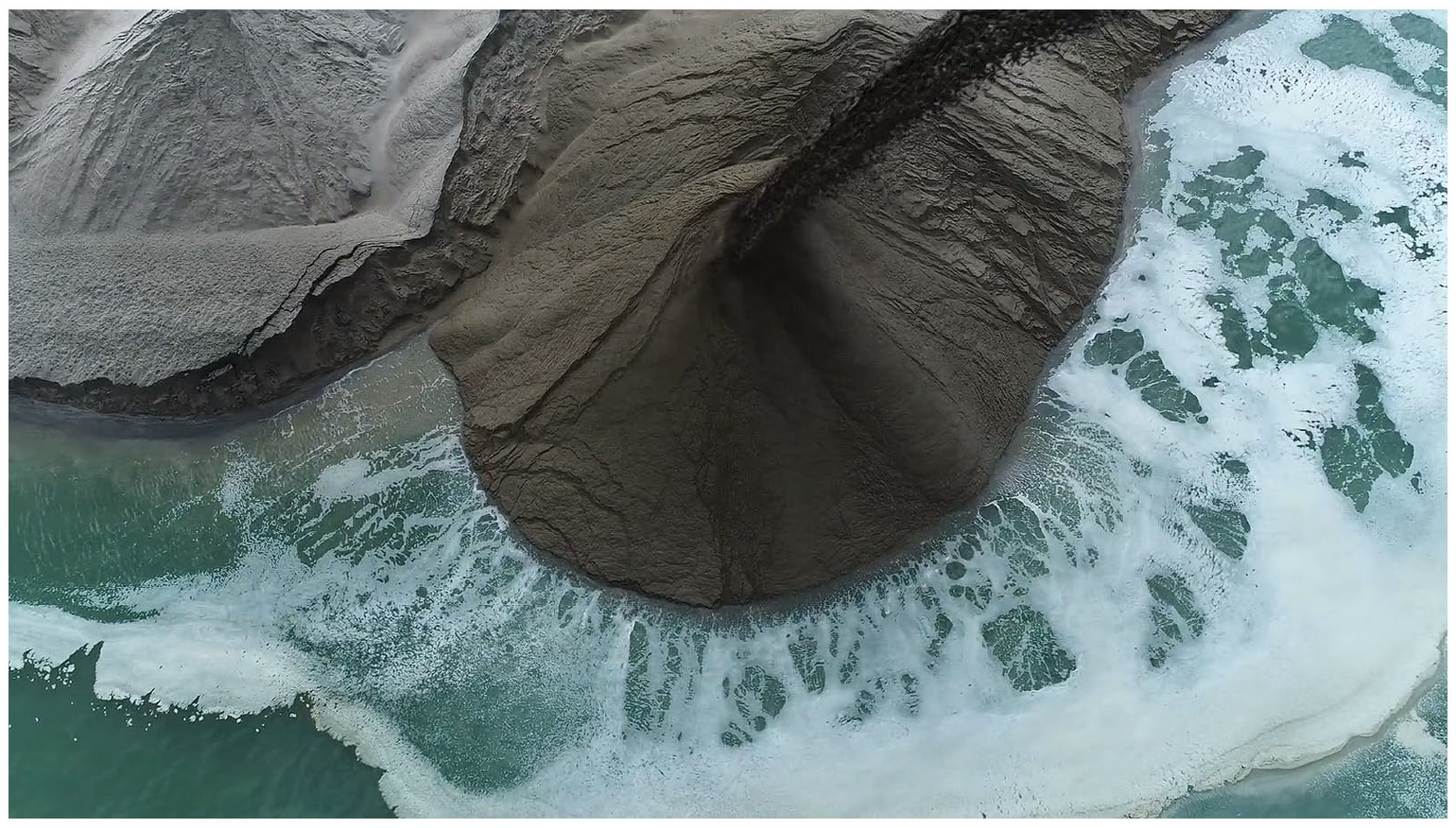
SEA STATE 9: proclamation.
The second part of ‘SEA STATE 9’, the inaugural 2019 Ng Teng Fong Roof Garden Commission installation called the ‘Proclamation Garden’ surfaced the implied infrastructural gesture of the Proclamation as legal text in the culminating installation of the SEA STATE series. The name alone augured a grand, unfolding vision, intimating some politico-liturgical statement made legible by vegetation. But blink and you’d have missed it. Planter boxes lined the glass roof of the atrium. Some shrubs and weeds that looked a little less than uniform, as well as some wilder reeds and fronds that agitated to be buffeted by a coastal breeze. By the bench there was a sign: ‘Some plants may cause allergic reactions: please refrain from touching or moving the plants. Insects may sting. Do not swat or try to touch them’. Underneath an awning some smaller, dwindling potted plants were arrayed around piles of sand, as if sheltering them (Figure 7). On closer inspection, the soil in the planter boxes was sand and gravel (Figure 8). The artistic gesture at stake lay in these small, camouflaged piles. These plants, and the sand they sheltered and that sheltered them, had been transplanted from Singapore’s reclaimed land; over 30 species that have taken root in the city-state’s 150-odd square kilometres of reclaimed land.
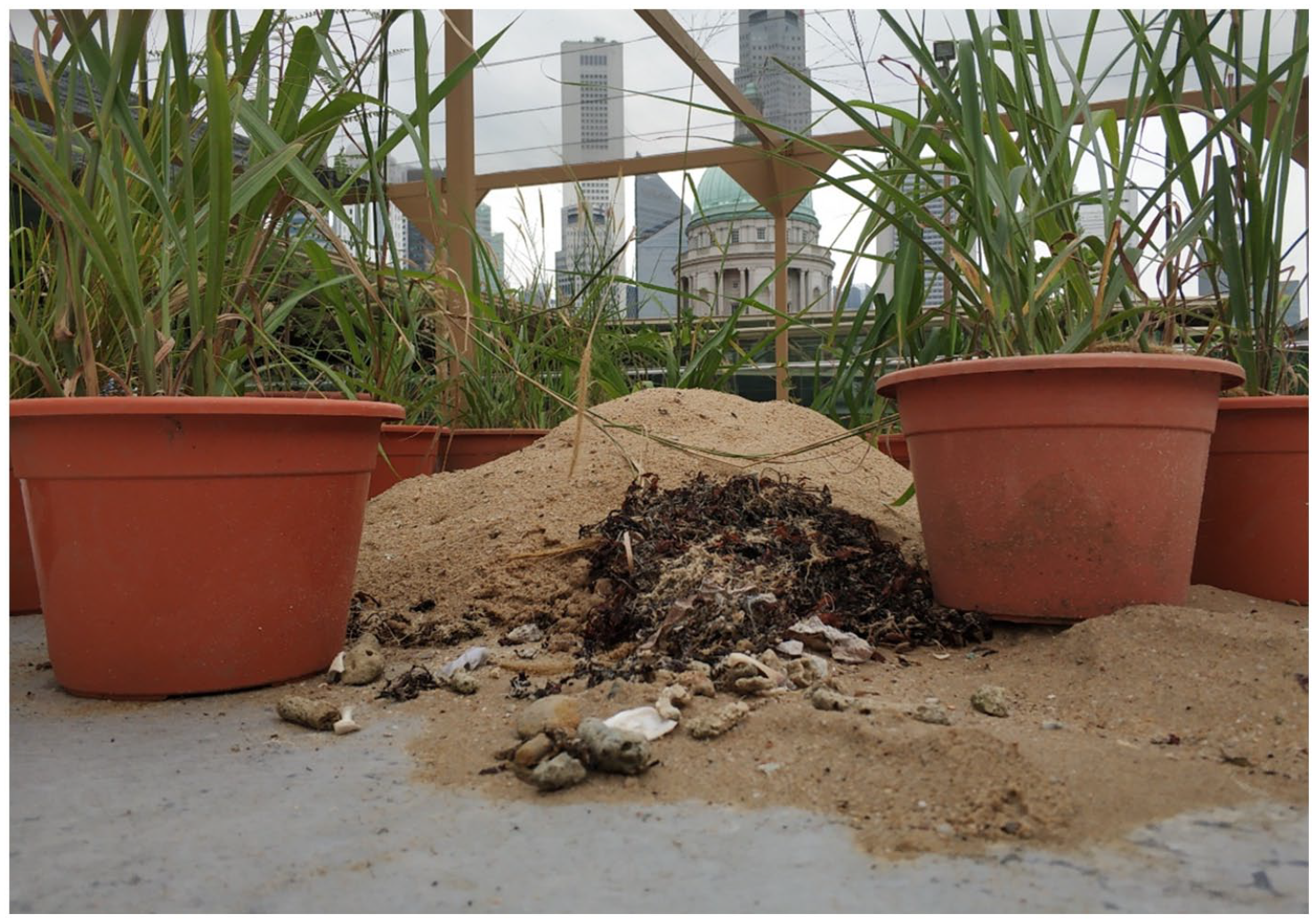
The Proclamation Garden.
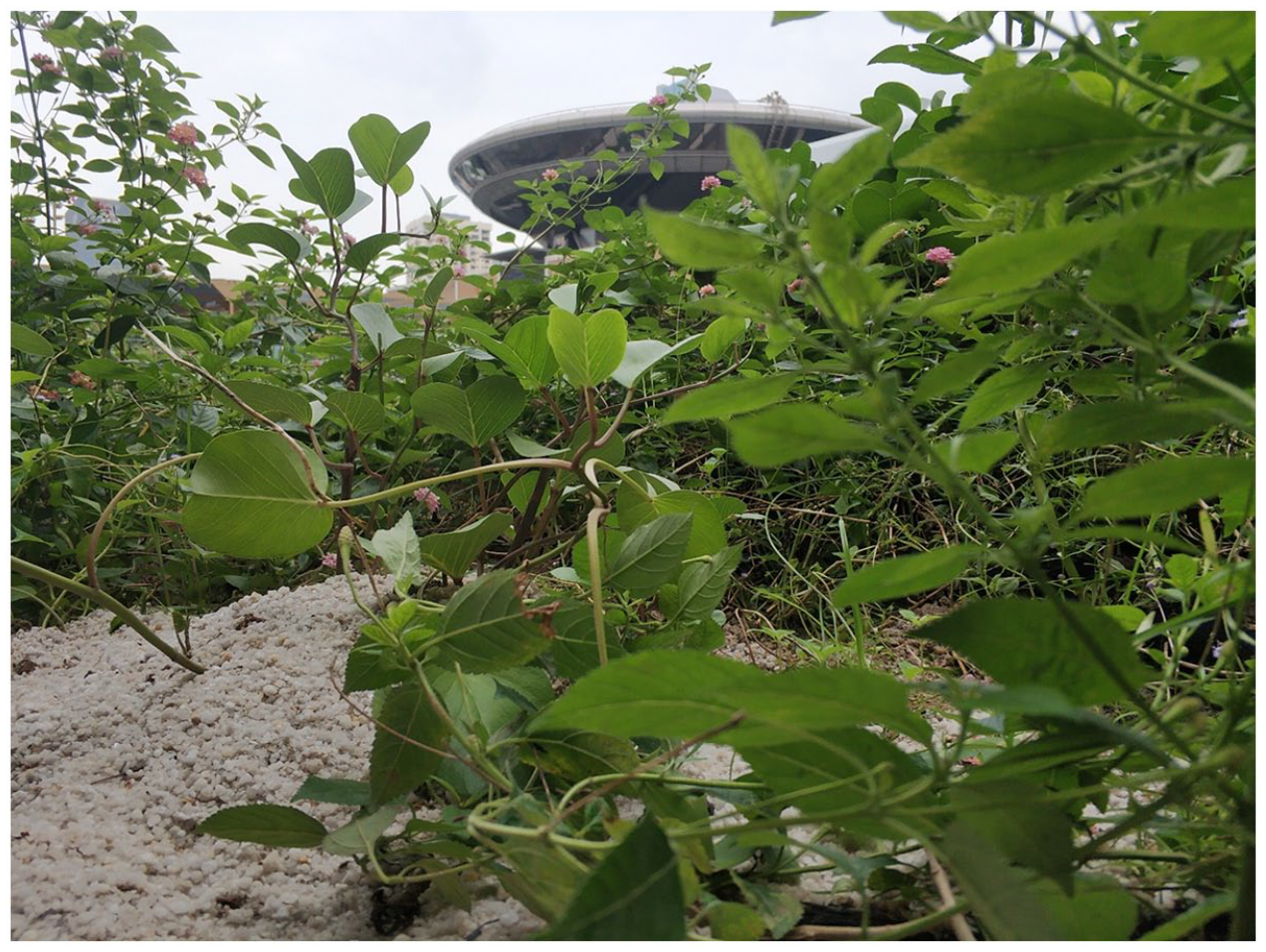
Proclamation Garden.
The ‘Proclamation’ is the legal mechanism by which reclaimed land is formally incorporated into state land, whereas the Proclamation Garden is littered with the ephemera of a land erased by its legal conversion into legibility. Many of these species are considered invasive; but what does this tell us when these species have not invaded but been smuggled, roots and seeds trafficked with the sand that has been taken from all over Southeast Asia. The garden, as colonial aesthetic form, becomes the forensic trace of the city-state’s geographic and semiotic inversion of colonisation, as they import millions of tonnes of sand to expand their internal frontier. 46 In Proclamation Garden, Lim inverted the envelopment of the geographic by the juridical that conditions the city-state’s exceptional geography: the trace of the invasive species and the invasive soil it hitched a ride on were the remains of a portable ground that permits such land to be legally proclaimed. They were, provisionally, its infrastructure, its depth of species and genus, of geomorphological variety, which surfaces the legal fiction of the Proclamation. By surfacing the hidden ‘infrastructure’ of the Proclamation in the consummate colonial form of the botanical garden, 47 and its taxonomy of ‘invasive species’, but also a rooftop in the perennially space-starved city-state, Proclamation Garden brought together the two incommensurable conditions of the sea-state’s continuing existence and expansion, and existence-as-expansion. It also ironised another site critical for the reproduction of Singapore as Global City: the Gardens by the Bay. While the hermetic and climatically manipulated Cloud Forest of the Gardens, host to tropical highland and mountain fauna, makes a spectacle of its own ‘neocolonial desires’, 48 the Proclamation Garden plants the forensic evidence of neocoloniality in modest pots and planters, the presentation of a botanical hobbyist. The subversive proclamation here is the blooming of alien species indigenous to the supposed tabula rasa of the sea-state.
If ‘Proclamation Garden’ everted the botanical excess of the sea-state’s geographic expansion grounded by exogenous means, ‘SEA STATE 6: phase one’ reveals the temporal dimension of the infrastructural inversion of figure and ground. ‘SEA STATE 6: phase one’ takes the form of a film, accompanied by an interview with retired Chief Defence Scientist Lui Pao Chuen entitled ‘The Department of Dreaming’.
The film opens with the figure of the artist sailing amongst hulking container ships, then capsizing into the water, the white boat sinking into the depths. It then shifts to the subterranean expanses of the Jurong Island rock caverns, artificial caves designed for the storage of oil to be processed by the vast petrochemical complex above. The oneiric dimension of the underground manifests as the reprise of the exact same sailing boat carried by constructions workers in hard hats and hi-vis jackets (Figure 9), and a spectral figure languishing in the caverns amongst drifts of reverb-drenched Southeast Asian pop music.
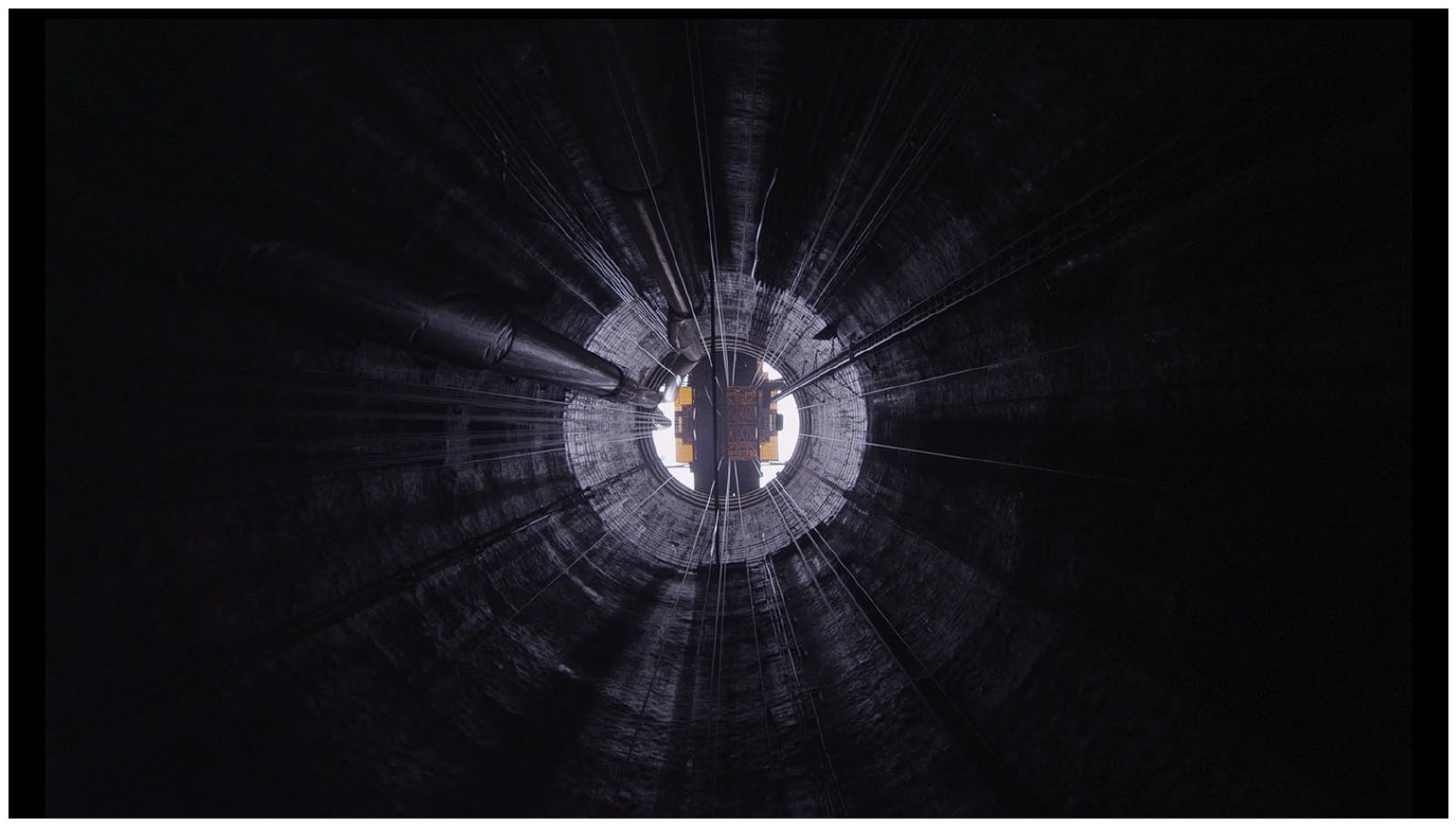
SEA STATE 6: phase 1.
Lim’s background as an avid sailor and former Olympian figures cunningly throughout ‘phase one’ to deftly imbricate Singapore’s horizontal and vertical infrastructural expansion: the expansion into the sea has been accompanied by a latent hollowing out of the earth. Jurong Island is in fact another product of an immense land reclamation project, an amalgamation of seven different islands, their prior history and names consigned to the Marine Port Authority’s archive. Its bespoke design was intended for the panoply of multinational petrochemical fixed capital investments that now riddle the island. A lone figure wanders through the caverns, and then lies down in a pool of water, when the film abruptly cuts back to the sea, facing an immense dune of sand (presumably stockpiled for another reclamation), and then to an incoming barge carrying – what else could it possibly be – sand. Lim’s spacious and dreamlike presentation camouflages perhaps, after ‘Proclamation Garden’, SEA STATE’s most revealing insight into Singapore’s infrastructure. The singular irony of the Jurong Island rock caverns in the broader totality of the sea-state is that they were bespoke excavations for the storage and processing of oil and other petrochemical products. The city-state’s planned century-long strategy to mitigate sea-level rise is literally and figuratively undercut by the sea-state’s complicity in incubating its own threat, figuring the contradiction of global capital into its own ground, and providing the ultimate rationale for the continued extension of the sea-state.
Recalling how the Proclamation acts as a conduit between the sea-state and the city-state, its uneasy point of transition, ‘SEA STATE 6: phase one’ outlines a different conduit, one in which the overcoming of vertical and horizontal horizons become perforated by a temporal porosity (Figure 10). Economically and climatically, Singapore has expanded its sea-state as an infrastructure to effectively negotiate its place in the global economy and mitigate its many vulnerabilities. In the interview with Lui Pao Chuen, it appears that the final infrastructural subordination of the sea-state is that of deep time itself, perforating the solid with the fluid.
Last question, what do you think is the next stage in terms of caverns?
. . .My vision is to lower the levels so that our drains lead into the tunnel system and since we can capture water, let’s use it. So the next major project, would be this. Reservoir.
What you are saying is that there will be a kind of a layer of water under Singapore Island?
All we need to do is at certain points, bring a shaft down into a tunnel that leads to the underground reservoir.
So eventually there will be water independence?
A: It is only an S$5b project. Why? Because S$5b is how much the integrated resorts costed. If one can spend S$5b for gambling, surely you can put S$5b to for the caverns. . . That is what it costs. How long will it last? Maybe 30 years and that’s it. How long will caverns last? Umm. . . a thousand years? 49
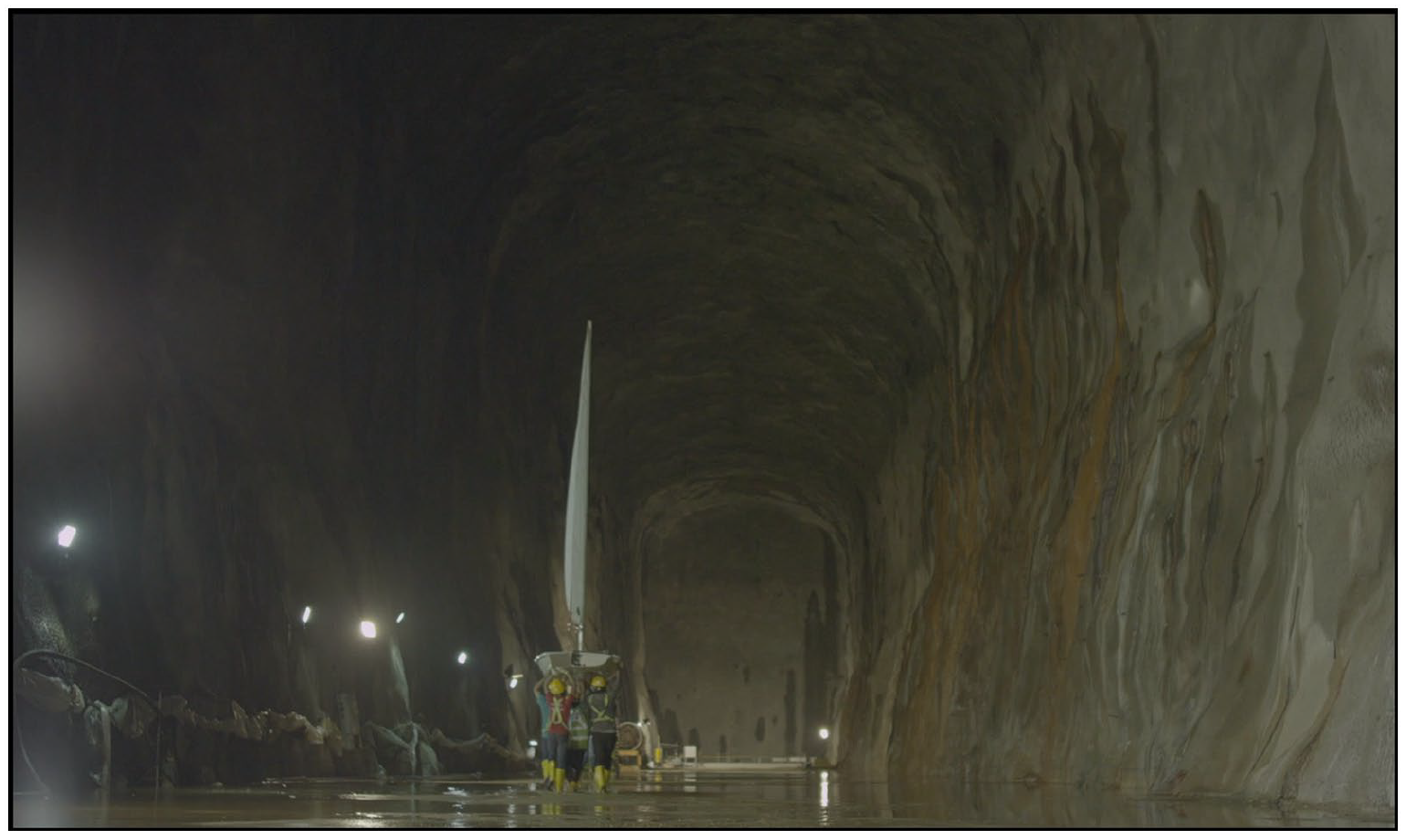
SEA STATE 6: phase 1.
Conclusion
To understand infrastructure as a geophilosophical relation is to situate its designation of figure and ground in terms of the earth, and how this designation produces a subsurface for the propagation of political-economic order. Infrastructural inversion then is not simply a hermeneutic for noticing or analysing infrastructure, but a slippage whereby those figures become the condition of possibility for that ground. Thus, a passage is tunnelled from figure/ground to figure/concept, with infrastructure recomposing territory, and its relation between the state and the earth. In SEA STATE, the figures revealed by Lim through inversion are the Line, the Grid and the Proclamation, each one a geophysical, cartographic or legal infrastructure of Singapore that subtends the reproduction of its urban, territorial and logistical fabric. Through these inversions, infrastructure’s configuration of figure and ground does not merely become unstable, but the former can become the condition of possibility for the latter. The territory produced through these figures then becomes subject to infrastructural vicissitudes of maintenance and reproduction. Figures come to condition the ground to such an extent that infrastructure fully envelops territory, effecting an ‘inversion’ of figure and ground. The inversion of the subsurface is accompanied by the desire to bury it once more, as the longform interviews of ‘the Grid’ and ‘the inarticulate sandman’ demonstrated. The interviewers’ repeated attempts to prise the implications the Grid holds for ungrounding territory, in both its mapping and its extraction, are dismissed as either irrelevant or mundane, indexing a wish to restore the ‘infra’ of ‘infrastructure’ to the very ground it is in the process of churning up. The further ground of infrastructural inversion currently left inexplicit by SEA STATE are the barges of imported sand from elsewhere in Southeast Asia and the migrant workers seen in the distance of reclamations and construction sites of the film ‘SEA STATE 9: proclamation’.
The Line, the Grid and the Proclamation taken together recompose the sea-state’s territory as an inversion of colonisation: territory extracted as a resource to expand an internal frontier. Territory as a concept, in its recent volumetric, ontological and terraqueous iterations, needs to be thought as the product and figuration of infrastructure, and thus its more complete implication within political-economic order beyond ‘land’ as an economic category. 50 Infrastructure’s relation with territory as part of global political-economic transformations needs to be accounted for through its inversions and slippages between figure and ground. How these demarcations become vulnerable to disruption is crucial for understanding infrastructure as the sedimented product of the ongoing introjection of a unilineal model of development and a critical aspect of the geopolitical litigation of political-economic order. Thinking in terms of infrastructure’s geophilosophical relations can help us chart longer trajectories for understanding how subjects are not simply included and excluded in the course of its production, but reified and produced, especially in terms of contemporary work on infrastructural maintenance, neglect, breakdown and access. 51
Lim’s SEA STATE reveals fundamental insights into how the geographical and geophilosophical relations of Singapore as a city-state are premised on the maintenance of wider political-economic order, which it has grafted itself to only through the fundamental abrogation of its territorial integrity as swathes of its territory have become infrastructure. The earthly prostheses that the sea-state has extended itself through, notably its massive reclamation projects and their intersections of geophysical, cartographic and legal space, and their hidden depths Lim represents through inversion, gives us a glimpse of the infrastructural politics of the Anthropocene. The proliferation of infrastructural systems throughout territory grains it with the porosities of maintenance and expansion, requiring continual reproduction which will force the sea-state to enrol another ‘infra’ from elsewhere: either excavating its furthest depths, 52 or importing sand extracted hundreds of miles elsewhere. What else might be unearthed with the inversion of figure and ground?
Footnotes
Acknowledgements
Thank you to Matthew Wilson for the robust editorial support, as well as to the three anonymous reviewers who added much clarity and precision to the paper. I would also like to thank Harriet Hawkins and Sasha Engelmann for their generosity and encouragement in those early conversations that gave me the confidence to plunge into these ideas. Thank you to my PhD supervisors Phil Crang and Katherine Brickell for their support and advice in the initial stages of this paper. Thank you to Pete Adey, Veronica Della Dora, Thomas Dekeyser, Janet Bowstead, Liling Xu, and everyone else who shared their thoughts on an earlier, much less intelligible version of this paper. And lastly, I would also like to thank Charles Lim for his receptiveness to my engagement with his work, and his time and generosity in talking to me about SEA STATE and Singapore in 2019. Any mistakes that remain are my own.
Funding
The authors disclosed receipt of the following financial support for the research, authorship, and/or publication of this article: The writing of this article was supported by funding from the European Research Council under the European Union’s Horizon 2020 Research and Innovation Programme (Grant agreement No. 863944 THINK DEEP); and an Arts Humanities Research Council PhD Studentship.
