




Abstract
This paper develops the new concept of the geography of placemories as a critical approach for deciphering spatialised memories in cultural geography. In referring to Alfred North Whitehead’s philosophy of organism and cultural materialism in line with Raymond Williams, the paper reflects on processual conceptions of feeling, society, memory and place. First, reviewing existing research on memory and place elucidates that cultural geography takes spatialised memories as fixed objects. Its analysis leads to statements about society. Second, to avoid this fallacy, the paper shifts the analytical basis for the cultural geographical conception of memorial sites from place to feelings and experiences by developing a new view on spatialised memory. The resulting processual problematisation of the ontology of memories, as well as its relevance for the present and spatialisations, is called the placemoric approach. The analysis of contested remembering processes with regard to the prerogative of interpretation of half-timbered houses in descriptions of Nuremberg’s old town in North Bavaria, Germany demonstrates the capabilities of the placemoric approach. In doing so, the paper shows how spatialised memories are the socially constructed result of permanently changing feelings.
Introduction
Place as mnemonics has become an important idea in the growing field of memory research across disciplinary boundaries. In particular, a diverse spectrum of cultural and social geographers has attempted to retrace the material, symbolic and affective transformations of memorial sites. Issues vary from reflections on street naming 1 and remembering after acts of violence, 2 through to considerations about memory in the context of urban renewal 3 or in the processing of ecological issues, 4 post-colonialism 5 or National Socialism. 6 The poles of the theoretical perspectives are landscape symbolism, 7 if discursive meanings are focused, and non-representational theory, 8 if the affectual enlivenment of memorial sites is emphasised. With regard to the question of how memory sites function, our main thesis is that memory sites cannot function as storage facilities, but only as anchors of memories. Memorial sites do not exist per se because a memory community once produced them in the past. But they are real if they are adapted in constant updates to the specific experiences of the present. Thereby, they are produced again and again in new ways.
With different emphasis, the changeable character of memorial sites is recognised in this literature. 9 And especially recent works reflect on the provisionality and the fluidity of memorial sites. 10 With our placemoric approach, we extend these considerations to an approach that is derived from the process philosophy of Alfred North Whitehead 11 and the cultural materialism of Raymond Williams. 12 In bridging the representational and non-representational nature of spatial memory, such a theoretical approach opens deep insights into the social emergence of memorial place-making. Our proposal of a geography of placemories conceptualises how memorial spatialisations are (re-)produced by focusing on alteration processes in social consciousness. Specifically, our main question is how spatialised memories represent society’s ever-changing view of the past depending on perceptions of the present. We relate to processual ontology to show that memories and their places are dependent on a permanent flux of feelings, experiences and meanings. To enrich this with notions of society, we refer to the concepts of ‘knowable community’ and ‘structures of feeling’ by Raymond Williams. 13 We focus on the entanglement of experience and meaning of spatialised memories in the immediate present and, thus, retrace ‘social experiences in solution’. 14 Such a processual and experience-based view on the relationship between society, individual memory and place opens the geography of placemories to how place-making processes arise from contemporary social consciousness.
The paper starts with a summary of geographical research on memorial sites. Subsequently, the paper shows the processual character of memorial sites. First, it gives a brief introduction to the thinking of Whitehead and Williams. Then it shows into which components the process of creation and the function of a memorial site can be decomposed and how these components are interrelated. The next section illustrates the resulting placemoric approach by discussing the old town of Nuremberg, Germany, as the invention of a half-timbered idyll, which is in fact a re-invention of the memory picture of the National Socialists. In doing this, we widen the understanding of a memorial by subsuming the whole old town, with numerous hotspots of remembrance, as one organism of a placemory. Much has been written from different disciplinary perspectives about the general memory practice in post-war Nuremberg 15 and the former Nazi Party Rally Grounds to the south of the city centre. 16 The traces of National Socialism in the old town of Nuremberg however, although the National Socialists redesigned it on a significant scale, 17 have been rather neglected in academic discourse, but represent the processual outcome of the entanglement of dominant contemporary structures of feeling with forms of collective memories. The paper ends with the political implementations of geographies of placemories and outlines the need for further research.
Memorial sites in spatial research
Following Dwyer, 18 memorial sites are not timeless or ‘faithful witnesses to the past’, but the result of power structures. Therefore, they are far from being ‘unproblematic representations of history’. 19 In fact, they hide more than they show. 20 In particular, cultural geography analyses memorial sites as the spatial outcome of societal memory-making which is closely knit with the construction of places. Generally, these analyses can be positioned on a scale ranging from landscape symbolism to non-representational theory. Despite not always clear classifications and fluid transitions between these two conceptual poles of research, a general distinction can be made in how the spatial realisation of a memorial site is fundamentally viewed. The representational strand of research considers memorial sites as tangible and material formations of the past, 21 that are based first and foremost on the circulation of symbolic-linguistic narratives. This view is mostly rooted in Pierre Nora’s notion of a national memory that is a crystallised collection of meaningful selections from the past. 22 These crystallisations are called lieux de mémoire that refer to a rather abstract group of memory members, in which the content of memory and the shape of the memory landscape is based on the decision of those who have the power to determine meanings conveyed in and through the landscape. 23 Thus, memorial sites are considered to be the materialised result of an engagement with past at a particular point in time. Approaches that relate more to non-representational theory go beyond the linguistic constructedness of memorial sites. They assume that memorial sites need practical and agentic activations to become meaningful places. 24 They come to life through the body of the percipient, 25 through its olfactory, visual, acoustic and haptic perceptions 26 as individual acts of empathy with the past. So they are conceptualised as a nexus of ‘embodiment, practice and performance’. 27 Following Lorimer, 28 this part of memory research requires renouncing the academic habit of seeking supra-individual meanings and values that await discovery. Rather than analysing memorial sites as a completed portrait of social construction, they are conceptualised as constantly becoming, as emerging from action. Action is understood as a relational phenomenon that constitutes a reciprocal connection between humans and non-human things. 29
Depending on these conceptual foundations, different aspects of memory sites move into the focus of research interest. Approaches that prefer the text metaphor 30 ask either about the narratives conveyed by means of places or about the social contestations from which these stories emerge. Memorial landscapes are read as narratives that unveil the discursive production of their symbolic meaning over time 31 or as arenas for implementing a certain view of the past. 32 Approaches that favour the non-representational, in contrast, focus on remembering rituals or individual perceptions. In this context, memorial sites are seen as triggers for performative acts 33 or for aesthetic and atmospheric perception 34 as well as for the subjective sensory detection 35 that enlivens memory and memorial sites (Figure 1).
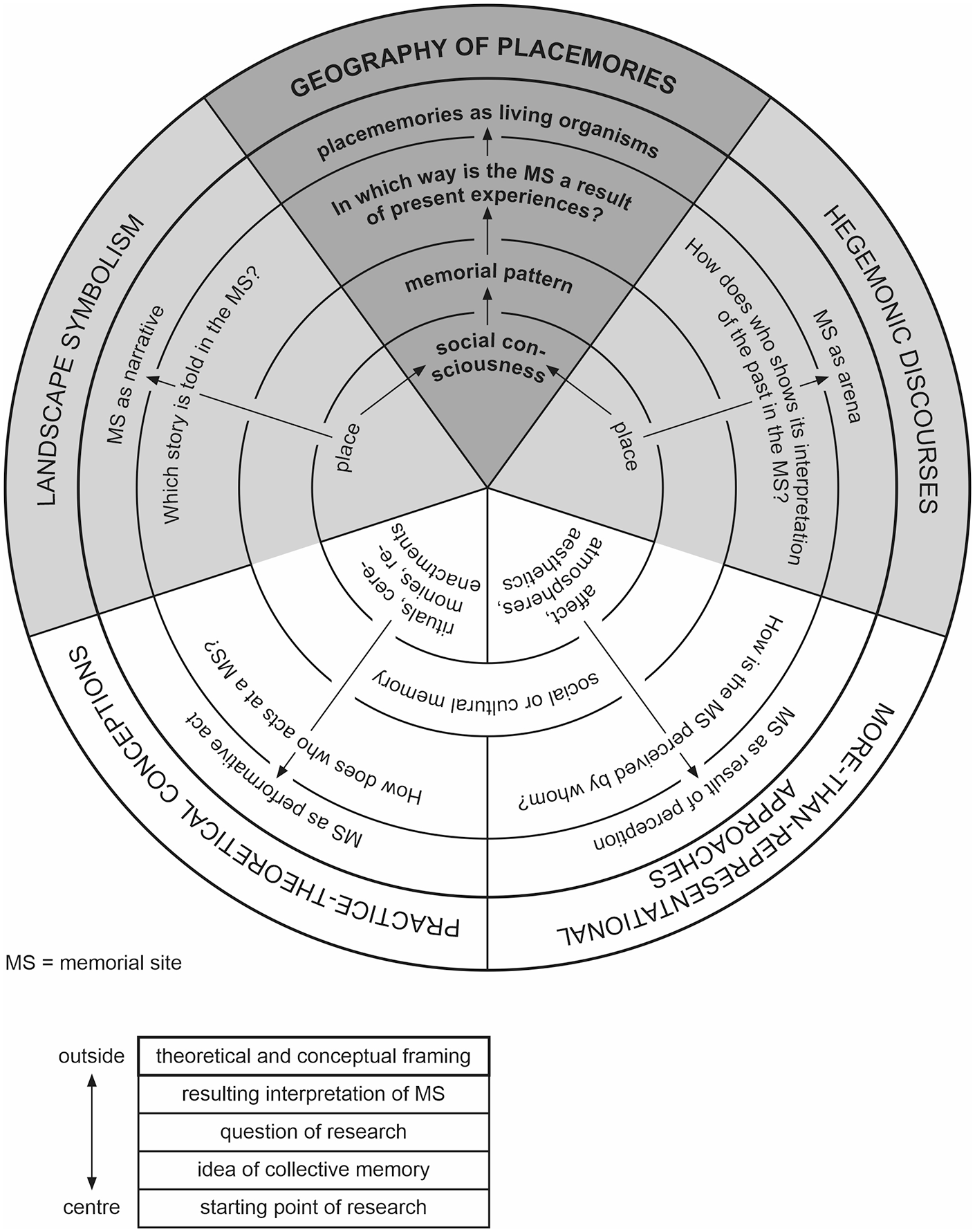
Overview of geographical memory research (own illustration).
This is the classic dichotomy of geographic memory research. It exposes two essential pitfalls to which all further considerations about memorial sites from a geographical perspective respond. First, this is the unbalanced relationship between society and the individual, between narrative representation and subjective memory. The representation of the material place itself is insufficiently appreciated or the importance of individual, subjective prior knowledge 36 and ultimately the importance of collective meaning is overlooked. Second, the special relationship between past and present that is formed at the memorial site receives little attention in most conceptual frameworks. Strictly following the principles of non-representational theory, by definition a memorial site emerges from the contemporary perception and activity of a subject. 37 This is an overemphasis on the present while neglecting past structures of meaning. Moreover, regarding memorial sites as narratives or arenas reduces them to the reproduction and legitimation of ideological ideas about the past. 38 Past meaning-making is overemphasised, and its embeddedness in the present is neglected. But it is only in considering the interdependent relationship between memory makers, memory users and the visual objects and traditions of representation 39 that collective, and thus spatialised, remembering can be fully grasped. Therefore, recent approaches overcome this conceptual dualism by expressing their distrust of fixed descriptions of place, space, site and landscape, and of temporal structures in new reflections on the ontological status of memorial sites. 40 All considerations have in common that they bring the temporal perspective of spatial memory processes to the fore of research 41 without disregarding the relationship between society and the individual. DeSilvey develops the concept of a ‘ruderal heritage’ that helps to ask how continuity with the past can be established across processes of change and innovation. 42 Rhodes contrasts the immutability of spatial artefacts with a fluidity of narratives attached to the spatial, each dependent on hierarchical or co-existing identity construction. 43 Complementing these approaches, a conceptualisation is outlined here that aims to explain and analytically grasp the mutability and provisionality of memorial sites with the categories of collective memory, society and space by thinking process philosophical ideas together with the ideas of cultural materialism.
Geography of placemories
Our main thesis is that memorial sites are anchors that link the memorial community to its collective memory contents. Since they lack sense attachments that go beyond the symbolic, they cannot store memories. But the link is effective if society succeeds in constantly embedding its memorial sites in the contemporary feeling. Therefore, memorial sites are subject to constant change, taking the present as a starting point. To accentuate the notion that memorial sites are in permanent ongoing flux, we give the name placemories to spatialised memories. In avoiding the expression ‘memorial site’ or ‘memorial landscape’, that mostly describes a fixed witness of the past made out of stone, we define placemories – comparable for instance with the process of gardening 44 – as ‘incompletions in process’. 45 The deciphering of placemories leads beyond the immediate present of the placemory itself to the whole organic environment in which a specific placemory is embedded. 46 Therefore, the placemoric approach understands placemory as a living organism in which the society, the individual observer, memorial patterns handed down from the past, and material space are relationally interwoven (Figure 2). 47
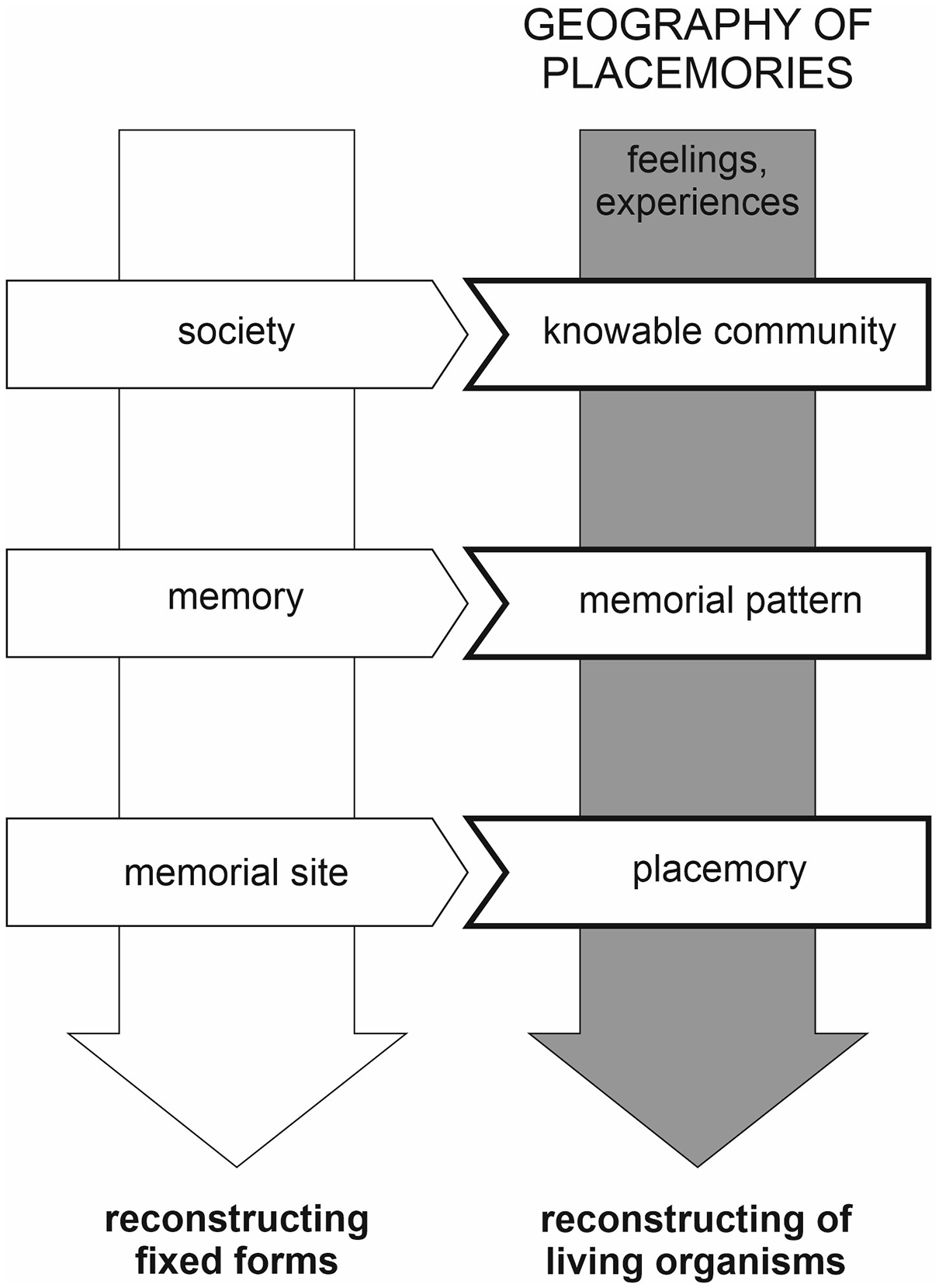
The vocabulary of the geography of placemories (own illustration).
We develop an analytical idea that conceptualises memorial sites in two steps. First, on the basis of process-philosophical assumptions about the emergence of reality and with the help of the cultural analytical terms ‘knowable community’ 48 and ‘structures of feeling’, 49 we manage to dissect memorial sites into their constituent elements. Then, we can reveal dependencies and mutual influences between these parts.
The following philosophical and cultural assumptions inform our considerations: From different perspectives Whitehead and Williams question the basic premise of western thinking 50 that (social) reality can be retraced in fixed forms of encapsulated units of meaning. 51 Despite different scientific backgrounds and ways of expressing them, both assume here a ‘fallacy of misplaced concreteness’. 52 In response to the new discoveries of quantum physics and the theory of relativity around 1900, Whitehead rejected the assumption of absolute reference systems to describe reality. Instead, the essence of his philosophy is the proposition that reality arises from interrelated process. So he takes seriously the fact that the basic characteristic of the natural and human world is being permanently in flux. 53 In reflecting on how society acquires its specific interpretations of the world and how these interpretations structure sociocultural interaction, Williams also states that fixed descriptions of society, culture or the economy do not get to the heart of contemporary reality. Human reality, therefore, is always ‘creative interpretation’ 54 based on experiences made in the actual world. 55 For both thinkers it is important that the processual progression according to the ‘ontological principle’ 56 emerges from past occurrences. In an abstract way, Whitehead means that everything in the world has its origin somewhere. Williams describes this causation in terms of cultural materialisations that guide societal life. But, since these fixations only develop their guiding effect in social practice, 57 they are subject to change. That which is perceived as fixation is far from being that which is actually produced in contemporary interaction. 58 To grasp this provisionality, Williams develops the concept of structures of feeling. They are loosely defined as ‘a particular quality of social experience and relationship, historically distinct from other particular qualities, which gives the living sense of a generation or of a period’. 59 In other words: They describe that sense-making milieu from which the current social reality arises. By bringing together socially shared patterns of collective experiences, structures of feeling can be regarded as habitual ideologies 60 that are – similar to Bourdieusian habitus 61 – the capacity of the individual to understand various impressions and representations according to a generation-specific holistic horizon of meaning.
In order to make the effort to think strictly in processes, the geography of placemories places this notion of ‘feeling’ at the centre of its conceptual thinking. Williams assumes that social reality can only be provisionally described in terms of feeling. Feelings intend the immediate incorporation of the contemporary world at the overlap of socially guided and individual perception. Countless acts of prehension constitute those feelings that are currently lived. Taken as a whole, these feelings are structuring in that they provide a framework for present life. They create a certain lifestyle blueprint for a generation or time that nobody can evade – even if the individual relation of course varies. Although Whitehead also assumes that reality emerges only in processes of prehension and feeling, his notion of feeling refers abstractly to all conceivable entities of reality. With William’s concept of feeling, the geography of placemories succeeds in transferring Whitehead’s abstract thinking into social context. In process-philosophical thinking, positive prehension is to be equated with a selection of entities from all thinkable ones in the universe and their integration to a new whole. In the process, the new linkage brings itself into being. Thus a placemory objectifies itself because it is the starting point of prehension and feeling. Whitehead assumes that processes – that is, placemory – produce themselves, but not their incorporated entities. All constituents of reality – all representational and non-representational components of placemory – exist as a ‘superject’ 62 in the form of real potentiality. 63 Selected entities only receive objectification in the process. A placemory proceeds from a meaningful selection and integration of elements of that living sense which is currently circulating in the structures of feeling. 64 It is updated in continuous processes of feeling that make memory patterns and the material form of the placemory effectual in collective and social consciousness. As a ‘stubborn fact’, 65 the placemory is a metaphorical anchor of memory and the starting point of its own objectification. In summing up for the moment: Placemories emerge from complex and constantly changing arrangements of feelings and memories at the intersection of society and the individual. In order to be able to explain the emergence of a placemory even more precisely two questions now need to be clarified: First, how can the fluidity of social reality at the society-individual intersection be described. Second, how are memories anchored in the structures of feeling.
(1) In classical memory research it is assumed either that society negotiates the stories of memorial sites or that an individual evokes memorial sites in affective experiences. We argue that memorial sites especially emerge from a complex interaction between society and the individual. Society provides the meaningful backdrop for memorial sites and sets the limits for their actualisation. 66 The individual, however, realises this backdrop only in active experience and only in this way it does unfolds its memory-creating effect. The difficulty with traditional approaches is that these tend to take society as an undifferentiated whole neglecting the individuality of memory. However, it is obvious that remembering, that is reactivating past experiences, can only be done by the individual. For a study of memorial spatiality, it is necessary to reintegrate the subjective position into the theorisations of the social. 67 In Whitehead’s philosophy, society is a universal notion of a community of distinct and actual entities that has a certain order. 68 Despite the individual diversity of its members, the community forms a nexus of communal characteristics. 69 With Williams’ concept of ‘knowable community’ 70 this atomistic idea of society can be transferred into the context of human society. Knowable community is an ‘uneasy contract’ 71 that is based on the possibility to communicate with each other. It is precisely at this intersection between the individual and its social environment that structures of feeling emerge. 72 Here, the discursive sphere emerge in which reconstructions of the past are discussed. A crucial characteristic of a knowable community is its creational progress. 73 Due to the succession of generations, knowable community could be understood as ‘flexible human organisation’, 74 which is embedded in a constant flow of knowledge and meaning. By referring to Cassirer’s 75 idea of symbolic forms, work on memories especially recognises that people use changing arrangements of symbolic patterns to apprehend their perceptions and experiences. 76 These approaches mostly provide a fixed image about society that is shaped by time as a ‘mediated experience’. 77 Yet, this expression is rather a synonym for historical time than a relationship between experience and expectation 78 and always under suspicion of focussing the material development of society. 79 By viewing society as a flexible organisation of diverse individuals, we draw attention to those societal and individual mechanisms that control individual experience and thus the actualisation of a memorial site.
(2) Geography of placemories does not start from one single memory as an unclassified totality that structures the whole society. Instead of using such a national-elitist view on memory, we conceptualise memories as principally pre-constructed, but their precise actualisation depends on the current structures of feeling. Here, a clear conceptual distinction must be made between the reconstruction of a historical event and memory. Using Williams’ words we define memories as residual patterns of meaning referenced to the past that do not determine the present but are tethered to individualistic prehension and experience of the actual world. Conceptualising memories entirely as part of the present, they are fraught with change and conflict since every individual prehension sets every memory pattern in new relations to the actual world. Significantly based on a previous act of experience, 80 remembering means to fit past experiences or residual structures of meaning 81 into the structures of feeling that determine the contemporary environment. Only the embedding of the objective historical fact in the actual feeling makes it a memory.
Two characteristics of memories are derived from this: First, every memory can be made only once. 82 Second, memories are always dependent on their environment. 83 This leads the placemoric approach to understand memories as structural ‘patterns’ 84 that arise in a multi-stage process of perceptions, derived from the immediate experiences of the original event, towards the development of universally applicable patterns. During this process, in which experiences are physically prehended and put into existing knowledge, 85 the original event loses its historicity but gains a conceptual meaning for other circumstances. 86 After all, it becomes a timeless abstraction that can be reactivated in various contexts. 87 Memory patterns are thus comparable with a ‘collected memory’, 88 in whose construction a knowable community and individuals may participate equally. The way that memory patterns are interwoven with actual experience spells out how important specific elements of the past are in certain contexts of the present. 89 They reveal where meanings come from and indicate how they will develop. 90 Memory patterns are linked with present feelings by ‘selective tradition’. 91 In creating a certain image of the past, 92 selective tradition values, canonises and interprets the past. It is an instrument of power that can exert considerable influence on the social order. 93 Due to its deep connection to the present, selective tradition is by no means a static organisation, 94 but a synonym for a permanently processed past in contexts of the actual world. Based on passive inheritance and active embodiment, memory patterns are passed on in the knowable community according to actual needs, wishes and ideas about the future. 95
Now the constituents of a placemory can be elaborated. They are memorial patterns, the collective experiences of the present life process, which are understood as the structures of feeling on a social level, as well as the individual feelings of a human subject. Starting from the material manifestation of the placemory, these constituents come together in a new way at each moment and lead to its specific realisation. Therefore, placemory is a meaningful arrangement of individual entities that already exist in the world. Even if its constituents have a past nature in some form, the reference point of the placemory remains the immediate present. Its arrangement emerges from the experience of the present. And this arrangement is valid only in this immediate present.
The actualisation of a placemory can be described as follows: Every actualisation begins with the stubbornness 96 of the material form of the placemory. 97 The perception of this spatial expression is the essential element for a placemory to fulfil its function as an anchor of memories. But the reverse is also true: the spatiality of a placemory can only be perceived when all its components have been meaningfully linked and thus actualised. Placemories are actualised in continuous processes of prehension, selection and creative combination. Being subject to ‘the play of a free imagination’, 98 placemories are the perpetual changing result of collecting, selecting and assembling meaningful characteristics of everything existing to a new, but only temporarily coherent unit. In this newly emerging unit the spatial continuum of the actual world is condensed for a tiny moment in the placemory 99 and changes from a mere potentiality into something spatially real. 100 It is not something materialised and fixed, but a permanent process that leads continuously to new actualisations. The important consequence of this organic ontology is that each placemory exists only in fluent shifts of development. 101 Each actualisation is the starting point for new processes. In adopting the assumption that an actual entity transcends past and future in the present, 102 each particular development of a placemory is the result of its predecessor and, thus, has an effect on further changes. Whitehead and Williams assume an intentional causation of every process or every social change. Each actualisation follows subjective or collective intentions. Consequently, each emergence of a placemory is subject to hegemonic structures of power 103 and individual imaginations and wishes. Collective circumstances in particular can exert pressure on which memorial patterns are considered legitimate and what link they have with the site. Therefore, every actualisation brings the risk of conflicts and conflicting opinions. When the placemory has reached the state of being fully realised, that is, the updating processes are not renewed again and again, it completely loses its function as a memory anchor. In simple words, this is the death of a placemory; it becomes a meaningless artefact.
The common and widespread idea of an understanding of place as a medium of memory 104 disregards the processual character of memory patterns embedded in structures of feeling and their spatial representations. The integration of the pivotal ontological difference between place as a solid symbol of the past 105 and remembering as a social construction, 106 and the constant process that arises out of these structures of feeling, is essential to grasp placemories to the greatest possible extent. Therefore, we shift the analytical basis for the geographical conception of placemories from place to feelings and experiences. This processual problematisation of the ontology of memories, its relevance for the present and its spatialisations in placemories, is exactly what we call the placemoric approach.
Placemory as a living organism: the example of Nuremberg’s old town
Applying the placemoric idea places geographical memory studies in the position to retrace ‘what is actually being lived, and not only what it is thought is being lived’ 107 as a form of embracing the living present of memory making. To think strictly in processes means to open research up to the direction of changeability and provisionality. Geography of placemories thus facilitates explanations of in which ways placemories are predominantly the reaction of the conscious perception of the present rather than being mere mediums of memory. A very rich research agenda is opened up with a diverse spectrum of methods. Only triangulation will probably provide an adequate account of the manifold processes involved in the of emergence of a placemory. In what follows, we give an initial impression of how our placemoric idea might influence the empirical exploration of a memorial site. At this point, we do not claim to present an extensive case study.
As a selective example of the placemoric approach we consider half-timbered houses of Nuremberg’s old town in North Bavaria, Germany, and their social interpretations as stubborn facts that accompany every actualisation of the placemory ‘Nuremberg’. We base our explanation on a content analysis of about 50 German-language travel guidebooks on Nuremberg over the last 200 years. Precisely because guidebooks have a clear intention to sell and not to document, they are ‘dynamic agents’ 108 that showcase experiences of the present first-hand. They catch feelings imminently and reflect the current structures of feeling in a non-ontological manner. 109 We inductively identified categories that characterise the placemory Nuremberg and then traced the diachronic evolution of these categories over the last two centuries. ‘Half-timbering’ is one of these categories. Derived from Whitehead’s thinking, our main consideration is: In a placemory only those memorial patterns can be actualised that circulate in the structures of feeling. Thus, a guidebook analysis supports the placemoric approach by helping to clarify the following questions: How is the half-timbering in Nuremberg described? Which adjectives are used? What is the relationship between the description of the half-timbering and the description of the old town as a whole? What changes in the description can be observed in a diachronic perspective? Together with information about the architectural history of Nuremberg, this enables us to reconstruct two different, but interrelated, aspects of creational placemory-making. These are the processes of actualisation of a placemory in the present and its emergence in the past.
With 518,000 inhabitants in 2018, Nuremberg is the second largest city in the German federal state of Bavaria. Nuremberg is of particular importance in German history as it was one of the places most strongly identified with Germany’s former National Socialist tyranny. 110 The city is well-known for its past as host to the annual NSDAP rallies , as well as to the International Military Tribunal after the Second World War. Nuremberg is better known for its monumentalist infrastructure, built by the NSDAP during the 1930s, 111 than for its half-timbered houses in the medieval part of the town. Although National Socialism remains the fundamental frame for perceiving the city until today, the contemporary memory picture of the old town is dominated by a medieval half-timbered idyll. The dark part of Nuremberg’s history is largely neglected in current discourses around the half-timbered idyll of this historic district.
Half-timbering was and is quantitatively not the dominant building method in Nuremberg, but beginning with the Romantic movement in the early 19th century it becomes a leitmotif in many portrayals of Nuremberg. During the19th century Nuremberg was considered a prototype of a medieval city because – contrary to the tendency in many other German cities, hardly any Baroque or Classicist renovations had taken place. Thus, a rich heritage of Renaissance buildings – including numerous half-timbered houses – survived into the early modern era. Even though a few occurred over the course of industrialisation, the architectural style of Nuremberg remained conservative and strongly oriented towards the existing building forms. Even the reconstruction after the Second World War was strongly oriented towards old forms. Although only a few, famous buildings such as the Albrecht-Dürer-Haus were completely reconstructed, Nuremberg’s society was very keen to preserve as much of the old as possible. Even today, the number of buildings recognisable as half-timbered houses is increasing due to the uncovering of half-timbered structures (Figure 3).
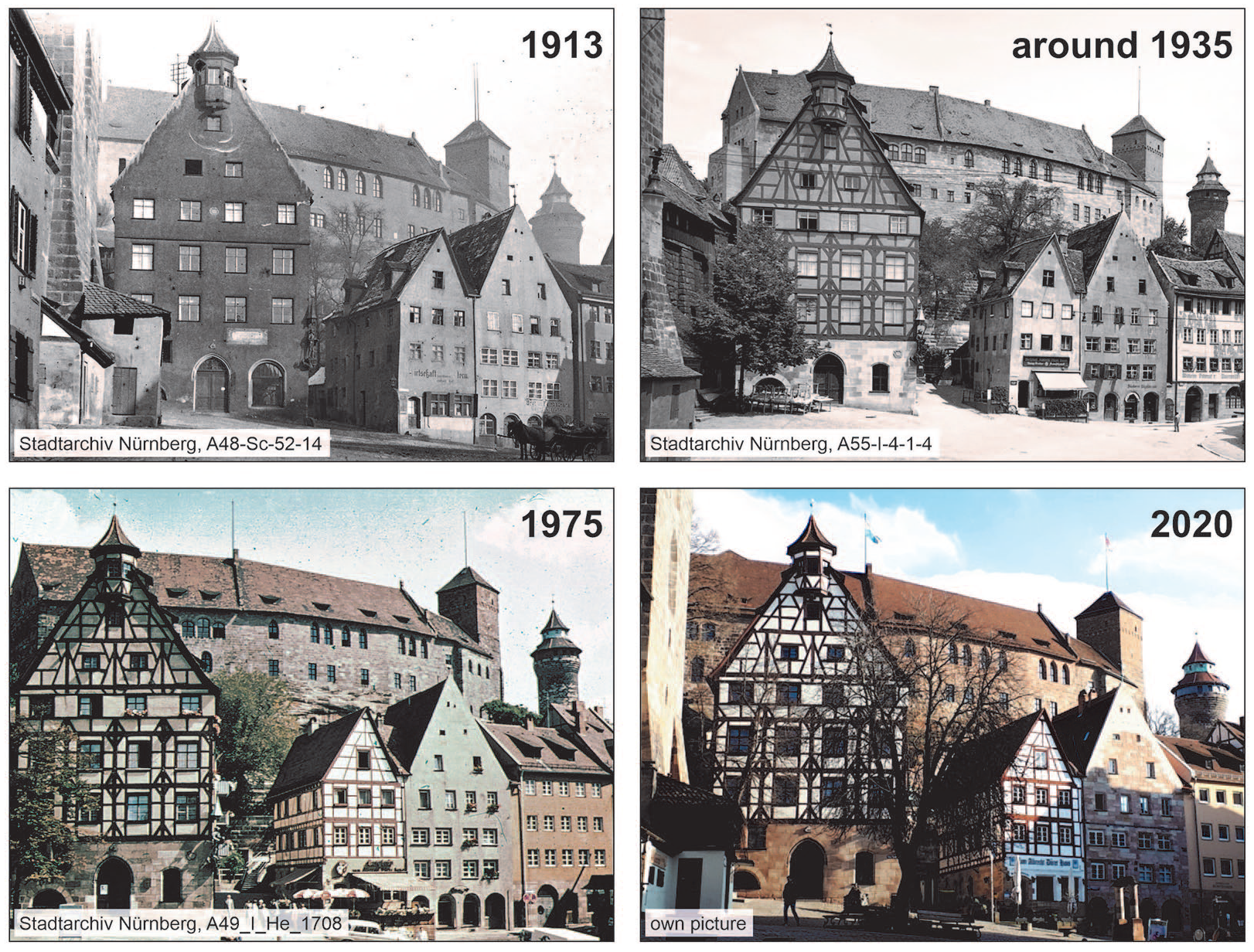
Half-timbered houses in old town of Nuremberg (own illustration with pictures from Stadtarchiv Nürnberg).
The reference point of every actualisation of the half-timbering placemory is the Renaissance, when Nuremberg’s half-timbered houses were typically built. 112 This period was Nuremberg’s heyday as a Free Imperial City when its trade and craftwork rose to European importance. 113 As an inexpensive method of constructing multi-storey buildings, half-timbering had served to imitate the bourgeois constructions of the wealthy patricians made of stone by the craftsmen of the medieval city. Since the Romantic movement, the half-timbering has strongly been associated with the image of the busy craftsman whose work in the Renaissance contributed significantly to Nuremberg’s the prosperity. The selective tradition has made this aspect of Nuremberg’s history an important memorial pattern that symbolises diligence and wealth of craftsmanship. And the selective tradition has inseparably linked it with the half-timbered buildings in Nuremberg. Half-timbering becomes a spatialised externalisation of a homogenised memory pattern. In line with Hobsbawm, 114 the half-timbering tradition in Nuremberg can be regarded as an invention by putting the memorial pattern about half-timbering into ever new functional relationships, each dependent on the current structures of feeling. Since the beginning of the 19th century this memorial pattern circulates with different emphasis in the structures of feeling and draws attention from society as well as from its individual members. The pattern functions like an ‘orienting system’ 115 for Nuremberg’s knowable community and its visitors to actualise the old-town placemory. When the old town of Nuremberg is prehended, this pattern that produces the placemory becomes part of the creational processes. A ‘tangible past’ 116 is produced that has little to do with the historical past.
The romantic invention of medieval Nuremberg becomes increasingly relevant during the 19th century – but without a particular focus on the half-timbering. Das Alterthümliche 117 (The Ancient) in general attracts attention. However, industrialisation created significant progress and the factory worker. This development is at least a dominant element in the structures of feeling. Half-timbering and the image of the traditional craftsman does not match with current feeling and is not given full attention. The beginning of the 20th century marks a turning point. In pointing out a contrast to industrialised modernity, half-timbered buildings gain attention.
Das Äußere des anheimelnden Fachwerkbaues zeigt heute noch das dasselbe Gesicht wie zu Dürers Zeit.
118
(The facade of the cosy half-timbered building is still the same today as it was in Dürer’s time.) Malerisch wirken [. . .] die alten [. . .] Fachwerkhäuser.
119
(The old [. . .] half-timbered houses [. . .] have a picturesque appearance.)
In the context of their ancientness, their unique beauty, and their cosy character is emphasised. The peak of glorification is reached during National Socialism. Half-timbering is stylised as a typical symbol of traditional Germanness.
Die Fachwerkhäuser sind so unendlich malerisch [. . .] und aus dem Stadtbild Nürnbergs nicht mehr wegzudenken.
120
(The half-timbered houses are so endlessly picturesque [. . .] and it is impossible to imagine Nuremberg’s cityscape without them.)
Das alte schön erhaltene Fachwerkhaus Albrecht Dürers am Tiergärtnertor wird jedem Besucher am wichtigsten sein, war es doch jahrzehntelang das Heim unseres größten deutschen Künstlers.
121
(The old beautifully preserved half-timbered house of Albrecht Dürer at the Tiergärtnertor will be most important to every visitor as it was the home of our greatest German artist for decades.)
By means of ideologically permeated wording during their regime, the Nazis invented a placemory that was intended to generate a sense of an archaic German community of self-effacing craftsmen, which was long-established and anchored in the past. After the defeat of the National Socialists, this narrative stops abruptly. In the following decades Nuremberg’s reconstruction efforts after the Second World War dominate. Half-timbering is seen as simply one architectural style among others. Half-timbering is soberly mentioned as a construction form if the building is historically significant, for example in the case of the Dürerhaus:
Einen spätmittelalterlichen Haustyp stellt der Fachwerkbau dar, als dessen prächtigstes Beispiel aus dem 15. Jahrhundert das Dürer-Haus gelten kann. Das Erdgeschoß, oft auch das erste Stockwerk, ist bei diesen Häusern immer aus Sandstein; darauf erheben sich in der Regel zwei bis drei Fachwerkgeschosse.
122
(A late medieval type of house is the half-timbered building. The most splendid example is the Dürerhaus from the 15th century. The ground floor and often also the first floor of these houses are made of sandstone. On top of this there are usually two to three half-timbered floors.)
Or in the case of the Weinstadel (medieval leprosarium, since the late 16th century official storage house for wine, after World War Two reconstructed as a student hostel):
Weinstadel: Auf einem Sandsteinuntergeschoß ruhen zwei etwas vorkragende Fachwerkgeschosse.
123
(Two slightly protruding half-timbered floors rest on a ground floor made of sandstone.)
The loss of many medieval half-timbered houses during the whole time period is an emotional issue for Nuremberg’s society. With increasing weakening of the collective post-war silence in Germany,
124
the descriptions of half-timbering regain their expressiveness:
In der Weißgerbergasse zeigt sich das typische Bild einer alten Nürnberger Handwerkergasse mit zahlreichen [. . .] Fachwerkhäusern. Trotz gleichartiger Bebauungsweise bewirken die unterschiedlichen Hausbreiten [. . .] eine unnachahmliche Lebendigkeit.
125
(Weißgerbergasse presents the typical picture of an old Nuremberg craftmen’s street with numerous half-timbered houses [. . .]. Despite the similarity of the buildings, the different widths of the houses create an inimitable liveliness.)
Increasing discussions about the Aufarbeitung of the past during 1980s led to a dissatisfaction with the reconstructions in the post-war period. These experiences strengthen the half-timbering placemory and give new relevance to the corresponding memorial pattern in the structures of feeling. With growing frequency, half-timbering is associated with beauty and high architectural value.
Eine der schönsten Gassen der [. . .] Altstadt ist die Weißgerbergasse mit ihren schmalen hohen Fachwerkhäusern.
126
(One of the most beautiful alleys of the old town is the Weißgerbergasse with its narrow and tall half-timbering houses.)
An vielen Ecken der Altstadt wird die Blütezeit der Reichsstadt lebendig: [. . .] Vor den schlanken Fachwerkhäusern der Handwerker in der Weißgebergasse
127
(The heyday of the imperial city comes to life in many spots in the old town: [. . .] in front of the narrow half-timbered houses of the craftsmen in Weißgerbergasse.)
Fachwerkromantik am Tiergärtnertorplatz: Die gute Stube Nürnbergs: Der Platz schmiegt sich beinahe am höchsten Punkt der Altstadt an die historische Stadtmauer, gesäumt von herrlichen Fachwerkhäusern
128
(Half-timbered romanticism at Tiergärtnertorplatz: Nuremberg’s parlour: The square snuggles up to the historic city wall almost at the highest point of the old town, surrounded by magnificent half-timbered houses.)
Due to this lived experience the medieval heyday of the city is newly reactivated – not only in the symbolic representation, but also in the material design of Nuremberg as, for instance, the development of Tiergärtnertorplatz verifies. ‘Older ways of feeling’, 129 which in the 1980s were still influenced by the traumatic silence of post-war German society, are replaced by newly created meanings, which are able to depict and to explain actual feelings. Half-timbering becomes an important element in the description to recreate the uniqueness of the old town. But at the same time this means taking up the interpretation of memory pattern that was forced by the National Socialists. In fact, the present actualisation of the medieval city is a re-invention of National Socialism’s memory construction without any deeper reflections of this fraught origin. This displays the changed structures of feeling since the 1980s, but it also signifies the unreflective handling of the Nazi past in descriptions of the city.
This placemoric consideration shows how spatialised memories are the socially constructed result of the permanently changing structures of feeling. Just like remembering, placemory-making is similarly a creative-creational process 130 that is based on a constantly reassembled present. To reconstruct its origins and to ground its self-image, 131 the knowable community procedurally puts selected memory patterns into new functional relationships adjusted to the present, 132 and objectifies an organism of an unprecedented placemory always anew.
Conclusion
The integration of the social consciousness of a generation as structures of feeling into the place-making process of placemories as permanent flux of experience unveils inherent ideological contradictions. The placemoric analysis sensitises for the manipulability of the only seemingly apolitical making of memorial sites. Memory is always in danger of being used ‘as a political and ideological resource’. 133 A specific image of history can be increasingly used to realise aims in the future. As our example of the trajectory of the National Socialist’s image of the old town of Nuremberg into the collective memory of the city displays, memorial sites represent political aesthetics that are occasionally far from being innocent. Furthermore, as Legg 134 emphasises, collective memory can function as a very specific narrative of selecting interpretations of the past. Placemories as important expressions of collective memory are, thus, haunted by different interests and rival interpretations that contain a huge potential for conflicts in societies.
Our placemoric approach allows for further reflection about the affective dimension of memorial sites by integrating process thinking into the social consciousness as structures of feeling. This opens up new possibilities for critical studies in cultural geography on collective memory and memorial sites by making alteration processes in social consciousness fruitful in deciphering memorial sites. The Whiteheadian notion of memorial sites as a permanent flux of feelings, experience and meaning at the intersection of process thinking and structures of feeling forces society, and subsequently also politics, into geographical thinking on these sites of remembering. The placemoric analysis presented above uncovers the hidden heritage of National Socialism, in both urban building and ideologically, in contemporary collective memories of Nuremberg’s half-timbered old town. The making of memorial sites is, so our inference, a contested field in society that deserves more attention in the broad field of memory studies analyses of place-related memory-making.
Footnotes
Funding
The author(s) received no financial support for the research, authorship, and/or publication of this article.
