




Abstract
Literary mapping has developed in fascinating ways in recent years, both as a field of study and as a practical tool to pursue those studies. However, one area of literary mapping as a subject remains under explored – the use and production of literary mappings by lay readers. Recent research into non-scholarly use and production of literary mappings has suggested that they are expressive, creative and affective practices. In the hands of lay readers, literary mappings have affective agency, they can tell stories, they can be catalysts of personal and worldly change. In this article I will show how we might see and feel these expressive, creative properties of literary mapping in action; to offer these affective properties as an answer to the question ‘what can literary mappings do?’. I explore this question here through a reading of a literary mapping of Dartmoor produced by Sherlockian fan Philip Weller, made within the context of the Sherlockian ‘Game’ to align actual and fictional times and places. By framing my reading through the lens of enchantment, I will focus on the role of Weller’s mapping as both a catalyst for, and a representation of, Thurgill and Lovell’s (2016) theory of the ‘spatial hinge’, that affective, creative moment when fictional and actual worlds bleed into each other. I suggest we can see Weller’s experience of the ‘spatial hinge’ and feel his mappings role in inciting his affective encounters with landscape and story, in action.
Introduction
In spring 1991, members of The Franco-Midland Hardware Company, a Sherlock Holmes fan society based in Britain, received a booklet. The Dartmoor of The Hound of the Baskervilles: A Practical Guide to the Sherlock Holmes Locations 1 by Philip Weller was a literary mapping of places in Dartmoor; places which look or feel like they could be actual-world equivalents of the main locations of the plot of Arthur Conan Doyle’s The Hound of the Baskervilles. It aligned actual and fictional times and places within the context of the Sherlockian ‘Game’ and its ironic pretence that Sherlock Holmes really lived. 2
Ostensibly a guidebook for Sherlockians to visit the various ‘locational candidates’ 3 for themselves, the Dartmoor mapping, as I shall refer to it here, is replete with personal references to Philip Weller’s own encounters with the places of Dartmoor and the places of Doyle’s stories, and with his flights of imagination and memory. The multiple roles that Weller’s mapping seems to be playing – guidebook, excuse for Weller to get out into Dartmoor, and record of his explorations – speaks to the complexity of literary mappings in general; those ‘slipperiest of “slippery customers”’. 4 Research over the past two decades has demonstrated the usefulness of literary mappings as tools for critical literary analysis 5 ; but scholars have also argued, including in these pages, that literary mappings can do more than help us to better understand a story or a fiction. They can act as creative expressions of our encounters with literature. 6
I argue that Weller’s Dartmoor mapping can be productively approached as both a creative, expressive interpretation of his encounters with both Dartmoor and Doyle’s stories, and as an affective catalyst for these encounters. It at once acts as record of Weller’s imaginative alignment of fictional and actual times and places, of Holmes’s Dartmoor and his own, and as a fellow traveller or instigator of these enchanted encounters. I explore this idea by attending to literary mappings’ affective force, their agency as tellers of stories and as inciters to feeling, and their role in the elision of ontological differences between actual and fictional-worlds. 7 I will use Jane Bennett’s theory of enchantment, that ‘moment that is always already escaping, a moment of heightened sensory receptivity that resists representation’ 8 to explore the ways in which the Dartmoor mapping incites Weller’s experience of what James Thurgill and Jane Lovell term the ‘spatial hinge’. The spatial hinge describes ‘the affective mechanism at work in the relationship between reader, text and place’ wherein ‘the actual-world. . . become[s] re-imagined/influenced/inflected by a reader after or while a text is being read’. 9 I explore the extent to which Weller’s mapping, and by implication other literary mappings, is responsible for creating that moment when the affective experiences of actual and fictional worlds mingle and merge.
Literary mappings: image, metaphor, process
The term ‘literary map’ is indistinct. Should the term be limited to those ‘graphic image[s]’ 10 given by authors to their readers? 11 Should we include mappings of fictional places created by readers as they follow a narrative, or visit a site associated with a book? 12 What should we make of mappings produced by scholars as analytical tools? 13 Much of this confusion arises from the ways in which the term ‘mapping’ has, in literary spatial studies, ‘moved beyond the practice of cartography to a broader, metaphorical sense of interpreting and creating images and texts and of making sense of a fast modernizing or post-modernizing of this world’. 14 Mapping as metaphor emphasises the ways in which authors and readers imagine the spaces, places and landscapes of fictional narratives. For authors, ‘a sort of cognitive mapping undergirds the project of literary representation itself’. 15 For many scholars, ‘mapping’ is ‘synonymous with the concatenated practices of reading, textual analysis and critical taxonomy rather than the surveillance and representation of the geographical landscape’. 16
In response to this apparently ‘vague, ambiguous and vacuous’ 17 use of the term ‘mapping’, literary cartographers have called in recent years for a ‘re-cartographisation’ of literary mapping studies. 18 The recartographisation movement recognises the literary critical rigour inherent in thinking about literary maps as ‘analytic tools as well as research objects’. 19 It seeks to add ‘geographical rigour’ 20 and ‘self-reflexive engagement with geographical thinking and practices’ 21 into this tradition, by ‘thinking about maps and “map-making” in a more conventional and literal sense’, 22 as a skilful practice which demands technical knowledge and application. 23 Literary spatial studies research building on these ideas takes seriously the notion that even literary maps which appear to be simply ‘graphic image[s]’ 24 can be read for the cartographic richness and geographic rigour they represent. 25 New directions in recartographisation include a range of exciting digital literary cartography projects. 26
One, perhaps unintended, consequence of these moves to recognise the technical difficulties of literal mapping, particularly clear in this new digital age, is an expectation that even amateur literary mappers are likely to come with the appellation ‘PhD’. 27 Few have considered the potential of easily-accessed digital mapping software on the rise of lay-reader mapping. 28 Yet, the question of who gets to map literature is important, particularly for geographers. Mappings and geographical knowledges of all kinds are never value-neutral objects. 29 Neither are they universal objects: as Edney’s idea of ‘cartography without progress’ argues, mapping does not develop towards a single, teleological end but is, rather, ‘contingent on the social, cultural and technical relations at particular times and places’. 30 It is also important in the light of attempts to push back against technological imperialism which may threaten ‘the elimination of wonder from our relationship with the world’. 31
Recent developments in post-representational cartography and relational literary geography provide an approach to literary mappings which retains both a respect for the geographical rigour of maps and a sense of wonder and possibility. They build on two widely-held concepts in geography: first, that space is a product of interrelations, an open system made of ‘loose ends and missing links’ 32 ; secondly, that representations ‘do things – they are activities that enable, sustain, interrupt, consolidate or otherwise (re)make forms or ways of life’ 33 and so are active participants in the ongoing construction of space. Maps are actants in the co-production of space. They ‘are always mappings’ 34 : they ‘are never fully formed and their work is never complete’. 35 Mappings are not contained by the media on which they are produced. ‘Mapping’ is a practice which includes those gestures, encounters and practices singular or shared, by which the world and the map are aligned, deciphered and so transformed. 36 Notions of maps as either imaginative and metaphorical, or physical and accurate, dissolve. In their place is left a recognition that, ‘maps come to life only when people start using them in a particular setting for a particular purpose’. 37 That what they say cannot be unconnected from how they are used.
Literary mappings are also actants in the co-production of fiction. Like mapping, fictions are collaborative co-productions. Fictions are not things to be held but events to be experienced: ‘dynamic, unfolding collaboration[s], happening in time and space’. 38 They emerge from in-between the encounters between reader, mapping and text as well as authors and other readers. This is because readers do not simply respond to, but co-create the plot and setting of fictions, imbuing them with the ‘multiple spatial dimensions [of their own lived experiences] mixed together: not just places visited and maps used but also books read, stories overheard, and many more’. 39 Given this, ‘reading literature is essentially an experimental process in which the categorical distinction between the frames of “fact” and “fiction” become blurred’, 40 and where the ‘ontological distinction between literary and non-literary spaces’ is undermined. 41
By examining literary mappings through a non-representational, ontogenetic lens, as processes and actants in the co-production of fiction and of the world, we can better understand them less as texts than as creative agents which slip the apparently rigid ontological bonds of ‘fact’ and ‘fiction’. 42 This creative power emerges from literary mappings’ position ‘as “enchanting” material objects, or “more-than-human bodies” sensuously interacting with emotional human bodies’. 43 It emerges from literary mappings’ power to ‘guide a spatial reading of the text’ whilst also ‘arous[ing] emotions. . . [and] tell[ing] stories’ of their own. 44 We should take seriously the affective power of literary mappings, as both tangible objects and actants in an ongoing process of co-production of text and world, to re-invigorate our sense of wonder in the world, to enchant our encounters with texts and landscape, and to create new spaces in the world which, even if for a moment, blur the ontological bounds of actual and fictional.
Philip Weller’s Dartmoor: mapping enchantment
How can we approach literary mappings to better understand them as both affective practices with the power to tell stories in their own right, and as objects of study that can help us to see readers’ encounters with stories, worlds and other parts of the lively collaboration that is literature? What tools can we use to see and ‘feel the processuality of [literary] mapping’ in action? 45 I address this question through a reading of Philip Weller’s The Dartmoor of The Hound of the Baskervilles: A Practical Guide to the Sherlock Holmes Locations. I argue that Weller’s mapping is an enchanting object, where enchantment is, that ‘fundamental encounter, [that] forceful event with the potential to radically reorder the world’. 46 Enchantment is a phenomenon widely recognised by cultural geographers, and can provide a useful way of thinking about what actually happens in the moment when a reader is caught up in an affective encounter with literature, place and self.
The Dartmoor mapping (Image 1) was produced in 1991 by Philip Weller, a British Sherlockian fan. He was a senior member of The Franco-Midland Hardware Company, a British-based Sherlock Holmes society playfully named after a fictional company featured in one of Doyle’s short stories. Weller was also a long-time teacher of survival skills on Dartmoor, a necessity in this landscape of peat bog, high rocky outcrops known as tors, and scattered fragments of ‘tiny, gnarled oaks’ that cling to the hillsides. 47 Perhaps due to the bracing nature of life and landscape in this upland corner of south-west Britain, Dartmoor has been described by those who know it as offering ‘the feeling of being somewhere enchanted’. 48 Weller had an intimate familiarity with this landscape, but also with the Sherlock Holmes stories and the practice of being a Sherlockian (which is itself a particularly enchanted form of literary fandom). 49 From in-between these elements, the Dartmoor mapping arose.
Dartmoor mapping title page. Credit: Philip Weller/Sherlock Publications.
The Dartmoor mapping is a booklet, of 54 pages, printed in a limited series of 200 and distributed to members of The Franco-Midland Hardware Company alongside a regular issue of their fan magazine, The Baker Street Pillar Box (Image 2). At the centre of the booklet is a two-page mapping spread (Image 4); the majority of the pages are devoted to a methodical discussion of the various locations of The Hound of the Baskervilles, each with its own actual-world counterpart sites. These sites were suggested by Weller’s own travels and readings of Doyle’s stories, but also by his reading the ideas of other Sherlockians who published them in fan journals. Notably, Weller leaves discussion of actual-world sites relating to Doyle’s own travels in Dartmoor and the inspirations for his story, such as Harry Baskerville, to a separate section near the end called ‘Other Locations’. 50 Reading this guide through the lens of enchantment reveals as much of Weller’s own personal, entangled and messy practice of literary mapping at work, as of his careful reading of the Sherlock Holmes stories.
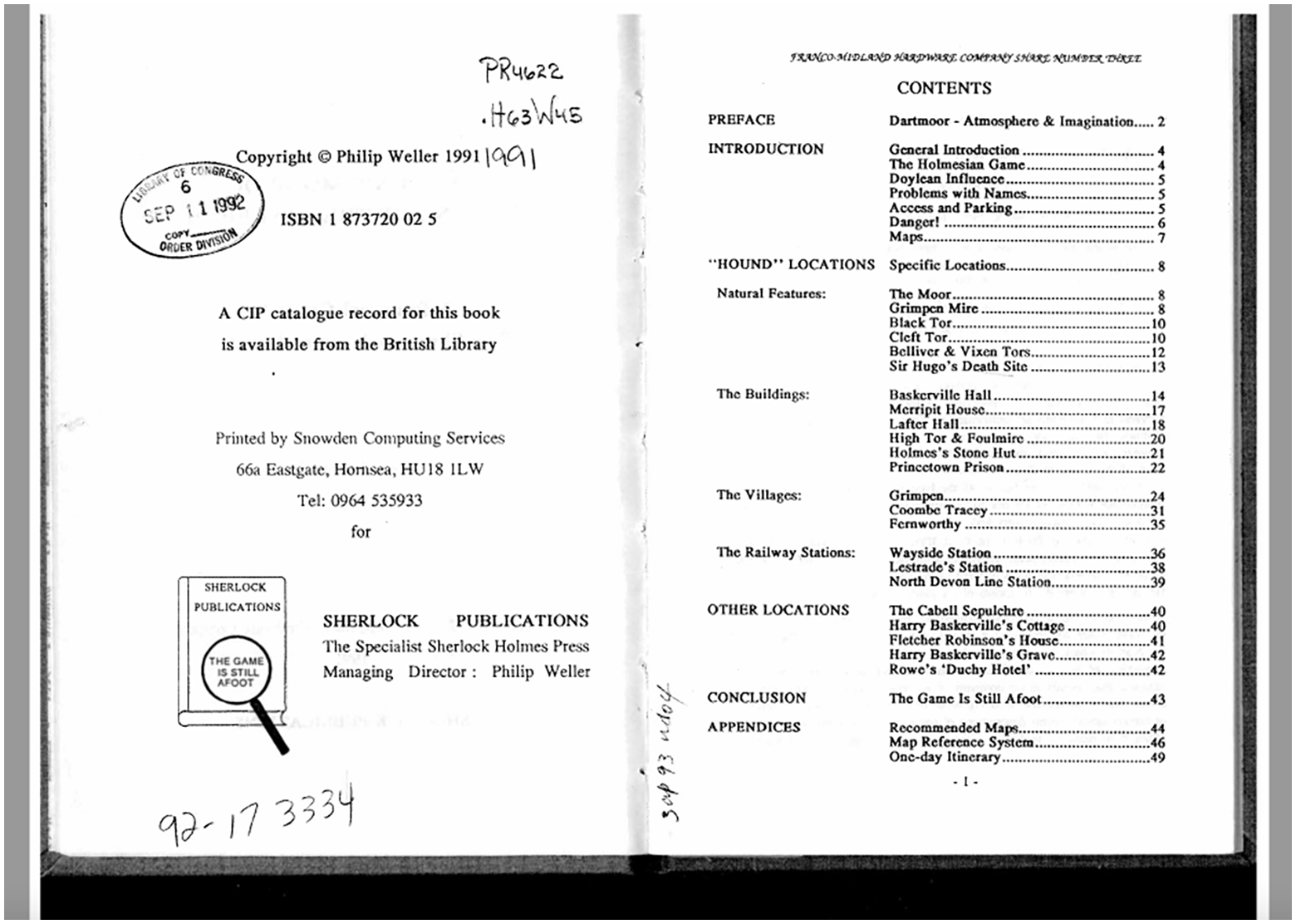
Dartmoor mapping copyright/contents page. Credit: Philip Weller/Sherlock Publications.
Since Jane Bennett wrote The Enchantment of Modern Life, 51 geographers have developed a multi-part definition of enchantment which explores what it is, what it can feel like, how we might get there, and what being enchanted might lead to. At its most simple, enchantment is an experience which helps us to feel that we or the world are capable of ‘being otherwise’. 52 Enchantment ‘allows for the experience of wonder in the contemporary world, accounts for the sheer emotional, imaginative and tangible power that objects provoke around them’. 53 It is a type of encounter, one that is both fleeting, always-already being displaced, which perhaps feels illusory in a ‘did-that-really-happen?’ way, 54 the feeling of which is frequently difficult to express in words, like many such encounters with affective intensity. 55 Yet, it is also a type of encounter which is immensely powerful: ‘a fundamental encounter, a forceful event with the capacity to reorder the world’. 56 Although enchantment often takes us unawares, as it ‘stops time, freezes movement, heightens sense, and provokes wonder and unease’, 57 it need not always do so; we can be ready for it. We can choose to adopt ‘an open, ready-to-be-surprised “disposition”’, 58 ready to meet moments of enchantment head on. 59
Therefore, enchantment is a useful tool through which to see ‘the affective mechanism at work in the relationship between reader, text and place’ 60 which drives the ‘spatial hinge’ in action. In the following pages, by attending to these key elements of enchantment – open dispositions, embodied encounters, the fleeting nature of enchantment, and the feeling of being both in and out of place – I will show in Weller’s Dartmoor mapping the affective force of fictional encounters and the role that literary mapping itself plays in enhancing and directing that force.
Weller’s open disposition
Looking at the Dartmoor mapping, it is first apparent that Weller approaches this landscape and the stories that have been told about it with an eagerness to be surprised. It is this attitude which leads to Weller’s enchanted encounters with Dartmoor and with the places of The Hound of the Baskervilles. In this section I will discuss the two elements of Weller’s disposition which underlie and make possible his fundamental encounter with landscape and story: his playing the Sherlockian game, and his expectations of Dartmoor as a place of ‘many moods’. 61
‘This guide certainly plays “The Game” most of the time’,
62
writes Weller: “The Game”. . . is to accept the premisses that Holmes and Watson were, and to most still are, “real, living persons” and that Dr Watson wrote the narrative from “real” events. Conan Doyle [sic] is appointed. . . Dr Watson’s “literary agent”. . . attempts are then made to fit all the events of the narratives into the real historical and geographical world.
63
To play the game is to adopt an attitude towards potential encounters that is very similar to Geoghegan and Woodyer’s definition of enchantment: ‘an open, ready-to-be-surprised “disposition”’. 64
For many Sherlockians at the end of the 20th century playing the game was not an armchair exercise. Despite Vincent Starrett’s famous description of the world of Sherlock Holmes as a ‘nostalgic country of the mind’, 65 by the 1970s, 1980s and 1990s, Sherlockians increasingly saw it as a place to be claimed by going out into the actual world for themselves. 66 This necessity of embodied encounters with actual-world places and the emphasis on feelings and other precognitive sensations that come from being-in-the-world is evident throughout the Dartmoor mapping. Weller’s focus on embodied encounters and feelings can be seen in, for example, his discussion of the possible actual-world locations of Grimpen, the village in The Hound of the Baskervilles where Dr. Mortimer lived. Weller visits each of these locations and considers their similarities to the Grimpen of The Hound, particularly three key locations: a doctor’s house, a pub and a post office. His descriptions of Poundsgate are exemplary. Lower Aish guest house, for Dr. Mortimer’s house, is ‘the only suitable residence for a doctor’; the Tavistock Inn is ‘a suitable hostelry for Grimpen’; and the village contains ‘classically combined post office and grocery shop’. 67
These descriptions foreground intangible judgements of suitability which are likely to have emerged from Weller’s own feelings on encountering these places – feelings prompted by the open disposition that playing the game entails. Intensely affective experiences can exceed representation; it is no surprise that Weller finds many more words for descriptions of sites’ locations (writing, e.g. 40 words on the location and aspect of the Old Forge in Holne, another candidate for Dr. Mortimer’s house), than he does to express his feeling that the Tavistock Inn fits his imagination of Grimpen, with its ‘gloom-laden name’. 68
Alongside the Sherlockian game, the moor itself, felt by Weller as a place of shifting moods and intensities, also appears to prepare him for more than one enchanted encounter which ‘stops time, freezes movement, heightens senses, and provokes wonder and unease’.
69
Weller’s awareness of the moor itself as a place of affective intensities is foregrounded in the Preface to his Dartmoor mapping. He writes of his extensive experience of Dartmoor that ‘[t]he one thing I have never done, however, is to exhaust the moods which the Moor possesses’.
70
Weller envisions the moor anthropomorphically as a creature with its own, unpredictable feelings. This sense of the moor’s liveliness is driven home by the frequent descriptions of the landscape that litter Weller’s mapping, particularly in the quotations which bookend the text. The Preface opens with the following epigraph, among others: “My word, it does not seem a very cheerful place” Inspector Lestrade.
71
On the last page, Weller ends with: “It is a great place, very sad and wild. . .” Arthur Conan Doyle Dartmoor 1901.
72
Weller’s framing of Dartmoor as a ‘Land of Atmosphere and Imagination’ 73 reflects the extent to which moors, bogs and other similar spaces have long been seen in literature as places of existential slippage: ‘Neither water nor land, bogs are liminal spaces, thresholds between surface and depths’. 74 Shawna Ross, writing about The Hound of the Baskervilles and its Gothic narrative, quotes Derek Gladwin on the slippery potential of bogs, peat and moorland: ‘bogs are central to Gothic literature because, being “visually deceptive, physically volatile, and conceptually elusive”, they help authors construct “certain slippages, or purposeful confusions”’. 75 For Doyle and his contemporary readers, this potential for slippage and confusion creates the narrative tension at the heart of The Hound of the Baskervilles: the potential, frighteningly possible for Victorian and Edwardian audiences, for atavistic slippage between modern, scientific man and dangerous precursor forms. 76 For Weller, it works to encourage the kinds of ‘confusion of categorial boundaries’ 77 that often leads to enchanted encounters – although in this case, the confusion applies more to actuality and fiction, rather than rationality and the Gothic.
A central aspect of moorland environments which evince literary and actual-world feelings of unease is the ever-changeable weather. In Doyle’s narrative the weather is represented as treacherous, the very fog itself an antagonist.
78
Weller’s warnings of caution about Dartmoor’s weather reflect this sense of treachery and trickster-ishness, as he writes, [I]n addition, there is the ever-present danger of the effects of the often-hard weather on the Moor. . . Take great care if you move off the tracks. . . as the weather can change dramatically within a matter of minutes.
79
This changeable weather is also a driver of Weller’s ‘open, ready-to-be-surprised “disposition”’.
80
For light and weather, sight and feel do more than lead travellers to turn for home; they can, as Tim Edensor writes in relation to his own moorland experience, affect how we feel about places and landscapes: These perceptual capacities and the manifold effects of light shape everyday experience, influencing the epistemologies, affects and sensations that inform our familiarity with quotidian landscapes. . . largely unreflexive, they anchor us in place, conditioning how we feel, practice and make sense of [. . .] places and landscapes.
81
In combination, these fleeting moments of recognition, surprise or delight that emerged for Weller as he moved through the atmospheric, moody landscape of Dartmoor in a disposition of openness, engendered through playing the game, are what make the Dartmoor mapping happen.
Following errant paths
The Dartmoor mapping first appears as a document produced and circulated by The Franco-Midland Hardware Company. However, this paper pamphlet is only one part of Weller’s mapping practice. It rests on Weller’s being in place, tramping the lanes and avoiding boggy marshlands. These embodied encounters reveal Weller’s mapping as a process; one which creates opportunities for enchantment.
Weller’s embodied encounters with Dartmoor are foregrounded in the text’s earliest pages. His warning that ‘the majority of the suggested locations are on private property, and visitors to some of these locations are not welcome’,
82
for example, evidently comes from personal experience! However, Weller does not appear to let anti-tourist, get-off-my-land-ers stand in the way of his achieving any form of sensory encounter with place: it is possible to view the location without intruding. . . indications are given as to where the property can be viewed from if it is not accessible.
83
The Dartmoor mapping text includes occasions where a good view must suffice. His descriptions of three candidate sites for the actual-world location of Lafter Hall, the home of ‘Frankland the crank’, provide good examples of his determination to encounter these places with his own eyes. Of Hannaford Manor, he writes: This private house cannot be seen clearly from any publicly accessible point, although its position can best be seen from the very narrow lane to the South of it.
84
Similarly, of Spitchwick Manor he says that the ‘house can only be approached along the footpath leaving the road at (MR:704724), and viewed from near the private driveway entrance’.
85
Of White-Oxen Manor he writes that: There is no public access to this house and its collection of surrounding buildings, but it can be seen from the old road which now runs parallel to the new dual carriageway.
86
Weller’s determination to engage in an embodied, sensory encounter with these places reflects the importance of bodily presence and of feeling the landscape in his mapping practice.
Weller’s embodied encounters lay the foundation for aligning the actual-world with the world of The Hound of the Baskervilles. Alignment is a crucial element of reading any mapping; it is the ‘process by which we think through. . . how we will get to where we want to go’. 87 We bring together ‘descriptions of the thing we are looking for, other maps, the help of others, what we can see around us’ 88 to orient ourselves in the world. Weller practices a form of alignment to create, rather than to use, a mapping, bringing together: the landscape of Dartmoor that he can see and hear; his knowledge of The Hound of the Baskervilles; his knowledge of other Sherlockians’ opinions on places in Dartmoor; and his feelings about a site. Being in place drives the alignment between feeling, story and world.
The following extract, in which Weller discusses the suitability of Black Tor as an actual-world counterpart of The Hound’s Black Tor, shows this in action: This tor provides a magnificent view of the Moor to the North, with rolling hills and a deep valley for the River Avon, or Aune as it is known in that area, and the classical Paget pose can readily be recreated on the tor. Shipley Tor can be seen less than half a mile away to the East, reminding one of Shipley’s Yard, the year near Waterloo Station from which John Clayton worked his cab when he drove Stapleton around London. One Baskerville Hall candidate <22> is two miles away and only just concealed in a hollow, and there is a good track leading six miles across the Moor to a Merripit House <27>.
89
This paragraph is rich with elements from different registers of experience – fiction, memory, thoughts, emotions and sensations – which align together in Weller’s mind as he stands atop the tor. From this account we can follow Weller’s keen-eyed gaze across Dartmoor to the River Avon (and his balancing of both local and non-local geographical knowledges); but we can also feel, perhaps, the sense of strength that comes from striking the classic ‘Man on the Tor’ pose adopted by Holmes (see Image 3.) Following Weller’s eyes as they stray east, an alignment takes place which reveals the spatial hinge in action, fleetingly, inside this overall moment of alignment and enchantment: Weller feels, for a moment, an affective memory-driven connection between nearby Shipley Tor and the fictional Shipley’s Yard, from A Study in Scarlet, Doyle’s first Holmes story. It demonstrates the potential for ‘actual-world settings that are otherwise unassociated with texts. . . [to] start to feel as if they belong to the text’, 90 even within an act of deliberate alignment between actual and fictional worlds. Finally, his act of alignment includes other candidate sites in his mapping of the moor – one for Baskerville Hall (Hayford Hall) and another for Merripit House (Old Nun’s Cottage).
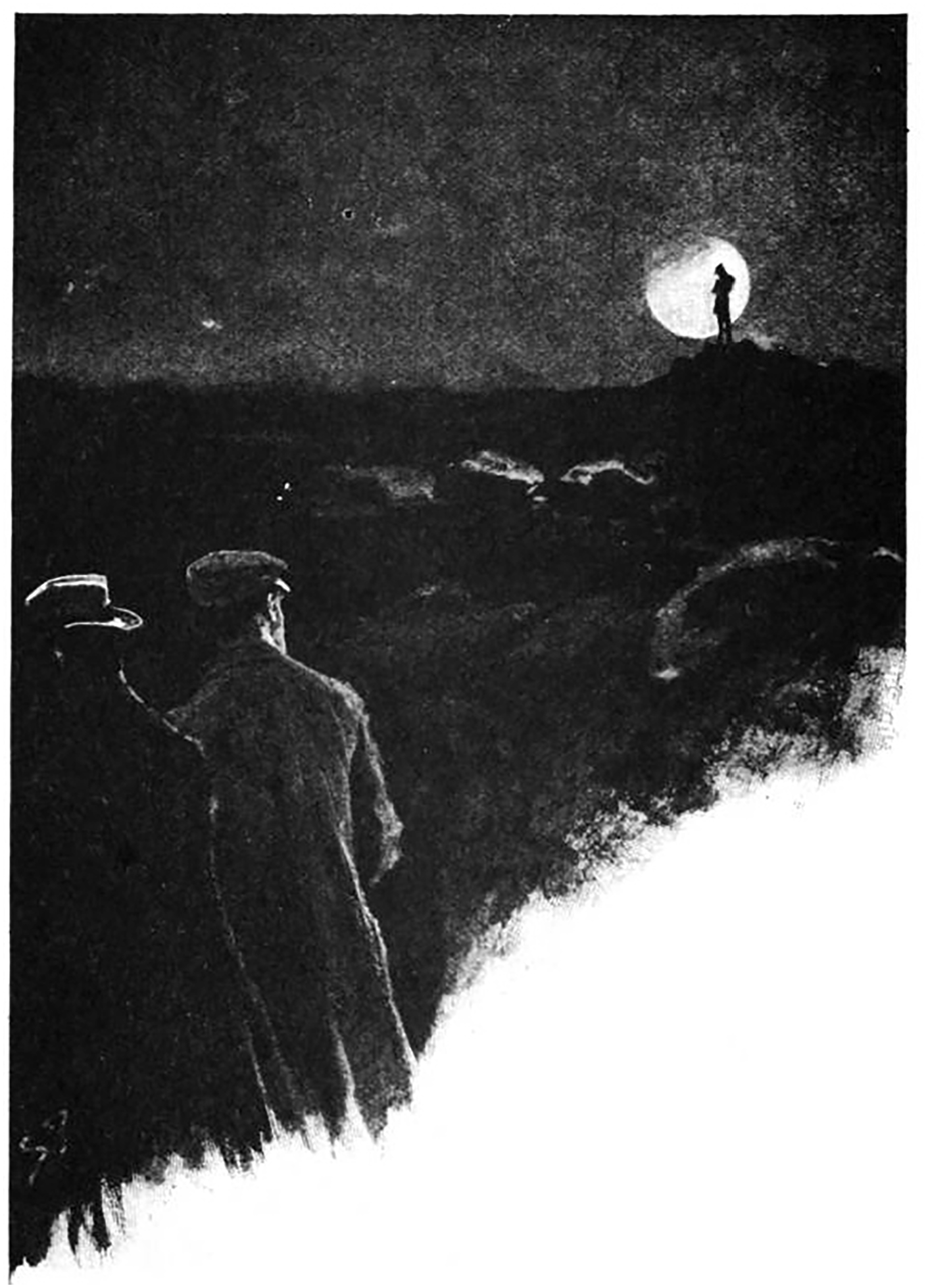
‘I saw the figure of a man upon the tor’ – Sidney Paget (1891) illustration of Holmes on Black Tor. Credit: Internet Archive/Victorian Web.
Weller’s text here emphasises one way in which ‘[e]nchantment as an encounter. . . emerges in-between’. 91 Yet, his experience at the top of Black Tor, of seeing many different Dartmoors spread out before him, also reflects enchantment’s ‘troubling and exhilarating feeling that things could be different’. 92 The exhilaration that Weller feels comes from his awareness that the Dartmoor he sees and the other Dartmoors he senses are at once present and hauntingly absent.
This practice of alignment emerging from embodied encounters with places drives a key claim of the Dartmoor mapping: that each candidate site is connected to others, in an unfolding enmeshment of lines of sight and mobility. As Weller writes about the Grimpen Mire: [It] has been taken as the first location indicated in this guide because its position is absolutely crucial to almost all of the other locations in “The Hound”.
93
Looking further into Dartmoor’s pages we can feel this enmeshment more readily in relation to Puper’s Hill, which stands in for Cleft Tor, the site from where the prisoner Selden signals into Baskerville Hall: This hill can be seen from two Baskerville Hall candidate sites <22,23>, although a signal from Pupers [sic] Rock would be difficult to see from the nearest and almost impossible from the other.
94
The site with which Puper’s Hill aligns changes depending on the direction of Weller’s gaze. Different alignments of body, place, story and memory produce different possible geographies of Dartmoor. The Dartmoor mapping is threaded with multiple lines of connection whose existence depends on where Weller stands, where he looks, and the different registers of experience he brings into each alignment.
The fleeting nature of these alignments reflects enchantments’ own fleetingness: that ‘something always takes their place, displaces and alienates them; in fact. . . something is always already displacing the moment, from without and within’. 95 The something that is always-already displacing each of Weller’s alignment of sites, memories, feelings and connections, is another alignment, another web of connections brought into existing by the simple act of looking off in a different direction, or of walking on a new path. In the next section I discuss Weller’s mapping as an attempt to counteract the fleetingness of enchanted encounters by representing them as stories.
Feeling landscape through stories
The Dartmoor mapping is a tour of the locations of The Hound. Yet, Weller’s textual mapping of Dartmoor relies on a more narrative form than one might expect from a guidebook. When compared, for example, to the straightforward prose found in Pugh, Spiring and Bhanji’s Arthur Conan Doyle, Sherlock Holmes and Devon: A Complete Tour Guide and Companion, 96 Weller’s notes overflow with emotive descriptions rooted in memory, allusion and being-in-place.
The poetic turn in Weller’s writing, as well as the fact that he wrote a personal narrative of his mapping practice at all, suggest that the textual elements of the Dartmoor mapping were written to do more than provide a practical guide. Much as he practices alignment, the bringing together of different registers of experience, to create, rather than to use a mapping, so it is possible to understand Weller’s textual mapping as an attempt to hold on to the enchantments he experiences. Pyyry and Aiava suggest that stories might be a route through which to ‘approach [enchantment] proximally. . . if we can think with them, we may still be able to discover what enchantment does and how it works. 97 Weller’s narrative uses this power of stories to represent enchantment as an attempt to forestall the fleeting, ungraspable, Dartmoor of both The Hound of the Baskervilles and his own creation; a landscape which is ‘an illusion, really, like all enchantments’. 98
How, then, does Weller’s textual mapping work to hold on to these fleeting moments of ‘being otherwise’? In fact, despite the revealing richness of the passage on Black Tor, the majority of Weller’s site entries in the Dartmoor mapping are less evocative and more mundane. The following entries relating to Poundsgate, discussed as a candidate site for the village of Grimpen, and which I quoted in part above, are a good example: Site 49 - POUNDSGATE (MR:Gridsquare:70/72)(P**:705721) This compact little village has all the requirements for Grimpen, including a reasonable proximity to a Baskerville Hall <23> but there is no suitable mire.
Locational and directional information, including map references, accessibility and availability of parking (the ‘P’ in parentheses), make up the bulk of the Dartmoor mapping. These directional aides make sense in the context of a ‘Practical Guide’. However, Weller’s Dartmoor mapping is not simply a guidebook for sightseeing. It is both an impetus for, and a record of, one man’s encounters with the multiple geographies of fiction, memory, feeling and experience, and of the enchantments which arise in-between these encounters. Why, then, does he not include more passages such as the evocative one about Black Tor?
One likely reason is that enchantment is an experience, a sensation, a feeling which exceeds representation, which exhausts the ability of words to capture the ‘unspeakable nature of affective experience and intensity’. 100 In recognition of this, with the exceptions of revealing passages such as the one about Black Tor, Weller’s text maps not the experiences of being enchanted, but rather the places and alignments in which his enchanted encounters happened. Despite the importance of lines of connection between candidate sites, whether made by walking or by seeing, Weller cannot trace and re-trace these lines permanently into the landscape, not least due to the erosive affects of the ‘often-harsh weather on the Moor’. 101 Instead, he traces the lines of his enchanted, more-than-fictional Dartmoor into his textual mapping.
The Dartmoor mapping’s text is littered with instances which allow a glimpse of the haunting nature of these experiences. A good example can be found in Weller’s description of Bellever Tor, suggested as an actual-world candidate site for The Hound’s Bellever Tor. When Weller writes that, ‘in Holmes’s time this was the location for local horse-racing and a fair, but that was before the area was invaded by the dreaded Forestry Commission conifers’, 102 his words evoke a double haunting. First, the spectral presence of the Victorian races and fairground, with their energy, noise and excitement rising momentarily before being choked back by the stifling silence of thick rows of dark trees. Secondly, Weller’s words are haunted by the presence of Holmes himself, who, through Weller’s opening of the spatial hinge between his affective experiences of being on Bellever Tor and his memories of the world Holmes likely inhabited claims a place in the actual world of the past.
Other examples of hauntings by landscape objects provide a glimpse into how Weller’s fleeting enchantments of a Dartmoor that is at once real and not real, there and not there, might feel. The land around Stannon is haunted by the ghostly presences of old tors and mires, long since passed on from this world: ‘some old maps show a small Blackator at (MR:665750), only three miles away’; and ‘[t]he ancient Stannon Mire is no longer shown on maps’, having been drained to nothing by intensive agriculture. 103 More dramatically, the village of Fernworthy, offered as an actual-world candidate site for The Hound’s village of Fernworthy, has been entirely submerged under a 20th-century reservoir. Weller’s ‘several decades of teaching survival and navigation techniques on Dartmoor’ 104 have likely attuned him to the ‘sensory triggers’ 105 of these ghostly presences on the moor enabling him to more readily open the spatial hinge between place and text; much as the alignment between present self, story, memory and landscape attunes Weller to the enchanted geographies of Dartmoor which arise, fleetingly, and yet which disappear as quickly, displaced by new sensations and experiences.
Candidate sites coexisting
The centrepiece of Weller’s Dartmoor mapping is a two-page, hand-drawn mapping (Image 4). Despite its similarities to traditional guidebook mapping, which helps readers find their way about, 106 Weller’s mapping is rather unusual. Weller’s hand-drawn mapping of Dartmoor reflects the tension that exists at the heart of any enchantment. The tension between the fleeting nature of the otherness of enchantment, the otherness of being, and the otherness of place that he likely experiences, and his desire to return to that feeling. Rather, a different tension resides in his hand-drawn mapping, equally integral to the experience of enchantment: ‘the sensation of being lost and found all at once, a sudden and overwhelming feeling of distance, of disinterested clarity’. 107
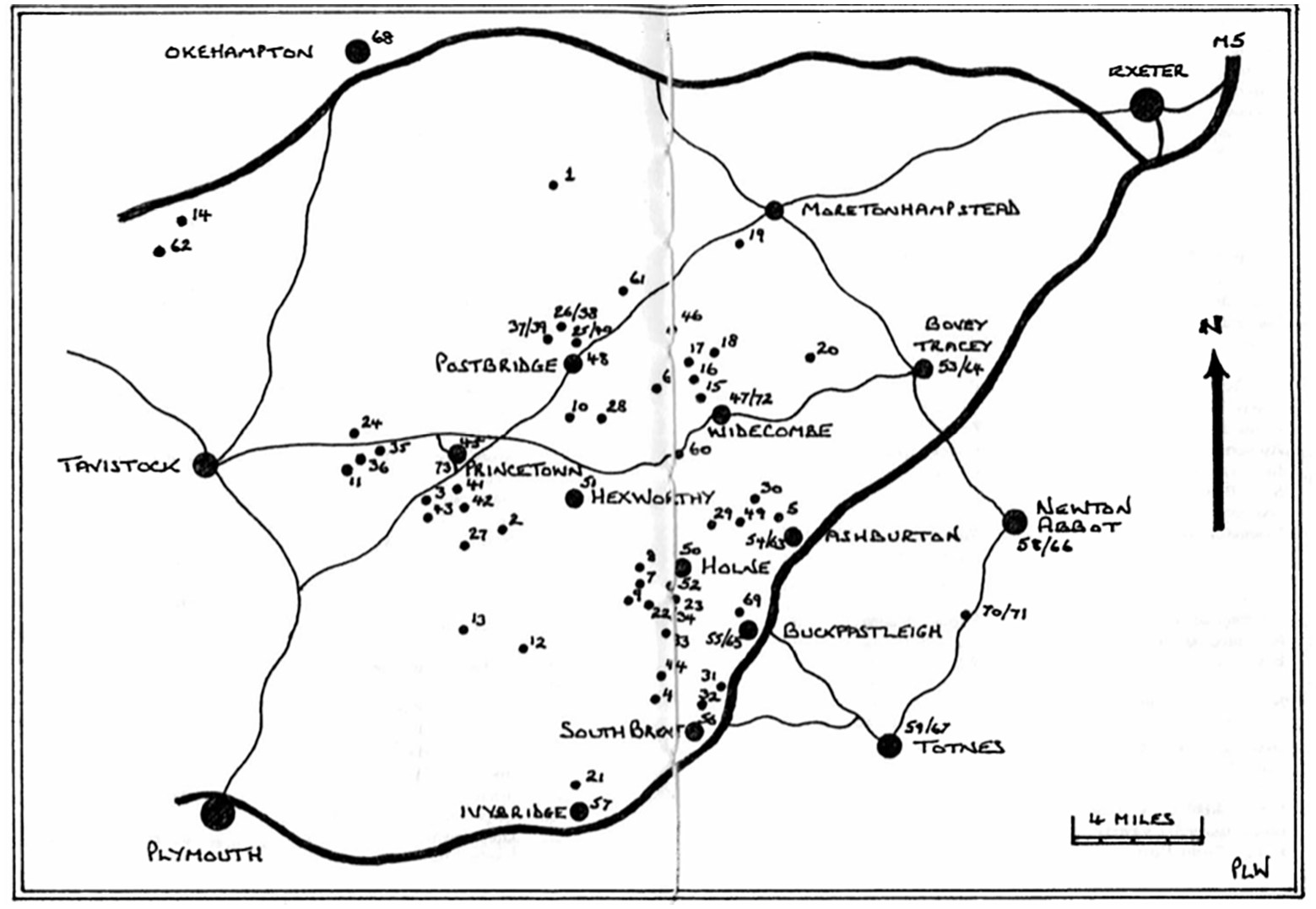
Weller’s hand-drawn mapping. Credit: Philip Weller/Sherlock Publications.
Weller’s hand-drawn mapping appears to overcome the fleetingness of the enchanted geographies to which his embodied encounters with story and landscape give rise. It fixes each site in place; and it gives each location from The Hound the same actual-world credence as non-Sherlockian places on the map such as Exeter, Plymouth and the M5 motorway. Yet, it also expresses how Weller feels to be both found and lost; how it feels to experience ‘simultaneous immersion and disconnect with the world’. 108
My own attempts imaginatively to navigate the Dartmoor of The Hound of the Baskervilles using this hand-drawn mapping, in my office at home in rural Norfolk, pulled me into an awareness of all the possible configurations of the various locations from The Hound of the Baskervilles, all at once. I looked for the Grimpen Mire, whose position on the moor, Weller himself notes, ‘is absolutely crucial to almost all of the other locations’. 109 There are two actual-world candidates for the Grimpen Mire marked on the map: Raybarrow Pool, far to the north of Postbridge, alone out on the moor; and Fox Tor Mires, close-in by Princetown. 110 With both possible actual-world Grimpen Mire sites marked on the map, any deliberate choice of one will always bring with it a haunting by the other site. Despite my best efforts to pin down other locations from The Hound based on their cartographical relation to Raybarrow Pool, I always found the idea of Fox Tor Mires hovering at the edge of my encounter with Holmes’s Dartmoor. The feeling only got stronger when I attempted imaginatively to encounter other places, such as Baskerville Hall, whose nine separate candidate sites each enticed me away from any definitive conclusions. Close up, Weller’s mapping creatively expresses what it feels like to be enchanted in place, to be caught between story, memory and landscape: being lost and found all at once, as each encounter is always-already being displaced by multiple others.
The hand-drawn mapping’s Apollonian point-of-view equally reveals it as a creative expression of how it feels to be enchanted in place, grappling with the ‘unspeakable nature of affective experience and intensity’. 111 For many, the Apollonian view’s ‘ontology of calculability’, 112 with its attendant ‘you are here’ security, still retains its aura of scientific objectivity. Weller’s own cautions to his Sherlockian readers that they bring reliable Ordnance Survey maps with them to Dartmoor exemplifies this apparent objectivity. 113 Despite his trust in official mappings, Weller’s own top-down mapping works creatively to challenge the ‘ontology of calculability’ that his viewpoint implies. Instead, it expresses the feeling of enchantment as ‘a fundamental encounter, a forceful event. . . a radical reordering of the world’. 114 This reordering is particularly apparent when looking at the ‘Key to Map Sites’, 115 which envelopes the mapping. By listing all possible candidate sites together here and on the hand-drawn mapping, Weller makes no effort to separate each different mapping of Dartmoor that emerges from his on-the-ground mapping practice. Many of these configurations cannot exist together in the unfolding enmeshment of Weller’s mapping. No objective mapping of the Dartmoor of The Hound of the Baskervilles can contain every candidate site, all at the same time. Yet, as Image 4 demonstrates, Weller’s mapping does show all these locations together, and others besides.
Weller’s mapping is not an objective mapping of Dartmoor, but a creative expression on his experiences of enchantment in place, one which attempts to capture the affective intensity of the ‘reordering of the world’ that he likely experienced. It challenges the ‘ontology of calculability’ that is inherent in cartography’s Apollonian viewpoint and in the Dartmoor mapping’s own claims to be a practical guide. The hand-drawn mapping’s central placement underscores the role of enchantment, particularly its feeling of being both found and lost, in Weller’s experience of the Dartmoor of The Hound.
Conclusion
In this article I have demonstrated that literary mappings do more than provide tools for literary critical insight. Weller’s Dartmoor mapping emerges here as a catalyst for, and at times a frustrater of, his (and my) connections with the multiple landscapes of Dartmoor – geographical, historical, fictional and personal. Like all reader-generated literary mappings it emerges in-between the encounter between the actual-world and the fictional; yet its affective force incites these encounters to take place. My reading of Weller’s mapping here demonstrates how literary mappings might be used by scholars to explore the moments of affective intensity that readers experience when reading and/or when being in place: those moments when the ‘spatial hinge’ allows feelings from fiction and experiences from the world to mingle and merge. In this way, I have emphasised what theories of enchantment can tell us about how encounters with fiction encourage us to be or do or perceive otherwise.
However, there are two areas which I have not discussed here which demand their own share of attention. The first is specific to Weller’s mapping. As much as we can read it as a record and a catalyst for his own enchanted encounters with Dartmoor and with The Hound, we should also pay attention to his explicit intention that this mapping be read, used and experienced on-the-ground by other Sherlockians. To what extent does Weller’s Dartmoor mapping influence other enchanted encounters? The second question raised by my research here relates to the theorisations of enchantment developed by cultural geographers, and their focus on the ethical nature of the new dispositions which may open up as we pass through a state of being enchanted. In my account here there is no space for an explicitly ethical dimension in Weller’s enchantment; his is a personal account of the affective, creative power of fictional encounter and of the practice of literary mapping. What, then, might the ethics of literary enchantment look like? How might they play out? These questions illustrate the new directions in scholarly studies of literary mapping, as both representation and practice, which this article has intended to contribute and, perhaps, to spy the next section of the path, that others might tread it further into the still undiscovered country that lies ahead.
Footnotes
Funding
The author received no financial support for the research, authorship, and/or publication of this article.