




Abstract
Much has been written in recent years about ruins and photography and especially so in the context of Detroit’s declining urban landscape. Numerous books present us with beautiful ruined buildings and landscapes, and further explanations why we might be drawn to images of decay. While some claim that ruin imagery triggers a form of resistance to the forces of capitalism, others stand critical to the beautification of ruins by arguing that such imagery removes viewers from any reflection on what causes ruins. Detroit’s new saviour Dan Gilbert is one of those ruin detractors who blames Detroit’s image as the poster child of ruin photography for all failed investments. This paper focusses on these image battles in the construction of a city’s place identity and argues for an understanding of ruin photographs as performance. Instead of offering a trace of an object once in front of the camera, I investigate how a collection of forgotten photo-installations curated by Detroit’s Urban Center for Photography gesture performatively to the ongoing event demolished by neglect whereby buildings are intentionally left to rot for profitable real estate development. Strategies of advertisement campaigns, it will be shown, are appropriated to make such live gestures. Investigating the doing aspect or force of ruin photographs contributes to cultural geography’s recent concerns around the potential ‘force of representations: their capacities to affect and effect’ and as such moves away from one of the central tasks of cultural geography, namely its focus on what representations mean. The spectre of Detroit’s image battle ultimately should provide us with questions about the construction of a city’s identity through visual documents and enable us to question the mechanism of neoliberal urban planning and governance.
Keywords
Take another look at Detroit
In the summer of 1987, a series of enlarged photographs of decayed interiors accompanied by the stencilled words ‘Demolished by Neglect’ or/and ‘Works in Progress’ started to appear on boarded-up fronts and abandoned schools, houses and downtown landmarks. These photo-installations were part of an art event entitled Demolished by Neglect (1987) organised by the loosely formed and now forgotten photographic collective Urban Center for Photography (UCP, 1986–89). Some questioned openly whether these installations were ‘art or “visual pollution”’, others perceived them as a form of ‘photo-activism’ that they understood related to a dissatisfaction (shared by many residents) with the former Mayor Coleman Young’s image-building campaigns and empty promises built on glimmering towers and multi-ethnic festivals. 1 In a published statement by the UCP reference was made to the fraught urban policies of Young’s administration based on a culture of disinvestment and abandonment, neglect and demolition and forced removal of populations all in the name of job creation fed this ruin making process, hence the title of the event Demolished by Neglect. 2 ‘We seek to bring an end to the defacement of our cultural heritage’, explained one of the primary authors of the art event. 3
Initially set up as an outdoor ‘guerrilla style’ exhibition on a series of white panels enclosing the neglected and now demolished Monroe Blocks, disagreement with the City of Detroit [hereafter City] caused the art event Demolished by Neglect to spread out to various ‘high traffic’ locations in the city. 4 It is perhaps telling that today the demolished Monroe Blocks used by the UCP as a vehicle to challenge processes of urban redevelopment is one of the four ‘transformational projects’ used as a key flagship project to re-sell the present rebirth of Detroit. 5 To offer an alternative to the ongoing struggle for Detroit’s image whereby ruin imagery is mostly seen as representation, this paper discusses the UCP’s use of photography as performance to challenge the City of Detroit’s dominant urban imaginary practices and reveal the neoliberal project of ruination as an active process that ‘brings ruin upon’ in order to ease redevelopment through dispossession. 6 It provides the first historical account and interpretation of a little-known collective of photographers working in Detroit in the mid 1980s.
The recent discussions and controversies around the ‘ruin porn’ photography is a good case in point of the amnesia inflicted in the relation of Detroit’s constructed identity and previously forgotten struggles to correct, oppose or support the selling of the city’s ‘quality of life’ by Detroit’s saviours as a place to ‘live, work and play [or shop]’ since Young kicked off the image branding campaign Take Another Look at Detroit in the mid 1970s. 7 In the discourse around ruin photography the attention primarily goes to the deindustrial sublime or the white middle class nostalgic longing for some glorious past. 8 Most of the recent art publications and popular exhibitions in and outside of Detroit do not mention earlier and influential attempts like Demolished by Neglect. 9 Others see Vergara as the ‘scholarly forebear to Detroit’s ruin tour industry’. 10 While this paper does not want to discredit these varied engagements with ruin photography, it intends to demystify and redirect discussions around the relation between ruins and city building by claiming that there is more to the culture of ruins and ruination then has been claimed by most ruin detractors. To do so it picks up the renewed interest and fascination with ruins in cultural geography and archaeology where generally the debates about ruins tend to demonstrate its potential as sites of resistance, alternative engagements with the past and transgression. 11
Following from Caitlin DeSilvey and Tim Edensor’s proposal to recognise ruins as sites of resistance to critique dominant hegemonic forces and structures, I investigate how the 1980s cultural practices appropriate strategies from advertisement and art to construct a counter-imaginary in order to violate the City’s image campaign to resell the city. 12 The UCP collective did so by developing a novel way, this paper claims, to represent ruins (directly or indirectly influenced by Conceptual Art and the 1980s alternative art practices in New York) in order to solicit a reaction to increase the pressure on Young to act and protect the city’s heritage, and to instil a form of civic responsibility and response in the residents. 13 These large-scale photo-installations perform by gesturing to the ongoing event or approach as others call it of demolished by neglect, and thereby directly referencing the demolition by neglect ordinance of 1976. 14 While most studies in cultural geography and elsewhere do signal the relevance and importance to study ruin photographs most however consider photographs as illustrations, representations in need of interpretation or evocations which can result according to Edensor in a form of ‘haptic visuality’. 15 I am arguing instead for the recognition of the performativity of ruin photographs: what is it that produces the ‘doing’ aspect of ruin photographs and directly affects the viewer to stage an intervention and subvert the structures set up by Detroit’s governing coalition? 16
Investigating the doing aspect or force of ruin photographs contributes to cultural geography’s current concerns around the potential ‘force of representations: their capacities to affect and effect’ and as such moves away, as mentioned by the cultural geographer Ben Anderson, from one of the central tasks of cultural geography, namely its focus on what representations mean. 17 It is a move from what a text or image represents to how a representation ‘operates and makes a difference as one part of a relational configuration’ hence the reference ‘representation-in-relation’. 18 Just like Anderson refers to the novel as a spatial event and not a thing, we can see these photo-installations also as ‘a spatial event’ and thus an integral part of the surrounding processes whereby relations are set up between the viewer, the photo-installations, the depicted subjects, the buildings and neighbourhoods, the city and its mode of city building. Hence, the focus on representations and relations redirects the binary opposition representation versus non-representation by insisting that both theories matter and influence our conception and perception of images. 19 Seeing and unfolding these relations is part of what Anderson likes to refer to as ‘reparative modes of inquiry’ (in reference to the critical theorist Eve Kosofsky Sedgwick) whereby representations are read for its potential for social change or in our case to disrupt a dominant mode of building. 20 By engaging with art history and performance studies, this paper aims to expand our understanding and use of the reparative mode of inquiry in cultural geography by looking more closely to the photograph as performance.
In the following three sections I analyse the ‘performative force’ of the Demolished by Neglect project; the call for action on the part of the viewer. 21 Based on archival research, media analysis and interviews with Detroit photographers, this presentation critically analyses these photographic practices in the context of the dominant past and present renaissance discourses to reconstruct Detroit’s identity. These discourses will be analysed in the first section of the article. In the second part of the article arguments will be constructed to engage with ruin photographs as a performance. The method used to analyse the event Demolished by Neglect can be described as discourse analysis as this method allows for a thorough examination of the context and how these practices attempt to intervene in the dominant construction of a place, as argued by Guy Cook, ‘who is communicating with whom and why; in what kind of society and situation; through what medium; how different types and acts of communication evolved, and their relationship to each other’. 22 Once the idea of the battle for Detroit’s identity is established and propositions are developed towards the UCP practices as performances, this paper will argue that the photo-installations perform by appropriating the image strategies used by the city to reimagine and rebrand Detroit as a place to live, work and shop.
How others see Detroit, and how we see ourselves
In the summer of 1987, the photographer and one of the founders of Detroit’s Urban Center for Photography, Keith Piaseczny, mounted on the boarded-up façade of the nationally recognised National Theatre (designed by Albert Kahn, 1912) a blown-up photograph of the theatre’s deteriorating interiors (Figure 1). Next to the poster-size photograph Piaseczny stenciled the tag ‘Demolished by Neglect’ in a well-known font used by political artists and official organisations to quickly label objects and locations. Placed in between a row of peeling advertisements, the photo-installation called attention to the collapsed ceiling of the vaulted arch in front of the stage which had caused the interior structure to rot beyond repair, a process that remained invisible from the exterior. The deteriorating conditions were largely invisible because the city posted ‘new signs on the [Monroe] block proclaiming it a preservation block’ for the 1980 Republican National Convention. 23 In short, the photo-installation demonstrated how the City of Detroit, whom owned the theatre and the rest of the Monroe Blocks from the mid-1970s, had allowed the theatre to fall into ruin, and symbolised as such Young’s treatment of Detroit’s architectural heritage as a whole. At present, the theatre is the sole reminder of the historical Monroe Block buildings and if the plans to ‘built vertically’ of Detroit’s new missionary Dan Gilbert are executed only the theatre’s façade will be saved and used as a gateway in a move described by preservationists as ‘facade-ectomy’. 24
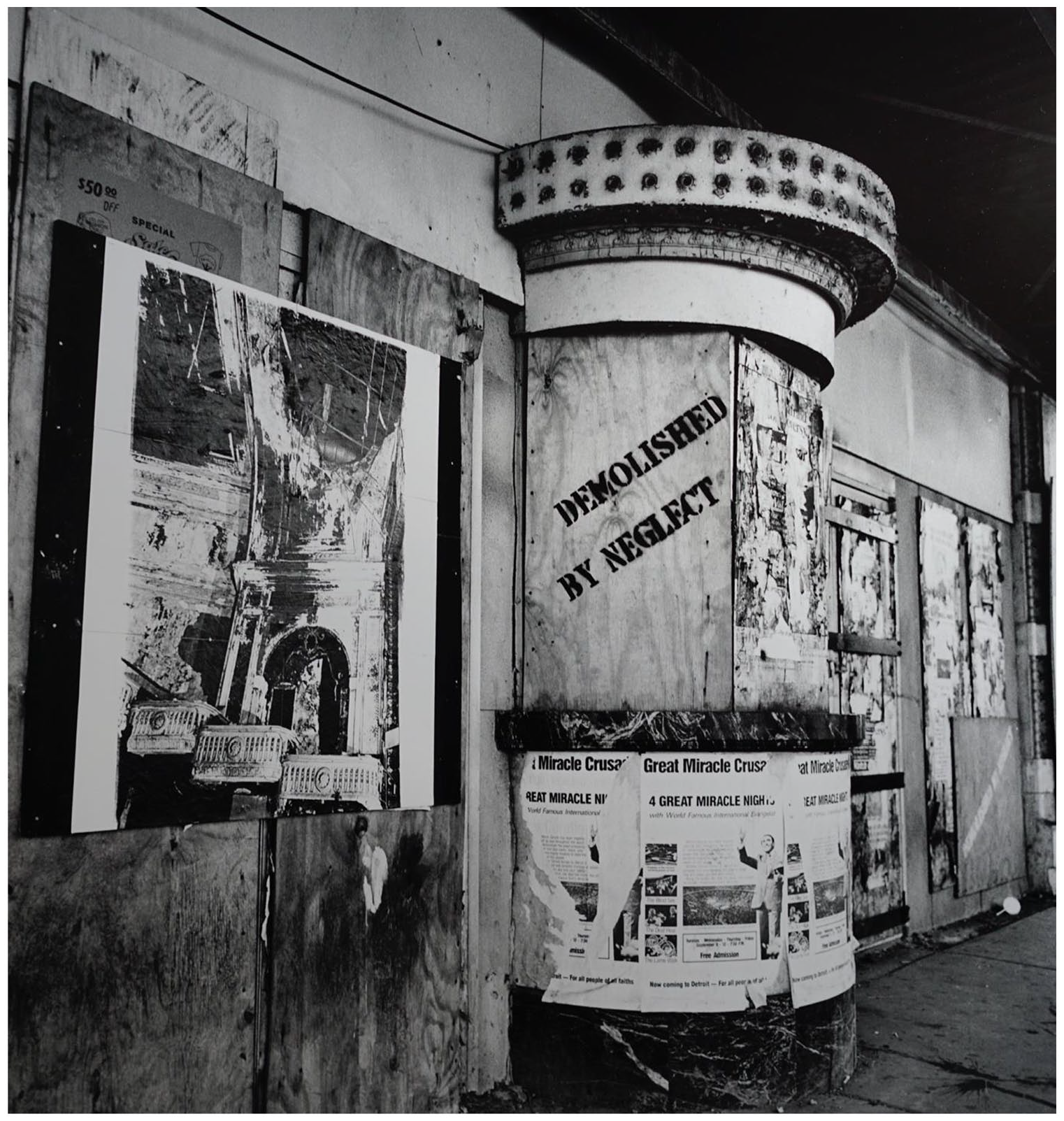
Keith Piaseczny’s Demolished by Neglect photo-installation on The National Theatre, Urban Center for Photography, Summer 1987. Photo by Piaseczny.
The photo-installation on the National Theatre was part of a whole series of Demolished by Neglect photo-installations all over Detroit loosely coordinated by the UCP and funded by the Detroit Council of the Arts and the Michigan Council for the Arts. 25 In total 12 photographers participated in what one reviewer referred to as ‘guerrilla photo-activism’, and depicted from different angles the decayed buildings and lives of Detroiters. 26 Some photographers were personally invited by one of the three founders of the UCP – Piaseczny, Michelle Graznak and Jessica Trevino; others joined through the call for participants to submit (by 15 March 1987) up to four individual ‘work prints’ incorporating ‘elements of text, drawing and/or graphics that further depict the interpretation of the theme [demolished by neglect]’. 27 Not all contributors exposed the rotting interior of abandoned houses, theatres, warehouses, schools or art-deco skyscrapers like Piaseczny (Figures 2 and 3). The artist James Dozier, for example, installed several enlarged photos of a naked torso with visible scars and X-rays of lungs (Figure 4), exposing as such the deteriorating health condition of residents living close to a waste incinerator. Photographs of objects that symbolise ‘signs of activities in the building’ were installed by Rolf Wojciechowski and Julio Perazza (Figure 5). 28 An exhibition of reprinted poster-format photographs at 1515 Broadway Gallery in Harmony Park, a conference about demolition by neglect as a development strategy, and various other dialogues with newspaper editors suggests how the project went into wider circulation.
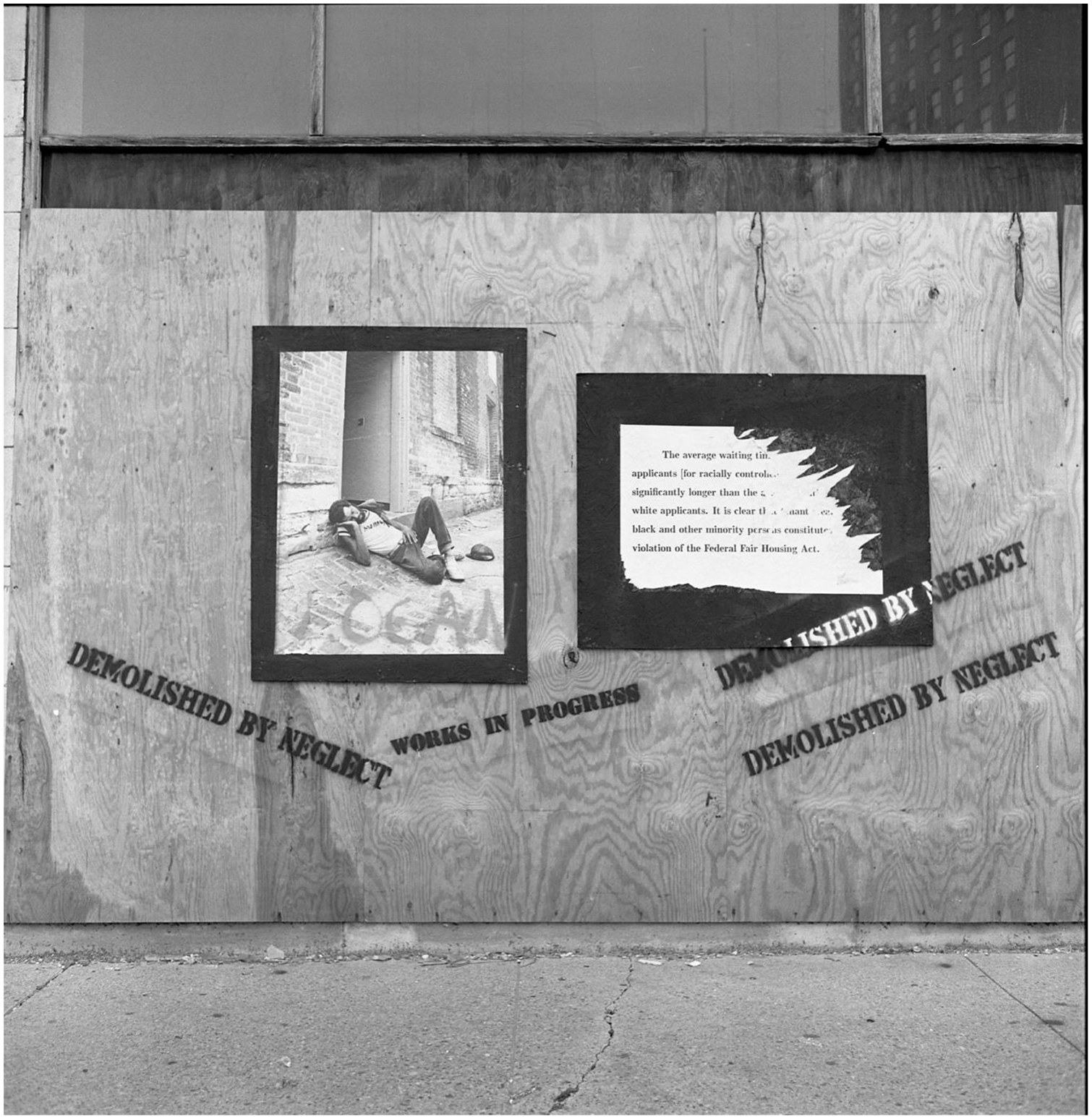
Piaseczny and Bruce Checefsky’s Demolished by Neglect photo-installation, Urban Center for Photography, Summer 1987. Photo by Julio Perazza.
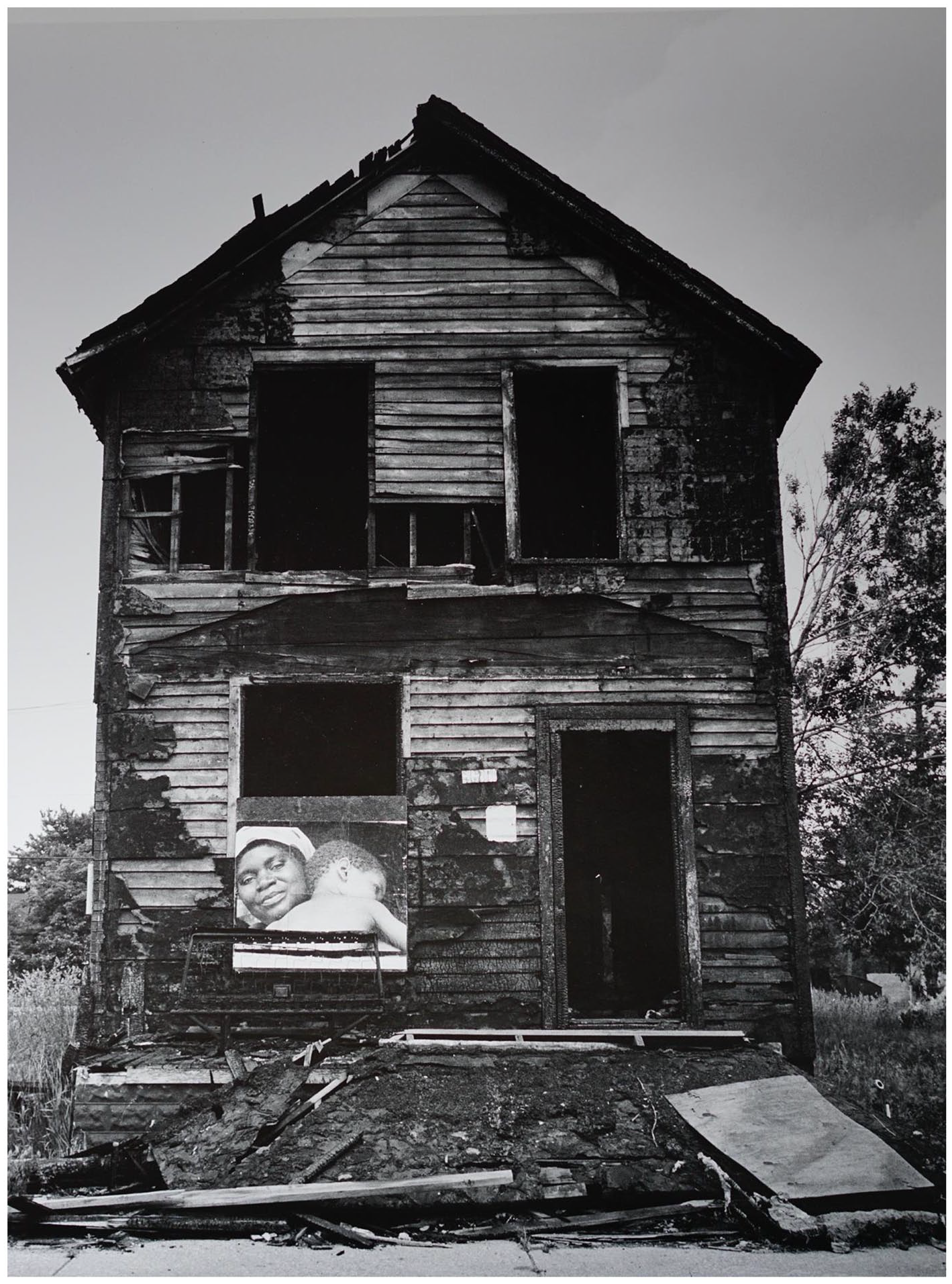
Keith Piaseczny Demolished by Neglect photo-installation, Urban Center for Photography, Summer 1987. Photo by Piaseczny.
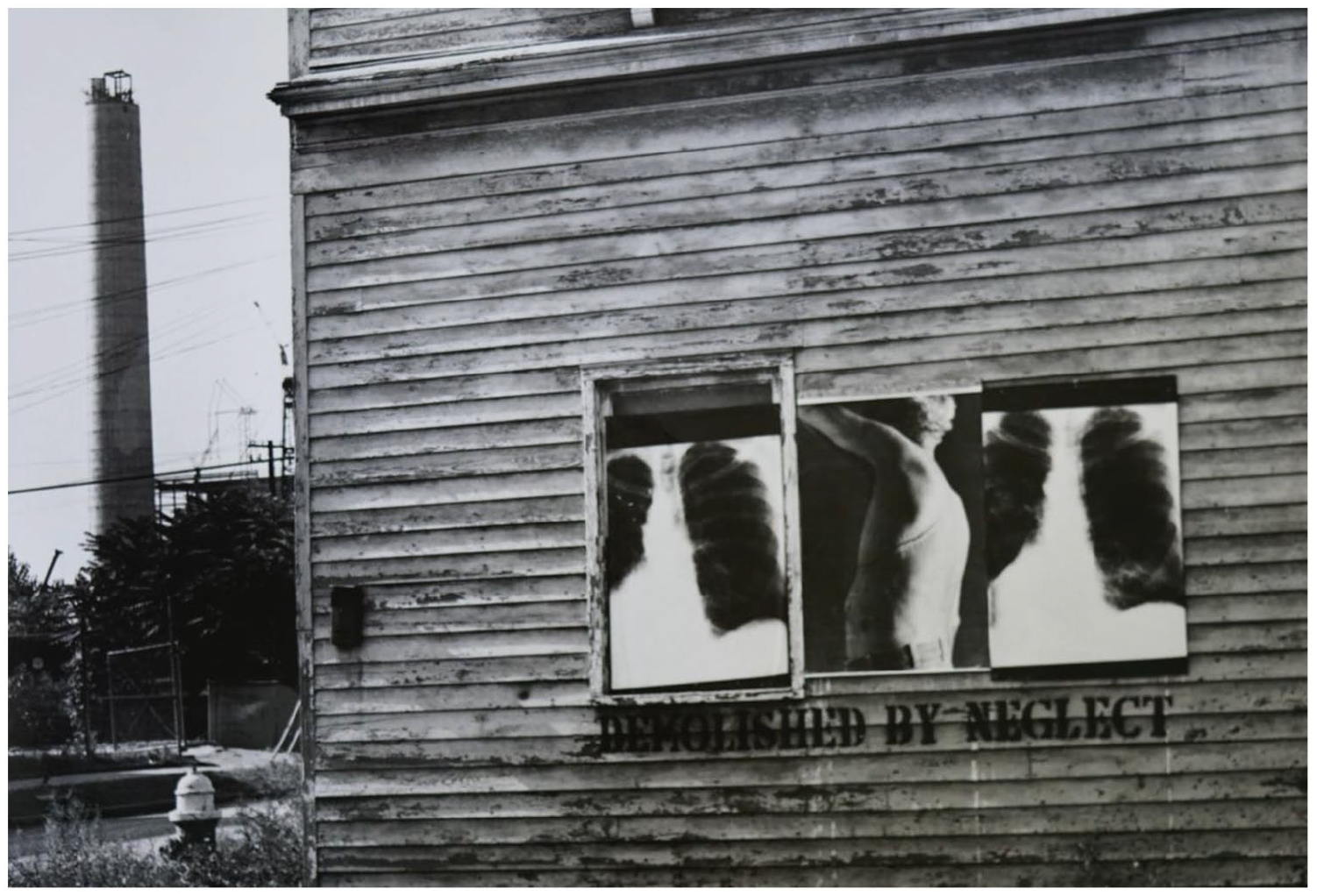
James Dozier’s Demolished by Neglect photo-installation on an abandoned house in Poletown, Urban Center for Photography, Summer 1987. Photo by Dozier.
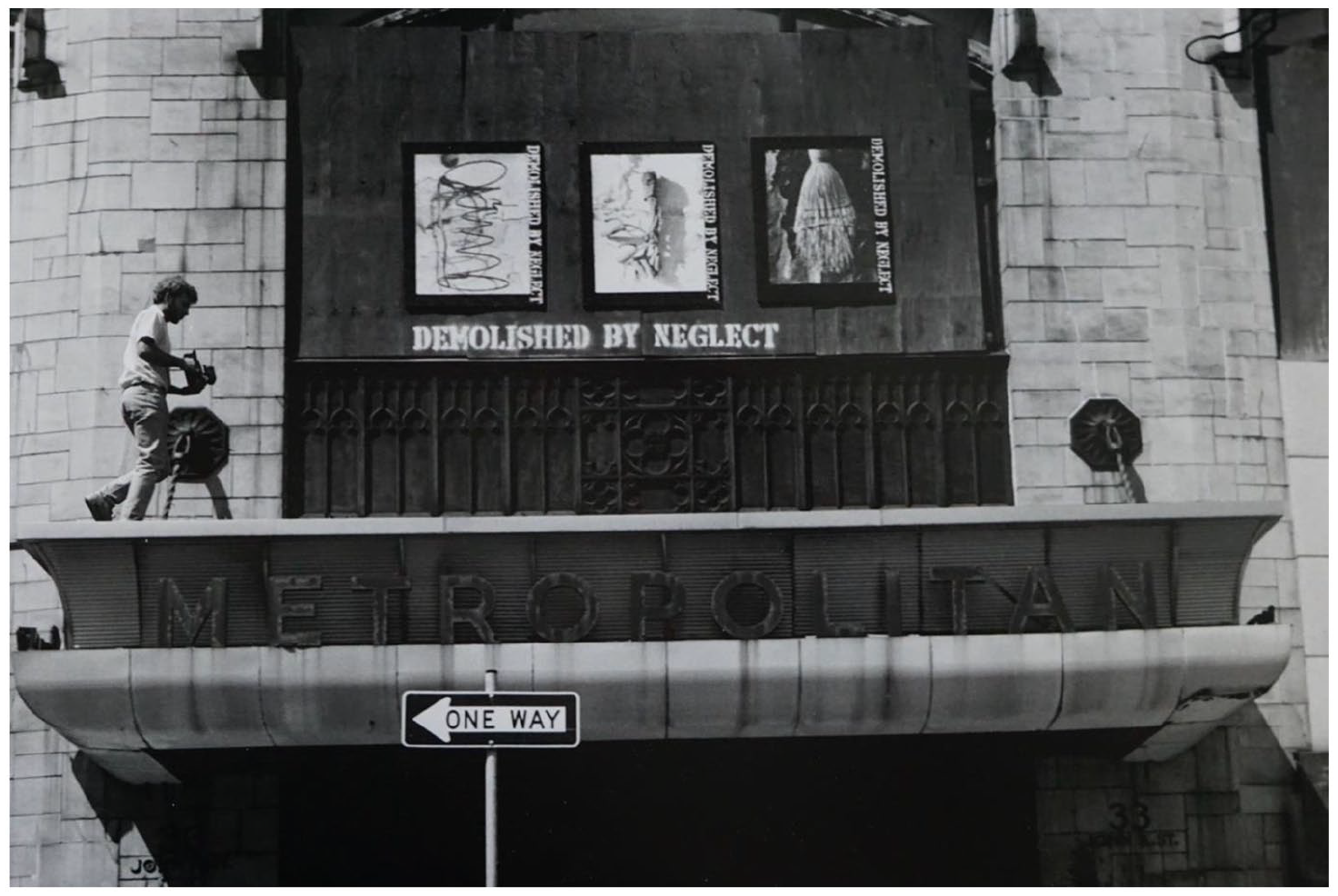
Rolf Wojciechowski’s Demolished by Neglect photo-installation on Metropolitan Building, Detroit, Urban Center for Photography, Summer 1987. Photo by Piaseczny.
No doubt that to exhibit photographic images in places of high visibility to expose and reimagine Detroit as a city demolished by neglect disturbed and caused much anxiety in the corridors of Detroit’s city hall. When the UCP tried to obtain official permission from the city in May 1987 to use the facades of the Monroe Block buildings for their ‘collaborative mural piece’ (as they referred to it in the beginning of the project), there was much disagreement and conflict about the purpose and execution of the project. 29 Some of it was because the UCP mistrusted the support and involvement of city officials like Sheldon Rocklin, Community & Economic Development Department (CEDD), out of fear ‘the city would seek to manipulate the project to fit within its own public image agenda’. 30 In one of the two meetings about the Monroe Block held between the Detroit Council of the Arts (DCA), CEDD and the UCP, Shahida Mausi, the director of the DCA, asks why the UCP cannot ‘show concern through image of neighborhood group cleaning up a vacant lot’. 31 So, while for the UCP showing ‘the cohesiveness of neglect’ can potentially bring about ‘positive effect’ in the form of direct actions; the DCA and CEDD perceived it as a form of ‘Detroit-bashing’ that might negatively impact economic investments. 32 It is a matter of communicating that ‘neglect is a matter of a conscious decision’, added UCP member Graznak, and thus not something that is part of a natural process in the development of a place. 33 No resolution was found and the initial proposal to produce a mural piece around the Monroe Blocks was abandoned in favour of a loosely coordinated guerilla style exhibition with works mounted in different locations in the City of Detroit.
The mid 1980s were a turning point in the development of Detroit on several levels. By the 1970s and 1980s the city had become synonymous with decay, murder and unemployment as well as depopulation. 34 The ‘white abandonment’ of Detroit in the wake of Young’s election in 1974, combined with a smaller urban tax base, declining commercial and manufacturing enterprises and a severe national economic recession left a trail of abandoned houses leading eventually to the well-known Devil’s Night in the 1980s. 35 This did not stop Young from stating that the Renaissance Center, a multi-storey mixed development built on the riverfront by the famous architect John Portman in 1977, ‘has had an impact that’s felt all over downtown Detroit and up and downtown the Detroit River’. 36 He expressed the belief in a series of articles in the Detroit Free Press that marked the centenary of the Renaissance Center that all these [riverside and downtown] developments would have been impossible ‘without the impetus and the catalytic force of Renaissance’. 37 The success of the Renaissance Center was important to Young because it represented how he did politics in the city and hence signals the city’s shift in urban governance from urban managerialism to urban entrepreneurialism. 38 In this new urban political climate, the public sector no longer merely manages the provision of social services, but adopts characteristics from the private sector such as ‘risk-taking, inventiveness, promotion and profit motivation’. 39 It is in this context that we must understand the dominant preoccupation with how others see Detroit since the 1970s and the renewed interest to expand the so-called catalytic development of the Renaissance Center through several other downtown projects like the Monroe Block. 40 From the mid-1970s campaign Take Another Look at Detroit to the mid-1980s Do it in Detroit, we can observe almost one advertisement campaign per year. 41
Part of the newly formed urban imaginary, and equally important as the attempt to make the city attractive again for investors, is that it stimulates ‘civic pride’ and ‘local support’. 42 This also explains the council’s attitude towards the ‘negative’ (or critical) images regardless of how much ‘factual representation’ the UCP would communicate or how reflective it would be of the tradition of engaged photography (as requested by Jim Hart, DCA’s deputy director, in one of meetings with the UCP). 43 ‘The stenciling of words on abandoned buildings’, states Mausi, the director of the DCA, ‘hardly contributes to the essential beauty of our city (. . .), it clearly contributes to the visual pollution of this (Grand Circus) neighborhood’. 44 Eventually, the resistance to cooperate and come to any resolution with the UCP to use the fences around the Monroe Block as an exhibition space benefitted the photo-installations as discussed below.
Ruin photography as performance
Many scholars theorise the act of writing and photographing ruins in Detroit and beyond as an attempt to distance oneself from the historical causes and significance of ruins in the search for what the cultural historian Dora Appels interprets as the ultimate pleasure (which follows from the 19th century romantic idea of ruin lust). 45 If the sublime, as Appels claims, is about mastering fear and terror than taking photograph of ruins is perceived as domesticating ‘the terrifying forces of capitalist disinvestment, privatisation and wealth inequality’ and hence making it beautiful and pleasurable. 46 The so-called uncritical celebration of ruins can also take on the form of a romanticised industrial past and working life, and hence glorify Detroit’s golden era neglecting the widespread social and racial oppression. 47
Instead of writing oneself out of a place, following cultural geographers and archaeologists’ search for meaning in ruins, I propose to develop further the claim made by what I will call the ruin photography defenders that the act of photography offers the possibility to write oneself into a place. 48 Much of these recent reconsiderations of ruin photography see the act of photographing as a particular form of engagement with things and ruins, as Thora Pétursdóttir and Bjornar Olsen argue, ‘an interactive performance’. 49 The argument goes that in this ‘interactive performance’ the ruin is set up and used to trigger particular affects and that is what they exploit. Photographing thus enforces a particular embodied ‘engagement with or way of approaching things/ruins as well as a way to mediate these engagements’. 50 In the urban exploration (UE) community and literature where photographs are meant to ‘mediate’ these engagements such interpretations are commonplace. 51 Whether referred to as ‘experimental site-specific theatre’, ‘an anticipatory history’, ‘alternative associations’ or a form of ‘radical nostalgia’, in these performances and its documentation the ruin no longer is used for a nostalgic longing to a past but rather used as a vehicle to interrogate and reflect on how ruins shape the past, present and future. 52 Thus, in one way or another, all of these ruin imaginaries produce ‘counter sites’ as mentioned by DeSilvey and Edensor, or ‘counter narrative’ according to Emma Fraser which is also what Demolished by Neglect intended to do by revealing the real nature of neoliberal capitalism. 53
To write oneself into as opposed to out of a place asks for a different understanding of the relation a photograph sets up between its referent and spectator. To write oneself into a place means in the first place that a photograph cannot only be read as a testimony of past events or objects once in front of the camera lens, the ‘that-has-been’ in Roland Barthes’s terms, a trace that all too easily places the viewer at a safe distance from the subject in and beyond the frame. 54 Demolished by Neglect can make claims towards a form of indexicality that, following the photography theorists David Green and Joanna Lowry, points to ‘the event of its own description’. 55 The art theorist Margaret Iversen refers in this regard to the surrealist play of shadows whereby the cast shadow is the indexical sign and like this ‘less a representation of an object than the effect of an event’. 56 The event in this case is what I refer to as the performance organised by the UCP held in the summer of 1986. It followed a simple brief with the following instructions: to visualise the theme of demolished by neglect (which many of the participants did by trespassing abandoned buildings), to mount the large-scale pictures with accompanying stencils ‘Demolished by Neglect’ or/and ‘Work in Progress’, and finally to document the installation in context. There was neither a map with the locations of the photo-installations for a visitor to follow nor was there an agreement between the participants prior to installing the pictures where each participant will exhibit their pictures.
Consequently, these large-scale installations appearing in the streets developed in a large performance campaign with varying and unforeseen open-ended outcomes addressing different types of ‘neglect’ in different places, and as such, following Iversen’s argument on the photographs in some of Vito Acconci’s performances, these photo-installations have the potential to function as ‘an instrument of analysis, discovery, or measurement’. 57 All the photo-installations together become in other words more than the representation of a few objects or decayed buildings; they measure, discover and expose the persistent and often unseen neglect of buildings and people. The elements of surprise and discovery is further elaborated on in the different types of recordings made of the installations. The way some participants recorded their installation stimulates this performative element like for example the juxtaposition to the city’s campaign slogan Do it in Detroit in the documentation of Julio Perazza (Figure 6) or the wrecking ball in Trevino’s pictures (Figure 7).
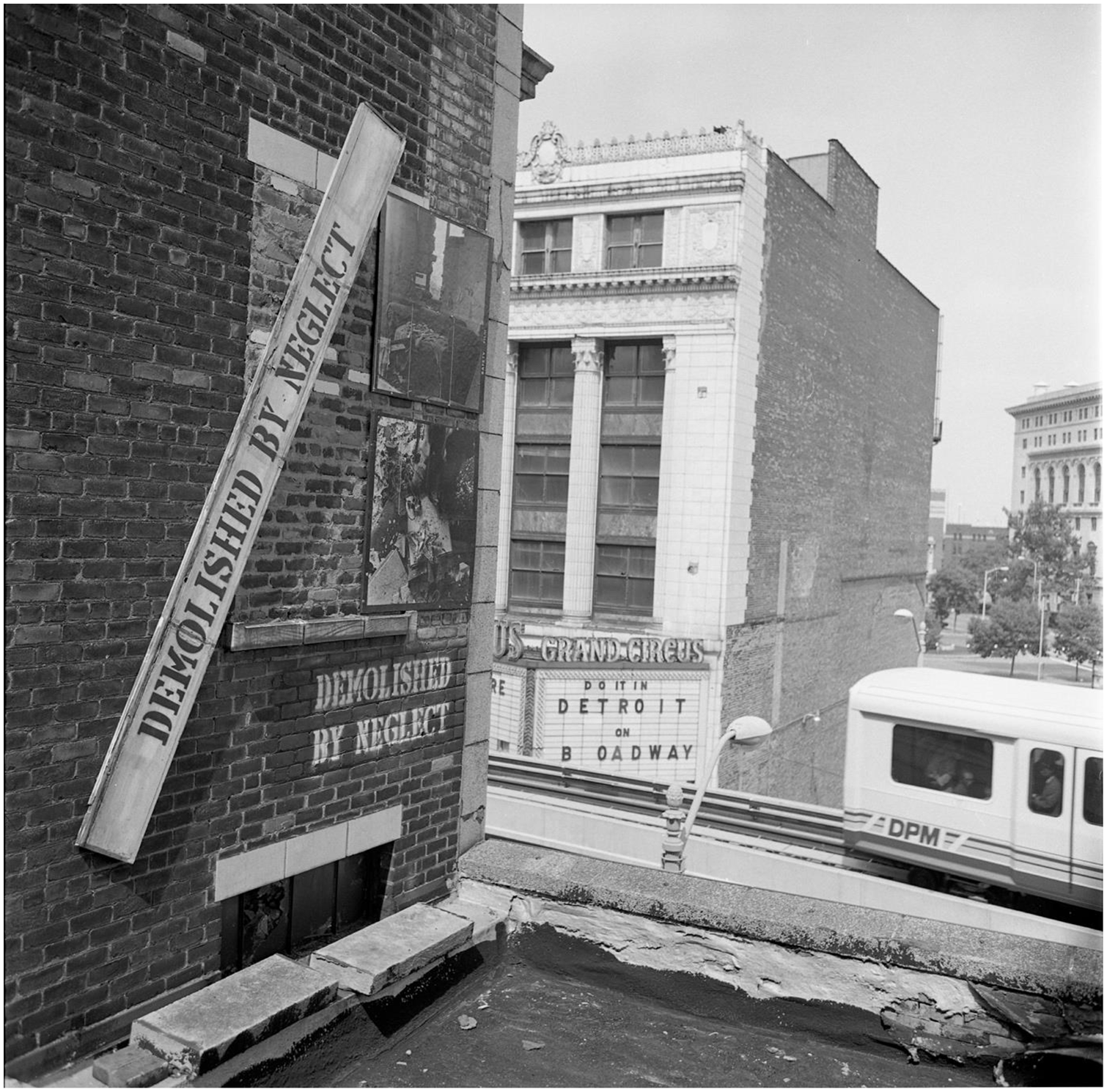
Julio Perazza’s Demolished by Neglect photo-installation on the Wurlitzer Building, Detroit, Urban Center for Photography, Summer 1987. Photo by Perazza.
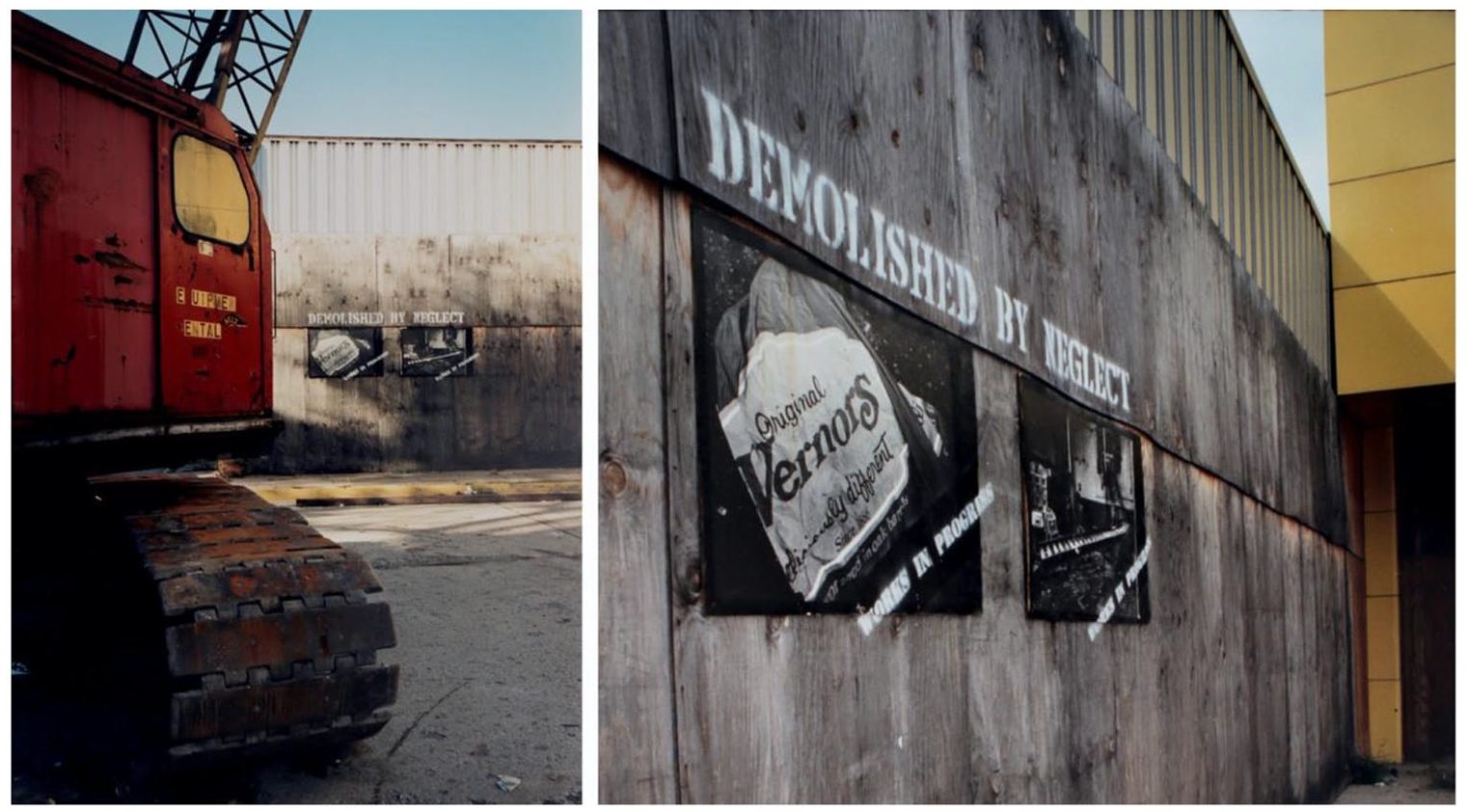
Jessica Trevino’s Demolished by Neglect photo-installation on Vernor’s Bottling Plant, Detroit, Urban Center for Photography, Summer 1987. Photo by Trevino.
Referencing the idea brought forward by Palmers and Iversen around ‘performative photography’, that is photography that is the result of a performative act, we can speak in this case of performative photo-installations made of pictures and words hung in various undetermined location in the city. The photo-installations are another example of what the performance theorist Philip Auslander refers to as the conflation between the two categories of performance photography, namely documentary and theatrical images. 58 If you consider the photographs as documentary images merely for reconstruction purposes or evidence that a performance occurred, the document remains a staged document and gives you access to the event. That means that even if the UCP artists did not record the installations themselves, the location of the installations in their urban context further determined how the record was made. The weather conditions also influenced the picture’s quality whereby the decaying nature of the posters (if they were not stolen or removed by the City) matched the deteriorating state of the building’s interior. In some recordings we see written annotations on the images hinting to an ongoing dialogue with the residents or alternatively we see only the tag ‘Demolished by Neglect’ on the building’s exterior walls without any pictures. And since the performance is only seen in the documentation as a performance (both in the city and art gallery) it makes sense to call the works more theatrical than documentary. After all, these photographers assume only a responsibility to Detroit’s residents on the moment when the pictures were installed. Understanding these photo-installations as performance refers to what others have called the performativity of the art works in reference to the use of the term performative in the work of John L Austin whereby as Mieke Bal writes words or/and images are ‘launched as weapons’ in the present. 59
If performativity signals an awareness of how ‘the present gesture is always an iteration or repetition of preceding acts’, as Iverson writes in her description of the difference between performance and performativity, then we can only make sense of the works in relation to the instructions and to each other, its immediate surround and the acts of neglect and others that helped cause the current impasse. 60 These reiterations or repetitions point to the ‘collective dimension of speech and action’, says Iversen, and that is what these artists are aiming for, to affect the collective dimension and responsibilities of both citizens and politicians. While Iverson only refers to the act of executing the score set for the performance in the case of the UCP, the repetition of preceding acts has larger ramification because of the specific urban sites it is in and references it makes to the city’s rebirth rhetoric, city image and the demolished by neglect ordinance.
While the stencils ‘Demolished by Neglect’ and ‘Work in Progress’ are an ironic play to the white plywood barriers built for the 1980 Republican National Convention around the Monroe Block with the words ‘Historic Restoration [in progress]’, they also reference the demolition by neglect ordinance of 1976. 61 The act describes in the section ‘Enforcement’ that ‘if it is determined by the historic district commission that a structure in an historic district [which includes many sites the UCP used] is being demolished by neglect [which means neglect in the maintenance, repair and security of a site, building or structure], the commission, [has the obligation to repair the subsequent property even if the city is not the owner]’. 62 The UCP seemed to be aware of the ordinance because in a newspaper article it mentions that their actions intend to push the City of Detroit to get them ‘to comply with its own laws pertaining to the protection of property and the preservation of historically designated buildings’. 63 So, this is the event pointed to and turned into an image campaign by most of the photo-installations; a city built around the culture of decay. This means that the stencils are not merely declarative acts lending a performativity to the relation between the installation, building and renaissance rhetoric. Both the photograph and stencils work performatively in the sense that they enact the Demolished by Neglect ordinance which is basically a social contract that denotes the truth-value of the claims made in the UCP’s advertisement campaign.
The tag the stenciled words ‘Demolished by Neglect’ and ‘Works In Progress’ (if penciled on the brick walls) remained for many years engraved on the buildings’ façade and started to re-appear in various other places confirming and enforcing as such its ‘performative force’: in photographs (Historic American Buildings Survey, HABS), blogs and newspaper journals. 64 When the Historic American Buildings Survey documented the architectural relevance of the David Preston School before demolition in order to make an alternative form of preservation of the building, unintentionally, Graznak’s stenciled words were included in the photographs (Figures 8 and 9). In this case, the documentation of the building, made by an independent government body, continues to provoke controversy decades after the UCP project ended.
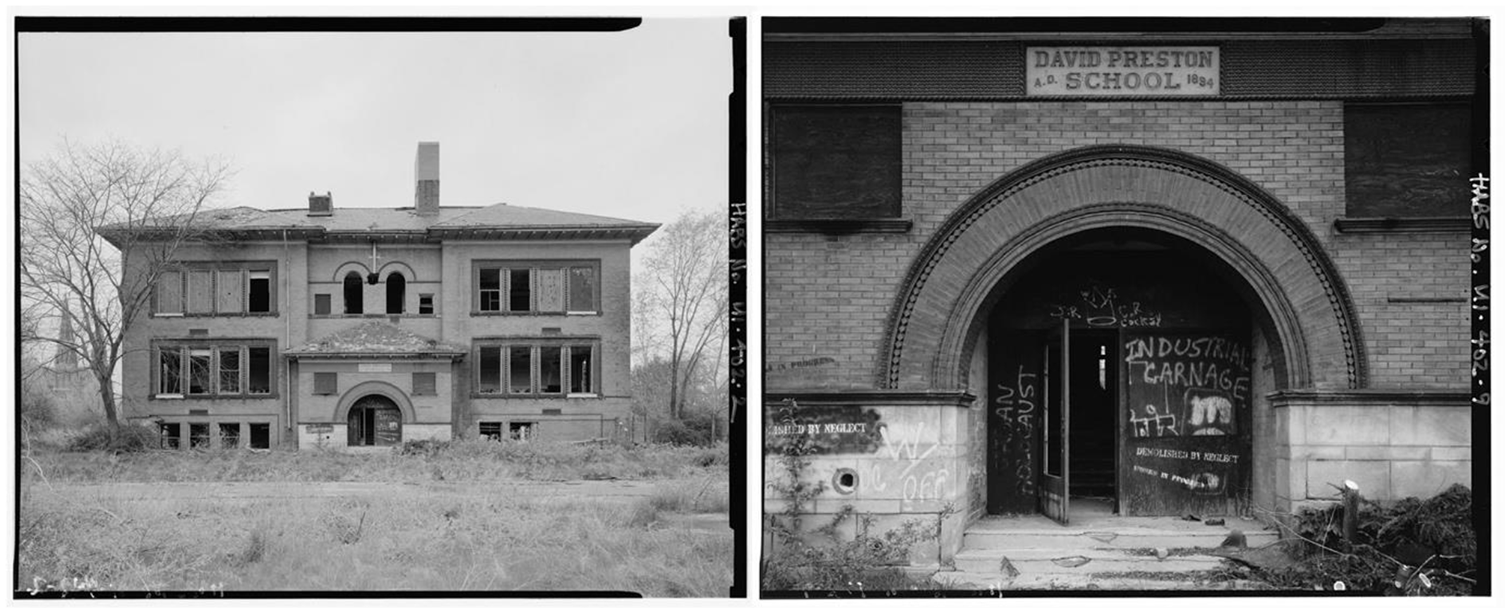
‘Preston School, 1251 Seventeenth Street, between Fort & Porter Streets, Detroit, Wayne County, MI’. Photo, Historic American Buildings Survey, National Park Service.
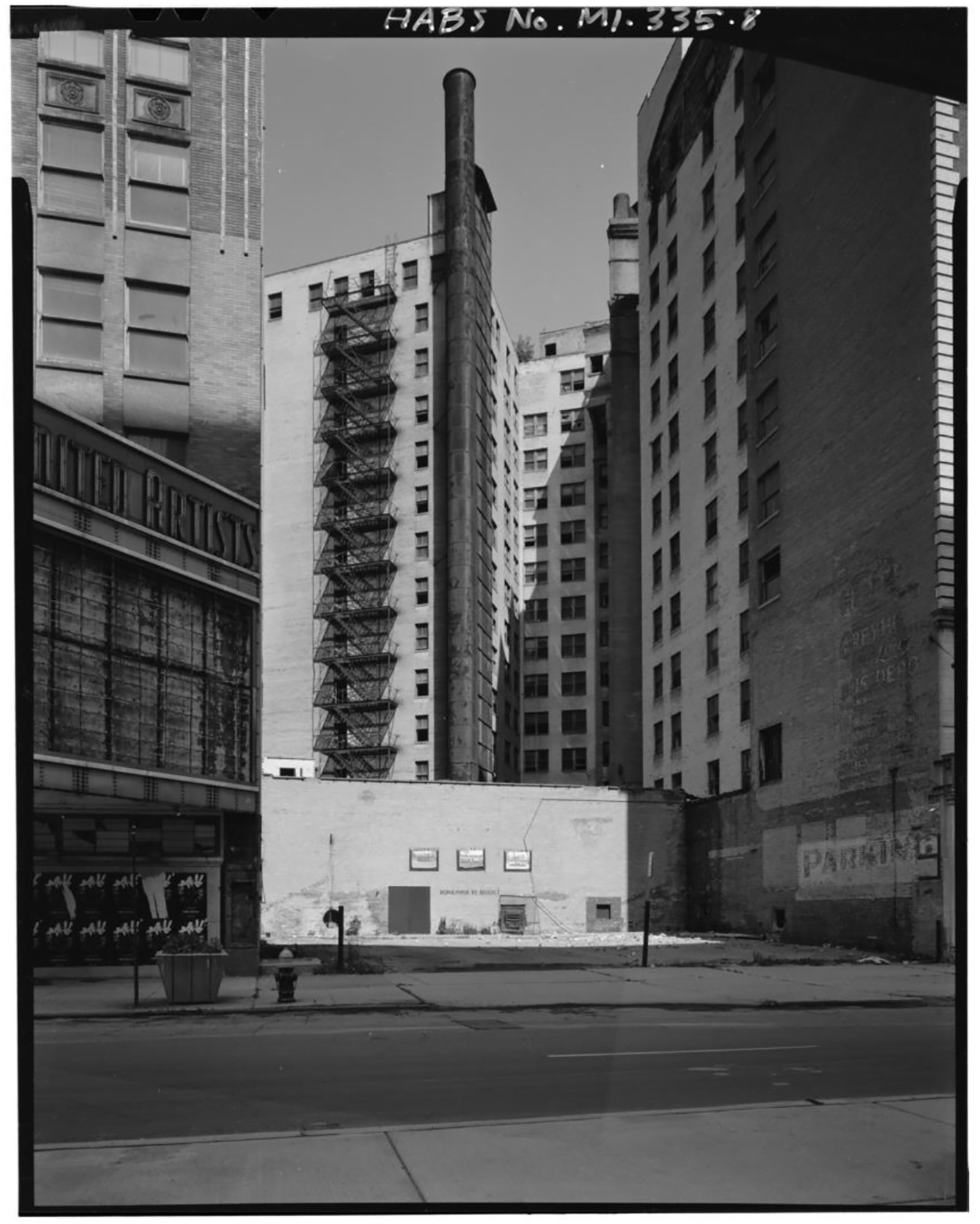
Tom Frank’s Demolished by Neglect photo-installation of abandoned and burned out cars. See ‘Tuller Hotel, 501-521 Park Boulevard, Detroit, Wayne County, MI’. Photo, Historic American Buildings Survey, National Park Service.
The performative nature makes the installations go beyond the more dominant denotated relationship ruin imagery sets up, that is as an image describing dirt and dereliction of building and lives as an inevitable and so-called natural process of decline. Neglect is thus the UCP’s casted shadow over the ruined historic structures. Spectators are not merely directed to the traces of decay shown in the image but to the ongoing process of neglect still occurring today. Hence, the UCP’s installations demonstrates, as Graznak mentioned in the UCP’s meeting with the city in May 1987, that ‘neglect is a conscious matter [and not produced by some natural event]’. 65 In other words, the photo-installations and the records of the installations are intended for the spectators or readers to recognise their co-presence with the event addressed and thus see the installations as records of ‘an ongoing event’ rather than as a representation of ‘a pre-existing object’. 66
Decay as advertisement: demolished by neglect
The UCP’s focus on the processes of neglect and demolition as ‘an ongoing event’ can be interpreted as an appropriation of the one thing Young’s city administration was supposedly very good in, namely advertisement campaigns to see the real city. Like advertisements, the photo-installations are placed in visible and high traffic locations on and around iconic buildings bordering the People Mover or other contentious sites undergoing some sort of development. 67 There is an insistent repetition and wide distribution of the same message ‘Demolished by Neglect’ and ‘Work in Progress’ in different forms and locations which potentially brands the city as a city demolished by neglect. What makes it stand out from advertisement’s desire for autonomy from its context to ‘violate’ reality and shock viewers is its relation to the urban surrounding. 68 There is no desire to simulate a reality because the images only intended to violate the city’s rebranded image. In that sense, the installations are indeed a form of ‘unwanted communication’ or an unwanted form of performativity to elicit an emotional response to the advertised product. 69
In more recent work in cultural geography, referring to the work of Naomi Klein, the geographer Thomas Dekeyser calls such practices of intervening into the advertising spaces ‘subvertising, a portmanteau for subvertising advertising’. 70 Others refer to similar practices whereby the public space is reclaimed as a form of ‘micro political resistance’ or what Klein called ‘cultural jammers’. 71 Besides advertisement’s intention to ‘violating reality’, visual theorist Paul Messaris also refers to images as evidence of the claims made by advertisements. 72 Hence, the installations parody the idea that the photographs in the installations evidence the success of the so-called advertisement campaign Demolished by Neglect. In that sense, these photo-installations as publicity do not persuade us, as John Berger mentions, ‘by showing us people [or places] who have apparently been transformed and are, as a result, enviable’. 73 Rather than being in a ‘state of being envied’ these new counter-publicity images of subvertising advertisements make us angry and shameful so that we might take collective action to prevent this from happening again.
The UCP’s strategy to appropriate the modes of address from those of the media and advertisement (including billboards, posters on buildings facades, subways and buses, newspapers and television) to find alternative platforms and spaces for their art (referred to by the art critic Peter Frank in the 1970s as ‘guerrilla-gathering’) places their work in the context of the driving art scene of New York in the 1970s and 1980s. 74 As mentioned by the artists Gregory Sholette, one of the founders of the 1980s New York Group Material, these ‘non-institutional forms of cultural distribution and interaction’ were used to speak about injustices and they did so ‘with an audience who presumably has little patience for refined aestheticism but does care about war, inequality, political freedom and protecting the environment’. 75 Art is perceived here as a cultural practice that has the ability, ‘to counter a world’, the critic Grant Kester mentions, ‘wherein we [community of consumers] are (. . .) dulled by spectacle and repetition’. 76 It is the argument of this paper that by imitating the image strategies the City of Detroit used in their branding campaigns, the UCP provide a particular answer to one of the questions posed by Sholette in his reflection on the success of the PAD/D’s exhibition Art for the Evicted in the Lower East Side: ‘The question is, how does it go beyond the art world? That’s the tough part’. 77
Conclusion
When no resolution was found on the use of the historic Monroe Block’s facades for the Demolished by Neglect mural piece in 1987, little did the Detroit Council for the Arts (DCA) know that the UCP artists would execute the project by trespassing on abandoned properties and mounting blown-up images of neglect. The posters outraged the members of the DCA. But instead of taking the opportunity to discuss the demolished by neglect theme in relation to Detroit’s future urban developments, the DCA opted to decry the art project and shift its focus of attention to the context of production, namely the illegality of the artists’ actions and the so-called waste of taxpayers’ money. Any critical (or self-reflective) note to interrogate the positive images the city promoted through advertisement campaigns needed to be opposed and avoided. The human geographer Tim Creswell writes about such image battles in the context of former New York City Mayor Lindsay in the 1970s whereby graffiti was set apart as matter out of place; ‘a massive and continuing defacement destroying the proper significance (meanings) of the carefully controlled facades of the urban environment’. 78 These sort of binary dichotomies like ‘art or visual pollution’ or/and rebirth and decline that these defensive reactions of the DCA produced, this article has shown, are in fact artificial cultural constructions serving a specific purpose whereby one mode of city building can be justified over another. They appear natural and innocent but, they undermine any serious interrogation of ruins and its image to the point that many artists and writers do not dare to touch this topic out of fear to be marked as a ruin porn image maker. If Demolished by Neglect showed one thing it is how much ruins and ruination are co-produced and sustained by the discourse on rebirth and the modes of urban governance and planning that belongs to the process of accumulation by dispossession.
This close interrogation of Demolished by Neglect also proofs that alternative art practices to change the system of distribution and representation were not solely confined to places on the East and West Coast. Detroit had and still has an active art scene where artists are motivated to develop alternative approaches to go beyond the limited confines of the art institute. And while in this article the UCP was analysed, other photographers were equally active in critically engaging with the City of Detroit’s renaissance discourse. One of those photographers is Douglas Aikenhead, the former head of the Detroit College for Creative Studies (CCS) whom together with the social historian John Bukowszcy compiled and edited a photography book Detroit Images: Photographs of the Renaissance City (1989) and asked readers ‘what will remain’ of Detroit if Young’s renaissance continues to guide Detroit’s future. 79
Current writings around placemaking urbanism in Detroit driven primarily by Gilbert’s company Bedrock confirm what has been mentioned here as well around the acknowledgement of the threat that graffiti poses to the image of the city when it is labelled as filth. Like in the 1980s and today informal activities like graffiti and murals appear to be only accepted, writes Lisa Berglund, ‘as entrepreneurial by the media and presented as necessary to attract an arriving class of young professionals’. 80 And even though some might see the city as a curated environment, recent publications in City demonstrate the continued relevance and persistent use of graffiti and street art in general in the city, as Anna Carastathis and Myrto Tsilimpounidi mention, ‘walls, in times of crisis, are repurposed as canvases of resistance, which communicate, amplify, and incite embodied resistance to authoritarianism and state violence’. 81 References are made to graffiti’s ability to denounce or challenge ‘the violence of private property and neoliberal capital’. 82 Street art remains as Creswell writes ‘a “tactic” of the dispossessed’. 83
Footnotes
Acknowledgements
I am grateful to Julian Brigstocke for his insightful comments on earlier drafts of this paper, to the two anonymous referees for their supportive feedback and to the editor Harriet Hawkins for her care in guiding me through this process. I also would like to thank the photographers in Detroit for sharing and discussing their photographic work from the 1980s in Detroit. Thank you, Michelle Andonian, Douglas Aikenhead, Lowell Boileau, Carlos Diaz, James Dozier, Michelle Graznak, Keith DeCesare (formerly Piaseczny), Jessica Trevino, Bill Sanders, Rolf Wojciechowski, and Marilyn Zimmerman. I also would like to thank Douglas Aikenhead, Romain Blanquart, John J. Bukowczyk, Bruce Harkness, and Anne Schenk for hosting or/ and guiding me around Detroit when I was doing fieldwork. And finally, I want to thank Barbara Penner for her continuous support during and after the PhD research.
Ethics Statement
When the fieldwork was done for this research in 2012 it was exempt from the requirement to obtain ethical approval through the University College London Research Ethics Committee. The data from the interviews was collected and stored in accordance with the Data Protection Act 1998.
Funding
The author(s) disclosed receipt of the following financial support for the research, authorship, and/or publication of this article: This research was funded by an AHRC Studentship Award, a Fulbright fellowship at Columbia University and the Bartlett School of Architecture Research Fund. For the images I received funding from the Welsh School of Architecture Research Grant Funding.
