Abstract
This essay combines text and photographs to animate and engage the 2021 Extinction Rebellion protests in London. The work draws attention to the Rebellion’s creative interventions in public space and identifies and explores five modes of geographical street activism. We offer this encounter and visual report in the hope that it might inspire geographers to imagine and launch their own ‘impossible rebellion’ in the wake of environmental emergency.
From the 23rd of August to the 4th of September 2021, London’s streets hosted ‘The Impossible Rebellion’. These actions were organised under the banner and umbrella of Extinction Rebellion (XR), a global network describing itself as a ‘decentralised, international and politically non-partisan movement using non-violent direct action and civil disobedience’ on issues relating to climate change and ecological crisis. 1 The Impossible Rebellion represented the fifth major set of XR protests in the United Kingdom, in which activists and organisers targeted the City of London as the home of many banks, law firms, oil and fast fashion companies. This fortnight of non-violent protest saw hundreds of arrests. 2 We participated in 4 days of action in the streets of London. Since the movement’s formation, XR protests have been characterised by the creativity of their interventions into public space, and the 2021 action was no exception. As a focal point of protest, we saw a huge pink table erected in central London bannered with the words ‘COME TO THE TABLE’. The table represented attempts to initiate grass-roots debate about climate crisis and ecocide and is indicative of XR’s ambition to initiate wider and deeper popular reflection and engagement.
In this photo-essay, we capture moments of creative transgression in the 2021 protest and address five modes of geographical street activism: Claiming Space; Bodies on the Line; Serious Play; Blood, Muck, and Money; and Pose and Gravity. Since XR’s birth in October 2018, it has developed a formula and style of public insurrection in which self-consciously performative acts interrupt the normal flow of traffic, people, time and governance. The aim is to generate public awareness, to pressure governments into action, and to conjure an ephemeral collectivity. The photographs reproduced here were taken at three specific moments and sites of action in London: on Day one, at the Blood Money March, and at the Tea Party. We offer these photographic montages and accompanying reflections as a means of not only documenting protest but also inspiring and provoking geographers to engage and take action within our shared environmental emergency. All photographs were taken by authors.
Claiming space
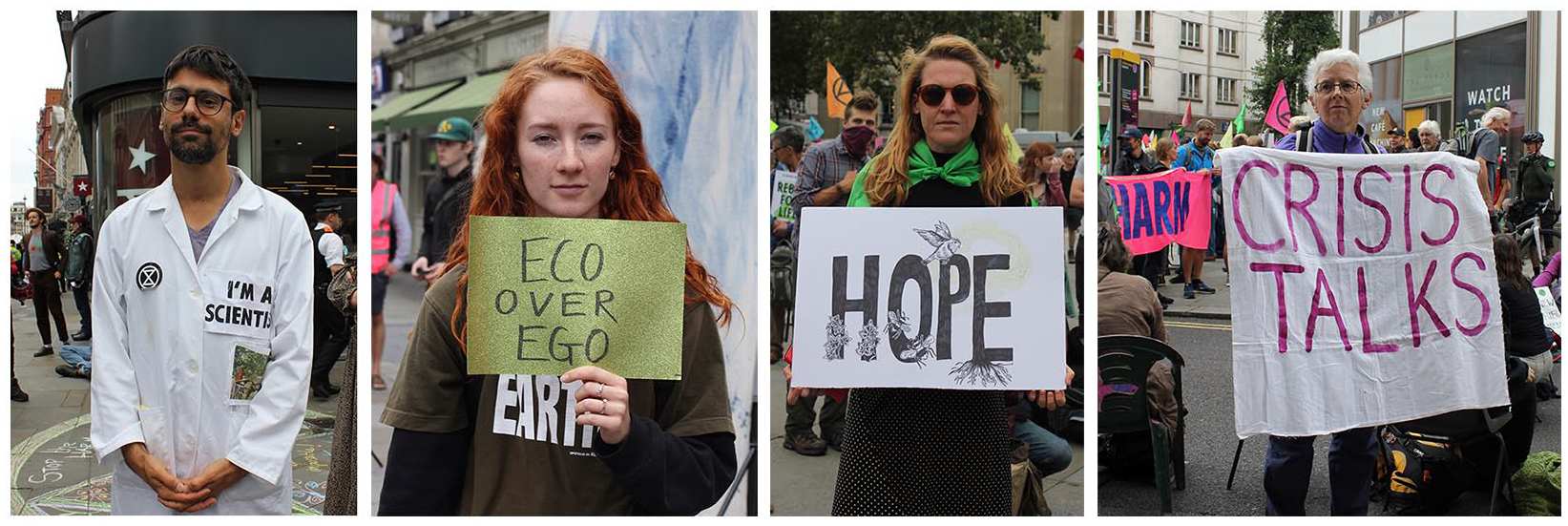
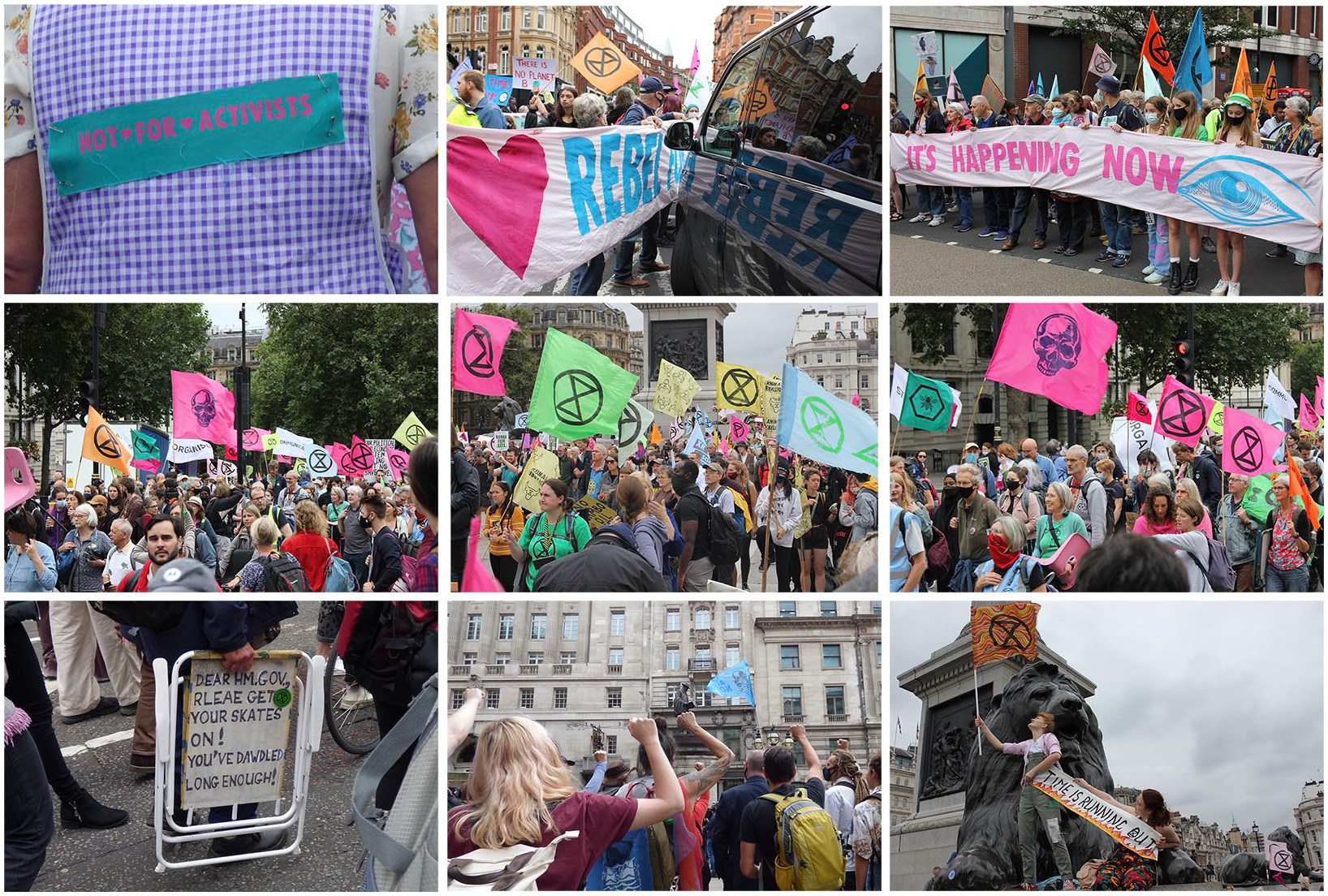
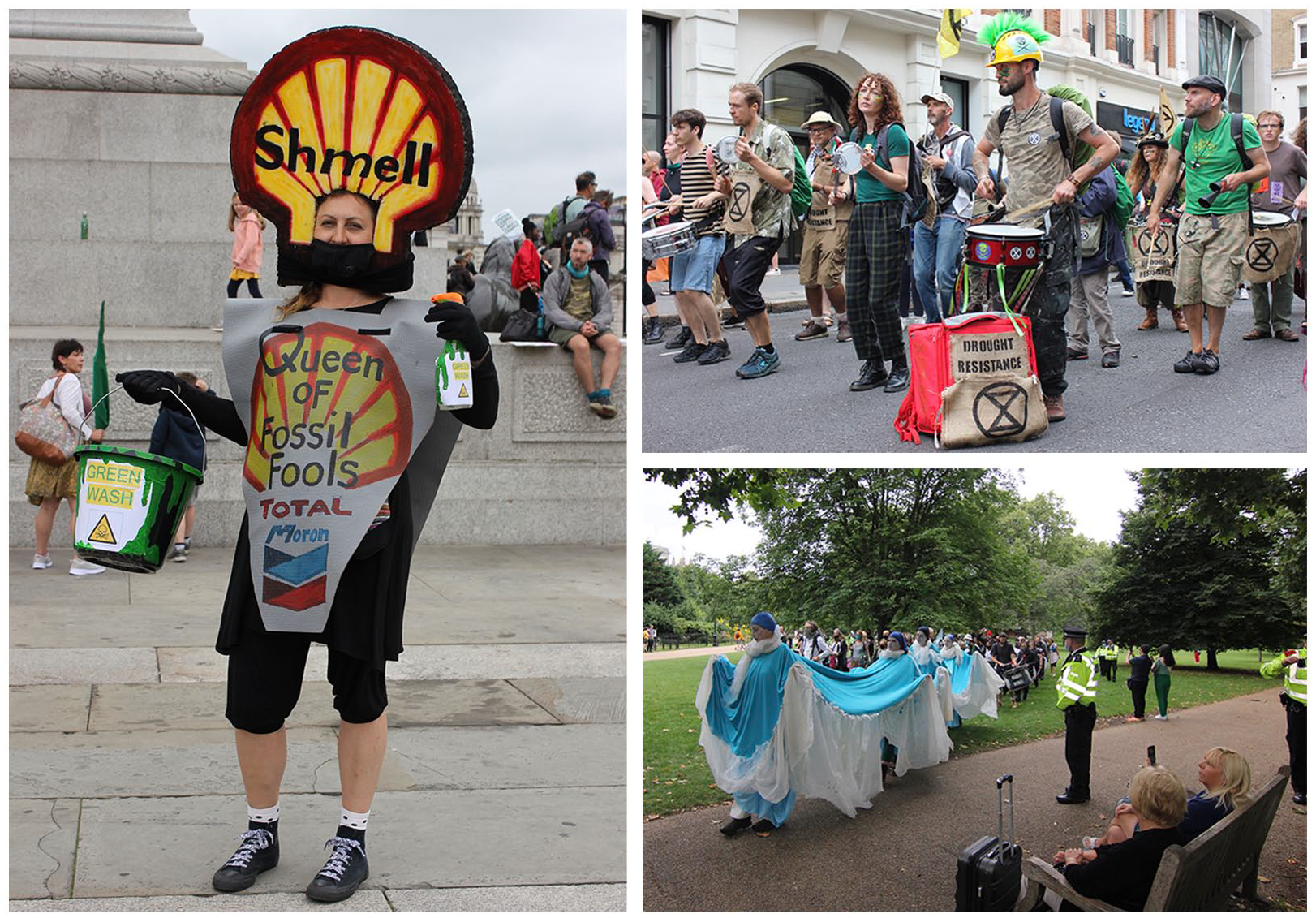
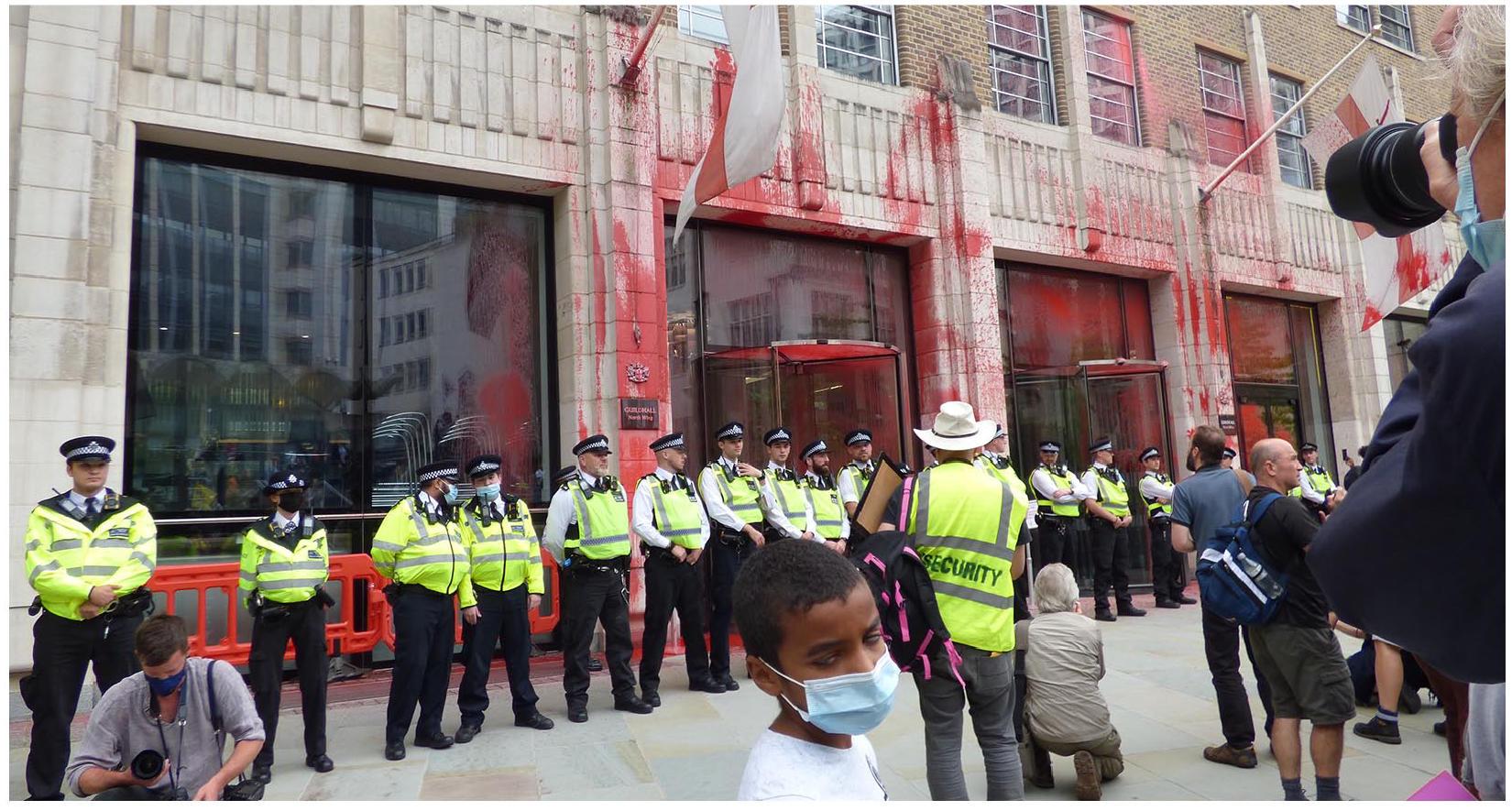
Crowds fill the roads and squares beside the Bank of England, Tower Bridge, Trafalgar Square and the Guildhall. Taking over famous sites, roads and bridges, protestors’ claims on space do not follow strictly prescribed routes or ask for police sanction and, hence, have an organic and unpredictable energy. Staged moments of protest come and go within the ebb and flow of the wider crowd. The crowd is an active player, part audience, part actor, a deliberate confusion of roles that facilitates a wider rupture in normality. At the fringes of the crowd, the protestors meet traffic, pedestrians and the police, and new ruptures form – daily life in the city has been disrupted. It is here that direct confrontation takes place with the city’s domination by cars, turning polluting traffic into objects of protest and counter protest, as the crowd presses up against and blocks the passage of private vehicles. The demonstrators’ passions and ambitions intersect with the curiosity, confusion, and annoyance of those just outside its newly claimed territory. Our images show a demographic diverse in age, but more often White and, perhaps, middle-class. Despite a uniting anger, they tend to be well behaved, to the point of self-conscious politeness. The ubiquitous XR hourglass flies everywhere, filling up the streets, reminding us of the temporal nature of the crisis as well as protestors’ spatial claims on the city. Time is running out fast. We don’t have much left. Along with other popular motifs, such as skulls and bees, the XR’s hourglass has become one of the most instantly recognisable symbols of our era. A logo for a no-logo movement, it strikes an X against ‘business as usual’.
Bodies on the line
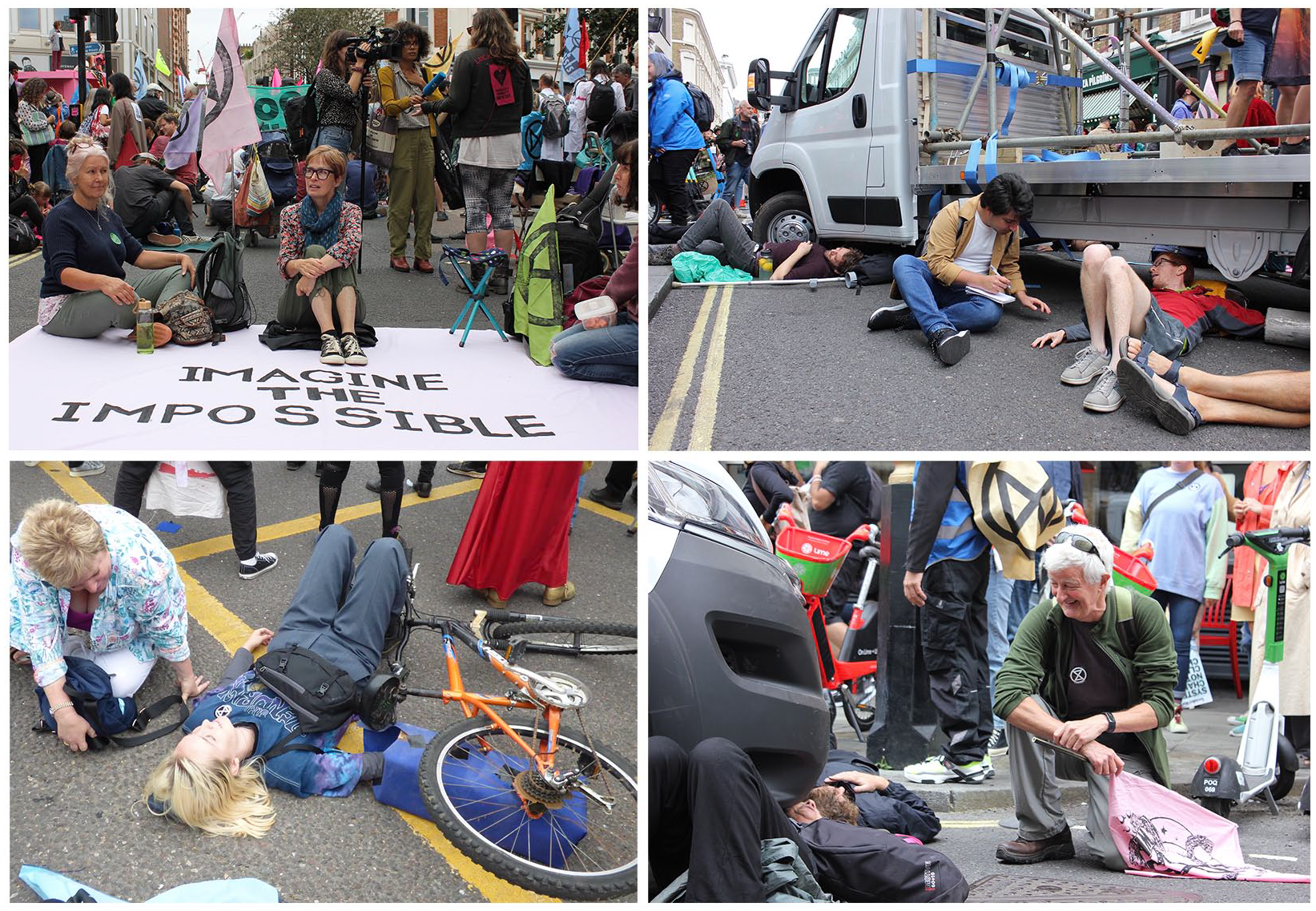
Creating immobility and deliberate obstruction are essential strategies deployed to stop business as usual. Getting in the way is the point. Environmental protestors have often chained themselves to destructive technologies, from whaling boats to oil platforms, and now glue themselves to roads and aeroplanes. 3 The audience for these daring acts can be global: the media is attracted to the danger and to the foolhardiness of people putting their bodies on the line. There is an immediate vulnerability on display that illuminates the protestors’ resoluteness. Lock-ons to bicycles or vehicles not only disrupt space but rupture time, threatening the city’s rhythm with the combined message: this crisis/this body/this vehicle is ‘not going away’. These bodies threaten or evoke non-violent martyrdom. Around the lock-ons, other less dramatic acts are performed, such as the transformation of the approach to Tower Bridge into a picnic site for afternoon tea. People simply sitting down, some with young children and flasks of tea, some dancing in the road or in front of the stock exchange, allowing themselves to relax and bringing a sense of play to serious and unwelcome spaces. Becoming comfortable, kicking back, in the financial heart of the city, the City of London, is itself a way of putting one’s body on the line, for it radically repurposes, if only for a few hours or days, a hostile environment.
Serious play
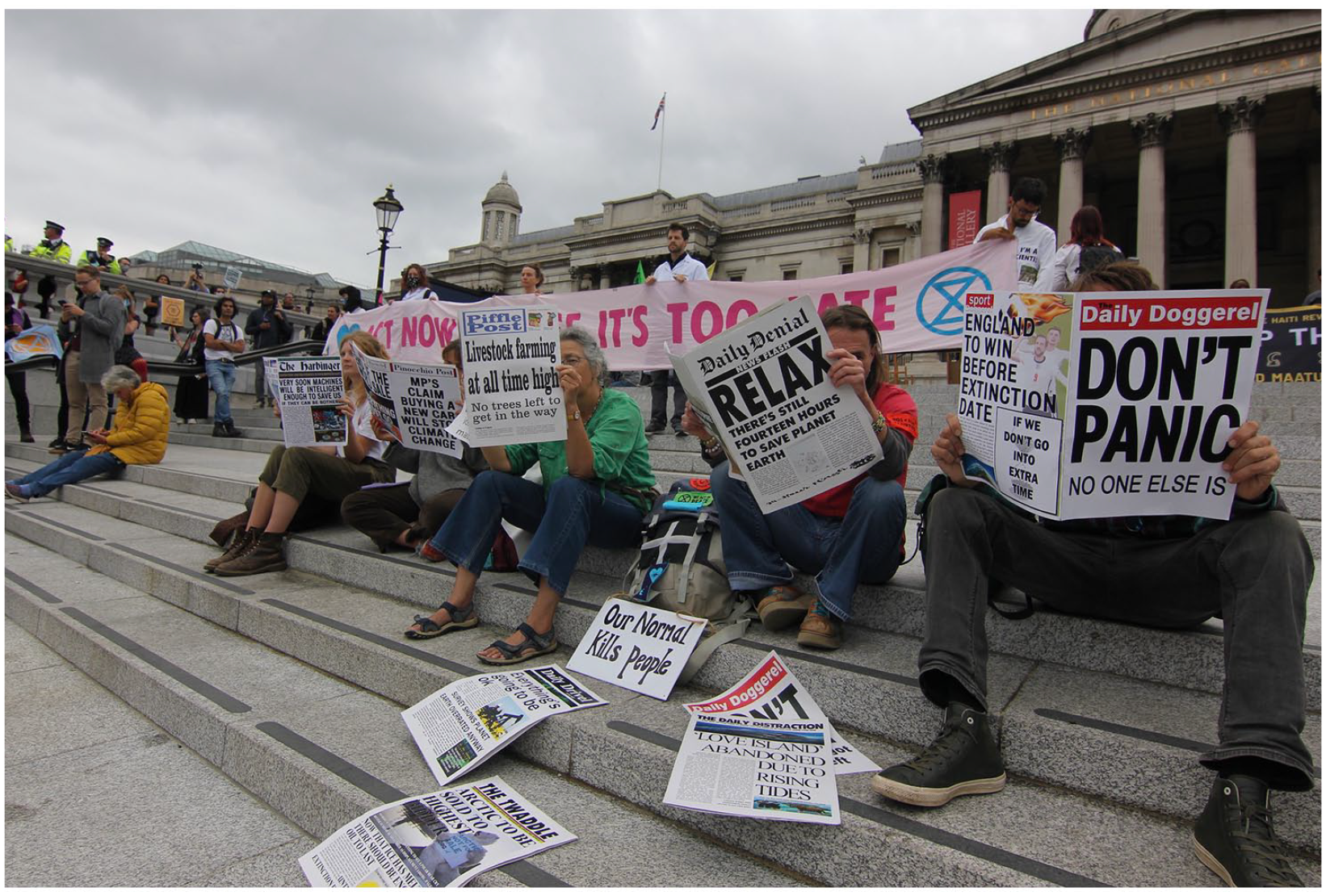
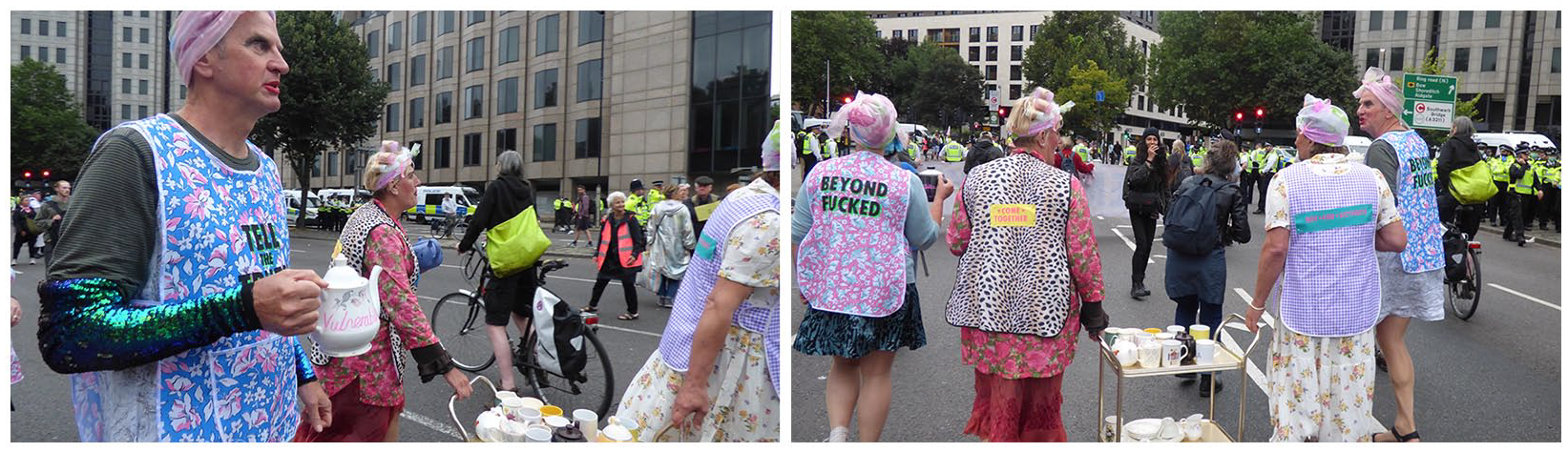
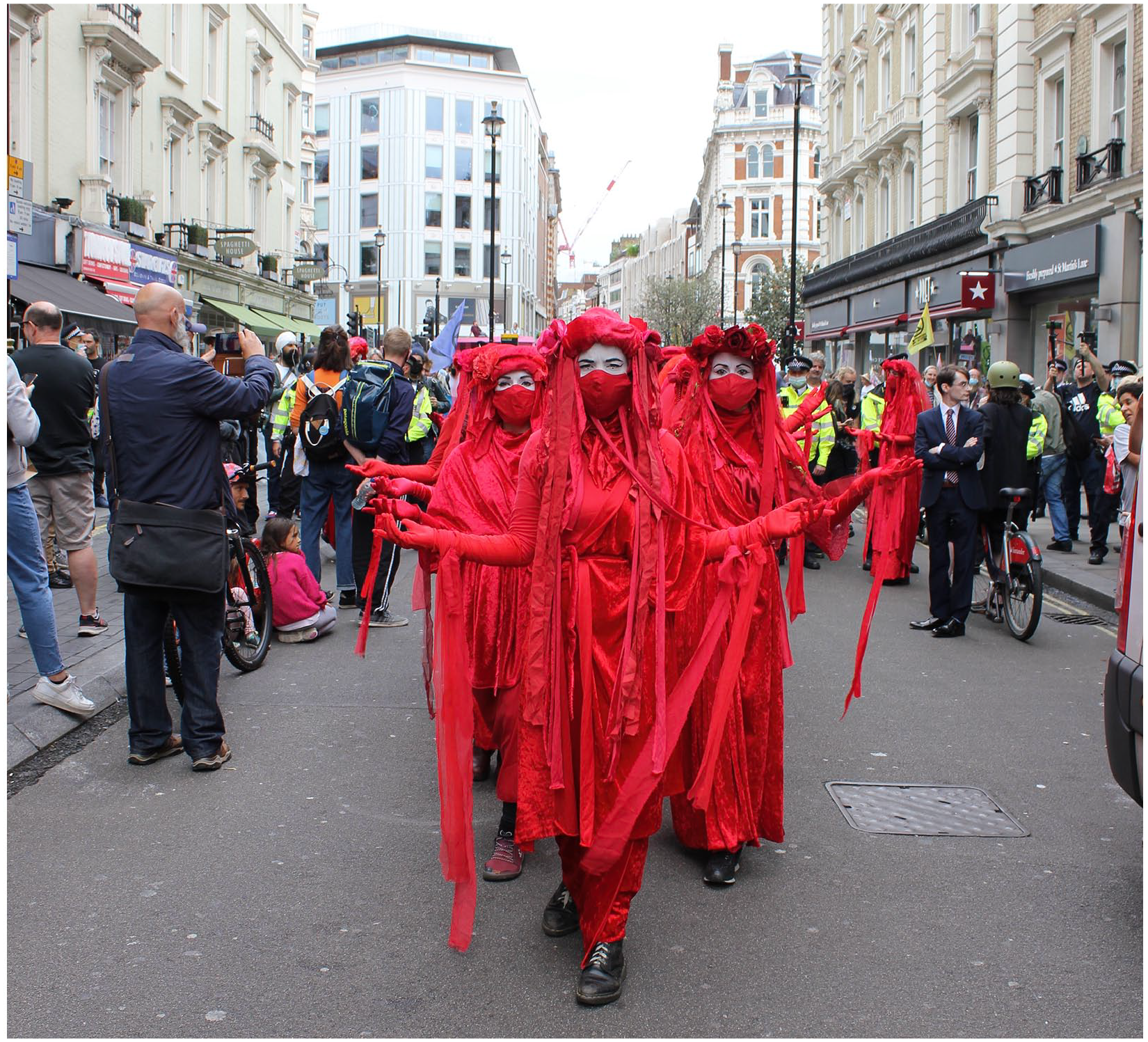
People sit on the steps on the National Gallery in London’s Trafalgar Square, reading a range of newspapers, including the Daily Denial, Piffle Post, The Daily Distraction and Daily Doggerel. At another location protesters, men and women, dressed as ‘tea ladies’, take part in ‘the impossible tea party’, a surreal evocation of corporate and government complacency which, in multiple forms, has taken place at many XR events across the UK (such as the Mad Hatter’s tea party at Gatwick 4 and the Dirty Scrubbers, dressed in curlers and aprons washing clean London’s financial district). Their self-fashioned costumes and banners reflect the Impossible Rebellion’s theatrical and farcical element. Even those painted in red (see below) exhibit a kind of childish glee, a love of comedy and jovial camaraderie: a carnival atmosphere whose momentum and rhythm are driven forward and scored by a diverse sound landscape of choirs and chatter along with batteries of samba bands. Creating a sense of festival is the Impossible Rebellion’s self-conscious aim, connecting and contrasting our sombre environmental reality with an affirmation of enchantment and transformation. The background noise of play means that the more tragic theatrical elements, such as the Cassandra figures of the Red Women, cut through the atmosphere more sharply.
Blood, muck and money
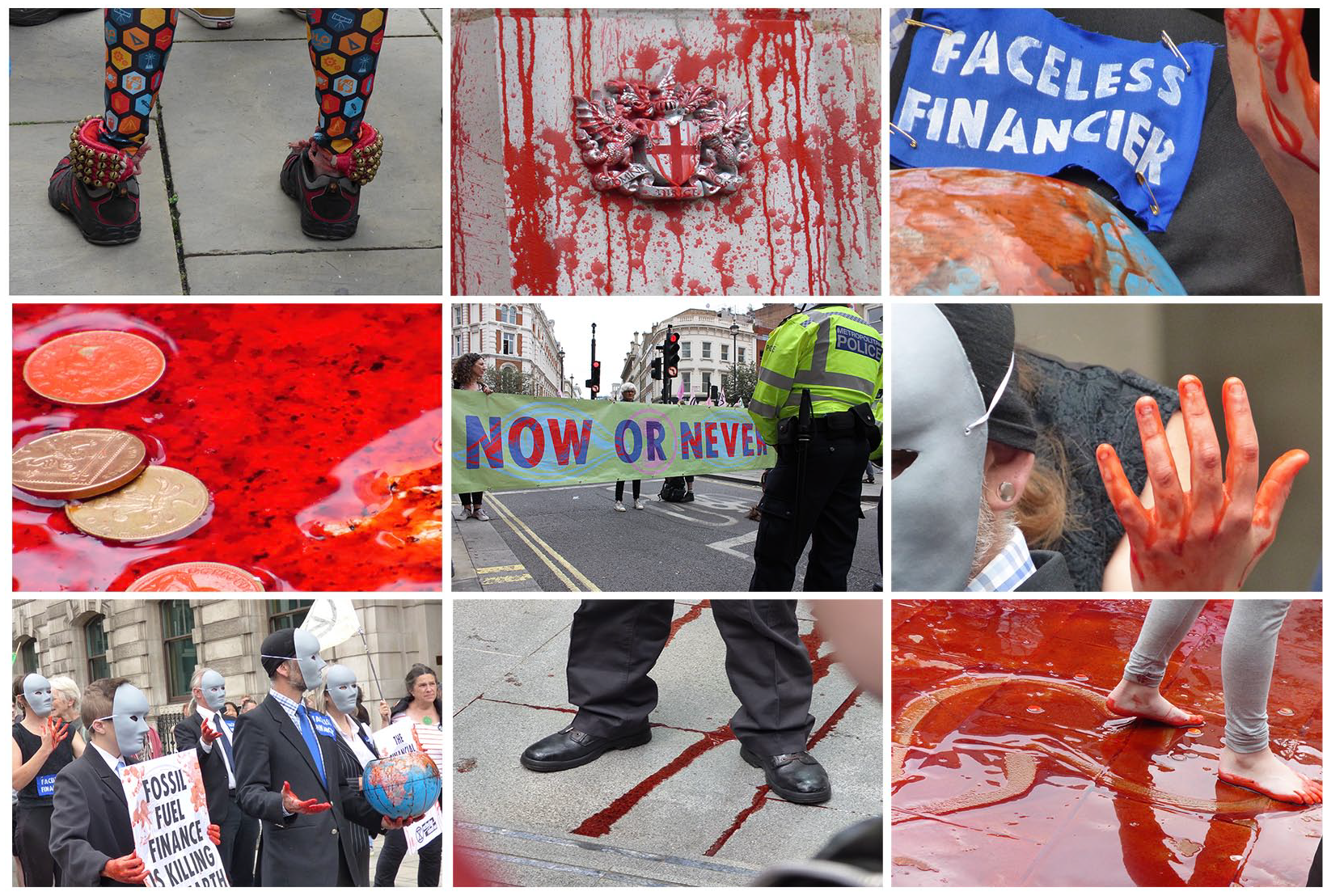
In Paternoster Square, outside the London Stock Exchange and in the shadow of St. Pauls, fake blood is liberally poured; protestors then spill handfuls of coins into the ‘blood’. It is dark and sticky, and as the crowd swirls, it is smeared across the paving stones, pooling thickly in some places but fading out along lanes, roads and walls into ever fainter prints of hands and feet. This encompassing performance is a visceral response to the violence of a society putting profits over people. Some protesters are dressed in business suits wearing blank white masks – the Faceless Financier wanders about, hands dipped in blood – dramatically embodying and imagining archetypal bankers suddenly confronted with the consequences of their trade. Even here, humour can erupt; the tone can shift: at one point a suited protestor takes off his trousers to reveal large union jack boxers, hands still dripping with blood. Others are more understated, in faceless masks, silently holding up their red-stained hands. The white masks and bloody hands evoke the staging of Greek tragedy, a recurrent motif of XR’s attempts to evoke environmental tragedy. These performances offer a complex mixture of the grandly performative and the intimate and small-scale. The coins protestors spill into the blood, and their bare hands and bare feet, soaked and bloody, register the violence that is being challenged but also the visceral disgust and anger felt by the protestors.
Pose and gravity
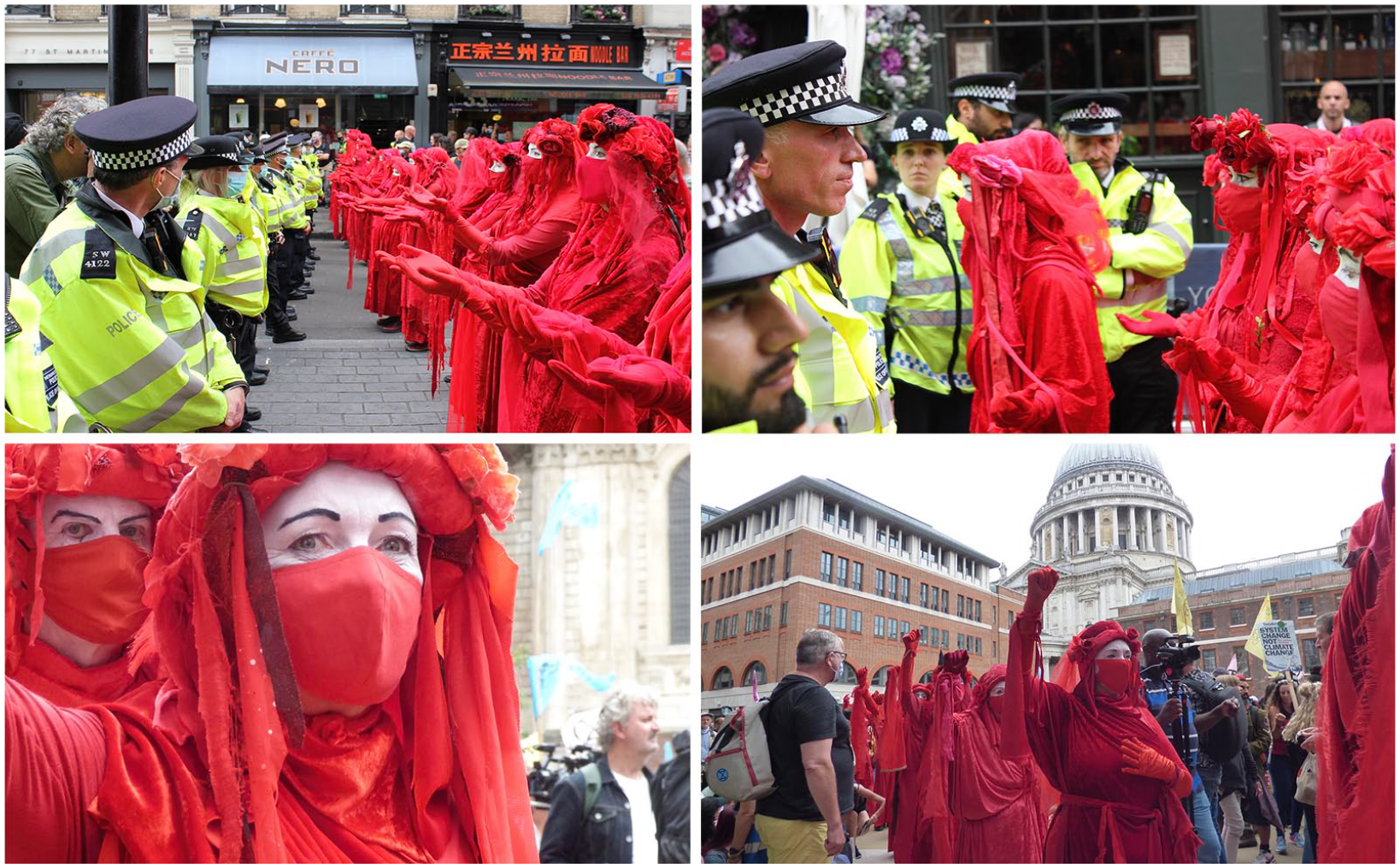
A procession draped in red cuts through the crowd and elicits a rippling hush. Greek tragedy is again conjured by the Red Women, a masked troupe characterised by slow, silent procession and dance. It is an expression of raw, unblinking grief, an emotion that contrasts with and is highlighted by the surrounding carnival atmosphere. The Red Women process through the crowds, inserting a sense of gravity and reverential horror into the ‘fun’. Their relationship to the crowd is clear-cut, but the sorrow they evoke is shared. Their performances have no clear start or end but come and go, a hushed moment in a protest that was a party and has become a wake. Although not exclusively female, the Red Women bring a powerful sense of feminist anger, although the meaning of their work remains elusive and troubling. For some, they may summon tropes of mother earth and guardianship, for others an apocalyptic mourning for a dying planet. We are reminded – with cold, unsmiling clarity – that the Impossible Rebellion is necessary not just because change must happen but because it hasn’t and it’s now becoming too late.
Postscript
2021: The Pacific Northwest bakes under an extended heat dome as the town of Lytton in British Columbia hits a record-shattering 49.6°C. Wildfires rage in Greece, while China’s Henan Province experiences its heaviest rainfall since records began. There is a massive ice melt event in Greenland. Drought in Brazil. Such examples could be multiplied. This is our shared climate emergency. In such circumstance, Extinction Rebellion urges us to act, to not sit idyll on the side-lines, but to engage, protest, and imagine a better future. Since its formation in 2018, the Rebellion has accelerated through a decentralised global network of organisations and individuals. Its style and method of public insurrection are provocative; activists often ‘get in the way’, disrupting and disordering the status quo. This disorder is also a creative re-ordering, demonstrating how civil resistance and imaginative freedom can walk hand-in-hand. As we have shown – as we have pictured – these interventions are at once playful and tragic as they hope to ignite wider popular action but also acknowledge the irreparable nature of the damage done.