




Abstract
Little Amal is a giant puppet who walked across Europe in 2021 to highlight the plight of child refugees. This paper reflects on my experience of her visit to Oxford, UK, critically evaluating the political potential of the event through Amal’s status as stranger and arguing that the practice of walking with Amal provides new but qualified political potency.
Introduction
On 27th July 2021, Little Amal (a 3.5 m tall puppet of a Syrian refugee girl) departed from the Syria/Turkey border on an 8,000 km walk through eight countries, ending in Manchester, UK, in November 2021. Encompassing 100 events in 65 settlements, each tailored to the local cultural context, this monumental public arts project (The Walk) sought to prompt the world not to forget displaced children. 1 On 26th October, Amal appeared in Oxford, where she met Alice (of Wonderland fame), another over-sized puppet. Here, I reflect on this event (Amal Meets Alice) as a spectator, drawing on Simmel’s stranger 2 to interrogate its political potency. I argue that although scalar factors and narrative intertwining between the two female protagonists obscured the concrete experiences of child refugees and concealed the critical purpose of The Walk, the practice of walking with Amal partially counteracts this through personal and collective embodiment of walking practices we might commonly associate with refugees. While a space of empathy emerged from walking with Amal, highlighting the potential for the spectating public to forge new solidarities and shared understandings, this overshadowed the intended politics behind the performance. Walking with Amal, then, renders such public art performances simultaneously productive and problematic.
Amal meets Alice
Amal left Syria with a bag of memories, but after meeting Alice in the Garden of Live Flowers from Lewis Carroll’s Through the Looking Glass, the memories escaped from the bag and scattered across the city, leaving Alice and Amal to search the city for them, developing a friendship along the way. 3 Amal and Alice traversed some of the city’s busiest streets, peering into buses and buildings as they passed and interacting with each other and the audience. A stream of spectators accompanied them, while at key locations on the route, crowds gathered in anticipation. Important narrative events included Amal receiving a book that reminded her of childhood stories, singing that evoked her mother’s lullabies, and the sound of war, from which she had fled. Amal Meets Alice was described as predominantly non-verbal, relying on music and dance to tell the story of how Alice and Amal learnt about each other’s worlds, culminating in each girl teaching those present a dance from their own culture. 4
Geographically speaking, Amal’s epic walk reflects all three identified avenues for the disciplinary development of performing arts research – intercultural aesthetics, migratory mobilities and geopolitics 5 – as her journey as a refugee spoke to geopolitical issues through intercultural performative exchanges. It is in the context of intercultural aesthetics that Alice comes to the fore. Amal is established as a visitor, a stranger, who encounters the city as a detached or dispassionate outsider, 6 and Alice as familiar, a local, who welcomes and befriends Amal. Alice was tasked with introducing Amal to the city and introducing us to the stranger, while spectators were tasked with relating to Amal through Alice and relating to child refugees everywhere through Amal. The puppets were thus utilised to make the stranger familiar, and the political message accessible, through their association with a locally recognisable cultural figure. However, various factors contributed to the deconstruction and reconstruction of the political message by spectators as the event unfolded.
Taking each character in turn, I examine features of Amal Meets Alice that reduced its political potential, attending to narrative and visual aspects with respect to Amal, and Alice’s role as host and friend, before considering the centrality of walking to both the performative event and political message. I conclude that the political message finds its firmest footing in the embodied practice of walking with Amal.
Amal
In tailoring the event to the place of performance, two distinct narratives were interwoven: that of The Walk (Amal searching for her mother) and that of Amal Meets Alice (Amal searching for her memories). The former is grounded in concrete experiences of innumerable child refugees globally while the latter concerns the cultural history of Oxford. While the narrative events within Amal Meets Alice forged connections with the broader political purpose of The Walk, the associations forged with Through the Looking Glass depoliticised the social critique by grounding it in fantasy fiction, elevating place specificity above political potency by transforming Oxford into Amal’s own wonderland.
Visual factors relating to scale compounded this situation. The puppets towered over their human companions (Figure 1), drawing the gaze upwards, and the density of the crowds meant that only their torsos and heads were visible for most people. Amal’s height and certain physical features (eyelashes) suggested adult rather than child status, while those features that seemed most childlike (chubby legs) were mostly obscured by the crowd. Similarly, the more human scale of narrative events connecting with the political message of The Walk made these events inaccessible for those further back in the crowd. Together, these factors rendered Amal Meets Alice scalar aesthetic rather than political message, spectacularising puppets rather than problematising (child) refugees.
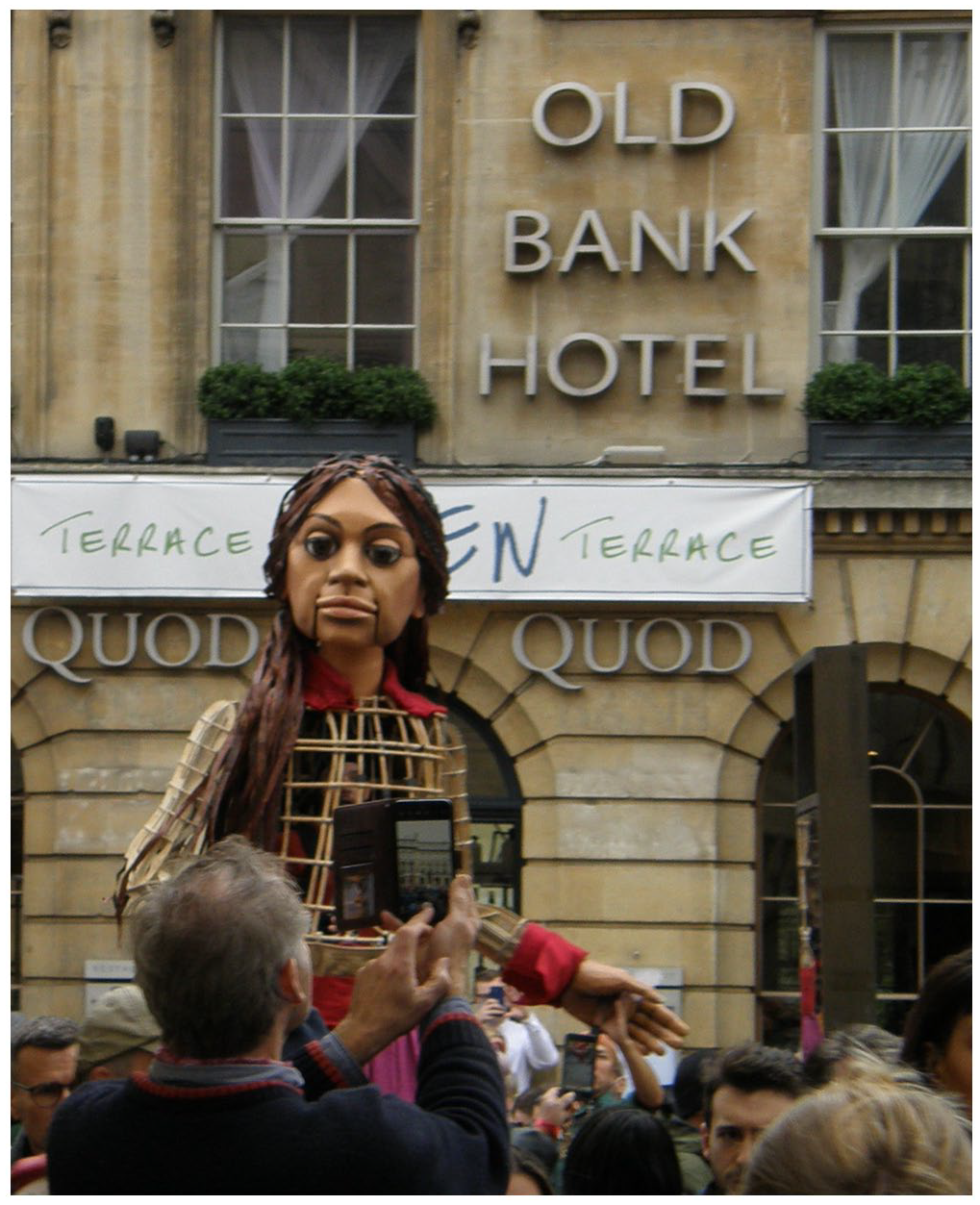
Amal.
This is not to suggest that these puppets were ineffective. Amal’s seemingly spontaneous acts of peering into windows or responding to spectators conveyed vitality, awareness and curiosity, while spectator mutterings of “Oh, bless” as her eyes slowly closed or “Ahhh” as giant puppet hands gently greeted a small human child evidenced empathy matching the crowd’s palpable sense of awe. One especially powerful moment involved Amal peeking curiously through an arched gateway, seemingly apprehensive as to whether to enter, prompting several spectators to egg her on with calls of “go on, go on”. The crowd clearly invested in Amal and empathised with her sensitivities, even if not with her plight as a child refugee.
Alice
Even before the puppets appeared, people referred to ‘Amal’ and asked where ‘she’ was, conceiving her as an agentive characterful individual. The emphasis on ‘she’ in the singular confirms that it was Amal (not Alice) who was the centre of attention despite the elevation of place specificity through association with Alice. Beyond favouritism toward Amal, Alice was explicitly rejected, described by some spectators as freaky, creepy, and an unnecessary distraction despite being the intended locus of cultural exchange. Her pouting expression seemed anything but welcoming (Figure 2), and Alice’s roles as host and new-found friend to Amal were only fleetingly perceptible. While there were instances of intimacy (e.g. hugging), they spent much time apart, and rather than Alice presenting the city to Amal, the serenely curious Amal largely carved her own path, with Alice lumbering glumly along behind (Figure 3). The spatial relation performed thus contradicted the narrative relation proposed.
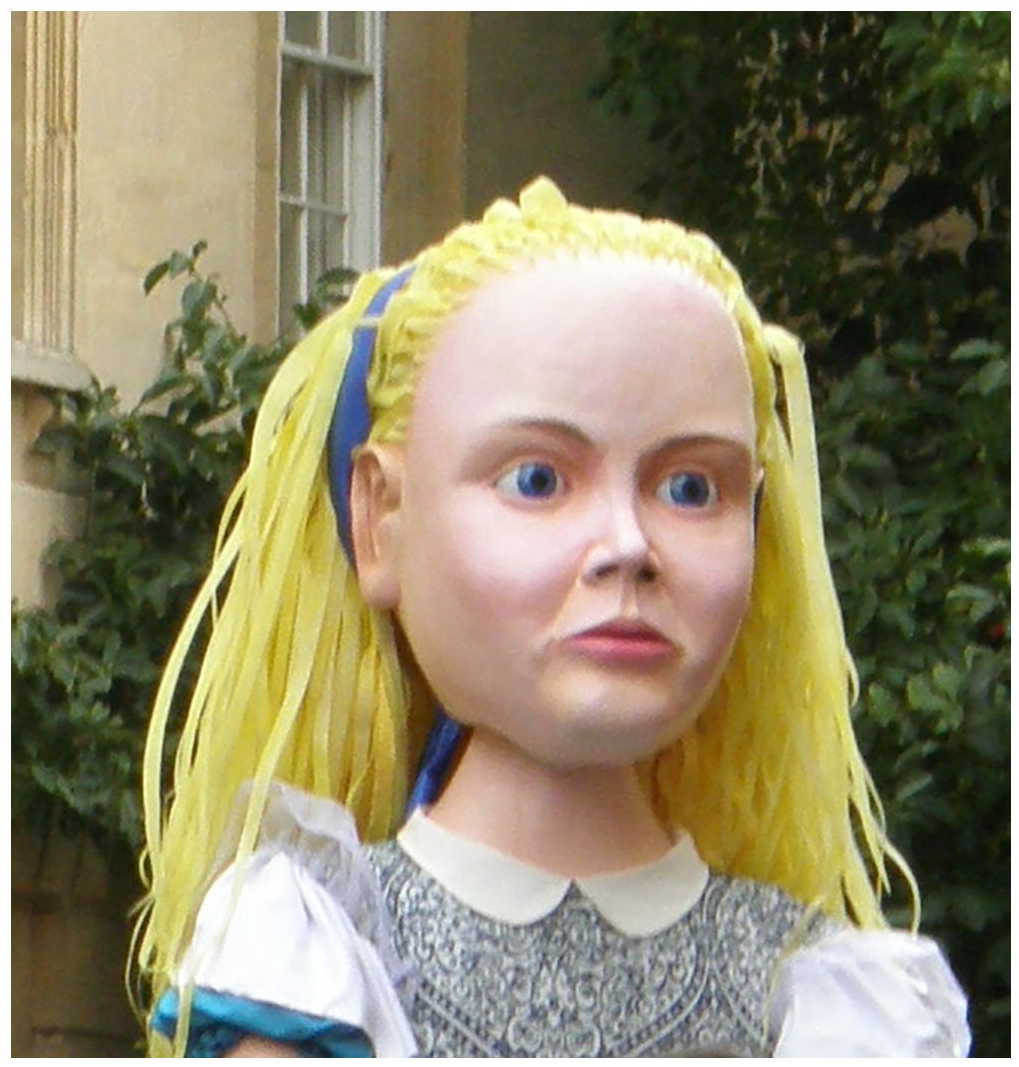
Alice.
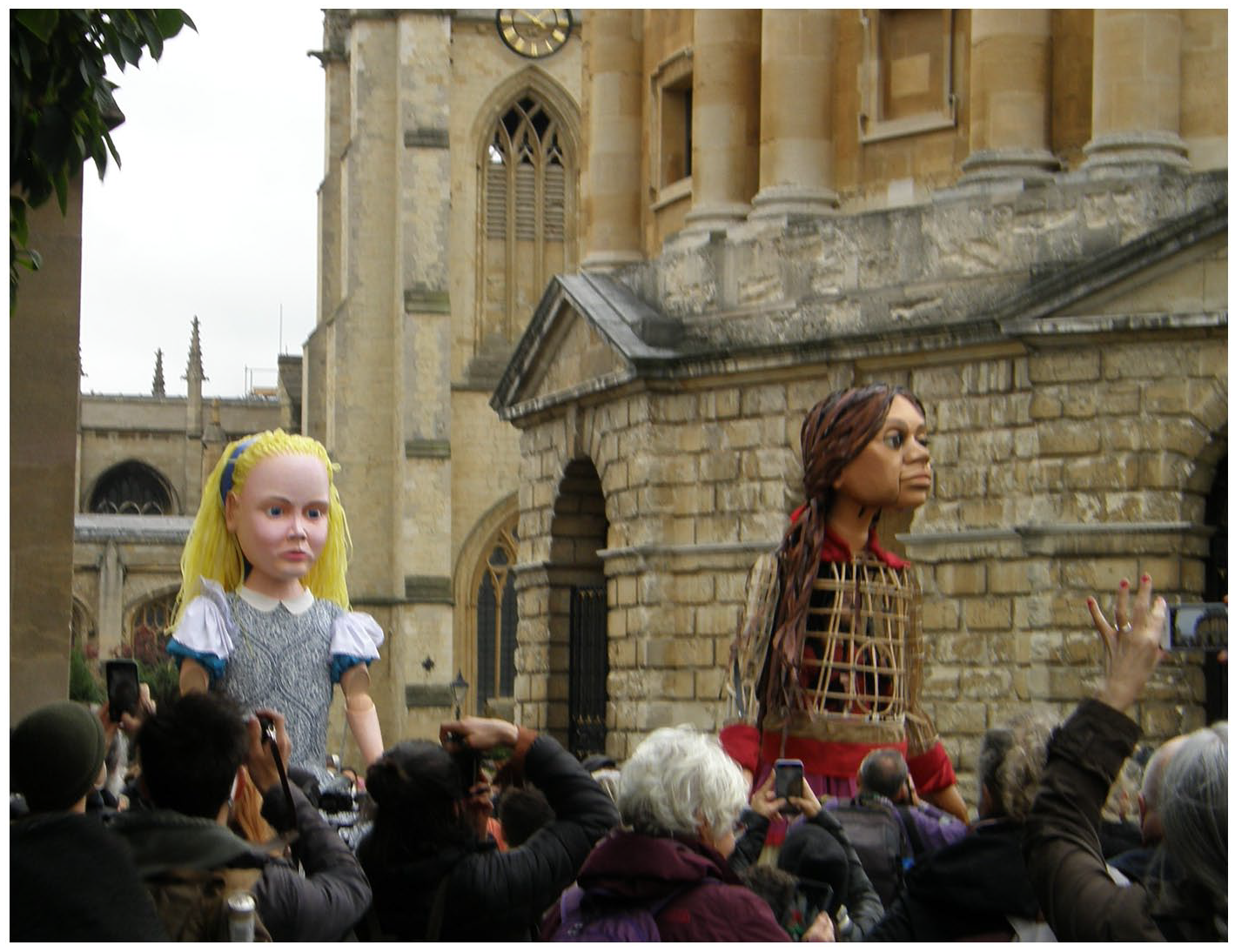
Walking with Amal.
Rather than forging a friendship with Amal, Alice seemed a grudging companion sulking at being eclipsed by the stranger, further mitigating against Amal’s political message. However, Alice did not obstruct the forging of compassion towards Amal as the crowd related to Amal independently of Alice rather than through her. Unlike Simmel’s stranger, the familiar was rejected and the stranger was welcomed, albeit with a sea of cameras that reinforced the spectacularisation.
Although the intertwining of political and fantastical narratives, the disposition of the host, the spectacularisation of scale and the crowding out of narrative events impeded the accessibility of the political message of The Walk, the crowd’s rejection of Alice in favour of the stranger simultaneously negated the elevated place specificity of Amal Meets Alice. Despite the global political and local cultural narratives being interwoven to facilitate the familiarisation of the stranger, these narratives were diluted and disassociated as the event unfolded, yet the stranger nonetheless became familiar, albeit on an affective rather than political level.
Mobilising the crowd
The political potential of Amal Meets Alice is partially reinstated by the mobilities involved, and specifically the equivalence evident between the movement of Amal and that of the crowd striving to ‘keep up’ with her. As the puppets and a crowd of onlookers walked up the High Street, the comportment, sway and pace of Amal mirrored that of the humans around her. Despite the human operator inside Amal, the extended legs (via stilts) and need to co-ordinate multiple operators (e.g. one for each arm) made this equivalence far from inevitable. Nonetheless, the affect achieved was commonality of motion and experience, and solidarity of form and community. An embodied motoric union was forged between human/s and puppet/s walking together, reminiscent of flows of refugees seeking sanctuary.
My own approach was to position myself ahead of the puppets, wait for them to get close and then scamper off to get ahead of them again, leaving me alternately swallowed by the crowd, struggling to escape from it, and free. Figure 3 encapsulates this sea of people accompanying the puppets approaching a bank of people watching them. Being enveloped by a mass of people moving in one direction, binding me to its own pace, established an embodied yet involuntary experience of that motoric union from within. Such immersion in the crowd provided a source of political meaning as the mass walking of refugees was memorialised in the mass walking of the puppet-human crowd. The crowd, its movement, its relation to Amal and my relation to it coalesced to generate powerful political pertinence.
This embodied motoric union both connected the practice of the performance to the political message underlying it and scaled up that political message from the individual puppet to countless refugees through the number of bodies involved. Thus, viewing and doing the mass walking partially compensated for the narrative conflation, spectacularisation and crowding out, thereby reinstating some political potential, but not specifically in relation to child refugees.
Conclusion
While narrative, scalar and crowding factors diluted the political message of both Amal Meets Alice and The Walk, Amal was warmly if spectacularly welcomed in Oxford. Such performances can impede their own political potential through narrative and aesthetic choices, yet spectators have capacity to generate their own meanings. This organicism suggests potential for such performances to elicit emergent shared meanings from the spectating public, as much as to communicate a pre-formed message, with potential for use in research contexts. Reminiscent of applied theatrical approaches to post-conflict cultural reconciliation, Amal invited cultural convergence, but on an affective plane only, placing the political message in peril. Within research contexts, meaningful airing rather than fleeting feeling of meanings among spectators might be necessary, thereby demanding subsequent discursive interaction. 7 This performance achieved its aim in spite of (not because of) the cultural interweaving of Amal and Alice, highlighting that cultural investment cannot be guaranteed even with the locally familiar, again rendering such performances risky. Nonetheless, simply participating in such events as a spectator offers both critical and creative potential, especially through engaging with the diverse spatialities, practices and people within the performance. The juxtaposition of embodied, affective engagement with reflective observation of the motoric union generated the deepest political meaning from the event. Although the political message about displaced children was lost, walking (and seeing others walk) with Amal embodied and invoked the mass walking of refugees in the puppet-human crowd. This reinstated Amal’s potency on a generalised affective level and suggests potential within experimental orchestration of diverse spatialities, practices and perspectives to generate shared meanings through performative research encounters.
Footnotes
Acknowledgements
I extend my thanks to Kelsey Monteith, Lucas Lyko, Elizabeth Bull and Zachary Elliott for their insightful contributions to a workshop that aided the development of the second draft of this paper. I am also grateful to the anonymous reviewers for their constructive and supportive feedback.
Funding
The author received no financial support for the research, authorship, and/or publication of this article.
Ethics Statement
Every effort has been made to ensure that individual spectators cannot be readily identified, for example by taking photographs from behind the crowd and only using images in which no individual spectator’s face is fully visible.
