




Abstract
This paper investigates how sound produces and transforms space and place as it moves and travels. In charting the movement of sound from field recording to music studio, and from rehearsal to performance space, this paper examines the aesthetic and affective geographies that are developed and the consequences of this travel. This argument is illustrated through the example of an artistic project that sought to explore the anti- or non-idyllic practice and experience of the British countryside in sonic and musical form. The notion that there are stranger and eerie, less bucolic, and more unnerving, versions of rurality formed the artistic impulse for this project. The paper explores the creative, emotional, and technical labour involved in translating this idea into sound and music. Through inspecting the processes of achieving this project, and the geographies it generated, the paper argues that it was in the translation and movement of sound through space and through different places that the project was – sometimes unexpectedly – realised. Thus, sonic atmospheres and affective charges of the eerie rural emerged because of this movement-transformation as much it did from the different creative and technical practices, and active sonic-interventions, that sought to achieve it.
Introduction: the strange and Eerie countryside
The rural idyll as a discourse, practice and experience of the countryside is a well-known and an often critiqued spatiality. 1 This bucolic formation is imbued with and known through notions of natural beauty, harmonious social relations, simplicity, and honesty. As a floating signifier and mode of habituation that coordinates places, materialities, products and experiences, the idyllic rendering of the countryside produces a space of peaceful nourishment, where the rural is given meaning as an often-enchanting repository of wholesome nature and an escape from the urban. This idyll exerts a considerable ‘pull’ for many, often middle-class, demographics, and underpins and merges with many other identity formations, particularly those of the nation. However, notwithstanding the socio-economic relations of un- and under-employment, second homes and unaffordable housing, and limited public services that this idyll masks and obscures, the rural, for many, can also be something experienced and felt as distinctly less bucolic, through a sense of rurality that admits “troubling elements, and whose overriding impression of rural space challenges its idyllic rendition.” 2 This paper is based upon a sonic-musical project that started with and explores the critical counter-notion that the countryside is not, or ever was, this idyllic space – what has been variously called the non-idyllic, the anti-idyll or the rural abject. 3
The notion of the anti-idyll as a source of inspiration for this project manifested in two ways. First, this non-idyllic countryside has been aesthetically rendered many times through a transformation of the rural into a space of the horrific and the gothic. Variously termed rural gothic, rural horror or folk horror, this aesthetic circulates and is consumed through a wide variety of films, television programmes, fiction, fan internet sites and Facebook groups, art and music. 4 Whilst defining what counts as rural or folk horror is a source of considerable debate, there are a number of themes which approximately circumscribe this ‘genre’: the countryside as a repository of folk or pagan beliefs and communities at odds or in conflict with rationality or Enlightenment thinking; the rural as a space hostile to the (often urban) outsider; or the countryside as a space where the unearthing of forgotten or occluded histories, lying beneath the surface of the landscape, becomes a source of terror. 5 As Young puts it, the rural here has the potential “to conceal persistent folk memories, supernatural doings and secrets – even, in its most extreme cases, abject horrors.” 6 Examples abound but think of the ‘The Slaughtered Lamb’ pub in An American Werewolf in London (John Landis, 1981), the sacrificial rituals of the folk of ‘Summerisle’ in The Wicker Man (Robin Hardy, 1973), the horror-filled forests in The Ritual (David Bruckner, 2017), the skull unearthed in The Blood on Satan’s Claw (Piers Haggard, 1971) or the destined re-performance of forgotten myth in the television series The Owl Service (Peter Plummer, 1969). In music, folk horror emerges through the work of a series of artists (e.g. The Hare and the Moon, Rowan Amber Mill, Kemper Norton, The Soulless Party, The Heartwood Institute and The Implicit Order), who sonically explore a rural at odds with more bucolic renderings. As Peters describes it, these artists evoke the “sensation of being alone in that country lane at night, surrounded and unnerved by nature.” 7
For Hutchings, this anti-idyll performs a “negation of positive rural values” and “counters a tendency apparent in much British film and television of figuring the countryside in more conventional terms as a site of peaceful repose to which one retires in order to escape the bruising instabilities of the modern metropolis”.
8
Yet as Thurgill so convincingly argues, there is a cultural politics at play here in that this aesthetics relies upon: a deliberate attempt to exploit the othering process manifest in the presentation of pastoral communities as something outside of the normative. To this end, folk horror presents us with a spatial politics that works to further alienate rural communities from the contemporary ‘mainstream’, placing the pastoral within a context of both spiritual and physical threat.
9
Yet the forms of rural experience explored through the sonic-musical project at the heart of this paper, are of slightly different hue and timbre: this project did not seek alienate or essentialise rural communities and practices, and it was not composed through an outright topophobic terror towards rurality and its monstrous-occluded history. Instead, the project attended to feelings and sensations of apprehension, unease, and shudders of anxious displacement; a countryside felt as sometimes unnerving and disquieting. This, then, is a countryside felt as eerie, rather than sensed through an immobilising fear or formed through skin-crawling dread of what lies beneath the surface of the rural landscape.
The concept of the eerie, as detailed by Mark Fisher, energised the project. For Fisher, the eerie is composed through two simultaneous processes of displacement and failure. 10 First, is the failure of absence, when absence is disturbed by the need for presence and thus when “there is nothing present when there should be something.” 11 Exemplary here would be an acousmatic bird cry or call: the bird is not always present to identify it as a source and, moreover, it generates a feeling that “there is something more in (or behind) the cry than a mere animal reflex or biological mechanism – that there is some form of intent at work, a form of intent that we do not usually associate with a bird.” 12 Second, the eerie is composed through the failure of presence, when presence is dislocated by absence and hence “when there is something present where there should be nothing.” 13 For example, I have contemplated how and why there is a rotting boat in a middle of a field, miles from the nearest navigable or pilotable waterway, and sensed this eeriness (Figure 1). Or there is the eeriness “that pertains to ruins or to other abandoned structures” such as the presence of disused mines or decaying agricultural buildings that garner speculation as to their (now absent) use or the labour that once filled them. 14 Fisher’s notion of the eerie, therefore, encapsulated the feelings and experience of the strange countryside that fuelled the project’s aesthetic aims.
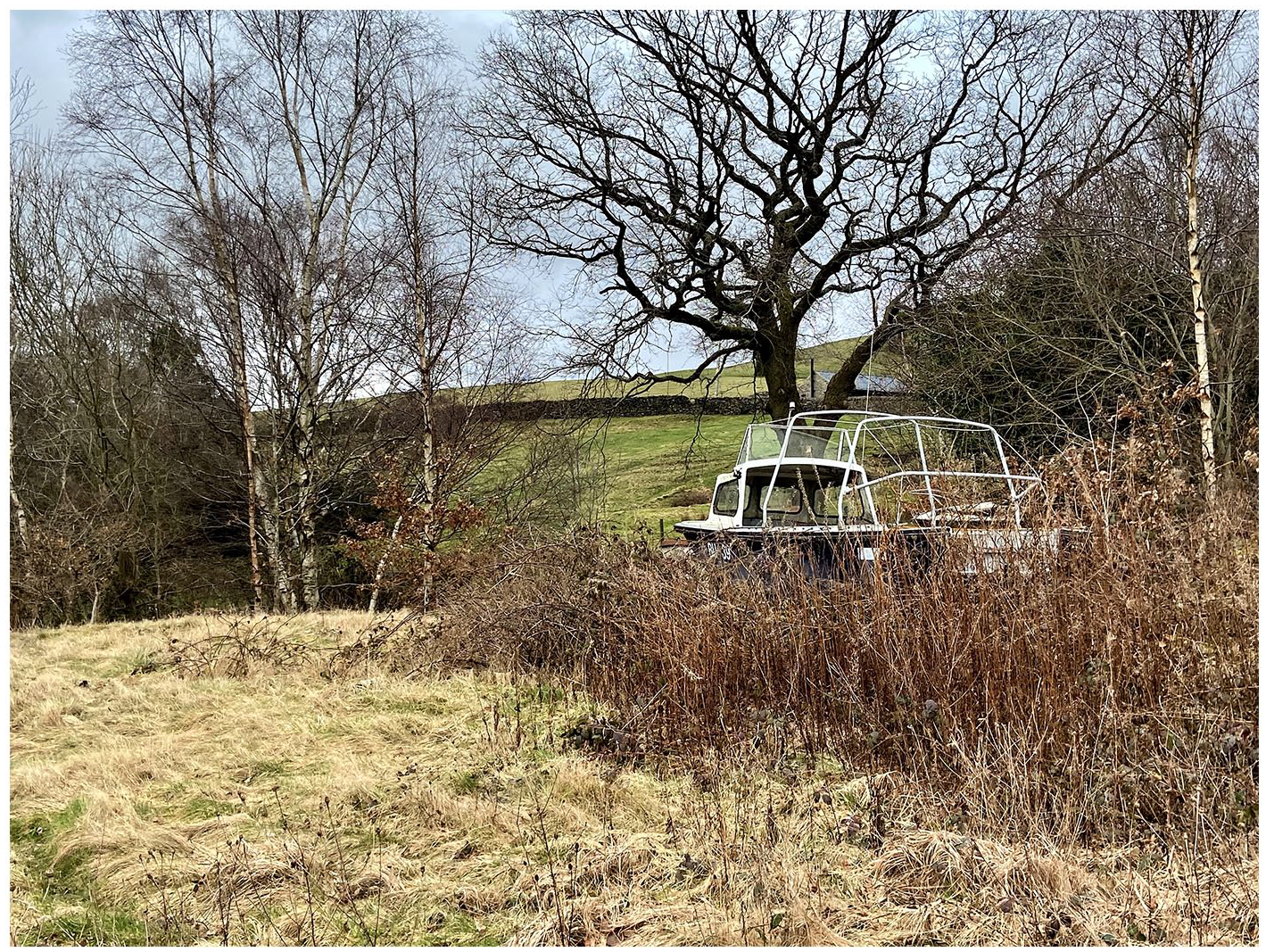
A decaying boat in a field in Derbyshire.
The second source of inspiration for the sonic-musical project (undoubtedly influenced by the cultural outputs outlined above) was a personal one and as such may not resonate with those practiced in rural ways or acclimatised to the countryside. Thus, the eeriness of the countryside is something personally experienced through living most of my life in cities, or at least suburban spaces. As such the rural has often felt different and a place of outsideness in my encounters with it. This sense of the strange and estranged countryside has often been realised visually. Gazing upon landscapes of wildness, of edges and moors, of fields partitioned with insurmountable walls and locked gates, I have often sensed my lack of pastoral skill and history. A visual encounter with the rural was always underscored by my lack of knowledged inhabitation; a lack that leads to conjecture at the purpose of agricultural buildings, both maintained and ruined, their machinery, and the crafts and expertise that enable their purpose. I have stood at a style looking across a field hoping to see the next waypoint anxious of straying off the official public path. I have read notices that warn of trespass, of unstable terrain, of the poisonous potential of plants like Giant Hogweed. I have stood gazing upon a haphazard pile of masonry, now repatriated with moss, lichen, and plants, where once a quarry was worked, and wondered at the effort and cruelties of past labour. A bull or cow has stared me down, returned my gaze, as I dared to encroach upon his or her field – their space.
This countryside has been glimpsed in the half-seen shapes and shadows in the woodland and copse, or in the desolate hill side, the treacherous rocky crag, and the lone leafless tree atop the knoll. This is a rurality often sensed through imminent threat, somewhere practiced through a fear of taking a wrong turn and ending up lost, finding yourself adrift on private land and at risk of forceful removal. This rurality is of the village green surrounded by thatched and stone cottages, whose picturesque vista tells little of communities whom I have often perceived, or at least imagined, to know my difference and outsideness. 15 This is a personal rurality where supposed closely-knit social ties have often felt impenetrable, almost unwelcoming, to the incomer and the blow-in. This particular geography is also rendered, akin to much rural or folk horror, as a disquieting space of leftovers, archaic survivals, custom and lore – occluded pasts and forgotten practices, unfamiliar to the uninitiated and unversed urbanite.
Whilst this apprehensive countryside is often apprehended visually, it is also realised through sound and the sonic. 16 The aural fecundity of nature, of flora and fauna, is also the unknown rustling in the hedgerow or the hoot of an owl as the country lane is travelled at night. It is the acousmatic sound of birdsong and animal calls that are heard without spatial certainty of their source and with an unknown (or barely known) reason for their occurrence. The countryside can be soundscaped by something approaching silence, which for many is its key attraction. As much as it signals escape from the urban cacophony, this supposed noiselessness can also transform into an unnerving quiet that can oppress as much as it relieves. The rural can be sonically composed through the soothing sounds of corn fields in a gentle breeze, yet equally articulated by the brute amplitude of a gale, of wind without barrier upon a moor, that batters your aural senses. The sound of sheep calling, can engender a sense of serenity in the sonic field, yet can be imagined as their fear, their dislocation, as they are herded onto a truck for transport somewhere sounded by distinctly unpastoral and even industrial timbres. The aural pleasures of a babbling brook, stream or river can be accompanied by an imagined sonic geography of amplification as they seasonally transform into the white noise of a destructive raging torrent.
Folk and rural horror, and this personal geographical imagination and practice, underscored the project detailed here. Entitled ‘Rural Eerie: Exploring the Strange Countryside through Sounds and Words’, this project was a multi-media performance event, an album, and a film. Organised by myself, Emily Oldfield, and Lucy Simpson, the event took place on the 19th October 2019 at The Peer Hat venue in Manchester as part of the 7th annual Gothic Manchester Festival coordinated by The Manchester Centre for Gothic Studies at Manchester Metropolitan University. The event was a mix of music and soundscapes composed and played by the band Flange Circus (comprising myself, Pete Collins, and John Taylor) that accompanied poetry and spoken word performances. The poets and writers involved were Emily Oldfield, Mark Pajak, Sarah Hymas, Helen Darby, Andrew Michael Hurley, and Richard Skelton. The event’s sonics and spoken word performances took place in front of a series of projected visuals shot at various English rural locations by myself and Pete Collins (Figure 2). The performance was repeated in a shortened form (with Emily Oldfield and Andrew Michael Hurley) at the third Manchester Folk Horror Festival, also at The Peer Hat, on 1st February 2020. After both events, the music and soundscapes pieces, and performances by several of the poets and writers, were recorded and released as an album, with profits from the digital sales donated to the Woodland Trust. The visuals and music became a short film (produced by Pete Collins) which was released with a limited edition of the album, as well as being premiered on YouTube on 16th May 2021 and was shown twice on the 12th June 2021 as part of the ‘K-Punk Marathon’, a 24-hour broadcast on Repeater Radio which paid tribute to the work of the late cultural critic Mark Fisher. 17
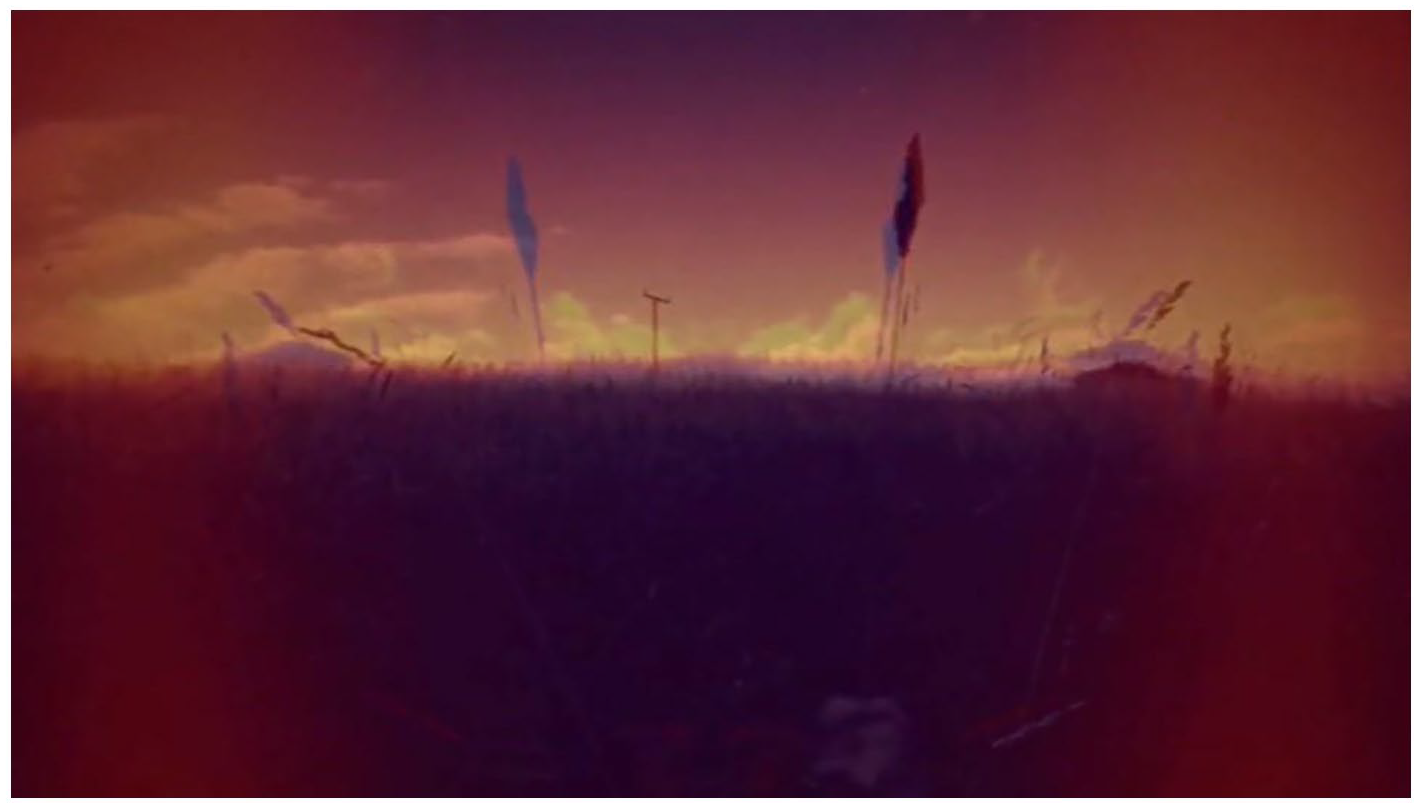
An example of the projected visuals at the Rural Eerie event.
Moving sonic geographies
[I]n addition to their representational functions, field recordings are also performative, something happening here and now as well as a document of another time and place . . . Such performances reconfigure present space, with acoustic traces from the recorded space–time folding into the playback space–time, effecting a doubling or thickening of space.”
18
“Sound moves us and we are moved by sound.
19
Using Rural Eerie as a case study, this paper is situated in the field of sonic geographies and seeks to explore how sound in its movement through space and place might open up new ways of interrogating the intersection of sound and space. This is achieved in three ways. First, it is about the transformation of sound recordings as they travel into and between places and contexts. Second, it is about the transformation of musical-writing, playback and listening spaces as sounds move and travel in and through them. Third, it is about how sound has the capacity to move and affect the body and the imagination. Gallagher above refers to the first two of these movements and highlights how we need to be attentive to the myriad ways that sound is emplaced and displaced, and hence how sound makes space and place in different ways as it is heard, listened to, or felt. Whether a sound is heard in place or a sound is heard from a recording of a sound in a place, sound performatively configures place with different meanings and capacities to affect. Thus, in its travel, sound reconfigures place and space through “displacement-replacement.” 20 Rural Eerie actively intervened in sound’s movement-displacement for aesthetic purposes: here, the knowledge that sound could be transformed in movement, and how it doubles the place of its listening and playback, was deliberately played upon in an attempt to stage affects and certain atmospheres. Hence this project, sought to explore, evoke, and render sensations of displaced absence and presence, and thus the eerie, in sonic form.
Whilst the visual and textual spatialities and practices that formed part of the project were key to its production and performance, and mentioned in the following, I focus here on the sonic and musical to further underline the need, now decidedly entrenched in Human Geography, to both challenge and compliment the visual and textual dominance of the discipline. Herein the emergence of sonic geography has offered “an appealing route into those geographies which lie beyond the visible world.” 21 For sonic geographers, sound and music does not happen in space and place, it makes and creates space and place, and underlines how (sonic) spaces and places are an event and always in a state of becoming: as Revill states “the spatial qualities of sound are intimately bound into its temporal structuring. Sounds intensify and fade; they have distinguishing properties of attack and decay that are constitutive to our experience of them.” 22 Furthermore and related to the third meaning of movement deployed here, by challenging occularcentrism and amplifying the performative role of sound, sonic geographers have revealed how sounds and music have the capacity to affect. Sonic geographers thus examine how sound and music moves bodies, moves in-between bodies, and is generated by bodies and thus “how we respond, react and interact with the movement of sound across our body’s (albeit permeable) boundaries.” 23 In focusing upon the affective register of sound on bodies and bodies on sound, sonic geographers therefore emphasise the non-representational aspects of sound and music, and thus what sound and music does, rather than necessarily what it means. Sound here is theorised as an emergent vibrational force or intensity which is registered as visceral and embodied (not just through the ear) and configures our sense of space and place. As spatial and temporal events, sonic geographies afford certain sensations, atmospheres, meanings, and affective registers, and lay bare both the relations that they are composed through and the relations they produce. In attending to the affective-relational and event-full movement of sound and music, this paper joins with others in moving beyond the position whereby “sound is at times reduced to the discursive and, in this reduction, the materiality of sound is not fully attended to – music and sound are viewed too much as a form of representation to be interpreted.” 24
Thus, this paper, and the project it documents, aims to explore “the ways that sound mediates emotional and affective engagements between people, objects, places and ideas.” 25 In seeking to achieve this aim, this paper examines the movement of sound and music across the different spaces of the project’s production and performance, whilst examining the affective and imaginative consequences of the spatial and temporal folding and unfolding of these (moving) sonic geographies. I hope, therefore, through analysing and listening to the spaces and places of this project, to develop the field of sonic geographies through detailing a phonographic event from its inception through to its performance, and thus interrogating the spatialities, practices and affective realisation of a practiced sonic geography. This is achieved through investigating and contrasting the different sonic geographies of the project’s unfolding – namely the space of field recordings, the musical writing space, the rehearsal space, and the performance space. Furthermore, realising Rural Eerie sonically involved employing many phonographic methods including “listening, recording, playback, editing, distribution, broadcast, performance, installation and so on” with each of these methods generating their own spatialities. 26 As such, this paper focuses (almost exclusively) on the sonic and the musical spatialities of this project to heed the call made by Gallagher and Prior that these phonographic methods “deserve more attention, development and critical discussion.” 27 In the next section I wish to account for the spatialities of sonic production and phonographic methodologies that led up to the performance space of Rural Eerie.
The field and the writing (recording) space
The production of Rural Eerie began with the phonographic method of field recording in various English rural locations – Derbyshire, Cheshire, Lincolnshire, Oxfordshire, Norfolk, Suffolk, and North Yorkshire. These sample sites were chosen mainly through happenstance: if I knew I was visiting or found myself somewhere considered rural (or semi-rural) I would make sure my field recorder (a Zoom H4N Pro) was charged with fresh batteries and was in my rucksack. The field recordings, for the most part, can be best characterised, according to Gallagher’s typology, as the ‘nature style’ and the ‘soundscape style’. 28 The ‘nature style’ refers to recordings which attempt to capture the non-human natural world and environment; the ‘soundscape style’ attempts to capture all the sounds (not just nature) of a particular environment to characterise a given place or space – in this case, broadly speaking, the countryside. However, contra to the common guiding ethic of these styles, the field recordings for Rural Eerie did not adhere to, nor were they intended to conform to, a need for sonic fidelity or mimesis. Given that I was aware these field recordings would be significantly edited and manipulated through layers of effects further into the production of Rural Eerie, there was little desire at this stage to faithfully replicate the sonic environs in which the recording was made (beyond technical practices of a good recording (noise to signal) level, and the limitation of handling noise and low frequency rumble). As such, the field recordings for Rural Eerie were a hybrid of the ‘nature’ and ‘soundscape’ style, and the ‘acousmatic style’ – wherein I knew the desire would be to “accentuate abstraction” – and the ‘sound art style’ that involve creative experimentation with the recordings. 29
The decision of what to record in these field sites was driven by several intersecting conditions, assumptions, and ideas. First, there was the knowledge of how “phonography is particularly useful for highlighting hidden or marginal aspects of places and their inhabitants.” 30 Given that Rural Eerie was underpinned by the desire to evoke the hidden or marginal aspects of the rural (idyll) this knowledge was foundational to recording choice. Here, the barely audible, the strangely timbral, the sonic-aesthetically discordant or the unlikely juxtaposed was attuned to and recorded. Second, given the acousmatic is often indicative of the eerie, sounds whose source was hidden or disembodied were given priority. Third, the awareness of how the recordings could potentially, in the musical production stage, be made to sound displaced and disturbing for sonic affect, underpinned the selection of sounds. For example, a sound or series of sounds whose acousmatic nature might be further enhanced to play with the idea of eerie dislocation were chosen over others. Here, the potentiality inherent to moving sound from the field to the studio drove the choice of field recordings. Thus, the selection of sounds or soundscapes was based on how they seemingly displaced the rural idyll, were acousmatically disturbing, or could be made to sound unnerving in their movement into the future spaces of the project: the overriding desire here was to evoke sonic geographies that would be “highly suggestive and atmospheric, with listeners unsure of what exactly they are hearing, provoking their imaginations to fill in the gaps”. 31
It was precisely the wish to enhance and amplify the gap between a recording and a given or assumed ‘reality’ of that recording that fuelled much of the field recording stage. In other words, the persistent failure of sonic mimesis in field recordings and an aesthetic wish to augment this failure, coordinated this phonographic method. For Labelle, with all field recordings: place paradoxically comes to life by being somewhat alien, other, and separate, removed and dislocated, rather than being thoroughly mimetically real . . . as a listener I hear just as much displacement as placement, just as much placelessness as place, for the extraction of sound from its environment partially wields its power by being boundless, uprooted and distinct.
32
Since Rural Eerie was born from and coordinated through a desire to displace and dislocate the rural idyll, and explore eerie absences and presences, the field recordings needed to have this potential composed into them. Furthermore, in so doing, different stages and spaces of the project began to move and fold into one another: the present space of the recording was shaped by potential spaces of future musical production and assumed listening, in addition to the sonic memories of rural spaces and soundscapes of folk or rural horror that inspired the project in the first place. Field recording became a practice of folded sonic atmospheric attunement, as multiple, and intersecting mobile geographies and their past, present, and future feel, were draw on, imagined, and evoked. Field recordings were organised by their potential to conjure imagined sonic-possible life-worlds of the rural, both as they were recorded and in other and possible future spaces of their production and consumption: recordings were developed to furnish an awareness of a “landscape’s pluralities and possibilities . . . [allowing] us to challenge the singularity of actuality and articulate a different sense of place and a different sense of self that lives in those possibilities and shows us how else things could be.” 33
Let us turn to an example to illustrate the geographies of this field recording. Lyme Park is a large National Trust estate located in Cheshire, but also bordering the Peak District National Park. In its grounds lies ‘The Cage’, an 18th century three storey sandstone structure, with square corner towers, which has variously been a hunting lodge, a cottage for the park keeper and a prison for local poachers (Figure 3). Standing atop a ridge 700 m North of the main house it is a popular location for visitors owing to its panoramic, mostly rural, views. Approaching the building for the very first time from its southern aspect, without seeing their origin, I heard the cries of children from what I thought was inside the structure: their voices echoing and reverberating, I made two thirty second recordings. Set in a country park, the acousmatic nature of the sound, complimented by the haunting and distal quality of the reverberation, generated an affective resonance with the conceptual impulse of Rural Eerie. These sensations were further enhanced when I realised that what I had actually heard and recorded was children playing on the other side of ‘The Cage’ – there was no access to the inside of the building and hence it had acted as its own reverb and echo chamber for the sounds of cries, calls and shrieks of children playing around the tower. This realisation unnerved and dislocated my sense of sonic perspective and aural surety. This was an eerie failure of absence: there was nothing there – children inside the building – when I sensed there should have been something. The sound of children’s joy and freedom at playing unencumbered in the countryside setting – a major trope of the rural idyll – had been displaced and dislocated by both this acousmatic failure of absence and the disquieting timbre of their reverberated voices. Here the countryside setting had been made eerie precisely through its soundscape and sonics. Furthermore, the potentially interesting and affecting ways to move this recording into the future spaces of the project was made viscerally and imaginatively apparent through this eerie encounter.
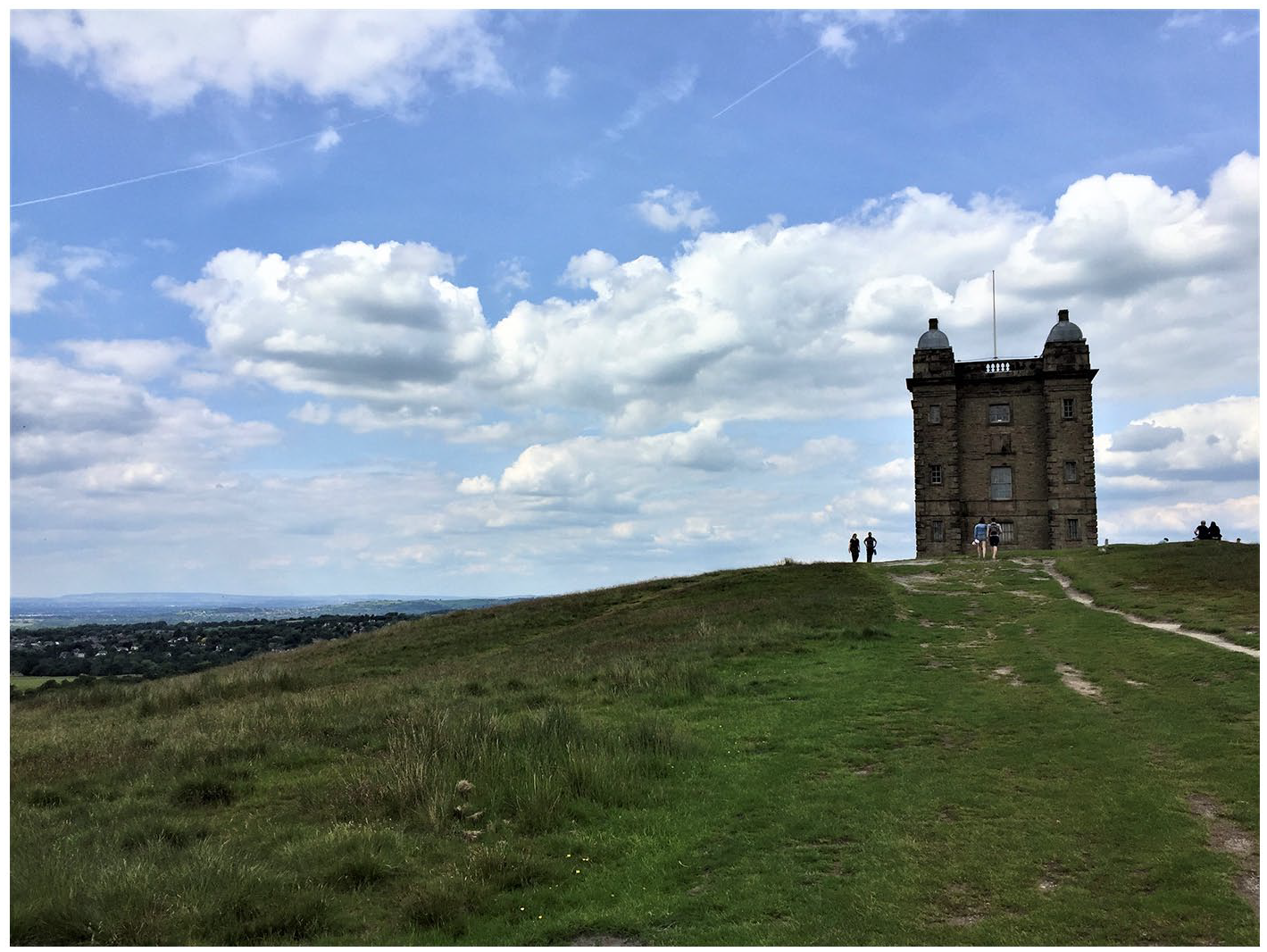
‘The Cage’ in Lyme Park, Cheshire.
The field recordings – once trimmed and normalised – were brought to a band writing session for Rural Eerie. Indeed, the ‘bringing to’ of a musical idea to such a setting is itself a moment and movement of emotional labour: in presenting an idea as the basis for a piece of music, the space is composed through registers of anxiety, hope and sometimes disappointment when other band members remain unmoved (affectively, emotionally, and even physically) by the musical idea. To counter the possible lack of fit of the recordings with an idea (or a band’s sense of its musical identity, sound or direction), certain audio effects were applied to the samples in their presentation simultaneously seeking to enhance the eeriness of the sound as first experienced in Lyme Park. Specifically, the sample, now called ‘Kids in The Cage’, was loaded into an iPad music application called SpaceCraft. This is a granular synthesiser where the original sound is split into slices or ‘granules’ of the original, around 10–50 ms in length, which can then be played non-sequentially to the sequence of the original sample. SpaceCraft allows one to control the grain frequency/length, apply low frequency oscillators to modulate the incoming source, effect the pitch of the sample and apply reverb. As such, the field recording once manipulated, seemed to resonate with the band, helped to explain the creative impetus of Rural Eerie, and amplified the eerie encounter at ‘The Cage’.
This effected sample became the source of an improvisation that morphed into a track for Rural Eerie – ‘Nineteen Corvids’. 34 Here the conceptual, affective, and embodied skein of the writing-recording space came to the fore: each member of the band sought out appropriate sounds, synthesiser patches, effects, rhythms and melodies to accompany the field recording. Here writing-recording spaces are “not simply containers of activity, they are a process of process; space and time are combined in becoming” as the song appeared. 35 Hence, this was a process of musicking – the performative doing of music – as much as it was an attempt to generate signification and to represent the eerie rural. 36 Through swells of affective resonance, and via non-verbal feel and cues, musical timbres, notes and sounds slowly fitted together ‘just right’, such that the emergent piece felt appropriate to the space of its formation and to the conceptual ideas that were its inspiration. The moment of something ‘working’ is difficult to pin down, but it is felt in its practice, performance, and emergent experimentation in space, tentatively registered and encapsulated in phrases such as ‘we’ve got something there’ and ‘that works.’
In the recording studio, the music for the project was composed, written, and recorded as demos. Recording studios are assemblages of technology and the skills or talent of engineer, artists, and producer. Moreover, as Watson and Ward argue, they are a space of affective and emotional labour and management, where the creation of a certain atmosphere and ‘vibe’ is paramount to selecting the best or most ‘authentic’ performance from a performer: “recording studios are more than simply physical and technological spaces for music making; they are relational and emotional spaces which determine the meanings generated by musical performance.” 37 With Rural Eerie, as is quite common, the recording studio was simultaneously a writing space and a recording space for demos that could be used to practice pieces before the performance. Allowing the studio to become a space for both writing and recording generates interrelated challenges. For example, staging a creative atmosphere where the conceptual ideas of the project could be realised often involves continual effort to background the technological aspects of writing and recording: nothing inhibits musical creativity more than a faulty cable, inadequate foldback (whereby a performer cannot hear what they are playing) or software that crashes. Furthermore, Rural Eerie began life partly as a personal sense of the countryside and thus trying to explain these feelings to others in the band who may or may not have had similar experience of the rural, required a further layer of emotional and conceptual attunement to be developed in the writing-recording space. In this way, the writing of Rural Eerie became a labour of acclimating to an imagined geography, an attempt to affect the creativity of others, and a tacit knowledge of sound engineering processes and equipment.
Rural Eerie, therefore, in its writing and development, emerged through numerous processes of sonic labour – the effort to attune to the imagined geography of its conceptualisation and working to form geographies of creativity that coordinated technology and affective musicking. The event itself was to be organised such that the band performed their pieces before, between and during the six poets and writers giving spoken-word performances on the theme. Therefore, as a band, we had to write soundscapes to accompany the spoken-word acts. We deliberately did not ask to see the actual poems or extracts from novels the writers and poets were to perform. Instead, each of the spoken-word artists were asked prior to the event for a series of keywords that gave a flavour of what they would be performing. The collaborative intention here was for the keywords to generate an imagined sonic geography that we would write to. Some of the keywords we received included, ‘Remote’, ‘Isolation’, ‘Unknown Agencies’, ‘Uncertainty’, ‘Roots’, ‘Spring’ and ‘Landscape sentience’.
Each of these words acted like impulses and pushes to creativity and echoed through the choice of, manipulation and modulation of field recordings and sounds, and the composition, especially in mood and timbre, of the pieces. Each word revealed a capacity to affect the creative stimulus in the writing phase of the event. The affective push of the textual here varied in its sonic capture: presented with ‘Vehicles’ a field recording of Skylark song and a distant tractor working a field came to the fore; ‘Unknown Agencies’ and ‘Landscape Sentience’ suggested sounds which heightened the acousmatic nature of their source and engendered the need to supplement further, through modulation, the eerie distancing between sound and source. Moreover, what was revealed here most starkly, was how musicking is a process of affective resonance coordinating a sense of the appropriateness and ‘fit’ of atmospheric staging: as something “that is characterised by an ineffability that, per definition, can never be reconciled through words.” 38 Thus, words might have initiated the musicking, but the capture and composition was based on a feeling generated through the atmosphere of the piece as it was written and practiced, and as sounds moved and were transformed into the studio space. The sense of the ‘success’ of the piece and its appropriate translation of the keywords owed much to the composition’s “ability to harness and potentially reactivate the memory of existing affective encounters, and/or translate these memories into the potential generation of new affects.” 39 Put simply, the soundscapes to accompany the poets and writers, and indeed the tracks more broadly, were judged as having to ‘feel right’ to the atmospheres and (imagined) geographies they sought to conjure. The soundscapes had to fulfil what Anderson has called the “affective imperatives” of the project in the space of its production and a sense of how they would move into the potential spaces of their reception. 40
The rehearsal space for Rural Eerie was principally composed through the labour of moving and translating the writing and demo-recording into embodied and tacit knowledge: cues were learnt through nods, eye-contact and the introduction of certain sounds, hands were choreographed to reach for the correct notes, buttons and potentiometers, and room was left for expressive and improvisatory divergence if and when it felt appropriate in the (future space) of the performance. Whilst a movement of the geographies of the field recordings continued into the rehearsal space, this space was charged somewhat differently to the previous spaces – it became charged by an oscillating difference of nervousness for the impending performance on the one hand, and delight and contentment, as a piece was performed without mishap, on the other. Indeed, in a sound-proofed and windowless room in a building on an industrial estate, the field recordings of ‘natural’ environments, even if modulated with intent to disturb and displace, fell short of staging an atmosphere of the eerie countryside. Thus, the rehearsal space somewhat erased the conceptual push of the rural eerie idea, as soundscapes became technical and performative accomplishments rather than staged sonic atmospheres. The sensation of the estranged countryside was more of a receding echo than something palpably felt, as the labour of technical memory and performance anxiety tempered the environment: here the anticipated future performance space moved into and coloured the rehearsal space.
The performance space
Let us know turn to the event itself. Rural Eerie was held in the basement gig space of The Peer Hat in Manchester’s Northern Quarter, a venue known for its support of DIY, grassroots and often experimental music and performance. Located, almost hidden, in a backstreet of what has become one of Manchester’s key areas for nightlife and (previous waves of) gentrification, The Peer Hat’s geography and location looks, feels, and even sounds very urban. As such, there was a lingering anxiety that this city-centre location would undo attempts to stage the atmosphere of the countryside (eerie or not) with any affective resonance, emotional force, or signifying power. Yet arguably, for several reasons, this turned out not to be the case. First, the rural, as a mobile signifier free to float beyond a demarcated or distinct space, strangely coordinates the venue’s image: The Peer Hat mostly uses pre-urbanisation early modern English in its promotional language and is the venue for the annual Manchester Folk Horror Festival. As such, the non-idyllic coloured this urban venue before Rural Eerie was attempted. The Peer Hat then, in its renown, booking policy, schedule and general image, can accommodate the weird, the strange and the displaced – one of the reasons why it was chosen. 41 Second, we attempted to counter these concerns aesthetically and atmospherically through décor, lights, and visuals: the stage, musical equipment and microphone stands were draped with (fake) ivy; the stage lights were dimmed to a green with some red; and the screen on the stage projected the publicity image as the audience arrived – a view of a Derbyshire valley, with grazing cows and green lush fields, framed by barbed wire (Figure 4). Yet it was precisely the movement of sound and soundscapes that brought the rural and the eerie to the city before and during the event – often in unexpected ways.
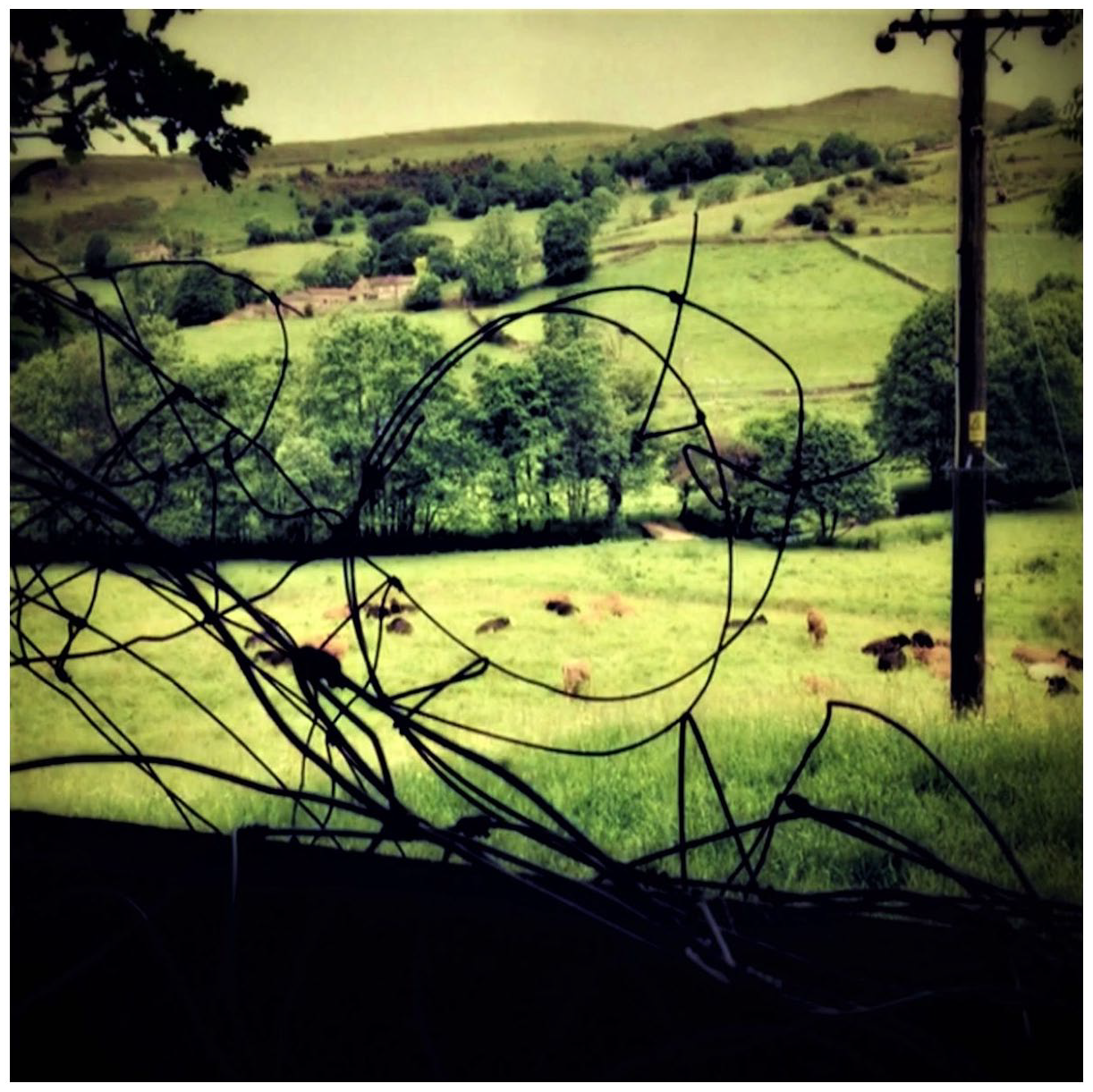
Rural Eerie promotional image and album cover.
As the audience descended the stairs to the underground venue, they were welcomed by the calls of a Lapwing, effected by delay and reverb, accompanied by the sound of a distant gale. At this moment, prior to going on stage and seething with nervous energy, I began to realise that some of the original aesthetic impetus for the project had (already) been achieved. To hear a bird so redolent of the countryside, looped, effected, moved to, and transformed in an urban venue, staged an unnerving displacement of the rural to the city. Indeed, it was precisely in this displacement, this spatial transformation and movement, that the eerie began to emerge. To a degree, this was unforeseen. As documented above, the intention had always been to evoke the rural eerie through the soundscapes per se. Yet some of the most eerie moments, at least for me, occurred upon hearing something evoking the rural in the city – as if the tropes of folk horror has been reversed and the rural became an (unwelcome) outsider in the urban. This field recording, and the geographies that it had been composed through, via its transportation to and transformation in the city, as well as its technological alteration, generated an affective and emotional register of uneasiness and apprehension as the basement was sonically rendered uncomfortably elsewhere. Moreover, it was the failure of both presence and absence – there was something there when there should have been nothing and there was nothing there when there should have been something – that registered a dislocating disquiet. A staged atmosphere of the rural eerie did not only emerge from the (modified) soundscapes themselves then, but also through the collapsing, movement, and alteration of one (rural) sonic space into and onto another (urban) sonic space – this sonic dislocation, détournement and transposition evoked the rural eerie. The sound effected, what Gallagher calls “a kind of doubling or layering of space” whereby “audio generated from the traces made ‘out there’ in the field melds and mixes with the acoustics of the playback location, its background noise, reflections, absorptions, and resonances, to create a new hybrid space.” 42 Thus, it was precisely through this peculiar hybridisation and defamiliarisation, through sonic transportation and transformation, that the eerie emerged – the movement, doubling and unfolding of sonic geographies rendered the space strange and apprehensive. As one reviewer put it, “I clutched the banister to descend into The Peer Hat’s subterranean venue, while the glitched tones of wild birds and waves created an unnerving soundscape. I thought I heard an owl. It was not an owl” 43 (Figure 5).
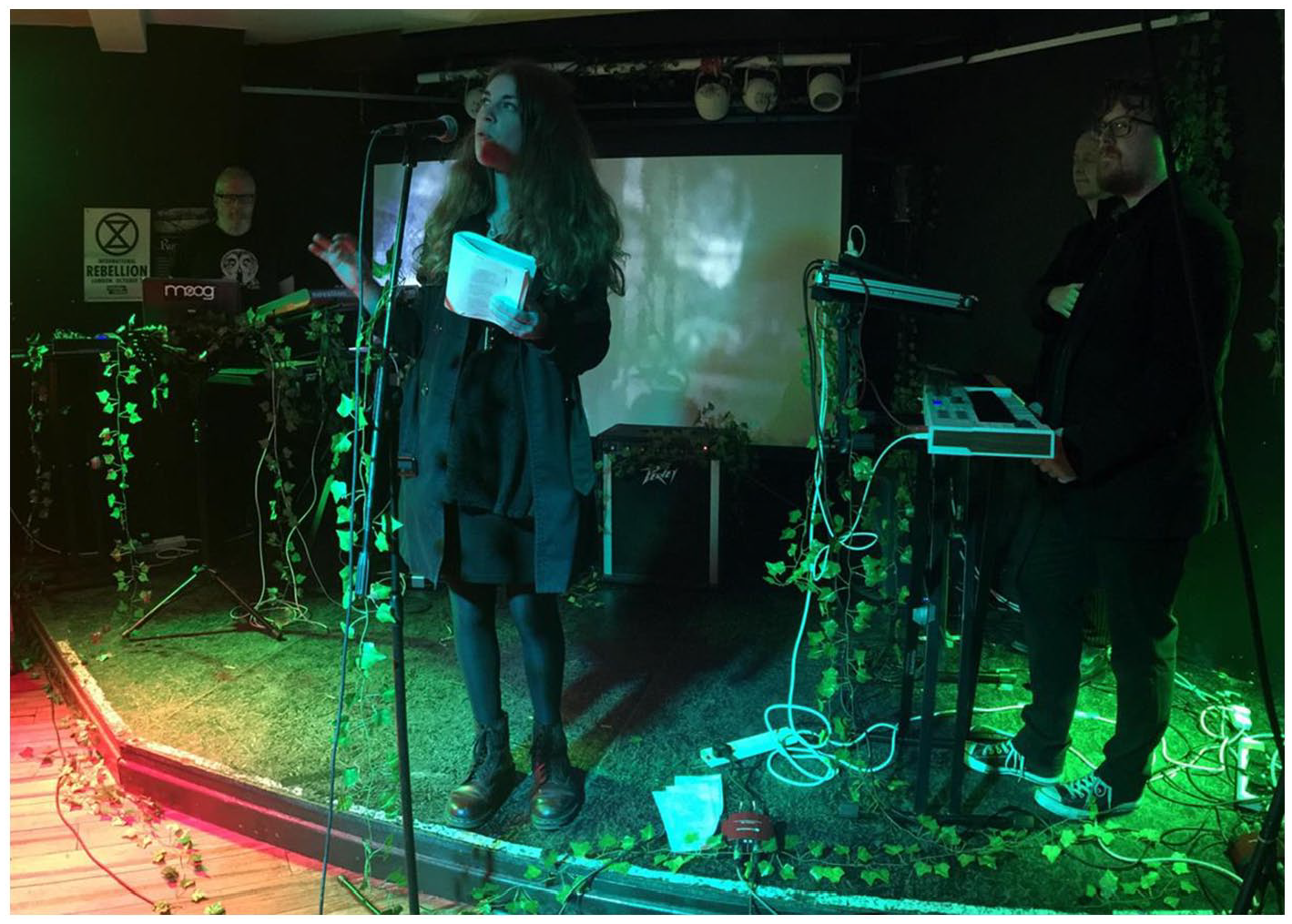
The poet Emily Oldfield performing at ‘Rural Eerie’, 19th October 2019 at the Peer Hat, Manchester.
Other similar moments of heightened sense of displacements, both sonic and visual, occurred throughout the performance. As ‘Kids in the Cage’ was manipulated live with disturbing intent or as field recordings of Snipes, Owls (this time), Crows or creaky gates (radically slowed down in tempo to sound like a pleading groan) resonated through the venue, the places, spaces and atmospheres of recording, writing and rehearsal moved into, layered and morphed with the venue in uneasy ways. Amid the nervous hope that the tacit and embodied knowledge learnt in the writing and rehearsal spaces would be achieved in the space of the performance, I caught glances of the visuals projecting at the back of the stage – discoloured images of angry rural streams, flickering vistas of disused mines, the sight of a rusted revolving gate seemingly moving of its own accord, a ruined car alone in a field repatriated by nature, tufts of sheep wool caught on electric and barbed wire fences. At these moments, the sites of their filming folded back into the venue’s basement and revealed an outside “pulsing beyond the confines of the mundane.” 44 The poet Helen Darby, attired in a white silk dress, handed out ears of corn to the audience, and took to the stage to perform a political and ritualistic triptych of poems evoking the gendered folklore of the harvest, and cycles of death and rebirth. She was accompanied by a soundscape comprising a folk song recorded from a speaker on an art installation discovered on a country trail, but now reversed and distorted to be barely recognisable. As the band sensed her poem building in intensity, reversed and reverbed samples of church bells were launched, alongside the sounds of an approaching summer thunderstorm recorded in a Derbyshire graveyard years before. Once again, the visuals and the words were intent on conjuring those feelings and atmospheres of apprehension, uneasiness, and outsideness that the rural idyll occludes – to what degree this succeeded is for others to say. Yet for me the shudders and shivers of eerie displacement that emerged on the night arose through the unpredicted and amplified dislocating movement of those sounds and the emergent hybrid geographies of their performance, as much as they did from the aesthetic intent woven into the soundscapes as they had been recorded, composed, and rehearsed.
Conclusions
Rural Eerie was an attempt to evoke the sonics and atmospheres of an uneasy rural. It hoped to conjure the hidden, occluded, and unnerving countryside so often masked by the dominance of the peacefully bucolic and harmonious pastoral. It brought together musicians and poets, writers and artists, technology, skills, knowledges, emotional charges, impulses, and labour, to stage an atmosphere, a modulation of affect, something felt as much as signified, said, or representable. Rural Eerie was not an attempt to fix the difference of the rural, its people, traditions, and geographies. Instead, it began with a personal feeling of my outsideness and my reflexive lack of fit to such landscapes, communities, and practices, and their idyllic reification. This feeling acted as the aesthetic impetus for the whole project. In this paper I have sought to explore how this sense and feeling was translated and transported: from me to other artists; into the sounds that were field recorded and how they were modulated and presented; into the compositions; into embodied techniques and procedural skills; and into spaces of performance. Each of these moments of transportation and movement involved a translative transformation. Some of these moments of transformation were deliberately engineered to evoke the eerie, as when an acousmatic field recording was intentionally made more unrecognisable, more disembodied or unlocatable in its movement to and modulation in the studio. Some of these moments of translation involved instances where a sense of appropriateness of a sound to an aesthetic impulse hovered at the edges of meaning and representation, as when an emergent piece of music sound seemed to fit right, just so. Moreover, some of these moments of movement-transformation led to unpredictable achievements of the originating feeling, as when the sonic geographies of a performance space in the city were displaced and rendered unnerving by the geographies of dissociated sounds of the rural.
With each space and time of movement, translation, and transformation, imagined and sonic geographies of the stranger side of the rural folded and unfolded, ebbed, and flowed, as affective and emotional charges, registers, and atmospheres. To what degree this folding and refolding of spatialities affectively resonated or staged an imagined sonic atmosphere for the individual listener or the audiences that have experienced Rural Eerie is beyond the scope of this paper. 45 The geographies of listening to Rural Eerie (as an event or an album or a film score) will involve further sonic iterations and movements with their own affective resonances and hybrid foldings of sonic spatialities and atmospheres. Understanding this playback space, wherever it may be or however it is configured, would need to take account how different listening bodies are differently placed and differently attuned to the vibrational force of the music and soundscapes. For music and sound more broadly, this is certainly something that sonic geographers may wish to pursue: how are geographies layered, solidified, and (re)configured as sounds and music move through different spaces and places with different affective atmospheres, vibratory potentials and materialities, and heard and listened to by differently emplaced bodies? This paper, therefore, hopes to encourage sonic geographers to attune their listening practices and critiques to this movement-transformation – of sounds, bodies, field recording, musical-writing and performance space and places – to further understand the intersection of sound, music, and space. Furthermore, sonic geographies may well benefit by tracking the movement of sounds, practices and the affective charges of musicking, sonic labour and phonographic methods, of other, different, sonic-musical projects from inception to performance and realisation, and charting the transformations and consequences of this travel. For the specific project discussed here, it might be that the same eerie registers, the same unnerving displacement of the rural idyll or the rural in(to) the city, the same doubling and “thickening of space”, are performed and sensed again as this movement proceeds. 46 Yet this for others to analytically score, hear and feel.
Footnotes
Acknowledgements
There were many, many people involved with ‘Rural Eerie’, and they all have my deepest gratitude for allowing a somewhat idiosyncratic idea to be successfully realised. I am particularly indebted to Emily Oldfield, Lucy Simpson, Louise Holloway, Pete Collins, and John Taylor for their hard work, inspiration, support, and for allowing the project to be unearthed from the field and the furrows. I would also like to thank Caleb Johnston, Dydia DeLyser and the two anonymous referees for their insightful comments and support.
Funding
The author received no financial support for the research, authorship, and/or publication of this article.
