




Abstract
The paper explores the politics of (dis)assembling borders within Europe. It examines the performance of the Berlin-based artist collective Zentrum für Politische Schönheit (Center for Political Beauty, ZPS) in 2014, in which artist activists temporarily removed white border crosses commemorating death at the former Berlin Wall. With this unauthorized displacement, ZPS sought to problematize ongoing violence and death at European borders. Via a three-part analysis of the performance Erster Europäischer Mauerfall (First European Fall of the Wall), the paper outlines a political framework for understanding art around and against borders – contributing to accounts on border art and the politics of borders. Staged as critique against the official commemoration of the 25th anniversary of the Fall of the Wall, perceived by ZPS as festivalized and thus apolitical event, the multiple performance acts highlight material and emotional movements. They oscillate between past and present border death, commemorated and forgotten border objects, bodies, places. In particular, ZPS aimed to denounce (implicit) hierarchies regarding how and whose death at European borders is remembered via acts of (dis)assembling. By unsolicitedly (re)moving Berlin’s border crosses (Act I), mobilizing over 100 activists to dismantle border fences and temporarily installing replica crosses at Southern EU borders and placing them in the hands of contemporary refugees (Act III), ZPS mobilized public concern about contemporary border politics and commemoration. The paper contributes to border studies that view borders as inherently complex and contingent symbolic, socio-spatial arrangements, which affect and are affected by objects, bodies, and policies that oscillate between contested absence and presence. Accompanied by controversial media coverage, the performance gathered (im)mobile bodies, moving objects, and multiple emotional responses about the what, where and who of Europe. Ultimately, politics of (dis)assembling unfold absence and presence to articulate mo(ve)ments of ‘the political’ as contestation against complacency and border violence.
Keywords
Introduction: (re)moving borders
In broad daylight on 3 November 2014, just a few days before city-wide celebrations of the 25th anniversary of the Fall of Berlin Wall on 9 November 1989, artist-activists from Zentrum für Politische Schönheit (Center for Political Beauty; hereafter: ZPS) removed 14 white crosses from their original location on the banks of river Spree. Installed as memorial site, located on the Western side of the Wall in 1971, and sponsored by a private citizen initiative, the Weiße Kreuze (white crosses) were designed to commemorate over 140 civilians, Mauertote (Wall casualties), who died at the Berlin Wall during its existence between August 1961 and November 1989. Some of the casualties’ names and dates of death are inscribed on the white memorial plaques, marking lethal attempts of individual East Berliners trying to move West. These Mauerkreuze (border crosses) mark an important chapter in the German-German history of border conflicts, violence, and death. A couple days later, ZPS activists organized a bus tour with over 100 participants to South-Eastern Bulgaria, announcing to bring Berlin’s border crosses to contemporary European borders, to ‘their future sisters and brothers: refugees who will die next at European external borders’. 1 Equipped with bolt cutters, the artist activists placed (replicas of) the crosses on border fences with the declaration to take down present-day borders within Europe. Simultaneously, other ZPS activists brought one border cross to the Spanish refugee camp in Melilla, capturing encounters between dead and living border refugees. In addition to photographing Black youth in the camp, holding the white border crosses (Image 3), they provided food and medical supplies. Together, these border movements coalesce into a three-part performance which I unpack via the lens of the politics of (dis)assembling. 2 With this analytic, I seek to add to the complex discussions about politics of borders 3 and artistic interventions in and at borders. 4
In the European context, the Berlin Wall as spatial signifier of the Cold War not only drew a wedge between political ideologies, but also between families, friends, lovers, neighbours. By relocating the border crosses from Germany’s now-pacified nation state to the increasingly militarized outer margins of the Southern European Union (EU), especially Greece, Italy, and Spain, the performance challenged the EU narrative of post-WWII peace, stability, and freedom of movement. The paper argues that the (re)moving of borders generated unexpected and controversial interpretations of the political and memorial implications of moved and moving borders. The temporary displacement of memorial objects not only (re)activated public memory and consciousness of a previously lethal border within Europe, but also sparked larger debate about German memorial culture.
The artist collective ZPS, consisting of a fluctuating body of over 70 artists and intellectuals, has been (in)famous for contested performances in public or digital spaces, spearheaded by philosopher Dr. Philipp Ruch since 2009. Their interventions have been described as action/performance art, artistic activism or ‘aggressive humanism’. 5 As a critique to the inactivity of German and European politicians and citizens, 6 ZPS proclaims the normative idea(l) of political beauty 7 as driver for political action. Sparking controversy in international media outlets, the performance Erster Europäischer Mauerfall (First European Fall of the Wall; hereafter First Fall) intervenes in individual emotional as well as legal-bureaucratic registers of the ongoing global refugee crisis. Moreover, the performance problematizes the politics of borders via the self-instructed, staged presence, absence, and movement of past and present borders. By temporarily removing rem(a)inders of past borders, ZPS not only physically moves bordering objects, but also emotionally moves different audiences (who witnessed parts of the performance as haphazardous passers-by in public space, protesting participants, news readers, or social media users).
I suggest an approach of political difference to understand the dynamics of ZPS’s politics of (dis)assembling. 8 Political difference distinguishes between the realm of ‘politics’, which aims to structure, govern or otherwise control political decision- and border-ma(r)king, and ‘the political’, which consistently challenges hegemonic practices and places of power. As potentially counter-hegemonic force, the political at large points to the contestability of all socio-spatial and political formations. 9 Borders, I argue, are constituted by both politics (i.e. bureaucratic, institutionalized, formal, legal procedures) and the political (i.e. overarching ideological assumptions about building borders, or not). Yet, to better understand contestations around borders in First Fall, the analytic of the political enlarges the scope of analysis to detect, discuss and potentially relate with artistic critiques of contemporary border regimes. In the quest for what Holmes calls new ‘territory of possibility’, 10 ZPS’s artistic activism is examined as medium to both physically and emotionally unsettle borders produced by politics. Paired with political difference, such ‘territories of possibility’ might reshuffle political claims and alliances across the spectrum of politics (often embodied by rules, prohibitions and formalized representations of ‘the’ state) and the political (exceeding the realm of politics towards, for example, artistic expressions).
The paper seeks to advance two-fold insights into the politics of (dis)assembling: first, outlining the narrower ‘politics’ of borders, which arrange and mark place-based separations via institutionalized and formal practices of (b)ordering 11 and commemoration. Second, sketching ‘the political’ in and of borders, or border art in particular, I extend the scales of border politics between places, bodies, feelings, images here and there to (dis)assemble new interscalar links, ranging from the global to the scale of the intimate. 12 The political of (dis)assembling, in its radically polyvalent range, points to the irreducible contestation around borders as constructions, including those present and those no longer there. Notably, in contrast to current contentious wall building projects or attempts to tear them down, the demise of the Berlin Wall was a cause for celebration in most parts of Western Europe (and North America); it created concern in some geopolitical contexts, while garnering little attention in other parts of the world. Hence, besides the physical walls of the Berlin Wall, today mostly dismantled, the border crosses function as commemorative and political artefacts with contested cultural heritage. They mourn loss and simultaneously remember politically instructed killings of German civilians. In short, the border crosses (re)materialize violence of the brick-and-mortar Iron Curtain as a hurtful and, in some cases, lethal border.
Inspired by literatures about border art, 13 geographies of art 14 and the interrelations between geopolitics, art, and aesthetics, 15 as well as critical curatorial and artistic activist discourse about political art, 16 I unpack the multiple political dynamics occurring during, besides, and beyond the performance. After delineating conceptual propositions about the co-constitutive subjects and objects of borders and art, the politics of (dis)assembling borders via art are traced. I examine the differently composed individual/collective, staged/unplanned, realized/inhibited performance elements. In Act One, ZPS physically disassembled the Berlin-based border memorial, then mobilized over 100 activists traveling to the Southern EU border to dismantle the latter (Act Two) and documented the excursion of one replica border cross to a refugee camp (Act Three). By bringing the theoretical offerings of political difference to the transdisciplinary study of artistic engagement at, with and against borders, I shed light on both the conceptual and practical, activist implications of these politics of (dis)assembling borders in their ontological and political polysemy. 17 Via the lens of the politics and political of (dis)assembled borders, we can better grasp the oft-paradoxical contradictions of art-activist interventions. 18
Borders and art, border art
In social science approaches such as peace and conflict studies, borders 19 have been studied as territorial markers within or between discrete units such as nation states. Critical border, 20 or borderland studies 21 have nuanced borders as embodied acts of (urban) citizenship. 22 ‘Hard’ border-making practices such as the construction of fences, securitization, and surveillance of borders and bodies 23 have been problematized vis-à-vis ‘softer’ bodily, symbolical, and emotional border constructions and contestations. 24 Robins’ recent discussion of ‘affective borders’ (i.e. underlining how borders and feelings interrelate) is insightful to attend to borders as ‘highly extended object with the capacity to traumatize at a great distance’. 25 Such dynamics of distance and proximity materialize in conditions of absence and presence. Underscoring the psychosocial and bodily effects caused by lack of information about border-crossers’ whereabouts, according to Robins, creates a feeling of ‘ambiguous loss’. In this loss, loved ones are matter-of-factly absent or missing, but their death has not yet been declared; their bodies linger between assumed and felt absence, their unconfirmed presence lingering elsewhere. Similarly, the border crosses operate as signifiers for such uncertainty, unfolding in the contingent presence and absence of commemorative objects. Teunissen discusses ‘border-crossing assemblages’ of FlixBuses travelling across Europe, used by Tunisian refugees as hide-outs to enter England or Germany. 26 Highlighting their scattered material and emotional, human, and more-than-human components, borders become tangible as anxiety-producing, emotionally and physically moving matter.
A later ZPS performance, Die Toten kommen (The Dead Are Coming, 2015), explicitly referenced death in their protest. ZPS claimed to have brought dead refugee bodies ‘from the EU’s external borders into the command centre of the European regime of repulsion, the German capital’. 27 With the intention to politicize the agency of dead migrant bodies, while those same bodies are treated with little interest by border control agencies such as FRONTEX (i.e. the European border and coast guard agency), Die Toten kommen sought to highlight agency of both living and deceased refugees. Yet, as problematized throughout this paper, ZPS’s attempts to activate migrants’ agency have also led to reproducing refugees as nameless, mute and dying. 28 While migrant death at European borders continues to be of significant concern – mind you, according to the Missing Migrants Project, between 2014 and 2021, over 10,000 people have died at the Mediterranean-EU border. 29 Taking literally Balibar’s 30 claim that ‘borders are everywhere’, this paper spells out how temporary border presences and absences produce controversial public responses and thus de-normalize existing border regimes. These artistically invoked politics of absence and presence advance the broader activist and theoretical project to understand the repressive underpinnings of both distant and all-too-proximate borders. 31
Border conflicts, especially along the U.S.-Mexican border, have been studied by ethnographers, cultural theorists, and artists as sites of resistance. Borders are experienced and (re)claimed by sentient vulnerable bodies as inflicting both physical and symbolical violence. 32 Borders hinder some people from entering countries to visit relatives and loved ones solely on the basis of their citizenship status, thus painfully sensing separation, and othering. Artistic and creative engagements with borders have examined the transformative potential of these artistic interventions to challenge, (dis-/re-)place or (de-/re-)construct existing borders. 33 More specifically, ‘border art’ concerns ‘art on the border, art born from the border, art against the border’, 34 and unpacks artists’ strategies to disrupt the routines and biopolitics of securitization at territorialized borders.
Amoore and Hall’s account of artistic interventions along borders calls attention to the ‘politics and ethics of border dissent’. 35 Understanding some border art as the theatrical staging where ‘presence becomes problematized’, 36 this paper adds nuance to the implications of border dissent, made present via the temporary absence of borders. In sum, the constitutive polysemy of border art can both transgress normalized practices of border passage and fail to do so, thus reinscribing limiting borders.
Artistic border projects have provided digitalized infrastructures of surveillance and control to grant border-crossers secure passage via GPS data, giving passers a heightened sense of agency. 37 Other artistic installations such as the ten-meter-high wooden Toy an Horse (a wordplay on Trojan Horse) diffusely and unsolicitedly disturbed the normalcy of U.S.-Mexican border-crossing. When the sculpture was removed after a year, border workers and passers-by noticed how the temporarily placed (i.e. present) artefact had marked, yet also unsettled their everyday border routines. In addition to the moving forces of presence and visibility, this paper complements accounts that examine the confrontational power of absence in art, and border art more specifically. Via the analytic of political difference, I attend to artistic interventions’ potential to mobilize controversies precisely between presence and absence, between politics and the political. As Amoore and Hall put it, ‘critical responses may interrupt more effectively if they themselves confront the absence of certainty and decidability’. 38 Borrowing from Giudice and Giubilaro, the paper shifts focus ‘from object to process, from border to disbordering’ 39 to capture the persistently contested and contingently (dis)assembled meanings, practices, effects, affects, or the interrelated æffects 40 of borders, which capture their ‘“affective effect or, if you prefer: effective affect” of art and art activism’. Via political difference, the multiple effects (e.g. media coverage, political statements, both approving or condemning) and affects leveraged by activist art (e.g. surprise, shame, disgust, fear, longing etc.) can index different registers and receptions of such performances including controversy and contradiction. 41 With Rumford, I emphasize that ‘borders do not have to be visible to all in order to be effective’. 42 In contrast to manufactured presence of border art objects, the first act of the First Fall strikes with the contrary effect of ma(r)king absence. By the ‘simple’ act of removing commemorative border crosses (which are not necessarily, or at least not exclusively considered ‘art’), the artist-activists question how the border and incurring death are commemorated (or not). This alternation between presence and absence resonates with Amoore and Hall’s observation that art does not need ‘to be proximate to observable and situated action easily identifiable as ‘political’ in order to be effective’. 43 In other words, border art does not have to ‘be’ present but can mobilize political critique and agitation via strategically (dis)placed absence. As Amilhat Szary argues, it is the ‘spatial translation’ of borders that ‘affects the meaning of art works as well as the meaning of place’. 44 Similarly, dell’Agnese and Amilhat Szary find that cultural production around borders ‘both contributes to de-essentializing the border landscape and reframing imaginaries that cope with the growing securitization of international limits’. 45 Subsequently, the radical re-positioning or dislocating of seemingly immovable borders draws out Holmes’ ‘territories of possibilities’, which manifest across physical and emotional borderscapes that hover between the narrower politics of borders, and the more ungraspable æffects of the political of borders.
Moving things, people, borders
While material objects can play a protruding role in border art, it is never solely their singular function or form that provoke political or emotional responses. Hence, the study of one moving border object alone might be too constricting. 46 Besides the (re)moved and moving border crosses, there are many other contingently entangled human, non-human, material, discursive and technological components that co-constitute the politics of (dis)assembling. 47 For example, the different bodies in the performance do very different things – those from Berlin actively (try to) dismantle crosses, take videos and photos, they ride buses, they protest. In contrast, the Black bodies located in a refugee camp are portrayed as mute, suffering, looking at cameras, asking for help. Besides bodies, objects such as bolt cutters (staged as activists’ emblems for self-organized dismantling of border fences in Act Two) as well as photographs, videos (Act Three), and social media and newspaper reports contribute to the many-faceted politics of (dis)assembling. Notably, some aspects of the performance gained more media attention than others, partially reinforced by ZPS’s own communicative strategy. Especially the images of Black refugee youth, holding white border crosses (Image 3) took on a seeming ‘life of their own’ in global socio-technological circulation.
In line with a new materialist understanding of objects, places, and people, 48 the performance includes, but is not limited to white border crosses, their spatial location in proximity to the German Bundestag, the liquid and walkable infrastructures surrounding the memorial site, frequented by passers-by including tourists and Berliners, the crosses’ historical significance to commemorate brutal shootings of German political refugees, the carefully selected timing a few days before the 25th anniversary of the Fall of the Wall, artists’ multi-media posts about the eventified commemoration in local, national, and international newspapers, the legally ambivalent state as ‘art’ or ‘non-art’, 49 the political pertinence of the refugee crisis as well as many other discourses and objects that affect views on migration, memorialization, politics, and art. All aspects together make up the multi-part event which acted in concrete locations and with straightforward messages, but also significantly stretched beyond specific times, places and feelings.
While the following analysis discusses the political implications of selected material things (e.g. border crosses, post-it notes, bolt cutters), the æffects and reactions evoked by their (dis)assembling remain somewhat incalculable - to the artists, as well as audiences and the analyzing researcher. Spilling beyond concrete objecthood or unequivocal effects, I encountered the performance as a multi-headed beast with various bodies, materialities, images, world views, memories and politics involved. This interrelates with my own reflexive positionality within this analysis: I have observed ZPS’s activities since 2013, have moved my body in ZPS protest marches, have wrestled with their founding idea(l) of political beauty. 50 In the context of the First Fall, however, I did not actively participate. My attempt to capture the politics of (dis)assembling hence relies on a triangulated approach connecting semi-structured interviews with ZPS activists who organized and participated in the three acts, with extensive analysis of national and international newspaper, blogs, and social media.
While a lot has been said about the politics of borders, 51 and by means of drawing this conceptual introduction to a close, the paper aims to problematize and politicize the staged visibility of border bodies. 52 Put differently, the paper pushes border art, or artistic activisms of (dis)bordering, into political difference to reflect on the emergent qualities of differences between politics and the political, and the ways in which they move ‘us’ (and ‘them’). 53 This trajectory resonates with Brambilla’s understanding that borderscapes can provide transformative tools to (re)imagine and spatialize counter-hegemonic borders, 54 but remains cautious of activists’ internalized pressure to ‘bear the burden of devising new models of social and political organisation’. 55 Let us see how ZPS approaches this conundrum.
Act one – disassembling the past border
A YouTube-Video, posted by ZPS, with over 87,000 views documents the removal of the 14 commemorative crosses. 56 Dressed as construction workers, anonymous ZPS members used screwdrivers to dismantle the white border crosses, each bearing the name of a German Wall casualty. Stacking the crosses on a wheel cart, the operation appears as a routine procedure to take the crosses away for cleaning or maintenance. The memorial objects left the public site without incident. A group gathered to look as if they listen to a tourist guide reinforces the situation’s alleged normalcy. After disassembling the crosses, ZPS volunteers placed small yellow post-it notes on the remaining black metal grids (Image 1). These ephemeral reminders call to mind 23-year-old Toumani from Mali, who died due to border patrol violence at the Spanish Moroccan border in August 2014. 57
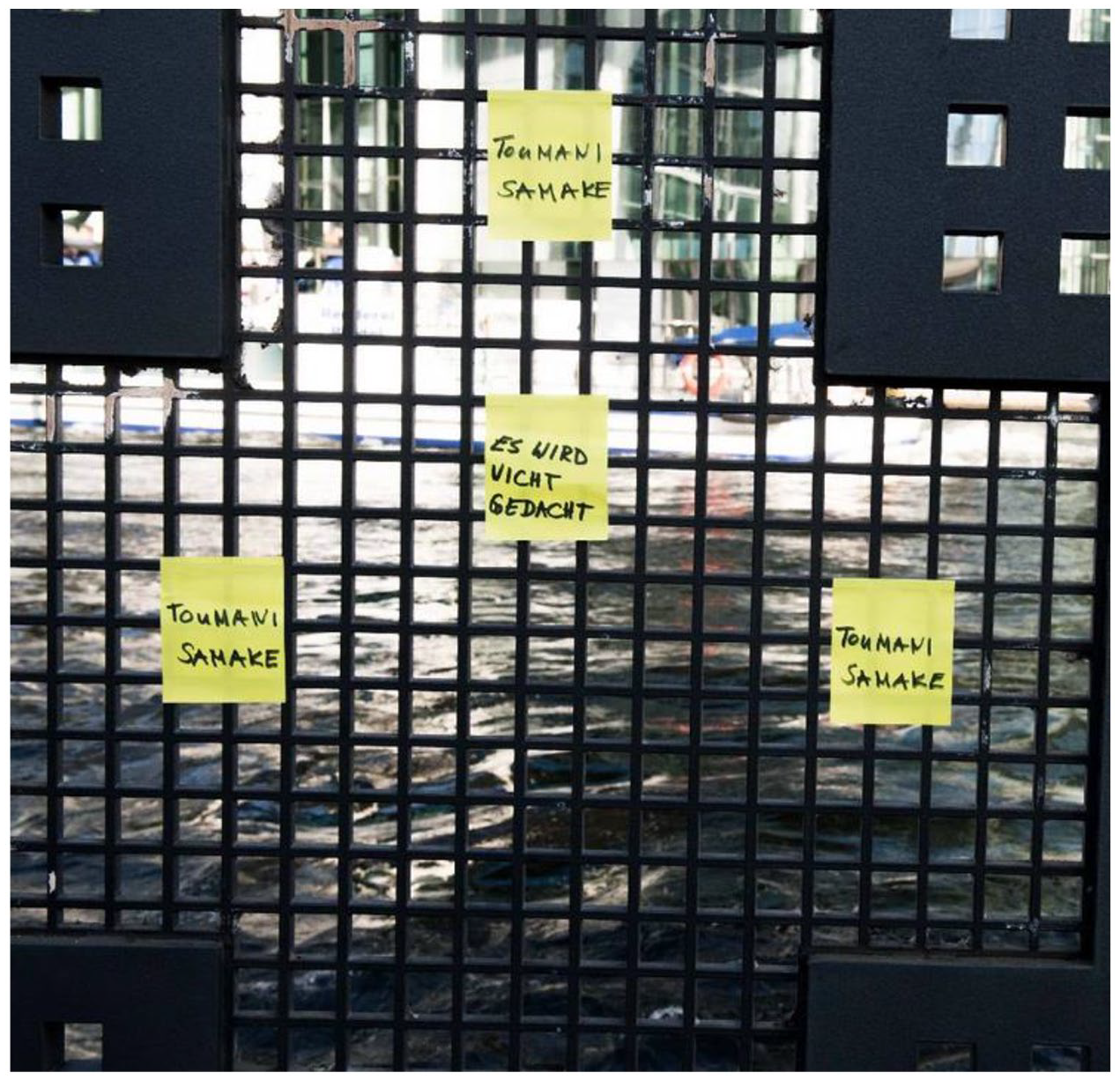
Black metal grids from where white border crosses were removed.
Another post-it within the black metal grids reads: ‘Es wird nicht gedacht’. Roughly, the phrase translates to ‘There is no commemoration’. However, translation remains ambivalent as the German passive construction does not specify a subject or ‘we’ that puts forth this claim. Hence, it remains unknown who (or how many) are not commemorating, and whether the claim is a widely shared opinion or not. In addition, the passive ‘gedacht’ can either derive from the verb ‘denken’ (think) or ‘gedenken’ (commemorate), blurring the lines between active thinking and commemoration. Within this ambivalence, the fleeting paper note hints at both a lack of critical thought and passive memory. Considering this unsanctioned critique as a mo(ve)ment where the political of and against border comes to the fore, ZPS’ first act is directly targeted against the seemingly stable, materialized space of commemoration as space of the politics of borders. These politics of borders spatialize the hegemonic dimension of borders and indicate where borders are to be commemorated. Accordingly, ZPS’s first act of (dis)assembling deliberately destabilizes the border by physically and emotionally moving an ostensibly immobile, relatively unattended wall memorial.
A ZPS interviewee states 58 : ‘Nobody cared about these crosses, only when they were removed. . . paint was all peeled off. . .quite telling, it says a lot about the culture of memory’. In ZPS’s understanding, the border was not ‘active’ in its separating function (anymore); the crosses no longer held tension, threat, danger, the type of irreducible conflict that would point to ‘the political’ in mainstream German society. ZPS assumed that the memorial appeared as dormant site to most Germans, a rem(a)inder of violence and fear that lies in an undisputedly gone past. In relation to political difference, ZPS moves the clearly located border crosses from reified, ‘sedimented’ things (i.e. signifier of memorial politics) towards constitutively contested agents of commemoration (i.e. gesturing towards the manifold appearances of the political). Hence, by removing the crosses, ZPS reactivated the contingent origins of the commemorative objects. They brought them (back) into the present to be actively remembered. With the material ephemerality of hand-written post-it notes, exposed to weather and passers-by who might take them down (To throw away? To keep as souvenir?), the first act offers a counterstrategy of commemoration in its most temporary, fleeting form. The border crosses are unhinged in the attempt for a more open and vulnerable culture of memory of the political.
The first act, driven by ZPS artist-activists and accidental publics unknowingly witnessing the unsolicited cross removal, problematizes European bureaucrats’ assumed indifference regarding the commemoration of German Wall casualties. What is more, new interrelations between past and contemporary death at European borders, between here and there, are proposed. Without intentional removal, these disturbing connections might not have been (re)marked. By making memorial objects temporarily absent, the presumed consensus and fixed spatial representation of how and where to commemorate border casualties now worked to challenge hegemonic memory for the sake of more contested memory politics instead.
The background voice of the YouTube video states (translated by author)
59
: Yesterday midday, the installation White Crosses which commemorates the dead at the Wall, has fled from the government district in Berlin. The death victims of the Wall are now safe from the official festivities for the 25th anniversary of the Wall. . . The Wall casualties are at the external borders of the European Union. In an act of spontaneous solidarity, the crosses have fled to those people who dehydrate, capsize, and drown on their way to Europe. They are now in the arms of their future sisters and brothers: refugees who will die next at the European external borders.
Alluding to the official festivities organized for the 25th anniversary, when the refugee crisis was medially very present, the group criticized the release of 7,000 air balloons along 15 kilometres of the inner-city Berlin wall, originally 155 kilometres long. The arms-length cultural organization Kulturprojekte had been commissioned to organize a temporary light installation called Lichtgrenze (Border of Light) and an open-air exhibition telling local residents’ stories about the Berlin Wall (total cost approximately 2 million Euros). In contrast to the description of the commemorative installation as ‘emotional and also serious’, 60 ZPS perceived the festivities as ‘Oktoberfestgedenken’ 61 (Oktoberfest memory), targeting the eventification and banalization of the border as a spectacle of light rather than darkness. 62 One of ZPS’s ‘accomplices’ at the time, Cesy Leonard, who organized the photographic encounters between Berlin’s white border crosses and Black refugees (see Act Three), poignantly states: ‘While air balloons are being released into the air in Berlin and the usual nostalgic speeches are being held, in an act of political beauty, German civil society brings the European external walls down’. 63 Another ZPS organizer dubs the festivities ‘menacingly harmless’, claiming that the group intentionally wanted to ‘disturb’ and act as ‘an advocate for the dead’. 64
In addition, the video ascribes agency to the crosses themselves, arguing that the latter fled to border-crossers currently struggling to enter Europe. According to a ZPS member, this narrative aimed to create attention that ‘the dead have something to say to the future dead’. 65 This equation of the already-dead and the almost-dead creates a provocative, uneasy alliance between the factually dead of the past, and those currently and decidedly resisting death by attempting to migrate to Europe. While the ZPS organizer considers this alliance as ‘romantic and beautiful’ to create a ‘line of causality and consciousness’ between bodies threatened by death, these acts of awareness-raising also sparked critique of refugee/Black suffering being instrumentalized, dehumanized again, as Black bodies were displayed amongst the ‘unliving’ rather than living 66 (see Act Three).
After (dis)assembling the stage of the past Berlin border, announcing the second act, the ZPS video shows an animation of a six-meter-high metal fence, anti-jump-features and metal wires on European borders today, claiming that this is ‘the only spatial pillar of post-cold war Europe that remains intact and even enhanced’. 67 The voice declares the resurrecting ‘dawn of a militaristic blockade and isolation in Europe’ and asks, ‘are those the limits of a self-confident and cooperative continent?’ 68 The video instructionally proclaims how to counter the crisis of inhumanity of Fortress Europe: ‘All we need for this is a bolt cutter and lots of people’. In the infotainment-style finale, ZPS directs viewers, who are assumedly German citizens or residents, to their crowd-funding platform to donate for charter buses, which will transport volunteer border dismantlers. The 3-minute clip ends reassuringly (ibid.): ‘We have prepared and tested everything; you only have to come on board’. Without further specifying who this ‘you’ encompasses, the undifferentiated appeal to action glances over the unequally distributed access and cost of such ‘action’ for some bodies over others.
Act two – almost-disassembling the contemporary border
On November 7, 2014, the attempt to take down European borders started at Maxim Gorki Theater, project partner and partial funder of the First Fall. About 120 affiliated supporters, including journalists and artists, gathered in front of the theatre to depart on a multi-day journey to the Bulgarian border. Chief ZPS instructor Ruch briefed participants: ‘We want to remain absolutely non-violent (. . .) We want to conduct our ceremony, we have the right to do so, we are an artist group – engrave that in your brains!’ 69 (translation by author). Only Ruch and one other ZPS accomplice, Stefan Pelzer, joined the mission. Notably, the two did not travel with ‘peaceful revolutionaries’ by bus but flew directly to Sofia (ibid.). Before leaving, over 100 German police staff and border guards delayed the buses’ departure, searching participants for ‘dangerous’ items such as weapons. Bolt cutters were found, but not confiscated. Tracing the three-day trip to Jambol in South-East Bulgaria (approximately 60 kilometers from the border strip), lasting over 130 hours in total, crossing eight countries, journalist Diesselhorst continuously refers to the bolt cutters on board. 70 These objects signified both the planned disassembling of border fences (Image 2) and the assumedly dangerous or threatening character of the performance, widely discussed in the media. In contrast, journalist Kappert describes the bus trip as ‘unspectacular’ until Serbian police found a sports bag full of bolt cutters, which were ‘inventoried, but not confiscated’; instead, solemnly handed to police officers by Ruch. 71 The bolt cutters caused suspicion, and nervousness, which led to the decision to ‘escort’ the two charter buses to the border. Bulgarian politicians’ desire to ‘keep the EU external border untouched’ was to be protected against an anticipated ‘state of riot’ potentially caused by the ZPS activists and their bolt cutters. 72 In terms of political difference, this literal meeting exemplifies the rift between ‘politics’ (or ‘police’, as Rancière 73 succinctly frames it) and ‘the political’. Again, politics and the political do not work independently from one another. Yet different views on why borders are in place, and whether they should remain intact, come to the fore via the provoked encounter between artist activists and formal police. In addition, human and more-than-human elements reinforce tension. In sum, political difference lingers between attempts of the formal ‘politics’/’police’ to maintain order rather than openness, to suppress rather than encourage a multiplicity of interpretations about borders.
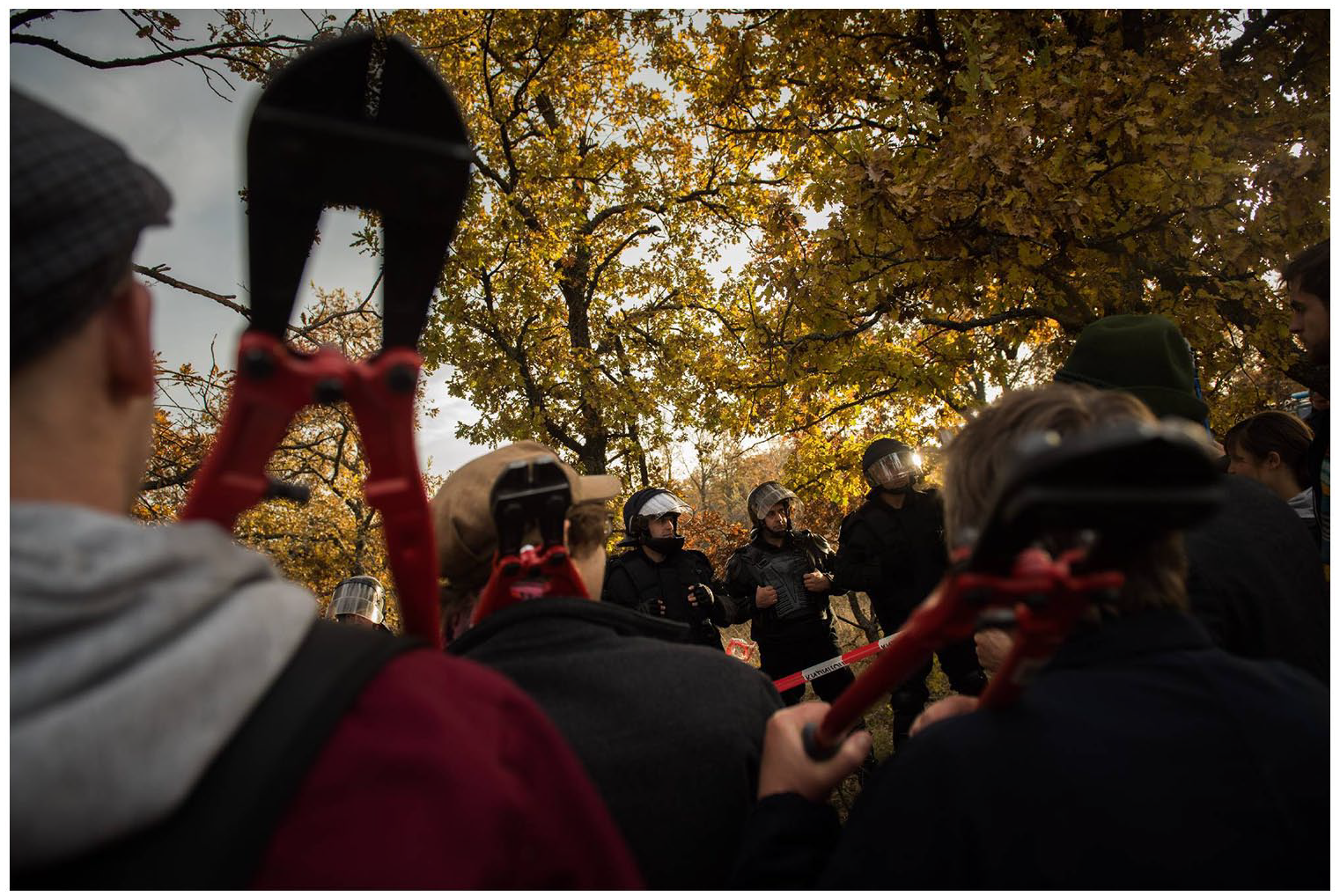
Peaceful revolutionaries waving bolt cutters at police.
Notably, the original white border crosses were not transported along the described bus trip, but stored safely in Berlin. Instead, replica crosses accompanied the peaceful revolutionaries’ journey. Yet, this cautionary decision was not officially communicated, thus fueling contention and concern, mobilized in the allegedly removed and now-moving border crosses. This (con)fusion of objects, events, images, and emotions was not accidental, but carefully curated – leaving non-participant observers wondering at times what ‘really’ happened, and what was staged as provocation. 74 The second act led to an impasse as activists did not ultimately make it to the border to physically disassemble border fences or meet refugees.
An interviewed ZPS activist argued that the physical encounter between refugees and the bussed-in ‘peaceful revolutionaries’ was not a main concern. He repelled the reproach that the overall performance was exploitative or instrumentalized past or present refugee bodies ‘as material’.
75
In contrast to other border art projects, which are explicitly co-produced by migrant agents,
76
the First Fall assumed the primary audience to be a depoliticized European middle-class, which is not sufficiently engaged in preventing ongoing border violence and death. To counter such passivity, the ZPS organizer urged for a shift in public perception and responsibility: ‘We want to provoke people to take initiative or usurp our initiatives (. . .) Everybody can be in charge (. . .) We don’t have copyright on our ideas’.
77
The ZPS member, who notably did not participate in the bus trip himself, but managed media coverage from Berlin, points to the performance’s primary ‘symbolical’ character (ibid.): I wouldn’t say the action failed, but it was really sobering that they were stopped 300 meters before the actual border by the police and couldn’t move. It became a symbolical act of holding the bolt cutters up in the air.
Again, the bolt cutters occupy a prominent role as contentious (dis)bordering objects, which caused a stir for Serbian, Bulgarian, and German police. 78 Agitated bodies who requested to negotiate the where and why of borders as part of ‘the political’ came to the fore. In addition, material objects carried by those moving bodies, contribute to the work of (dis)assembling and destabilizing set borders and access restrictions around them. In other words, the bolt cutters, perceived as potentially destructive and dangerous weapons by some, and signifiers for cross-border liberation by others, mobilize feelings such as protestors’ pride, sense of empowerment, resistance, anger, political self-determination or even -militarization, but possibly also disappointment, humiliation, or fury to not have succeeded in dismantling the border. In sum, the bolt cutters materially and emotionally serve as placeholders pointing to the performance’s ambivalent status as ‘territory of possibility’ that can challenge border politics.
Rumford’s notion of ‘borderwork’ is instructive here, suggesting that (de)construction of borders by ordinary people leads us ‘to rethink the issue of who is responsible for making, dismantling and shifting borders’.
79
The attempted borderwork by Berlin’s ‘peaceful revolutionaries’ elicited such a micro-political attempt at dismantling. However, these individually experienced æffects of borderwork are asymmetrically distributed: While for activists, arriving at European borders after a strenuous journey, the excursion provided opportunities for self-reflection, the fact that refugees played little to no role in the almost-dismantling of border fences also created discomfort amongst other participants. Critical about their own limited agency, or naiveté, participants stated that they had not been sufficiently informed about ‘what kind of role we were supposed to play in the “action”’, alluding to the power asymmetry between them and ZPS organizers.
80
An anonymous document called Voices from the Buses appeared shortly after the return to Berlin, stating that participants viewed themselves as privileged ‘extras in an art project, which was primarily addressed to the German public as a media performance’, in which ‘we acted without the involvement of local actors and concerned parties (i.e. refugees)’.
81
The anonymous authors (ibid.) write: In this field of tension, we sharpened our perspective for the political struggle we will continue to lead (. . .) Art has led the way. Now, the European Fall of the Wall needs a basis (. . .) This requires diverse practices of resistance, continuous and sustainable, with all our participation.
The document works as another more-than-human performative component, bringing to life more differential positions and dissident voices within the performance. In response to these tensions, a ZPS organizer reports that the returned revolutionaries were ‘angry with us’ because their expectation of actually taking the border down remained unrealized. 82 As the video had grandly announced that participants could ‘bring a piece of the fence home as a souvenir’ 83 (referring to the well-known Berlin tourist obsession of snatching an allegedly original piece of the Wall), the intended sensationalization of Act Two reminds of catastrophe/slum tourism. Moreover, it fell short of realizing its own problematic promise by not quite disassembling the border. It staged direct encounter between the police/politics of borders, but no dissolution thereof. While few resisting bodies and objects called those constricting border politics into question, they did not meet their goal of physically dismantling border fences. Yet, it is precisely in this partial failure, that the already precarious, contested political of borders is invoked.
Act three – imag(in)ing borders
One replica cross was brought to the Spanish enclave of Melilla by Cesy Leonard and professional photographers. Pictures of predominantly Black male youth holding white border crosses (Image 3) dominate the public image and ex-post documentation, both on ZPS’s website, and in external media. The photographed subjects remain nameless, their stories untold, they appear as staged to portray the crosses being ‘out of place’. While the individuals were informed about the context of having their photographs taken, and thus consented to partake in the performance, 84 the refugees play little active role. The crosses, narrated as agents who ‘have fled’ to their ‘brothers and sisters’ (unintentionally?) reinforce the visibility and attention on lost European lives some 30 years ago. The focus on the experience of loss, police violence, suffering, and trauma of those very individuals who are not yet dying at Europe’s borders in this day and age seems blurred. Especially photographs of ‘our’ white crosses in ‘their’ Black hands complicates a new scalar order of solidarity between ‘us’ and ‘them’ across spaces and time. The photographs provocatively yet problematically (re)produce images of Black suffering to evoke concern, empathy, and pity from (presumably White) Europeans. While contemporary refugees’ suffering is made visible/present, the depicted persons’ concrete, lived persistence and struggle are not further elaborated. As non-speaking holders of a replicated border cross, Black subjects are positioned rather than positioning themselves in border struggle.
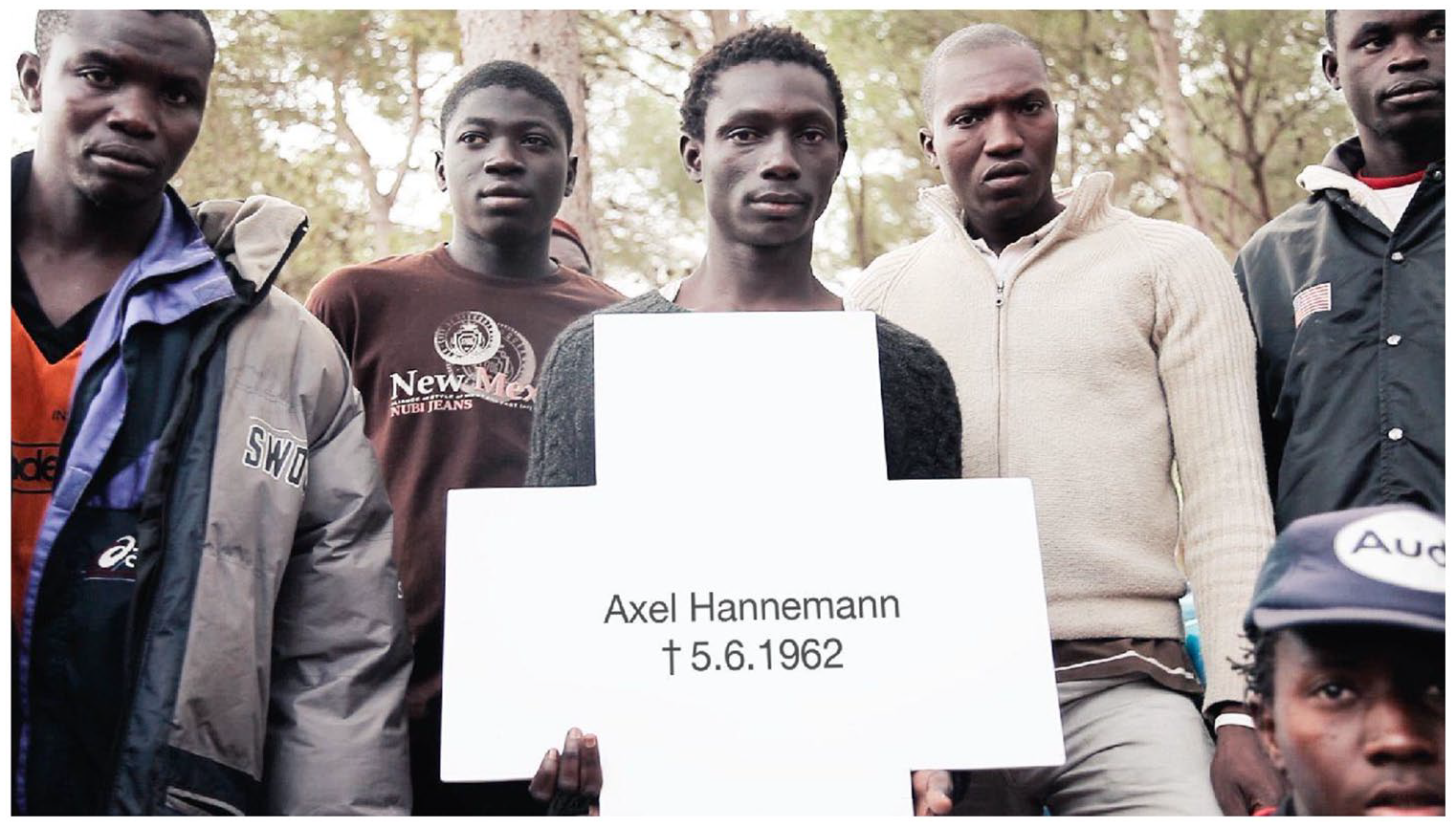
Unknown refugees and replica of border cross; ZPS photograph.
While Leonard argues that the performance sought to ‘bear the tension and provocation of these images’ 85 in mind, this particular act risked exposing Black bodies as disposable props rather than self-determined agents. The performance, curated by mostly White bodies, can lead to ‘discursively overtax the suffering Black body’. 86 Moreover, the theatrical encounter of Black subjects and white crosses slides into a perpetuating depiction of the Black life as ‘dead and dying’, 87 even though these bodies are alive. As Black feminist geographer McKittrick cautions, ‘inhabitants of spaces of absolute otherness can be, quite easily, discursively colonized by our intellectual investigations’. 88 The static, mute(d) depiction of Blackness can thus dangerously misalign and end up overwriting migrant’s actually existing agency with imported signifiers of (past) death. 89 The portrayal of refugees as not-yet-dead hovers over their presumed ‘group-differentiated vulnerability to premature death’. 90 By facilitating objectified Blackness as stand-in for white commemoration, ZPS’s images literally turn refugee bodies into objects. This affects European people, politics and commemoration, but at the great cost of de-humanizing migrants’ bodies. 91 In conclusion, ZPS’s attempt at aggressive humanist advocacy for both living and dead refugees, lurches and, in the worst case, falls into the trap of ‘naïve humanism’ which ‘rests on problematic over- and under-investments of migrant agency in which humans are assumed either as supreme or powerless’. 92
Additionally, ZPS assembled 1- to 3-minute video monologues with four Black men and boys about their living conditions in the camp. Responding to Leonard’s inquiry from the off about what freedom means to them, one of the refugees answers: ‘We live here like animals (. . .) it is up to you to help us’. 11-year-old Seylou repeats the appeal for international assistance. On ZPS’s webpage, there is no further information on the whereabouts of the filmed and photographed individuals, or recommendations how to help them. These videos, where refugees actually speak, received significantly less views on YouTube than the above-mentioned clip narrating the whole performance. While the footage is less accessible for (non-French-speaking) audiences in that they have neither been translated nor edited for reducing background noise, it is telling that media reports consistently reproduced images of white crosses and Black refugees (Image 3). These however temporary physical encounters between Berlin activists, border crosses and refugees do not reappear prominently in the wide-spread coverage. Revealingly, the videos are placed at the very bottom of ZPS’s webpage, subtly marking an internal hierarchy within the three-act performance. In sum, the asymmetrical (re)production of images and imaginations of Europe displays a selective politics of visibility. In comparison to Acts One and Two, which clearly articulated ZPS’s critique against the ‘politics’ of borders, Act Three wafts ‘the political’ via more diffuse æffects.
A ZPS member situates the knowingly triggering, yet uncontrollable reactions to artistically assembled images as constitutive of the performance’s moving mobility. He defines media management and ‘public relations as part of the artwork’. 93 German media extensively reported on both the removal of the crosses, as well as the bus trip, portraying controversial reactions in local, national, and international outlets, including daily and weekly newspapers, art blogs and social media. The Police Department of Berlin condemned the action as ‘extremely severe theft’. 94 Conservatives’ reactions ranged from describing the cross removal as despicable, disrespectful to deceased individuals, ruthless, pseudo-humanitarian, cynical, desecrating, dishonoring, and unethical towards the memorial site. On the ZPS website, these dismissive statements are indiscriminately placed next to descriptions that admire the performance as ‘positioning courage and phantasy against inhumanity and bureaucratic lack of phantasy’, 95 or ‘putting the finger in the wound, to show alternatives that humiliate reality’. 96 The weekly newspaper Die Zeit argued that the performance showed that ‘“history” does not only belong to those who have experienced it’, 97 thus promoting the concern for Wall casualties then and now beyond the scope of post-Reunification Germany. Besides explicitly ethical assessments, prominent figures discussed whether or not the action constituted ‘art’. Protected under the auspices of artistic freedom in the German Grundgesetz, Berlin’s then-mayor and Cultural Senator Wowereit defended that the group had received 10,000 Euros of cultural funding. 98 To conclude, the differently imag(in)ed border encounters push the socio-technical, mediatized, and bodily components of borderwork into the realm of ‘the political’, yet without accounting for potentially reinscribing, and thus amplifying images of migrant suffering.
Conclusions: politics of (dis)assembling
This paper has provided insight into a contested piece of border art. It has shed light on the distinct yet interrelated components of a borderwork performance. This border art discontinuously (dis)assembles and blurs literal, historical, temporal, mediatized, ethical, emotional, embodied borders. As conceptual fusion between the transdisciplinary study of borders, political difference, and art, I have unwrapped moments, movements, encounters, and irritations between the ‘politics’ and ‘the political’ of borders.
The analysis of (dis)assembled borders which moved, were moved, which almost unmade and remade borders, sought to substantiate how border art challenges concrete border ‘politics’. It outlined potential scope for political action, emotion and commemoration within the irreducibly conflictual dimension of ‘the political’. The performance undoubtedly prompts different audiences in Berlin, Germany, Europe and beyond to take a stance in relation (or opposition) to the suggested ‘we’ of Europe’s borders. By raising questions of where Europe could or should end, both physically and mentally, or who is part of it, and who isn’t, the politics of (dis)assembling unsettle the spatio-political construct of ‘Fortress Europe’. Temporary border dislocation drives a wedge into the current, seemingly stable, strictly territorialized, death-producing and -tolerating spatial definition of ‘Europe’. Politics of (dis)assembling beg for a re-definition, and possibly even a re-spatialization of Europe. Europe is, after all, nothing but a hegemonically produced construct. While this realization might help to (re)politicize European citizens, it also needs to be acknowledged that, to date, Europe’s selectively lethal borders have not (yet) moved one inch.
In conclusion, I draw out three co-constitutive aspects of the politics of (dis)assembling. First, via the lens of political difference, I have contoured the reshuffling of times, places, and agents of border commemoration, control, violence, activism, and solidarity. While ZPS’s intervention certainly invoked wide-ranging æffects (which remain difficult to disentangle), the ongoing oscillations between ‘politics’ and ‘the political’ deliberately maintain tensions between conflictual subjects and objects. They irritate relations between political past and present, interconnect between past and present death of political refugees into a more complex culture of commemoration about border death. While this critique was aimed at the dispassionate formal ‘politics’ of memory apparatus, the casting of alternative memorialization shook up the ossified, arguably postpolitical German culture of memory. The removal of border crosses has mobilized and thus reactivated the contested origins of any political order. In contrast, the mobilizing encounter between border objects of the past and border subjects in the present has gravely disserviced the latter by stimulating a perception that reads refugees as instrumentalized stand-ins to retell the story of European Wall casualties.
Second, politics of (dis)assembling are invested in ma(r)king the politics of absence and presence. The temporary absence of the border crosses from their set location has shown borders’ capacities to move, move ‘us’, be moved by ‘us’ (but notably not ‘all’ of us). Accordingly, the politics of (dis)assembling complicate ongoing presence and absence of borders. Border politics of absence and presence mobilize the ambiguity of political meanings, feelings (ranging from guilt, shame, pity, outrage, disgust to empowerment and hope), responsibilities, actions, or inactions around borders that are there, or no longer there. This points to the possibilities of de- and re-spatializations of affect, which provide territories of possibility to pose a promise or a threat. 99 Appealing to the imag(in)ed power of moved and moving borders in artistic performances, borders made absent, or present, can contribute to their own denaturalization, or ultimate dissolution. 100 While the concrete æffects produced by images lie behind ZPS activists’ control (because it’s art, isn’t it?), and possibly even outside their concern, the ambivalent encounters between absence and presence at emotionally-charged borders can also jeopardize precarious border-crossers’ struggles. The focus on White bodies’ agency (i.e. assumedly German/European audiences) can dangerously reinforce stereotypes of ascribing power to White bodies to wave bolt cutters at the police and travel in a peacefully revolutionary spirit, while Black (refugee) bodies as portrayed as muted, immobile, almost dead and dying. Hence, the re-politicization of arguably White European bodies as primary agents comes at the cost of reinscribing passivation, disempowerment, de-humanization onto other, non-White migrant bodies. Although the performance unleashes the irrevocable contingency of any border arrangement, offering multiple (dis)connects between attachment and detachment, hegemony and counter-hegemony, the specific narrative curated by ZPS in the First Fall falls short of keeping migrant bodies’ agency, and space of ‘the political’, articulated by and for them open. For a more potent conceptual understanding of the politics of (dis)assembling, their disbordering towards ‘the political’ could have been attempted as a participatory project. The performance articulates a seemingly unconditional call to action – hopping on a bus to cut down border fences seems in every way favorable to staying at home – ‘we’ are told by ZPS that ‘we’ need to do something. Yet, that ‘we’ crucially does not include migrant bodies, still perceived, and portrayed, at a distance. If this unevenness would have been at least addressed in an aggressively humanist manner, the politics of (dis)assembling could have put the constitutive contestedness of political activism centerstage. The impression that ZPS’s proposed solutions are ‘too easy’, or lapse into ‘naïve humanism’ leaves a bitter taste. Nevertheless, the politics of (dis)assembling leverage a discussion about the price of political action or inaction, the price of exclusion, the price of this Europe.
Third, and last, politics of (dis)assembling mobilize heterogeneous feelings, thoughts, and intentions that trigger ‘affective politics of dissent and disagreement’. 101 These dissensual politics become experiential via moving agents of all colours, as well as material objects such as border crosses, bolt cutters, voices from buses, buses themselves. Theft or not, art or not, a politically beautiful act or not, I hope to have shown how the interrelated tropes of political difference and border art project themselves towards new territories of ‘the political’ in the face of contingency and conflict.
Footnotes
Acknowledgements
I would like to thank Laura Kemmer, Michele Lancione, Eugene McCann, Jannik Schritt, Magie Ramirez, Mirjam Wajsberg, as well as three anonymous reviewers, for encouraging and constructive feedback on earlier versions of this paper. I would like to thank interviewees from the Zentrum für Politische Schönheit for their time and dedication to talk to me.
Funding
The author received no financial support for the research, authorship, and/or publication of this article.
