




Abstract
This paper reflects on the search for a lost, obscure piece of experimental architecture that appeared on the west coast of Scotland in the late 1960s. Encouraged by cultural geography’s efforts to recuperate storytelling as a valid mode of inquiry and to adopt a more enchanted, affirmative disposition to our endeavors, we develop a geographical story intended to draw out how enchanted experiences gained through curiosity and an openness to contingencies can serve as a vital force for sustaining geographical ways of being, doing and knowing with the world. This account focuses on our encounters with various research sites that we identify as ‘dreamlands’ to express the idiosyncratic, unregulated, unexpected sensations of wonder and delight that such places evoked, the excessive materialities they revealed and the imaginative processes they elicited. We argue that such dreamlands are not as superfluous as might be assumed by their uncanny absence from the polished end-products of scholarship, and instead, allude to the latent forces of enchantment to which geographers might become better attuned when conducting and crafting their research.
Storylines
Our research, as is sometimes the upshot of these strange, intense events, was initiated at a geography conference in 2018. 1 I, Luke, was talking about my archival research into the urban experiments of British theatre director, Joan Littlewood. 2 As an aside, I mentioned that she had collaborated with the environmental designers Keith and Hazel Albarn among a circle of experimental architects, designers and artists who had variously sought to realise Littlewood’s scheme to construct ‘Fun Palaces’ from the early 1960s to the mid-1970s; a forgotten element of her enigmatic, utopian vision. I, Tim, was in the audience, and was profoundly struck by this aside because my grandmother had taken my sister and I, aged 11, to the small seaside resort of Girvan on Scotland’s Ayrshire coast in the summer of 1969, where we encountered one of Keith Albarn’s psychedelic sensoriums. I had never experienced anything remotely like the Fifth Dimension; I have never encountered anything like it since. After a circuitous wander around its extraordinary passages and chambers, I emerged bedazzled, enthralled by an overwhelming medley of uncanny sounds, weird textures, glowing lights and fabulous colours. I loved it and have never forgotten this sensory impact. Decades later, returning to the town, I gathered some local newspaper clippings about the Fifth Dimension, which for several years remained in a file in the vague hope that they might 1 day contribute to a paper about the installation. Suddenly, unexpectedly, it seemed time to locate them. Our spontaneous connection, forged in the sterile heat of a New Orleans hotel conference suite raised the tantalising opportunity to pick up these threads. After meeting after the session, we immediately decided to work together to find out more about the Fifth Dimension.
As is convention, one eventual outcome of our subsequent research was a journal article in which we discuss the Fifth Dimension as exemplary of the modular modernities appearing in the late 1960s and as an installation that sought to reconfigure environmental awareness through multi-sensory immersion. 3 In it, we elaborate on Albarn’s approach to environmental design and his belief in the sensory potency of psychedelia. Yet what this article did not – and perhaps could not – capture adequately was the visceral force of enchantment that we experienced through the meandering, unpredictable process of our research (which had included the pleasure of writing about it together). Our research journey ranged across different episodes, each so intense that at times we had exclaimed out loud to each other about the generative richness of the unfolding stories that we were becoming immersed in. Driven by curiosity to follow the storylines that extended from our patchy archival findings into these disparate field sites, we confronted a superfluity of material objects and entangled narratives, a seething proliferation that we initially felt unable to incorporate into an academic paper tailored to developing distinctive theoretical contributions. Here we tell this research story, reflecting on its emergence from our initial meeting with the Albarns, and tracing how our search for a lost architectural object evolved into a sensational adventure in the lived practices of cultural geography, an odyssey composed of extraordinary, serendipitous and enchanted encounters and unexpected excess. 4 Inspired by the creative research practices advanced by cultural geographers, we adopt and develop two key approaches.
First, we are motivated by a recuperation of storytelling and the craft of description when writing about place, particularly through the narrative power of journeys made in both literal and imaginative terms. 5 As DeLyser and Hawkins observe, the academic research process often ‘remains masked by its product’, a ‘neat and linear’ formulation which conceals ‘the engaged and embodied practices of cultural geography that lie behind the varied published expressions of our scholarship’. 6 Moreover, Lorimer and Parr identify how academic narratives are typically constituted ‘with inquiries channelled through criticism, interpretation, or technical analysis of prose’ to meet conventions of scholarly inquiry and publication, that stand in contradistinction to the crafting of a ‘creative form of telling’ that privileges ‘matters of composition, expression, voice, language, tone, cadence, and mode of address’. 7 Encouragingly, they point to emerging accounts concerned to ‘induce feeling’, perhaps ‘to woo, engage, surprise, persuade, rattle, disarm, or disquiet the reader’, to create thick descriptions that extend a richer sense of place as a realm of intensity that gathers stories. 8 Such narratives resist conceptual closure while deploying ‘language attuned to affective worlds of hope, anxiety, care, desperation, joy, wonder, enchantment, dread and desire’. 9 Inspired by these counter-currents of geographical scholarship, we narrate our account through a sequence of what Lorimer describes as ‘small stories’ that attend to the minor, the personal, the mundane and the local. 10 For the heterogeneous, very specific, yet nonetheless striking stories that emerged through our research endorse Cameron’s articulation of ‘a politics of valuing the local, the situated, and the specific’ that may not be evident ‘when our attention is trained on the institutional, the epistemic, and the discursive’. 11
Second, and relatedly, we take up Woodyer and Geoghagen’s compelling agenda for regaining a critically affirmative disposition that ‘challenge[s] extant habits of masterful knowing and moralistic judgement based on the objective separation of the detached critic’ in order to re-enchant our geographical undertakings. 12 We aim to draw out how enchanted experiences gained through an openness to contingencies can serve as a vital force for sustaining geographical ways of being and knowing with the world. In particular, we explore how creative cultural geographies can be produced through a willingness to be lured down byways, welcome the serendipitous and grasp the pleasures and unanticipated connections that may emerge by taking such diversions. This open approach chimes with what Phillips calls ‘sociable curiosity’, a disposition induced by a passionate, inquisitive desire to generate relational knowledges in which objects of inquiry are shared, sparking memories and ideas that draw people together, often stimulating profound affective attachments and interconnected stories. 13 By foregrounding the process of this research, we show how such enthusiastic sensibilities can impel journeys of surprise and discovery through which diverse encounters with people, places and things proliferate and quixotic searches along divergent paths turn up unforeseeable ‘results’. 14
On reflection, the extraordinary episodes we experienced are inevitably written from our privileged position as straight, white, male researchers. Nonetheless, in a wider sense, such experiences point to the array of enchanted affects likely to unfold in the process of research, but which tend to be withheld in more conventional published outputs. Rather than attempt to construct a definitive history of Albarn’s lost work, our account focuses on our encounters with various research sites that we identify as ‘dreamlands’ to express the idiosyncratic, unregulated, unexpected sensations of wonder and delight that such places evoked, the excessive materialities they revealed and the imaginative processes they elicited. To conclude, we step beyond the particularities of our own project to argue that such dreamlands are not as superfluous as might be assumed by their uncanny absence from the polished end-products of scholarship, and that in diverse ways, they allude to the latent forces of enchantment to which geographers might become better attuned when conducting and crafting their research.
Memory work
Following our chance encounter in New Orleans, we first aimed to track down the architect of the Fifth Dimension. Happily, after some encouraging correspondence, we undertook the first of several wonderfully insightful interviews with Keith and Hazel Albarn, now in their eighties, in their east London flat. Our conversations on this and subsequent visits were lengthy and unstructured, forming arcs of narrative exchange across the necessarily excessive and serendipitous process of ‘memory work’. 15
Often referring to the amazing objects that adorned their home – folded card models and 3D-printed shapes from Keith’s ongoing development of protype architectural forms (Figure 1a), a distinctive chair made by Hazel, a poster advertising a notorious happening the Albarns had organised at Joan Littlewood’s Theatre Royal in Stratford in 1967, an original version of the rotating ‘Tumbli’ toy Keith invented in 1965 (Figure 1b) – we began to assemble biographical stories, memories and reflections. Throughout, Keith referred to his thinking behind the Fifth Dimension through an enormous illustrated two-volume compilation, a draft compendium of his enduring interest in the connections between mathematical pattern, Western and Islamic art and architecture, natural forms and built environments, which at every conversational turn provoked extensive elaborations. 16 In later meetings, Keith presented a folder crammed with press clippings covering his environmental design work and a large collection of photographic slides that featured examples from his expansive oeuvre, including compelling images of the Fifth Dimension, all rendered in tiny squares of coloured light. 17
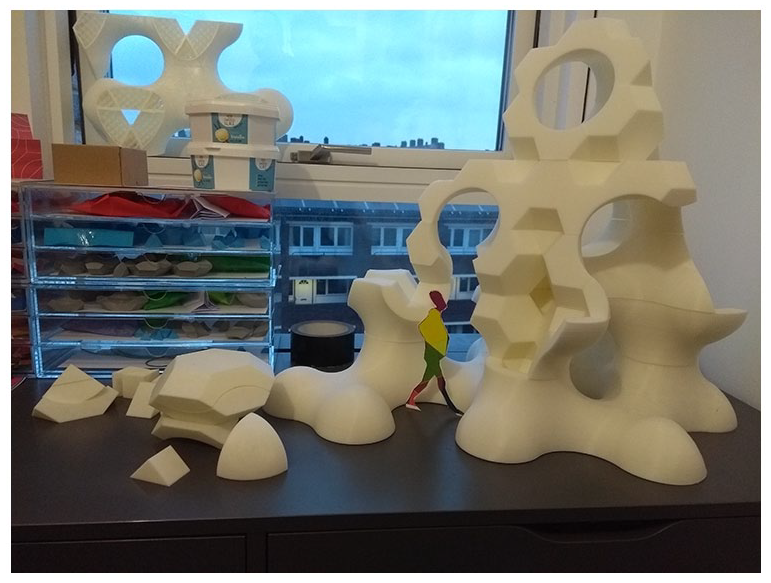
Keith Albarn’s latest models, November 2018.
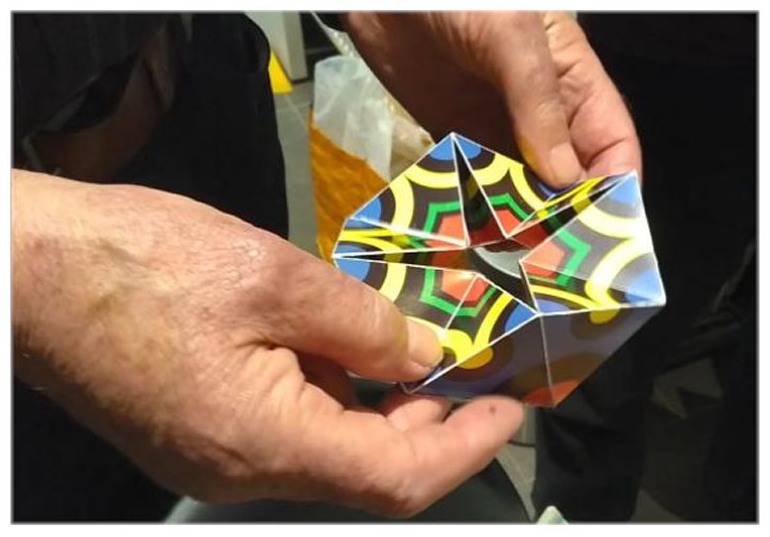
Keith demonstrates how to roll a Tumbli, November 2018.
In offering a mutual exchange, we showed Keith unattributed copies of his drawings of the modular Ekistikit system that Luke had found at an archive in the USA (‘I haven’t seen that for fifty years!’). We also disclosed extracts from Littlewood’s diaries concerning her late 1960s fun palace playgrounds in Stratford, east London, and in which Keith and Hazel feature rather more prominently than they had realised (Littlewood describing them fondly as ‘art clowns’). Hazel recalled working on set designs and costumes for Littlewood’s theatrical productions, and Littlewood’s single-minded efforts to realise her fun palace project. Keith reminisced how encounters with Littlewood and her architectural collaborators Cedric Price and Richard Rogers had inspired him to explore inflatable structures, including one proposal for an inflatable fun palace on the Thames. Keith also reflected candidly on enjoying these ‘stirring memories, in both senses!’, admitting that he found the slippery process of recall challenging but that ‘it actually helps me do what I’m doing now [book project] because you’re enriching the connections which make grey matter’. 18
In triggering such memories, our meetings stimulated a torrent of extraordinary tales, only some of which focused on the Fifth Dimension. 19 We heard much about the creative ferment of 1960s London, the couple’s involvement with dynamic scenes involving a cast of renowned architects, artists, designers, musicians, performers and poets. After each meeting, we reflected together on the many rich ideas that Keith and Hazel opened-up for us, untangling our thoughts as we attempted to refocus on our search for the Fifth Dimension.
Proximities
A crucial touchstone for me, Tim, was a treasured yet crumpled postcard that my Grandmother had bought me during our 1969 trip to Girvan. Upon relocating it after the conference in New Orleans, I was returned to thoughts of my Grandmother as a continuing source of inspiration. My childhood holidays were largely spent in her cottage in rural Renfrewshire, with most days bringing forth adventures that she instigated. A woman of unquenchable curiosity and numerous passions, she assumed that I would share her urge to visit the places that she had researched. We would set off in her battered Ford in search of prehistoric stone circles, castles, grand and obscure museums and art galleries, country estates, geological wonders, spectacular landscapes, modernist new towns, bird reserves, foreshores, shipyards. . . and on one occasion, a psychedelic fun palace in Girvan.
The postcard’s coloured photograph depicts the Fifth Dimension on the Girvan seafront, surrounded by a large car park and extensively lawned area, with the newly built Beach Pavilion in the background and situated adjacent to the sober granite commemorative McCracken fountain erected in 1927 (Figure 2a). Three small boys are sitting on the edge of the fountain looking towards the Fifth Dimension and a fourth boy is walking towards them. This image caused us to wonder about the children who, like Tim, had encountered the psychedelic incongruity from London. What did they make of it? How did they feel once they had mustered up the courage to cross the threshold and move through its disorientating chambers? Were they still around, and if so, what did they remember about it? What trace of these young lives and their encounters remained to be discovered? 20
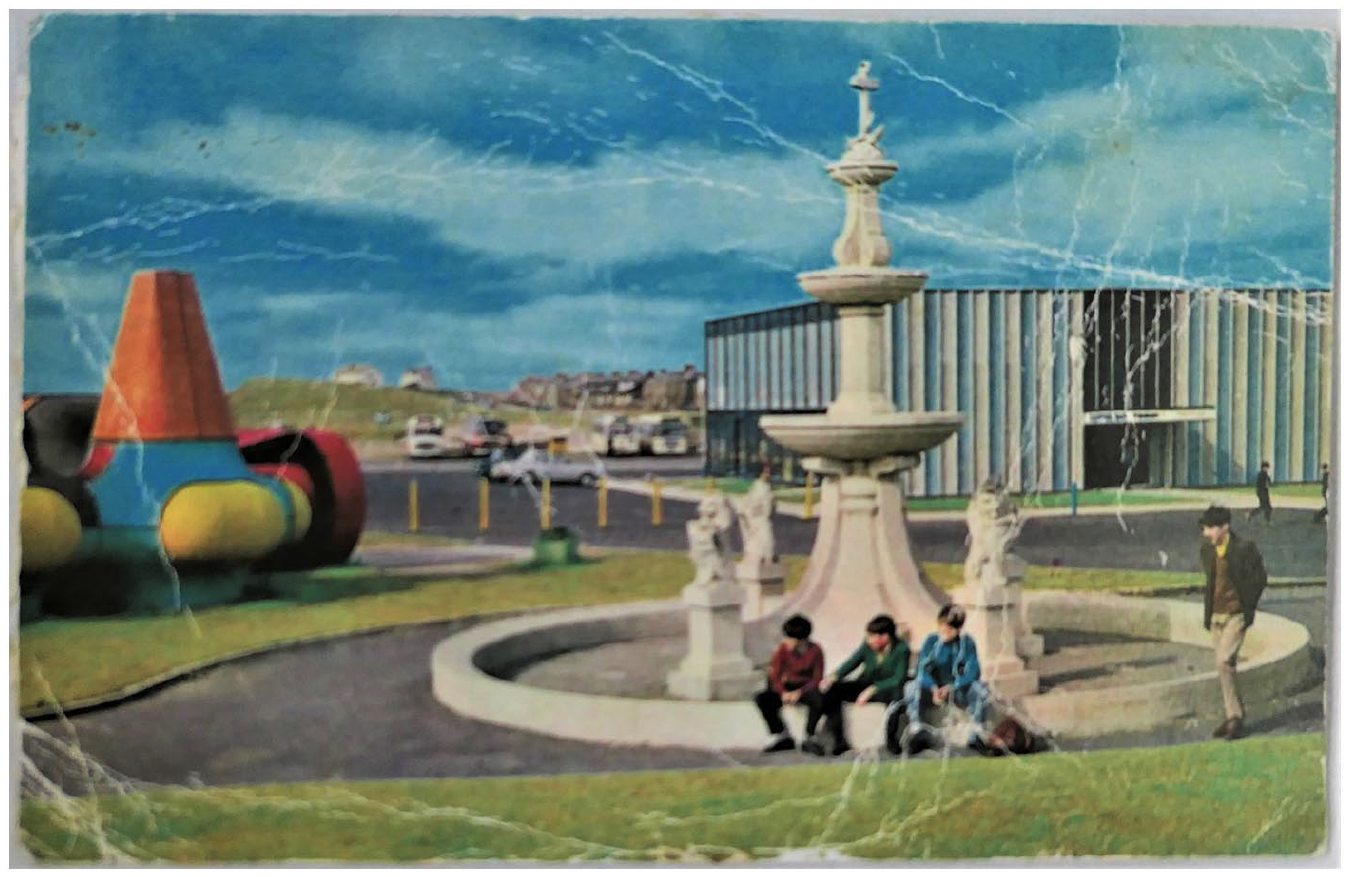
Tim’s postcard of the Girvan foreshore, c.1969.
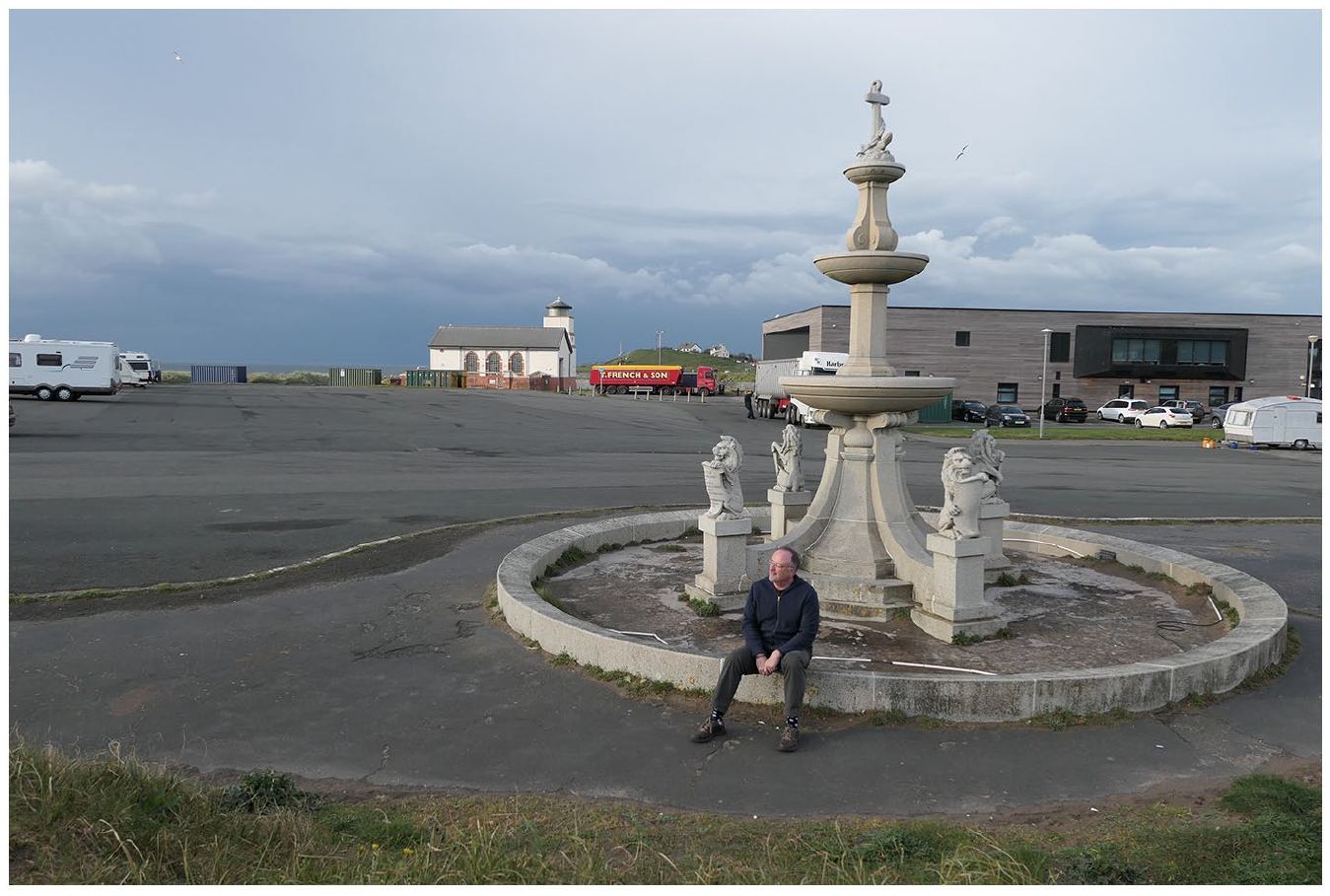
Tim sitting on the commemorative fountain on our arrival in Girvan, April 2019.
Under a mounting, seemingly inescapable desire to go to Girvan and find out, we hurriedly wrote to a local newspaper appealing for memories of the Fifth Dimension, booked a B&B and drove from Manchester to Scotland. 21 Upon arrival, despite being tired from our 4-hour drive, we drove straight to the car park where the Fifth Dimension once stood. Tim sat on the edge of the McCracken fountain, now only adjacent to an even larger expanse of blank tarmac and looked out to sea in reverie (Figure 2b). 22
Gleaning
From our conversations with Keith, we knew that his team had installed the Fifth Dimension on the Girvan foreshore in April 1969 (Figure 3), a key date that we could work with as the basis for our archival search. Having received several wonderful responses to our newspaper appeal, our initial task in Girvan was to search for any archival clues in the usual places; visiting the local library and chatting with the slightly perplexed staff, and then on to Ayr’s Carnegie Library where, after several hours trawling through microfiche records, we assembled a smattering of news pieces about the Fifth Dimension. These revealed a surprisingly detailed, transparent civic forum with close reporting on local council decisions and intentions. Many reported discussions geared towards tourism, notably the provision of amenities on the foreshore, and reflected a lively local politics in Girvan before early 1970s restructuring moved to more regional decision making based in Ayr (and, thus transforming local press and council archives). We traced reports on the decision to commission the Fifth Dimension, its initial launch, a relaunch the year later after a refit and commitments to extend its profit-making run for another season. A report of damage to the structure after a ‘week of gales’ in January 1974 was the final record we found, confirming that the Fifth Dimension was in place much longer than we first assumed. 23
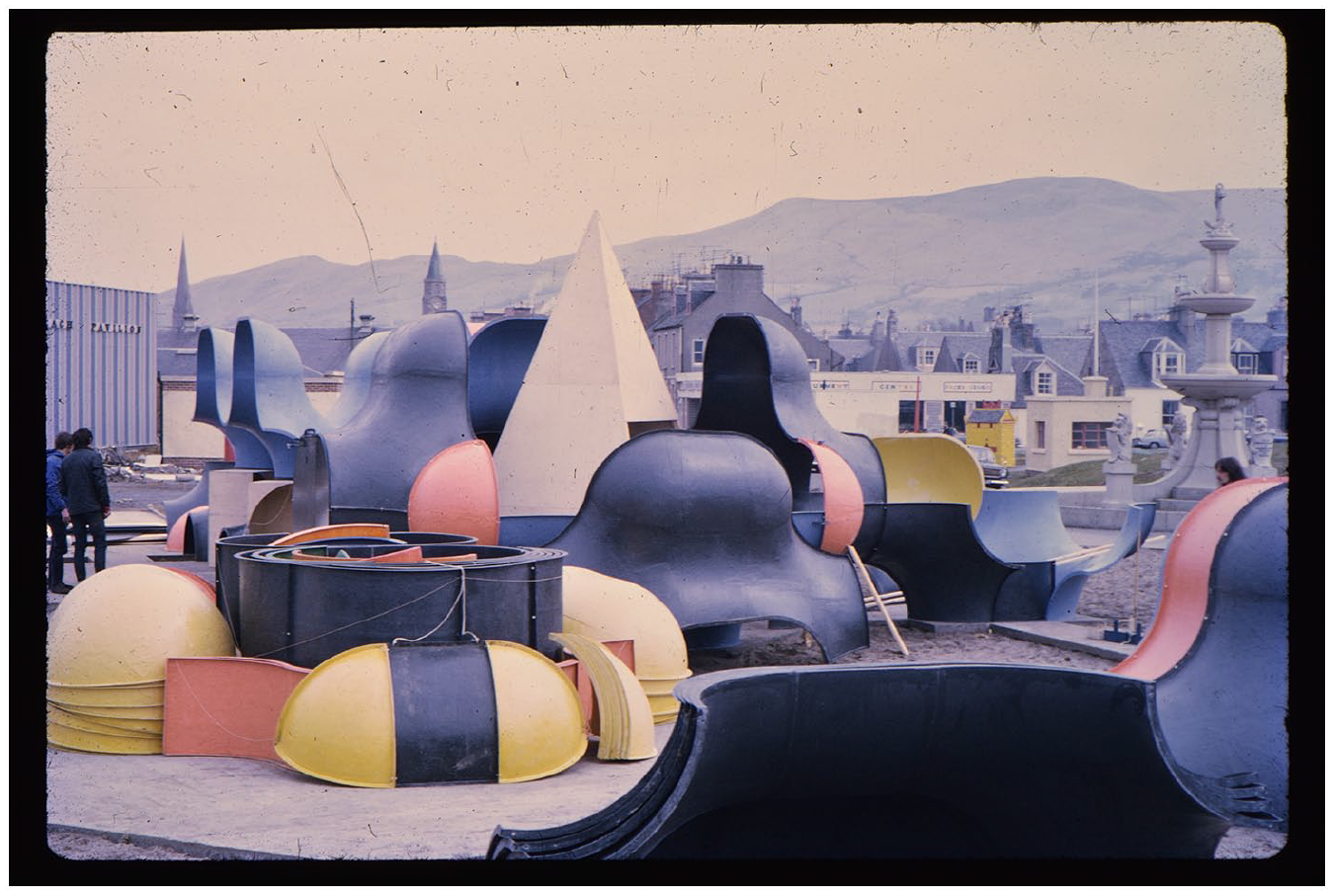
The Fifth Dimension being installed on the Girvan seafront by Keith Albarn (second from left) and team, April 1969.
Back in Girvan, our knowledgeable landlady suggested that we pay a visit to the town’s community and resource centre, the McKechnie institute. The staff, Bob and Kerrie, welcomed us kindly, and shared personal reflections of the town’s history and local characters. While the collections here provided scant evidence of the Fifth Dimension, a brilliant tourist brochure from 1973 celebrated the offerings of the town: a ‘fine sandy beach’, a ‘picturesque harbour’, dancing, wrestling and variety shows in the Beach Pavilion, seafront golfing greens, a boating lake and giant helter-skelter, newly opened swimming baths; and in several images, the Fifth Dimension was captured as part of this once-lively tourist scene (Figure 4). On the wall was an austere 1965 photograph of the town councillors who had worked hard to assemble the attractions at the crucial foreshore site to – in the words of the brochure – create a special place ‘for happy family holidays’. Seeing the pioneering May Connor, Girvan’s first female councillor, alongside the savvy councillor, William McMillan, who first proposed commissioning a ‘light and sound project’ by Keith Albarn – names we had repeatedly seen in the detailed minutes and local press as leading the development of the Fifth Dimension – was a surprisingly moving experience.
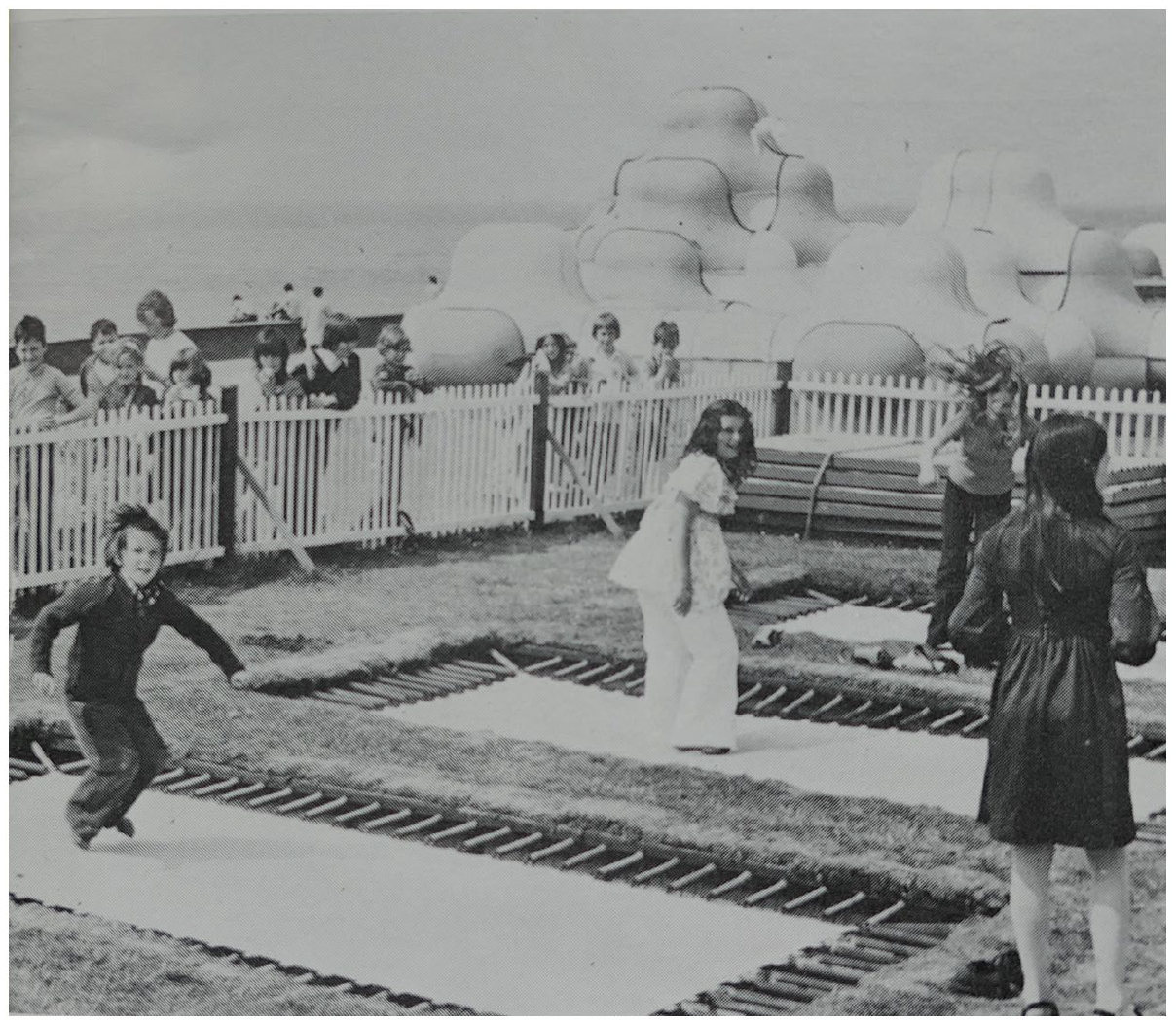
Children playing on trampolines, the Fifth Dimension in the background, Girvan, c.1973.
Word soon got around that two strangers were in town asking questions about the Fifth Dimension, and over cups of tea and biscuits in the McKechnie Institute, several long-term residents arrived to share their teenage stories. Their patchy tales told of first witnessing the extraordinary structure, entering it and experiencing its sensory overload, their excitedness at having a cutting-edge example of avant-garde 1960s creativity in their somewhat staid town, and the contrastingly scathing responses of the town’s elders to the attraction. They also related the gradual decline of the fun palace over its 7-year installation, as it became a mundane part of Girvan’s fabric, and its uneventful disappearance at a time that nobody could quite remember.
Despite the insights provided by these first-hand experiences, we still knew nothing about the fate of the Fifth Dimension after the storm in January 1974. Had it been repaired yet again, or perhaps relocated to another resort? Might it have been stored somewhere or acquired for a private collection? We were aware of several intriguing rumours: that Girvan’s councillors had attempted to sell it to another British seaside resort; and more enticingly, according to Keith, that it had been buried beneath the local sand dunes. In the absence of any definitive accounts, we began to fantasise about persuading Channel Four’s Time Team to conduct a surreal ‘geophys’ survey of the shorefront that would inspire an archaeological dig to unearth the remnants of the fibreglass structure.
We furtively wandered around town, driven by a feverish preoccupation with discovering the discarded remains of the Fifth Dimension. Finding nothing, we widened our search, driving slowly along the surrounding country lanes, circling car parks, the scrubby edges of shoreline roads, a caravan park, golf club and scrap yard. We poked about in piles of abandoned matter hoping to glean even the slightest fragment of the lost sensorium, showing Tim’s postcard to anyone kind enough to listen or concerned enough to enquire about our somewhat odd behaviour. 24 We became familiar with Girvan’s hinterland, venturing into rural and coastal settings we would never otherwise have come across. Disappointingly, nothing materialised from our rain sodden searching, but after each excursion we returned to our B&B, revived with the warm satisfactions of the places we had toured through, the people we had met and the lingering hopes that they sustained, inspiring fireside chatter in the local pubs. 25
On our penultimate day in town, we were unceremoniously disabused of our yearnings by Shirley, a highly knowledgeable member of the local history society who bluntly informed us that the Fifth Dimension’s final resting place was a site previously used for landfill next to the Grants distillery on the edge of town. It was, she insisted, ‘long gone’, buried deep and irretrievable in anything like its original form.
Auspicious accumulations
Renowned for its world-class golf courses, the Ayrshire coast continues to attract numerous golf tourists. On our way to the Carnegie Library, we stopped outside the Open course, Turnberry, now the Trump Turnberry, for no less a personage than the former president of the USA was the proprietor. Golf seemed marginal to our tale but would become more central – and uncanny – than we had anticipated.
To make sense of this connection, we return to an early conversation at a point when Keith was explaining how he had managed to fund the development of his Ekistikit modular building system in 1967. He recounted how a stranger had appeared at one of the famous happenings in the Artist’s Own Gallery on Kingly Street in London’s Soho and offered to pay to keep the exhibition open for a few more weeks. Revealing his name as Roger Wall, inheritor of the Wall’s ice cream fortune, his generous offer was made in the hope that Keith and Hazel might produce a multi-sensory, promotional structure for their latest products. While a psychedelic ice cream experience did not ultimately transpire, Roger’s patronage did secure, rather obliquely, the production of several golf-ball-shaped fibreglass shelters (Figure 5). As Keith elaborated,
By then we’d done [a prototype sensorium called Inter-67 at] Brighton Festival, and that was based upon hemispheres and tubes with a slot, and they linked quite neatly, geometrically. So, I wanted a bigger version; I wanted a proper building kit, so I played around with eight-foot spheres cut in various ways and established a relationship with a fibreglass manufacturer.
It’s interesting how these things sort of come together.
Yes. And actually, life is really a series of journeys with stop-off points, and you move on. You’re lucky to run up against certain things, really.
. . . one night we were having a drink, and another drink, and I said [to Roger] ‘What do you do for fun?’ This was a family joke, but he didn’t know that: ‘What do you do for fun, Keith?’ ‘Work!’. He said something similar, except that he was passionate about golf, and I thought, ‘God almighty, Wall’s ice cream to golf. I can’t cope with this’ . . . I remember that I took the pint glasses back to the corner table, and on the way, I thought, ‘It’s all balls! Eight-foot spheres, golf balls with dimples!’
He did you a favour then, didn’t he?
Yes. . . He did pay [to extend the exhibition], because he thought he was going to make a real killing. So, I said, ‘Well, all I want out of it is an eight-foot master mould’, because in those days, they had to be made. . . I worked out how it would be cut apart so I could use the master, and then I thought, it’s got to have dimples, but if I put the dimples on the outside of the mould, bolted on, I could take them off, then I’d got my perfect eight-foot sphere! That’s how I got the mould. . . Roger sold the golf ball idea to Algur Hurtle Meadows who’s an oil multimillionaire who owned the Meadows Building in Dallas, Texas. . . he was an art collector. . . I got a telephone call from the Savoy, ‘Is that Albarn, Keith Albarn?’ ‘Yes. Who’s that speaking?’ ‘I’m Algur Hurtle Meadows. You may have heard of me’. . . So, I said, ‘I’m afraid not’, and he said, ‘Well, you will by the end of the day because you’re coming to see me this afternoon’. . . He said ‘I’m at the Savoy. . . come at two o’clock today’ . . . So, I had this bizarre meeting with this man, who was living in a suite at the top of the Savoy . . . Anyhow, he did actually do some business with me for the golf balls, but I never benefitted a penny. I don’t know what he did . . .
. . . maybe those golf balls are knocking around somewhere?
Well, absolutely, that’s what I’m thinking.
We might try and track some of that down . . .
We got more publicity for that bloody golf ball than for anything else we ever did . . . every bloody newspaper in the country had it.
There must be some sort of archival trail about that, we’ll do some digging. 26
Back in our Girvan B&B, and deeply dissatisfied with the abrupt curtailment of our search, we looked again through our accumulating mass of gleaned materials, notes and photographs. Sure enough, these included a local press report mentioning that Keith had donated no less than three golf shelters to the town council as a gift for their forward-looking commissioning of the Fifth Dimension. 27 This gift, as he explains above, was a happenstance by-product of Keith’s strategic attempts to develop his Ekistikit system. In order to secure a production master mould, a limited run of golf shelters were produced before being offloaded to various parts of the world in an unlikely deal between businessmen trading in ice cream and oil and art. This incidental yet captivating detail suddenly gained fresh relevance to our present interest. With the Fifth Dimension seemingly consigned to landfill, might there be some other trace of Keith’s relationship with the town, perhaps one of these golf shelters? The chances, it must be said, felt rather slim.
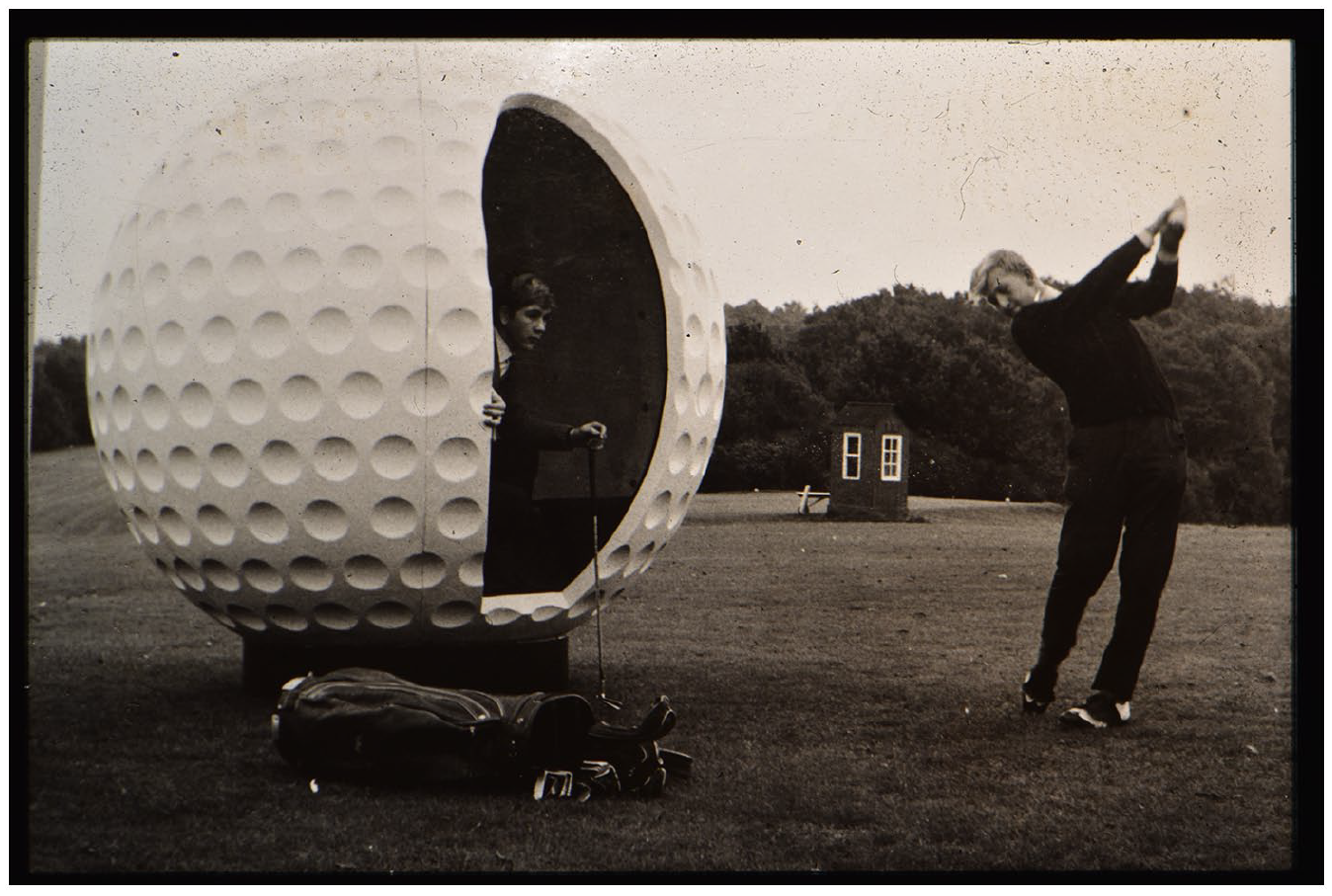
A shelter designed by Keith Albarn on an Ayrshire golf course, exact location unknown, c.1969.
Our luck changed on our last night in Girvan, as we supped a late pint in one of the friendly pubs. As ever, we were regaling a few nonplussed locals with our show-and-tell routine about our unfulfilled search for the Fifth Dimension, using Tim’s postcard as a tatty prop to help counteract the tallness of our tale. We mentioned the golf balls. This suddenly pricked the memory of the landlady. She offered her partial reflections as they came together in her mind. There was at one point, she felt certain, some sort of strange DJ booth in the basement bar of the old King’s Arms hotel. Now she thought of it, it was rather golf-ball-like in shape. The basement bar was called The Bunker (a golfing reference?). It was, she offered, a fun night out in its heyday, but the hotel closed years ago after tourism dried up. But there was an auction. A name was mentioned with a wry smile: Forbes Robertson. Forbes had a reputation locally as an eccentric, entrepreneurial character who ran themed entertainment venues in Girvan and Ayr. He had amplified his notoriety of late after making a charismatic appearance on the Come Dine with Me television series, where he was billed as ‘Ayr’s answer to Donald Trump’. 28 Crucially, he liked to collect curiosities. The landlady felt that if anyone might have picked up a giant golf-ball-shaped fibreglass shelter at an auction way back then, Forbes Robertson would be a good bet. Forbes owned a nightclub in Girvan called Flix which, she suggested, was filled with some of his ‘strange’ collections and might be worth a look. ‘Aye,’ she said, ‘if I were you, I’d try there’.
Wunderkammer
On our last evening in Girvan, we ventured out to locate Flix on the main drag through town, only to find it closed. We lingered, peering through the shutters that revealed promising glimmers of the objets d’art inside, but began to nurse our further disappointment that we might never find out whether an oversized golf ball was among the curiosities within. Just as we were about to accept defeat, a man with a large bunch of keys walked up to the doorway and lifted the shutter. We approached him, garbling something about golf shelters and the auction at the King’s Arms and showed him Tim’s postcard. Jock the bouncer politely agreed to let us accompany him into the dark club while he set up for the evening ahead.
We ascended a narrow flight of stairs and entered a large room with a dancefloor and a few smaller adjoining chambers. All were crammed with an extraordinary, overflowing assortment of artefacts, an Aladdin’s cave of kitsch, a treasure trove of popular cultural icons, brief crazes, products and oddities. 29 Giant plastic and fibreglass figures crowded the walls and ceilings: Tintin, Betty Boop, Marilyn Monroe, Frankenstein’s monster, astronauts, extra-terrestrials, grinning Disney characters, life-size cows, cartoon alligators, dinosaurs, walnut whips, barrels, robots, comic kilted Scotsmen, square jawed cowboys, buxom cheerleaders and carousel horses, along with giant scissors, beer cans, fruit machines, musical instruments, advertisements, street signs and number plates and far too many other items to take in (Figure 6a). This teeming setting became progressively more intensely bathed in the colours radiated by glowing, animated illumination as Jock walked round flicking on switches.
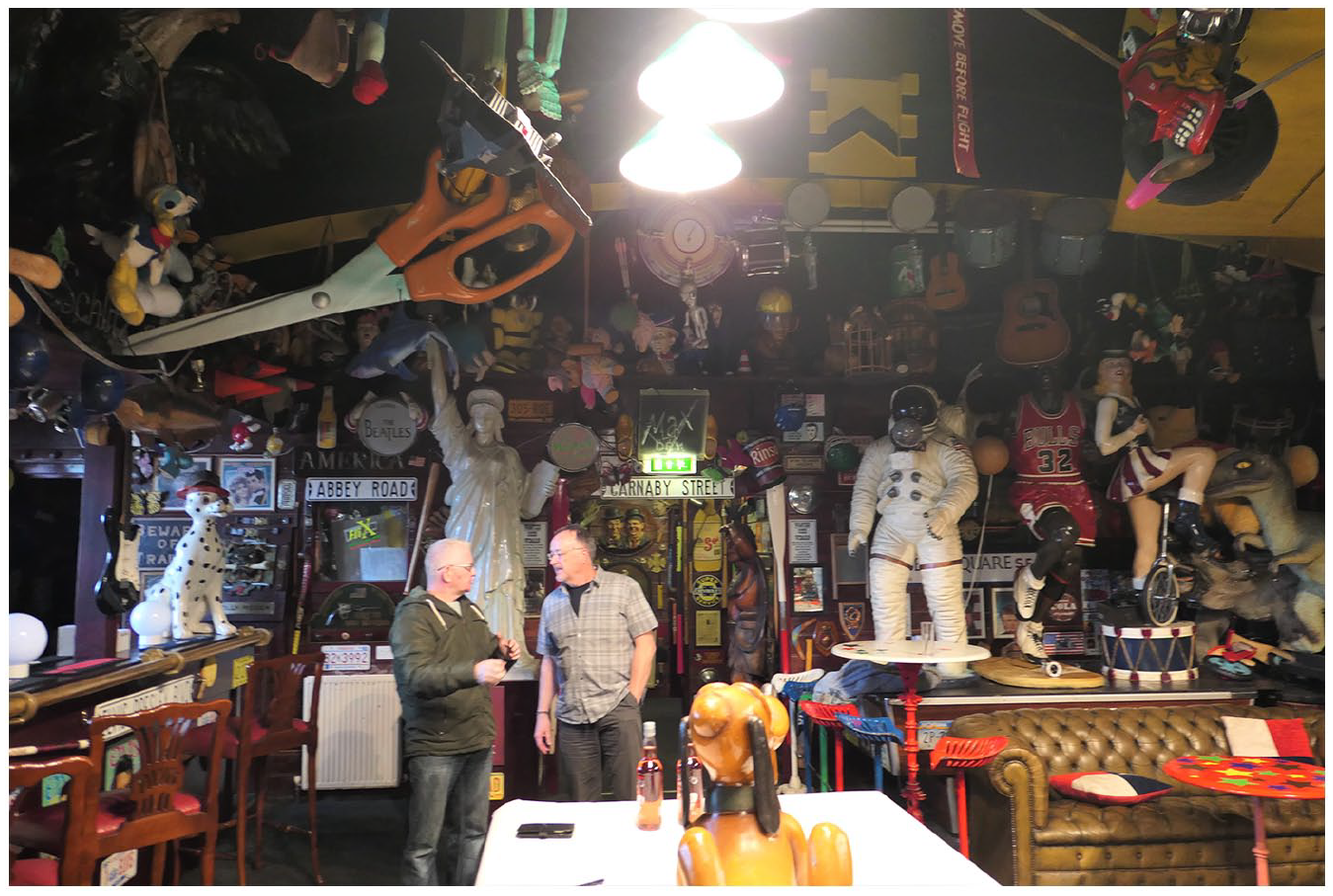
Jock and Tim inside Flix nightclub, Girvan, April 2019.
Driven by the compulsive enthusiasms of their collector, mixing the absurd and the nostalgic, the growing accumulation of items that mingled indiscriminately in Flix were displayed according to no obvious aesthetic principles. Confronting this excessive array, a cornucopia testifying to the protean, dynamic fads that circulate through British popular culture, a host of memories were triggered and bizarre juxtapositions confounded and beguiled us. 30 Our gaze wandered across the surfeit, snagging on particular entities, but we were unable to focus on any single object for we were ceaselessly distracted by others that suddenly stood out from the material profusion. This compressed and luxuriant world, a vernacular Wunderkammer, was a wholly unanticipated delight. 31
And there, on one side of the room, separate from this collage of oddments, was a spherical booth with two model dalmatians sporting red hats perched on a curved green countertop. Was this what we were looking for? Around 8 ft in diameter, made from thin, moulded fibreglass and possessing a neatly dimpled roof, ready identification of the object was complicated by the modifications that had transformed it from golf shelter to DJ booth and subsequently, into what Jock informed us was the club’s ‘shots bar’. It was lined inside with mounts for spirit bottles, adorned with coloured lighting, with the counter used as a bar for serving. Albarn’s iconic golf shelter had been cut into quarters and re-assembled on its side, with the original doorway widened to accommodate a bar hatch. Flushed with excitement, we climbed inside what may well have been the last material vestige of the architect’s work to remain above ground in Girvan and posed with beaming smiles while Jock captured the moment for posterity (Figure 6b).
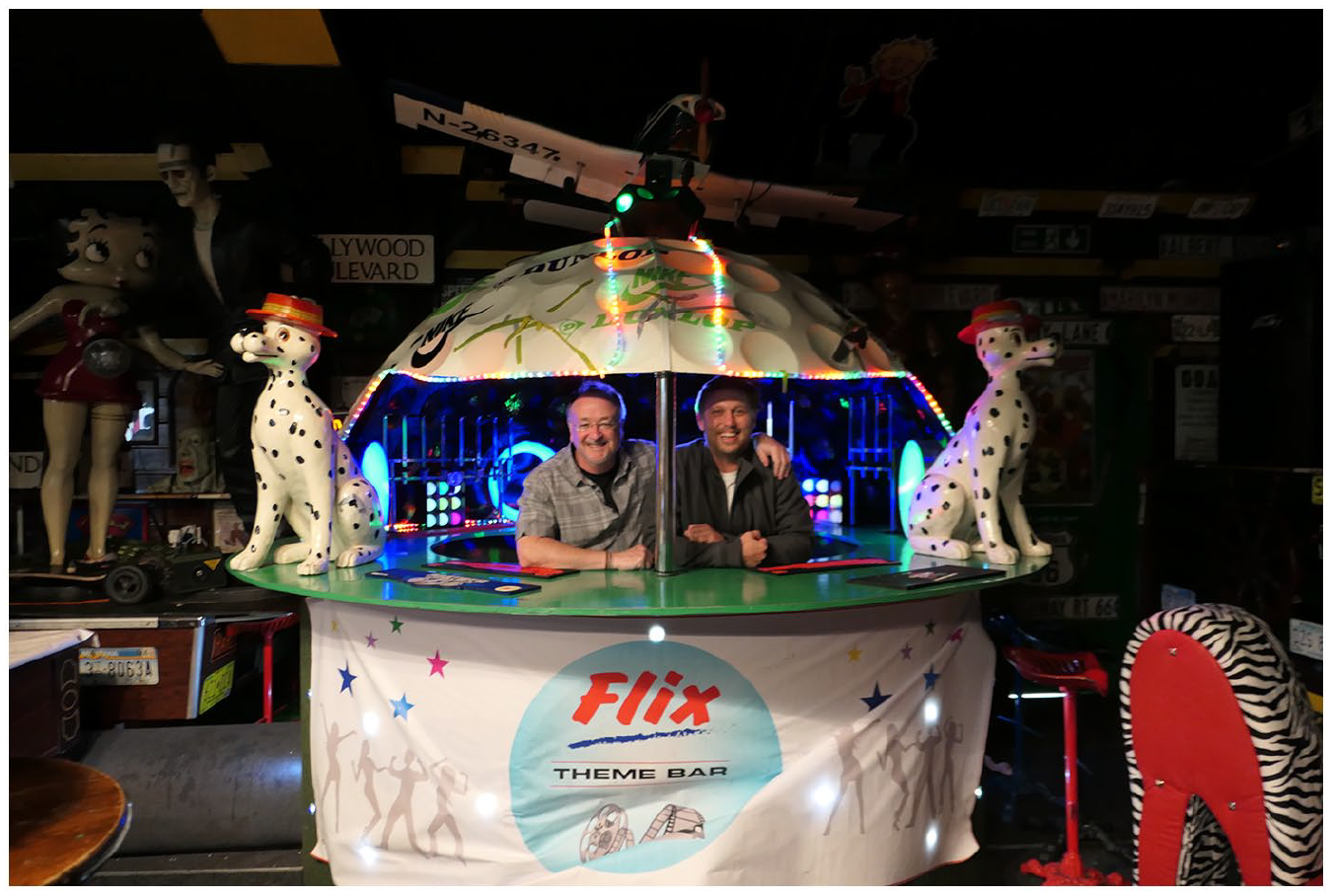
The authors pose inside Keith Albarn’s golf shelter, Flix nightclub, Girvan, April 2019.
Curious affects
The next morning, with Tim leaving town by car and a few hours until I, Luke, had to catch my train, I received an unexpected phone call from Forbes Robertson: ‘If you come to Ayr on your way home, I’ll pick you up at the station and we can chat’. Jock had passed my number to him, along with news that his shots bar at Flix was rather more significant than he might have assumed. I was delighted with this chance to follow up with Forbes and immediately set off for Ayr. In the station carpark, a man with a big grin and shockingly firm handshake was waiting by his custom-plated, ice-white Range Rover. Forbes’ first act, setting the tone for what would follow, was to open the passenger door to reveal a replica of R2D2 from Star Wars sitting in my seat (because, I had to assume, my name is Luke). Before he returned me to the station several hours later, he insisted I pose for a photo in the driver’s seat of his Range Rover holding a lightsabre next to R2D2 (Figure 7a). Looking back, I can see how this surreal, somewhat disconcerting moment served as an important reminder about the unpredictability of interviews and the limits to assuming control in such interactions.
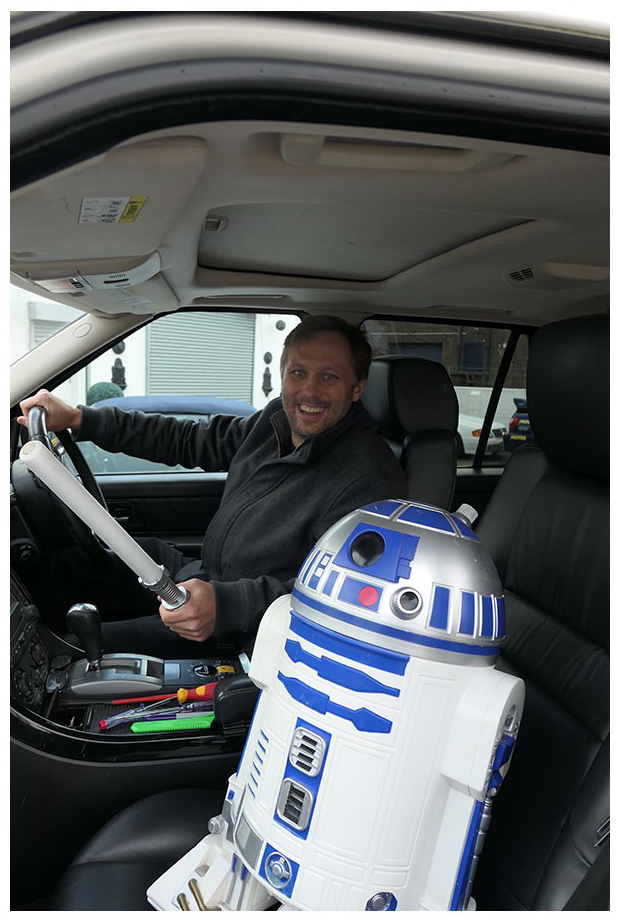
Luke (Skywalker?) in a Range Rover outside Pet Heaven crematorium, Ayr, April 2019.
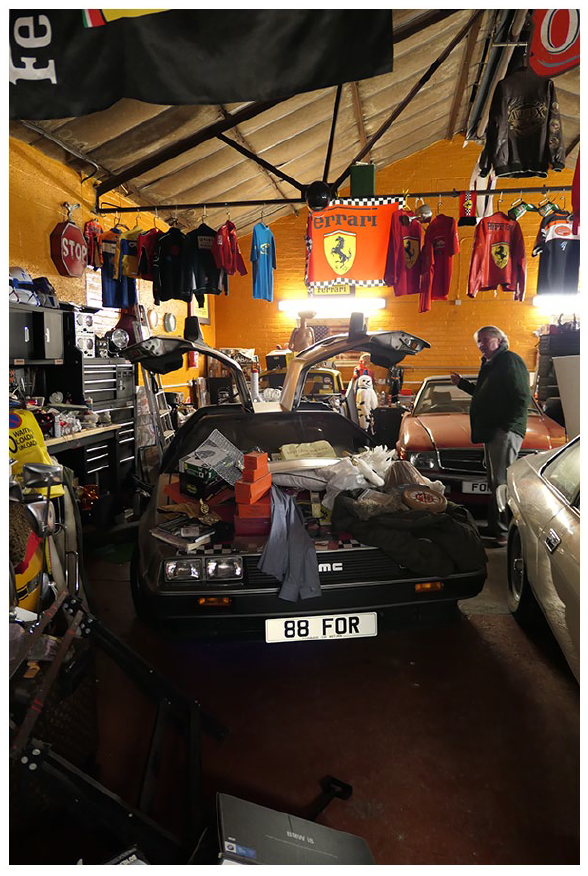
Forbes Robertson with some of his memorabilia collection at Pet Heaven, Ayr, April 2019.
Forbes then took me on a tour of his various businesses around Ayr, stopping first at his themed bar, The Nineteenth Hole, laden with golfing memorabilia (he initially wanted to instal Albarn’s golf shelter here but ‘there wasn’t enough room’); then on to his small restaurant called Come Dine with Me, and then for coffee in his café, the more plainly named The Sandwich Bar, its walls crammed with rows of kitsch teapots on display. We chatted about the golf ball, the fortune he made running roller discos in Ayr and Girvan in the 1970s, his later lucrative investments in the care home business, his ongoing battles with Ayr council in trying to open a strip club, and his views about young people not working hard enough anymore. I recorded his account and assumed this constituted the promised interview. But in a final flourish, Forbes wanted to show me his latest venture, a pet crematorium called Pet Heaven, and I agreed with some trepidation to take up his offer.
Initially, if you overlook the trailer on the forecourt mocked up as a NASA rocket, my tour of Pet Heaven fell within the reasonable parameters of my expectations: a series of sombre rooms adorned with animal-themed objects: brass lions, a large pair of ceramic swans, a bronze-cast head of a horse. So too was observing what Forbes with a dark humour referred to as ‘the ovens’ in a backstage area behind the curtains. But then we moved into another back room where Forbes kept his collections, and things changed gear: here was a space filled with three custom plated red Ferraris, a custom plated E-type Jaguar, a mint-condition 1985 Porsche 911, walls plastered with car racing paraphernalia, a smiling mannequin in racing overalls holding a crash helmet. On then to another room, and another: in one corner a DeLorean with a ‘working’ flux capacitor, behind it a yellow three-wheeled Robin Reliant with ‘Trotters Independent Trading Co.’ printed on the side. Rows upon rows of tee-shirts, shelves filled with vintage toys in original packaging, a life-size E.T. Flix, had been but a foretaste. As I made my way back to London that evening my head whirled with an unsettling excess of curious affects. 32
Dreamlands
Energised by our time in Girvan, which had confirmed our faith in the enchanting rewards that may befall the curious, we considered whether similar wonders might be revealed in a search for the prototype of Albarn’s Fifth Dimension called Spectrum, which had been installed for the 1968 summer season at Margate’s Dreamland theme park (Figure 8). Some weeks later, we joined the seasonal throngs who regularly make the trip from London down to Margate. 33
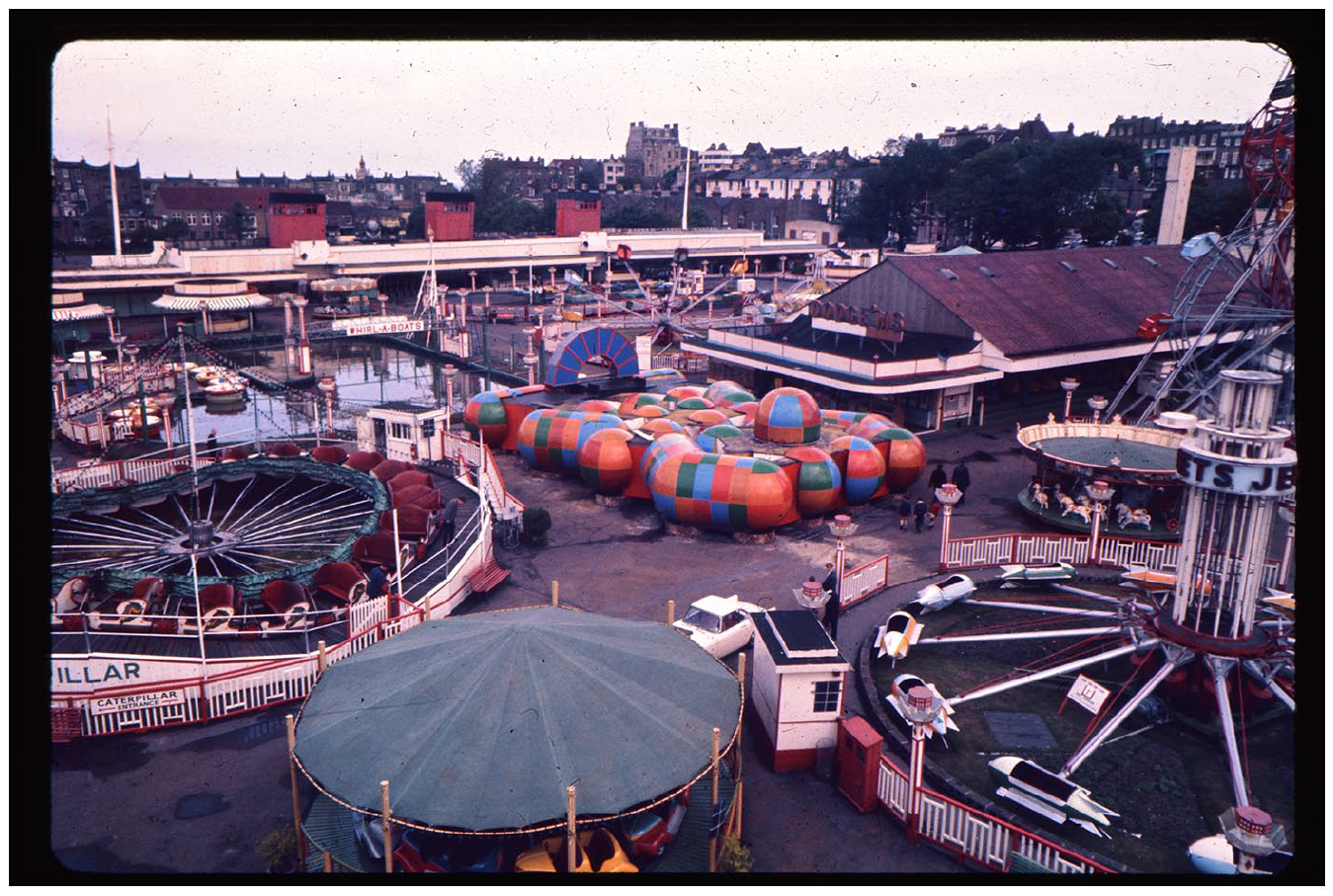
Keith Albarn’s Spectrum at Dreamland, Margate, 1968.
Though Spectrum had garnered much national attention and media publicity at the time, some of which Keith shared with us, our journey was initially rather unfruitful. The local library contained a few late 1960s press articles and beautiful adverts for Dreamland, but none featured Spectrum. Our posts on local forums appealing for memories had largely drawn a blank. We paused outside a local solicitors’ office after finding it closed because we were informed that one of the partners sat on the board of the Dreamland trust. By chance he pulled up in a smart car to collect some files for the weekend, listened sympathetically to our obscure research interests, and kindly arranged for us to look through the Trust’s photo archive, certainly a treasure trove but lacking any evidence of Spectrum. We decided to explore Margate Museum, a former police station and courthouse, which included an exhibition devoted to the wonders of Dreamland in one of the old cells.
Though we enjoyed poring over the exhibit’s extensive historical collection of fairground memorabilia, we were once more disheartened to find no reference to Spectrum. As we left, we explained to the steward the focus of our research and the apparent dearth of leads. ‘But you saw the model didn’t you?’ she offered, and beamed as the look on our faces betrayed that we had not; ‘it’s in the photograph of Mick’s models’, she explained. We hurried back to the cell and upon closer inspection found a small unframed photograph affixed to the wall depicting a man standing behind a scale model of Dreamland (see Figure 9). As we scrutinised this image, we were staggered to notice that this model included a miniature simulacrum of Albarn’s Spectrum. Mick, we were informed by the delighted steward, still lived in Margate and was a well-known local character, having recently successfully campaigned to become the town’s mayor. Thrilled at this fortunate discovery, we were already planning our next visit to Margate as our train wound its way back to London.
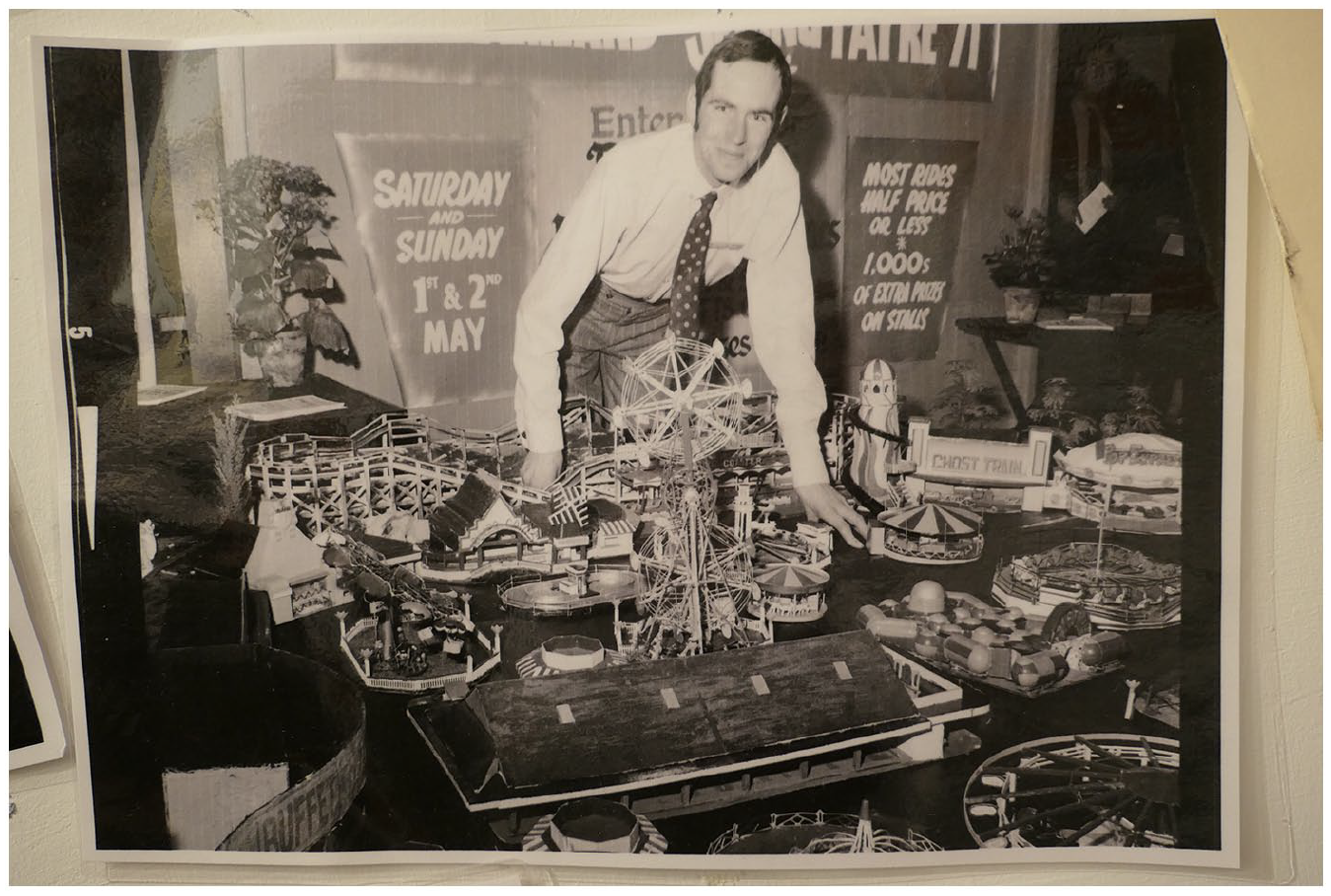
Mick T with his model of Dreamland featuring a maquette of Spectrum, Barker’s of Kensington, London, c.1970s.
A couple of weeks later, we arrived at Mick’s modest, inter-war semi-detached house on the outskirts of town, to encounter a jovial fellow, eager to share his recollections over a cup of tea in his sitting room. Having once been a mod (‘not a bad one!’), he was fond of 1960s rock and soul music and told how he had plied his trade as a prominent disk jockey in the town for many years. As a longstanding Margate resident, Dreamland had been of central importance to his life, and he elaborated upon its volatile revivals and declines, shifting ownership and the different thrill rides that have arrived and departed.
Most crucially, Mick was a qualified electrical engineer and had been employed on Dreamland’s construction of the River Caves and Ghost Train before his involvement in the complex installation of Spectrum which caused, he explained, the relocation of a disgruntled palmist. Installed on irregular ground, Spectrum required much work to render it stable and the fibreglass out of which it was made proved too thin, with the volume of visitors ensuring that it was badly damaged by the end of the summer season. Despite these setbacks, Mick spoke affectionately and nostalgically about the fun palace; the heady fibreglass smell, innovative lighting, multiple textures, diverse chambers and the disorienting effects resulting from immersion inside. As he reflected, ‘you would come out and say, “What the hell was that?” . . . even to this day . . . you think “What was that all about!” But it had a massive impact’. Consequently, he had been keen to incorporate Spectrum into his 1968 model of Dreamland. 34 As an exquisite aside, he explained that after dismantling Spectrum in 1969, he recycled its modular, spherical forms for the illuminated Magic Garden that once lined the course of Dreamland’s iconic Scenic Railway roller coaster. Moreover, much of Spectrum’s electronic control gear and dimming lights had ‘come in handy’ in modifying various features around the fairground.
As our cheery interview drew to a close, and with glint in his eye, Mick offered us a final temptation: ‘Before you disappear, come and have a look upstairs; let me show you something’. We followed him into his spare bedroom, where sitting upon a chair in its centre, he switched on the controls of an elaborate, finely detailed working model funfair (Figure 10). Mick’s ‘Dreampark’ was replete with a big wheel, roundabouts, swing boats, walzters and pendulum rides and other attractions akin to rides from Dreamland: the ‘Ghost Train’, the ‘Dreamland Drop’, the ‘Spinning Teacups’, the ‘Up, Up and Away’. A photographic backdrop of a large townscape was arranged on the wall behind, and the model was abundantly augmented with shrubs and trees, fencing, tourist coaches and tiny human figures milling about, it would seem, having fun. On shelving above, further attractions awaited installation, including two large scenic railways. Fifty years on, Mick was still making models, more elaborate than ever. 35
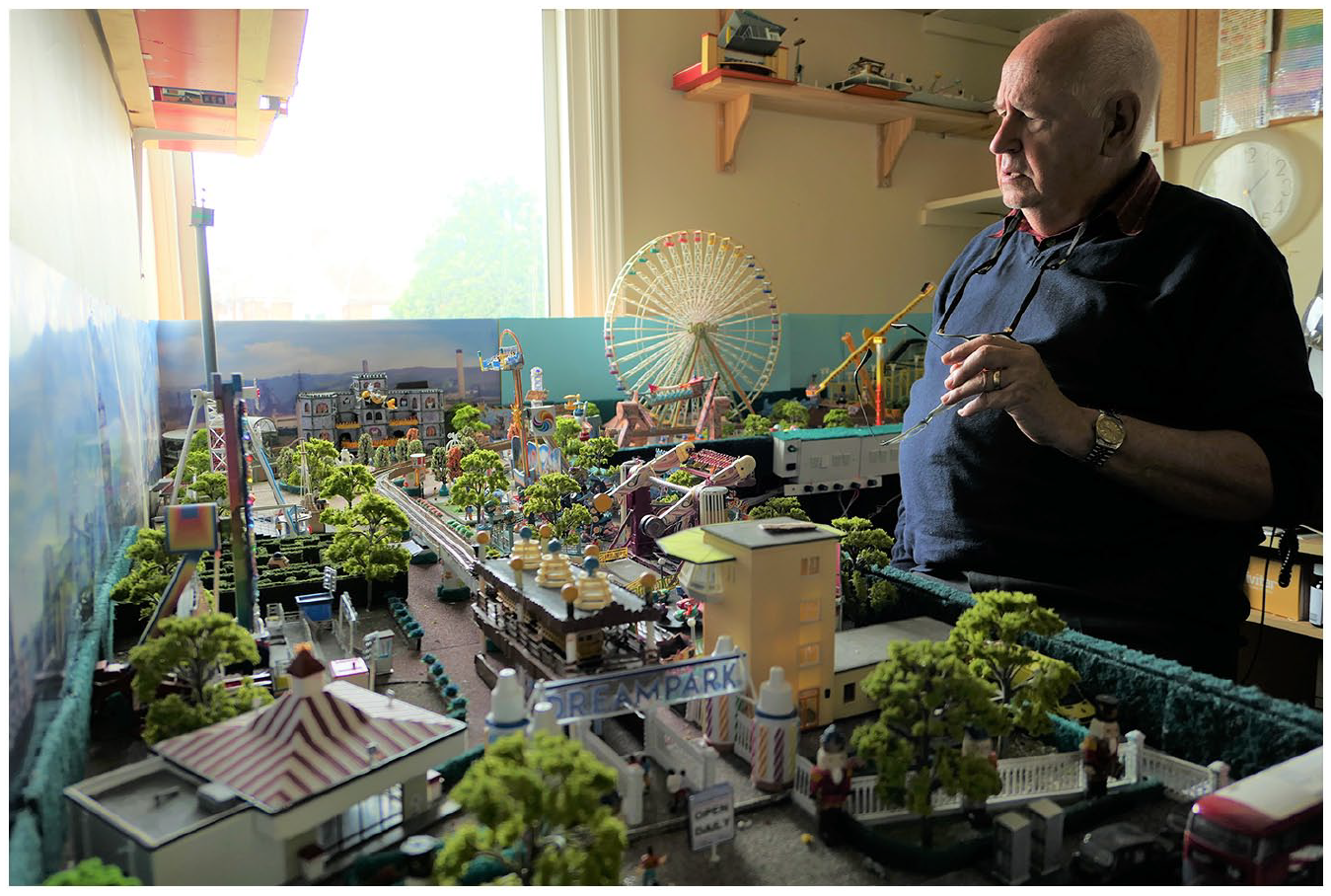
Mick T’s model ‘Dreampark’ in his spare bedroom, Margate, May 2019.
Yet, in contradistinction to his earlier model that sought to accurately capture the features of Dreamland in Summer 1968, this more extensive model was a compilation impregnated with Mick’s own desires, his love of fairground attractions as a habitue of Dreamland. A work of hobbyist enthusiasm – ‘it keeps me busy’, he explained, ‘but it will never be finished’ – creating the model was a playful, absorbing endeavour that attested to the working-class heritage of the seaside amusement park. Confronting this vibrant, tiny playground, the usual perspectives through which we apprehend the fairground were utterly inverted. Yet the abundance of miniature, hyperreal constituents also triggered a cascade of our own memories of carnival and seaside pleasures. 36 Filling the small room, the scope and intricacy of this display as it clacked and whirred away was stunning, its unexpected, animated flurries of motion and sound rendered more peculiar in its contrast with the suburban quiescence outside. We dallied, soaking up the scene, absorbing the details and committing what sense of it we could to memory: another dreamland in miniature.
In search of lost sensations
While honouring the intrinsic value of telling what Lorimer describes as ‘small stories’, 37 this paper has grappled with a central question: are the storied dreamlands of research such as those presented here superfluous to conventional academic accounts? Alternatively, might they intimate the vital forces that underpin the creative practices of cultural geography? We initially assumed the former to be the case, but with a pressing sense that these stories were too potent to leave untold, our telling of them here has motivated us to consider how they might advance Woodyer and Geoghagen’s call for the adoption of a more creative, enchanted disposition to the writing of worlds. 38
Encouraged by growing efforts within cultural geography to recuperate storytelling as a valid mode of inquiry, we have sought to craft a descriptive account that evokes a sense of ‘being there’: of getting caught up in the chase, sharing in the mix of disappointment and satisfaction we felt after hours of searching the hinterland of an out-of-season Scottish resort town in the rain, the disorientating thrill of finding Keith’s golf ball amongst the wonders of Flix, or the sensory delights of a miniature Dreamland. 39 We hope to have conveyed our delight in experiencing their extra-ordinariness, yet while these were certainly some of the most exceptional, exhilarating moments of our academic careers, it also seems likely that our stories resonate on a more fundamentally affective level, tacitly prompting recognition that we might all have these kinds of research stories somewhere. Indeed, telling research stories that deploy a more descriptive writing style intended to both express and induce feelings would seem to offer a more generous relational gesture.
Further significant connections become foregrounded in this way of narrating our research; since, as the adage goes, stories beget stories. We certainly could not tell a story about our research without others – the compelling memories of the Albarns, or the eclectic enterprises created by Forbes, or Mick the mayor’s descriptions of his enthusiasm for model making – or, indeed, without each other. Meeting friendly librarians, curators and local informants forged rich social connections and shared emotions, reveries and experiences. Their stories become entangled with our stories, an intense, collaborative process of reimagining the Fifth Dimension as the subject of numerous entanglements and webs of engagement across space and time. Writing in ways that draw on the multiplicity of narratives are important for presenting contingent and, sometimes, more uncanny links between seemingly disconnected sites of imagination and experience.
In highlighting the usually untold adventures experienced during the research process, we have cast light on how cultural geography might be practised through the cultivation of an enchanted disposition centred around the dynamics of what Phillips defines as ‘sociable curiosity’. 40 Crucially, adopting this approach allowed us to move – and to be moved – through a disparate, unexpected series of encounters with other people, proliferating materials and disparate sites. In doing so, we found opportunities to prompt memories, unsettle assumptions, raise questions, glean what we could from extraordinary realms and follow rumours and suggestions towards things seemingly tangential to our theoretical explorations. We thus emphasise the rich, creative opportunities for producing cultural geographies that emerge when following our curiosities down divergent paths while being receptive to the experience of unfamiliar or marginal places and spending time sharing in the enthusiasms of the fascinating people who turn up along the way. Such relational openness, we suggest, initiates a potential for experiencing enchantment as an integral part of the research experience that is valuable in itself. And while some enchanting episodes may thwart attempts at theoretical sense-making, others might offer empirical material that underpins ideas under consideration or open-up entirely new research vistas.
Our growing desire to locate and re-experience the Albarns’ extraordinary lost sensoria became an impelling force that catalysed further encounters with other dreamlands, and with the excessive material, affective and sensory charge that they might afford. Though not our initial intention, we ventured far beyond an archival focus and into overlooked places: a ghostly foreshore once buzzing with tourist activity, local dumps, recreational spaces and industrial sites of Girvan’s edgelands, a pet crematorium, a repurposed prison cell, a spare bedroom occupied by a model funfair, as well as more mundane sitting rooms, community centres, libraries, museums and pubs. Our ‘findings’ from this process are many, varied and inevitably beyond our full grasp, but perhaps most important was that while we didn’t recover Albarn’s lost sensorium in its original form, our search for it induced anything but the loss of sensation. We thus foreground the notion of dreamlands here to describe sites of enchantment that prioritise the usually omitted stories of material and sensory excess, celebrate the richness of place and disclose the delightfully unsettling peregrinations that might stimulate our geographical imaginations beyond assumed formal and conceptual boundaries.
Equally importantly, these enchanting episodes provided the propulsion that kept our search alive amidst various setbacks, disappointments and dead ends. They were affectively and emotionally sustaining during periods of hiatus, a vital force that endured when leads fizzled out, no archival evidence seemed to exist and nobody seemed to remember anything. Enthusiastically sharing these intense research adventures fostered not only fruitful professional collaboration but consolidated a friendship that persisted, exemplified in our signing off with the affirmative salutation to ‘have fun!’ each time we returned a writing draft to the other. Research can be draining, frustrating and tedious. It can also be extraordinarily enchanting and a great deal of fun. Such experiences, we propose, need to be recognised and celebrated as integral to the process of geographical research.
Footnotes
Acknowledgements
We are especially grateful to Keith and Hazel Albarn for their kindly and generous contributions to our research. We are also indebted to the many people in Girvan and Margate who made numerous improvements to our project through their fascinating insights and thoughtful suggestions. We deeply appreciate the supportive efforts of Dydia DeLyser and three anonymous reviewers who, during a global pandemic, provided constructive and encouraging feedback on earlier drafts of this paper.
Funding
The author(s) disclosed receipt of the following financial support for the research, authorship, and/or publication of this article: The research informing this article was supported by a British Academy/Leverhulme Trust small grant, award number: SG170671.
Ethical approval
Ethical approval for this research was granted by King’s College London, reference number MRA-18/19-11619.
