




Abstract
Studying buildings can be a rich entry point into emerging cultural geographies. The archipelago of Chiloé in southern Chile is experiencing rapid change since the country’s extreme turn toward neoliberal governance in the 1970s. Once a rural, communal, and sea-faring region, it has been transformed by industrial aquaculture in recent decades which has driven a new urban landscapes and consumer-oriented lifestyles. This paper offers findings from an ethnographic study of changing consumption geographies, from iconic tourist sites linked to the region’s rich heritage geographies, to the new corporate retailers and shopping malls. Specifically, the new shopping mall clashes with the heritage and tourist landscape of colonial era churches and other unique heritage architectures that have captured the attention of tourists and investors. We glimpse a dynamic architectural geography in flux, as an array of buildings pulls the population in multiple directions at once, making it an ideal case study of the competing forces of what Deleuze and Guattari called de- and re-territorialization, an appropriate analytic for understanding the powerful forces of commodification.
Introduction
Buildings, rather than passive features of a lifeless background of everyday life, exert force. They are material insofar as they direct activity this way and that, often without us always being fully aware of it. They are also symbolic insofar as they become meaningful and shape our worldviews and even our identities. Depending on what kind of building, they are also malleable insofar as diverse and unpredictable socio-cultural practices course through and around them. 1 How, then, are we to conceptualize complex and fragmented urban landscapes that often contain any number of buildings, all with different intentions and surpluses of meaning that might be more or less explicit, more or less powerful?
This paper shows what an ethnography of buildings looks like. It is ethnographic in the traditional sense of seeking to understand the everyday life and culture of a place through familiar qualitative research methodology, but is orientated toward specific buildings and building-types as they become affective and emotive in different ways. In a place like Chiloé in southern Chile, architectural geography tells a lot about cultural geographies and the forces of commodification reshaping them today. As a major “commodity region” 2 centered around industrial aquaculture, life at the archipelago of Chiloé has changed rapidly since the neoliberal turn, a process perhaps best encapsulated in the new shopping mall in Castro, the provincial capital, towering over its smaller surroundings (Figure 1). Perhaps most shockingly, it confronts the San Francisco Church, a UNESCO World Heritage site (Figure 2). The conflict that ensued is part of the focus of this research, as it exposed many of the conflictual geographies that link the archipelago to the mainland, a relationship that has long been one of tension, hybridity, colonialism, and uneven development. As some traditions of Chiloé transform along with the recent flows associated with post-dictatorship neoliberalism in Chile – namely, elements of an advanced corporate retail apparatus – there is happening simultaneously another commodification of Chiloé itself, and not just its waters and natural resources. A growing number of tourists find themselves pulled to Chiloé to experience its unique cultural heritage, from its “World Heritage” architecture to its rich culinary traditions and provocative mythology. As such, the forces of commodification transforming Chiloé include not only the expansion of industrial aquaculture and corporate retail, but also the “tourist gaze.” 3
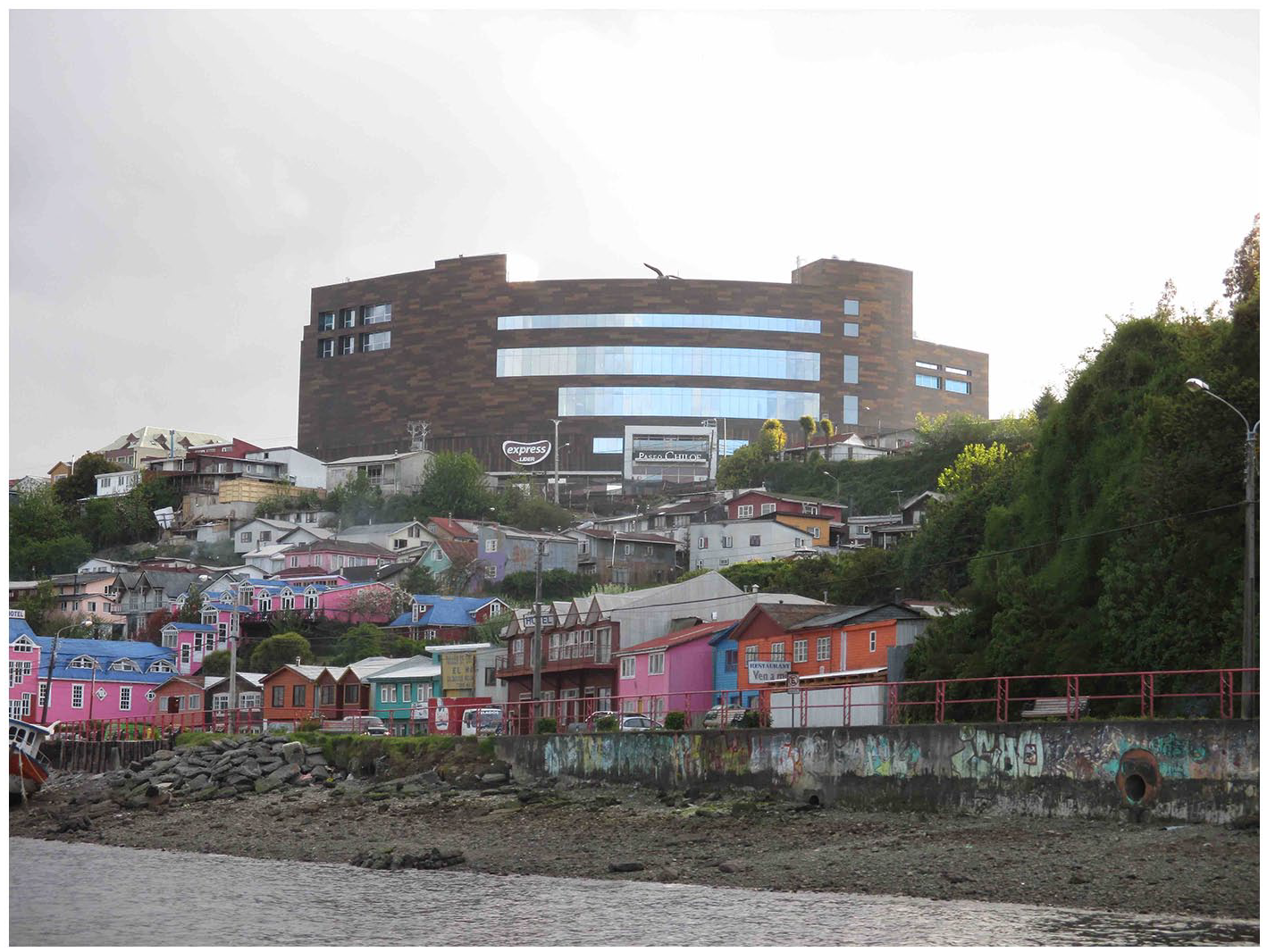
Mall Paseo Chiloé, Castro (photo by author).
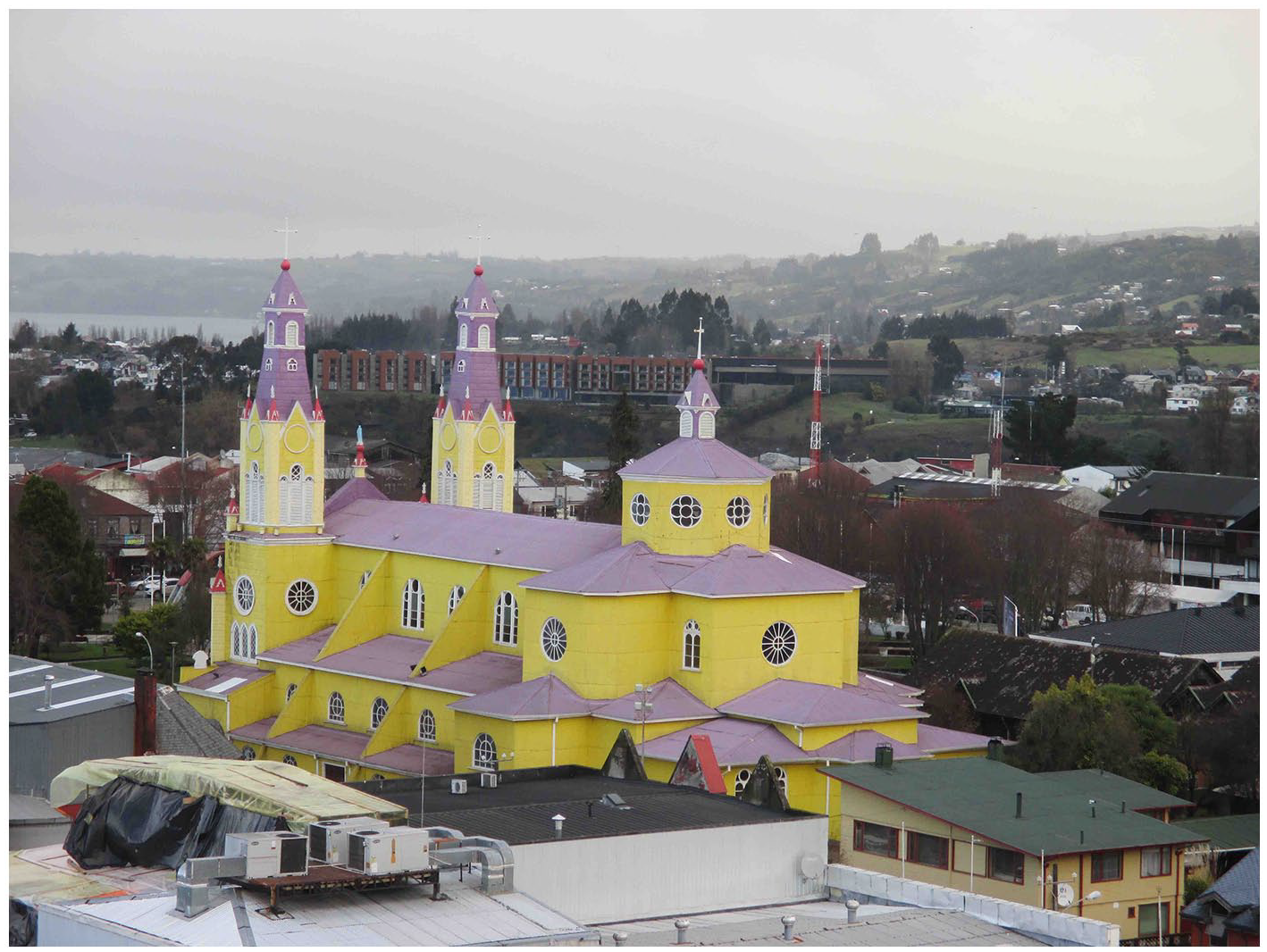
San Francisco Church, Castro (photo taken by author from the roof of the mall).
This paper explores the tensions bubbling just underneath the surface of these buildings. These emerge out of the new connections that are coming into place, and the threat of loss or ruination. In 2012, images of the mall went viral, sparking a vigorous public debate. Some were outraged by what they saw as an aggressive affront to the precious culture of Chiloé; indeed, the qualification of the church as UNESCO World Heritage is now in jeopardy. A significant part of the community, however, was in favor of it, despite its flaws. This would be the first mall of its kind for the island, promising much in terms of better prices and selection, as well as badly needed jobs. Down on the waterfront, only blocks away from this architectural drama, another heritage architecture is undergoing transformation. The “palafitos” – waterfront buildings on wooden stilts that hang over the water’s edge at high tide (Figure 3) – have also become iconic of Chiloé. While these have traditionally been very basic and even precarious housing structures, today these are being transformed into boutique hotels, restaurants, cafés, and art galleries, largely catering to tourists, as some locals are persuaded to sell and relocate.
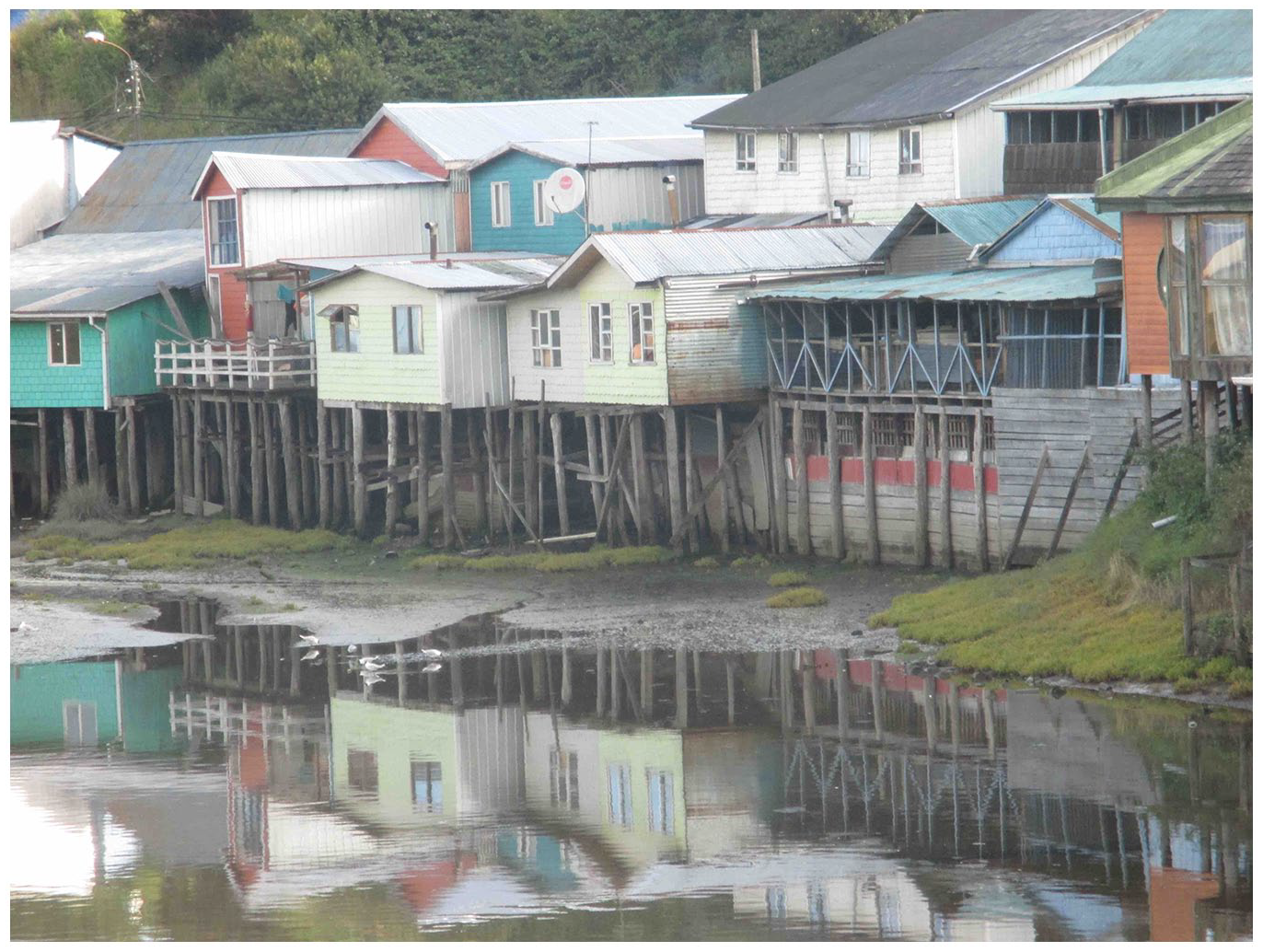
Palafitos in Castro (photo by author).
This case study, then, elaborates on a geography of architecture clearly in flux. 4 These buildings – the shopping mall, the church, the palafitos – co-exist in suspense. There are two approaches to thinking about buildings that this paper draws on to make more sense of this: ruination as a process, 5 and buildings as assemblages, particularly through the lens of what Deleuze and Guattari called de/reterritorialization. 6 Both approaches emphasize time and the temporal aspects of spatial transformation, as well as the multiplicities that constitute any singular building or space, ruinous or not. For Deleuze and Guattari, space and subjectivity intertwine as so many “territorializations,” one of their terms to describe how our desire to control a chaotic world is spatialized. 7 De-territorialization names the process of coming undone (a constant threat), while re-territorialization is always trailing closely thereafter, as the resulting combination is active and always in formation. De- and re-territorialization are part of their assemblage theory insofar as these processes make and re-make socio-spatial formations. 8 As a Deleuze-Guattarian assemblage geography, buildings become machines that are implicated in the dynamics of de- and re-territorialization as never-ending processes of cultural vibrancy – as change, stability, or combinations thereof. Interestingly, Deleuze and Guattari also attend to capitalist commodification in particular, as a force that gains power because of its ability generate de-/re-territorialization. 9
Amid the de/reterritorializations of Chiloé, a particular sense of ruination emerges for some, as long-standing traditions are clearly under threat of fading into memory and historical archives. Much of the literature on cultural change at Chiloé, in fact, documents these transformations that have origins in the “modernist development project” 10 that had reached Chiloé in the early to mid-20th century but were greatly accelerated following the violent turn toward neoliberalism in the 1970s. Anthropologist Anton Daughters documents emerging generational differences, for instance, finding that today’s youth are more accepting of emerging new cultural forms while the older generation tends to be more nostalgic amid a feeling of loss and ruination. 11 In other parts of the world, scholars like Tsing remind us of the advantages of a process philosophy (such as Deleuze and Guattari’s). Namely, that there is always the possibility of something new and surprising to emerge from what appear to be ruins, even if this emerging cultural form is coincident with the circuits of commodification. 12 Daughters’ research, in fact, documents many of these emergent processes at Chiloé. As such, this paper points to the productive overlaps and potentials for bringing together theories of ruination and de/reterritorialization. 13
Below, the first section introduces Deleuze and Guattari’s de/reterritorialization for cultural geographies of architecture. Then the paper moves into the geographies of Chiloé and how the tension between the shopping mall and the church correspond to two interlinking processes of de/reterritorialization – colonialism and neoliberalism – and how these further coincide today with two circuits of commodification: tourism/heritage and corporate retail. To be clear, neoliberal capitalism is not separate from the (post)colonial epoch, but instead extends it in dramatic ways that nevertheless unsettle the longstanding geographies of life, production, and consumption that have formed since the colonial era. The paper then turns attention to the palafitos as a space where these processes and circuits merge. Again, Deleuze and Guattari’s philosophy can account for such merging and emergence, as what appear as oppositional forces between the mall and church end up complementing each other in the palafitos. The conclusion returns to the question of ruination as a powerful emotive thread running through these multiple socio-spatial processes exerted by these buildings.
De/reterritorialization
Geographers and others have long invoked “deterritorialization” to describe the unsettling effects of globalization for the nation-state and its territorial imperatives. 14 While not antagonistic to these kinds of analytics, Deleuze and Guattari’s de- and re-territorialization applies to subjectivity itself 15 and, more specifically, the capitalist mode of production. 16 Importantly, this is a more-than-human constitution of subjectivity, one that only emerges along-with its dense material surroundings. It has been widely acknowledged that deterritorialization is not only an entry to radical openness but, instead, always results in a reterritorialization of what comes next. Importantly, following Saldanha’s interpretation, capitalist commodification works precisely at this frontier of de/reterritorialization as it brings more and more spaces of life within the “profit motive.” 17
While offering powerful and often invigorating perspectives on how to conceptualize space and its relations, 18 not all interpretations of Deleuze and Guattari engage with the temporal aspects that are central to de/reterritorialization. In other words, their expansive vocabulary often reinvigorates our sense of what space is in any given and emergent moment in time, but a complete view of their theory also pays attention to how assemblages come to produce socio-spatial relations and transformations across time, causing difference to vanish, or to flourish, or reinvent itself anew and thereby transform into something else. Often, one or more of Deleuze and Guattari’s conceptual couplets is used – “molar and molecular”; “arborescent and rhizomatic,” among others – to discuss the complexity of any geographical situation. Horowitz, 19 for example, finds “rhizomatic and arborescent assemblages” a useful analytic for understanding the struggles of the Kanak, an Indigenous group in New Caledonia, against an industrial mining project and how the heritage industry became enrolled in these relations. Power relations twist and turn around a contested mining project and the bid for “World Heritage” status with UNESCO. In this case, the arborescence of organization swallows up the rhizomatic potential of the Indigenous activists, leaving them dismayed with the inability of organizations like UNESCO to protect their territory. Elsewhere, taking another example, Merriman 20 contributes a similarly rich account of the Israeli separation wall in the occupied West Bank by way of Deleuze and Guattari’s “molar and molecular.” As an embodied and militarized infrastructure, power relations flow through these registers of politics in everyday mobility, thereby linking militarized infrastructure with bodies in motion. De/reterritorialization slips in as part of these complex mobilities, emphasizing the persistent flux and interplay between molar and molecular forces.
But what about how regimes of power changes across time and space, from one formation to another? This is precisely what de/re-territorialization names. Richmond 21 gets closer to this trajectory when examining the Brazilian favela as an “urban assemblage.” Importantly, we see how the favela as mega-assemblage changes, sometimes in surprising or even contradictory ways. Some areas, for example, have indeed improved and become more formalized, while other flows (drugs, police, violence, racism) continue to produce stigma and marginalization elsewhere. In this way, we see how an urban form multiplies in its connections and how these change through their relations. Several others have also drawn on Deleuze and Guattari to reimagine what a building is. 22 As an assemblage, it is not only holding together a complex array of materials, 23 but it also helps articulate its socio-spatial relations with other entities beyond itself. As Deleuze and Guattari sometimes used the idea of a machine to conceptualize these workings of assemblages, the buildings discussed in this paper are sometimes referred to as building-machines.
One kind of building is of particular interest here: the so-called ruin. While ruins might include other structures, they are often remnants of buildings and the relations that created them. A now sprawling heritage industry has grown around what might be or become “ruins.” Much scholarship exists on ruins and ruination, pointing to all the ways that materials like buildings are often coded as such, but continue to hold fugitive and even subversive energies. 24 This paper examines several historic buildings, but also responds to a kind of ruinous imagination at play in the architectural geography of Chiloé. As we will see, there are problems with naming the recent changes as only ruination. 25
Methodology
I first went to Chiloé as a researcher in 2013 to visit the embattled shopping mall and scope the possibility of future fieldwork. In 2015 I spent roughly 9-months in Chile, most of its spent in Chiloé, based in Castro, researching the mall controversy by way of ethnographic methodology. I participated in and observed everyday life while conducting semi-structured interviews with residents and civic leaders. Once the mall was open, I sometimes solicited “go-along” interviews 26 (n = 12) to get closer to its affective and emotional dimensions. Overall, I conducted 110 semi-structured interviews in 2015, which consisted of interviews with residents I met randomly in everyday life (n = 72) as well as with civic leaders I sought out because of their involvement in the controversy (n = 38). I sometimes used photo-elicitation 27 in the interviews, when possible, to again get closer to the emotional and affective dimensions of the changing landscape (n = 19). Additionally, I collected an archive of articles by the local paper (La Estrella) that documented the controversy in detail from 2011 to 2015.
In 2019, I returned for a short visit (3 weeks) to follow-up with key participants and begin new research on the palafitos. I conducted eight formal interviews with diverse participants, including residents, business owners, and other stakeholders. To get my own experience of them as a tourist visitor, I booked several nights stay at three separate locations. Two were booked using Airbnb and another in a hotel. When I arrived at my Airbnb and met the host, I explained that I was researching the tourist geographies of Chiloé and invited them to participate. I also visited several other palafitos more informally and later took detailed fieldnotes. I provide no compensation for participation and relied on the rapport and willingness of residents to participate. Key participants facilitated these connections, as detailed below.
Buildings de/reterritorializing at Chiloé
Two Indigenous groups inhabited the region prior to Spanish colonialism: the Huilliche, an “offshoot of a larger Indigenous group found on the continent known as the Mapuche” 28 and the Chono, a nomadic sea-faring people. By the mid 16th century Spanish imperial forces had arrived in what is now Chile. A group of Spanish colonists set out to take the archipelago of Chiloé and founded Castro in 1567, making it one of Chile’s oldest urban settlements and the Spanish empire’s southernmost outpost. They soon became stranded there, however, isolated in part by a Mapuche uprising on the mainland in 1598 that led to recognition of their territorial sovereignty until the late 1800s, 29 effectively cutting off the land route between Chiloé and Santiago. The emergence of what is today referred to as “Chilote” identity is based in these geographical conditions, which encouraged a particularly intimate relation between the colonizers and the pueblos originarios, or original peoples, of the area.
By the time Jesuit missionaries arrived in the 17th century, a particular version of cultural hybridity was emerging. Missionaries faced the unique challenge of an archipelago geography, as the population was scattered across roughly 40 islands, some small and more isolated. Their solution was the “circular mission” in which they would visit each community only once a year to perform rites and rituals. They relied on unique local architectural and craft knowledge to build wooden churches that would embody their mission while they were away. In the “official” narrative provided by the cultural and heritage industries, the churches appear as perfect examples of de/reterritorialization: “The Churches of Chiloé are outstanding examples of the successful fusion of European and Indigenous cultural traditions to produce a unique form of wooden architecture. . . The mestizo culture resulting from Jesuit missionary activities in the 17th and 18th centuries has survived intact in the Chiloé archipelago, and achieves its highest expression in the outstanding wooden churches” (World Heritage Center/ICOMOS 2013, p. 7).
A Deleuze and Guattari approach, however, would not sanitize the colonial encounter in such a way. 30 The deterritorialization of Indigenous geography surely includes the violence of the encomienda system and massacres by the colonial state apparatus, such as the one that occurred in Chiloé in 1712. 31 In any case, the emergence of Chilote identity as somewhat distinct from the rest of the continent emerges only through these complex relations. While the official narrative of the heritage industries is surely incomplete, the churches surely are a architecture of colonial de/reterritorialization at Chiloé, an architecture still alive today through a variety of organizations and in everyday life for many islanders.
As a building-machine, the churches have helped consolidate the cultural identity of Chiloé that is today unsettled by another intervention: neoliberalism. That is, the rural, communal, agrarian, and sea-faring livelihoods that have articulated Chilote identity since the colonial encounter have been massively disrupted since the 1970s when neoliberalism was unleashed by the military dictatorship of Pinochet (1973–1990). There is some evidence of cultural change in Chiloé in the mid-20th century, due to the “modernist development project,” 32 but Daughters and many others point to the how these trends were rapidly accelerated in the context of neoliberalism in particular. 33 Neoliberal deterritorialization of rural identities only occurred through the rapid and violent imposition of commodification, as Chiloé became a major “commodity region” 34 for the global markets, primarily through the export of farmed salmon and other seafood. As such, the region was more easily incorporated into other emerging geographies of post-dictatorship, neoliberal consumer culture, perhaps best encapsulated by the expanding retail industries. 35 The shopping mall had become symbolic of this apparatus, 36 one fused at the confluence of state terrorism and so-called market expansion, 37 bringing cheap imports to Chile as well as powerful new consumer finance technologies. By the 2000s, shopping malls and other retail spaces had reconfigured Santiago and many regional capitals. Scholars at the time debated “the postmodern” present, as a new wave of corporate influences unsettled so many hierarchies. 38
This unsettling, however, was not felt evenly across society. Historian Tinsman 39 documents the impact these networks made for Chilean women working in the fruit harvesting industry. Rather than signal only a new kind of neoliberal “capture,” Tinsman charts how women’s lives changed and were in some ways empowered by these new flows. The deterritorialization of the post-dictatorship mall-machine, then, may lead to a more empowering reterritorialization as gender relations are reconfigured. Something similar has happened in Chiloé with aquaculture as many women have gained employment outside the home for the first time, altering their subjectivities. 40 Other scholarship points to scenarios in which communities persist in the face of the neoliberal mall-machine’s deterritorialization, and sometimes even resist its seductive power. 41
The arrival of the Mall Paseo Chiloé encapsulates many of these conundrums. Rather than driving the changes, the mall is the “icing on the cake” as one civic leader told me in 2015. 42 The salmon industry, he said, was clearly the driver of these changes. By 2010, mega-corporate retail was ready to expand into this previously uncharted territory. Mall developers Pasmar, a Chilean company headquartered in the regional capital Puerto Montt, began construction on what was thought to be a modestly sized building in the center of Castro. As the building grew larger, however, locals and others began to take notice. The building became scandalous as architectural experts and a government watchdog agency found it to be non-compliant with planning regulations. Nevertheless, the developers had a strong position, knowing that many inhabitants were eager to have a space like this within reach. Access to the mall was often included in a bundle of other socio-spatial exclusions, including to advanced health and educational infrastructures. 43 The mall promised a kind of inclusion and even a kind of justice, for some. An argument circulated that Chilotes, too, deserved access to these infrastructures.
In summary, each building-machine corresponds to particular forces of de/reterritorialization: (1) the church-machine at the edge of colonial relations, and (2) the mall-machine at the edge of neoliberalism, following in the wake of state terrorism and aquaculture. The neoliberal phase accelerates the forces of commodification that has implications for both kinds of architecture. Furthermore, each building-machine corresponds to a particular circuit of commodification: the mall-machine with the circuits of corporate retail, 44 and the church-machine with the circuits of the heritage and tourism industries. The controversy over the mall can be better understood with these analytics: it not only exerts a deterritorialization of the preexisting cultural geography (along with the aquaculture farms), but in fact reveals differential workings of competing circuits of commodification, putting them in tension and confrontation. As we’ll see in the next section, the palafito-machine succeeds in resolving these tensions, but ends up producing yet another set of problems.
De/reterritorializing 1: Palafito dreaming
In 2019 I sat in one of the palafito cafes with a key participant who told me about a friend who lives next to one of the large renovations. Having to co-exist with tourists in a particularly intimate way felt like a violation of privacy, she explained: “. . . the construction was invasive for the people that live there, those that only live there, you know?, those that aren’t trying to make a profit from it; no. They are people that live their everyday lives there. And they don’t have the resources to construct; but yes, a company will have it. So, they felt run over by them (atropellado); they felt like, ‘wow!’ (pucha), a lack of respect in a way, because they also weren’t consulted, so the situation there was pretty complicated in that time” (interview, Karina,
45
Jan 8, 2019, Castro).
Her friend was out of town, but she did introduce me to someone else who grew up in another palafito and whose parents live there today. They arranged for an interview with his father, age 76, at the palafito. As we sat in the front room facing the street, I quickly became aware of how my own expectations had been shaped by the tourist gaze. 46 I imagined, for some reason, that we would sit on the opposite side of the house, facing the water. We sat instead in the front room facing the street. While the new tourist versions of the palafitos all emphasize the seaward-facing direction of the building and locate their dining areas there (Figure 4), I came to learn that original inhabitants do not typically use that part of the building for similar purposes. In the middle of the palafito is the main room in the traditional Chilote home, the kitchen. 47 The space facing the water was not used for dining or hosting guests, but as a sort of storage unit connected to a workshop in this case. In other visits I made to residential palafitos, I observed similar layouts and surprising uses, such as a chicken coop on the far-side hanging over the water in one case. The renovation of palafitos for the tourist gaze is clearly removed from how these spaces are typically used in everyday life. In places like hotels with their spectacular designs, the palafito itself is de/reterritorialized for the tourist gaze (Figure 4).
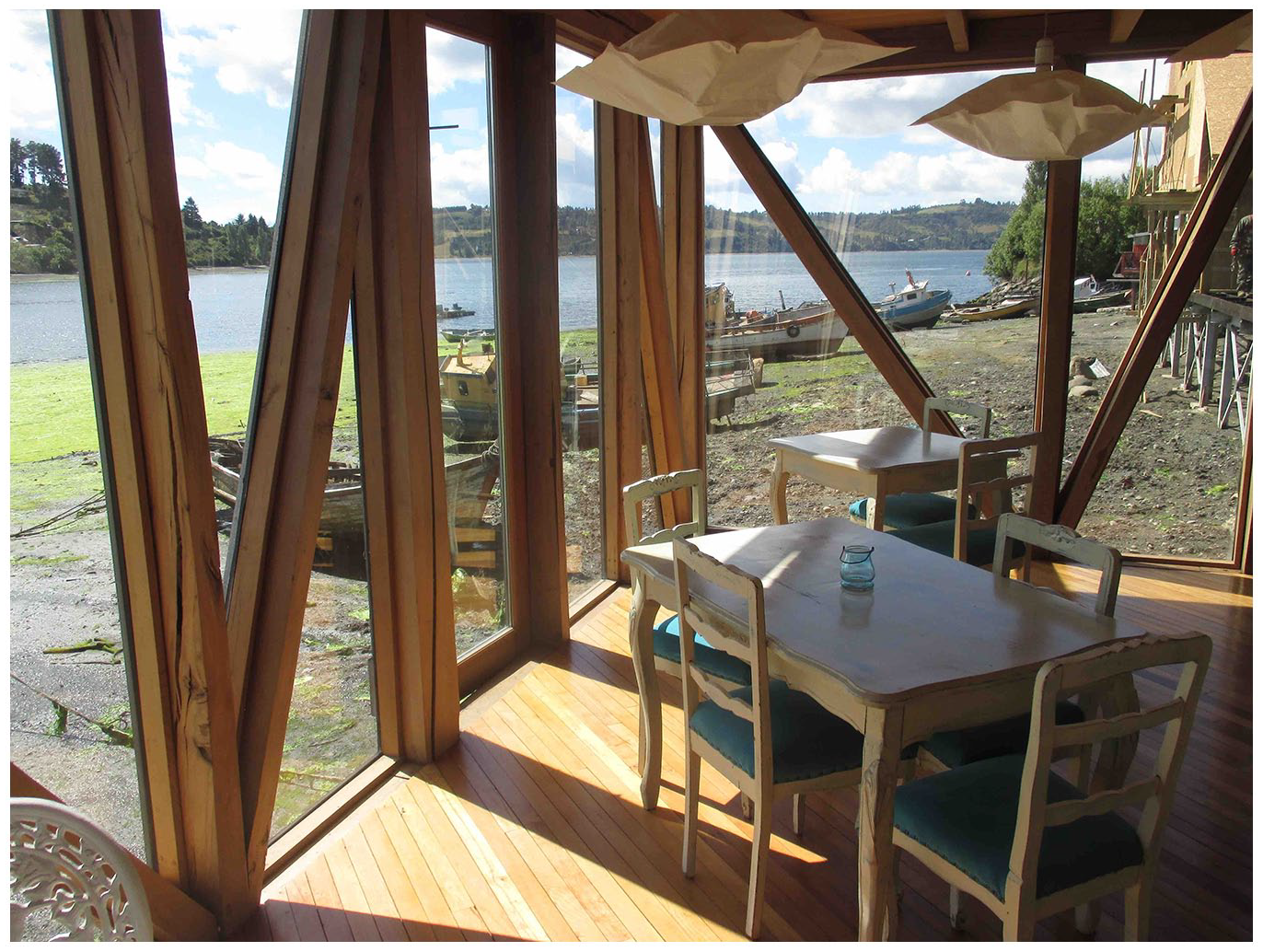
Palafito re-territorialized, Castro (photo by author).
As we sat in the front room, this participant explained they had resisted repeated offers to purchase their palafito. Even though they are also nearby to some of the new and larger renovations, he reported overwhelmingly positive relations with the newcomers. “They are really good people” he said, and repeated, “really good; they’ve helped me out a few times.” Interestingly, he also highlighted the ethnic difference between them. “They are all mostly white (medio rubio),” which went along with him informing me that his last name is one typical of those with Indigenous ancestry. Overall, he reported no qualms about what was happening to the palafitos. He even recalled a sense of pride when, a number of years earlier, he was traveling in another part of Chile and saw a photograph of his palafito used as a touristic device: “I couldn’t believe it, that’s my house!” he recalled in astonishment (interview, January 19, 2019, Castro). While visiting another family, I noted a similar acceptance of and indeed participation in the tourism sector, as one member of the household works as a provider of boat tours and thereby puts their palafito on display, providing additional income. 48
There was also a clear performance of benevolence by some of the new business owners I spoke to. The owners of a hotel had recently completed a major renovation and were now renting rooms and running a café and giftshop. Like so many who have relocated to Chiloé, one of the owners told me of how they “were bored with Santiago” and relocated to Chiloé because of its rich natural and cultural heritage, and to participate in the emerging tourism sector. They initially came to the palafito to photograph it and then offered to buy it from the original inhabitants, starting a multi-year renovation, as “there were a lot of challenges.” Along with the café restaurant, they also operate a small gift shop, full of local artisan crafts. Throughout the interview and the tour provided, there was an overwhelming performance of paying respect to the local culture that attracted them there to begin with (interview, Business Owners, hotel, Castro, 10 January, 2019).
Despite this benevolence, these stakeholders are, nevertheless, wrapped-up in the dynamics of neighborhood change that bear the signs of gentrification. This kind of change happens not all at once, of course, but across time. 49 These initial findings are not conclusive, but do point to some looming possibilities. As property values increase dramatically, long-standing owners sometimes cash-out and move elsewhere; they aren’t displaced through eviction. The cost of maintaining palafitos was mentioned to me throughout my trip, as the pillars holding up the structure must be replaced every few years and is costly. In this sense, the real material processes of ruination, or simple deterioration, also exerts a push-force. 50 As such, the scene is set for gentrification: palafitos are not just rich heritage spaces but are also associated with precarity and poverty. 51 For now, a significant number of locals remain, and the neighborhoods retain a sense of vitality and charm, adding to the feelings of “authenticity” that attract tourists and investors. Some, such as the family I discuss above, have resisted offers to sell, but time will tell what their adult children will do in the years to come.
To what extent are locals themselves the beneficiaries of these emerging flows? Preliminary findings point to a plethora of activities, formal and informal, taking place especially during the tourist high season (December–March). The hosts of my two Airbnb stays provided some initial insight into the challenges faced and how local people are reterritorializing the palafito-as-commodity for their own benefit and livelihood, such as the boat tour provider mentioned above. The host of my first stay was a woman originally from Santiago but who had married into a Chilote family decades earlier. She showed me around the apartment furnished with local artisan crafts; a stack of tourism pamphlets sat on the table, left behind by previous guests. Business had been going “very well,” she said, “better than expected.” They modified the original palafito by expanding and sub-dividing it into three separate units. Much to my disappointment, the one I booked did not have any access to the water which I had imagined all along. Again, my tourist gaze was disappointed. When asked how coordinated the tourist sector is, she said it was limited. She added that local people typically don’t want to monetize their homes by turning them into businesses, saying “they just aren’t interested” (interview, Airbnb Host 1, 8 January, 2019).
This contrasted strongly with the next Airbnb host I met. I stayed alongside a family who had lived there for several decades. I found a similar layout and heard of a similar expansion to produce separate dwellings. My rental faced the street rather than the water, and my tourist gaze was again denied. Instead, my bedroom had only a small window facing that direction looking out over the metal roofs and chimneys, and the other rooms faced the somewhat noisy street. The host self-identified as an “entrepreneur” who had always used the space for her livelihood. During the salmon industry boom in the early 2000s, she turned one of the units into a massage parlor, only to abandon it when the industry nearly collapsed during a virus outbreak in 2008. In recent years they began renting rooms and have been busy (interview, Airbnb Host 2, 19 January, 2019).
Interestingly, she explained the complex legal geographies of the coastline and how it complicates her ability to thrive as a business. In addition to ongoing Indigenous territorial claims, the coasts of Chile are federal property, meaning that the palafitos are in legal limbo as inhabitants do not have fully property rights. This has an impact, as it bars local entrepreneurs from eligibility for assistance from the main government tourism agency. Host 2, for instance, is now in the long, complicated process of gaining the documentation that they hope will free-up this assistance. Most inhabitants do not have this documentation or the resources to obtain it, but for those attempting to turn their homes into businesses, it becomes a significant administrative barrier.
Instead, what seem to be taking off much more easily are the larger capital-intensive projects such as “Palafito 1326,” a large hotel that was the last palafito accommodation I stayed at during my visit in 2019. This time I booked the room using their website and phone line, and I was fully aware that I was not going to sleep over the water: their website informed me that only street facing rooms were available at a lower rate. Nevertheless, I was eager to experience this version of the palafito with its rooftop deck patio and sea-facing dining room where I breakfasted with European visitors and Chileans visiting from Santiago. Most of the staff were locals from Chiloé, 52 contrasting with an assertion made by one civic leader that some tourist orientated businesses have had to recruit outside labor to provide a sufficient standard of service. 53 One staff mentioned having been trained by the local polytechnic, but that the course was no longer offered. Attractive books of palafito photography and history lay on the coffee-tables in the lounge areas, as well as a computer for guest use and access to the large deck facing seaward and a roof-top bar, towering over the smaller neighboring palafitos.
I met several architects who were incisive and sometimes fierce critics of the Mall Paseo Chiloé but who had a more nuanced view of what is happening with the palafitos. One was a key participant and was involved himself in the creation of Palafito 1326, but who was also aware of the displacement taking place. “We have studied them [palafitos] and have found that many, at certain points, were involved in commercial use . . . not just residential ones” he told me in 2019 (interview, January 21, Castro). He continued: “The problem for me is that the new uses have been pushing away the original dwellers, and part of the soul of the neighhorhoods is being lost”. Nevertheless, I continue to wonder, to what extent can local people become more actively involved and thereby bridge the gap between the violence of deterritorialization and the reterritorialization that might, or might not, include them as participants and beneficiaries. Future work should focus on such questions. 54
De/reterritorializing 2: Ruination?
Early in my stay 2015, to learn more about how tourism flows are shaping Chiloé, I signed-up for a guided daytrip that included the “highlights” of Chiloé: churches, artisan crafts, and a trip to one of the smaller islands for our own curanto 55 feast. The next day a group of around 20 of us left in a comfortable private bus. About half were from Santiago and the others were international (Mexican, Panamanian, French). The trip included a stop in Dalcahue, a nearby town known for its artisan marketplace and eatery on the waterfront, and its UNESCO church. On the way there, the guide gave us a brief history of Chiloé, including details about the churches, the local mythology and of course a description of the curanto. Once in Dalcahue, we had 1 hour to see the church, the marketplace, the waterfront and the small museum operated by the municipality. The next stop was the smaller town of Tenaún, location of another UNESCO church, and where we boarded the boat that took us to Mechuque Island. A small gift shop near the church attracted a few members of our group and we almost left one behind who was captivated by the cheap, delicate gifts.
After a short ride in the boat, we arrived in what seemed to be an abandoned town. Only a couple of people were to be seen, including a middle-aged man who followed us from the dock. Most of the group ignored him as they examined the historic wooden houses as well as several palafitos. Some of these majestic houses appeared abandoned and in bad decline. The guide told me that the population there is aging, and he lamented that most of the island’s youth have left and probably will not return, hence the dilapidated houses. We were directed toward a residential-looking building where the curanto was being prepared. We seemed to have entered a private residence but were not introduced to anyone in particular. In the outdoor patio, the stones were ready, red hot in the ground, along with crates of shellfish, potatoes, smoked meat, and the giant leaves. We watched in fascination and took photographs as two women prepared the curanto. Then we were free to roam the town until it was time to eat.
The man who followed us stopped short of coming inside. He was somehow not invited, even though the curanto feast is traditionally a festive and communal event. This was for us, those who paid for it. While the guide made a toast for the two cooks, we were never really introduced to them and knew nothing about who they were. I was told by the guide that most of the food came from nearby sources. While we waited for the food, I spoke to the man who had followed us. He wore torn and faded attire. He told me that most people, including himself, still grow a few crops but don’t have much money, and he asked me for some. It began to rain heavily, and I returned to the house with the others to wait for the food, served in large trays that circulated the tables, an all-you-can-eat offering with wine and soft-drinks. The atmosphere was festive, and the unnamed women workers cleaned-up everything themselves.
Throughout the day I spoke with many of the other tourists. It was striking that all of them had a similar response to my question about their opinion of the Mall Paseo Chiloé. The response typically began with a rolling of the eyes and then an affirmative and damning explanation that “that is not what Chiloé really is.” These visitors, like the many others who relocated to Chiloé in recent years, are in search of something more “natural,” “traditional,” “calm (tranquilo),” ideas that are usually tinged with the belief that Chiloé is much more pristine and authentic than the cities that have grown rapidly in recent decades. The mall, in short, ruins Chiloé by way of the deterritorialization it represents, clashing with their idealized images, fantasies, and tourist gazes. Little did they know that many local inhabitants feel disadvantaged by not having access to corporate retailers found in the shopping malls, and many see their isolation in the retail sphere as part of a broader marginalization by the central continental state apparatus. The archipelago to this day is without a bridge connection to the continent, making trips to the regional capital even more laborious and indeed costly for many. I was reminded of these geographies again and again during my conversations with residents. However, my analysis considered a majority of the respondents to be somewhat ambivalent, rather than entirely “for” or “against” the mall, 56 suggesting a complex relationship to the emerging reterritorializations they are enrolled in.
I returned to Castro feeling uneasy. The visitors I met overwhelmingly opposed the mall as a sign of impending consumer culture, but they delighted in devouring the curanto. They perhaps did not consider the commercialized nature of the feast itself, the fact that it was prepared solely for us and was devoid of the dense social bonds that traditionally go into it. We were not introduced to anyone in the town and besides an awkward toast for the workers, there was minimal interaction with anyone outside of our group. As a practice of the tourist economy, they were less concerned that the curanto itself was entirely deterritorialized from its historical roots, only to be remade in commodified, spectacular form.
Several civic leaders from Chiloé participated in interviews with me to discuss these and other issues. Renato Cárdenas, a popular local historian and public intellectual, spoke with me on a number of occasions and was skeptical of what he saw as a crass utilization of heritage for profit. At an event at the Castro Public Library, he and another civic leader, Sergio Mansilla Torres, spoke about Chiloé’s rich mythological tradition, including fantastical creatures such as the Trauco, or forest gnome, and other ghostly entities like the Caleuche, a phantom ship. These myths link Chilote present with the past, as these figures have been passed down through many generations. Today, they take on new shape:
“This is the manipulation that we talked about the other night. About how tourism appropriates the myths and traditions. So, in several places you are going to find some Traucos, some images, but it’s really a boy, or a doll, and you can pay, I don’t even know how much, to take a picture with it, with the Trauco. . . you’ll see this around. This is manipulation. Then, in another way, on another scale, they take entire traditions, like the tiradura de casas. 57 I know there is this guy [. . .], and there must be others, that has a house on the water that they pull around with a boat; I don’t know how that makes any sense.”
“it’s just to sell. . .”
“. . . the image, the image. Because this is not a minga. 58 The minga is when the community participates in something like this, when you really have the necessity of moving your house; this isn’t just a boat ride! These are the deviations that, you know, they don’t translate well [se estira mal] they don’t translate when there is no content. They lack content” (interview, July 13, 2015, Castro).
Renato lamented these changes as part of what he called the tourist “package” of Chiloé, one that “disgraces” the cultural heritage by making it into a “farándula,” or mindless distraction. Both Cárdenas and Torres worry about the loss of cultural identity amid the current round of de/reterritorialization, but Torres had a slightly different view. In an interview he elaborated on how the myths were once part of the “symbolic apparatus” that held society together but are now being transformed as the people of Chiloé become increasingly interconnected with the rest of the country. Interestingly, Torres has a vision of an emerging Chilote identity that embraces outside influences without necessarily signaling a loss. Even when it comes to the concept of traditions that become commodities for tourist consumption, Torres cautiously held out hope: “people are trying to survive, converting memory into something for tourists. I mean exploiting it, selling an image of Chiloé as magical, but with the intention that people pay money for it. Now, it’s not that bad. It’s not all bad because, for example. . . because the memory of the curanto still exists. So, while it’s there, it is a memory reserve. In this sense, I see tourism as an opportunity to mobilize for other purposes [activarse para otros fines]” (interview, June 24, 2015, Valdivia).
Several times during the fieldwork I witnessed events that substantiated this view. In September 2015, I attended the inauguration ceremony for the newly restored church in Dalcahue, the town we visited on the guided tour. I was somehow surprised at the large crowd. Officials used ropes to control the crowd, clearing a space in front of the church. Regional and local politicians and other officials stood on the inside of the ropes. Tents were set up nearby and would soon be filled with complimentary soft-drinks and snacks. The ceremony was led by a priest, but also included other people involved with the restoration project who spoke about its significance for the community. Then, a procession of religious figures around the town square in front of the church signaled the momentous entrance to the building. A mass was then held inside the church, overflowing with people. The mass was followed with folkloric music and free snacks outside. This was a very big event for the small town.
These churches, therefore, are not just tourist sites. Later I met Macarena Almonacid, an architect from Chiloé, in charge of restoring the UNESCO church on Chelín Island. With the support of the Friends of the Churches, a non-profit organization dedicated to maintaining and restoring them, as well as new attention from governmental agencies, Macarena is one of many professionals working to maintain these iconic heritage sites. On a warm sunny day, she took me on a tour of the church, pointing out how they were using as much of the original materials as possible. Teams of men bustled around us, working with tools, while Macarena gave instructions and took photographs with a digital camera. She explained that although Chiloé has changed rapidly in recent decades, in the rural areas, especially on some of the smaller islands like Chelín, certain traditions remain alive. The church remains a central part of what holds society together, she told me. The mall was a sign of worry, however, a sign of how fast Chiloé is changing, and not for the better.
Conclusion
The buildings discussed in this paper act as machines because of their power to articulate socio-spatial formations across time. As neoliberal capitalism has inaugurated a new set of flows across the territory of Chiloé, new building-machines have proliferated, which has caused some tremors in the emotional and affective geographies linking the archipelago with the continent and the rest of the world. These building-machines, then, are threaded through a series of processes that are fundamentally political: ruination, commodification and the dynamics of tourism, heritage, and retail. The simultaneity of these building-machines, and the relations between them, are not easy to delineate. It helps to recognize the multiplicities 59 within these overlapping and sometimes conflicting processes of de/reterritorialization.
First, while it appears that the neoliberal mall-machine is in tension with the (post)colonial church-machine, this overstates the differences between them. Mall-machine in Chiloé is very much an imperial architecture, seeking to advance a particular set of interests through the architectural landscape itself. Deleuze and Guattari, in fact, are concerned with a particular outcome of capitalist reterritorialization, 60 as an infrastructure of consumption puts in place ever more opportunities for us to produce value for capital, even without us knowing it. In their time, it was “television” and “urban models,” 61 but could be very well updated with shopping centers of consumer culture today and especially the techno-embodied dynamics of surveillance capitalism. 62 Moreover, in Chiloé the mall- and church-machines co-exist and are not mutually exclusive in terms of the subjectivities they seek to generate. Many of those attending the church event in Dalcahue, especially the youth, for example, have no doubt visited the mall in Castro and participate in other contemporary consumer cultures that have swept across Chile.
As the shopping malls of Chile are clearly spatial manifestations of post-dictatorship neoliberalism, these geopolitics made an appearance in some of the reasons for resistance. Professional critics of the mall (particularly the architects) often reminded me of the dictatorship and its impact on the production of urban space. Again, for some, including these critics, the mall ruins the heritage landscape of Chiloé precisely because of the deterritorializing forces it embodies and represents. The emerging mall-machine at Chiloé, following this perspective, is not neutral, but instead bears the weight of postcolonial power as retail capital. Importantly, this critical discourse often borrowed on the language of ruin and ruination. Protecting the churches from ruin became one part of the strategy for resisting the mall. As I argue elsewhere, such a position, while legitimate in some important ways, risks imposing its own postcolonial violence by insisting that Chiloé not change, that it remains as a tourist-friendly site stuck in time. 63 This timelessness is hard to miss when visiting Chiloé, as it seeps out of many tourist spaces, texts, and practices. Drawing on scholars who have approached ruins not as fixed things but as socio-spatial processes, 64 we can refuse such a one-dimensional approach that carries with it the many assumptions of a “continental gaze.” 65
The palafito-machine illustrates how these forces appear to dissolve in an emerging architectural form, the palafito as tourist commodity. However, this synthesis produces yet another new set of concerns around social and spatial justice. Namely, the looming threat of neighborhood change and displacement (gentrification). While the blatant commercialization of the Mall Paseo Chiloé galled some, there has been no similar outburst with the commercialization of the palafitos. Part of the reason is their perceived and actual ruination. Investment and renovations are framed as rescuing them from neglect, while the cost of maintaining them often came up as a challenge for residents. Crucially for Deleuze and Guattari, oppositional forces can be brought back within the confines of hegemonic power via the processes of de/reterritorialization. 66 In some ways, the powerful emotions of the mall critics are somehow integrated into this other emerging consumer landscape. While urban heritage appears as a barrier to capital investment in the case of the mall controversy, tension between these circuits appears resolved in the palafito-machine. My concern is that continued growth of this kind will negate precisely what it claims to admire; namely, the people and their cultures. 67
In conclusion, ruination can’t be the only explanation for what is happening at Chiloé, notwithstanding the destruction of industrial practices and the threats posed by tourism. As recent scholarship has argued, engaging with the ruins of capitalism requires more than denunciation, but a willingness to see what happens in the wake of destruction and abandonment. Chilote subjectivity is alive amid these competing forces and their building-machines, among others. Chiloé will continue to exist as a place despite all the de/reterritorialization that commodification is currently unleashing. Recognizing this, moreover, does not hold us back from criticizing these same structural processes. It keeps us looking forward to what happens next.
Footnotes
Acknowledgements
I thank the participants for their time and generosity, and to the funding agencies as well as the Northumbria University Department of Geography and Environmental Sciences for their support. Thank you Beatriz Bustos-Gallardo, Manuel Prieto and Kathryn Cassidy for feedback on early drafts. Thank you to everyone who helped with the fieldwork; those at the University of Arizona School of Geography and Development and the Center for Latin American Studies; the Universidad de Chile Facultad de Arquitectura y Urbanismo; and the Universidad Católica de Maule. Thank you, finally, Anna Secor for your editorial advice and to the anonymous reviewers for their generous feedback.
Funding
The author(s) disclosed receipt of the following financial support for the research, authorship and/or publication of this article: This research was funded by the Fulbright Commission (U.S. Department of State); the Tinker Foundation; the Social and Behavioral Sciences Research Institute, University of Arizona; the Institute of the Environment, University of Arizona; and the Northumbria University Department of Geography and Environmental Sciences.
