




Abstract
Sustainable flood memories – defined as those formed of folk memories of flooding, flood heritage and other local, lay knowledges – have been identified as having great potential for increasing community resilience to floods. Focusing on the social and cultural aspects of flood and drought memory, we present the findings of archival research, interviews with residents of the Welsh colony in Argentine Patagonia (Y Wladfa in Welsh), and critical textual analysis of museum spaces. This analysis enables reconstruction of flood and drought history over the ~150 years of the colony, provides insights into the impact, emotive power and perception of floods and droughts, and highlights the ways in which lay knowledge and flood and drought memories are transmitted vertically and shared horizontally in material and immaterial ways. We argue that specific thresholds of memory exist, as related to flood/drought magnitude, duration, social impact and memorialisation, which ensure that some events are encoded, transcribed and transmitted through the collective memoria of a community, while other events may fade from memory. Ensuring long-term sustainability of the Welsh-language community, and integration of these flood/drought memories with those from other cultures and languages, will help develop community resilience to 21st century hydroclimatic changes.
Introduction
In late May 1865, around 153 men, women and children set sail from Liverpool docks on board a modified tea-clipper called the Mimosa. Part of a wider trend of nineteenth-century emigration from the British Isles to the Americas and elsewhere, the group were bound for Patagonia, Argentina, where they were seeking religious and cultural freedom, and more promising economic conditions than were offered by Wales’s heavy industries and agriculture. In particular, they were looking for isolation in which the Welsh language and culture could flourish, free from the influence of the English language and customs that tended to dilute or assimilate Welsh identity elsewhere. 1 On 28th July, the Mimosa arrived at a bay that the settlers called Bae Newydd (New Bay), now better known as the location of Porth Madryn (Puerto Madryn). In contrast to the fertile land of opportunity promised to them by the proponents of the migration, Hugh Hughes, Michael D. Jones and others, 2 the party found themselves on a semi-arid Atlantic coastline, without shelter and with only limited provisions. After initial significant hardship in this unfamiliar environment, the settlers established communities farther south in the lower Chubut valley (Y Dyffryn) (Figures 1 and 2). The early settlements included Rawson (then called Trerawson), Trelew and Gaiman. Despite initial overall peaceable relations between the colonisers and nomadic indigenous groups (Tehuelche, Pampa and Mapuche) based on trading and exchange, 3 there was further hardship in the form of water and food scarcity, flooding risks, and difficulties in establishing agriculture. Following the establishment of a complex irrigation system, however, a flourishing agricultural community developed. When the Conquest of the Desert 4 military campaign, led by the Argentine state against indigenous groups, reached the Chubut valley region, a period of inland exploration followed. By the late 1880s a new settlement, Cwm Hyfryd, had been established in the Andean foothills, and Trevelin and Esquel subsequently developed 5 (Figures 1 and 2). Other settlers followed the first cohorts, and partly through management and manipulation of water resources, these Welsh-speaking communities have endured to the present alongside an increasingly dominant Spanish-speaking population. Owing to continued written correspondence between the settlers and contacts in Wales, and renewed historical interest associated with celebration of the colony’s centenary in 1965, Y Wladfa (‘the colony’) has come to occupy a unique, emotional and enduring place in the Welsh cultural imagination, as expressed through creative arts including poetry, prose, film, music and performance.
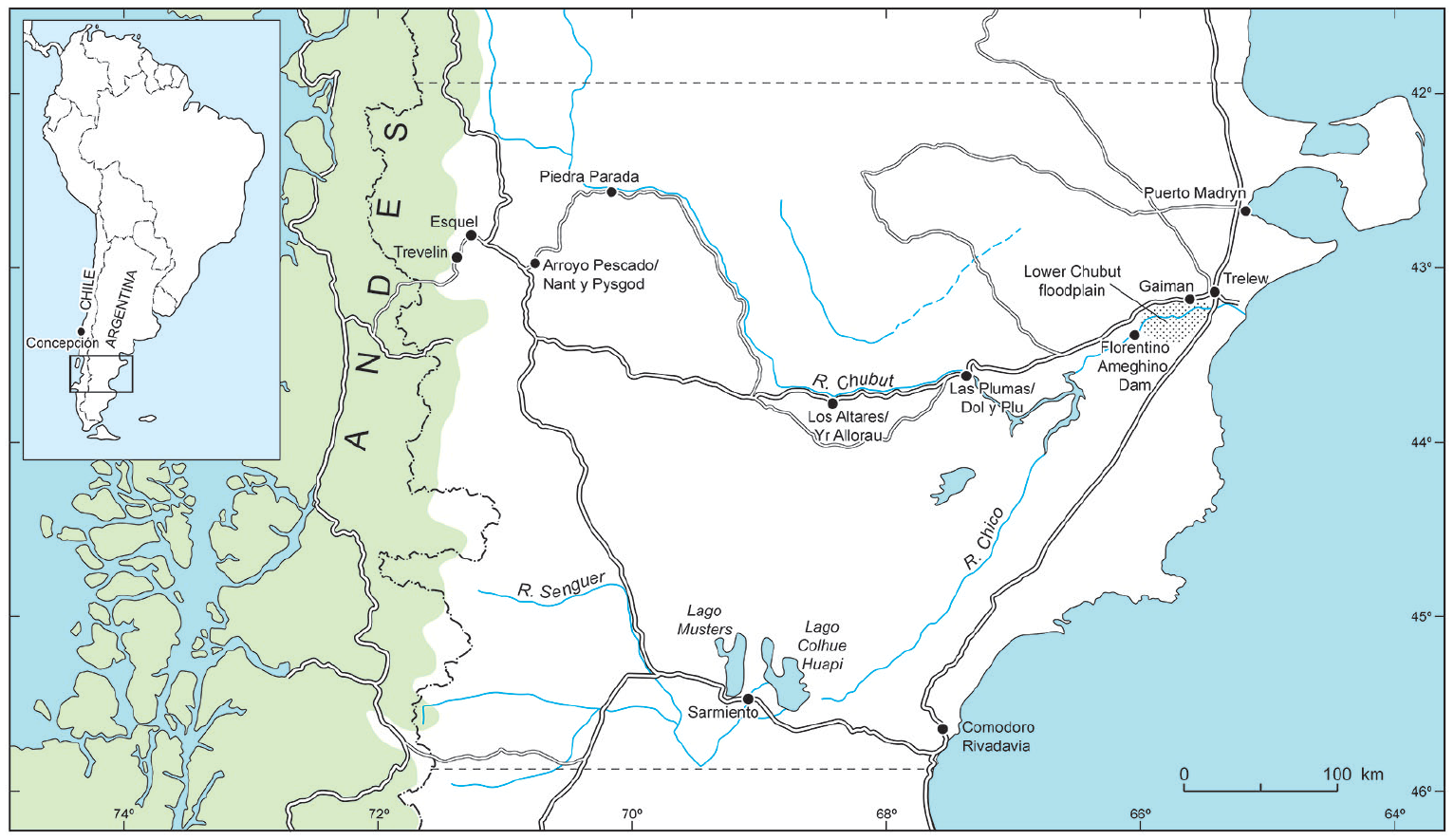
Map of a part of Patagonia, showing the principal historical and contemporary Welsh settlements (Trelew, Gaiman, Esquel and Trevelin). The dot-dashed line indicates the present-day Chile-Argentina border. The ~5 km wide lower Chubut valley (known in Welsh as Y Dyffryn and in Spanish as El Valle Inferior del Río Chubut) is deeply incised within the semi-arid paith (i.e. plain).
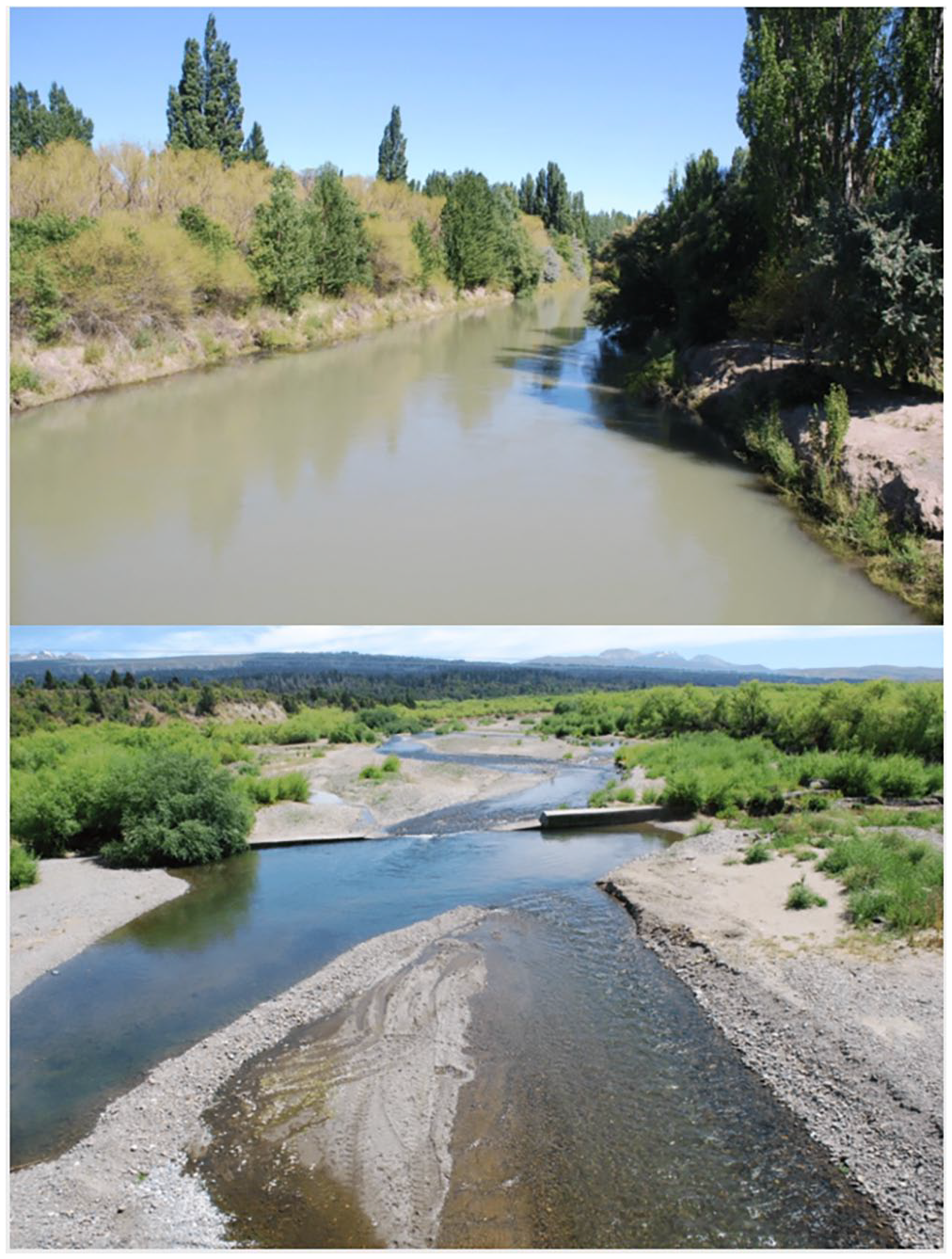
Upper: The Río Chubut (Afon Camwy or sinuous river in Welsh, or Chupat, meaning transparent in the indigenous Tehuelche), looking upstream from Gaiman bridge. The river meanders through a floodplain predominantly used for mixed arable and pastoral farming that is supported by an extensive, complex irrigation system originally established by the Welsh settlers. The Florentino Ameghino dam, completed in 1963, spans the river in a gorge located upstream of the head of the lower valley and provides hydropower, drinking water, and flood protection for the settlements downstream. Lower: Río Percy, looking upstream from a bridge near Trevelin. The Río Percy is a dynamic gravel-bed river that flows into the Río Futaleufú. The Futaleufú is dammed for hydropower and drains westward into the Pacific Ocean. Picture Credit: Hywel Griffiths
Contemporary communities in Patagonia continue to face many of the same environmental problems as their predecessors, including sustaining agricultural productivity in a water-scarce environment and managing flood risks. Historical scientific data to help understand flood and drought extremes exist (e.g. instrumented river discharge records date back to the early 1940s 6 ), but more dispersed records (e.g. personal correspondence, newspaper reports, memoirs, material culture) spanning the ~150 years of colonisation offer a richer and deeper perspective, especially by enabling us to understand how the communities have remembered the hydrological extremes that they have experienced. Furthermore, examining the adaptation and mitigation strategies of prior communities may offer valuable lessons for contemporary communities in Patagonia, Wales and elsewhere, in particular by contributing to current debates around the place of lay knowledges and sustainable flood memories 7 in flood risk policy formulation. 8 Analysis of such historical cultural attitudes thus can provide an understanding of human-environment interactions that may prove valuable if societies are to increase resilience to future changes in the frequency and magnitude of hydroclimatic extremes. 9
In flood-prone communities, for instance, the central place of the flood in cultural ‘memoria’ is significant in determining historical and contemporary perceptions of flood risk, coping mechanisms, and management strategies. 10 Floods have been recorded in official and unofficial written accounts, poetry, stories and myths, and recorded in the physical landscape in the form of epigraphic markers, flood embankments, and diverted river channels. 11 Historically, floods in some communities were viewed in religious contexts and regarded as divine punishment, but in other communities floods were seen as more commonplace and in more secular contexts. 12
After reviewing current understandings of memory in geography, particularly in relation to sustainable flood memories, our aim is to reconstruct the chronology of floods and droughts over the ~150 years of Y Wladfa, and to analyse the memories and historical and contemporary perceptions of these hydrological extremes in Welsh-speaking Patagonian communities. We consider the two types of extreme because both floods and droughts were of concern to the early settlers and both continue to influence water infrastructure and environmental management decisions. We highlight five key themes and conclude that insights from the Welsh-speaking communities can be integrated with those arising from other language and cultural communities, including indigenous communities, to help with the challenges of developing greater community resilience to 21st century hydroclimatic changes.
Sustainable flood memories and lay knowledges
Mining of historical documentary archives to extend and augment instrumented records of floods and droughts has been used across different geographic regions. 13 In addition, such archives can reveal historical environmental perceptions 14 and examples of how society, culture, weather and climate intersect. Archives of historical weather in particular are frequently cited as examples of the discourses around ‘local weather and about the relationships between weather and local physical objects and cultural practices’, 15 how they become part of communal and cultural memory, and how they are transcribed. 16
Work on the geographies of memory and forgetting has shown that memories can be strongly tied to particular sites 17 – Nora’s 18 lieux de memoire (‘sites of memory’) – including specific sites of commemoration or more ‘everyday’ spaces or objects. 19 Memories can be related to materiality, 20 and can be highly performative 21 and political. 22 Rather than necessarily being focused, located and singular, memories can also be dispersed and fragmented. 23 Muzaini’s work on forgetting 24 argues that the process of producing absence is as worthy of study as remembering, that attempts to forget are both hindered and supported by materials, and that memories, through embodied encounters with places and objects, can return, sometimes unexpectedly. This haunting quality of absence and its relationship to presence in materiality is also discussed in Wylie’s work on the geographies of memorial benches in Cornwall. 25
Griffiths’s work 26 on the memory of the 1960s flooding of the Tryweryn valley, Wales, to provide water for the city of Liverpool, highlighted that conscious or subconscious forgetting of the event is disrupted not only by immaterial traces in Welsh cultural expression (e.g. poetry, songs, and popular music) or by material objects in the landscape (e.g. graffiti and the dam and reservoir), but also by the hydroclimatological processes of drought and rainfall (e.g. fall and rise in water levels that alternately expose and submerge remains of the flooded village). The cultural expressions of the memory of the flooding of Tryweryn, and the generally negative perception of the event, has been perpetuated through political and cultural discourse to such an extent that contemporary debates around water management are commonly viewed negatively, thereby influencing contemporary societal perception and adoption of environmental management measures. 27
This link between memory, culture, and contemporary public policy and politics illustrates the importance of studying individual and collective memories of floods and droughts. In the UK, the link between flood memories, community resilience, lay knowledge and contemporary flood policy has been comprehensively addressed by the Sustainable Flood Memories project, which has focused on the Somerset Levels, southwest England. 28 McEwen et al. 29 focus on communicative memory 30 and highlight how memories can be transmitted vertically through time (e.g. as oral histories that are passed down from one generation to another) and also shared horizontally (e.g. between communities). The authors succinctly note that ‘Vertical memory is enduring and intergenerational, while horizontal memory as intra-generational . . . is increasingly shareable . . .’ 31 but conclude that those memories can be ‘individualised, unevenly distributed, hidden or actively forgotten.’ 32 Garde-Hansen et al. note that ‘memory travels in time and through time, always connecting and being (re)mediated.’ 33 Garde-Hansen et al. also focus on the process of active remembering and active forgetting – the encouragement and repression of memories, respectively – and on the tensions that arise between those processes. In particular, they show that both personal and collective memories and related lay knowledges can be very important for building community resilience. These lay knowledges are defined by McEwen et al. as ‘local, informal, traditional or vernacular knowledge’ comprising ‘subjective narrative accounts and stories constructed to understand, explain and assign meaning to events in everyday life’, 34 and are intimately linked to those flood memories that are transmitted vertically and horizontally in complex ways.
The cultural and creative nature of flood memories is perhaps one of those complexities. This creative nature is increasingly recognised, as remembering is an ‘active and creative process.’ 35 For example, this creative nature of memory has been shown in medieval Welsh literature, 36 early modern England, 37 and the North Sea coast of Germany 38 from communities that, despite sharing common features, also exhibit many diverse social, historical, political, linguistic and cultural contingencies. Understanding how flood memories and lay knowledges are encoded and transmitted in different contexts is, therefore, very important if their potential as components of a more community-specific, co-produced, way of living with floods is to be realised.
Methods
Our analysis of the chronology, memories and perceptions of floods and droughts in Y Wladfa comprises three separate yet complementary approaches, similar to those used in the Sustainable Flood Memories project. 39 First, archival research was undertaken, focusing mainly on published volumes, including collections of letters, Llythyrau’r Wladfa, 40 and memoirs of key historical figures (e.g. John Daniel Evans, W.M. Hughes, Eluned Morgan 41 ). Welsh-language newspaper and periodical articles held in El Museo Histórico Regional de Gaiman were also consulted. We acknowledge that these sources do not represent an exhaustive set of Welsh-language archival material, nor are they the only perspectives on Y Wladfa. For instance, Taylor argues in her archival research on the relations between the Welsh colonists and the indigenous population that Welsh-language texts contain voices who provide ‘over-privileged’ European perspectives on those relations. As such they do not capture potentially divergent perspectives of the indigenous communities with whom the Welsh colonists traded and built relationships. 42 The colonists also had links to the Argentine state, having been supported in their venture by President Rawson and later during expeditions westward into the interior. 43 Nevertheless, our selected sources include many of the key texts from which information on extreme events can be obtained, and collectively cover the time since initial Welsh settlement. These sources were read closely and notes made on dates, locations, impacts, perceptions, and descriptive language employed.
Second, semi-structured interviews were conducted with 19 residents of Y Dyffryn, primarily in Gaiman and Trelew. Interviews with a further 17 people were conducted in the Andean foothills, mainly in Esquel and Trevelin. These interviews focused on three key themes. First, we asked whether the interviewees remembered any particular flood or drought events, and if so, when they happened and what impact, if any, they had on their lives. Second, we asked whether the interviewees had been told of particular flood or drought events by their parents and/or older relations and, if so, what kinds of stories they had been told. As part of this theme, we also asked whether the interviewees were aware of the irrigation works undertaken by the early Welsh settlers and their descendants in the lower Chubut valley. Third, we asked the interviewees about their feelings regarding contemporary floods and droughts, and whether they had any other environmental concerns. Many of the interviewees were descendants of Welsh settlers, and interviews were conducted in Welsh, and as such, quotations presented are English translations. A limited number of interviews with more recent migrants to the communities and non-Welsh speaking descendants of the Welsh settlers were conducted in Spanish or English. The majority of interviewees were over 50 years of age. We faced similar methodological challenges to the Sustainable Flood Memories project, 44 in particular the fact that we were, through the interview questions, actively encouraging remembering. Our interviews were with people who may or may not have actively (or passively) remembered or forgotten about hydrological extremes, and some of the events that we were interested in had happened decades ago, in some cases before the interviewee was born. This should be taken into consideration in analysis but the treatment of interview material alongside archival material did allow us to ‘explore how memories had persisted as stories and knowledge’ 45 and how some hydrological events were remembered and others forgotten.
Third, following similar work on memorialisation and materialising memory at formal and vernacular sites, 46 critical textual content analysis of key sites was also undertaken, including the exhibition of historical and flood-related phenomena in El Museo Histórico Regional de Gaiman and in El Museo Regional Molino Andes, located in the old mill in Trevelin. Information boards on the banks of the Río Chubut in Gaiman and associated with the numerous chapels located on the lower Chubut floodplain were also analysed, alongside less formal materials (e.g. personal photographs) and practices (e.g. marking flood levels) highlighted by interviewees.
Flood and drought chronologies
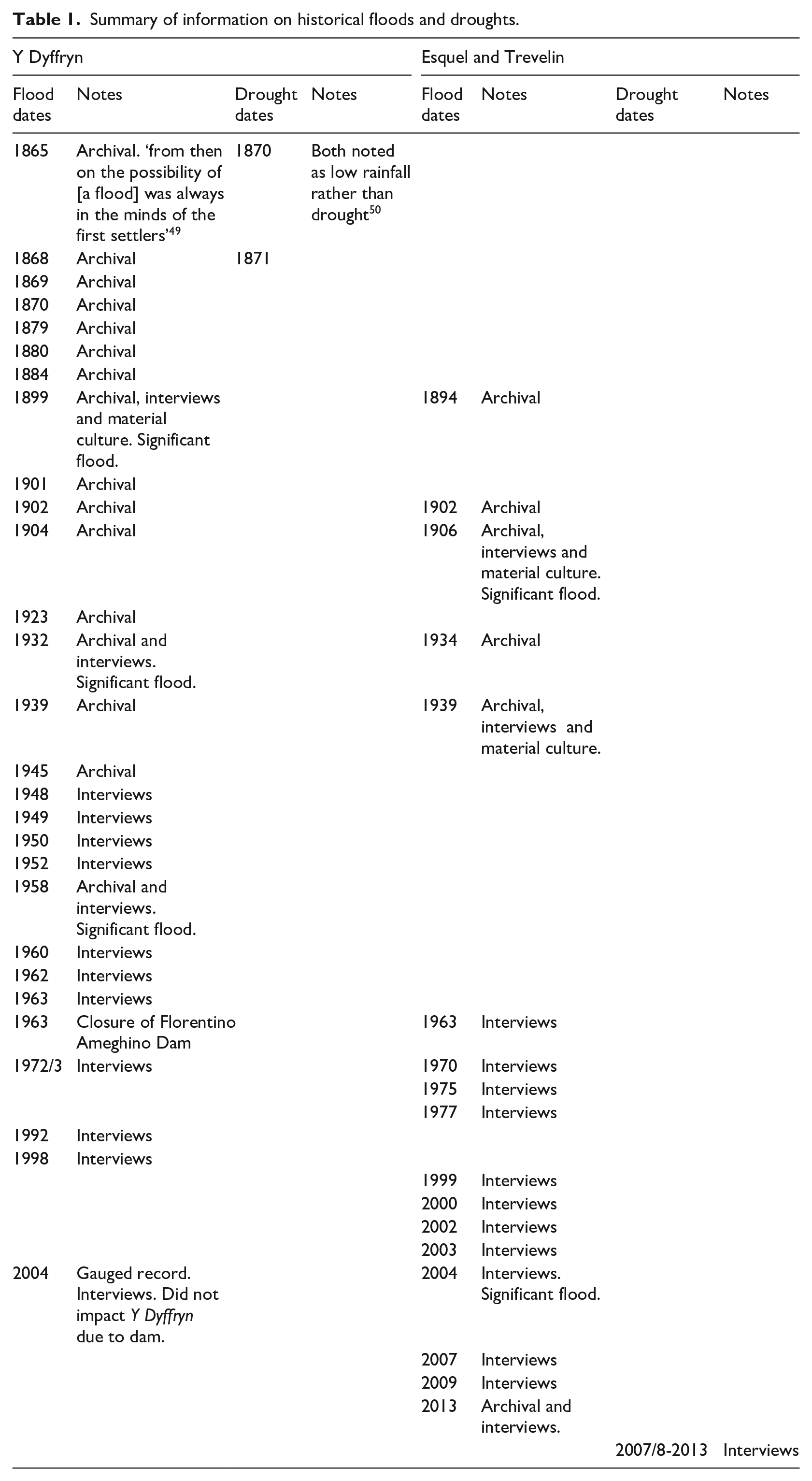
Table 1 summarises the information on historical floods and droughts revealed through our combination of methods. In Y Dyffryn, one of the largest floods recorded in the archival material occurred in July 1899. Following the 1901, 1902 and 1904 floods, the 1910s seem to have passed without frequent or notable floods before more floods occurred in subsequent decades. Particularly significant floods that were mentioned in interviews included the 1899, 1932 and 1958 events, corroborating archival sources. In Esquel and Trevelin, significant floods occurred in 1906, 1939 and 1977. Few descriptions of droughts were found in the archival sources or mentioned in interviews.
Summary of information on historical floods and droughts.
Emotion and perception of flood and drought impacts
Impact and scale
The impacts of certain floods are vividly described in the archival sources and by interviewees. Some of the floods following initial settlement were particularly significant, in that the colony was still developing and took time to adapt. John Daniel Evans describes one such flood around 1870, including how his father had to move a haystack three times from hill to hill in front of the floodwaters: ‘It was very heart-breaking to see the golden crop going on the back of the flow towards the sea and food so scarce, and the colony languished for a long time after this.’
47
Most other dramatic descriptions in the archival material relate to the exceptionally large 1899 flood, in which settlements were destroyed and the inhabitants forced to flee to the hillsides, where some lived in tents for months. Eluned Morgan
48
writes in a letter to her friend about the 1899 flood: ‘we have truly been in deep water . . . seeing the old, quiet and fertile valley as one massive lake from hill to hill and from the rocks to the sea, a view that will never be forgotten by those who witnessed it.’
51
In one of her volumes Dringo’r Andes (‘Climbing the Andes’), she writes of the flood: ‘It was a stormy, tempestuous night, the wind blew in its peak, the rain flowed mercilessly, the water roared like thunder, houses were heard falling one by one like cannon, by dawn not one wall stood on the whole plain, only heaps of rubble.’
52
W.M. Hughes also wrote of the 1899 flood: ‘The deluge destroyed everything in its path, like an angel of death.’ 53
Other writers were equally florid. In a poem, James Peter Jones writes of a 1923 flood: ‘The river rises every hour, every day, And the merciless flood marching like a giant.’
54
Trauma
Such literary descriptions of the sublime wonder of floods do not necessarily capture the personal trauma of flooding but evidence from interviews is informative. One interviewee said: ‘I remember the flood of 1932 as if it were yesterday. We lived in the middle of the valley – we knew the flood was coming, we prepared, sent the animals to the hills . . . I went two miles through mud and rain, crying like a pig, I’m sure!’
Flood trauma may also be long lasting. One interviewee in Gaiman said: ‘In 1958, I remember my mother becoming awfully upset because she had seen 1932 and she came to stay in Gaiman. They went for a walk one afternoon and went on to a bridge over the river and she was upset . . . seeing such water coming.’
Another who had experienced the 1958 flood as a child recounted: ‘The furniture went with the water, that was something horrible, horrible after days and days . . . of digging to stop it flooding but flood it did.’
In Y Dyffryn, flood impact to some extent depended on whether you lived on a farm on the floodplain. The Río Chubut is perched above the surrounding floodplain, as it flows atop an alluvial ridge and is bordered by natural levees. As a result, overtopping floodwaters could remain on the ground and not drain away for long periods, causing hardship to farmers, enduring homelessness, and restricted movement along the floodplain. Indeed, W.M. Hughes notes that some of the 1899 floodwaters were still visible as semi-permanent floodplain lakes in 1904. 55 Other interviewees recalled how the 1899 and 1932 floods had led to people leaving Y Dyffryn permanently, bound for the Andean settlements or Comodoro Rividavia.
A particularly poignant vignette that illustrates how the river and flooding had become ingrained in the inhabitants’ psyche is recounted in Mari Emlyn’s collection of letters.
56
Mary Ann Freeman, who drowned in the river a year later after losing three children to typhoid, wrote: ‘last night I dreampt (sic) that the river was flowing over and that we had a bridge to cross over & when the boys were going over Tutu & Connie fell in then the boys jumped in after them: then I woke up to day (sic) I see them in the river can’t get rid of it.’
57
Nostalgia and wonder
Some interviewees recalled flooding with nostalgia,
58
especially flooding that occurred during their childhood. One elderly interviewee recalled following the men around at night as they walked the riverbanks, checking the water level: ‘My sister and I were in our element, walking after the men, because they were walking with the spades and the torches to see where the waters were . . . we were ten . . . I remember because I was a child and it was fun for us . . .’
An interviewee in the Andes recalled her mother recounting a trip across the paith to Y Dyffryn: ‘Mum was used to going from here to Y Dyffryn and once, on the way there was a large flood and they were on the road for a long time before arriving and the food nearly finished and they sent a man on to Gaiman for water, they baked and washed clothes on the way but they were happy, having fun said my Mum.’
Three additional quotes sum up the emotions and perceptions of flooding. First, a quotation from W.M. Hughes about the 1899 flood speaks to the heterogeneous nature of flood emotions and perceptions: ‘The flood affected the feelings of different people in different ways. It brought to attention, like foam on the surface of water, hidden characteristics in many . . . Strong men, in body anyway, were seen crying heavily, whereas others who were seemingly weaker pursed their lips and became resolute . . .’
59
Second, stoicism and resoluteness of some people in the face of flood adversity is also shown in a letter written by Lewis Jones in 1870: ‘. . . They lost a great deal of wheat in the floods, and as a result they were unable to sow last year. . . They also lost fifty cattle in the floods, and many houses. Despite all this, everyone is comfortable and hearty.’
60
The letter’s positivity may have been an attempt by one of the main proponents of the colony to continue with the project despite adversity, but people certainly suffered in floods, yet carried on.
Third, a comment by an interviewee speaks to flood-inspired wonder. They told us that during the 2004 flood (the largest gauged) that he and a friend had driven to Rhyd yr Indiaid, located upstream of the Florentino Ameghino dam (Figure 1), ‘just to look at the river, it was insane.’
Droughts
Significantly, in archival and interview material, drought memories are less focused than those of floods. With interviewees, individual years were not so clearly recalled and impacts seem to be more dispersed, especially in comparison to the immediacy of singular flood events. One interviewee in Gaiman, who had been raised on a farm said: ‘There have been years of drought but I can’t say that they have affected us on the farm to the extent that I remember an occasion and a year.’
Many interviewees said that, despite widespread dam building and water supply management, the Patagonian region was currently experiencing a significant drought, which had already lasted 4 to 6 years. This had impacted agriculture, particularly by reducing sheep numbers. Historically, aside from the experiences of the very first settlers who arrived with no sources of fresh water, the main drought impact was to necessitate irrigation water rationing, sometimes increasing conflicts between farmers, particularly in Y Dyffryn. One interviewee said: ‘one week this farm would have water, the next week after, the next farm …. people did argue a little because they wanted water.’
Thresholds of intergenerational memory
In the magazine Cymru, W.H. Hughes wrote that the 22nd July 1899 would be ‘a day long remembered.’
61
This was the date of the particularly large, destructive flood in Y Dyffryn which has been recorded in the literary tradition of Y Wladfa and still occupies a central place in flood memoria (Table 1). Of course, no interviewees were alive at the time but many, particularly those with strong familial ties with Y Wladfa, referenced the 1899 event when asked about historical flood impacts. Some had heard their parents or grandparents speak about this flood, and others recalled flood lines related to the event on or in houses in Gaiman. Others saw the significance of the 1899 flood in the history of Y Wladfa: ‘1899 was a kind of centrepoint for the future of Y Wladfa, many people went and many who thought of coming didn’t. How many Welsh would there be in Patagonia today if we hadn’t had 1899?’
Another said: ‘it’s important for the history of Y Wladfa, anyone who has read it knows about the flood of 1899.’
The prevalence of the 1899 flood in interviewees’ recollections is perhaps unsurprising given its magnitude and social impact. However, further large floods occurred in Y Dyffryn in 1901, 1902 and 1904 (Table 1), but these floods were barely mentioned by interviewees, despite having been recorded in great detail by W.M. Hughes. 62 Other large floods, for example 1932 and 1958, are also remembered (Table 1), but are viewed as being smaller than 1899 even though precise data on flood magnitudes are not available.
A key difference in the way in which different generations in Y Dyffryn remember floods and droughts is evident. Those inhabitants old enough to have experienced the large floods of 1958 and perhaps 1932, and those who may have heard stories from their parents and grandparents about the 1899 flood, tended to downplay any floods that have occurred in the lower valley since closure of the Florentino Ameghino Dam in 1963 and subsequent flow regulation. Younger inhabitants, who were not alive to experience the large, pre-regulation floods, tended to mention floods that had occurred since dam closure, for example in 1998. While these floods were likely smaller than the pre-regulation floods, occurring mainly in response to intense localised rainfall downstream of the dam, they nonetheless inundated streets, houses and businesses. One interviewee who had moved to Patagonia from Wales said: ‘I arrived in 1998 and the rain came, I had never seen rain like it . . . there was water on the surface for four months, easy.’
Some older generations who have clearly seen a change in flood experiences since their younger days referred to these different perceptions of younger people and relative newcomers. One elderly interviewee in Gaiman said plainly ‘children today don’t know what a flood is.’ Another in Trevelin said: ‘people from outside see the water dirty [full of sediment] and they say – ‘flood’ – but we used to see the water flow past the front door – that hasn’t happened.’
Are there, therefore, specific thresholds of memory above which a flood or drought event becomes part of the memoria of a community? In other words, why does the 1899 flood occupy such a central place, yet the floods of 1901, 1902 and 1904 seemingly are forgotten? We suggest that there could be multiple interrelated thresholds related to flood/drought magnitude and flood duration, and thus to the individual and collective impacts of the events, but also thresholds related to memorialisation (see below).
What is clear is that regardless of which events are remembered and why, memories of floods, and to a lesser extent droughts, have been transmitted vertically through the generations by the telling of stories. One interviewee in Gaiman said: ‘When the flood came everyone talked about ‘in such and such a year.’
Another interviewee in Esquel had spent time as a child on a farm in Y Dyffryn and recalled: ‘my father used to talk about the ’32 flood – he remembered terrible things about the flood’.
A young interviewee in Gaiman, whose family had lived in Y Dyffryn for generations, said: ‘My grandparents talked about it all the time – my grandmother’s family lived here in 1899, they said everything was gone . . .’
Two interviewees in Trevelin, recalled that: ‘the old people talk about floods in the old times from one side of the valley to the other’ and that they knew of the floods through: ‘reading and the stories of the old people - we didn’t have a TV so there was plenty of time to tell stories.’
Specific cultural and language factors may also determine which events are remembered. In Trevelin, some three months before we conducted our interviews, a flood occurred on the Río Percy, making the front page of the regional paper ‘El Chubut’. The story featured an aerial photograph of inundated land and a photograph of the Governor of Chubut Province visiting the town. Naturally, we assumed that this flood would be foremost in the minds of local residents. However, none of our interviewees – including those in Trevelin – mentioned the flood, and some even had difficulty recalling the event. Increasingly mystified, we eventually asked one of our interviewees why this was the case. It was, he said, only ‘una crecida’ (flow) rather than ‘una inundación’ (flood), and the flooding had actually occurred downstream of Trevelin, contrary to the newspaper headline and photograph caption. This cautionary tale is important in terms of considering the methods used to investigate personal and collective flood memories in multilingual communities, especially when undertaken by researchers from outside the community.
The materiality of flooding and drought memories
Thresholds of flood and drought memories may also be related to memorialisation, especially when this involves materialisation. 63 The official memorialisation of flooding in Y Wladfa is predominantly material in nature. In the two main museums of Welsh culture in Patagonia (El Museo Histórico Regional de Gaiman and El Museo Regional Molino Andes in Trevelin), flooding is given significant exhibition space. In the Gaiman museum, one room is dominated by the memoria of flooding and the river landscape. A large, historic map of the lower Chubut valley, showing the river’s course, numerous older channels, and the original boundaries of farms assigned to early settlers, occupies one wall (Figure 3). The map’s prominent position highlights the centrality of the river landscape in Welsh Patagonia. A brass door knocker is on display (Figure 4), one of the only remnants of Lewis Jones’s house to survive the 1899 flood, as are numerous photographs of floods in the lower Chubut valley (e.g. in 1932). The interweaving of presence and absence 64 is felt very powerfully here. The presence of the door knocker so clearly speaks to the absence of the rest of the building, and both evoke the presence of water. The liquid, fluid presence of river flow is keenly felt in relation to the absence of the dependable solidity of human construction. In the Trevelin museum, a historical photograph (Figure 5) of the 1939 flood is given prominent space, having been reproduced at a large scale to occupy nearly the entire height of the room. The photograph shows the main street inundated with floodwaters and residents are pictured in boats and on horseback. The fact that the museum itself is located in the old mill, strongly associated with the riverine history of the town, also helps to intertwine water and memory.
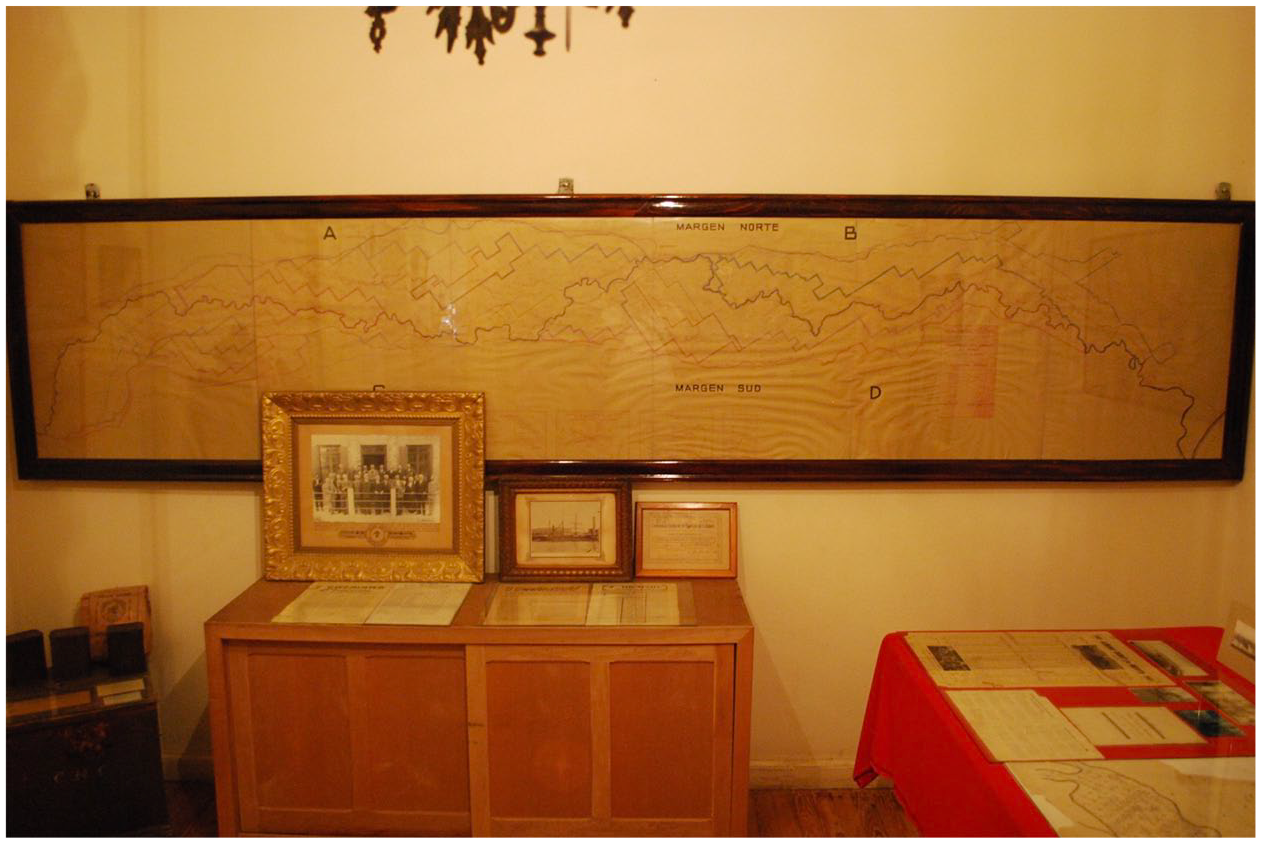
Map of Y Dyffryn, in El Museo Histórico Regional de Gaiman. Picture Credit: Hywel Griffiths with thanks to El Museo Histórico Regional de Gaiman
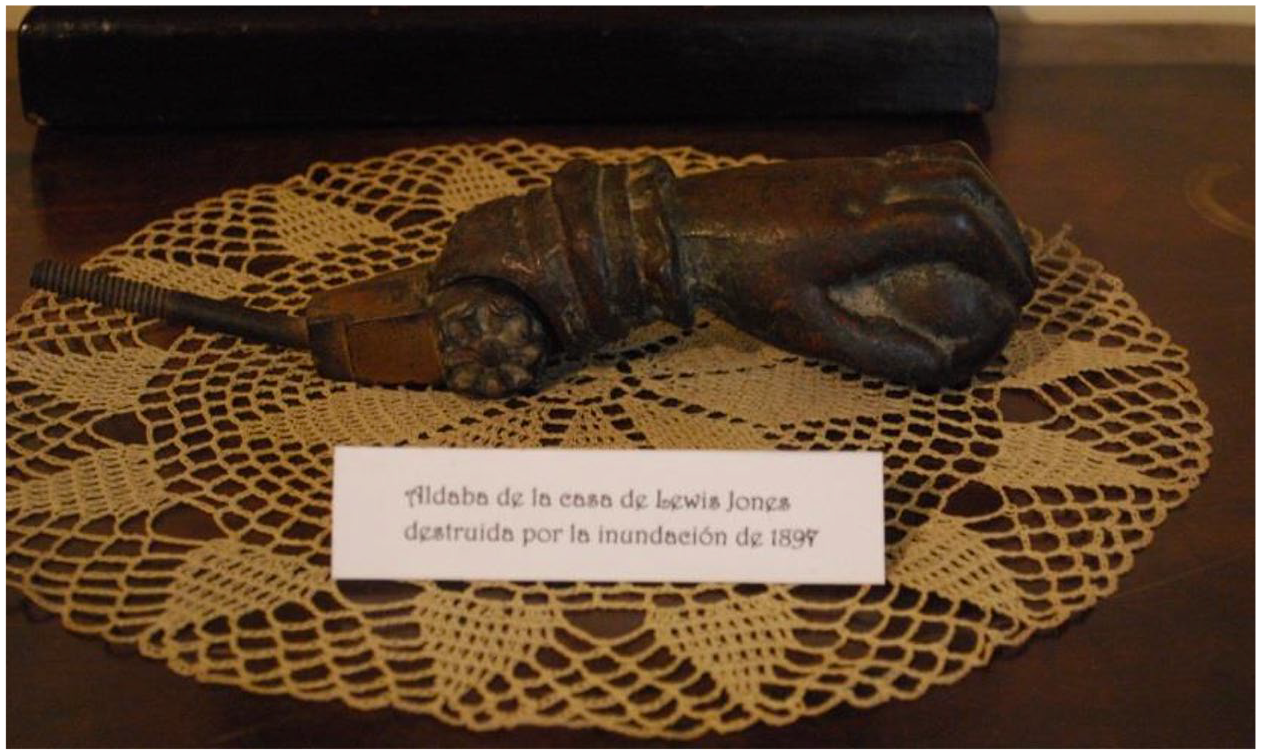
A brass door knocker, found following the flood of 1899, and now on display in El Museo Histórico Regional de Gaiman. Photo by Hywel Griffiths with thanks to El Museo Histórico Regional de Gaiman
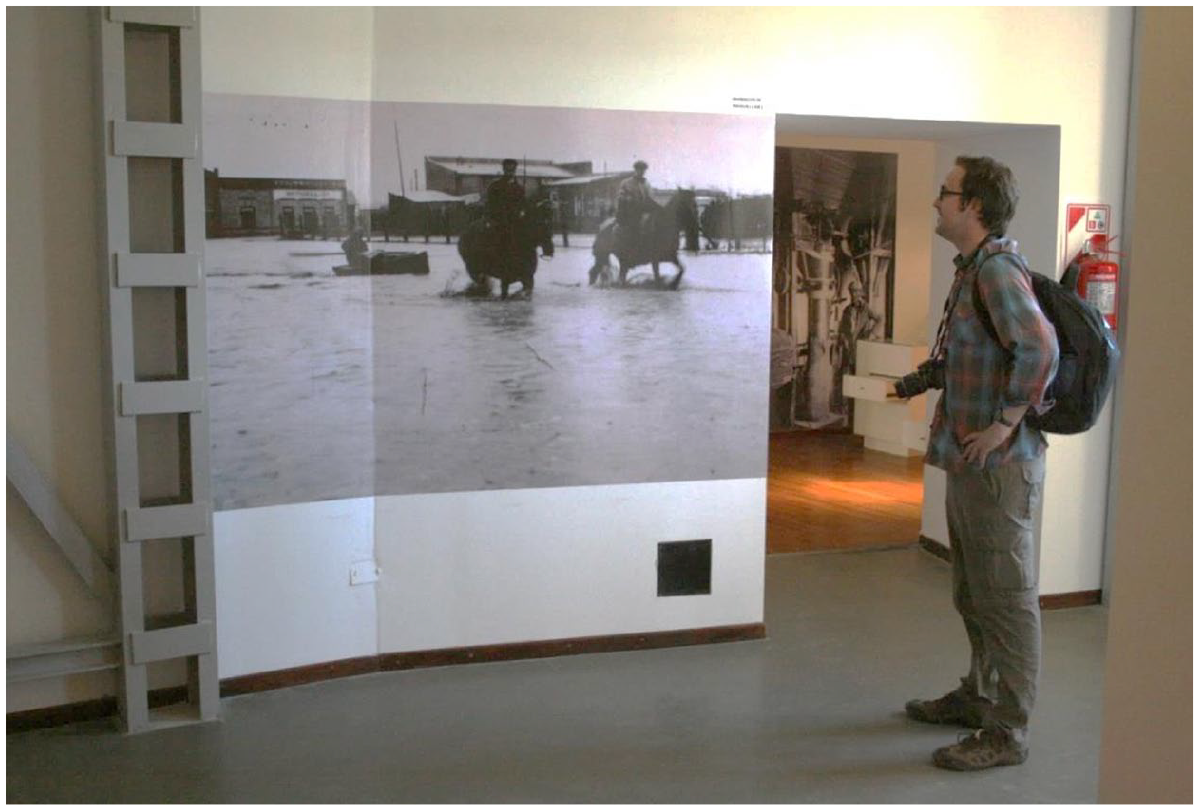
Photograph of the 1939 flood in El Museo Regional Molino Andes, Trevelin. Photo by Stephen Tooth with thanks to El Museo Regional Molino Andes
Examples of more informal, intensely personal, material memories of flooding in Y Wladfa also exist. Flood photographs were on display in one of the popular Welsh tea houses in Gaiman and two interviewees produced personal photographs related to flooding. One photograph showed a man stooping near a pool of water, seemingly working to repair a gap in a levee, and in the far distance the flood is evident. Once again, absence and presence interweave, with the absence of part of the levee testament to the presence of unusually large amounts of water. Another photograph was of the interviewee’s family temporarily living on a hillside as a result of flooding.
Although epigraphic markers are not as common in Y Wladfa as they are in Europe, some interviewees told us of flood markers inside their houses. One interviewee in Gaiman told us of a family tradition of flood markers in the house and of the 1899 flood story being passed from one family to another: ‘there was a line on the wall in the old house of the 1899 flood and my grandfather used to show it to everyone – who knows if it was true or not!’
An interviewee who remembered living in a flat in Trelew during the 1988 flood recalls seeing a flood line clearly on the wall of her flat. A childhood recollection from an interviewee in Trevelin also highlights the material nature of flood memories: ‘after the high flows the ford changed. We had to look for a new ford.’
On the Río Chubut and Río Percy floodplains, flooding is also memorialised in space, place and topography, both officially and unofficially. For example, flood memories are captured by the flood impacts on chapels, buildings which were so important to the early settlers. In Gaiman, there is an ‘old chapel’, partially destroyed by the 1899 flood, and a ‘new chapel’ (‘Bethel’) constructed nearby. An interviewee recalled how the ‘men had raised the organ’ in case the floodwaters entered this new chapel. The materiality of memory is particularly evident at Capel Bryn Crwn (Round Hill Chapel), which stands on its own on the Río Chubut floodplain. An information board (Figure 6) reminds locals and informs tourists that the original chapel at Bryn Crwn was destroyed by the ‘la gran indundación’ (big flood) of 1899, and that the new chapel, built less than a year later in 1900, was located on the slightly higher ground that the congregation had noticed was not under water during the flood.
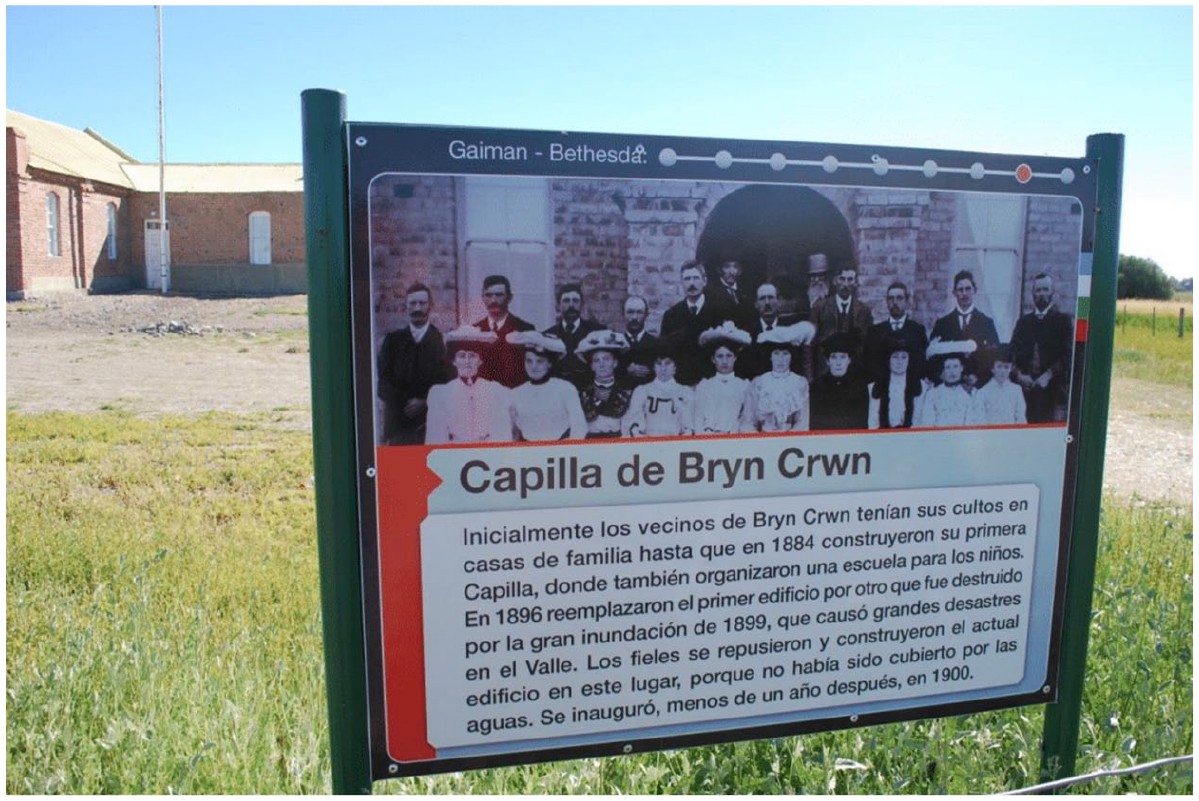
Information board at Bryn Crwn chapel, Y Dyffryn, mentioning the flood of 1899. Photo by Hywel Griffiths
The materiality of flood memories is, then, simultaneously official and unofficial, and various scales at which memories can be encountered, from the individual to the communal, can be identified. By contrast, drought memories are largely absent from interview responses and to some extent from the museums. Of course, avoiding drought was implicit in development of the irrigation channel network in Y Dyffryn. One could also argue that the largest example of where memories of flooding and drought have been materialised is in the Florentino Ameghino dam structure and reservoir, which was, according to some interviewees, the destination of Sunday school trips, and ‘a very pretty place to go and see.’
Historical documents and flood and drought memories as repositories of lay knowledge
Here, we focus on the vertical transmission of flood/drought memories and lay knowledges, and the complex interconnections between them. Historical documents and memories recalled during interviews show clearly that inhabitants of Y Wladfa have developed a significant lay knowledge of flooding in particular, owing to the fact that they have lived with capricious rivers for over 150 years. In the historical documents, discussions around large floods indicate a well-developed understanding of the nature of flooding, especially in Y Dyffryn. W.H. Hughes compared relative flood levels, noting that during the 1899 flood ‘All the little hills that were above the water in 1878 were now completely invisible.’
65
In Ar Lannau’r Gamwy,
66
W.M. Hughes includes one chapter on the 1899 flood and three chapters on the 1901 flood (entitled ‘Another flood’), 1902 (‘A flood again) and 1904 (‘A flood once more’). These successive floods allowed W.M. Hughes to observe and learn from their different characteristics. Of the 1899 flood he says: ‘The attempt by the waters to travel along the paths that it previously travelled along became clear during this flood . . .’
67
Of the 1901 flood, he says: ‘It caused little damage, as the inhabitants had learnt the lessons of the first flood, and had rebuilt on the neighbouring hills, far from its reach.’
68
The colony’s chroniclers, therefore, compared flood events, learning and remembering which areas were above ground during which floods, and in some cases this knowledge was used to mitigate damage by future floods. One interviewee remembered the positive effects of reduced flood impacts in Y Dyffryn, saying that during one flood, ‘water went into the old chapel, but not into the new chapel’.
Chroniclers also noted the reason for the prolonged floodplain inundation, namely the perched nature of the Río Chubut. The Reverend J. Lewis wrote in the magazine Cymru: ‘The river flows on the highest land in the valley, and there is a sudden drop to a plain on either side. This is what makes it easy for the valley to be flooded when the river rises above her banks.’
69
This informal geomorphological understanding also led to a deep knowledge among the inhabitants of Y Dyffryn, and farmers in particular, about where the river was likely to ‘break out’, and what would happen if it did. Accordingly, this knowledge provided an imperative to strengthen and repair artificial levees for flood defence. One interviewee said: ‘I can’t say that I remember the floods themselves, but I do remember everyone worrying terribly about the different places they considered to be weak, and those were the places where people tried to make sure that the river didn’t break out ….’
Other examples of the transmission of lay flood knowledge are related to the close community networks. One interviewee from Y Dyffryn recalls: ‘I remember a competitive meeting
70
in Bethesda some 20 days before [the 1958 flood], and that night they were saying about the rain in the upper valley and there was a danger of flooding, for the flood to come, and it did come, about twenty days later.’
Sustainable flood and drought memories and changing behaviour
Investigations of flood and drought memories are particularly relevant for discussions regarding adapting to, and mitigating, hydrological extremes that probably will occur more frequently in response to 21st century climate change. Particularly important are strong community networks
71
and cultural activities that facilitate vertical and horizontal transmission of ‘watery’ lay knowledges. McEwen et al. have shown that the changing nature of family and community is very important in determining whether flood memories are transmitted vertically through the generations.
72
In Y Wladfa, for example, community changes due to changing economic conditions, inward and outward migration, and the creation of new communities through social media may influence whether memories of some historical floods (e.g. 1932, 1958 in Y Dyffryn) continue to be transmitted, or whether the official memorialisation of the larger floods (e.g. 1899 in Y Dyffryn and 1939 in Trevelin) will mean that only these events are remembered. Furthermore, despite the centrality of hydrological extremes in the inter-generational, societal and cultural memory in Patagonia, and the material memorialisation that might counteract any forgetting, evidence from the present communities indicates that the links between flood/drought memories, lay knowledge, and local environmental governance are not straightforward. For instance, the widespread and still extant lay knowledge in the Welsh community, particularly regarding floods, is not readily incorporated in policy making, as is evident from interviewees’ opinions on contemporary flooding issues in Y Dyffryn. Many challenges are related to the geomorphological changes set in train by the closure of the Florentino Ameghino dam.
73
In Trelew in particular, this has encouraged significant housing encroachment near the Río Chubut owing to a misplaced sense of ‘control’ over floods. One interviewee noted that: ‘because the river doesn’t carry as much water now the river has narrowed and invasive willows have taken over, closing the river . . . some people have taken the sides of the river down, a totally irresponsible thing to do because if a flood comes . . .’.
The observation of river narrowing and links to invasive species indicate a lay geomorphological knowledge of processes that is confirmed by scientific research. 74
In Trevelin, some disquiet regarding the number of houses that had been built on the Río Percy floodplain was evident. One interviewee said: ‘I hope that we don’t have a flood like we had before because many will be underwater. They don’t believe it when someone says to them – raise the ground there because that part used to be under water . . . I know this place.’
Another interviewee suggested that the community’s emphasis had shifted from taking personal responsibility towards an expectation that local government had responsibility for flood protection: ‘Now we have more people living in places where our ancestors knew they couldn’t live because every year you had floods so they built their houses in places where they knew the water couldn’t go. Now there are a lot of people trying to build houses near the river . . . and after they build the house they expect the government to repair and fix everything.’
The utility of flood and drought memories and lay knowledge may be inherently linked to the sustainability of the communities themselves. Although interest in the Welsh language in Patagonia is now revitalised, for many decades the Welsh language communities have been gradually assimilated into the rapidly growing, dominantly Spanish-speaking communities. 75 In these larger communities, which include many people without lengthy familial ties in the region, the memory of hydrological extremes may not be as potent. Hence, lay knowledges that in the past have helped with flood adaptation and mitigation in the Welsh language communities may be being underutilised in dealing with contemporary flooding problems.
This assertion is illustrated by the floods of April 2017 that impacted most heavily on the city of Comodoro Rivadavia, located ~375 km southwest of Gaiman and Trelew. 76 While the lower Chubut valley escaped major inundation, nonetheless local communities experienced water shortages following failure of the water treatment works at Florentino Ameghino dam that resulted from high suspended sediment loads in entering floodwaters. This was the first major flood to impact the lower Chubut valley since the advent of widespread use of Facebook and Twitter. In communities served by a dam that simultaneously offers some protection from floods and droughts but also causes detrimental environmental impacts, opportunities exist to study the nature of flood/drought memories and lay knowledges that result from the emotions, networks and materialities that commonly are now being negotiated via social media rather than orally or in literary form. In this new, hyper-connected world, hopefully there will still be a very important place for the memories of the hydrological extremes preserved by the Welsh-speaking communities in Y Wladfa alongside those arising from Spanish-speaking or indigenous communities. 77 Nevertheless, the processes of vertical and horizontal transmission may be mutating rapidly. As one of our interviewees put it, ‘there are pictures [of floods] on Facebook, and people in Wales have seen them, but it isn’t anything like the old floods.’
Conclusions
Taken together, instrumented records, archival sources and oral histories can provide very valuable data with which flood and drought histories can be reconstructed, and memories and perceptions can be interrogated. Our findings from archival research, interviews, and critical textual analysis demonstrate that flooding is generally more prevalent than drought in the memories of Y Wladfa, and that there are ‘thresholds of remembering’ related to the magnitude, duration, and personal or collective impact of a flood event. The particularly large, destructive 1899 flood in the lower Chubut valley continues to be recalled by current members of the community, as does the large 1939 flood in Trevelin, even by those too young to have experienced the events personally. Embodied encounters with the official, focused and singular flood memorialisation in museums and on tourist information boards, and the unofficial, dispersed and selective flood memories in literary and oral traditions, also ensures that the largest floods are not forgotten. Together, these factors help the memory of particular floods to be transmitted vertically from generation to generation as a kind of inherited or ‘prosthetic’ memory. By contrast, other large, singular floods (even recent ones) or slow onset, protracted droughts have not assumed the same place in cultural and social memoria owing to their lesser personal or collective impacts. 78
Flood memories in Patagonia provide further empirical evidence of how memory can be both geographically tied to particular sites (whether sites of official commemoration in museums or on information boards, or more informal everyday sites) and more spatially and temporally dispersed and fragmented, as well as examples of the creative and performative nature of memory. Poetry and prose, especially memoirs and letter writing from the first century of the colony’s history, have combined with inter-generational story telling to contribute to the transcription 79 of flood memories and their vertical transmission. While examples of ‘active’ remembering exist, individual flood events also cause the ‘return’ 80 of memories of historical events which are then ‘(re)mediated’ 81 by other social, cultural and political factors, including the influence of material traces of flooding at various scales. Through these various factors, floods and droughts can be, to varying degrees, both absent and present at any one time in any one place in a landscape.
In addition to being subject to ‘thresholds of remembering’, many flood memories are culturally contingent. Many floods, particularly those events in the first few decades of the colony, are recorded only in Welsh-language texts and are now recalled mainly by Welsh-language speakers with lengthy connections to the area. This situation highlights the importance of the long-term sustainability of the Welsh-language community for preservation of sustainable flood memories in Y Wladfa. Future work should focus on integrating these memories with those from other cultures and languages, including through oral history work with indigenous communities. This finding has implications for current strategies to increase community flood resilience, both in Patagonia and, more generally, farther afield. Cultural representations of extreme weather or hydrological events can provide a window into the historical perceptions of these extremes and the previous strategies employed to adapt to, or mitigate, their impacts. As such, great potential exists to bring understandings gained from such historical sources to discussions around 21st century hydroclimatic changes and the development of community-led resilience strategies.
Footnotes
Acknowledgements
We thank colleagues for comments and suggestions received following talks at Aberystwyth University, the RGS-IBG Annual Meeting in 2013, the Annual E.G. Bowen Memorial Lecture in 2014, and the International Conference of Historical Geographers in 2015. We also thank Antony Smith for assistance with the production of figures, Ceris Gruffudd for making links to residents of Welsh Patagonia, and Teithiau Tango Tours for making travel arrangements. This research would not have been possible without the hospitality, enthusiasm and assistance of residents of Welsh Patagonia. Finally we thank the editor and two anonymous reviewers for their constructive comments on the manuscript.
Funding
The author(s) disclosed receipt of the following financial support for the research, authorship, and/or publication of this article: We are very grateful to the British Academy/Leverhulme and Sir Ernest Cassel Educational Trust Grant for funding research in Welsh Patagonia through the award of a BA/Leverhulme Small Research Grant (SG122351 Remembering a hydrographic society: flooding, drought, adaptation and culture in the Welsh colony of Patagonia, Argentina).
