




Abstract
Human geography has become deeply interested in a range of research methods that focus on researchers’ corporeal engagement with their research sites. This interest has opened up an exciting set of research horizons, energising the discipline in a whole range of ways. Welcoming this engagement, this paper presents a series of meditations on the process of using the researcher’s corporeal learning as a research tool. Exploring two research projects, as well as the work of the photographer Nikki S Lee, it examines how the process of becoming corporeally capable might productively be framed as sets of ongoing experiments. Framing such engagements as experiments is a useful heuristic through which to think rigorously about what such research can claim as knowledge. More controversially, the paper argues that the heuristic of the experiment helps us to attend to the varying durations of becoming in ways that much existing work has discounted. Developing corporeal capacities – gaining a skill, becoming capable of doing a particular activity – involves becoming attuned to a range of thresholds, the crossing of which open up novel and frequently unexpected perspectives. Attunement to these thresholds does not arise simply through the process of mixing in and participating in a research site. It requires careful attention to the parameters of transformation involved in being able to participate. The paper explores how such parameters might be decided upon and calibrated as part of an ongoing engagement with a research site or event. Our aim is not to artificially restrict or constrain how human geographers approach their research design. Rather it is to encourage human geographers to show more courage in their use of corporeal based research methodologies.
Keywords
‘Only when we recognize that certain means are available to us do we discover goals which had not occurred to us before’. Hans Joas
1
‘Actually, I think that what is called the scientific method often works the way I do. You don’t know. By the time you know what you are looking for, you’ve already found it. You can’t know ahead of time what you are going to discover. How can you find out, except by fiddling around?’ Jane Jacobs
2
Introduction
Engagement with the work of ethnographers and cultural anthropologists, ethnomethodologists, feminist scholars, performance artists and certain strands of philosophy have prompted many human geographers towards an interest in the researcher’s body as a site of transformation. 3 Attending closely to the researcher’s sustained corporeal engagement with a specific site, practice, or thing becomes the conduit into knowing about how the site, practice or thing being studied is entangled or enmeshed into the social. This movement towards a sensual or carnal style of human geography is to be welcomed. It has energised and pluralised geographical scholarship in ways that are surprising, challenging and invigorating. 4
Largely, this work has been presented through its insights in theoretical terms: in producing new understandings of corporeal geographies by reshaping theoretical perspectives. In alignment with and in response to this work, in this paper we offer a set of methodological precepts to ground these carnal geographies in empirical worlds. Specifically, we want to access what it means to ‘experiment’ with one’s corporeality as a means of generating social scientific knowledge. Retrospectively considering our own work, we want to think more carefully about methodological tenets that might help to formulate how scientific knowledge can be produced through researcher’s corporeal transformation.
We recognise that suggesting a need for methodological structure may be controversial. It has become a common complaint, cutting across human geography, that work evoking intimate ethnographic attention to one’s engagement with a social setting – such as engagements of corporeal, emotional or affective attunement – tends to be devoid of empirical procedural formalism. 5 This methodological informality is often attached to ‘experimentation’ as conceptually oriented, something more like speculative probing and less like hypothesis testing. For some, this form of experimentation is grounded in the call of theorists like Deleuze, 6 Massumi 7 and others 8 to cast philosophy – and with it social theory – as a creative and speculative act of generating concepts; concepts that are then let loose in the world. 9 Others, more influenced by feminist critiques of science, eschew methodological formalism as a hangover from positivist epistemologies. 10 Geographical work animated by this experimental register has opened new research horizons, 11 yet in many ways it remains challenging for a larger audience – both within the discipline and outside – precisely because of its refusal to speak of or define its methodological warrants. 12
We think that a useful middle ground is possible: that there can be ways to observe the corporeal and somatic transformations of individual researchers that allow for probing while also producing social scientific knowledge. There can be ways that these ‘experiments’ can attend to certain details; be fruitfully planned, intended, executed and reflected upon; and offer more robust, and perhaps less solipsistic, insights. 13 We think there are valuable things to be learned by exploring how exactly learning to undertake a particular practice, or taking on a specific corporeal orientation, generate new ways of understanding the social world. This is a position that connects with cultural geographers’ developing interest in skill and corporeal learning. 14 But we also ask ourselves, what is it that we can understand through committing to such transformations that we cannot learn about from simply talking to or observing others? What exactly does it mean to experiment with our bodies? Exactly what transformations are being traced? And over what duration?
In the following we use our own attempts at producing bodily knowledge to consider some ways human geographers and other qualitatively oriented social scientists might more precisely frame what is involved such transformations. Inspired by an artist whose projects use purposeful planning for her own embodied transformations, we want to suggest some ways of rethinking what it means to ‘experiment’ as a corporeally committed qualitative researcher. Rather than thinking about experimentation within qualitative research as trying out new or novel techniques, we consider corporeal experimentation as a rigorous, iterative, process through which researchers attend to – and aim to produce knowledge about – the social site on which they are focused. Before turning directly to the theme of experimentation, we revisit quickly first how and why corporeality and the body have become so central to the thinking of many qualitative researchers.
Embodiment and why it matters
To think about the body and corporeality as a site of experimentation is to think through the question of bodily becoming as a kind of research technique. Or even perhaps to think of it as a method. Choosing among the many possible ways of entering a discussion on embodiment, we begin with phenomenology. This is partly because it takes us straight to the body as a site of knowledge and knowledge production. 15 But more than that, it is because it is a way of thinking about the body and embodiment that has been enormously influential within the kind of social scientific work we call upon here.
The singular phenomenological intuition is that everything we know – and can know – about the world emerges through our embodied engagement with that world. We are inevitably and irretrievably entangled, intertwined, mixed-up in, immersed (take your pick) in the messy diversity of the world. We are also, and our ways of knowing and sensing are, inevitably entangled up with the factuality of the bodies that we inhabit. It follows from this intuition, that all knowledge must be rooted in (and routed through) the fact of this embodiment. This is why Merleau-Ponty 16 and other phenomenologists 17 expend so much effort exploring the body’s orientation to the environment in which it finds itself, and it is also why his philosophy is one that concentrates on our fleshiness. That we are made of muscle, skin, bones, organs. That we touch, feel, taste, smell, hear, see.
This insight has been taken up within the social sciences and humanities as an invitation to explore how people’s ways of experiencing and being-in-the-world are conditioned, or better yet, a product of, or produced through and within, our enculturation in the world. Mauss 18 talked about the ways cultures shape a kind of bodily habitus; a range of bodily techniques, comportments and skills specific to that culture. Bourdieu 19 would develop that insight further with his anthropological writings on Kabylia emphasising habitus as a field of power; a way in which societies both reproduced themselves, and site of social conflict and innovation. So, thinking within a phenomenological register leads us not only to the body and its embodiments, it also brings us to all sorts of questions about society and the social. 20
Habitus also points us towards habit – even as Mauss and Bourdieu insist that habitus is much more than simple habit. And habit suggests the notion of and the habitual. But rather than simply emphasising the taken for granted, routinised and thusly largely un-thought-through competencies, orientations, dispositions of habit, we string a bow from Merleau-Ponty, Mauss and Bourdieu across the Atlantic to John Dewey’s explorations of the societal forces of habit. 21 Dewey’s use of habit could be read as a kind of conceptual precursor to habitus. But – when compared to habitus – Dewey’s conceptualisation of habit has the advantage of offering some productive ways of thinking about how our bodily capabilities, the ways we inhabit and navigate through situations, might become the focus of self-reflection and a concerted focus for self-refashioning. Most crucially, Dewey points to the way that the histories of our bodies, the habits of deportment and so forth, both prime and constrain our capacity for action in all sorts of consequential ways. For Dewey habit is a kind of embedded, non-conscious learning and he was interested in thinking about techniques that explicitly work at refashioning the habitual ways we are embodied in the world.
If we continue along this vein, we could enter an endless loop of what causes what; society versus individual, individual versus society, body versus context, context versus body and on and on. We do not want to get caught in this loop. For the purposes of this essay, the Bourdieusian notion of habitus and Dewey’s embodied habit are useful starting points for thinking about the kinds of transformations – and the effort that may be involved in those transformations – necessary to undertake empirically consequential research on becoming. They remind us that a great deal of what we (and thus those we wish to understand) know about the world and how we understand the world is built up through both a range of body consciousness-es and learnt bodily capacities. They also remind us that it is often difficult to gain access to the functioning and operation of these capacities because they are built up through the complex accretion of routine, habit and learning. And they do so over durations that vary from days, to years, or even lifetimes.
Intervening in these philosophies of embodiment as an empirical method is, most obviously, ethnography, or participant observation, as a domain of anthropology. Despite having existed and propagated as a method for a century, ethnographic instructions for participant observation are often imprecise about the corporeal and social transformations involved in it. Such transformations are understood as part of the ‘craft’ of doing ethnography, which is recognised as skilled by other craftspersons, but, like other crafts, is challenging to talk about outside of the setting where it is undertaken. While we appreciate that part of what makes ethnography successful as a method is this imprecision about the source and substance of embedded knowledge and how it can be accrued in situ, we want to turn attention with our intervention on that ‘craft’ of becoming corporeally knowledgeable as a kind of experiment in becoming. As an experiment, executed under certain conditions and designed to observe certain effects, we move towards a formulation of ethnography that attends to corporeal experience as its analytical site, and ‘experiment’ as a qualitative method.
Using a rubric of experiment, we want to explore how an empirical understanding of corporeality can be developed through a purposeful, researcher-enacted, attempt at acquiring skill. The embodied researcher as enmeshed in tacit corporeal knowledges becomes, borrowing from the work of Barad, an apparatus. 22 Thinking about scientific experiments as performative ‘cuts’ into generating knowledge, she argues that an experimental apparatus is not an inert tool to create infinitely replicable conditions. Rather, apparatuses are ‘boundary-making practices that are formative of matter and meaning, productive of, and part of, the phenomena produced’. 23 That is to say, she draws attention to the generativity of that tool as enmeshed and assembled into the materiality of observation, intra-actively configuring what can be intelligibly observable. In parallel, we consider a researcher as an apparatus that starts from a certain place of skilledness; s/he is non-neutral and constitutive of how an experiment takes place, entangling a world ‘through which bodies are intra-actively materialized’, 24 both her own and bodies with which s/he intra-acts. The parameters of this ‘researcher-as-apparatus’ shape what sorts of new knowledges s/he can produce – effectively limited by its distinctive corporealities, but still malleable and able to learn. Inevitably, though, the ‘tacit knowledge’ of the researcher that is never entirely known or knowable. Yet, it can be taken into account, we contend, and observed through how embodied transformation takes place as a process of attunement, starting from certain conditions of practice and shaping towards others.
To elaborate how we understand attunement as a methodological practice, in the following sections we first take inspiration from photographer Nikki S Lee and others about the utility and craft of experimenting with becoming, then develop some terminology to consider how our own ethnographic projects have implicitly built on experiments with corporeal knowledgeability.
Provocative becomings: the experiments Nikki S Lee and others
Nikki S Lee is a Korean artist based in New York, whose primary materials are photography and her own body as a piece of composition inserted into real-world backgrounds. From 1997 to 2000, she completed a photographic series entitled Projects. 25 The method to this series, according to its volume of compilation and critique, 26 was to approach a group and present her artistic purpose and spend some time (length unspecified) engaging with the group as a novice becoming a member. The artistic output of these methods are selection of snapshot photographs – at times taken by group members or strangers, and at times by her friend Soo Hyun Ahn – of Nikki in everyday interactions with the group.
Many more images can be found on the artist’s gallery site, 27 but to illustrate we reproduce some here. Figure 1 shows Nikki S Lee:
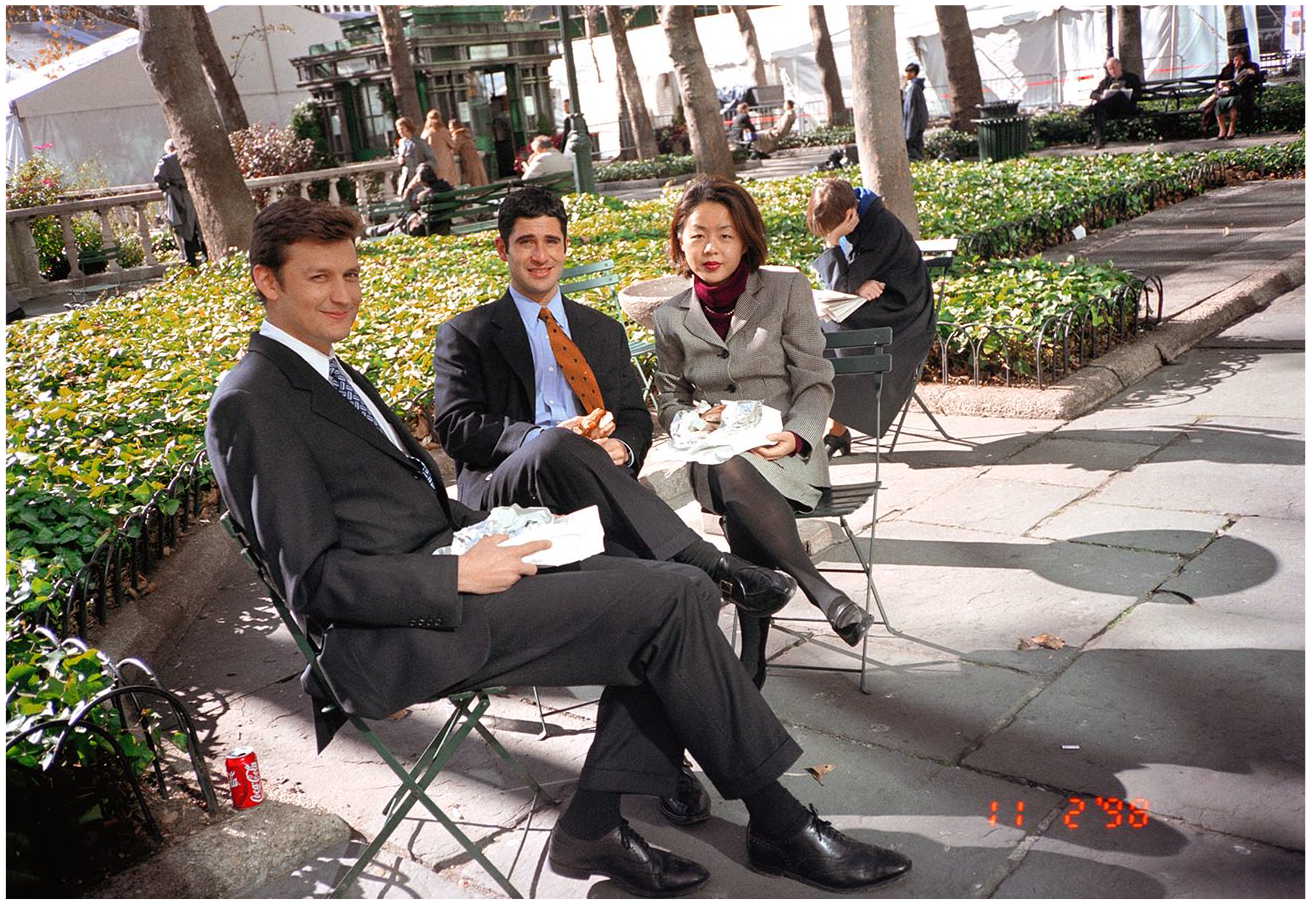
Yuppie Project 17, Nikki S Lee.
as does Figure 2:
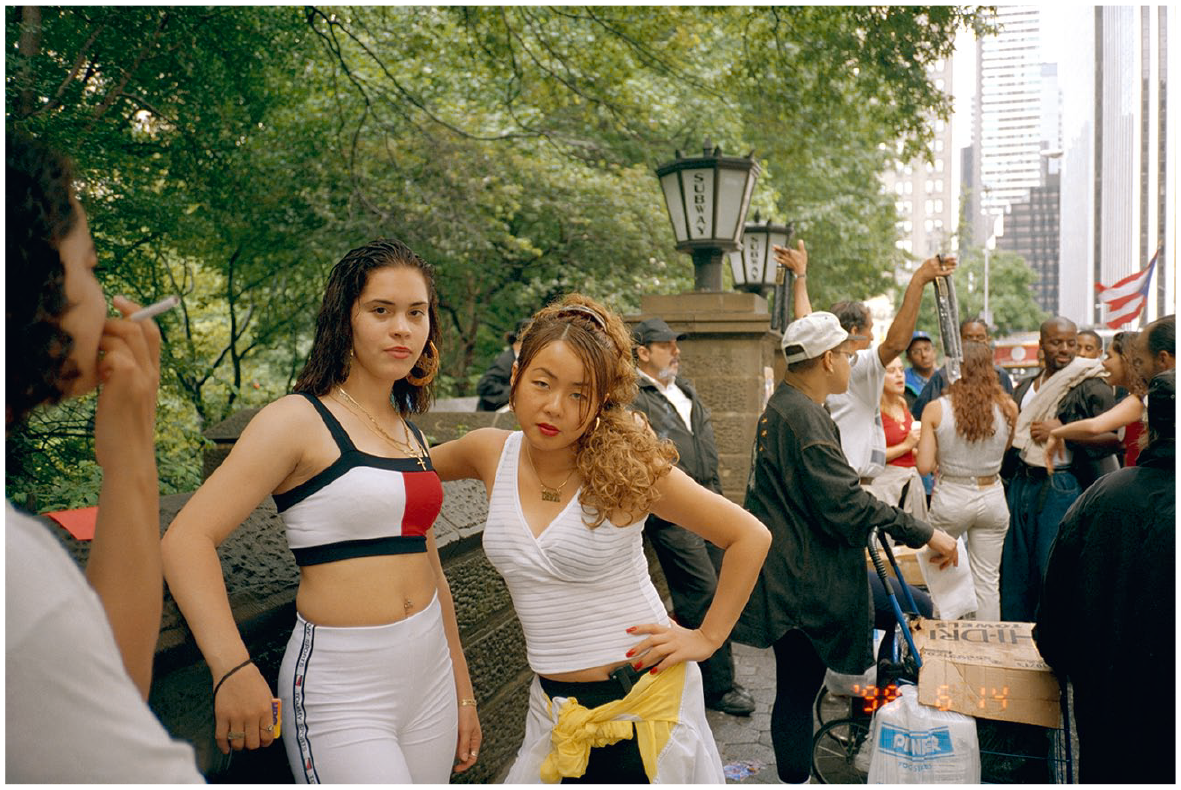
Hispanic Project 2, Nikki S Lee.
and Figure 3:
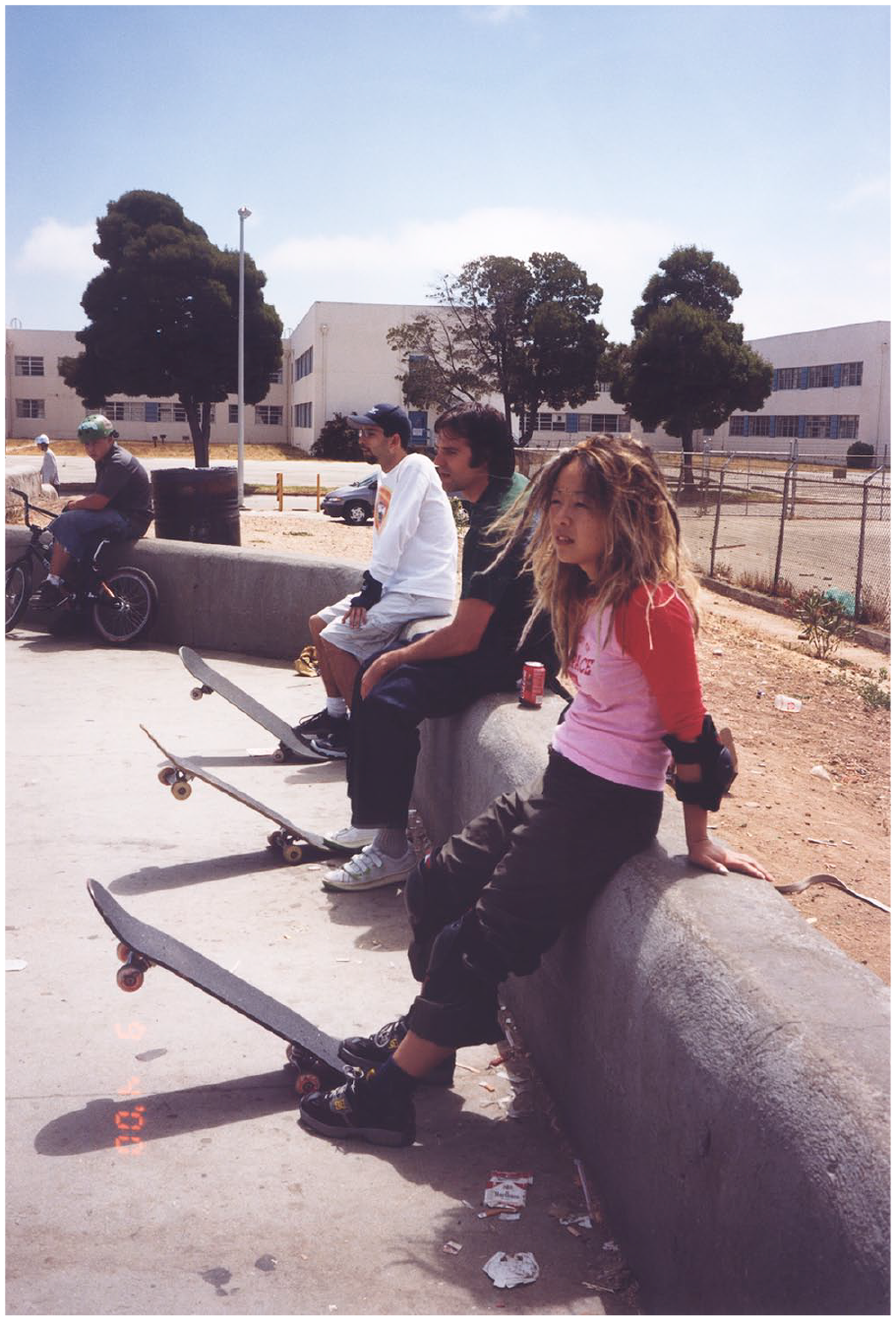
Skateboarders Project 7, Nikki S Lee.
As we flipped through Lee’s book of Projects, we were struck with many questions that are part of a broader public appreciation of her art, as well as many questions that relate to our particular positioning as social scientists. How does she manage to transform her body in these ways? How does she manage to be accepted into these communities in the way these photographs show her as being not just a ‘person who is present’ but a person who is integral to action and on intimate terms with others? What do her transformative abilities say about the way we think about individuals as ‘having an identity’, or about communities as strict, or about bodies as malleable? Especially, as social science researchers who have also had occasion to transform our bodies and our habits to attempt to integrate unobtrusively and intimately into a new community, we wonder how she does all of this ‘becoming’.
Nikki prompted us to think about what different trajectories of embodied and practiced transformations are possible, but to consider this question in our own terms: as practitioners interested in being able to explain our methods and in trying to produce knowledge about the way everyday life works through our systematic approach to exploring it. While she serves as a model of sorts, as a possible outcome for a project of becoming, the details of her methodology for doing so remain obscure. She is an artist, not a researcher; her job is to encourage others to pose these questions, and not necessarily to reveal her processes in creating that provocation. Our goal here, then, is not to analyse what Nikki did, but to use Nikki’s provocation to analyse what we do with our bodies as ethnographically, ethnomethodologically, materially and interactionally engaged researchers.
From how she demonstrates herself in the photographs, and how she describes her ‘method’, 28 we can map out some stages and steps in her process. She introduces herself as an artist to a chosen group. She embarks on some bodily transformation, both through the use of ‘costume’ and makeup, and in more sustained and corporeal transformations by gaining and losing weight, affecting her posture and ordinary manner of movement, and training her reflexes for different kinds of athletics and dance. Through these embodied efforts (as well as, presumably, some intellectual ones) Nikki works to blend in. The resulting snapshot photograph becomes a moment of ratification, showing how she has become part of that group through a kind of mimesis. Her work becomes an experiment in embodied empathy, in that she can convince the groups she is working with that she can play along and be(come) one of them. 29
Nikki S Lee is not unique in her experiments in empathy. She is connecting with a long tradition of performance art that examines the ways we connect both with others and with environments. Her critics reference photographers like Cindy Sherman and performance artists like Adrian Piper and Anna Deavere Smith. 30 We can see similar impulses at play in Charles Foster’s Being a Beast 31 where he attempts to live like a badger, a fox, an otter, a deer and a swift. Or in documentarians like Morgan Spurlock, 32 who use their bodies as sites of experimentation. Actors such as Daniel Day Lewis are renowned for treating their cinematic work as a project of mimetic becoming that invokes more molecular embodied transformations: changing their selves through intensive materialities of ingestion, flesh and form, as opposed to relatively extensive materialities like makeup and clothing. Returning to a more ordinary example, we might think of a range of medical technological interventions that are designed to allow the healthy to understand what it is to inhabit an ageing or failing body. 33
Social scientists have likewise attempted to gain knowledge through using their bodies as tools or instruments of reflection. Examples include Loic Wacquant’s learning how to be a boxer, 34 Trevor Marchand learning how to be a builder 35 and David Sudnow learning to play piano. 36 Others, moreover, have focused analytical attention on learned skills and their embodiment by experts, like Alan Harper’s investigation on mechanical skill, 37 and Rachel Prentice’s investigation on surgical skill. 38 In all cases, part of what is empirically produced is a transformation from inexperienced to experienced or inexpert to expert, where the artistic production or scientific product documents the corporeal transition accomplished.
In many of the examples we cite above, there is an ‘experimental’ configuration towards that transition; an uncertainty or contingency on how it might be accomplished. Often, they involve projecting towards a certain outcome, defined by a ‘successful’ moment or production of a body. They involve a series of attempts, configurations, controllings and varyings to produce that outcome, with attention to the trial and error involved. The practitioner develops understandings of enskillment, embodiment and corporeal becoming – differentially as social, material, or practical – through themselves achieving (and failing), and reflecting on, what might be called tacit knowledge. 39 By using this heuristic of experimenting, we want to think about the ways we as researchers draw upon the work of attending to our corporeality as a way of knowing into our research situations.
Across these experiments – both artistic and social scientific – we see a mode of implementing the corporeal experience that could be formalised as method. Notions of what is required in the process of becoming skilled and how the practitioner does the work of being attentive to that ability unifies photographer, writer, artist and ethnographer in these experiments. We contend that this sort of embodied attention lies somewhere between the presumed transformation prescribed by ethnographic methods – to speak and act like an acceptable person in a new environment (not unlike what Lee seems to have done) – and the potential for auto-ethnography to become overly solipsistic. We imagine this intermediary trajectory as an attunement to transformation, or to processes of becoming, that can be analytically useful by using a researcher’s body as a tool, but not as the only tool. That attunement has something to do with paying close attention to embodied transformation – to our abilities to transform with time and effort and concentration, and to our inabilities to transform under the same conditions – while employing some conditions related to experimentation to do so.
To continue our elaboration of attunement, we look retrospectively at our own work, in light of Nikki S Lee’s provocation, to consider embodied experimenting through a social scientific warrant. To be frank, we are jealous of Nikki, to some extent, because she gets to attempt her Projects with the warrant of an artist: her purpose is to provoke, not to explain or analyse. We, on the other hand, feel the need for some basic parameters of method to encode our practices as ‘data’, intelligible for analysis to our peers and robust enough to generate knowledge about how embodied practices, techniques, habits and becomings work. Combining what Nikki does, with what is becoming a form of embodied investigation within geography, we outline below a configuration of ‘experiment’ based on our own trials and errors doing research that needed to account for embodied tacit knowledges.
Experiments in becoming: attunement over durations and thresholds
Inasmuch as the notion of experimentation is the pivot of our argument, we are using our retroactively evaluated ‘experiments’ to identify parameters which we think unify approaches (beginning with our own) to observing embodied becomings. We take the experimental observation of becoming as a process of corporeally ‘attuning’ through practice: meaning, attending to the time and effort involved in ‘becoming-X’, full of its moments of progress and missteps, of leaps and chutes. The time and effort taken in this pursuit of enskillment or attunement can be observed through durations and thresholds.
Our notion of ‘duration’ follows the premise of relational, materialist ontology, in using an ordinal sense of sequence, rather than a linear passage of ‘time’. 40 Different entities in (embodied) assemblage may be operating through different temporal durations, in the way that we can try to form a word in a new language with accurate intentions, but our mouths and tongues and larynxes may not be as quick to be able to pronounce it understandably. These parts of the embodied practice of language follow different durations; they require different repetitions and differentiations, 41 different accumulations of knowledge along with the occasional reversal (of forgotten words, misplaced tongues) as a building refrain. Such practices often build towards a transition point, marking an ordinal step on a path towards enskillment, which can be recognised retrospectively. One part of our argument therefore is to highlight and think closely about how temporality(ies), or durations until transition points, can be empirically understood for research on bodily enskillment (such as Wacquant’s, Marchand’s and Sudnow’s). When the explicit aim is to develop the corporeal skills and capacities needed to inhabit (or perform) a particular social world, the time needed to develop skill does not operate as a linear period of clock time but as ordinal (and often unpredictable) durations.
Thresholds happen as skills accumulate and one’s embodied practice – having started at some corporeal and physiological condition of ability – is recognisably changing state. Learning to be capable at something involves, in one way or another, a transformation in the body’s physical capacities over durations marked by intensities of practice. We can think about how we might evolve – in fits and starts, with progressions and retreats, and sometimes ceilings that cannot be passed – from an inability to do something, to being capable but awkward or inaccurate, to being proficient, to being highly skilled as involving moving through a series of thresholds. Crossing these thresholds of skill concomitantly involves shifting in understanding of the skill itself. As a threshold is crossed, the attuning researcher is able to look back on their skill development and develop analytical specificity on the corporeal knowledges ratified by a previous threshold, as well as look forward towards new ‘levels’ that become visible within the scope of this particular skill. Thresholds may work similarly to ‘saturation’ as a condition of ethnographic knowledge, meaning a point at which a researcher feels they are not learning anything new. For our purposes, instead, they become a point at which a researcher can appreciate the durations that have accrued into a moment of transformation and also recognise what further directions might be attainable for certain skilled bodies. In place of the concept of saturation, we think with durations and thresholds as observable components of attunement, making an empirical vantage point on becoming-skilled which recognises the incompletability and unpredictability of enskillment integrated into the body.
In the following subsections, we frame how each of us was engaged in embodied experimentation that involved some kind of attunement or enskillment, each to our particular research area. Retrospectively, we can recognise that durations and thresholds were part of our design, though we were not envisioning our designs necessarily as ‘experiments’. In the framework of experimentation in becoming we propose, rather, imagining thresholds – like Nikki’s snapshot threshold for ratification as a ‘member’ – and attending to durations involved in reaching them becomes a methodological grounding for analysing processes of embodiment as part of research.
Unplanned experiment: discovering thresholds
Lauren’s story is a familiar, fairly ordinary attempt at ethnography, but one where embodied practice became, eventually, of analytical importance. Her research addressed a problem of embodiment as belonging rather than embodiment as skill: how postmigrant generation diasporic bodies fit as belonging (or not) when they visit their country of parental origin. Or, more broadly, she wondered what it is that people do when they regularly visit their parents’ homeland, and how their practices contribute to a sense of belonging or alienation from that homeland.
Coming from a background in linguistic anthropology before beginning a PhD in geography, Lauren entered her PhD fieldwork with some methodological pre-conditioning on how one should adapt, ethnographically, to the field. It was obvious that she must become competent in the languages of her ‘site’, and that she would spend an extended amount of time in that site to develop her understanding of it. Given that she had no prior claims to membership to the group she was studying – neither ancestry nor heritage, nor birthplace, nor upbringing – this meant training herself to ‘become’ part of that community in the fieldsite, in line with an anthropological ethnographic project. Yet, the defining factor of her ‘site’ was that it is spread across places, as a community embedded simultaneously in a resident and parental homeland. To become ethnographically embedded in this community would require being simultaneously part of many sites at once – a corporeal impossibility, simply in terms of her physical capacity to be present.
In trying to solve this problem, Lauren put herself into what we are considering here as an experiment. The main question of her research revolved around problems of embodied practice: how and when diasporic visitors felt accepted or stigmatised in their ancestral homeland. In order to understand the significance of different practices, to be able to notice what is missing, or what participants might not be aware of differing from others, she would need to be more competent than her participants in what was considered ‘normal’ and acceptable as ‘being-Moroccan’ in the Moroccan pole of their homeland mobilities. She would need to ‘become-Moroccan’ to recognise how participants felt themselves to be or were singled out as ‘un-Moroccan’.
Along the way in this process of training her linguistic skills – which began already at age 12 beginning to learn French, then again during her masters, when she began learning dialectal Arabic – she was also training other aspects of her corporeality. In the way that anthropologists have long embraced, she worked to enact and perform her membership in this pole of her participants’ places. She – through her body – became comfortable (and uncomfortable) wearing certain clothes, walking down the street, affectively responding to social cues that were part of this ‘fieldsite’ (though, of course, not universally competent). She began to be noticed by participants as embodying the ‘more than’ she had aimed for – even once snapshotted by a friend-participant for being ‘too Moroccan’ (Figure 4)
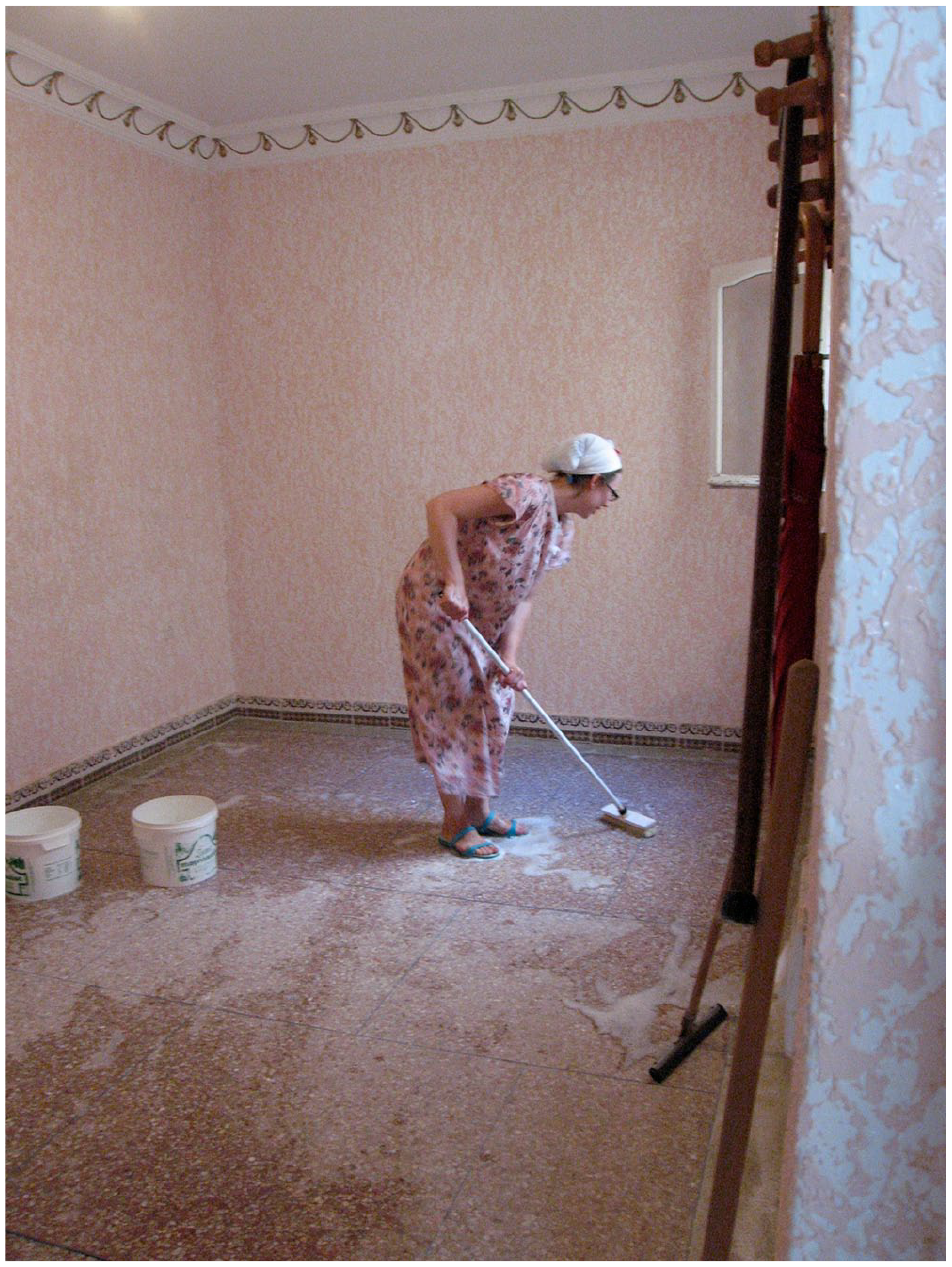
Snapshot by friend. Photo by an anonymous research participant.
With Nikki S Lee in the back of her mind, Lauren understood this moment as an achievement of ratification, a culmination point of her ethnographic mandate. She had developed an embodied enskillment that had become observably ‘more competent’ at being-Moroccan, to the extent that a participant labelled her as such. Of course, this competence was in some ways a stereotype – in this image, one of a young woman, wearing pyjamas and wrapping her hair, performing cleaning labour. Yet, this would not be the only time that she received a comment like ‘you are more Moroccan than us’ from participants, sometimes in reference to her knowledge about places or her knowledge about how to do things, like bargain or hail a taxi, out in public space. She is sometimes told that she ‘doesn’t understand Morocco’ by others. As one threshold is achieved, new ones open up.
For the purposes of gathering data, ‘being-Moroccan’ proved not to be a universally generative choice. As Lauren continued in her research, following along with diasporic visitors in marketplaces around Morocco, wearing Moroccan clothing or using Moroccan languages, she became ‘too Moroccan’ for some participants. Having achieved a Nikki S Lee moment of ratification, she found it more effective to retreat from that threshold. She made choices of when to dress ‘Moroccan’ (hanging out at the hotel, doing her laundry with the cleaning lady) and when to dress ‘Western’ (Figure 5) in a way that made her more acceptable to potential research participants.
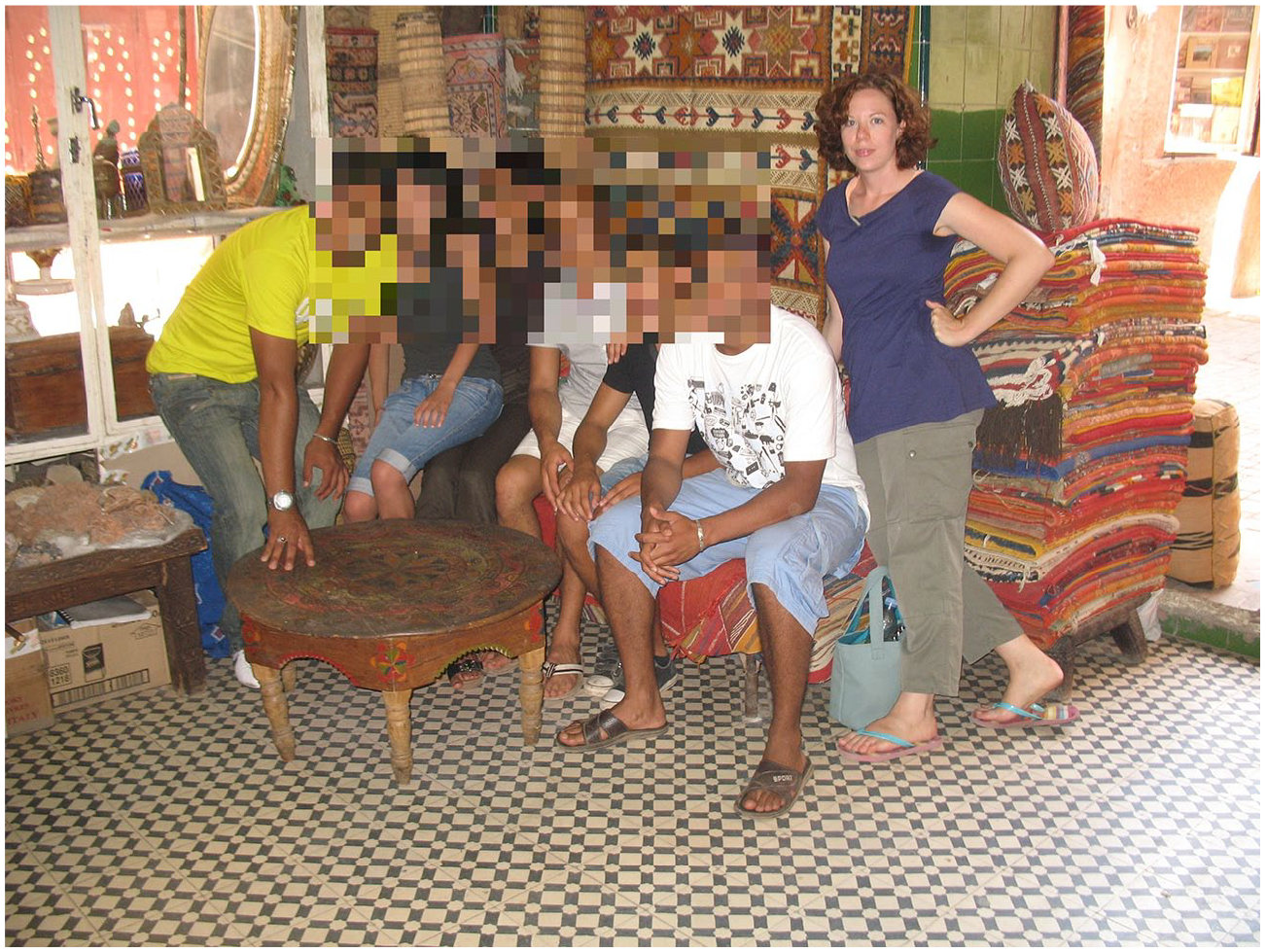
Snapshot with group. Photo by an anonymous research participant.
Thresholds of ‘becoming-Moroccan’ needed to be passed, in order to be retreated from and thereby appreciable in their corporeality. Eventually, they would become analytically instrumental to Lauren in approaching participants’ claims about their sense of embodiment and how their sense of unbelonging in Morocco can take sensory, corporeal forms through how a body feels in the clothes it is wearing. 42 Having attuned her own body to similar clothing in the process of doing ethnography, she found that she could recognise the corporealities her participants described as visceral experiences herself.
Experiments in physical endurance
Our second case is rather different. Here rather than delving into a different and in some sense radically other ‘culture’ (defined by a different language, sets of norms and so forth) we were interested in understanding something that was a common (if not necessarily ubiquitous) practice in our own society. Alan was interested in what was involved in becoming a recreational Marathon runner. This interest arose from a concern to understand how practices of physical fitness are developed and maintained in the context of societies that are otherwise increasingly sedentary. Running a Marathon requires a high degree of commitment. This commitment involves many weeks developing the corporeal endurance, strength and speed to run more or less continuously for 42.2 km. It involves (for most people at least) a major bodily transformation, with all the effort and discomfort that such transformations imply.
The empirical parameters of the research project were straightforward. This was the experiment: train to run a Marathon, then run a Marathon; the Marathon would in effect act as proof that the experiment’s ends had been reached. A Marathon was registered for. A training plan hunted down. Running shoes bought, along with sports socks, shorts, t-shirts and various anti-chafing devices and balms. Maps were consulted and training routes devised. This all worked well enough. Long runs were tackled. A world of sports gels, isotonic drinks and power bars discovered, along with the imperative of taking a travel card and fiver on each outing in case of overreach.
Learning to run for long distances is all about repetition. The repetition of one foot after another (repeated over 10,000 times each hour of running), of breathing in and out, the motion of arms back and forth. But also of a host of small rituals ahead of, during, and after each run. Getting dressed, checking the training schedule, finding keys, shoes, stretching, easing into the run, checking for pace, cooling down, showering, washing the running stuff. . . Ticking off the weeks of the schedule – counting down from 24 to 0. The endless (or so it felt) circuits of Victoria Park, traverses up and down the Lea Valley.
All this generated a mass of material. And at the end – Week Zero! – a Marathon was run and completed. And yet, as an experiment the project felt insufficient. Why? The aim of the project, and the experiment, was to gain an in-depth, rigorously focussed understanding into the process of working with and transforming a body such that it becomes capable of running long distances. But along with that, the experiment was about tracing the differences that pull the individual body towards becoming-long-distance-runner; the corporeal pleasures and capacities that are uncovered and discovered through becoming physically active in certain ways. Elements that were hinted at in training manuals and popular representations of distance running, but which seemed inadequate in explaining why an activity that from the outside looked so arduous and painful had become so popular amongst a broad section of the population.
Part of the experiment’s insufficiency was due to the limits to personally monitoring – without extensive medical devices – what is going on within an individual body, even one’s own. As phenomenologists from Merleau-Ponty to Schusterman have highlighted, there is a certain unknowability about the body inside. 43 Developing aerobic and muscular fitness is an extraordinary complex biochemical process. Tracking the difference in the body’s capacities from one day to the next is equally complex. Most of the transformations are not immediately obvious. In the case of this experiment running did not make the body lighter. Nor did it change its shape in any appreciable way, despite running over 2,000 training kilometres. This, of course, is in a way about the limits of what social scientists are set-up to know about (we aren’t set up to study the molecular 44 ). More importantly was how the experiment was – for all its various repetitions – an experiment of one. Not just one Marathon. But also of one body.
In her work Nikki S Lee undergoes a series of radical bodily transformations to achieve the effect of fitting within a group. She takes on the bodily comportments, the styles of dress and the activities of the group she is working with. Apart from the fragility of gaining access to a group, this, as has already been highlighted, requires Lee to commit to a series of corporeal training regimes. She diets to change her body shape. She learns to skateboard. She learns to dance Swing. And so forth. The success of Lee’s projects comes not from a single transformation, but from the laying on of transformation on top of transformation. It is the multiplicity of her transformations that make her work so affecting. The relative insufficiency of the experiment in becoming a runner was because it remained rooted in one singular body. And it did not – because of the design of experiment – have a way of reaching beyond this singular experience.
What does experimentation do for understanding tacit corporeal knowledges?
We have been talking about our two research examples in terms of experiment and experimentation. Of course, these terms are not new to cultural geography. Experimental geographies are increasingly being invoked as a technique of intervention and invention through which human geographers do their work. Such experiments involve altering or intervening in the configuration of a space or practice as a way of generating new-ness in the world. 45 The invocation of new-ness is crucial here. Whilst there is no clear consensus on what defines an experiment, and consequently no obvious protocols on how they should be undertaken, there is a general sense that experiments should be creative improvisations where their creativity and improvisation in itself are a warrant of research ‘What most geographers seem to agree on’, Last argues, ‘is that experimentation in their discipline should push the limitations of current conventions of representation and knowledge-making’. 46 Such experiments involve drawing other social actors together in attempts to explore or generate novel sets of relations. Often the notion of artistic creativity (sometimes called ‘experimentation’ 47 ) gives lots of forms and combinations into creating representations; questions how representations are able to spark new impressions and understandings – interventions – which change the state of the world moving forward. The researcher becomes the formal chronicler of other actors’ experimentation with, and exploration of, the rupture or tear in the usual social fabric. Novelty is realised as the degree to which elements other than simply the researcher’s body are pulled into the space of experimentation.
While we can see the generative possibilities of such interventions which – like Nikki S Lee’s work – provoke the questioning of assumptions and reviewing of entrenched perspectives, 48 our aim is to experiment towards the assumptions and tacit knowledge themselves. Novelty and creativity help to imagine what might be possible, but it can be equally fruitful – if not a prerequisite – to develop a contoured understanding of how things work in a current state. Provocations like those of Nikki S Lee demonstrate to us one way of building an apparatus that structures observing assumptions themselves by using one’s own body. To focus on corporeal knowledge as a site, we necessarily presume that our bodies as researchers are part of the apparatus, 49 with specific capacities (and incapacities) to recognise, achieve and discover thresholds relevant to the learned and habitual embodiment we execute the experiment to investigate. Designing experiments that target specific embodied knowledge, like what is necessary to run a marathon or to be Moroccan, while incorporating the potentials and limitations of that apparatus, we think, can ground productive experimentation towards new social science understandings.
We should be clear that we are not suggesting designing experiments in a tradition of single-variable control and variation. Thinking with those theorists who have inspired other experimentations43,50 we suggest that an experiment is not only a ‘seeing what will happen’; it is a designing of a manipulation, in order to see what will happen given the range of nonlinear predictability in social life. It is a purposeful changing of state, to push towards a point of transition, or passing of a threshold, in order to explore how thresholds are produced that demarcate one state from another. It is a qualitative method for exploring the multifacetedness of causality and the sometimes ineffable ingredients that may be entangled with it. Performed through an embodied apparatus, such experiments also involve a complex, intensive ‘attunement’, through repetition over time, and with attention to durations and thresholds that engender different possible becomings.
What do our two examples tell us about how to undertake such corporeally oriented experiments? Remember Lauren was experimenting with becoming/passing (not unlike Nikki), in order to understand others’ experiences. Only well into her research did she notice that her increasing proficiency at Moroccan corporeality was in some instances problematic. It was only through attending closely, retrospectively, to what thresholds she had passed that it was possible to work towards calibrating interactions with respondents that produced empirically robust research material. This leads to a first summary point: often it takes a great deal of time, and the acquisition of thresholds in skill, before it is possible to define the right kinds of questions through which a corporeal experiment should be oriented. More than that, as per the epigraphs, it is often only in the middle of undertaking corporeally absorbing research before any parameters become apparent that might merit an experimental orientation to their becoming.
The second point is about duration and repetition: that corporeal experiments are iterative over an unpredictable number of repetitions. What defines them as experiments in the sense that we are interested in here is that they involve the self-conscious repetition of an action or series of actions. It is through being attentive to the difference generated through those iterations that the researcher begins to find out reliable and useful knowledge about the skill being examined. Furthermore, these iterations are modular, and shift in quality and focus as the researcher crosses between different thresholds of corporeal capability. With Lauren’s project this modularity can be understood in terms of both the repetition of particular words, phrases and gestures within more singular encounters between particular people or respondents. In Alan’s project there was the repetition of running itself that sat within the varying types of runs undertaken week in, week out, as part of the training program; amongst this too were the accompanying routines of preparation and recovery. Within this repetition there was the shifting sense of what these runs involved as the increasingly trained body gained new capacities.
Of course all these repetitions focussed on one body, tracing a singular set of paths through the city-scape. Which leads to our third, and final, point: that it is important to ask what exactly is each iteration a repetition of a relation towards? In the work of much corporeally focused geographic research there is a focus on the singularity of the body’s movement – the central task is attending to that action in the moment. Yet we are also interested in those iterations because they are a case of something, that they speak to a more ‘general’ empirical field of knowledge. Engaging in the sorts of corporeal experiments discussed in the preceding sections involved all sorts of decisions about what precisely will be attended to. This is in effect – to borrow an argument from Howard Becker – a kind of sampling. 51 The discoveries from these experiments are used to speak to broader sets of concerns. To do so effectively, our experiments need to be designed with care, and with explicit attention to their empirical reach. This of course was the central lacuna in Alan’s experiment in becoming a Marathon runner. Although the experiment examined a whole range of dimensions of the process of becoming a Marathon runner, and involved the examination of all sorts of relations within which the body-in-training was entangled (different landscapes, different intensities of running, different levels of physical proficiency) as an experiment it was conceived as an experiment of one; of one body, one individual, one person. And of course there are many, many, different bodies in the word. So, why focus on just the one?
Conclusion
We are trying, in this paper, to step beyond participant observation and take ‘becoming’ seriously as ontologically constitutive in contemporary human geography research. To do so, we draw attention to the difference between becoming-participant as a person who is accepted in the environment but separable from it, and becoming-embodied as a person who is both accepted into the environment and transformatively attuned to it. By attunement we mean, in shorthand, the acquired ability to recognise durations and thresholds that are cogent to the practices at hand by having experienced them. Methodologically, this attunement enables both recognising different aspects to practice as practicant and talking about practices in different registers as a body that has achieved and can recognise the pursuit of thresholds of ability. It also takes into account that research is a process of embodied transformation, where the researcher as ‘apparatus’ is not merely reflexive and positioned, but intra-actively becoming part of the context in order to abstract knowledge about it.
We do not mean to suggest that the strategies we present here are conclusive and definitive for how to do embodied experiments. Instead, we want to provoke a discussion and work on some vocabulary for developing discussion about how experimentation is used in geography as a social science. Building from work by the photographer Nikki S Lee as an entry point for reflecting on our own attempts at embodied experimentation – both purposefully experimental, and retrospectively – we were provoked to look closer at our own temporalities and positions taken for gathering and analysing data on becoming. Through that exercise, we propose a way to take seriously treating a researcher’s body as a site for experimenting towards becoming.
In this respect, our exploration speaks to two aspects of such experimentation. First, in parallel with the ethos of ethnography, it often takes a great deal of time, and the acquisition of substantial levels of skill, before it is possible to define the questions through which corporeal experiment should be oriented. More than just unearthing the questions, the iterative attunement carved out by each of us excavated some of the parameters involved in how this corporeal practice worked, which may have otherwise been unobservable. In this sense, while a sample of one can be problematic, attending to what questions and parameters emerge can inform what that sample means for designing the next investigation. Secondly, inspired by Lee’s work, and the work of other theorists of habit and transformation, we characterise this attunement through durations of practice marked by thresholds of transition. We take durations and thresholds as integral to such experiments but also not designable, per se, in how long they will take or what it means to reach them. This unpredictability would seem contradictory to a definition of ‘experiment’ as a controlled intervention, yet we see it as fundamental to investigating becoming. For experiments in becoming require a combination of purposeful attentiveness to circumstances with purposeful openness to transformation, with both of these necessary to develop attunement.
Footnotes
Acknowledgements
The authors would like to thank Nikki S Lee for granting permission to reprint her artwork. Lauren owes her gratitude to the Body Reading Group and Ethnography Group at Maastricht University for inspiring conversations. Finally, we both thank Martijn Duineveld and Gwyn Williams for their unsuspecting hospitality that contributed to the writing of this paper, and congratulate Mos Williams for his monumental act of becoming in the process.
Funding
The author(s) disclosed receipt of the following financial support for the research, authorship and/or publication of this article: Lauren Wagner received funding from the University of London Central Research Fund for this research.
