




Abstract
This article explores the potential of tidal spaces to perform acts of remembrance and forgetting. Using oceanographer Rachel Carson’s The Edge of the Sea to contextualise tidal spaces, this analysis will discuss how constantly shifting and eroding coastlines act as a site for writing, rewriting and performing acts of cultural and personal memory. The concept of tidal choreographies will be introduced via two contemporary works performed on shorelines: 14-18 NOW’s Pages of the Sea, a large-scale public memorial performed on multiple beaches across the United Kingdom on Remembrance Sunday 2018; and Chloe Smith’s Tidal, an intergenerational, participatory, community work which was performed on the shore at Berwick-upon-Tweed in 2015. I will offer reflections on my own collaborative work Tide Times created with Tim Cooper to explicate ideas of the potential of tidal spaces (in this case a tidal island) further. In explicating various artworks which explore ideas of remembrance using tidal spaces, this article will also acknowledge the forgetting that is implicit in performing these actions. The markings in the sand are washed away, community groups that participate in the performance disperse and detritus left is eroded by the elements. What can the legacy of commemorations traced in such a transient and precarious space as a tidal zone be? This article argues that while shorelines provide sites for large and small-scale acts of public remembering, they are simultaneously acts of forgetting as the twice-daily tides cause inevitable erasure.
Performance as an art form is live, ephemeral and of the moment. Tidal spaces are transitional places, the tidal zone in constant flux with each incoming and outgoing tide. Memorials or sites of remembrance, on the contrary, are frequently public, prominent and permanent. How can choreographies (by which I mean patterns of movement) of remembrance be performed in tidal spaces? Any imprint made on a beach will ultimately prove impermanent as it vanishes with the incoming tides. How then does that knowledge of transience impact performances that take place on beaches? How can these live actions perform the function of a memorial? This article addresses these questions by exploring the potential of tidal spaces to perform seemingly antithetical acts of remembrance and forgetting. Using oceanographer Rachel Carson’s The Edge of the Sea to contextualise tidal spaces, I consider how constantly shifting and eroding coastlines act as a site for writing, rewriting and performing acts of cultural and personal memory. I introduce the idea of tidal choreographies via two contemporary works performed on shorelines: 14-18 NOW’s Pages of the Sea, a large-scale public memorial performed on multiple beaches across the United Kingdom on Remembrance Sunday 2018; and Chloe Smith’s Tidal, an intergenerational, participatory, community work which was performed on the shore at Berwick-upon-Tweed in 2015. I then offer reflections on my own collaborative work Tide Times created with Tim Cooper in 2018 to explore the creative potential of tidal spaces (in this case a tidal island) further.
This article is informed by Joseph Roach’s Cities of the Dead (1996) in which he outlines what he defines as ‘the paradox of collective perpetuation: [that] memory is a process that depends crucially on forgetting’. 1 French historian Pierre Nora explores the idea of ‘places of memory’ (lieux de memoire) as artificial sites in contrast to ‘environments of memory’ (mileux de memoire), the largely oral and corporeal retentions of traditional cultures. 2 In The Edge of the Sea, the second book of her acclaimed marine trilogy, Rachel Carson states, ‘The edge of the sea is a strange and beautiful place. For no two successive days is the shoreline precisely the same. The tides advance and retreat in their eternal rhythms, the sea is never at rest’. 3 Shorelines provide an interesting contrast: on one hand, the constancy and repetition of the waves and the tides; on the other, the shifting, sands, shingle, weeds and creatures which are in constant flux. In Between Memory and History: Les Lieux de Memoire (1989), Nora argues that modernity is characterised as the replacement of environments of memory by places of memory, such as archives, monuments and theme parks, and he uses the metaphor of tidal spaces in relation to memory. He states, ‘moments of history torn away from the movement of history, then returned; no longer quite life, not yet death, like shells on the shore when the sea of living memory has receded’. 4 Shells on the shore provide the metaphor for this transitional space, living memory a wave that has receded. Not only are the shells moved by the tides, they are also gradually altered, eroded and broken down by the waves over time.
The poet Mary Oliver claims that ‘The sea isn’t a place but a fact, and a mystery’. 5 The sea (as it has often been depicted through stories, images and folklore) is not only a site but also a space, an idea, a concept, a mirror to human consciousness as Conrad described it, and also a place of transformation (both literal and metaphorical). Cultural historian John Mack claims that the sea is a space not a place: ‘The sea is not somewhere with “history,” at least not recorded history. There are no footprints left upon it . . . It is not monumentalised’. 6 It is both a place and a non-place, impossible to historicise in some ways, but it also acts as a receptacle of cultural memory, and in the case of the transatlantic slave trade and recent refugee crisis, cultural trauma. The tidal zone, which Carson describes as ‘the edge of the sea,’ marks the meeting of the land and the water. Described by Mack as an ‘in-between place’, 7 he claims ‘it is at the coastline that the maritime world “touches” the terrestrial’. 8 This meeting place is both a site of remembrance (due to the actions performed on tidal spaces) and a site of forgetting, as the sea erases traces left on the shorelines. Tidal waters act as the cleanser of marks of human activity, a purifying force that returns the sands to a blank canvas.
Tidal performances
14-18 NOW’s Pages of the Sea, directed by Danny Boyle, invited communities around the United Kingdom to meet on their local beach to commemorate the dead of World War I (WWI) by marking portraits in the tidal sands. I attended the National Theatre of Scotland’s performance on Ayr Beach on the West coast of Scotland on Remembrance Sunday, 11 November 2018. From 8:30 a.m. (when the tide was out), people were invited to gather on the beach to commemorate loved ones lost in the war. This act of remembering on a calendar date that is publicly recognised, such as Remembrance Sunday in the United Kingdom, stakes a traditional annual act of commemoration further, inviting people all around the country to physically visit a beach to remember those who left to fight and who did not return to these shores. Life-sized stencils of bodies were laid on the sand and rakes used to mark human forms in the tidal zone. Many people inscribed on the sand the name of their family member. Some stood next to the figure to speak about the person and tell their individual story. As the morning progressed, the stencilled bodies were washed away by the incoming tide.
Further up the beach, there was a large-scale sand drawing of the portrait of Second Lieutenant Walter Tull (28 April 1888 to 25 March 1918), the British Army’s first Black officer who was killed in March 1918 at Arras, on the Western Front. A different portrait was marked on each beach around the United Kingdom, from Folkstone to Londonderry. Just as Nora describes the erasure of memory by history as a revelation, 9 in Pages of the Sea the portraits are described as ‘revealed’. Not drawn or marked but revealed, implying that the memories are there already to be discovered. Nora claims that ‘modern memory relies on the visibility of the image’. 10 Taking this further, images created through live performance activate processes of remembering.
The sea can enact the perpetual state of forgetting through its tidal motions. The image of Tull’s portrait was completely obliterated as the tide comes in. The people who turned up to mark the sand with the figures of their loved one and who stayed to tell their story were participating in acts of remembering. In Pages of the Sea, only a select few were memorialised in this specific action; what of those whose portraits were not rendered in sand? Nora argues that we speak so much of memory because there is so little of it left, 11 and part of the ritual of Remembrance Sunday is a reminder of the transience of memory; people engage in a cultural moment remembering people they never knew. Pages of the Sea tries to anchor these memories to specific individuals, to ask for a more detailed remembering, but ultimately the tides erase even these markings.
Choreographer Chloe Smith’s Tidal performed in Berwick-upon-Tweed in 2015 was originally commissioned as a commemorative work to celebrate 900 years of the town’s history but also became an act of personal memorialising when Smith’s brother was drowned off the cliffs of the beach, weeks before she began making the work. Tidal was a community-based, site-specific, participatory work which involved intergenerational participants in a devised dance performance. In interview, Smith is keen to stress the ownership over the piece of all of the participants and that it is their piece, not just hers, and she was careful not to impose the tragic story of her brother’s death on the performance.
Tidal took place on the boardwalk and beach in Berwick and Smith felt it was important that it was an event that people could chance upon, both a celebration of the sea and acknowledging it as a powerful force which can take a life. The participants perform a choreography on the beach where their bodies become like waves as they roll down the sand towards the beach, while other performers jump over them, as though playing in the waves on the shore. There is a moment in Tidal when the dancers are about to go in the sea and they go barefoot. Smith has spoken about how when they lined their shoes up at the shore and started walking towards the sea, she had a moment of realisation of what this action implied. One of her brother’s shoes was never found after he was drowned. Despite not intending to make the work autobiographical, and being devised collaboratively, this action provides a moment of remembrance for Smith’s brother who had been killed at this site. The shoreline performance in the tidal zone simultaneously evokes an act of cultural remembering (a celebration of 900 years of Berwick on Tweed) as well as memorialising Smith’s personal grief.
Tide Times
My own collaborative site-responsive work, Tide Times (2018), created with electroacoustic composer Tim Cooper for the tidal island of Cramond in the Firth of Forth, invites creative subjective interactions with the landscape in response to the place. The work comprises 10 audio tracks made up of poetic writing and sounds recorded from the island (listened to via a mobile device and headphones), invitations for creative engagements with the island found in treasure chests hidden in various locations and a map to navigate by.
Cramond is only accessible by a causeway which is exposed twice daily when the tide is out (Figure 1). As one of 17 tidal islands in Scotland, Cramond can be reached by foot from the mainland at specific times of the day. The influence of the tide times on our ability to access the island informed the project greatly and gave the piece its title – the place choreographed when we were permitted to visit it. Neither Tim or I had visited the island before, so the experience of exploring it together was an important part of our collaborative process. After visiting five times to make the work, we held two invited sharings of the work in August and September 2018. 12
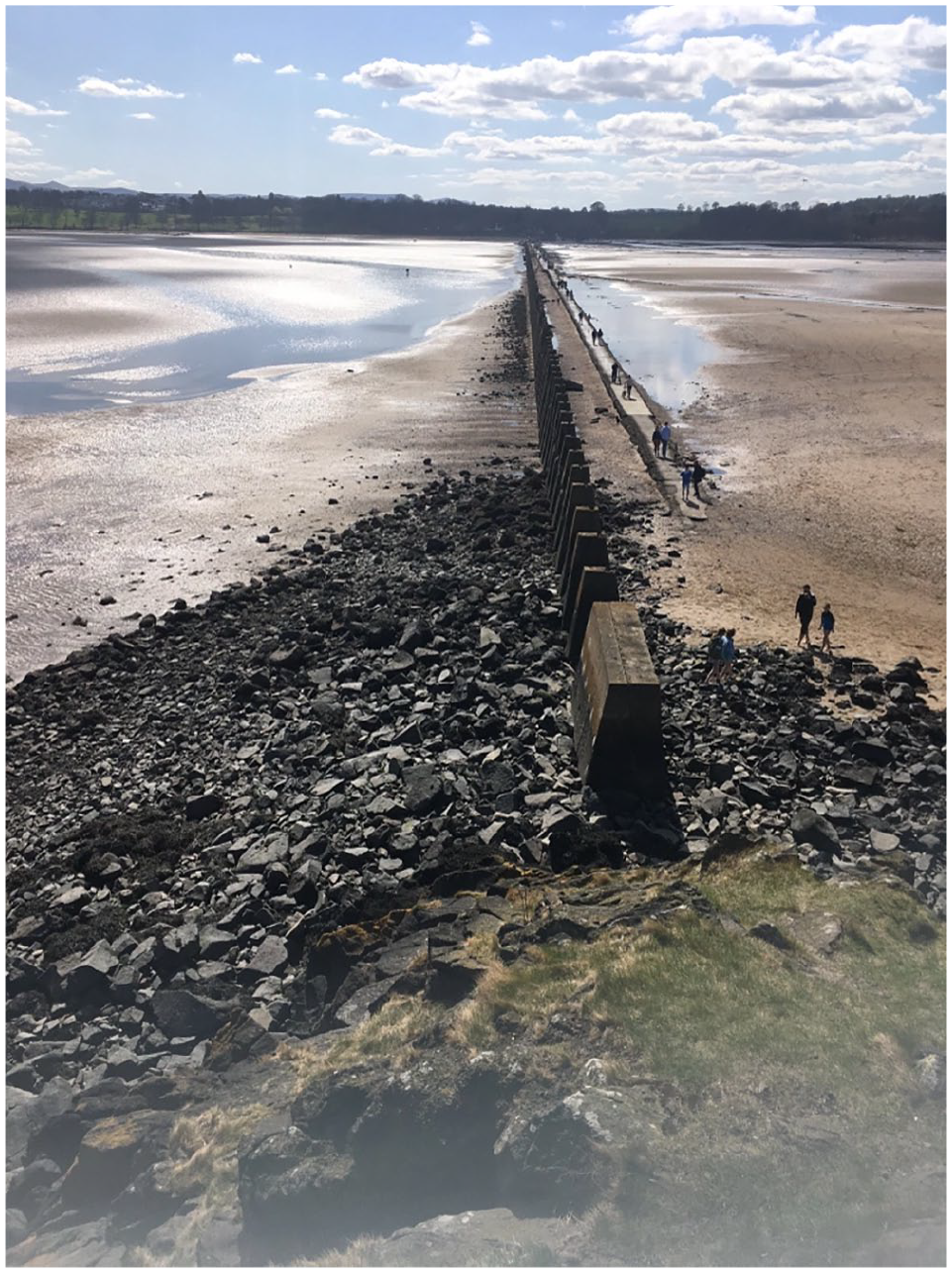
Cramond island walkway. Photo by Laura Bissell.
The aim of Tide Times was to heighten an experience of the island through site-responsive audio works and texts. Informed by Minty Donald’s observation that people ‘can invest in a “sense of place” while concurrently recognising the temporality, porosity and interconnectedness of that place’, 13 we avoided harking back to Cramond’s military past (it was used defensively in both WWI and World War II (WWII)) or exploring its proposed touristic future (plans to extensively develop the foreshore as a tourist attraction have been put forward), but instead acknowledged the various identities of the site. The multiplicity of identities and usages by visitors and locals became part of the palimpsest of different types of texts and sounds used in the final work (Figure 2).
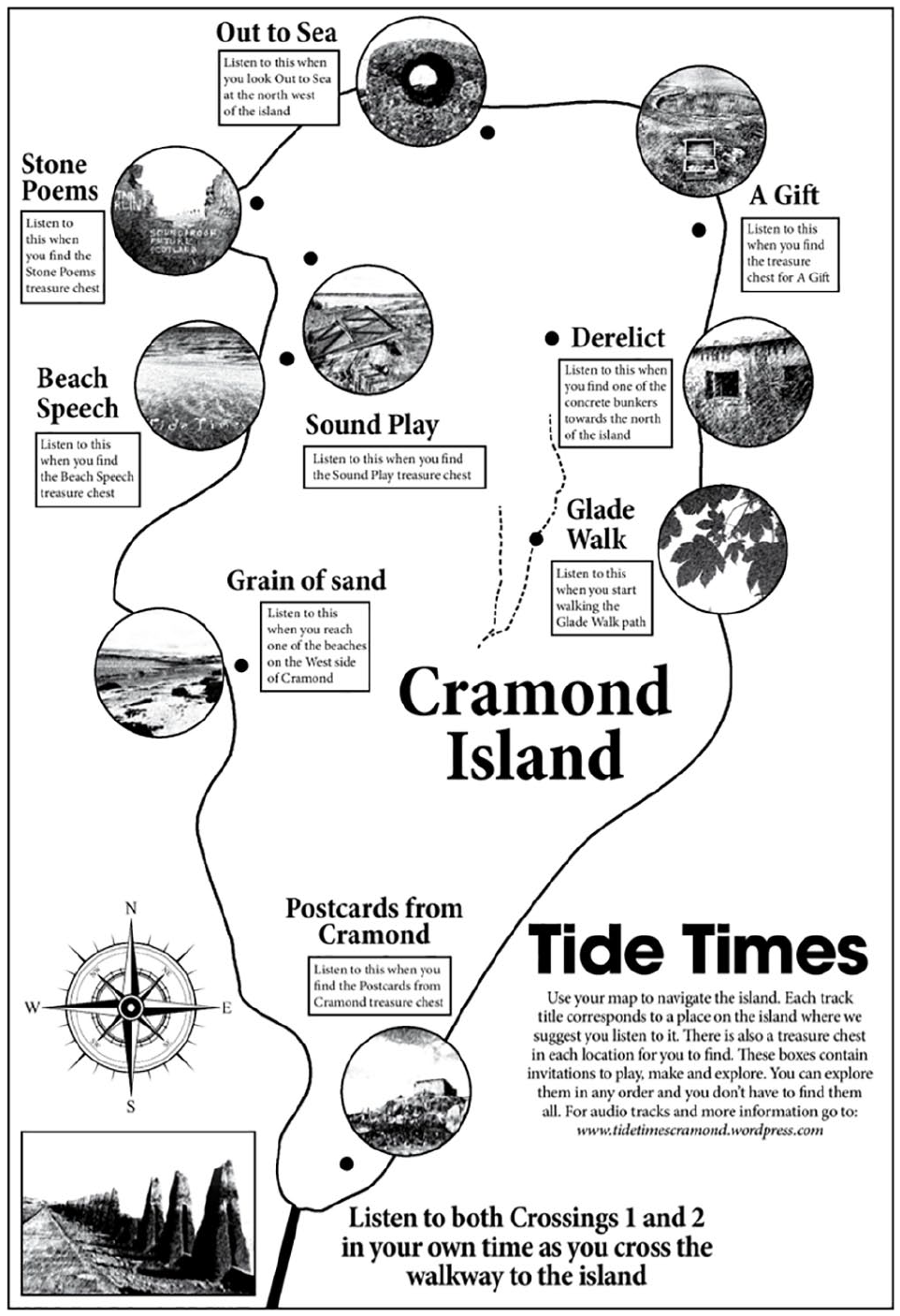
Tide Times map of island. Map of Cramond by Laura Bissell and Tim Cooper.
On our first visit to the island in April 2018, we found a geocache (a global treasure hunt using GPS) and were encouraged by the idea of encountering something physical on the island which connected disparate visitors in a shared experience and provided the impetus for a response from those who found it. We decided to experiment with the place, leaving a ‘treasure chest’ on the island when we visited for the third time; this was our version of a geocache made specifically for this project to see whether it would stand up to the weather. We left a small box with some shells in it secreted in a crevice by a concrete bunker at the far end of the island. We returned 2 weeks later and found the box full of trinkets and gifts. Inside was a scrap of paper with a Polish stamp on the back and a handwritten message in biro which read, ‘Please leave something from you and put it back’. Someone had written underneath in pencil ‘What a lovely idea!’ In the space of 2 weeks, the box now contained (among other things) a hairband, a small white and pink toy pony, a selection of coins in a range of currencies, a small piece of green glass and a picture of a botanical drawing. The people visiting Cramond took ownership of this box and shaped its purpose. This encouraged us to develop nine treasure chests each with their own invitations to creatively engage with the island (Figures 3 and 4).
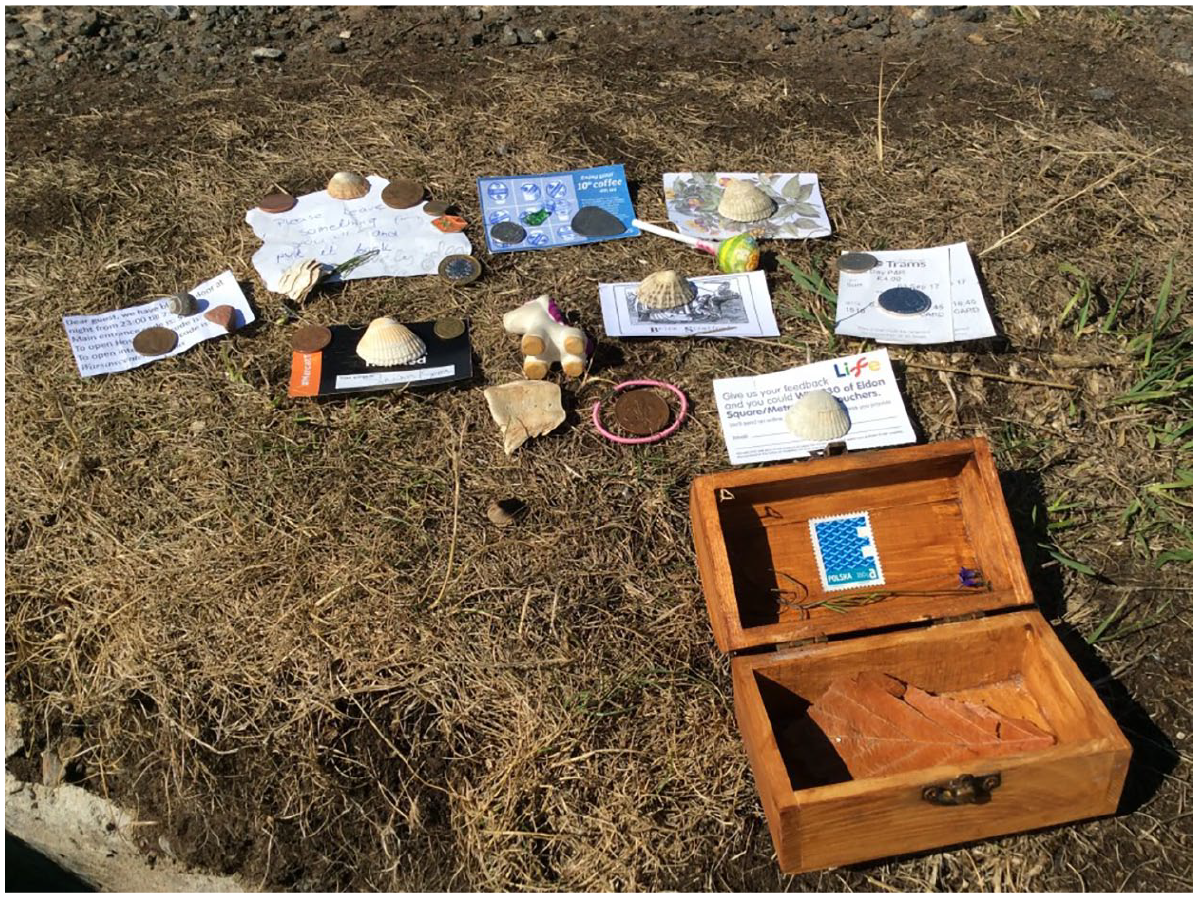
Tide Times pilot box: a gift. Photo by Laura Bissell.
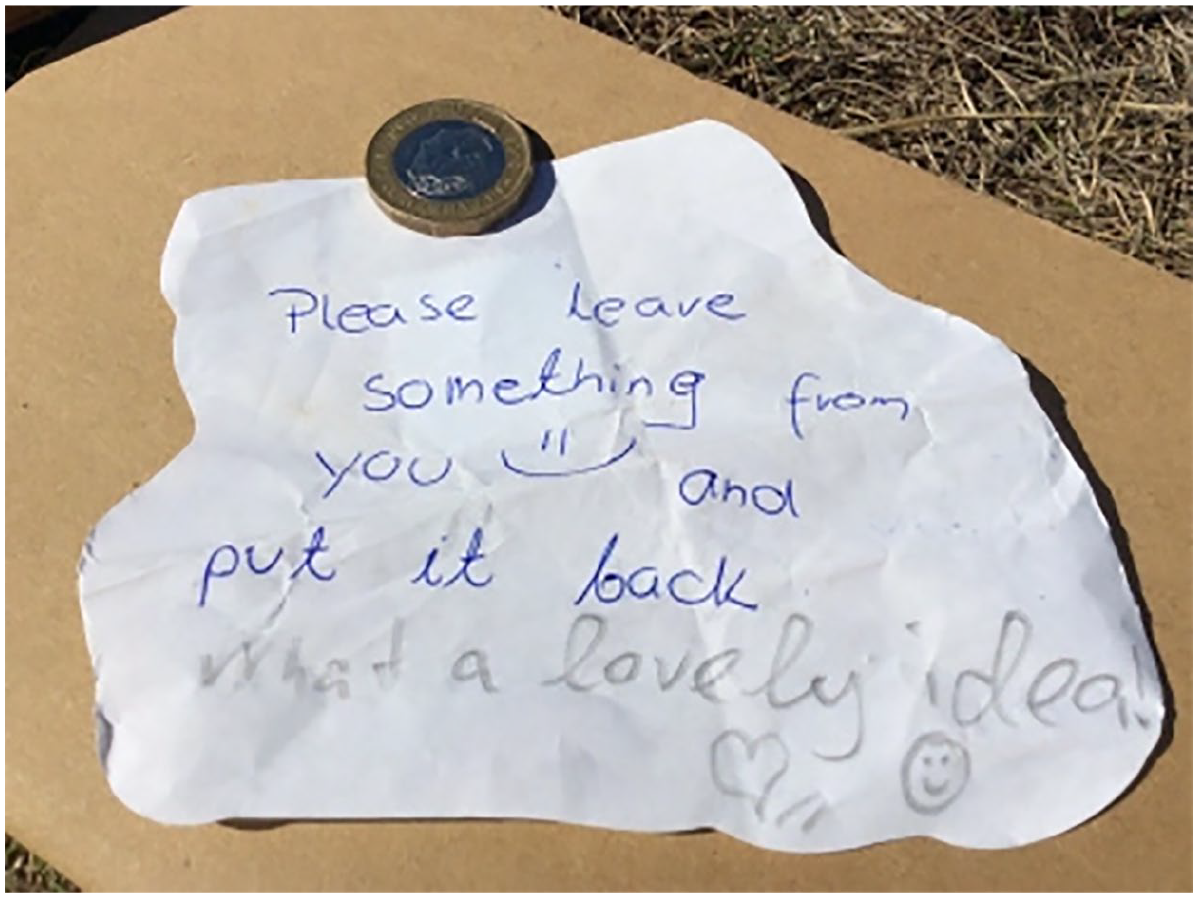
Tide Times: a gift. Photo by Laura Bissell.
The making of Tide Times was informed by Tim Ingold’s ideas of atmosphere and place, 14 Hildegard Westerkamp’s theories of soundwalking 15 and Eric F. Clarke’s acoustic ecology. 16 I undertook explorations of text within the landscape throughout the process of making Tide Times, which became integral to some of the invitations to play on the island. Grain of Sand, Stone Poems and Beach Speech are audio tracks with an accompanying box which ask visitors to use language to temporarily mark the island using materials found there encouraging creative interventions on the tidal space of the beach. The audio texts that accompany these invitations for performative writing within the landscape include excerpts from Carson’s The Edge of the Sea intended to expand perceptions of this specific tidal island to the vast lunar processes that choreograph the tides. Carson’s focus on the more-than-human life forms which inhabit tidal zones are considered within Beach Speech, asking visitors to Cramond not just to notice the environment and its inhabitants but to consider their place on the island too.
In Beach Speech, when we returned to the box months afterwards, participants had left responses to our invitations. In Out to Sea, people left messages in a bottle of what they wanted to say to this place. One message read ‘don’t disappear’ – acknowledging the precariousness of this environment and also its tidalness – the path to the island literally disappears at high tide. While the markings on the sand were obliterated with each tide, the invitations in the boxes on the island allowed for some sense of continuity between participants. One person’s interaction with the place is communicated to another person in the same place in a different moment. The boxes offered invitations for creative interventions and reciprocal interactions with other visitors to the island over time. Using treasure chests meant that the invitations existed even after the tides had washed away what the previous participant had written in sand. By storing the boxes inland, beyond the tideline, the sea was unable to fully enact the function of forgetting, thus allowing for a sense of connection and collaboration between those on the island who encountered them. This is not to say that the boxes which were out of reach of the sea all survived; many went missing, succumbed to the elements or were removed by visitors (perhaps enacting their own remembrance of the place by taking a memento away). While the tidalness of this place was imperative to the work and the creation of a collective memory of place, what Tide Times revealed was the multitude of identities and meanings of a place over time and the possibilities of reciprocal remembering and collaboration between visitors.
Conclusion
The various artworks which investigate remembrance using tidal spaces act as reminders of the shifting, transient nature of memory: the act of remembering remains irrevocably bound with the act of forgetting. In Pages of the Sea, the markings in the sand are washed away even before the event is over; in Tidal, community groups that participated in the performance disperse after the shows; and in Tide Times, the artworks and detritus left as part of the work are eroded by the elements or disappear from the island. What can the legacy of commemorations traced in such a transient and precarious space as a tidal zone be? This article argues that while shorelines provide sites for large and small-scale acts of public remembering, they are simultaneously acts of forgetting as the twice-daily tides cause inevitable erasure. What Roach describes as ‘the paradox of collective perpetuation: [that] memory is a process that depends crucially on forgetting’ 17 can be witnessed through the actions of marking the sand (iterating the memory) with the knowledge that the tide will wash it away (the inevitable forgetting). These tidal choreographies, the subjective made public and the physical act of marking the tidal space are important because they will be erased; the transient moment of performance immediately assigned to the past. The ephemerality of these moments of iteration, of performativity in impermanence, commemorates in order to both remember and forget while creating another layer in the palimpsest of these tidal spaces.
Footnotes
Funding
The author(s) disclosed receipt of the following financial support for the research, authorship and/or publication of this article: The early stages of this research were supported by the RCS Research Knowledge Exchange Athenaeum Award.
