




Abstract
There is a broad consensus that psychoanalytic theory cannot offer an account to further engage with the ontological turn toward the object that human sciences face today. In particular, the structuralist side of psychoanalysis, most prominently promoted by Jacques Lacan, is supposed to be unable to grasp an object independently from the subject. Against this background, it is no surprise that ‘object-oriented’ geographers ignore psychoanalytic theory. My aim is to investigate the interstices between the object-oriented turn and Lacanian psychoanalysis. I argue that the critiques miss a crucial aspect of Lacan’s ontology: he does not question that there are objects located ‘out there’, but rather adds that psychoanalysis engages with another object whose location remains uncertain. I follow Lacan’s most important invention, the object a, to argue that this object is crucial to understanding the ontology of Lacan as an ‘object-disoriented’ ontology. While object-oriented approaches in cultural geography give ontological priority to the material conditions of existence, Lacanian ontology allows us to understand how material objects become spectralized through an immaterial surplus. To substantiate this claim, I explore the role of anxiety with regard to the Sathorn Unique Tower, an abandoned skyscraper sitting in the middle of Bangkok. Widely known as the ‘Ghost Tower’, this ruin is internationally considered to be haunted. By focusing on a movie and an interview about the Ghost Tower as well as my own ethnographic observation of it, I not only explore the topological dimension of the ghost but also demonstrate that it is precisely the impossibility of localization that enables an object to disorientate the subject.
The question of the object is fundamental for us analysts.
1
Introduction
There is no question that the calls for ‘rematerializing’ cultural geography from the beginning of the 2000s have been heard.
2
Nowadays, objects are strewn all over the subdiscipline. In the wake of this ‘object-oriented’ turn, a variety of theories and approaches have started to guide the works of cultural geographers. While the works of actor–network theory, object-oriented philosophy, new materialism, and speculative realism have a crucial impact on a countless number of object-oriented research projects today,
3
more ‘subject-oriented’ approaches seemed to have been proven useless for investigating the power, potentials, and independence of things. One of the most useless accounts in this context is psychoanalysis. In Graham Harman’s recently published introduction Object-Oriented Ontology: A New Theory of Everything, the author concludes that psychoanalysis refers to culture as primarily human culture and thereby ignores what is more than human within this culture: Psychoanalysis . . . sometimes viewed itself as master of the human sciences . . . cannot take us very far beyond the sphere of human culture, and it leaves the inanimate world largely untouched.
4
This critique is not new. In We Have Never Been Modern, one of the founding texts of the object-oriented turn, Bruno Latour counts the psychoanalyst Jacques Lacan as one of the thinkers who ‘let the world of things drift slowly in its void’. 5 In a similar vein, Levy Bryant states that the key problem with Lacanian psychoanalysis is that ‘[t]here is no question here of an independently existing real object’, 6 while Manuel DeLanda and Graham Harman agree that all ‘Lacanian moves are clearly anti-realist’. 7 Instead of placing ‘all entities on an equal footing’, Lacanians assume ‘in advance that human beings are not just interesting, but are so utterly different in kind from everything else that they deserve an utterly different ontological category of their own’. 8 To that end, Quentin Meillassoux states that Lacanian psychoanalysis, and more precisely, Lacan’s concept of ‘the Real’, is a ‘misfired correlationism’ that takes the subject as its presupposition and ‘does not go outside’ of it. 9
If we summarize these critical remarks from the variant fields of actor–network theory, object-oriented philosophy, new materialism, and speculative realism, we may conclude that psychoanalysis, and especially Lacanian psychoanalysis, has nothing to say about the object. By declaring the subject as the main focus of every matter, psychoanalysis stands in direct opposition to the ideas of a ‘flat ontology’, which is based on the assumption that ‘humans and non-humans alike are material configurations, not dividable, separate or separable, but integrated, co-constituted and co-dependent’. 10 If cultural geography today ‘accords ontological priority to the material conditions of existence, and rejects non-material (e.g. spiritual, metaphysical, and other transcendent) prime causes’, 11 then psychoanalysis appears to be oddly outdated. Instead of ‘decentring the human in human geography’ 12 and ‘re-“thinging”’ its landscapes, 13 psychoanalysis seems to draw us back to a subject that takes everything ‘out there’ as being a ‘correlate’ of its own. Against this background, it is not surprising that object-oriented geographers ignore psychoanalytic theory, since it seems to be one of the greatest strongholds blocking the path to an object-oriented turn in human sciences.
We can begin to take apart this image of psychoanalytic theory by turning to Alenka Zupančič’s latest book, What is Sex? Zupančič offers not only a groundbreaking introduction into some of the general ideas and aims of Lacanian psychoanalysis but also a starting point to call the previous critics into question: If there is an ontology that follows from psychoanalytic (Lacanian) theory, this can only be an ontology as ‘disoriented’ by what he calls the object a.
14
While this is, of course, a reference to the object-oriented turn, Zupančič does not further discuss the relation between object-oriented ontology and ‘object-disoriented ontology’. By adopting this term, I seek to engage with the potential of a Lacanian ontology for the geographic turn toward objects. Since the object is not the blind spot but rather the heart of (Lacanian) psychoanalysis, I seek to show that there are good reasons to rehabilitate psychoanalysis as the ‘master of the human sciences’. If it is inconceivable ‘that a truly human geography can be imagined, without drawing on the insights of psychoanalysis’, as Steve Pile 15 aptly mused in one of the early attempts to relate geography and psychoanalysis, then it remains to be proven whether it is similarly unthinkable to imagine a more-than-human geography without taking psychoanalysis into account. 16
To engage with this question, I focus on Lacan’s 10th seminar on anxiety. 17 This seminar not only offers one of the most profound discussions of the object a but also helps to engage with a fundamental question of Lacanian ontology: the transformation of an object that is localizable in the world ‘out there’ into an inaccessible object a whose location remains unknown. After retracing Lacan’s idea that anxiety is not object-less but has the object a as its object, I follow his argument that in anxiety, the subject encounters the impossibility of locating an object. Anxiety serves as the royal road to an object-disoriented ontology, since its object is ‘deeply unsettling and leaves you with a disorienting sense of confusion and uncertainty’. 18
Empirically, I explore the role anxiety plays with regard to the Sathorn Unique Tower, an abandoned skyscraper sitting in the middle of Bangkok. Based on three field trips conducted between 2017 and 2018 and consisting of semi-structured interviews and participatory observations, as well as discourse and image analyses of film and photographic material, press releases, and social networks, this article investigates the anxiety produced by the Sathorn Unique Tower. Widely known as the ‘Ghost Tower’, this ruin is internationally rumored to be haunted by a ghost. To engage with the possibility of turning the ruin into an object of anxiety, I first discuss the role of the ghost in The Promise (2017), a Thai horror movie that takes place inside the Ghost Tower. Second, I consider an extract from an interview I conducted with Pansit Torsuwan, the ruin’s current caretaker and son of the architect. Finally, I focus on my own experience inside the Ghost Tower, whereby I ‘encountered’ the ghost myself. Through these three points of reference, I not only explore the topological dimension of anxiety’s object but also seek to show that it is precisely this dimension that enables an object to ontologically disorientate the subject.
Topology of anxiety
Anxiety is very precisely the meeting point where everything from my previous disquisition is lying in wait for you.
19
Let us start our investigation with a broad question: what is the true invention of Lacanian psychoanalysis? One is tempted to cite a range of possible responses to this question: that ‘the unconscious is structured like a language’, or that ‘the desire is the desire of the Other’, or that ‘there is no sexual relationship’, to give only a few possibilities. In the 11th session of one of his unpublished seminars, Les Non-Dupes Errent, which took place between 1973 and 1974, Lacan himself raised this question by stating ‘what was it that Lacan, who is here present, invented?’ But instead of offering a variety of answers, Lacan leaves us only one choice: ‘the object a’. 20 Of course, Lacanian psychoanalysis deals with more than one concept, and geographers have made great efforts in recent years to make the rich diversity of Lacanian concepts accessible to cultural geographies. 21 But if we follow Lacan himself, then it is only the object a that distinguishes Lacanian psychoanalysis from other fields of psychoanalysis. It is only through this object that Lacan, as an analyst and thinker, obtains a singular status, where he goes beyond a ‘return to Freud’ and paves the way for a truly Lacanian psychoanalysis. While Lacan’s 7th, 11th, and 20th seminars are often considered as the most important cornerstones of his teachings, in the following pages, I seek to show that the 10th seminar on anxiety, delivered between 1962 and 1963, allows us to take this kernel of his oeuvre into account. Anxiety is crucial for Lacan, because here ‘the object a is taking centre stage’. 22
From philosophy, we know that there is a crucial distinction between fear and anxiety. While fear has a proper object, anxiety refers solely to the subject itself. ‘Anxiety can fasten on to someone without his knowing a particular object for it’, says Kant. 23 ‘[T]he object of anxiety is a nothing’, says Kierkegaard. 24 ‘[A]nxiety is characterized by the fact that what threatens is nowhere’, says Heidegger. 25 Lacan offers a crucial objection to this distinction between fear as ‘object-oriented’ and anxiety as ‘object-less’. He argues that anxiety is ‘not without object’, 26 which basically means that anxiety has not simply no object but rather has a different sort of object, namely, the object a. While fear is oriented toward an ‘objective danger’, 27 anxiety has to be understood as being ‘object-disoriented’. Before going into detail about what this sort of disorientation is about, we can simply state that the basic difference between fear and anxiety derives from that fact that fear is oriented toward an object located ‘out there’, while anxiety is based on an object that is fundamentally unlocatable and thereby disorienting. What is crucial about anxiety is not that it lacks a proper object, but rather that this object lacks a proper place. This non-place is what Lacan calls the Real. Through the encounter with an object of the Real, the subject loses its orientation: ‘I am no longer in my “here” perceiving an object situated somewhere “over there”’. 28
To understand this breakdown, let us take a look into Freud’s famous story of the so-called Fort-Da (absent-present), which is based on an observation of his grandson playing a game. 29 The child slid a reel of thread over the curtained edge of his bed until it was out of sight, and then he retrieved it again, all the while making the sounds ‘O’ and ‘A’ along with this movement. Freud sees in this game a substitution of the mother’s coming and going. Through the game, the child grasps himself as being not one with the mother, which is a fundamental precondition for the subject’s ability to be separated from the reality ‘out there’. However, in anxiety, the subject encounters a sort of impasse according to this separation. Therefore, Lacan states that anxiety is the moment when the Fort-Da ends, so that there is no way of obtaining a distance to the object anymore. 30 In anxiety, an object that supposed to be outside starts to blur the boundaries between what it means to be inside or outside.
To capture this impossibility to locate the object a, Lacan introduces the neologism ‘extimacy’, which allows us to account for something being ‘nearest to us, while at the same time being outside us’. 31 Extimacy is at best captured within the topological figure of the Möbius strip. This double-sided strip binds its two sides together in such a way that it ‘allows us to pass with the greatest of ease from the inner face to the outer face without ever having to go over the rim’. 32 As such, extimacy not only calls the separation between inner (French intimite) and outer (French exterieur) into question but also helps to understand why certain objects can have disturbing effects on the subject, just as it helps to explain why our most intimate feelings can be perceived as peculiarly alien to us. 33 While Lacanian topology is not new to geographers, 34 I will show throughout the following discussion that extimacy opens the path toward an object-disoriented approach of anxiety. My aim is to show that it is the non-place of the object that leads to an ontological disorientation of the subject.
The Ghost (in the) Tower
Located at one of the central hubs in the urban structure of the city, surrounded by neighborhoods and small businesses, stands the Sathorn Unique Tower, the so-called ‘Ghost Tower’ of Bangkok (Figure 1). Construction of the 49-story condominium building began in the early 1990s and was never completed. It is one of the most visible and prominent remnants of the Asian financial crisis of 1997. While several buildings fell into disrepair during the years after the crisis, most of the ruins from that time have either been demolished or reinvented, leaving the Sathorn Unique Tower as one of the last material leftovers of this period of Thailand’s history.
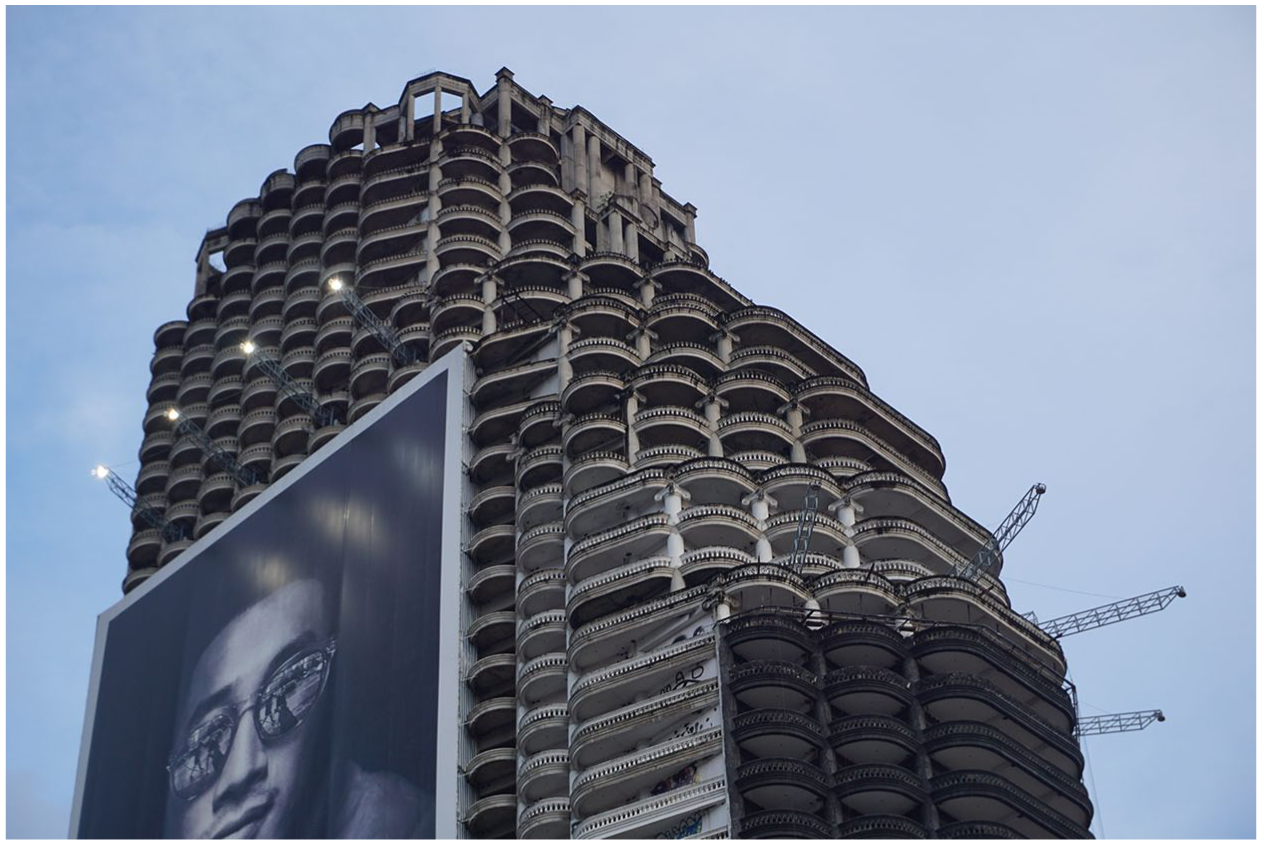
Sathorn Unique Tower in 2017.
The reasons why this building, despite its central location, has not been developed are just as diverse as they are controversial. In the beginning of the 1990s, the architect and developer of the Sathorn Unique Tower, Rangsan Torsuwan – at that time one of the most successful architects in the city – was arrested, because he was accused of being part of a team that planned to assassinate the president of Supreme Court Affairs. Though the murder never took place, Torsuwan lost all his credibility as an architect and was not able to develop the building further. Since then, crucial changes in urban planning regulations within the last two decades have made it impossible to develop the building in its current state. For instance, high-rise buildings in Bangkok today have to be built on a broader piece of land to support air circulation in the city. They also require direct access to parking lots, such that great parts of the building would have to be demolished and modified to fit into the current regulations. However, there is another reason the Sathorn Unique Tower remains in ruins today: it is widely acknowledged as being haunted by a ghost, and it is this reason that I will engage within the following pages.
Based on my conversations with people who live and work around the Ghost Tower, it remains quite unclear what caused the haunting of the ruin. While there are rumors that the building was built on a former graveyard and therefore doomed from the start, other people state that the ruin is haunted because of its shadow falling onto the temple nearby. Often people refer to a suicide that took place in 2014: a Swedish backpacker hung himself in one of the upper floors of the ruin, resulting in the first international media reports about the Ghost Tower of Bangkok. Another common narrative refers to a more general relationship between ruins and ghosts in Thai beliefs, whereby the mere fact that the building is ruined is the cause of the haunting. I would like to clarify that this article does not attempt to engage with the spiritual belief in ghosts within Thai culture. The question I engage with concerns the role anxiety plays in transforming an object ‘out there’ in reality into an extimate object of the Real. I am therefore less interested in the ghost itself than in what the ghost tells us about the structure of the object a. 35 Against this background, I do not seek to further engage with the question of why the ruin is haunted, but rather how this haunting is introduced into the object to turn it into an object of anxiety.
A movie
I will start my investigation of the Ghost Tower through an analysis of The Promise (2017), a horror movie produced by one of Thailand’s biggest film studios. Such a reference is not accidental but follows Lacan’s own observation that anxiety can at best experienced through fiction. ‘In reality, this experience [of anxiety] is too fleeting. Fiction demonstrates it far better and even produces it as an effect in a more stable way because it’s better articulated’. 36 The Promise will help us to further understand ‘what kind of Thing’ enables an ordinary object to turn into an object of anxiety. Furthermore, I will seek to elaborate on why Lacan states: ‘Not only is it [anxiety] not without object, but it very likely designates the most, as it were, profound object, the ultimate object, the Thing’. 37
The Promise starts with a scene on the construction site of the Sathorn Unique Tower in 1997, shortly before the crisis hit the Thai economy. The two girls, Ib and Boum, play around and talk about their future in the building. Boum states that their fathers, the two developers of the building, have agreed that they can get a room together and they imagine sharing the penthouse on the top floor. On their way out, the two teenagers witness Boum’s father’s breakdown on the phone, when he hears that his entire capital is lost due to the fall in stock prices. The construction comes to an end. Since the girls already shared their imaginary future in the building, the decision to stop the construction of the Sathorn Unique also calls their future into question. One night they meet again at the site to commit suicide. Ib brings her father’s pistol and asks Boum to promise that they will die together, but after Ib shoots herself, Boum panics and runs away. Twenty years after the incident, Boum is the single mother of a teenage daughter and a real-estate developer herself. To save her company from bankruptcy, she decides to develop the Sathorn Unique Tower. She visits the ruin for the first time since Ib’s suicide to convince the authorities to give her a loan to develop the property. After Boum’s visit, her daughter starts to become possessed by the ghost of Ib, and the curse of the film takes its course.
From the beginning of The Promise, it is clear that the Sathorn Unique Tower is more than an ordinary building. The fact that the building never became the new home of the two girls, but instead marked the end of life as they knew it, motivates the whole plot of the film. The ruined Ghost Tower thus functions as the remainder of a building that promised a future full of enjoyment. The intended building, referenced by the ruin, becomes what Lacan calls das Ding (the Thing). ‘What we experience as “reality” [in The Promise] discloses itself against the background of the lack, of the absence of it, of the Thing, of the mythical object whose encounter would bring about the full satisfaction’. 38 Although the building – or better, built-Ding – has never been realized, the ruin proves its possible existence. The Ghost Tower becomes the phantasmatic remnant of the built-Ding.
The crisis is such a crucial moment for Ib and Boum because it marks not only the moment of the financial breakdown of their families but also the moment when the built-Ding emerges as being structurally ‘inaccessible’. 39 The girls lose what they never had. Psychoanalytically speaking, this is the moment when they become proper subjects. However, what causes anxiety in The Promise is neither the loss of the girls’ future home nor the loss of Boum’s best friend; the cause of anxiety is that the loss is not lost: the built-Ding is not fort but haunts the da. Boum cannot approach the ruin like any other investment property, because the ruin won’t let her forget what happened inside of it 20 years before. Once she enters the ruin again, she is unable to distance herself from the built-Ding. Lacan states that ‘[a]nxiety isn’t about the loss of the object, but its presence’. 40 Now, the ghost of Ib marks exactly this loss of the loss. What is truly disorienting about the ghost is not so much the ghost itself, but the way it brings the built-Ding back to life. Since ‘[a]nxiety emerges when at the place of the lack one encounters a certain object, which perturbs the fantasy frame through which the subject assessed reality’, 41 Boum’s encounter with the spectral appearance of Ib presents her with the limit of her reality. She cannot go on, because the lack of the built-Ding that secured her existence – that determines the fort and da of her reality – ‘happens to be lacking’. 42
Already at this stage, we can see that Lacanian psychoanalysis is far from being anti-realist. Lacan does not call the existence of independently existing objects into question. He rather allows us to understand how an object transforms from being an ordinary object ‘that can be located, pinpointed, and exchanged’ into a ‘kind of private, incommunicable and yet dominant object that is our correlative in the fantasy’. 43 Starting from the assumption that there are objects ‘out there’, Lacan follows the ways in which the subject inscribes itself into these objects. However, the point of Lacanian psychoanalysis is not to simply restrict the reality of objects to the realm of the subject, but to point to a certain deadlock within the subject’s inscription into reality: ‘as soon as “brute”, pre-symbolic reality is symbolized/historicized, it “secretes”, it isolates the empty, “indigestible” place of the Thing’. 44
While there is, in this sense, no question of whether something exists outside of the subject, Lacan points toward some-Thing that does not simply exist ‘out there’, but is retroactively ejected to a place that cannot be accessed by the subject. This place of the Thing should not be confused with a physical location; it is not located at a place in the topographical sense. The Thing is rather inherently ‘out of place’. Its place is profoundly topological. Like the outer side of the Möbius strip, the Thing is bound to the subject, but nevertheless separated from it – an extimate limit of the Real that constitutes the realm of the subject’s reality.
An interview
In the beginning of February 2017, I started my fieldwork with an interview with Pansit Torsuwan, the son of the architect/developer of the Sathorn Unique Tower. He is not only the caretaker of the ruin; he also recently published a book titled Ghost Tower & Me in Thai,
45
where he tells his personal story about the ruin. I hoped that by talking to him, I would learn more about the ghost. We spoke for 2 hours about the history and challenges of developing this building, and it was not until the very end of our conversation that I dared to ask him about the haunting. He started to laugh and replied quite nonchalantly: There is this story on and on. It became the name of the building, internationally, Ghost Tower . . . a Swedish, I think Swedish or Dutch, I cannot remember, hanged himself two years ago in there, and that’s it! . . . I don’t know why the people think it’s a ghost in there. I’ve never seen one.
I felt somewhat disillusioned by this answer. The suicide of the Swedish backpacker seemed to be quite unmemorable for Torsuwan, and even the meaning of the ghost seemed to be irrelevant. For a moment after this statement, neither of us said anything. Then, suddenly, he continued in a more serious tone: To myself, I think something mysterious is in there, I mean beyond ghost or God or whatever. My personal belief in something behind this building? I believe so, but I don’t know, if it’s good or bad. I think it keeps me stuck in here for too long but it never lets me die . . . The one time I walk up there, 50 floors – and I never exercise for too long after I got married ten years ago – and I didn’t feel tired. Just like something lifted me up . . . The 50th floor, very hot, small stair tower, very close, no air – and I didn’t feel anything . . . I don’t know what it is.
In the course of one conversation, the ruin transformed from being completely insignificant into a mysterious place that fundamentally affects the life of the architect’s son. To capture the structure of this shift, I should first emphasize that Torsuwan has already been asked my question several times in the past. The ghost story is not new to him; on the contrary, ‘there is this story on and on’. This is important, because the starting point of his response presupposes that the majority of people think that there are ghosts haunting the ruin, leading him to wonder ‘why people think it’s a ghost in there’. Based on the presupposition that the ghost exists, his first response to my question disavows this existence with cynical distance. He turns the haunted house into an ordinary object, emphasized through the phrase: ‘that’s it’. Then, in the second step, Torsuwan openly states that ‘there is something’ inside of the ruin, something that goes beyond the rumors. What Torsuwan seems to be saying is that there is no ghost in the Ghost Tower, but all the same, there is something in there. Thus, he starts by negating a positive existence (the ghost does not exist), and then, in a second step, negates this negation (the ghost does not exist, but something else exists).
Torsuwan does not simply admit that there is something inside the Ghost Tower, but more crucially states that there is ‘not nothing’ in there. Whatever is inside the ruin, it is neither a substantial being nor simply nothing, but rather a sort of positivized negativity, a remainder of the Thing. Here we find a repetition of the structural difference between anxiety and fear. Torsuwan rejects the existence of a ghost, because he has ‘never seen one’, and thus refers to a rejection of an object of fear. There is, in this sense, no ‘objective danger’. However, this does not mean that there is nothing inside the Ghost Tower. Just as anxiety is ‘not without object’, the Ghost Tower is ‘not without ghost’. Even though Torsuwan has never seen a ghost, he knows, with a ‘dreadful certainty’, 46 that there is something in there – something that does not simply exist independently from him, but more crucially exists independently only because of him; something that ‘keeps him stuck in there, but never lets him die’ (similar to the ghost of Ib in The Promise).
While Torsuwan is convinced that he was faced with something when he entered the Ghost Tower, his answer to my question ends with a gesture of surrender: ‘I don’t know what it is’. This sort of confusion about the ontological quality of the ghost should not be taken solely as an epistemological obstacle. It is not as if Torsuwan would know more about the ghost if only he had the right measuring devices. From a Lacanian standpoint, the impossibility to ‘fully’ understand the Ghost Tower becomes an ontological part of the thing itself. As soon as we can clearly say ‘what it is’, we also lose ‘what’ we talk about. However, this does not mean that the ghost is an illusion taking place inside of the subject’s mind. The ghost only becomes an object of interest for psychoanalysis because it cannot be reached. It thus marks a limit of what can be registered within the reality of the subject, which is why Slavoj Žižek states that ‘the true lesson of psychoanalysis is not that the external events which fascinate and/or disturb us are just projections of our inner repressed impulses. The unbearable fact of life is that there really are disturbing events out there’. 47 While one of the basic premises of the object-oriented turn is to rely on the indivisibility of humans and non-humans, psychoanalysis thus points toward the dividing gap between subjects and objects. Without this division, we cannot understand why objects can have such disturbing effects on the subject.
A visit
After talking to Torsuwan, he was willing to give me official access to the Ghost Tower. I invited May, a local journalist who has helped me with my research before, in case I needed any sort of assistance. We arrived on a Saturday morning in the beginning of April 2018. After a short conversation with the guard, he unlocked the door to the stairwell and let us pass. We walked up the pitch-black staircases with the flashlights of our phones as the only source of light. After around 30 minutes, when we had reached the 25th floor, we came to a sudden stop: a rhythmic banging on metal was echoing through the stairwell above us. Through the light of my phone, I could see the wide-open eyes of my research assistant. She whispered, ‘What is that?’ After a few minutes, standing there in the middle of the darkness, the noise suddenly stopped. A moment later, we continued walking. We recognized that the sound must have come from the 27th floor, but I decided to continue up to the roof first and check the cause of this noise on our way back. I wanted to make sure that this ‘discovery’ would not stop us from seeing the rest of the ruin. After half an hour, we arrived on the rooftop. While we enjoyed the view, I asked May how she felt on the way up. She told me that the whole energy in the building made her feel uneasy, and she was sure that we had encountered the ghost on that floor. 48 With the same ‘dreadful certainty’ as Torsuwan, May knew that we had encountered something. There was no doubt that the sound was a ‘signal of the real’. 49 The sound not only seemed to reveal that we were not alone; it was also a demonstration of something we could neither see nor explain, something beyond the imaginary and the symbolic.
We spent more time on the rooftop than necessary, probably because we both wanted to avoid the way back to the darkness. Finally, after another hour, we decided to go down again. I told May that we had to investigate this ‘ghost’, and that I needed more evidence in order to evaluate its existence as a proper result of my research. We both laughed, and even though she was uncertain about going deeper into that topic, she agreed to go along with my investigation. As we got closer to the 27th floor, the noise returned, the same rhythmic banging on metal. We stood in front of the entrance to the floor, and May asked me to go first. When I entered the corridor, the noise suddenly stopped. At this moment, I seriously started to wonder what was happening. My research assistant was visibly disturbed, and I was not fully able to maintain a scholarly distance from the object anymore. It was a kind of breakdown of the Fort-Da game, a sort of ‘ontological dissonance’, 50 where something that is supposed to be absent/inexistent starts to be present/existent.
I decided to stay on the floor until the sound came back again, because otherwise it would have been hard to locate its point of origin (Figure 2). We walked around in one of the apartments on the 27th floor and chatted about the possibility that the sound responded to our entrance into the corridor. Before I got to the point of trying to come up with a rational explanation for all this, the noise started again. While we slowly walked in its direction, checking one apartment after the other, we suddenly became aware of a room that was divided by a sheet metal wall (Figure 3). It looked different than all the other apartments, and when we got closer, we saw that a part of the sheet metal had been torn out of the wall. It looked like a small door, and as the wind blew through the building, the metal ‘door’ opened and closed again and again. As we stood in front of the wall, the little door started to shake and to create the familiar rhythm. At that moment, both my research assistant and I were visibly relieved about the cause of the noise. We started to laugh, and before we left, May put a stone against the door, to make sure that it was not able to make any sound again.
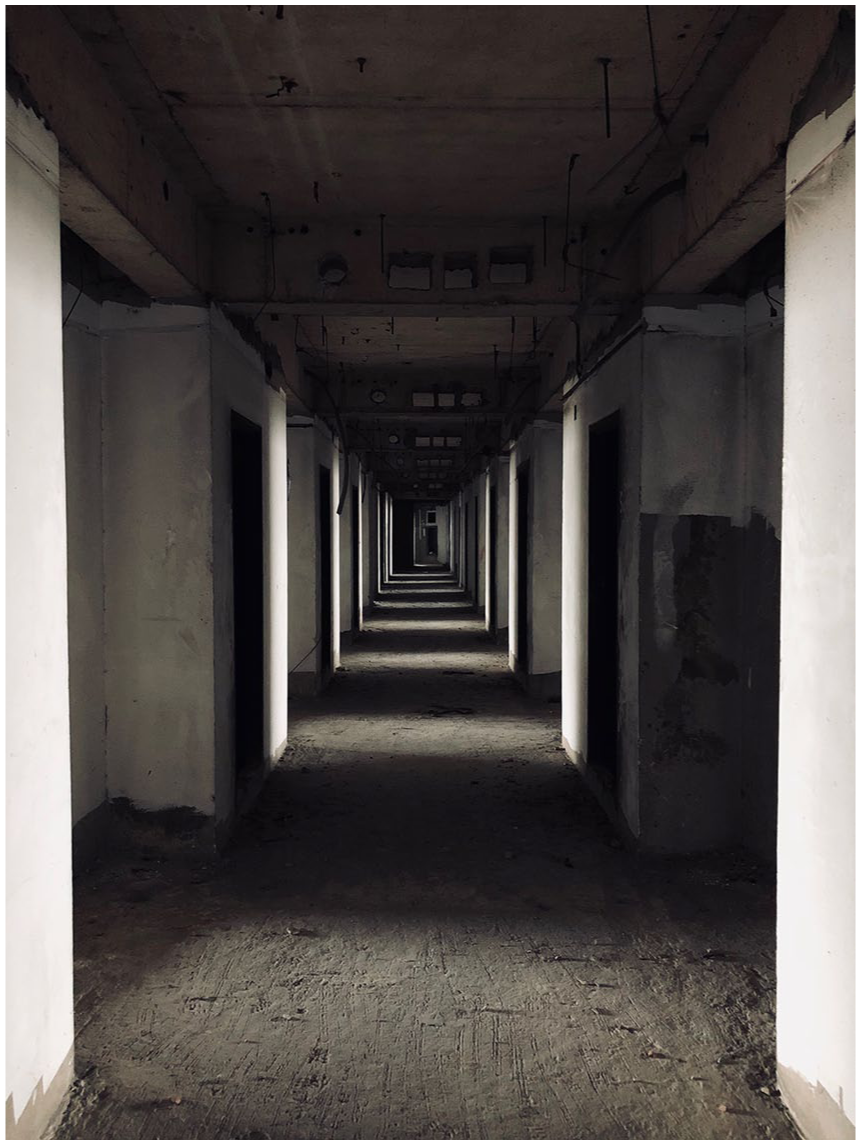
The 27th floor of the Ghost Tower.
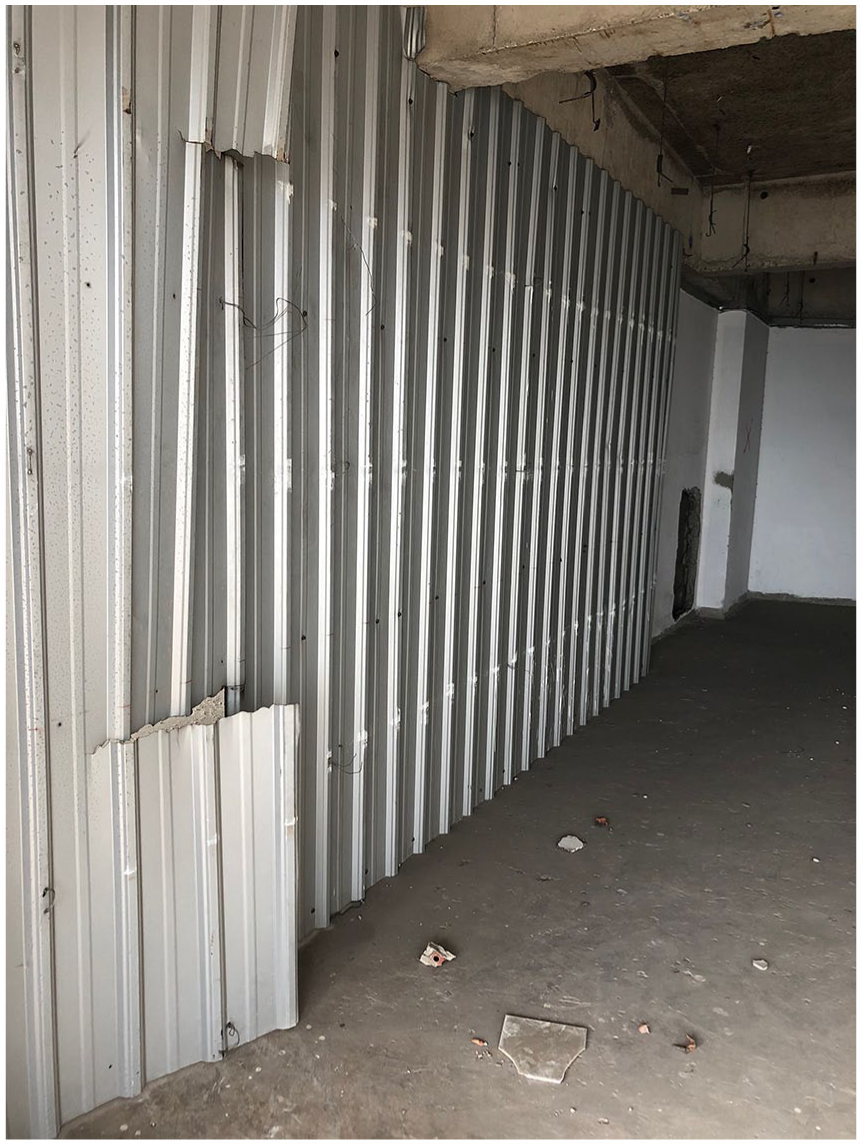
The cause of the noise on the 27th floor of the Ghost Tower.
Conclusion
An obvious way to evaluate the end of this story would be to take it as a simple proof that the ghost does not exist. The conclusion we could draw from this would be that only solid empirical social research allows us to bring the truth to light. Our work as scientists would be to ‘demystify’ the built-Ding and to transform ‘this kind of private, incommunicable and yet dominant object that is our correlative in the fantasy’ into ‘an object that can be located, pinpointed, and exchanged’. 51 In this way, cultural geography is there to dispel the object-cause of anxieties, giving us another reason why Scott Kirsch argues that it ‘accords ontological priority to the material conditions of existence, and rejects non-material (e.g. spiritual, metaphysical, and other transcendent) prime causes’. 52
The problem with such a priority is that it is based on the rejection of the Real. If cultural geographies solely focus on ‘the immediate material world’, 53 then they remain blind to objects that have no proper place in this world. However, since ‘[n]o praxis is more orientated towards . . . the kernel of the real than psychoanalysis’, 54 it is precisely the impossibility of something to obtain a proper place that triggers a geographic interest in psychoanalysis. The Lacanian way to approach the Ghost Tower thus leads to a serious treatment of the ruin as being haunted by the ghost qua Real. The ghost is part of the Real because of its non-place, its extimacy; and the only proof of its existence is its ability to disorientate the subject. What is the ghost in this regard? It is neither nothing, because it has a certain effectivity, nor is it something, because it does not obtain an own material body. It is neither 1 nor 0. It is neither here nor there, it is ‘less than nothing’, 55 a form of a ‘negation of negation’, to adopt a Hegelian phrase, 56 and it is precisely such a sort of determined non-being Lacan has in mind, when he invents the object a as the ontological foundation of psychoanalysis.
This brings us back to the introduction and the critique of object-oriented thinkers, who argue that psychoanalysis is unable to engage with the object. Regarding my claim that (Lacanian) psychoanalysis is not oriented toward the subject but rather follows the possibility of an object to disorientate the subject, it seems questionable whether Lacan is only another representative of what Meillassoux calls ‘correlationism’. 57 Is everything in the world of psychoanalysis solely based on human perception? I argue that such a critique would miss a crucial aspect of Lacanian psychoanalysis. Lacan does not question that there are objects independent from us. The focus of Lacan is not the reality of objects but rather the possibility of an object to contradict with this reality. The starting point of his object-disoriented ontology is to follow the transformation of an object from being locatable in reality to being unlocatable in the Real.
While the materialism of the object-oriented turn seeks to close the gap opened up between subject and object, Lacanian materialism ‘transposes back into nature not subjectivity as such but the very gap that separates subjectivity from objective reality’. 58 The fundamental axiom of this materialism is ‘not “matter is all” or “matter is primary”, but relates rather to the primacy of a cut’. 59 Lacan thus does not let the world of things drift in its void, but rather allows the void at the heart of things to be localized. For him, it is not ‘the figure of matter that underpins a materialism’, 60 but, on the contrary, a sort of immaterial surplus, which turns an ordinary object into ‘the object of objects’. 61 Against this background, Žižek states that Lacan does not differentiate between Matter and Spirit, but proclaims that there is another ‘spectralized’ materiality taking place next to matter as such. 62 This spectralization or haunting of matter is what gets lost within the object-oriented turn. While object-oriented ontologies allow us to understand why ‘objects that surround us (from cups, tables, and flowers to skyscrapers and elephants) seem to have independent features of their own’, 63 they do not help us to retrace ‘why some books, poems, oceans, or skyscrapers please [or terrify] us more than others’. 64 As long as everything matters, we cannot understand why some things matter more than others.
Psychoanalysis in this sense rejects the idea of ‘flat ontologies’ that equalizes every sort of (human and nonhuman) actor, and instead introduces an ontology that challenges the smooth transition between subjects and objects. However, psychoanalysis does not rely on ‘a strict division between human thought on one side and everything else on the other’ 65 to proclaim superiority of humankind, but to understand how an object becomes able to disorientate the subject. ‘[T]here is no democracy of the object’, 66 because the subject does not meet the object a at eye level but is fundamentally out of joint based on its existence. The world of psychoanalysis is a world of contradictions, a world in which something ‘doesn’t work’, 67 and Lacan’s name for this obstacle is the object a. The whole aim of Lacanian ontology is to understand this contradiction as an immanent contradiction, or, to put it differently, ‘an ontology that pursues not simply being qua being, but the crack (the Real, the antagonism) that haunts being from within’. 68
Footnotes
Acknowledgements
The author is very grateful to Paul Kingsbury, Friederike Landau, and his working group at the Department of Human Geography in Frankfurt as well as the two anonymous reviewers for providing very helpful critiques and comments. He also thanks Anna J. Secor for her marvelous editorial support and guidance.
Funding
The author(s) disclosed receipt of the following financial support for the research, authorship, and/or publication of this article: The research for this article was funded by a scholarship from the Rosa-Luxemburg Foundation.
