




Abstract
‘Sophie’s story’ is a creative rendition of an interview narrative gathered in a research project on missing people. The paper explains why Sophie’s story was written and details the wider intention to provide new narrative resources for police officer training, families of missing people and returned missing people. We contextualize this cultural intervention with an argument about the transformative potential of writing trauma stories. It is suggested that trauma stories produce difficult and unknown affects, but ones that may provide new ways of talking about unspeakable events. Sophie’s story is thus presented as a hopeful cultural geography in process, and one that seeks to help rewrite existing social scripts about missing people.
Introduction
There is, as Daniels and Lorimer 1 would have it, a ‘new narrative space across the humanities [and, we would add, the social sciences] . . . opening a space for many kinds of story, personal and political, biographical and environmental’. We wish to occupy this new space in order to relate something of the writing and performing of ‘Sophie’s story’. 2 In doing so, we are aiming to lay bare a new kind of research experience and outcome for us (as situated researchers), and to continue a performative engagement with an interview narrative collected in a recent research project. 3 We want to produce an academic rendering of our engagement with Sophie’s narrative of going missing and think carefully about what research traditions and other social influences have enabled this engagement. We want to reflect further on the story’s purpose, specifically in light of its role as a witness to individual trauma and crisis, but also for more collective social purpose. In this latter ambition, our paper cannot tell the whole of Sophie’s story because it is ongoing, and, like all interesting tales, Sophie’s is being repeated, we hope in multiple mediums and to multiple audiences where it will have different affects and moving force. We hence relate a partial account of the making, telling and audiencing (in text, person and via audio file) of Sophie’s story in order to contribute to a recent disciplinary engagement with versions of ‘the story’, 4 and through this elaborate a contemporary attempt to diversify some particular understandings of, and uses for, ‘geography’ in the public realm, here as connected with policing practice in the UK.
We are experimenting with ways to use narratives collected in research, and also with ways to represent ‘geography’ and what counts as ‘useful’ geographical knowledge to non-disciplinary actors. We can be argued to be actively ‘storying’ both research data and human geography beyond academia in ways encouraged by the likes of Withers
5
:
If we are to understand . . . the spaces in which geography, however understood, has been produced, consumed and negotiated, we should not uncritically privilege the academic in considering the sites of its making and consumption.
6
The paper will start by selectively reviewing how geographers and others have understood the story as a transformative medium, and we draw particularly on research that evaluates trauma stories and the kinds of ‘wounding work’ they do. 7 We also situate the story as a recent and very particular way of managing qualitative data in human geography in a manner that creatively deviates from a previous emphasis on inter-subjective interview data in academic productions of knowledge. Using this platform, we turn to an extract of Sophie’s story, discussing how this use of a research interview narrative was driven by the perceived need for an affectual intervention within standard police representations of ‘missing geographies’ and missing people, as well as a more general ambition to address a public silence about missing experience. We then elaborate how spatial performances of story narratives are critical to their power and involve questions of risk, and we weigh this risk in our case study against the intended use of Sophie’s story for social purpose. While we are not in a position fully to report the outcomes from this story experiment, we can discuss the journey so far and in ways that contribute to Hoskins’ 8 concept of ‘narrative economy’ where stories acquire value that relate to ‘their productive capacity to do work and make contributions’.
Writing trauma in human geography
Geographers have a relatively longstanding interest in the capacity for stories to create social, political and intellectual change . . . as part of a politics of valuing the local, the situated, and the specific.
9
In situating the work of Sophie’s story, in this section we contextualize our efforts in terms of established geographical scholarship that has centred human ‘voice’ in different ways, and specifically in terms of recent thinking about the practice of story work as more than (just) representational. Cameron’s comment above is part of a more general evaluative essay that reviews work on the transformative potential of stories for social change, and as a medium through which utopic or alternative realities might be engaged and made possible. 10 Notwithstanding this recent creative turn, geographers have been working imaginatively with narrative for many years – including deftly constructing its inter-subjective possibilities, 11 allowing personal experience to emerge and matter as a kind of politics, 12 and using autobiographical witness from geographers and others. 13 Cameron also points out that stories are not just made but told – and we may understand this ‘telling’ (textually or verbally) as kind of performance 14 – and indeed geographers have in some ways become storytellers, positioned as narrators of their own or other experience, 15 in a genre where style and story-shapes are central in productions of knowledge. 16 A consistent problematic that weaves through story productions of narrative material for geographers is why and how it all matters – and here questions of advance, politics, purpose, risk, insight, audience reception, scale, impact and change often surface.
In seeking to develop understandings of ‘narrative economy’, 17 we suggest that stories do more than ‘represent’ and that their performative powers always manifest, transmit and circulate more than the teller intends. There is a strong sense here of a disjuncture between any careful authorial crafting of style, pace, content, intended affect and rhythm and what happens via performance (the telling or communication of stories to different audiences). While geographers are acutely aware of the risks of unpredictable audiencing of stories, 18 there is also the sense of a vital, hopeful politics that accompanies this particular kind of craft work, one that is theoretically articulated around the moving force of stories to generate actual change. 19 Stories might thereby be cast as interventions, and here the narrative form lends itself well to contemporary demands of academic output to be resourceful – to act as resources and as mediums of knowledge transfer and exchange. This language around a purposing of academically acquired narrative is at once useful and dangerous: it appeals to a disciplinary legacy of crisis around representation, but also risks disallowing some kinds of literary and creative post-phenomenological experiment 20 that may not obviously present itself as socially useful.
We want to comment specifically here about the potential of working with difficult narratives stories,
21
ones that often emerge from traumatic events. We draw on a range of geographers and others who are working productively around trauma. In Till’s recent work on ‘wounded cities’, she discusses the difficulty in storying trauma at all, citing Bal’s insistence that being unable to ‘relate’ or ‘tell’ trauma is integral to its constitution:
traumatic memories resist integration and cannot become narratives . . . Trauma does not occur from an event or occurrence that caused pain or suffering per se, but from an individual’s inability to give the past some sort of story.
22
There are clearly different kinds of trauma and related narrative, and the above comment references very individual difficulties in forming narrative coherence, but it also helps us understand the multiple dominant and alternative forms of collective testimonial witness to traumatic events. 23 Here psychotherapeutic approaches also illuminates further how any impasse might occur: ‘what is traumatic is raw experience felt and lived but not ordinarily available for the kind of symbolic elaboration necessary to create stories or make meanings’. 24 Trauma scholarship also points to how trauma evokes, reflects and shapes repetitive stories (of the event or cause) that ‘lock in’ the sufferer to re-telling themselves isolated tales in which nothing really changes, and at which point therapeutic meaning-making may be helpful. While acknowledging this difficulty in the stasis that trauma may produce, we also take further inspiration from those who seek to mobilize traumatic memory, 25 perhaps for more than individual benefit and coherence, and so we want to widen our scope here to understand how the trauma of missing experience might be collectively witnessed and acted upon in what Selzer has termed a (problematic) ‘wound culture’, 26 to describe a contemporary life organized around a ‘public fascination with torn and open bodies, and torn and opened persons’. 27 Although our focus is rather narrower than that of ‘contemporary life’, we discuss how stories of trauma might feature as a mobilizing practice in a human geography of missing people – in this case also involving police officers, families of missing people and people who have ‘returned’ from their missing status and journey.
In attempting to use a narrative from a research project on crisis-led missing mobility (Sophie’s story below is a story of a suicide attempt), we are complicit in writing trauma and traumatic geographies. We do this consciously and with the optimism that producing a witness to missing trauma involves mobilizing force (some of which is positive). This is partly because of the conviction – a widely held one in narrative scholarship – that stories matter:
At the individual level, people make sense of their lives through the stories that are available to them, and they attempt to fit their lives into the available stories. People live by stories . . . Collective stories that deviate from standard cultural plots provide new narratives; hearing them legitimates a re-plotting of one’s own life. New narratives offer the patterns for new lives. The story of the transformed life, then, becomes a part of the cultural heritage affecting future stories and lives.
28
So we begin writing Sophie’s story from a position shared with Tamas that ‘writing from trauma is an implicit act of hope’.
29
Trauma experiences that are related in research obviously generate ‘difficult’ material and the writing of these difficulties as ‘story resources’ produces particular kinds of risks: do we ‘smooth out’ the trauma? do we render it more traumatic than it actually was? do we ‘dramatize’ it in ways that might be problematic and what are these ways? how is the witness of trauma helpful and in what ways? These are questions that also apply to other sorts of narrative material, and echo the widespread ‘crisis of representation’ rebounding throughout human geography over the last two decades and still ongoing.
30
While we do not wish to repeat these machinations, we do want to address something of the politics of collecting and storying narrative material that is clearly related to traumatic events, experiences, situations, acts and geographies. Such a project addresses a continued silence around trauma – particularly that which is constructed as shameful in some way (and suicide narratives might be one example; see Stevenson
31
):
Trauma is rendered unspeakable because it is too dirty and dangerous, a filthy stray ghost dog scavenging on the margins, unfit to let into our house of words.
32
Tamas elaborates on her metaphorical assessment of the politics of writing trauma as a kind of engagement with ‘dirt’:
Dirty text hopes to disrupt the cycles of compulsive testimony that never feels real or complete because it too smoothly makes sense.
33
Here we have an encouragement to work differently and not so ‘smoothly’ with testimony. 34 Her points above are made as part of a much larger evaluation of trauma scholarship; one that also interrupts received wisdoms about the validity and truthful witness of trauma testimony as always beyond reproach or question. In this edgy critique, Tamas draws on Gordon whose work helps us understand something about the value of engaging in ‘dirty trauma writing’. 35 Here there is a claim that trauma haunts in a fashion that ‘draws us affectively, sometimes against our will and always a bit magically, into the structure of feeling a reality we come to experience, not as cold knowledge, but as transformative recognition’. 36 The reason why haunting affect is transformative is because ‘disturbed feelings cannot be put away’. 37 Such an assessment suggests a productive but uncanny risk with any audience, and as such Tamas warns that ‘trauma testimony is not inherently progressive, and all forms are not equal’. 38 So in order to write responsibly with trauma narrative, a self-conscious acknowledgement of the particularity of the content of trauma experience might matter here, as well as the contexts in which it is produced and where and how the resulting stories are to be told.
In elaborating the work of trauma stories and the moving work that they can do in the places and spaces they are told, we might turn back to Johnston and Pratt’s now seminal work on Nanay, a scripting of (often traumatic) research testimony for theatrical engagement: ‘We understand Nanay to be an attempt to create – and not just describe – emotional geographies of public significance’.
39
In this interventionist ambition, the emotion created around the storied work-up of the narrative is what is important. Pratt elaborates what might be at stake here when discussing the trauma of mothers who leave their children in the Philippines while coming to work as domestic nannies in Canada.
40
She is engaged in: ‘telling stories about their grief in such a way that a wider witnessing public cannot keep its distance’.
41
Much like the suggestive comment from Gordon above, Pratt evokes these stories as constituting a space in which it seems possible to become intimate with trauma experience, engendering a relation that affects a deliberate impossibility of emotional distance.
42
Interestingly, and with echoes of the arguments above, this is exactly what Bondi suggests is a fundamental gap, an unbridgeable chasm to (raw) trauma:
However redolent such accounts may be of traumatic suffering or other kinds of lived experience, they are nonetheless somehow removed from, and therefore misrepresentative of, the very subjective reality of which they speak.
43
Although Bondi sees an inevitable partiality in story-making about trauma experience, she also recognizes such representations as part of a worthwhile and symbolic meaning-making that has value, entailing capacity-building interventions that can occur in both research and therapy. An understanding of story-making as a kind of contingent spatial practice is here emergent, one entertaining the potential of an emotionally moving ‘meaning work’, involving the cultivation of both intimacies and inevitable distances. Within this relational spatiality, there is an uncertain, if hopeful, sense of praxis, bound up with the unknown and uncontrollable audiencing of the stories, however they are written, performed or dramatized.
In building on the notion that stories are meaningful practices that do work, and that explicitly engage emotional and affectual force, we perhaps need briefly to return to the rather disturbing comments surrounding contemporary ‘wound cultures’, 44 in order to further appreciate how trauma, once told and performed, may live up to any ambitions that contextualize its writing. Here there is a suggestion that ‘wound cultures’ are fuelled by ‘both our insatiable morbid appetite for voyeuristic spectacles and compulsive exhibitionist masochism in trauma survivors’. 45 This double fetish effectively enables trauma testimony to be (selectively) heard. 46 This is not a place to debate broader histories and geographies of trauma and wounding, and how particular survivors of trauma speak within these. 47 Instead, we acknowledge the very idea of receptive (if problematic) ‘wound cultures’ that valorize traumatic experience in complex ways, but also want to point to ways in which very particular and much more local cultures are often seemingly and surprisingly resistant to emotions/emotional performativity (of which trauma stories would be part): here some workplace cultures are a prime example. In our own example, we are engaged in research work that involves speaking to police cultures, and specifically to those police officers involved in tracing missing people. One of the reasons that Sophie’s traumatic journey story has been written (and is being performed) is precisely because we are seeking an affectual intervention in policing workplace cultures, and in doing so we are hoping to engage new thinking and practice in this community and in relation to people who go missing: and specifically to influence how they are known (via operational categories), understood, traced, communicated with and supported following their return, not just by police officers, but by a range of possible actors.
Sophie’s story
‘Sophie’s story’ thus emerges from an academic research project about the geographies of missing people. 48 The former National Police Improvement Agency (NPIA), particular police forces and the UK Missing People charity have been working together with us to help ‘story’ missing people and their journey-making in new ways by allowing us to access their databases to invite people who have been reported missing to participate in the research. Our role is to help write and articulate these narratives to and between different audiences of interest, and Sophie’s is one of 10 story ‘resources’ that are now being produced in various versions and lengths and formats. These 10 stories are ‘creative re-constructions’ of 45 in-depth interviews that concentrated specifically on the experience of missing journeys. 49 The transcripts of the interviews have been analysed both singularly and across groups of interviews with reference to emergent and assigned coding categories. In the process particular words that were spoken have been selected and rearranged in terms of their order, and sometimes their ‘author’, and we have added linking words for logic, as well as paying attention to dramatic pacing and delivery. The 10 stories are thus a mixture of a creative reconstruction of a single narrative interview script (as in the case of Sophie’s) and ‘composite stories’ that are compiled from across our database of experience. The combination of single and composite stories is a strategy that allows us to speak to the specificity of cases and individual experience, but also across experience, in order to gather consensual points of meaning but protect individual identities.
The 10 stories were web-launched via project and partner websites (in text and in audio, read by actors) in June 2013. The stories – including Sophie’s – are also being performed in person (by the researchers) and as part of presentations in audio at a variety of police and charitable events and at international meetings. The audiencing and impact of these performances is unknown at the time of writing, but the representatives of the above partner organizations are excited by these resources, and there is hope that it will encourage more empathetic policing practice and public awareness. The stories as an intervention or resource do three main things: firstly, they serve to personify the dominant representations of missing geographies that are currently produced by the police in ways that update and complement statistical knowledge and ‘incidence cartographies’; 50 secondly, they seek to be a provocative and affective reminder to police officers that missing people are people and not just policing problems; and thirdly, this seeks to act as a creative resource to help both people who have been reported as missing and families of missing people address a near total silence with respect to publicly available ‘voices of experience’. We elaborate and problematize these ambitions further below.
Let us turn, however, to Sophie’s story below; one deliberately not carved up for social or policing science, but creatively recomposed from an interview transcript for reading and telling:
Sophie’s story
I suffer from depression and I was going through a really bad episode, everything was a bit much, things just got pretty over the top and I took a huge overdose and that’s what made me go missing, because I sent emails out to lots of people while I was under the influence of a lot of tablets and some red wine. Like to my mum and my boss and some of my friends, my sister. When I realized I was still alive, it was a working night, it was in the middle of the week and people were going to start to wakening up and get their emails and I thought ‘I’m going to disappear’, so I just sort of took my iPod and left my phone at home and just like decided I would go … that was really the reason how I ended up being reported missing because I left my phone and everything at home and I didn’t show up for work. I spent a lot of time vomiting, but I was aware by four in the morning that I was still alive, and very much still alive, and people were going to start getting the letters and I had not planned to still be around, so I had to go somewhere until all the tablets did their worst and that was my thinking. I got dressed for the weather, I don’t know why because if you think you’re going to die why do you bother? It’s just a thing you do I guess. I also wanted to be wearing dark things so I wouldn’t be easy to spot and I’m blonde. I knew where I was going from when I left.
That would have been about four or five o’clock that morning. I don’t know why, but it was kind of like a light bulb came on, I don’t know why I thought of that place, it was kind of perfect because it wasn’t far away. I didn’t think I was going to be a missing person, but I know I didn’t want to be found. I wanted to be missing for long enough for the tablets to do their job, and after that it didn’t matter. I wanted to be dead so I needed a certain amount of time for the poison to take effect basically, so I knew that I had to be well hidden.
I used to run by the building, that’s how I knew it. I don’t know what it used to be, it’s beside an old mill, like what’s left of an old mill on the river. It’s kind of in the bank, and there’s a path that goes alongside it and then steps upwards. A lot of it is derelict now, it’s full of leaves when it gets windy, it’s very well hidden and you can’t see it from the road or anything.
It was winter so I put extra jumper on and a jacket, something with a hood so I could just put it over my head and sort of hide as well, it’s all kind of about hiding. I was listening to Nirvana which is very good when you’re in that mess because of, you know, obviously he suffered. So that’s why I took the iPod with me and I’m pretty sure the other thing I took was my house key and the bottle of wine.
I could only get there by foot. I remember it was pretty quiet, I walked alongside the parked cars, so if I did stumble I wasn’t very obvious. I was aware that if a police car was going past or even a taxi driver, somebody might have spotted me and just sort of ‘there’s something really not right with that girl’, and that would have spoiled my plan as well …
It was like being really drunk, I remember my vision, it was like everything was kind of in slow motion. I had taken a mixture of things, paracetamol and pain killers and sleeping tablets and you know just anything I could get my hands on. I was aware that I was sort of weaving about and I was trying not to trip or fall or anything … my eyes … I was probably closing and opening my eyes a lot … you know it probably just wouldn’t have looked right. I do remember about two cars passed me because of the headlights. I was trying even harder to sort of stand up straight and not stumble and not to look at them as well. I remember being quite focused on my walking. I was thumping my feet down, it was very deliberate, everything was very deliberate. I remember I was then walking fast, definitely, ’cause I was nearly there and then I sort of had to hold myself to stop that, especially as I got to the roundabout because it’s more lit up again there.
There are a lot of places I could have stopped if I was struggling, I could have stopped and probably found somewhere to hide, but because a lot of the buildings were being demolished, there were workmen going about during the day and they probably come quite early. I just had thought of this place and I was focused on getting there.
So I cut from where I was, diagonally across the little roundabout to the path along the river. It’s only a matter of a few hundred yards to that building and even though I was struggling, I just jumped in it because I didn’t really care if I hurt myself. It’s about a six foot drop, so I jumped down, but the wind meant that there was a lot of leaves build up on it, so it’s quite soft in there. I just kind of crawled into the space, put my iPod on and sat there. I didn’t take my phone because I watched police programmes and they can track you with your phone, so that was in my mind.
So I just went like right in the corner, you would have to put your head in to see me and the wall is granite, the wall was thick. There was the shelter and seclusion ’cause you know I just wanted, I didn’t want to have to face what I’d done in the emails. I just thought I was safe, I just thought, well that’s me, I’m safe you know.
(long pause)
…. and then as daylight was coming and I was still alive, that was sort of when I started to panic. I couldn’t face drinking anymore but I was trying, trying to drink more wine so that I could maybe make the whole cocktail work, but I had like a few mouthfuls maximum. I just kept putting my entire collection of Nirvana on repeat, listening to it all the way through and closing my eyes and hoping that, you know, they wouldn’t find me.
I know I was thinking about my family.
I was sort of curled in a ball, I wasn’t lying down but I was sitting like holding my knees with my back against the wall. I had to move a few times ’cause I was sick. I tried to move away from where I was sitting because it was quite a prime spot. I was sick further away and I covered it with leaves but sometimes it was just like too quick. I mean I didn’t move very far, I just shuffled along little bit further, but mostly I was just sort of curled in a ball, ’cause it was pretty cold. My head felt quite wobbly. The whole point is when it gets to the end you would lose consciousness, I just sort of remember kind of coming out of something, like snapping my head up and then realizing that I had probably slept or just been unconscious or something and then I would sort of check the light and then just close my eyes again, just listening to the music.
I didn’t think I would become a missing person as such.
My mum goes to work at eight, so she would have been the first one, she starts at eight, so she would have been the first one to get her email.
I really didn’t hope for any of that, that I was going to be a missing person or any of that sort of business, or that they would phone the police. When you’re in that depressive state you’re very self-involved to a point you can’t really think about anything outside. I was on a mission that was going to end all that for me.
I wasn’t alert when she shouted my name, it was like ‘oh Sophie thank god just stay there, just stay there I’m coming down, I’m coming down’ and she had my dad with her. She did the jump, like the six foot jump, because she was so worried that I would run away or something. My friend had mentioned my running route and they’d worked it out and just gone looking.
They were at the hospital soon after I arrived there, the police. I was emotional. I felt guilty that I didn’t deserve treatment because I did it myself. I remember they stayed with me for ages. They asked me questions about what had happened, and why I ended up missing, and sort of, was I, was I going to … would I be doing it again, kind of thing …
(long pause)
It was two months, three months later that I went back there to that place and I went on my own. I was quite emotional at the start. I was really nervous and anxious about going in. I was on quite high levels of anti-depressants so I couldn’t cry, there wasn’t any of that. I didn’t stay there long.
I haven’t thought about being reported missing that much, I never really considered myself a missing person, even speaking to the police. I never really thought of myself as a missing person, although that’s what they classed me as at the time. That just sort of enhanced the sort of severity of it and the waste of resources, because I’ve done it myself, even though I was ill. I was a depressive who attempted suicide, a vulnerable adult, that was the label that the police gave me as well I think. I think I’m that more than a missing person.
Sophie’s story could clearly be discussed from many angles: we could concentrate on the detail of what she says; how the story function ‘works’; how we selected the text from the interview transcript and tried to work with and rework the rhythms of her words uttered during the interview; whether Sophie read and commented on her ‘story’. We could concentrate on the pauses, the pulse of her language and the words we included and erased in order to allow the build up and expression of acts of mobility, harm, hesitancy and feelings like shock and sadness. We could interrogate versions of this text for their different purpose (the one reproduced here was a script for a spoken performance, but it is also being textually reworked for police training packages). We could dwell on Sophie’s story via a kind of conceptual or narrative analysis, but this is not our purpose here: and, although we include the story, we deliberately do not want to disassemble it via an academic anatomy of its construction. We want Sophie’s story to do other sorts of work both here and in the forums where we are currently telling it, and this is what we choose to narrate around this intervention.
Sophie’s story is an attempt to contribute to a re-scripting of ‘people reported as missing’,
51
and more particularly people with mental health problems who go missing.
52
As indicated above, policing research usually portrays missing people and their journeys via statistical geographic behaviour profiling (see Figure 1).
53
That this ‘quantitative geography’ represents missing people’s journeys to the police and others, and indeed is the only evidential basis of specialist search strategy, is curious. In the case of missing persons, the police often deduce a relationship between mental health diagnosis (construed as ‘risk’) and distance travelled as the dominant plot line in the practice of constructing a search. The detail of the missing journeys between point of departure and point of ‘return’ are then predominately understood by the police as a sequence of search tasks spread across databases and via a series of officers in physical spaces. Missing people in the UK are called ‘mispers’ by the police and constructed through their ‘time-away’ and any perceived changing risk status, largely tied up with age and mental health diagnosis. In effect our ‘spatial profiling’ is a qualitative storying of places, sites, way-finding and embodiment, and exists as a complement to policing methodologies.
54
While we are not entirely sure what qualitatively storying missing people in different ways might ‘do’ for and within such professional knowledges and practices, our police and charitable partners are supporting these textual and affectual experiments for education and training purposes. This may be because, perhaps surprisingly, policing is acknowledged to involve intense forms of qualitative informational work, it even being suggested that:
Narrative and storytelling play an important part in knowledge management in policing contexts. Officers learn to gather intelligence by listening to the stories, or whispers, of criminals and members of the public. They spend numerous hours on patrol swapping work stories with colleagues and learn to give narrated evidence in court. Policing is a narrative-bounded activity.
55
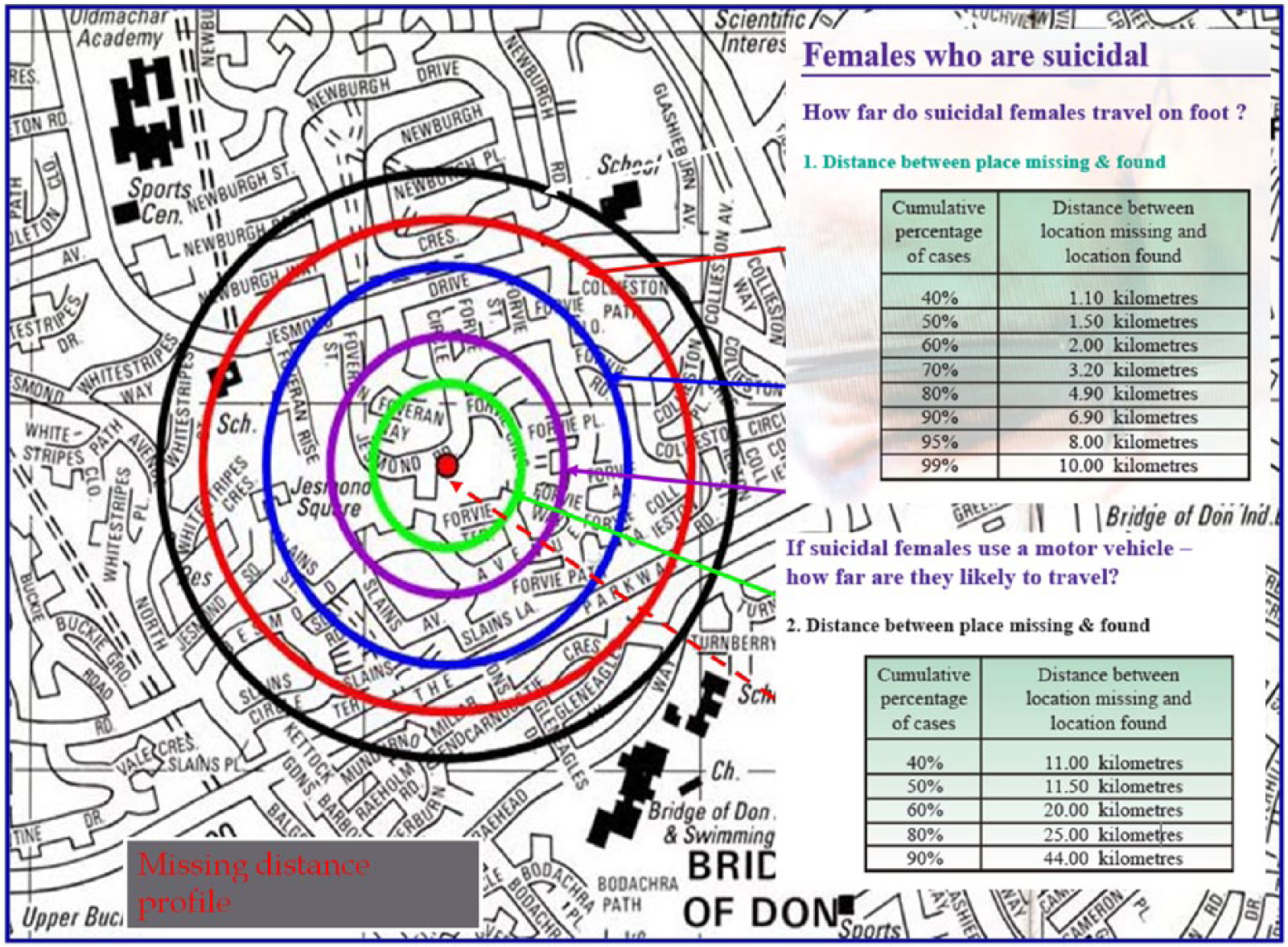
Predictive spatial behaviour data mapping produced by Grampian Police. © Grampian Police.
Storying subjective accounts of missing journeys is another way to understand more about missing people’s experience, with the ambition of providing learning resources for people-sensitive policing and tracing scenarios, rather than honing operational skills for locating the missing in any one case (as a new software intervention might). These are stories that are produced in ways that are intended to be potentially operationally significant, but will not necessarily or straightforwardly help police find missing people: they are intended to help create empathetic and affectual resonance among them, and this has unknown outcomes in terms of any ensuing policing practices.
In returning to some of the discussion above, we are wilfully and optimistically rendering a range of people proximate to the trauma of Sophie’s suicide attempt in the hope that hearing or reading her story will engage new interest in missing people in all their range and complexity. Her 24 hour missing journey is typical of a large majority of missing adult person cases handled by the police, 56 and it is these kinds of cases that the media often do not report because they are considered un-sensational and not noteworthy. Sophie’s story is thus an affectual intervention in which ‘the misper’ has a name, and is someone who expresses feelings, and who shows extraordinary geographical imagination and nuance in her short crisis-led mobility. On one level, then, this is a story clearly aimed at police officers who trace short-term adult missing people in order to encourage more identification and empathetic engagement, as well as to encourage people-sensitive geographical imaginations, rather than only relying on ‘spatial behaviour profile’ in tracing enquiries.
Here we are answering Edkins’ recent call for more specificity in missing person investigation and analysis. 57 She argues that ‘missing people’ or ‘missing persons’ are phrases we recognize, but often the personal is subsumed, or somehow amalgamated, especially in identification scenarios: ‘A focus on missing persons demands a focus on the specific, the particular.’ 58 It is Edkins’ contention that new ways of encountering missing personhood will help us to better understand our relationship to the data-rich state, and render it better able to deal with who we are, not just what we are. 59 Sophie’s story is one kind of specific response, it is particular and deeply personal, and is written in order to open up new conversations about who is missing and why, and what might be appropriate responses. Storying missing journeys is thus underlain by a creative ambition to enliven, personify and further specify ‘the absent’ for social purpose. Here we join with Pratt and Johnston, who have also argued that the stories which we tell as academics have effects, and that we might want to experiment with different stories in different ways to have different kinds of effects. 60 We turn now to consider these possible effects in more detail by way of conclusion.
Concluding notes: producing testimonial stories in media cultures
Stories push cultural geographers, and . . . cultural geographers might in turn push stories.
61
We must be alert to the practice of geography as process, and more sensitive to its affective or emotive dimensions . . . [We] can usefully remind ourselves that our stories should retain their human aspect; even if this leaves them as ‘messy’ or ‘partial’.
62
In writing and performing Sophie’s story (and others) as a traumatic, crisis-led mobility, we are actively producing new ways to creatively witness emotional geographies of missing experience. In reference to the above quotations, these are stories that we are pushing forward as messy and partial accounts of a barely understood kind of human mobility in order to end a marked silence about it. This is a kind of experiment, a cultural geography in process. This process, as we have already stated, is particularly bound up with wanting to provoke imaginative feeling-work in police officers who are being trained to trace missing people. It is our hope that the research project may help in providing resources for further cultivating sensitive police services in this area. Different stories will no doubt produce different affects and effects in individual workers, but in ways that are quite difficult to ‘measure’ and ‘evidence’ more collectively, although we are currently working with police training services to try to find ways to ‘account’ for these interventions. 63 Beyond police training, we are producing these missing stories with the ambition of raising awareness and starting new ‘public conversations’ about going missing among a range of groups, not least those who have returned. These ambitions are differently configured in and through different ways of performing, reading and telling the stories that are being written.
The first ever public performance of Sophie’s story was at the Glasgow University’s Human Geography Research Group’s Excursions conference in 2011. The audience there was broadly sympathetic to its ambition, and some were moved and perhaps disturbed by what had been attempted. Repeated performances in other conference and seminar settings have produced a range of comment around the use of trauma testimony, but our feeling is that the story has rendered the audiences concerned newly proximate to missing experience. While we may consider this a success of sorts, we are very well aware of the distances that still exist, and the many risks involved, not only with academic deliveries, but more related to the performative consequences of the stories beyond the academy – precisely the locations into which we are aiming to push the stories.
Missing people tend to excite much media attention and news-copy, and we are also often involved in conversations with journalists who are keen to report on the research project that produced Sophie’s story. 64 In deliberately producing media-friendly emotional geographies of missing trauma, we are acutely conscious that our research, and any stories that are produced from it, constitute risky kinds of ‘public geographies’, 65 not least because of the exclusions and assumptions that may result. 66 The stories that we are writing and performing (and mainstream news media renditions of them are a kind of performance) are not co-written with the people who gave their testimony (a practice one of us has adopted previously), and so the wider responsibilities of this very assertive act of creative writing are profound, especially in mediatized cultures. Pratt has pointed to the risks of public work with testimony in deeply unsettling ways. 67 She highlights how testimonial acts might re-circulate stigma rather than remove it, and she supposes that there are real affective blockages which occur between peoples and places, and therefore the risks of going public with some personal stories may well outweigh any benefit. In the case of missing person testimony, we then might question what possible public response could justify our creative writing work? In partial answer – partial because we cannot yet know what will become of these stories and their failures – we can only claim to be trying to start public conversations about going missing in what seems to be a space of silence – and our efforts are initially made towards the very groups who register this absence the most: returned missing people and their families.
In interviews with both of these groups as part of our wider project work, one of the most disturbing aspects of missing experience has been reported as the silence surrounding it. This might be a silence experienced actually within families when a person reported as missing returns; all parties being so traumatized by the profundity of an act of missing absence that they literally do not know what to say. For others, especially those families who have not yet had the difficult benefit of return, the stories may hold some insights, offer ‘a’ voice through the pervading silence. It will not be their loved one who speaks, but someone, saying something about what it is, what it feels like, to go missing. There are 350,000 incidents of reported missing persons in the UK each year,
68
many of which are repeat cases, and yet there is no missing ‘community’, no NGO specifically for and about missing people themselves (the UK charity Missing People is an organization for support of families), no missing stories of adult experience currently available (beyond what the media choose to profile). In producing such narratives, then, we are assuming that there is a possibility of moving a wider public (perhaps enabling political support for state-funded missing services, for example), and we are also hoping to assist families in finding a place to start talking. More particularly, we are aiming to prompt possible collectivities (not communities) of people who have been absent and who go absent regularly. This collectivity could, at the very least, be one in which it is possible to share stories of missing experience – as at present ‘going missing’ is represented as an almost entirely isolating and individual(izing) event (and see www.geographiesofmissingpeople.org/missingstories). Even in an age of ‘wound culture’,
69
this act seems currently unspeakable, and so it is a trauma that might be ‘attended’ to by some story work. It would be beneficial to repeat and extend some thoughts from Pratt, cited earlier, in further articulating our intention. She argues:
We hope to tell stories about grief in such a way that a wider witnessing public cannot keep its distance, and is neither numb to nor able to voyeuristically gaze upon the spectacle of suffering and shame in ways that further objectify and dehumanize. These witnesses must come in closer, listen more carefully. We hope that the narratives that we present produce contradictory and ambivalent emotions – emotions that provoke analysis and critique, rather than replace it.
70
Pratt is not intending to replace grief by creative renderings of her testimony, and neither are we; and likewise, we cannot simply replace the trauma of being missing with hope, nor completely close any affectual gaps that may still exist. The stories and their performances do, however, hold possibilities; 71 and this potential is the very stuff of human cultural geography.
There may be something possible, then, about these stories enabling a new kind of conversation about being missing as they are downloaded and replayed and distributed in annual training courses and beyond. 72 Writing multiple stories about missing experience – and that might be repeatedly retold – perhaps encourages us to think beyond simplistic categories 73 and helps us to counter the risk of Sophie’s story being ‘read-off’ as a ‘singular and romantic’ or ‘exploitative’ account. In the process, it may be that we engender new ways of storying not only missing experience, but also human geography, as hinted at the start of the paper. Here human geography is being practised creatively and with qualitative data in working cultures (police based) that have primarily understood the discipline as providing cartographic tools and techniques. 74 This additional ‘translation work’ that underlies our own project may not be at odds with possible futures of cultural geographies, as Wylie has recently visioned them when discussing ‘conceptualizing and practising cultural geography as performance; as creative writing, as photography and video, as site-specific art, as different forms of mapping and diagramming’, 75 but in ways that can still have social purchase. Indeed, he also notes ambition for the ‘practice [of] cultural geography as a form of writing both critical and creative, at once scholarly and story-like’. Sophie’s story is a tentative experiment in this regard, and can be understood as an outworking of a disciplinary ambition sharing ‘a desire for different types of writing, methods, formats and “outputs” and a shared stress also on the affective, emotive and praxis-based aspects of life’. 76 This creative experiment is also part of a longer term attempt to keep dealing with difficult humanity and its geographies, 77 not shying away from unsettling trauma. 78 Even if we cannot always bridge the gaps that trauma produces, 79 at the very least we might be better able to recognize it, and thereby begin to talk about it differently.
Footnotes
Acknowledgements
We thank participants at the 2011 Excursions conference in Glasgow for their comments and reflections on ‘Sophie’s story’. We also thank Nick Fyfe and Penny Woolnough for their teamwork in the wider missing people project, and Chris Philo for a critical reading of a version of this paper. Particular thanks go to Caleb Johnston and Deborah Heard for creative advice on writing and performing Sophie’s story.
