




Abstract
This article argues for the potentially transformative value of using historical fiction in the teaching of undergraduate history. While there is substantial scholarship ably demonstrating the value of historical fiction in primary and secondary education as a tool for encouraging engagement and interest in history and helping younger students to develop empathy, there is less discussion of the utility of historical fiction in higher education. Through critical reflection on our teaching practices and a student survey, we argue that in addition to encouraging engagement and the development of empathy, historical fiction can be used in university classrooms to help students to grasp key elements of academic history that they frequently struggle with: the constructed nature of historical writing and the contingent nature of scholarship.
Keywords
Introduction
Historical fiction is a widely popular genre of literature, film and tv, demonstrated by the huge success of authors like Hilary Mantel, films like Oppenheimer and series like The Crown. Historical fiction is also attractive to educators hoping to engage students in history (Rodwell, 2013). Some historians have taken to writing historical fiction themselves, using historical fiction to complete the stories we cannot tell within the disciplinary boundaries of historical scholarship, but ‘know’ to be true (Slotkin, 2005: 223; Smith, 2022). However, while there is a body of research discussing the use of historical fiction (and its benefits and risks) in primary and secondary education (Beck et al., 2000; Beckett, 2022; Booth, 1993; Brugar and Whitlock, 2019, 2019, 2019; Dwyer and Martin-Chang, 2023; Foster et al., 2016; Jackson, 2020; Martin and Brooke, 2002; Mills, 1995; Rodwell, 2013), the discussion of its use in third-level education is far less developed and tends to focus on either specific experiences or on its use in teacher education programmes (Eaton, 2018; Howell, 2014; Hower, 2019; Mehta and Mollmann, 2020; Yeager and Wilson, 1997).
In this article, we argue for the utility of historical fiction in third-level history instruction beyond the traditional uses to engage and entertain. Just as it does for younger learners, historical fiction can help engage students, but it also can do much more. In contrast to textbooks and some academic history writing, which may be constrained by space, lack of sources, and a need to focus on key players, historical fiction can allow for the full development of a wider range of past actors. Consumption and creation of historical fiction can help students to develop historical empathy, as it enables them to put themselves in the place of these characters (Dwyer and Martin-Chang, 2023; Mills, 1995; Smith, 2022). When carefully done, historical fiction can also take steps towards correcting archival imbalances and silences, by allowing writers to recreate, and students to understand, the lives and experiences of subaltern, oppressed, or silenced historical actors, whose voices we might otherwise lack or only possess in heavily mediated forms (Mehta and Mollmann, 2020: 43; Smith, 2022: 400). Historical fiction also provides students with a more comprehensive understanding of the experience of the past; novelists like Margaret Atwood and Hilary Mantel have explained just how intensive their research processes are, seeking out the minutiae of the past, which are crucial to worldbuilding but often extraneous to academic work (Atwood, 1998: 1514; Demos, 1998: 1528–1529; Mantel, 2017). Nevertheless, these details are fascinating to students and can help them visualise the ‘otherness’ of history. Historical fiction can also help students to understand the historical – and thus changing – nature of things they think are timeless (Eaton, 2018). Finally, historical fiction can also be used to get students to think about how stories are told in the present about the past (Pinto, 2010: 200).
We, like many other historians teaching at third level, have used historical fiction in our own classes. One of us teaches a module examining the blurred lines between academic history, popular history, and historical fiction (discussed below). At the same time, we are very aware of the potential risks of using historical fiction in the classroom, made most prominent by scholars at University College London who raised the alarm about the dangers of widespread use of John Boyne’s The Boy in the Striped Pyjamas in English schools, which they connected to students’ distorted understanding of the Holocaust (Foster et al., 2016; Jackson, 2020). However, when used sensitively and well contextualised, we think historical fiction has great value in third-level history education. In this paper we critically analyse the impact of an existing university module that uses historical fiction. We extend our analysis with a survey capturing undergraduate students’ experiences with, and reflections on, historical fiction. We argue that the module and the survey highlight the value of using historical fiction to teach students about the construction of historical narrative and the contingent nature of scholarship in addition to the traditional focus on generating empathy or engagement.
An undergraduate history module using historical fiction
McNamara’s module was created in response to a common problem among third-level history students: a difficulty in shedding a positivist understanding of history and grappling with the constructed nature of history and historical scholarship. Many students enter university history classes wanting to learn ‘what happened’ and find it difficult to grasp that there is not one historical ‘truth’ that their lecturers can impart to them or that they can discover on their own. Considering the constructed nature of historical fiction alongside the constructed nature of academic history thus provides students with a way to come to terms with this key element of the discipline and advance to more critical engagement with their studies. McNamara has been teaching and refining this module since 2019, first at a US regional comprehensive and now at Dublin City University. It explicitly asks students to engage critically with examples of historical fiction, popular history, and academic scholarship, and to create examples of fictional or popular content, in several media forms.
The module begins with a unit exploring questions of accuracy and narrative, truth versus fact (or accuracy vs authenticity, as explored by (Saxton, 2020)), by looking at reflective pieces by creators (Atwood, 1998; Kadish, 2018; Mantel, 2017), reflective pieces by professional historians who work as historical advisors (Greig, 2016; Greig and Jenner, 2016), and finally academic and popular pieces discussing the value of historical fiction and the boundaries that should – or should not – be maintained between it and academic scholarship (Carroll, 2011; Lepore, 2008; Schama, 2015; Slotkin, 2005; White, 2005).
When professional historians discuss their views on historical fiction, a key issue often raised is the constructed nature of historical narrative. When students read Keith Jenkin’s claim, cited by Richard Carroll, that ‘anyone who writes a narrative is fictionalising,’ they often resist, responding with a much more positivist understanding of history that hearkens back to the 19th-century Rankean ideal of history as science (Carroll, 2011). But through detailed discussions not only of historiographical trends – particularly the explanations of postmodernism offered by Hayden White and Richard Carroll – and more specific examples of how historians’ interpretations of documents are inherently individual and frequently conflicting, most students begin to accept the uncomfortable truth about their chosen field of study. This also allows for in-depth discussions of bias, of which many students have a very basic understanding. They have been trained to think about and try to identify bias, but in a way that paints bias as ‘bad’ and objectivity as ‘good.’ By discussing the constructed nature of historical narrative, they come to understand that bias is unavoidable and objectivity in history impossible: they develop a more nuanced understanding of how the historian should be aware of and attempt to limit biases in their reading of sources and their own interpretation and writing of history.
The rest of the module looks at four different types of media: podcasts, novels, television series, and films. Due to McNamara’s own expertise, the materials focus on early modern Europe (broadly defined as c. 1300-1850), but the specific topics and materials are chosen by popular vote. Thus the module is different each semester it is taught while the basic formula remains the same. The students choose the podcast, the novel, the series, and the film, and McNamara pairs each with reflective pieces on that media, scholarly sources on the history depicted, and primary sources relevant to the chosen piece. Throughout the semester, students are encouraged to consider the accuracy of the fictional works, the choices creators have made, and the impact of the work on the audience. Class discussions also incorporate criticism of the choices made, with students frequently making suggestions as to how the history could have been better portrayed. Finally, in discussing the assigned primary and secondary source readings, we discuss not only the content and its relation to the fiction, but also the interpretative and argumentative choices of the historian, applying a similar critical lens as that focused on the fictional pieces.
Students then demonstrate their mastery of these concepts through a mix of critical and creative assignments, both requiring additional research. Critical assignments ask them to choose another example of a particular genre, research the history depicted, and write a critical, research-based review that also engages with their own position on the appropriate boundaries between fact and fiction. Creative assignments ask them to produce their own example of that media (a podcast, a short story, a scene-length spec script, or a film trailer) set in early modern Europe, based on solid research. Alongside their creative work, they submit a reflective statement, in which they elaborate on their research and justify their choices, especially if they have chosen to introduce historical inaccuracies or ignore certain facts in service of their narrative.
This module, and Adelman’s experiences integrating historical fiction into various undergraduate modules, have convinced us that the inclusion of historical fiction is potentially transformative for history students at university, whether or not teaching is in their future. However, we wanted to ensure that we were using historical fiction in ways that best capitalised on its strengths and best avoided the pitfalls that have been noted for younger students. In order to better understand our students’ experiences prior to third-level education and their own thoughts about the value of historical fiction in educational settings, we devised an online survey.
Survey methodology
The survey (created using a Google Form) asked respondents a mixture of short and more reflective questions. We collected information on gender identity, year at university and degree programme. The first section of questions asked about two texts that we anticipated most students would have encountered at school: John Boyne’s The Boy in the Striped Pyjamas and Marita Conlon-McKenna’s Under the Hawthorn Tree (Gray, 2014; Ní Cassaithe, 2023; Rodwell, 2013; UCL Centre For Holocaust Education, 2022). We hoped this would allow for some comparisons with the existing literature on the use of historical novels in school history teaching. The second section then asked about broader experiences with historical fiction in personal reading or viewing habits and in the context of the classroom. At a basic level, we wanted to know what historical fictions the students were consuming, why they liked it (if they did) and what value they felt it had (if any) in the classroom.
With ethics approval, the survey was sent to around 500 undergraduates at Dublin City University who are either taking history as one of two subjects for a 3-year BA or as part of a 4-year BEd that results in qualification for secondary school teaching. We received 64 completed (anonymous) surveys, just over 10% of all students. Over half (53.1%) identified as female while 40.8% identified as male; the remainder selected ‘non-binary’ or ‘prefer not to say.’ This varies slightly from the student population taking history modules, where approximately 46% identify as female; female students are thus overrepresented in our survey sample (Data gathered from Dublin City University, student registration system, 2023).
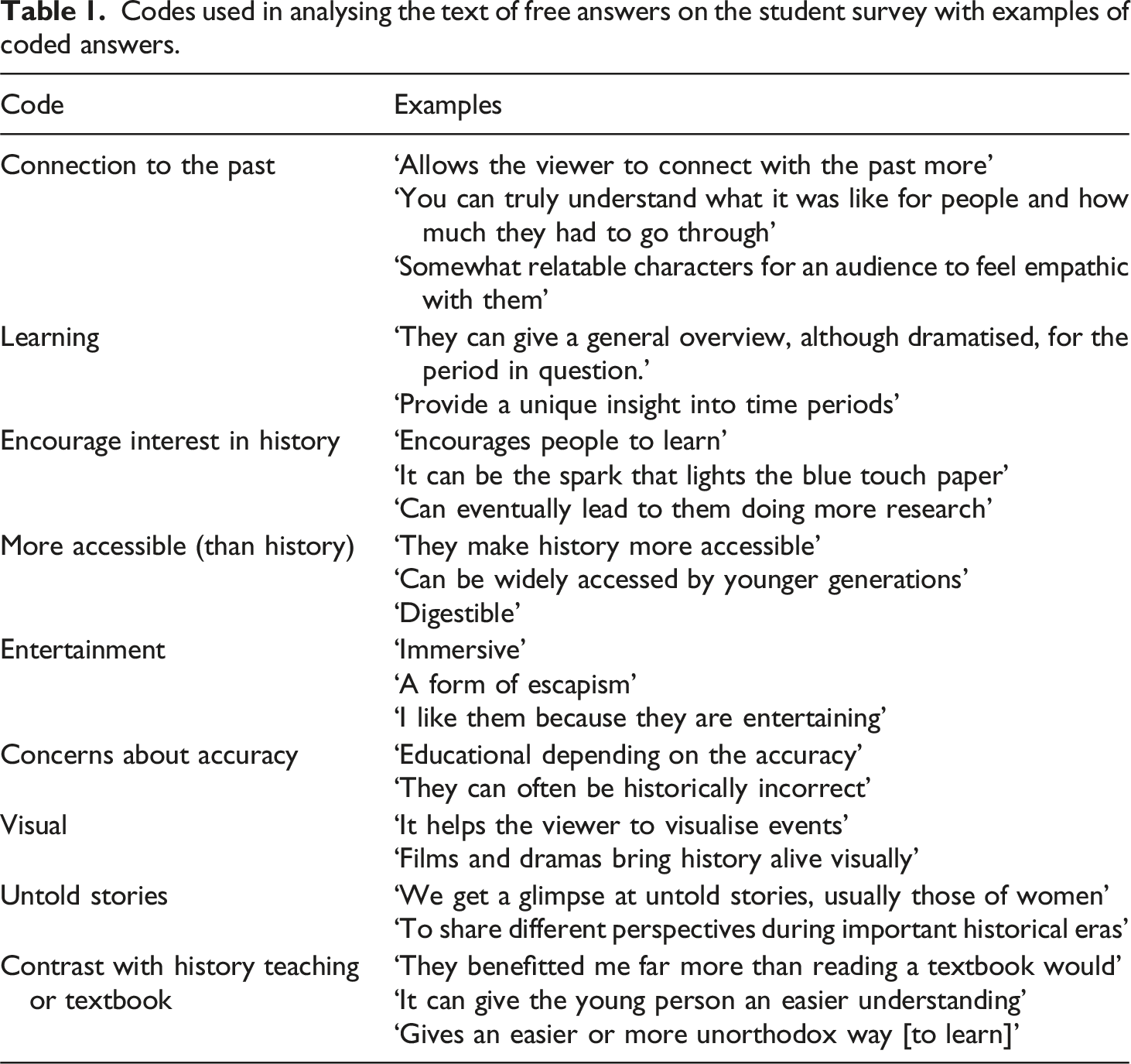
Codes used in analysing the text of free answers on the student survey with examples of coded answers.
The results of the survey confirmed that our students are very familiar with historical fiction and are avid consumers of it. However, the students also revealed a clear understanding of the limitations of historical fiction and expressed some concerns about its potential misuse in the classroom. Nonetheless, students did not make a connection between the constructed nature of historical fiction and the constructed nature of historical narratives. We suggest that a focus on this connection between the writing of history and the creation of historical fiction is both an appropriate and potentially transformative use of historical fiction in the university classroom. Teaching with historical fiction, we argue, provides a more accessible way to interrogate the nature of historical writing and helps to develop students’ skills in critical engagement with the discipline of history.
Encounters with historical fiction in primary and secondary school
Much of the literature on history and historical fiction has focused on its use in the school classroom. Scholarship suggests that historical fiction can enhance engagement with history and encourage empathy with historical actors. Our survey broadly confirms that this is how students have experienced historical fiction in primary and secondary school. We chose to focus on The Boy in the Striped Pyjamas (TBITSP) and Under the Hawthorn Tree (UTHT), texts that we expected many students to have encountered in secondary and primary school, respectively. Indeed, over 95% of our students reported that they had either read TBITSP or seen the film. Almost 55% of the students had seen the film and read the book. Over half (53.1%) had encountered the book or film in school. Over 45% of our survey respondents had read Under the Hawthorn Tree and a further 5% saw the film. Almost all of these had experienced it in a school context.
There are also similarities between TBITSP and UTHT that we thought might provide us with insights into how students engage with, use, and understand historical fiction. Both works deal with large scale historical trauma (the Holocaust and the Great Famine respectively) but are written for the consumption of children. They have been embraced by schools as one way of teaching about these difficult periods of history. Studies have shown that TBITSP is widely used in English schools and our survey suggests that it is also widely used in Ireland around age 12 to 13. Under the Hawthorn Tree is also very familiar to our students and was endorsed by the state curriculum for use in fourth class in primary school (age 10) (Pollack, 1997). Copies of the book in ‘class sets’ for school use are available throughout the public library system and further copies are in school libraries (Libraries Ireland Online Catalogue, 2023). Conlon-McKenna has also continued a circuit of school visits since the book’s publication in 1990.
For those not familiar with the novels, brief plot summaries may help. TBITSP follows Bruno, the son of a Nazi officer, as his family moves out of the city to a rural area where his father oversees a concentration camp. There Bruno befriends Shmuel, ‘the boy in striped pyjamas’ who is a Jewish resident of the camp. Bruno is unaware of the meaning of the concentration camp or of the existence of antisemitism. His naivety is his undoing when he sneaks into the camp and follows Shmuel to his death in the gas chamber. The book is subtitled ‘a fable’, underscoring that it is fiction and not based on real individuals or a real concentration camp (although most readers have assumed the camp depicted is Auschwitz) (Boyne, 2006). UTHT follows the journey of three siblings during the Great Famine in Ireland (1845-1850) after the death of their baby sister and the disappearance of their parents (Conlon-McKenna, 1990). The novel covers a few months during what may be 1847, considered by historians to be the worst year of dearth, as they try to scavenge for food and make their way to an aunt’s house where they believe they will find safety.
While both texts deal with sensitive subjects, TBITSP has been at the centre of a debate about the potentially damaging impact of its use on children’s understanding of the Holocaust. The Centre for Holocaust Education at University College London found that a high proportion of teachers in England use the book or film while teaching the Holocaust (UCL Centre For Holocaust Education, 2022). Focus groups with some of these students have suggested that the book contributes to ‘(re)framing Germans–and in some cases even Nazis–as “victims” too’ (UCL Centre For Holocaust Education, 2022; referencing Foster et al., 2016, 93). The popularity of the film has extended its influence and, for some researchers, its potential damage with one headmaster asking how it can ‘tackle antisemitism and opposition to Holocaust education when the protagonists are overwhelmingly German and the Jewish characters in the film are only ever presented as weak, vulnerable and helpless?’ (Gray, 2014). Research suggests that some students take away from the book or film the idea that many Germans were ignorant of the Holocaust and did not hold antisemitic views. This contradicts abundant historical evidence about the wider German public before and during the Third Reich (Schrafstetter and Steinweis, 2017).
The historical narrative around the Great Famine has been debated by academic historians and was, until the 1990s, considered under-researched. In the context of ‘Irish Revisionism’ (a historiographical movement that sought to make Irish history politically neutral, see (Brady, 1994)), some historians downplayed the British government’s responsibility for the Famine and placed more emphasis on the vulnerability of the agricultural system, population pressures and the culpability of absentee landlords (Kinealy, 2006: xix–xxii; Ó Gráda, 2006: 264–265). Some historians even revised the death toll downwards (Jackson, 1999: 70). These interventions were countered by other historians who suggested that revisionist histories had removed a sense of horror and sympathy for victims, almost blaming them for their situation. Thus a children’s novel on the Famine has the potential to stir debate in Ireland. However, Conlon-McKenna has not been criticised for perpetuating historical inaccuracies. In TBITSP, the appealing character of Bruno and the emphasis on the Nazi family allows readers to take away a deep untruth about systemic prejudice and violence, about who is victim and who is perpetrator. By concentrating on the children of a poor labouring family, Conlon-McKenna has chosen to depict those who were unequivocally the victims of the Famine. She has taken advantage of one of the benefits of historical fiction: to humanise and individualise the story of those who are often considered as statistics in academic history. Further, the narrative is silent on the issues of blame and scale that have vexed historians.
We wanted to know what our students had retained from their engagement with TBITSP and UTHT and how it might have impacted their understanding of the relevant historical events. We asked them a basic open-ended question: ‘What do you remember about the story?’ The majority of students mentioned that The Boy in the Striped Pyjamas was about or set in a concentration camp (60%) although a smaller number mentioned Nazis specifically (38.3%). Over half remembered TBITSP as a story of friendship (51.7%) and a smaller number described the emotional experience as sad (21.7%). Surprisingly, fewer than half of the students mentioned that the camp contained Jews or that the child prisoner was a Jew (46.7%). They were more likely to recall the name of the German protagonist: seven responses mentioned Bruno by name and only three mentioned Shmuel (one called the Jewish child ‘Saul’). Many of them also remembered Bruno’s naivety or innocence (28.3%). They wrote that Bruno was ‘too young to understand what is going on at the concentration camps’, that he was ‘unaware of the plight of the Jewish people’, he hasn’t ‘fully grasped the situation at hand’. However, Irish students were not very likely to extrapolate this to mean that ALL Germans were unaware of the concentration camps. In fact, only two respondents made a generalisation beyond Bruno’s viewpoint saying that ‘the rest of the family was unaware that the camp was killing people’ and ‘I think the only person aware of this [the presence of the concentration camp] from the start was the father’. Further, several respondents noted the lack of historical accuracy as presented in the book or film. They remarked that they remembered ‘it was a fictional story’ and that it ‘seemed unrealistic’ while another criticised the fact that ‘we were expected to sympathize with the nazi [sic] who got his son killed at the end’ and another suggested that the ‘German boys [sic] death [was] portrayed as being more sad then [sic] the mass number of Jew deaths’.
Perhaps because they had experienced UTHT at a younger age than TBITSP, students had fewer detailed memories of it. Close to 35% of the students mentioned death in their answer about what they remembered. In the words of one student, there was ‘lots of death’. This is interesting because there is only one intimate discussion of a death in the book (the children’s baby sister) but this had significant emotional impact. Conlon-McKenna explained that she chose to have the family’s infant die at the start of the book despite the possibility of distressing young readers because of reality and accuracy. She wanted this event to signify to readers ‘I’m not telling you a fairy tale’ (Marita Conlon McKenna talks about ‘Under the Hawthorn Tree’, 2013: 7:34). Over half of the students who responded mentioned that the book was about the Great Famine and 38% recalled the narrative as one of migration or flight. However, few recalled key historical details such as the fear of workhouses (13.8%) or the employment of people on public works projects (13.8%). Mostly it was a story about family or siblings (55.2%) that happened to be set during the Famine.
What is similar in the responses to both texts is that more than half of the students who answered remembered the relationship between the characters (friendship in TBITSP and family in UTHT). This is not surprising as it is surely people and their relationships that draws readers and viewers to historical fiction as it draws us to most fiction. However, this might serve as a reminder that using historical fiction to teach history has potential pitfalls. As discussed below, many of our students reported that historical fiction would be a useful way to encourage interest in history in the classroom. Certainly teachers in the Irish primary school system are currently using UTHT as an aid to teaching about the Great Famine. Adelman is aware from the experience of her own children in school and personal correspondence with those engaged in training primary school teachers that Under the Hawthorn Tree is taught with the use of supplementary factual resources (Ní Cassaithe, 2023). A larger survey population would be required to get a better understanding of the impact of this experience. However, the relationships set up in both UTHT and TBITSP are not well-grounded in the historical record. For example, UTHT distorts the factual reality for young children during the Famine: they were more likely to die than their parents (Boyle and Gráda, 1986). TBITSP posits a friendship between a Jewish prisoner and the child of a Nazi officer overseeing the camp where the child is imprisoned. Such a friendship, indeed even the opportunity for the son of a Nazi and a boy in the camp to regularly interact, would have been all but impossible. Jewish children were exterminated or died in higher numbers than adults. Further, while some Germans did resist prejudice and try to help a Jewish friend or relative, this was relatively rare and Bruno’s ignorance of Jews or antisemitism is one of the least plausible aspects of the story. Several thousand Jews survived the Nazi regime because they were hidden by a friend or relative. The Germans who resisted in this way were, however, unusual, and antisemitism and a desire for the Jews to be expelled was widespread (Niewyk and Nicosia, 2000: 111–113).
Our students’ recollections of TBITSP and UTHT suggest that the texts were used to encourage engagement and empathy and that they were broadly successful in this way. The responses underscore the need for teachers to provide significant context and supplemental historical materials and not to allow novels and period drama to stand in for history texts. Further, we support the conclusion of other scholars that teachers must carefully consider the texts that they choose and, where relevant, which historical actors the students are being asked to empathise with. The remainder of the survey sought to probe the students’ consumption of, and thoughts about, historical fiction both in and out of the classroom.
Student consumption of historical fiction
The survey results confirmed that our students are avid consumers of historical novels. Asked to list favourite historical novels, the students named 72 different texts. Among these titles were 15 novels that were not historical fiction but fiction written in the past including works by Jane Austen, Charlotte Bronte and Leo Tolstoy. A further five titles were either popular history or memoir rather than fiction, one was a contemporary novel with ‘history’ in the title and another was a play written in the past.
The survey also showed that their consumption of historical novels mirrors their preference for areas of academic study: the majority of texts were set in the twentieth century. World War II and particularly the Holocaust were the most popular subjects with seven students listing The Tattooist of Auschwitz and four The Book Thief as favourite books. Over 60% of students who responded listed at least one novel set during WWII as a favourite book and over 74% of students listed at least one novel set in the 20th century. Of the 50 unique historical fiction titles or series listed by students, 34 were set in the 20th century (if a series title was given, then it was included in the count if it contained a title set in the 20th century).
Our students consume more, and more diverse, period dramas. Survey responses included 93 different films or TV series. Only a very small number of these would not be categorised as historical fiction but rather docudramas (e.g. one on the Ottoman Empire and another on the Medici family). The most popular period drama, cited by 12 different students, was The Crown followed closely by Pride and Prejudice, Bridgerton and Little Women. (We considered modern television and film interpretations of historical texts to be ‘period drama’ while the texts themselves are not historical fiction as they were set at the time they were written.) While WWII and the 20th century dominated titles, this was less pronounced than with the novels: 38% of students listed at least one WWII film or tv drama and 78% listed at least one film or tv drama set in the 20th century.
We therefore conclude that our history students are exposed to and actively consume a range of historical fiction, with a definite preference for the modern period. Further, many of them use historical fiction as a starting point for research of their own. For example, over 60% of students reported that they research before or after reading a novel and over 70% research before or after watching a period drama or film, demonstrating both curiosity and an understanding that historical fiction does not give the full picture and is not necessarily historically accurate. Their focus on the twentieth century also suggests that sensitive use of historical fiction set in earlier periods in higher education might be a way to encourage a broadening of academic interests.
The value of historical fiction
We also wanted to understand how students value historical fiction personally. Many of our students go on to teach in both primary and secondary schools, so their opinions might also impact their own teaching in the future. We asked a series of open-ended questions about the value of historical fiction that allowed them to add as much detail in their response as they wanted. The answers varied in length from a single phrase to a full paragraph. Using interpretive content analysis, we scrutinised the responses for recurrent themes and phrases and developed a set of codes that reflected the most commonly repeated ideas (Drisko and Maschi, 2016). The codes are listed and explained in Table 1. We then assigned codes to each individual answer and calculated their frequency across the survey answers. A code was only counted once per individual answer even if the idea was repeated several times by the same student. An individual answer often contained statements aligned to more than one code, even within a sentence. For example the statement ‘can provide a digestible introduction to a topic someone can find potentially interesting’ was coded as both ‘learning’ and ‘more accessible than history’ because it suggests that historical fiction can result in learning about a topic and implies this information will be easier to assimilate (‘digestible’).
Students were asked about the value of historical fiction, on screen and in books (‘What do you think the value of historical fiction novels, television, and/or films is? Why do you like them (or not like them)?’). Five students chose not to answer the question so our analysis is based on 59 answers. Of these, almost 39% of responses mentioned either education or learning in their answers and a similar percentage (40%) credited historical fiction with encouraging an interest in history. Other recurring themes included the idea that historical fiction can provide a connection with the past (40%), a visual representation of the past (13.5%) or untold/different stories (7%). Students also believe that historical fiction is more accessible than other forms of history (20%) although they have concerns about its accuracy (15%). Only 15% noted the value of historical fiction as entertainment (perhaps a reflection of what students think their lecturers want to hear rather than anything else).
To assess the students’ feelings about how historical fiction can be used in the classroom we asked them ‘Do you think historical fiction novels, television, and/or films should be used in schools? Why or why not?’. The answers were coded using the same system described above. The following analysis is based on 62 answers out of 64 students who completed the survey (2 did not answer the question).
Almost all students thought historical fiction was suitable for use in primary school (95%) or secondary school (90%). In more expansive answers it was clear that students regard historical fiction as an antidote to history texts that were perceived as duller and more difficult. For example, students cited the value of a visual experience (11%), a connection with the past (14.5%) or contrasted historical fiction favourably with other forms of teaching or learning from textbooks (22.5%). However, around 29% of students worried that historical fiction might be inaccurate and that this should limit its use in the classroom. Almost half of the students thought that the value of historical fiction was to encourage interest in history (42%) and a similar number thought that students could learn history through historical fiction (41%).
In summary, historical fiction was perceived by the students who responded to the survey as a good way to encourage an interest in history with the caveat that it could be inaccurate or misleading. This response seems to reflect their own experience of The Boy in the Striped Pyjamas and Under the Hawthorn Tree in primary and secondary school. Most of them enjoy historical fiction and think it is helpful for engagement (and thus using it was valid at least in some classroom settings, with proper framing). But missing from their thoughts on historical fiction was any consideration of the construction of historical fiction - they do not seem to be thinking about how creators of historical fiction are making decisions, doing research (or avoiding it), or why they choose particular ways to tell their stories. Throughout their responses, students demonstrated a very positivist understanding of history, and thus their primary concern with historical fiction was whether or not it was ‘true’ or ‘accurate.’
This gap in students’ thinking about historical fiction, we argue, is where its most significant potential for third-level students lies. Of course, we can still use it at third level to increase engagement and to help students continue to develop historical empathy. But we can also use it to help develop them as historians, to push past more positivist understandings of the discipline and encourage them to engage with the craft of history writing.
Conclusion: Optimising the use of historical fiction in higher education
Although there are undoubtedly risks to the use of historical fiction in the history classroom, there is definite value in its inclusion. When used sensitively, with clear contextualisation and opportunities for student engagement through research, historical fiction promotes student engagement, encourages student research, helps to develop historical empathy, and, at an advanced level, pushes students to grapple with the limits of historical knowledge. Our survey suggests that students are aware of the limitations of historical fiction and period dramas and concerned to mitigate the effects of potential bias or factual inaccuracy. However, they are much less aware that fiction is not the opposite of history. As historians, we often find it difficult to help students to understand the constructed nature of historical writing, which is crucial for their own ability to approach scholarship critically. Teaching with historical fiction can help them develop this important but difficult skill.
Our survey supports the design and intentions of the module on historical fiction. The module is successful in generating engagement and empathy, the usual reported reasons for teaching with historical fiction (Hower, 2019). Students are deeply engaged. Enrolments have always been full, attendance levels high, and participation robust. Further, the students translate this engagement into a desire to research and learn. In the context of a 15-week US semester, students completed projects for three units (of four); in the more compressed Irish semester, they complete two projects. They must explore different time periods and/or geographies, and they must write or create in different styles as they are required to do one of each type of project. Thus they expand their content knowledge of early modern European history and also develop different styles of writing and presenting research. Given that most of our students expressed familiarity with works set in the 20th century, this particular module is also an opportunity to give them exposure to a wider variety of historical fiction and popular history.
Moreover, the engagement with historical fiction and especially the process of producing their own examples of the genre helps students to further develop their historical empathy, as they must understand their characters enough to figure out what they would plausibly do and say; many say they read primary sources on a very different level after completing this project, as they are more attentive to small details, the use of language, and also to what is not said; they start to see the silence in the archives.
In addition to learning new content and modes of expressing their research, which we might also find at a different level in primary or secondary school settings, students are pushed to engage differently with academic scholarship and with their chosen field of study. By looking at history and its expression in a new way, students develop the confidence to critique not only popular history and fictional history, but also the scholarship they read. They become much more aware of and comfortable with the constructed nature of academic scholarship, and begin to take more ownership of their own interpretive lenses as historians.
Though they often struggle at the beginning with postmodernist scholarship that challenges the empirical model of history many of them still cling to, by the end of the module they are typically comfortable with the idea that historical scholarship is itself a sort of fiction, or at the very least not a solid fact. This helps them to engage with scholarship more critically, to ask the questions of academic sources that we often struggle to get them to ask, and to not take what they read at face value, as simple fact. In student module evaluations, students mention learning ‘not all history is as it seems’ and ‘never trust everything you see or hear,’ ‘to be an independent thinker and not take every popular source as pure facts,’ ‘to think critically about the historical fiction we consume, as well as the common understandings of history that may be based on a lie’ (State University of New York at Cortland, Course teacher evaluations, 2019, 2021; Dublin City University, Student Survey of Teaching, 2024).
The impact of the module extends beyond the requirements of the assessments and encourages a more critical lens on media consumption generally. As one student expressed in an evaluation, ‘I feel I have gained a new skill that can be translated elsewhere’ (DCU, SSoT, 2023). Many students who choose the module, like many of our survey respondents, say that they already do their own research before or after engaging with historical fiction. But the few who had not previously made this a practice mostly walk away saying that they will in future. As one student wrote in their evaluation of the module, ‘I enjoyed looking at the flaws of fictional history as before this I would’ve watched stuff or listened and nearly just took them at their word (how naive of me!) but I won’t be doing that anymore’ (DCU, SSoT, 2024). And it is our sense - and hope - that this also extends to other sorts of sources they engage with in their daily lives, including news media and social media; once they start to question or engage critically with received wisdom, that tendency spreads. One student wrote that the module helped them to think ‘about the media we consume in a different light whether that be through more scepticism or just looking at what we can get out of a certain text’ (DCU, SSoT, 2023). Developing a healthy scepticism about what they consume is the one consistent thread every time the module has been taught. Teaching with historical fiction, then, can not only encourage engagement and the development of historical empathy, but it has the power to help students achieve a more nuanced and critical view of the discipline of history and, potentially, of a wider range of media claiming to tell them the ‘truth’ about something in a world increasingly threatened by powerful and compelling lies.
