




Abstract
Studying modern languages has been part of Australian tertiary education from close to its beginning. This study, which uses an online content analysis approach, analyses current units of study in each Australian public university teaching modern languages. Set in the context of the origin and development of this field, together with contemporary debates regarding the value of studying the humanities in general, and modern languages more specifically, this research offers detailed analysis of what is currently being taught, and how public universities are framing the merit and utility of teaching modern languages. Our analysis reveals that the study of modern languages remains relatively vigorous, but there is a high degree of institutional isomorphism at play. The findings show that many universities offer very similar fields of study across the board, albeit with some surprising omissions of languages that are of strategic significance to Australia’s national interests.
Introduction
Scholars have examined the teaching of modern languages in Australia from various angles, including the impact of government policy on the funding and choice of languages (Hamid and Kirkpatrick, 2016), the actual languages taught (Crozet, 2008), student motivation (D’Orazzi, 2020), equity in the provision of languages (Molla et al., 2019), and the rationale for teaching languages (Mason and Hajek, 2020; Scarino, 2014). Baldwin’s (2019) extensive treatment of the history and the political background of modern languages in Australian higher education represents an important touchstone for this study, with her extensive survey of the pedagogical and policy contexts shaping language teaching being the most extensive work on the topic in recent times. To date, however, no study of the full scope, depth and relevant strength of undergraduate modern language education in Australian public universities per unit of study has been undertaken, with the current study adding the additional dimension of examining the way in which these universities have articulated the value of language education.
The following analysis first provides historical context for instruction in modern languages in Australian public universities, including the previous centrality of them in the humanities. Next, we analyse every unit 1 of modern language instruction that has been advertised as being available in Australian public universities in 2024 (n = 1504). Underpinning this fine-grained analysis of what is taught, the study also examines, in thematic fashion, the value propositions associated with learning a modern language, with these public-facing value propositions being regarded as justifying the rationale for learning modern languages at the public university in question. By value proposition, we mean a succinct statement on a public-facing website that articulates the value of studying a course of study and provides a short but enticing rationale for why people should enrol. Our focus, however, is not the approach to teaching a modern language in terms of pedagogy, but on the decisions made by institutions regarding what they teach and why.
Although the teaching of modern languages continues in the majority of Australia public universities, there is reportedly a sense of crisis building in the humanities (Ahlburg and Roberts, 2018), with this “pessimism”, as Moss (2004: 125) calls it, going back to at least the early 1990s, a view supported by Pascoe (2002), but called into question by Brown et al. (2019), who opine that the ‘crisis’ has been somewhat overstated. Regardless, degrees that policy makers deem lacking in relevance have lost their previous funding support (Jay, 2014), an outcome which suggests that policy makers in both the government and the senior executive tier of universities regard languages as lacking sufficient value for taxpayers. With the humanities coming under significant public scrutiny, particularly manifested in the Australian federal government’s recent decision to raise the tuition fees for humanities education, many students have been pushed to study putatively more practical STEM-based courses (Department of Education, Skills and Employment, 2021).
Indeed, the Australian Government’s Jobs Ready Graduate Package (JRGP) emphasized that universities should be teaching their students content that will lead to “job readiness” (Department of Education, Skills and Employment, 2021). Since then, a change in the Federal Government brought with it the 2024 Australian Universities Accord, which critiqued the previous government’s JRGP and the deemphasizing of humanities and communication studies in general: “the 113% increase in student contributions for Commonwealth supported students studying communications, humanities, other society and culture, and human movement units needs to be corrected as soon as possible” (Australian Government, 2024: 251). The emphasis on utility and employability that prevailed under the JRGP could have put education in modern languages in a very parlous position, particularly if links between language education and employment had not been made clear. Specifically in terms of languages, the Accord noted the limitations that the JRGP placed on teaching foreign languages and using language instruction as a means to deepen regional engagement. It also specified that “the [university] system has not been successful at projecting and acting on opportunities for skills development that would help Australia engage better with our region (e.g. Indonesian language skills)” (Australian Government, 2024: 195).
Changes to fees are indicative of an uncomfortable relationship between government policy and the humanities that have traversed Australian governments for decades, regardless of the party or parties forming government (Charles et al., 2022). While a centre-right-leaning Coalition government was responsible for the aforementioned cuts to funding support for the humanities, it could be argued that these developments have their roots in the wide-ranging Dawkins reforms. Initiated by the centre-left-leaning Hawke-Labor government in the late 1980s, these reforms were viewed by many as a backlash against the humanities (Forsyth, 2014: 118), and as disparaging the value of theory compared with ‘useful’ work skills (Hajek and Nicholas, 2004). Yet, with respect to language education, one might expect it to be comparatively easier to defend, at least compared to areas like classics and ancient history (Charles and Harmes, 2023).
A discourse of ‘crisis’, however, also pervades the teaching of modern languages in a more general sense throughout Australia, including how they are publicly discussed in the media (Mason and Hajek, 2019). This discourse is contextual and includes data that the number of students in Grades 11 and 12 (senior) in Australian high schools studying a language has now fallen below 10% (Printcev, 2023). Indeed, the figure has never moved beyond 15% over the past few decades (Mason and Hajek, 2020), despite ongoing rhetoric about the importance of learning languages in a highly multicultural nation that is heavily reliant on international commerce (Black et al., 2018; Scarino, 2014). As today’s high school seniors are tomorrow’s undergraduates, these figures would appear to indicate an impending collapse in tertiary language enrolments that has already been prefigured by universities’ planned cuts to their modern language offerings (Heffernan and Carroll, 2023). As early as 2005, Martín (2005: 69) referred to a sense of crisis in university departments offering languages, so it would appear that this crisis is set to deepen as new students move to other areas.
Our ambit is ‘the study of modern languages in Australian public universities’. This definition, which encompasses the viewpoint that language study can mean interrogating texts of various types in modern languages other than English, was used to guide the data collection and precludes the study of topics that are more properly understood as cultural studies. We take a modern language to be a living language taught outside its host culture (e.g., French taught in an Australian public university). A living language can be differentiated from other language offerings such as Latin, Classical Greek or New Testament Greek, which now exist primarily through academic study, not through a living use. This study examines each publicly funded university in Australia to determine where modern languages are taught at the bachelor level to identify the range, type and vitality of this teaching. Our focus on public universities is driven by contextual factors, including the current political emphasis on studying courses that are both practical and contribute to ‘job readiness’, and where government policy can directly intervene in university decision making – which prompts the question of how the public value of undertaking this type of education is communicated, emphasized and even defended in an environment that is largely inimical to humanities education.
Brief historical background
The data analysed in this study is of current language offerings; however, these offerings are the product of long institutional developments that have expanded, contracted and changed which languages are taught. Latin and Classical Greek were the first languages other than English taught in colonial universities, which characteristically began with a core professoriate that included a Professor of Classics. Living European languages soon became available and indeed mandatory for study in the Liberal Arts. French, which was also literally the international lingua franca, and German, a language central to the study of science and philosophy, were early offerings. They were furthermore embedded in study as matriculation and study requirements. For example, the University of Melbourne for a time maintained French 1A as a compulsory unit in the Bachelor of Arts (Poynter and Rasmussen, 1996: 211). French and other mainstream European languages such as German maintained status and scale in Melbourne’s Faculty of Arts and could be described as “the larger, older language departments” at Melbourne, compared with Dutch, Swedish, Italian and Asian languages (Poynter and Rasmussen, 1996: 373). Similarly, by the early twentieth century, the Faculty of Arts at the University of Adelaide offered French and German, including at Honours level (Fornasiero and West-Sooby, 2012: 155).
The dominance of European languages in general derived from multiple factors. As Trigg notes, an inherent sense of “cultural rightness” permeated some intellectual circles, such as statements in 1960 by the medievalist John Gilchrist (cited in Trigg, 2016) that “Asiatic studies have a place in Australian universities”, but “to argue that because Australia’s nearest neighbour is Indonesia, therefore the schools ought to teach Indonesian and drop French and German” was unthinkable. Crozet (2008) and Hajek and Nicholas (2004) place this sort of thinking in an essentially elitist attitude to language derived from British educational traditions. As Trigg (2016) observes, points such as these combine racial as well as conservative views and are reflective of largely unchanging pedagogical assumptions regarding the value of studying European culture, all of which helps to explain the continued dominance of German and French over Asian and even other European languages.
External factors, including government policy, have impacted on which languages are taught and why. The post-war expansion of Australian public higher education beyond the earlier sandstone institutions brought more universities into existence. Their modern language offerings, however, were institutionally isomorphic and nearly all Australian public universities that existed in 1974 taught French, with most also teaching German. Italian and Modern Greek, described by Black et al. (2018: 349) as “community languages”, also eventually made their appearance, largely because of post-war immigration (Martín, 2005), although there was a presence of Italian at the University of Sydney as early as the 1930s (Baldwin, 2019: 35). Asian language units were still thin on the ground in post-war Australia, despite emergent changes in government policy towards engagement with Asia and the emergence of multiculturalism as an identifiable intellectual and social policy, as was manifested by the appointment of Al Grassby as Immigration Minister in 1972 under the Whitlam government and the contemporaneous final dissolution of the White Australia Policy (Martín, 2005).
The consistency in and similarity of language offerings at a tertiary level reflected the languages taught in primary and secondary schools up to at least the 1970s, where “French and German dominated” (Ozolins, 1993: 38) and where, since the 1960s, 97% of school students studying a modern language matriculated with either French or German (Ozolins, 1993: 86). However, by the 1950s, most universities had abandoned what was characterized as a ‘foreign’ language matriculation requirement and, in schools, progressive updates to curricula shifted and ultimately diminished the place of languages both classical and modern in place of vocational and technical subjects (Martín, 2005). In time, the dominance of French and German in both schools and higher education also shifted according to the impact of government policies and cultural changes, including the greater proportion of funding given to Asian languages under the federal government’s 2012 White Paper “Australia in the Asian Century” (Parliament of Australia, 2012), together with language-specific strategies for greater engagement with China, Japan, South Korea, Indonesia and India (Baldwin, 2019: 190; Hill, 2012: 2).
The competing forces of globalization and neoliberalism soon came to shape language policy and provision. Indeed, globalization, combined with the notion of the upcoming ‘Asian century’ and the seeming prosperity of the ‘Asian tigers’, suggested the necessity of greater cultural and economic engagement with Asia from the 1980s onwards, with this including the teaching of Asian languages (Hamid and Kirkpatrick, 2016). Neoliberalism, however, underscored the diminishment of humanities offerings in Australian universities, including languages (Black et al., 2018). In that sort of climate, specific and specialized areas of study eventually fell victim to economic cuts. For example, Macquarie University had in 1983 established a full Department of Slavonic Studies to teach eastern European languages and culture. As will be discussed below, some vestiges of this now-disestablished department remain, such as Croatian and Russian language majors, but the wider and deeper opportunity to learn other Slavonic languages has vanished (Koscharsky and Pavković, 2005). As our data below show, among Australian universities, the ANU retains a distinctively wide and strong language provision, with the possibility existing that stronger academic governance and infrastructure upholds these offerings. In particular, the Centre for Arab and Islamic Studies and the Schools of Culture, History and Language and Literature, Languages and Linguistics appear to provide clearly delineated institutional support for language teaching. Research projects at ANU also foreground the importance of bilingual education, early exposure to second and third languages, and linguistic diversity (Perez, 2024).
The neoliberal impulse in higher education is placed centre stage in Dunne and Pavlyshyn’s (2012) study of language offerings in Australian higher education, a study which represents an important but now dated survey that nonetheless serves as an important precursor to this research. Their results (taken in 2011) showed “relative stability” in the languages offered in Australian public universities, and they accordingly provide a useful benchmark against which to compare the data collected for this research. As of 2011, French, German, Italian, Indonesian, Japanese, Chinese (Mandarin) and Spanish were the major languages taught in multiple universities. Noting and interpreting this stability, which is also a sign of the sameness in offerings, Dunne and Pavlyshyn attributed the situation to university business models that demanded that course offerings break even, a priority which discourages adventurousness in the curriculum. As per our data analysis, we have found the exact same combination of languages dominating in 2024. As we further suggest in our discussion, this seemingly unmovable hegemony of language choice largely omits globally important languages including Hindi, Portuguese and to some extent Arabic, a circumstance at odds with the internationalizing value propositions of many universities.
Since the 1980s, a further challenge to more traditional humanities studies has emerged, often referred to as the so-called ‘invasion of others’. This phenomenon has been described as resulting in considerable fragmentation in the humanities with respect to discipline areas and the conceptualization of these discipline areas (D’Acci, 2004). In many parts of the Western world, traditional humanities disciplines, including the study of modern languages, have had to compete with emerging fields such as women’s studies, gender studies, cultural studies, media studies, and queer studies (Bérubé and Nelson, 1995; Hall, 1990). The advent of such areas of study, with their origins in activism and advocacy, have resulted in further consternation for the humanities as a whole, with right-of-centre politicians, in particular, perceiving that such theory-heavy subjects cannot pass the infamous ‘pub test’ (Piccini and Moses, 2018), and thus should not be supported by the public purse. With these thoughts in mind, we now turn to the study of languages in Australian public universities, both in terms of the data for offerings and the way in which these universities expound the merits and benefits of these offerings.
Methods
The discussion and findings rest on two primary datasets created for this study as a part of an online content analysis approach (Krippendorff, 2012). The first is the fine-grained analysis of the unit offerings at every public Australian public university teaching modern languages. The second dataset encompasses the value propositions (short, public facing statements encouraging enrolment and study) that these universities currently articulate as justification for the value of these teaching areas and, of course, to encourage enrolment in them.
The web presence of all Australian public universities offering education in modern languages was investigated using online handbooks, together with the webpages of individual units. A small pilot sample of four universities was chosen in the first case to determine the efficacy of the data collection tool that was developed in Excel for this study. It soon became clear that some universities were still advertising units that no longer existed, so it was determined that only those units that were explicitly available in 2024 would be recorded, with this being achieved by consulting a combination of the online handbook and the webpages of individual units in order to ascertain stated availability.
Basic data for “education in modern languages” was collected along the lines of modern language type being offered at a Bachelor’s level. As often occurs with the online content analysis approach, some difficulties arose when determining what data might fit a specific category; in particular, concerns were encountered about what, exactly, would be regarded as education in a modern language. First, a ‘modern language’ was deemed to be a living language other than English that is regarded as an official language of a nation, which meant that the studyi of Indigenous Australian languages was not included. Second, a unit needed to involve working with or interrogating material other than English. If no evidence of that could be found in the unit’s official online description, generally found on a dedicated webpage for that unit, it was not included. Thus, a “French Popular Culture” unit that looks at material in French would be included, whereas a “French Popular Culture” unit where such materials would be looked at in translation would not. In some cases, this was difficult to determine, but, if a unit stated, as a prerequisite, that a certain amount of “European Culture Studies” was required, but made no mention of “French Language”, such a unit was deemed most likely to use translations. The task was sometimes simplified via statements on individual unit webpages such as “This unit is taught in English”. A small number of units, particularly those of a cultural nature, claimed that the unit was suitable for students with no modern language exposure, or could be undertaken by students studying a particular language, with the students looking at different material and undertaking different assessment items according to their language abilities. Such units were included as they constituted further language education. Third, the very few units offered in a modern language program that focussed on a language’s ‘classical’ form were included, largely on account of their institutional location. Thus a “Classical Chinese” unit would be included, but “Biblical Hebrew” or “Ancient Greek” units would not, since the latter were not found to form part of existing modern language programs.
In addition, the pilot study found that some universities were wont to use what might be termed ‘shell units’ to add seemingly greater numerical strength to a major or a field of language study. Such units might be called “Advanced European Languages one” or “Advanced Asian Languages 2”, with students studying one of the European or Asian languages on offer being able to pursue additional language studies in such units. Some of these units involved undertaking education in the target language at an international host university. Owing to a lack of specificity regarding the taught content, and ambiguity relating to the resourcing arrangements, it was decided not to count such units.
Note that some universities allow their students studying, say, a Bachelor of Arts to study a major in an approved modern language at a nearby university. For example, Queensland University of Technology offer a few units in Chinese, but, if you want to study another language, you must do so through members of the Brisbane Universities Language Alliance, namely Griffith University and the University of Queensland, where multiple modern languages are on offer. As a result, only the language units actually offered by each public university were recorded, as offering the language signifies an ongoing financial commitment. Thus, students of Brisbane’s three major public universities can all study a major or second major in Indonesian, but only the University of Queensland is regarding as offering this language from a data collection perspective.
Next, whether it was possible to study a major was recorded. In line with the study of Charles and Harmes (2023: 9) on the presence of classics and ancient history units in Antipodean public universities, the possibility of studying a major represented “a kind of proxy of the degree to which the broader discipline area remained well defined and identifiable among the university’s other undergraduate offerings in the humanities”. In much the same way as the aforementioned study, the possibility of extending one’s education was also deemed relevant, and so whether Honours was available in any modern language was recorded. Connection to a particular language was often unable to be verified, with the ability to study Honours with a focus on a particular language depending on multiple factors, including the availability or interest of appropriate staff. In short, we record merely whether Honours is available in a modern language. 2
Like Hogan et al., 2021 study on the public value of business education in Australia, the value proposition of the university entity providing education in modern languages at each institution was also recorded. This was deemed necessary to understand how the public entity in question, such as a school, department or discipline area, was positioning itself regarding questions of public utility and relevance that have been raised in the context of humanities education. In short, these value propositions are the statements made on public-facing university webpages that articulate the value of studying modern languages at that particular public institution, with these webpages usually being devoted to introducing an academic discipline or study area. Once collected, these statements underwent thematic analysis, a qualitative data analysis technique originating with clinical, social and psychological research, with this approach facilitating “identifying, analysing, and reporting patterns (themes) within the data” (Braun and Clarke, 2006: 79). Core ideas and repeated points emerged as a result of this analytical process, which, given the number of value propositions recorded (n = 26), was able to be undertaken manually without the aid of software. Thematic analysis of language, and especially the use of verbs, also allowed the identification of core ideas and repeated points in these statements through what was mainly an inductive process (Braun and Clarke, 2006).
All data collected for analysis were subjected to rigorous double-checking and then discussion between the researchers to ensure inter-rater reliability, which forms a fundamental element of validation when using the online analysis approach. The data collection process occurred from mid-November 2023 until early January 2024.
Findings
Broader findings
There are 37 publicly funded Australian universities. Of these, 26 have some kind of teaching presence in the area of modern languages at the Bachelor’s level; c. 70% of the total. Of the 11 universities that do not offer such education, 3 Victoria University does still offer a Graduate Diploma in Modern Languages in Chinese, Japanese, Vietnamese and Spanish, while James Cook University’s Academy of Modern Languages offers short courses in Chinese, French, Japanese and Spanish. Many of the universities included also have similar programmes, such as University of Queensland’s Institute of Modern Languages. Some of these 11 universities also had modern language study at the Bachelor’s level until comparatively recently, such as University of Canberra, University of Southern Queensland, and James Cook University, while other universities have abandoned specific languages, such as Indonesian at La Trobe. Regardless, let us look at the representation of individual languages at the 26 universities that teach modern languages at the Bachelor’s level.
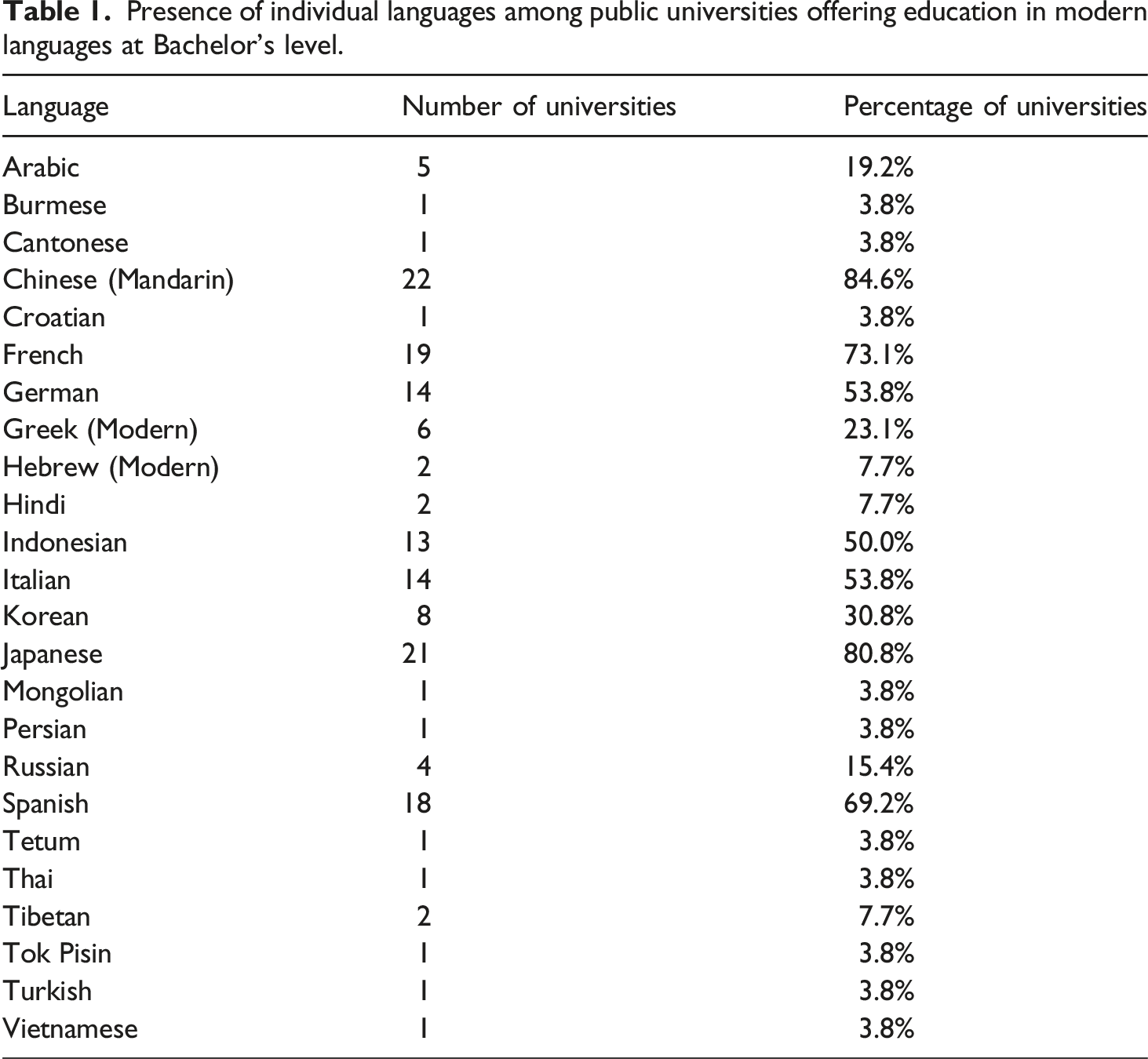
Overall, 24 modern languages are taught at Bachelor’s level in Australian public universities. A clear leader is presented by Chinese, with 84.6% of the universities offering modern languages choosing to teach this language. In close second place comes Japanese at 80.8%, with French (73.1%) and Spanish (69.2%) making up third and fourth places respectively. From there, we find both German and Italian in equal fifth place at 53.8%, and Indonesian coming in at sixth with 50.0%. Then there is quite a dip to the seventh most commonly found language with Korean at 30.0%. In fact, if we lump the frequency of the top seven languages together, that is, 121 out of 160 individual languages offerings at Bachelor’s level across the sector, it becomes clear that just over three quarters of the public universities offering modern languages would have some sort of combination of Chinese, Japanese, French, Spanish, German, Italian and Indonesian for 2024.
Finer-grained unit analysis of units
Presence of individual languages among public universities offering education in modern languages at Bachelor’s level.
Presence of individual-unit categories among public universities offering education in modern languages (languages in alphabetical order).
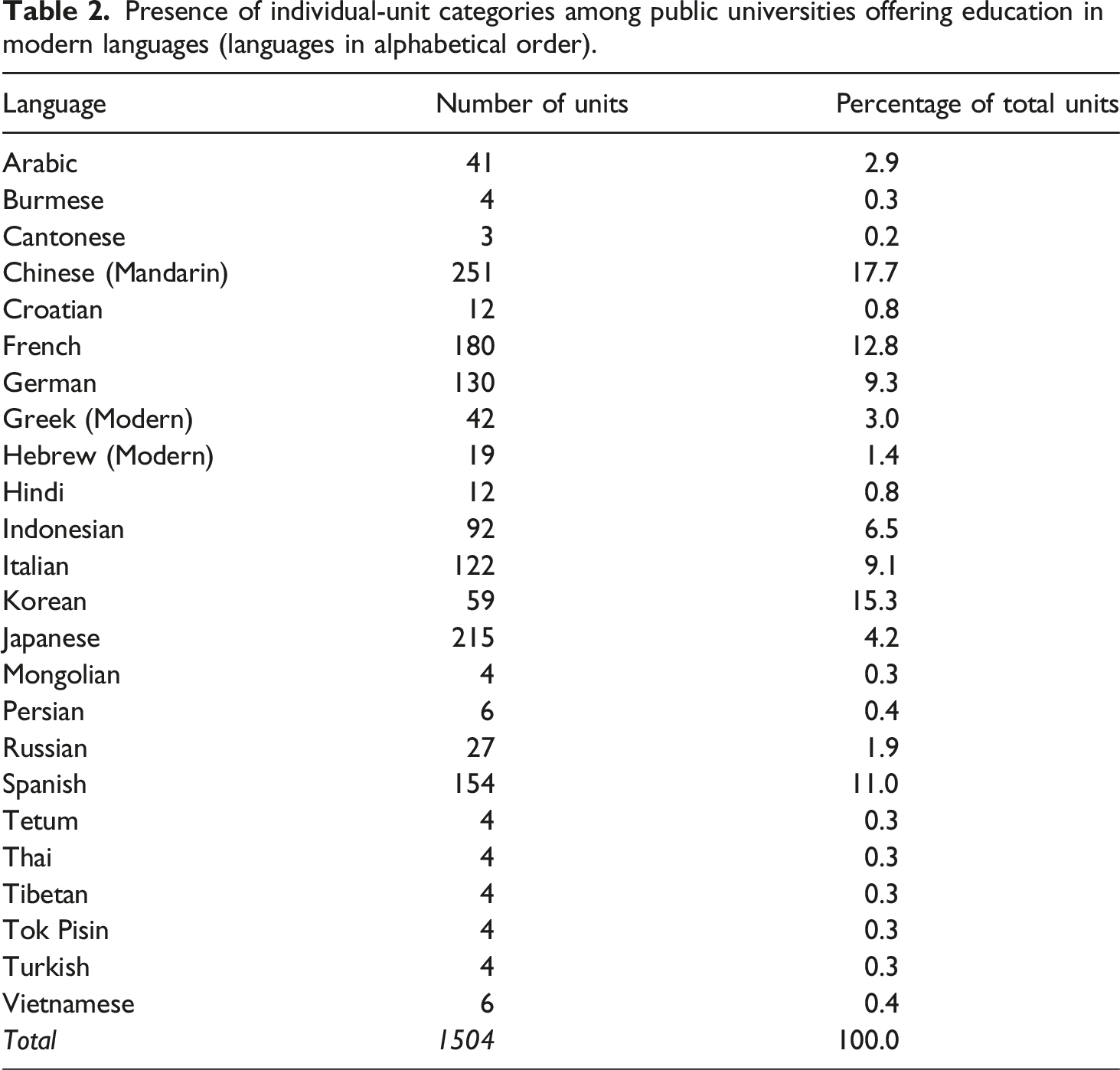
As can be seen, 1504 individual units met the definition of ‘education in modern languages’ put forward in the methods section. Table 2 reinforces the ubiquity of Chinese and Japanese language instruction, but shows that, compared to other languages, more units overall are available, compared to, say, other relatively commonly taught languages such as French or Spanish. In many universities, Chinese and Japanese have multiple entry points, depending on the student’s existing proficiency. For example, a student wanting to study Chinese might start at the beginner’s level, an intermediate level, or an advanced level. This means that more language units are required to enable that student to complete a major in that language. In some instances, universities have developed units that are for native speakers of Chinese only, thus adding to the total unit number. Some universities also have multiple entry points with the European languages, such as French and Spanish in particular.
The other reason why some languages are so well resourced is that they cater not only to language studies per se, but also to cultural studies undertaken either completely or partially in the target language. While Chinese and Japanese might have more ‘pragmatic’ units involving instruction on vocabulary and grammar, the popular European languages, especially in well-resourced Go8 universities, tend to have a selection of cultural studies units attached to their language majors. These units might delve into, for example, French cinema, or Italian poetry, or German literature. While these units might interrogate work in the target language and thus lead to greater language proficiency, they likely also have the additional function of making language studies more appealing to those studying language as a vehicle to gaining a better understanding of particular cultures. One might also link the existence of such units to the aforementioned so-called ‘invasion of others’ that has become commonplace in the humanities (D’Acci, 2004), with online unit information about such offerings often referring to “gender”, “sex”, “women” and “identity”. That is not to say that units dealing with Asian languages do not also follow, on some occasions, the same path.
On the opposite side of the spectrum, many universities offer only a bare minimum of units. For example, a major in a particular language, regardless of the institution, typically comprises 6 units of language instruction, plus a cultural-type unit in the target language, plus some sort of history or cultural unit that is taught in English, or else something even more generic such as ‘European Literature’ or ‘Asian Religions’. The situation is, of course, even more austere for those languages only offered as a minor – or worse – mere electives. Such is the case for those languages where only four or six units in the language are offered nationally, such as Burmese, Cantonese, Mongolian, Persian, Tetum, Thai, Tibetan, Tok Pisin, Turkish and Vietnamese, most of which are found at only one university, namely the Australian National University (apart from Tibetan).
Majors and honours
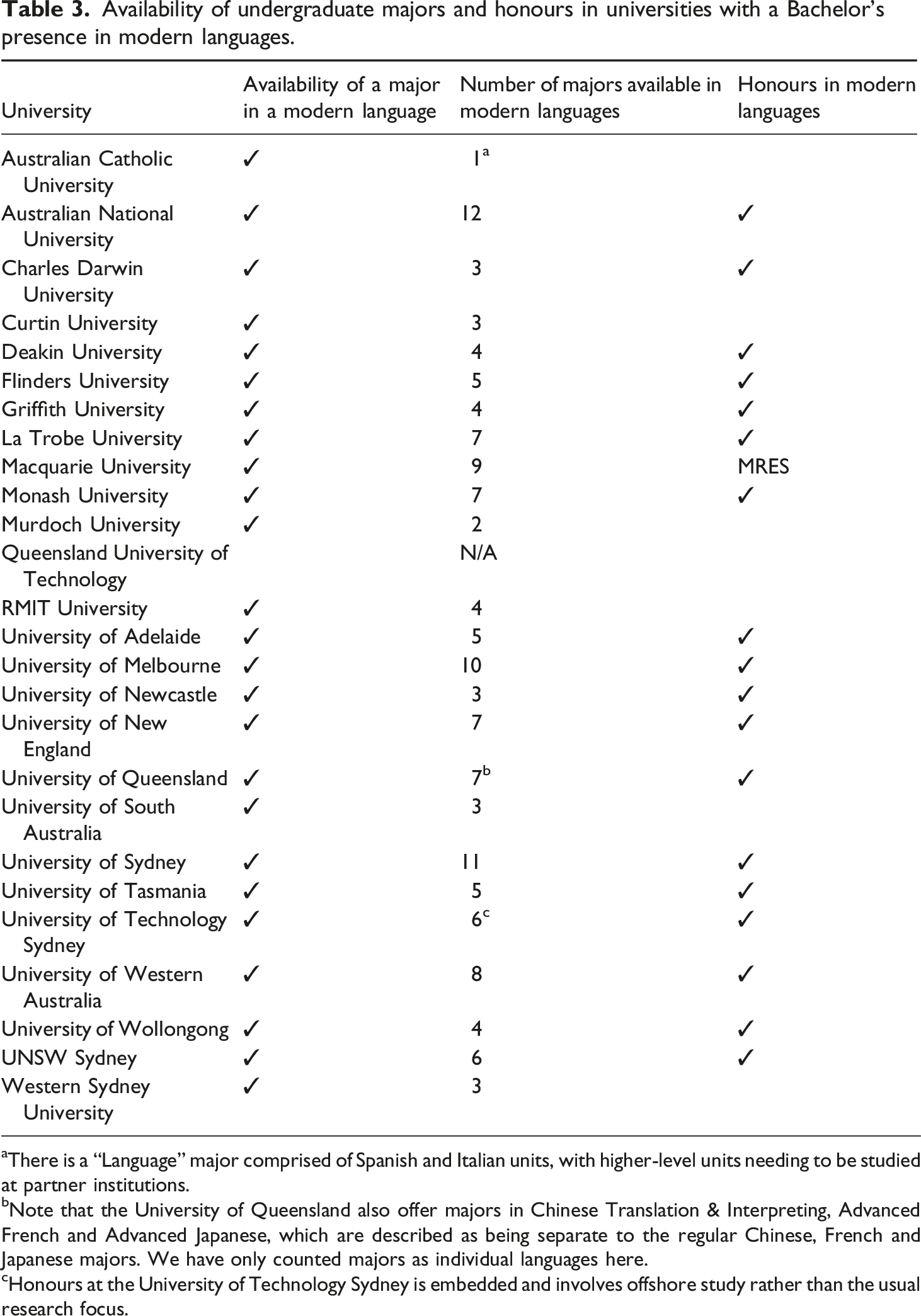
Availability of undergraduate majors and honours in universities with a Bachelor’s presence in modern languages.
aThere is a “Language” major comprised of Spanish and Italian units, with higher-level units needing to be studied at partner institutions.
bNote that the University of Queensland also offer majors in Chinese Translation & Interpreting, Advanced French and Advanced Japanese, which are described as being separate to the regular Chinese, French and Japanese majors. We have only counted majors as individual languages here.
cHonours at the University of Technology Sydney is embedded and involves offshore study rather than the usual research focus.
Of the 26 public universities teaching modern language units, almost all offer at least one of these languages as a major. The exceptions are Queensland University of Technology, which only teaches a handful of Chinese units, and the Australian Catholic University, where students can amalgamate introductory and intermediate Spanish and Italian units to form a “Languages” major, or else go to one of the university’s partners to continue their language studies. Note, of course, that several of the universities do offer language majors beyond the range they teach themselves. At Queensland University of Technology, for example, students can undertake a “second major” in a modern language at either the University of Queensland or Griffith University, which means that quite a wide choice of languages is available for their students. Likewise, Western Sydney University teaches three modern language majors and offers Indonesian as a major, but this must be studied at a partner institution. With respect to range, all the older Group of Eight (Go8) universities bar the University of Adelaide offer, nor unexpectedly, a major in at least half a dozen modern languages, with the Australian National University topping the table with 12 modern language majors. In addition, La Trobe University and the University of New England offer a relatively comprehensive range with seven majors, while the University of Technology Sydney offers six. In general, if a university offers a particular modern language, there is a high probability that a student will be able to graduate with a major in that language.
Questions relating to demographics and privilege present themselves in these data. Indeed, a report into second language learning in Australia concluded that the “most likely profile of a language learner in Australia is female, with a parent born overseas in a non-English speaking country, of high socio-economic status, with high achievement in literacy and numeracy and attending an Independent school in a capital city” (Asia Education Foundation, 2014: 8). It has been observed that, with respect to modern languages, the Go8 universities and their residential colleges (Hamilton and Hamilton 2024a) enrol a disproportionally high number of students who have been educated at elite metropolitan private schools; these schools have the resources to offer extensive facilities to their students including foreign language and immersive language teaching (Hamilton and Hamilton, 2024b).
As stated above, a major typically comprises eight units. Where the depth is somewhat slim, this often means a minimum of six units of language instruction, plus one or two other prescribed units that might be taught in the target language. Sometimes these units are shared between the various language majors. Such units are often of a cultural nature, although they can sometimes be literary, political or historical. In other universities, and especially among the Go8, there is greater choice, especially regarding elective units that can be undertaken within the major. For example, French at the University of Melbourne involves eight units of a literary, cultural, historical and even culinary nature that are taught in French, in addition to seven language instruction units. In other cases, such as the Japanese major at the University of Sydney, some of the prescribed electives include units that improve the student’s translation skills, or focus on archaic or classical forms of the language. Another possibility is various entry points. For example, at Deakin University, one might start one’s journey in Chinese as a complete beginner, someone with intermediate knowledge, or someone with advanced or ‘background’ capabilities. This is usually reflected in a higher number of language instruction units being available that is significantly beyond that required to complete a major, together with a solid array of cultural-type units offered in the target language.
Although most of the universities in Table 3 provide a package of language units that cohere well with the major’s underlying intention, being instruction in a particular language from beginners to advanced, some anomalies are present. A particularly unusual situation exists at La Trobe University for the core of the “Spanish Extended Major”, where students complete an array of language tuition units, but then must complete “Ancient Greece: Myth, Art and War” as well as “Globalisation and Development”. In a similar vein, those studying the Italian major can undertake “Gods, Love and War in Roman Epic” or “Women Throughout History in Southern Europe and Latin America”, units which seem to have little to do with acquiring a working knowledge of Italian.
With respect to Honours, most of those universities offering a major in a particular modern language are also likely to offer study at the Honours level in that language, as Table 3 indicates. That said, the ability to pursue this is likely contingent on the student’s proposed thesis topic being acceptable, together with the availability of suitable staff, who may be thin on the ground for some languages in some universities. Note that, at Macquarie, students are unable to undertake an Honours year, with those intending to pursue doctoral studies being required to undertake a Masters of Research (MRES).
Value propositions
Value propositions in all public universities offering Bachelor’s education in modern languages.
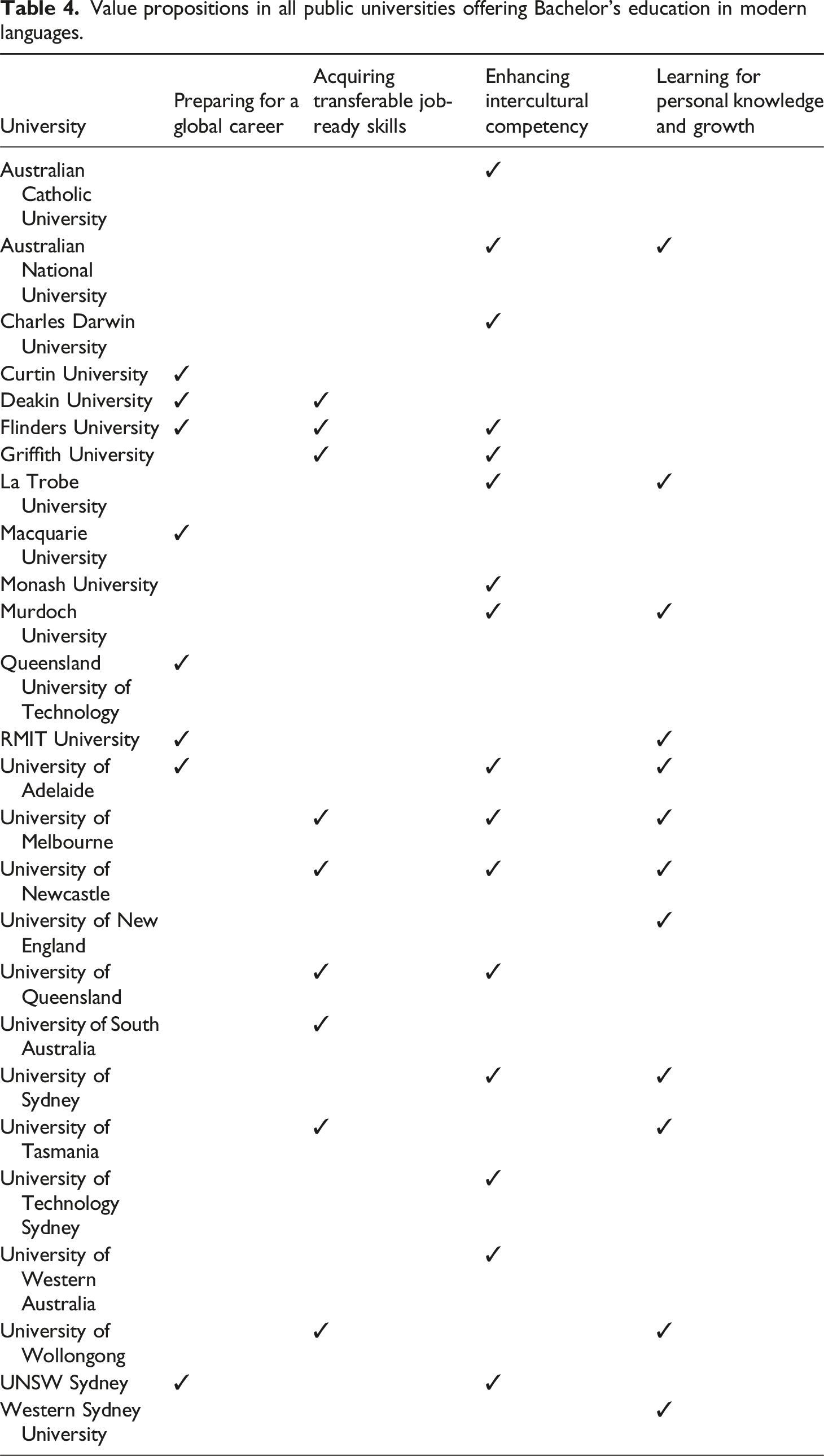
All universities offering education in modern languages could be aligned to at least one of the four value propositions identified in the process of thematic analysis, although it will be noted that there was no overarching value proposition for Curtin University’s language offerings, as there were separate value propositions for Chinese, Korean and Japanese that needed to be combined for analysis. All four identified value propositions are in some way intertwined, but are nonetheless relatively specific regarding the value to which they refer.
Although Preparing for a global career and Acquiring transferable job-ready skills might seem related, it soon became clear that they were quite separate. Note that universities generally made a clear distinction between these two value propositions, with only Flinders University pointing to both. The former value proposition makes clear the enticing proposition that the graduate will be able to find a job beyond Australian borders on the completion of their studies. For example, Macquarie University states that “Studies in languages and linguistics … will prepare you for a range of careers across the globe”, while the University of Newcastle proposes that “Those who have studied a second language are attractive for a range of jobs, especially those involving travel [and] ... overseas postings”. Australians are well known for their love of travel and working abroad, so this value proposition is likely aimed at students with these goals in mind.
In contrast, Acquiring transferable job-ready skills does not refer specifically to travel or forging a career in another country. Rather, it emphasizes that the skills gained while learning a modern language are in demand in the workplace and will help with securing gainful employment – wherever that workplace might be. Flinders University, for example, contends that “The ability to speak another language will open huge career opportunities for you” and adds that “You’ll stand out compared to other job applicants”. The University of Wollongong suggests that “Language skills are highly valued in our increasingly globalised world, with business, culture, and recreation conducted across borders”. Such a value proposition does not necessarily suggest working in other countries, but emphasizes the importance of language skills in a more interconnected world – something which is as important when using ICT media such as Zoom or Skype as it is when working in another country.
Enhancing intercultural competency emerged as the most prevalent of the four value propositions, with 16 of the statements mentioning this outcome for graduates. Thus, there appears to be a strong emphasis on the notion that learning a language represents a vehicle through which to gain a greater appreciation and understanding of other cultures. There is, of course, a link to the second value proposition as intercultural competence is clearly a desirable characteristic in the workplace, but this third value proposition adds a specificity not found in Acquiring transferable job-ready skills. For example, the Australian National University emphasizes that “The study of languages and cultures … provides you with insights into other societies, other ways of seeing the world, and other ways of relating to people”. Similarly, the University of Queensland refers to the importance of recognizing “the intersection of language and culture”. The University of Western Australia even adds that learning modern languages will allow its graduates to “Move between cultures with ease”. At first, some thought was given to a separate value proposition relating to global citizenship. Indeed, the University of Sydney, the University of Technology Sydney and the University of Western Australia all describe something along the lines of modern languages being a passport to “global citizenship”, but these three universities also strongly emphasized the importance of intercultural competence, so it was decided to join these two potential value propositions together.
Finally, and perhaps even a little surprisingly in today’s vocationally oriented tertiary landscape, 12 universities promoted the idea of Learning for personal knowledge and growth, which one might suggest aligns well with traditional value propositions for the humanities. Here, the emphasis is not necessarily on learning a modern language to find a job or travel the world, but to learn a language because it contributes to one’s education and personal knowledge base. The University of Melbourne’s value proposition even bluntly suggests that “Languages are great for your brain”, while the University of Newcastle observes that “Proficiency in other languages enriches personal growth”. Other value propositions speak more directly to the personal achievement associated with mastering another language, for example, the University of Tasmania’s notion that students will become “fluent experts”, or can study for study’s sake. While the University of Wollongong, as seen above, firmly ascribes to the value proposition of Acquiring transferable job-ready skills, it also adheres to the fourth value proposition by stating that “Language is a bridge to understanding; an appreciation of human expression through the study of literature or a second language will help you think analytically, and enhance your communication skills”. Such a statement is not directly connected to employability, as is the case with Acquiring transferable job-ready skills, but speaks to more traditional outcomes relating to studying the humanities.
Discussion and concluding remarks
The historical context presented above adduced several points including the long-standing dominance of French and German and the general institutional isomorphism of university language offerings. That historical context provides a meaningful benchmark for current data. Among European languages, French and German have retained their traditional dominance, while so-called ‘community languages’ like Italian and Modern Greek, though in decline overall compared to their heyday in the 1970s and 1980s (Hajek and Nicholas, 2004; Moss, 2004), still have a reasonably strong presence. However, they have been first joined and then overtaken by Asian languages, a development imbricated with multiple factors, including the emergence of the policy of multiculturalism and government funding that prioritizes Asian languages being taught in secondary schools. But the institutional isomorphism remains. As we noted above, in 2024, about three quarters of the public universities teaching a modern language have a combination of Chinese, Japanese, French, Spanish, German, Italian and Indonesian on offer. This isomorphism has had consequences, including, as will be discussed, the absence of other key languages.
This study has only reported on data from universities currently teaching one or more modern languages, but silent data, so to speak, are the numbers of universities that have wholly discontinued teaching second languages (such as University of Southern Queensland), or those which have progressively cut the number of languages offered. This has been achieved by either diminishing the number of units offered so a major is reduced to a minor (such as Russian at the University of Queensland), or cutting some languages, while retaining others (such as La Trobe University). Also apparent is the reduction in the institutional ‘footprint’ of languages, with schools and departments being subsumed by larger generic organizational units, such as the subsummation of the Departments of Romance Languages and German and Russian into a larger School of Cultural Studies at the University of Queensland, or the disestablishment of the School of Slavonic Studies at Macquarie University.
The data tracking Honours availability also indicates that permanent academic staff may not always be available to coordinate instruction in a language, again signifying a reducing institutional footprint. These points reveal that several universities are attempting to maintain a language offer on diminishing resources, but many are also offering much the same as other institutions. In terms of both policy and resourcing, the data reveal significant layers of duplication, yet they also show that some collaboration is already in evidence in the form of cross-institutional offerings. Given that today’s universities are required to function with less resourcing but are evidently duplicating efforts, the expansion of these cross-institutional offerings could reduce duplication, while retaining relatively broad coverage. Indeed, this form of rationalization could potentially stabilize a field that is frequently characterized as being in an enduring state of crisis. Given that language offerings in Australian higher education have already been critiqued from the perspective of privilege and equity (Molla et al., 2019), partnerships of this nature also represent an opportunity for modern languages to become available through regional universities that, at present, do not offer them.
A notable outcome is the general absence of Hindi, with only two universities offering it. While it may be true that many educated Indians are thoroughly conversant in English, and that English remains an official language in India, it remains surprising that there is so little interest in learning the languages that most Indians speak in their day-to-day lives. In 2012, the White Paper “Australia in the Asian Century” identified knowledge of, and proficiency in, Hindi as a major goal for facilitating regional engagement. In 2013, Dunne and Palvyshyn (2013) identified that government priorities were not aligned with university offerings and noted Hindi as one of the “endangered” languages in the ecology of higher language offerings, a view largely supported Brown et al. (2019: 51), where a “downward” trend is noted for “Southern and Southeast Asian Languages”. In more than a decade, this circumstance has not altered, with Hindi being a rare offering, even though India remains a major strategic partner for Australia (Baldwin, 2019: 190). If language really is a vehicle to understand culture, as many of the value propositions relating to modern language acquisition suggest, Australia is clearly missing an opportunity to improve its understanding of the culture of one of its most important partners – indeed the world’s largest democracy – if it continues to neglect instruction in languages such as Hindi, or even Bengali, which has a similar number of global speakers as the widely-taught French.
Worthy of comment is the complete absence of Portuguese, which is often described as the seventh-most-spoken language, with around 232 million native speakers globally (Middlebury Language Schools, 2023). Aside from Portugal and Brazil, it is widely spoken in various African nations. Learning basic Portuguese is not difficult for those with knowledge of Spanish, but it is nonetheless a separate language with its own idiosyncrasies and literary traditions and thus can serve as an access point to a variety of significant cultures. Although five institutions offer it, mainly in locations where a large Arabic-speaking community exists, Arabic would appear to be under-represented in terms of its reach, despite being within the top-five-most-spoken languages in the world (Middlebury Language Schools, 2023), despite significant dialectical differences. Given ongoing tensions between Western countries and the Islamic world, one would think that learning Arabic could be of great strategic utility, and could also assist with overcoming cultural differences, as Baldwin (2019: 158) suggests.
It is relevant to note that, while this research has focused on public universities and their justifications of the utility of offering languages, the expansion of tertiary education in modern languages also appears to be occurring in private universities or colleges, although such institutions are beyond our scope. The growing number of private universities in Australia (at the time of writing, the Australian University of Theology had gained university status in December 2024, making it the fifth) and the liberal arts focus of several of them (including the University of Divinity, the Australian University of Theology and Notre Dame University), suggests that the scope of modern language provision in the private tertiary sector represents an important area of future research. Another area of future research could be determining the impact that the current federal cap on international students could have on modern language offerings in the future (Turnbull, 2024), especially in the larger Australian universities that have relied heavily in recent years on funding from international studies fees, especially those studying business, to subsidize less lucrative offerings, such as the humanities in general and languages in particular (Hogan et al., 2021b). A possible outcome, for example, could be an increasing recourse to cross-listing agreements and/or language ‘consortiums’, such as that existing among Brisbane-based universities, as a means to reduce operating costs yet continue to offer a breadth of options, even if a more efficient usage of resources is probably required across the sector to avoid duplication and result in better value for money.
Footnotes
Declaration of conflicting interests
The author(s) declared no potential conflicts of interest with respect to the research, authorship, and/or publication of this article.
Funding
The author(s) received no financial support for the research, authorship, and/or publication of this article.
