



Abstract
What are the main views and perceptions of creativity of a music teacher? By administering an open-ended questionnaire to 11 music teachers, we sought to elicit responses to clarify what are their self-reported understandings of creativity; how they think musical creativity can be facilitated in a teaching setting; and how they can differentiate between individual and collective forms of musical creativity in the classroom. A thematic analysis gave rise to five categories, each addressing one or more of these dimensions from different angles. Findings indicate that our respondents tended to associate the development of a creative musicianship with generally positive concepts, attributing to it several interrelated meanings. In particular, the music teachers who took part in the study mentioned how fostering creative attitude in their students may involve stimulating their curiosity, changing their perspectives, and helping them navigate both personal and social domains; finally, our participants indicated that both individual and collective forms of teaching may display important constraints when creativity is placed at the heart of the lesson.
Introduction
Creativity is a central aspect of one’s musical life (Burnard, 2012; Cook, 2018; Van der Schyff et al., 2018). Creative thought and action greatly influence how we engage in a variety of musical activities, ranging from improvisation and performance (Berkowitz, 2010; Clarke and Doffman, 2017; Sawyer, 2006), to composition (Collins, 2005; Nagy, 2017) as well as education (MacDonald et al., 2000; Randles and Webster, 2013). Because the latter domain plays a key role in shaping musical growth and flourishing, developing insights into how creative musicianship is understood within pedagogical contexts is of primary importance. A way to do so involves exploring how the multifaceted phenomenon of musical creativity is seen and approached by music teachers in the context of their work. The present contribution seeks to address this broad theme through a thematic analysis of the verbal descriptions, reflections, and examples offered by a cohort of expert music teachers. Building on existing work that examines creativity as a capacity that can be taught and cultivated through practice and years of engagement in a given domain (see e.g. Simonton, 1997), we aim to contribute novel insights which can be relevant for future theoretical work as well as pedagogical practice in music.
This goal reflects a growing interest for research and theory devoted to inspiring richer understandings of how music teachers and students conceive of creativity (Kladder and Lee, 2019; Huovinen, 2021), how creativity unfolds through different forms of interaction between students or between students and teachers (Barret et al., 2021; Kupers and Van Dijk, 2020), and how creativity-based educational settings can facilitate musical flourishing more generally (Smith, 2021). As such, the theme of musical creativity in higher education has been the focus of several important contributions. For example, Haddon and Burnard’s edited book Creative Teaching for Creative Learning in Higher Music Education (2016), is an excellent collection of chapters investigating how creativity manifests itself in the daylight of musical experience through a systematic analysis of how scholars, educators, and practitioners, understand and frame creative musicking in the context of their learning and teaching communities. The volume also offers an opportunity to delve into a discussion on those specific aspects of creativity that are fundamental for music and education, following several other contributions similarly dedicated to this topic (see e.g. Burnard, 2012; Odena et al., 2005; Webster, 2016). If the role of teachers holds to “values and practices that make radical improvements to […] the process and outcomes [of education]” (Burnard, 2012: p. 237), then we need to understand how such views are put into practice, and how creativity can be facilitated across a range of learning environments. The premise of such a desideratum is that a creative attitude can be encouraged and developed – a belief that appears to be accepted by many teachers. In a recent study, Kladder and Lee (2019) administrated a questionnaire to 164 primary, secondary, and tertiary music teachers from the United States. The instrument adopted for their study involved a mixture of Likert-scale, multiple-choice, and open-ended questions. It was found that 85% of the participants did not conceive of creativity as a birth-right of selected individual but rather as something that everyone could develop through practice and active musical engagement.
The question of how teachers think of promoting such a positive, creativity-prone learning environment is therefore given major emphasis in the present contribution. Previous research showed that teachers’ backgrounds and views on creativity can directly shape what creative practices are implemented in the classroom (Odena and Welch, 2009), drawing an important continuum between the personal histories of musical engagements of students and teachers (see also Folkestad, 2004). As our analysis will reveal, many individual differences are also evident within the domain of classical music (in which most of the teachers recruited for this study work). Here, several complementary teaching strategies may be pursued to stimulate creative action as well as critical reflections among students. An important aspect concerning how to engage with students involves negotiating between singular and plural forms of creativity (see Burnard and Dragovic, 2014; Burnard and Murphy, 2013; Schiavio et al., 2019a). As noted by Biasutti (2015), therefore “the challenge for education is joining the individual and the social dimensions to promote the connection of individual learning for creativity and social creativity and learning” (p. 118).
This calls for a complementary approach in music education, which explicitly addresses the differences and continuities between individual and collective forms of creativity, and that decentres the traditional focus on individual creators (see e.g. Cook, 2018; Montuori and Purser, 1995). The common view that creativity must be a property of gifted individual standing out from the norm, indeed, has been radically challenged by approaches that focus on the sociocultural dimension in which individual creators are embedded (see Glaveanu, 2013, 2014; Rhodes, 1961). As such, many recent perspectives on musical creativity examine the role of interpersonal collaboration, as well as ecological and interactive factors in creative production over individual creative skills (see e.g. Antonini Philippe et al., in prep; Barrett, 2006, 2012; De Bruin, 2019). On this point, it has been argued that musical creativity might benefit from a view that goes beyond a too strict polarization between solo and collective perspectives (Hill, 2018; Schiavio and Benedek, 2020). The quotations reported below offer a fascinating overview of the difficulties and challenges faced by music teachers when dealing with individual and collective teaching settings, with a specific focus on the creative processes and expected outcomes associated to such an endeavour. In general, while there is a wealth of research dedicated to understanding what creativity entails in musical and educational contexts, there remain important aspects to be further addressed. Specifically, we seek to complement existing scholarship by focusing on how music teachers define and implement musical creativity practices at both individual and collective levels.
Methods
The present paper reports on an original qualitative study conducted with 11 expert music teachers. Participants were invited to reflect upon, and comment on various aspects of their teaching experience which speak of creative education and its implementation. We sought to elicit responses which could help clarify the following three main points motivating our research, namely: (i) what are music teachers’ self-reported understandings of creativity in a music education context? (ii) how can musical creativity be facilitated according to music teachers? (iii) how do music teachers differentiate between individual and collective forms of musical creativity?
Participants
Eleven, adult participants (3 women; 8 men) were selected from direct contacts and recruited for this study. Their age ranged between 31 and 59 years old (mean age = 44.8 years; SD = 9.1). Participants were based and worked in Europe (Italy and Belgium) and had at least 8 years of professional experience of teaching music at both secondary and higher education level. We have focused on expert music teachers because, as we mention above, we were particularly interested in concepts and ideas of creative musicianship that have developed over time, through daily work and interaction with students. We also note that our participants mainly taught classical music, but in three cases they also mentioned popular music, soul, and jazz as their principal teaching duties. Recruitment involved direct email exchanges and word-of-mouth. All participants completed an informed consent form before taking part in the study voluntarily.
Materials and data collection
An ad-hoc questionnaire was developed by the research team. This comprised an initial background section focussed on demographics, followed by 11 items. These items were designed to invite the cohort of participants to share their intuition, insights, and experiences of creative teaching as well as provide concrete examples that demonstrate particular techniques or strategies used to enhance creativity in their students. The instrument is available upon request to the first author. Participants received the questionnaire via email, along with the consent form, and were invited to complete both files and return them to the research team within a period of 2 weeks maximum. This gave them the opportunity to ponder their answers at different times, if necessary, approaching the same question in a thoughtful way over several days. The study was conducted in accordance with the Declaration of Helsinki, and ethical approval for data collection was granted by the University of Graz’s Research Ethics Committee in 2021.
Data analysis
The responses provided by our participants were analysed through a grounded theory approach. This consists in generating meaningful categories directly from the dataset and has been widely adopted in music research (see e.g. Biasutti, 2013; Nerdinga et al., 2018; Schiavio et al., 2020b) as well as in other scholarly domains interested in creativity more generally (see e.g. Mace and Ward, 2002; Konecki, 2019; Wanqing et al., 2020). We chose such a methodological approach as it allows the researchers to develop an understanding of the phenomenon under examination that is not pre-defined in light of existing frameworks, but which rather reflects a more natural view of human activity and the cultural and social environment in which such an activity takes place. The procedure involved a first immersion phase where the research team gained familiarity with the material. This process begun with a purposive sampling (see Charmaz and Bryant, 2011; Chun Tie et al., 2019), where sets of data (e.g. responses to given items) were selected to offer initial answers to the research questions reported above. Once enough familiarity with the material was achieved, relevant statements provided by our respondents were systematically organised around the following five categories: novel perspectives and boundaries; pedagogical insights; cultivating creative opportunities; creativity and personal growth; limits and challenges. If deemed relevant to classify its content, responses were segmented and assigned to one of these categories until theoretical saturation was achieved. This phase involved an iteration between team members, and different options (e.g. names of categories; where to assign a quotation) were compared until a final agreement was reached. The analysis ended with a general discussion concerning the interpretation of the data, as well as the narrative by which findings should be presented. Data were then anonymised for publishing (i.e. participants were assigned a pseudonym from M1 to M11).
Findings
In this section, selected statements from our participants are reported and contextualized in light of our thematic analysis. These quotations are offered to illustrate how music teachers conceive of musical creativity; implement creative pedagogical settings; and distinguish between individual and collective forms of creative activity.
Novel perspectives and boundaries
This code is associated with statements where different aspects of musical creativity are illustrated and discussed from a general perspective. To begin with, we may consider the intuitive definitions of creativity offered by two teachers, who describe it as “improvisation – [that is], doing something that is not pre-defined” (M8), and as “doing what you feel like in a way that you never did before, but within certain boundaries” (M2), respectively. We will see later how the notion of “boundaries” plays an important role in shaping creative effort according to our respondents; for now, we wish to focus on the important role of novelty for creative activity, which both quotations highlight. It is important to note that here novelty does not only imply the development of completely new material, but might involve a capacity to step back and (be stimulated to) find novel meaning in common practices: “I connect [creativity] to the ability to see, hear, do things in new ways, ways that many people do not often consider. For example, when asking people what they see when looking at a tree (I did it over and over again in my lessons, then turning to look at the score), they will mostly refer to the obvious aspects of it: the trunk, branches, green leaves. They will not spontaneously talk about the shades of brown or green, the figures one can detect in the leaves and branches, […] the same happens with music and with written scores.” (M4)
For our participants, looking at things from a different perspective can be then understood as a valuable factor for musical creativity. Such an attitude may be seen to help develop novel ways of thinking and acting which can give rise to innovative musical solutions and in turn push existing boundaries further. This idea is echoed by another participant, who suggests that creativity may be conceived of “the ability to make new connections and associations.” (M3); the same teacher dedicates a few more words to this theme, describing in more detail what creativity in music entails: “I think […] in most contexts in daily life where we might be creative, creativity is often a tool for problem solving, to reach certain goals. The specificity of art, on the contrary, is its goal-lessness. Very often, it has itself or beauty as a goal. In that way, creativity is released from a lot of boundaries, which can also make it harder to practice or put into words.” (M3)
By offering a distinction between musical and everyday forms of creativity, the dimension of freedom is emphasised. While the forms of creativity associated with music making do involve forms of goal-directed problem solving (e.g. developing new instrumental or compositional technique to realize a desired sound), the overarching nature of creativity in these contexts is open-ended, and is often less concerned with the realization of a specific outcome. Many meaningful musical outcomes, it should be noted, may be also achieved by dissolving existing boudaries. This loosening of constraints, however, brings its own challenges. As M3 suggests, less boundaries can make practice and verbal descriptions more difficult. However, as other participants note, developing the capacity to engage with the challenges inherent in losing or reshaping boundaries is a necessary part of artistic freedom: “I consider a thing [e.g., a music performance] as creative […] when it results from the free creation and/or personal re-elaboration of the subject and not the mere repetition, imitation, of deliveries received. Creative is every performance, which distances itself from a reproductive model.” (M5) “For me creativity […] is a question of investigating the unusual in a personalized way that […] depends on the sensitivity of each person. There are no pre-packaged rules, and everything is determined in the moment of the creative act.” (M11).
The respondents here draw an important distinction between reproduction of received information and free creation. Indeed, as much music education in Western contexts often relies on the reproduction of musical scores written by others – and on following established norms of performance – the comments above suggest that we need to look more carefully at how teachers may support students in injecting their personal, creative ideas into the music they practice and perform. In connection with this concern, phenomenology-inspired qualitative research has shown how expert classical musicians often conceive of their performance in less rigid terms: despite the “certainty” of the musical information in the score, high-level performers may report that they are never completely sure of what might happen during a concert (Schiavio and Hoffding, 2015). This can open a space for creative adaptations and interpretations which, while respecting the ideas of the composers being performed, also reflects the personal style of the performer(s) (see also Cook, 2018; Héroux, 2018; Van der Schyff and Schiavio, 2022). Developing these kinds of interpretive-adaptive abilities is challenging for teachers and students as it involves fostering linkages between the performer’s skills, the constraints of the score, and the analytical and in-the-moment decision-making process that shapes the performer’s actions. This leads to the question of how teachers develop pedagogical settings that may enhance the interpretive-adaptive and perceptual possibilities available to a performer. The quotations reported below are offered to help address this question through concrete examples and verbal descriptions.
Pedagogical insights
A first point to consider when looking at possible ways to stimulate creativity in music students strongly resonates with a previously mentioned theme – that of change of perspective. Recall how M4 linked creativity with the ability to see things from a different angle; the following statements by another respondent indicate that teachers could systematically inspire students to consider novel options and choose from a range of possibilities for action: “In music we need to be creative to avoid boredom. No one wants to hear the same interpretation over and over. […] As a teacher I take pride in telling my students to be creative: I would like them to be fully aware of the whole repertoire and possibilities of the instrument.” (M2) “I might ask [the students] to stop playing and start thinking. If there are other ‘roads’ to consider [they] should carefully choose which one to take before start running. Choosing between these ‘paths’ may not be creative, but approaching them in the right mood and with the right intentions, yes.” (M2)
This last remark is interesting as it points to a possible distinction between planning things with a (clear) goal in mind and navigating the various opportunities for creative action in light of the “right” mood and intention. This trades the focus on outcomes for a view that is more concerned with the moment-to-moment processes involved in the creative activity. This statement resonates with the insights provided above by M3, where an important factor defining musical creativity was identified in its goal-less nature. This brings again the discussion to the notion of freedom, as well as its possibilities for implementation. Consider the following quotes from two different participants: “In the didactic-musical activities that I conduct, I develop […] learning paths that bring together, at the same time, a plurality of interconnected musical experiences (voice, movement, instrumental practice, etc.). By doing so, I leave room for a 'didactic of occasionality' that becomes a stimulus for individual creativity.” (M5) “An example of teaching to be creative [is the following]: When we learn a new ‘song’ or composition, prior to approaching the score, we ‘play’ with the building blocks of the composition, such as certain rhythms or note sequences, often improvising […]. Such as, improvising a melody on a certain rhythmical pattern, or playing a melodic pattern in different rhythms. But sometimes we play scales with the rhythms or do movement activities while playing. I also often introduce inventing lyrics to a certain pattern or ask to tell a story for which the music could be the soundtrack. So, in the end, when we arrive at the score, the students have approached the ‘material’ from different perspectives.” (M4)
These two quotations suggest that freedom could be an important resource for musical flourishing and the development of creativity. In a sense, creative education “teaches students freedom” (M8), and… “…gets you used to being active in living [an] art[istic life], and consequently prepares you in general for a way of being […] freer from conditioning” (M10).
Constraints, however, might still be regarded as important building blocks of creative activities. And echoing a previously mentioned theme, the tension between freedom and constraints in music education is further illustrated in the following quotation: “[E]ducation […] means letting students free to explore and learn as they like it – that is certainly a great responsibility for the teacher. […] A too creative setting, however, runs the opposite risk, that is, letting the student completely empty.” (M6)
That said, too many constraints and adherence to standardized rules may also be detrimental for musical development. In the next code we examine in more detail how our respondents encourage their students to develop new ways to engage in creative musical activity.
Cultivating creative opportunities
Generally speaking, finding meaning in the musical material may be seen as one fundamental aspect of being musical. Consider the following two quotations from the same participant: “I believe every note is an opportunity to do something different: even when a piece is already beautiful you can always highlight some different moments to make […] them shine over the others. These can change all the time. […] As a musician, you can’t just read the score and do what is already written there – you need to produce something new, that tells [something] about you.” (M2) “Let’s say my student has to prepare a short piece. She studies it at home, and then comes to me and we analyse it together from the beginning till the end. […] Then we can start to change things and look at [it] from another perspective. Not as the composer or as the [performer] – but maybe as an audience member. […] Put yourself in the shoes of someone else and try to imagine the piece in different contexts, from different angles: what notes did you overlook? what chords should resonate more? When students face this set of questions seriously and discover new ways to play the same piece in coherent manner, I think we are doing something creative.” (M2)
Exploring and choosing different musical options, as these quotations suggest, is an important way to produce creative outcomes. While this often seems to play out as an individual activity, it also involves a social side: consider how our respondent mentioned that students should put themselves “in the shoes of someone else” to decentre the focus on their habits and explore novel creative solutions. This is echoed by another participant as follows: “The first tool to cultivate my students' musical creativity is to stimulate their curiosity by placing musical experience and knowledge in a multicultural, intercultural, and interdisciplinary perspective. This is followed by the enhancement of their identities by giving voice to their attitudes, needs and motivations.” (M5)
Shared experiences, in the light of such statements, may thus be seen to play a key role in shaping creative musical activities, facilitating action-planning and exploration. The role of teachers is not easy here: they need to provide guidance and, at the same time, let the students explore freely the unfolding horizon of creative opportunities: “[Cultivating creativity in my students] is very hard because you can’t show too much, otherwise too many examples might be simply copied or interiorized, whereas instead one should [help the student to] pave a way where fantasy and emotion can be autonomously developed, even if mistakes can be made in the process.” (M6)
This is also well put by another participant
“Creativity […] means giving space to the inner dimensions trying to bring out the hidden and original aspects that characterize you as a person. It is about leaving room for one's inner impulses without repressing them and trying to convey them in the context of familiarity and well-being.” (M11)
We can note that many of the descriptions offered by our respondents are relevant not only for music, but for other artistic and non-artistic activities as well. In other words, it is possible to extend some of the main descriptive features of musical creativity to a more domain-general perspective, one that speaks to everyday life creativity. The following code includes statements that make this link explicit.
Creativity and personal growth
Looking at the statements provided by our participants, we could say that many properties at the heart of creative activity may be considered as important aspects of mind and life more generally. Consider the following quotation, where it is stated that “[creativity] means being able to express my own vision of life, my feelings, and my emotions.” (M9). This understanding emerges also in this statement by another participant: “I believe [that creativity] opens minds, fosters a growth mind-set, promotes initiative, self-regulation and even self-efficacy. These are not only essential for approaching music in a creative way, but they are also important assets in life, whether in professional or personal life. It also gives students more possibilities to find their own “voice” and fosters their self-confidence in expressing that voice.” (M4)
The theme of personal growth is linked here with categories such as “emotions”, “confidence”, and “initiative”, which are seen to contribute shaping a student’s creative development. As another participant put it: “Creativity forms a self-reinforcing combination both with building confidence, and with structural insight in the skill where you are being creative in. I think it is important to consider the reciprocal effects of creativity on these two matters, because we too often see them as a one-way link.” (M3)
We saw earlier that exploring and engaging with different (i.e. existing and new) boundaries drives our creative musical journey in many ways. At the same time, being creative may also shape who we are: it helps us explore further the world around us as well as ourselves – our expertise and our state of minds (see Hoffding and Schiavio, 2019). Such an insight resonates well with the following statements offered by two other respondents: “The challenge lies in going beyond, exploring new pathways, leave the trodden paths. Or, importantly, it might also be situated in the further development of a creative outcome, showing that it is possible to go beyond the mere initial creative outburst.” (M4) “[Musical] creativity means to interact with an instrument in personal and different ways […] to find original and personal musical solutions. […]. [Creativity is] being able to give expression to one's individuality, shared in a social and cultural context.” (M1)
There is a positive tension here between seeing ourselves as individuals pushing limits and placing ourselves within a community, a theme that we also encountered earlier in the code Cultivating creative potential, and that is arguably at the heart of the following quotation from another participant: “creative education promotes diversity of opinions […] as it involves the student in developing new concepts, ideas, objectives, and interests.” (M7). In what is next, we explore whether such a learning dimension also presents limitations.
Limits and challenges
The dialectic between freedom, and constraints, and the interplay of individuality and collectivity sometimes make creativity hard to engage with for the students. Consider for example how one respondent mentioned that enhancing creativity in the pupils… “…often relies on individual skill or input, or (in group contexts) on an extravert personality to weigh on the thinking process of the group. In this way, it might scare pupils who lack skill or confidence and leave them behind.” (M3)
The same participant further illustrated this point through a revealing example: “In individual arrangement or composition lessons, creative practice is the core of the lesson. In the youth orchestras I conduct, improvisation exercises are not always enjoyed, because (depending on the format) they are not always suitable for the group size and a lot of the musicians don’t expect improvisation to be a part of orchestra rehearsals.” (M3)
In a similar vein, difficulties in creativity-driven group teaching are also recognised by another participant: “In my experience, I think that duos are more difficult to be guided to a creative performance, because you will have to blend different stylistics and aesthetics views.” (M2)
And indeed, it is of primary importance to keep in mind that “not all students, because of their personal experience, are open to different solutions” (M7). The concerns expressed in such quotations contrast with the view of another teacher, who thinks that groups may promote creative effort more naturally when compared to individual forms of tuition: “[Teaching creatively] really works better in groups, because the one-to-one situation is often less comfortable, being more ‘direct’. Often, the group dynamics allow students to find their most comfortable position in the group, a safe place. As a teacher, when you observe this, you can then acknowledge this, but at the same time invite the student sometimes to leave the comfort zone. Never forcing them, only encouraging them. Also, the group dynamics may promote the discovery of new ideas, more in-depth interaction between the students which leads to more engagement. As said before, this can sometimes lead to challenges regarding classroom management.” (M4)
This resonates with what another respondent understands as one of the most important aspects of teaching music that is, “exposing the student to different viewpoints concerning technical and interpretative solutions, in a continuous comparison with teacher and classmates.” (M7). As he insists, “with the group there are more solutions and ideas, which stimulate motivation and curiosity” (M7). This view is shared by another teacher: “In the group the salient element is the comparison with others, the challenge and the possibility of growing creatively together. Surely when you are creatively confronted with others, there is a process of comparison that leads you to go beyond the limits, to go beyond taking risks. It is a fundamental process that allows you to explore the unknown and arrive at original results. […] [I]t is perhaps more complex to stimulate creativity individually because there is an internal reference context and very different processes are activated because they are limited to an inner search without then speaking as verification and comparison with others.” (M11)
These last quotations suggest that while issues may arise regarding classroom management in collective settings, the latter may nevertheless be more suited to enhance creativity in the students. This view is in line with state-of-the-art thinking in music education research (see Barrett et al., 2021 for a systematic review), but should not downplay the individual contribution to group creativity every individual brings forth, nor the importance of individual tuition. It is also very interesting to note that creative education poses an interesting challenge for the institution as well, considering that one of our participants stated that “the worst aspect [of teaching creatively] is not being understood by non-creative colleagues, or worse still by the [school’s] executives” (M10).
Discussion and conclusion
Our thematic analysis gave rise to five unique categories (novel perspectives and boundaries; pedagogical insights; cultivating creative opportunities; creativity and personal growth; limits and challenges). Exploring concepts and themes central to each category (see Figure 1) can help us offer preliminary answers to the research questions posed above and see relevant connections between categories and codes. Overview of categories and associated themes and concepts. Colours correspond to the research questions each category addresses with a particular emphasis. Green refers to question (i); blue refers to question (ii); pink to question (iii).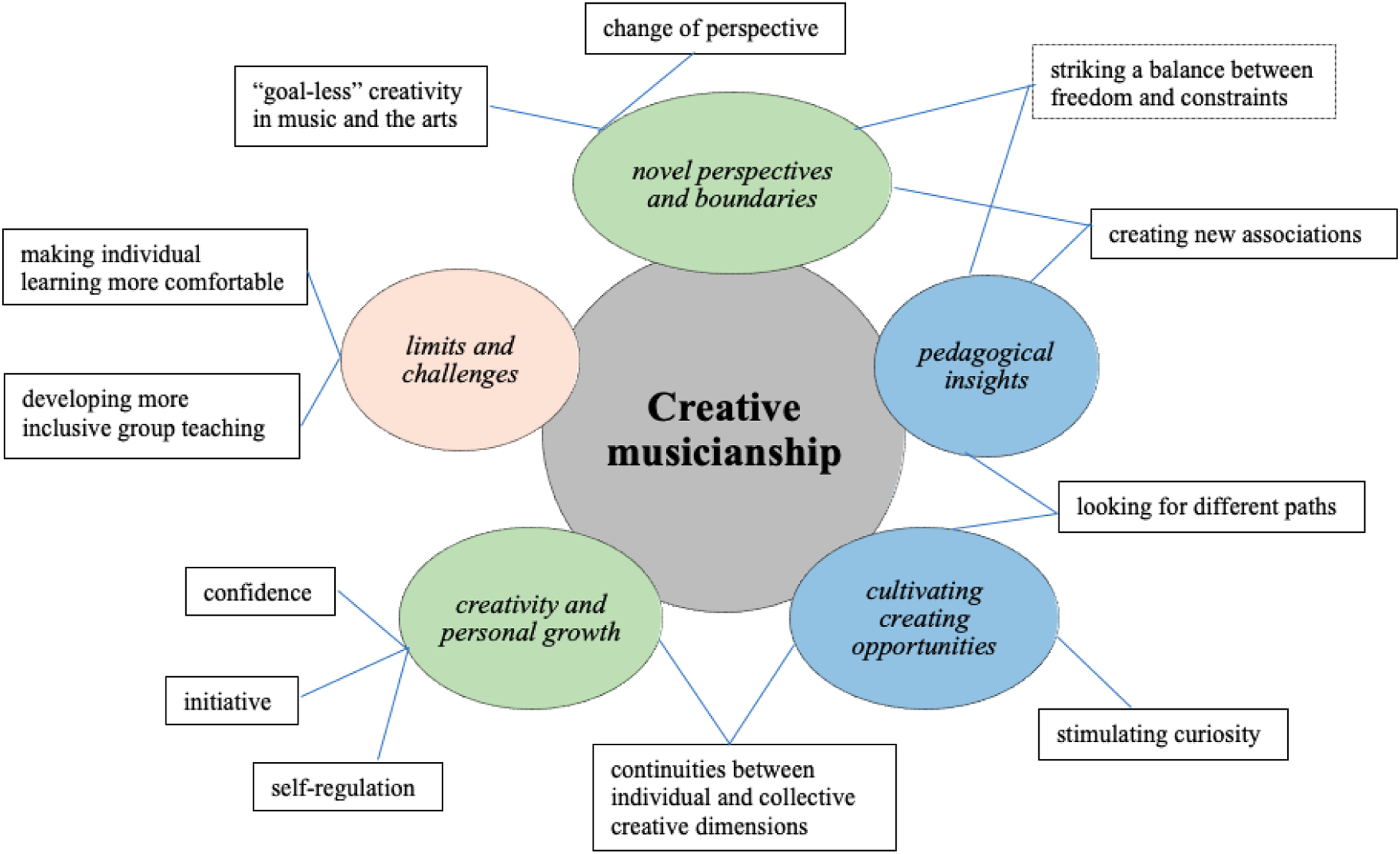
The multifaceted nature of musical creativity
The categories novel perspectives and boundaries and creativity and personal growth, more than others, offer important insights to address the first research question – i.e. what are music teachers’ self-reported understandings of creativity in a music education context? To begin with the former category, different statements point here to the interplay between freedom and constraint. That is a common topic in creativity research (Haworth, 2013), with a growing number of studies suggesting that a constrained environment may be useful to promote innovation and enhance creativity (Torrents et al., 2021). Our data point to a similar direction when boundaries have been described as important tools to facilitate musical learning. However, while recognising that setting less boundaries might give rise to more difficulties in playing and learning music, artistic freedom is given a major emphasis across different quotations. As such, the status of boundaries and constraints in the classroom remain ambiguous for our respondents, as students might best engage in creative musical activities without feeling under the pressure of achieving optimal outcomes. Perhaps in more speculative terms, this aspect of our data might be seen to promote the development of a problem-finding pedagogy, complementing those educational frameworks framed within a problem-solving orientation (see Borgo, 2007). By this view, rather than being regarded as stable and fixed elements of the lesson, constraints could instead be understood as specific resources co-constructed by the students, making them a more integral part of the creative process. This can give rise to a less rigid dichotomy between constraints and creative freedom, favouring the ability to autonomously navigate the “creative space” in between the two, in turn negotiating between innovative and task-functional 1 pathways in more personal and meaningful ways (Van der Schyff et al., 2016, 2018). As it has been argued elsewhere, this process of discovery may stimulate novel approaches to evaluation based on self- or peer-assessment (Van der Schyff, 2019).
Another key finding is the focus given by our participants to the change of perspective that often accompanies creative behaviour. Consider how, sometimes, it does not come too naturally for students to be creative and explore novel valuable musical solutions: through practice, instead, they might more often tend to follow habits and engage in standardised activities (playing scales in the same way every day, indulging on a particular expressive interpretation, etc.). To compensate for this, teachers may promote a critical attitude toward common practices to cultivate and enhance the students’ capacity to develop creative associations (e.g. practice a scale or an arpeggio across different registers with different intentions, dynamics, and expressive nuances) and divergent thinking 2 (see also Kupers and Van Dijk, 2020). A further aspect emphasised by one participant refers to the difference between musical creativity and creativity as it plays out in other (i.e. non-artistic) domains: the former – it is suggested – does not involve precise goals, whereas the latter may rely on more specific outcomes.
Finally, a number of statements assigned to the category of creativity and personal growth contribute to clarify how our respondents conceive of creativity. Our data show that the latter notion is generally associated with positive concepts, such as “confidence”, “initiative”, and “self-regulation”, which play out at both individual and collective level. These findings align with research by Claxton and colleagues (2006), where creativity is seen to give rise to positive outcomes and meaningful processes that are fundamental for human flourishing, when based in curiosity, resilience, experimenting, attentiveness, thoughtfulness, and environment-setting.
Creative musical activities in the classroom
Data relevant to the second research question (i.e. how can musical creativity be cultivated in a teaching setting?) may be individuated across all five categories. However, statements assigned to the categories pedagogical insights and cultivating creative opportunities are particularly meaningful in this regard. Here, respondents offered concrete examples of activities conducted across different musical settings, emphasising how establishing novel (e.g. sensorimotor; musical) associations might benefit one’s practice, in turn enhancing creative flourishing. Such examples involve both moments of improvisation and reflection. As mentioned, the former approach seeks to explore and establish novel musical associations within the moment-to-moment contingencies of musical action and interaction, thus prioritizing the natural taste and musical inclinations developed by individuals and groups. This has the advantage to provide students concrete tools to navigate in real time the manifold artistic landscapes emerging from the dialogue between freedom (understood as the heart of improvisation) and constraints (set in terms of instrument-specific limitations, or style, for example). The latter approach, instead, is based on the notion of “change of perspective” described earlier with reference to the first research question. Pupils may not only need to “feel” creativity as they play; they may also cultivate it with the help of the teacher. Recall how M2 mentioned that one of her students was once asked to put themselves in the shoes of others (e.g. an audience member) to explore novel expressive solutions and look at the musical material from a refreshing, novel angle. The process arguably stimulates and further develops curiosity in the students, as they are prompted to actively search for different musical options that may go well beyond intuitive or well-known practices.
In discovering such novel paths, our participants noted how pupils often negotiate between personal and social domains: indeed, the “change of perspective” that students are invited to make may involve an intuitive analysis or felt experience of what others may think or do, recognising their “presence” as a resource for creative activity. While it cannot be said whether this cognitive operation of putting oneself in the shoes of others can lead to effective learning outcomes (as our teachers do not make it explicit), the negotiation between self and others has nonetheless been explored in other studies focused on composers (Schiavio et al., 2020a) as well as novice and expert performers (Hoffding and Satne, 2019; Schiavio et al., in press). In these contributions, among others, the social dimension of musical activity was brought forth and described across a range of prima facie solitary musical behaviours (e.g. improvising or rehearsing by oneself, composing music alone), suggesting that music-making involves a broader range of ecological and intersubjective factors that play out at different individual levels. One of the activities adopted by a teacher described above similarly includes the imagined presence of other individuals as a tool to promote creative musicianship. Future research may build on this example to further explore the links between the social nature of creative activity (see Elisondo, 2016; Glaveanu, 2015a, 2015b) and of musical experience (Borgo, 2007; Clarke and Doffman, 2017; Turino, 2008), developing novel pedagogical practices that specifically associate inter-individual experience and creativity with the acquisition and development of musical expertise (see Schiavio and Kimmel, 2021). As we shall see next, this is no easy task, as teachers may face important difficulties when engaging with both groups and individuals.
Challenges in individual and collective tuitions
Data addressing the third research question (i.e. how do teachers differentiate between individual and collective forms of musical creativity?) mostly appear in the category limits and challenges. This shows that while there is a fluid relationship between individual and collective aspects of creativity – as clear boundaries between the two may hardly be observable – teachers may encounter difficulties in negotiating between these contexts, and develop an optimal learning environment for single pupils and groups. In other words, when approached from a more teacher-centred perspective, important differences remain between the two settings. Our respondents have emphasised how both teaching situations involve difficulties and challenges that might be detrimental for musical learning. Such a concern is predicated through statements describing (i) problems in classroom management and in balancing the students’ contribution in light of their expertise and character and (ii) possible issues concerning a too direct relationship between pupil and teacher in one-to-one tuition.
The former issue gravitates around the students’ individual differences, and the role the teachers play in letting each student meaningfully participate in the classroom activity. In a sense, this is a similar issue to that encountered earlier (when discussing freedom and constraints). Teachers need not let entropy dominate the teaching sessions; on the contrary, they must exert a tangible influence on how the music lesson unfolds (e.g. by stimulating the students’ curiosity in various ways). In the same vein, when music students of various backgrounds, character, taste, and goals take part in the same class collectively, each individual should feel they are given equal opportunity and access to the teaching dynamics. As M2 mentioned above, this involves the teacher’s ability to “blend different stylistics and aesthetics views”. A way to do so, as reported in another study (Schiavio et al., 2020b) might be for teachers to step back and give more responsibilities to their students. Among others, this may involve assigning a teaching role to students, so that they could come up with creative activities that can be shared and discussed among the class. This last point also shows one major advantage of collective teaching, namely the possibility that group dynamics can facilitate idea-generation, promote a change of perspective, and invite students to discover and explore novel musical options and opportunities.
With regard to the problems of individual teaching, we only have a few statements that directly addresses this point: according to M4, for example, individual tuition “is often less comfortable, being more ‘direct’”. This is an important point, as verbal and non-verbal forms communication within the context of student-instructor music lesson are often seen as a key factor in shaping the pupil’s learning trajectory (see Gaunt, 2008; Kurkul, 2007: Schiavio et al., 2019b; Wang 2001). Conversely, another respondent (M3) put emphasis on how creativity often relies on the contribution of a single individual, and that in one-to-one tuition creative practices remain at the heart of the lesson. When a good relationship between teachers and students is achieved, and a safe learning environment established, individual tuitions can also provide important stimuli for the students. This somewhat contrasts statements by another teacher (M10), who instead individuates the main issue of individual teaching precisely in the lack of points of view students might experience in such a context, as they are only exposed to the teacher’s perspectives. In all, it should be clear that both individual and collective teaching dynamics display important limitations and advantages regarding creativity. These depend on a range of factors including how the relationship between teacher and student(s) unfold, the size of the group, as well as the teacher’s capacity to ensure inclusivity and equal opportunities for everyone.
Conclusion
In this article we have presented original qualitative data associated with the perspectives offered by 11 expert music teachers on musical creativity in education: its meaning, its implementation, and its challenges. Findings indicate that the development of a creative musicianship in students can be associated to generally positive concepts, and often involves a balance between freedom and constraints as well as changes in perspective. Such understandings of creativity might be concretized in practice in several ways, for example when our respondents reported fostering creativity in their students by stimulating curiosity, and by helping them find new musical paths, opportunities, views, as well as creative associations. In this process of discovery, our teacher participants observed that students often navigate personal and social domains – two dimensions that remain sometimes problematic when treated without enough flexibility: respondents have reported that both display important limitations when creativity is placed at the heart of the lesson and must be therefore approached carefully.
Besides the difficulty to generalise findings due to the qualitative methods we chose to adopt, we recognize as the main limitations of the present investigation the lack of hypothesis-testing and objective measurements, as well as its adherence to Western settings based on classical music. Whilst a vast population of music teachers is not necessary to validate the richness of the findings presented here, quantitative data collected on large scale may help test specific hypotheses. Additionally, all participants operated within Western (mainly classical) contexts, limiting the interpretation of the data to very specific settings. Our discussion has focussed on the accounts of the participants we interviewed and does not examine in detail how their insights connect or contrast with specific varieties of classical music pedagogy. It is hoped that future work can address these limitations by systematically comparing teachers working in different geographical locations, across diverse musical cultures, and who adopt different pedagogical approaches.
Footnotes
Acknowledgements
We wish to thank all participants who took part in the study.
Declaration of conflicting interests
The author(s) declared no potential conflicts of interest with respect to the research, authorship, and/or publication of this article.
Funding
The author(s) disclosed receipt of the following financial support for the research, authorship, and/or publication of this article: This research was funded by the Austrian Science Fund (FWF), project number: P 32460.
