




Abstract
This paper focuses on how contributions are argued in research proposals in the humanities. Due to standardizing tendencies in research funding towards formats characteristic of science, technology, engineering and mathematics (STEM) subjects, there has been concern that the humanities are marginalized. In this study, ‘contribution statements’ were identified in proposals funded by the Bank of Sweden Tercentenary Foundation across the humanistic disciplines. These statements were systematically analyzed in terms of type and structure of contributions advanced. The results suggest that the humanities differ from the sciences in terms of specificity of focus, a high level of ‘acceptable serendipity’ in proposed outcomes, but that these disciplines structurally tend to adhere to the same types of research contribution arguments as STEM. A better understanding of the way in which humanities scholars frame contributions offers insight into how these fields change and how they relate to developments in the science policy and funding landscape.
Introduction
Getting funded is just as important in the humanities as anywhere else in the academic research community and, to an increasing extent, humanities researchers have had to develop and adapt their skills to the particular form of authorship involved in proposal writing. Many application formats entail expectations that are often seen as non-typical to research in the humanities, e.g. narrowly circumscribed outcomes, significant pre-structuring of the research process, and overall a low level of acceptable serendipity (see Hellström, 2010). Scholars have already noted that quality criteria in review committees in social science and the humanities (SSH) are less calibrated and that the aims of research proposals in these fields tend to be broader than in the natural sciences (Abbott, 2014; Ochsner et al., 2016). 1 Yet from a science studies/higher education perspective we know considerably less about how SSH scholars establish or argue cognitive advancements, and how they might relate to, for example, technoscientific (aka STEM) fields in this regard. As many funders begin to reward larger integrated research efforts, the onus is put on how knowledge production in the SSH disciplines is affected by such trends. Much of what has been stated in the classical literature on SSH knowledge production seems to put such fields at a disadvantage vis-à-vis STEM subjects in this regard. If SSH knowledge typically ‘suffers’ from value infused theorizing, ‘open’ rather than ‘closed’ empirical domains, and reliance on non-formalized modes of expression (cf. Martin and McIntyre, 2001), how do SSH scholars fare when funders asks for predictable outcomes, decomposable work packages and clearly specified division of labor? This paper is motivated by the above question, however, the central problem addressed here, is a much more circumscribed part of the broader issue. While much of the literature seems to argue that the humanities in particular and SSH in general often eschew strictly delimited conceptual and empirical problems, which are cumulative and aggregable in the STEM sense, we need to evaluate such arguments on the basis of how SSH researchers actually formulate and advance research contributions in their fields. Are they so different from STEM? Or are they structurally if not topically similar? Addressing this question may contribute to an understanding of the SSH subjects supposed marginalization in the science policy system.
This paper deepens our understanding of the above problem by investigating how contributions (‘contribution statements’) are presented in research proposals in the humanities. Studying these ‘contribution statements’ as they appear in proposals might offer insights into the cognitive dynamics of the humanities to address the above broader question. 2 Rule (1997) suggests that contribution statements amount to fitting individual efforts into a greater whole, the work of the discipline or program, to which they are contributing. Similarly, Blakeslee (1994) notes that while constructing novelty is a requirement for getting published, novelty claims have to be situated against the backdrop of established tradition. This implies a form of creative puzzle-solving, where novel claims have to be fitted into the preexisting structures of knowledge like more or less compliant pieces in a puzzle (also Myers, 1990; Miller, 1992).
Likewise, proposal writers must position their proposals against the backdrop of some common expectations or institutional discourses (e.g. excellence, impact and so on). Lamont and Guetzkow’s (2016) study of funder review panels for the humanities shows that applicants and panel reviewers converge on what constitutes ‘originality’ or a contribution because they are part of the same evaluative culture. In multidisciplinary panels, the field expert is often treated as the authority on proposals from his/her field (Lamont, 2009) and proposal writers tend to view the reviewers as addressees in their proposals (cf. Boltanski and Thévenot, 2006).
In line with this reasoning, one may treat contribution statements as indicators of discipline identity-building processes rather than mere rhetorical constructions by presumably autonomous agents. Following Rip (1997) contribution statements can then be viewed as local units and practices (for example a researcher) linking up to higher level scientific fields through ‘regulatives’ (cognitive and social rules/norms) that anticipate the ‘context of justification’ for that field (for example. a review board, new evaluation criteria, etc.). These regulatives should not be viewed as disembodied universal standards of the kind previously suggested by unificationist accounts, but rather a higher socio-cognitive ‘cosmopolitan’ level of practices and norms that subsumes local practices, and to which local practices refer ‘somewhat independently’ (Rip, 1997). In this paper we view contribution statements as ‘coordinates’ on a disciplinary map that can be reconstructed as instantiations of an academic identity. Proposal writer, reviewer and research council together form a meaning universe of shared justificatory points of departure that in turn become part of the discursive features of grant proposals (see Serrano Valerde, 2018; Boltanski and Thévenot, 2006; Lamont et al., 2000). As suggested above, the significance of understanding this particular meaning universe for SSH lies to a large extent in the way it may further our understanding of how these disciplines come to relate to an increasingly homogenized evaluation regime, where, for example criteria for excellence and relevance become shared across traditionally separate disciplinary divides. The present study focuses on these local pieces of a broader justificatory puzzle: contributory arguments in the proposal text, with the aim to problematize and understand the different ways in which contribution statements are forged across the humanities as part of a greater effort to disentangle the position of and possibilities for the humanities in particular and SSH in general in the wider academic landscape.
This introduction will be followed by a literature overview, focusing on types of contribution statements and some differences between the sciences and SSH. A subsequent method section elaborates the details on the material, collection and analysis. The results section reports on a sample of contribution statements extracted from the Bank of Sweden Tercentenary Foundation open project database, and the outcome of an inductive textual analytical reading aimed to extract and order types of contribution statements. The results of this exercise are discussed against the background of some typical kinds of contributions as well as a number of identified ‘contributions heuristics’ used in the sample, and also in terms of how the humanities corresponds to the STEM fields in this regard. Finally, some implications are addressed regarding the issue of the place in the funding landscape of the humanities and SSH.
Literature overview
This overview focuses on various types of contribution in research proposals, in articles and review processes, identified by previous research. A contribution may take many forms. For instance, originality and novelty are two common ways in which one may frame a contribution, and such studies have also been included here. The present overview will try to address this area of study by first dealing with STEM, second with SSH and finally review some studies that specifically deal with differences between the two.
Focusing on the natural sciences, Dirk (1999) reviews of a number of highly cited papers across several disciplines. She finds that by far the most common pattern of contribution is where novelty is argued for the hypothesis/problem as well as for the results, but to a considerably less degree in terms of methods. This fits well with other observations that suggest that methodological commitments tend to be more stable over time than problems (aims) and theories (e.g. Laudan, 1979; Nola and Sankey, 2007). Methodological contributions do of course occur (Dirk, 1999 reports that about 5% of the articles in her sample were based solely on a methods contribution), but their frequency might differ across disciplines, and over time in the same disciplines. For example, Blakeslee (1994) was able to identify claims of methodological novelty, as argued by author and peers, in her study of reviews and commentary in Physical Review Letters. Some examples include methodological advance on existing problems, extension of standard methods, and proof of ‘methodological concept’.
Priority (originality or novelty) represents an important contribution type in the natural sciences. Barlösius (2019), drawing on an empirical study of the Volkswagen Foundation’s ‘Experiment!’ program, found three modes of originality in the sampled research proposals. One was novelty in terms of ‘being first’ in the sense that no previous work had been done on that topic. Another relates to addressing a topic/problem in a less than ordinary way, using different methods/approaches, and finally a project could address the problem (or perhaps a new phenomenon) in a fundamentally new way. Barlösius suggests that there might be disciplinary differences in how originality is argued (perceived) where, for example, biologists offer to make ‘revolutionary breaks with convention’ while physicists rather more humbly tend to aim to ‘test ideas and hypotheses’ (Barlösius, 2019). It is important to note here that temporal priority is something different from ‘discovery’ since contribution claims in project proposals are promissory notes rather than actual breakthroughs. Covering new empirical ground might lead to discovery but is not a discovery in itself.
Philips and Weißenborn (2019), in another study of research applications submitted to the Volkswagen Foundation, contend that researchers must organize their possibly unconventional ideas according to conventional patterns in order to get them funded. They identified four patterns of contribution claims in the neurosciences: (1) solving practical problems (by identifying them and providing solutions); (2) exploring specific phenomena (by indicating unknowns and presenting characteristics and patterns); (3) expanding confirmed knowledge (by indicating shortcomings in theory and methods and offering a solution); and (4) offering alternative theory (by indicating new findings and introducing an alternative explanation). For all the applications (52) funded in the period of study (2013), the authors found that providing solutions to practical problems was the most common category of contribution. This might have to do with the close connection between the basic research problems in neuroscience and possible neurological treatments.
Turning specifically to SSH, Abbott (2014) suggested that the humanities (and the humanistic social sciences) are mainly focused on “creating new interpretations of well-known things, or putting together things previously kept apart, or maximally filling a space of possible things to say” (p. 147). He argued that unlike the natural sciences, where old explanations/results are rejected or subsumed by subsequent research, the humanities lack such ‘directional qualities’. For example, just as there is no necessary order or direction to interpreting Melville’s Moby Dick, there is no necessary order or direction to humanistic knowledge in general. It is of course not far-fetched to assume that the ‘element of novelty’ requires more discursive construction in the SSH, and especially in the humanities since the actual research object often is discourse or constituted as discourse (Collini, 2012).
A classic contribution from this perspective is that of Davis (1971), who introduces ‘interestingness’ as the key contributory element in the social sciences, its most basic quality being to assert a radically new explanation of a known phenomenon or a new frame for seeing (e.g. “what seems to be X is in reality non-X” p. 313). This involves a number of conceptual strategems, for example connecting previously unconnected systems into one; identifying a single underlying structure that ‘contradicts’ obvious surface phenomena; changing the way a phenomenon is operationalized as ‘good’ or ‘bad’; or showing the coexistence of seemingly incompatible states. In contrast, non-interesting propositions are typically deemed obvious, irrelevant or unlikely by the audience. Davies (1971) emphasizes how moving the audience to accept that a contribution is in fact the opposite of non-interesting is a rhetorical act of persuasion that proceeds along several discursive lines of argument.
One way to initiate such a contributory strategy is to textually construct an audience or a problem area. Locke and Golden-Biddle (1997) identified several ways in which organization studies researchers textually constructed opportunities for making a contribution in article manuscripts in this way. They found that authors typically went through two main phases of arguing for their contribution: first by constructing an ‘intertextual field’, i.e. a relevant academic backdrop for their work as being incomplete in one way or another, followed by problematizing this situation as inadequate or wrong. It is important to note that this is more about establishing conditions for a contribution in the sense of constructing an academic readership/problem nexus than putting forward the contribution ‘itself’. Nevertheless, it seems to imply an attempt to frame contributions in terms of progress in a theoretical sense that bears family resemblance to some of the natural science modes of contribution discussed above.
Guetzkow et al. (2004) and Lamont and Guetzkow (2016) have a slightly more ‘tangible’ yet open-ended take on the subject of what is a contribution. They maintain that humanities reviewers most often operationalize originality as ‘original approach’, and that other forms of originality include original topic, original data, and original method. An original approach, the most valued form of contribution, involves issues such as ‘new questions’, ‘new perspective’, and new angle on a tired or trendy topic. Other categories include sub-themes such as non-canonical/conventional topics, connecting ideas, innovation in method/design, new uses of old data, synthesis of methods or simply new data. The authors speculate that humanities scholars value new approaches to ‘framing’ texts or specific archival material that yield new interpretations, rather than conceptual novelty.
Lamont et al.‘s observations in this regard might be typical of text and archive oriented disciplines. In contrast, Serrano Valerde (2018) used Little’s (1991) framework for dividing research strategies into explanatory (seeking causal, rational-intentional or interpretative explanation/understanding) and factual (describing an empirical domain) as a point of departure for looking at research proposals submitted to the German Research Foundation. For the one SSH discipline in their study (political science) the subsequent analysis expanded these categories into seven contributory dimensions (or ‘explanatory objectives’), viz. contributions in method, in data, in theory, causal explanatory contributions, interpretative (explanatory) contributions, rational-intentional (explanatory) contributions and non-explanatory contributions. While these categories of contribution focus on explanation rather than ‘approach’, it is important to note that when one moves into the humanities side of SSH, these might converge.
Discussions on the differences between the natural sciences and the humanities often draw on contrasting notions of concreteness-abstraction, global-local standards and demonstrative-discursive modes of communication. So, for example, in a study of European Research Council (ERC) projects, Laudel and Gläser (2014) identified two broad categories of contributions in the ERC review process selected for their high comparative quality: ‘planned innovations’ in the natural sciences, which include novelty in methods, empirical base and explanations and, for SSH, ‘answers to big questions’. The latter typically refer to questions that are framed on a broad theoretical, methodological and empirical base, focusing on, for example, major society-shaping historical processes. In addition, four categories of ‘non-mainstream’ contributions were identified, viz. contradicting majority opinion; addressing a communities’ blind spots; applying non-mainstream approaches/methods to mainstream problems; and linking otherwise separate communities through identifying new cognitive complementarities (see also Bonaccorsi, 2008; Bonaccorsi 2010).
It is clear that the SSH disciplines operate within a broad spectrum with regard to what may eventually be considered a contribution. For example, Mallard et al. (2009) noted that SSH fields display a greater variety of positions on quality, i.e. more cognitive contextualism and methodological pluralism than do the STEM subjects. A well-known attempt to explain this is made by Whitley (1984), who suggests that the relative clarity of criteria in the natural sciences compared to the SSH is a result of the latter’s higher degree of task uncertainty (the uncertainty a researcher faces when trying to solve a problem) and the former’s higher degree of strategic and functional dependence vis-à-vis other researchers in the field. In the natural sciences it is simply clearer what constitutes a contribution, due to a certain kind of ‘mechanical interconnectedness’ between research projects and programs, as well as relatively high agreement about what constitutes data and results due to more commonality in instrumentation.
Collins (1994) argues similarly that what separates the social from the natural sciences in terms of contributions is the latter’s possibility for robust consensus derived from experimental technologies. Rather than empiricism and mathematization, it is genealogies of research technologies that produce discovery and consensus. In the SSH fields, in contrast, interesting concepts do not generate consensus (nor do researchers usually strive to apply them to that end), but rather conceptual novelty tends to split researchers into factions or schools. According to Collins, it might be the subject matter (e.g. values and meaning making) of these disciplines that produce factionalization rather than the absence of research technologies. On a related topic, Ochsner et al. (2016) point to the difficulty experienced by many humanities scholars in operationalizing quality concepts in a consistent way or at all, and how such notions are very context-dependent (in the sense of what is ‘good’ with a project depends on what project is advanced). This observation correlates with Kuhn’s (1977) classic discussions on value application in science, where values might be shared but applied differently, even within the same narrow community. Criteria for what is a good project is applied within some constraints but are not determined; for example agreement on the value of simplicity in one case may not imply agreement on how to apply it, or how to trade it off against for example precision (see Achinstein 2001 for a fuller appreciation of Kuhn’s ‘partial subjectivism’).
In summary, there are some quite clear differences in the type of contributions favored by STEM and SSH respectively, but also similarity. Research policy scholars have noted that isomorphic pressures on the humanities, through internationalization of standards/routines in higher education as well as in research funding, tend to smooth out many differences in quality criteria and by extension what constitutes a contribution (Tsay et al., 2003). Gulbrandsen and Aanstad (2015), among many others, have argued that the strong drive towards tangible economic and bibliometric indicators for social contributions (aka ‘impact’), such as those associated with technical innovation, tend to disbenefit the humanities. These authors point out, however, that the trend towards research that addresses grand challenges type problems perhaps fit better with the humanities. One might reflect here that speculation about both technological and social innovation oriented outcomes depend on instrumental reasoning about the material implications of a research result; a mode which may not be as typical for the humanities as for the STEM subjects (or much of the social sciences). As we will see in the below, when the humanities argue for social contributions (as opposed to epistemic) the line of reasoning often has little to do with solving social problems in the traditional sense of political and economic intervention.
Method
Background and material
The material for this study consists of project proposal summaries extracted from the project database at the Bank of Sweden Tercentenary Foundation (RJ, 2019). The Foundation is the second largest funder of SSH research in Sweden, with an allocation of ca. 14.3 million euros in 2018 and a typical acceptance level of 9-10% of submitted proposals. Its main focus is basic social science and humanities research projects and programs. The Foundation accepts project proposals on an annual basis with an average allocation per project of 300,000 euros/year and a duration of 3-5 years. The applicants decide the topic of the proposal themselves and receive no instructions regarding how contributions, problems, originality etc. will be evaluated, but are only informed broadly about the evaluative dimensions applied by reviewers. These concern method and theory, the proposal’s international orientation, relation to previous research, and an assessment of the knowledge that the project is likely to generate. Reviewers also comment on feasibility and the applicant’s research competence.
The Foundation’s database includes about 2000 accepted proposals from the year 2000 and onwards. The present study selected 5 proposals from 10 disciplines placing an emphasis on maximum thematic and methodological variation within each. The sampled disciplines were archaeology, ethnology, philosophy, history, art studies, history of ideas, linguistics, literature, musicology and religious studies. In order to get a complete selection within each disciplinary category, the total sample of 50 texts stretched the period between 2004–2018.
Analysis
The units of analysis for this study are not abstracts or application texts taken as whole arguments. Rather, they are specific linguistic segments that express statements of an intended contribution. Such statements are sequences of suggested premises - circumstances and proposed matters of fact - that together amount to arguments for a future contribution. The element of contribution may be explicitly stated, but can also be implicit. For instance, the researchers may only outline certain premises or circumstances supporting the worth of the project without claiming that this is a contribution (cf. the specific ‘piece of the puzzle’ discussed above).
Analytic summary of contribution types. ‘→’ should be read ‘affect(s)’.
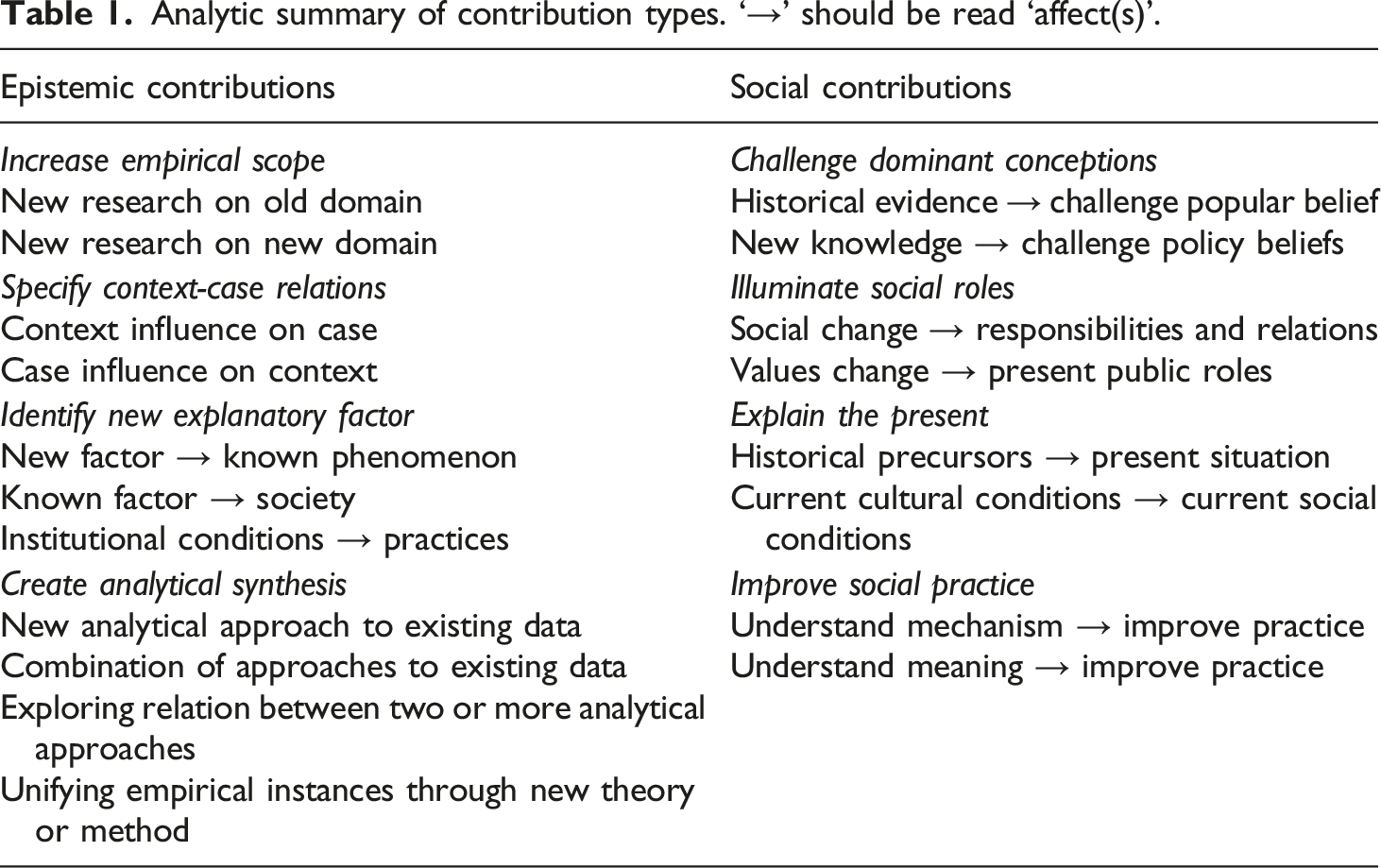
The following section presents these categories with illustrative extracts. The extracts are analyzed and interpreted as they are presented. This gives an interpretative perspective on the contributory statements as well as provides an analytical context for the discussion and conclusions.
Types of contribution
Epistemic contributions
The epistemic contributions can be divided into two main domains: empirical and analytical. The former concerned factual observations, for example filling an empirical ‘gap’ or simply compensating for factual ignorance in some area, for example by exploring a new empirical setting in terms of some empirical question, or in terms of identifying new ‘context-case’ relations. The latter was more analytical and focused on new explanatory factors for some phenomena, and on providing new analytical syntheses for known aspects of a domain.
The first basic type of empirical contribution was that of addressing factual ignorance (or filling a ‘research gap’) by increasing the empirical scope of research in a domain. Some of these contributions were concerned with compensating for lack of research on important cultural phenomena or identifying previously omitted ‘voices’ in material, that is actors’ perspectives able to shed new light on a cultural phenomenon. An example of the latter: The choice of archive material means that voices that have previously not been part of the historical record are emphasized. The project adds a comparative perspective where different population groups are allowed to speak […]. (Linguistics, the article author's translations throughout).
Such an approach may also involve elucidating a ‘forgotten’ part of cultural history such as ‘separating myth and reality of jazz music in Sweden’, e.g. Specific attention will be paid to the dynamic between individual life strategy, public expectations and musical choices. Expressed differently: what has been ‘myth’ and ‘reality’ regarding jazz musicians in Sweden, and how have these [myth and reality] affected each other. (Musicology).
Contributions of empirical scope sometimes involve identifying a new empirical setting for a known phenomenon. This has to do with extending existing research into a new empirical domain, for example, by supplementing an empirical database, or by recognizing the lack of empirical attention regarding some practice in a specific context: In contrast to the girl book, there is no comprehensive study of the Swedish boy book. There has also been no general research on the Swedish youth literature from a masculinity perspective, which is a limitation, […] given the extensive international research […]. (Literature).
A version of such an argument involves offering a new empirical angle on a previously researched phenomenon: The 18th century Medea character has been recognized by researchers from several countries and disciplines. Many of these studies are strictly national or deal with a specific language […] the purpose of this study is to locate European 18th century Medea texts in a transcultural perspective. (Literature).
Some empirical (or descriptive) contributions relate to what may be called context-case relations. This involves empirically studying a sub-category of a broader field, for example the local expression/context of a more general cultural phenomenon: The purpose of the project is to understand how Swedish modernity’s parallel production of notions of wild animals and of masculinities has changed in relation to the development of nature photography 1890–1970. [And how] this problematic has been expressed in a local context different from the American, where most previous research has been done. (Art Studies).
It might also involve the study of a relationship between a cultural context and, for example, an artistic phenomenon, such as the relationship between aspects of a social-historical milieu and the conditions for a particular art practice. The two-pronged argument for this type of approach is that a delimited empirical study may offer insight into a broader empirical phenomenon, and/or that a more general social phenomenon is relevant for understanding an empirical sub-field. An example of the former: Creoles, as young languages, would provide a unique insight into [how] language develops towards higher levels of complexity. (Linguistics).
The second domain of epistemic contributions relates to more analytical aspects of research, in this case the identification of new explanatory factors or analytical syntheses in theory or methodology in a domain. The most obvious contribution in the former category has to do with challenging accepted causal beliefs, for example about the influences on national practices, including that of empirically challenging current theory in a field or testing robustness of theory against empirical and conceptual evidence. For example: Unexpected results […] partly contradict previous theory, where Central European mines and metal producers is considered the main source of European metal. […] The purpose is to deepen this further and investigate the differences in import patterns for various parts of Scandinavia. (Archeology).
Such ‘testing’ is enabled when new empirical material gives access to a new source of causal influence, in which case the project may set out to investigate the causal efficacy of a new factor on a known phenomenon, e.g. There is a plethora of biographies on specific kings, queens and other royalties, while the debate on state building is dominated by work on social groups (nobles, bureaucrats and ordinary people). The purpose of this project is to identify how these family-based power groups affected the state building process in Europe’s state conglomerates. (History).
It can also involve investigating the influence of a known but not yet studied influence of an institutional or cultural factor on society at large, such as showing how music ‘created a new world’ in the past, and then to re-create that world.
The final category of epistemic contribution is that of analytical synthesis involving either theory or methodology, or both. This has to do with finding new ways of analyzing existing empirical material, for example taking a new analytical angle on the current empirical understanding of a phenomenon, or by connecting two areas of thought. It may also have to do with addressing a phenomenon by combining novel approaches or fields of research in a new way: The study is novel in several ways, mainly by combining global history with history of experimental science and its ambition to recreate past laboratory practices. Early modern pharmacists and their knowledge has very rarely been discussed in the history of science and medicine. (History).
Methodologically, analytical synthesis of this kind may involve connecting aspects of a broader empirical phenomenon using a new method, or viewing it through a new analytical lens, for example understanding culture in a historical period through its musical expressions: Our purpose is to contribute a new understanding of cultural relations in early modern Europe by focusing on how competing forms of religious and political affiliation was communicated through music. (Musicology).
Social contributions
Social contributions are those which focus on how societal or practical value is expected to emerge from the research. Four categories of social contributions were identified in the material: the general contribution of social elucidation including challenging dominant conceptions, illuminating social roles and explaining the present, and a final category was improvement of social practice.
The first of these - social elucidation by challenging dominant conceptions-includes attempts to challenge popular conceptions of culture and society by, for example, creating more nuanced images of the past. This could be done by problematizing an (assumed) social preconception using historical evidence: Because the Viking age has been popularly associated with the ‘original Sweden’ and nation building, it is of special import to highlight artefacts of non-Scandinavian provenance from the lake Malar district from this period. (Archaeology).
A more practical aspect of this was the attempt to introduce new forms of knowledge in a current policy debate, thereby challenging the publics’ social and cultural conceptions. An example: A result of this study will be a contribution to the contemporary environmental debate with an alternative perspective focusing on traditional knowledge. (Linguistics).
Another type of social elucidation involved illuminating social roles. This related to, for example, understanding social responsibilities by highlighting the relevance of values in a changing society, or more specifically illuminating the ‘human dimensions’ of current political life. An example of the former: A highly integrated, globalized world requires a deepened understanding of responsibility in complex social systems, and the project aims to develop our models so as to improve such understanding. (Philosophy).
Some contributions attempted to establish how social factors impress on action and relations, for example the role of culture in the exercise of power (by elucidating the interchange between cultural and social forms) or understanding the social conditions for science and science-society relations, e.g. The case is used to investigate more general questions regarding how the development of modern knowledge society continuously recreated the conditions for knowledge production related to scientific and technological issues [and the relation between] researchers and laypeople. (History of Ideas).
A third sub-category of social elucidation is explaining the present. This has to do with comprehending today’s social situation, for example, by understanding present social conditions through their historical origins or by advancing understanding of other types of culture-society connections. An example of the former: If we can provide an answer to the question of how dynastic powerful groups functioned and influenced early modern state building, we will better understand how today’s states have evolved. (History).
The typical angle here is to argue that historical precursors affect or relate to current practices, for example to set out to show how cultural political history contributes to present day’s social system of cultural relations. It might also involve explaining current pertinent issues by anchoring them in long-term cultural traditions, such as understanding the mechanisms of social integration/assimilation through religious practices or institutions: This project investigates African churches in Sweden from a migration perspective, and how they work both as a factor of integration and segregation in society. The point of departure is the essential differences between assimilation and integration. (Religious Studies).
The final category of social contribution is titled improving social practice. The common assumption is made that research can be instrumental for some social practices that depend on humanities domain knowledge. Some of the envisaged contributions relate to more specific ‘mechanistic’ knowledge and focus on particular areas of application, for example determining learning processes to support education, and understanding (a form of) language acquisition to assist learning. Another version of this involves the study of narratives to enable practical interaction or, moving into the context of application, yield better treatments from understanding patient reasoning: Previous research has connected [limited] reasoning skills to inadequate social abilities, which is the biggest and most treatment resistant problem for schizophrenia patients. This project will provide a unique insight into how patients reason in social contexts, which may eventually contribute to treatment outcomes. (Linguistics).
More general instantiations of this category involve contributions such as studying history to understand conditions for change in a social/cultural system, general ‘contributions to legal theory and praxis’, or compensating for lack of research in pertinent areas of practice. The latter might be exemplified by understanding the production of value of literature and its import for related practical activities: The aim of the project is to, on empirical grounds, develop theoretical and methodological tools for analyzing and understanding how literary texts are made ‘useful’ in our culture. This is a question of great import not only for the development of literature studies, but also for decision makers in cultural policy, in the educational field and in the publishing business. (Literature).
Discussion and conclusions
At first glance there seems to be a fair amount of overlap between the contribution statements above and what previous literature reports for both STEM and SSH. Epistemic contributions in the broad ‘factual’ category relate to new phenomena, new patterns identified and new relations in an empirical domain, similar to that discussed by both Philips and Weißenborn (2019) and Abbott (2014). Temporal priority in the sense of ‘being first’ is a key motivator for contributory attention, but unlike Barlösian’s (2019) examples, the approaches described here seem more to do with identifying new actor perspectives (offered indirect through the author’s interpretation) on a topic. The ‘allow to speak’ phrase used in one of the examples is typical in its metaphorical implication of a court or agora where central others are making available a discovery through their testimony, and for whom the researcher is merely giving voice. This amounts to a version of any sort of discovery or revelatory contribution, only on a human substrate. A similar form of revelatory ambition can be perceived in the ‘myth vs. reality’ dichotomy exemplified above. While it is a bit unclear in what respect current misconceptions regarding the topic are best described as popular or academic, it is clear that reducing factual ignorance by extending the empirical scope carries an empiricist inclination that, short of being hypothesis testing in the traditional natural science manner, still resembles this approach in its basic epistemic revelatory ambition.
The contributions that extend existing research to a new empirical domain feature new cases for an ongoing empirical research program, or make new observations in a new (for the research program) domain. One may treat these as an empirical version of offering a new perspective on a phenomenon by making connections, however unlike Lamont and Guetzkow’s (2016) ‘new perspective’ the present examples are not explicit about what analytical frame is relevant for the interpretation. A more interesting version of the factual/empirical contribution is where cases are related to their surrounding contexts, and vice versa. This type of contribution is a ‘semi’ or ‘proto’ explanatory mode of reasoning, where two circumstances are suggested to correspond by force of one being implicated in the other, according to some material or symbolic conditions. The focus here is not on formulating theory in conceptual terms, but rather to examine local expressions of case-context correspondence, that is how a milieu affects the conditions for a practice. This amounts to a form of empirical ‘upward’ or ‘downward’ understanding reminiscent of Davies’ (1971) ‘ordering of connections’, by showing how phenomena on various levels are ‘same’ or ‘different’.
Explanatory contributions challenge or test current theory and tend to address empirical rather than conceptual problems. For example, rather than theoretical breakthroughs allowing new explanations, it is new data/material that offers such possibilities. Just as in the above, the analytical focus is on how some empirical circumstances affect understanding, or the possibility of explaining other circumstances. The difference is that in the case of explanatory contributions, the analytical component is a conceptual device rather than a local empirical observation or association, for example new analytical angles (methods or theories) or combinations of approaches. As suggested by the above, these devices need not be formally expressed but may be presented as a narrative synthesis for understanding the case, where typically an empirical phenomenon is understood by highlighting specific domain relationships (cf. Abbott’s 2014 ‘pattern identification’). It is likely that the significant difference between the humanities and the sciences (including the non-humanist social sciences) is not so much the structure of an explanatory contribution as its level of specification, both in terms of the precision of contribution statements, and the way these are enacted in the ‘final product’ i.e. the actual contribution. To what extent such differences are related to subject matter or research technology (including conceptual clarity) is the topic of a greater debate (Collins, 1994).
Significantly, but not unexpectedly, the majority of the social contributions related to what might be referred to as ‘social enlightenment’. This implies a considerably broader audience than that for epistemic contributions, and therefore also stronger (in the sense of less robust) ‘assumptions of ignorance’ regarding that audience than would typically be the case for epistemic contributions. These assumptions are seldom argued explicitly, or much evidenced, but rather taken as well-known facts. However, the social enlightenment contributions stand or fall on assumptions about popular ignorance. One way of handling this is to narrow the audience and the ‘use context’ of the contribution considerably, for example as in the cases above where environmental or cultural policy making were suggested as application domains for project results. Such narrowing, of course, begs several questions regarding what social relevance should be sought, and what relevance counts for any specific form of research project (cf. Gulbrandsen and Aanstad, 2015). Here, again, one needs to be aware that contribution statements may often be incomplete. However, complete or not, it is important to note that these kinds of statements rely on explicit or implied causative or conceptual reasoning about the relation between a piece of knowledge and a social application domain of some kind, and in this sense they carry epistemic implications. Enlightenment contributions also focus on the elucidation of values and their (practical) relevance in certain circumstances, for example in decision making, and the closely associated question of role relationships and their present shape and function in a historical perspective. The explanatory models underpinning these contributions also seek support from assumptions about particular forms of historical contiguity, affecting practices, norms and traditions, for example where specific factors in one domain affect social practices in another domain. Unlike the typical scientific contributions discussed by Barlösian (2019) and Philips and Weißendorn (2019), in social enlightenment contributions technical criteria of inference, such as those involved in making causality claims, are not the focus.
The final type of social contribution is closer to the traditional scientific notion of utility, in the sense of applied science or technological knowledge (see Niiniluoto, 1993). Therefore, the assumptions about causal efficacy of contributions become more relevant. Unlike in the case of social enlightenment, here is an explicit ‘mechanistic’ assumption about the instrumental value of humanities research. This means that there are at least implicit ideas about a ‘dependent variable’ which consists of practical goal-oriented outcomes, that is subject to instrumental knowledge for its success. However, as we saw in the above this ‘variable’ is not always sharply formulated, and possible mechanisms are more often implied than explicit.
One may note that many of the epistemic contributions were written in a revelatory or discovery oriented idiom. In that sense they seem different from the traditional scientific approach only in terms of methods and subject matter, rather than in their basic methodology, epistemology and ‘reality orientation’. The appeal to human testimony or ‘myth-busting’ implies a less circumscribed approach to the object of discovery, but in principle represents no great epistemic deviation from traditional scientific mores. Apart from simply covering new domains, the epistemic contributions also involved a form of ‘proto-explanatory’ mode, where context-case relations were explored for empirical correspondences. This type of ‘connection making’ is known from the literature, and most of what separates SSH from the sciences here seems to be the inclination towards broader and less circumscribed topics (cf. Laudel and Gläser, 2014). Explanatory and analytical contribution statements seem to correspond structurally to such statements in the sciences, but deviate typically in terms of clarity of the intended domain/object of contribution as well as in terms of the specificity of the ‘conceptual device’ applied or sought. Whether this is due to subject matter or relative task uncertainty/functional dependence of these fields compared to the sciences is a matter of long-standing debate. In the social enlightenment type of contribution, the traditional scientific contributory models elaborated by, for example, Barlösian (2019), Philips and Weißendorn (2019), Serrano Valerde (2018) and Laudel and Gläser (2014) seem to matter the least. In these contributions, technical criteria of inference are not the focus, and neither are empirical relationships, theory or method at the centre of the problematic.
In conclusion, given the corpus of material used in this study, and the typical examples extracted from this material as presented above, it is clear that differences in contribution statements between the humanities and the sciences may be more a matter of style than principle. Causal relationships are suggested, new data is pushing ‘discovery’, theories, methods and explanations, often in terms of ‘perspectives’, which are sometimes combined to offer greater scope. In this study it has not been possible to identify any systematic differences in these regards between humanities disciplines. Possibly due to the ‘maximum variation’ selection used, the span within each discipline became great enough to cover such differences in the sampled material. However, in the future it might be useful to dig deeper into a fewer set of fields to capture contribution statements and actual contributions as part of longer temporal cycles of change, and perhaps there find a more solid understanding of the role of ‘the contribution’ in disciplinary change.
Connecting to more general issues regarding research funding, a few notable insights emerge. In so far as SSH is marginalized in the science policy landscape it may not be a matter of some form of outdated epistemological exceptionalism, but rather a matter of subject matter and social expectations (impact, ‘value for money’, innovation etc.). It is outside of the scope of this paper to address these wider issues, however one may reflect that if this were the case, there may not be any great epistemological or methodological obstacles to these subjects gaining traction in Grand Challenges and ‘wicked problems’ type research. Lamont and Guetzkow (2016) contend that review panels converge on an evaluation culture, to which applicants respond. This suggests that disciplinary evaluation cultures are, to a large extent, self-referential and conservative unless subject to outside pressures, like new evaluation regimes. One may reflect that proposal texts, application guidelines and assessment criteria are likely to have a great impact on panels and applicants, and the significance of the results above should be interpreted in this light. The similarities between STEM and SSH identified above, as well as the latter’s clear adherence to traditional methodological canons may be read as a promise that new evaluation frameworks need not be fatal to SSH, but instead act as a means to positive disciplinary change. While this may appear threatening to some, for SSH as a whole it may be viewed in a positive light. The type of contributions offered by these fields should be taken as valid representations of their subject matter rather than as deviations from the somehow more acceptable standards of the STEM subjects. Contribution statements such as those reviewed above might better fit into a funding system in line with multi/interdisciplinary research ventures, Grand Challenges or intractable social issues. Having said that it is also important to defend SSH from the role of ‘social problem solver’, and recognize its involvement with timeless human concerns as necessary contributions in their own right.
Footnotes
Declaration of Conflicting Interests
The author(s) declared no potential conflicts of interest with respect to the research, authorship, and/or publication of this article.
Funding
The author(s) disclosed receipt of the following financial support for the research, authorship, and/or publication of this article: This work was supported by the Riksbankens Jubileumsfond (FSK15-0881:1).
