




Abstract
Successful induction has been evidenced to strengthen students’ learning, engagement and feelings of belonging. Technology offers opportunities for enhancing the student induction experience, especially pre-arrival, but has been under-utilised. This article provides an evaluation of an online induction learning resource for pre-arrival students in the Faculty of Arts at the University of Warwick in 2019. There will be particular focus on the method of co-designing the resource with a group of current students. The article will demonstrate how online learning resources for pre-arrival students can support successful induction. It argues that co-designing digital student experience resources in collaboration with students aids the development of materials that students find engaging and that co-design has a range of benefits for staff and students who are involved in the process.
Article
Students are well known to experience starting university, like many other rite passages (Tinto, 1988; Van Gennep, 1960), as exciting and anxiety producing in equal measures. The common challenge for pre-arrival students is that starting university involves entering an unfamiliar learning environment where they know that the social context and learning styles are likely to be different from those that they have previously experienced, but for which many of them have limited reference (Quinn et al., 2005). When enrolling at university most students also expect, and hope to experience, an education that is more rigorous and demanding than their previous learning in schools or further education, which can create further unease and concern. While most universities invest in marketing their degree programmes online, less attention has been paid to how technology can be used to support traditional campus-based induction for first-year students and to facilitate learning engagement with students before they formally start their studies. Equally, despite a healthy body of scholarship having emerged in the past decade evidencing the value of student partnership as an approach to student engagement (Cook-Sather et al., 2014; Gravett et al., 2020; Healey and Healey, 2019; Healey et al., 2014), many universities remain reticent to employing genuine partnership approaches outside of ‘student voice’ governance and quality assurance activity Matthews et al., 2019), including in relation to induction and transition. As its point of departure, the Arts Faculty Pre-Arrival Project that this research examines aimed to utilise a student partnership approach to develop a digital learning space and materials for pre-arrival students to support their transition into higher education and promote student engagement.
This article provides an evaluation of the staff–student co-design of an online learning resource for pre-arrival Arts students at the University of Warwick in 2019. This Arts Faculty Pre-Arrival Project sought to improve the student induction experience. The project was developed in a Higher Education context where there is an increasing focus on enhancing the transition into university for first-year undergraduates (Berzonsky and Kuk, 2000), and growing appreciation of pre-arrival as a distinct phase in the transition lifecycle when it is important that students ‘start to feel part of the university, their faculty, school and department, and learning community’ (Morgan, 2013: 1448). There is also acknowledgement that international students may have particular pre-arrival information requirements (Foster, 2011) and that extended induction periods, with web-based interventions, may be beneficial for students from non-UK learning communities (Pringle et al., 2008). At the same time, there is growing use of digital resources to enhance students’ experiences of this transition (Krause and Coates, 2008), with many scholars noting how virtual learning spaces offer new opportunities for learning, knowledge, scholarship, partnership and collaboration between students and other partners located across multiple physical sites (Bagga-Gupta et al., 2019; Neary et al., 2010).
The Arts Faculty Pre-Arrival Project was innovative in its method of co-designing a virtual learning site and induction resources with students. The project drew upon these students’ prior experiences of induction and online learning to ensure that the project outputs would be engaging and meaningful for students when starting university. It was developed out of an understanding, suggested by Collins, that ‘technology has altered the way students learn, connect and view themselves’ (Collins, 2019). It was also informed by the idea of ‘student as producer’. This pedagogical approach promotes the engagement of students in ‘real world situations and giving them real responsibility for learning, research-engaged teaching and learning’, to enable them to become ‘producers of knowledge of real academic value, rather than passive consumers of information’ (Neary et al., 2010: 9). The insights provided by this article are of particular value in the current context where, due to Covid-19, almost all Higher Education providers have been forced to look at how they can provide online alternatives to the delivery of educational and student experience activities which have traditionally taken place face-to-face (Adnan and Anwar, 2020). There is concern about the potential impact that these digital-first approaches might have on the student experience, and students’ feelings of community and belonging (Czerniewicz et al., 2020).
The article will seek to demonstrate that working in partnership with students in the co-design of induction learning spaces and resources for pre-arrival students can effectively support first-year students’ transition, but also learning engagement and community building for the whole student community. This project establishes that the co-creation of student experience resources – especially digital resources –- enables the development of better understanding between staff and students, and that students who are involved in such projects can learn new skills that can enhance their confidence and employability.
This study is of value because although in the last decade numerous studies and Higher Education organisations have detailed and promoted the benefit of partnership working (Healy et al., 2014; Matthews, 2016), many universities continue to be reticent in using partnership approaches, in part due to the absence of practice‐based examples. In demonstrating a successful staff–student co-design partnership model, this research aims to encourage other universities to trial similar projects by showing how they can contribute to the development of meaningful and quality student learning materials, and support student engagement and skills development.
Context: Induction in higher education and the pedagogic literature
Since the early 2000s, there has been growing interest among Higher Education providers and pedagogic researchers on the transition experience into university for first-year undergraduate students. This has increased awareness of the challenges that students can experience when starting university (Briggs et al., 2012; Hillman, 2005; Berzonsky and Kuk, 2000). A first-year male UK student noted in report from the ‘What Works? Student Retention & Success Programme’ (2012) that: ‘Anyone that says they’re not scared is lying because there is that fear. Everyone has those giant fears of am I going be liked, and I going to make friends, how and I going to feel living away from home…you know…you’re afraid of everything, but you’ve got to grow up some time’ (quoted in Thomas, 2012: 25). Huon and Sankey have suggested that these fears are often connected to the way university arrival requires students ‘to reorganise the way they think about themselves, as learners, and as social beings’ (2002: 1). The ‘What Works’ report suggest that the following make the biggest impact on positive student induction, retention and success: 1. Socialisation and formation of friendship groups, which provide a support network and promote social integration; 2. Informing expectations of Higher Education and helping students to be effective learners by developing their confidence and their academic skills; 3. Developing relationships with members of staff, allowing students to approach them subsequently when they need to (Thomas, 2012: 25).
Poor transition from school and college to university has also been shown to create poor continuation rates (Smith, 2003), as well as feelings of unhappiness, dissatisfaction (Yorke, 2000) and alienation (Mann, 2001). These issues, as well as questions of belonging, are often compounded by other factors relating to student identity. Scanlon et al. note that it is important for students to create a sense of their ‘student’ identity in their first year, otherwise they will experience disorientation and loss of their ‘personal’ identity (2005). Students who are first-generation Higher Education attenders (Clerehan, 2003), or from disadvantaged backgrounds (Yorke and Thomas, 2003), can often find induction especially challenging. Research into the experiences of students from disadvantaged backgrounds conducted as part of a case study of six UK universities by Yorke and Thomas shows that potential success factors for widening participation include ‘an emphasis on support leading up to, and during, the critically important first-year of study’ (2003: 72). According to Perry and Allard, it is equally important for students to be able to make connections between pre-university experiences and their experience at university (2003). Briggs et al. (2012) argue that the process of induction should begin long before students arrive on campus for their first class.
Much of the research discussed above relating to academic induction has been focused, primarily, on face-to-face and ‘on campus’ induction activities. In contrast, online induction materials and activities have been a neglected area of analysis and investment on the part of Higher Education institutions. It ‘is evident’, as Forrester et al. write, ‘that more attention is being given to campus-based induction in order to assist students with the transition to university’ (2005). This is despite the fact that students increasingly expect to have aspects of their learning delivered online and to use online resources to support their learning. Dave White, Head of Technology Enhanced Learning at the University of the Arts in London, writes: ‘The web represents access to a vast array of resources and opportunities to collaborate to support teaching and learning. To ensure our institutions are relevant and credible places of learning we must embrace the influence of the digital and evolve our approaches accordingly’ (Killen, 2015). Evidence suggests that induction is even more critical to ongoing successful student engagement and progression when significant elements of learning are delivered online (Forrester et al., 2005; Simpson, 2012).
The recent situation with the Covid-19 pandemic – which has caused many Higher Education institutions in the UK and across the world to move their learning delivery online – is predicted to lead to increasing use of technology to support learning and the student experience (Barber, 2021; Czerniewicz et al., 2020; Dhawan, 2020). There has been a pressure for institutions to move quickly to develop new online resources for students, but also an acknowledgement that online learning has been successfully undertaken for many years (for instance in the UK by the Open University) with studies demonstrating the benefits of e-learning and blended approaches (Nortvig et al., 2018).
This evaluation is of value because it provides a detailed account of an online learning resource that was developed in partnership with students that aimed to support student induction. It also provides evidence of the positive impact of this resource on the different groups of students involved, and a critical reflection on why the project worked. The evaluation will demonstrate the value in the method of co-designing such resources with current students, and the benefits of this approach for student co-creators and staff involved in supporting academic induction. It also evidences what sorts of information, support and online learning activities students consider useful and engaging, and helpful to them in feeling prepared and confident about starting their studies. Although this evaluation is focused on the development of resources for arts and humanities students, the methods and approaches used in this project have wide applicability to the design of a range of student experience projects and can be reproduced in a different disciplinary contexts in the UK and beyond.
Project background: Academic induction and widening participation in the faculty of arts at Warwick
In 2018, the University of Warwick hosted its first ever Fresher’s programme, branded as ‘Welcome Week’. Traditionally there had been no specific induction period, and instead classes began on the Monday after the weekend students moved into residences. Responses to Welcome Week from both staff and students were overwhelmingly positive. When asked, 83% of students said that Welcome Week met their expectations, and 88% reported that they would recommend Welcome Week to a friend (Welcome Report, 2018: 4–5). Yet, one part of Welcome that students reported that they felt could have been improved was academic induction. When asked if Welcome Week had helped them understand the requirements of their degree course, 70% of students responded ‘strongly agree’, while a further 18% reported that they ‘neither agree nor disagree, with the final 12% tending to disagree. Among the students’ comments was the suggestion that more information could have been made available online (Welcome Report: 10–11).
In addition to improving students’ experiences of academic induction, the Arts Faculty Pre-arrival Project was developed to give pre-arrival students a better ‘sense’ of being ready and prepared for student life and learning at the University of Warwick. It aimed to offset some of the anxieties that students are known to experience around the ‘un-known’ when starting their studies. It also aimed to improve students’ feelings of being part a learning community and their understanding of the Warwick’s academic support provision. These issues were identified as areas for development from the National Student Survey, internal University of Warwick Student Experience Survey data and feedback from student representatives and academic staff.
Giving pre-arrival students a better ‘sense’ of being ready for learning at university was considered especially important for widening participation students: students from lower socio-economic backgrounds, minority ethnic and first-in-family into Higher Education (Breeze et al., 2020; Chrowdy et al., 2013). These students are often less likely to have a friend or family member who they can ask what university is like and to turn to for guidance. It has been shown that extended induction processes can help these students to navigate institutional cultures and processes (Fowles-Sweet and Barker, 2018). In the last 3 years, the University of Warwick has been developing a new ‘lifecycle’ approach to widening participation and inclusion. At the core of this is the recognition that ‘widening participation extends beyond simply gaining access to HE’ (Moore et al., 2013, iv). Consideration of how students may be supported through the whole ‘student lifecycle’ is also currently a key priority for the Office for Students (Access and Participation Plan, OfS, 2020). Research has shown that induction and transition processes to support ‘non-traditional’ groups of students are needed as these groups are more likely to have higher non-continuation rates (Social Market Foundation, 2017). This project was developed to support this work and provide enhanced support for widening participation students.
At Warwick, arrangements for academic induction are primarily organised and delivered locally by departments, although there are many commonalities in Arts students’ experiences of academic induction. Within the Arts Faculty, there are nine departments. Some departments have an intake of over 200, whilst in others the cohorts are as small as 25. The total undergraduate population in 2019 was 2929, with a first-year cohort of 738. From the first-year intake in 2019, 25.3% were students who could be classified as being from a widening participation background as they received a university bursary.
Research methodology: Aims
This article uses an evaluative approach to explore the design of the Arts Faculty Pre-Arrival initiative undertaken in collaboration with students at the University of Warwick in 2019.
Project evaluations need to be carefully designed so that the changing nature of initiatives can be considered as projects develop (Kelly, 2010). An evaluative process can be an effective way of reflecting on a project’s strengths and areas for improvement. It also allows for future practice to be enhanced and developed. We concur with McCaig (2010) that evaluations need to have a logical and coherent thread running through them, but also that the method of evaluation is developed with a clear notion of the setting where the initiative took place. The evaluation for this research study was in two parts. Firstly, we evaluated the experience of the student co-creators who worked with us in developing the digital learning materials. Secondly, there was an evaluation of the learning resource’s use by pre‐arrival and new students.
This initiative was developed in the context of the University of Warwick, but it is not a study of the entire organisation. Rather, it was specific to arts and humanities students. Nevertheless, we consider the findings of our project to have wide applicability to the design of similar projects that aim to support and enhance the student experience through the development of online resources by the means of student partnership. In the following discussion, we have sought to provide as much detail about our methods and processes as possible, as well as the context for the project, to enable our methods to be replicated by others. We also seek to offer broader perspectives, in terms of the broad underlying principles that account for the success of this project.
Ethical approval was sought and awarded from the University of Warwick’s ethics committee to undertake this research. The student co-creators were given consent forms and participant information leaflets to ensure that we kept within appropriate ethical guidelines (BERA, Ethical Guidelines for Educational Research, 2018).
Data collection and analysis
As previously stated, there was a two-stage evaluation process, which involved both the student co-creators but also the students who engaged with the Moodle module. The first stage was the student co-creator’s reflections on their involvement in the project. The experiences of the project’s student co-creators were captured through an anonymous survey. We used an online survey platform called Survey Monkey. The students were asked a series of questions to enable them to reflect on the process, but also the initiative as a whole. The second stage of the evaluative process was the pre-arrival students’ engagement and responses to the resource. We collected this data through an anonymous feedback survey (within the Moodle platform), one focus group, and learner analytics within the virtual learning environment.
As part of the project’s evaluation, we also examined internal institutional survey data and retention metrics to understand the impact of the resource in supporting learners’ induction experience. To understand the wider reception to the resource from the academic community, we received feedback from academic and professional service colleagues and student representatives, who we asked to provide some initial thoughts on the resource before it was released.
The first part of the analysis is based on evaluative data from the student co-creators. This was primarily based on their self-reflection of their involvement in the project. The open qualitative questions allowed the students to provide a more holistic picture of their own experiences (Watts et al., 2017). Conversely, the quantitative Likert scale questions enabled us to capture a snapshot of ‘feelings, actions and pragmatic opinion of the participants’ (Joshi et al., 2015), particularly around their sense of ownership of the project and their personal satisfaction from taking part.
The feedback from the users of the Moodle site took two forms. They could respond via the feedback survey within the platform or volunteer to take part in our post-project focus group. The feedback we received from the Moodle site compromised of four open questions and nine students who completed the module provided comments. The post-project focus group had six participants. The data collected from these two evaluative interventions will be discussed in further detail. We used these methods as we felt they best suited our tasks and enabled us to get both written and verbal feedback (Jing et al., 1998).
Design considerations and principles
The Arts Faculty Pre-Arrival Project sought to improve student engagement and experience before arrival, and to support academic induction. Its aims were to: 1. Enhance the experience of pre-arrival students, especially from widening partici-pation backgrounds, for a successful arrival, Welcome Week and integration into the student community at the University of Warwick; 2. Develop a better understanding of the student pre-arrival and induction experience; 3. Co-produce a sustainable, engaging and interactive e-learning resource in collaboration with current students to prepare pre-arrival students for university, to support academic induction and create a sense of learning community pre-arrival.
The e-learning resource, as the primary output of the project, sought to help students feel prepared for starting university life; reassure students about the process of starting university; increase a sense of belonging; orientate students in regard to life at university and in their subject area; reduce anxiety around the ‘unknown’ aspects of university; and provide practical resources and links to further information.
There were several key design considerations and principles that underpinned the development of this project. Identifying these at the start of the project was key to its success. To begin with, consideration was given to the types of ‘learning domains’ that would be suitable for this project (Siemens, 2005). Using the model of project design provided by Beetham and Sharpe (2013), we initially identified the project’s learning domains through the following questions: 1. Who are the audience? 2. What solution will best meet users’ needs? 3. How can this be communicated to the users? 4. How useful is it in practice?
As the transition support for these students was to occur before they came physically to the campus, consideration was given to what online systems were available to use at the University of Warwick, and also externally, to see what would be the ‘best fit’ for this project. Part of this review involved meeting with a range of stakeholders, including staff from academic teams and professional services. These colleagues were able to provide insight into the various platforms that Warwick uses, and that students may have access to at different stages of the student lifecycle. This was also supported by discussions with other colleagues who support student induction, such as the Welcome Week Team and academic staff.
This pre-arrival resource was deliberately designed for students who had accepted a place Warwick but who had not formally started their studies. The design of resource thus involved working out when Warwick’s virtual learning domains were available to pre-arrival Warwick students. As is reported by the OECD (2016b, cited by Bower, 2017), digital technologies can help to ‘facilitate personalised learning’ and a student ‘can decide to choose a certain learning pathway’. External platforms, such as Facebook and Wordpress, were considered, but were discounted because sharing information on these platforms would have placed it beyond institutional control (Jones, 2013).
From discussions with colleagues in Information Technology, Extended Classroom Team and Communications, the two primary options identified were SiteBuilder (the university’s web publishing tool) and Moodle, Warwick’s Virtual Learning Environment. Both platforms are used regularly at the University and can be restricted to ensure there is access to only certain members. The learning domain needed to be able to address the needs of the audience, accessible to all participants and a space which we could set-up and monitor within the University.
Ultimately, Moodle was decided the best option for facilitating the pre-arrival project. It is a domain which is used across educational institutions as an open-source digital learning platform. It which has an interface which is ‘very intuitive and allows for easy navigation’ (Chourishi et al., 2011). Moodle also allowed the students co-creators to develop the digital learning materials relatively easily, due to Moodle being a system that has been deliberately designed to enable the easy creation of learning materials by non-IT specialists. In addition, Moodle facilitates the construction of learning resources via plug-ins such as the open-source learning design tool H5P (https://h5p.org/) and to integrate videos and images into learning resources. This was considered important for interactivity which has been shown to be a useful means of facilitating student engagement with e-learning resources (Stiwinter, 2013). Students could also be given access to Moodle after accepting their place and having their IT account set-up; all of which usually happens at Warwick a few months before students arrive on campus. Moodle is widely used in many different educational providers due to its gamification elements and mobile device functionality (Shanavaz, 2019).
Student co-creation
The Arts Faculty Pre-Arrival Project was distinct in involving students in the co-creation of online learning resources that aimed to support the student experience. The concept of co-creation is described by Bovill (2013: 463) as ‘a collaborative approach to the design and creation of learning and teaching experiences’. Cook-Sather notes that ‘respect, reciprocity, and shared responsibility’ are key to the success of co-creation projects (Cook-Sather et al., 2014: 1). At present, there are moves in the Higher Education sector to encourage students to create online materials and content for other students. For example, as part of the Digital Education Transformation Programme at the University of Lincoln, students are employed as content creators, making videos for other students about student life.
The Arts Faculty Pre-Arrival Project gave students a key role in the design and content creation of an online learning module which conveyed information about learning at university, as well as student life. It was distinct in allowing students to independently create learning resources in Moodle, which is more frequently used as a teaching delivery tool. This approach was embraced because researchers such as Wegener and Leimeister (2012) have shown that the creation of developing e-learning content does not depend on specialists and that we need to provide students with the ‘processes and tools….in content creation while still providing a guarantee of high quality’. Mike Neary’s ‘student as producer’ activity at the Lincoln has also shown that if given ‘permission’ to step into areas usually the sole domain of professional and academic staff, students can produce work of significant quality while at the same time improving the quality of teaching and services (2010). Involvement in projects like this can help students build new employability skills, especially digital skills, and obtain experiences akin to work-based placement (Newman et al., 2018). By building a partnership with current students – learning from and incorporating their insights, experiences, ideas and voices – this project aimed to develop quality and engaging digital learning resources with interactive content to support pre-arrival student induction as well as build a culture of partnership working within the Arts Faculty.
The Warwick International Higher Education Academy provided funding to enable us to pay a team of six student co-creators to progress this work. Healy, Flint and Harrington argue that student participation in extra-curricular projects should be properly recognised (2014). The student co-creators involved in this project were employed by the university over several weeks to undertake this work.
In the initial phases of the project, we worked closely with the students to encourage them ‘to share their authority and expertise by working interdependently’ (Baxter Magolda, 2004). Moving to a position where there was equality of ideas and authority over key decisions about content was not always straight-forward. This is because many students are not used to working in this way with academic and professional service staff. Above all, we did not want to ‘perpetuate compliance’ (McMahon, 2012) with a version of democratic engagement. We achieved partnership working by being clear with students – as part of the recruitment process and in our first session – about the co-creation method that the project was based on, and their responsibilities and autonomy over decision making on the project. The students on the project were informed from the start that had the following responsibilities for the resource design: 1. To make key decisions about the key messages, tone and content of the pre-arrival module; 2. To design the module page layout and sections and how the user will move through the module; 3. To develop content – videos, quizzes, written content, forums etc.
We also sought to collapse the traditional teacher–student hierarchy by running the project through three full day workshops where students were set activities to facilitate independent working. The students were also paid to work on the project outside of the workshops either independently or in small groups.
Method
Laurillard has written that when using digital technologies educationists must become ‘more deeply involved in scaffolding the way students think and how they develop the new kinds of skills they will need for the digital literacies’, but also that we should avoid the assumption that because of new technologies ‘students can do it for themselves’ (2012: 4). In the case of co-produced projects that intend to result in outputs for other student learners, such as the Pre-Arrival Project, teachers and project leads need to think how student partners and the student audience will be supported to acquire the required level of digital literacy to enable learning engagement. This was certainly a key consideration for us as we established the design and delivery of the co-production sessions with our student co-creators.
The first priority was identifying the learning aims of the pre-arrival resource. The first session of workshop 1 started with a group discussion where we asked the student co-creators to discuss various questions about their own pre-arrival experiences. The questions they were asked included: 1. How did you feel before arriving at university? 2. What would have been helpful to know before you started university? 3. How do you think the information should be presented? Videos/text/interactive activities or a mix? 4. What sorts of information did you find you needed in your first term that maybe was not covered in welcome week? How did you find out about things you needed?
At the second workshop session on day 1, we asked the students to work in small groups to formulate a list of what the key things that they thought should be included in the student pre-arrival module, and potential learning activities that could be developed as part of the module, based on the findings of the group discussion. From these initial discussions, we were able to ensure that the structure, content and aims of the project were developed directly out of the student experience.
In the first afternoon session on day 1, we provided the students with training that they would need to design and develop the Moodle resource. This was considered important as we did not want to make assumptions about the students’ digital literacy, and we were aware that the students were unlikely to have previously used Moodle to create learning resources. Research shows that to enable for students to contribute effectively as learning partners, they should be given tools which enable them to do so and that short training sessions can provide this scaffolding (Cook-Sather et al., 2014).
The training session was supported by colleagues in the Extended Classroom Team and Academic Development Centre. This training introduced the students to methods of learning design – focussing on online learning – and encouraged them to think critically about users’ accessibility needs and levels of digital literacy (Watling, 2012). The students were also provided an overview of some of the different features within Moodle, with a particular emphasis on the H5P learning tool and video making.
In the final session of workshop on day 1, the students were put into two groups and asked to use everything that they had discussed and learnt so far during the workshop to develop a ‘pitch’ of their vision for the learning resource to the project leads as imagined ‘clients’. In their pitch the students were asked to cover the following: 1. What the main page of the module would look like and how learners would move though it; 2. An idea for a text, video or graphic welcoming pre-arrival students to the learning resource and explaining how it worked; 3. A brief summary of what would be included in each section of the module.
At the design meeting, both groups came up with a relatively similar grid design for the main page. Both groups also came up with a flexible model for student engagement with the resource whereby students could either a) work through the resource from start to finish, marking off their progress or b) dip in-and-out of sections as they wished and found useful. Both groups liked the idea of a welcome video for the resource. One of the groups was keen to develop a second video which would present a ‘Day in the life’, and this proposal was supported by the whole group after some discussion. The other group came up with the idea of including a pre-arrival checklist, which was also supported by the wider group.
Following the pitches, the students agreed to split the module into nine different sections. These were as follows: Day in the Life; Warwick Community; Departmental Information; Teaching and Learning; University Support Services; Checklists; Library Support; International Students and a Questions section. In terms of what should be included in each section of the learning resource, both groups expressed a desire to work with the H5P course presentation and branching tools, and a wish to develop quizzes and other gamified activities.
Over the next two workshop sessions, the students worked independently or in pairs and small groups (however they preferred) to create the content for the resource. We provided a space for the students to work in the ‘Flexible Learning Grid’ in the University library. This allowed the students access to facilities and gave them a collective working space. The team had ‘check-ins’ over the course of workshops to offer each other feedback and ideas for how things may be adapted, changed or improved.
The online module was created over several weeks, with project co-creators working together to develop the resources. The students also worked on the project away from the University campus and a Microsoft Teams space was set-up to allow the students to share work collaboratively when working at distance. This supported empowering the students to make autonomous decisions on the project about the design of the resource (Watling, 2012). As stated previously, the student project partners were treated as equals and when instances of disagreement arose, we tended to defer to the students. The only occasions where we intervened were in cases where there were issues around the copyright of material and the use of language in some of the chosen external blogs. These discussions were always cordial and started from a perspective of trying to ensure we had the best end-product we could. When working on their sections of the project independently, the students were encouraged to ask for advice where needed from professional services, academics and IT.
Results: The resource
The online resource that was eventually created contained a welcome video that had been produced, presented and edited by the students. The nine sections (see Figure 1) all contained different interactive elements (see Figures 2 and 3) which students could navigate in their own time and access via different devices. Arts Faculty Pre‐Arrival Student Induction Module Main Welcome Page. Example HP5 Presentation Slide about Modules from the Teaching and Learning Section of the Moodle Resource. Example H5P Interactive Quiz from the end of the Teaching and Learning Section of the Moodle Resource.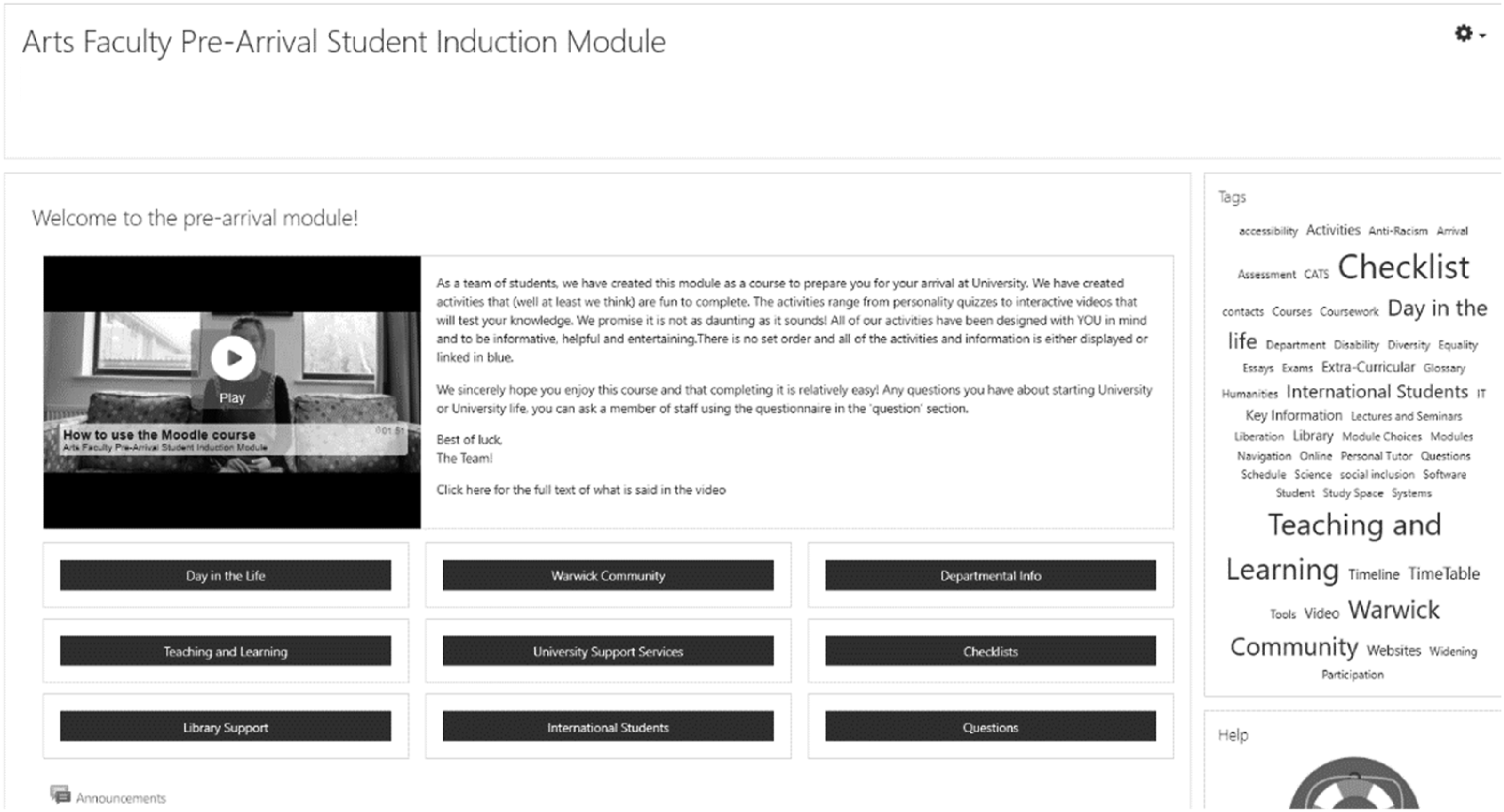
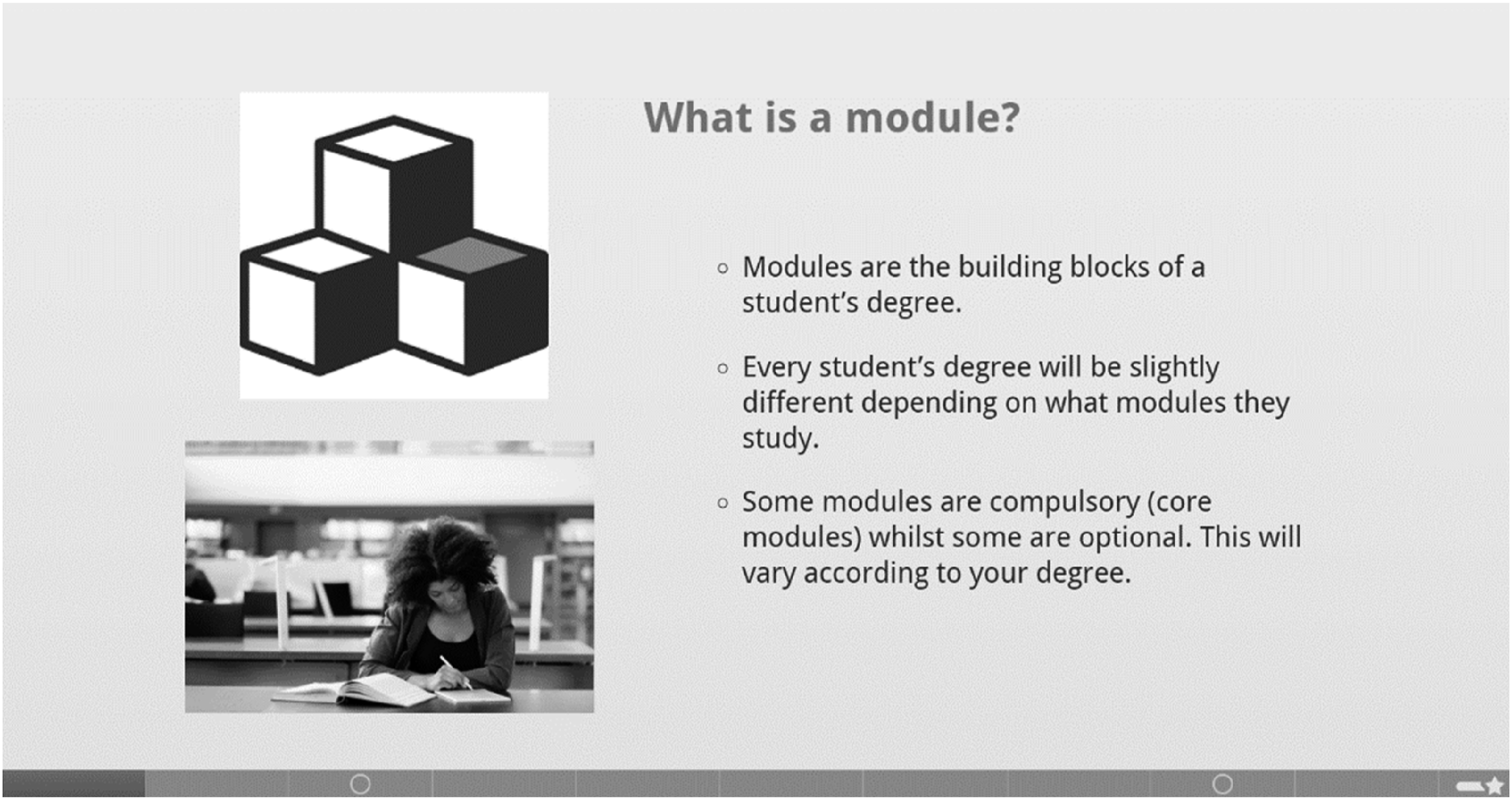
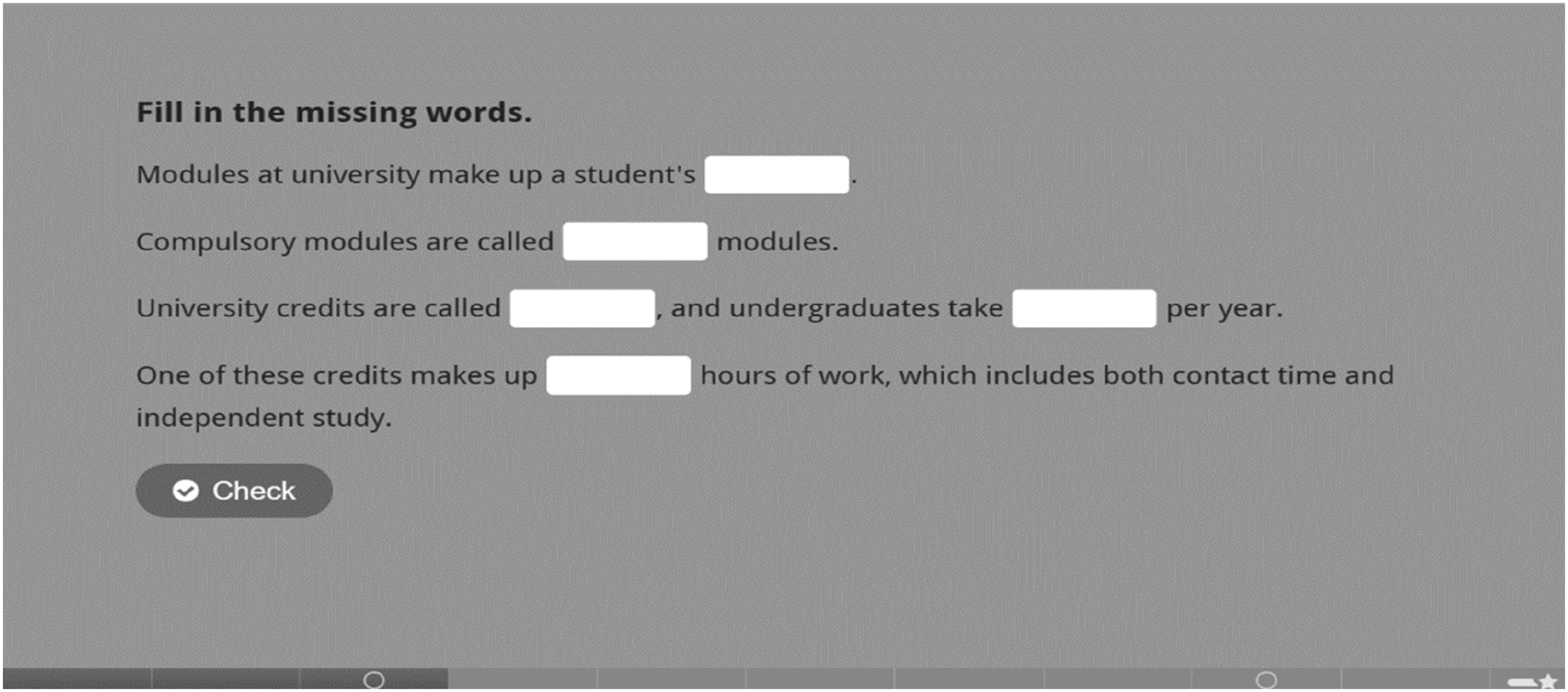
Within each section, there were a number of different features. In the Teaching and Learning section, for instance, there were subsections based around the following: lectures and seminars; online tools; course and assessment; personal tutors; study spaces and university terminology glossary. Each of these subsections had information about what a new student may encounter when they came to university. For example, in the course and assessment subsection, there was information on what a university module is (Figure 2), followed by an interactive quiz to help solidify learning of the information and to ensure it was not just passively ‘clicked through’ (Figure 3).
Other parts of the site contained pre-existing student support videos, images, quizzes, hyperlinks to other webpages, question trees, presentations, downloadable documents, question and answer options, and links to external sites such as YouTube. All of these materials were ‘found’ by the student co-producers as part of their development of the resource and were included because they considered them useful. The resource learning content was available for new students to access in their own time and at their own speed. Before we released the resource, we asked the academic technology team, student representatives and some academic colleagues to review it to ensure it was fully accessible and met the universities expectations relating to the delivery of online resources, as well as get some initial feedback.
The resource was promoted to Arts Faculty pre-arrival students from mid-August 2019 via centrally delivered communications sent out by the Welcome Week Team. The pre-arrival students were sent a link with a brief description of the resource and information about how it had been co-created with existing students. The resource was also advertised to students once they had begun their studies via emails from the Arts Faculty.
Evaluation of the co-creation method
The student co-creators’ experiences of the project were evaluated through an anonymous survey. The students rated their experience on the project at an average of 8 out of 10 and wrote further qualitative statements when discussing the benefits of taking part, such as: ‘there are a myriad of benefits, as you learn more about the resources you have open to you and helps you develop more skills. Also you can relate better to the target audience’. The students also reported that they had developed skills in team work, time keeping and working to deadlines. Their favourite parts of the project included ‘using H5P to create interactive production’ and the ‘planning process and deciding what needed to be included and the best way to display the information’.
Content and statistical analysis of the evaluation data shows that the students who co-created the Moodle module got a lot out of the process, including developing their understanding of technology enhanced learning and awareness of university induction. They were able to identify key skills that they had developed and note what parts of the technology (for instance, H5P) they had built skills using. As Biggs and Tang (2011: 70) state ‘technology can be used to enhance the dialogue between teacher and learner as new ways of engaging students in learning become available’. The evidence from the literature on co-creating technology enhanced learning with students suggests that there should be a ‘new way’ of developing learning which allows students to feel motivated and included (Wegener and Leimeister, 2012). The co-creators on this project fed back that they felt many benefits from taking part and developed new skills. For example, the student co-creators noted the benefits of working in a collaborative way, stating ‘everyone contributed and asked for opinions so it was very easy to work as part of a team with peers and staff’, and also that they enjoyed ‘coming up with ideas and working as part of a team’. These experiences reflect those of others who have worked in co-creative practice (Prescott et al., 2020) where students develop skills that enhance future employability (Pauli et al., 2016).
Evaluation of the resource
In terms of the evaluation of the resource, we firstly sought to establish pre-arrival student engagement with the resource, and if and how the resource had supported students’ pre-arrival experience and induction. The data collection methods to gauge pre-arrival students’ engagement with the resource included: 1. Learning analytics data from the Moodle pre-arrival site; 2. Feedback from pre-arrival students gathered via a survey form on the pre-arrival Moodle page; 3. Post-project focus group with pre-arrival students once they had arrived at Warwick.
To measure its success in terms of pre-arrival student engagement, we reviewed the learning analytics from the pre-arrival resource. As this was a non-compulsory module, we judged that the resource would have been successful if at least 25% of arriving students took part in advance of the academic year and during week. With 728 new Faculty of Arts students starting in September 2019, we anticipated that around 182 students undertaking the module would represent a good level of engagement. This baseline was identified for a variety of reasons, but primarily due to the fact that it was a brand new initiative, the ability to ‘promote’ it to new students was limited to emails from the Welcome Week team, and it was voluntary. Monitoring of pre-arrival student engagement with site was undertaken at different intervals after the launch of the module in late August 2019. As of 1 December 2019, we were delighted that the site had been accessed by 375 out of the 728 possible users (51.5% of all possible users). This was considered a successful outcome. In addition, the data showed that students continued to access the site once they had arrived at Warwick, perhaps underlining the use of the site to enable to students to find out information that they did not want to ask their peers or staff, or that they felt embarrassed to not know. The first date of access from the new students was the day the Welcome Week email was sent out (25 August 2019). The last date of use was in mid-November.
The most popular section of the Moodle site were the ‘Welcome’ and ‘Day in the Student Life’ videos made by the student co-creators. The second most viewed element of the site was the Teaching and Learning section, especially the sections on assessment, lectures, and seminars. The least viewed element of the site was the International Student section, perhaps reflecting the relatively small numbers of international students in the Faculty and the central induction provision already afforded to international students. The other part of the site that had limited engagement was the ‘Announcements’ section through which students could provide feedback on the Moodle site itself and ask questions about starting University.
Although the feedback part of the site was sparingly used by the pre-arrival students, it should be noted that feedback we did receive was overwhelmingly positive, with comments such as the Moodle module was ‘informative and easy to understand’. It appears that the feedback element of the site was either not featured prominently enough, or that students felt they did not want to provide feedback at that juncture. The pre-arrival students who responded to the module feedback questionnaire also reported that they felt better informed about starting at Warwick after completing the pre-arrival induction module. Students rated their experience of the pre-arrival module as 9 out of ten (1 being the lowest and 10 the highest). In response to the question ‘what else would have been helpful to know’, one student responded: ‘More about the facilities available on campus and their uses’.
We also held a post-project focus group, inviting students who had completed the pre-arrival module to come and speak about their views. In this focus group, there were various comments made; the vast majority were overwhelmingly positive. They included statements like ‘it was well organised’ and ‘seemed like it was made by staff’ and it provided a ‘different type of advice than from parents – more specific’. Comments were also made about different parts of the site, and the feedback noted that indications that were given about how long each section would take to complete were especially useful. Parts that could have been improved, as reported by the focus group, included providing more information about departments, greater use of videos and further information about how you select a module and use reading lists.
Academic colleagues also provided useful feedback on the resource including: ‘it looks like a very useful resource’, ‘it’s intuitive and it balances self-directing learning with progress so you feel like you’re actually getting somewhere’ and the ‘Moodle site looks great’. Academic colleagues support for the resource played a key role in its promotion and student engagement, especially once students had started their studies. A yearly internal report into the impact of the university induction process (University of Warwick, Welcome Report, 2019) found that there was an increase in students feeling like they were part of a community and that they understood the learning expectations of their subject. The Welcome Report also highlighted that students felt that there was effective pre-arrival communications in 2019 and there was an increase in students reporting feeling that they felt prepared for university life following induction. The university also grew its numbers of Widening Participation students during this period (Office for Students, 2021a), and progression rates for diverse groups of students were maintained. Whilst the pre-arrival resource cannot directly be attributed with this increase in numbers, the resource was part of a renewed focus on a ‘lifecycle’ approach as promoted by the Office for Students (Office for Students, 2021b). Ensuring that support for students begins at pre-entry points, through induction periods and then into the first year of study and beyond, is key to ensuring that diverse groups of students do not withdraw from university (MacFarlane, 2019). The initial indicators are that the pre-arrival module had a positive impact on those students who started at Warwick in 2019/20.
Conclusion
The project can be deemed a success in many ways, but one of the primary examples of this was the level of engagement from the pre-arrival students. Although a Moodle module cannot entirely replace an induction process or Welcome Week for students, at least for those who are likely to study at least some of their programme ‘in person’, technology can complement and add value to existing formal structures (Motiwalla, 2007; Nortvig et al., 2018). There are clear advantages to providing online support to students before they physically arrive on campus. However e-learning materials should be carefully designed and developed so they can be critically analysed to understand which approaches help support student induction. There are clearly areas for improvement in future practice in this space, most notably the ability to promote this type of site in a more structured and recurrent way, but also to ensure that the content which has been more popular (for example, videos) and that information which was more relevant to individual students (departmental information) is more prevalent.
The project revealed what sorts of support that arts and humanities students felt they would have benefited from before arriving at university. This included information about what a day in the student life is like, how learning is delivered through modules, lectures, and seminars, and the different modes of assessment that students can expect at university. It revealed that students consider learning study skills and information about the library useful to know before starting university. These insights, first identified by the student co-creators, were backed-up by pre-arrival students’ engagement with the resource, with these being parts of the site that were the most popular. This suggests that arts and humanities students are particularly interested in finding out more about the student academic experience before starting university; perhaps more so than other parts of the broader student experience which is often the focus of campus-based induction pre-arrival. This online resource was created for all students, but was designed to be of particular use to those students from diverse backgrounds. It should be acknowledged that a direct correlation between the success of Widening Participation students and the use of the module is complex; however, the early signs are that it is well used and provides levels of support that students may not have traditionally had access to.
There are many lessons to be learnt from this project, most notably the benefits of working with students to co-create technology enhanced learning materials. Indeed, the feedback received from a range of stakeholders, including staff, current students and the newly arrived first-years, indicates that these challenges are worth overcoming. But, as this project has shown, these types of projects and forms of learning present challenges, such as ‘breaking down the power differential’ between traditional hierarchal staff–student relationships (Bovill et al., 2011), and moving into a space where creative control is jointly held by both staff and students, which can lead to a sense of uncertainty (Uskoković, 2018). It has been shown that co-production projects such as this, which use and involve the production of digital learning environments with students, can push the limits traditional definitions and traditional characterisations of teacher and learner and learning environment, in ways that are conducive to genuine partnership collaboration. Key to co-creation and partnership with students, this project demonstrates, is employing methods like workshop collaboration and group work, and utilising digital tools that can empower student co-creators and give them autonomy and support.
Footnotes
Acknowledgements
We extend our thanks to Warwick’s International Higher Education Academy for providing the funding for the Arts Faculty Pre-Arrival Project, and our fabulous team of student co-creators.
Declaration of conflicting interests
The author(s) declared no potential conflicts of interest with respect to the research, authorship, and/or publication of this article.
Funding
The author(s) disclosed receipt of the following financial support for the research, authorship, and/or publication of this article: Warwick International Higher Education Academy.
Ethical approval
Ethical approval was sought and awarded from the University of Warwick’s ethics committee to undertake this research. The student co-creators were given consent forms and participant information leaflets to ensure that we kept within appropriate ethical guidelines (BERA, Ethical Guidelines for Educational Research, 2018).
