




Abstract
This study seeks to investigate aspects of the relationship between the core academic activities of teaching and research in higher education, through a theoretically enriched discussion of the design of an innovative popular music module on Adele’s 25 album and its delivery to first-year undergraduates on a general-purpose music degree during the academic years 2015–21. Drawing on autoethnographic approaches, it contemplates the challenges associated with the execution of a module on genuinely contemporary topics, outlining the case for the importance of ensuring that university curricula remain up-to-the-minute as well as exploring strategies by which to realise this aspiration in the absence of a body of academic literature that might ordinarily have provided strong foundations for the content of such teaching. These lines of inquiry lead to consideration of broader questions concerning the evolving relationship between teaching and research in light of the substantial changes that have taken place within the UK higher education sector in recent years, as well as the possibilities for teaching-led research, developed exclusively for and in the academic classroom, as an alternative to the more traditional research-led teaching.
Keywords
The UK higher education sector has witnessed great change in recent years in terms of both teaching and research. The introduction of tuition fees in 1998, at least in England, and their escalation as high as £9,000 per annum for home students for undergraduate entry as of 2012 (with further rises thereafter) has brought an unprecedented focus on institutional accountability in relation to the quality and quantity of teaching. This has led to an increasingly customer-oriented environment that is itself subject to unparalleled scrutiny through standard measures such as the National Student Survey (NSS), which has accrued momentum dramatically since its inception in 2005, as well as the advent of published Key Information Sets (KIS) from 2013–14. The culmination of the inaugural cycle of the Research Excellence Framework (REF) in 2014 as a replacement for the previous Research Assessment Exercise (RAE), and its upcoming second iteration in 2021, has continued the rigorous national auditing of research outputs, impact, and environment at institutional and disciplinary level, while the importance of grant capture as a principal revenue stream for UK higher education has been heightened by the caps placed on tuition fees for much of the preceding eight years and, in 2019, the Augar Review’s proposals to reduce them to £7,500 per annum (Secretary of State for Education, 2019). The considerable emphasis currently placed on rankings in the principal national league tables, which incorporate metrics including the NSS and/or REF, has ensured close public awareness of the comparative performance of higher education institutions in a combination of teaching and research. Both activities have also recently undergone major parliamentary enquiry in the form of the 2016 White Paper (BIS (Department for Business, Innovation and Skills), 2016) and Stern Review (BEIS (Department for Business, Energy and Industrial Strategy), 2016), respectively, the former including a proposal for the introduction of a new Teaching Excellence Framework (TEF) from 2017 (subsequently, the Teaching Excellence and Student Outcomes Framework) as a counterpart to the existing REF.
It is against this backdrop of substantial change that popular music studies has exponentially gained prominence, with the number of dedicated undergraduate courses and modules having proliferated in the UK since the turn of the millennium (Cloonan, 2005; Cloonan and Hulstedt, 2012). Its dramatically increased visibility at all educational levels is such that has been described in terms of a revolution or even, possibly, a ‘paradigm shift’ (Smith et al., 2017: 5), for which a distinct yet broad pedagogy—popular music education—has developed in tandem, albeit one that is ambiguous, difficult to define, and forever in a state of flux (Kratus, 2019; Moir et al., 2019). The implications of the greatly shifting environment for UK higher education may therefore be more keenly felt within this recently burgeoning field, suggesting that it may provide fertile ground for the reconsideration, if not reconceptualisation, of the changing relationship between its core activities of teaching and research. In consequence of its relative newness, traditionally-educated students may be less prepared for, and less well equipped for, undergraduate education in popular music relative to more established counterparts such as classical music; a recent pilot study by Moir and Stillie (2018) identified that while undergraduate students of both classical and popular music feel somewhat under-prepared by their secondary education, this was especially true of the latter, since popular music was not a particular focal point of their school curriculum. Cloonan and Hulstedt (2012: 11) have additionally called attention to the remarkably diverse nature of popular music studies, encompassing elements of the ‘critical’ (analytical, historical, and cultural studies), the industry-facing or ‘vocational’ (music business, management, and promotion), as well as the ‘practical’ (performance, songwriting, and production).
This article, which concerns the academic study of popular music rather than its practical or managerial dimensions, falls within the former. It provides a theoretically enriched discussion of the significant challenges presented by the design of a popular music module focused on Adele’s then newly-released 25 album, as well as its delivery to first-year undergraduates during the academic years 2015–21. In exploring these experiences through the medium of autoethnography, this investigation leads me to contemplate the fundamental relationship between teaching and research in the broader context of contemporary UK higher education. While its starting-point is an account of popular music teaching on an up-to-the-minute topic, at the same time it offers wider consideration of the research-teaching nexus as well as the autoethnography of academic development.
Aims and methodology
Departing from my position as a research-active lecturer at a leading university in South-East England teaching on a general-purpose BMus Music degree, this article discusses an academic module that was particularly innovative for its endeavours to embrace contemporaneous content through significant amounts of original research undertaken for the express purposes of teaching. In reflecting on my own academic practice with hindsight, I adopt autoethnography—an approach regarded by some as radical, and which has attracted its fair share of criticism and controversy—as a method for pedagogic inquiry. With roots in anthropology, autoethnography is a type of qualitative social science research comprising autobiographical narrative integrated with interpretation and analysis of the wider sociocultural context in which the individual operates, in order to reach an enhanced understanding of the relationship between them (e.g. Austin and Hickey, 2007; Bochner and Ellis, 2016; Chang, 2008; Chang et al., 2013; Ellis et al., 2011; Ellis and Bochner, 2000; Etherington, 2004). The author’s narrated experiences in relation to the specific focal point(s) of the study comprise the principal data, thereby assuring a level of familiarity and accessibility distinctive within ethnographic work. However, the processes of conducting fieldwork-based research in order to gather the data are nonetheless those belonging to ethnography, as are the critical and ethical standards adopted in relation to its interpretation and the establishment of its validity, reliability, and accuracy, such that the end result transcends mere story-telling or description for its own sake. The datasets for autoethnography may hypothetically incorporate more experimental media such as fictional writing, audio-visual material, poems, and dramatisations (Etherington, 2004), and even drawing a picture or composing music (Gouzouasis, 2017), in addition to conventional documentary evidence including written observations, interviews, diaries, witness testimony, and reflective narratives (Chang, 2008), suggesting that it may be particularly well understood by—and suited to practice within—the arts and humanities. There is no expectation that the autoethnographic subject will present an extraordinary or exceptional case study necessarily, merely an appropriate lens through which to scrutinise specific issues in relation to the cultural context in which that subject is located.
Autoethnography is a methodological approach upon which I have repeatedly drawn in earlier studies (e.g. Wiley, 2019; Wiley and Franklin, 2017), by way of retrospective examination of my professional activity in both teaching and academic leadership (but not, previously, in research). It has received extensive application within pedagogic studies, some explicitly positioned within a particular taught discipline (e.g. Kinchin and Wiley, 2018 on the humanities), others exploring more focused topics such as the experiences of industry practitioners navigating the transition into academia (e.g. Franklin, 2019; Shreeve, 2011). The following study combines both of these possibilities, drawing upon a range of contemporaneous data including my own written narratives reflecting on the teaching, feedback from the students including formal end-of-module evaluations, and comments received informally from colleagues, captured across the whole life cycle of the module from preparation to delivery. Ellis and Bochner (2000: 739) write that ‘autoethnographers gaze, first through an ethnographic wide-angle lens, focusing out-ward on social and cultural aspects of their personal experience; then, they look inward, exposing a vulnerable self that is moved by and may move through, refract, and resist cultural interpretations’, and this is the approach that I take here, oscillating between my own case study of designing an undergraduate module that highlighted a specific aspect of the relationship between teaching and research, and contemplation of the wider context for that same relationship in the UK academic profession. Editing my autoethnographic reflection into the prose at appropriate junctures, I examine the case for the importance of embracing genuinely contemporary topics in higher education, even when it leads the curriculum into areas hitherto unfamiliar to academia, since its up-to-the-minute nature necessarily means that the scholarly discourse that might ordinarily have provided strong foundations for such teaching has not yet had the chance to develop. As indicated, I make no claims that my story—borne of the fieldwork of my curriculum design and classroom delivery—is unique or even distinctive, merely that it serves as an instructive springboard from which to consider wider matters of pedagogy with respect to popular music. These include the relationship between the academic study of popular music and better established repertories, as well as more fundamental issues concerning the evolving relationship between teaching and research in higher education, given the major changes recently witnessed in the sector nationally. While departing from a strong disciplinary grounding in popular music studies, this article will therefore hold much relevance to disciplines across the academic profession in the UK if not also beyond.
The research-teaching nexus in UK higher education
The model often cited as having provided the foundations for the modern research university, after which many institutions internationally were either fashioned or reformed, is the Humboldian one, which evolved in early 19th-century Germany (McNeely, 2002). Under Humboldt’s model, teaching and research were inseparably combined in an idealised intellectual union, with teaching as the more privileged of the two activities. In modern higher education, however, teaching and research have come to been seen as two separate and conflicting activities, a situation heightened in recent years with the rise of teaching-track contracts (i.e. teaching-only academic positions, often offered on a fixed-term basis) recruited in tandem with traditional tenured research-led posts (Hajdarpasic et al., 2015; Locke, 2014). The situation has not been helped by the removal of the division between polytechnics and universities in the UK in 1992, which ostensibly brought the activities of research-intensive and vocational teaching institutions together, while largely perpetuating the binary structure of teaching-only, career-driven activity being the domain of the latter whereas traditional research-oriented activity was seen to be the preserve of the more intellectually prestigious, elite former. Within the UK context, then, research appears largely to have lost the relevance to society associated with vocational teaching, and teaching has reciprocally lost much of its intellectual connection to research.
The 2003 White Paper, The future of higher education (DfES (Department for Education and Skills), 2003), attempted to establish an equal standing for teaching and research, as well as proposing a scheme of professional standards for teaching. The resulting UK Professional Standards Framework placed a focus on cultivating an ‘integrated approach to academic practice’ that continues to be firmly embedded in its current iteration (HEA (Higher Education Academy), 2011). Nonetheless, as Barnett (2003) holds, teaching and research have become rivals; while Kreber (2010) acknowledges the greater emphasis, institutional recognition, and rewards granted to research relative to teaching. The more recent 2016 White Paper lamented that ‘For too long, teaching has been the poor cousin of research’ (BIS (Department for Business, Innovation and Skills), 2016: 12), repeating near-wholesale the pronouncement upon teaching in its earlier counterpart (DfES (Department for Education and Skills), 2003): 15). This situation has been the case to the extent that the Stern Review identified the need to ‘strengthen the vital relationship between teaching and research in HEIs’ (BEIS (Department for Business, Energy and Industrial Strategy), 2016: 31). The introduction of the TEF as a complement to the already established REF may have the effect of placing teaching and research on an equal footing in terms of their visibility and the national frameworks by which they are evaluated, but there are no guarantees that it will correspondingly equalise their stature.
Isolated studies have previously attempted to identify links between research and teaching in disciplines such as geography (Healey, 2007) and social work (Taylor and Rafferty, 2003). The strategy that I have developed for integrating the two, in my module on Adele’s 25 album, represents a more radical reconceptualisation of their relationship, perhaps better thought of not as ‘research-led teaching’ at all, but as ‘teaching-led research’. It is indebted to the idea of research undertaken expressly for the purpose of teaching and developed exclusively for and in the academic classroom, rather than in fulfilment of a research-led academic contract. I embarked upon this pedagogical experiment mindful of the risks associated with doing things differently, both for students, given that an unsuccessful module may lead to lower marks as well as reduced satisfaction, and for staff, for whom poor ratings in student evaluation of teaching and other performance management measures can be highly detrimental to their career prospects. My story is outlined on the pages that follow, in the hope that it may resonate with others who might follow its lead.
The module on Adele’s 25 album
Context
The immediate context for the creation of my module on Adele’s 25 album was an institution-wide Operational Review that took place in 2015, which, inter alia, led to a significant reduction in the number of academic staff in music. This precipitated a major redesign of the well-established and highly regarded undergraduate portfolio in light of the smaller staff base, partly overseen by myself in the role of (at the time) departmental Director of Learning and Teaching. The new general-purpose BMus Music degree was constructed principally on compulsory modules for reasons of sustainability, including, in each year of the programme, a series of modules each focussed on a single case study. These ‘Topic Study’ modules shared a common module specification, with differentiated learning outcomes according to FHEQ level. They were therefore based on the premise that a module may be delivered according to the same blueprint whether its focus is on classical or popular music; the module descriptors were essentially mirrors of one another, with the substitution of ‘popular’ in place of ‘classical’, and (referring to the case study) ‘album’ in place of ‘work’.
The relationship between classical music and popular music warrants further consideration in this context, not least because my own prior experience suggested that it would be far more pedagogically challenging to sustain meaningful discussion for a ten-week lecture series on a single album of popular music than, say, a major, widely-theorised masterwork of classical music such as Beethoven’s Ninth Symphony, for which there is a substantial scholarly discourse on which to draw. I know from past teaching that even in the case of an album about which there is much to say as well as a significant body of secondary literature, such as The Beatles’s Sgt. Pepper’s Lonely Hearts Club Band (1967), discussion soon becomes exhausted after at most 2–3 hours of lectures. Moreover, and while there is indisputably shared middleground between the two repertories, musicologists have emphasised from the earliest position statements on popular music that, fundamentally, new approaches have been needed in order to study it (e.g. Covach, 1999; McClary and Walser, 1990; Middleton, 1990). The issues at stake include (1) that the traditional tools of musicology—its vocabulary, its methods, and its notation—were perceived to be inadequate to take account of popular music, for which the ‘text’ is recorded or performed rather than fully written down, and the study of which therefore needs to embrace a multiplicity of musical parameters and nuances; and (2) that any serious inquiry into popular music could not ignore its sociological dimension, which historically had been overlooked with some consistency in classical music studies (for a critical summary of, and response to, these arguments, see Wiley, 2021). Popular music and classical music, then, are incontrovertibly distinct fields of study, raising various potential problems in the classroom. In connection with the scrutiny of the content of the music itself, students may lack the skillset needed to extend or even reject the tools they have hitherto used to engage with music throughout their careers, much less to be able to critique those that they have previously been employing unquestioningly. It was revealing, for instance, that on the first iteration of the module, the students asked if I could run a class on academic skills to support their work, given that they had not to my knowledge made such a request in other modules. Evidently they recognised, for whatever reason, that they did not yet have adequate skills to flourish on this module in particular.
It is to the inextricable link between popular music and its sociocultural context that I ascribe the strong feeling I have experienced in past teaching that the music studied ought to be contemporary rather than historical. For instance, in a seminar on global citizenship and popular music given at my previous institution, for which my teaching crystallised around Paul Simon’s album Graceland (1985), fellow academics asked me what I felt was the benefit to the students of discussing such an old case study. Although some of the literature with which we were engaging was then quite recent (e.g. Fairley, 2001), scholarship can move so quickly in popular music studies that even a few years can start to feel like a significant lag, and academic discussion can soon dry up. What is notable about such views is that it would be very difficult to imagine similar suggestions being put forward in respect of classical music, the basis for studying the rich and influential history of which is well known and understood, even given that it would be entirely possible to base one’s teaching on current practice in the contemporary classical world. There is something of an irony in the widely-held presumption that lectures based on (popular) content 20 years old are considered outdated, when those based on (classical) content 200 years old remain fair game.
Content
For the above reasons, I was determined that were I to design a module on popular music studies based around a specific album, it would be one prominent in the contemporary popular culture in which the students were immersed, rather than a historical example. I therefore soon dismissed my earliest idea for such a case study, ABBA’s Gold: Greatest Hits album (1992, but comprising tracks from 1973–81), on the grounds that ‘the music is older than I am’. My intentions were that the students engage with the music that had the greatest currency at the point of delivery of teaching, as a counterpoint to the parallel Topic Study modules that centred on (classical) historical topics. Moreover, I was resolved that my module would not simply fall into the same trap as others that have intended to respond to current trends in popular culture but in reality often lapsed into a historical vein, for instance, exploring the topic of recurring musical themes in the scores of the most recent films of the Star Wars franchise (2015–19), an inquiry that inevitably merely leads discussion back to the origins of the practice decades earlier in the first such film, Episode IV: A New Hope (1977). However, my decision substantially restricted the possibilities for preparing the teaching in advance, since I had little idea what the future might hold for mainstream contemporary popular music and hence which yet-to-be-released album might serve appropriately as the foundation for an entire module. It was highly fortunate that Adele’s 25 album was released in late November 2015, and that it was No. 1 in the UK album charts during the initial presentation of the module, which ran from February–May 2016. Following Adele’s 21 (2011), by then firmly established as one of the best-selling albums of all time, 25 held particular cultural significance from the outset, being heralded by the media as the album to ‘save the music industry’ (e.g. Gill, 2015; Knopper, 2015) given its emphasis on physical formats (CD and vinyl) and its corresponding resistance to more recent trends such as streaming and digital downloads, which have become the prevalent modes of consumption of popular music in recent years. Subsequent events were fortuitously to endorse my choice of case study: 21 and 25 have since been named as the two biggest albums of the decade in the UK (Copsey, 2019).
The approach I adopted for the module was one in which each lecture crystallised around one (sometimes two) topics associated with the academic study of popular music. Given the inevitable absence of published scholarship on 25, as noted, I drew my academic perspectives instead from literature discussing general issues in popular music studies, which I sought to apply newly to specific examples drawn from Adele’s catalogue. The topics were chosen mindful of key elements of popular music (such as the music and lyrics) together with major contextual issues arising from the scholarly literature (for instance, authenticity), shaped and informed by my choice of case study. The 25 album therefore functioned as a vehicle for discussing academic issues widely identified to be important to the subject, while reciprocally conditioning the topics explored, such that the module content was moulded to the music in question rather than merely following a pre-defined list. The resulting lecture outline is set out in Table 1; the modest published research that has hitherto appeared on Adele (in relation to her earlier work) has largely reinforced issues I repeatedly foregrounded within my lectures as being particularly significant to this case study, such as her expressive use of the voice (Dibben, 2014), the autobiographical nature of her output as a ‘confessional’ singer-songwriter (Suhadolnik, 2016), and questions of authenticity and authentication (Till, 2016).
Lecture outline for undergraduate module on Adele’s 25 album.
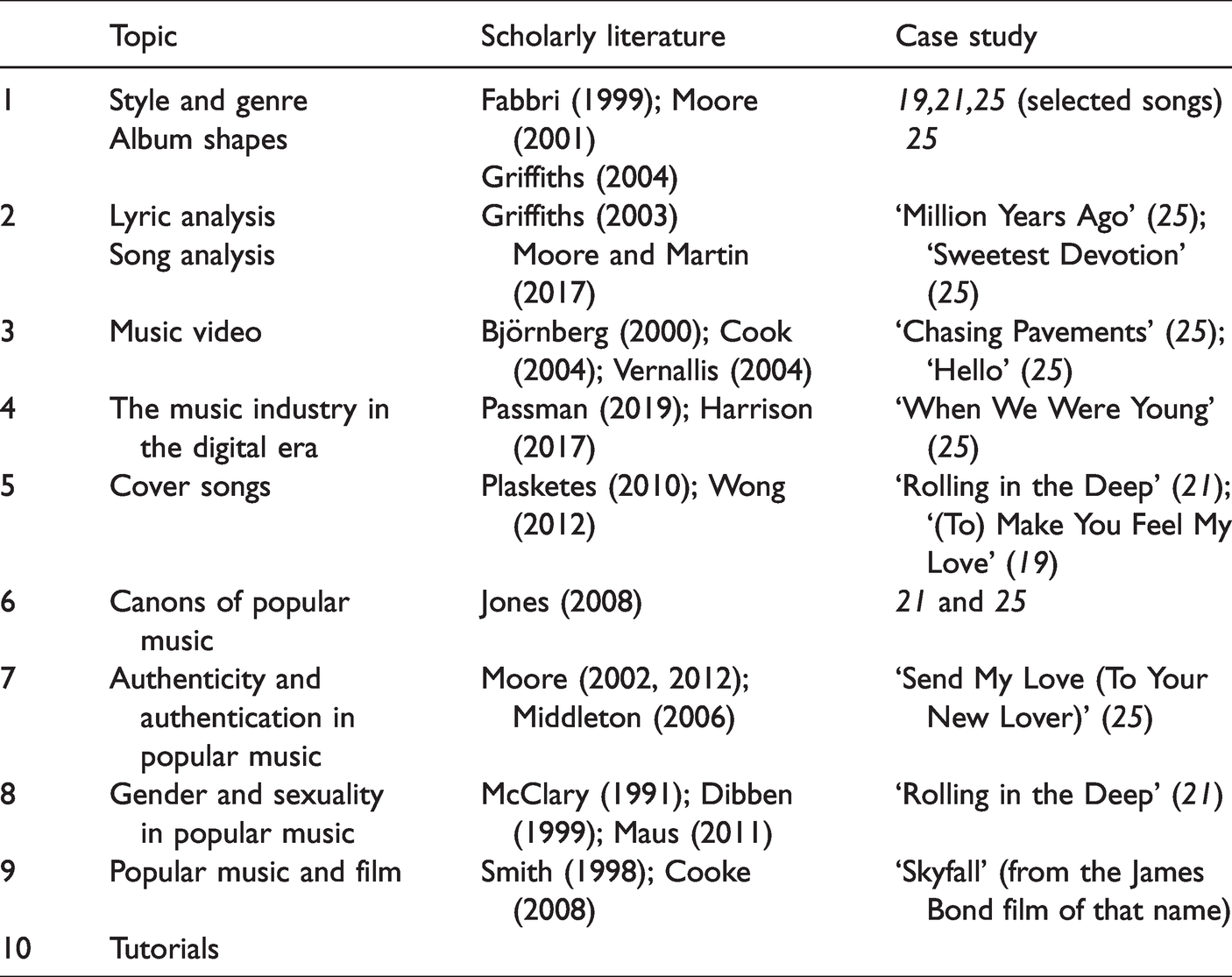
The importance of engaging with a contemporary topic became apparent at an early stage in the design process, since Adele’s 25 enabled discussion of recent developments in the music industry that would have been largely precluded by a historical case study such as ABBA, yet represented probably the most directly relevant part of the entire module to the students—many of whom aspire to enter the music industry as performers, songwriters, engineers, or producers. Adele’s involvement in the James Bond franchise with Skyfall (2012) conveniently opened up the possibilities for a lecture on popular music and film (even if it led to discussion of a film series that dated back to 1962, a situation that, as mentioned, I had hoped to avoid), although I regretted not being able to include in my module any teaching on the recently emerged phenomenon of the jukebox musical for which ABBA would have been ideal, given the unparalleled success of Mamma mia! as a theatrical show (1999) and two films (2008, 2018). I was similarly uncomfortable that, despite my insistence that the module crystallise around up-to-the-minute music, I had to delve back some eight years in Adele’s catalogue to find the example of a cover song best suited to the teaching, namely ‘(To) Make You Feel My Love’ (Bob Dylan/Billy Joel). However, I was simply not prepared to teach an entire module on popular music studies without addressing such a fundamental topic, since cover versions have a long and rich history that it seemed imperative for the teaching to encompass by way of fulfilling its aims to introduce key perspectives to the students.
Delivery
My vision for the module was therefore that it would simultaneously serve as a rigorous critical examination of Adele’s 25 and the cultural context in which it emerged, and as a general introduction to popular music studies itself, equipping students with the basic methodological tools needed to engage with the field throughout their degree programme with reference to the example of one in-depth case study. These aims were recognised by the students as early as its initial presentation; one noted on their anonymised end-of-module evaluation of teaching that ‘seeing different ways of analysing music applied to something recent (so recent that few others will have analysed it) helped me to see that different methods of analysing music aren’t as solely theoretical as I previously thought and can be applied to anything I want in order to learn more about that music’ (BMus student, June 2016). Another observed that the common parlance that had evolved within the Department of referring to this teaching as ‘the Adele module’ seemed to overlook its value as a general introduction to the academic field of popular music studies (BMus student, June 2017), an issue that was rectified in subsequent presentations.
The advantages of maintaining a focus on contemporary developments in a module on popular music are clear. It leaves no doubt that the material in question is current, and hence likely to be more relevant to the students than a historical example in terms of their prospective academic pursuits and career aspirations. It embodies a self-evident relationship between teaching and research (albeit not the one normally intended when academics refer to ‘research-led teaching’, a point to which I shall return), and has the potential directly to enhance the lecturer’s research profile through using teaching preparation to develop research, assuming that it ultimately feeds into their own outputs. Conversely, as I was to discover, the aspiration to keep teaching up-to-the-minute material comes at a significant cost, and not merely in terms of the risks previously noted. Inevitably I found myself not in a position to identify suitable content for the module until relatively close to the start of teaching (with no guarantees that the latest developments in popular culture would furnish any suitable candidates that might be adopted for such a module), precluding advance preparation and creating unnecessary stress as a by-product. There was also a need constantly to respond to events in the world of popular music as they continued to unfold while the module was running, particularly in its first incarnation. In terms of sustainability, while I had hoped that a contemporary subject would remain current for some years, and hence guarantee several different presentations of the module before it needed to be refreshed, the irony is that in reality it became dated more quickly than a historical subject would have done. I even found myself rewriting some of the lectures with each cycle of the module, particularly the one on the music industry (lecture 4), to take account of new trends. With media reports in 2020 that Adele is planning to release a new album imminently (Braidwood, 2020) but that it is not yet finished (Savage, 2020), this point in time presents itself as an appropriate juncture for retrospective reflection on the entire module, since the 2020–21 academic year left me waiting to see if it might just survive one final presentation or whether it would have already run its course after less than five years, which would be a relatively short return on the investment of all the research that had gone into creating it—one student, for example, recently referred to the 25 album as ‘nostalgia’, suggesting something from a time long since past. Finally, while I was concerned that meeting students on the ‘home turf’ of their own popular culture would lead to the danger that they might know more about the subject than I would, the opposite proved to be the case. In some respects, the teaching was too contemporary: in the first iteration of my module, I found that many students were unfamiliar with Adele’s 25 as they had not yet caught up with these developments for themselves. It was only on its second presentation, once a full year had passed, that the level of background knowledge of the cohort was truly equal to the content of the module.
I had originally hoped that I might be able to devise my teaching according to a ‘plug and play’ model, such that the emphasis would fall on the identified topics in popular music studies, with the content from Adele’s catalogue (while it nonetheless conditioned the list of topics around which the lecture outline crystallised) assuming a supplementary role in exemplifying the issues under discussion. That would have enabled me easily to substitute a different case study in subsequent years once another album had presented itself as a worthy, and more up-to-the-minute, example to succeed 25 on the module—for instance, Beyoncé’s Lemonade (2016), Ed Sheeran’s ÷ (2017), Ariana Grande’s Thank U, Next (2019), Billie Eilish’s When We All Fall Asleep, Where Do We Go? (2019), or Taylor Swift’s surprise album Folklore (2020). But this would have wrongly prioritised a set of pre-defined lecture topics above the case study, as if the choice of music itself were unimportant. I soon discovered that this teaching entailed substantial original research and musical analysis on Adele and 25 to be undertaken on my part, which consequently shifted the module’s focus away from the general perspectives on popular music and toward the case study, meaning that the album itself—the element that fundamentally underpinned this teaching—was central. Since I was only able to draw upon existing scholarship for its methodology and not also for its content, analyses that in other modules would simply be borrowed from published sources were instead the product of hour upon hour of original research (Figure 1 presents one such example), leading to a massive time investment required in order to bring this module to fruition—much more so, ironically, than would be needed for a conventional research-led module. As I was to discover, even just being able to identify which scholarship would be appropriate to apply successfully to an original case study required the vast pre-existing knowledge of the available literature that comes only with a rigorous grounding in the field to begin with.
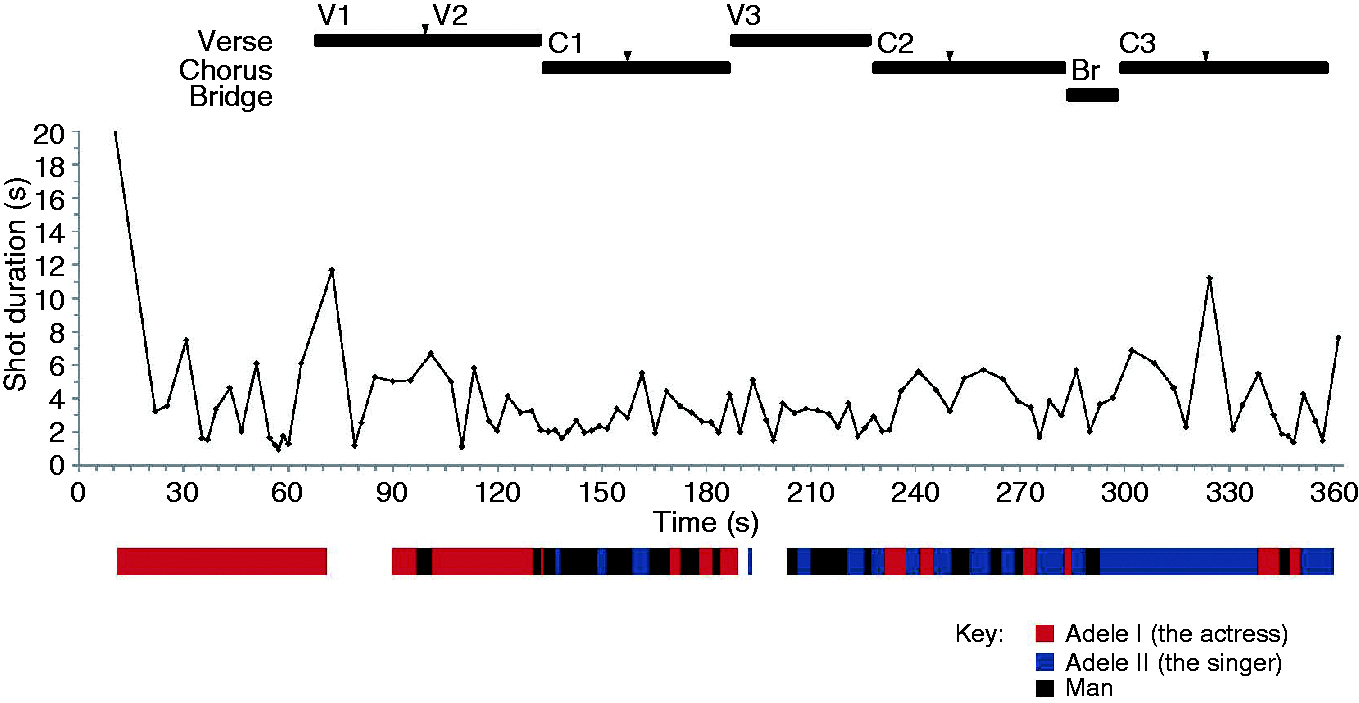
Graphical analysis of Adele’s ‘Hello’ music video (after Cook, 2004: 160–161).
Further discussion
The different focus between teaching and research embodied by this case study has invited me to contemplate the wider relationship between these two core activities, as well as the fundamental role of research within the classroom, given the context for twenty-first-century UK higher education highlighted in earlier sections of this article. The broader question of the current relationship between teaching and research in the academic profession has understandably received much attention in recent years, resulting in a vast bibliography (Healey, 2019). A seminal study by Hattie and Marsh (1996) indicated that the evidence base was lacking to support the widely-held supposition that subject research is of benefit to education. More recently, a literature review by Verburgh et al. (2007) was unable to reach conclusions as to the correlation between the quality of research of individual lecturers, the integration of that research into their teaching, and its positive impact on student learning. In this respect, indeed, it may not match students’ own expectations (Hajdarpasic et al., 2015). Other studies that have explored the relationships between teaching and research have acknowledged the potential for their rehabilitation but have called for a reshaping of higher education itself as a necessary step change in order to bring it about (e.g. Barnett, 2005; Brew, 2010, 2012; Jenkins et al., 2003; Kezar, 2000). It is notable, for instance, that the many references to research in the 2016 White Paper (BIS (Department for Business, Innovation and Skills), 2016) on higher education teaching are not mirrored in the Stern Review (BEIS (Department for Business, Energy and Industrial Strategy), 2016) on higher education research, in which teaching is mentioned nowhere near as frequently.
A recurrent theme in autoethnographic research on the academic profession concerns the usefulness of the method for evaluating one’s professional identity (Archer, 2008; Austin and Hickey, 2007; Kinchin and Wiley, 2018; Learmonth and Humphreys, 2011; Shreeve, 2009, 2011). Skelton (2012) isolates three distinct ‘teacher identities’ in higher education: the teaching specialist; the research-active academic who teaches as a secondary activity; and a middleground, the ‘blended professional’, whose research may be pedagogical rather than subject-specific in nature. The above example is arguably closest to the ‘blended’ approach, in that it demonstrates that a lecturer engaged in teaching activity (whether or not on a research-led contract) might nonetheless undertake substantial research as an integral part of their day-to-day teaching—by which I refer to original research undertaken for the express purposes of teaching up-to-the-minute, socially and culturally relevant topics, as distinct from research previously conducted with a view to academic publication and presented in the form of taught lectures only as a subsidiary endeavour. The latter description would apply to some of my previous experiences of using in the classroom research that I had originally conducted outside of the context of my teaching—but not, as noted, to the module discussed above.
I would therefore suggest that the dichotomy between ‘teaching’ and ‘research’ that has become deep-seated in higher education—as encapsulated in the UK context by the REF and the TEF, two methodologically very different national exercises, as well as the current model of academic contracts being identified as either teaching-track or research-led—can be somewhat unhelpful, leading to the implication that the two are separate, even mutually exclusive, endeavours. The reality, indeed, is that much ostensibly research-led teaching involves academics delivering tuition in an area that may be only broadly or tangentially related to the specifics of their research, and without involving them in disseminating the findings of their own published (or soon to be published) research per se. Given the extent of the diversity of many arts and humanities disciplines today, and the need to sustain breadth of teaching within often modest-sized programme teams, there is, indeed, not always the expectation that research-active academics will even be teaching in areas related to their personal research necessarily; as Hajdarpasic et al. (2015: 655) acknowledge, ‘some research-active academics do not integrate their research into their teaching’. But this raises the crucial question of the positioning of the teaching-led research for which this article has advocated. Enabling teaching to lead research, rather than the other way round, runs the serious risk that such activity might be construed as pedagogic research (that is, as research related to teaching, rather than an original contribution to the advancement of knowledge of the associated discipline), particularly as it could be undertaken equally by teaching-track and research-active staff. As indicated, it could be seen to fall within Skelton’s (2012) category of the ‘blended professionals’ rather than that of the ‘researchers who [secondarily] teach’.
The current UK higher education environment is one in which research into one’s discipline is institutionally favoured above the more marginalised pedagogic research (even as the scholarly literature suggests that the former might at the same time have little real-world potential for enhancing teaching quality). Multiple studies (Boshier, 2009; Cotton et al., 2018; Kreber, 2010; Wiley and Franklin, 2017; Yorke, 2000) have identified that pedagogic research is considered a less intellectually rigorous and less worthwhile endeavour, one that is not valorised, recognised, or rewarded within academia to the same extent as discipline-specific research. However, my own experiences of designing and delivering the module on Adele’s 25 album, as re-evaluated above through the medium of autoethnography, would seem to indicate that the lines between teaching and research are, quite rightly, rather more blurred than is suggested by the rigid divisions institutionally constructed between the two. Higher education may therefore be enriched in the future through the greater recognition of teaching and research as equal and inseparable activities rather than as conflicting and mutually exclusive ones, coupled to a rigorous defence of teaching-led research and its relative value in keeping university curricula genuinely contemporary and thereby enhancing the quality of student learning.
There is one further insight to be gained from my pedagogical experiment, concerning a different facet of the relationship between teaching and research that has also been explored in the scholarly literature—namely, the students’ own engagement with research, and the nurturing of the practice of research in the context of undergraduate teaching (e.g. Brew, 2006; Garde-Hansen and Calvert, 2007). For although I was myself capable of undertaking original research in applying critical perspectives from one area of scholarship on popular music to a new example upon which little had previously been published, the same was not true of the students, whose initial reaction to the module assignment was to seek out books (where these even existed) on the popular music artists they wished to study, from which they could then write their essays. This speaks to wider issues that are currently being debated in the disciplines of music and musicology in higher education, concerning the risks associated with current trends towards ‘deskilling’ undergraduate curricula and the problems consequently created for teaching (Pace and Tregear, 2021). It took several iterations of my module to arrive at a workable solution, namely reconfiguring the assessment as a ‘patchwork text’ (Jones-Devitt et al., 2016; Winter, 2003), which enabled the assignment to be broken down into smaller components with carefully expressed rubrics in order to provide the students with very clear guidance as to how to complete each step of the work cumulatively. These avenues of inquiry represent fertile ground for future study (Wiley, 2021).
Footnotes
Acknowledgements
Previous versions of this article were presented at ‘Teaching and Creativity in Popular Music’, University of Surrey, 10 June 2017; ‘Surrey ExciTeS’ Excellence in Teaching Symposium, University of Surrey, 3 January 2018; ‘Beyond “Mesearch”: Autoethnography, self-reflexivity, and personal experience as academic research in music studies’, Institute of Musical Research, University of London, 16 April 2018; and ‘Progressive Methods in Popular Music Education’, Western University, London, Ontario, Canada, 8 June 2018. My thanks to the participants in these events for their questions, feedback, and encouragement. This article will appear in revised form in the forthcoming The Routledge Companion to Autoethnography and Self-Reflexivity in Music Studies and is printed here with the permission of the publisher.
Declaration of conflicting interests
The author(s) declared no potential conflicts of interest with respect to the research, authorship, and/or publication of this article.
Funding
The author(s) received no financial support for the research, authorship, and/or publication of this article.
