




Abstract
Recognising the popularity of partnership models, this article questions the current literature on partnership within the humanities and explores the possibility of effectively implementing partnership within the English discipline, through exploration of the traditional modes of learning associated with specific disciplines and the barriers that exist through the traditional teacher-learner dynamic. It considers the difficulty of breaking down both the conventional learning methods of reading English and traditional hierarchies in universities in order to foster more collaborative processes. In this article, I use Fairclough’s three-dimensional model of critical discourse analysis to explore 32 interviews, 12 observations and 12 policy documents from two post-1992 English universities. Negotiating partnership models in the humanities requires further exploration, with attention given to conventional methods of learning associated with disciplines, traditional learner-teacher hierarchies and the structural barriers these associations create for establishing collaborative learning relationships between academics and undergraduates.
Introduction
Partnership models are becoming increasingly popular within universities in England (Tong et al., 2018). Premised on the notion of shared authority and collaboration within the learning process, they present a new way of negotiating knowledge. Partnership models ‘inherently subvert the traditional power hierarchy between learners and teachers by re-positioning partners as learners and teachers’ (Bovill et al., 2011: 14); they constitute new behaviours and new ways of learning. The literature often discusses the broad challenges of establishing partnership relationships, with a number of studies focussing on the divergence between partnership values and those perpetuated by consumerist models (Symonds, 2020) and the divergence between traditional hierarchies and the shared authority necessary in partnership dynamics (Bovill and Felten, 2016). Less attention, though, has been given to the challenges of overcoming traditional modes of learning within disciplines.
The humanities, as academic disciplines, are entrenched in established ways of learning and behaving. Trowler argues against viewing disciplines through a strong essentialist lens because of the inherent risk in dismissing nuances at the practical level. He posits that strong essentialism emphasises that disciplines have ‘unique identifying characteristics which mark it as being itself’ (2014: 1721). Although against strong essentialism, Trowler maintains the necessity of moderate essentialism in order to understand the impact of disciplines and he draws on Wittgenstein’s family resemblance concept to conceptualise shared characteristics within disciplines (Trowler, 2014). This article agrees that strong essentialism blurs the nuances present in the practice of disciplinary learning, but it agrees that ‘different disciplinary contexts will each, to some extent, possess their own norms, language and practices’ (McCune and Hounsell, 2005: 257); as such, it argues that English disciplines have characteristics that, although shared with other disciplines, are recognised and accepted as appropriate.
McCune and Hounsell (2005) emphasise the importance of ‘ways of thinking and practising’ (WTP) within disciplinary contexts, which describes ‘the richness, depth and breadth of what students might learn through engagement with a given subject area in a specific contexts’ and helps students ‘develop a sense of what it might mean to be part of a particular disciplinary community’ (McCune and Hounsell, 2005: 257). The concept of WTP can help to explain the impact that particular disciplinary contexts have on the implementation of new ways of thinking within subjects. The traditional learning approach in the study of English is characterised by autonomy and individual interpretation where ‘students deal with the original materials and are able to respond in personal and original ways’ (Evans, 1993: 22). There is an assumed academic freedom in the study of English, and the ability to ‘deny seriousness, to be self-indulgent, pleasure-seeking’ (Evans, 1993: 40). Shulman describes the associated pedagogy of disciplines in terms of pedagogical content knowledge, in which ‘knowledge of the discipline and knowledge of its particular range of pedagogies [intersect] to create a special kind of knowledge’ (2011: 5). Consequently, the content taught within English is often presented through established pedagogical methods. Evans celebrates the English discipline as one which has the capacity to ‘deny, provisionally at least, a view of life and of education which puts career, consumption, material success and upward mobility first’ (1993: 116). As such, it should be ideal for fostering partnerships because, in contrast to being defined by finite knowledge, the WTP (McCune and Hounsell, 2005) in English are characterised by ‘creativity, imagination, emotion, subjectivity, responsiveness, receptivity, the non-instrumental, the transcendent’ (Evans, 1993: 127). However, this conceptualisation of studying English lacks consideration of both the traditional approach to teaching within disciplines and the influence of socially structured relationships (Isaac, 1987: 21).
Not only is partnership difficult to implement because of the specific modes of learning in disciplines, but it is also impeded by the behavioural expectations associated with the traditional teacher-learner dynamic, which is constituted by the two established subjectivities of the learner and the teacher. Subjectivities are the product of social rules determining appropriate ways of being; in other words, they refer to ‘prescriptions about the behaviour of a person occupying a given position, a set of guide-lines which direct the behaviour of the role’ (Hargreaves, 1972: 71). As a social construct, subjectivities are contingent upon pre-determined characteristics that define that particular subject position: ‘taking up a subject-position in a certain social discourse provides the individual with knowledge and rationale for actions with which the individual unwittingly identifies’ (Atkins, 2005: 208).
The traditional learner subjectivity is established throughout compulsory schooling as an appropriate position to take up within educational contexts. Freire, from a critical pedagogical perspective, argues that in this traditional learner subjectivity, ‘educators are the possessors of knowledge, whereas learners are “empty vessels” to be filled by the educators’ deposits’ (1985: 100). He elaborates by surmising that education ‘is reduced to a situation in which the educator as “the one who knows” transfers existing knowledge to the learner as “the one who does not know”’ (1985: 114). Traditional learners are expected to be dependent upon the unilateral authority of the individual occupying the teacher role, with little need to discover knowledge for themselves. This characteristic is naturalised to such an extent that ‘what has been socially and historically constructed by a specific culture becomes presented to students as undebatable and unchangeable, always there, timeless’ (Shor, 1996: 10–11). As Shor illuminates, the traditional learner subjectivity is a social construction but, because of its pervasiveness, it appears as natural.
The natural adoption of the traditional learner subjectivity is framed as a negative barrier to the implementation of collaborative relationships in HE. McMillan and Cheney argue that ‘we need to depart from the old-fashioned model of passive information transmission, in which the student is viewed merely as a receptor and mirror’ (1996: 13). However, it is far more complex than stating a necessity in departing from the transmission model of teaching because, as MacFarlane notes, ‘there is a wealth of evidence that students prefer to learn in ways that are often labelled negatively as “traditional” or “passive”, notably via the lecture method’ (2015: 342); there is a close association between deference to the teacher’s authority and the passivity encouraged by certain teaching methods. Moreover, the dispositional power granted to the social role of learner is limited; learners have little authority over class content, the assessment process or the creation and distribution of knowledge. Allin notes that ‘in terms of learning and our relations with students […] the power resides with the authority of the lecturer and is often reinforced through our social practices of teaching and our interactions’ (2014: 97). Thus, undergraduates not only associate the English discipline with a specific way of learning, they also associate the context of the university with the behavioural expectations of the traditional learner.
Applying Haugaard’s theorisation of structural power in regards to the rules of particular contexts is illuminating for understanding the impact of established modes of learning and established social roles and their dynamics. He posits that social structure ‘constitutes a way of ordering the world, which precludes certain conditions of possibility and facilitates others’ (2015: 151). By this view, social interactions and practices are premised on shared understanding and acceptance of appropriate behaviours; the English discipline is a socially structured practice premised on the understanding of appropriate methods of learning. He elaborates on this through the conceptualisation of structural constraint, which is ‘a process whereby actors who threaten systemic stability by new and innovative structuration practices are met by the non-collaboration of others in the reproduction of these new structures’ (Haugaard, 2003: 94). Implementing a partnership approach within the English disciplines is often met with resistance because it threatens the established order of learning. The field of student partnership frequently cites the potential benefits of collaboration between students and academics in the creation of knowledge, and although there is often acknowledgement of the ‘powerful structural constraint’ (Haugaard, 2015: 153) presented by traditional hierarchies and HE contexts (Bovill, 2017), there is less attention given to the barriers of traditional learning approaches within disciplines. Although, arguably, the traditional teacher-learner dynamic presents a more pronounced barrier for implementing partnership, the barrier presented by the traditional approaches to teaching within disciplines requires equal exploration. The perception and negotiation of both the traditional modes of learning and the traditional teacher-learner dynamic, in relation to fostering partnership models within the English discipline, is the focus of this article.
Understanding partnership
Partnership can be conceptualised in a number of ways and for different purposes (Bovill, 2017); the discursive labels range from ‘student-staff partnership’ (Marquis et al., 2017), ‘co-production’ (McCulloch, 2009), ‘co-creation’ (Bovill et al., 2011), ‘co-researching’ (Jones et al., 2012), ‘collaboration’ (Allin, 2014) and ‘research-based education’ (Brew and Mantai, 2017). Despite the use of different discursive terms, they all share similar characteristics and are underpinned by authenticity, inclusivity, reciprocity, empowerment, trust, challenge, community, and responsibility (Healey et al., 2014). This article focusses on partnership as an ethos (Dollinger and Mercer-Mapstone, 2019), but with specific focus on both collaboration in teaching and learning activities within classrooms and the co-creation of research. Forming a partnership is precipitated on the notion of shared responsibility and reciprocity ‘whereby students and staff work together to achieve common goals’ (Matthews et al., 2018: 31).
This notion of reciprocity is contradicted by the notion of autonomous learning which characterises traditional learning processes within the humanities. Pilsworth argues that establishing reciprocity should be easier within the humanities disciplines because they can be ‘defined as dialogues in both a literal sense (they are built on discussion) as well as a metaphorical sense (they are about thought processes, an exchange of ideas and an encounter with the unknown)’ (2018: 129). But whilst it is true that English holds the potential for collaborative learning processes, characterised by reciprocal dialogue between undergraduates and academics, Pilsworth fails to acknowledge the strength of the traditional mode of autonomous learning within the discipline. Moreover, partnership holds the potential to support a more holistic approach to learning, emphasising development in terms of ‘knowing, acting and being’ (Barnett and Coate, 2004: 124). Barnett and Coate argue that knowing is when ‘the student comes to make claims of her own, however tentatively, however half formed’ (2004: 124) and acting takes place ‘in her own way […] for there are no precise scripts to follow’ (2004: 124). Ultimately, this leads to engagement through ‘being’, whereby ‘the student comes into herself in new ways’ (2004: 124). Partnership models hold the potential to disrupt the traditional approaches to learning and teaching, creating space for alternative forms of engagement and holistic approaches to student development. The possibility of fostering this potential, though, lies in the ability to break down the entrenched modes of learning within disciplines.
Taylor (1976) argues that disciplines are characterised by ‘heroic myths’; these myths perpetuate ‘the power of the discipline’s own ideology’ (Trowler et al., 2012: 48) and aid in the continuation of associated approaches to teaching, learning and research. Evron argues: ‘in contrast with the articles produced by our colleagues in the sciences, the texts that we produce – for which “research” always seems like the wrong word – are rarely co-authored’ (2018). Ways of thinking in the English discipline are often characterised by singular authorship and there is an ‘heroic myth’ in the production of individual research (Taylor, 1976). Perhaps this myth owes its establishment to the understanding of literary production within the content of the discipline itself; post-Romantic notions of singular authorship, canonicity and individual genius are plausible causes for the association between English and individual authorship. This is not a universal conclusion regarding research within the humanities and the implementation of collaborative approaches to teaching, learning and research can offer a fruitful means of disbanding this myth, however, the familiarity of individual authorship can be problematic for implementing reciprocal pedagogical relationships because the two approaches to teaching, learning and research are divergent.
As well as reciprocity, partnership relationships are also characterised by undergraduates sharing responsibility for knowledge creation. Telfer argues that partnership ‘has the ability to increase students’ abilities to acquire and retain their own knowledge through the double-loop learning model and the act of designing one’s own approach to learning’ (2018: 249–50). In research, new knowledge is sought, but in teaching, finite knowledge is provided; this helps to explain the inclination for undergraduates to avoid sharing responsibility. In opposition to this, the willingness of undergraduates to share responsibility is affected heavily by the traditional teacher-learning dynamic, which acts as a ‘powerful structural constraint’ (Haugaard, 2015: 153) to the successful implementation of partnership models within the humanities.
Undergraduates have internalised the socially constructed role of the traditional learner, which creates a pervasive normalisation of appropriate behaviour within educational contexts. Whilst there are some schools which incorporate co-creation, there is still a long history of the traditional learner role, largely perpetuated by the national curriculum and the need for teachers to impart predetermined knowledge in order for students to pass required assessments. As will be discussed in more detail, the findings present acknowledgement of the need for academics to set out the change in expectations for undergraduates to foster more collaborative pedagogical relationships; this, however, is not always achieved and undergraduates in this study frequently perceived no changes in expectations regarding approaches to teaching and learning. Matthews et al., acknowledge that ‘students are not pedagogical or disciplinary experts’ (2018: 31); undergraduates have been socialised into a learner role which emphasises the authority of the teacher, whilst diminishing the responsibility of learners in the creation of knowledge.
As Marquis et al., note, ‘student-faculty partnerships are not without their challenges, foremost amongst which are the difficulties attached to dismantling entrenched structures of authority’ (2016: 5). In a different study, Marquis et al., discovered that ‘some participants questioned whether it is possible to fully challenge existing hierarchies, particularly when they are so normalized that we can be blind to their operations’ (2017: 726–7) and noted that ‘even when individuals are willing to step outside of these pre-existing roles, the unfamiliarity of the process can create uncertainties about how to act’ (2017: 726). The notion of fostering reciprocal relationships is acknowledged in the literature as being both problematic and challenging in terms of addressing traditional social roles, but what is missing is an integrated understanding of these problems and challenges in relation to disciplinary traditions and their approaches to teaching.
Bovill et al., surmise that partnership models ‘inherently subvert the traditional power hierarchy between learners and teachers by re-positioning partners as learners and teachers’ (2011: 14). Both undergraduates and academics must negotiate the ‘enduring relations’ (Isaac, 1987: 22) of the traditional teacher-learner relationship as well as the behavioural expectations of the traditional approaches to learning that characterise disciplines. As such, the ability to foster collaboration and co-creation becomes even more challenging than if it were just a case of deconstructing the traditional hierarchy. This article explores the necessity of understanding the traditional approaches to learning, teaching and research in the humanities before institutions can attempt to effectively reconstitute relationships between undergraduates and academics. Without an in-depth understanding of these traditional approaches, it is difficult to restructure them in a way that allows space for collaboration and co-creation.
Research design
This chapter draws from research conducted across two post-1992 universities in England, referred to as University A and University B (A or B in the data), both of which have institutional policies for implementing student partnership. University A has a specific strategy to configure a collaborative learning process at the institutional level and was chosen to explore how the positioning of undergraduates within a partner subjectivity plays out within interpersonal relationships with academics. University B was chosen to provide a comparative model within the same categorisation of institution; the intention being to explore the variation in perspectives and practices between a university with an influential partnership model and one with less emphasis.
The undergraduate population of both institutions is almost all state-school students: 97.3% at University A and 97.5% at University B (HESA, 2019). According to Taberner, ‘the most starkly challenging students go to the post-1992 universities, where most students need lots of pedagogical and pastoral support’ (2018: 144). To add to Taberner’s idea, this current article investigates the premise that undergraduates from post-1992 universities have a significant reliance on the traditional teacher-learner dynamic. There is plausibility in concluding that undergraduates who lack confidence will struggle to partake in the co-creation of knowledge because of the reliance on teachers to build their confidence in ability. However, it is also plausible to conclude that students who are confident and have a history of success in a traditional structure will struggle to adhere to behavioural expectations that are unfamiliar and thus, present a greater risk of failure. At present, there is not enough evidence to form a solid conclusion regarding either possible explanation of reluctance, but instead, the findings of this study present the possibility of opening up dialogues about the impact of undergraduates’ backgrounds on their willingness to partake in partnership dynamics.
This project included 32 semi-structured interviews with undergraduates and academics (12 academics and 20 undergraduates); the interviews explored methods of engagement, the impact of policy documents, the concept of partnership in HE, and the relationships between undergraduates and academics, conceptualised in drawings produced by participants. The article also draws on 6 institutional documents from each university. Participants were all voluntary and included undergraduates in different years of study (Year1, Year2 or Year3 in the data). The research is situated within the humanities, specifically the Department of English at both institutions, because a large number of educational studies have been carried out within STEM disciplines (Woodall et al., 2014). Understanding the contextual significance of the humanities in relation to the implementation of partnership models is an important area of research that is underexplored. All participants have been given pseudonyms for confidentiality. The study was approved by The Faculty of Arts and Social Sciences and Lancaster Management School Ethics Committee at Lancaster University.
The study uses Faircloughian critical discourse analysis (CDA) to interpret the spoken discourse of the interviews and the written discourse of institutional policy. All data were analysed as a text (vocabulary and grammar), a discursive practice (situational context and intertextuality) and a social practice (social determinants influencing the text) (Fairclough, 2015). The three-dimensional model was applied to key parts of the discourses from the datasets. The textual analysis including pulling out specific textual elements, including vocabulary and grammar; the data was then analysed as a discursive practice, which included interpreting the ways in which the text had used other discourses and how these had manifested, as well as any presuppositions and their origins; the analysis from these stages was then used to explain the text as a social practice, which involved analysing the social determinants influencing the text, from systems of knowledge and belief, to social identities and relations. Because discourse in CDA is defined broadly as ‘language use as […] social practice’ (Fairclough, 1993: 3), the visual drawings produced by participants were analysed using the three-dimensional model, except vocabulary and grammar were replaced by image.
Findings
Autonomy versus collaboration
Both University A and University B have institutional policies outlining methods for engaging undergraduates within partnership models. For University A, the policy is based on ‘mutual expectations and aspirations’ (2018b), and for University B, the policy defines undergraduates and staff as ‘co-creators of understanding’ and ‘co-producers of knowledge’ (2018a). According to Marquis et al., ‘partnerships involve the formation of reciprocal relationships between students and academic staff, with the capacity to mitigate traditional hierarchies’ (2016: 4). For both universities in this study, though, each unique partnership strategy is, at best, ambiguously defined and the discourses of the interviews indicate ambivalent and varied perceptions of its meaning and representation.
The academic interview discourses from University B reflected ambiguity in defining what partnership entailed for the institution. For one academic, it was perceived as ‘anti-consumer rhetoric’ (B, Vicky), whereas for another, it was considered a representation of a ‘two-way relationship’ (B, Alistair) and another yet saw it as a ‘word which is used in order to break down […] a teacher-pupil division’ (B, James). Each of these definitions has slightly different connotations for engaging undergraduates; an anti-consumer ethos would imply an attempt to diminish the power of the undergraduate now they are positioned as consumers, whereas a strategy to break down the traditional hierarchy between learners and teachers would suggest empowering undergraduates. Whilst this article does not have the scope to delve into the impact of consumer-provider relations in the current university climate, it does acknowledge that undergraduates are positioned as consumers and the findings highlighted the difficulty for undergraduates and academics to negotiate the opposing agendas of partnership and consumer dynamics (see Symonds, 2020). One academic defined the practical implications of the partnership model as: ‘student reps, students have an opinion, they contribute to the way that a programme is delivered’ (B, Lizzie). According to Little though, these representations of undergraduate consultation are not related to the concept of partnership: ‘institutional attempts to engage students in shaping the learning experience historically have rested more on the discourse and practices of representation and consultation than on those of partnership and collaboration’ (2010: 7). The true concept of partnership relates back at least as far as Humboldt’s University of Berlin and entails ‘a community of learners and scholars engaged in the pursuit and building of knowledge through collective inquiry’ (Little, 2010: 3). The emphasis on undergraduate evaluation and opinion is not so much partnership, but a recognition of undergraduates’ rights as stakeholders in the institution.
The discourse of the academic interviews in University A suggested a similar ambiguity in the understanding of partnership. One defined it as representing the logic of the ‘cooperative university […] ran by its members, who are all equal’ (A, Andrew), defining the institution as one in which students and staff ‘work it out together’ (A, Andrew). However, other academics perceived it slightly differently; one said: ‘the way that I tend to think about it, is not in terms of a specific project […] the way that I understand it more, is in terms of a, kind of, ethos’ (A, Mary), which suggests an acceptance of the theory, but a reluctance to implement it in practice. Another perceived it as ‘repackaging’ what ‘university teaching’s always been’ (A, Grace) and another simply stated that ‘we understand the concept, and we approve of the concept and we have meetings in which we talk about the concept’ (A, Bernard), which suggests that the partnership strategy is a concept rather than an implemented practice. Despite the university’s partnership policy being institutionally embedded, the academics at University A had ambiguous perceptions of what the strategy meant in practice. This dichotomy between theory and practice has been felt by participants in other studies; Marquis et al., noted that ‘while it appeared that the idea itself was simple and/or appealing, thinking about putting it into action was intimidating’ (2017: 725). For both institutions, there was a very obvious lack of consistency in how the concept of partnership should be defined, how it should be understood and how it should be implemented in practice.
This uncertainty about applying partnership models in practice was felt to be particularly pertinent within the humanities. Although argument has been made concerning the ease of creating reciprocal dialogues within the English discipline (Pilsworth, 2018), this was not apparent in the perceptions of participants in this study; there was concern about the possibility of sharing responsibility for knowledge production in a field that is characterised by autonomy and individuality. As Pauli et al., note, ‘disposition towards certain learning and motivational styles can thus be expected to influence how students-as-partners pedagogies are experienced and the degree to which an individual student benefits’ (2016: 12–13). Undergraduates in the humanities, particularly, are familiar with an approach to learning that is characterised by individual interpretation and subjective response. Levy et al., note that ‘research collaboration tends to be the norm in science and engineering but is less frequent in the humanities’ (2010: 4); indeed, the notion of co-creating knowledge or collaborating in the pursuit of knowledge was considered problematic by participants in this study. Academics reflected on the emphasis in the humanities being focused ‘much more on the individual doing their own work’ (A, Mary) and undergraduates corroborated that they are often told ‘“off you go, do your own thing”’ (A, Year2, Daisy).
Murphy et al., discovered in their study on partnership, that ‘in relation to barriers to partnership working, the staff perceived, students’ subject and pedagogic knowledge and professional body awareness as issues to partnership activities’ (2017: 7). A number of participants in this study perceived undergraduates’ lack of expertise as a significant barrier to collaboration; some participants returned to the subjectivity of the traditional learner, the ‘little people who don’t know anything’ (A, Year1, Claire), which perpetuated the conception that academics ‘know a lot more about the subject and about the teaching and learning of it than they do’ (B, Michelle). In a study by Robertson and Blackler (2006), English students perceived themselves more as collaborators compared to their peers in Physics and Geography, however, this study found that undergraduates generally perceived themselves as learners under supervision as opposed to partners or co-creators: ‘I would see myself as a student, I wouldn’t see myself as a researcher’ (A, Year2, Ben). One of the ‘heroic myths’ (Taylor, 1976: 131) of the English discipline is its autonomy: ‘at the heart of English there seems to be a doubt about the subject itself. Reading is possible. Writing is possible. But in isolation, not in communication’ (1993: 75). The conventional assumptions surrounding English as an ‘academic discipline’ (A, Louise) where academic members are ‘very reluctant to change’ (A, Louise) are based on learning as an isolated and individual endeavour, in which subjective response leads the way.
Consequently, there was a suggestion that the co-creation of research was too difficult to implement in the discipline of English:
It probably doesn’t fit with English as well as it does with other subjects I would say […] I mean my research is individual for one thing, or mostly it is, and, you know, how I would get a student to actively engage with a piece of writing that I was doing on Tennyson or something, I mean, they couldn’t (A, Bernard).
There was a general feeling in the discourses of the interviews that collaborating on research projects within the discipline of English was difficult because of the emphasis on self-authorship and individual research. Within the humanities, knowledge is ‘rarely co-authored’ (Evron, 2018), it is often constituted through autonomy and individuality, which directly opposes the necessary characteristics of reciprocity and shared contribution that constitute partnership. The implementation of successful partnerships is further problematised by the emphasis on undergraduates’ taking responsibility for their own learning, which is encouraged by both institutions and their academics.
“Off you go, do your own thing”: Navigating responsibility for learning
The discourses of the institutional documentation from both institutions reflected an emphasis on undergraduates’ responsibility for learning. The Student Charter from University A encourages undergraduates to ‘take responsibility for [their] own learning and research’ (2018b). The institution positions them as ‘independent learner[s] or researcher[s]’ (2018b) and as such, they ‘are required to engage in independent study’ (2018a). According to the Student Charter from University B, undergraduates are expected to ‘take responsibility for managing their own learning’ (2018b) and this is achieved through an emphasis on ‘developing confidence’ (2018a).
The majority of academics not only supported the emphasis on undergraduates’ responsibility for learning, but most of them also perceived it to be an essential characteristic of engagement:
Engagement is making them take responsibility and ownership (A, Louise).
It’s about the student having ownership of the learning experience (B, Vicky).
I would encourage them to do as much of the talking as possible really, because again, it’s that idea of engagement, I’m trying to steer them to do something not do it for them (B, Janice).
The academic interviewees consistently emphasised their attempts to engage undergraduates as independent learners who are responsible for their own learning. One academic said they try to ‘give them more independent tasks, where […] they lead part of the seminar, or they find a resource […] rather than always proscribing to them what I’ve found’ (A, Grace). Another academic said they design assignments ‘that are creative in a way, so that […] I’m not just asking them to regurgitate what we’ve discussed in class’ (B, Michelle) and another reflected that they ‘try and encourage them not to accept everything they read’ (B, Alistair).
In all of the above reflections, there is an emphasis on the teaching practice being facilitated by undergraduates rather than academics, which reverses their engagement through deference to authoritative knowledge. This emphasis on their responsibility was reflected back in the discourses of the undergraduate interviews. One said: ‘most tutors try to get you to interact with them, answer questions, think for yourself and come up with your own answer’ (A, Year3, Daniel) and another said: ‘there are some topics that I think they gave you specifically so that you’ll look up and you’ll research on your own, because they also want you to do independent study’ (B, Year1, Bella). Generally, undergraduates and academics from both institutions perceived the undergraduate’s responsibility for learning to be very apparent within sites of learning and teaching.
Responsibility for independent learning was perceived as particularly prominent within English because of the traditional approach to learning. One said: ‘in English, particularly, is it’s very much, “Come to the lectures, we’ll chat for a bit in the seminar and then, off you go, do your own thing”’ (A, Year2, Daisy) and another said: ‘especially for English, there’s a lot less contact hours so, they, sort of, encourage us to do our own thing’ (A, Year1, Chloe). There was a recognition that reading for an English degree emphasises independent study: ‘the emphasis in the Humanities, and in English especially, is much more on the individual doing their own work’ (A, Mary). Evans argues:
The characteristic of English as a subject is that students deal with the original materials and are able to respond in personal and original ways. The subject is more democratic, in the sense that the student’s relation to a literary text is much freer than a student’s relation to most other school materials, where the teacher’s mediation is all-powerful (1993: 22).
Taking responsibility for one’s own learning encourages undergraduates to work autonomously and navigate the learning process themselves.
The majority of academics in this study emphasised their focus on ‘making [undergraduates] take responsibility and ownership’ (A, Louise). The majority of undergraduates acknowledged the attempts to cultivate responsibility for learning and reflected that academics ‘encourage [them] to do [their] own thing’ (A, Year1, Chloe) as well as to ‘do independent study’ (B, Year1, Bella). The emphasis on undergraduates’ taking responsibility for their own learning encourages the perpetuation of the traditional approach to teaching that characterises the humanities; an approach based on individual and autonomous interpretation. This entails that undergraduates interact with academics on the basis of receiving constructive help or guidance, rather than collaboration or co-creation. This relationship dynamic was implied by a number of the undergraduate participants’ drawings (Figures 1 to 3).
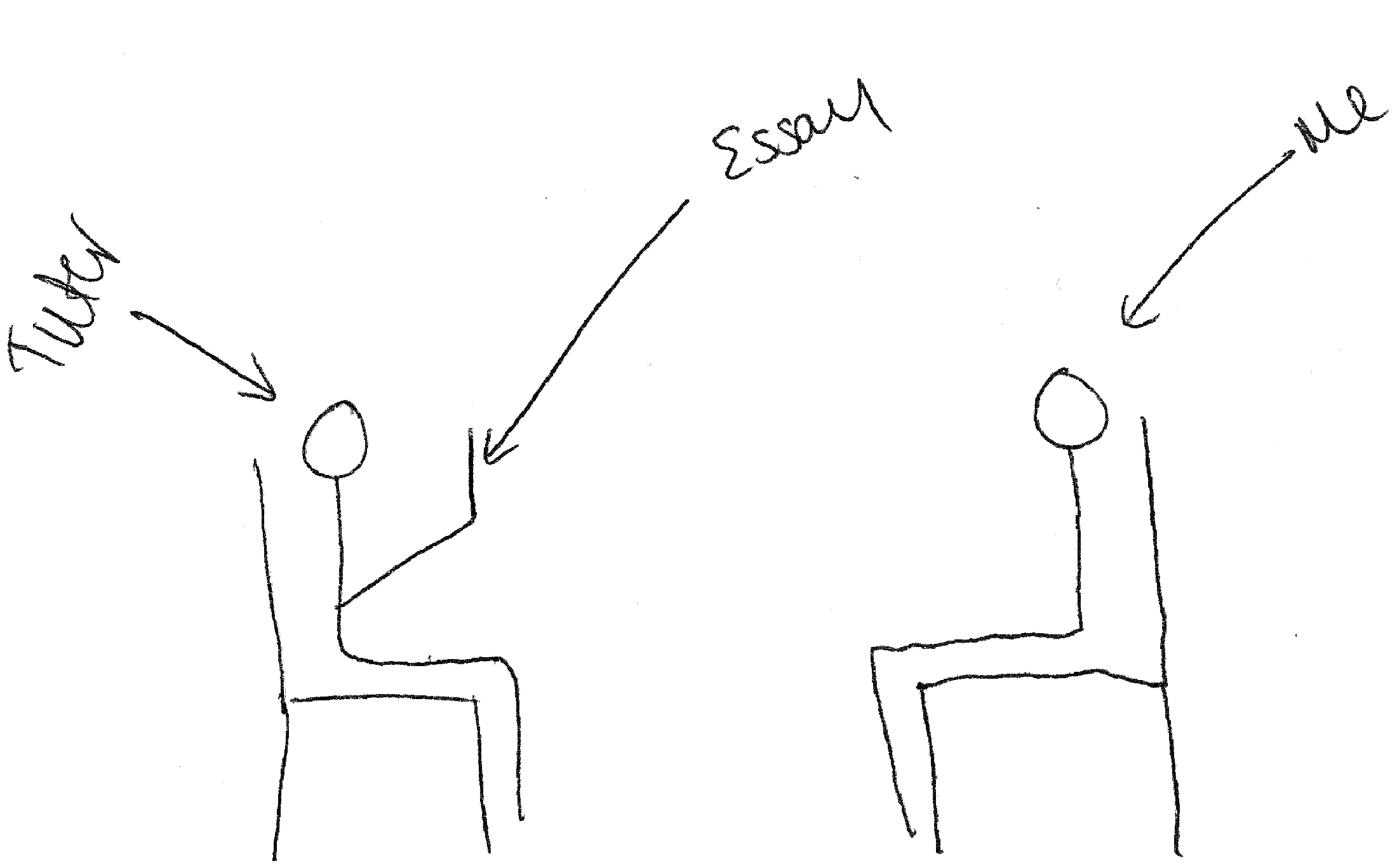
Drawing of a ‘good' relationship with an academic (A, Year2, Ben).
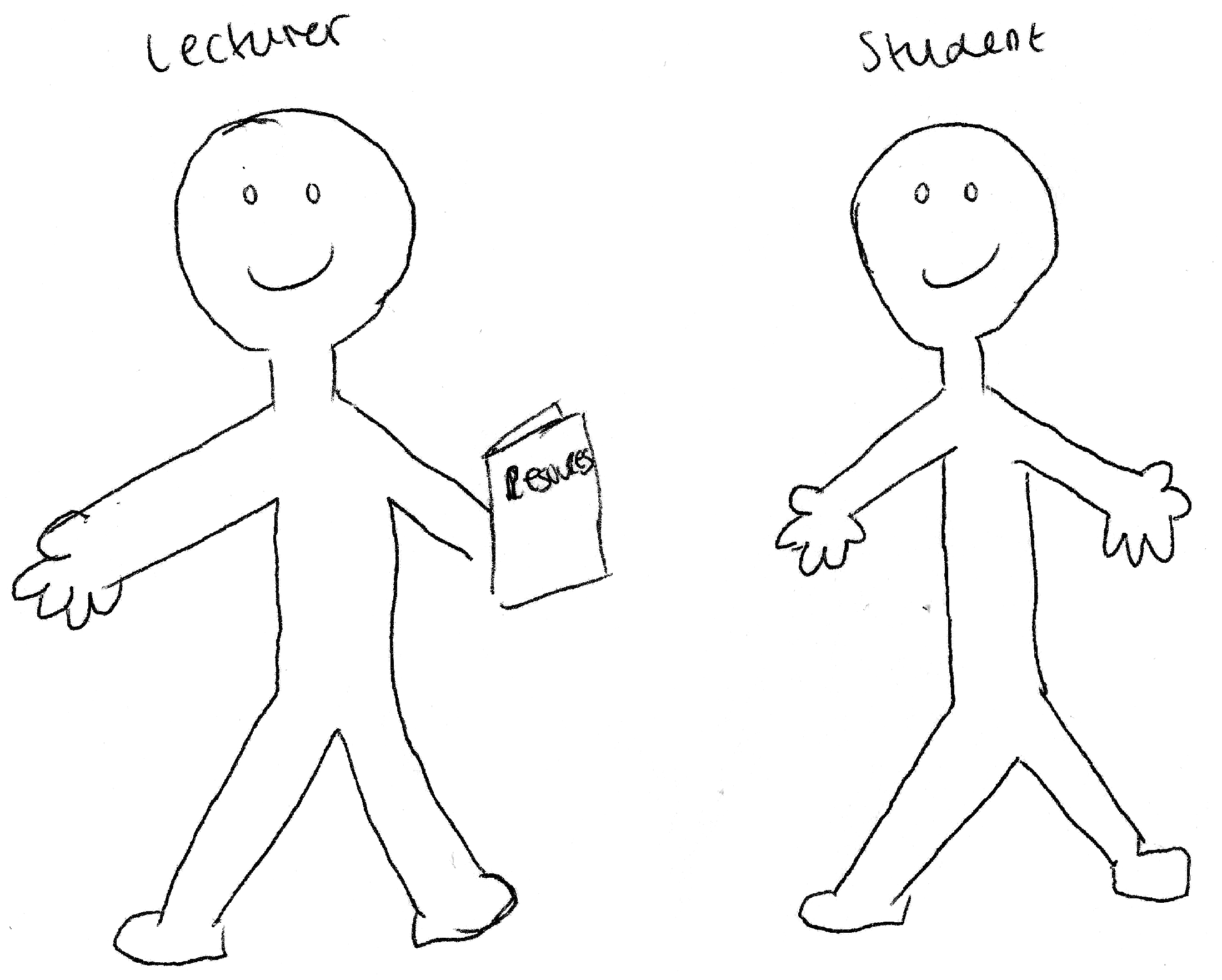
Drawing of a ‘good' relationship with an academic (B, Year3, Phoebe).
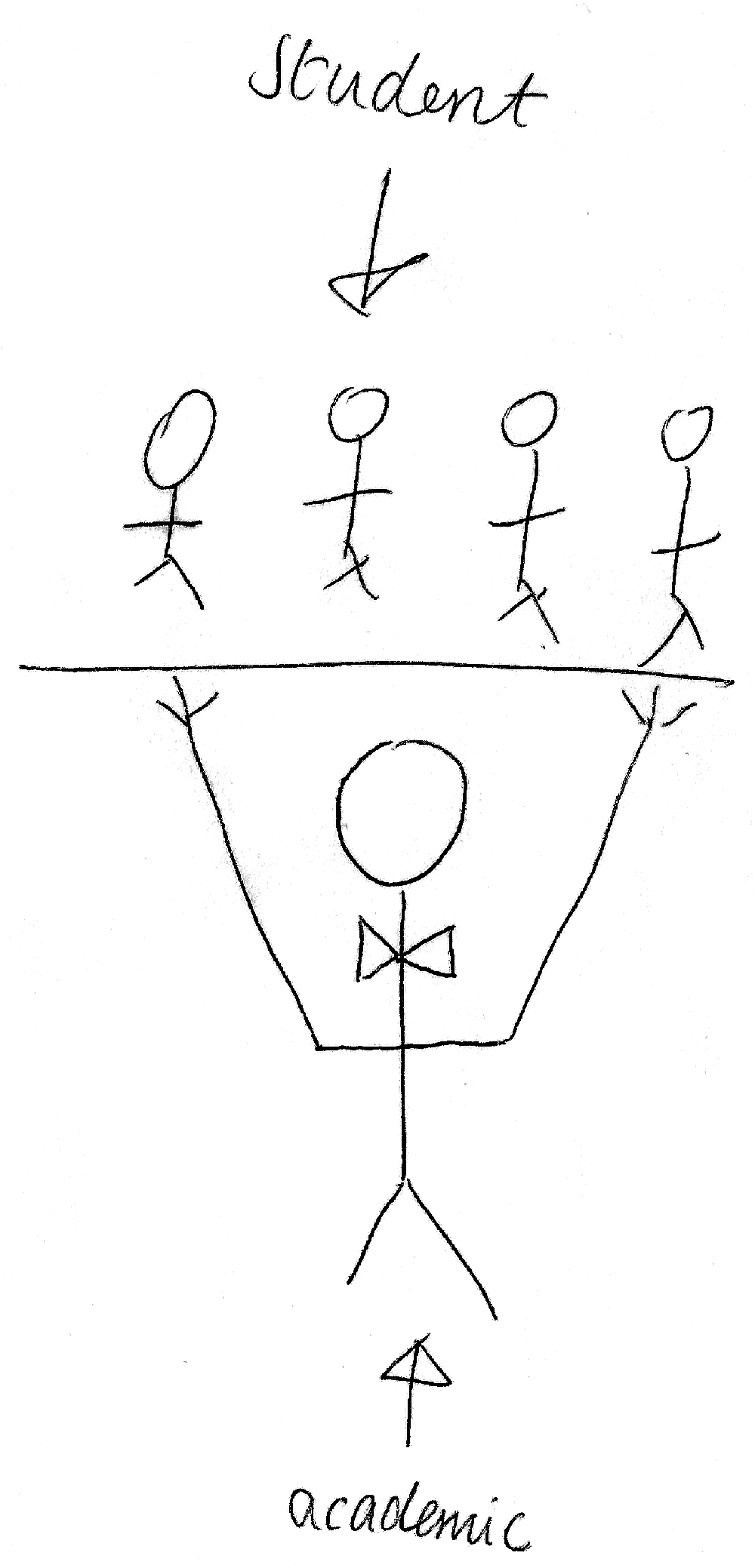
Drawing of a ‘good' relationship with an academic (B, Year3, Charles).
The distinction between the undergraduates as learners and the academics as teachers in the above drawings implies a division that belies collaboration or co-creation.
The discourses of the undergraduate interviews from University A suggested significant discomfort at the thought of having responsibility for the co-creation of knowledge: I think the notion of working collaboratively sounds a lot nicer, but then I don’t know how that would work really, because we’re not on the same level […] I would see myself as a student, I wouldn’t see myself as a researcher […] I think those two things are a world away from each other (A, 2, M, E).
The discursive metaphor ‘world away from each other’ emphasises the perceived separation between teaching and research, and thus between the subjectivity of a learner and a partner, a dichotomy that is considered problematic in HE (Brew, 2006). The associated characteristics of the traditional learner are so well established that attempts to undermine or modify that social role are often met with resistance. This is not to say, though, that they cannot be modified; participants in this study held positive attitudes towards the concept of partnership, with one undergraduate concluding that ‘it would be really cool actually to be able to do something as a collaboration’ (B, Year3, Charles). However, the findings do suggest that, in order to effectively modify the entrenched social roles of HE and the ‘heroic myths’ (Taylor, 1976: 131) of disciplines, there must first be acknowledgement and subsequent understanding of the barriers created by their established norms. In this study, there was frequent recognition of the traditional approaches to teaching and learning as well as the traditional learner-teacher dynamic; the same undergraduate who thought partnership would be ‘really cool’ reflected on these traditions: ‘it’s very much, we are told to do this and we have to do this and, the only time we ever get to really talk to our tutors […] is if we have a problem’ (B, Year3, Charles).
These traditional approaches to teaching stem from what Taylor calls ‘the knowledge industry’ (1976: 130); disciplines, as social communities, determine what knowledge is worthwhile. English holds great potential for the co-creation of knowledge because of its creative and transgressive nature; as argued by Robertson and Bond, in ‘soft’ disciplines, there is greater scope for ‘the disciplinary community (teachers and students together) [to] participate in the (de)construction of knowledge’ (2003: 13). It holds the potential to engage undergraduates not only in terms of knowing, but also acting and being (Barnett and Coate, 2004) because the subject is ‘more democratic’ (Evans, 1993: 22). However, Colbeck’s (1998) study of academics in Physics and English concluded that co-creation of research was more likely in Physics because of the team-based nature of research, whereas in English, the teaching-research connections were confined more to the content of the curriculum. This is not to say that co-creation of knowledge within English is universally disregarded; there is evidence of researchers actively engaging in collaborative projects with their students in English (Cook-Sather, 2014; Shor, 1996). However, it is plausible to surmise that co-creation within English is less likely to occur compared to other disciplines; to overcome this, recognition must be given to the familiar norms that influence undergraduate and academic behaviour, which can promote reluctance in nurturing these collaborative endeavours: ‘teaching can be creative and can address the tensions between thinking and feeling, between personal experience and textual knowledge. But staff seem to find great difficulty in escaping from the traditional forms’ (Evans, 1993: 75).
The participants in this study reflected that co-creation is difficult to implement because of the deference that characterises the traditional dynamic: ‘partnership can be a bit misleading because we’re not equals’ (B, Michelle). Hargreaves argues that ‘the majority of pupils accept the teacher’s definition of the situation and are relatively content to conform to the teacher’s role expectations of them’ (1972: 164); this was corroborated by the findings. Academics recognised that ‘students are deferent and they are in different ways’ (B, Alistair) from addressing academics by title and ‘putting their hands up’ (A, Bernard) to being ‘very polite, very respectful’ (A, Grace). The findings also suggested that deference was perceived of as a natural characteristic of the traditional dynamic and there was no sense in which academics expected ‘unnecessary deference’ (A, Grace). A number of undergraduates in this study perceived of deference in terms of ‘respect’ (B, Year2, Vera; B, Year1, Bella) and most were happy to ‘put trust in the fact they’re academics’ (A, Year1, Claire). This deference is constituted through the widely accepted notion that ‘the power resides with the authority of the lecturers’ (Allin, 2014: 97) because ‘they’re more educated’ (A, Year2, Ben). Shor, an American educator, argues: ‘I cannot instantly shed or deny the authority I bring to class. Many students won’t allow that. They expect me to install unilateral authority; in some ways, they prefer it or want it, more than just expect it’ (1996: 18). Shor attempted to mitigate his authority in the classroom, but the experiment presented difficulties; his students frequently demonstrated reluctance in sharing authority and presented frequent expectation of Shor’s ultimate authority as a teacher (1996).
Traditional learners are socialised into accepting and reciting the teacher’s opinion because it represents an authoritative position. As one academic noted, in compulsory school, ‘there’s a lot more of, kind of, getting essays back and doing them again and again until you get them right, and it’s almost as much the teacher’s responsibility’ (A, Bernard). The unilateral authority of the teacher belies the possibility of fostering reciprocal partnership dynamics because it emphasises the learners’ deference: ‘the whole process of education is actually designed to keep people in a position of inequality and the teacher tells the students, “You are never going to be me”’ (A, Andrew). This academic was drawing from Rousseau (1968) in his conceptualisation of the traditional teacher-learner relationship; from a critical pedagogical perspective, the authority of the teacher ‘transforms students into receiving objects. It attempts to control thinking and action, leads women and men to adjust to the world, and inhibits their creative power’ (Freire, 1996: 58).
There was acknowledgement from some academics of the need to emphasise a change in expectations from undergraduates in the pursuit of collaborative approaches to teaching and learning. One said: ‘if we change the way in which we think about the situation, then we could think of students as part of the production, not only of research but also of teaching’ (A, Andrew). In order for this to occur, he argued it was necessary
To really have a process where students are, almost, trained into what the university is doing, what the purpose of it is, what their roles – so they’re not just coming into it and not knowing what it is (A, Andrew).
Another agreed and reflect:
I think for students when they start university, it’s about saying, “Well, this is a seminar and this is a lecture […] this is how these things work”, and so, if you’re responsible for delivering seminars, you have to train the students up to know how to work with you in that situation (B, Lizzie).
Both of the above academics recognised the need to re-socialise undergraduates from their natural inclination to adopt the traditional learner subjectivity. The attitudes and approaches of academics in this study differed; some, like the above, were keen to configure alternative approaches to teaching and foster more collaboration in sites of learning and teaching, but some perceived it to be impractical within the English discipline. Subsequently, undergraduates frequently perceived the presence of the traditional approach to teaching: ‘on the whole, I feel as though it’s very much student and teacher and there’s that separation’ (A, Year2, Ben). The deference to authoritative knowledge, then, which perpetuates the traditional dynamic, acts as a barrier to the implementation of more collaborative pedagogical relationships.
Concluding thoughts
This study suggests that disciplines are important in the construction of partnerships; traditional approaches to teaching associated with particular disciplines can aid or prevent the successful implementation of partnership activities. For English, and perhaps the humanities more broadly, the conventional approach to teaching, which emphasises learning in isolation, as well as autonomy and individuality in the creation of knowledge, acts as a deterrent for undergraduates and academics in establishing a partnership dynamic. Moreover, shared responsibility in co-creating knowledge is difficult to negotiate in a context in which undergraduates and academics naturally adhere to the traditional teacher-learner dynamic. Partnerships require undergraduates to share responsibility for the creation of knowledge, but in the traditional teacher-learner dynamic, undergraduates defer to finite knowledge provided by their teachers. These disciplinary conventions and traditional learning relationships need to be acknowledged and overcome if successful partnerships are to occur.
This article has presented findings which illuminate the barriers of implementing partnership dynamics within the humanities; it has provided further explanation than is currently offered in the field by exploring these barriers as ‘powerful social construct[s]’ (Haugaard, 2015: 153) in regards to understanding how undergraduates choose to behave in relationships with academics. Undergraduates and academics in this study perceived difficulty in implementing partnership models within the humanities because the focus is ‘much more on the individual doing their own work’ (A, Mary). This was attributed to the discipline of English, whereby participants felt as though partnership ‘probably doesn’t fit with English as well as it does with other subjects’ (A, Bernard) because ‘research is individual’ (A, Bernard) within the humanities. Participants struggled to envision, within the discipline of English, the ‘shared responsibility and cooperative or collaborative action, in relation to shared purposes’ (Levy et al., 2010: 1) necessary for partnership models to be successful.
Although this article agrees with Trowler (2014) that disciplines should not be viewed through the lens of essentialism, it does posit that disciplines have associated characteristics that are familiar to those who teach and learn within them. Relationship dynamics based around the premise of ‘reciprocity, mutual respect, shared responsibility, and complementary contributions’ (Marquis et al., 2017: 720) are difficult to negotiate in a context that is characterised by individuality, and autonomous learning and researching. Within English, and the humanities more broadly, knowledge is ‘rarely co-authored’ (Evron, 2018); the findings of this study emphasise the reluctance of academics to engage in partnership models with undergraduates because of the ‘heroic myth’ (Taylor, 1976: 130) of individual authorship associated with teaching and learning in the humanities. The traditional approach to teaching in English can act as a deterrent for undergraduates and academics in establishing a partnership dynamic.
Moreover, the social role of the traditional learner, and the traditional teacher-learner dynamic that it invokes, are incompatible with collaboration and co-creation. The former is characterised by the unilateral authority of the teacher and the deference and dependence of the learner, whereas the latter aree constituted through ‘collegial working relationships’ (Marquis et al., 2017: 720). Undergraduates perceived research and learning to be ‘a world away from each other’ (A, Year2, Ben); the social roles of the traditional learner and the partner are incompatible in terms of their expected behaviours. The traditional learner is expected to absorb the teacher’s authoritative knowledge, which belies their willingness to share responsibility and thus, engage in co-creation with academics. Additionally, the traditional learner is expected to defer to the individual occupying the teacher role; this deference prevents undergraduates and academics from engaging in partnership relationships because it belies the shared authority necessary for collaborative pedagogical processes.
The participants from University B perceived significant barriers to implementing partnership models within the English discipline; despite the embedded institutional partnership policy at University A, participants also perceived difficulties, relating to the traditional approaches to teaching in the humanities and traditional hierarchies. Both universities are teaching-oriented, which necessitates different learning dynamics from those found in more research-oriented institutions. Although this article can only surmise the outcomes had this study been conducted within different universities, the findings suggest that partnership models would be even more difficult to foster within the discipline of English at more research-intensive institutions because of the decreased focus on teaching and thus, less emphasis on partnership relationships. Further research within different types of institution would be beneficial for understanding the barriers that exist for fostering partnership models within the humanities. If partnerships are to be successfully implemented within English courses, and the humanities more broadly, there must be recognition of the structural barriers presented by the conventional styles of learning associated with disciplines, as well as the behavioural characteristics that exist as part of the ‘enduring relations’ (Isaac, 1987: 22) of socially structured subjectivities and their resulting relationship dynamics.
Footnotes
Acknowledgements
This article is based on doctoral research carried out as part of a PhD in Educational Research. I thank the voluntary participants of this study for their time and insights. I am also forever grateful to my supervisors for their constructive feedback and dedicated guidance.
Data availability statement
The data that support the findings of this study are available from the corresponding author, ES, upon reasonable request and subject to ethical limitations.
Declaration of conflicting interests
The author declared no potential conflicts of interest with respect to the research, authorship, and/or publication of this article.
Funding
The author disclosed receipt of the following financial support for the research, authorship, and/or publication of this article: This work was supported by the ESRC under Grant ES/P000665/1.
