




Abstract
Fifty-six individuals were charged with terrorism between December 2001 when Canada first enacted its antiterrorism criminal offences and December 2019. Not a single such individual was associated with a far-right group or espoused a far-right ideology. Over the same period of time, Canada saw a rise in far-right violence and crime, including several deadly attacks that raised the spectre of terrorism. This article seeks to identify why terrorism has not been associated with the activities of those on the far right, how Canada has prosecuted far-right violence if not for terrorism and what the implications are for Canada’s criminal prosecutions going forward. It finds that since December 2001 all publicly reported hate speech cases and cases where an individual’s sentence was aggravated for hate have involved individuals espousing far-right rhetoric; likewise, all but one case where the media raised the spectre of terrorism but no such charge ensued can be described as being motivated by far-right ideation. In the result, Canadian law punishes more seriously Al-Qaida (AQ)-inspired extremism than far-right extremism, while stigmatizing the former more than the latter. The time has thus come to tackle head-on the concept of ideology in Canadian criminal law, and how the law treats various ideologies.
Introduction
One afternoon in late April, 2018, a self-identified ‘Incel’ (Involuntary Celibate) named Alek Minassian drove a rented van down a crowded Toronto street, running down his victims and killing 10 people while injuring a further 16. Less than a year later, on a cold evening in late January 2019, Alexandre Bissonnette entered a Mosque in Quebec City and opened fire, killing six people and injuring 19 others. These acts drew widespread Canadian and international attention, and though they were decried as acts of terrorism, neither individual was criminally charged as such. This outcome was perhaps not surprising with the benefit of historical perspective: between December 2001 when Canada’s Anti-Terrorism Act 1 (ATA) first introduced terrorism offences to the Criminal Code 2 and December 2019, the end date for this study, Canada saw 56 individuals charged with terrorism offences but not a single terrorism charge associated with far-right extremism, broadly defined. 3 This despite the fact that, over the same time period in Canada, far-right extremism killed or injured more people 4 and was responsible for more domestic criminal incidents than AQ-inspired extremism; 5 and, such far-right extremist incidents are indeed increasing 6 and being prosecuted, 7 it is just that such incidents have not been treated as terrorism by the criminal justice system.
Why such acts have not been treated as terrorism offences is indeed curious. Canada has neither a general crime nor general definition of terrorism; rather, pt II.1 of the Criminal Code offers 14 specific terrorism offences, 8 each of which are premised on one of two predicates: (1) the groups predicate and (2) the terrorist activity predicate. For example, there are offences regarding the financing a terrorist group 9 or of a terrorist activity, 10 participating in a terrorist group 11 or facilitating a terrorist activity, 12 or the commission of an offence for a terrorist group. 13 To prove terrorism, a prosecutor must thus prove not only the wrongful action(s) but also the connection either to one of a terrorist group or to a terrorist activity. A terrorist group is then defined as ‘an entity that has one of its purposes or activities facilitating or carrying out terrorist activity’. 14 So, to distinguish terrorism from other serious crimes, we return, in most cases, to the definition of terrorist activity. The definition of terrorist activity has three further predicates (perhaps better called clauses): (1) the purpose clause, which says that the crime or activity must be carried out with the intention of intimidating the public or a portion thereof or a government; (2) the consequence clause, that being that the impugned activity must cause death or serious bodily harm, or otherwise endanger life or cause substantial property damage and so on; and (3) the motive clause, which requires that the act be committed for a ‘political, religious or ideological motive’. 15 In cases like Bissonnette and Minassian, the consequence clause is clearly met, so the clauses that would distinguish these acts as between terrorist activity and ordinary serious crimes are whether they were also committed for a political purpose by someone driven by a political or ideological purpose. What is it, then, about the far-right actors and their politics or ideologies that has insulated them from terrorism charges? Why have they not been charged with terrorism when it certainly appears that at least several could have been, and what is the alternative (or alternatives)?
This article seeks to take up this conundrum and identify how far-right actors in Canada are being prosecuted if not for terrorism, and secondarily why terrorism charges have not been applied to date. To answer this question, this article proceeds as follows. Part I outlines the methodology used to collect the data for this study, that is, criminal offences committed by actors that are motivated, at least in part, by a far-right ideology. Part II then offers an empirical overview, based on publicly reported cases, of the prosecutorial landscape of far-right extremism in Canada between December 2001 when Canada’s terrorism offences were first introduced and December 2019. Canada does not have a specific hate crime, so it is necessary to examine proxies that, together, might usefully explain the field. In particular, Part II.i evaluates the offences usually associated with hate crimes in Canada, those being hate speech and inciting hatred (s 319 of the Criminal Code) and mischief as hate (s 430(4.1)). 16 Part II.ii then looks to all cases not captured in Part II.i where hate was cited as a motivating factor upon sentencing of an individual (s 718.2(i)(a)). (See Appendixes 1 and 2, for the cases associated with hate speech and hate as an aggravating factor at sentencing, respectively.) Part II.iii offers a media review of criminal prosecutions that have raised the spectre of terrorism but were not captured in Parts II.i or II.ii. Finally, Part III offers some of the common legal explanations for why these cases were not prosecuted under Canada’s terrorism offences regime and offers counters to demonstrate why these legal explanations are unconvincing in describing the whole picture.
The results are indeed revealing. Between December 2001 and December 2019, all hate speech cases 17 and cases sentenced for hate were perpetrated by someone motivated by, or while committing an act that meets virtually any common definition of, far-right extremism; with one exception, they were also all committed by men. We also see that of the handful of cases over the past 20 years or so where the media has raised the spectre of terrorism, but where it was not charged, all but one are best described as some form of far-right extremism. Quite simply, there seems to be systemic bias in the Canadian system whereby AQ-inspired extremism is being treated as terrorism by prosecutors and far-right extremism is being treated as ‘regular’ crime (mischief, assault, murder, etc.) or hate speech. In so doing, the law punishes more seriously AQ-inspired extremism than it does far-right extremism and stigmatizes the former far more than the latter. The result demands a re-evaluation of Canada’s hate crimes and terrorism legislation and approaches to prosecuting these crimes.
Part I: Methodology
Before we begin to collect data on cases that might involve far-right extremism, we must first resolve how to identify when, if ever, any of these offences have indeed been committed by someone motivated specifically, in whole or in part, by a far-right ideology. A working definition of ‘far-right extremism’ is no simple task in itself: It can seem as though there are as many definitions of far-right extremism as there are groups—and, as a fractious lot, there are certainly an unfortunate plethora of far-right groups, including in Canada. 18 Rather than choose one such definition as ‘correct’, this article instead takes the following approach: It looks to various definitions, including from the Anti-Defamation League (ADL) in the United States, which follows hate groups in that country and has really been a leader in defining, researching and following such groups, 19 to the definition used by Canada’s domestic security service, Canadian Security Intelligence Service (CSIS), 20 and to that offered by the leading academics in Canada responsible for the most comprehensive study of the topic to date (Perry and Scrivens). 21 Then, rather than definitively adopting any one of these definitions, this study asks whether the motivations for the crimes noted in the publicly reported cases examined (e.g. any of the hate speech offences) might reasonably meet all of the definitions of far-right extremism. The method risks being underinclusive of far-right cases in that it demands that three slightly different definitions are all met. However, in theory, it also ensures that there can be little debate when a case is coded as far right and, in any event, it made little practical difference in the study because all hate crimes cases, for example, met all three definitions.
With a method of identifying ‘far-right extremism’ in place, we must then identify hate crimes to determine the ideological motivation behind them. But this too presents a problem: Canada has no ‘hate crime’ per se; instead, Canada has a number of Criminal Code offences and other provisions that usefully signal when a crime has been committed for a hateful purpose. The methodology adopted herein is thus to evaluate such provisions that together might paint an accurate picture of hate crimes in Canada.
As such, first, this study evaluates Canada’s hate speech offence, s 319 of the Criminal Code, as well as s 430(4.1), which was introduced specifically to criminalize ‘mischief’ when it targets religious property or educational institutions for a hateful purpose (e.g. the painting of a swastika on a synagogue). 22 Sections 319 and 430(4.1) of the Code are generally (along with genocide 23 and terrorism) considered the ‘hate crimes’ offences and, as such, form the natural backbone for evaluating hate crimes in this country.
Data on ss 319(1), 391(2) and 430(4.1) offences were obtained by a search of cases since 1 December 2001 first and primarily with WestlawNext, while validating the findings using CanLII and Lexis Advance Quicklaw. The coding methodology used in this article then went as follows. Two research assistants were asked to ‘code’ the various cases as far-right extremism or not; any disagreements would be brought to the attention of the author who would read the relevant cases and ‘break the tie’. The author would also randomly select other examples to ensure consistency. In the end, the research assistants agreed on all counts—all were reasonably coded as far-right incidents—thus no ties needed to be broken. As a result, the author went through all cases—given that they were lower in numbers than originally expected—and confirmed the work of the research assistants. Thus, there was uniform agreement around the coding of the cases. 24
Second, this article looks to s 718.2(a)(i) of the Criminal Code, which states that, for sentencing purposes, judges shall (mandatory language) consider whether there is ‘evidence that the offence was motivated by bias, prejudice or hate…’. 25 This Criminal Code provision is a useful addition to the study because it can, in theory, help us uncover the remaining publicly reported cases that are motivated by an element of hate—for example, an assault or murder that was not prosecuted as terrorism but was motivated by racism—but were not prosecuted as either of the common ‘hate crimes’ provisions—or as terrorism. 26
To identify relevant sentencing decisions, the author first considered all publicly reported sentencing decisions between December 2001 and December 2019 that considered s 718.2(a)(i) specifically. 27 Once again WestLawNext and CanLII formed the basis for the initial search. All numbers were confirmed independently a second time with WestlawNext. This search was then narrowed to only those cases that used the words ‘bias’ or ‘hate’ in the sentencing decisions. Cases were further refined because many resultant sentencing decisions simply listed all the aggravating factors to be considered upon sentencing, without necessarily considering each one independently and particularly without specifically considering (and thus applying) an aggravating factor for hate or bias. As a result, this study includes only those cases where, after reading the decision, it is clear that the judge actually considered hate to be an aggravating factor on sentencing. Finally, all cases that were otherwise considered under the hate speech or terrorism offences were removed from the list to avoid duplication. Coding was achieved in the same manner as that for ss 319 and 430(4.1).
Third and finally, a Canadian media review was conducted to identify far right and other ideologically inspired acts of hate since December 2001, where the media has raised the spectre of terrorism but—for whatever reason—the individual was not charged with a terrorism offence or under the typical hate crimes regime, and the case was not flagged under the s 718.2(a)(i) search. Put another way, we are only considering here cases that raised the spectre of terrorism but were not otherwise captured by this study. Here, the author looked specifically for significant criminal events reported in Canadian media where questions were raised by media, commentators or state officials (e.g. police) about whether the acts might rise to the level of terrorism.
The intention behind this three-pronged methodology is to produce a roughly accurate picture of how far-right extremists—and in theory other extremists as well—commit acts in furtherance of their ideology and how these acts are subsequently prosecuted. This can then be compared and contrasted with Canada’s terrorism prosecutions to explain—or not—both how far-right extremism is prosecuted and why it has not been prosecuted as terrorism.
Part II: Prosecuting landscape of far-right extremism in Canada
(i) Prosecuting far-right extremism as hate (or mischief)
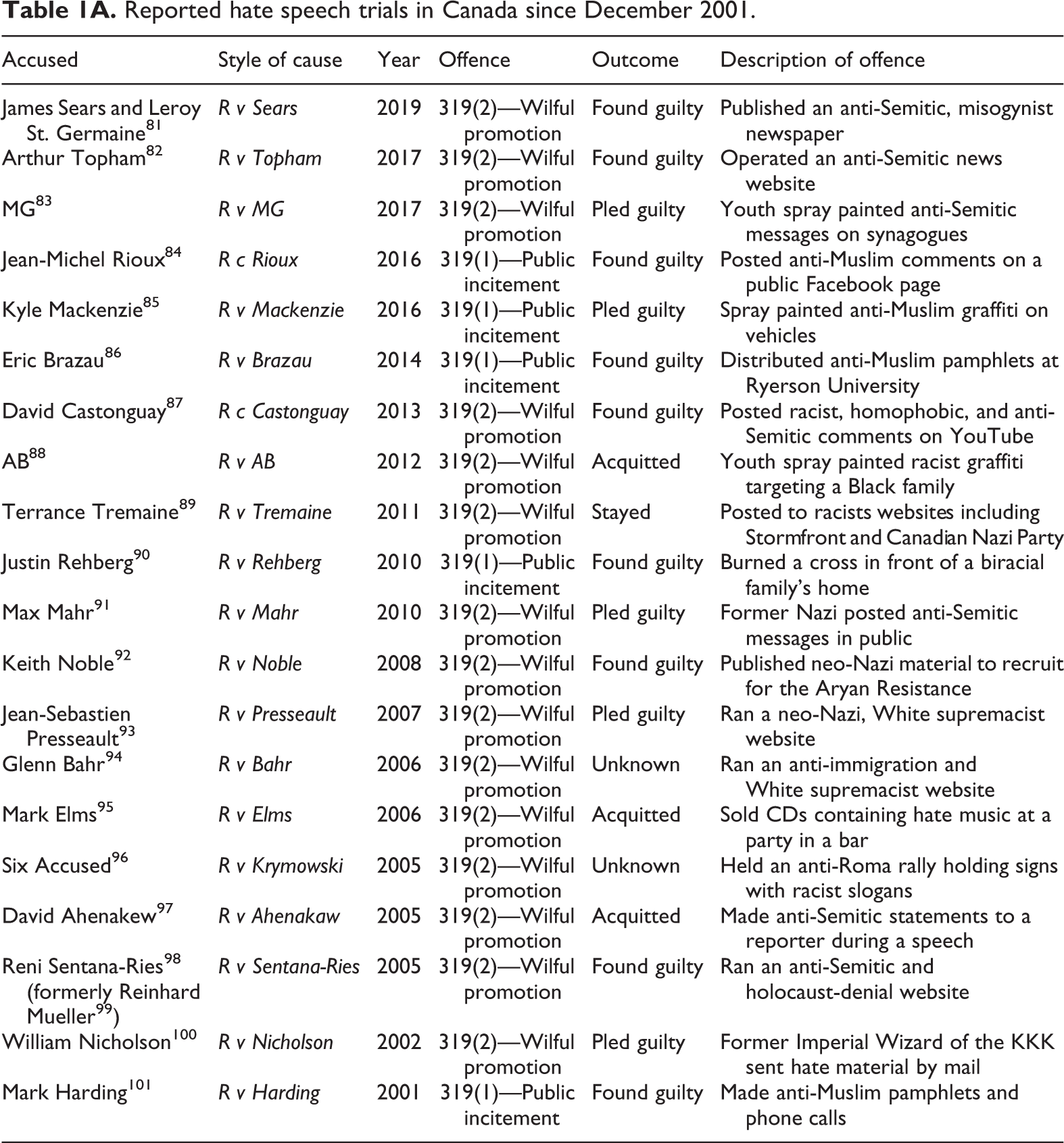
Canada’s hate speech offence is found in s 319 of the Criminal Code. Between December 2001 and December 2019, there were 20 publicly reported cases (see Appendix 1) dealing with such offences (covering 26 accused). 28 Using the definitions provided by the ADL, Perry and Scrivens and CSIS, each of these cases can be classified as motivated, in whole or in part, by behaviour and beliefs consistent with far-right extremism. That is, in each case, the reported judgment details behaviour and motivations that fall within each of the identified (academic and practitioners’) definitions of far-right extremism. Of those 26 identified accused, 16 were charged with wilful promotion of hatred (s 319(2)) and four were charged with public incitement of hatred (s 319(1)). 29 Interestingly, all of the accused are male, which is consistent with—though a more extreme trend than—Canada’s experience to date with terrorism offences, where the vast majority of those charged to date have been men. 30
The mischief as motivated by hate crime (s 430(4.1)) did not produce meaningful results. A search of legal databases produced only two publicly reported decisions over the relevant time period. In the first, R v Ghaffari, a religious Muslim man was angry at his faith following the death of his mother and was subsequently accused of urinating on a Mosque.
31
The other case, R v MG, dealt with a youth who spray painted offensive (anti-Semitic) messages on a synagogue; MG also pled guilty to hate speech and thus this case was already captured in the hate speech numbers, above.
32
(ii) Hate and sentencing decisions
Section 718.2(a)(i) mandates that, upon sentencing an individual for a crime, the judge must consider whether the crime was committed with a hateful, prejudiced or bias animus. Before delving into these numbers, a caveat is required; that is, there is unfortunately no guarantee that all sentencing decisions that involve a crime committed for a hateful motive will be considered as such on sentencing (and, as with the other offences, publicly reported cases are not equivalent to all cases). For example, ‘terrorism’ is also a mandatory aggravating consideration at sentencing. 33 Yet a large number of sentencing decisions for terrorism offences in Canada have not considered ‘terrorism’ as an aggravating factor, or at least it was not clear that they did so in the written sentencing decisions. 34 It is also true that ‘bias’ or ‘hate’ was not considered explicitly as an aggravating factor in about two-thirds of all terrorism sentencing decisions to date, despite it being mandatory to do so when present and despite the fact that it is hard to conceive of bias and/or hate not being a motivating factor in most if not all Canadian terrorism cases. 35 It is unclear why sentencing decisions have so failed to take account of mandatory factors—again, the Canadian law mandates that this not be the case. Nevertheless, with this caveat in mind, the numbers herein remain a useful addition to the study to help flesh out further examples of offenders with a hateful motivation for their offences.
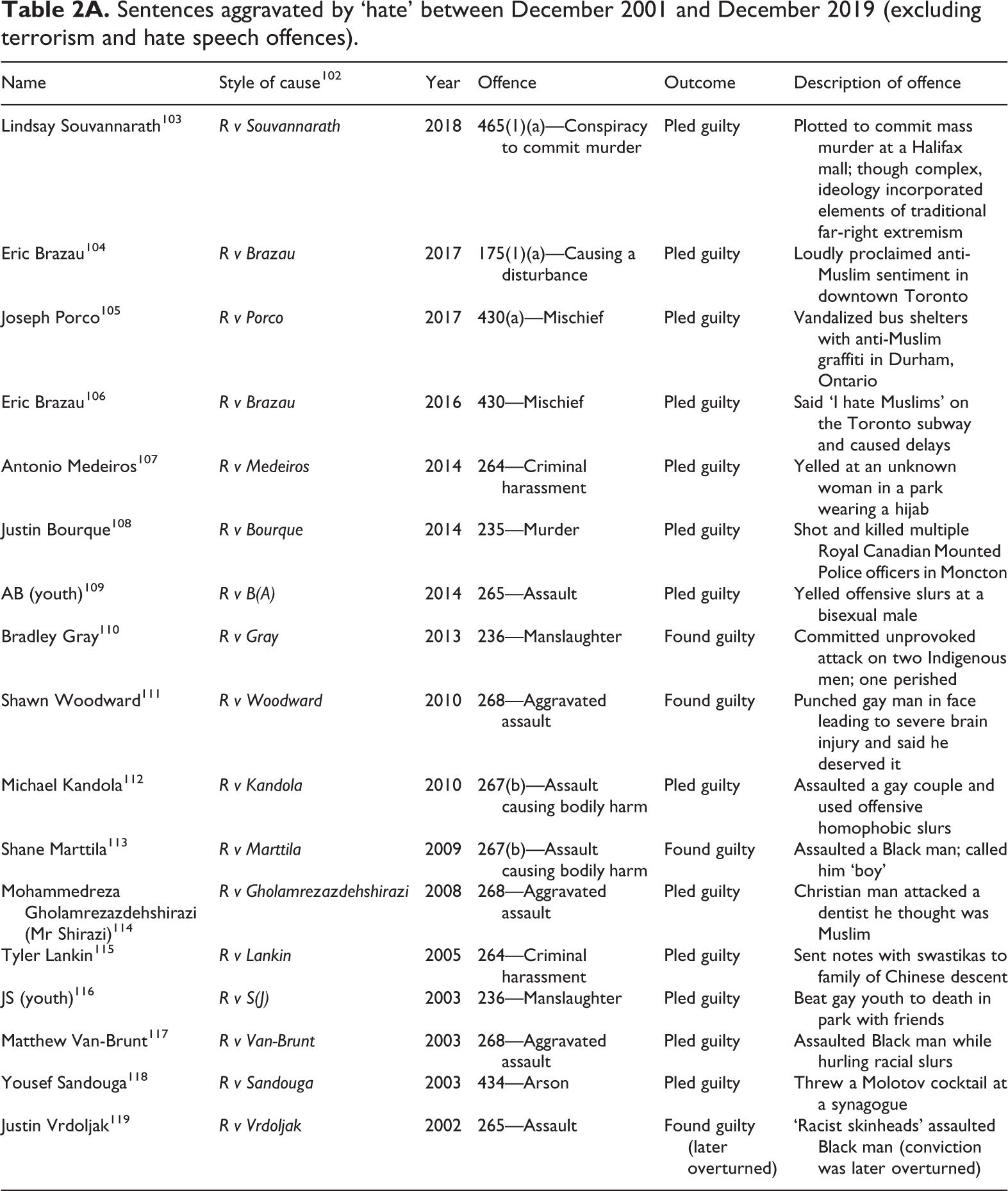
After removing terrorism cases and hate speech offences, the result produces only 17 unique, publicly reported decisions involving 15 individuals. (See Appendix 2, for a list of relevant publicly available cases where s 718.2(a)(i) was applied, including case names, outcomes, offences and a description of offences.) As Appendix 2 demonstrates, all of these individuals were cited, at least in part, for racist (anti-Black, anti-Semitic or anti-Indigenous), sexist or homophobic beliefs and/or actions. Four of the individuals committed, planned or attempted to commit murder or manslaughter, seven individuals were charged with some form of assault, two were convicted of criminal harassment (closely associated with hate speech, particularly in these cases), two more were charged with mischief, while one individual was charged with causing a disturbance and another individual with arson. With the exception of Lindsay Souvannarath (the most recent case, and an excellent candidate for a stand-alone case study on terrorism vs. hate), all of the accused on this list are again male.
The numbers to this point paint an interesting picture. Almost all terrorist prosecutions in Canada have concerned AQ-inspired men while none have concerned far-right actors. Of those non-terrorism cases that involve hate as a motive for an offence, all are associated with the values of far-right extremism while none are associated with AQ-inspired extremism. It appears, on the numbers, that far-right-inspired actions are charged as hate crimes, while AQ-inspired extremism is charged as terrorism. Of course, the numbers alone do not tell you why that is or whether it is justified, a topic that we will return to in Part III of this article, which examines why the bias that the numbers seem to reflect is indeed likely present in charging practices. Finally, note also that the percentage of men committing far-right-inspired offences is even higher than the percentage of men prosecuted for terrorism in Canada, which itself hovers close to 95%.
36
(iii) Murders (and attempts) that raised the spectre of terrorism in the Canadian media
There have been a number of serious (criminal) events since December 2001 that have made media headlines in Canada and raised the spectre of terrorism across the country, without the perpetrator being charged as such. Some of these, such as the killing of Corporal Nathan Cirillo by Michael Zehaf-Bibeau on Parliament Hill on 22 October 2014, are not considered herein because the perpetrator was killed and thus, of course, was never charged. Still others, such as Justin Bourque, 37 who killed three Royal Canadian Mounted Police (RCMP) officers in a shooting rampage in 2014, and the (unsuccessful) Valentine’s Day massacre plot to both open fire in and firebomb a Halifax mall by Lindsay Souvannarath, 38 are not considered at this stage because their cases were captured by the above search of cases where hate was identified as a motivating (and aggravating) factor upon sentencing (see Appendix 2). What remains are three far-right examples, discussed below, as well as one counterexample of a potentially AQ-inspired actor, discussed at the end of this section.
Perhaps the most notorious case of a (far right) Canadian criminal perpetrator whose trial was marked by allusions to terrorism, but was charged with neither terrorism nor a hate crime (and thus has not already been accounted for in this study), is that of Alexandre Bissonnette, 39 the Quebec Mosque shooter mentioned in the Introduction to this article, whose actions have since influenced other far-right actors, including Brenton Tarrant, New Zealand’s Christchurch Mosque killer. 40 On the evening of 29 January 2017, Bissonnette entered the Islamic Cultural Centre—a Mosque—in Quebec City and killed six people, while injuring 19 others. Bissonnette was apprehended shortly thereafter and charged with and convicted of six counts of first-degree murder. 41 Bissonnette received life in prison with no possibility of parole for 40 years for the crimes (a sentence that is being appealed at the time of writing)—one of the longest sentences in the history of Canada. 42
At trial, the court found that Bissonnette had researched various mass killings, including those by Dylann Roof and Elliot Rodger, notorious far-right figures in the United States, as well as Marc Lepine, the misogynist killer of 14 women in 1989 at the Ecole Polytechnique de Montreal, Canada 43 ; he had also researched the Ku Klux Klan (KKK). Bissonnette clearly held anti-immigrant, anti-Muslim and misogynistic beliefs, all factors that guided his justification for the mass shooting. There is little doubt that Bissonnette could have been charged with terrorism in Canada. For example, he could have been charged under s 231(6.01) of the Criminal Code, which makes murder first-degree when it is also terrorist activity. Likewise, he could have been charged with s 83.2, which criminalizes terrorist actions committed for a terrorist group, though he would have to be shown to be associated with a transnational 44 far-right ‘group’ in the way that many Canadian terrorists have been associated with the ideals of ISIS without having any formal membership (for no such thing exists). Further, Bissonnette could have been punished more harshly for his actions on sentencing by virtue of s 718.2(a)(v) of the Criminal Code, which the court must consider wherever there is ‘evidence that the offence was a terrorism offence’. 45 Nevertheless, Bissonnette was neither charged with any terrorism offences nor did prosecutors seek to have his activities declared terrorism as an aggravating factor on sentencing. This caused, perhaps not surprisingly, a good deal of debate in Canada about why Bissonnette escaped terrorism charges. 46
The same question arose in the context of Richard Bain, a politically motivated gunman intent on killing Quebec politician Pauline Marois. Bain opened fire on a Parti Quebecois victory rally on the night of the Quebec provincial election on 4 September 2012, in Montreal. Although he was unsuccessful in his assassination attempt of Premiere Pauline Marois, he did kill a stage technician and injured another person. Bain was heard shouting about Anglophone rights when he was arrested. 47 As the court summarized following Bain’s criminal trial: ‘the offences were carried out with intention of preventing Premier Elect Pauline Marois [from making] her victory speech’. 48 As with the case of Bissonnette, here we have a (1) incident of serious violence—a murder and attempted murder—committed for a (2) political motive, arguably with the (3) intent of intimidating the public and a political party, a triad of factors that are considered the predicates, or perhaps better the three clauses, for the Canadian Criminal Code’s definition of terrorist activity. 49 And again, as with Bissonnette (above), considering that the definition of terrorist activity could have been met in this case, and thus Canadian authorities had a number of options in terms of applying Canada’s terrorism regime to Bain’s actions 50 —just as they did with Bissonnette—the question lingers as to why this remained a ‘regular’ (non-terrorism), albeit heinous crime? 51
Next, we have the case of Alek Minassian, the self-identified ‘Incel’ that ran down his victims (10 deceased, a further 16 injured) in a rented van on 23 April 2018, in Toronto. His case was not captured by the study of reported decisions because he has yet to be tried for his crimes as of the writing of this article. However, his actions and criminal charges are worth mentioning here both because it was reported widely within Canada and abroad and because it is notable that he was not charged with terrorism despite the actions being decried in the media as such. 52 Minassian was instead charged with 10 counts of murder and 16 counts of attempted murder. 53 As with Bain and Bissonnette, Minassian’s actions clearly reveal the purpose—for example, he reportedly admitted he wanted to send a message and be part of a public ‘uprising’ 54 —and consequence predicates of terrorist activity. The only question here—one debated publicly—was whether his misogynistic Incel ideology sufficed to meet the motive predicate—’ ideological purpose’—attached to terrorist activity in the Code. 55
Finally, there is the case of Abdulahi Hasan Sharif, 56 the accused in the Edmonton truck attack, who in September 2017, stabbed an Edmonton police constable before using a van to run down four pedestrians. 57 He was found guilty of five counts of attempted murder, a further count of aggravated assault and several driving-related offences. 58 He received a sentence of 28 years in prison. 59 Sharif provides an interesting—and seemingly the only—example of an attack that had elements of AQ-inspired ideology behind it, yet where no terrorism charges were laid. Indeed, early reporting on the attack indicated that terrorism charges were ‘pending’ against Sharif. According to police, there was ‘an Islamic State flag found’ in the vehicle Sharif had used to perpetrate the offences 60 and, furthermore, he was linked to an ongoing extremism investigation involving the Integrated National Security Enforcement, or INSET K Division, team, dating back to 2015. 61 Nevertheless, once again, neither terrorism nor hate/bias was identified as aggravating factors against Sharif upon sentencing. That did not stop police Superintendent Stacey Talbot, head of INSET K Division, from asserting after sentencing that she believed Sharif had perpetrated a terrorist act; as a result, the spectre of terrorism continued to loom large over reporting on the case, even after its conclusion. 62
The Sharif charges—or, specifically, the lack of terrorism charges—serve as a rejoinder to the argument that followed Bissonnette’s charges in particular, namely that the only reason that he and perhaps also Bain and Minassian were not charged with terrorism was that far-right ideology was treated as less serious, or less worthy of the terrorism label, than AQ-inspired extremism. While that may well be true, the Sharif case does muddy the waters in that he seems to have been charged, at least superficially, in a similar manner to Bissonnette and the others for engaging in similar activities. Perhaps, rather, the four cases serve to demonstrate that once a serious offence is committed, it will be charged not as terrorism but as murder or attempted murder regardless of who commits the offence. In other words, perhaps the form of ideology, whether far right or AQ-inspired, has nothing to do with the charges; rather, perhaps it is about whether the charges relate to preparatory, inchoate activities—such as planning to commit future violence—or post-violence, where the former is treated as terrorism and the latter as regular, serious crime. 63 In theory, this suggestion is not far-fetched. Canadian law mandates life imprisonment for first-degree murder, for example, with no possibility of parole for 25 years. A terrorism sentence adds little to the ultimate punishment where murder is charged, while adding plenty to the complexity, uncertainty and cost of the trial. 64
However, the above explanation—the logic—has not been consistently applied and thus no longer properly explains the Canadian landscape, if it ever did. Between December 2001 and December 2019, there are several counterexamples where AQ-inspired (or ISIS-inspired in these cases) actors committed both a serious offence—murder, attempted murder, serious assault—and yet were nevertheless charged with terrorism offences as well as those serious ‘regular’ offences. 65 Further, Canada’s Criminal Code—and indeed the history of the creation of terrorism offences in Canada—both make clear that those who perpetrate serious acts of violence can and in some cases should also be charged with terrorism. 66 So, individuals who perpetrate serious acts of violence in Canada have also been charged with terrorism in addition to serious criminal offences; it is just that those who do so with a far-right ideology—along with Sharif, the counterexample—were not so charged as of the writing of this article. 67 If Canada is to have terrorism offences, then they should be applied consistently. Of course, it would also send an odd message to say that those who plan but never commit serious acts of political violence are terrorists, but those who follow through are not.
Moreover, if far-right extremism is on the rise and has recently been deemed a significant national security threat by Canada’s intelligence agencies, 68 and if individuals are committing acts of serious violence in the name of a far-right ideology, then one wonders why AQ-inspired plans are being disrupted to the tune of dozens of charges, but no far-right plans have been disrupted and terrorism charges laid. Putting the picture together, the numbers once again suggest a divide between the treatment of far-right ideologies in terms of how they are investigated and prosecuted and AQ-inspired terrorism. Let us now discuss the legitimacy of that divide suggested by the numbers in more detail.
Part III
There exist two further resolutions to the problems—ones that do not implicate a divergence between far-right ideologies and AQ-inspired acts are treated—that the numbers might seem at first blush to suggest but do not. That is, first, that far-right extremists are being charged primarily with hate crimes because all that they are doing is hate speech; and, second, that none of the far-right murderers introduced above were charged with terrorism because their crimes did not amount to terrorism in Canadian law.
First, the cases reviewed (in Appendix 2) regarding sentences that have been aggravated for hate reveal that, over almost 20 years, the vast majority of non-speech related, far-right motivated offences have been murder, manslaughter or assault (11 of 17 cases)—serious crimes by any measure, which can and have received very long sentences, including in the example of Bourque, who received the longest sentence in Canadian history as of the writing of this article. Moreover, three of the four brief case studies involve murders perpetrated by those driven by ideological motives associated with the far right. It follows that the far right in Canada is certainly committing serious acts of violence, and not just hate speech. While far-right extremists may indeed commit more hate speech, it is clear that they are also attacking crowds and committing violent crimes in attempts to send political messages to society writ large. In other words, they are not exclusively committing a type of crime or offence that is qualitatively different—less violent, or less public perhaps—than are AQ-inspired extremists.
This leads us to the second potential argument, which is that the far-right violent crime in Canada is motivated by racial or gender bias, but that racial bias—or something about the far-right bias or activities—does not meet the three terrorist activity clauses in Canadian law. But the Bissonnette, Bain and Minassian cases, at least, all throw that claim into serious doubt. In each case, the three terrorist activity clauses are clearly or arguably met. In each case, the individual intentionally caused death or endangered lives (the consequence clause of terrorist activity in Canadian law) and seemingly committed their acts in a public manner so as to evince an intention [to] intimidate…the public, or a segment of the public [so-called “Stacey’s” for Minassian]…or compel…a person [or] a government…to do or to refrain from doing any act [e.g. curbing immigration, as was one of Bissonnette’s concerns]…. (the purpose clause of terrorist activity)
Further, in each case, a rather specific, hateful ideology—system of belief—can directly be associated with the offenders and tied to his activities (the motive clause of terrorist activity). If this is correct and the actions arguably rise to level of ‘terrorist activity’, then Canada certainly has a host of terrorism offences and punishments that could apply.
There remains a rather obvious explanation for part of the AQ–far-right divide found in the Canadian legal landscape, one which likely does obtain. That is, but of course far-right extremists are largely prosecuted for hate speech and mischief—or sentenced on these grounds—whereas AQ-inspired extremists are largely prosecuted for terrorism, for that it is precisely how the system is set up to work.
Canada’s hate speech—and later the mischief-as-hate offence—was drafted to counter far-right extremism of the very sort that it is currently tackling. By the late-1950s, Canada did not have today’s hate speech crimes, but Canada was seeing a proliferation of hateful ideological propaganda, at least partially due to US hate groups like the KKK making a revival during the civil rights movement. Pressure mounted on the Canadian government to take action and it was coming from civil society groups like the Canadian Jewish Congress. With anti-Semitic and anti-Black movements cresting in the 1960s, Canada’s so-called ‘Cohen Committee’ was formed by government to study the problem and recommend responses. The Committee found that hate propaganda—the biggest problem at the time, or so was the sense—was indeed a source of great social harm, which in turn justified a brand new limit on free expression by way of a criminal offence on hate speech. 69 Although it then took until 1970 before Canada’s hate speech offence was passed into law by Parliament, the general structure of the law—and what it proscribed—has remained in place. 70
In contrast, the impetus for Canada’s quickly drafted ATA legislation—that which brought about the terrorism offences in the Criminal Code—was the 9/11 bombings and AQ-inspired terrorism. 71 But AQ was not just the impetus but also the organizational model for the offences: the ATA was designed primarily to create tools to pre-empt massive attacks by groups like AQ and demonstrate Canada’s commitment to antiterrorism to the United States. 72 So, again, it makes sense that the offences have since proved relatively effective at capturing AQ-inspired terrorism. 73 Perhaps the better question all along was whether, as the terrorism threat vector invariably shifted, Canada’s terrorism offences were able to capture new and emerging groups with qualitatively different ideologies and methods. This is a question that Canada is yet to answer satisfactorily.
But whether Canada’s approach to countering far-right extremism is an example of tunnel vision or anchoring bias or simply that investigators and prosecutors believe that the respective crimes better fit the behaviours of the various groups (AQ-inspired and far right), the result is a systemic bias with profound results. Calling one group terrorists and another merely hateful matters, and it matters not just socially and culturally. Law has a normative, social and communicative function—this is why, for example, general deterrence and denunciation are thought to be fundamental principles of sentencing, at least in Canada. 74 Terrorism should be called out as such when it meets the Criminal Code’s requirements of a terrorism offence. Moreover, the divide matters in terms of the sentence that offenders receive. Those convicted of hate speech could receive a maximum of 2 years in prison. 75 The most commonly charged terrorism offences, 76 by contrast, have maximum terms of incarceration of 10 years for participation in a terrorist group, 77 14 years for the facilitation of a terrorist activity 78 and life for the commission of an indictable offence that is also a terrorist activity. 79 The divide is indeed stark in practice: as shown in Appendix 1, since 2001 the average length of incarceration for those convicted of hate speech under s 319(1) and s 319(2) is 6.8 months, while the average length of non-custodial punishment for a conviction under the same sections is 10 months; by contrast, between 2001 and 2019, the average custodial sentence for a terrorism offender was 13 years and all offenders received custodial sentences, though admittedly that is often the custodial term for multiple offences. 80 Different groups of people—those with different religious, political or ideological motives—should not receive differential treatment and vastly different sentences solely because the contours of their hate or identity differ.
This brings us to the inexorable conclusion that there is also a public safety element associated with these divergent approaches to types of extremism and, thus, their divergent custodial terms. Put simply, if far-right crimes are minimized through more lenient charging and sentencing, then they are not being treated with the seriousness that they deserve by the legal system (most obviously by offering lower penalties). Such an approach to far-right crime could, in turn, serve to exacerbate the growing far-right problem.
In the end, re-examining Canada’s approach to prosecuting various forms of ideology, and in particular hate and terrorism, with particular attention to the far right, is not just the right thing to do morally, it is imperative to bring coherence to the law, to better counter a serious public safety threat and to uphold public confidence in the criminal justice system.
Conclusions
Terrorism in Canada, at least as concerns the charging practices, looked distinctly monolithic over the first 20 years or so of practice; as it turns out, so was the prosecution of hate speech. Far-right extremism was prosecuted as hate speech and hate crimes, or regular crime aggravated at sentencing for hate, while the prosecution of terrorism in Canada was solely associated with AQ-inspired ideology, even if Canada’s threat environment said and continues to say otherwise. Part of this divide is explained by what crimes are actually committed by these groups, and part is explained by the history of the terrorism and hate speech offences, what they targeted, and how they were constructed to specifically target those threats. But today that legislative history and the resultant practice has created what looks like systemic discrimination, where AQ-inspired extremism is charged, prosecuted and sentenced differently and more seriously than similarly ideological far-right violent crime. In the result, Canada is fairly clearly at an inflection point: fail to adjust the practice, and the nation risks criminalizing religiously inspired extremism as terrorism and White extremism as normal crime, creating a cascading host of effects that build on and exacerbate existing marginalization and discrimination.
But it is not the argument herein that all or even most far-right actors should have been charged—or should be charged going forward—with terrorism. Stretching the definition of terrorist activity to become more all-encompassing is not advisable for a country that prides itself on democracy and the rule of law. But similarly restricting terrorism to only one subset of society is discriminatory, unjust and unwise. The goal for all, then, from parliamentarians to police investigators to prosecutors, has to be overcoming the current ideological divide, while not splitting it so wide as to open the floodgates. This may begin with parliament and the courts, and a rethink of how terrorist activity is defined and interpreted.
Footnotes
Author’s note
The author wishes to thank Peter Shyba and Anna White for exceptional research assistance.
Conflict of interest
The author(s) declared no potential conflicts of interest with respect to the research, authorship, and/or publication of this article.
Funding
The author(s) received no financial support for the research, authorship, and/or publication of this article.
Appendix 1
Reported hate speech trials in Canada since December 2001.
| Accused | Style of cause | Year | Offence | Outcome | Description of offence |
|---|---|---|---|---|---|
| James Sears and Leroy St. Germaine 81 | R v Sears | 2019 | 319(2)—Wilful promotion | Found guilty | Published an anti-Semitic, misogynist newspaper |
| Arthur Topham 82 | R v Topham | 2017 | 319(2)—Wilful promotion | Found guilty | Operated an anti-Semitic news website |
| MG 83 | R v MG | 2017 | 319(2)—Wilful promotion | Pled guilty | Youth spray painted anti-Semitic messages on synagogues |
| Jean-Michel Rioux 84 | R c Rioux | 2016 | 319(1)—Public incitement | Found guilty | Posted anti-Muslim comments on a public Facebook page |
| Kyle Mackenzie 85 | R v Mackenzie | 2016 | 319(1)—Public incitement | Pled guilty | Spray painted anti-Muslim graffiti on vehicles |
| Eric Brazau 86 | R v Brazau | 2014 | 319(1)—Public incitement | Found guilty | Distributed anti-Muslim pamphlets at Ryerson University |
| David Castonguay 87 | R c Castonguay | 2013 | 319(2)—Wilful promotion | Found guilty | Posted racist, homophobic, and anti-Semitic comments on YouTube |
| AB 88 | R v AB | 2012 | 319(2)—Wilful promotion | Acquitted | Youth spray painted racist graffiti targeting a Black family |
| Terrance Tremaine 89 | R v Tremaine | 2011 | 319(2)—Wilful promotion | Stayed | Posted to racists websites including Stormfront and Canadian Nazi Party |
| Justin Rehberg 90 | R v Rehberg | 2010 | 319(1)—Public incitement | Found guilty | Burned a cross in front of a biracial family’s home |
| Max Mahr 91 | R v Mahr | 2010 | 319(2)—Wilful promotion | Pled guilty | Former Nazi posted anti-Semitic messages in public |
| Keith Noble 92 | R v Noble | 2008 | 319(2)—Wilful promotion | Found guilty | Published neo-Nazi material to recruit for the Aryan Resistance |
| Jean-Sebastien Presseault 93 | R v Presseault | 2007 | 319(2)—Wilful promotion | Pled guilty | Ran a neo-Nazi, White supremacist website |
| Glenn Bahr 94 | R v Bahr | 2006 | 319(2)—Wilful promotion | Unknown | Ran an anti-immigration and White supremacist website |
| Mark Elms 95 | R v Elms | 2006 | 319(2)—Wilful promotion | Acquitted | Sold CDs containing hate music at a party in a bar |
| Six Accused 96 | R v Krymowski | 2005 | 319(2)—Wilful promotion | Unknown | Held an anti-Roma rally holding signs with racist slogans |
| David Ahenakew 97 | R v Ahenakaw | 2005 | 319(2)—Wilful promotion | Acquitted | Made anti-Semitic statements to a reporter during a speech |
| Reni Sentana-Ries 98 (formerly Reinhard Mueller 99 ) | R v Sentana-Ries | 2005 | 319(2)—Wilful promotion | Found guilty | Ran an anti-Semitic and holocaust-denial website |
| William Nicholson 100 | R v Nicholson | 2002 | 319(2)—Wilful promotion | Pled guilty | Former Imperial Wizard of the KKK sent hate material by mail |
| Mark Harding 101 | R v Harding | 2001 | 319(1)—Public incitement | Found guilty | Made anti-Muslim pamphlets and phone calls |
Appendix 2
Sentences aggravated by ‘hate’ between December 2001 and December 2019 (excluding terrorism and hate speech offences).
| Name | Style of cause 102 | Year | Offence | Outcome | Description of offence |
|---|---|---|---|---|---|
| Lindsay Souvannarath 103 | R v Souvannarath | 2018 | 465(1)(a)—Conspiracy to commit murder | Pled guilty | Plotted to commit mass murder at a Halifax mall; though complex, ideology incorporated elements of traditional far-right extremism |
| Eric Brazau 104 | R v Brazau | 2017 | 175(1)(a)—Causing a disturbance | Pled guilty | Loudly proclaimed anti-Muslim sentiment in downtown Toronto |
| Joseph Porco 105 | R v Porco | 2017 | 430(a)—Mischief | Pled guilty | Vandalized bus shelters with anti-Muslim graffiti in Durham, Ontario |
| Eric Brazau 106 | R v Brazau | 2016 | 430—Mischief | Pled guilty | Said ‘I hate Muslims’ on the Toronto subway and caused delays |
| Antonio Medeiros 107 | R v Medeiros | 2014 | 264—Criminal harassment | Pled guilty | Yelled at an unknown woman in a park wearing a hijab |
| Justin Bourque 108 | R v Bourque | 2014 | 235—Murder | Pled guilty | Shot and killed multiple Royal Canadian Mounted Police officers in Moncton |
| AB (youth) 109 | R v B(A) | 2014 | 265—Assault | Pled guilty | Yelled offensive slurs at a bisexual male |
| Bradley Gray 110 | R v Gray | 2013 | 236—Manslaughter | Found guilty | Committed unprovoked attack on two Indigenous men; one perished |
| Shawn Woodward 111 | R v Woodward | 2010 | 268—Aggravated assault | Found guilty | Punched gay man in face leading to severe brain injury and said he deserved it |
| Michael Kandola 112 | R v Kandola | 2010 | 267(b)—Assault causing bodily harm | Pled guilty | Assaulted a gay couple and used offensive homophobic slurs |
| Shane Marttila 113 | R v Marttila | 2009 | 267(b)—Assault causing bodily harm | Found guilty | Assaulted a Black man; called him ‘boy’ |
| Mohammedreza Gholamrezazdehshirazi (Mr Shirazi) 114 | R v Gholamrezazdehshirazi | 2008 | 268—Aggravated assault | Pled guilty | Christian man attacked a dentist he thought was Muslim |
| Tyler Lankin 115 | R v Lankin | 2005 | 264—Criminal harassment | Pled guilty | Sent notes with swastikas to family of Chinese descent |
| JS (youth) 116 | R v S(J) | 2003 | 236—Manslaughter | Pled guilty | Beat gay youth to death in park with friends |
| Matthew Van-Brunt 117 | R v Van-Brunt | 2003 | 268—Aggravated assault | Pled guilty | Assaulted Black man while hurling racial slurs |
| Yousef Sandouga 118 | R v Sandouga | 2003 | 434—Arson | Pled guilty | Threw a Molotov cocktail at a synagogue |
| Justin Vrdoljak 119 | R v Vrdoljak | 2002 | 265—Assault | Found guilty (later overturned) | ‘Racist skinheads’ assaulted Black man (conviction was later overturned) |