




Abstract
Most studies on young mothers focus on the challenges they face in adjusting to motherhood and the risks these challenges pose for their children. However, emerging research highlights the distinct developmental challenges young mothers experience, separate from their maternal role. This study explores how vulnerable young mothers define themselves as young women navigating emerging adulthood, with a focus on self-concept clarity—the ability to describe oneself in positive and consistent ways. Achieving self-concept clarity is particularly challenging for vulnerable young mothers who have often faced adversity and trauma. This qualitative study involved interviews with 20 vulnerable young mothers living in affordable social housing tailored to their needs. The findings reveal that most participants struggled to define themselves outside the framework of motherhood. Three key self-concept themes emerged: an undefined sense of self shaped by both their transition to motherhood and past adverse experiences; a fragile, negatively impacted sense of self; and a sense of self aimed at resilience but still in development. These results highlight the need to view vulnerable young mothers’ sense of self as distinct from their social role as mothers, ensuring their personal development needs are not overlooked. By shedding light on the unique identity challenges faced by vulnerable young mothers, this study underscores the importance of support systems that address both their personal development and their roles as caregivers.
Introduction
Having a first child is a significant milestone for any woman, requiring substantial adaptation and changes, both in her identity as a woman and in the organization of her daily life. Over the last few decades, the average age at which women have their first child has risen considerably. In North and South America, Europe, and the Asia-Pacific region, the average age now exceeds 25, often reaching 30 or above (The Organisation for Economic Co-operation and Development, 2020). Consequently, becoming a mother before the age of 25 may raise social concerns, as it can deviate from expectations linked to other life milestones, such as completing education or establishing a career, and may therefore be perceived as outside the normative trajectory.
Studies have shown that many women who became mothers before the age of 25 feel and report being stigmatized, observed, and judged by society (Chumbler et al., 2016; Lanctôt and Turcotte, 2018). To overcome these feelings of being stigmatized, young mothers tend to display great determination in defining a new and positive sense of self for themselves. These efforts have been particularly observed among young women who experienced adversity during their life course (e.g.: child maltreatment, exposure to violence, out of home placements) and/or among those being in vulnerable circumstances (e.g.: single parenthood, poverty, low educational attainment, domestic violence, social isolation, drug abuse and psychological distress) (Aparicio et al., 2015, 2018; Brand et al., 2015; Chumbler et al., 2016; Lanctôt, 2005; Leese, 2016; Radey et al., 2017; Svoboda et al., 2012).
It has been documented that many of these vulnerable young mothers choose to view motherhood as an important opportunity to redefine themselves in a new role and redirect their lives in a positive way so that their children do not suffer in the same ways that they did (Ali et al., 2013; Aparicio, 2016; Breen, 2014; Connolly et al., 2012; Pryce and Samuels, 2010; Radey et al., 2016). However, these genuine efforts to define a positive sense of self may be hampered by the overwhelming feelings of vulnerability, insecurity, and self-doubts they are likely to experience (Maxwell et al., 2011).
Beyond motherhood: the developmental task of transitioning to emerging adulthood
Despite their determination to make motherhood a meaningful turning point, vulnerable young mothers often face significant personal and social challenges. Frequently isolated and marginalized, they struggle to find sufficient support from their social networks. Many accumulate difficulties, including adjustment issues, academic struggles, and higher rates of substance use compared to their peers (Boden et al., 2008). These young women often live in precarious socio-economic conditions, require assistance for one or more health-related problems, and have been victims of maltreatment or physical, sexual, or psychological abuse, experiencing trauma during childhood or adolescence (Virokannas et al., 2020). Additionally, they are at an increased risk of compromising their children’s safety and development (Putnam-Hornstein and King, 2014; Tzoumakis et al., 2012; Widom et al., 2015). In light of the risks of intergenerational transmission of adjustment problems, most psychosocial programs focus on helping young mothers to develop parenting skills and to become more sensitive to their children’s needs (Hudgins et al., 2014; Kazdin et al., 1992; Webster-Stratton, 2011). Such programs are unquestionably appropriate and effective for supporting vulnerable young mothers so as to reduce the risks that they will maltreat their children and that their children will develop behavior problems (Piquero et al., 2016; Ruane and Carr, 2019; Tarabulsy et al., 2019). But the primary goal of such programs is to promote the healthy development of the children concerned.
More and more studies are now pointing to the importance of attending to the distinct developmental challenges of the young mothers themselves, apart from those related directly to childcare and to their role as mothers (Brand et al., 2014; Buchanan and Jardine, 2020; Chablani and Spinney, 2011). In those psychosocial programs that do target young mothers’ own needs more specifically, the main goals are to advance their education, improve their employability skills and help them to find jobs and housing (Gendron et al., 2014). Functional goals such as these are essential to help young mothers formulate and pursue life plans. But such goals do not address young mothers’ developmental and emotional difficulties (Chablani and Spinney, 2011; Collins and Clay, 2009; Muzik et al., 2013), even though they have pressing needs in these areas (Asheer et al., 2014; Pryce and Samuels, 2010). For instance, out of a sample of 387 young mothers followed by a support program for young parents, 62% reported high levels of psychological distress (Gendron et al., 2014).
The way programs and services respond to young mothers highlights the heavy emphasis placed on the challenges faced by young women in their commitment to their social role as mothers, and, in reverse, highlights the scant attention paid to their personal growth as individuals transitioning to emerging adulthood. Being a mother can entail changes not only in young women’s new social role as parents, but also in their individual development as young women coping with the various challenges of emerging adulthood. In this regard, Breen (2014) found that young mothers reported positive changes in the values that guided their personal goals and their interpersonal relationships. But she also found that very little is known about young mothers’ conception of themselves as young women, outside the framework of motherhood. For this reason, Breen (2014: p. 75) writes: […] research with pregnant and parenting women should not focus exclusively on social identity in relation to pregnancy and motherhood (i.e., self as mother), but should also consider the full range of participants’ experiences and selves.
Identity development in emerging adulthood
The transition to adulthood entails considerable changes in various aspects of life, and forging one’a own identity constitutes a central developmental challenge during this period (Arnett, 2004; Vosylis et al., 2018). To develop their identity, individuals explore and choose among various options in various spheres of their lives. As they carry out these choices, they gradually define themselves as human beings. They then consolidate their identity as they test and assess how effectively these choices advance their values and aspirations in the real world (McAdams and Zapata-Gietl, 2015; Vosylis et al., 2018). Building on Erikson’s theory (1968), Albarello et al. (2018, p. 690) describe the processes through which individuals develop their identity as “making choices in important life domains that provide them with a sense of direction and purpose, and thus avoiding a condition of identity confusion”. Schwartz et al. (2017) go further and explain that developmental identity processes such as exploration, commitment, and reconsideration are mechanisms through which self-concept clarity is developed and maintained. Self-concept clarity refers to the extent to which individuals describe themselves in “positive and consistent ways, and the extent to which individuals feel ‘sure’ of themselves” (Schwartz et al., 2011, p. 373). It prevents stress and improves well-being by providing individuals with a strong foundation to rely on when coping with stressful situations. Self-concept clarity thus represents an important internal resource to protect individuals against “disequilibrating situations” (Schwartz et al., 2017: p. 153).
Achieving self-concept clarity is likely a significant developmental challenge for young mothers, particularly those who are vulnerable. The adversity and abuse they have often experienced throughout their lives remain largely unaddressed, further complicating their ability to establish a clear sense of self (Evans et al., 2015; Keshet and Gilboa-Schechtman, 2017). These young women face the dual challenge of navigating their own personal development while simultaneously managing to the constant and demanding needs of their children (Dworsky and Courtney, 2010; Maxwell et al., 2011). As reported by Maxwell et al. (2011), motherhood can provide mothers a sense of self-pride, allowing young mothers to recognize they have the capacities to cope and be resilient, but it can also enhance their feelings of self-doubts, vulnerabilities and insecurities, as well as their fear of rejection and abandonment. Also, early motherhood may have limited their opportunities for exploring and making meaningful commitments to various activities and plans. For example, some young mothers report that since giving birth, they have felt that they have been parachuted too quickly into an adult role that has prevented them from having experiences that other young women their age might have (Brubaker and Wright, 2006; Dworsky and Meehan, 2012). The general aim of this study was to explore how vulnerable young mothers defined themselves as young women navigating their paths to emerging adulthood.
Method
Procedure
This study focused on young, single, vulnerable mothers residing in affordable social housing specifically designed to support their needs. These resources provided them the financial support to pay for this housing as well as psychosocial counselling to help them develop and strengthen the adjustment and parenting skills needed for social integration. The young mothers living in these facilities often face a complex combination of personal and social adjustment challenges that heighten their vulnerability, including substance abuse, histories of trauma and abuse, and a lack of informal social support. Their social exclusion is further reflected in severe poverty and disconnection from social institutions, such as having no diploma, no employment, and no stable housing.
Participants were recruited from seven housing resources in various parts of the Canadian province of Quebec. To be eligible for the study, participants must be aged between 18 and 25 (but one participant turned 26 by the time we interviewed her), had their first birth before age 25, have a child not less than 6 months old, speak and understand French, and receive services specifically because of the difficulties they encountered as young mothers. Each young mother who agreed to participate in the study provided written consent and subsequently underwent a qualitative interview. Each interview was held in a closed room to protect the participant’s confidentiality, and each participant received financial compensation in the form of a $40 gift card. Also, a magnet listing some helping resources and their contact details was distributed to each participant at the end of the interviews. This research procedure was approved by the research ethics committee of the Université du Québec en Outaouais.
Participants
Participants’ Characteristics.
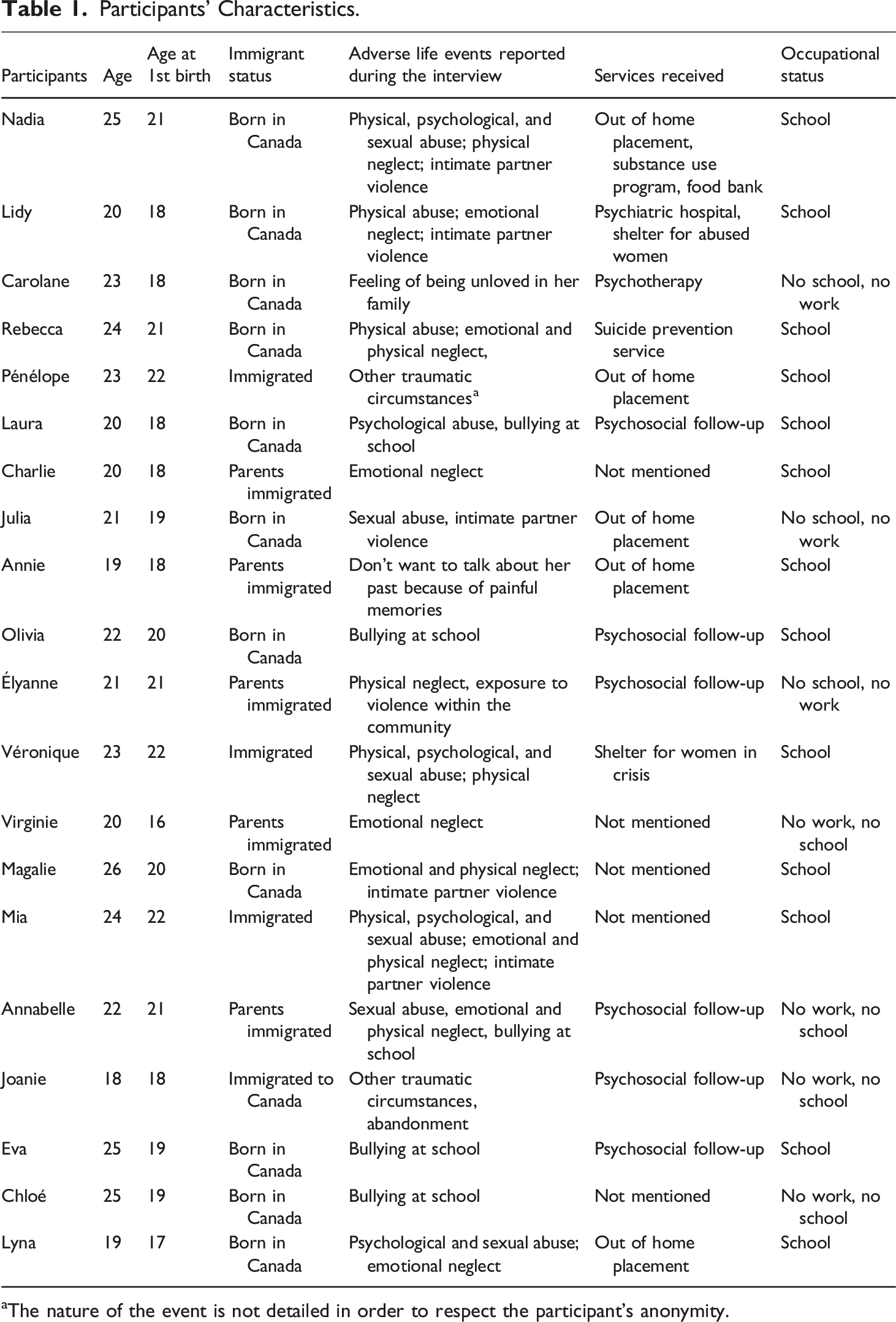
aThe nature of the event is not detailed in order to respect the participant’s anonymity.
Qualitative interviews
Research assistants conducted a semi-structured qualitative interview, in French, with each participant individually. The notion of self-concept was central to the interview protocol that was inspired by the Possible Selves Mapping Interview (Markus and Nurius, 1986; Shepard and Marshall, 1999). The present study is part of a larger study, whose ultimate aim was to document how young women envision themselves in their future (their “possible selves”). Considering that possible selves are derived from representations of the self in the past and are connected to current representations of the self, the interview protocol was designed to provide an understanding of such things as how the participants described themselves as children, when they thought about their past, and how they described themselves as young women now, when they thought about their current lives. The present paper focussed specifically on past and actual self-concepts and the data were issued from questions such as: Can you describe to me what kind of child/adolescent you were? If I could see a picture of you as a child/adolescent, what would that picture tell me about who you were at that period of your life? How would you describe you now, as a young adult? More questions were asked if needed to better capture how participants see, value, think or feel about themselves. Each interview lasted 90 to 120 minutes and was recorded and then transcribed verbatim. The research assistants also wrote a report describing the context of each interview (emotions, general atmosphere, voice intonations, etc.).
In order to obtain the most reliable data possible, the research assistants were given training not only in how to follow the interview protocol but also in the theoretical principles that had guided its design. Also, pilot interviews were conducted to allow for optimal training of the interviewers. In addition, the first two authors of this study listened to the first five recorded interviews and provided the interviewers with feedback on how to get subsequent interviewees to dig deeper and provide more information. In conducting the interviews, the interviewers placed great emphasis on establishing trust with the interviewees and showing them sensitivity, empathy, and respect, so as to encourage them to share their feelings and perceptions. On the whole, the participants provided rich insights into their experiences, thoughts, and emotions. But some of them found it harder to engage in introspection and talk about their identities— “who I am”. Also, one of the interviewees did not want to talk much about things in her past; she said that it brought back too many bad memories that she had worked too hard to forget. This may have limited the content of her interview, but the interviewer demonstrated respect and consideration for the participant’s situation and reminded her that she was not required to answer the questions if she felt uncomfortable.
Analytical strategy
We used a two-step analysis process in order to first reduce our data before doing a thematic analysis. Following a close reading of the transcripts, we used the method proposed by Schneuwly et al. (2009) and Falardeau and Simard (2011), which involves condensing each transcript into a narrative summary that captured the essential elements of the interviewee’s life story and of her descriptions of her past and present sense of self. These summaries focused on the terms that the interviewees used to describe themselves, the significant life experiences that they reported, and the meanings that they ascribed to these experiences. We also selected excerpts from the transcripts to support our findings. Producing such summaries entails a condensation of the data to be analyzed (Miles et al., 2014). To minimize any bias, three authors reread the transcripts and the summaries several times, adjusting and clarifying the summaries as necessary to make them reflect the true meaning of the data, with a minimum of inference. Once we had completed this first step, we performed a thematic analysis to identify similarities, singularities and differences that emerged from these dense summaries (Paillé and Mucchielli, 2016). In this process of continuous thematization, we identified themes that were recurrent in the narrative summaries, described them thoroughly and then categorized them. We grouped similar sub-themes together to eliminate redundancies and to emphasize contradictions or differences between themes (Paillé and Mucchielli, 2016).
At every stage of the analysis, the authors sought consensus, making precise, exhaustive use of the consensual approach proposed by Hill et al. (2005). Throughout the process, the decisions on selection, definition and interpretation of themes were discussed, made and validated by all authors, with the fundamental objective of enhancing the credibility and confirmability of the data.
Results
Our results suggest how difficult it was for most of the participants to define themselves as young women outside the framework of motherhood. More specifically, three senses of self were described by these vulnerable young mothers: an undefined sense of self, which is shaped by their transition to motherhood and the adverse events they experienced, a negatively impacted and fragile sense of self, and a sense of self that was intended to be resilient but was still under construction 1 .
Undefined sense of self
The participants were asked to describe how they defined themselves as young women and what kind of young women they were at this stage of their lives. For most of these young mothers, this was a rather difficult exercise. Many of them admitted that they did not know themselves well and were in the process of figuring themselves out. The following comments from Rebecca, age 24 and who reported having been neglected by her parents during childhood and having attempted suicide during adolescence, reflect this rather unclear sense of self. I definitely don’t see myself as anything much. No, I really don’t see myself as anyone, more just somebody who’s looking for herself. Maybe I’m searching for my identity with some teenage crises mixed in and all that.
In response to the interview questions, the participants often strayed off topic, describing events and situations and thus talking more about what they did rather than who they were, or talking more about other people than about how they thought of themselves. For example, Joanie, age 18 who experienced a considerable amount of instability and feelings of abandonment during her life course explained : So… I’m … I don’t even know what to say, but I’m trying to go to school, because, um … I used to have a job, but I stopped. So I worked at McDonald’s before, then I stopped because I’m on maternity leave […] Man, I don’t like those kinds of questions! Because to tell you the truth, I don’t know how to answer!
The self in transition: navigating motherhood and adulthood
Several of the participants reported that when they became mothers, they tended to “lose themselves”. Some told how that they felt as if they were nothing but “mommies” and empty, fragile or incomplete as young women. For example, Magalie, even if she was our oldest participant (age 26), could not manage to describe herself beyond her role as a mother: Umm… well, a fragile woman, I don’t know, a Mom, for sure, a woman who lives for her child, a woman, umm … I don’t know [silence] I don’t know, for now.
Other participants made statements that clearly reflected the problems involved in transitioning to motherhood and adulthood simultaneously. For example, Annie said that she was “growing up at the same time as my daughter”. Several participants experienced motherhood and emerging adulthood as a dual burden on their sense of self. As Nadia, age 25 and a victim of many forms of violence during her life course, put it: When I got pregnant, that’s when I told myself, maybe now it’s time for me to start thinking about myself in my life, you know, the way I should. But because I couldn’t, I started to think about my child instead. But at the same time, it has been good for me too. It has helped me to become an adult, because I tell you, I’m not there yet. I’m 25, but I’m working hard on it! It’s tough, when you become a parent and an adult at the same time. It’s hard to educate yourself when you’re educating someone else, because sometimes, you might say that I’m torn between who do I educate today, you know?
The burden of adverse experiences on their sense of self
Beyond this perceived impact of motherhood, results also revealed these young women’s undefined sense of self should be understood in light of the connections that they were making on their own between their life stories and their sense of self. Some of the participants believed that the kinds of lives they had led had not helped them to know themselves very well. Annabelle and Charlie explained that they had often been left on their own as children and talked about some of their experiences of parental neglect. They said that these experiences had kept them from defining themselves as people because they did not know what values should guide their lives and had not received any support when they had to make choices or decisions. Charlie, age 20, explained that she felt an emptiness inside, because it seemed as if she did not have any foundation that she could build on to define herself: I’d say to you that presently, I feel as if…as if I no longer have any foundation […] It’s like I’m there, but at the same time, not there. Like, I’m so busy thinking, then trying to understand, then trying to find answers, that you’d say I’m like super-fragile. I’m not there […] The void! I feel like I’m not there, like … something’s missing, there’s a hole that … I feel like I’m just trying to keep pedalling to try to, to fill that void.
Several participants described having grown up in very controlling families where violence was often present. These young women said that, in their families, they had not had any opportunities to express their own opinions or make their own choices. On the contrary, they had always given in to other people’s demands and expectations, and if they had gone against their parents’ wishes or made any choices on their own, they might have been subjected to violence. Now that they had become independent young adults, they experienced a lot of problems in taking control of their own lives and felt very insecure when they had to make decisions, take initiative, or try to define themselves as human beings. Lidy, age 20, explained this situation in vivid terms: Before, I felt as if I were in another body, and I’d watch myself going around. There was nothing I could do. I was a spectator. I just watched this little girl doing whatever. Now, I see myself as the scriptwriter who’s going to write the scene and decide what’s going to happen, where I’m going to go, even if there are going to be some obstacles. You know, now I need a conclusion, to resolve the situation in the end. That’s how I feel now: I feel as if I’m kind of inside myself, without somebody else to my left or right […]! But right now, I’m more afraid of the new me than of the old one. I don’t dare to do anything.
Like Lidy, several other participants recognized the impacts that this lack of self-knowledge was having on their day-to-day lives. Some of them said that they had trouble in identifying their interests, while others said that they had little trust in their own judgment and were afraid of making bad choices. For these young women, continuing with their education, getting job training and finding a job were all especially difficult. Several of them said that they wanted to take job-related training but could not figure out what field they wanted to specialize in or what kind of work they might want to do. These young women tended to fall back on other people to make decisions, or to just rely on fate or their religious beliefs to find “the right path”. At a key transition point in their lives, when they needed to be making long-term plans and taking action independently, this undefined sense of self caused real distress for some of them, Julia, age 21, offered a touching example: I don’t know how to describe myself! […] I don’t really have a future that I know of, and I don’t know what I want to do in life, so I feel like I’m just going around in circles. But time is flying anyway. I’m afraid of where I’m going to be at two years from now. You know, when I have to pay full-price rent and everything, it’s going to be tough! I can’t seem to give myself a good kick in the ass. I’m depressed and negative all the time. Everything bothers me. I cry all the time.
Negatively impacted and fragile sense of self
Persistent and invasive negative representations of self were a salient feature among some of the participants who described themselves in a variety of clearly negative terms throughout the interviews. Laura, for example, said she felt “like less than nothing”, like someone who is “stupid, annoying, controlling and impulsive”. For several of these young women, a very negative sense of self was a natural outgrowth of their life experiences. Several of them alluded to having been bullied or excluded at school on numerous occasions. Laura, for example, associated her current negative sense of self with her having been rejected and teased a lot by her peers when she was younger. Other respondents attributed their negative sense of self to maltreatment that they had received at the hands of adults. Lyna, for example, said that she had been so badly mistreated in her foster family that she ended up firmly believing that she was worthless, and that even now, as a young adult, disparaging herself had become an everyday reflex. Nadia, age 25, described how the maltreatment that she had endured continued to affect the way she saw herself: The abuse that went on – physical abuse, sexual abuse, psychological abuse … It was hell there. I had to survive, you know … [...] It was my self-image that took the hit. The image that I have of myself really isn’t very pretty, to tell you the truth. Even though I may have managed to be positive in my life, I don’t see myself as a very positive person at all. That’s the first thing that I noticed. I thought a lot about that. But basically, I see myself as the person that I don’t want to become. I see myself as the same, even though I’m no longer in the same place…
These experiences of being repeatedly bullied, rejected or maltreated made these young women not only believe that they were worthless as human beings, but also feel that they “didn’t belong anywhere”. Some of the participants expressed this feeling of unbelonging in very heartfelt terms. Julia and Carolane did so with much sadness, while Lidy, age 20, said that this feeling had even led her to attempt suicide: I felt judged wherever I went. I was in really bad shape. All the time. I felt empty a lot of the time too … I always felt excluded. I never felt at home in my skin.
Ongoing construction of a resilient self
Most of the participants made a point of saying that despite all the adversity that they had experienced in their lives and that had undermined their sense of self, they were determined to redefine themselves in a more positive way and to recognize their strengths. For example, Chloé, who described herself as being anxious as well as distrustful and distant towards others, was proud that even though she still feels fragile, she also feels that she now has the strength to start moving forward. Another of our respondents, Mia, age 24, highlighted the importance of believing in herself despite the fact that she felt rejected and disregarded by her family since childhood: I’m going to describe myself as a young woman who is trying to overcome, despite everything that she has been through. And who still believes … well, I don’t know, I find that I still believe in myself. That I can overcome.
Thus, the respondents did not talk about themselves in negative terms only. Most of them said that the problems that they had experienced had enabled them to grow and to make positive changes. In this regard, they described themselves as intrepid, brave, independent, resourceful, generous, attentive, dynamic, responsible, calm, thoughtful and mature. Some of these young women also recognized that they were proud of the work that they were doing on themselves and said that they felt that they had more and more control over the course of their lives. Thus, their responses reflected a process of self-examination and a pathway through resilience. This willingness to be positive and press ahead despite their difficulties was often motivated by their desire to be positive role models for their children and to make sure that their children’s lives would not be so hard as their own had been. Here is how Laura, age 20, put it: Well, I think that what it comes down to is that sooner or later, you have no choice but to accept yourself. And that for sure, I have some work to do on myself, and that I’m going to do it, because, exactly, I don’t want my daughter to follow in my footsteps, and I do want her to have a much better life than me. And I’d really like to protect all the people I love. So I have no choice but to change! And to become a better person, one day after another.
But even though they were able to recognize their strengths and abilities, most of these young women said that they still needed to take some time for themselves, to rebuild themselves. Some thought that, before trying to set any personal objectives, they needed to live one day at a time and get to know themselves better. This was true for Nadia, age 25, who still had a negative sense of self and now wanted to take some time for herself. As a young woman, I’m a little bit broken. I don’t … I’m more focused on repairing myself than on developing myself. That’s where I’m at. I have kept my perseverance and my positive attitude, and that’s helping me a lot […] But also, to go with the flow. We’re not all at the same stage, so there’s no point in rushing myself to become someone. I’m better off taking care of the person I am today, so that things can be better tomorrow.
Discussion
The scientific literature clearly spotlights the challenges that vulnerable young women face when they have to make the transitions to adulthood and motherhood at the same time. Until now, vulnerable young mothers’ experiences have been documented mostly from the standpoint of their social role (self as mother) (Aparicio et al., 2015, 2018; Brand et al., 2014; Chumbler et al., 2016; Leese, 2016; Radey et al., 2016). The present study makes an innovative contribution by exploring these young women’s sense of self, focusing on the extent to which they clearly see, value, think about, or feel connected to themselves. Their sense of self is often fragmented and deeply intertwined with their identity as mothers, with both identities rooted in their experiences of adversity.
Like many other studies, this one has observed the multiple adverse and even traumatic events that may mark the lives of young mothers (Aparicio, 2016; Breen, 2014; Connolly et al., 2012; Pryce and Samuels, 2010; Radey et al., 2016). Past studies have provided an understanding of how such events can undermine young mothers’ ability to play their parental role (Brand et al., 2015; Maxwell et al., 2011; Narendorf et al., 2013; Pryce and Samuels, 2010). The present study sheds new light by documenting how these negative experiences also greatly impair their representations of themselves as young women.
Although personal identity development is still very much a work in progress for most young adults (Vosylis et al., 2018), the young mothers in our sample were in an especially vulnerable position and eloquently expressed just how little they knew themselves. To explain this great lack of self-knowledge, these young mothers strongly emphasized how few opportunities and how little support they had received throughout their childhood and adolescence for exploring their interests, making choices and committing to them. Yet such opportunities and support are essential conditions for developing one’s personal identity and achieving a clear sense of self (Crocetti et al., 2018; Schwartz et al., 2017). Another noteworthy difference between the vulnerable young mothers in our sample and emerging adults from the general population rests in the process of recovery most of them were currently going through as young adults. Before having the time and space for exploration and commitment to different projects that would fall into a normative pathway (e.g.: planning the school-to-work transition, having a long-term romantic relationship) they must beforehand rebuild themselves emotionally. In addition, this process of recovery generally takes place in vulnerable circumstances (e.g.: single parenthood, poverty, low educational attainment, domestic violence, social isolation, drug abuse and psychological distress).
The self-concepts of the young women in our study must be understood in light of the maltreatment that so many of them experienced in childhood. Briere (2011) explains that maltreatment is associated with a higher risk of having insufficient access to one’s self and to one’s personal identity, thus resulting in an weakened self-concept. A fragile self-concept is manifested primarily by reduced self-awareness, which reflects a lack of self-knowledge, confusion about one’s own thoughts and beliefs, and problems in setting personal objectives. An weakened self-concept is also manifested by an excessive tendency to rely on other people to make choices and decisions, which results in poor awareness of one’s own needs, rights, thoughts and feelings and a propensity to regard other people as more relevant and credible than oneself (Briere, 2011). Both of these dimensions characterized the lack of self-concept clarity among the young women in our sample.
Our findings indicate that although developing a clear sense of self does represent a challenging task for young mothers, the young mothers in our sample were indeed in the process of building their identities. Past studies have shown that motherhood often provides motivation to change, in that it enables young women to perform a meaningful social role from which they can derive a sense of personal worth (Breen, 2014; Chumbler et al., 2016; Dworsky and Meehan, 2012; Leese, 2016; Mantovani and Thomas, 2015; Narendorf et al., 2013; Pryce and Samuels, 2010; Radey et al., 2016). Our findings also suggest, however, that this social role masks some considerable personal needs. Many of the young mothers in our study expressed the need to take time to find themselves and to construct themselves as young women. For some of them, the process of self-examination involved in developing their sense of self led to emotional problems, sometimes involving significant distress. But as Crocetti et al. (2018, p. 302) explain, distress associated with questioning one’s current identity may be a necessary step toward a more mature one.
The present study did have some limitations. First and perhaps most importantly, our analysis did not take into account any potential social, structural or cultural influences on sense of self, and reflects the statements of a very specific subgroup of young mothers who were receiving services due to their psychosocial vulnerability. Therefore, future research could benefit from applying an intersectional lens to explore how social structures and sources of oppression, such as patriarchy, racism and class, intersect with psychosocial vulnerability in shaping young mothers’ identities. Second, it was retrospective and so, by definition, could not examine how these young women’s perceptions and feelings about themselves continued to evolve in the future. This question would be worth examining in longitudinal studies. Third, because the questions we were asking were highly personal, some of our respondents may have found it too painful to draw connections with their pasts or may have answered some questions in such a way as to preserve a positive self-image. Fourth, it would have been worth while to discuss our findings with the respondents so that they could validate our interpretations of their interviews. Finally, we did not analyze the factors that could contribute to the development of a clear and positive sense of self. Such a positive standpoint would be essential to consider in a further study.
Despites these limitations, this study has shown the value of considering young mothers from the standpoint of their personal sense of self, rather than simply from that of their social role as mothers. This study also suggests possible new approaches to supporting the personal development of vulnerable young mothers. Their fragile self-concepts are likely to be accompanied both by psychological distress and by difficulty in making choices in their day-to-day lives or longer-term commitments to go back to school or find a job. These impacts of a fragile self-concept have been documented previously in the literature (Albarello et al., 2018; Arnett, 2004; McAdams and Zapata-Gietl, 2015; Vosylis et al., 2018). Before implementing any programs to promote better functional social integration of young mothers (for example, through education or employability skills training), it is therefore essential to recognize that many of them could also use help in navigating the identity-formation process.
Related to this context, Schwartz et al. (2005) propose the delivery both of cognitively focused interventions that promote self-construction and emotionally focused interventions that favor self-discovery. Cognitively focused interventions must enable individuals to explore new avenues for their present and their future and to develop problem-solving and decision-making skills. Emotionally focused interventions must enable individuals to identify and recognize their own skills, as well as to set objectives and to have aspirations that are important and meaningful for them. They can then apply these skills to achieve these objectives and aspirations, deriving positive experiences in the process (Schwartz et al., 2005). It is essential to give vulnerable young mothers the time and space they need to begin valuing their own thoughts, feelings and aspirations and thus promote a “sense of personal meaning and direction” (Schwartz et al., 2005: p. 310).
Lastly, although this study focused on sense of self, it is crucial to remember that, as other authors have pointed out (Breen, 2014; Brubaker and Wright, 2006), the development of identity is also a social process. In addition to evincing a personal desire to develop a more positive sense of self, vulnerable young mothers need to be supported in their process of self-construction by the significant people around them.
Footnotes
Declaration of conflicting interests
The author(s) declared no potential conflicts of interest with respect to the research, authorship, and/or publication of this article.
Funding
The author(s) disclosed receipt of the following financial support for the research, authorship, and/or publication of this article: This study was supported by the Social Sciences and Humanities Research Council of Canada (Grant 430-2016-00518).

Data Availability Statement
Due to the nature of this research, participants of this study did not agree for their data to be shared publicly, so supporting data is not available.