




Abstract
The focus of this paper is exploring topic avoidance in the form of family secrets and how they may influence Child-To-Parent Violence and Abuse (CPVA). The research was conducted with two families experiencing CPVA using the Biographic Narrative Interpretive Method (BNIM). This method was selected with the intention of gaining a deep understanding of the living experiences of families experiencing CPVA. An outcome of using this method was uncovering the ways in which secrets, as part of problematic communication, affect the behaviours of family members throughout their life-course. The narratives collected from each participant were analysed by the researcher and ‘Reflecting Teams’ as recommended by the BNIM approach. The findings showed that there was a pattern of parental avoidance of conflict through the use of topic avoidance and secrecy leading to Child-To-Parent Violence and Abuse, creating a ‘spiral of secrecy and abuse’ operating within the families.
Introduction
Child-to-parent violence and abuse (CPVA) is a pattern of behaviours involving verbal, emotional, physical, sexual, and financial abuse, as well as coercive and controlling behaviours, from a child, (defined as under 18 years old), towards their parent or carer (predominantly the mother). This can have multiple negative influences and outcomes for the whole family, including other children living in the household. With the parent/s feeling a loss of control, powerlessness and fear, and the child in a self-destructive and negatively powerful position within the family, there is the added potential for damaging relationships across the whole life course, both internal and external to the family (Cottrell, 2003; Holt, 2016; Home Office, 2012, 2015).
The complex nature of CPVA links various factors that affect individuals’ and family wellbeing, such as domestic or family violence and abuse, trauma, mental ill health, substance misuse, and permissive parenting or overly controlling parenting and a lack of parental warmth (Calvete, 2023; Contreras and Cano, 2014; Ibabe and Bentler, 2016; Jiménez et al., 2019; López-Martínez et al., 2019; Maranon and Ibabe, 2022; Papamichail and Bates 2020). CPVA should therefore be understood as bi-directional as it adversely affects both the parents and the child/ren. This paper addresses this issue with a view to helping practitioners to better support families who are experiencing CPVA.
Communication and family functioning
Positive communication within family functioning has been shown to be a protective factor for prosocial behaviours (Jiménez et al., 2019). Families where there is openness and free exchange of information, understanding, and some flexibility, allows children to develop more positive open communication. Parental warmth, cohesion and familial affection also support positive communications (Dailey, 2006; Ibabe and Bentler, 2016; Jiménez et al., 2019). Children can then be confident about disclosing their problems to parents, who in turn are accepting and responsive to their needs (Afifi and Steuber, 2010; Dailey, 2006).
Conversely, problematic communication, which displays patterns of being overly critical, negative, averse to being affectionate and disinclined to share information, which over time can become bi-directional, and poor family functioning, with low cohesion in the family and disengagement, have all been shown to be correlated to behavioural problems in children, family instability, lack of trust and breakdown in relationships, criminal behaviours, substance abuse and aggression (Contreras and Cano 2014; Jiménez et al., 2019; López-Martínez et al., 2019; Maranon and Ibabe, 2022) and CPVA This is understood to include parents withholding information from their children the parent being overly critical of their children, and a lack of parental warmth and low emotional support (Paulson et al., 1990; Pagani et al., 2004; Contreras and Cano, 2014; Jiménez et al., 2019; López-Martínez et al., 2019).
The notion that communication is linked to CPVA is also found in a study by Jiménez et al. (2019). They found that negative family communication (including poor communication, being excessively critical and withholding information) was a predictor of verbal CPVA, examples where a child would resort to verbally abusive behaviours towards their parents if they felt that they were not listened to or if they were feeling unfairly criticised. Jiménez et al. (2019) explained this as bi-directional, due to the ‘reciprocal exchanges’ within the family environment.
Similar findings were made by López-Martínez et al. (2019) who conducted quantitative research in Spain with 1200 adolescents with the aim of studying the relationship between styles of family communication, emotional intelligence and child to parent violence. They argued that problematic communications (offensive and avoidant) led children to internalise these communication processes, until eventually they were unable to communicate their thoughts or feelings effectively and/or these communications were not being understood by their parents. When the children are unable to manage the resulting negative emotions in an appropriate way, they feel anger and frustration, which in turn may lead them to attack their parents. Furthermore, Romero-Abrio (2024) explains, that if an adolescent is brought up in a family with a perceived lack of empathy and support then this will have an impact upon their child’s behaviours.
Literature also shows that when families experience CPVA, the parents also experience distress and mental ill health, such as depression, anxiety, as well as a sense of shame, self-blame, guilt, helplessness and worthlessness (Desir and Karatekin, 2018; Jiménez-Granado et al., 2023; Junco-Guerrero et al., 2023; Rutter, 2021; Williams et al., 2017). Such feelings as shame can be debilitating and go as far as to impact parents reporting their experiences and seeking support, with some parent’s only reporting their child’s behaviours as an act of desperation or fear of injury (Cobdry and Miles, 2014). Guilt can also be wrapped up in questioning their own parenting abilities (Desir and Karatekin, 2018; Williams et al., 2017) and wondering why their child is being abusive towards them or feeling that their child’s behaviour is their fault, for example, being a victim of domestic abuse. With that notion, the parent may also feel responsible for changing their child’s behaviours (Gabriel et al., 2018; Toole-Anstey et al., 2024). Equally the child may blame the parent for their behaviours (Holt, 2013), creating a ‘cycle of shame’ which can impact the parents wellbeing, sense of helplessness and relationships (Gabriel et al., 2018).
This shame can lead to self-blame. As Williams et al. (2017) notes; “the psychological experience of CPVA involves an emotional turmoil (a ‘never-ending bloody emotional roller-coaster’) of escalating and de-escalating negative and positive emotions, from resentment, anger, hatred and sadness to love, protection and forgiveness. These confusing and conflicting emotions are privately endured and worked through, and perhaps not articulated because of the judgmental blaming (self-blame and others’ blame) that informs these experiences” (p. 604).
Why some families are able to avoid conflict may be complex and nuanced, for example, parental warmth, affectionate and positive communications are known to be protective factors against adolescents developing abusive behaviours (Romero-Abrio et al., 2024) and thus some families are able to successfully navigate conflict. Beckmann (2020) also argues that a buffer for physical CPVA was family cohesion and positive family relationships, even if the family relationships had been abusive in the past.
This growing body of evidence showing a correlation between problematic communication and poor family functioning, such as a lack of or restricted parental warmth, avoidant communication and withholding information, demonstrates the impact upon individuals as well as the whole family and an association with CPVA. This may not however be causal, other explanations could be that the experience of CPVA when already established within the families may lead to problematic communication not problematic communication leading to CPVA or that both situations were cyclically exacerbated. Focusing more acutely on problematic communication and family functioning enables us to see that child and adolescent to parent violence and abuse studies, so far, have rarely overtly addressed secret keeping as a form of problematic communication in families experiencing CPVA.
Secrets and secrecy
A commonly used definition is taken from Bok (1982) ‘to keep a secret from someone, is to block information about it or evidence of it from reaching that person, and to do so intentionally: to prevent him [sic] from learning it’ (pp. 5-6). For the purpose of this study, secrets are about keeping information from someone, through topic avoidance, avoiding the person the secret is being kept from, and lying.
People tend to keep secrets because revelation would make them feel vulnerable, and therefore to varying degrees, they do whatever they can to keep their secret from others, especially if the secret holder has experienced negative repercussions from previous revelations (Afifi and Steuber, 2010). They may be keeping their own secret or keeping one for someone else. Regarding CPVA, family violence is often kept a secret and for different reasons, including fear of being judged, shame and fear of criminalising someone they love, or fear of professionals interfering. There is a ‘veil of secrecy’ (Kennair and Mellor, 2007: 203; Patterson et al., 2002: 90), resulting from a perceived need for self-protection.
The drive to sustain secrets is key to this need for self-protection. Afifi and Steuber (2010) argued that to sustain self-protection, the secret holder has to control the secret. This is based upon verbally aggressive reactions from past revelations and fear of how people will react to a new revelation, creating a ‘cycle of concealment’ (Afifi and Steuber, 2010: 1029). Afifi and Steuber (2010) state that, ‘children for example, may be more likely to engage in the cycle of concealment rather than parents because children typically have no dependence power over parents. Parents also are less likely to fear an aggressive response from children’ (p. 1031).
Fear of revelation due to aggressive reactions has also been evidenced in Afifi and Olson’s (2005) study. They conducted research on the pressure to conceal secrets within families, gathering data on 171 families (629 family members) consisting of single or co-parents with children 18 years and older. They found that “family members may refrain from revealing sensitive information that prompts conflict because they have become accustomed to avoiding conflict and fear the rather harsh rebukes that might result from such revelation” (p. 211). A further factor which affects revelation is that people are less likely to reveal their secret if they lack the communication skills to talk about the secret (Afifi and Steuber, 2009). Alternatively, those that have communication efficacy are more likely to disclose their secrets without fearing negative repercussions.
When considering the impact secrets have upon the ‘unknowing’ or ‘unaware’ person, it has been shown that the impact can be severe, leading to lowered relational well-being and mistrust, (Finkenauer et al., 2005; Finkenauer and Righetti, 2011). Therefore, keeping secrets, can have a deleterious impact upon individuals, it can distort relationships and create rifts of distrust in families, as well as being linked to aggression and violence.
This review of the literature has shown that problematic communication, with a focus upon withholding information from someone, through topic avoidance, in the form of secrets and secrecy in families and its influence upon family functioning and CPVA, is worthy of in-depth investigation.
Aims
This study aimed to investigate the family as a system in order to gain a deeper understanding of the living experiences of families experiencing CPVA. This included family functioning, exploring how this can be used to work more effectively when supporting families experiencing CPVA. Through this investigation, communication patterns and the effects that topic avoidance, including family secrets and secrecy can have on individuals and family functioning was further explored. The objective in this study was to draw the attention to practitioners of the importance and function of this when it comes to family wellbeing.
Method
Ethical approval was gained through Bournemouth University ethics committee and written consent was sought from the parents who volunteered to participate in this research, as well as parental consent given for their children, as they were under the age of 16 years. Assent was also sought from the children. All participants were fully aware of the research aims, method, risk and safety issues, confidentiality, safeguarding and when this may need to be broken, anonymity, dissemination and the complaints procedure. Informed continued consent/assent and the right to withdraw were discussed with each participant. The participants were not given money or vouchers to participate, their only incentive was to share their story and support this research.
The sample selection process was purposive; two families were required; the inclusion criteria were that each family had to have children under the age of 18 years living with them and the family are experiencing CPVA. Each family member was interviewed separately using a biographic approach, which created a large amount of rich data. This was an in-depth ideographic approach to understanding CPVA using a very small sample, but nevertheless it has provided sufficient material for a better understanding to be developed.
Participants were recruited via children’s social care, England (UK) and were known to be experiencing CPVA and already having professional support services in place. This approach was taken so that any support or safeguarding issues identified following interview would trigger immediate support for the family if it were needed. It transpired that no safeguarding concerns were raised during the process, and no one required additional support or counselling afterwards.
Social work practitioners already working with families experiencing CPVA asked parents if they would consent to being contacted by a researcher to discuss participation in a research project. If they agreed, their details were forwarded. The parents were then contacted by telephone, and the research was outlined, including aims, methods, data protection and ethical issues, and asked if they still wanted to participate. If they agreed, an initial meeting was arranged to share the participation information and consent forms and give everyone the opportunity to ask further questions before finally agreeing to participate. Dates were arranged for the parents and their child/ren for their various interviews. Age-appropriate written information was given to each child, and they also had the opportunity to ask questions prior to interview.
The interviews were conducted in a venue chosen by the participants, for some this was in a neutral location such as a private room in a community setting or their home (as long as other family members were not present). This was done so that participants felt safe to talk without being overheard. Follow up support was offered at the end of the interviews, including a de-brief conversation and an information sheet with various support services was given, and all participants were offered a follow up call a few weeks later to check on their welfare, as well as ascertaining if signposting for further support was required. This was in line with initial risk assessment protocols.
This study employed the Biographic Narrative Interpretive Method (BNIM) (Jones, 2003; Wengraf, 2001), which incorporates Schűtze’s (1976) narrative and text analysis, Oevermann et al.’s. (1979) theory of objective hermeneutics and case reconstruction, and Fischer’s thematic field analysis (Fischer, 1982; Jones, 2003; Rosenthal, 1993; Rosenthal and Bar-On, 1992; Wengraf, 2001). It is based on how the ‘Lived Life’ (chronology of events) informs the ‘Told Story’ (experience according to the narrator) (Wengraf, 2001).
The data collection, guided by BNIM, uses interviews with up to three interview sub-sessions. Sub-sessions one and two were conducted on the same day; however, it was found that the third sub-session was unnecessary for this study due to the wealth of information gathered in the first two sub-sessions.
The first sub-session used a ‘Single-Question aimed at Inducing Narratives’ (Wengraf, 2001): ‘Please tell me the story of your life’ while the researcher remains silent. Nonverbal and paralinguistic expressions were used to encourage the participant to continue talking, allowing long pauses with only occasional words such as ‘tell me more’ to encourage them to keep talking. Notes were taken throughout, and all interviews were audio recorded.
The youngest participant (aged 11 years) struggled after a while, so the researcher broke the questions down, as suggested by Hesketh (2014). The researcher chose to ask the participant to talk about her family, friends, school, and what she does outside of school. These prompts helped her, and an in-depth narrative was given, the questions were still left as open as possible to limit bias. However, by prompting questions, the participant-led approach to the interview process could have been compromised.
Sub-session two was held after a short break following sub-session One. The interviewer asked questions on topics raised during the previous interview. The participant’s exact words in exactly the same order originally spoken were used to frame these questions. This ensured that the ‘gestalt’, or the participant’s particular and individual ordering of her/his life, was not broken (Jones, 2004).
Once the interviews were transcribed, the researcher organised the transcripts using the BNIM Text Sort Method (Wengraf, 2001). The Lived Life is composed of ‘uncontroversial hard biographical data (Wengraf, 2001: 236), it is a chronology of the participants life. The Told Story is created when the structure of the story has changed and a new structure has started, creating a ‘Text Structure Sequentialization’ (Wengraf, 2001: 255). Reflecting Teams made up of people who have different lived experiences, undertook the role of using their own background experiences to interpret the information revealed to them by the ‘narrative chunks’ or sequences of text. This analysis provided different perspectives on the information, thus generating ‘multi-voiced’ interpretations (Jones, 2004). The use of Reflecting Teams enabled the researcher to minimise bias by not imposing her own preconceived ideas onto the analysis (Fenge and Jones, 2011; Jones, 2003; Wengraf, 2001).
Each interview required two Reflecting Teams. The role of these teams was to interpret the ‘Lived Life’ and the ‘Told Story’ by having the sequences of text revealed to them in small ‘chunks’, one at a time, and asked to draw hypotheses on what the text meant and then induce theories about what might happen next. Each team comprised between 3 and 6 people, who were all volunteers, drawn from a pool of friends, family and colleagues. The recruitment for the Reflecting Teams involved asking existing volunteers to invite other people they knew to join the teams, thus deliberately drawing from as wide a social spectrum as possible. The reflecting teams were given information sheets prior to engaging with this task and were also offered follow up support should it be required. They agreed to abide by the university’s confidentiality and ethical principles to ensure an additional layer of protection for the participants’ privacy.
It is significant that to date, literature on this topic has lacked child-led in-depth interviews (Holt and Lewis, 2021) and this study has given full voice to parents and their children. This inclusion of children’s voices within the research has added an important layer to our understanding of CPVA.
To further safeguard participants from potential harm, certain family background information was redacted. Although the narratives are real, all the names Lily, the mother, Josh, the father, their daughter Ella, aged 13 years who is exhibiting CPVA, and her younger sister Mia, aged 11 years are fictional, and have been amalgamated into one composite family.
Findings and discussion
Individuals within the family held their own secrets, as well as family secrets which were not talked about either within or outside the family. A frequent observation made during the biographic interviews was that participants had never spoken about certain events or situations they had experienced prior to the interview. There were ‘holes’ in narratives which were filled by other family members in their interviews, and different perspectives of the same event were given. This allowed the researcher and reflecting teams to uncover secrets and also see where secrets were still being maintained by individuals and, at times, the whole family. As this paper is not about the secrets per se, but more about how secrets are a part of problematic communication within families, it has been decided not to reveal the secrets. Instead, narrative accounts will be shared which show rather than tell the nature of topic avoidance as secret keeping with examples of problematic communication within families.
The interpretation process clearly identified that family secrets do influence CPVA. Secrets were sustained by parents to avoid conflict and emotional hurt, yet paradoxically, it appeared that this experience silenced the children leading to CPVA The more severe or frequent the CPVA, the more fractured the family relationships became. As parent/s became more fearful and/or deskilled in communicating, a spiral of secrecy and abuse grew within the microsystem of the family (see Diagram 1). In line with the research question, these findings will be broken down into three sub-themes. Spiral of secrecy and abuse.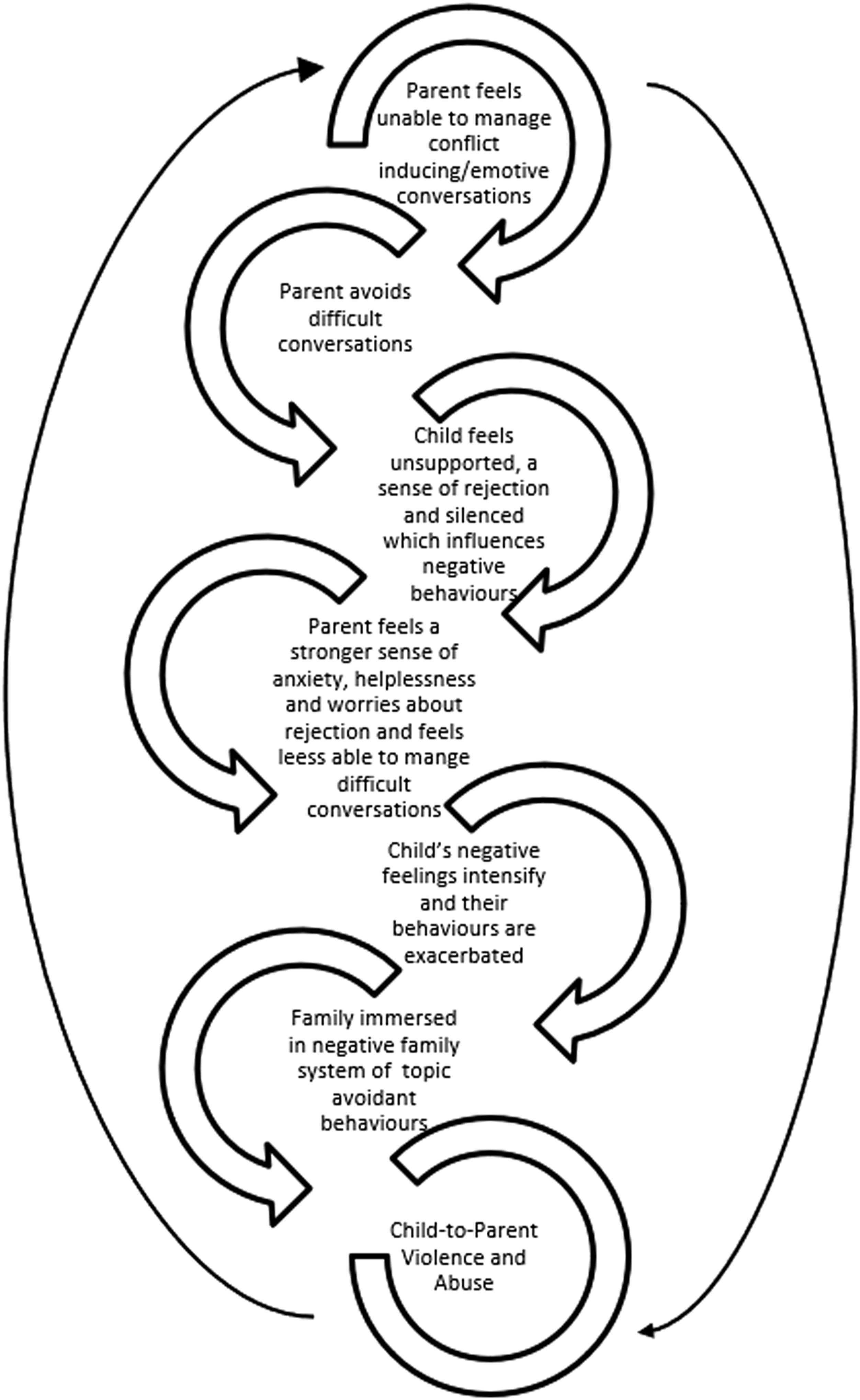
Subtheme 1
The first subtheme is the use of secrets. Through the tactics of topic avoidance and secrecy, and as part of a dominant communication pattern constructed within the family system to avoid conflict, it was seen that while topic avoidance may be used to avoid conflict, it still led to conflict, including CPVA. The interviews with Ella and Mia identified the frustration of being silenced, having information hidden, and/or not being able to talk about emotive issues. Ella stated: ‘…there is this constant voice in my head saying, do not tell anyone anything. Do not tell anyone anything. And it basically just goes like this. [Tapping a rhythmic beat]. Don’t tell anyone anything. Don’t tell anyone anything. And I could kind of sing it out. I could kind of dance it out’.
Findings from this study concur with the literature that shows that problematic communications are associated with CPVA (see Contreras and Cano 2014; Jiménez et al., 2019; López-Martínez et al., 2019; Maranon and Ibabe, 2022), and secrets are likely to be used as strategies to avoid conflict (Afifi and Olson, 2005; Afifi and Steuber, 2010). For example, Josh said in his interview that ‘I try to leave her alone as much as possible…without sounding in an uncaring way, I try and have as little contact with her as possible’.
This study found that communications were avoided, and that secrets were maintained for fear of negative consequences, this strategy having developed from past experiences of aggression. These secrets were a tactic for avoiding further conflict, creating a ‘cycle of concealment’ (Afifi and Steuber 2010: 1029). This is not about keeping secrets, but about avoiding conflict, because the secret holder has learnt that through concealing information, further conflict is avoided, and is then negatively reinforced as self-protection.
Concealing information does not always work; in agreement with other studies, for example Jiménez et al. (2019) who showed that concealment leads to increased perceptions of stress in children and is a predictor of verbal CPVA, especially when it is an automatic response sustained through the reciprocal family exchanges. This notion of secrets leading to stress and aggression is also found in Frijns et al.’s. (2005) study, which showed that keeping secrets from parents was associated with children experiencing stress and exhibiting increased aggressive behaviours. Whilst this study did not use the term ‘stress’, the interpretation process considered similar negative emotions such as frustration, the impact of not feeling listened to or feeling silenced. These themes resonated with López-Martínez et al.’s. (2019) study, which found that negative emotions led to incidents of CPVA as a way of children expressing their feelings or as Romero-Abrio et al. (2024) said, if a child feels unsupported or a lack of empathy then this will have an impact upon their violent behaviours. For example, Ella recalled an incident when she perceived her family were keeping specific information from her, she noted: ‘and then I go to my mum, be honest, and then the argument started from about there. And I had a really bad like day…and I went absolutely ballistic at my mum’.
An alternative explanation for this could be that the use of conflict, including CPVA, is used as a strategy to avoid addressing certain topics and sustain secrets by the secret holder. This is in line with research such as Dailey (2006) and Afifi and Steuber (2010) who note that positive communication between family members is more likely to support revelation. This is due to the person the information is being revealed to, being perceived as able to respond positively, and the secret holder having the skills to communicate and explore what has been shared. This would mean that it may not be the secrets that influence the incidence of CPVA, but rather that use of CPVA is a strategy to sustain secrets. This question can only be resolved by further research.
Subtheme 2
The second subtheme concerns secrets as an influence upon the parent’s sense of feeling deskilled to manage conflict, inducing emotive discussions, leading to the child feeling rejected and silenced, and affecting the child’s behaviours. The study revealed that when secrets and secrecy are used for topic avoidance by parents, it negatively affects individual well-being through lowered self-esteem, self-harming, powerful negative emotions which lead to identity issues. This is clear in Ella’s narrative which described her feeling like the ‘black sheep’ of the family or being excluded/rejected from it as well as experiencing mental health problems (anxiety, depression). These detrimental effects are also seen in other studies (see: Frijns et al., 2005; Frijns and Finkenauer, 2009; Frijns et al., 2013; Bautista-Aranda et al., 2024; Maranon and Ibabe, 2022). This study also showed that when families keep secrets it led to CPVA. A child needs positive and responsive communications with their parents to enable them to disclose information (Afifi and Steuber, 2010; Dailey, 2006; Romero-Abrio et al., 2024).
When secrets are kept and topic avoidance and secrecy employed by families, not only does the child feel frustrated and silenced, but they also lose the opportunity to talk through their problems in a positive way, leading to negative feelings building up over time. As Ella notes: ‘It’s kind of, I know there is more stuff to tell people, because I know my mum says to me, you don't really want to know about it, and that's how I know there's more things. But I just don't know what they are. I just don't. And sometimes it gets me uptight because I'm just like, [saying this more forcefully] mum tell me. Mum tell me. …It’s for me, I kind of feel like I'm in this barrier. So, there's like a gate here, a gate here, a gate behind me, a gate here [points around her body to indicate where the gates would be]. So, there's a massive gate and I'm just shut in it, so I can't move, I can't do anything. And that's how it kind of makes me feel at times’.
Focusing on these findings, it seems that as an individual develops, they learn from their family to avoid certain topics rather than deal with them appropriately. Such behaviours perpetuate a pattern of communication from one generation to the next. As Jiménez et al. (2019) notes, family members engage in reciprocal exchanges and ‘influence and shape each other’s behaviours’ (Jiménez et al., 2019: 4546). This is illustrated by Mia when talking about her parent’s and has revealed too much, she then tries to cover up her disclosure: ‘Sometimes like my mum and dad row but not that often I would say, it’s only like, yeah, barely any like time I don’t think they row. Like yeah, so um, um […] no’.
This study found that the antecedence for family members to use topic avoidance were that individuals, particularly parents, did not have or perceive themselves to have, the skills or emotional stability required to discuss issues that they considered to be conflict inducing. These findings are supported by Afifi and Steuber’s (2009) study which uses a revelation risk model. For instance, Lily spoke about feeling rejected by her daughter: ‘I remember… her totally rejecting me and telling me to go away. I was making the situation worse...and I realised a real change, I’d lost my little girl, and it’s replaced by this person I don’t still understand. And as a mother I became very desperate because I didn’t know how to handle it’.
A further consideration which could influence the parents struggle to hold potentially conflict inducing conversations, is the feeling of shame and self-blame. In the above example, Lily feels desperate because she did not know what to do to make things better. Williams et al. (2017) noted that when experiencing CPVA the parent experiences emotional turmoil, including, sadness, love and protection. These feelings are clearly depicted in the above excerpt, as well as an underlying sense of shame and self-blame. This can be debilitating for parents to know how to make change for their child, for the family and for themselves. As Williams et al. (2017) and Desir and Karatekin (2018) noted, such negative feelings can lead parents to question how effective their parenting abilities are. Potentially feeding into this spiral of secrecy and abuse.
Subtheme 3
The third subtheme is that secrets and secrecy have a negative effect upon family relationships and family dynamics, leading to familial problematic communications and CPVA. The findings of this study revealed that Ella had a strong sense of exclusion and rejection from her family. The study results are similar to CPVA literature which identifies a perceived sense of exclusion and rejection from the parents towards the child (Contreras and Cano, 2014, 2015; Papamichail and Bates, 2020; Bautista-Aranda et al., 2024; Maranon and Ibabe, 2022). The literature on secrets can expand our understanding of the impact of rejection and exclusion as it highlights that concealment of information has a negative effect upon both the secret holder and the quality of their relationships (Frijns et al., 2013).
The findings in this study suggest that the more entrenched the negative communication patterns are, the greater the feelings of rejection and exclusion experienced by family members. The child is left feeling rejected and isolated from their family and parents adapt their behaviours to avoid further conflict. This results in parents having less contact with their child, and avoiding any topic that could lead to conflict, creating a negative cycle that leads to further CPVA. This results in the child being situated in a negatively powerful position in the family and the parents at a loss as to how to change the situation.
Practice implications
Practitioners engaged in working with families experiencing CPVA, should consider a systemic approach to family work, based upon the notion that individuals are a part of different systems, all interconnected and which have an influence on each other. Such systems include the family system, work/school systems, as well as social systems (Flynn, 2019). This approach also recognises that problems are sustained within and by family dynamics, relationships and the systems they are a part of. As Burnham (1986: 1) argues “this approach looks at problems within the system of relationships in which they occur and aims to promote change by intervening in the broader system rather than in the individual alone”. Therefore, considering the living experiences of each person within the family, the intergenerational multi-morbid risk factors associated with CPVA, family dynamics and communication patterns are essential to practice. The systemic approach acknowledges that as a family system, different patterns emerge, evolve and are sustained within the family (Burnham, 1986). When focusing on CPVA, such patterns as problematic family communication and topic avoidance, which could lead to lowered family cohesion should be considered and engage with the whole family to contemplate developing new patterns that promote positive communication.
The interview method for this research required the researcher to remain silent throughout the interviews, not asking questions, not providing prompts or solutions to problems (theirs or the researchers’ perceptions of the problems). This led to all the participants feeling listened to, supported and their experience understood, with the mothers noting that the interviews were therapeutic. There is something to be said about not interrupting others and trying not to problem solve for them, to fully listen and spend time trying to understand their lived experience, as Vajda (2007) noted, biographic narrative interviews can have a therapeutic effect for participants.
Limitations
This study presented some methodological limitations. Firstly, although it was an in-depth small-scale study the findings added some new insights to the cumulative understanding of CPVA. Second, the recruitment of participants lacked diversity. This was because all those who agreed to participate via gatekeepers in this study identified as White British, with parents identifying heteronormative relationships (the children did not mention their sexuality), and these family experiences may be different to those from other ethnicities, genders, sexualities and cultures. The children who were violent towards their parent/s were all cis-female, and the experiences of males might, therefore, be different, especially when considering the notion of how male hegemonic power can influence family functioning.
Conclusion
The major finding arising from this study is that the influence of topic avoidance in the form of secrets and secrecy should be considered as a risk factor for CPVA, but this is not a simple lineal cause and effect relationship. It should be considered in terms of topic avoidance, through the strategies of secret-holding and secrecy, as part of a constructed dominant negative communication pattern within the whole family system.
The Reflecting Teams and the researcher’s own interpretative processes identified that the use of secrecy and secrets appeared to be used to avoid conflict within the participating families, which paradoxically lead to more family violence and abuse including CPVA. The use of topic avoidance created a ‘spiral of secrecy and abuse’. The findings exposed intergenerational patterns of communication that appeared to affect identity, well-being, and relationships that could be detrimental to the whole family system due to secrets being concealed.
Footnotes
Acknowledgements
We would like thank the late Dr Kip Jones for his support through this doctoral research project.
Declaration of conflicting interests
The author(s) declared no potential conflicts of interest with respect to the research, authorship, and/or publication of this article.
Funding
The primary author recieved a scholarship from Bournemouth University to complete the research.
