




Abstract
The Norwegian child welfare service is under pressure both nationally and internationally after several unfavourable verdicts in the European Court of Human Rights (EMD) and national inspections that uncovered serious problems in the system. While the challenging situation for child welfare workers has been well documented in research, there is limited knowledge on how child welfare leaders (CWLs) experience their work situation. This article explores how CWLs experience their everyday work by applying the theoretical framework of the job demands-resources (JDR) model. Data were obtained through qualitative interviews with 12 CWLs and analysed thematically. The study shows that CWLs experience a relatively high imbalance between work demands and available resources in the workplace. Additionally, participants also experience staff challenges, seemingly impossible priorities, and a sense of great personal responsibility. Many leaders experience a work situation that can best be described as a Gordian knot.
Introduction
The Norwegian child welfare service (CWS) has been in both the national and international spotlight since Norway was found guilty of human rights violations by the European Court of Human Rights (ECHR) in several cases (Melinder et al., 2021).
Child welfare leaders (CWLs) at the municipal level hold a crucial position in the decentralised structure of Norwegian child welfare services (CWS), as they are authorised to administer one of the welfare states’ most intrusive pieces of legislation the Child Welfare Law. In total, there are 356 municipalities in Norway, and about a third of them (126) have less than 3000 inhabitants. Several CWS`s offices (40) within these small towns often have less than five employees (Bufdir, 2022). Regardless of the number of employees, the CWS’ are responsible for carrying out all tasks required by the law in a justifiable manner The child welfare leader is invested with powers within the CWS regarding investigations, assessments, conclusions, and initiation of supportive measures. Conclusions regarding more invasive measures need to be forwarded to a County Social Welfare Board. The position must be regarded as a middle manager as these measures are directly and indirectly influenced by the decisions of both higher-ranking County Boards/Courts and municipal leaders, and finally the municipal board. The role is described as one in change where there is an increasing focus on control, administration and budget responsibilities (Shanks et al., 2015; Tham and Strömberg, 2020).
While the work is strongly politically influenced by increasingly detailed requirements, the service has limited resources. In the Norwegian Directorate for Children, Youth and Family Affairs’ description of requirements and expectations for operational leadership in the CWS, six equally important areas of leadership are detailed: (1) Organising and the provision of services, (2) Professional, (3) Strategic, (4) Personnel, (5) Financial and (6) Public (Bufdir, 2017: p. 9–10). In this article, we explore how leaders experience their work and the challenges it implies for municipal CWSs and how we can understand this through the lens of the job demands-resources (JD-R) model.
Child welfare leadership
CWS, both nationally and internationally, is described as one of the most complex, emotionally demanding, and stressful workplaces in social work, having high employee turnover (Madden et al., 2014; McFadden et al., 2015; Baugerud et al., 2017). Leadership in social work takes place in a context consisting of the needs of the client, the employee, and the organisation within a constantly changing political climate (Peters, 2018). It is further characterised as being strongly purpose-driven, having an intense emotional aspect and being largely dependent on collaboration with other agencies (Peters, 2018). Norwegian CWLs experience their work as complex, with increasing expectations and conflicting management requirements (Olsvik and Saus, 2019). Organisational factors such as legislation, rules and guidelines, political guidelines, internal culture, available interventions, time, finances, and criticism from collaborative partners have a limiting effect on the leaders’ autonomy and ability to exercise discretion. In addition, leaders experience many conflicting needs and pressures characterised as paradoxical tensions (Olsvik and Saus, 2020). These tensions are handled in different ways: by suppressing, dividing, and prioritising between demands or by adjusting and adapting to both elements in any given paradox (Olsvik and Saus, 2020). Gotvassli and Moe (2019) point to the importance of colleagues in decision-making, as this helps to reduce the usual complexities found in leadership.
Olsvik and Saus (2019, p. 278) argue that it is important to clarify the leadership role and strengthen the child welfare leader’s competences: “Good organisational frameworks and conditions are a prerequisite for the increased leadership competence to contribute to the professionalisation of management in child welfare”.
Due to the complex and demanding nature of child welfare work, it has been compared to other types of occupations labelled as “safety critical organisations” (Cull et al., 2013; Olaniyan et al., 2020). A characterisation in safety critical organisations is that errors in the execution of work can have severe consequences (Cull et al., 2013). In the context of child welfare, so also for children and parents. If for instance, investigations are not properly conducted owing to some workplace issues, this could potentially lead to wrongful decisions, with adverse consequences for families and children in need. When negative workplace experiences are not curbed or properly addressed, they often lead to unwanted implications to the affected worker and the work environment in general (Bakker et al., 2023). Such risks in the workplace are associated with stress, impaired health, and reduced work capacity (Olaniyan et al., 2020).
Work environment research has shown that high work pressure, emotional strain, time pressure, lack of reward and unclear roles and responsibilities at work can lead to health impairments and reduced production/services (Bakker and Demerouti, 2007; Karasek and Theorell, 1990). Available resources at work, such as social support, managerial and/or colleague support, feedback and autonomy, are likely to increase motivation, job-related learning, and commitment (Bakker and Demerouti, 2007; Bakker et al., 2005).
In essence, focusing on the negative work experiences as well as the positive ones will ensure a more profitable outlook to any workplace. This is owing to what workplaces stand to gain by reducing workers ‘experiences that are unwanted, while initiating efforts to increase the desired workplace experiences. Earlier work psychology theories like work characteristics model and conservation of resources have also attempted to shed lights on the importance of focusing on negative workplace experiences and workplace resources (Arnold et al., 2024).
Theoretical framework
While some other workplace theories might be relevant in the present study, we find that the job demand-resources (JD-R) model, developed by Bakker and Demerouti (2007), is an overall balanced model for understanding the impact of work environment factors on employee health. By incorporating both the demand and the resource perspectives, it is applicable to analyse various work situations (Bakker and Demerouti, 2007; Demerouti et al., 2001). The conceptual framework of the model enables us to analyse a CWLs experiences of present demands and available resources in the workplace and to look at these from an overall analytical perspective. A main assumption in the JD-R model is that all work environment characteristics can be categorised as either job demands or job resources.
Job demands refer to the physical, social and/or organisational aspects of the job that require sustained physical and/or psychological efforts (Bakker and Demerouti, 2007: p. 312). These are associated with physical and/or psychological costs for the employee. Examples of job demands are an excessive workload, time pressure, difficult physical working conditions or emotionally demanding work. Job resources refer to those physical, social, or organisational aspects of the job that are functional in achieving goals and/or reducing job demands and/or stimulating personal growth and development (Bakker and Demerouti, 2007: p. 312). Resources in the workplace are important not only in reducing the negative effects of job demands but also in themselves contributing to motivation and commitment. Job resources can be found at all levels of the organisation at the overall, relational, organisational and task levels. Understanding what can be considered job demands or job resources will depend on the context in which one works (Bakker and Demerouti, 2007).
Important elements in the concept of “job resources” are social support, autonomy, feedback and opportunities for development (Bakker and Demerouti, 2007). Social support can be described as the sum of available social support for an employee in a work environment (Karasek and Theorell, 1990). The essence of the concept of workplace support lies in the duality where the support has the potential to increase commitment and the experience of meaning but also to reduce the likelihood of negative experiences from occurring and to reduce the effect of these experiences if they do occur (Olaniyan et al., 2020). A main assumption in the JD-R model is that psychological processes affect the development of job stress, motivation, and commitment. Job demands that are perceived to be too demanding can drain employees’ mental and/or physical resources and lead to fatigue and health problems (Bakker and Demerouti, 2007; Demerouti et al., 2001; Schaufeli and Taris, 2014). Further persistent high job demands can lead to the development of compensatory strategies and strategy adjustments such as limited attention, increased selectivity, a subjective redefining of requirements and an exhaustion effect that can lead to more risky decisions and a feeling of fatigue and burnout (Bakker and Demerouti, 2007). Considering the child welfare leader’s authority and the nature of the services’ work, such situations could have serious negative consequences.
In a health-promoting process, on the other hand, increased motivation may arise if the employee experiences a high degree of available job resources (Bakker and Demerouti, 2007). The motivation process can be both internally motivated by resources contributing to personal growth, learning and development and externally motivated by the resources that facilitate achieving work goals. The interaction effects between job demands and job resources are another important element in the model regarding the understanding of the development of stress, exhaustion and/or job engagement, where job resources are assumed to act as a buffer between job demands and exhaustion (Bakker and Demerouti, 2007; Bakker et al., 2005; Geisler et al., 2019, e.g., found interaction effects between emotional and quantitative job demands among social workers. Emotional demands may have a positive effect on the meaning and quality of work when quantitative demands are lower.
The focus of the study
The focus of this study is to examine how CWLs experience their everyday work life in municipal CWS. The article further examines the research questions: What do they consider to be the main challenges, and how do they attempt to handle them?
Method
This was a qualitative study aimed at understanding the subjective opinions of the participants’ experience of a phenomenon (Creswell and Poth, 2018) and the experiences of the leaders of Norwegian CWS. We have chosen to employ semi-structured interviews in the present study because of its focus on in depth knowledge of a phenomenon, as well as its focus on rich data production (Braun, & Clarke, 2022).
Participants and procedure
The participants were leaders of municipal CWS recruited from municipalities in the western part of Norway. One of the strategies we employed to ensure transferability, that is, the extent to which findings from our study could be to other setting or context, was keeping the recruitment of informants to a section of the country. We believe that studies of CWS offices with similar parameters as the ones in the present study will likely generate similar findings. We contacted 13 leaders, of whom 12 agreed to participate. The sample consisted of 10 women and two men. The leaders were between 35 and 65 years old. Six were educated social workers, while the remaining had varied education within the sectors of health, education, and law. Six leaders had 2–5 years of experience in the role as CWL, three had 5–10 years of experience, and three leaders had 15–20 years of experience. The CWL represented services of various sizes: small, 5–10 employees; medium, 10–20 employees; and large, 20–40 employees.
Data collection
The data were collected using semi-structured interviews. An openly formulated interview guide developed around the themes of leadership, leadership style, quality and challenges at work was followed to promote the free narration of experiences. The interviews were conducted at the informant’s workplace at the informant’s request and lasted between 01:00 and 1:45 h. The interviews were recorded on audiotape and transcribed.
Compliance with ethical standards
The study conforms to internationally accepted ethical guidelines and the research project was approved by the National Data Protection Office. In Norway, the Norwegian Agency for shared services in education and research is a body responsible for monitoring ethical adherence. The goal of the body is to ensure information security and data protection. In doing these, they monitor the study focus, interview questions and interviewees rights to anonymity. In compliance with ethical guidelines, all participants gave an informed, written consent.
Data analysis
The data material was analysed using reflexive thematic analysis (Braun and Clarke, 2006, 2021, 2022). The first author had the main responsibility for the analysis, and the findings were regularly discussed with coauthors. This was done to ensure that findings are deep-rooted into the data to promote a sensible and comprehensible interpretations of the data, that is, credibility (Lincoln and Guba, 1985). Getting to know the dataset well and developing an impression of the whole was the first step. Keeping a high level of awareness about one’s own preunderstandings was important, as the dataset was read several times focusing on the participants’ voices to ensure dependability. Thoughts and questions were continuously noted in a reflection note to ensure reflexivity. Additionally, we conducted several analytical meetings where all the authors deliberated on the data as well as the themes development. We did these to increase the confidence that future studies can corroborate our findings, that is, confirmability. In step two, we searched for “codes”, features and patterns in the dataset that were relevant to the problem. In the third step, the codes were given different colours according to the themes they dealt with, and gradually in this process, reoccurring themes were made visible. In phase four, we took a step back and reflected on the extent to which the identified themes sufficiently reflected the entire dataset, a process that alternately involved proximity and distance to the information until we were satisfied with the identified themes. In step five, we categorised the various themes using mind maps and colour codes to visualise and stimulate the process of identifying possible connections between them. Finally, the knowledge was summarised in an analytical narrative with the aim of illustrating the essence of each category, making the data come alive and providing increased insight, nuance, and depth by highlighting the informants’ voice.
Consistent awareness of one’s own preconceptions, reflective notes, a critical attitude towards findings and interpretation, and triangulating reflections between the first author, coauthors and data were important elements in this process (Nowell et al., 2017).
Findings
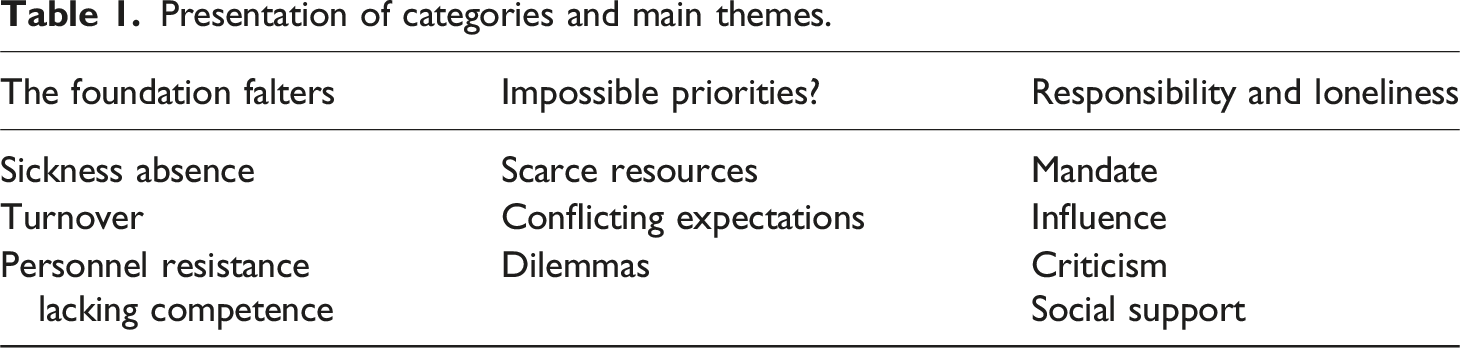
Presentation of categories and main themes.
The foundation falters
The leaders mostly agreed that a stable presence of staff in the office is essential to the deliverance of services, and some of our participants referred to the staff as being “the cornerstone” of the service. The majority of the participants reported, however, extensive challenges related to instability in the staff due to absence from sickness, high turnover, and other work environment challenges. Some of these leaders also experienced periodical inadequacies regarding the provision of essential services and regularly lacked the required overview and control of the service due to a lack of staff resources. In contrast, one-third of the leaders reported very few absences due to sickness and no staff turnover, half of whom nevertheless experienced a degree of instability due to many maternity leaves. A high rate of sickness absence and turnover among the staff were mainly attributed to the extensive pressure on the caseworker role and an emotional strain of feeling inadequate owing to the inability to fulfil their roles as caseworkers. Criticism from the outside was also described as an added burden. Ann, from a medium-sized service, describes the situation as follows: This is all connected as you know, clearly some employees are more resilient than others, this has to do with their family situation also (…), but it is not supposed to be this way. Your job is so demanding that it makes you even more sick. Because I do want to say that the service is so poorly staffed that this work can easily make you sick, the cases are serious and difficult to handle, and when you, in addition to that, continuously feel that you should be doing more and tasks are left undone, and all surrounding criticism
The CWLs talked about different ways of dealing with sick leave and their abilities to shield and tailor the work tasks to the needs of the caseworkers. Some leaders went to great lengths to try to tailor the work for employees, for example, by not assigning new cases or not giving particularly demanding cases to employees who experienced high stress. The extensive need for such tailored work made the leaders’ responsibility to ensure sound services difficult. Mariann, who heads one of the medium-sized services, said this: We are supposed to have an inclusive work policy, so everything has to be tailored to the employees' needs. This has made me pull my hair in frustration, and occasionally I will say give me healthy people, give me healthy people who I can delegate tasks to without having to constantly worry about what my staff are able to handle.
In contrast, a few of the leaders stated that “not everybody is cut out for this kind of work” and instead of attempting to tailor work, initiated talks about changing careers.
Some leaders experienced opposition from employees regarding the development of the service, such as the implementation of new routines or guidelines. This was particularly evident in the small- and medium-sized offices where the leader had gone from being a colleague to become the leader. Several of these leaders described setting aside such work, even if considered necessary, due to concerns that strained relations in the office would damage the work environment. For these leaders, staff represented an important source of social support at work. Mary explained this; I'm not fond of conflicts. I believe I accept things from my staff that I might not consider to be right, (...) There is so much conflict management in the case work that I am reluctant to enter into additional conflicts.
In some of the smaller municipalities, CWLs reported that the CWS often struggles to improve competence among its staff in all essential areas. The reasons they cited were both the low number of employees and a limited number of cases, providing few opportunities to build experience. Several leaders in smaller municipalities wanted intermunicipal cooperating services to achieve a more competent professional environment but described a lack of political will to enter such cooperation. Further absentee challenges and turnover were considered a primary contribution to weakening the service’s overall level of competence. The leaders of the largest service described it this way: If the training and competency building and recruitment continues as it is, with such a large turnover, we can keep going until we turn blue in the face (…). This is our greatest challenge - When the pressure at work becomes too high, those who have the opportunity will apply for less pressurised positions.
Impossible priorities?
The leaders described their everyday work life as busy and characterised by a situation of scarce resources but also as challenging, exciting, rewarding, and educational. “You feel alive in the front line” said one leader. The lack of resources was, however, described as a major challenge that weakens the quality of the service’s work in several areas, as described by Elisabeth, from one of the largest municipalities in the study: The main challenge to high quality in the child welfare service is clearly the services` capacity, resources and capacity (...)
The scarcity of resources led to a situation where the service was not able to carry out its tasks sufficiently well, but rather priorities had to be made where some things inevitably had to be put aside. This situation has consequences for direct service provision but also affects the management and development of the service in other areas. The leaders often find themselves in conflicting situations where priorities must be made. Mona, from one of the larger services, described it this way: The main challenge is time. In addition, for me, a lack of time means a lack of development, because when you find yourself in the throttle of everyday work life and you must prioritise between all the tasks, you have to make choices.
The service’s client-oriented activities are prioritised first and foremost; however, some leaders experienced having to make priorities in such service provision as well, one describing having to assess “which child could wait a month” for an investigation and another putting away cases solely due to the lack of caseworker capacity.
In the small services, the leaders reported that frontline casework required most of the leaders’ time, as they did not see other solutions to be able to handle the caseload. Four participants reported that they regularly conducted frontline casework to contribute “on an equal footing” with the employees, to achieve better control in cases, and/or to rejuvenate caseworkers “who were drowning”. When leaders prioritise frontline casework over their leadership duties, responsibilities such as professional development, systems, and routine development as well as collaboration with other agencies suffer tangible setbacks. To remedy this situation, many leaders brought work home and consequently described the leadership role as a lifestyle. The other half of the leaders, from the larger services, did not carry out frontline casework but drew a sharp distinction between work and private life.
Several of the leaders in this study have “taken over” a CWS with extensive challenges, as Nora described her starting point: (...) we had a 40% absenteeism, spent way too much money and did not adhere to legal requirements. Therefore, we have spent the last few years working hard to get us up to speed, both regarding legal requirements, making people enjoy working here and towards spending the money we are supposed to and not so much more (...). The biggest challenge – when we have had so many – has been to prioritise which ones to deal with first and set something to the side.
“Setting something aside” was a reoccurring topic among the leaders in this study. It is understood as part of the leader’s job to help caseworkers prioritise and take responsibility for the cases that are set aside. Increased government requirements, such as securing the child’s participation and increased documentation requirements without added resources, have contributed to increased pressure on CWS. Linda, from a small municipality, said this: The focus on children's participation, for example, how in the world can we secure this if we do not have time to speak with the child more than once or twice during the investigation period? How is the child supposed to find trust in a stranger from the CWS (…)? Within the resource situation that exists today, it is highly unlikely in my opinion”.
Responsibility and loneliness
The CWLs described a great sense of responsibility and awareness regarding the provision of essential services. At the same time, several participants talked about the limited opportunities they possess to influence conditions that directly affect their ability to provide services. The CWLs generally believe that the CWS’s mandate is too wide and demanding, requiring enormous resources and efforts from bodies outside the child welfare leader’s authority; “The child welfare service can never do this alone,” said one of the leaders. Beth, from a smaller service, said: Our resource situation clearly sets the premise for how much focus you can have, and your capacity to follow your values (…). I truly do not have the resources to handle the cases at all. Obviously - this affects me (...) I feel very much alone in managing this responsibility in my municipality.
A strategy for dealing with the service’s lack of resources, in addition to making priorities internally in the service, is to reach out to the higher administrative and political level in the municipality to inform and try to generate more resources but also to share responsibility and receive social support. Some of the leaders describe experiencing support from their immediate leader as well as a political commitment that makes it easier to assume the role. Other leaders experience a lack of support and/or understanding and experience a long road before giving information leads to an actual change, often due to financial circumstances. Many are calling for clearer political responsibilities.
According to the leaders, insufficient resources and subsequent work pressure are some of the main contributors to poor service quality, not a lack of competence. As such, they do not believe that the authorities’ present competence strategy will solve the challenges in the system. Laila describes the situation as follows: Even when the State implements its competence strategy and the ministry applauds, there are still challenges associated with the service that are not solved (…) it becomes a paradox of sorts, as the challenge, at least in our service, is not necessarily lack of competence, but a lack of employees”.
The government’s lack of understanding of the child welfare service’s staffing needs, also highlighted in the wake of the “Hi Erna campaign” (a campaign by CWW demanding a better working condition and more staff in the field - Rød, 2019). This has been described by several leaders as a disappointment and an expression of the lack of understanding and support from the authorities. Mona puts it this way: I must say that I am very disappointed, I am very disappointed that the CWS is not prioritised by the authorities. If we are to continue with this model without competence requirements and without a norm to say how many cases a caseworker can have and with all these new state requirements (...) I believe we are doomed to fail if we do not get more people.
Considering the national and international public debate and criticism that is regularly promoted in the media, several CWLs call for other responsible institutions such as the state authorities and the courts to “raise their hand” and take co-responsibility. The CWS’s negative reputation worries several of the leaders, where the poor reputation is considered to make the task of fulfilling the CWS’s mandate more difficult. Berit describes her experience like this: I believe the CWLs have substantial powers and very little power at the same time. Many people think that we have unlimited powers – that we can do whatever we want (...), but on the other hand, we often feel powerless and can only witness situations we cannot change.
Discussion
In this study, we examine how CWLs experience their everyday work and the challenges they face in municipal child welfare services. Our use of “a gordian knot” is underpinned in the Greek mythology concerning how Alexander the Great was able to solve a supposedly difficult problem using his sword. We see similarities in how the leaders in the present study navigate their everyday lives as leaders in the CWS. Three main categories with underlying themes were identified: “The foundation falters”, “Impossible priorities?” and “Responsibility and loneliness”. In the following, the study’s findings will be discussed through the lenses of the JD-R model, empirical research, and expectations expressed through legislation and regulations.
A context of constant conflicting pressures
The illustrated situation where the foundation seems to falter, that is, a continuous high level of absence from sickness and turnover, represents a significant burden and stress in the work situation for many leaders. A high absentee rate represents a challenge for the child welfare service in general and has a documented negative effect on the remaining colleagues, the work environment and for the children and the parents who receive services (Baugerud, 2019; Olaniyan et al., 2022a). Among the four services that experienced stable staff, two were large, and two were among the smallest. In the two smaller services, the leader performed a great deal of frontline casework alongside staff. In the two largest services, the leader rarely participated in frontline casework but rather described a systematic approach at both the organisational and individual levels to reduce sick leave. Both approaches may be important factors in contributing to stable staff. One could be the value of the leader working on an “equal footing”, contributing to unity and fellowship, which promotes personnel stability in the service; the other may be that “freed” resources (in that the leader does not work with case processing) are used for targeted personnel work that increases stability and presence at work. However, in this context, stable and present staff represent an important job resource for these four leaders (Bakker and Demerouti, 2007).
Another prevailing job demand in this study is that the leaders consistently and, regardless of the size of the service or stability of staff, all report lacking time, resources, and the capacity to sufficiently solve the tasks at hand. This leads to constant time pressure, an excessive workload and conflicting demands and expectations, which forces the leader to prioritise. Similar findings have been described in other studies (e.g., Gotvassli and Moe, 2016; Olsvik and Saus, 2019, 2020). Looking back to the Directorate`s description of requirements and expectations for operational leadership in the CWS, most of the leaders mainly prioritise two of the six areas of leadership, namely, organising and provision of services and personnel. Bufdir does not leave it to the leaders to choose which of the six leadership areas to prioritise, yet this is the reality as it is described by the leaders. Nor does The Child Welfare Act’s intend for priorities to be made, such as “which children can wait a month for an investigation”. Having to take responsibility for making priorities in a situation where all the tasks are presumably of equal importance and legally binding entails an emotional burden for several of the leaders. Other leaders convey that this represents normalcy; “it comes with the job”, implying that they cannot let themselves be emotionally affected by not getting everything done. In addition to being a practical necessity, such priorities can also be understood as a compensatory strategy (Bakker and Demerouti, 2007; Olaniyan et al., 2022b). Such strategies are associated with compensatory costs for the individual, such as limitation of attention, increased selectivity, and redefinition of requirements (Bakker and Demerouti, 2007). These phenomena are made visible in what several of the CWLs describe and seem to be strategies that prevent stress. Similar findings have been described by Olsvik and Saus, 2020. Astvik and Melin (2013: Pages 352, 254) find that social workers mostly use what they describe as a “compensatory and quality-reducing strategy”, meaning that they work more, eliminate taking breaks, take work home with them and think of work when they have free time. At the same time, they lower the quality standards and ask the leader for help in prioritising.
Manoeuvring autonomy and the leadership role
Autonomy is one of the most important job resources associated with an increased ability to handle stressful work situations (Bakker and Demerouti, 2007; Karasek, 1979). While CWLs are given autonomy to solve the tasks that arise in the service, in reality, autonomy appears limited by several factors, such as the legal framework, restricted resources, unpredictable caseloads and the extensive area of responsibility, expectations and requirements. The leaders in the larger services in this study seem to experience greater autonomy, potentially due to the flexibility of having more staff, but this can also be linked to relational factors where role clarity appears to be a factor. These leaders avoid participation in frontline casework and, thus, have a clearer leadership role; furthermore, they appear to “take the job home” to a lesser extent, which represents a better work-life balance.
For leaders who, to a large extent, participate in frontline casework, an unclear leadership role seems to exist. Such participation can both be caused by—and could contribute to—role ambiguity and role conflict, factors that can lead to increased stress. Kvello and Moe (2014) have previously found that CWL risks become too case-oriented at the expense of other management areas. Olsvik and Saus (2019) further find that collective exercise of discretion can make it difficult to develop a clear leadership role. These leaders also describe a work-home imbalance where they work a significant number of hours above the norm. The leaders in the larger services seem to experience a more balanced work situation compared with their colleagues in the smaller services, whereas the latter group seems to be at risk for role overload.
Support: A double-edged sword
Karasek and Theorell (1990) describe the term “workplace support” as the sum of available support for an employee from a leader or colleagues. Social support is one of the important factors that can act as a buffer against stress resulting from job requirements (Bakker and Demerouti, 2007). Particularly in the child welfare field, colleagues and/or managerial support in the workplace have been found to act as an effective cushion for the burdens that the child welfare service’s work entails (Olaniyan et al., 2020).
In this study, the extent to which a leader experiences social support in the workplace seems arbitrary. Some experience receiving support from a municipal superior as a positive and important resource. These underscore the importance of being able to provide clear and honest information about the service challenges they experience, with the aim of sharing responsibility and preventing criticism of their person. A few leaders find that such information also contributes to temporary instrumental support, such as extra resources. Others find themselves in a situation where social support from a superior is not readily available and where colleagues, meaning employees in the service, represent the main source of social support for the leader. These leaders seem to experience a dilemma where they risk losing social support by implementing demands, decisions and changes in the organisation that meet resistance from employees. This dilemma seems to affect the extent to which some of the leaders implement necessary changes and/or development activities in the service. For other leaders, experience and/or personal characteristics seem to prevent role ambiguity and dilemmas at the intersection of management and social support. In general, our findings are in line with findings from recent studies within the field of CWS (McFadden et al., 2015; Olaniyan et al., 2020; Tham and Strömberg, 2020).
Experiencing meaningfulness in the job is regarded as an important resource that strongly influences motivation. All leaders in this study stated the feeling that their jobs were meaningful; however, they also expressed feeling left alone in attempting to uphold and defend their work in the wake of continuous criticism of the child welfare service in the public debate. Being subject to such constant criticism in combination with a perceived lack of overall superior support can risk the motivating effect the leaders experience in their job (Tham and Strömberg, 2020).
Methodological reflection and limitations of the study
This study provides increased insight into how Norwegian CWLs experience their own work situation and provides insight into factors that, in the absence of added resources, can contribute to strengthening the service by promoting a more balanced work situation for leaders.
High awareness of preconceptions is important in the interpretation process (Malterud, 2001) and has been a continuous focus in this study, as two of the authors have extensive experience from child welfare and leadership work, and as such, this is the starting point of our preconception. Researching in one’s own field can be beneficial for understanding; at the same time, it requires that the analytical interpretations of the data be carried out in a reflexive and critical way (Shenton, 2004). This was further ensured by the involvement of coauthors. A broader examination of several factors that affect the leaders’ situations would have given a more comprehensive picture of the situation, for example, personal characteristics, objective facts about the service and the employees’ perspectives.
Implications for policy, practice, leadership development, social work education, and future studies
Firstly, our study is one of the first to delve into the workplace experiences of CWL in Norway. For this reason alone, our study shed lights on the everyday work experiences of these leaders and their perception of the challenges in the system. Secondly, giving the complexities that is often found among frontline workers within the CWS, our study shows similar experiences even among the leaders. Thirdly, our findings point to the importance of initiating policies to safeguard the well-being of these leaders and facilitate exercising good leadership. The is even more vital especially since research has linked the well-being of leaders to that of their subordinates. Fifthly, our findings also showed why more attention should be paid to the inclusion of leadership in the curricula of social work educational institutions. Lastly, owing to the nature of leadership within the CWS in Norway (usually comprising of main communal leader, followed by middle manager, and then the floor-level manager), future studies should endeavour to investigate the relationship between these leaders and how these affects service provision and workers well-being.
Conclusion
It seems in this study that the child welfare leaders’ working day is characterised by an imbalance between job demands and available resources, but to somewhat differing degrees.
The extent of the imbalance seems to be related to the size of the service, but other factors, such as personal characteristics, may also affect this balance. None of the leaders in this study experienced adequate resources to meet the expectations and demands of the job, nor do they feel understood by the authorities when policies are made. For one-third of the CWLs in this study, there seems to be such a large imbalance between perceived resources and work demands that the work situation represents a role overload that can lead to exhaustion.
In conclusion, we would like to point out the apparent discrepancy between the authorities list of demands directed at the CWLs, on the one hand, and the absence of securing an equally comprehensive system regarding the leader’s job resource situation on the other. CWLs seem to be largely left to themselves in the everyday work life of the municipality where they work; given the municipality’s preconditions, where they, to the best of their ability, try to solve what appears to be a Gordian knot.
Footnotes
Declaration of conflicting interests
The author(s) declared no potential conflicts of interest with respect to the research, authorship, and/or publication of this article.
Funding
The author(s) received no financial support for the research, authorship, and/or publication of this article.
