




Abstract
This paper discusses the development and utility of the Ara Wairua data analysis tool. The term Ara Wairua means ‘spiritual pathway’ in the Māori language. Ara Wairua symbolises the existential journey researchers take when exploring the essence of participants insights and the richness of their voices. The intention was to develop a data analysis tool to help explore the experiences of Māori healers and social workers, and how these individuals understand traditional healing knowledge in social work. The various analytical stages integrate important qualitative techniques such as the practice of observation, coding and creating themes however these aspects have been adapted to align with four states of human consciousness from a Māori spiritual perspective. Each stage guides researchers through a rigorous and intuitive process to elicit key kaupapa (themes) contained within participants’ stories. The Ara Wairua analysis tool is underpinned by pūrākau (narrative) methodology which is an ancestral story telling framework used by researchers to capture the richness of individuals experiences. The Ara Wairua initiates the praxis of pūrākau methodology by engaging the researcher in a cyclic motion of thinking, being and doing as they move through the research journey. This feature of the Ara Wairua tool further engages researchers in processes of reflexivity and reflection, both of which are critical skills when doing research with Indigenous Peoples.
Introduction
As Indigenous researchers, we must be able to do research our way. In the Māori world, this is particularly so, because research with Indigenous communities must consider the mediation of space between the researcher and what is being researched; why the research is being done and who is going to benefit from it. Graham Smith (1999, p. 2) suggests “Māori people have had to be convinced that research can have positive, pragmatic and innovative outcomes, that research can be useful and sympathetic and, that not only can Māori be partners in research, but Māori can also carry out research ourselves”. This particular view is a strength and a weakness of this study thus it will be explained more in this paper. I, Dr Levi Arana Fox developed the Ara Wairua analysis tool for my PhD to help me explore a slice of life from the experiences of my participants. It was important to embed spirituality within my analysis tool because social work practitioners are often ashamed to work from a spiritual perspective with some individuals believing that it is not evidence-based practice but furthermore, there is very little research on intuition within social work (Hodgson and Watts, 2017). In addition, even less is known about intuitive inquiry and the utility of wairua (eternal spirit) in research processes (Fox, 2024). To that end, I created the Ara Wairua analysis model to help address this gap in knowledge, but I also wanted to produce a pragmatic tool as part of our ongoing commitment to decolonising research (Fox, 2024; Smith, 2012). The Ara Wairua tool was therefore important for connecting with the legitimacy of Māori spiritual knowledge and embedding aspects of our traditional healing ways within research and the various stages of data analysis.
My doctoral study explored the experiences of 16 traditional Māori healers and social workers to address gaps within the literature whereby little is known about the development of Māori healing knowledge and spiritual concepts in social work (Fox, 2024). The primary question guiding the research was – “What is the role of traditional Māori healing in social work?”. In terms of the recruitment criteria, non-Māori participants were excluded because the research sought to explore the realities of individuals with whakapapa (ancestral connections). Whakapapa is a construct of our collective realities, and a metaphysical framework constructed to place oneself within the world (Te Rito, 2007). Along with having whakapapa, social work participants were required to have a formal social work qualification and to also have experience in the helping professions, whereas traditional healers did not require formal qualifications because having Western credentials was not a requirement of traditional practitioners in healthcare settings at the time of my research being undertaken.
One of the key functions of the Ara Wairua tool is to generate new insights by exploring kaupapa and applying pūrākau methodology in a cyclic manner to assist with the transmission of tribal knowledge (Fox, 2024). The pūrākau methodology ensured there was an authentic theoretical foundation for carrying out my study and that the methods were underpinned by Māori worldviews and the notion of storytelling (Lee-Morgan, 2019). As such, implicit bias was a deliberate part of the analytical process because my perceptions of the world and relationships with others have been guided by whakapapa knowledge. From a social work practice and research perspective, whakapapa knowledge is critical because it contains potential repositories for healing and grief resolution (Fox, 2024). Thus, as a ‘pracademic’ (social work practitioner and academic), it was my intention to ensure that whakapapa and wairua knowledge have been embedded in the Ara Wairua tool because these are the inexplicable features of my own worldview which I bring to my daily practice and research.
The research itself is grounded in Kaupapa Māori Theory to encourage wise ways of knowing and the development unique knowledge (Smith, 2012). Although some Indigenous analysis models lack a detailed sequence of steps grounded in worldview, one of the exceptions is Kaupapa Māori research analysis which moves through stages of noho puku (self-reflection), whanaungatanga (connection), and kaitiakitanga (guardianship) (Elder and Kirsten, 2015). Similarly, the Ara Wairua tool contributes to Kaupapa Māori research by way of validating Indigenous research methods (doing) and allowing a genuine connection with participants’ axiology and values. As Royal (2012) suggested, Indigenous-to-Indigenous exchanges of information ensure that our kōrero (conversations) remain intact and authentic. In addition, affirming the Indigenous voice in research, combats cultural dissonance and protects knowledge by reframing a critical gaze of traditional knowing (Fox, 2024). This sentiment resonates with the Kaupapa Māori Theory principle known as kia tūpato which is about being cautious of what we bring to the research environment (Cram and Adcock, 2022). From a culturally nuanced point of view, what this means is that researchers must be ethically and spiritually responsive to the needs of Indigenous participants when engaging in research. Therefore, the Ara Wairua analysis tool is a purpose-built model to help harness wairua and actualise spiritual knowledge in a research context. The meaning of wairua and intuition in research and its limitations will be discussed later in this paper.
Māori epistemology and storytelling methodology
Research with Indigenous Peoples is grounded in worldviews, cultural axiology, and ontology (Lee-Morgan, 2019; Smith, 2012). Developing and utilising the Ara Wairua analysis tool for research with our communities, reinforces these aspects in two very distinct ways. First, is the pūrākau approach which allows researchers to explore participants’ lived experiences, and second is the way in which the Ara Wairua tool helps researchers investigate those pūrākau (Fox, 2024). Storytelling approaches are not new in research, in fact, the notion of pūrākau has been shared for many years and can also be found among other Indigenous communities such as the notion of yarning in First Nations Australian cultures. Emerson (2014, p. 58) further speaks to this sentiment stating that Indigenous methodologies are “…new ways of knowing and being that are so old they look new”. In my doctoral research, the stories of 16 participants were an expression of their identity and ways of being. As Lee-Morgan (2019) suggested, pūrākau are fundamental for receiving knowledge because each narrative allows individuals to reconnect with their tribal stories passed down through many generations.
There are different ways in which pūrākau can be put into context, for example, pūrākau refers to Māori creation stories as well as the narratives of research participants (Lee-Morgan, 2019). Pūrākau are also part of the oral traditions such as pakiwaitara (mythology), kōrero tāwhito (ancient stories) and kōrero ō nehe rā (stories from the beginning of time). There are also many ways in which pūrākau are communicated within the contemporary world, for example, through traditional carving, weaving and oral speech making. As Lee-Morgan (2019) suggests, pūrākau contain philosophical thought and worldviews. My doctoral research encouraged participants to share narratives about their healing traditions, the genesis of their knowledge, and the practice wisdom they have developed over a lifetime (Fox, 2024). The stories shared by participants in this particular study emerged from their inherent worldviews and epistemology, thus have been theoretically framed as the teachings from kaumātua (elders). Examples of pūrākau from the study will be used in this paper to demonstrate the workings of the Ara Wairua tool and how this model provides an empirical basis for analysing data.
Developing the Ara Wairua tool
Establishing an Indigenous tool for research based on Māori concepts draws on elements of whakapapa and wairua. These aspects are an important part of Kaupapa Māori Theory, which for Linda Tuhiwai Smith (1999, p. 191), “weaves in and out of Māori beliefs and Western ways of knowing, Māori histories, Western forms of education, as well as Māori dreams and socio-economic needs”. Utilising the Ara Wairua tool similarly ensured that our beliefs and tribal histories have been embedded in the research process because Māori oral traditions are a repository of philosophical thinking and personal experiences (Lee-Morgan, 2019). In terms of weaving Western ways of knowing, the Ara Wairua tool draws on aspects of qualitative research techniques such as thematic analysis, coding, developing themes, subthemes and observational practices (Azungah, 2018). The caveat, however, is that integrating qualitative methodologies with Indigenous ways of doing research needed to be done with great caution though because we cannot simply slot Māori epistemology with Western perspectives (Denzin and Lincoln, 1996; Smith, 2012). Therefore, it was important to have a clear goal for my analysis tool whereby each stage of the Ara Wairua is informed by Kaupapa Māori theory along with aspects of Western research methods.
Another part of the tool’s development was with the weaving of a korowai (cloak). A korowai symbolises protection and is often gifted down as a treasure. The relevance of weaving a korowai was to illustrate that pūrākau can also be transmitted through the arts such weaving and carving (Fox, 2024). Along with the metaphorical weaving of a korowai, it was also important to develop an understanding of wairua in the context of who we are as spiritual beings. Indigenous Peoples have a definitive relationship with spirituality as seen at a very complex intersection of people, place, and ecological relationships with the land, the broader environment and whakapapa (Niania et al., 2016). Developing the Ara Wairua tool required an internal process, not only to establish a model for analysing data but also because spirituality is part of our ontological positioning when making sense of intangible phenomena. The late spiritual leader and Māori educator Dr Rangimārie Te Turuki Arikirangi Rose Pere stated that “every act, natural phenomena, and other influences are considered to have both physical and spiritual implications” (Pere, 1982: p. 12). As social workers, it is vital that practitioners engage with their own understandings of spirituality and how this knowledge interacts with their practices (Fox, 2024). The same can be said for research in the sense that wairua is embedded into the analysis of data because making meaning and connecting with intuitive knowledge is also part of our spiritual basis to humanity and the broader environment.
Some may ask why not just use an existing analytical tool for research? The answer is because my particular study needed to draw on principles and ideas which were unique yet familiar to participants hence the focus was on Māori perspectives of the human mind to conceptualise the stages of data analysis (Fox, 2024). The internalisation of data to create mental schemas from a Māori healing perspective, also has some alignment with aspects of Western heuristic models whereby one must develop a better understanding of themselves in a certain setting, such as ecological approaches to understanding human cognition (Fossey et al., 2002). The Ara Wairua tool similarly uses various mental schemas such as whatumana (intuitive knowing) and kare-pū-toro (neutrality) to understand the stages of research analysis. As Linda Tuhiwai Smith (2012) suggests, Indigenous research methods are located in a cultural framework and are lived by real people every day. My participants are living and breathing whakapapa, therefore, establishing the Ara Wairua tool connected us to our collective culture, language, and inherent knowledge systems. The next section will highlight the workings of my analysis tool.
Demonstrating the Ara Wairua analysis process
This section outlines how the Ara Wairua data analysis tool has been applied to the research study. Figure 1 below illustrates the various analytical stages of the tool including the tāniko (embroidered pattern) of the korowai design comprising of red, black, and white silk threads. These colours contain creative outputs for example, red symbolises the power to overcome various tensions, white is a reference to purity which aligns with the new knowledge, and black represents the void where potential is stored (Fox, 2024). A diagram is a cohesive visual representation of the relationships between concepts. For many researchers, diagrams are integral to the analytic process, for example, matrix making, concept charting, and flow charting (Lofland et al., 2022). However, my vision for the Ara Wairua tool was to illustrate various ngā ara (pathways) moving in a stairway formation alongside the essence of Māori imagery as per the tāniko design. This stairway pattern is a pivotal point here because this particular design, also known as poutama (stairway to heaven), is symbolic of the way in which I was able to traverse up and down the analytical process from one stage to stage to the next. There are four stages prescriptive to Māori concepts of healing and the hinengaro (human mind). Each stage contains mātauranga (epistemology) from the baskets of healing knowledge including kare-pū-toro (stage one), whatumanawa (stage two), kare-ā-roto (stage three) and tihei mauri ora (stage four). Each phase is explained in this discussion and applied to examples of pūrākau from my PhD thesis to demonstrate the workings of the Ara Wairua tool. Diagram of the Ara Wairua data analysis tool.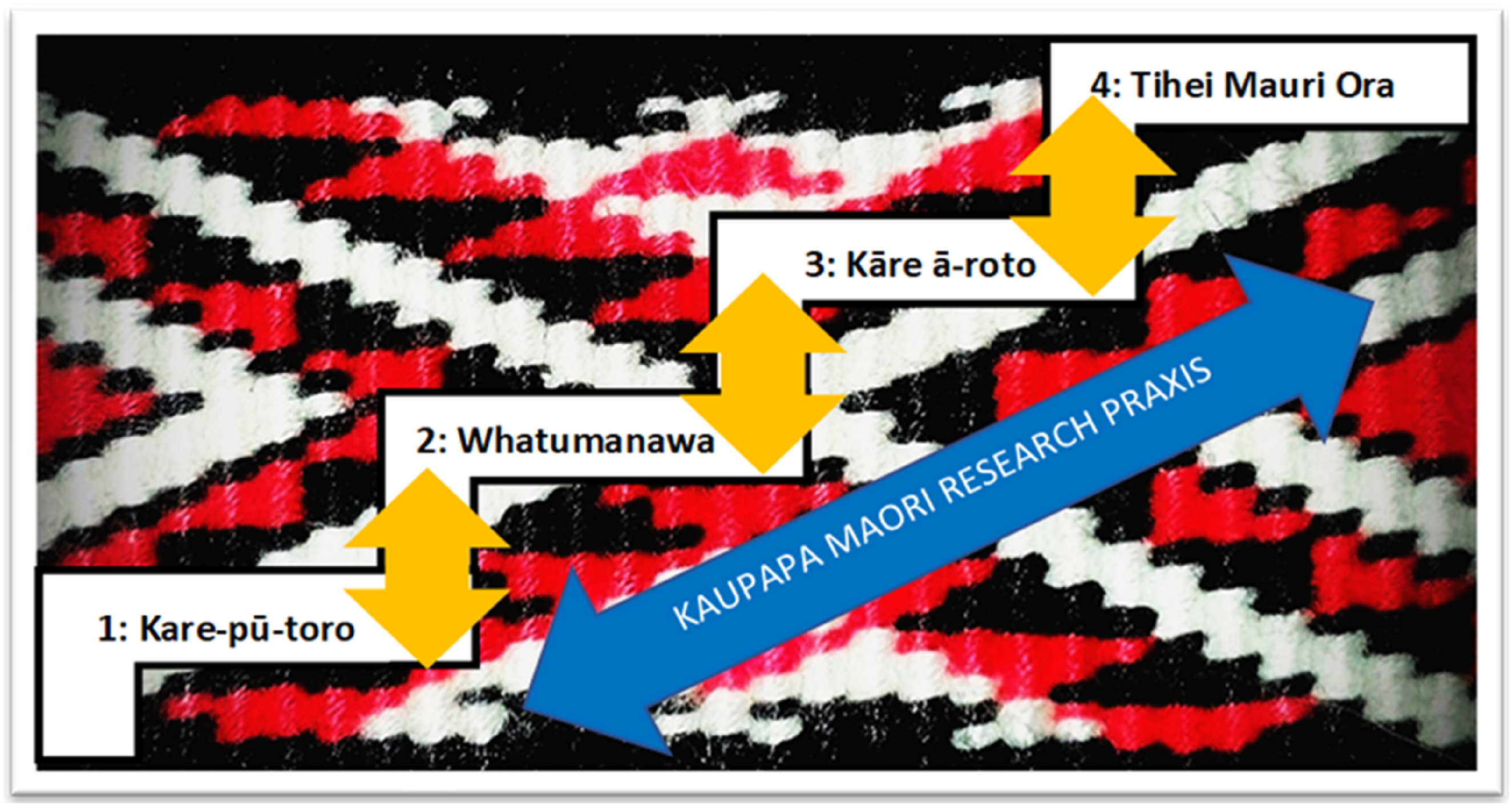
Stage 1: Kare-pū-toro
Kare-pū-toro (stage one) involves analysing manifested content such as the visual and audio data. In this stage, the goal is to get a sense of what the participants are feeling in terms of their wairua through the practice of observation in research. To contextualise, Kare-pū-toro can be described as the purest thought which comes to mind (Fox, 2024). The late traditional Māori healer, Hohepa Delamere suggested that Kare-pū-toro is a place of zero energy and absolute silence of the mind, whereby healers enter a state of neutrality (O′ Connor, 2007). Similarly, I was able to sit in a neutral space with participants in their whare (home) or marae (traditional meeting places) to carry out the interviews. Azungah (2018) claimed that observation is part of analytical processes in terms of latent content which emphasises a focus on everything that happened during the interviews including participants who are silent a lot, subtle signs in their facial expressions or changes in their body posture. In addition, the practice of sensemaking has been described as “…the ongoing retrospective development of plausible images that rationalize what people are doing (Weick, 2001: p. 460). To that end, the notion of Kare-pū-toro allowed me to seek out the mysteriousness of participants experiences and to get an understanding of what participants were doing during the interviews. The following extract is part of a pūrākau from research participant Weherua, followed by an explanation of my observations to demonstrate the workings of stage one.
Weherua
“There is a whakapapa (ancestral connections) on mental health. Hinetangikuhaaua and Hinengaro are the twin sisters of the mind, so there is the relationship with Tāne te whiwhia and back to the jewels of knowledge. There are two aspects to Whirikoka - the good which is where the knowledge comes from and the bad which is where Whirikoka comes in. So, with Tāne marrying the conscious and sub conscious minds you see the relationships of illness in that name Hinetangikuhaaua are psychosis and suicide. If we trace illness to this particular Atua, then we can focus on the treatment…” (Fox, p. 109).
One of the key observations in this example, relates to how Weherua connected with the story of Tāne te whiwhia and the sisters of the mind. I noted themes such as the flow of te reo Māori (the Māori language) while he was talking about Hinetangikuhaaua and the sadness when talking about suicide. Weherua stood up with a glow when talking about how we should focus on Atua (deities) to inform treatment, which I interpreted as being something he is passionate about. Reviewing these aspects of the data helped me to get a holistic understanding of the pūrākau (Fox, 2024). I kept a journal of these observations and made links to these physical manifestations of storytelling as my analysis continued. The practice of observation, especially in social work, involves shifting between analytical an intuitive rationality (Avby, 2015) and is enacted through social storytelling (Cook and Gregory, 2020). In summary, kare-pū-toro involves analysing raw research data and making sense of wairua through the initial observation of physical content and participants’ emotional attachment to their pūrākau. The next stage progressively shifts to the interpretation of each pūrākau.
Stage 2: Whatumanawa
Whatumanawa (stage two) analyses the key messages and kaupapa contained within each pūrākau. By this stage, the latent content and raw data should have been reviewed ahead of the next task which is to examine the individual transcripts. To give more context, the whatumanawa (intuitive knowing) is where our spiritual revelations emanate. O′Connor (2007, p. 145) suggested that “Making sense through the whatumanawa internalises the healer’s role in the production of truth as opposed to setting the healers in an oral dialogue with the patient”. Whatumanawa in relation to the Ara Wairua tool, requires researchers to use their intuition to interpret key kaupapa contained within each pūrākau. Although intuition plays an important role in information processing, not everyone can use intuition as part of analytical stage, because not everyone develops intuition as part of their practice (Gigerenzer, 2015). In addition, “intuitive thinking is a holistic perspective that takes into account all types of information that often cannot be easily articulated explicitly” (Pretz, 2008: p. 555). However, the Ara Wairua tool encourages us to apply intuition because when the whatumanawa is open, that is when we experience an awakening where everything is not logical but is limitless (O′Connor, 2007). To that end, I wanted to ensure that my interpretation of the data emanated from my whatumanawa. The following sections will demonstrate how I was able to engage with stage two by first highlighting the raw data [part of the pūrākau] and then describing the development of each theme. In the first excerpt from participant, Reremoana, she shares knowledge about suicide and in the second excerpt, Bonnie shares her perspective on aroha (love) which she suggests is the life force within us.
Reremoana
“Think about what is in your DNA. Whakamomori (suicide) has a whakapapa. The wai kahu is the embryo sac and stores water memories. The journey of the releasing of the egg into the uterus, is a streamline into the uterus from Io (God). They would then wash the baby and send them off with karakia, to ensure that the baby belonged in Te Ao Māori. He will always remember where he belongs…” (Fox, 2024: p. 108).
Bonnie
“Wairua is a knowing and a feeling, and you cannot measure that. I guess the emotion that we can link it to, is aroha. It is the divine breath of the Creator within us. The fire and the mauri that is your life force, and it cannot be measured in any way. We are spiritual beings but where the imbalance occurs, is when the Ira tangata (human side) and Ira Atua (divine side), are not in sync with each other. One aspect is absent and when we push the wairua away or deny its existence, sometimes it’s the need to acknowledge it is there when things go haywire…” (Fox, 2024: p. 111).
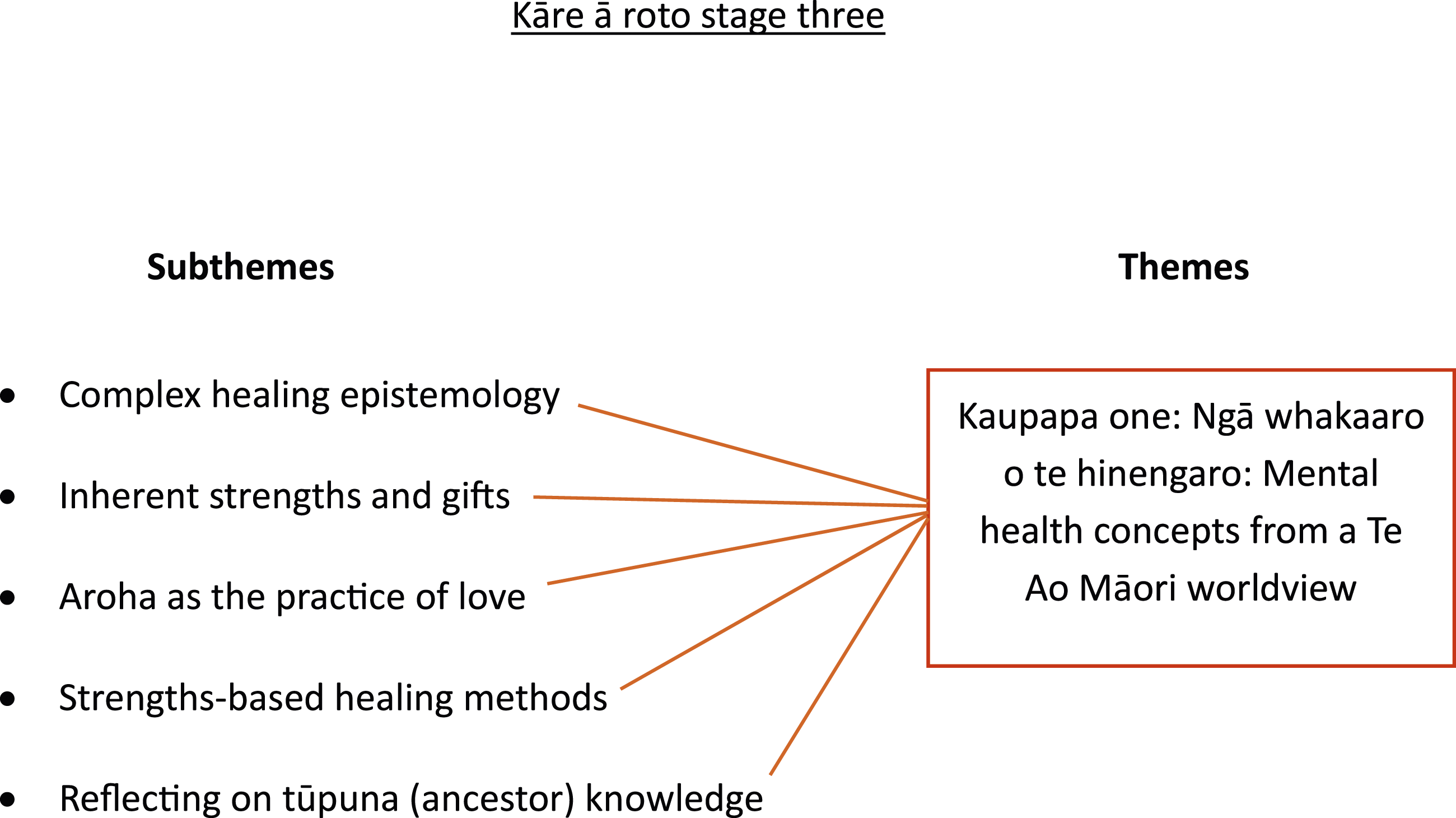
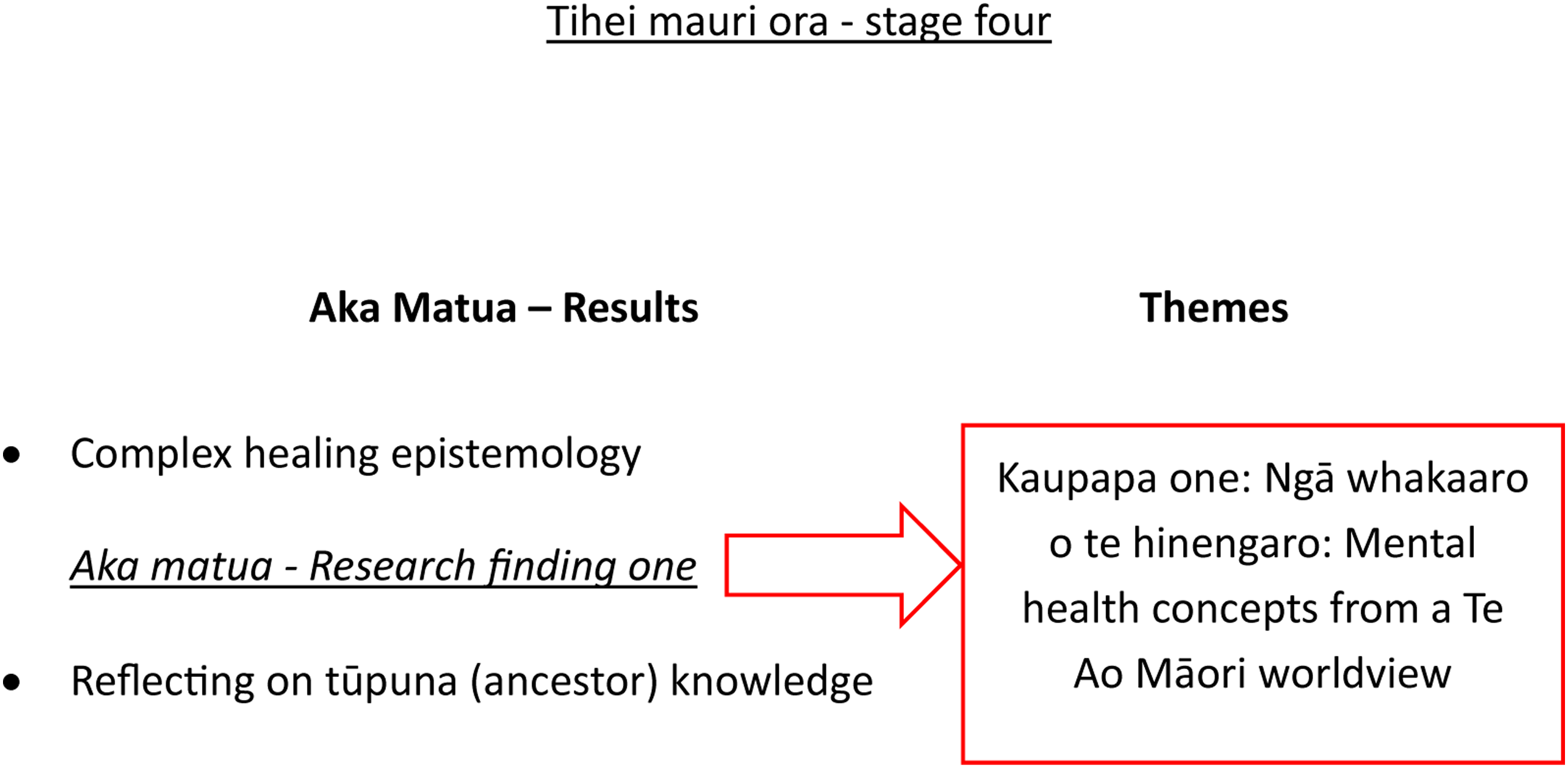
At this point, the researcher should be developing open codes and themes in relation to their research question. Some individuals might use terms such as sub-themes, themes and main themes in place of sub-categories, categories and main categories (Azungah, 2018). I used the philosophy of whatumanawa to describe these categories and effectively complement Western research ideas to create a richer understanding of what I was interpreting in the dataset. However, this was done with great caution because there are opposing theoretical views on the balance between rational and intuitive styles which can make research quite difficult to measure and standout as evidence-based (Hodgkinson and Healey, 2008). The whatumanawa aspect, in terms of how this categorisation was operationalised, is very much in line with heuristics approaches and strategies which limit the search for certain information however can be relied on both consciously and intuitively (Sicora et al., 2021). My interpretation of the data occurred in much the same way by connecting the kaupapa that were organically emerging then categorising them along with their open codes as per below.(Figures 2–4) Diagram of Whatumanawa - stage two. Diagram of kāre ā roto - stage three. Diagram of tihei mauri ora - stage four.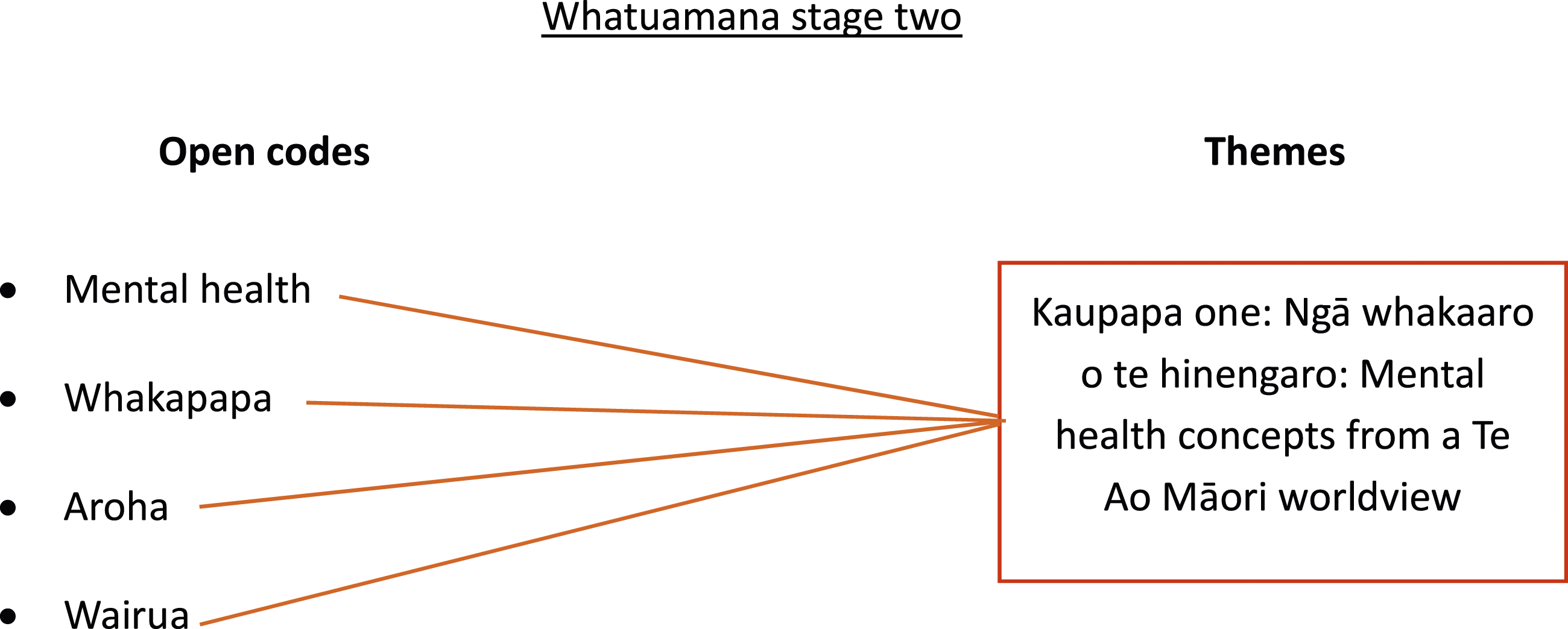
The whatumanawa stage connects researchers with participants’ pūrākau and encourages us to think at deeper level to not only interpret and understand what is being said, but to begin an important stage in research which is data reduction (Azungah, 2018). Data reduction is the way in which researchers structure the data and create layers for making sense of participants’ stories. It can be quite time consuming, but it was necessary to stay engaged with the wairua of the narratives. Hence, my reluctance to use computer software programs such as NVivo for completing data analysis, which would artificially remove me from this entire experience. I will discuss the strengths and weaknesses of the tool in a later section of this paper. It is crucial to note here that self-location within the data, as an Indigenous Māori person, validates the importance of my own subjective worldviews and spiritual perspectives in the research process (Fox, 2024). The Ara Wairua analysis tool therefore ensures the authenticity of this connection, worldviews and ontological perspectives across each stage of analysis. Once the whatumanawa stage is completed and the kaupapa have been established, the next phase is to build on those themes and determine further insights from the pūrākau.
Stage 3: Kāre ā roto
Kāre ā roto (stage three) progressively shifts into deeper analysis of the themes, with the end result being the development of subthemes from each category. The term kāre ā roto is a reference to inner emotions. Stage two has described the essence of whatumanawa as being a condition of the spiritual heart and intuition, but kāre ā roto is focused on the hinengaro (human mind). Takirirangi Smith (2008) spoke about the ngākau (heart) as being a whare tīpuna (an ancestral meeting house). However, he goes on to say that the porch area of an ancestral meeting house is often referred to as the roro (brain) and whakaaro (perception), which I interpret as being a thought process which occurs within the heart space. Kāre ā roto is therefore another layer of the Ara Wairua tool because its primary function is to critique, expand and theorise what is happening within the data (Fox, 2024). This is an important step because losing connection to the actual context during the analytical process, can lead the analysis in the wrong direction, meaning the researcher will subjectively interpret the data, and it will no longer represent what was actually said (Azungah, 2018; Lofland et al., 2022). Thus, adding an additional layer to the Ara Wairua tool ensures a true representation of the pūrākau. The following section will now highlight the placement of pūrākau and discussions emerging from the researchers’ analysis and interpretation of the data.
Subtheme 1: complex healing epistemology
[Raw data] Turumākina
“…I think the psyche is a very complex and vast space. There can be many voices going on inside our heads. Jungian psychology refers to these 12 archetypes [The Innocent, Everyman, Hero, Outlaw, Explorer, Creator, Ruler, Magician, Lover, Caregiver, Jester, and Sage]. Each one represents a particular space in the mind such as the Forest. It can be a wild place with dangers and beasts; it can also be a place to reconnect with nature…and so on…You know, for me this helps manage the dialogue in my own head. You can control your thoughts in that way. In Māori culture, our Atua (deities) are relatable. We had 72 Atua and each one links to an archetype. So, you need to see beyond just pathological lenses. A lot of the time, we help clients find their archetype. I sow the seeds for them, they will reconstruct their story…” (Fox 2024: pp. 111-112)
[Memo] The notion of archetypes described by Turumākina adds another concept to kaupapa one in that psychological distress relates to specific archetypes relatable to Māori deities such as Io (God). Our inherent connection with Io informs the structure of our community and guides its spiritual organisation. The archetypes which Turumākina speaks about are the intersection between the human and the divine. Spiritual authority is recognised as both the seen and unseen aspects of the supernatural realms (Fox, 2024).
The example above highlights the placement of pūrākau and my interpretation of the data. Managing the data followed the same procedure as above, however, it was important to scribe my interpretation of the subthemes only when I had an adequate understanding of the stories and what is being conveyed. Kyngäs (2020) further suggested that in order to sustain a good connection with the raw data and the open codes, researchers can sometimes add memos and notes to help when they return to their collation of data and documented subthemes.
As demonstrated here, stage three extrapolates the key subthemes from each overarching kaupapa and expands on each category to demonstrate the researcher’s understanding of the pūrākau. In many research projects, using codes and memos are part of the researcher’s tool kit to help us get from topics and questions to analysis (Lofland et al., 2022). Not all researchers follow these techniques exactly, but while many do, the strategies used here are not the only possible ways to analyse data (Kyngäs, 2020). The Ara Wairua stages use basic principles of coding to label, separate, compile, summarize, and sort observations made of the data (Azungah, 2018). The point of difference here is that the Ara Wairua tool has offered another way to process the data using Māori knowledge along with wairua to provide a theoretical basis for using intuition as part of the process. The critical link between collecting the pūrākau and conceptual framing of Māori worldviews, is fundamental for accurate coding and therefore an important feature of data analysis (Fox, 2024). To conclude this section, kāre ā roto (stage three) helps researchers traverse into a deeper analysis of the themes with the end result being the development of subthemes from each category. The final stage of the Ara Wairua tool is to synthesise and integrate the memos with an anthology of literature.
Stage 4: Tihei mauri ora
Tihei mauri ora (stage four) is where the researcher integrates the memos with literature to discuss the research findings. This final stage is called tihei mauri ora which for Māori means the infinite breath of life. It was fitting to frame this part of the Ara Wairua analytical process in terms of the tihei mauri ora expression because our stories and pūrākau are timeless and limitless (Lee-Morgan, 2019). Qualitative research findings are generally presented as textual descriptions which should illuminate subjective meanings of the phenomena being studied but also position the results in context (Fossey et al., 2002). But the question is, what is the relevance of integrating the memos with literature, and is this really part of the data analysis process? According to Denzin and Lincoln (1996) it is becuase the development of a description of the findings, contextualises the data as a whole where the researcher’s interpretation of the findings are embedded. It is the final stage of transforming the data into a written description of the findings and the kinds of interpretations made from them (Fox, 2024). By this point, the researcher should have compiled their subthemes and memos and the connections between the findings and the data, should therefore be comprehensible to the reader. This next section will now highlight the workings of stage four by taking a paragraph from my doctoral thesis as an example and a diagram of the tihei mauri ora stage.
“Aka Matua (1) further highlighted specific examples of how participants actualise their worldviews in response to culturally appropriate practice. A good example of this responsivity is observed in the excerpts of Hārata and Rāniera who both identified the problem with spiritual misdiagnoses and hearing voices, and the omission of matakite (intuitive) experiences from social work reports. These concerns were similarly raised in other studies which showed clear anecdotal evidence that Māori communities want better access to appropriate cultural and spiritual resources. Mark and Lyons (2014) identified how doctors were unwilling to collaborate or accept rongoā (medicine), while arguing that context and interpretation of spiritual experiences was equally as important as their structure and content. Thus, Aka Matua (1) provides substantial evidence from 16 participants’ who articulate differential wairua experiences among a spectrum of clinical symptoms and epistemological views of cultural healing to help embolden our understandings of client’s strengths and gifts”. (Fox, 2024: p. 157)
This section demonstrates the integration of my memos, a critique of available literature to contextualise the information, and a sentence to summarise the findings contained within that particular kaupapa. This is quite a vital feature in qualitative research because the researchers’ description and interpretation, helps the reader to evaluate the authenticity of claims regarding the data (Fossey et al., 2002). This authenticity is also shown by way of direct quotes and further enhanced by evidence that participants’ voices were kept intact. Indeed, the reader might interpret the pūrākau to mean something else, but throughout this entire process, my role as a researcher was to inform the research question – What is the role of traditional Māori healing knowledge in social work?
As Fossey et al. (2002) point out, reflexive reporting helps distinguish participants’ voices from that of the researcher while enhancing the permeability of the researcher’s role. To that end, the Ara Wairua tool helped me to keep focus on the research question by weaving the pūrākau together with what we already in the scholarship, but to also legitimise pūrākau as being as infinite process of analysis. However, researchers must also be mindful not to generalise participants experiences and worldviews (Denzin and Lincoln, 1996). Thus, my intention was to make no claim of generalisability, but to apply an adequate description of the kaupapa and findings, so that the reader can evaluate its applicability in another setting. Tihei mauri ora and stage four of the Ara Wairua analysis tool ends once the writer has formulated the results section of their report. To conclude this section, tihei mauri ora (stage four) is where the researcher integrates the memos with literature to discuss the research findings.
Strengths and limitations of the Ara wairua tool
There are some strengths and weaknesses when it comes to operationalising the Ara Wairua tool. In terms of its weaknesses, the whatumanawa stage requires researchers to actualise a deeper sense of intuition in order to interpret the key kaupapa contained within each pūrākau. For Māori, intuition is part of our being and a tool for navigating the natural and spiritual worlds (Smith, 2008) and without that intuitive knowledge, it would be difficult to establish the connections between the kaupapa and the pūrākau. However, operationalising intuition as a research process can be difficult when it is not understood well (Hodgkinson and Healey, 2008). Others also do not agree with intuition as a practice concept such as Schraeder and Fischer (1987: p. 47) who state that intuition is “immediate knowledge of something without the conscious use of reason”. Moreover, Cioffi (1997) argued that intuition is difficult to translate in a tangible manner. Although, there is some doubt about intuition as a type of knowledge or ‘knowing’ and how this affects data analysis due to its visibility, Kovach (2010) asserts that Indigenous research paradigms should not only shape the choice of methods, but also how the data is analysed. Hence, the onus is on us as Indigenous researchers to show the broader community how we can actualise spiritual ways of being in research, but the onus is on others - both Indigenous and non-Indigenous to develop their own sense of intuition if they choose to apply Indigenous models to their research.
Although the notion of spirituality and intuition can be seen as a limitation to utilising the Ara Wairua tool, it also strength of this particular model because using our hinengaro (mind) and whatumanawa (intuitive knowing) keeps us physically connected to the data and the pūrākau (Fox, 2024). One of the issues with some Western approaches to research, is the tendency to remove the researcher from data analysis and interpretation entirely (Cunsolo Willox et al., 2013). The Ara Wairua tool engages the researcher through the entire process and emphasises how we must use more than our analytical and logical skills to interpret the pūrākau. As Lee-Morgan (2019) affirms, pūrākau is merely one way that Māori narrate our realities within a research framework, yet it has the power to provide a relevant narrative inquiry solution to explore our stories. Although computer software programs such as NVivo have their use in qualitative research, these tools would not have been able to interpret the essence of each pūrākau, the true meaning of Māori terminology, but furthermore, I would have been entirely removed from the intuitive experience of analysing the data. As Cunsolo Willox and colleagues (2013) suggest, locating the self within Indigenous research further enrichens the dataset by increasing complexity through connection and cultural knowledge production.
Conclusion
The Ara wairua data analysis tool was specifically designed to explore the experiences of 16 traditional Māori healers and social workers as part of a doctoral study into the development of ancient Māori healing traditions in social work. The utility and development of this model was quite unique in that it draws on Māori concepts of the human mind and philosophical healing knowledge to help describe four specific analytical phases for research. There is alignment with important Western research techniques in each stage, such as the practice of observation, coding and the categorisation of data. However, the Ara Wairua complements these aspects by integrating pūrākau methodology, intuitive skills and wairua knowledge as a way of exploring the experiences of one group of participants. Although some people may struggle to actualise the concept of intuition as part of their analysis, the whatumanawa is a unique strength of this model because it keeps us physically connected to the data and the pūrākau. To that end, it is the responsibility of the individual to develop their intuition if they seek to operationalise this model in research practice. As the developer of this data analysis tool, I give permission for both Indigenous and non-Indigenous peoples to use it and apply it to their research. Tihei mauri ora – Let there be life!
Footnotes
Declaration of conflicting interest
The author(s) declared no potential conflicts of interest with respect to the research, authorship, and/or publication of this article.
Funding
The author(s) disclosed receipt of the following financial support for the research, authorship, and/or publication of this article: The research reported in this article was supported by the Research Training Program - RTP.
