




Abstract
This article describes an unexpected methodological shift made in response to the COVID-19 pandemic during doctoral research, and exemplifies reflexivity in action whilst negotiating my complex positionality as both a researcher and a social worker. The first UK national lockdown was announced after I had conducted 3 months of ethnographic data collection in a local authority adult social work team, thus halting my research. As society shut down, face-to-face research was paused overnight, however, the local authority continued to provide essential services and support. Forging a path forward, I successfully gained a job practising as a social worker within the team and completed a supplementary ethics application to include auto-ethnographic data which would complement the existing ethnography. Although practicing reflexivity and analysing positionality are established and encouraged parts of ethnographic research, how a researcher actively conducts them varies and usually remains unseen. Methodologies are often presented in a sanitised and polished manner, depriving the reader of the messy yet informative reality of research. This article draws upon fieldnotes to practically illustrate and bring this reflexivity on positionality to the fore. As I move from participant-observer to complete-participant, the findings zoom in on my experience of navigating positionality, revealing a micro picture of the details and subtleties of this process. This unexpected research journey enhanced my level of intimacy with the phenomenon, the research site, and the participants. Overall, this example of enacting reflexivity helps to bridge the gap between how positionality is theorised and how it actively practiced. Finally, this article is a call for more open, deeper, and continual reflexivity on our positionality as researchers.
Introduction
The purpose of this paper is to explore reflexivity on positionality in practice in the context of an unexpected methodological shift in doctoral research made in response to the COVID-19 pandemic. Following 3 months of ethnographic data collection in a local authority adult social work team, the first UK national lockdown was announced, thus halting my research. To find a way forward, I secured a job as a practising social worker within the team and adapted my methodology to include auto-ethnographic data. Reflexive examination of my fluid and complex positionality supported me in effectively navigating the method of ethnography and making sense of my transition from a participant-observer to a complete-participant. Although researchers commonly claim to practice reflexivity and to analyse their positionality, how this is done, and in what ways, often remains unseen. Methodologies are often presented in a sanitised and polished manner, depriving the reader of the messy yet informative reality of research (Oakley, 2018). This article aims to make this complex process visible and to bring my reflexivity on positionality to life. In doing so, I aim to be transparent about my engagement, effect, and influence within this research, thus acknowledging that neutrality and objectivity are illusions (Pachirat, 2015).
My doctoral research focuses on self-directed support, which is Scotland’s approach to social care, enshrined in legislation with the passing of the Social Care (Self-directed Support) (Scotland) Act 2013. This legislation and approach to care is underpinned by a shift towards personalised social care services with the intention that people who require support can exercise as much choice and control as possible over their receipt of social care (Morrow and Kettle, 2021). It is widely acknowledged that self-directed support is not being delivered as had been intended (Feeley, 2021). Within the growing self-directed support literature, little attention has been paid to the daily work of social work practitioners, who are tasked with translating self-directed support legislation into everyday practices. Consequently, in order to bridge this gap, my doctoral research was an ethnography of an adult social work team focussing on what practitioners actually do and what their daily micro practices are, through exploring their everyday situated work (Morrow, 2022). The thesis did not explore whether self-directed support works, but rather how self-directed support works. Within the realm of qualitative research, ethnography is viewed as being best-suited to research projects which aim to capture in-depth insights and complex descriptions of the daily lives of others (Hammersley and Atkinson, 2019) because as Geertz (1973: 10) explains, the ethnographer is faced with: […] a multiplicity of complex conceptual structures, many of them superimposed upon or knotted into one another, which are at once strange, irregular, and inexplicit, and which he must contrive somehow first to grasp and then to render.
This method therefore enables the analysis of multiple layers of self-directed support, and thus seeks to generate what Geertz (1973: 10) famously describes as a ‘thick description’ of social worlds. Ethnography consequently enables the researcher to immerse themselves into phenomena and to capture both frontstage and backstage activities, practices, narratives, and routines in an inductive manner (Murchison, 2010; Prus, 2005).
When exploring the method of ethnography in more detail, it is apparent that no singular definition of the approach, or exact description of what ethnographers do, exists. However, rather than undermining its value as a method, this lack of consensus highlights the diversity and fluid nature of ethnographic inquiry, which mutates and responds to the subject matter, drawing upon a range of data collection techniques. Although multiple descriptions exist, Hammersley and Atkinson (2019: 3) highlight that ethnography involves the researcher participating, either overtly or covertly, in people’s daily lives for an extended period of time, often watching, listening, and asking questions, along with reading documents in order to understand the phenomenon.
Although observation and participation are central to the role of an ethnographer, Hammersley and Atkinson (2019: 87) outline that there are different forms of covert and overt observation, including: (1) complete-participant; (2) participant-as-observer; (3) observer-as-participant; and (4) complete-observer. My methodological shift to include auto-ethnography resulted in my transitioning from participant-observer to a complete-participant, thus altering how I interacted with the phenomenon and what data were generated. Consequently, I became increasingly aware that I had become unavoidably woven into and inseparable from the data and the entire research process. As Pillow (2010: 272) recognises, there has been a shift amongst qualitative researchers, as ‘no longer could researchers claim a fly on the wall approach’. Thus, my positionality, or the multiple identities and where I was positioned in relation to the other, became an area of importance and curiosity (Madison, 2019). As Fook (1999: 12) highlights, reflexivity provides insights into ‘how what you see is influenced by your own way of seeing, and how your very presence and act of research influences the situation in which you are researching’. This article therefore brings my reflexivity on positionality to the fore, bridging the gap between how positionality is theorised and how it is practiced.
An unexpected auto-ethnographic shift
The ethnographic research design was determined prior to entering the field. Nevertheless, ethnography must remain adaptable and fluid to enable the researcher to respond to the field and to seize any relevant opportunities in relation to observations and interviews Hammersley and Atkinson (2019). This fluid approach proved advantageous when I was reconsidering my research direction once the COVID-19 pandemic began in March 2020. My original plan was to immerse myself within an adult social work team for a period of 6 months in order to observe meetings, processes, and daily interactions, and to conduct interviews. Often I moved through care homes, hospitals, houses, and offices with frontline workers. Despite the COVID-19 lockdown, the local authority remained operational and continued to provide vital services, which meant that following a supplementary ethics application I was able to pursue auto-ethnographic data collection whilst also working as a social worker in the team.
Auto-ethnography has been described ‘as a form of ethnography’ (Ellis, 2004: 31) which endeavours to ‘systematically analyze (graphy) personal experience (auto) in order to understand cultural experience (ethnos)’ (Ellis et al., 2011: 273). The analytical gaze is turned inwards in self-reflection, to examine how the personal is influenced by the social, and how the social is influenced by the personal. Once I transitioned from a participant-observer to a complete-participant I stopped taking fieldnotes and began a reflective log which resembled what Punch (2012) describes as a field diary. This centred around my own experiences as a practitioner, capturing my thoughts, feelings, challenges, views, and relationships. My personal experience therefore became part of the data. The active process of engaging with reflexivity remained vital whilst exploring and documenting my own lived reality through auto-ethnography (Madison, 2019). Auto-ethnography shares ontological and epistemological commonalities with self-narrative, reflexive ethnography, and ethnographic autobiography (Collinson and Hockey, 2005). Nevertheless, not all personal experience writing is auto-ethnographic. Thus, my reflective log was guided by what Jones et al. (2013: 22) describe as the four traits which characterise auto-ethnographies, which are: 1. Commenting or critiquing cultural practices through drawing upon their own experiences and stories. 2. Contributing to existing research, knowledge, and scholarly conversation. 3. Becoming an intentionally vulnerable subject as a researcher by sharing personal experiences available for critique. 4. Creating a reciprocal relationship with audiences which actively seeks a response or action and encourages the reader to consider the topic in a distinct way.
Overall, COVID-19 had a substantial impact on my research journey, and could potentially have caused major limitations and even prematurely halted the research. Nevertheless, although COVID-19 was disruptive and impacted the entire project, I argue that the auto-ethnographic amendment ultimately enhanced the project, rather than constraining and limiting it. The shift I made in my role and position enabled me to gain a wealth of data, resulting in a rich, thick experience and description. Moeran (2009) poignantly captures the potential for deeper, more holistic research and analysis when crossing the boundary and moving into the backstage auto-ethnographic space. As Moeran (2009: 148) states: [Y]our informants may come to realize that you have learned the rules and know the difference between front and back stage games, and, as a result, they may stop pretending when in your presence and allow themselves to be seen as they are. […] But as you learn to play the game, you will be increasingly able, I think, to separate fact from fiction and gossip from information, while strategically using both to gain further data. The sheer wealth of information, criticism and commentary that can be made available by informants – who are now essentially colleagues – can lead to a further acceptance of the fieldworker as an insider who will then use his myriad data to create a holistic analysis.
Given the prominent role of self within ethnography and particularly auto-ethnography, my data captured powerful observations and narratives regarding my fluid and evolving positionality. The below findings section presents some raw and honest extracts from the fieldnotes and reflective log, rendering the messy, evolving reality of reflexivity on positionality visible during the research process.
Methodology
The research site
The ethnographic research site was a Scottish local authority adult team based on the outskirts of a city. The data were collected between December 2019 and January 2021 (see Figure 1). For the initial 3 months, from late December 2019 to March 2020, observations and informal interviews were gathered 4 days a week from 9:30a.m to 3:30p.m. The research focus was on capturing day-to-day work including desk work, meetings, assessment and care plan activities, informal interactions, visits to supported people in the community, and analysis documents and their formation. In order to generate thick descriptions of the phenomenon, this research was a ‘multi-sited ethnography’ in which I moved with the practitioner through practice spaces, for example, a living room, an open plan office, a manager’s office, or a meeting (Campbell and Gregor, 2002; Ferguson, 2016; Marcus, 2012). Over this period, an estimated 280 h were spent observing the team. This data was captured through compiling detailed descriptions of events in daily fieldnotes. Timeline of data collection.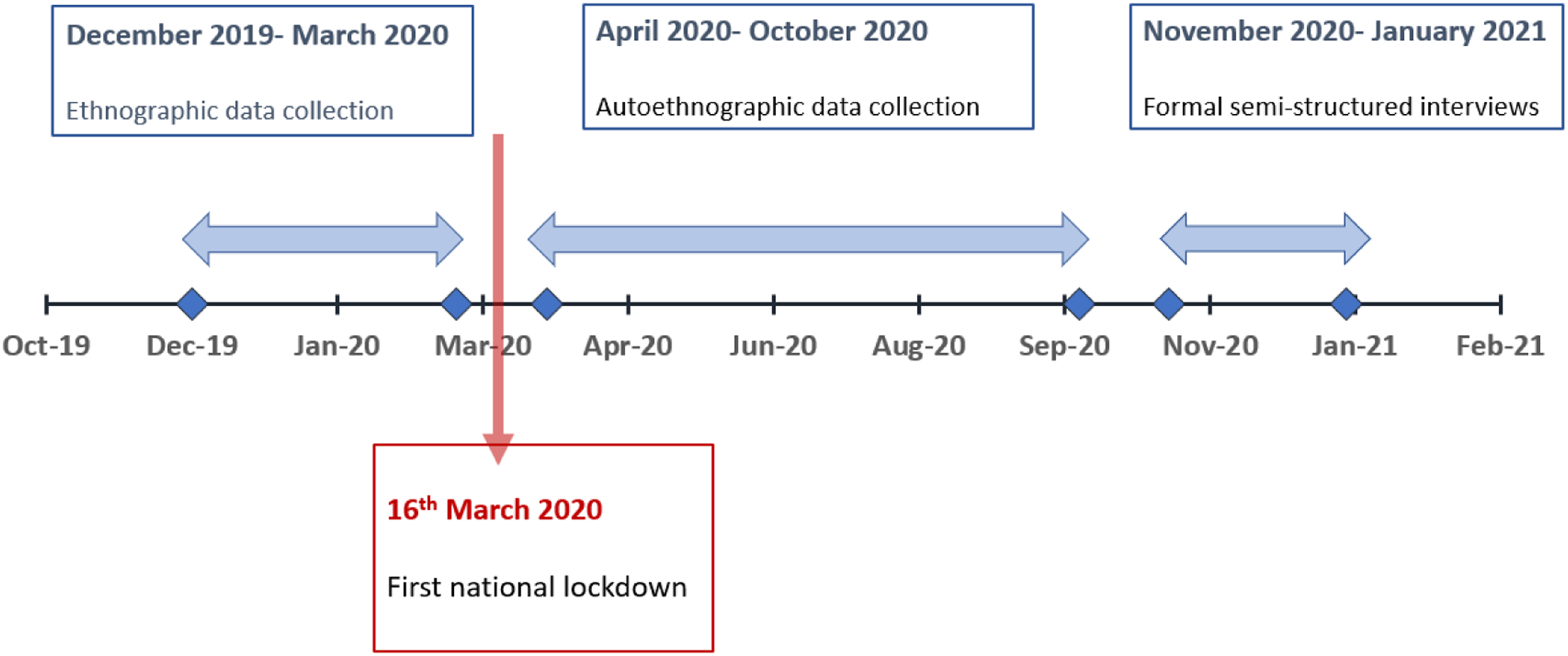
In March 2020, as previously mentioned, I maintained access and continued to gather data through formally gaining a full-time 6 month contract practising as a social worker within the same team. My positionality therefore changed from that of a participant-observer to a complete-participant, and 6 months of auto-ethnographic data was captured in a reflective log (Hammersley and Atkinson, 2019). Finally, from November 2020 to January 2021, ten semi-structured interviews were conducted online with the service manager, two team leaders, six social workers, and one community occupational therapist. These interviews were carried out with practitioners who had already been directly observed, with the aim of enriching the data captured in the fieldnotes (Miller and Glassner, 2016). The interviews each lasted between 60 and 90 min and were recorded and transcribed verbatim. Consequently, the research design encompassed a multi-method approach, or as Nicolini (2009: 1403) describes it, a ‘toolkit logic’ comprised of observations, formal and informal interviews, and document analysis, captured within a reflective log, fieldnotes, and interview transcripts. The fieldnotes, reflective log, and interview transcripts were then thematically analysed using Nvivo, resulting in the progressive accumulation of inductive codes and overarching themes.
Negotiating ethics – Through the looking glass
Prior to starting the research I gained formal ethical approval from the university’s ethics committee and the local authority research site. However, attaining access to case work involved a gradual process of building rapport and trust with the workers who would subsequently invite me into a case once the supported person and worker had given their informed consent. Furthermore, a manager from the team acted as the gatekeeper in overseeing access to the various cases.
When I altered my methodology to include auto-ethnographic data, I completed supplementary ethics applications for the university and local authority. Shifting roles and negotiating my multiple identities raised a number of ethical challenges which I considered during my supplementary ethics application and throughout the data collection and analysis processes. I had to carefully balance my duty of care and responsibility to the supported people whilst also continuing to conduct research. As an employee I gained increased power through additional access to records, cases, documents, systems, and information. I was automatically included in more meetings, reviews, and conversations with other professionals, supported people, and their families. In some situations I was working exclusively as a practitioner, whilst during other encounters I was also a researcher. Supervision with my Director of Studies, the social work line manager, and gatekeeper provided a space in which to consider and manage the ethical concerns which arose from the shift in roles to auto-ethnography. My role as a social worker always took priority over my role as a researcher. My practice was underpinned by the Scottish Social Services Council (SSSC) national codes of practice and relevant safeguarding legislation, and therefore practice casework always came first above my research agenda. Crucially, my auto-ethnographic data collection focussed on my experiences as a practitioner rather than on the complexities and confidential information of the supported people and their cases. Finally, throughout the study I was transparent about my role as a researcher and I continued to gain informed written and verbal consent, provide information sheets, and offer one-to-one discussions, to empower workers and supported people to make informed decisions about whether they wished to be involved in the study.
Findings
Multiple identities: Researcher/social worker/expert?
These findings begin by unravelling my positionality when I first entered the field, followed by an exploration of my evolving positionality as I transitioned to a complete-participant during the auto-ethnographic data collection. Throughout my ethnography I was both unconsciously and consciously negotiating different positions through constructing my identity and role, and attempting to control how I was perceived. These embodied negotiations were captured in my fieldnotes, and excerpts are presented to below to reveal the often unseen process of reflexivity on positionality. Goffman (1955) describes how our faces or identity construction change depending on who we interact with during the process of impression management. Once I entered the local authority department, I consciously adopted the office language, including speaking in the relevant acronyms and abbreviations in an attempt to fit in and simulate what was perceived as the standard professional behaviour (Silverman, 2017). Furthermore, when describing who I was and the nature of my research project to practitioners in the office, my identity as a qualified social worker seemed to give me passage. This experience was captured in my fieldnotes: After explaining who I was, my role, and the research project, I asked the worker if there were any bits of work I could observe or any visits I could possibly attend. The worker responded, “oh, so you’re one of us then. You get it. You know what it’s like. Sure, I am writing up an assessment at the moment. Have you seen the assessment form yet? I can talk you through it”.
My status as a social worker professional often resulted in my being positioned as ‘one of them’, an insider, rather than as an outside researcher, a benefit which enabled me to quickly build trust and rapport with staff, and to gain the team’s swift acceptance. Additionally, my identity of a younger woman who had never been a manager in any local authority aided in creating a more balanced power dynamic, as I was perceived to be at a similar level or status, as I reflected in my fieldnotes: One worker said to me, “you know… you look really like a social work student, rather than a researcher from the university”. She smiled. I laughed, and asked what she meant. She responded, “like… I can’t imagine you in university. Also, you’re too practical”.
To maintain my position as ‘one of them’, I often concealed parts of my researcher identity; for example, I tended to write my fieldnotes up at home, privately and out of sight. I found that by visibly being a researcher through writing fieldnotes in the office, I drew attention to the observation and risked potentially influencing behaviours. Furthermore, I wanted to avoid being a marginal member observing from a distance, and being seen as solely conducting an explicit research role. Hammersley and Atkinson (2019: 218) argue that there is a level of deception occurring within ethnography because there is ‘an element of not telling the whole truth’. They continue by highlighting that even ‘active deception, may be justifiable so long as it is not designed to harm the people researched, and so long as there is little chance that it will do this’. Although there was no need for active deception in my research, I did deliberately downplay and hide my research activities.
Negotiating access to the research site via senior management automatically enabled me to build relationships with managers who at times presumed I was a specialist in the self-directed support policy and as such, positioned me as a researcher rather than a social worker. The following extract from my fieldnotes acknowledges that others played an active role in creating parts of my perceived identity and social status: Whilst shadowing an informal case discussion between managers, I was caught off-guard as one manager turned to me and said: “Felicity will be able to help, you’re our resident SDS expert after all”. I noticed I was feeling uncomfortable. I thought I had always been mindful throughout my research project to position staff as the experts. Yet, my identity as a PhD researcher meant I was at times viewed as a specialist.
My fieldnotes also captured a number of ways in which my identity was perceived by others in the field, including as ‘one of us’, ‘a student social worker’, and ‘an expert’. My positionality was thus not only continuously evolving and multiple but also relational and contextual, and formed not only by me but by others too.
Initially, during my first 3 months of ethnography prior to the pandemic, I found myself in new surroundings, attempting to make sense of what was happening. I was often seeking information and understanding encounters, requiring the adoption of a position of naivety. During this period of data collection my views and opinions were not overtly discussed, and therefore remained hidden. However, when I changed roles from an observer to a complete-participant, my views, assessments, opinions, and ideas then formed part of my daily practice, so I could no longer present as a neutral bystander, and consequently I felt vulnerable and anxious that my knowledge gaps as a practitioner would be apparent. I regularly had to discuss cases and seek advice from colleagues and managers. Nevertheless, through doing and embodying the policy, I reached new depths of understanding. This change in role from a more passive observer to a complete active participant was not deliberately planned, but happened in response to the unforeseen consequences of the pandemic. On reflection, this alteration enhanced my observations and understanding. As Moeran (2009: 140) argues, a change in roles can result in a ‘qualitative leap in understanding’ because the researcher may learn ‘things with their whole body and not just with their mind’, which ‘leads to a far more nuanced analysis’. I was therefore not simply observing SDS, but beginning to personally enact the policy by engaging in the daily backstage activities taking place. In many ways I welcomed the inclusion of a reflective log and felt empowered to include my experiences and understandings, which complemented and enhanced the ethnography. My reflective log captured the transition from observing backstage games to participating in them and learning the rules of practice. One of my reflections was as follows:
I began to do the maths when looking at my assessment. I had become fluent in understanding what risk ratings generated what budget, and how many hours of care could be purchased. I asked myself: does this assignment generate an adequate budget to meet needs? Should that even be a question a social worker asks? Was I now playing the game that I had so often observed, of engineering an assessment in order to get an adequate budget and care?
Building rapport with frontline social workers enabled me to gain access to practice observations. Friendship building with colleagues therefore became part of the research process (Beech et al., 2009). As I transitioned from observer to complete-participant during the auto-ethnography these friendships continued to grow, which inevitably impacted on what people told me and how I responded and saw things. At the point when I was most immersed within the team, following 3 months of ethnography and 6 months of auto-ethnography, I conducted the semi-structured interviews. Often there was a clear sense of rapport during these interviews, when my fellow workers made comments such as ‘you know what it’s like’ and ‘I think you probably know who I mean’, combined with informal language, jokes, and candid comments. Nevertheless, the informal atmosphere still generated a wealth of data which created a holistic picture of the phenomenon. Although at times I was shocked at the frank nature of some comments due to my position as a friend or colleague, the workers all had a clear understanding and awareness of the research in order to make an informed decision regarding their participation. Finally, my position shifted again when I left the field, leaving my job as a frontline social worker and returning to my PhD researcher role. My reflective log captured some of my concluding thoughts as I left my job:
Leaving the office and the role as a social worker feels sudden, although I always knew it would be a six-month contract. My job took over in a way I never anticipated. The pace of work has never slowed, some of my cases are still open, ongoing, and transferred to other workers. Final goodbyes were not possible with everyone due to the restrictions. There seemed to be a feeling that I would see them all again soon. Practice during COVID-19 was non-stop, so I do feel a sense of relief; however, I now have what feels like the impossible task of processing and analysing this mass of data. Will what I’ve found do justice to all the service users and workers?
These reflexive extracts emphasise my complex, fluid, multiple, and continuously evolving positionality which is never complete. Through tracing my evolving positionality throughout the research process, the often-invisible concepts of reflexivity and positionality have been rendered visible thus supporting efforts to bridge the gap between how this process is theorised and how it actively practiced in real-life contexts.
Discussion and concluding thoughts
Focussing on the micro details of my evolving identity facilitates understanding of my positionality; nevertheless, Nicolini (2009) acknowledges the need to switch lenses, by not only ‘zooming in’ on granular elements but also ‘zooming out’. Zooming in provides the micro picture, whilst zooming out focusses on the wider, macro contextual issues. Consequently, zooming in and out links these worlds together. In other words, by failing to zoom in, concepts such as positionality and identity remain abstract and out of touch with the messy practical manifestation. Meanwhile, if zooming out does not happen then the bigger picture is lost, and therefore the wider contextual significance of the findings is not considered. Both lenses have their positives and negatives: ‘zoom in, and get a close look at select details - perhaps too close to make sense of them. Zoom out, and see the big picture - but perhaps miss some subtleties and nuances’ (Moss Kanter, 2011: 112).
Through zooming in on my evolving positionality, the findings illustrate that during my research, I negotiated multiple faces while interacting with a range of different people in various settings (Goffman, 1955). Reflexive examination of my positionality was a critical research tool which supported me to navigate ethnography generally, and the specific transition from a participant-observer to a complete-participant. I constantly considered what information to share and what not to disclose, sometimes consciously and at other times subconsciously. Furthermore, the research participants also contributed to my positionality and identity formation. I began as an observer who kept my views hidden, but later became more vulnerable and exposed during auto-ethnography. These reflexive accounts illustrate the ways in which I was implicated in my own research, exposing both how I affected the research and was affected by it. These findings therefore acknowledge the subjective nature of the research, and in fact, openly draw upon my co-construction of reality which was inherent in all phases of the research process, and which supported me in making sense of the phenomenon. I have not aimed to deny or conceal my impact on the data; instead, I have sought to actively incorporate it. Importantly, it is argued that this does not compromise the rigour of the study, as reliability and rigour are in part maintained via the application of a transparent reflexive processes. While reflexivity does not guarantee more valid and reliable research, it does support the researcher in working towards this (Pillow, 2003).
This process of zooming in diffuses the smokescreen which commonly surrounds written research methodology, thereby framing research as an ongoing process rather than a clean-cut, finalised product. By zooming out and considering the implications and benefits of these findings for qualitative research more broadly, it is apparent that reflexive accounts of positionality support a researcher in unravelling and understanding the inherent power relations at play, and furthermore, they provide opportunities to respond in an ethical way. Whilst many scholars recognise the importance of positionality, reflexivity, and identity, few actively illustrate the practical process of doing reflexivity and considering positionality through exploring thoughts, feelings, and emotions during research. This paper provides an example of the enactment of reflexivity on positionality and urges researchers to think more deeply about positionality by considering both how the individual influences the data and the data influences the individual. Research which illustrates the active process of reflexive positionality is beneficial for other researchers, the audience, and most importantly, it enhances the researcher’s own understanding of the data and the phenomenon. This paper thus frames positionality and reflexivity as research tools which facilitate the co-construction of the social worlds around the researcher. Finally, it is not enough for researchers to simply claim reflexive thinking and analysis of positionality; instead, this paper encourages researchers to capture written methodological accounts of the processes in action, thus providing greater clarity on what actually happens during research.
Footnotes
Declaration of conflicting interests
The author(s) declared no potential conflicts of interest with respect to the research, authorship, and/or publication of this article.
Funding
The author(s) received no financial support for the research, authorship, and/or publication of this article.
