




Abstract
This article uses Feminist New Materialist theoretical perspectives on time and temporality to critically explore the social work practice of life story work, designed to help children who are or have been in public care, or are adopted, assemble a coherent narrative of their care journey, adverse experiences and identity. Interview data presented here was produced with 17 participants (foster carers, adoptive parents and social work professionals in care or adoption teams) who were part of a project which sought to understand how aspects of life story work could be transformed into everyday care conversations between children and the adults who care for them (see www.difficultconversations.info). Our analysis highlights the way participants understood and constructed temporal elements of children’s experiences and identities: their pasts, presents and futures, in the context of having conversations about care with them. Through the discussion, we indicate a need to loosen the configuration of children’s life stories and identities as ‘pre-care’ and ‘post-care’, and instead move toward an acceptance of children’s multiple selves and multiple important others as existing across time.
Introduction
The number of children in state care in England and Wales is at an all-time high: in March 2021 80,850 children were ‘looked after’; of which 2870 were adopted (Gov.uk,2021). While most children enter state care due to abuse and/or neglect, an increasing body of research is beginning to provide a structural account of the care system, highlighting the integral role of social inequality (Elliott,2020). Care experiences and outcomes have sustained policy, practice and activist concern for a number of years. Many children experience a lack of stability, transitory placements and stigma, and have a much higher propensity to develop a mental health disorder than a child raised consistently with their birth family (Sanders,2020). In this context, this paper adds a critical perspective to Life Story Work, an established social work practice designed to ameliorate negative outcomes by helping a child understand and integrate their past into their present (Coman et al.,2016).
Life Story Work supports children who enter care to understand the reasons they are unable to live with their birth family, to know what has happened to them, and why decisions were made about them with a view to helping children secure a sense of their identity. Practitioners embarking on the process of Life Story Work gather together pieces of the child’s life: precious objects or images, stories from birth families or previous carers, and documents pertaining to the child (Baynes,2008). This is then translated into a written account, often a Life Story Book. The communication of this story depends on age and circumstances of a child, they may be very involved through play-based activities, the co-creation of timelines, or visits to previous carers, or it may be compiled by adults involved in their care. When an infant is placed for adoption, this written record – the Life Story Book – is provided to adoptive parents, for them to explore as the child grows. These Life Story Work processes support children to understand and articulate their story so that it becomes part of their memory and identity. It facilitates the construction of their autobiography.
Having a coherent narrative of adverse experiences is particularly important for care-experienced children due to its association with recovery from trauma, particularly when the narrative is disrupted (Jirek,2017). Using life stories as part of identity formation works on the basis that the past ‘must be articulated to become memory’ (Huyssen,1995, p.3) and requires a form of autobiographical construction: ‘the way we tell others and ourselves the story of our lives’ (Misztal,2003, p.10). Supporting children who do not live with their birth families with autobiographical memory is part of social work practice in the UK. For example, the creation of a Life Story Book forms a mandatory part of the preparation for adoption, as statutory guidance states ‘all children with a plan for adoption must have a life story book’ (DfE,2014, 3.10, p. 45).
There are many critiques of Life Story Books which we do not have space to repeat here (Watson et al.,2015a; 2015b; Hooley et al.,2016). However, it is important to note that as a written intervention aimed at documenting the child’s past, Life Story Books cannot represent the rich detail or temporal contexts across which the child and carer may be trying to make sense of the child’s memories, attachments and ultimately identity. Similarly, broader Life Story Work, which may be ongoing for children who remain in care, is critiqued as memorialising the past to the detriment of the present (Baynes,2008). Further, training for adopters and foster carers can frame the child as future adult by overemphasising pre-care trauma as deterministic, crystallising in notions of ‘disordered attachment’, an (over)diagnosis which has received some critique (Woolgar and Scott,2014).
As documented in an earlier paper from the same study, children and young people who have experienced care reported they wanted to have open and honest conversations with adults in their lives about their experiences. However, they often felt that the adults concerned lack the confidence, skills, knowledge or openness to have these conversations or they were not the person they wished to discuss their life with (Watson et al.,2021). In the current paper we present perspectives of the adults who constellate around care-experienced children (social workers, adoptive parents and foster carers) on having ‘difficult care conversations’.
We present qualitative data which explores reframing some of the ‘work’ of Life Story Work as ‘care conversations’. This reflects a dynamic, temporal and multi-perspectival focus which recognises the effects of time and temporality on children and adults’ experiences. To do this, we draw upon Feminist New Materialist analyses of time and temporalities, particularly the work of scholars such as Karen Barad (2017) and Karin Murris (2020) which undo understandings of our existence in time as purely chronological. In doing so, this paper troubles the goal of constructing a linear past, present and future for care-experienced children via an intervention such as Life Story Books. Instead, we open the door to adults to embark on the co-construction of memory and identity with the children they care about through everyday care conversations.
The impetus for the theorisation of this topic in this way is the recognition of the political-economic and social work contexts in England. This includes increasing numbers of children entering care; and cuts to Local Authority budgets, including those of Children’s Social Care and Child and Adolescent Mental Health Services (CAMHS), showing no signs of easing as public finances face intense pressure (Elliott,2020; Griffin et al.,2022). In this context, social work practice urgently needs to find ways of helping children and their new families/carers to reconcile children’s past, presents and futures. Supporting adoptive parents and carers to open up conversations about care journeys in the granular, everyday moments is thus vital. In this paper we suggest that Life Story Work principles could be threaded and embedded throughout family life in ways that do not overly memorialise the past, nor project the past onto the becoming adult. Core to this endeavour is dissolving binaries such as a child’s pre-versus post-care identity, or the pursuit of a single ‘real’ autobiography which needs curation and reassembly. The theoretical concepts employed in our analysis are explored in the next section.
Childhoods in/across time
Traditional, often psychologically influenced understandings of childhood suggest a linear mode of development whereby the child lays the foundations for the becoming adult: a sort of ‘moonshot’. In this highly complex and engineered trajectory towards adulthood, childhood is seen to be important (James and Prout,2015). This future adultist framing of the becoming child is critiqued as failing to recognise the ‘being’ child who is exists now. It overemphasises childhood as the ‘potential antecedent for adult neurosis’ (James and Prout,2015, p.209): particularly salient in the construction of children who are care experienced.
A developmental view of childhood risks foreclosing ‘the thick now of each moment’ which is ‘already their situated childhood as well as their future and the present’ (Murris,2020, p.172). This temporally ‘thick now’ for care-experienced children exists in family life co-currently in pre, present and post temporal conditions. Memories, relational encounters and a sense of belonging span the familial and institutional assemblages they are part of, across birth families, foster families and for some, adopted families. Prior connections do not exist only in the past but remain part of the child, and necessitate that the adults surrounding them recognise, respect and do justice to what has come before (Murris,2020).
This sense of co-existing across time, in multiple temporalities is conceptualised as ‘lived time’ in opposition to ‘clock time’. The theoretical work of Barad is useful in elucidating this concept: …a given entity can be in (a state of) superposition of different times. This means that a given particle can be in a state of coexisting at multiple times – for example, yesterday, today, tomorrow…There is no determinate time, only a specific temporal indeterminacy (Barad,2017, pp. 219–220).
The notion of ‘lived time’ does not represent a rejection of chronological time. Rather, it acknowledges the ways in which our experiences of the world and construction of identity rely on different times always ‘bleeding through one another’ (Barad,2017, p.220). As such, we conceive of children’s life stories and identities as ‘full of inheritances and remembering, and full of comings, of nurturing what might still be’ (Haraway,2016, p.2).
A form of ‘lived time’ is memorialisation, where children are enabled to keep past family members in mind and to honour their past relationships using significant toys, objects, Life Story Books and photographs (Watson et al.,2019) as they attempt to retain emotional bonds to human and non-human entities and memories (Rogers,2018). Enabling care-experienced children to keep birth family members in mind and retain emotional bonds is complex and requires what is described as a form of ‘travel hopping’ on the part of all parties: that is ‘the art of noticing multiple temporalities’ (Murris and Kohan,2020, p.4). ‘Travel hopping’ is a term borrowed from Kyoko Hayashi’s novella Trinity to Trinity, ‘written through time, place, history, and memory in search of a way to justly mourn the victims of atomic bombings’ (Barad,2017). Crucially, ‘travel hopping’ posits that while past injustices do indeed exist in the past, they reverberate into the present and future, and cannot ever be existentially erased: ‘the past is never finished’ (Barad,2017, p.73).
We argue this way of thinking about time, temporality and identity offers opportunities to challenge deterministic views of post-traumatic childhoods as ‘the ontology of an entity “in” the past remains open to future workings’ (Murris and Kohan,2020, p.9). For care-experienced children, making sense of traumatic and adverse events requires more than cataloguing and archiving them. It means accepting that those events, sensations and memories live with them in the present and future, across temporal domains. This leaves them open to integration into a child’s identity which goes beyond a pre/post-care binary.
In this paper, we recognise the role of adults in the lives of care-experienced children in the context of living together in the present whilst imagining the future, and confronting the histories that co-constitute them. The temporal indeterminacy or ‘lived time’, that we argue best represents care-experienced children’s life stories and identities, poses a specific challenge for carers and adoptive families. The responsibilities towards the relational entanglements in a care-experienced child’s life are likely to be more overlapping, multiple and pivotal than for a child raised solely by a birth family (Murris,2020). This paper explores adoptive parent, carer and social work participant responses, constructions and understandings of children’s life stories and identities via ‘difficult care conversations’ and how these manifest across and through time.
Methods
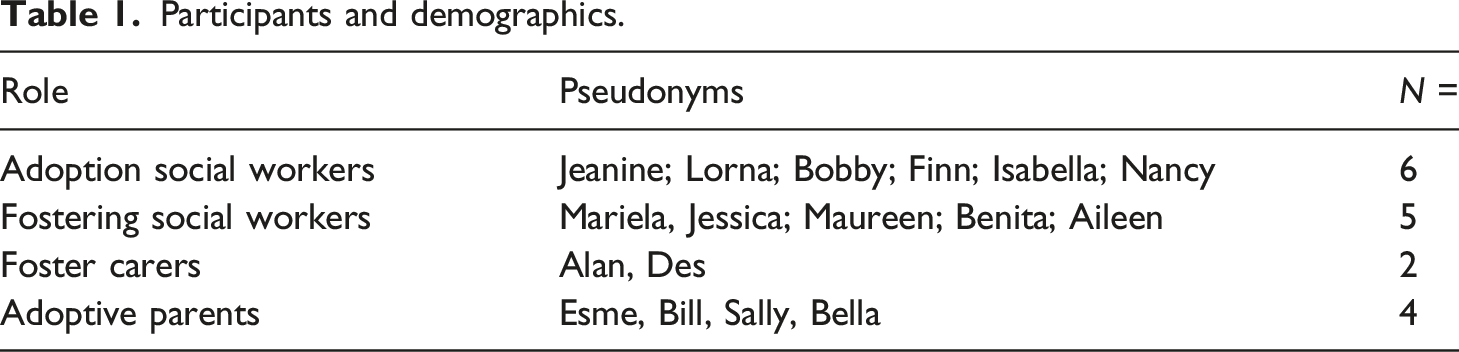
Participants and demographics.
The method of data production was ‘sandboxing’: participants were each provided with a small portable tray filled with sand, and a selection of small objects such as vehicles, shells, animals, buildings, people, flowers and trees. Water in jugs was provided for the creation of pools or to make the sand more buildable. Participants were then asked to create scenes in the sand representing their hopes and fears about having difficult life story conversations with child/ren they cared for, had adopted or worked with. Once the sand scenes were complete, we conducted an individual interview using a semi-structured topic guide. (Figures 1 and 2) Image of a sandscene created in a miniature sandtray, using various small figures and objects. Image of a sandscene created in a miniature sandtray, using various small figures and objects.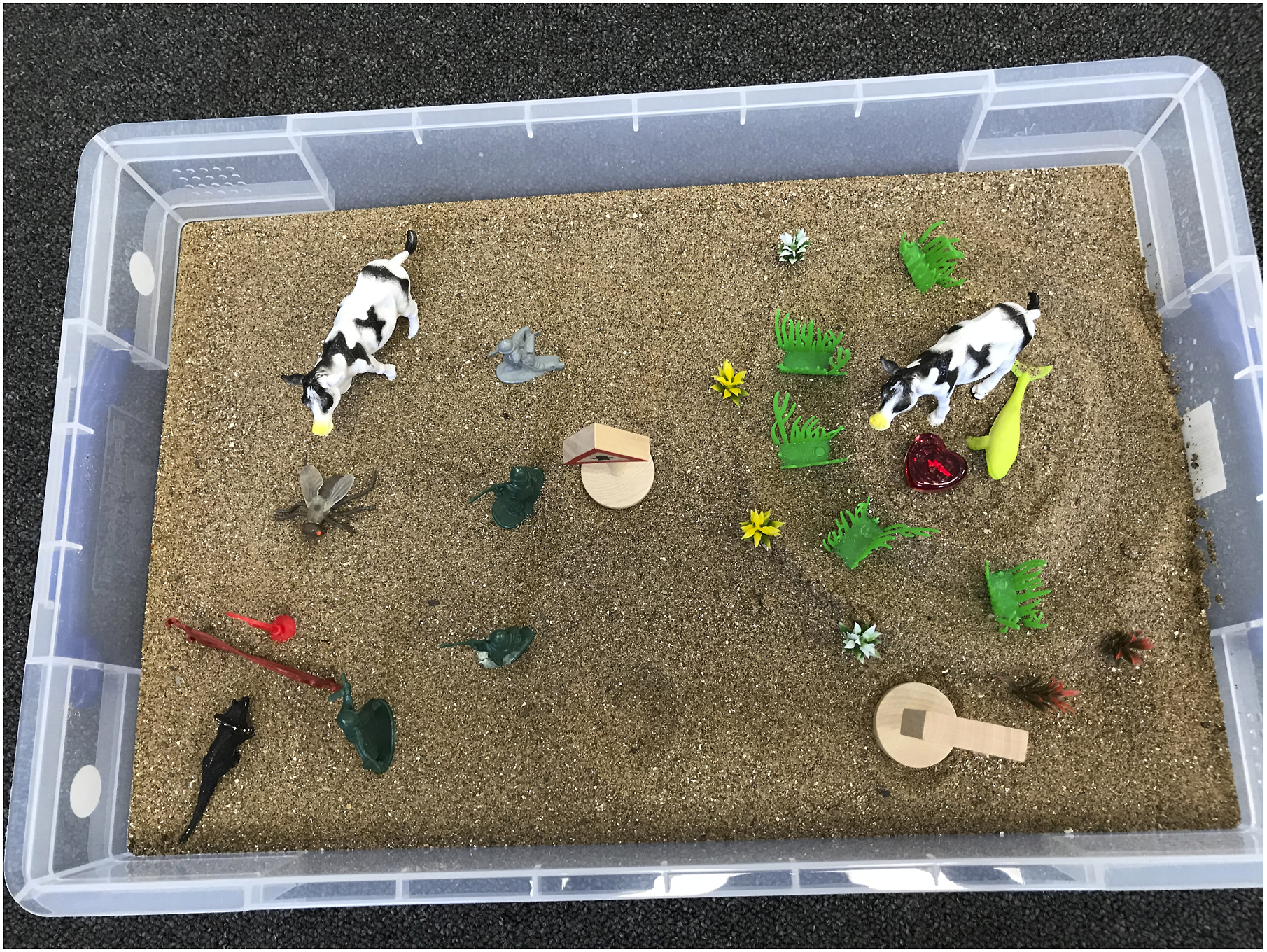
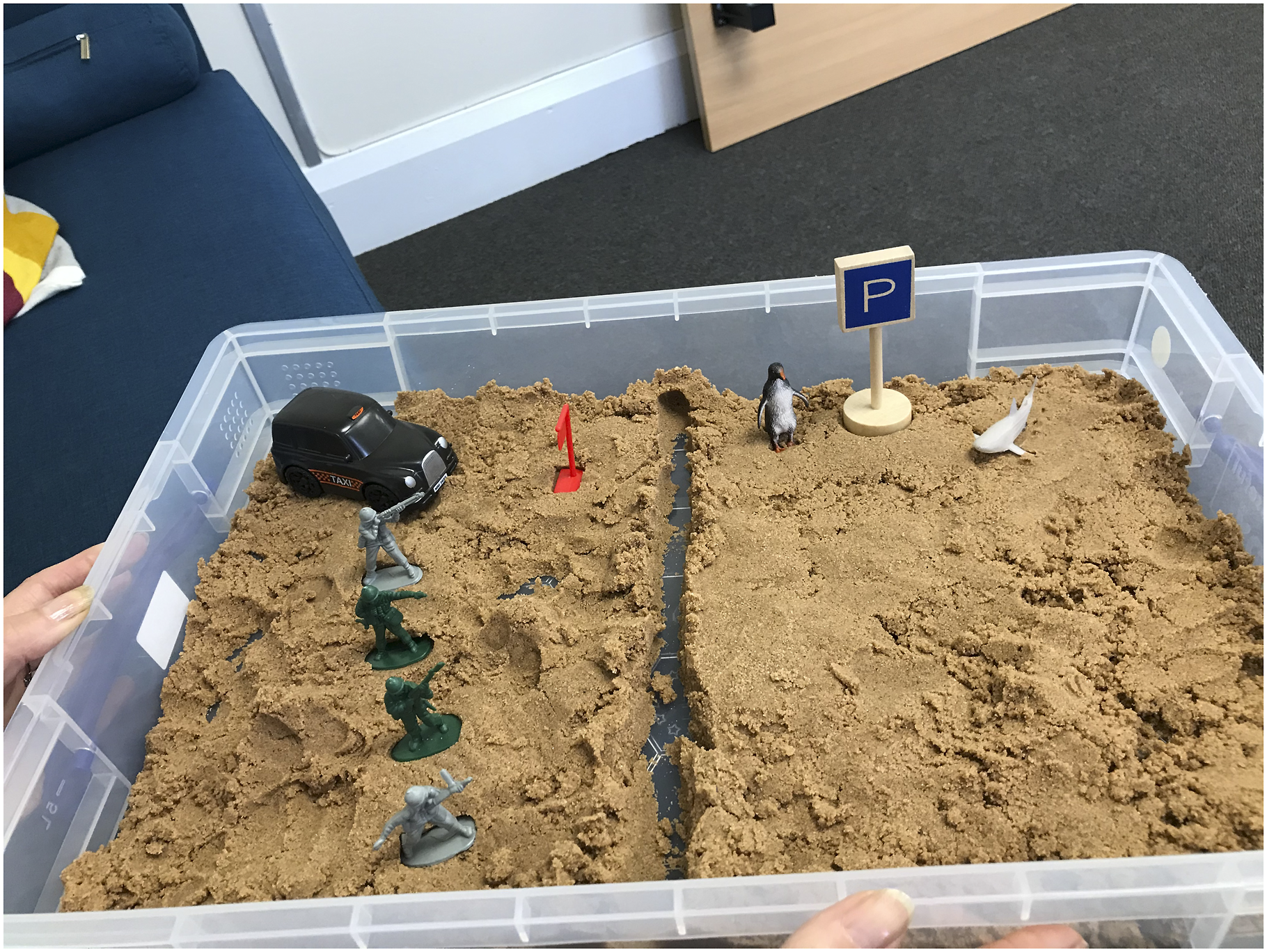
The sandboxing method is an adaptation of Lowenfeld’s (1979) therapeutic use of sand play for non-therapeutic participant-led creative research purposes (Mannay et al., 2017). A more detailed account of the same methodological approach can be found in an earlier paper from the same study, which focused on children and young people (Watson et al.,2021). Some of our adult participants initially expressed uncertainty about creating sand scenes. However, all took part in the activity and reflected afterwards how helpful the method had been in allowing the time, space and physical material (of the sand and figures) to ‘think things through’ before being interviewed. For adoptive parents and foster carers, difficult care conversations were both consciously and unconsciously threaded through their daily lives so it was important to use a method which could offer opportunities for participants to render this familiarity, strange (Mannay, 2010). Sandboxing enabled us to unravel taken-for-granted meanings about care-experienced children’s life stories and subsequent identities: their pasts, presents and futures. It also enabled participants to communicate multiple, sometimes contradictory views on children’s care histories and life stories, and their own roles within these narratives across time.
Producing rich, differentiated data on this topic was integral to our attempt to broaden the field of Life Story Work research and practice which can be framed in terms of an ‘intervention’, delivered by specially trained professionals for finite period of time (Hammond et al.,2020). It can also be framed as an exercise in managing risks of pre-care trauma (Hooley et al.,2016). In contrast, our conception of care conversations involves acknowledging the entanglements of being, belonging and becoming, where the past necessarily lives in and through the present and future. Our findings and discussion explore this in more detail below.
Findings and discussion: Being, becoming and belonging
Our findings are structured around themes influenced by Barad’s (2017) notion of the ‘specific temporal indeterminacy’ (p.220) of the past, present and future. These themes frame temporal experiences and identities as co-constructed by the adults caring for the children. We analysed the data in line with Braun and Clarke’s elucidation of thematic analysis (Braun and Clarke, 2006; 2021). The explicit use of a Feminist New Materialist theorisation of time alongside our own research knowledge and experience drove the analysis and interpretation of the data in a cyclical, iterative way. This resulted in three themes: ‘Identity, fracture and flux’; ‘Recognition in the moment’ and ‘Living memories’, which are presented below.
Identity, fracture and flux
This first theme encapsulates the way participants understood temporality in relation to their child’s identity. Often this was expressed in line with culturally engrained, developmental understandings about childhood: as a foundational time for development of the ‘becoming’ future adult (James and Prout,2015). Many participants emphasised facilitating a child’s movement forward, away from their past to secure a sense of self, and a more settled, contented life in the future. Specifically, the majority of participant’s accounts framed children’s identity 1 as dual dimensioned, a ‘before’ (pre-entry to care) and ‘after’ (entry into care/adoption).
Adoptive parents and foster carers have the closest proximity to the children in relation to day-to-day care, affection, and obligation. For these participant groups the metaphor of children’s identity ‘being stuck’ in the space and time of ‘before-care’ was particularly prominent: He’s been stuck for so long…and he still thinks that he is a bad person so some way to moving on to release that sort of blackness that’s locked inside, I think, and every day’s a constant struggle to keep that in. I just want him to have peace of mind and actually enjoy life and look forward and well, enjoy the present. He’s got the present (Sally, Adoptive Parent).
Children’s perceived emotional and relational immobility was concerning to many adoptive parents and carers, weighing heavily on children as a ‘horrendous burden’ (Alan, Foster Carer). In some cases, children were discussed as having an identity solely rooted in the past, disconnected from the present: He presents and perceives himself as a victim and thinks he will always be a victim and he can’t move on from that. We want to help him move on from that by having these conversations (Des, Foster Carer).
Children’s fixedness in a time and space which was perceived to no longer reflect their desired present or a future caused some confusion and anxiety. In essence, carers and adoptive parents often viewed children’s fixation on the past or fixedness in the past as foreclosing their ability to live in their present or engage with what was framed as a more positive post-care identity: She’s thinking of her [sister] as a baby…So her picture, her imagination – and we can’t update those photographs…that would probably help her to move along. But it’s, for her, life’s frozen, in that sense (Alan, Foster Carer).
Indeed, this sense of a necessary movement from the past, forward into the present and future facilitated by difficult care conversations appeared in all sand scenes across the participant groups. Participants put faith in difficult care conversations as healing a disjuncture or hole in a child’s narrative, to enable, as Social Worker, Jessica states: ‘all our children to be loving their place, to be loving their life’. Here, it is useful to consider how using care conversations to heal and move children forward might be reconfigured using ‘lived time’, as per Barad (2017).
Granular, everyday care conversations based on ‘lived time’ accept the inedible mark that pre-care experiences have on children. They recognise the traumas and injustices that children may have suffered but also acknowledge that relational entanglements of birth family may be a current source of both joy and pain. They bring these temporal threads alive, weaved in small, safe ways through the child’s life – at the kitchen table after dinner, on the car journey to school, or in musings about aspirations. As Barad states, we ‘weave them into the entangled tale’ (p. 61). Acknowledging the entanglements of a child’s past, present and future in their everyday existence would trouble the idea that for a child to love their ‘place’, they must be released from the past, that the past must be gotten over. This in turn could ease the burden carers feel to facilitate this.
Notably, some adoptive parents themselves, and most social work professionals reflecting on adoptive parents, referenced a sense of being stuck. Here, adoptive parents often felt (or were framed as feeling) blocked from their own present or future because of the immobilising effects of their child’s past: They are thinking, I can’t say anything, I am stuck, and I don’t know what to do (Jeanine, Adoption Social Worker)
The notion that acknowledging children’s ‘past’ identity and experiences could do damage to a child and family’s life in the present can be likened to a fear of opening a ‘pandora’s box’. This sentiment underpinned part of the rationale for the research, succinctly encapsulated by one Adoptive Parent, Sally: We were told in our training you must do this regularly, it is important and so that was my one question to the all the adopters that came round that we talked to in our training, ‘how did you do it?’ and they were going ‘we didn’t’, ‘we haven’t, we haven’t done that yet’, ‘we’ll do that soon’ or ‘I’m not quite sure’ or ‘I think somebody wrote a book’.
One of the ways that we attempted to remove the blockage of not knowing or being frightened to talk about children’s life stories and identities, was to use the sandboxing method. This enabled participants to visually represent care conversations independently and reflectively first, rather than having to verbalise answers on the spot. It also lent itself to thinking about temporal and spatial aspects of care conversations, and thus journeys or bridge-crossings were often created in the sand.
These journeys were framed as necessary undertakings for moving children out of the grip of an amorphous, threatening or chaotic pre-care identity. At the same time, participants acknowledged that this process involved both adults and children confronting, processing and verbalising difficult emotions and painful memories: …you might be able to see a path over there but if there are dangers and that area is defended then you could get hurt trying to move across to there (Esme, Adoptive Parent)
The use of such metaphors allowed participants to represent many of the complexities and ambiguities of having difficult care conversations. However, what was frequently described was a process where the past could unpredictably bleed into the present and future and, as Esme states above, do some damage.
A useful way to reconceptualise the fear of opening a ‘pandora’s box’ of children’s pasts is by employing the notion of ‘travel hopping’ (Hayashi,2010; Barad,2017; Murris and Kohan,2020). In having care conversations with children and young people, ‘travel hopping’ would involve a recognition that our identities cannot be contained to linear, chronological moments of ‘clock time’. Rather it suggests that we exist as beings constantly hopping from one memory, one hope, one sensation, one emotion to another – or many all at once, across different temporalities. From this perspective, the work of care conversations is not to ‘reconstruct’ a sequential, linear narrative of a child’s life. Instead, the aim becomes to establish small connections between a child’s past, present and future with an understanding that the past cannot be processed and ‘put away’, it lives on in our present, and our future.
Overall, the data in this theme illustrates that participants’ conceptualisations of children’s identities were generally rooted in an understanding of temporality in terms of ‘clock time’ rather than ‘lived time’. However, while there was a strong sense of a need to free children from the past to move them into the present, respecting and recognising the child ‘here and now’ was also a prevailing concern of our participants, as explored below.
Recognition in the moment
This theme explores the extent to which adoptive parents, carers and social workers understood the temporal indeterminacy of children in the present. That is, how they understood the role of time in a child’s identity ‘here and now’. This is what Bella, an adoptive parent, described as a child’s ongoing need for ‘that sense that somebody recognises them’. Many of our participants expressed a duty to meet children as they are, in the moment, and not construct them in terms of as they were (pre-care) or how they wanted them to be (post-care): People would want the child to smile and look happy, but that’s not necessarily − I think it’s really annoying when people just keep trying to jolly a child along. It’s really not helpful…Calmness, acceptance (Finn, Adoption Social Worker).
Where participants touched on the temporal indeterminacy of the ‘here and now’ child, they often did so in relation to children’s birth families. Participants who resisted the ‘jollying along’ of children acknowledged the ongoing presence of birth families in a child’s life, regardless of levels of contact. Overall, there was a recognition that children exist in relation to both their adopted/care family and their birth family and that their past relationships comprised aspects of their present and future: …a child is kind of a bit like them, so that’s a bit weird because they’ll never be like them, but they’re not exactly like them either. They’re in the middle, aren’t they? In between (Mariela, Fostering Social Worker)
There were other ways in which participants perceived the temporally entangled nature of ‘the here and now’ child. For example, one foster carer expressed his openness to enter a dialogue with his young person about unknown aspects of both of their pasts, with the knowledge that this information would bleed into their present identities and future selves: His biggest question was who was my father? We’ve done the DNA…we’ll probably never know his real father but what we might be able to do is establish some history for him to say, look, hey. [We] did the same so it wasn’t done in isolation
(Alan, Foster Carer)
Nevertheless, being able to respect the interplay between a child’s past, present and future, what Murris (2020) terms the ‘thick now’ of a child’s identity, was not straightforward. Accepting the indelibility of the past, yet its meanings being attributed in the present and future could be particularly difficult for adoptive parents. As one adoption social worker summed up, existential angst exists in acknowledging a child’s past for some adoptive parents, because of what it means for the family unit in the present: The finality, wanting to protect their child from hurt and harm. Fear for themselves, that they’re not the real parents and that they can’t square the circle. The worry that they won’t be able to ever satisfy a child. Huge, huge existential dilemma (Isabella, Adoption Social Worker)
Indeed, the trepidatious journeys that carers and adoptive parents faced in contemplating their children’s pasts in order to recognise them in the present were apparent across the sand scenes created. This construction of the past is, arguably, based on an understanding of temporality in terms of ‘clock time’, where the past remains ‘back there’ and to look at it risks inciting trauma for the child (Barad,2017). However, ‘lived time’ illuminates the way the past is always in the ‘here and now’ child and will always be there in the future adult. Helping adoptive parents and carers to understand how the past is necessarily weaved into the present and future may make the thought of having care conversations less frightening and stressful.
The following adoptive parent reflected on his sand scene of a crossroads, more in line with an understanding of ‘lived time’. He suggested that difficult care conversations create ambiguities rather than providing a simple way to process and then ‘straighten out’ their child’s past: The responses sometimes – hence the crossroads – I would like to think that by talking to the girls, you get feedback, but it does lead then to very different emotions. It might stir up things that are not nice for them… It is a bit confusing really (Bill, Adoptive Parent)
In Bill’s reflection, he recognises the outcomes that difficult care conversations may precipitate including confusion, distress and an unsettling period for the child and the adult. He also acknowledges that it may provoke different emotions, not all of which are necessarily negative. In doing so he acknowledged that the past is ‘alive in the thick here and now’ (Barad,2017). He provided his children with an opportunity to be recognised in the moment: the messy entanglements of the past caught up with hopes for the future and overlaid with emotional responses in the present.
The data shows that many adoptive parents and carers do understand that ‘established relationships never go away, no matter how great the disruptions or barriers’ (Rogers,2018, p.186). Central to this is the understanding that a child’s past need not be memorialised in any fixed sense, but viewed as a fluid part of their identity which does not need to be ‘worked through’ and ‘put away’. However, as mentioned above, this journey or process was met with some trepidation by participants, which signals a need for additional support for adoptive parents and carers in navigating lifelong care conversations with children.
Living memories
Many participants expressed anxieties and frustrations about being unable to verify the accuracy of children’s memories or know how memory should be represented. This theme explores the way participants understood the affect and accuracy of children’s memories. It also looks at the power these memories and ‘past’ identities have to reach into the present. The pressure to be ‘more than’ ordinary parents or carers involved the responsibility of curating children’s memories. As such, memory was understood by participants as both objective historic record in need of reassembling (e.g. through Life Story Books or care files), and as dangerous, unreliable and potentially to be avoided.
A related aspect of this theme includes participants’ views on parenting/caring practices. Perhaps unsurprisingly, a discourse particularly dominant in adoption, is that care-experienced children need a certain type of parenting/care, sometimes requiring support via a psychological or social work intervention (Staines et al.,2019). This tends to be related to assumptions about trauma and attachment which necessitate a more ‘sensitive’ approach to overcome as one paper relatively uncritically terms: ‘the problems and challenges presented by children adopted from care’ (Rushton et al., 2005, p.25). These discourses were evident in the data where participants expressed these sentiments in terms of parenting expertise: We would recommend the A to Z of therapeutic parenting. A big section of it is dedicated to specific examples and scenarios which have come in quite handy (Esme, Adoptive Parent)
Further, this theme explores the way children’s birth families were recognised as forming an important part of a child’s identity comprising ‘different times bleeding into one another’ (Barad,2017, p.220). Yet at the same time, birth family also represented a shadowy presence that co-existed uncomfortably in children’s past and present and needed cautious treatment to be integrated into the child’s future.
Accurately understanding and logically ordering children’s memories was raised as a contingent element of helping them ‘make sense’ and come to terms with their care histories and identities in most participant accounts. However, Adoption Social Worker, Bobby describes this integration of a child’s past into their present as difficult and emotive work which can be ‘the snake in the grass…there may be these things lurking, it’s there, and its underneath’. Of particular concern to carers and adoptive parents was not having access to what they felt was complete and accurate information of a child’s pre-care life. This made curating children’s memories very challenging: When you do an assessment and you bring a child into the care process, you’re not gonna know everything that’s happened…if you think that they’ve been malnourished and they haven’t been fed properly, they probably haven’t. I can’t give you [the child] the details and I can’t fill in those blanks for you but they probably haven’t and that’s probably why, but I think also they almost want you to tell them, and they want you to have all those bits of information but you don’t (Isabella, Adoptive Parent).
For adoptive parents in particular, the gathering, processing and presenting of information to help children reconstruct a coherent life narrative, facilitating their child’s reconciliation with their past was felt to be a core responsibility, and in some cases a heavy burden. To ease this burden, we can again turn to the concept of ‘travel hopping’ in care conversations. Perhaps this can encourage a loosening of a desire to construct a unified self (of the child), made up of chronological moments in time; a letting go of the ‘unabated continuous flow moving inexorably from past to future’ of clock time (Barad,2017, p.73).
For participants caring for children, providing accounts of pre-care experiences, interpreting them and supporting children to process this also took on a different significance, a sort of co-production of memory. Participants had different ways of approaching this. Some felt they had a responsibility to be corrective: They ask a question, they provide, maybe, have a birth date or a date or an uncle that they’ve misnamed or a birthday…you can say no, no, that’s wrong, it is and you’re correcting their memory, you’re correcting their memories (Alan, Foster Carer)
For others, the value of memory, and the narrative children take from it to build a secure and safe identity incorporating their pasts, presents and futures was understood to be subjective. This memory could be historically ‘inaccurate’, complex and contradictory but nevertheless valuable as part of a process of a child’s ability to make sense of themselves: You know we all remember d]ifferent things and we all have different things in every child’s unique so they’re gonna remember different things and what might be important to you is not gonna be important to them (Isabella, Adoptive Parent)
Participants also emphasised that birth family evoked tensions in relation to the slipperiness of memory. Adoptive parents expressed the challenge of representing birth families to their child in balanced and honest ways and incorporating them into their own family narrative in the present: We are always taught to understand that the birth parents, whatever they did, it is something they probably inherited all the way down, so I suppose it is trying to have a bit of compassion for them… (Bill, Adoptive Parent)
Ultimately as Bill notes, holding different people in equal measure across temporalities is challenging when your emotional and relational commitment is inevitably to the child rather than the birth parents. Moreover the effect of children’s memories on self-conceptualisation and current relationships, including with adoptive parents, were also seen to be heavily configured in relation to birth mothers (rather than fathers): She was very much a daddy’s girl. Mummy was a bit of an enemy and that reflected on what her experience with her birth mum. She just saw mummies as bad figures (Esme, Adoptive Parent)
Here, the notion that memory lives in the past, present and future and within several people at once, is brought into sharp focus. It is ‘specific temporal indeterminacy’ (Barad,2017, pp. 219–220) writ large, and one which causes problems for systems and institutions, including the family, structured by rigid binaries and boundaries. These institutions struggle to allow for the bleeding in of one temporality to another in the construction of identity, often with dire consequences for everyone involved: He doesn’t want to talk about his past ever so it’s how to introduce that and I suppose I was caught on the hop but when he moved to [place] and I was moving, so he took his things with him and I didn’t realise that some of his social worker reports must have been in the things he took…out of the blue he rang up and said, I didn’t know my mother had a choice whether to [give me up][sigh]. I was literally shaking. (Sally, Adoptive Parent)
Whilst Sally was taken aback by this statement from her adopted son, there was a real sense across the data that children had a right to information and understanding about their care journeys, even if it hurt a carer or parent in the process. All adults felt that children had a right to know ‘who’s looking after them, who’s loving them’ at different points in their life (Finn, Adoption Social Worker). Further, there was a commitment to supporting children to develop a temporally integrated identity as a shared endeavour by all the adults around them; as Aileen, a Fostering Social Worker sums up: ‘we can’t do everything, but we can all do something’.
Overall though, it was apparent that for many the past was a scary prospect and one which firmly belonged ‘back there’, in line with a ‘clock time’ understanding of temporality. Re-theorising time and temporality in line with Barad (2017) and Murris (2020), offers opportunities to consider how we talk to care-experienced children about their past, their life stories and their identities in ways which acknowledge that the threads of past are alive in the ‘here and now’ and future child.
Conclusion
This paper emphasises the importance of helping care-experienced children with memory work without conceptualising the past as a hurdle to overcome, or left behind. A fear of inciting children’s trauma by discussing children’s life stories can prevent adoptive parents/carers and social workers from having ‘difficult care conversations’. As such, a shift is required in deterministic adult-focused narratives about childhood that consider the traumatised child as a troubled or deficient adult-in-process. The steady march towards a child’s future needs to be revised, to invite in a non-linear journey: ‘to break apart in different directions’ (Barad, 2014, p.168) and make room for a child’s past, present and future in the construction of identity and self. Concurrently there is a need for a cultural shift in social work practice away from risk-averse direct work with children and families centred on the ‘containment’ of emotions and the psychologisation of trauma.
The onus also falls on policy makers to create a less deterministic understanding of childhood, care and adoption and engage with evidence from a range of perspectives and sources. Dominant policy and practice constructions frame children and childhood as a high stakes terrain for projected adulthood. The identities of care-experienced children and young people are overlayed to an even greater extent by future oriented outcomes and indicators which are heavily measured and monitored. This population of children and young people have memories, feelings and embodied connections with other family members, who may no longer be physically present in their lives and who often bear weighty judgements of deficit or threat. However, the relationships and experiences children have with birth families leave an imprint on the child forever and are integral to who that child is and who they will become. As such, understanding the ontology of an entity in the past, opens possibilities for different future ways of its being (Murris and Kohan,2020).
Fundamentally, the data we have presented here challenges professionals and families to imagine the care-experienced child (as all children should be considered) as co-existing in multiple temporalities where past, present and future are indiscernible, co-existent and co-constructive of identity. Respecting the dynamic interplay of the past, present and future of care-experienced children’s identities does not mean that acts of harm or violence experienced in their birth families need to be memorialised, used to define children or blithely forgiven. However, ‘any pretense that the past can be made undone’ (Murris and Kohan,2020, p.5) through Life Story Work, or indeed in difficult care conversations more broadly, must be rejected as a goal. Instead, the longing to hold, love and care for a child in the present must incorporate an acceptance of the indelible mark of the past, and its continual remaking in the present and future. Whilst there is no panacea for such socially, emotionally and relationally challenging work, there are resources available including the freely available Difficult Conversations materials developed for this purpose (https://difficultconversations.info/).
Footnotes
Acknowledgements
The authors would like to thank all participants who took part in the research, as well as the professionals who helped to facilitate data collection.
Declaration of Conflicting Interests
The author(s) declared no potential conflicts of interest with respect to the research, authorship, and/or publication of this article.
Funding
The authors disclosed receipt of the following financial support for the research, authorship, and/or publication of this article: Funding for the research was provided by the Economic and Social Research Council (ESRC) as part of the University of Bristol Impact Acceleration Account: ES/M500410/1.
