




Abstract
Autism Spectrum Disorder (ASD) is a neurodevelopmental disorder characterized by impaired social interaction and communication. Autistic children suffer from social cognitive difficulties. There is no specific treatment for ASD, but ongoing individualized care can lead to an improvement in symptoms. Adopting a pet into a family with an autistic child is increasingly recognized as beneficial for improving some of the child’s social skills. Cats are the second most common pet in the homes of autistic children. Previous studies showed that adopting calm-tempered shelter cats to autistic children decreased anxiety and improved the child’s social skills. In the present study, we aimed to qualitatively explore the experience of parents of autistic children who adopted a shelter cat. 11 families participated in the study, and were asked 6 open-ended questions every 2 weeks for 18 weeks after the cat's adoption. Five main themes emerged from the analysis: benefits of cat adoption, challenges of cat adoption, parent-cat bonding, child-cat bonding, and family impact of cat adoption. Adoption leads to the creation of a strong relationship between the family members and the shelter cat, and an improvement in the child’s social skills, with some difficulties related to the maintenance of the cat. These findings highlight the beneficial impact of adopting a shelter cat into a family with an autistic child, and open the door for future research to generalize these results.
Keywords
Background
Autistic children
In the United States, autism spectrum disorder (ASD) is one of the most commonly diagnosed neurodevelopmental disorders in early childhood (Hall et al., 2017). The DSM-5 defines ASD as a heterogeneous condition that involves persistent lifelong difficulties in verbal and nonverbal interactions, resulting in significantly impaired functioning in a social and educational setting (American Psychiatric Association [APA], 2013).
Autism spectrum disorder phenotypes are varied in cognitive level, language level, as well as the inclusion of developmental and/or co-occurring psychiatric disorders (Jennett et al., 2013). Autism spectrum disorder is characterized by differences in social interactions such as responding to social cues, intentions, and mental states of other people, and an inability to process social stimuli resulting in misunderstood communication, as well as the presence of repetitive behaviors and focused interests and activities (Byström and Lundqvist Persson, 2015; Harwood et al., 2019).
Anxiety commonly co-occurs with ASD. Indeed, it appears that autistic children are more sensitive to stress and have a higher risk of anxiety than other individuals (Jennett et al., 2013) which can lead to increased maladaptive behaviors and negative life experiences (Keehnet al., 2013). This combination of symptoms has a significant impact on the autistic child and the family as a whole (Petrou et al., 2018). Parents of autistic children report higher levels of stress and higher rates of depression compared with parents of neurotypically developing children (Padden and James, 2017). In this same study, parents of autistic children were found to have greater use of strategies to cope with stress such as seeking emotional support from others and through religion. Experience employing positive coping strategies may lay the groundwork for a positive response to human-animal interaction as a coping mechanism.
Companion animals in families of autistic children
While studies have revealed an improvement in well-being by decreasing autistic children’s stress and anxiety levels during therapy sessions with the presence of a trained companion animal (CA), (Byström and Lundqvist Persson, 2015; O’Haire, 2013; Wright et al., 2015), less is found in the literature regarding pets in the homes of autistic children. Exploratory studies have found pet ownership to be common in families of autistic children (Carlisle et al. 2018, 2021). A survey of 764 families with autistic children aged 3–18 years found that 90% lived with a CA, with 29% of the families living with dogs, 21% living with cats, and 19% with both a cat and dog (Carlisle et al., 2020). The benefits associated with owning a CA may closely align with co-occurring characteristics of autistic children such as social differences and anxiety. Companion animals in the home have been associated with increased pro-social behaviors and decreased anxiety for autistic children (Carlisle et al., 2021; Harwood et al., 2019). Indeed, the introduction of a CA to live with autistic children, compared with children having always lived with a CA, has been associated with an increase in children’s prosocial behaviors (Grandgeorge et al., 2012). Other studies also found that autistic children living with CAs had greater social behaviors than those children without a CA (Bystrom and Lundqvist Persson, 2015; Carlisle, 2014). Companion animals may facilitate the child’s contact with others by providing a conversation topic of mutual interest, thus an opportunity to expand their social contacts (Bystrom and Lundqvist Persson 2015). The presence of a CA may also improve emotional regulation and alleviate communication differences and negative sensory experiences (Harwood et al., 2019). Companion animals may also provide social and behavioral developmental support through companionship and a calming presence, thus alleviating anxiety and improving autistic children’s quality of life (Byström and Lundqvist Persson, 2015; Harwood et al., 2019). Furthermore, autistic children have been found to prioritize their relationships with their CA, identifying the CA as someone with whom they can share their feelings (Carlisle, 2014). For example, most autistic children interacted with their dogs daily and reported being “attached” to their dogs (Carlisle, 2014). A strong bond between an autistic child and CA is often described as a positive relationship by parents (Bystrom and Lundqvist Persson, 2015; Hall et al., 2017). Parents of autistic children have also emphasized the developmental benefit of learning to take responsibility for animal care activities (Byström and Lundqvist Persson, 2015; Carlisle, 2014; Harwood et al., 2019). These benefits associated with CA are especially meaningful for autistic children as they parallel the developmental findings among neurotypically developing children (Melson, 2003).
The CA appears to play a central role in the family system for autistic children by providing a source of attachment which can help bring family members together (Berry et al., 2013; Grandgeorge et al., 2012). Parents of autistic children often have high levels of anxiety and stress (Hall et al., 2017), and there is a strong association between ASD and anxiety symptoms (Wright et al., 2015). Companion animal in families of autistic children may support reduced parental stress. Parents who perceive their CA as beneficial to their autistic child were found to be less stressed (Carlisle et al., 2020). Lower levels of parental stress may also be related to the bond a parent develops with the CA (Carlisle et al., 2020; Wright et al., 2015). Furthermore, the short-term benefits associated with having a CA appear to be largely maintained several years after adoption. A significant reduction in family difficulties has been observed in families who adopted a CA, particularly with respect to parental stress levels (Hall et al., 2017).
Cat as companion animal for children with ASD
Parents of autistic children often report being overwhelmed and not having the time to care for themselves and their families (Carlisle, 2014; Serrata, 2012). Therefore, to be beneficial to the family and alleviate stress for parents and children, a CA must be well-suited to the family (Carlisle et al., 2018). Identifying a type of CA which might be a good match for a family includes recognizing the caretaking responsibilities associated with a specific species (e.g., walking a dog, clean a cat’s litterbox) as well as the typical behavior of a species. Caring for a CA adds additional tasks for busy parents, and while dogs are the most commonly identified type of pet in homes of autistic children, cats are the second most common CA (Carlisle, 2014; Carlisle et al., 2020). For this reason, other CA species other than dogs and cats are not discussed here. Cats do not bark loudly or require the walking or exercise activities necessary for most dogs. Additionally, the restriction of minimizing time away from home is not present for cats due to their use of a litterbox. In a study of adults, cats were identified as requiring less cost for care in terms of finances and time for care when compared with dogs (Gonzalez-Ramirez and Landero-Hernandez, 2021). Time for care is an important consideration as cats are less likely to be relinquished for owner lack of care-taking time than dogs (Jensen et al., 2020). Indeed, parents of autistic children reported the ease of care for cats as a favorable characteristic (Carlisle, 2014).
Cat behavior is generally expected to be more independent than the behavior of a dog (Serpell, 1996), this less intrusive characteristic may be desirable for an autistic child (Carlisle, 2014; Hart et al., 2018). Both attachment and social support are at work in these human-cat relationships (Stammbach and Turner, 1999). A cat with a low-aggressive, socially outgoing, and affectionate temperament may increase the likelihood of positive outcomes for cat integration in families of autistic children (Hart et al., 2018). Moreover, in families with cats, most parents describe an affectionate relationship between their autistic child and the cat (Hart et al., 2018). Parents perceive their cats as having a calming effect on their children, perhaps providing ongoing soothing comfort that complements that of a parent or other human family member and also facilitating the child’s social behavior (Hart et al., 2018). However, parents of autistic children identified as having more severe symptoms, compared with children having less severe symptoms such as Asperger’s syndrome, rated the family cat as less affectionate with their autistic child (Hart et al., 2018).
Carlisle et al. (2021) conducted a quantitative exploratory study of the impact of adopting shelter cats who were screened for a social but calm temperament into families with autistic children. Eleven families were followed for 18 weeks after cat adoption. This study found the change to the home environment associated with the adoption of a cat was associated with a significant decrease in separation anxiety for the autistic children (Carlisle et al., 2021). The present study is the qualitative approach nested within that quantitative study. A qualitative analysis allowed us to characterize the nature of the relationship between the cat and the members of these families in the weeks following cat adoption through the parents’ written reports. The purpose of this study was to explore the lived experience of parents of autistic children who adopted a shelter cat.
Methods
This study was approved by the university’s Health Sciences Institutional Review Board (protocol #2008460) to protect our human participants, the Animal Care, and Use Committee (protocol #9583) to meet ethical standards for cat participation, and was also registered with clinicaltrials.gov (#NCT03625297).
Participants were recruited by utilizing a database of parent contact information of children with an ASD diagnosis from a Midwest ASD diagnosis and treatment center. Families were required to be English speaking and live within 125 miles of the study site. Children were between 6 and 14 years old and did not have a cat living in the home. Participants were excluded if any member of the household had cat allergies, a dislike of cats, or a history of harming animals.
Shelter cats were chosen due to their wide availability to families. Cats with an age estimated by shelter staff as younger than 10 months or older than 4 years were excluded. This age span was selected since adult cat temperament is typically stable by the age of 10 months (Siegford et al., 2003), and younger cats have been found to be more interactive with autistic children (Hart et al., 2018). Cats meeting the age criteria at two animal shelters were screened for possible adoption with the requirement of a score of 20 or greater on the Feline Temperament Profile (FTP), indicating a calm and social temperament. Study staff collaborated with a Board-Certified Specialist in Veterinary Behavior in their training to administer the FTP and all staff were required to have a 90% agreement in rating. Families were required to be approved to adopt a cat through the standard protocol of the shelter. Each family was provided with a cat carrier, climbing tree, toys, food, and litter throughout the study as a free gift for participating in the study. Families were also given written information on cat care based on content from The Ohio State Indoor Pet Initiative. In addition to this, a Board-Certified Specialist in Veterinary Behavior was available to respond to questions on the newly adopted cats from parents participating in the study.
Qualtrics parent survey questions.
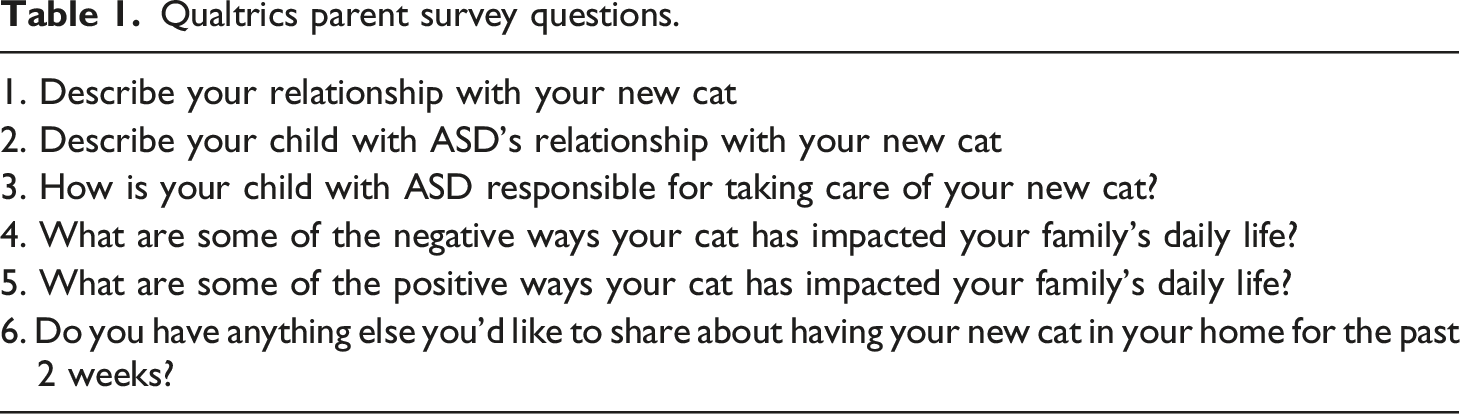
Analysis
Thematic analysis was utilized by applying a systematic approach to identify themes from the written responses of the participants (Braun and Clarke, 2006). Survey responses were entered into data file twice and a comparison technique was used to identify any differences. These differences were compared to the original responses to correct any errors. Three of the six co-authors read and re-read the complete data for each participant with a focus on the aim of the study which was to explore the lived experience of parents of autistic children who adopted a shelter cat. They then read and re-read the data organized by week. Each of the three team members independently developed codes for the content of the parent responses based upon these readings. The codes were basic summaries about the experience the team member believed the parent was expressing. The team then met to discuss codes and their definitions. Co-authors then reread the data, reflecting on the coding options and met after to discuss and reach an agreement on the content coding. The co-authors then read the data again, reflecting on codes before meeting to discuss themes. The themes were developed by looking at similarities and patterns in the previously agreed upon codes. Themes were agreed upon by each co-author before being counted. The act of reading the data multiple times and collaborating allowed the co-authors to feel confident that the themes are a direct result of the meaning of each data point.
Results
Ten families participated in the study. The mean parent age was 37.2 years old with nine being mothers and one grandmother. Homes included a range of 1–7 children with a mean of 3.4. Seven parents were Caucasian, two Native American, and one African American. Family income ranges included one with <$39,999, three with $40–64,999, and three with $65–99,999. One parent had a high school degree, five had some college coursework, and four had a college degree. Six parents were married, three divorced/separated, and one had never married. The children with ASD ranged from 6 to 14 years old with a mean of 9.0. Two children were female and eight were male. Six of the families included companion animals other than cats at the time of enrollment in the study. The mean cat age at adoption was 18.4 months with three male and seven female cats. Two cats were relinquished prior to completion of the study. One cat was relinquished at week six per the parent description of the cat soiling outside the litter box and not bonding with the child. The second cat was relinquished at week 12 per the parent description that the cat cried all day while her child with ASD was away at school.
Parent perspectives of shelter cat adoption.
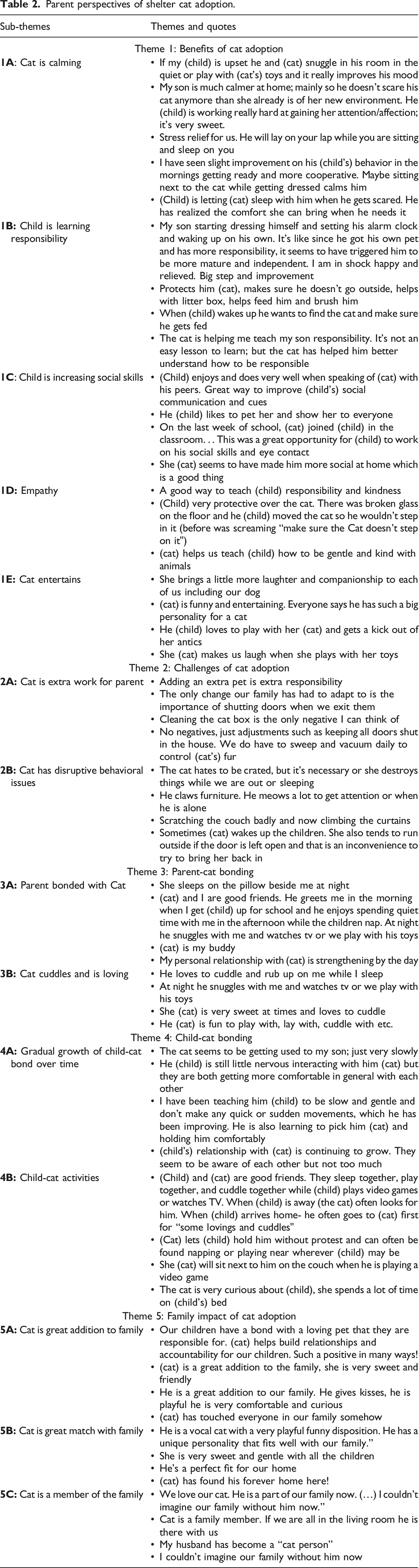
Parents reported that the cat had benefits for the autistic child and themselves. Indeed, individual members of the family developed a bond with the cat, as did the family as a whole. Challenges also emerged from interviews. These challenges were rooted in both the extra care required of the parents and the cats’ behaviors.
Discussion
As noted previously, there is a paucity of research on the experience of cats adopted from shelters. Families of autistic children commonly own cats (Carlisle, 2014): creating an urgency to understand the experience of the children, parents, and their families so professionals might better support families. Social workers may provide information to parents of autistic children on the pros and cons to cat ownership allowing parents to make more informed pet ownership decisions (Foster, 2015). In addition to this, future research might be targeted based on these exploratory findings.
Benefits emerged from the data and among those was the calming influence associated with the families’ newly adopted cats. Our findings echo those of Hart et al. (2018) who found that parents perceived a calming effect of their cats on their autistic children. Studies of CAs, including cats, have also found an observed calming influence for autistic children (Harwood et al., 2019). Anxiety is a common co-occurring diagnosis in ASD so the calming presence of a cat might be particularly important. Other benefits for autistic children have been associated with CAs including learning responsibility (Carlisle, 2014; Carlisle et al., 2018, 2021), were also found this in our study. Parents in our study described their children taking responsibility for their cats by feeding, watering, brushing, and playing with their cats. In Erickson’s (1968) developmental stage of Industry versus Inferiority, school aged children progress through this stage in part by learning to take responsibility and successfully accomplish tasks. Parents of typically developing children often cite the opportunity to learn to be responsible as part of the rationale for adding a CA to the family (Fifield and Forsyth, 1999). By contributing to care-taking tasks for their cat, autistic children may develop pride in their ability to care for their cat, with this skill aiding them in their development. Additionally, being successful in these tasks may improve self-confidence, which has been found to be an important coping mechanism of autistic youth as they transition to adulthood (First et al., 2019).
Social skills are a core difference for autistic individuals (APA, 2013). Parents in our study identified the arrival of their cat with improved social skills for their autistic children. Greater social skills have been associated with CA for autistic children (Byström and Lundqvist Persson, 2015; Carlisle, 2014; Carlisle et al., 2021; Grandgeorge et al., 2012). The parents in the present study reported the cat had helped their child develop empathy. Our finding echoes those of Harwood et al. (2019) who found parents perceived the experience of living with a dog to aid autistic children’s understanding of others including the expression of empathy. Parents perceived entertainment benefits for the autistic child as well as the whole family. A study of families of autistic children found entertainment and happiness to be a common benefit of dog ownership (Carlisle, 2014). An affectionate cat could provide a positive relationship for the child and complement parental affection and be emotionally beneficial, or perhaps even serve as a gateway to other social interactions for the child. An autistic child may be taught not only to interact in a manner similar to their peers, but also to partially care for the cat and even communicate verbally with the cat (Hart et al., 2018).
The parents in our study also reported challenges due to bringing a cat into their home. Parents of autistic children rate themselves as highly stressed (Vogan et al., 2014), so it might be expected that the addition of a new CA into the home would add a burden for these parents. Cat as extra work for parent was a sub-theme. Parents noted the extra cleaning, specifically cleaning the litterbox and vacuuming, as well as needing to supervise the child in the feeding of the cat. Monitoring the household doors to prevent the cat from accidently exiting the home with children in the family not accustomed to taking care to prevent this occurrence was also a challenge. Added caretaking responsibilities for parents were found in other studies of CA ownership among families of autistic children (Carlisle et al., 2018; Wright et al., 2015). Another sub-theme was disruptive cat behavioral issues. Destruction of furniture through clawing was a specifically identified challenge. While no other studies have explored cat behaviors in families of autistic children, studies of cat owners rate unwanted scratching behaviors as present in 52% of homes (Wright et al., 2015). Scratching posts were provided for each family in the study on adoption of their cats, along with the offer of consultation by a veterinary behaviorist; however, none of the parents desired this support. In a study of 6,089 relinquished cats, only 1% were reported returned for scratching behaviors (Casey et al., 2009), and of the two relinquished cats in this study neither was reportedly related to scratching.
Parents described close relationships with their cats that included spending time together and the cat being especially affectionate with them. As the decision-makers in acquiring a CA for the family, parents report adding an animal for their own companionship, as well as that of their children (Carlisle, 2014). Parents’ bond with their CA has been associated with their perception of greater benefits, and this in turn was associated with a rating of less parent stress (Carlisle et al., 2020). Affection from a cat might be especially important for parents of autistic children, as some autistic children are less demonstrative in their expressions of affection (Attwood, 2007).
While parents quickly developed bonds with the cat, the relationship took time to develop for autistic children and their cats. Parents identified the need to teach their children to be gentle and quiet as loud and rough behaviors were frightening to the cats. Reportedly, as children learned to modify their own behaviors, the cats began to spend more time with the children in activities such as snuggling, watching TV, playing video games, or just being in the same room together with the child. A study of cats in families of autistic children found 78% of children demonstrated at least some affection for the cats with activities including snuggling, sleeping, petting, holding, talking, and reading to their cat (Hart et al., 2018).
When CAs are adopted by families, the impact is experienced by all family members, even if the targeted companion is only one member of the family such as the autistic child in this study. Despite the added responsibility of caring for the cat, parents reported their cats were a positive addition to the family. Relationships with the cat extended to parents and siblings. One parent described their cat as a “perfect fit for our home.” Benefits of CA in families of autistic children have been associated with those animals being a good fit for the family (Carlisle et al., 2018).
Limitations of this study include the lack of a control comparison group of parents of typically developing children who adopted a shelter cat screened for the same age range and temperament, as well as the lack of diversity among our participants. The small sample size limits the ability to generalize the findings. While children in the study were required to have a diagnosis of ASD, we did not include other variables such as Intelligence Quotient or verbal ability. Children who differ in these characteristics may have interacted differently with their cats. Additionally, the survey only followed the parent experience for 18 weeks after adoption and experiences may change over a longer period of time.
Conclusion
We found parents of autistic children perceived their children could conceivably benefit emotionally, and perhaps cognitively, from the affection that an appropriate pet cat could provide. While cats created extra work for busy parents, this was often balanced by the positive relationship parents developed with the cat, along with the benefits for their autistic child and the family as a whole. Future research examining the experience of shelter cat adoption by families of autistic children would be beneficial as it is not possible to generalize with this exploratory study.
Footnotes
Acknowledgements
We appreciate the commitment of the parents who participated in our study and the partnering shelter organizations and their staff. We also appreciate the recruitment assistance of the University of Missouri Thompson Center for Autism and Neurodevelopmental Disorders.
Authorship contributions
Gretchen K Carlisle provided substantial contribution to conception and design of the study, coordinated data collection, analyzed and interpreted the data, wrote the initial draft of the manuscript, revised and approved the manuscript for final submission.
Angélique Lamontagne analyzed and interpreted the data, assisted with the initial draft of the manuscript, revised and approved the manuscript for final submission.
Sandra Crowder analyzed and interpreted the data, assisted with the initial draft of the manuscript, revised and approved the manuscript for final submission.
Jessica Bibbo participated in the design of the study, provided revision and approved the manuscript for final submission.
Rebecca A Johnson provided substantial contribution to the conception and design of the study, revised and approved the manuscript for final submission.
Leslie A Lyons participated in the design of the study, revised and approved of the manuscript for final submission.
Declaration of conflicting interests
The author(s) declared no potential conflicts of interest with respect to the research, authorship, and/or publication of this article.
Funding
The author(s) disclosed receipt of the following financial support for the research, authorship, and/or publication of this article: This work was supported by the Human Animal Bond Research Institute (HABRI) (HAB 17-001) and the EveryCat Health Foundation (W17-031).
