




Abstract
Welfare organisations across the world are becoming more streamlined with less time for building relationships with clients, rendering non-governmental organisations increasingly important for welfare provision. In this paper, we investigate an understudied area in social work: the small talk through which volunteer organisations conduct social work tasks in interaction with clients. The data consist of 108 phone calls to a helpline that offers social contact to older people, recorded in 2020 in Sweden. We use conversation analysis to investigate how callers and call-takers rely on and produce informal sociability in providing support for clients. Specifically, we show that talk about the weather, a prosaic small talk topic, is interwoven with institutional work. By allowing or preventing outdoor activities, weather is a conduit for call-takers and callers to introduce and navigate norms of remaining active as an older adult. Cultural understandings and concerns about good or bad weather allow participants to move between reproducing client/service-provider asymmetries and reaching affiliative affective stances. Thus, the supposedly banal topic of the weather, known as a resource for sociability amongst the unacquainted, is, in this setting, used in ways particular to social work practice.
Introduction
In many countries, welfare organisations are becoming more streamlined with less space for the small talk with clients that builds social relationships. This streamlining has been notable in Sweden, where the predominantly social democratic welfare regime has developed in a liberal market direction (Kamali and Jönsson, 2018). In this process, the role of non-governmental organisations (NGOs) has grown so that their previously residual activities are now part of the regular provision of welfare services (Linde and Scaramuzzino, 2017; Vamstad, 2018). Existing studies indicate that voluntary-based services are less bureaucratically constrained and, consequently, volunteers have more time to engage with their clients (Kåks and Målqvist, 2020; Phillimore, 2019). The social contact that these services offer is an understudied area of social work (but see Jones and Pastor, 2017; Washington, 2013).
In this paper, we investigate the business of such a service – a helpline for older people which, according to the organisation’s website, offers ‘support from a fellow human being’, an anonymous friend who ‘listens’ rather than provide therapy or advice. Because decline in health in older age is related to isolation, talk that informally probes social contact becomes an important part of the social work task (cf. Coupland et al., 1992). In a study of a peer-run warmline, Pudlinski (1998) notes that although clients may talk about their problems during calls, many people call just to tell someone about their day (cf. Pudlinski, 2009). Making small talk with a client about their day might seem irrelevant but informal sociability is significant in accomplishing organisational work (Boden, 1994). For example, in medical settings small talk helps caregivers and caretakers to start meetings (Maynard and Hudak, 2008) and to disattend intrusive procedures (Benwell and McCreaddie, 2016; Maynard and Hudak, 2008). Despite its presence in communication with clients, however, small talk has received marginal attention in social work research and practice.
Using conversation analysis (CA), we begin to fill this research gap by investigating how callers and call-takers rely on and produce informal sociability, that is, orientations to one another unrelated to institutional tasks, in providing support for clients. Unlike previous studies of small talk where the main institutional service is practical (e.g. medical examinations, driving lessons, hair cutting, etc.) our study sheds light on small talk as the central resource for sharing experiences but also for accomplishing social work. As such it shifts from, for example, the symmetries of sharing stories to the asymmetries of monitoring the welfare of the caller, in ways that reflect the abiding relevance of the helpline as helpline. Specifically, we investigate how this is manifest in the quintessential small talk topic of the weather (Coupland and Ylänne-McEwan, 2000), in order to interrogate the entangled character of institutional and informal talk.
Talking about the weather in institutional settings
In their foundational text, Drew and Heritage (1992: 23f) suggest three features that constitute institutional talk. First, at least one of the participants should be oriented to some institutional goal, task or identity, related to the institution’s reason for existing. Second, institutional interaction involves particular constraints on what the participants will treat as acceptable contributions to the business at hand. Third, institutional interaction is associated with inferential frameworks and procedures that are particular to, and make sense in, specific institutional contexts (Heritage and Clayman, 2010: 34). Although small talk is often defined as referentially independent from institutional services (Hudak and Maynard, 2011), CA studies have shown that small talk recognises and maintains social relationships (Holmes, 2000), as well as supports and enables the accomplishment of institutional tasks (Coupland and Ylänne-McEwan, 2000; De Stefani and Horlacher, 2018; Raevaara, 2011).
Weather talk exemplifies both of these points: in a service encounter, weather can be sequentially important for closing the task and reinstating the relevance of the environment outside (Coupland and Ylänne-McEwan, 2000). Weather is also socially significant by offering an object of shared experience and is often considered neutral, non-controversial and impersonal (cf. Coupland and Ylänne-McEwan, 2000; Holmes, 2000; Hudak and Maynard, 2011). Given its occurrence across settings, it is clear that talk about the weather is both utterly common and perpetually available (e.g. Benwell and McCreddie, 2016; Holmes, 2000; Hudak and Maynard, 2011). Coupland and Ylänne-McEwan (2000) acknowledge that by drawing on common understandings, people ‘design their comments about the weather to elicit evaluative consensus’ (Coupland and Ylänne-McEwan, 2000: 170), for example, by exaggerating its impact. Below, we use an excerpt from a café service encounter to illustrate the functions of weather small talk. The example is typical for this setting, where the waitress initiates small talk by asking about the customer’s day, while finishing payment. It begins as she hands the change from payment back to the customer.
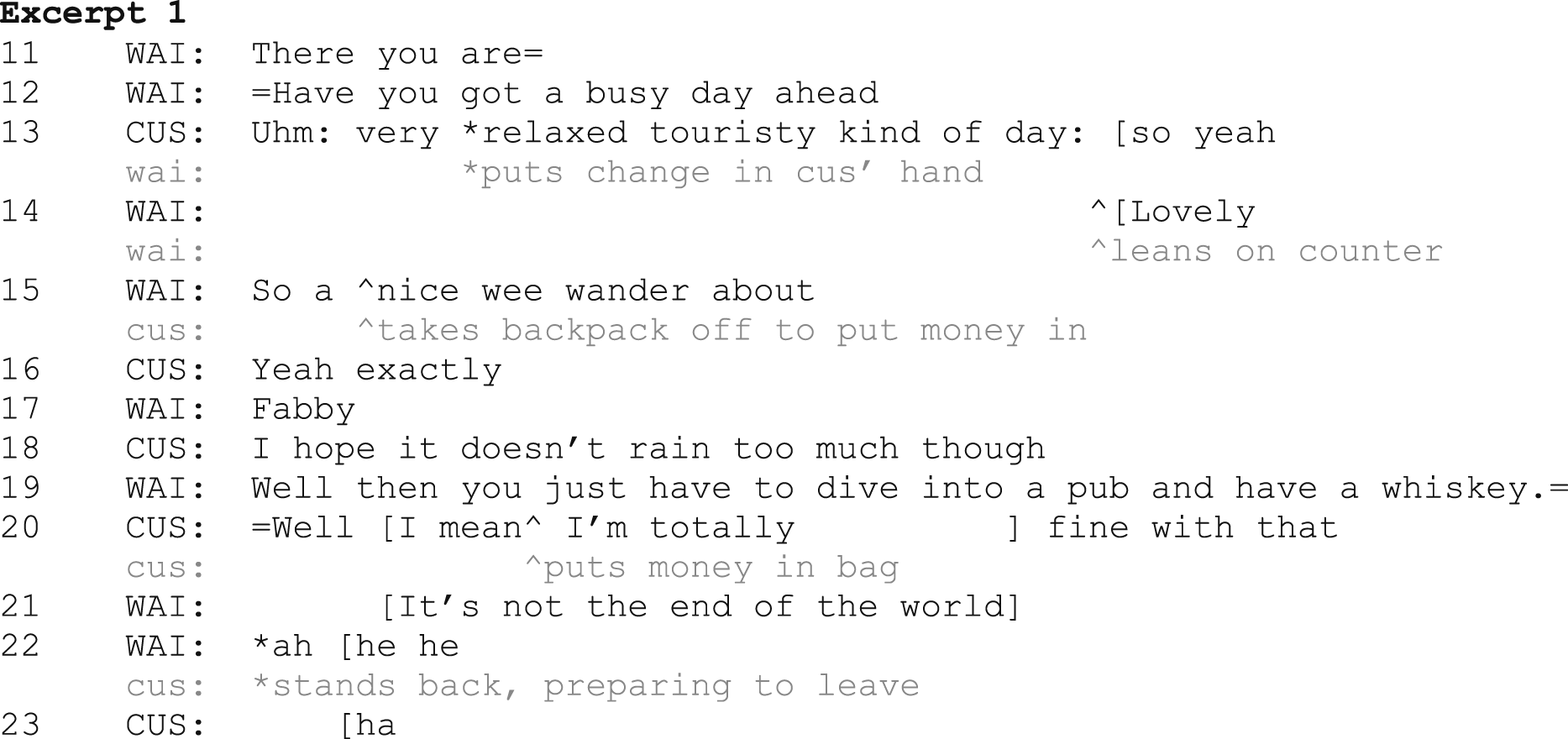
The question ‘Have you got a busy day ahead’ (l.12) is recognisable as a small talk initiating question, because it is talk that is no longer relevant to the immediate task of paying. It allows for minimal or more elaborate story-telling in response, from ‘certainly have’ with then a rapid departure, to a slightly longer series of turns (cf. Raevaara, 2011). At line 17, with the person’s identity as tourist implicitly recognised, the waitress offers a potential closing of the small talk. However, the customer shows her willingness to extend their encounter a little longer by linking her activities to the weather (l.18). Already we can see in this excerpt how weather talk allows the staff to learn more about their customer’s activities, build affiliation, and even get cues about the customer’s character through their stance on ‘bad’ weather. Participants’ seemingly symmetrical rights of knowing and assessing weather and its projection of activities thus make it a useful resource for café staff building relationships with customers or, of course, helpline volunteers building relationships with callers.
As we have noted earlier, our study examines weather talk in the institutional setting of volunteer support where providing social contact is the core service and where there are loose constraints on institutionally legitimate topics (cf. Drew and Heritage, 1992). Calling for social support can involve a range of different activities and although callers may contact the helpline regularly, their anonymity means that there is little possibility to specify and work towards a goal over time. This, and the volunteers’ lack of a professional mandate to provide advice, means that call participants ought to focus on other matters than ‘fixable problems.' Despite participants’ anonymity, small talk on the helpline is close to the interactions studied by Drew and Chilton (2000) between friends and family members who call ‘just to keep in touch.' The helpline is characterised by participants reporting observations about their local environment and describing or asking about daily happenings with the entitlements to do so that we would expect of friends and family.
Nevertheless, doing social work rather than friendship or family is inescapable in the helpline because one participant is a service-provider and the other a client. Previous research has noted a mismatch between nondirective agendas and frequent advice-giving in helplines (e.g. Pollock et al., 2010; Iversen and Westerlund, 2022) and described various practices through which participants bring off advice in ways that promote callers’ authority (e.g. Butler et al., 2010; Pudlinski, 1998). In this sense, the volunteers can then also be understood as producing themselves as social workers when they move to providing advice instead of attention or sympathy. By showing how callers and call-takers infer meanings from weather talk – in particular, a recurrent sequential and logical relationship between weather formulations and being outdoors/indoors – we close in on the intertwined accountabilities of activities related to establishing a relationship between fellow human beings who share the same weather-related sufferings and pleasures, and activities where one is coaching and solving problems for the other as doing social work.
Data and methods
The main source of data for this study is calls to a helpline for older people, recorded in the summer of 2020. The ‘Ageing Line’ is an anonymous phone service providing peer support (medmänskligt stöd, literally translated to co-human support). It is run by an NGO in Sweden and is staffed with trained volunteers who themselves are often senior citizens. The number of calls received at the helpline increased rapidly during the course of the Covid-19 pandemic and hundreds of new volunteers were recruited to meet the demand. The situation for older people during the pandemic elevated the need to replace previous social contacts with interactions that were safe (Iversen et al., 2021), but the increased number of calls over time also aligns with a general development: as a consequence of more restricted resources for public welfare services, welfare staff are today to a lesser extent able to provide informal social support in the form of conversation separate from, or as part of, the provision of other services.
Following ethical approval by the Ethics Authority in Sweden (Dnr 2020–01808), all calls were recorded during the two months we collected data, resulting in 108 calls (about 32 hours of audio). The average length was about 18 minutes and 80% of calls were made by women. Both the call-taker and caller gave informed consent to taking part in the study. Call-takers’ consent was written, whereas callers were given information about the study while waiting to be connected to a call-taker, and were then given the option to participate or not by pressing a button on their phone. In addition, they could withdraw from the study by telling the call-taker during the course of the call or contact the researchers afterwards. Additional written information was provided on a project website. The study also draws on a database of audio-recorded calls to a crisis helpline (Iversen, 2021), and video-recorded data from a study of café interaction (Laurier, 2013), to validate and contextualise the claims made in this article.
The first and second author listened to all calls and made detailed notes, including recurrent topics, such as loneliness, boredom and worry, often related to Covid-19 (cf. Iversen et al., 2021). In initial CA data sessions, the conditions for small talk were identified as a key phenomenon in this setting. In the broader analysis of small talk activities, weather talk was singled out as particularly relevant to focus on since it exemplified the way small talk and institutional tasks were intertwined on the helpline. The analysis is based on the 39 fragments in which weather was mentioned. These were transcribed according to CA conventions (Hepburn and Bolden, 2014) and analysed with regards to how talk about the weather was positioned in interactional sequences and how participants set up and responded to constraints, for example, with grammatical and lexical choices, as well as stance (e.g. Hoey and Kendrick, 2018). The analysis is presented with excerpts including original Swedish as well as literal and idiomatic English.
Analysis
Weather talk at the Ageing Line features in the collaborative production of three activities: listening, sharing of experiences and advice-giving. In the following sections, we show how weather is mentioned in ways that assume participants’ equal access to and similar assessment of the weather. In advice-related activities (Section 1) as well as in talk conveying negative (Section 2) and positive (Section 3) assessments of the weather and its consequences, we see how callers and call-takers draw on unstated knowledge about the weather to display a normative orientation towards being an active older person. The analysis shows that while weather talk serves as an important element of the helpline’s focus on providing support from a fellow human being, it never fully escapes from call-takers’ orientations to the role of service-provider in terms of offering advice, ‘listening’ and promoting an optimistic stance.
Linking weather to proper activities
While helplines’ staff guidelines commonly warn against advice-giving, studies show that advice is, nevertheless, given (e.g. Pollock et al., 2010). In this section we show how the weather provides grounds for advice, in this case, suggestions about the caller’s capacity to be active outdoors (cf. Coupland and Ylänne-McEwan, 2000). We start with an example from a call closing to show how, as an obstacle, ‘bad weather’ is used to justify the callers resting. Just prior to the excerpt, the call-taker suggested that the caller should think about nice events the following day, when her relatives are coming to visit. The caller offers a weak agreement and the call-taker pursues a more optimistic uptake:
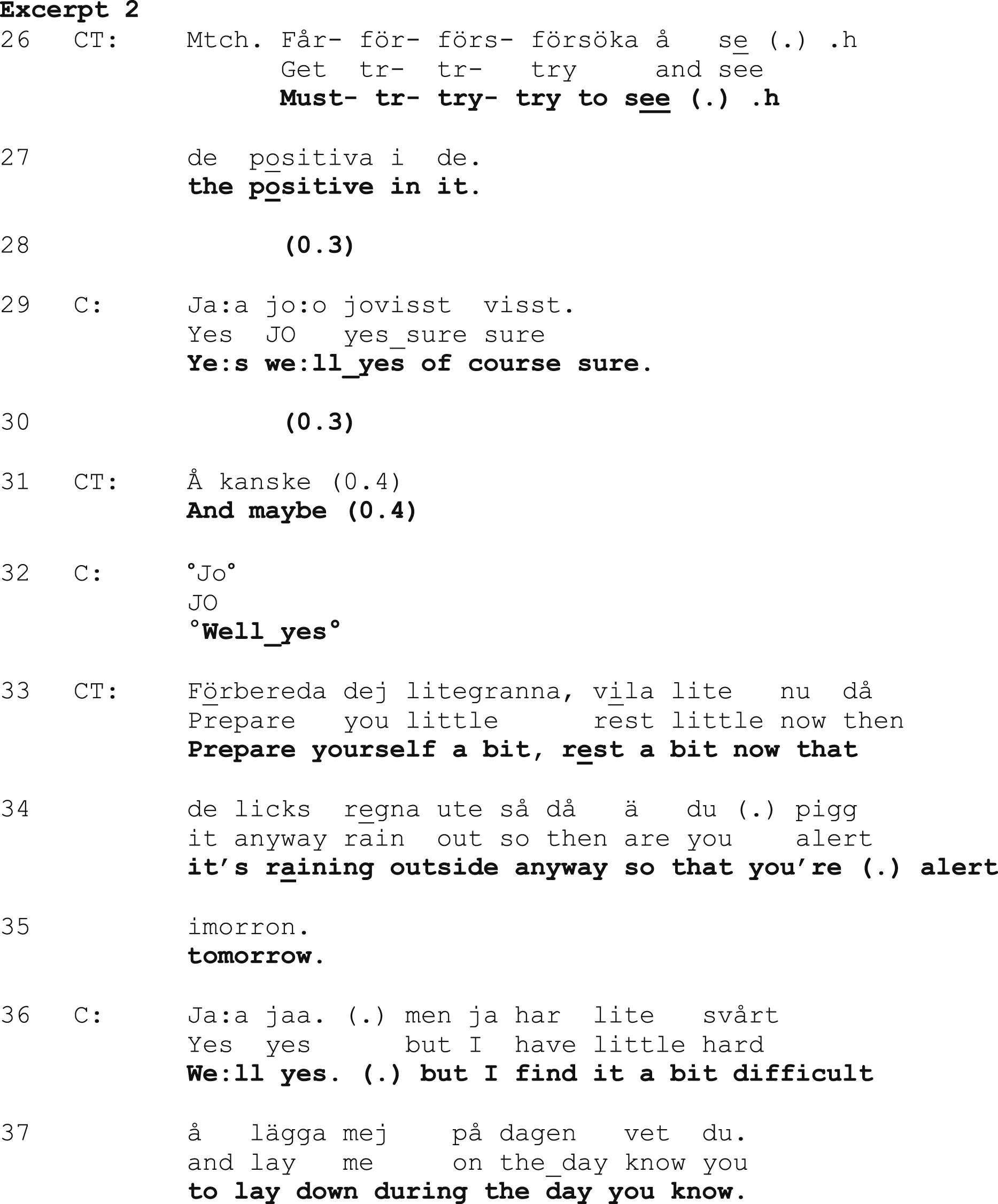
During this closing, the weather can be understood as a resource among others (resting and tomorrow’s meeting with relatives) to orient the caller to the world outside of the phone call (cf. Coupland and Ylänne-McEwan, 2000). A first observation is thus that the call-taker mentions the weather in relation to appropriate activities: while bad weather is invoked to suggest something for the caller to do, it is something that is not effortful and allows for ‘staying in’ (‘rest a bit now that it’s raining outside anyway’ l.33–34). We can begin to see the caller and call-taker establishing ‘in’ and ‘out’ as inference-rich terms, connected to activity and inactivity. Because daily activity is strongly linked to a cultural norm about successful ageing (cf. Torres, 2002), talking about resting due to bad weather introduces an exception to this norm: bad weather is treated as a legitimate reason for inactivity – even though the caller then resists the suggestion (l.36–37). There is then also a permission for ‘good’ staying in, further secured in connecting it to sociability the next day.
The call-taker’s suggestion to rest in order to be alert the day after (l. 31, 33–35) is hearable as an institutional activity similar to that found in other nondirective helplines (e.g. Butler et al., 2010). Bad weather, as a means of accounting, produces the suggestion as non-controversial and downplays the asymmetry otherwise invoked by advice-giving (Vehviläinen, 2001) – both parties are assumed to access knowledge about the weather’s state and implications. In this sense, the suggestion is reminiscent of how suggestions are brought off in informal relationships (Shaw and Hepburn, 2013). Thus, in the activity of suggesting proper actions, the weather works as a resource to promote an informal and symmetrical relation between the caller and call-taker.
The next excerpt also features an orientation to rainy weather as an obstacle to outdoor activities, but this time as something to overcome. We enter the call as the call-taker is offering an assessment (l.38) in response to the caller’s story of how people are now received at the hospital by gatekeepers because of Covid-19 restrictions. The call-taker then launches a new topic, asking about the caller’s habits of going outside (l.39):
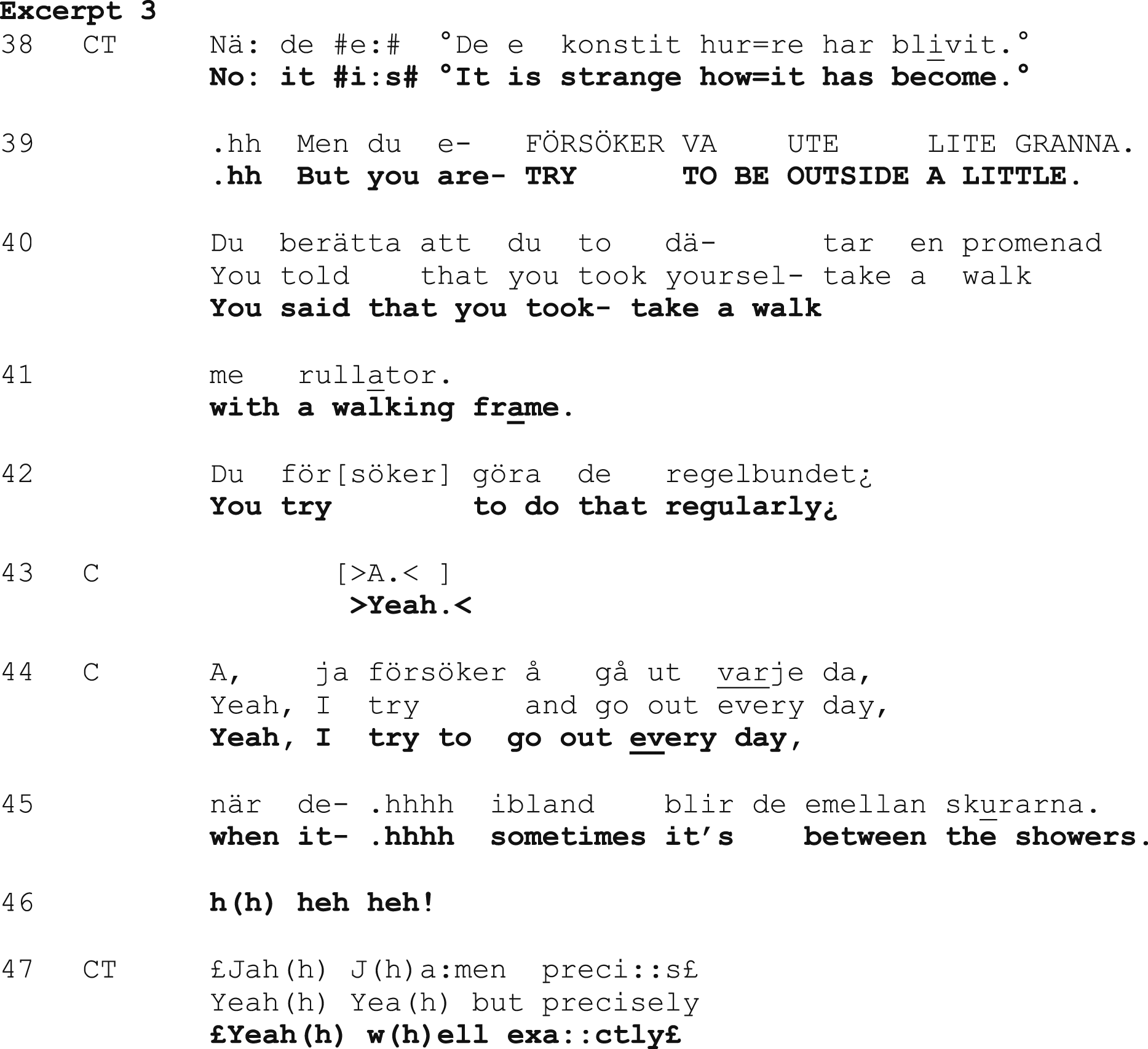
The call-taker refers to her indirect access to the caller’s activities: ‘You said that you took- take a walk’ (l.40), thereby providing a warrant for her assumption (l.39). She then asks a second declarative question, ‘You try to do that regularly’? (l.42). This grammatical format invites the caller’s confirmation (Heritage, 2012) and assumes that the call-taker knows the facts (Houtkoop-Steenstra, 2000), so rather than eliciting information, the call-taker can be heard as initiating talk about the virtues of being outdoors regularly. Similarly to Excerpt 2, the call-taker implies, rather than asserts, the normativity of walking, softening the asymmetrical dimension of this as advice (cf. Butler et al., 2010; Pudlinski, 1998). The lexical choice, ‘try’, (l.39, 42) allows the caller to confirm the call-taker’s understanding, as well as to reveal difficulties to conform to the norm (Flinkfeldt 2011).
In response, the caller displays her strong commitment to ‘go out’ (l.44), upgrading the call-taker’s unspecific ‘regularly’ (l.42) to an emphasised ‘every day’ (l.44). She picks up the orientation to potential failure with ‘try’ (l.42), but rather than describing failure, she presents herself as someone who will still go out, despite obstacles. This upgrade is aligned with the advice implications of the call-taker’s turn, but by showing that she is already acting according to the norm, she makes advice superfluous. She is thus aligning with the content of the advice, while resisting the role as someone in need of advice (cf. Shaw and Hepburn, 2013). Like in Excerpt 1 the weather is treated as a potential problem that people can overcome. This light approach to weather is evident in the caller’s laughter (l.46) and how the call-taker reciprocates the caller’s turn with upgraded agreement (l.47). Rain showers become a problem over which the participants can come together, establishing what kind of persons they are. Like in the call-taker’s mentioning of bad weather as a reason to rest in Excerpt 2, referring here to ‘showers’, while assuming that the call-taker can make relevant inferences, contributes to establishing a symmetrical relationship.
In these initial examples, we see the participants moving between advice-implicative actions and the weather, presenting themselves as active older persons, built from what kind of person stays in and what kind goes out. We are beginning to get a feel for the intertwined nature of institutional talk and informal sociability, where references to shared knowledge and unstated implications about the weather relax, even as they maintain, the institutional identities of service-provider and client. In the following analytic sections, we will look more closely at small talk related to a focus on callers’ situation, on the one hand, and reciprocal building of social relationships, on the other. We start with call-takers’ prioritising ‘listening’ and positive stances on the weather over the sharing of experiences.
Delayed or absent sharing
In this section, we examine callers’ topicalisation of the weather and call-takers’ delayed or absent cooperation in establishing a shared understanding about its implications. Excerpt 4 comes after the caller, in response to the call-taker’s question, has described outdoor activities as a necessity, thus displaying being an active older person. She immediately elaborates by introducing ‘rainy and bad’ weather as a new topic, which is oriented to as an obstacle by the contrast-prefacing ‘But’ (l.23–24):
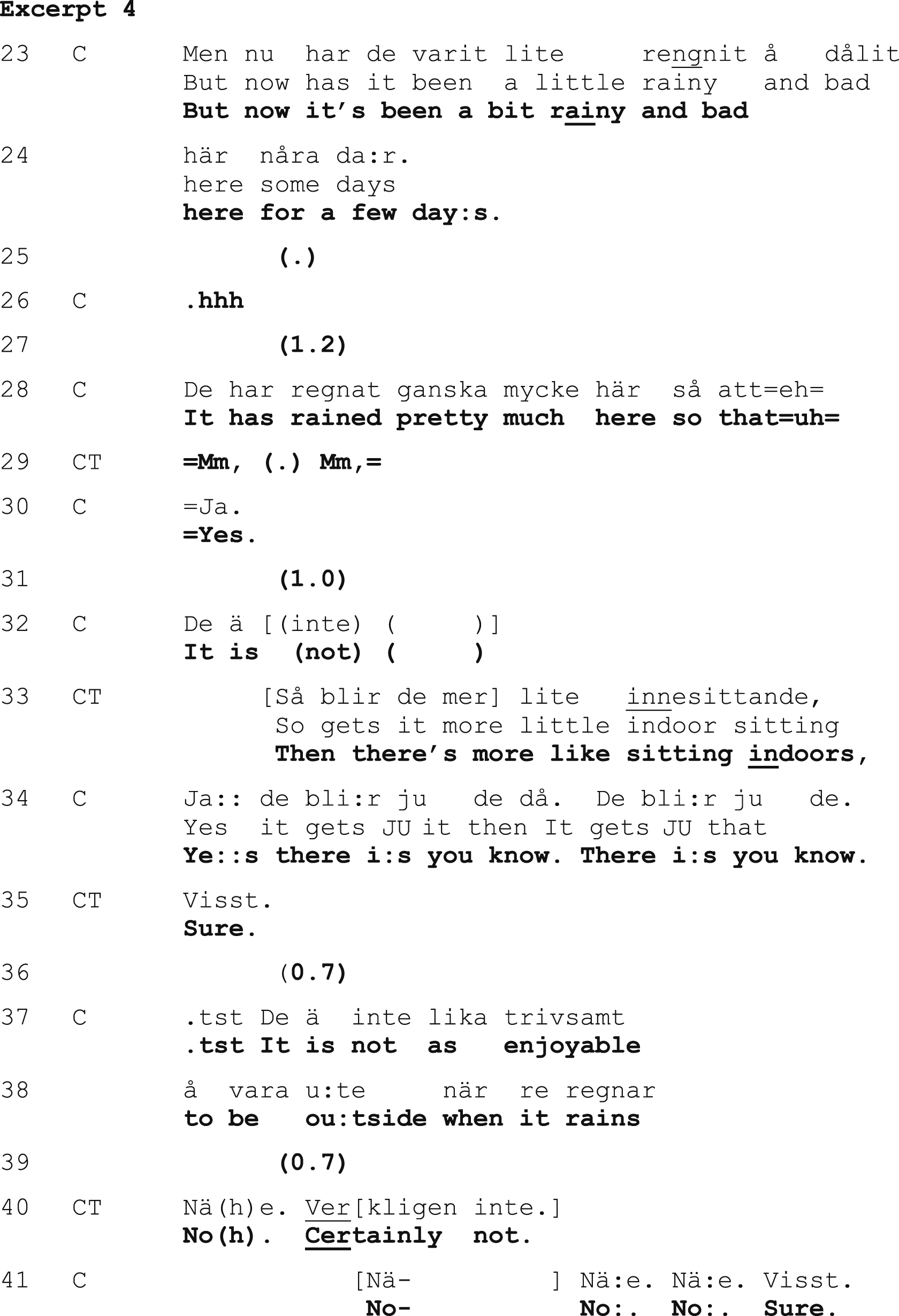
The institutional peculiarity of ‘listening’ and offering ‘support from a fellow human being’ are notable in this excerpt. By informing the call-taker of a lengthy period of rainy weather (l.23–28), the caller is building up the weather as a problem. In interactions between friends, such informings can relevantly be responded to with the call-taker’s reciprocal telling of their weather or sharing knowledge of the caller’s weather (Drew and Chilton, 2000: 152–153). Here, the call-taker instead treats the caller as unfinished by refraining from reciprocating (l. 25–27). The caller pursues a response by offering more information about her local situation, ‘here’ (l.28), which emphasises the caller’s situation in relation to other places, such as – of course – the call-taker’s. Ending the turn with ‘so that=uh’ (l. 28), the caller orients to an unstated inference regarding the weather (cf. Raymond, 2004). The call-taker still treats this as information under way (l.29), thereby giving the caller another chance to make the inference explicit. Thus, while the caller’s contributions here can be seen as small talk, common in talk between family and friends – offering information about her situation and inviting the call-taker’s contribution – the call-taker’s lack of uptake can be seen as an orientation to the institutional constraints of ‘listening’ and being anonymous by not sharing private information. We can thus see both a tension and an ambiguity between institutional tasks and the mutual building and maintenance of social relationships (cf. Holmes, 2000).
Then, in overlap with the caller’s turn, the call-taker formulates her understanding in terms of its upshot for going out or staying in: ‘Then there’s more like sitting indoors’ (l.33). Thus, the call-taker responds to the caller’s information as related to the previously established norm of daily activity as a must, and treats bad weather as an acceptable reason to stay indoors. The caller confirms (l.34–35), using the adverb ‘ju’, an epistemic marker that appeals to shared knowledge (Heinemann et al., 2011), thereby assuming that the call-taker’s assessment of the weather is self-evident to both of them. She then resumes her turn (l.32) as an object-side assessment (Edwards & Potter, 2017) that treats the experience as shared: ‘It is not as enjoyable to be ou:tside when it rains’ (l.37–38), to which the call-taker offers strong agreement (l.40). Accordingly, what initially seemed like small talk is subtly turned to focus on the caller’s situation in relation to the norm of going outside. We can see the call-taker’s orientation to institutional constraints as she promotes the caller’s unpacking of her experiences, rather than a symmetrical sharing. The institutional identities as service-provider and client are established in how weather is treated as relevant as to its implications for each party.
In Excerpt 5, we see a similar case where the potential for social reciprocity is abandoned in favour of elicitation of the caller’s activity. After a routine opening line (l.2) and an exchange of greetings, the caller offers a first topic by assessing the weather as ‘hot now’ (l.7):
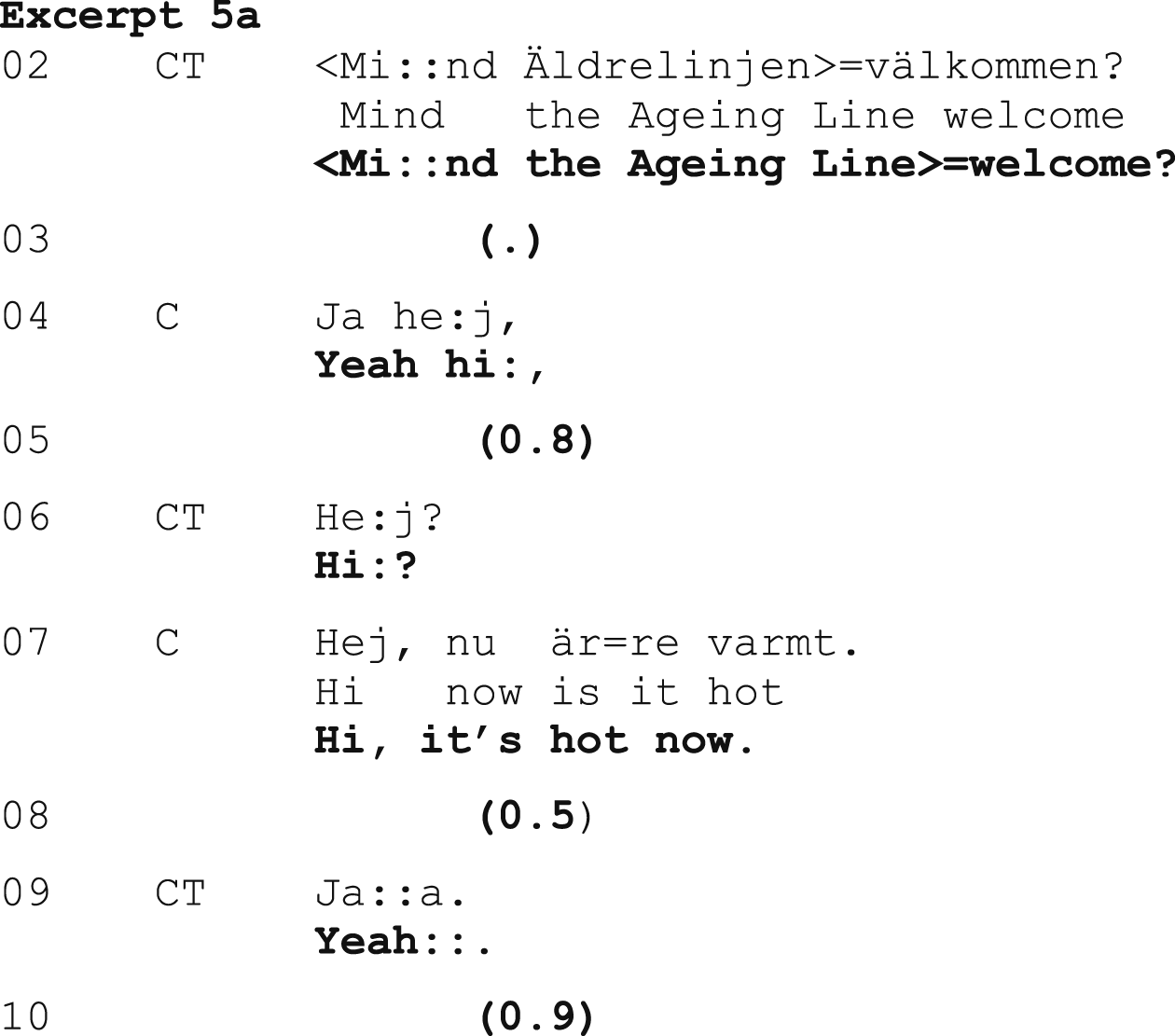
Here, the weather almost appears as the reason for the call: immediately after the call-taker has reciprocated the greeting, the caller announces the temperature (l.7). Yet, while the helpline is there to provide small talk and the weather is a relevant reason for calling, its early placement projects a further development of its implications. Thus, while previous research has shown that weather talk can be related to self-disclosive statements as speakers detail how they are affected by weather (Coupland and Ylänne-McEwan, 2000), we see here that by leaving it to the call-taker to state the emotive expression, the caller treats ‘hot now’ as common knowledge or a shared experience, as might have been the case in the café setting in Excerpt 1. The unstated evaluation creates an opportunity for a second assessment or story (Laurier, 2013). However, the call-taker simply produces a receipt (‘Yea:h’, l.9), waiting for the caller’s more explicit stance on hot weather which does indeed appear in the next turn:
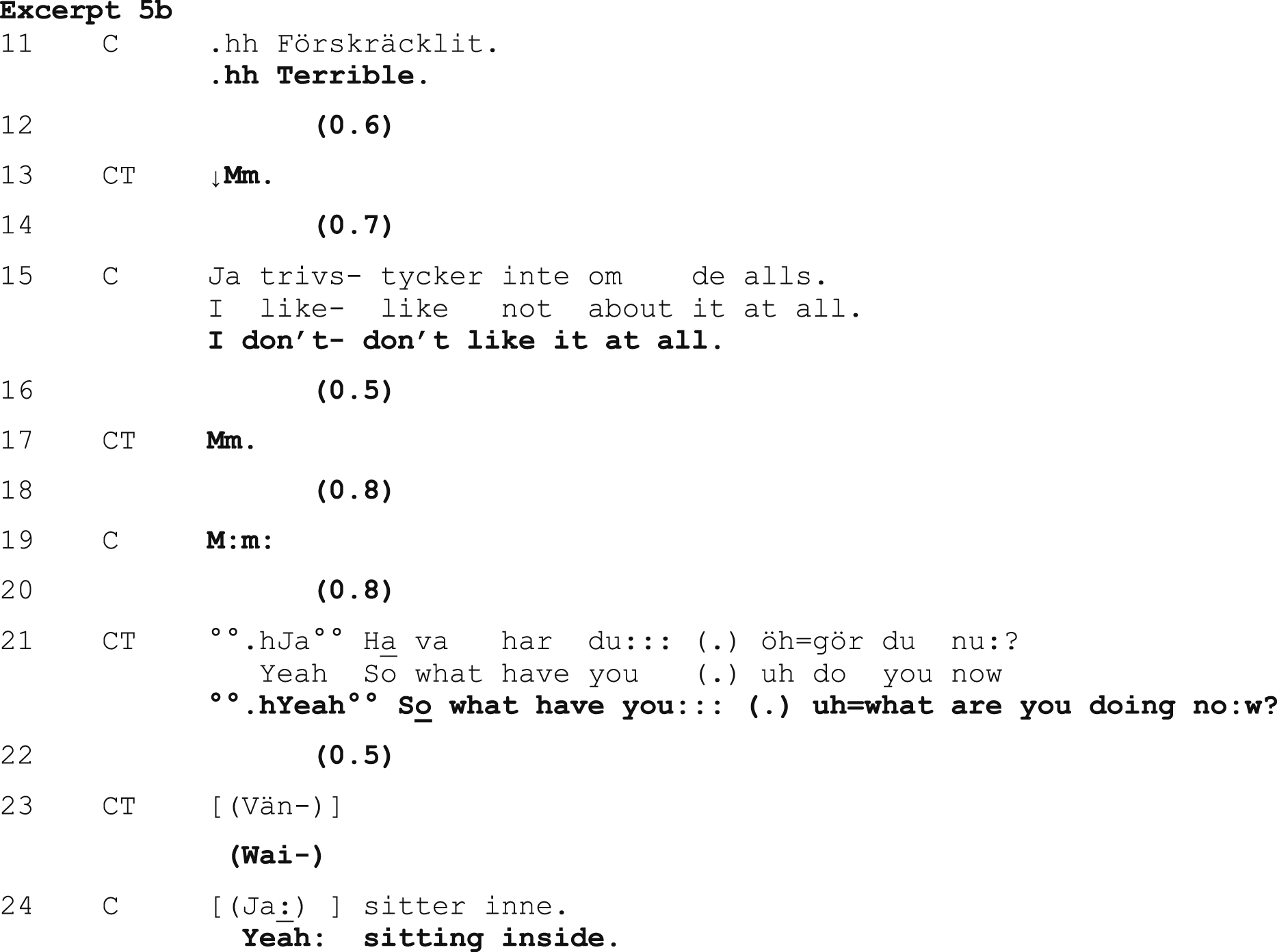
Given that the negative assessment, ‘terrible’, is not accounted for, the caller is treating the assessment of hot weather as a complainable matter based on shared understanding. The call-taker’s continuer (l.13) is noticeably delayed and minimal. The caller then redoes her assessment as subject-side, ‘I don’t- don’t like it at all’ (l.15), which does not place the same requirements on the call-taker to offer a second assessment (cf. Edwards and Potter, 2017). Without attending to the assessment, the call-taker takes the opportunity in her next turn to transition to a new topic: ‘.hYeah So what have you (.) uh what are you doing now’? (l.21). The hedging, interruption and repair display the call-taker’s effort at initiating a new course of action, and to move away from the current one – complaining.
Similarly to Excerpt 4, the call-taker can be seen as doing ‘listening’ rather than sharing. In terms of a fellow human being to talk to, this stresses the institutional identities as someone who is there for the other. In a place where the call-taker could have offered her own experience or shared the caller’s negative assessment of the weather (Excerpt 5a, l.8, 9, 10), she shifts the topic to the caller’s activities. As we have seen, current activities constitute another small talk topic that can relevantly be raised in relation to the weather. With ‘Yeah sitting inside’ (l. 24), the caller produces a conforming response while resisting the topic shift introduced by the call-taker and, instead, delivers what becomes an upshot with ‘inside’, building on the hot weather as an obstacle to going out.
Previous research (Iversen et al., 2021) shows that callers to the ‘Ageing Line’ categorised old people who complain as problematic; in fact, one reason for turning to the helpline, mentioned by callers, was to avoid burdening close ones with complaints. One explanation for the lack of affiliation around ‘bad’ weather lies in the potential conflict between the two institutional tasks at work: a broader social work agenda of encouraging potentially isolated callers to go out, on the one hand; providing the sociability that is to be found in small talk through reciprocating tellings or affiliating with assessments about bad weather, on the other. (Jefferson and Lee, 1992: 546) documented a similar conflict between troubles-telling being responded to with ‘emotional reciprocity’ versus advice-giving and the difficulties of moving between the two. In our analysis so far, we can see the call-takers orienting to bad weather in relation to outside activity rather than shared experience/suffering.
In Excerpt 6a, the caller explicitly orients to complaining as a problematic activity, while seeking a shared affective stance about the weather. The caller has initially mentioned that it was difficult to get through to the helpline and then raises the topic of weather.
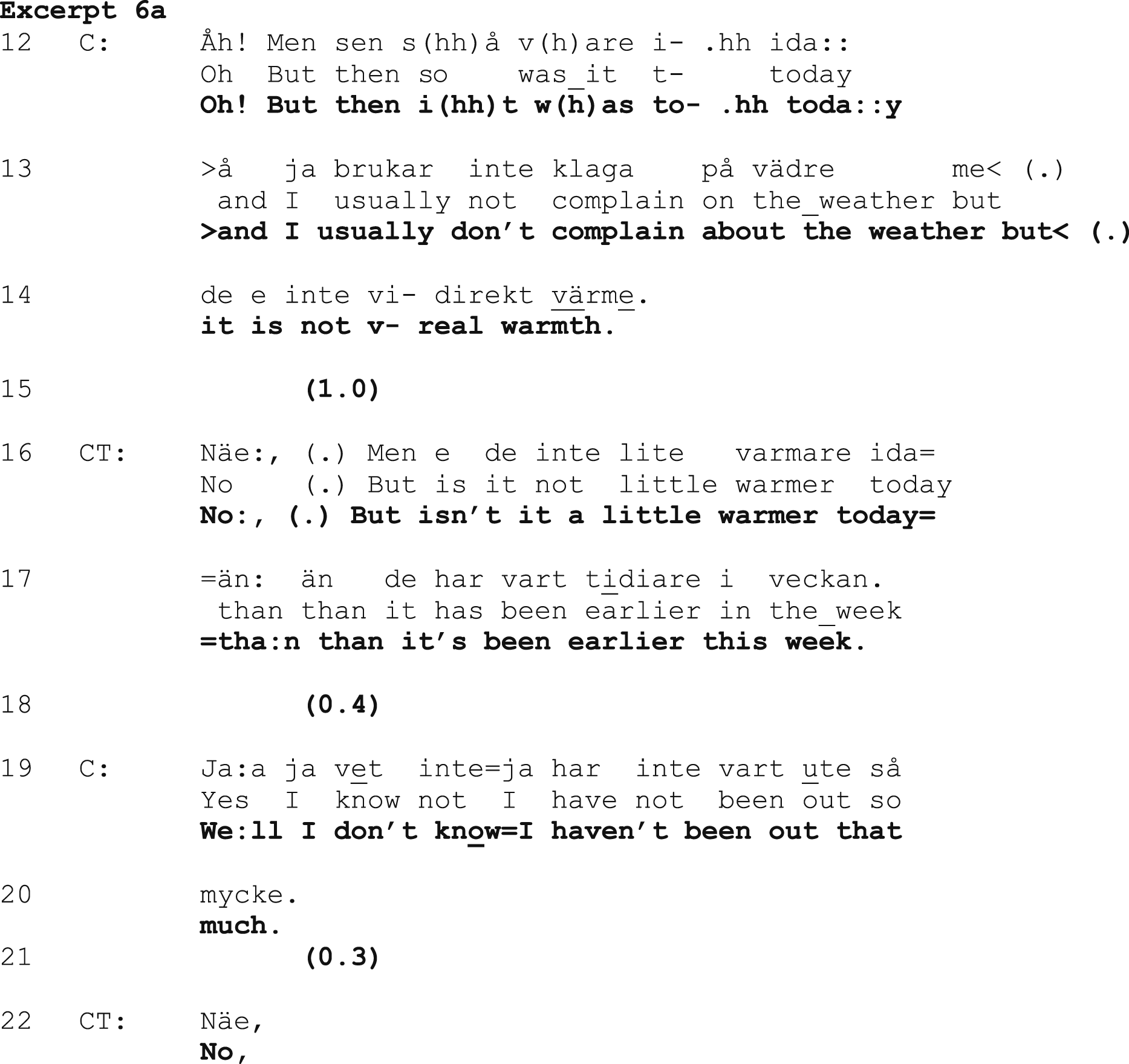
With the disclaimer, ‘I usually don’t complain about the weather’ (l.13) the caller works to produce this as a proper complaint rather than stemming from her being, for example, a ‘whinger’ (cf. Edwards, 2005). The call-taker’s response is dispreferred: ‘No’ is delayed by a pause (l.15) and followed by a contrastive assessment of the weather as improving (l.16–17). On this occasion, the call-taker’s re-assessment of the weather raises two troubles for the caller in responding, because, firstly, it reveals the caller’s lack of experience of the outdoor temperature, and, secondly, it reveals that the caller has not been out (l.19–20). The lack of experience of the weather, however, builds the caller as a helpline relevant caller, who has not ‘been out that much’ in order to try and find sociability in the pandemic quiet public spaces. Call-takers, then, can project complaints about the weather as likely accounts for staying in and so can be heard to be preparing the ground for encouraging callers to go out when responding with ‘but isn’t it a little warmer today’.
In sum, the examples in this section show callers initiating weather talk in ways that invite small talk as reciprocal tellings or shared complaints about the weather and its implications. The assumed shared knowledge of the weather is a key element in this, as it offers room for collaborative sense making. Call-takers, however, prioritise listening or eliciting further talk related to outdoor activities. In the final analytic section, we contrast this with cases where callers and call-takers build togetherness around positive assessments of the weather.
Building togetherness
The following excerpts show a different trajectory of affective stance related to the weather and activity than what we saw in the previous section. We start with the excerpt following directly after Excerpt 6a, where the caller attends to the subject-side of complaining by showing troubles-resistance:
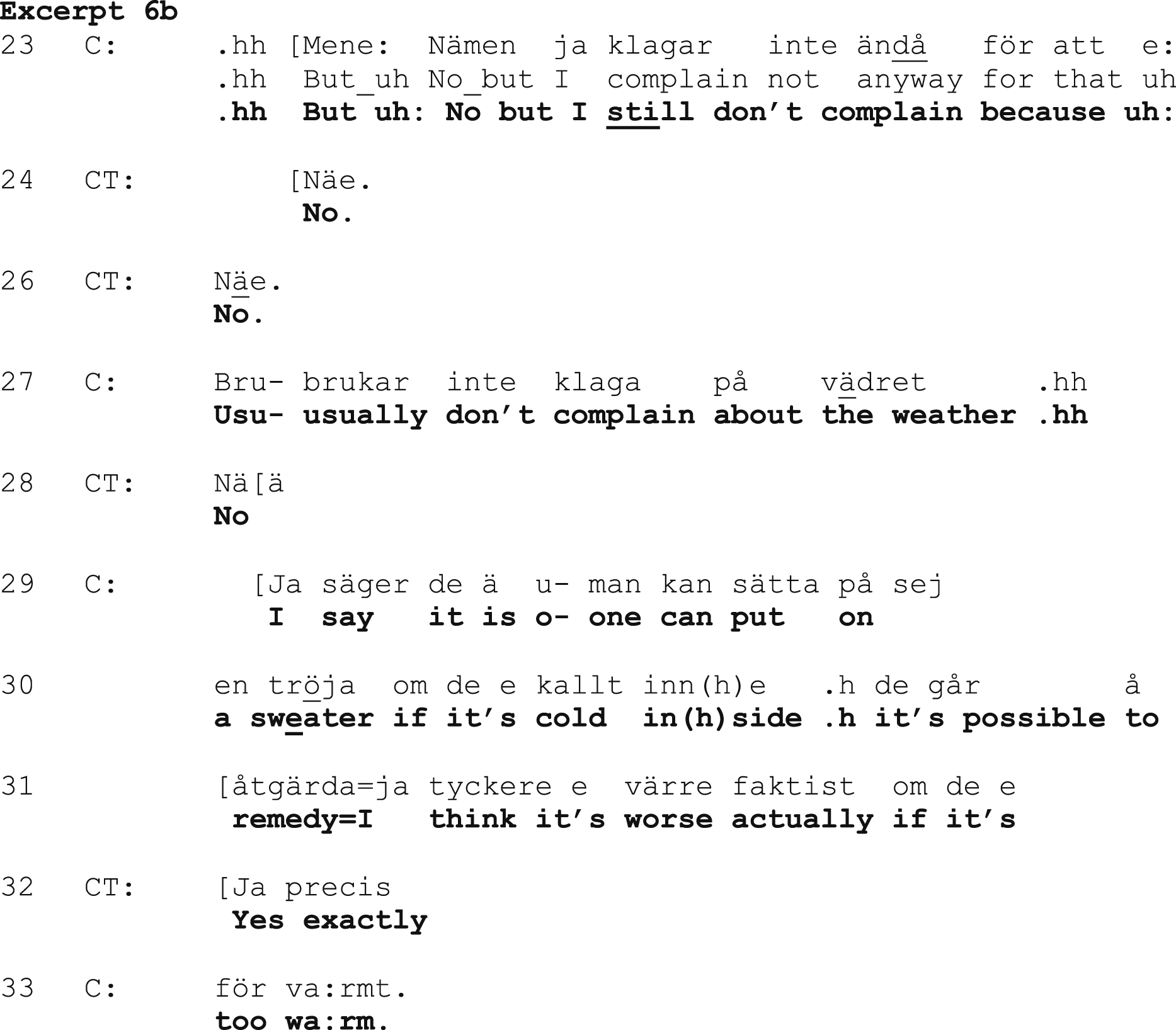
This caller uses the topic of weather to disclose how she is active in response to it (and so her regular response is not to complain), but in this case it is disengaged from recent, current or next states of the weather. She continues to build on the inside/outside pair, yet switching the inside to be the cold environment so that she has not avoided suffering the cold weather. Moreover, with ‘I say’ (l.29), the caller describes a general stance in life, not unique to a specific situation. The caller displays troubles-resistance by suggesting putting on a sweater when facing cold weather. The personal character of her preferences is stressed as she describes thinking that warm weather is (‘actually’, l.31) worse. In contrast to her effort to re-assess the complaint in the previous excerpt (l.16), the call-taker offers quick and strong agreement (l.32) to this display of troubles-resistance. Like in Excerpt 2, the participants establish their similarity around this troubles-resistant position.
When we enter the call in the next excerpt, the talk about the weather is already underway and we will witness a climax of affiliation. Initially, the call-taker has asked about the caller’s weather after the caller has described still being in bed. With our previous cases in mind, we can note that being in bed during the day indexes potential inactivity and isolation, so that asking about the weather can prepare for suggestions to go outside. After the participants have reciprocated descriptions and positive assessments of the currently sunny weather in each of their locations, the caller in line 34 invites the call-taker to confirm the weather forecast:
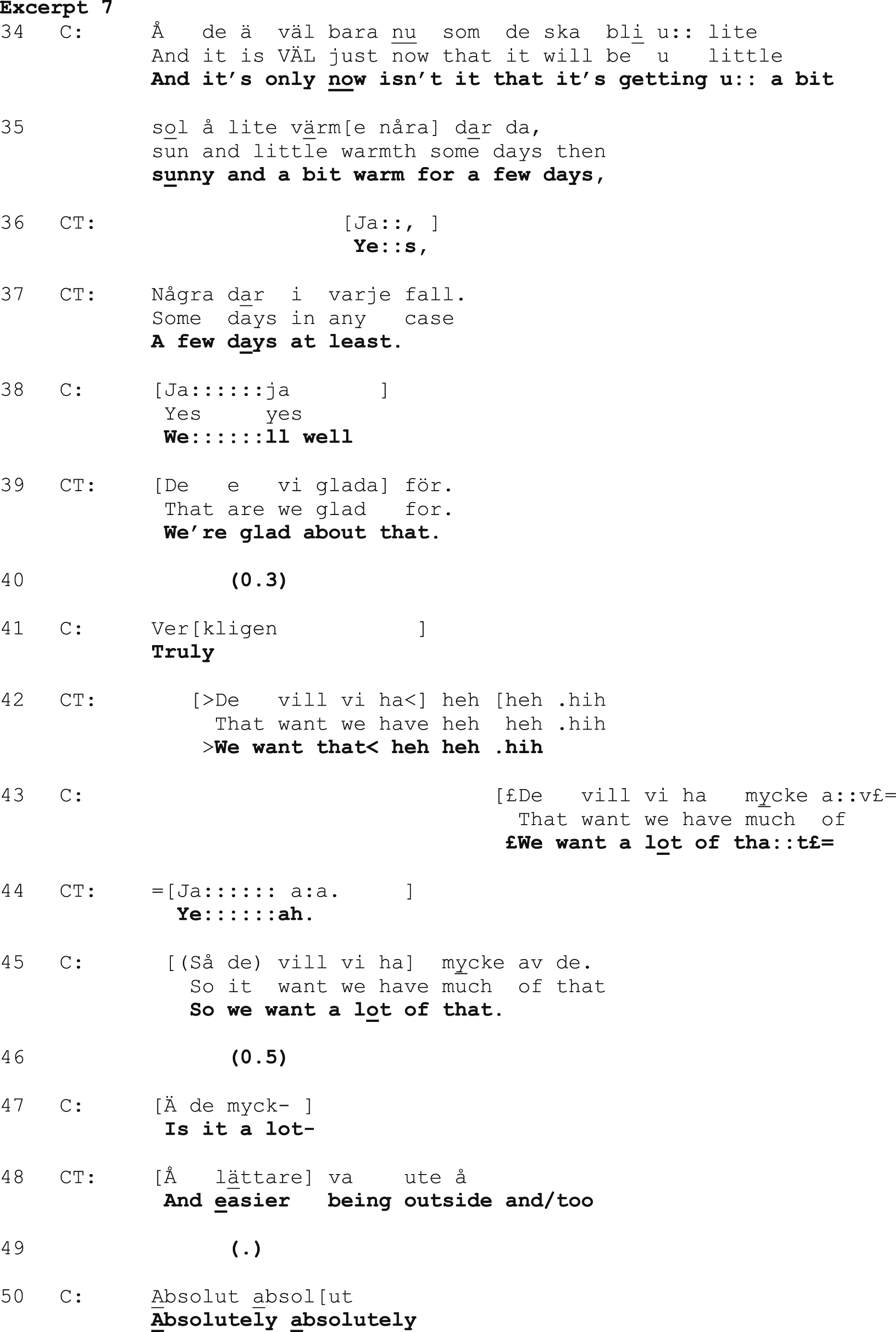
Here, we focus on the call-taker’s subject-side assessment ‘We’re glad about that’. (l.39; cf. Edwards and Potter, 2017) after the caller’s description of the warm weather as an exception. This positive assessment is different from the call-takers’ uptake in Excerpts 5 and 6 and understandably so, since it projects going outside. Common knowledge about living in temperate climates with unpredictable weather is used to build toward the call-taker being able to suggest going out (cf. Coupland and Ylänne-McEwan, 2000). ‘Sun’ and ‘warmth’ in this excerpt contrast with the affective side of ‘hot’ as ‘terrible’ (Excerpt 5) and ‘it is not as enjoyable to be outside when it rains’ (Excerpt 6) which projects staying in.
To build on the weather formulations, the call-taker uses collective self-reference (Lerner and Kitzinger, 2007), assuming that they share the same subjective state and the caller validates this with a strong confirmation, ‘Truly’ (l.41). The participants then together enforce this enthusiastic stance about the weather in words and tone of voice, establishing their togetherness with ‘we’ (l.42–45). After this establishes social connection, the call-taker artfully moves to display the ease of being outdoors (l.48), which the caller confirms (l.50). Thus, while the activity here is social in terms of persons establishing similar investment, knowledge and values, the taken-for-granted wish to be outdoor provides a normative backdrop that can be drawn on to coach the caller in talking about their plans.
Excerpt 8 is 20 lines later in the call from Excerpt 3, where the caller had established herself as going out regardless of the weather. In between, the caller has further described herself as active by reporting her exercise routines during the last days, linking it to the currently unstable weather. She finishes (l.68–69) with a so-prefaced conclusion about the unpredictability of the rain:
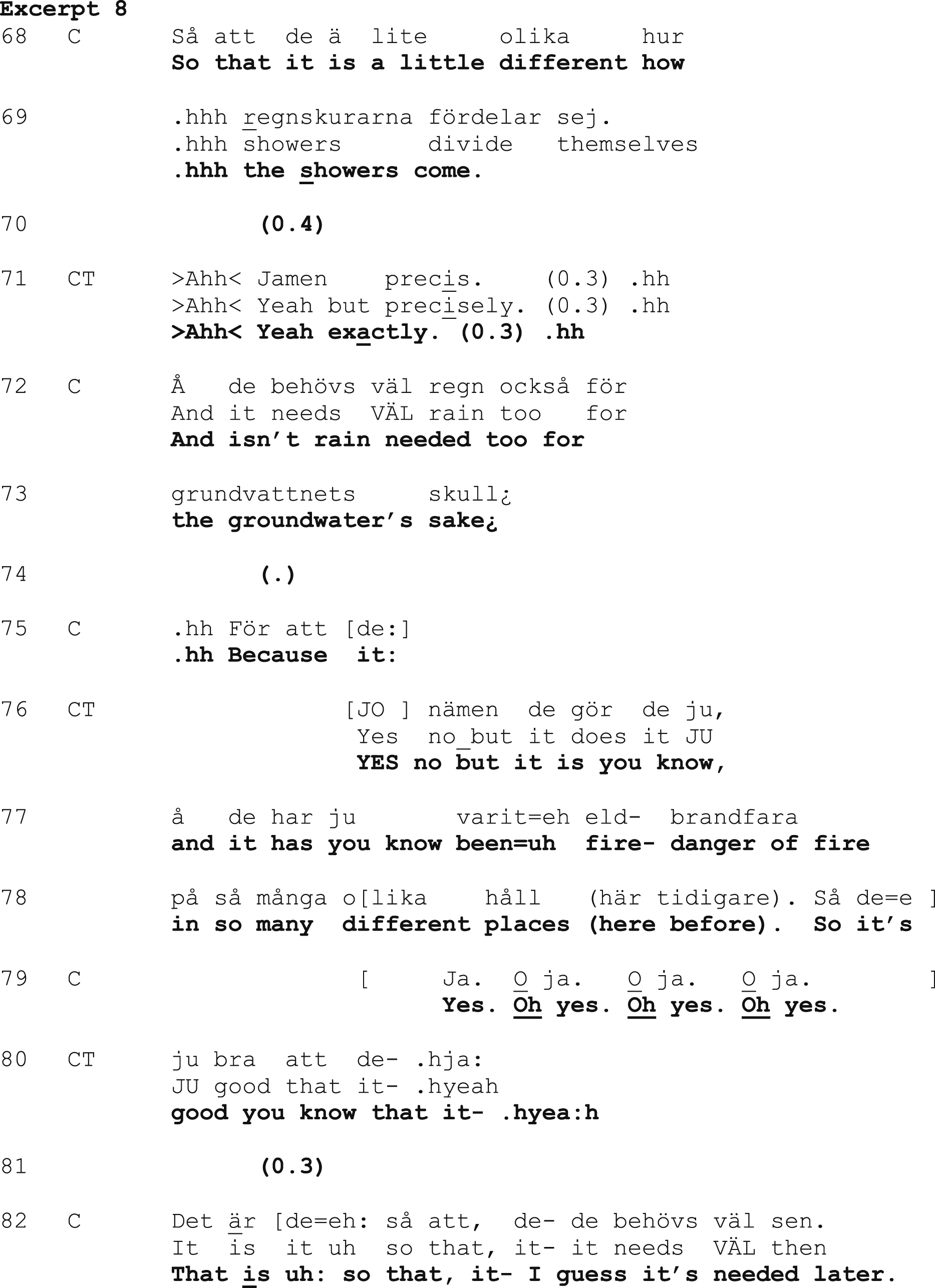
The caller’s conclusion (l.68–69) is offered as a general assessment and the call-taker strongly agrees, ‘Yeah exactly’ (l.71). The weather has gone from being a potential obstacle that the caller can overcome, to being used as a general component for both participants to know and assess. The caller offers a positive take on the current rainy weather, ‘And isn’t rain needed too for the groundwater’s sake’? which invites agreement from the call-taker. As the caller begins to provide an account, the call-taker confirms in overlap (l.76), using the epistemic marker ‘ju’ (see also l.77, l.80), which orients to the stance as shared while stressing the assessment as independently made (Heinemann et al., 2011). That this is her personal opinion, assumed to also be held by the caller, is further established by the call-taker’s account (l.77–78). Moving away from the asymmetries of advice-giving, weather is thus dealt with as a shared and community-oriented resource. Through this category transformation, the call participants unite in their (unusual) shared assessment of rainy weather as positive.
In contrast to the excerpts in the previous subsection, Excerpt 6b-8 show weather as a small talk topic of members on an equal footing. Across these latter fragments, weather functions as a resource for mutuality and connectivity: by affiliating with the other’s stance towards the weather, callers and call-takers build a sense of being similar. Thus, in the analysis, we have seen how the weather is intertwined with institutional accountability of the helpline, firstly, in terms of cautious advice-giving, listening and refocusing in response to small talk about ‘bad weather’, and, secondly, in terms of providing a sense of symmetrical sociability through sharing assessments.
Discussion
By studying small talk about the weather in calls to a helpline for older people, this article contributes to the understanding of how social work is accomplished in a setting where informal sociability, in the form of talking to a fellow human being, is a core characteristic. We have shown how small talk is intimately connected to the activities of advice-giving, listening and building togetherness. Although both participants are assumed to access weather and have rights to assess it (cf. Coupland and Ylänne-McEwan, 2000; Holmes, 2000), we have highlighted that even as weather talk relaxes the identities of service-provider and client, it never escapes them.
These findings have two implications. First, we show that small talk in a social work setting can have similar benefits as in other organisational settings: by ‘oiling the interpersonal wheels’ (Holmes, 2000: 50), it facilitates building relationships (e.g. Benwell and McCreaddie, 2016; Maynard and Hudak, 2008). This means that a delimited focus on task, associated with streamlined services in social work (e.g. Kamali and Jönsson, 2018), may strip away the very relationships that social workers rely on to accomplish activities such as advice-giving and social support. In relation to advice-giving in volunteer-based helplines, where we, in line with previous research (e.g. Pollock et al., 2010; Iversen and Westerlund, 2022), found a mismatch between nondirective agendas and actual practice, our findings point to the possibility of differentiating between more and less directive ways of suggesting courses of actions. Guidelines discouraging advice-giving are rooted in a lack of professional mandate and the principle that callers are better served by someone who listens, rather than tell clients what to do (Pollock et al., 2010). However, volunteers’ persistent orientation to providing advice indicates that it might be useful to draw on the emerging findings on how call-takers do offer advice in ways that sustain relationships and show concern (cf. Pudlinski 1998; Butler et al. 2010).
The second set of findings relates to the distinction in social work between using small talk to accomplish a task and accomplishing sociability for the clients as a goal in itself. The call-takers’ responses in excerpts 4-6a exhibit the specific nature of this helpline and the status of small talk therein, on a fine line between the phone calls of friends and family ‘just keeping in touch’ (Drew and Chilton, 2000) and seeking to explore callers’ problems and coach them. We have shown that delayed or absent responses to callers’ initiations of small talk about bad weather can be understood as call-takers orienting to callers’ problems, rather than reciprocating small talk. A reason for cautiousness related to reciprocity may be instructions on ‘active listening’, where silence is an important component (e.g. Hutchby, 2005). Another reason may be anonymity – call-takers are instructed to not reveal their identity and descriptions of their local environment may be considered a breach.
The analysis thus highlights potential clashes between the goals of offering company and supporting change, both of which can be included in the fuzzy institutional agenda of ‘being there as a fellow human being.' Similar to the findings in Pudlinski’s (2009) helpline study, people sometimes call the Ageing Line to tell someone about their day, which, in itself, is a social need. Co-complaining may be threatening to anonymity, and it may also increase risks of role reversal, where the caller supports the call-taker (cf. Pudlinski, 1998). However, by pushing callers towards an optimistic stance, call-takers risk being heard as avoiding the trouble, giving callers the impression that they ultimately are left alone with their problems. In excerpts 6b-8, we saw how callers’ optimistic tellings were reciprocated with strong agreements and assessments, offering the call-takers’ own takes on the weather. Such everyday public contacts with ‘consequential strangers’ have been pointed out as important (Fingerman, 2009), especially for older people who may have lost their companions and/or have difficulties building personal relationships (Iversen et al., 2021).
In conclusion, our findings show that weather clearly does not operate as a neutral, transparent topic, but as an inference-rich anchor point from which people can express their membership in shared and divergent normative communities (cf. Coupland and Ylänne McEwan, 2000). Using small talk in social work, as we hope to have made clear, is a surprisingly complicated affair. In different social work settings, in particular when clients’ future life situation is dependent on social workers’ decisions, we can assume that the use of small talk, in terms of assumptions of shared cultural knowledge, may be both even more essential and more problematic. This study continues the work in undoing the prejudice of small talk as merely phatic and separated from institutional business, and begins to show its particular uses in social work.
Footnotes
Declaration of conflicting interests
The author(s) declared no potential conflicts of interest with respect to the research, authorship, and/or publication of this article.
Funding
The author(s) disclosed receipt of the following financial support for the research, authorship, and/or publication of this article: This research was supported by the Swedish Research Council [CI Grant Number 2019-02575] and Forskningsrådet för hälsa arbetsliv och välfärd [Grant Number 2017-01328].
