




Abstract
This article is a single case analysis of trouble talk taking place between teachers and care workers at a Swedish special residential home for boys and young men (aged 12–20). The topic of the talk is a potentially unwarranted solitary detention of a student. Using sequential- and Membership Categorisation analyses, we examine the participants’ methods for talking about the event as institutionally problematic while avoiding to blame the teacher responsible for the disciplinary action. Specifically, we demonstrate how the grounds for the confinement were initially disputed by the care workers and how an extended negotiation with the teachers eventually lead to a jointly acceptable account of the event. This involved recasting the event as a real-life experience that should afford the student important opportunities for socialisation into the social and institutional orders which inform daily life at the residential home. More generally, the analysis demonstrates how presumed knowledge of social and institutional structures and practices is mobilised and negotiated – through ‘categorial ordering work’ (Hester & Eglin, 1997) – in the service of coming to terms with the complex accountability arrangements of the special residential home.
Keywords
Introduction
In Sweden, special residential homes (Särskilda ungdomshem) offer care and treatment for troubled youth. This work includes monitoring, assessing, supporting and occasionally sanctioning the social behaviour of the students residing at the institutions. As a result, the students’ daily behaviour is a constant concern for the staff and the one main topic in the daily interprofessional meetings that take place between the staff. The aim of this paper is to investigate the micropolitics and accountability involved in staff discussions about the students’ social behaviour, because the practical reasoning and local rationalities of the staff may yield insight into the institutional workings of residential care. For this purpose, we have analysed the interaction during a handover meeting at a special residential home, henceforth referred to as Forest Springs.
Previously, handover meetings have been studied in healthcare settings, where, for instance, nursing shift handovers – entailing staff’s interactional management of epistemic incongruities (Mori et al., 2017) – were shown to be examples of professional practice that is structured by institutional routines and agendas which encompassed medical concerns as well as administrative rationalities (e.g. Buus, 2006). The handover meeting examined in the present study involves two categories of staff – teachers and care workers – who discuss the sanctionability of a student’s behaviour. Accordingly, the analysis focuses on aspects of interprofessional collaboration and local micropolitics of collegiality as well as institutional accountability as they play out in the course of the discussion.
After each school day, the teachers report to the care workers about the students’ behaviour and academic progression during the lessons. The discussion analysed in this article concerns an event that had taken place earlier in the day, whereby a student was placed in solitary confinement – an extraordinary measure controlled under the Care of Young Persons (Special Provisions) Act (Lag [1990:52] med särskilda bestämmelser om vård av unga) – henceforth LVU.
Repeated close readings of the talk during the meeting revealed three main participant concerns to which staff talk was oriented. The first deals with the participants’ knowledge concerning the details of the incident and, in particular, of the subsequent confinement of the student. As we shall see, the teachers and care workers share with one another their understanding of what exactly had occurred as the student was detained. The second concern for the participants has to do with whether the decision to use this extraordinary measure was legitimate, or based on a questionable assessment of the situation. Given the legal dimension of infringing on young persons’ right to freedom, this issue presents itself as a key source of trouble to the parties present. As a consequence, much of the talk at the meeting is geared toward working up a joint stance with respect to the confinement. Having thus reached the conclusion that the confinement was not an adequate response to the situation, the question is then raised how this may be accounted for in a way that does not threaten the collegiality among staff, nor compromise their professional identities. These accounting practices compose the third type of concern that the parties manage in the handover meeting. By examining the practical reasoning and accounting work of the staff, the analysis contributes to prior work in ethnomethodology and conversation analysis on institutional interaction (e.g. Arminen, 2005; Hester and Francis, 2001; Watson, 1986) and social work with juvenile delinquents in particular (Cicourel, 1976[1968]).
Trouble in facilities for youth in forced care
Over the last twenty years, an important body of knowledge concerning youth in forced care has been taking shape. Among some of the early contributions we find analyses which highlight aspects of the institutional work – chiefly comprising assessment, schooling and treatment or rehabilitation – by focussing on the communication between the resident and staff, occasionally also including representatives of other domains such as health, education or the social services.
For instance, Osvaldsson’s (2002) study of interprofessional network meetings demonstrated how the discussions formed an important arena for ascribing, resisting, or otherwise negotiating the institutional identities for the residents. It was also noted that the order and aims of these meetings was difficult to grasp for the young persons themselves. That it is difficult for youth in forced care to grasp the institutional aims of assessment and treatment has long been documented in interview-based studies (see Enell, 2016; Levin, 1998; Vogel, 2018).
Osvaldsson (2004) uses Membership Categorisation Analysis (henceforth MCA) to analyse the residents’ own accounts of how they came to be placed in forced care. She demonstrates how the youth draw on different category implicative features to present themselves as, for all intents and purposes, ordinary young persons, attributing their incarceration to extraordinary and unfortunate circumstances. Practices of membership categorisation were also in focus of Cromdal and Osvaldsson’s (2012) analysis of trouble talk during school lessons. They show how the residents initiated and escalated verbal fights with one another by methodically drawing on stage of life categories to assemble degrading descriptions of their adversaries as immature and incompetent.
Clearly, various instantiations of trouble are commonplace in residential homes providing forced care for youth, and accordingly, a growing concern in research into these institutions has been to examine how conflicts, fighting and other forms of trouble are handled by the staff who work there. In a critical overview of research focussing on quarrels in institutions for juvenile delinquents, Wästerfors (2009) notes that studies typically rely on field notes, a method which risks missing out on important detail in the emergent ‘physical and emotional manifestations’ (p 29) of adversary interaction. Inspired by earlier CA work on young persons’ conflict talk (e.g. Maynard, 1985), he calls for studies using this approach to investigate adversary exchanges taking place in forced care institutions.
Recently, Stenström and Pettersson (2021) interviewed staff as well as residents in forced care homes about trouble situations identifying an interactional pattern they labelled ‘the conflict script’. This pattern involves events – initially trivial rule infringements – escalating to a point where the parties involved can no longer step down and the situation often results in coercive measures being taken against the resident. In a study of case notes of incarcerated youth, Wästerfors and Åkerström (2015) identified several discursive techniques – ‘trouble zooming’, ‘mood notes’ and ‘deflecting staff agency’ – by which staff highlight the unruliness of the residents while minimising documentation of actions taken by staff. In a follow-up study, Wästerfors (2019) compared the case notes formally documenting a violent incident between two residents with interview accounts of the self-same event, pointing to systematic ‘institutional omissions and transformations’ of fact and detail in the case files. Case notes, he argues, are products of the staff and serve institutional documentary purposes, while the residents’ accounts are more detailed, nuanced and reasoned – that is, hold much more granular and relevant information concerning the unfolding of incident – much of which never makes it to the case files. He concludes that ‘What is put into the record (the texts as such) and what is left out says something about how client-producing institutions function and define themselves’ (p. 256).
This inevitably raises the question of institutional accounting practices: how are events represented, talked about, negotiated and eventually documented in a young person’s case history? And what can be learned from these accounting practices about the ‘doing [of] the organization’s work’ (cf. Watson, 1986)? It is to such matters that we turn in this article. Analysing the in situ production of verbal accounts at an interprofessional staff meeting, we set out to examine how the parties’ talk displays a range of institutionally relevant concerns. In examining how staff produce versions of residents and their behaviour, as well as that of the staff, in their accounts of trouble incidents, we point to matters of collegiality as well as the accountability arrangements (Stone, 1995) that the parties orient to in the course of their talk. Building on the findings of the studies above, we specifically examine the categorial ordering practices (Hester and Eglin, 1997) which, we argue, form an integral part of the staff’s work of rehabilitating a young person in forced care.
Special residential homes in Sweden
All special residential homes in Sweden are organised under The Swedish National Board of Institutional Care (Statens institutionsstyrelse, 2021, or SiS). The homes provide compulsory care for young people with severe psychosocial problems including substance abuse and antisocial behaviour, under the terms of the LVU Act.
It is the local social services that apply for a place for the young person, while admittance as well as priority order are handled by the Administrative Court (Förvaltningsrätten). Some of the special residential homes also admit young criminal offenders who have been sentenced to care under the Secure Youth Care Act (LSU) (www.stat-inst.se). A minority of the residents may also reside there on a voluntary basis, in accordance with the Social Service Act (Socialtjänstlagen). Special residential homes are provisionally licenced to make use of measures that no other institutions that provide care for young people may employ. This includes a spectrum of physical constraint and the most fargoing of these coercive measures is the option to force young people into solitary confinement (Swe: Avskiljning).
Solitary confinement of youth in forced care
According to the law the Care of Young Persons (Special Provisions) Act (LVU) §15c solitary confinement may be executed under specific circumstances:
He/she who is subsumed under the regulations in 15§ may, if it is particularly called for due to the young person's violent behaviour or intoxication to the degree that he or she will not adhere to order, be kept in solitary confinement. The young person at hand must be kept under constant surveillance by staff as well as have the possibility to call for assistance by staff. He or she must not be kept in such confinement for any amount of time longer than what is absolutely necessary and never for longer than four hours in succession. A physician or a nurse should promptly express an opinion concerning every measure that has been taken according to the above paragraph. If the physician or the nurse so requests, the confinement is to be immediately discontinued. The above mentioned as well as other coercive measures (15-15d§ and 17–19§§) are only to be used if they stand in proportion to the aim of the action taken. Should less intrusive measures be sufficient, they are to be used instead (SFS 2018: 652, authors' translation).
1
According to a press release from The National Board of Institutional Care, young residents in forced care were placed in solitary confinement on 1354 occasions during 2020. It is stated that the confinements were executed to keep order and to protect other residents and staff in severely violent or otherwise dangerous situations (https://www.stat-inst.se/press/pressmeddelanden-nyheter/2021/var-syn-pa-viktig-granskning retrieved 220619).
Setting, procedure and methodological considerations
The data analysed in this chapter were collected through ten weeks of fieldwork at Forest Springs,
2
a special residential home for boys ‘demonstrating psychosocial problems, substance abuse and criminal behaviour’. Forest Springs is a government facility, providing a national service under the auspices of the National Board of Institutional Care (SiS). It is one out of 22 government institutions licenced to forcibly detain young persons. It is a relatively large facility with three separate wards, each enforcing different restrictions upon its residents. − Lake Side is an open dorm, housing students in voluntary as well as forced care, the latter either being considered ‘low-risk’ residents, or not prone to escaping. As long as certain time tables and house rules were heeded, residents of Lake Side were free to enter and leave the building at will. − Oak Hill is a secure ward. Its entrance was locked at all times and there was an alarm installed to all its windows and hatches. The common areas within the building were open to the residents. When outside the building, Oak Hill students were accompanied by staff at all times. Jan (age 15), who is the main topic of the discussion analysed in this article, resides here. − The Well is a high security ward. Its entrance was locked, windows barred and its interior divided in locked sections. Its residents had access to common areas, normally in the company of members of staff. The building was equipped with a fenced-off outdoor area. All residents at the Well are sentenced in court and deemed to present a potential danger to other residents.
Many of the residents at Forest Springs are below the age of 16. Among other things, this means that the institution is obliged by Swedish law to provide the residents with adequate schooling. The school at Forest Springs was located in a separate building and admitted students from Lake Side and Oak Hill. Students residing in The Well received instruction within their residential building. There were more than ten teachers working at Forest Springs, and another 40 staff including nurses, counsellors, care workers, administration and kitchen staff as well as a handful of security personnel ensuring that order was maintained on the premises. The total number of students at the time of the fieldwork was 18 – six in Lake Side, eight in Oak Hill and four in The Well (see also Cromdal and Osvaldsson 2012). The fieldwork was conducted at the open school, where the second author spent two days a week video-recording classroom activities and audio taping a variety of non-curricular activities, such as recess, lunches, outdoor walks and more or less formalised staff meetings. This resulted in approximately 30 hours of video- and over eight hours of audio-recorded interaction, as well as a collection of spontaneously talked-in field notes. 3
Membership categorisation and sequential organisation of interaction
For the purposes of the present analysis, we have combined MCA (Hester and Eglin, 1997; Jayyusi, 1984; Sacks, 1972, 1995) with sequential analysis (Sacks et al., 1974; Sacks, 1995), which has allowed us to inspect at close range the participants’ demonstrable orientations towards the issues at hand. The sequential analysis has allowed us to follow the participants’ emergent production and understanding of their mutually oriented actions, including the distribution of knowledge or epistemics (Heritage, 2012). Membership categorisation analysis allowed us to recognise and explicate how the participants produced and made sense of descriptions and other actions accountably – that is, in methodical and socially recognisable ways. Membership categories are culturally sensitive ways of describing persons (e.g. woman, referee, true believer) events (e.g. court hearing, penalty shot) or places (e.g. green room, roundabout intersection) and are often described as ‘inference rich’, which is to say that a lot of taken for granted culturally distributed knowledge is stored in them (Sacks, 1972). Membership category devices (MCDs) are collections of membership categories. A device such as ‘occupation’ may hold a range of categories including, for example, teacher, care worker, nurse or warden while categories such as mother or parent do not fit this device. Other elements crucial to the functioning of membership categories and membership category devices include category-bound activities that is, actions, behaviours or activities which members will hear as specifically, more or less tightly, linked to certain categories (or category devices), and predicates (or category attributes) comprising personal traits, preferences or dispositions which we routinely hear as belonging to incumbents of a category. By employing a combined focus on the sequential and categorial features of the interaction, we sought to gain a fuller view – and offer a fuller explication – of the participants’ discursive resources (cf. Watson, 1997, for a discussion of the ‘mutual determination’ of sequential and categorial aspects of talk) in the handover meeting.
Analysis
Each day at the Lake side/Oak hill school begins and ends with a short handover meeting between the school staff (henceforth teachers) and staff who work at the two residential wards (henceforth care workers). During these meetings, the receiving parties are briefed on recent events as well as each student’s emotional, motivational and health status. For an after school meeting such as the one analysed here, the receiving party are care workers from the wards. The meeting chosen for analysis is presented as it followed in time. The analysis is divided into four steps: (I) provides the reader with a description of the event leading up to the confinement of the student; (II) offers an analysis of the collegial discussion of the event, and especially the responsive measure taken, as problematic for the institution; (III) focuses on the participants´ divergent accounts of the problem and (IV) explicates how the parties assemble a jointly acceptable account of the event and its affordances for the future. There are five persons present at the meeting: two care workers (C1,C2), two teachers (T1,T2) and a researcher (Re).
The antecedent event
On the day of the meeting an incident took place during a morning lesson at the open school. The below account of the incident is based on tape-recordings and field notes from the school day.
As the morning lesson at the Lake side/Oak hill school of the special residential home is drawing towards an end, Jan is seated at one of the classroom tables, rocking back and forth in his chair. Next to him, Camilla is busy helping another student. Camilla usually teaches at the high security ward. During the course of the lesson, she has repeatedly told Jan to stop rocking his chair and urged him to attend to his schoolwork. Suddenly the chair tips over backwards. As Jan falls to the floor, his right foot finds the teacher’s head, landing a kick on her left ear and temple. Camilla activates her personal alarm. Within short, security personnel enter the classroom, and after a short exchange with the teacher Jan is peacefully apprehended and escorted to the detention room located in the school building. Upon arrival he undresses to his underwear and, as the door closes behind him, takes place on the bench awaiting the compulsory medical exam by the doctor. 4 Less than an hour later he is released and escorted to his room at Oak hill.
Working up a sense of an institutionally problematic event
Solitary confinement of a student is considered by the staff as the very last resort of upkeeping order and safety at the home. When, occasionally, trouble does get out of hand to the extent that a student is physically restrained and temporarily confined, word immediately spreads around such that all present at the facility – staff and students alike – soon learn that one of the youth has ‘åkt in i isoleringen’ (‘been thrown in solitary confinement’). Accordingly, the parties to the handover meeting we examine in this article were well aware of Jan’s confinement.
However, as none of them had actually witnessed the events leading up to the incident, nor were present at the scene of his detention, talk at the meeting was initially focused on establishing a sense of what really had happened. In our first extract, one of the care workers (C1) starts off by relaying a conversation that she had had with the student himself. While it is routinely the teachers who – having the epistemic advantage of first-hand knowledge concerning the events in school – report to the care workers at the end of the school day, the initial announcement by C1 that she had been in direct contact with Jan serves to claim the right to speak. Citing one of the parties to the incident as the primary source of what she is about to relate works up her epistemic status (Heritage 2012) as someone who has relevant information to share with the others up front.
Excerpt 1. Not sit for very long
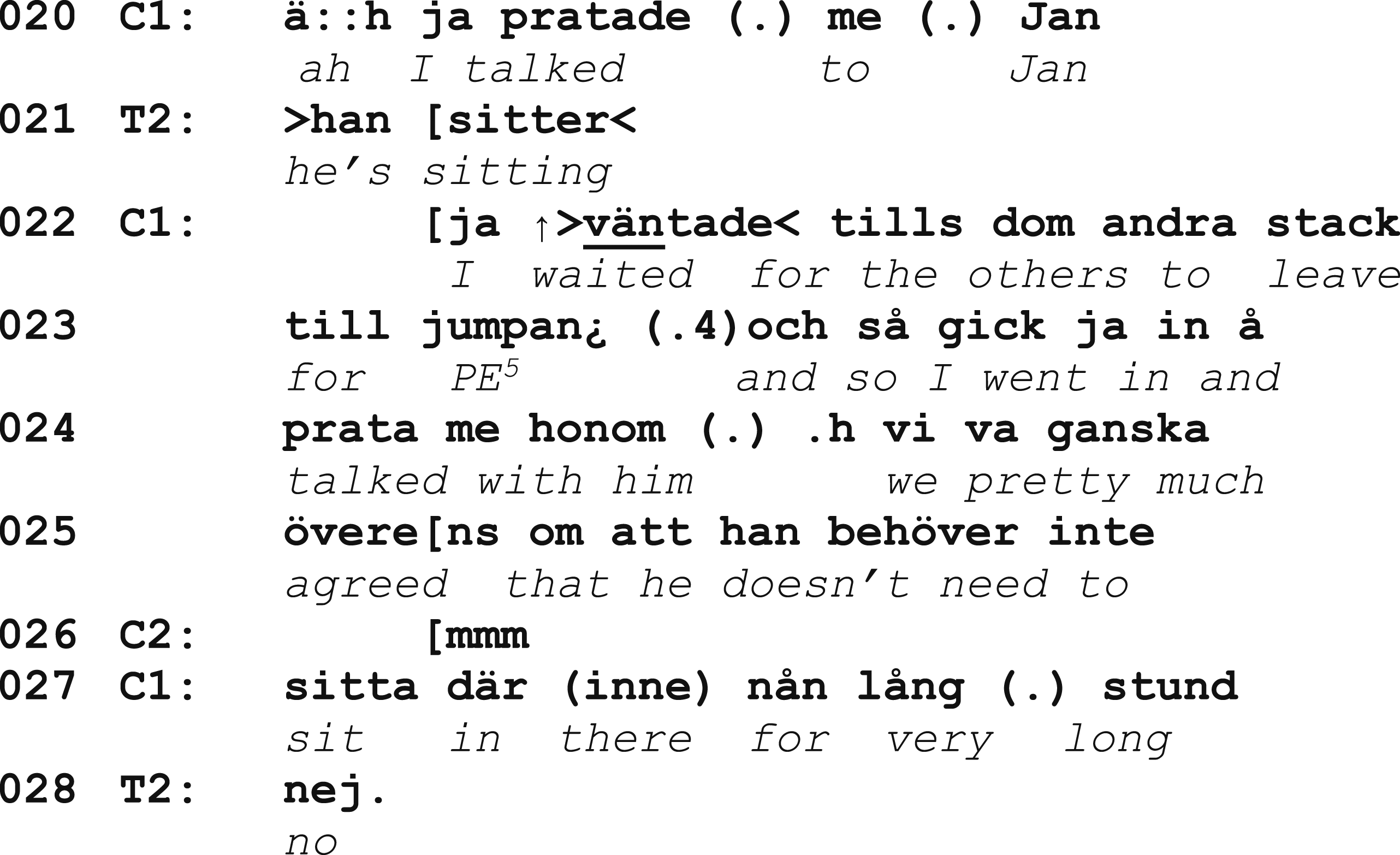
Ignoring the teacher’s attempt to claim the floor (line 21) the care worker informs the group that her talk with Jan had taken place as he was still in detention and that they had both agreed that his confinement will not need to last long, a conclusion with which the teacher affiliates in line 28. Hence, a consensual understanding that there is no grounds for prolonging Jan’s confinement is established already at the outset of the handover meeting.
It is worth noting that while students are not routinely given a say in decisions concerning the duration of their confinement, Jan had been given the opportunity to agree with the care worker’s assessment. Indeed, her description of the interaction that had taken place in the detention room – using activity formulations such as ‘talking with’ and ‘agreeing’ – allows for categorial inferences of their meeting as a peaceful exchange, devoid of any overt animosity or emotional agitation. Bearing in mind that solitary confinement is a lawful response to situations in which the youth presents a danger to himself and those around him exclusively (LVU, 15c§), we can already infer a categorial contrast between the reported behaviour and the location in which it took place.
The care worker’s continued report in the extract below provides for similar category-based inferences.
Excerpt 2. He went in calmly
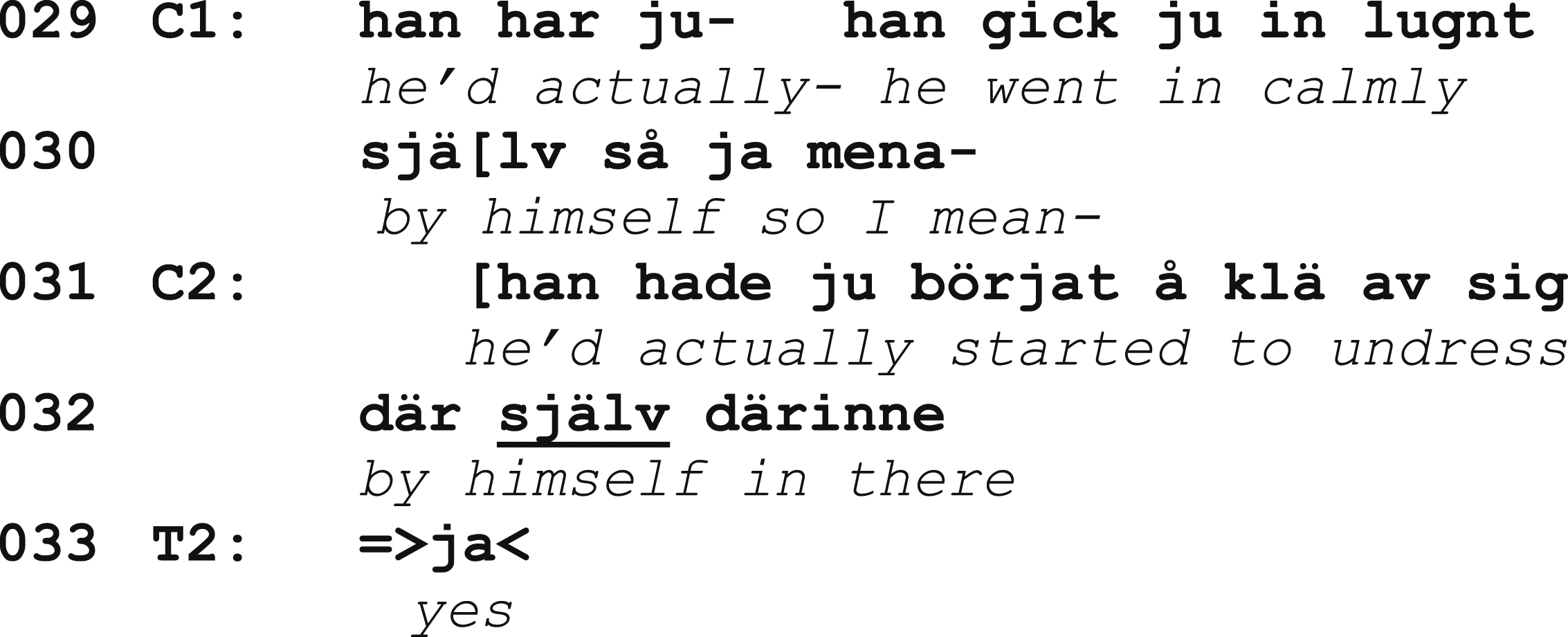
Describing Jan’s escorted entry into the detention room (lines 29–30) as voluntary – ‘he went in […] by himself’, as opposed to having been carried into the room – as well as composed (‘went in calmly’), presents a categorial mismatch between the student’s behaviour and his destination. The description of Jan’s peaceful entry uses the epistemic particle ‘ju’ (‘he went [ju] in calmly by himself’) to bolster its institutional implications. In Swedish, ‘ju’ typically invokes shared understanding or knowledge of an event (Ajmer, 1996; Bergqvist, 2020) but as Heinemann, et al., (2011) have shown, it can also be used to index a moral transgression. In our case, the care worker’s ‘ju’ appeals to the participants’ professional understanding of the incongruence between Jan’s cooperative conduct and the decision to place him in confinement. Further to this point, the incremental extension (Ford, et al., 2002) ‘so I mean’ suggests that the C1 is taking a personal stance towards the event – a stance that is, at this point, only alluded to.
As C1´s turn is projectably approaching a transition point, C2 adds another aspect of Jan’s cooperative behaviour, stating that once he entered the detention room, he immediately began to undress. Again, the description holds the epistemic particle ‘ju’ indexing the obvious, and troublesome, implications. Jan’s forthcoming attitude is at odds with their collective experience of how youth who are being detained and placed in solitary confinement tend to behave, and the two care workers’ collaboratively produced descriptions are tailored to make the dissonance recognisable to the teachers. T2’s minimal receipt in line 33 suggests that the care workers’ reports raise no need for any further inquiries.
In the next extract, C2 revises her previous statement proposing that Jan had in fact undressed himself before he had even arrived at the detention room (lines 34–35). Her subsequent declaration that he had gone ‘first of them all’ (see Pomerantz, 1986, on extreme case formulations), suggests that Jan headed off for the detention room before anyone had a chance to escort him there. This adds another dimension to C1’s previous description of Jan’s voluntary demeanour; an addition with which C1 agrees in line 37. Narratively, these reformulations serve to upgrade the student’s compliance and cooperation with the institutional protocol for detention procedures.
Excerpt 3. He went first of them all
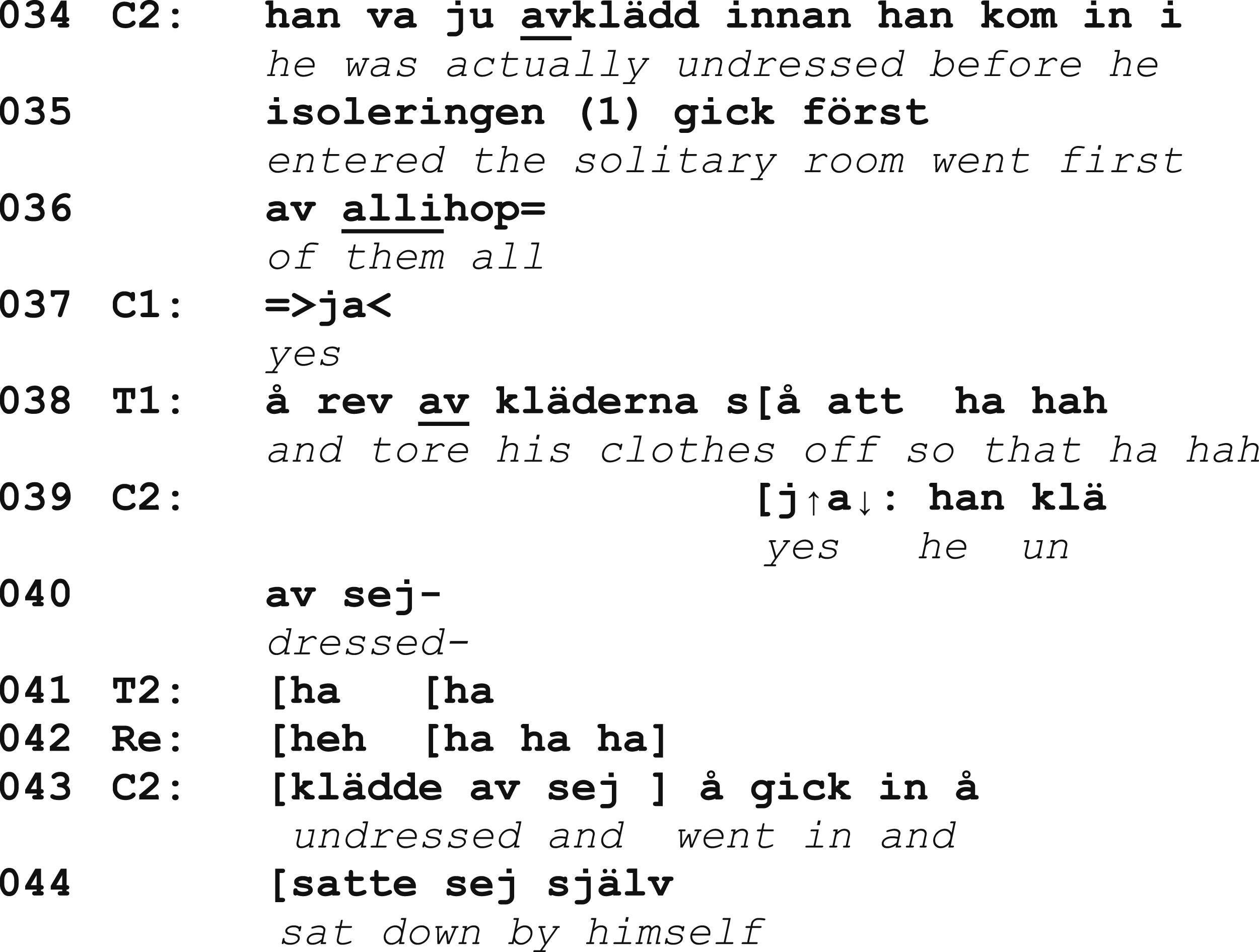
The stress on Jan’s extraordinarily compliant attitude at the prospect of being put in solitary confinement is resisted by T1, who responds to C2’s narration with an over-the-top formulation of the student’s undressing as ‘tearing his clothes off’ that caricatures the reported event. Through this jocular receipt, which constructs Jan as overly zealous considering the nature of the activity, T1 orients to C2’s account as exaggerated. The care worker, however, does not laugh along (Coser 1960). Instead, she rebuts T1’s joke with a ‘po-faced’ agreement (line 39), then produces yet another account of the student’s behaviour (lines 39–44). In light of the teacher’s non-sympathetic hearing, she attends to the factual features of her report listing three minimally phrased, consecutive actions by Jan, but leaving out the other previous narrative elements (e.g. the upgraded and extreme formulations and the ‘ju’-indexed appeals to a collegial understanding). The actions listed by C2 – ‘walking in’, ‘undressing’ and ‘sitting down’ – are congruent with both care workers’ earlier accounts that construe Jan as cooperative through and through, making the enforcement of the decision to place him in solitary confinement a peaceful and orderly event.
Wästerfors and Åkerström (2015) analysis of record keeping, identified a documentary practice they label ‘trouble zooming’ whereby staff laboriously describe the troublesome behaviour of the youth, while keeping records of positive behaviour to a minimum. By parallel, the care workers’ zooming in on the details of Jan’s detention returns, above all, a worrying absence of trouble. In the section that follows, we explicate the institutional basis of that worry.
Accounting for a problematic decision
Because the special residential home is an institutional environment where there is a risk of students resorting to violence, all personnel are equipped with personal safety alarms while on the premises and are obliged to use it whenever the circumstances so demand. Calls to activate the alarm, thereby summoning the security crew, are grounded in an assessment of the situation and made at each staff member's discretion. The same applies to the subsequent decision how best to de-escalate the situation, which may but need not result in the use of physical force, and ultimately in solitary confinement of the youth.
Though part of the professional reality of the staff, these can be difficult decisions, often made in agitated and generally stressful circumstances. Being an institutional obligation, the capability to make such momentary decisions is not just part of the professional identity of the staff, but a question of institutional accountability. Given the official purpose of special residential homes – to provide treatment and care for troubled youth – there is a concern among staff that such sensitive situations are handled adequately and whenever a student is placed in solitary confinement the grounds for the decision is a routine topic among staff. At the present meeting, Jan’s non-aggressive attitude is, as we have seen, a point of particular concern for the care workers. This continues in the transcript below which follows directly on the example above. Before C2 has finished her list of Jan’s conduct (lines 43–44, Excerpt 3), the other care worker begins to formulate (line 45) what she would have seen a more appropriate response to the incident:
Excerpt 4. The room would have been enough
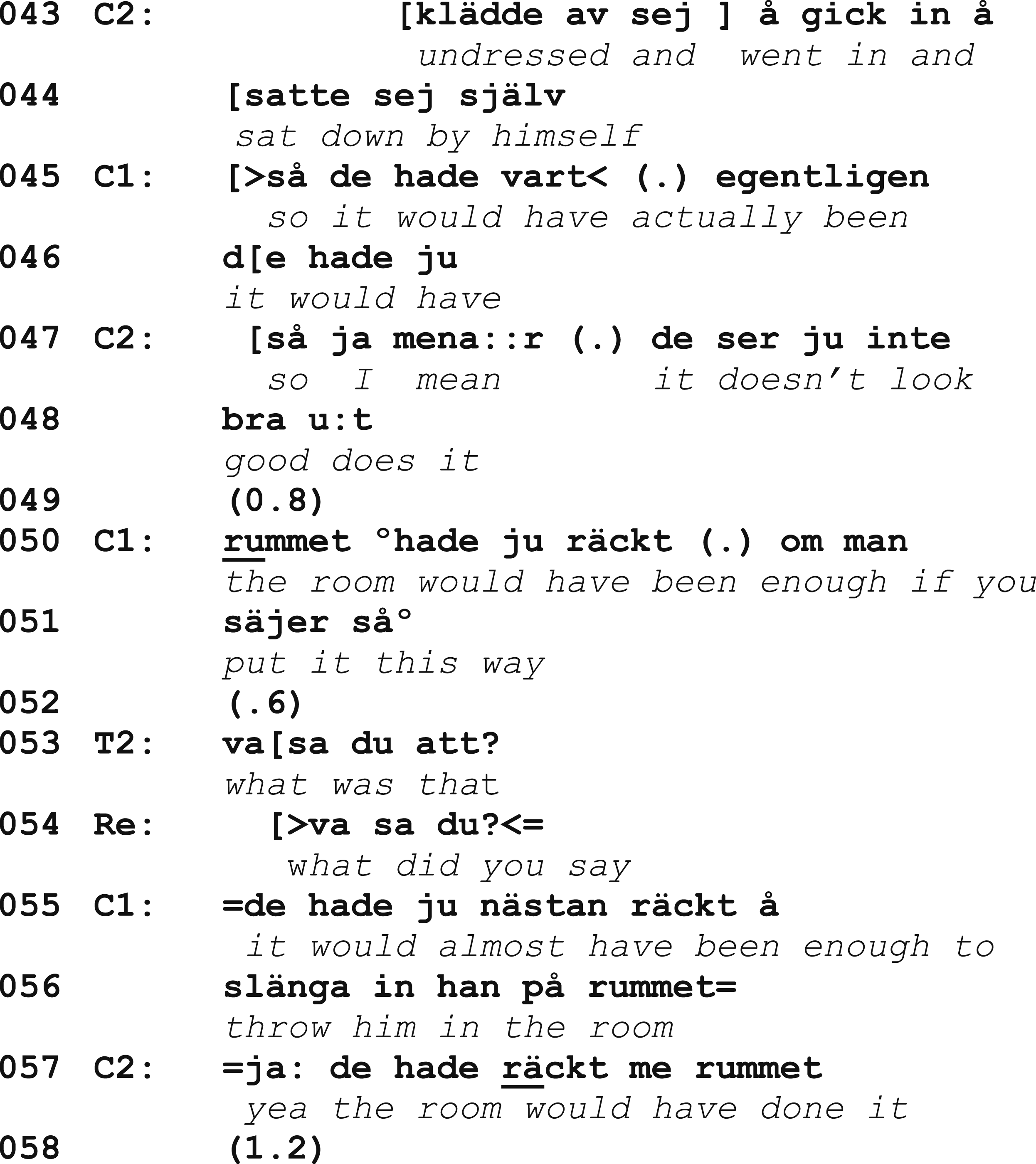
In line 45, C1’s modal construction is fronted by an upshot-marking ‘so’ (e.g. Heritage and Watson, 1980), which makes her turn hearable as a conclusion – grounded in C2’s description (as well as those prior to it) of Jan’s cooperative conduct – that a different course of action would have been more adequate. However, she restarts her turn (line 46) and before she has a chance to verbalise what alternative action she had in mind, C2 comes in with a gist-projecting preface (‘so I mean’) followed up by a negative assessment of the detention (lines 47–48). As Maynard (2013) proposed, such IMPUs (‘I mean’-prefaced utterances) ‘offer explicative completion to what has so far been said’ (p. 207).
Note that this is the first time in the meeting that the confinement of the student is explicitly criticised. The critical assessment is positioned after a collaboratively assembled description of Jan’s behaviour as disjunctive with the institution’s use of coercive measures. By proposing (with some degree of insistence by using the preface and the ‘ju’ - particle) that ‘it doesn’t look good’, C2 manages to avoid going on record with direct critique of a colleague’s decision. Instead, her action is concerned with institutional accountability. 6 It raises the issue of how the fact that a perfectly compliant, cooperating student has been locked up in solitary detention will look from outside the special residential home – but also within its realm. In particular, inappropriate treatment of a student may severely harm the general relations between the staff and the residents, which could have negative consequences for the staff to carry out their work of treatment and care. As Maynard (2013) suggested, IMPUs can be used in pursuit of alignment with the proposed upshot, and as we shall demonstrate below, the two care workers are indeed building a joint stance with respect to the confinement.
After a short pause, C1 resumes her turn and proposes that it would have sufficed to expel Jan to his room (lines 50–51). Note that while C2’s comment targets more general affairs such as institutional accountability, professionalism and staff-client relations in a collective sense, C1’s suggestion that a different type of response would have been preferable can be heard as embedded critique of a particular colleague’s decision. It is in this light that we may understand C1 producing her speech using markedly lower volume and tagging on the adverb phrase ‘om man säger så’/‘if you put it this way’ which according to Nilsson (2005, p. 88) may serve to downgrade both the proposition, and the way it is being said.
The quiet delivery generates several repair initiations, and the repaired version of her turn in lines 55–56 is syntactically expanded, hedged (‘almost’), and its proposition categorially modified. The alternative course of action being suggested – expelling Jan to the ward – is now phrased as ‘throwing him in the room’, which brings on board category inferences of disciplinary action – as opposed to, say, ‘take the rest of the day off from school’ that might imply illness or some other reason than his untoward behaviour. Note that it is the first time in the meeting that matters of Jan’s culpability are invoked, albeit indirectly. In line 57, C2 agrees that the ‘room would have done it’, thereby establishing a joint stance towards the detention of Jan as an inadequate measure while at the same time supporting the relevancy of some disciplinary action being taken against him, in light of the incident that he had caused.
We should note that while the care workers clearly adopt a critical stance to the action taken, both seem careful to avoid blaming – or even mentioning – the colleague who had made the decision to have Jan detained. In the subsequent turn (Extract 5 below), T1 asks whether the decision was made by Camilla – the teacher who was kicked in the head:
Excerpt 5. Used to rough going
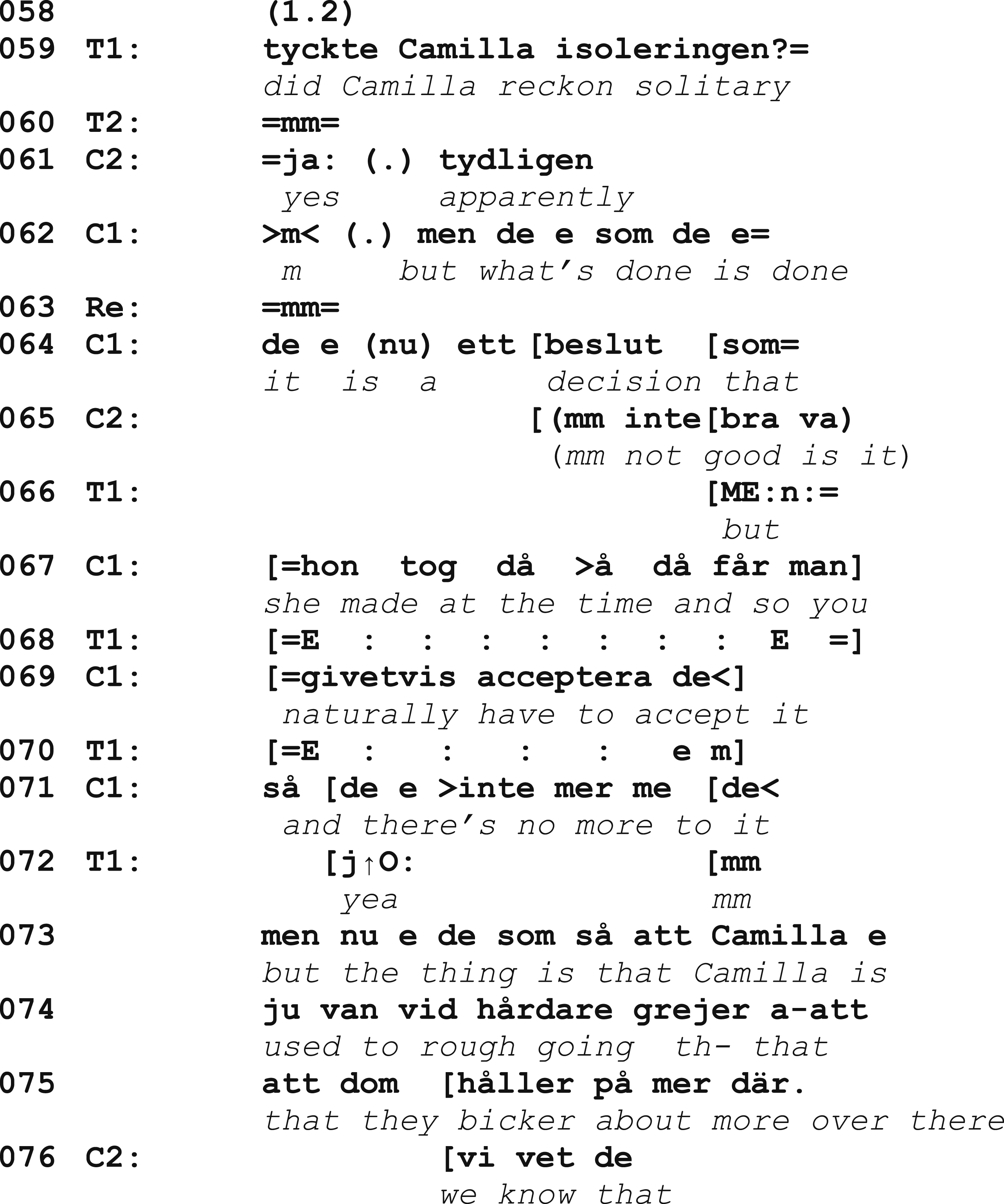
While T2 produces a minimal affirmative response to T1’s query, C2 confirms showing her disaffiliative stance to Camilla’s decision by adding ‘apparently’, which is later emphasised through an unmitigated assessment (line 65). C1, however, seems to affiliate with C2’s displayed stance, but only minimally (line 62). Instead, she acknowledges that while the decision is regrettable, it cannot be undone. She then downplays the blame of Camilla, invoking a collegial norm that staff at the special residential home have to make momentary decisions and that as colleagues they all have to accept this (lines 64 through 69). She then reinforces her norm statement through a bottom line-formulation (cf. Edwards et al. 1995) ‘and there is no more to it’ (line 71) designed to produce compliance by closing any options for disagreement.
It is worth noticing that while the two care workers are keeping a shared stance vs. Camilla’s decision as unfortunate, T1 launches a prosodically marked ‘but’ (line 66) – which projects disagreement with the care workers – then vocalises a considerably prolongated ‘ehm’ (lines 68 through 70) that outvoices the best part of C1’s norm statement. Through his turn-competitive incoming (French and Local 1983), T1 makes it rather clear that he will not let the care workers’ treatment of the non-present colleague’s decision as a mistake stand unchallenged. As C1’s relatively lengthy turn eventually comes to an end, T1 produces a hearably disaffiliating preface (‘but the thing is that’) that projects a counter argument, using the epistemic ‘ju’ (line 74) to state something that they are all well aware of. Reminding them that Camilla normally works at the high security ward, with which he ties the category implicative descriptions ‘rough going’ and ‘bicker about’ to suggest that Camilla has good reason for keeping a lower tolerance level for any form of violent behaviour. In other words, rather than buying into the notion, pushed by the two care workers, of Camilla’s decision being a mistake, he provides a rationale for her action grounded in her experience of working in a more dangerous environment.
C2 responds by acknowledging the reasoning offered by T1, then gives up her turn to C1, who claims the floor invoking her previous talk with the student. Using reported speech, C1 then relates how she had explained to Jan the very same argument that T1 has just made (Excerpt 6 below, lines 81–89):
Excerpt 6. Try to learn her way
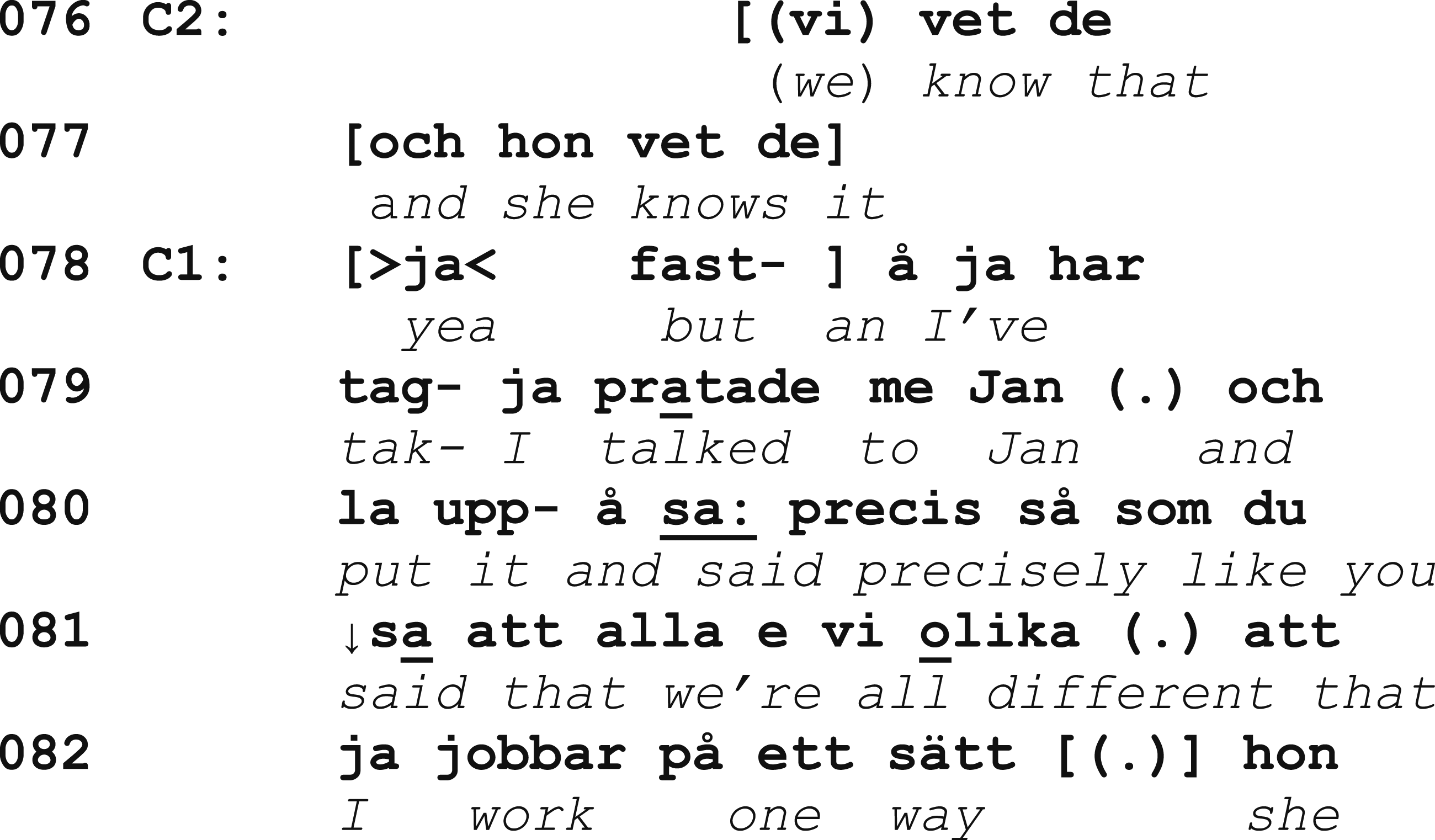
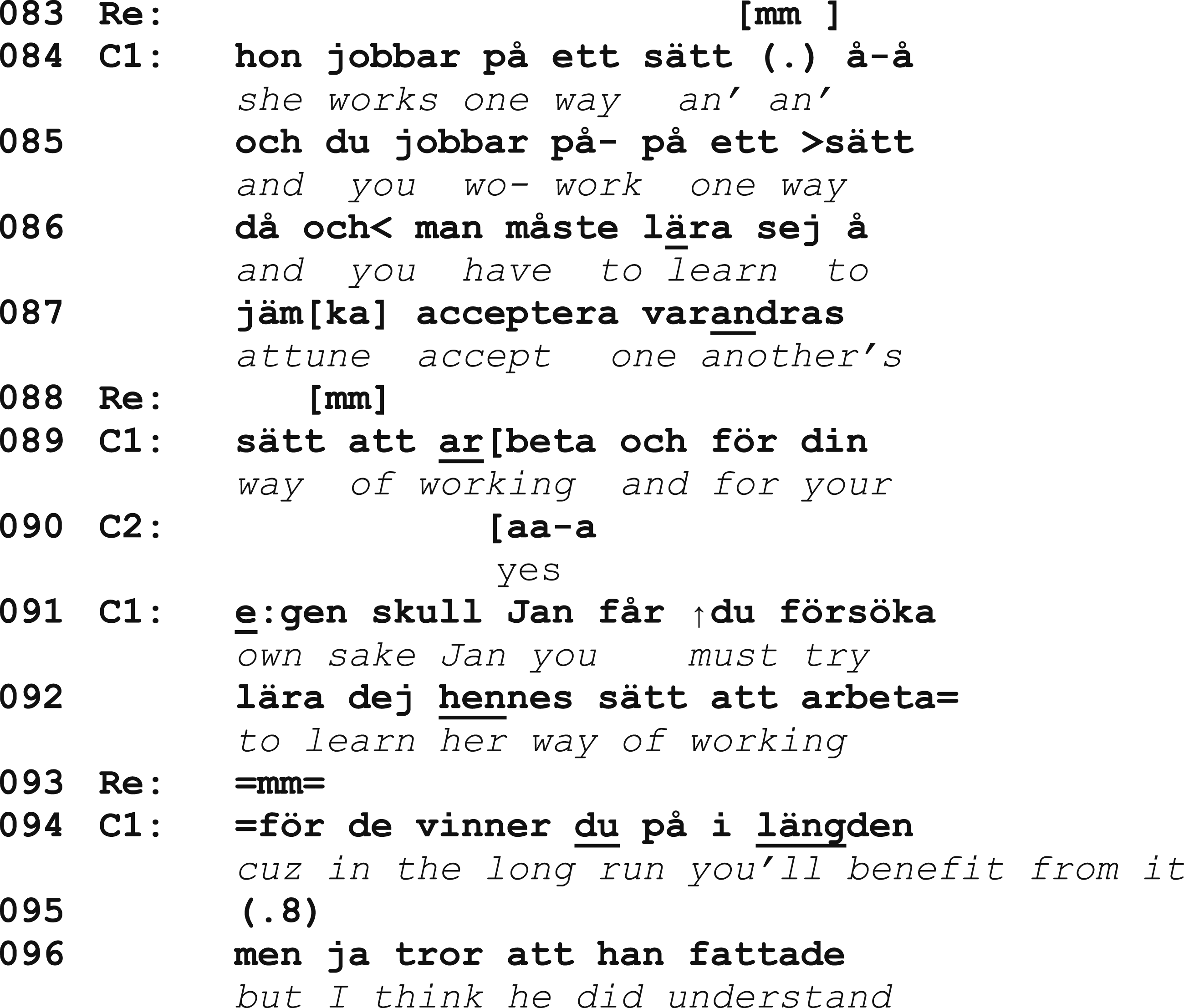
Note that before C1 begins specifying the details of her conversation with the student, she provides a gloss of that conversation – ‘I said precisely like you said’ (lines 80–81). This works as a preface to her story, allowing for a hearing of it as very much in parallel to the gist of T1’s account. From the outset, then, C1’s story is framed as affiliated with T1’s position vs. Camilla’s handling of the situation, and throughout the story she uses direct reported speech in evidence of such common stance.
There is, however, more to C1s’ narrated conversation with Jan. Her explanation attributes staff’s different work routines to personal traits and preferences (cf. Antaki 1994, on attributions as accounts) through the use of a formulaic ‘we are all different’ statement that forms what we might call a rhetorical plurality device. This, we propose, achieves more than merely account for Camilla’s choice of disciplinary action: by celebrating plurality as a workplace philosophy at the special residential home, C1 may be heard as justifying staff’s personality-based behaviour, and invoking a moral order that promotes tolerance of their differences. In fact, C1’s use of the device makes it inevitable that each teacher or care worker will respond differently to similar forms of trouble (lines 81–85). This lays the ground for her subsequent move: using the generalised form of ‘you’ she pronounces a norm that they all need to learn to accommodate to and accept each other’s ways (lines 86–89). From this norm statement she moves to recommend that Jan should try to learn Camilla’s ways to avoid future trouble (lines 92–94). In this way, her retelling of the conversation with Jan highlights her attempts to make the student understand why he ended up in solitary confinement. In particular, their talk is construed as encompassing good advice, whereby the incident is transformed into a general learning opportunity.
With no response forthcoming as she brings the reported conversation to a close, she ends her turn through a footing shift (Goffman, 1981) in line 96 commenting on Jan’s positive uptake of her explanation. Below, T1 adds to the formation of their joint stance by extending the pedagogic rationale introduced by C1:
Excerpt 7. How it works in life
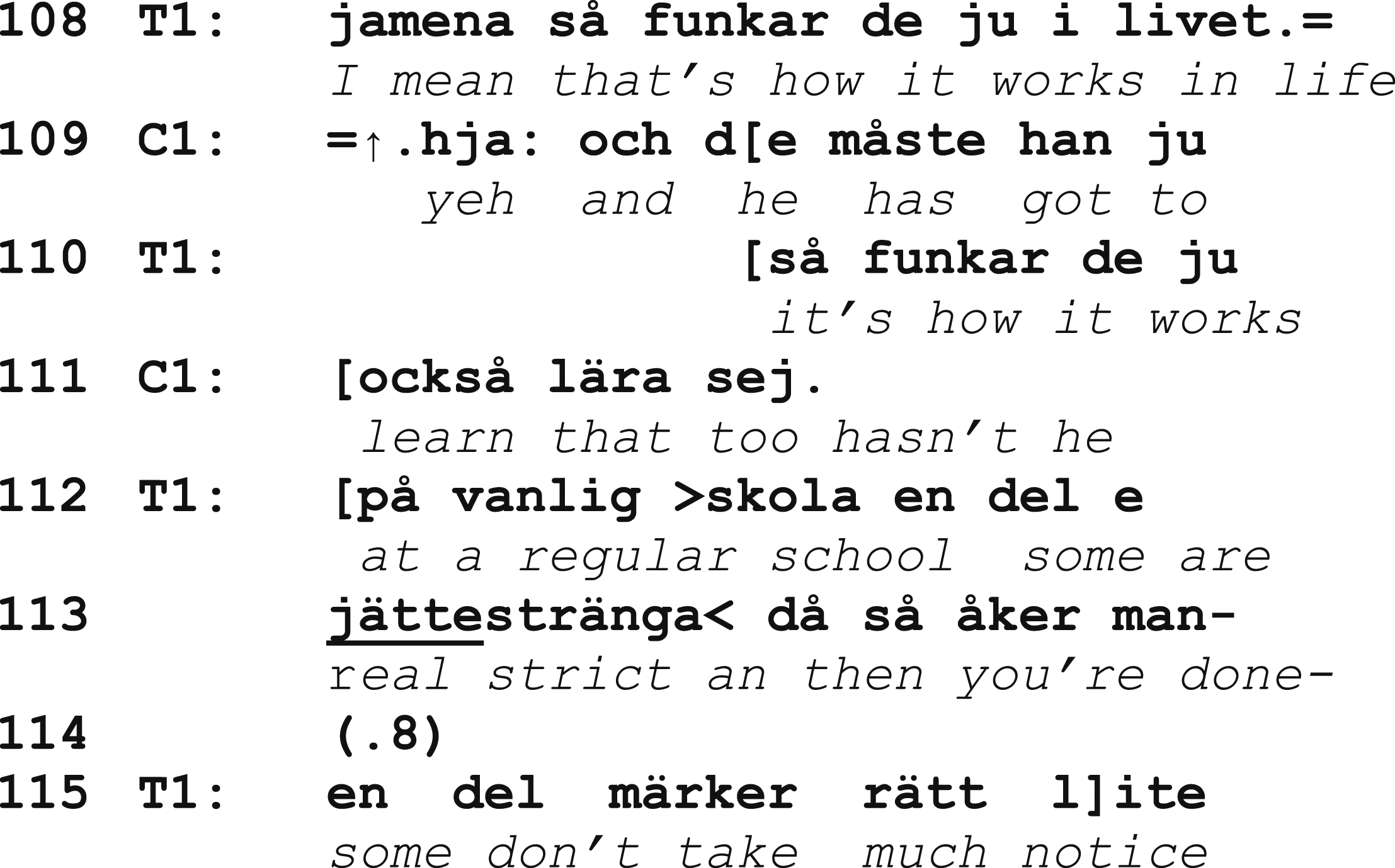
Agreeing with the C1’s point that Jan will have to accept that staff at the special residential home may handle trouble situations differently, T1 reformulates the idea as good life advice in general. The mindset is then narrowed down to apply to ‘regular school’ (i.e. schools outside the special residential home), where teachers may differ in their tolerance of students’ disciplinary transgressions. Interactionally speaking, these phatic observations help to consolidate the joint stance of the care workers and teachers, but they also work to normalise the practical reasoning of professional staff at the special residential home through parallels with schools outside – and even life in general.
T1’s reflections may also be understood against the backdrop of the general goal of youth rehabilitation. Much of the institution’s work – its treatment programmes, school activities, etc. – are specifically designed to provide for and bolster students’ re-entry into ordinary society, and as we have observed elsewhere (Cromdal and Osvaldsson, 2012), life outside the special residential home forms a frequently recurrent topic for its actors, staff and students alike. For instance, students may exploit with great success the failures of other students to live up to norms outside the special residential home as conflict-seeking put-downs.
In sum, the above exchanges allow us to glimpse some of the institutional micropolitics that were set off by a single student incident. Though the care workers initially construed the disciplinary action taken as inadequate, this was resisted by the teachers and through a jointly orchestrated re-specification of the event as above all an important learning opportunity for the student, a joint stance was gradually achieved. In the final section, we further discuss aspects of this interprofessional alignment as it sheds some light on the dialectical relationship between the institution and the identities of its members (Atkinson and Housley, 2003).
Concluding discussion
Analysing a fragment of a staff meeting that addressed as its topic the disciplinary action taken toward a resident at a Swedish special residential home, we have laid bare some of the institutional micropolitics involved in talking about potential policy transgressions. While it would have been easy, on the basis of local as well as national regulations, to simply dismiss the disciplinary action as lacking legal ground, the parties to the meeting that we examined did not opt for this possibility. Instead, the meeting began by two care workers engaging in rather colourful descriptions of the student’s conduct; descriptions which were produced as a collection of documentary evidences (Garfinkel, 1967) of an illicit choice of disciplinary action.
Underlying this descriptive practice are some basic notions of membership categorisation. As Jayyusi (1984: 35) pointed out, there are ‘a host of features that, as clusters, can be oriented to and conventionally expected to go together with some categories, . . . [w]hat is situatedly provided for or invoked as being category-bound is, of course, an occasioned matter and a methodic achievement on the part of members’. As we have shown, the two care workers’ collaborative listing of the student’s non-aggressive, cooperative conduct amounted to such a ‘cluster’ of category implicative features, but did so in sharp contrast to their shared experience of how students behave when being moved – often carried – to the detention room. This cluster of behaviours then, was methodically assembled not as evidence of the student’s incumbency of a ‘solitary confinement case’, but to the contrary as, specifically, his incompatibility with that category. Through these category contrastive descriptions, the care workers are able to produce an account of the disciplinary action taken by the teacher as institutionally problematic without explicitly blaming her for making that decision in the spur of the moment.
The care workers’ categorisation of the event structured the ensuing discussion as a negotiation of local micropolitics around matters of individual, collegial as well as institutional accountability. Clearly, the complaint that the disciplinary action taken by Camilla ‘doesn’t look good’ as well as the conclusion that it ‘wouldn’t hold water up in Stockholm’ reveals a concern with what may be termed ‘upward accountability’ (Vershuere et al. 2006). The work of the special residential home is subject to inspection, assessment and the possibility of sanction, from government bodies that administrate and oversee each institution's ways of working toward rehabilitation of troubled youth.
But the accountability arrangements (Stone 1995) of the special residential home are more complex than that. They also involve aspects of accountability between different categories of staff – particularly in light of the institutional division of labour between, for example, teachers and care workers – where the local production of accounts can be seen as ‘a manifestation of the underlying negotiation of identities’ (Scott and Lyman 1968: 59). The teachers’ receipt of the care workers’ report is telling evidence of this micropolitical concern. Of particular interest here is T1’s counter argument concerning the staff’s professional discretion (and duty) to make difficult decisions; a discretion firmly anchored in local experience of working with unruly youth, where issues of safety are constant concerns for the staff. As we have shown, this lead to the formation of a joint stance towards the event, a stance that effectively deflected issues of blame and responsibility from the conversational agenda (see also Wästerfors and Åkerström (2015), on minimising staff agency in accounts of trouble). Instead, the parties joined in a focus on the student’s experience of the event in question, and in particular how he may come to benefit from it in the future. In so doing, they turned to another aspect of accountability, namely, vis-à-vis their clients, that is, the youth residing at the special residential home. In this way, the parties united in the sole mission of the institution – to rehabilitate the residents, which involves raising their social and relational skills, and otherwise preparing them for life outside the special residential home.
By way of concluding, we therefore want to make a brief point about Jan’s social, relational – and indeed, institutional – competence that the analysis of the staff discussion uncovers. In Wästerfors and Åkerström's (2015) study of case notes rhetoric they argue that staffs’ use of technical terminology allows for a bypassing of relational detail involved in enforcing emergency sanctions. For instance, a report of having ‘pressed down’ (‘lagt ned’) a resident both describes a form of extreme sanction and accounts for its use – if pressing the resident is involved in handling the situation, then this automatically also accounts for the coercive sanction of solitary detention. In the data we have examined, we find that Jan’s compliant and non-aggressive behaviour en route to the detention room not only saves him from being pressed down or otherwise forcibly handled; it also, somewhat ironically, bereaves the staff of a natural way – the only way, according to the law – of accounting for having placed him in solitary confinement. It is worth recalling the care worker’s uneasy conclusion: ‘if they should see it up in Stockholm, it wouldn’t hold water’.
Footnotes
Declaration of Conflicting Interests
The author(s) declared no potential conflicts of interest with respect to the research, authorship, and/or publication of this article.
Funding
The author(s) disclosed receipt of the following financial support for the research, authorship, and/or publication of this article: This work was supported by the We are indebted to the Swedish research council (Vetenskapsrådet) for providing financial support for this project (VR 2003-4095).

Notes
Transcription notations.