




Abstract
In anonymous online text-based counselling provided by social services, counsellors face specific communicative and professional challenges. Among other things, they need to ensure that they have understood the chat users correctly in order to provide relevant information and advice. The paper studies how counsellors check their understanding of users’ situations by using formulations, namely, summarising and rephrasing users’ initial problem descriptions. The data consists of chat logs from 56 web-based counselling sessions provided by social services in Sweden. Conversational analysis is used to examine the functions of chat counsellors’ formulations. Analyses show that counsellors reformulate users’ initial requests to establish a joint understanding of the users’ situations and help requested. Three distinct functions of the initial formulations are identified: recasting requests in the institutional terms of social services, clarifying ambiguity in the user’s initial posts and affiliating with the user.
Introduction
In the increasingly digitalised modern world, there is a strong demand for online social services. The field of social work practice responds to this demand through a growing number of digitalised services such as, for example, online application forms, smartphone apps and online counselling. Among other things, information about social services and social guidance are provided by means of mediated communication, including text communication via online chats. Text communication online differs from more conventional formats of face-to-face and telephone encounters by its being ‘faceless and voiceless’ (Fukkink and Hermanns, 2009: 940), which poses specific challenges for professionals. One of the challenges is a higher risk of misunderstanding in textual encounters due to the lack of nonverbal clues. Bambling with colleagues (2008) has for instance shown that counsellors’ active listening techniques and empathic statements can be misinterpreted by clients when used in online counselling via chat. Moreover, users of online counselling services often remain anonymous, which means that professionals need to work with limited information about the client’s situation (Dowling and Rickwood, 2014).
At the same time, research on communicative strategies and practices, which are used to meet the challenges of social work with clients online, is scarce. Existing studies show that professionals need to make communicative adjustments in their work when they encounter clients online through text. Murphy with colleagues (2008), for example, describe presence techniques used in email counselling to compensate for lacking nonverbal elements of communication, such as a description of the counsellors’ emotional state and the setting the counsellor is in. Stommel and te Molder (2015) show that while in telephone counselling, clients usually acknowledge received advice and thus initiate closing of the calls, in an online chat counsellors may need to use distinct practices to initiate such closings. This may lead the counsellors to perceive online chat as more difficult and less satisfying than answering telephone calls.
The present paper studies anonymous online text-based counselling provided by social services in Sweden. The social services’ online chat aims to provide easily accessible guidance on what kind of support and help social services can offer, where to turn in order to get help, how to apply for benefits and similar concerns. The chat poses communicative challenges for both chat users and counsellors. The users need to formulate their problem or question concisely and anonymously while at the same time providing enough detail to receive relevant information or advice. The counsellors, on the other hand, need to ensure that they have understood the user’s situation correctly in order to provide such relevant information and advice. This paper studies how counsellors check their understanding of users’ requests using the conversational practice of formulation, namely, by summarising and reformulating users’ initial descriptions and requests.
Conversational practice of formulation
Formulation is understood here in the meaning suggested by Heritage and Watson (1979, 1980) – as a conversational practice of providing a candidate reading of a preceding stretch of talk. Heritage and Watson (1979) point out that understanding is a practical achievement in conversation and that there are moments in interaction when conversation participants need to manifestly exhibit their understanding to each other. This can be done by means of formulating what has been said earlier in the conversation, that is, by producing a paraphrase of a prior utterance. The formulation, or paraphrase, preserves parts of the previous utterance while simultaneously deleting or transforming its other parts. Heritage and Watson (1979) suggest that formulation solves the practical problem of possible different readings for utterances and stretches of talk: by displaying a candidate understanding of what has been said conversation participants establish preferences among available readings.
Since Heritage and Watson’s (1979, 1980) work, formulations have been studied in different conversational settings. It has been observed that the practice of formulating is more common in institutional contexts than in mundane interaction (e.g. Drew, 2003). The formulating appears to be particularly suitable for institutional purposes as it allows professionals to edit the client’s words in institutionally relevant ways while presenting the edited version as a neutral summary of what has been said (Antaki, 2008). For instance, studies on formulations in psychotherapy show that formulations allow for directing encounters towards therapeutically relevant matters (e.g. Antaki, 2008; Antaki et al., 2005). Formulations have been also shown to allow for recasting children’s talk in therapeutic terms in child counselling (Hutchby, 2005), steering clients towards solutions in community mediation (Stokoe and Sikveland, 2016), reshaping clients’ descriptions to redirect the talk in occupational therapy (Weiste, 2016) and reframing callers’ experiences to explore alternatives to suicide in suicide helpline calls (Iversen, 2021).
Research shows that formulations are also used in web-based chat counselling (Danby et al., 2009; Stommel, 2016; Stommel and van der Houwen, 2013). Interestingly, counsellors appear to use formulations in the early phase of chat sessions more frequently than in the equivalent phase on the telephone (Stommel, 2016). Studies indicate that in web-based chat counselling formulations may have distinct functions reflecting both the institutional context and the mediated nature of the encounter. For example, Stommel and van der Houwen (2013) studied formulations used by counsellors in chat sessions aiming to provide support to persons with anxiety and depression. They have identified a type of formulation that has not been observed in face-to-face counselling, namely, formulations designed to clarify ambiguity in the immediately prior utterance. These formulations dealt with discontinuities in chat interactions and aimed at re-establishing intersubjective understanding. In another study, Stommel (2016) found two types of formulations used by counsellors in the initial phase of alcohol and drugs chat sessions: question-focused formulations used to clarify an aspect of the client’s question and problem-focused formulations used to offer an option to discuss the client’s problem rather than immediately give the requested information.
The present paper explicates some further usages of formulations in chat counselling. It shows how formulations can be employed to recast chat users’ requests in line with the social services’ agenda and how formulations may serve affiliating with a user. It also provides additional evidence on and further explicates how formulations can be used to prevent potential misunderstandings by clarifying ambiguity in users’ posts (cf. Stommel and van der Houwen, 2013).
Data and method
The data consists of chat logs from 56 web-based counselling sessions provided by a municipal social services department in Sweden. The chat service has been operating since 2013 and aims at providing information and advice on different social questions such as how to apply for financial aid, where to get support in dealing with a relative with addiction or what to do if one suffers from abuse at home. The chat is open during working hours 5 days a week. Questions in the chat are answered by counsellors who are professionally educated social workers.
The chat logs were saved and collected by the counsellors during November–December 2020. Only chat logs with anonymous users were collected. The counsellors also deleted any information that could compromise users’ anonymity such as names of geographical locations. The chat logs do not contain information about which counsellor answered in which chat session. The data has been collected as a part of the research project ‘Social guidance on the Internet: professional challenges, strategies and practices’. Besides analyses of the chat conversations, the project included interviews with the counsellors about their experiences of working with the chat. Both the counsellors and the head of the social services’ department responsible for the chat were informed about the project’s research questions and consented to the chat logs being used for research purposes. The Swedish Ethical Review Authority had no ethical objections to the research project (diary number: 2020–02578).
The counsellors answering in the chat had a varying experience of chat counselling – from 9 months to 4 years. The counsellors did not have any particular training in chat communication, but they were trained in Motivational Interviewing (MI, e.g. Miller and Rollnick, 2012). When providing support and advice in the chat, the counsellors used some communicative techniques from this approach. A central technique in MI is reflection – displaying understanding through rephrasing what the client said (a simple reflection) and adding new angles to the client’s words (a complex reflection). In the interviews, the counsellors mentioned that they intentionally used reflections to allow the chat user know that he/she was listened to, check if they had understood the user correctly as well as subtly lead the conversation in a particular direction. The counsellors also reasoned that by using reflections they helped users to arrive at an understanding of what kind of help they were seeking. On the level of interaction, the MI technique of reflection is performed through the conversational practice of formulation, which has been described above and is the focus of the present study.
The research approach of the study is conversation analysis (CA), which has a long tradition of research in the field of professional practice (Drew and Heritage, 1992; Heritage and Clayman, 2010) including social work (e.g. Hall et al., 2014; Lee et al., 2019; Noordegraaf et al., 2008; Solberg, 2011). CA has its methodological roots in ethnomethodology, particularly the insight into how language is used to manage (mundane as well as professional) situations of everyday life (Heritage, 1984; for ethnomethodology’s potential for social work see de Montigny, 2007). In studies on professional practice, CA allows a close examination of interaction between a professional and client and provides for a detailed description of how professional tasks are accomplished through talk and social interaction.
CA has also proved to be useful in studies of Internet-mediated communication (Giles et al., 2015; Meredith, 2019) including online counselling (e.g. Stommel and te Molder, 2015; Stommel, 2016; Stommel and van der Houwen, 2013). When applied to computer-mediated interaction, CA is argued to be suitable for the study of ‘conversation-like’ data: that is, exchanges of written messages, which include initiating and responsive actions with a sequential order comparable (though not identical) to the rules of turn-taking in face-to-face and telephone conversations (Giles et al., 2015). CA provides tools for studying the organisation of online interaction with particular focus on its affordances and constraints: it allows investigating how conversational participants orient to technological features of the communication medium (Hutchby, 2001; Meredith, 2019). Thus, CA is suitable for studying challenges professionals face when communicating with clients online and the conversational practices used to meet these challenges.
In the present paper, conversation analysis is used to examine the interactional environment in which counsellors’ formulations occur and functions performed by these formulations. Initially, the whole sample of 56 chat logs was examined to identify those chat sessions where counsellors responded to chat users’ initial problem description or question using the conversational practice of formulation. A collection of instances of counsellors’ formulations was composed (N = 26) and closely studied through cross-examination. The analyses focused on a post-by-post development of the chat conversations. A particular interest was if and how counsellors’ formulations transformed users’ initial requests (cf. Stommel, 2016). The chat logs included an indication of time (hour, minute and second) regarding when each post was posted. The timings were considered when attending to the possibility of simultaneous postings: short time intervals between postings of different conversation participants might indicate that they were composed simultaneously and thus constituted a response to previous posts rather than to each other (the phenomenon of disrupted turn adjacency: Herring, 1999).
Results
In about half (N = 26) of the total 56 social services’ chat sessions, counsellors responded to the chat user’s initial question or request with a (re)formulation of the user’s words. In the other chat sessions, the counsellor either directly proceeded to information giving and answering the user’s question (about one third of all the sessions) or gathered additional information about the user’s situation by means of follow-up questions and the encouragement ‘tell more’ (the rest of the sessions). The present paper focuses on the 26 session openings where counsellors used (re)formulations before proceeding to gathering more information and answering the user’s question. These formulations aimed at establishing a joint understanding of the user’s request. At the same time, they served other functions: recasting the requests in the institutional terms of social services, clarifying ambiguity in the user’s initial posts or affiliating with the user.
Securing joint understanding
Let us begin with comparing two extracts below (Extract 1 and 2). In the first extract, the counsellor responds to the user’s initial question with an answer, while in the second the counsellor summarises and rephrases the user’s question first, before proceeding to answering it.
Extract 1
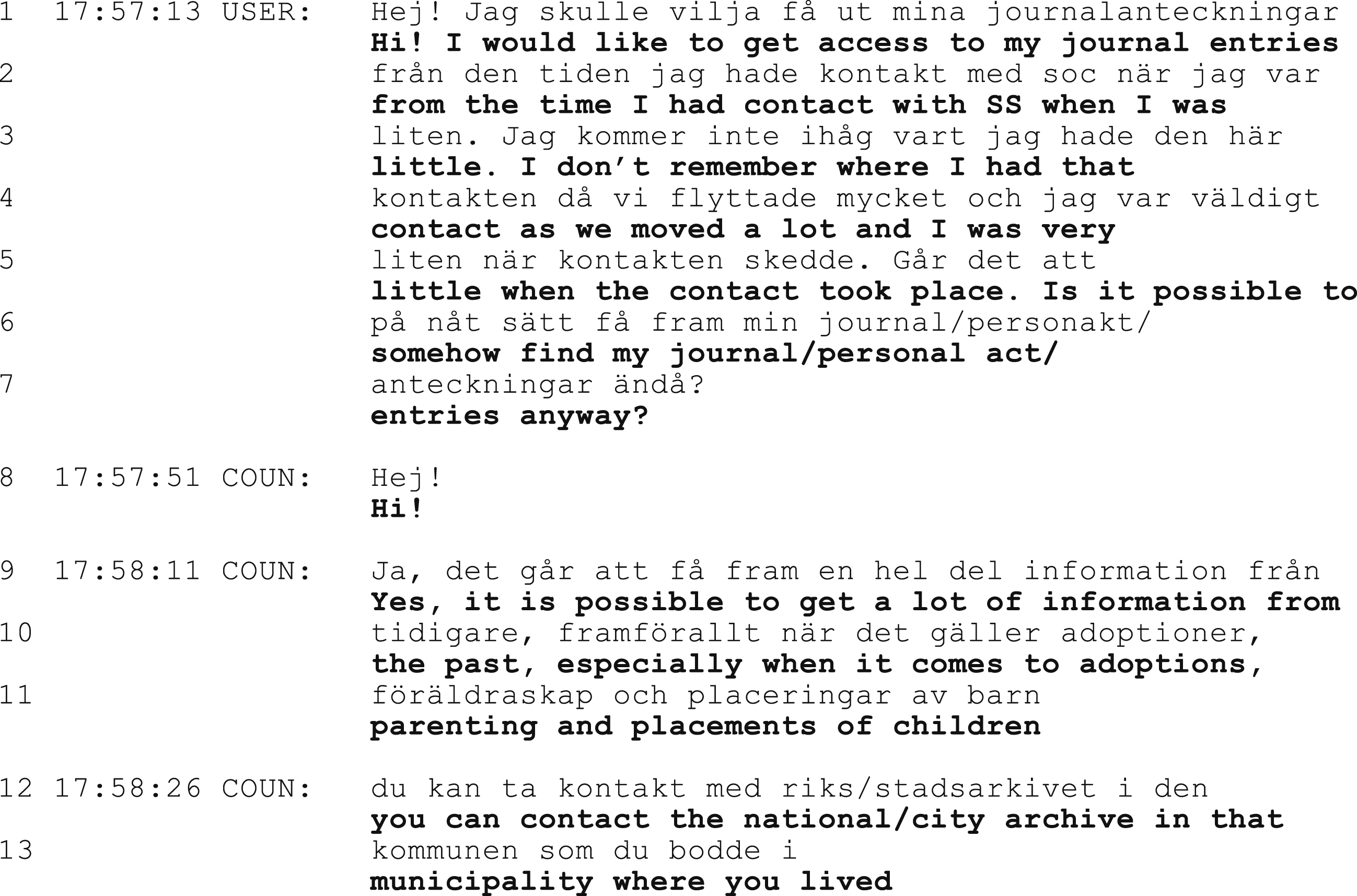
In Extract 1, the counsellor, after reciprocally greeting the user (line 8), immediately proceeds to providing an answer to the user’s question about whether it is possible to retrieve journal entries (lines 9–11). Then, in the next post (lines 12–13), the counsellor provides information about whom the user can contact in the matter. The counsellor advises the user to turn to the municipality where the user lived (line 13). This is in spite of the user’s mentioning problems with remembering the place of residence (lines 3–5). In the continuation of Extract 1, the user rejects the advice (lines 14–15) due to the lack of knowledge about the right municipality:
Extract 1 (continued)

By recycling the earlier wording ‘we moved a lot’ (compare line 4 and 14) and rephrasing what has been written earlier about difficulties in identification of the place of residence (compare line 15 and 3–4), the user orients to a possible trouble in understanding. The counsellor seems to have missed that the user does not remember where the family lived at that time. Instances of difficulties in establishing a joint understanding were not rare in the chat conversations where counsellors proceeded to giving information immediately after users posting their requests (for another example, see Extract 5).
In Extract 2, the counsellor uses quite a different strategy. The counsellor checks his/her understanding of the user’s request (lines 15–21) before proceeding to the answer and thereby secures that his/her reading of it is correct:
Extract 2 1
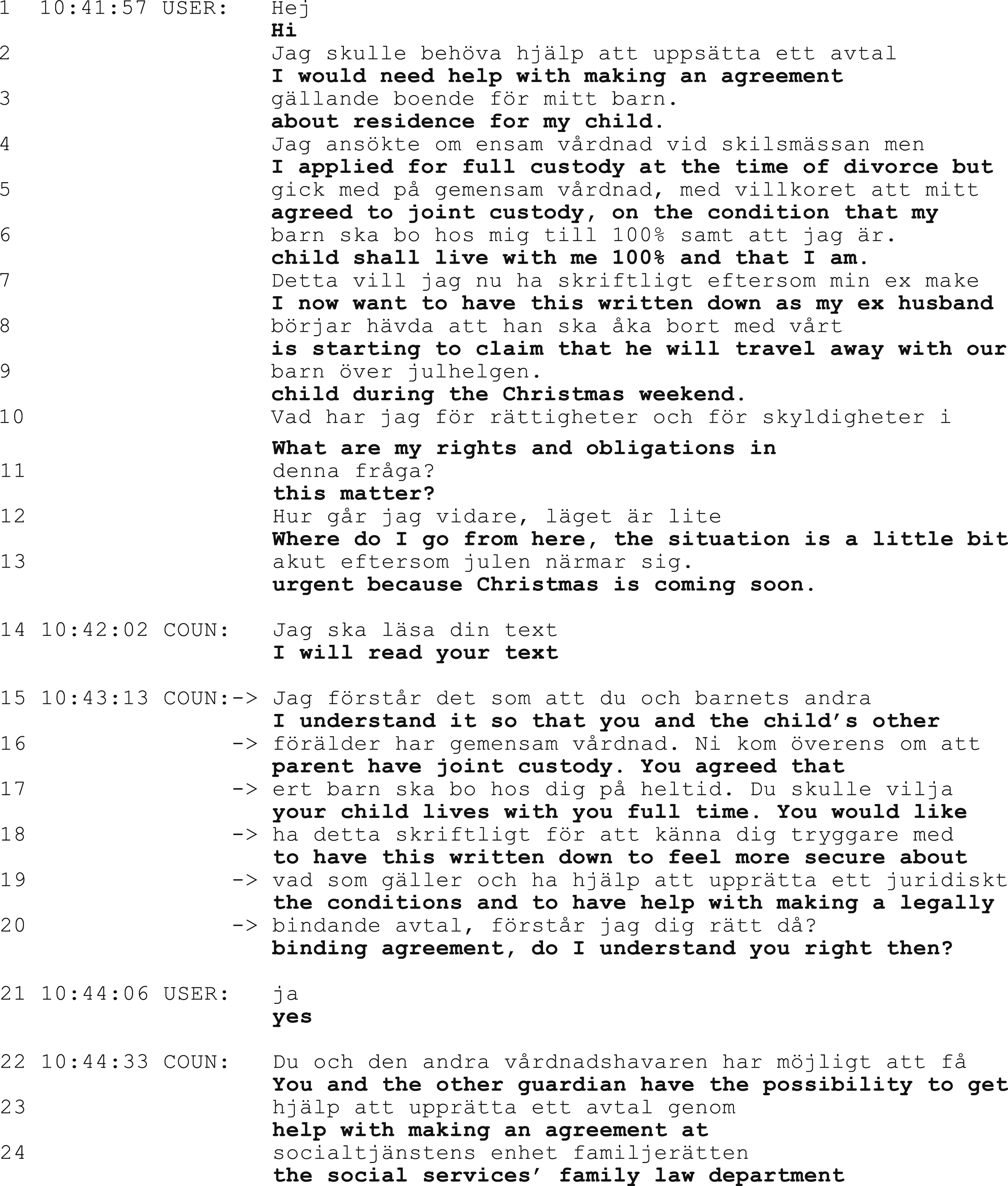
The counsellor responds to the user’s rather long initial post with announcement of reading (line 14) to account for the coming pause (Stommel and te Molder, 2016). After the pause of more than 1 minute, the counsellor posts a formulation (lines 15–20) in the form of a summary of what the user has written. The summary is a compressed and selective version of the user’s request: it omits the historical development of the situation (divorce in line 4 and the ex-husband’s claim in line 7–9) and the question about rights and obligations (lines 10–11). Instead, it selects and recycles, thus highlighting (cf. Weiste and Peräkylä, 2013) particular elements of the user’s post with focus on the present state of affairs: joint custody (lines 5 and 16), child living with the user (lines 6 and 17) and the user’s intention to make an agreement (lines 2, 7 and 19–20). Note that the counsellor also adds a definition of the agreement (‘a legally binding agreement’ in line 19–20) thus checking if this is the kind of agreement the user means. The edited version of the request is overtly presented as a candidate reading of it (“I understand it so that” in line 15) and is submitted to user’s confirmation (“do I understand you right then?” in line 20). By agreeing with the counsellor’s formulation (line 21), the user confirms the counsellor’s understanding as correct and at the same time agrees to the revised version of the request.
In Extract 2, the counsellor’s formulation works to straightforwardly establish a joint understanding of the user’s situation and thereby secure that the answer the counsellor will provide is adequate. Particularly, the question ‘do I understand you right then?’ (line 20) explicitly invites the user to verify the counsellor’s reading of his/her post. By confirming that the counsellor has understood the post correctly, the user signals that a joint understanding of his/her request is established. While establishing joint understanding was a common function for all initial formulations, it was not the only one. In Extract 2, the formulation performs another parallel function, which is explicated below.
Recasting requests in institutional terms
We have already seen that the counsellor’s formulation in Extract 2 selects and reorganises elements from the user’s description. The counsellor’s formulation also makes a subtle transformation in understanding and presenting the user’s situation. The user described her situation in terms of opposition between herself and the child’s dad: it is she who applied for full custody (line 4) and she agreed to joint custody on a particular condition (lines 5–6). The user complains about her ex-husband claiming he will travel away with the child (lines 7–9) despite the oral agreement about the child living with her. The counsellor’s formulation presents a more impartial description of the situation that includes both the user and her ex-husband on equal grounds: they together (lines 15–16: ‘you and the child’s other parent’) have joint custody and they together (line 16: Swedish ‘ni’ is a plural second person pronoun) agreed about the child living with her. The counsellor thus rephrases the user’s description, bringing it in line with the social services’ agenda: social services are not supposed to take one parent’s side but should aim at helping both parents to agree on what is best for the child.
The counsellor’s formulation and the user’s confirmation of it constitute an inserted sequence (Schegloff, 1972) – they occur between the user’s question or request for information (lines 1–13) and the counsellor’s answer to it (lines 22–24). Schegloff (1972) observes that inserted sequences are also pre-sequences as they accomplish preparation work for the subsequent information giving. Note that in lines 22–24, the counsellor answers the user’s question from the point of view of the reformulated version of the family situation, which includes both parents as equally active participants (lines 22–23: ‘you and the other guardian have the possibility to get help with making an agreement’). The counsellor’s reformulation of the user’s description (lines 15–20) thus works as a preparation to the answer (lines 22–24), which is designed as a recommendation for a joint action of both parents rather than something that the user shall do on her own (compare with the user’s words in line 2: ‘I would need help with making an agreement’).
Consider another example in Extract 3 concerning how a counsellor’s formulation may subtly transform the user’s initial description of his/her situation:
Extract 3
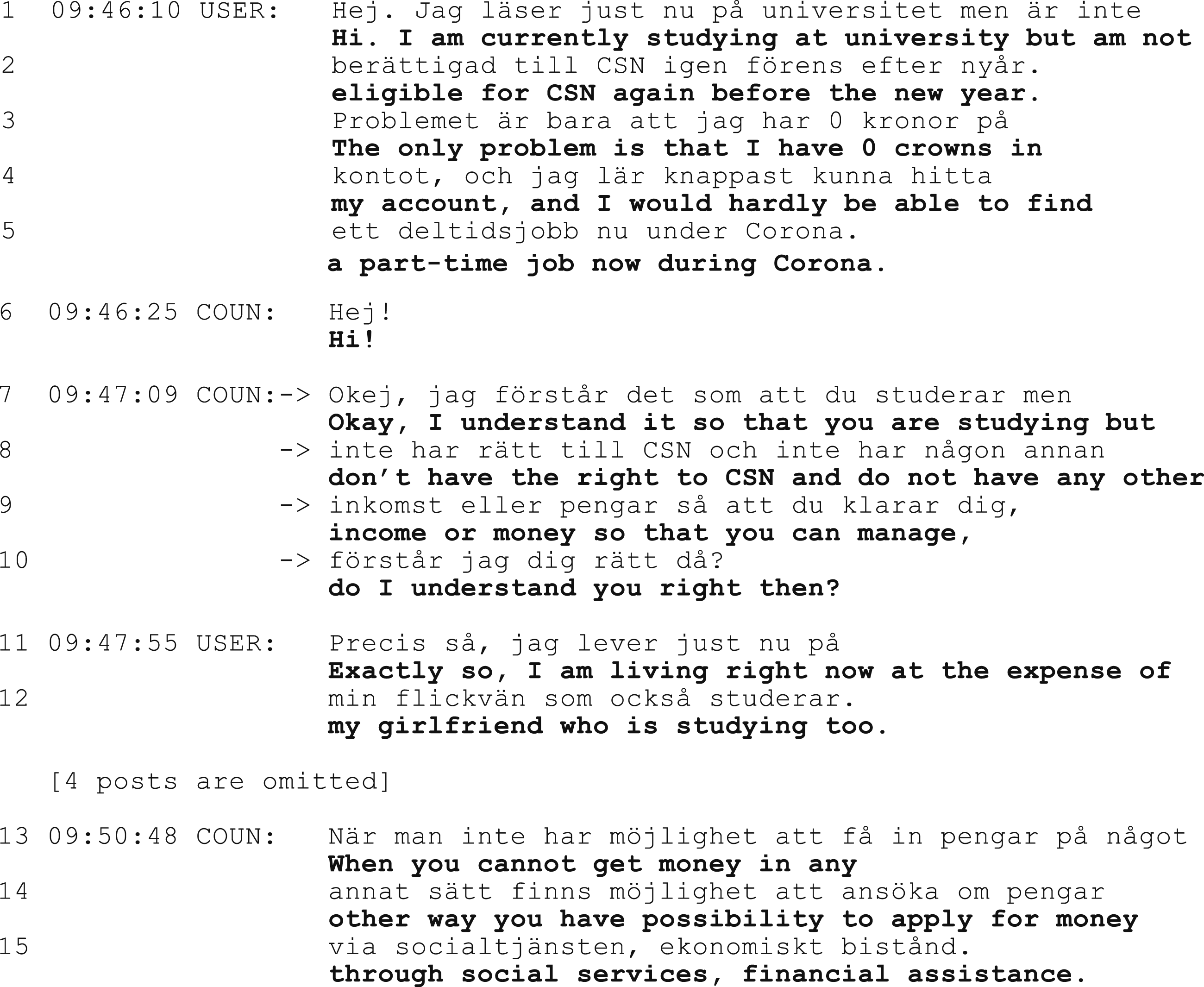
Similar to Extract 2, after responding to the user’s greeting (line 6), the counsellor summarises the user’s narration (line 7–10) and formats it as candidate understanding, which is subject to the user’s confirmation or disconfirmation (line 7: ‘I understand it so that’ and line 10: ‘do I understand you right then?’). First, the counsellor reformulates the user’s point about studying but not having right to a grant or loan from CSN, the Swedish Board of Student Finance (compare line 1–2 and 7–8). Then, the counsellor makes a generalisation about the user not having ‘any other income or money’ (lines 8–9). This generalisation mirrors the user’s narration about having ‘0 crowns’ in his/her account (lines 3–4) and the claim that he/she would not be able to find a job (lines 4–5). At the same time, it more overtly addresses a requirement for applying for financial social assistance, which is granted by social services in those cases where all other support options are excluded. The counsellor spells out this requirement when he/she proceeds to providing information about what can apply in the user’s case: ‘when you cannot get money in any other way’ (lines 13–14). The counsellor’s formulation thus revises the description of the user’s situation in such a way as to bring it closer to the requirement for financial assistance. This revision is discreet as it can be read as a mere summary of what the user him/herself has written. The revised description prepares the ground for the counsellor’s suggestion that the user can apply for financial assistance (lines 13–15).
Antaki (2008) observes that formulations provide an opportunity for institutional agents to edit clients’ narratives according to their own institutional interests. These edited versions are at the same time put forward as mere neutral summaries of the clients’ words. Both in Extract 2 and Extract 3, we can see how counsellors’ formulations may serve to recast the user’s situation in light of social services’ rules and procedures, while doing it in a subtle way. Thus, recasting formulations appear to be used as means of executing institutional power by social services’ counsellors (cf. Hutchby, 1996).
In contrast to Extract 2, where the user responds to the counsellor’s formulation with a minimal confirmation ‘yes’, in Extract 3, the user’s response is extended. The user first gives a strong confirmation ‘exactly so’ (line 11) and then elaborates on his/her situation (living at the expense of his/her girlfriend in lines 11–12). These are the two types of responses – confirmation and confirmation with elaboration – that the counsellors’ recasting formulations routinely elicited. Hence, the recasted descriptions of the users’ situations were never rejected or confronted by the users. This could be because recasting formulations presented institutionally legitimate pictures of the users’ situations and thus foreshadowed the eligibility for receiving social services’ help, such as financial assistance or a family law consultation.
Clarifying ambiguity
The social services counsellors also routinely used formulations of the users’ initial requests to clarify something ambiguous or unclear in these requests. This use of formulations is similar to ‘clarifying formulations’ described by Stommel and van der Houwen (2013) – formulations addressing ambiguity in the immediately prior utterance. Unlike recasting formulations, clarifying formulations do not involve an institutionally relevant transformation of the user’s narrative. In clarifying formulations, the counsellors also do not strive to give a summary of the user’s narrative but rather rephrase a particular element of this narrative. Consider Extract 4 where the counsellor’s formulation in lines 15–18 attends to an ambiguous reference in the user’s post:
Extract 4
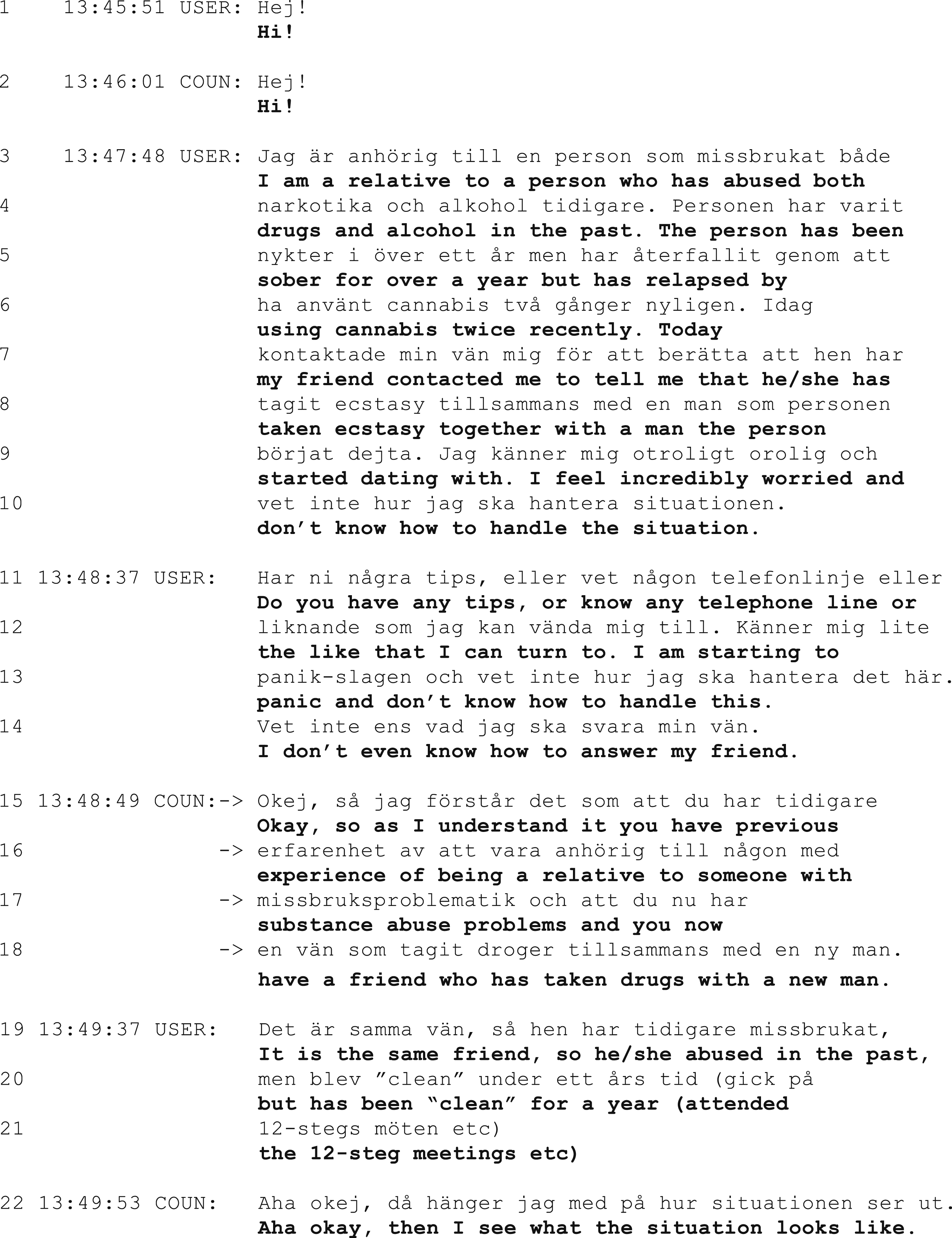
In his/her post, the user makes reference to a person whom he/she is concerned about. This reference is first made through a definition of kinship, ‘I am a relative to a person’ (line 3), and then through a qualitative description of the relationship, ‘my friend’ (line 7). The user does not specify if the ‘relative’ and the ‘friend’ are the same person or two different persons. This ambiguity is addressed in the counsellor’s formulation in lines 15–18, where the counsellor suggests a candidate understanding of the user’s reference as a reference to two different persons: a relative ‘with substance abuse problems’ (lines 16–17) and ‘a friend who has taken drugs with a new man’ (line 18). In his/her response, the user corrects the counsellor’s reading, clarifying that both references are to the same person: ‘it is the same friend’ (line 19).
The counsellor’s formulation functions as an initiation of conversational repair through resaying the trouble-source with different words and verifying it with the speaker of the trouble-source turn (Kitzinger, 2013: 249). It works for clarifying an ambiguity inherent in the user’s initial presentation of his/her situation, thus ensuring that the counsellor correctly comprehends the user’s request. Users responded to counsellors’ clarifying formulations with either confirmation (in few cases) or, as in Extract 4, with correction (in most cases). The user’s correcting response was in turn followed by the counsellor’s token of repair receival such as ‘okay’ and ‘I see’. In Extract 4, the counsellor also responds to the user’s correction by marking its newsworthiness with the particle ‘aha’ (cf. Koivisto, 2019): ‘Aha okay, then I see what the situation looks like’ (line 22).
Affiliating with the user
A small portion of instances of the counsellors’ initial formulations appear to have still another interactional function. In these cases, counsellors use formulations to affiliate with the user, that is, to display their support for the user’s stance. Stivers (2008) suggests that affiliation pertains to the affective or action level of cooperation in interaction: affiliative responses either involve support for the prior speaker’s affective stance or accord with the action preference set up by the initiating action. The social service counsellors used formulations to affiliate with the user’s affective treatment of the situation he/she was describing as well as with the course of action initiated by the user. Extract 5 shows an instance where the chat session starts with what appears to be a misunderstanding about the user’s request. This example is different from the previous ones as here the counsellor first makes an attempt to answer the user’s question. The counsellor’s formulation (lines 14–15) occurs only after the user rejects the answer as irrelevant and repeats his/her request:
Extract 5
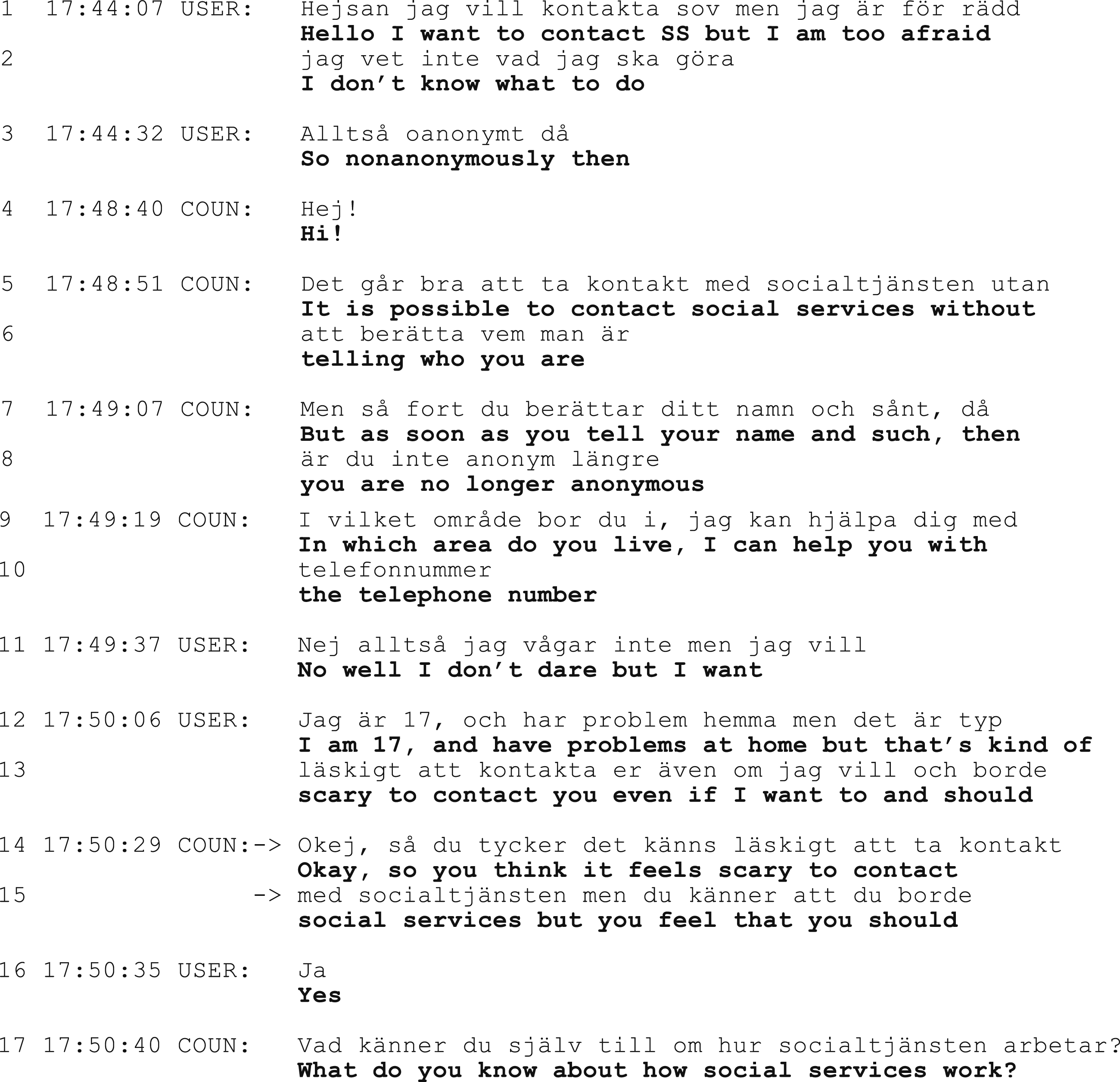
The user starts the chat session writing that he/she wants to contact social services (‘SS’ in line 1) but is afraid to do so. The user exposes a trouble (wanting to do something but being afraid to do it) and then invites advice from the counsellor: ‘I don’t know what to do’ (line 2). After this, the user adds another post saying that he/she means contact that is not anonymous (line 3), insinuating a contrast to the contact he/she is currently taking through the anonymous chat. The counsellor answers after a considerable delay of more than 4 minutes (line 4). After the greeting ‘Hi!’ (line 4), the counsellor explains, in the next two posts, how one can contact social services anonymously (lines 5–8). Then, in yet another post, the counsellor offers to provide the user with a telephone number to the social services’ office (lines 9–10). Short intervals between the counsellor’s four posts (11, 16 and 12 s) indicate that the counsellor sends them after one another without waiting for the user’s response. These separate posts thus comprise, in combination, a reply to the user’s request in lines 1–3. The counsellor responds to this request selectively: he/she addresses the user’s wish to contact social services and the remark about anonymity while leaving out the user’s troubles-telling and appeal for advice. The counsellor treats the user’s posts as a request for contact information (‘I can help you with the telephone number’ in lines 9–10) and asks the user in which area he/she lives (line 9) to provide him/her with the correct contact details.
The user does not answer the counsellor’s question and instead reformulates his/her initial problem description: ‘No well I don’t dare but I want’ (line 11). The post starts with ‘Nej alltså’ (‘No well’) which sends an alert that the reply will not be a straightforward answer to the counsellor’s question (cf. Schegloff and Lerner, 2009). In the next post, the user elaborates on the description of his/her situation (line 12–13) and again repeats, although slightly rephrased, what was written in the first post: it is ‘scary to contact’ but ‘I want’ (compare with lines 1–2). The user thus declines the counsellor’s offer to provide him/her with the social services’ telephone number. Furthermore, by repeating his/her concern the user indicates a problem in the counsellor’s understanding of the request.
This time, the counsellor responds to the user’s repeated concern by reformulating it (lines 14–15). While leaving out the user’s age and situation at home (‘I am 17, and have problems at home’ in line 12), the counsellor reproduces the dilemma the user is facing. In contrast to previous examples, the counsellor’s formulation in this case stays close to the user’s wording. The counsellor recycles the user’s words ‘scary to contact’ (lines 13 and 14) and ‘should’ (lines 13 and 15) and reproduces the tension between what the user wants and thinks and how he/she feels (compare ‘even if’ in line 13 and ‘but’ in line 15). At the same time, the counsellor introduces a slight transformation by reframing the user’s description as thoughts and feelings (line 14: ‘you think it feels scary to contact’ and line 15: ‘you feel that you should’), which is a way of displaying empathy without endorsing the described experience (Iversen 2021). By acknowledging the user’s confusion about what to do, the counsellor explicitly indicates that he/she has read the user’s post and has ‘heard’ what the user’s concern is about (cf. Hutchby, 2005). The formulation indicates a change in the counsellor’s understanding of the user’s request that seems to be about seeking help with his/her state of mind rather than finding out contact details. The user responds to the counsellor’s formulation with confirmation (line 16), thereby indicating that a joint understanding is established. Thereafter the counsellor proceeds to ask the user about what he/she already knows about social services (line 17). In such a way, he/she starts an exploration of what may scare the user as well as what kind of support the user may need (not shown in the extract). The counsellor’s affiliative formulation thus serves to attend to a trouble in understanding and manifestly exhibiting an attempt to remedy it.
Discussion
The three distinct functions of the counsellors’ initial formulations – recasting, clarifying and affiliating – seem to be consistent with the distinct challenges social services’ counsellors face online. By summarising the user’s request and recasting it in social services’ terms (Extract 2 and 3), the counsellors deal with the challenge of extracting most relevant information from the user’s (especially longer) post and translating the user’s situation into social services’ language. When offering the edited version to the user for confirmation, the counsellors check if it is still recognisable and acceptable for the user. By rephrasing and clarifying the ambiguous elements from the user’s narratives (Extract 4), the counsellors ensure that they understand the user’s situation correctly despite the limited information due to the user’s anonymity and lack of nonverbal clues (cf. Fukkink and Hermanns, 2009). By affiliating with the user’s affective stance and interactional project (Extract 5), the counsellors establish or restore the cooperative grounds of the encounter.
Of the three functions identified, two (clarification and affiliation) appear to deal, primarily, with interactional tasks and one (recasting) with the institutional tasks of the chat sessions. Clarifying and affiliative formulations, found in the social services’ chat sessions, are similar in function to practices described in other counselling settings such as online psychological support (Stommel and van der Houwen, 2013) and suicide helplines (Iversen, 2021). Stommel and van der Houwen (2013) suggest that clarifying formulations may be specific for text-based interaction online, possibly due to a higher risk of discontinuities and troubles in understanding during text-mediated encounters. Recasting formulations, on the other hand, serve to bring users’ requests in accordance with social services’ institutional logic and norms and thus may be specific for the social services’ counselling chat. At the same time, the recasting function originates in the generic property of formulations to provide an opportunity to edit and transform clients’ descriptions and thereby adapt them to institutional interests and agendas (Antaki, 2008).
Chat counselling is regarded to have several advantages for service users such as availability and anonymity. Among other things, chat counselling has been claimed to strengthen users’ autonomy and enable more power balance as the contact is taken to a greater extent on the users’ terms: the user initiates the contact and can end it at any time during the chat exchange (e.g. Bambling et al., 2008). Van de Luitgaarden and van der Tier (2018), who studied an online social service for young people with psychosocial problems in the Netherlands, nevertheless raise a concern that social workers tend to take a professionally dominant role online. The authors have shown that in the online counselling social workers prioritised their point of view over the experiences of service users and were reluctant to give the users more control over the conversation. The present study has explicated one particular instrument that can be used by social workers to subtly execute institutional power, namely, recasting formulations. When interviewed, the counsellors who worked in the studied social services’ chat reported that they could intentionally reformulate users’ words to direct the conversation towards what they considered to be important discussion points. The close analyses of the chat exchanges have specified that these reformulations served to make users’ descriptions institutionally appropriate. When recasting users’ life situations in social services terms, the counsellors shifted, at least to some extent, attention from users’ complex experiences to social services’ institutional categorisations to thereby treat users’ situations as recognisable cases (cf. Järvinen, 2014). The narrowing down of the unique life circumstances to concrete, institutionally defined problems appears to be in line with the social services’ chat’s function of ‘a psychosocial helpdesk’ (van de Luitgaarden and van der Tier, 2018), where social workers tend to provide information or quick advice and refer service users to further help outside the chat.
To conclude, the present study contributes to the scarcely researched field of online services in social work by explicating how counsellors respond to chat users’ questions in the challenging environment of a text-based encounter. The close analyses of the chat conversations have allowed us to trace how the conversational practice of formulation may be used for different purposes depending on the immediate requirements of the interaction (such as a trouble in understanding) as well as the counsellors’ vision of their work goals (institutional tasks). Of the three usages identified for the counsellors’ formulations, the recasting one may require practitioners’ special awareness as it involves imposing institutional authority.
Footnotes
Declaration of conflicting interests
The author(s) declared no potential conflicts of interest with respect to the research, authorship, and/or publication of this article.
Funding
The author(s) disclosed receipt of the following financial support for the research, authorship, and/or publication of this article: This work was supported by the Swedish Research Council for Health, Working Life and Welfare (2019-01522).
