




Abstract
There is wide ranging research that uses innovative methods to seek the views of children in out-of-home care. In the area of education, this group of children increasingly participate in research that involves various educational interventions (including book-gifting, tutoring, paired reading), that are designed to improve their educational attainment and achievements. Despite the overall growth in research evidence, there remains an absence of widely reported research on children’s views of the educational interventions that they are involved in and secondly, an absence of more reflective contributions that outline the methodological opportunities and challenges involved. This paper makes a contribution to both areas by reporting both the findings of and critical reflections on the use of an innovative method, the Talking Album, to gather the views of young children, aged 7–9 years old, regarding a reading intervention they were involved in, known as the Reading Together programme. The methodological approach is outlined. Informed by the basic principles underpinning children’s rights as set out in the UNCRC, key learning on the selection, introduction, and support of such methods/tools is reflected upon. From the findings and reflections, recommendations for future research that concerns interventions with children are made.
Introduction
The generally poorer educational outcomes for children in out-of-home care (OHC) in comparison with their peer group is well-established (Tessier et al., 2018), and as a result, there has been increasing recognition of the need for research that evaluates the effectiveness of interventions designed to address these disadvantages because of their potency in determining longer-term health, wellbeing and employment outcomes (Brännstrom et al., 2017). There is also an acceptance of the fundamental importance of seeking the views and experiences of this group, with children’s position as experts in their own lives, now informing most research designs.
Hence, research knowledge in the area of educational interventions for children in OHC is growing. Systematic reviews (Evans et al., 2017; Forsman and Vinnerljung, 2012; Liabo et al., 2012) note that educational interventions for children in OHC, are delivered in a range of settings (typically either the care setting or the school), target either the child or the child and their carer/teacher; and focus on different outcomes including academic skills and attitudes; school attendance, stability and behaviour; and relationships. Of the different types of intervention that do exist, book-gifting, individual tutoring (including direct instruction and paired reading), and individualised educational support programmes are the most popular. However, far less is known about: first, how far and in what ways children are involved in the design of interventions; second, what their views and experiences of the interventions are; and third, how the views and experiences of children influence new developments.
Indeed, in a systematic review by Evans et al. (2017), although many of the included studies had a process evaluation, only a minority made any reference to the views the participants, in particular the children involved. A similar pattern is noted in the systematic review by Forsman and Vinnerljung (2012), where some of the included studies did seek the views of children and others did not. Notable exceptions to this include research by Dymoke and Griffiths (2010) and Griffiths (2012) which sought the views of young children about the Letterbox Club (a book-gifting scheme) in which they were involved and Rix et al. (2017), who as part of a bigger study, interviewed 14 children in foster care and drew attention to children’s views of the benefits and barriers associated with reading with their foster carers.
The patchy attention to seeking the views of young children in care about educational interventions they are involved in, lags behind other research that documents views and experiences of school children in general as noted in a recent systematic review by Townsend et al. (2020) which included 11 studies of children in care, (aged 10 and over) and focused on children’s perspectives of educational experiences. The review by Townsend et al. (2020) illustrates the capacity and potential of children in care to share their views and experiences if supported by: a) the right type of environment (provision of time and space, adults who are willing to listen and to take action on what children share); b) provision of the right materials (varied, child-friendly, accessible); and c) free choice (freedom to use or not use the materials available and to engage or not engage).
In a context where the views and experiences of children about the interventions they are involved in are not routinely collected, this paper aims to help address the identified gaps in research knowledge by reporting both the findings of and critical reflections on the use of an innovative method, the Talking Album, to gather the views of young children, aged 7–9 years old, regarding a reading intervention they were involved in, known as the Reading Together programme. The Talking Album is explained first, followed by an outline of the study design and a critical reflection of the methodological approach and the challenges and opportunities of its use to gather views of children in OHC in an educational intervention.
Talking album
The Talking Album, designed to create audio-visual memories for children and adults, is an album containing several transparent sleeves (pages) into which photographs (6 × 4 inches) can be inserted. On each sleeve, there is a recording device, activated by pushing a button. It enables a person to talk about the photograph they have inserted and save the recording. The button has different functions (record, replay and delete), depending on the function might need to be pushed once or twice or held down and the record and stop record functions are accompanied by different coloured lights. The total recording time is 2 hours. The method sits at the intersection between photovoice (which involves research participants in a community being empowered to participate by being given cameras to photograph what is important to them) and photo elicitation (which involves a photograph being inserted into an interview to draw out deeper meaning and insight regarding an issue of focus in the interview process) (Gomez, 2020).
Photovoice has been used successfully with groups of very young children in early childhood settings (Butschi and Hedderich, 2021) as illustrated by the Mosaic approach (Clark, 2017) which sets out a multi-method participatory research framework for gathering the views and experiences of young children about their early childhood settings. Photo elicitation has also been very successfully used in research with young children (Pyle, 2013; Shaw, 2021) and as noted by Pyle (2013) can involve photographs being inserted into interviews that have not been taken by the participants themselves but can also involve using photographs taken by research participants. Mannay (2017) in research with care experienced children aged 6–27 years, used a form of photo elicitation which involved taking photographs of the artefacts made by children as part of the overall creative, participatory methodological approach and then using these photographs in one-to-one follow-up interviews with the children and young people involved.
A third approach, more akin to Talking Album is photostories or audiophotography; a visual method which uses both the participant generated photographs and their stories that accompany their photographs in an interview to generate deep meaning around the issues of concern (Frohlich, 2015; Gomez, 2020).
Overall, the research literature regarding the use of the Talking Album is extremely limited. Research by (Blackmore et al., 2020) highlights its use as a tool to support the transitions of children from foster placements to adoptive placements. They highlight that the Talking Album can have a positive impact on the transition process because it helps children familiarise themselves with new family members, their voices and faces and can assist in the process of forming new connections. Lewis (2021: 10) focus on the use of the Talking Album by professionals to assess children’s wellbeing in early years settings noting its ‘participatory components, whereby child, practitioner and parent become actively involved, engage in a dialogue and reflection, and have shared ownership’. This paper therefore seeks to add to knowledge about the application of, and challenges and opportunities of, this methodological approach through a critical reflection of its use in the Reading Together research study. This study is explored next.
Research study
The research study involved the design and evaluation of the effectiveness of an enhanced book-gifting intervention called ‘Reading Together’ that supplemented existing approaches to book-gifting by incorporating a paired reading component for foster carers to undertake with their children and also providing the children with choice in relation to the selection of the books they received. A total of 22 local authorities participated in the study, which ran between 2019 and 2021 and involved 266 children, aged 7–9 years who participated in a three-armed randomised controlled trial, designed to evaluate the effectiveness of the book-gifting scheme supported by paired reading delivered by foster carers trained in the reading approach. The main findings of this study are elsewhere (Connolly et al., 2022).
As part of the study, a qualitative process evaluation was undertaken, with the aim of seeking the views and experiences of 30 children and their carers regarding the reading intervention. Of the 22 local authorities involved, 6 agreed to participate in the process evaluation. From these, the research team planned to recruit 30 children and their carers; 15 families from local authorities in Northern England and 15 families from local authorities in Southern England. The overall methodological approach involved a pre-intervention interview with each child and their carer and a post-intervention interview. At the pre-intervention stage, 12 families in Northern England and 15 families in Southern England participated in face-to-face interviews. It was not possible to recruit 15 families from Northern England because of those identified to take part, changes in placement and personal circumstances meant it was no longer appropriate for them to be involved.
For those involved in pre-intervention interviews, part of the interview involved the researcher giving the family the Talking Album, a disposable camera and a voucher to get the film from the disposable camera developed so that photographs could be inserted into the album and recordings made by the child to accompany each photograph. The researcher also talked through and demonstrated how the Talking Album worked and encouraged carers and children to have a go by recording their voices. The researcher also left a simple instruction sheet with photographs to illustrate how to operate the Album along with spare batteries for the charger. The children and carers were also informed that the researcher would contact them by phone during the course of the intervention to see how things were going regarding using the Talking Album.
During the period of the intervention, when families were about to receive or had just received their initial book-gifting parcels, the covid pandemic emerged. Participants were all involved in the first national lockdown where legally enforceable measures which came into force on 26th March 2022 resulted in carers and children having to stay at home and adjusting to changes where some employed carers had to work from home and some children (although technically eligible to continue attending school because of their status as vulnerable) being home-schooled. Changes in daily life for children and their carers caused by the pandemic obviously impacted on the research study and are reported in detail elsewhere (Tah et al., 2022). In relation to this article, the relevance of the pandemic to the innovative methodological approach used is explored where relevant.
At the post-intervention interview stage, 6 children had partially completed their Talking Album (taking photographs but not getting them developed, having the photographs ready but not mounted in the album), 12 did not complete it and 1 child completed it in full. All interviews were digitally recorded and transcribed data was organised and coded using NVivo12. The process of coding involved four members of the research team reading randomly selected transcripts and each researcher generated a series of codes. The research team then shared these codes with each other. They then agreed a set of codes which together formed the initial coding framework. As the coding progressed and the team became more familiar with the dataset, the four researchers met to suggest and agree additions and changes to the initial coding framework. A final coding framework was agreed within the research team. In this paper, the findings related to the use of the Talking Album and disposable camera are discussed and critical reflections drawn out. Implications for future studies are considered.
Findings
This section begins with outlining the main findings from the pre-intervention interviews with the carers and children in which the Talking Album and disposable cameras were introduced to the families. A subsequent section outlines the findings from the post-intervention interviews in which the engagement of children and carers with the Talking Albums and disposable cameras was explored.
Pre-intervention interviews: Introducing the Talking Album to children and their carers
Carer and child confidence and familiarity with the Talking Album
A dominant theme that emerged in the pre-intervention interviews was a lack of confidence and familiarity by carers and children with the method itself including the technicalities of the Talking Album and the disposable camera. With regards to the Talking Album, its technicalities were confusing to some carers. As noted earlier, the recording button has different functions (record, replay and delete), and depending on the function it might need to be pushed once or twice or held down. Different functions are noted by different coloured lights. In the example below, the researcher spent time going through the Talking Album with Marie (carer) who was not confident. In response, the researcher tried to ensure that Mia (child) was clear about how the Talking Album worked:
On the other hand, there was one carer (Eric) who was familiar with the Talking Album and Eddie (the child), taking the lead from his carer, engaged with curiosity and excitement with the method, as noted below:
Eddie listened in, followed up requesting more information and appeared to absorb the instructions by reflecting them back to the researcher, as outlined below:
Carer and child confidence and familiarity with the disposable camera
Regarding the disposable camera, further confusion was caused when researchers introduced the disposable camera, which came sealed in a foil covering and in a brightly coloured box. The disposable camera (which had a roll of film and involved taking photographs which were then sent away to be developed), was completely unfamiliar to some children, who were more used to having instant photographs via their phones. This is illustrated in the discussion between Gwen (carer) and Georgia (female child below):
In another excerpt, involving Charlotte (carer) and Connor (child), Connor was unfamiliar with the disposable camera and thought it was like a digital camera:
Conor asked to take the camera out of its foil packaging and engaged with the researcher, who showed him how the camera works, as illustrated below:
However, Charlotte (carer) was less convinced that the disposable camera was a good option and indicated that she might use her phone instead: Charlotte then reinforced this in the following excerpt:
Members of the research team reported that with time spent with families demonstrating the method, and by making available an accessible diagrammatic instruction leaflet on the method and contact details in case of difficulty, children and carers agreed to use the method, some looking forward to engaging with it.
Post-intervention interviews: Child and carer engagement with the Talking Album and the disposable camera
Conducive home environment and collaborative effort
As noted earlier, of the 19 children interviewed at the post-intervention stage, 6 had partially completed their Talking Album (taking photographs but not getting them developed, having the photographs ready but not mounted in the album), 12 did not complete it and 1 child completed it in full. Beginning with the child who completed their Talking Album, there were several interrelated child and carer factors that appeared to create a conducive and collaborative environment which assisted engagement. For carers, these included their relationship with the child; their attitude towards, and confidence with the method; and their other commitments. For children, these included their confidence, comprehension and concentration.
As an illustrative example of interrelated carer/child factors that created a conducive environment to support a child’s engagement with and completion of the Talking Album, the case study of Eric (a single male foster carer) and Eddie (a male child, aged 8 years), highlighted earlier, illustrates that carer confidence and familiarity with the method created the context within which both approached the technology with a degree of confidence and familiarity. Eddie’s Talking Album, which had been completed at home during the pandemic, contained 5 photographs (taken by Eric), 3 pictures and 8 voice recordings on 8 pages.
Eddie took part in a post-intervention interview with the researcher which lasted 28 minutes, via Zoom, to share his Talking Album. Eric was also present. Eddie showed the researcher his album and shared his recordings. The Talking Album and Eddie’s recorded voice are captured in a mini video recorded by Eric (carer). Some excerpts from the transcript are noted below: Eddie then presses the voice activator button on the facing page where he says, ‘I enjoyed the book about birds. My favourite one (bird) was the oyster catcher and I did some research on the internet about the oyster catcher. And I even drew my own one’. This is accompanied by a photo which shows Eddie, dressed in a T-shirt at a table, using the pencil that came in the book parcel and with book on birds in front of him. On the next page is a picture of the Cookie book. Eddie’s pre-recorded voice says, ‘Cookie came in the second parcel but I was a bit sad as Cookie wasn’t the one that I’d asked for. And I tried to read it but we didn’t finish it because it was a bit boring because it was all about a girl’. Eddie can be seen still holding his Talking Album up in front of the camera and smiling.
Of note is the fact that completion of the Talking Album by Eddie, represented a collaborative effort between Eric (carer) and Eddie (the child) within a context where Eric was confident and familiar with the methodological approach, had thought through its inherent limitations, used his phone to supplement the disposable camera, spent time with Eddie completing the reading and supported Eddie’s own curiosity and desire to learn more (as noted by the completion of the additional project about the oyster catcher, outlined above). Within this context, Eddie approached the method in a confident and curious way as indicated when he displayed his album, replayed the recordings (which he enjoyed listening to and was very proud of) and talked through his views.
Challenging home environment and competing priorities
In the post-intervention interviews, issues regarding lack of confidence and lack of familiarity with the Talking Album and disposable camera, which had come to the fore for some families when the method was introduced in the pre-intervention interviews, had been exacerbated by challenges in the home environment caused by the covid pandemic, as illustrated below. Haley (child) when asked about the Talking Album said the following:
Other children had also recorded their voices, taken the photographs but not got them developed as indicated below involving Leanne (carer) and Les (child):
Other challenges included changes in personal and placement related circumstances as well as active choices made by children not to engage in the methodological approach. For example, even at the pre-intervention stage, once child had already decided that this was not the method for them as illustrated below:
Critical reflection and discussion
Prior to the start of the research, the team believed that the Talking Album and disposable camera, as a form of audiophotography, had several strengths for this study. First, the method appeared to offer children choice, freedom and flexibility about how, when and in what ways they might use the disposable camera and the Talking Album to record their views. Second, the method appeared to offer children the opportunity of capturing their views ‘in the moment’, for example, photographing the arrival of book parcels and/or their opening and documenting their views in a ‘moment-by-moment’ account of the ‘ups and downs’ of the reading process. It was thought that this approach had the potential to offer new and different insights compared with inviting children to reflect back and recall their experiences of book-gifting, where time and space between being involved in the book-gifting programme and completing an interview about it, would naturally impact on the interview content. Third, it was believed that in the post-intervention interviews, the Talking Album could enable children to participate almost by proxy simply displaying the album with the photographs and playing back to the researchers the voice overs they had made. Fourth, the research team planned for each child to keep the Talking Album. The method therefore offered children the option of preserving their photos and voice overs as a memento or they could take out the photographs, delete the voice overs and use it for something else, in line with their choices and preferences.
Basic requirements for the implementation of the right of the child to be heard (excerpts taken from UN, 2009, section D, para 132: 26–27).
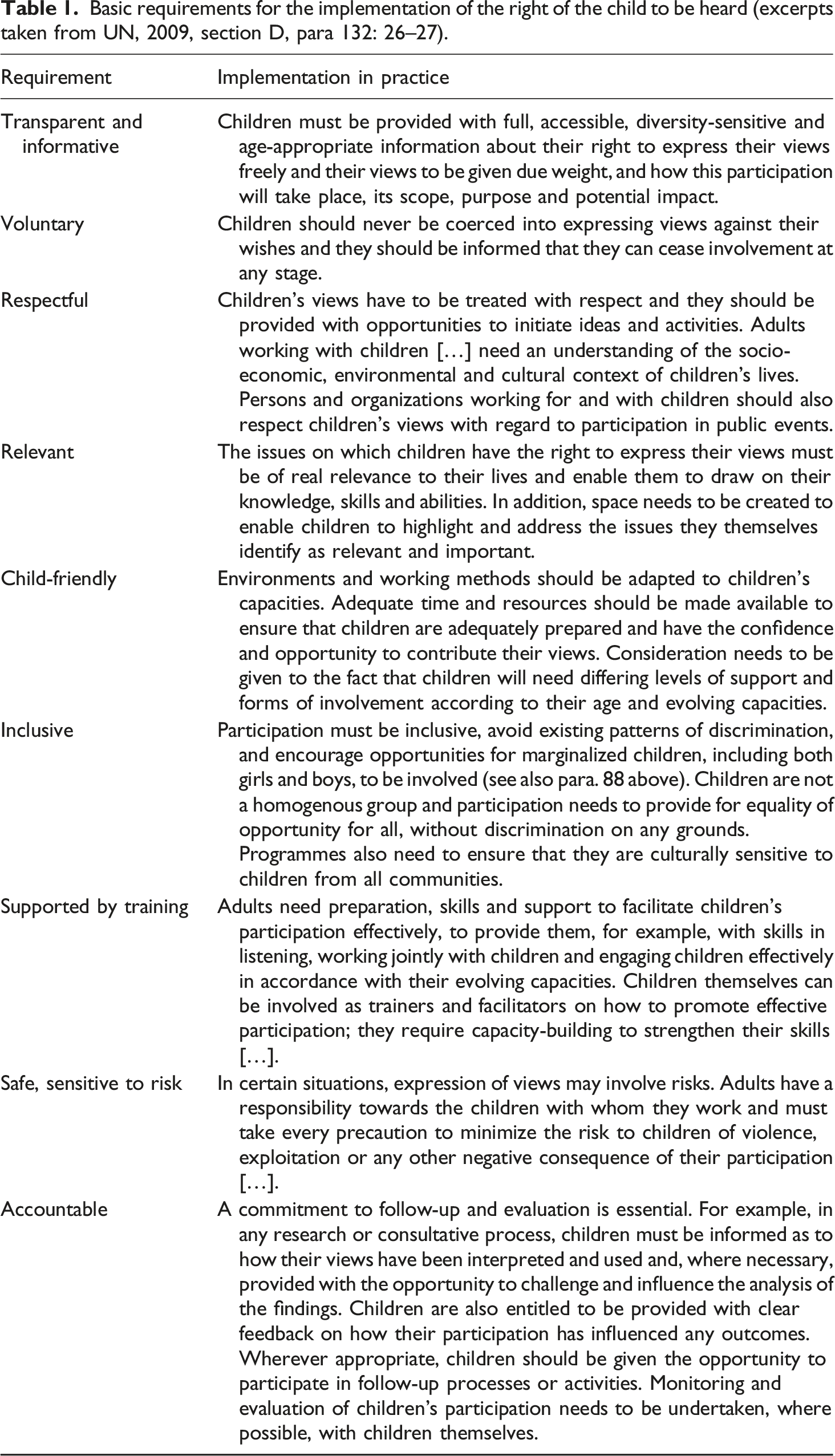
With regards to the principle of inclusivity, it is clear from the challenges encountered that children in out-of-home care should be involved from the outset in the choice and design of the methods by which their views are to be sought. While the research design had included a children’s advisory group comprising care experienced young people, it was not possible to establish such a group within the time frame of the study because of challenges sourcing a stable group of care experienced young people who were available and willing to be involved. One impact of this was that the method chosen by the research team to elicit children’s views was not inclusive because most children and carers found the Talking Album and disposable cameras old fashioned and overly complicated.
Reflecting on the principle of ‘child-friendly’ and whether this particular method could have been made more ‘child-friendly’, a question is whether ‘adequate time and resources […] had been made available so that the involved children were prepared and had ‘the confidence and opportunity to contribute their views’, particularly as the introduction of the method in the pre-intervention interviews could appear to be constructed as a ‘one-off’ event rather than as an ‘ongoing process’. The research team identified that the method was less child-friendly than hoped for partly because the availability of ongoing support (regular check-in telephone calls from the researchers) included in the original research design, did not happen because of the pandemic. The research team became aware that foster families were under immense strain, dealing with other pressing priorities such as home-schooling, changes to working patterns, emotional/social strain and, in these circumstances thought it highly inappropriate and unethical to be pursuing families and children regarding their use of the Talking Album at this time. That said, the research team concluded from the findings from children and carers that regardless of support offered, the Talking Album method was less child-friendly than digital technology including iPhones, iPads and computers, which children and carers noted were used in their daily lives.
With regards to digital technology and the principle of ‘safe and sensitive to risk’, as outlined in Table 1, it is acknowledged that the engagement of children in OHC in digital technology is far from risk free (Iyer et al., 2020), but it is also noteworthy that from the point of view of the children and carers, digital technology appeared to be the most popular and child-friendly research method because of its familiarity, easy access and instant outputs. During the design of the study, the research team had discussed the use of digital technology to gather feedback from carers and children but were alerted to concerns by adult stakeholders involved in the study and opted not to pursue this. We suggest that in this era of digital technology and the increased interest in the use of digital technology by young children (Sandberg and Gillen, 2020), it is likely that this will be the preferred research method of the future and, as long as its use is supported by training, adult guidance and is safe, it will be the preferred and indeed, most child-friendly option for many children.
Reflecting further on the principle of ‘supported by training and adult guidance’, the findings from children and carer engagement in the Talking Album and disposable camera, indicated the centrality of the role of the carer in facilitating children to complete (or not) their Talking Album. Children do not express their views in isolation but rather these are contextual, contingent and in this case, the role of the adult carer was key. Our research design could have been significantly enhanced in this regard by paying further attention to the training needs of carers when the Talking Album was introduced. Whilst the research team did make a video that carers and children could watch regarding the workings of the Talking Album, what seemed to be needed was ongoing ‘hands on’, ‘in the moment’ practical help navigating the use of the Talking Album. It is difficult for the research team to separate out how far lack of engagement was caused by the pandemic per se or disenchantment with the method chosen, however the research team surmise that lack of engagement would have been an issue without the pandemic because of the wider issues, already highlighted in the pre-intervention interviews, regarding the method chosen.
With regards to the principle of accountability, it is noteworthy that in Table 1 under the basic principle, ‘accountable’, children should have the opportunity to participate in follow-up processes or activities. Here risk and safety are key considerations, especially for children in out-of-home care whose sensitive situations are kept private given (as illustrated by the children involved in Mannay et al.’s study (2017)) that the label ‘child in care’ can cause lifelong prejudice and discrimination. However, in our study, Eddie (who completed his Talking Album) had invested a great deal of time and energy completing his Talking Album (with photos, pictures and voice overs) and then also making a video in which he displayed his Talking Album, activating each of his voice recordings as he turned the pages. He was very proud of his accomplishments and very keen to share his work. However, our ethical protocol (which secured his anonymity) prevented him sharing more widely. Again, had he and other care experienced children been involved in the design of the evaluation, this issue may have been raised and solutions offered by the children which made the research findings more accountable to them and more respectful of their views and the ways they wanted these shared.
Concluding thoughts
Using a reflective approach guided by the basic UNCRC principles underpinning a child’s right to be heard, this paper has reported both the findings of and critical reflections on the use of an innovative method, the Talking Album with disposable camera, to gather the views of young children, aged 7–9 years old, regarding a reading intervention they were involved in, known as the Reading Together programme. Several issues have been identified relating to inclusivity, child-friendliness and the availability of support mechanisms for children and carers. There are several recommendations that arise from our critical reflections. First, all intervention studies that target children should be designed to include children’s views and experiences of the intervention. Second, to assist in the process of appropriately eliciting children’s views, it is imperative that research teams establish a functioning children’s advisory group. The children’s advisory group should be involved throughout the research process, in particular at the research design stage and specifically regarding the methods chosen to elicit children’s views and perspectives. Identified methods should also be piloted with a group of children so that their preferences can be further accurately ascertained. As part of the research design stage, research teams should give active consideration to the use of digital technology that is safe and sensitive to risk. Third, all intervention studies that target children and seek to collect their views about the intervention, should indicate how and in what ways they intend to acknowledge the critical role played by the significant carers/adults in gathering children’s views. Fourthly, future intervention studies should seek to include genuine opportunities for children to be engaged in dissemination and follow-up activities regarding research study findings. This should include consideration as to whether children wish to share their own accounts and be named in their own work.
Our own reflections build on the work of Larsson et al. (2018) whose review focuses on children’s participation in developing interventions relating to their own health and wellbeing. Based on the discovery that while intervention studies mentioned the participation of children, the term was not well operationalised, the actual extent of children’s participation was not clear and that children’s engagement varied greatly, Larsson et al. (2018) recommend greater consistency theoretically and greater clarity in reporting the practical applications of participatory processes. These thoughts resonate with our own reflections. We strongly recommend that the UNCRC basic practice principles regarding the implementation of a child’s right to be heard (featured in this paper) should form the framework underpinning the design of all intervention research involving children and that all intervention research should routinely seek children’s views in clear, coherent and theoretically informed ways.
Footnotes
Declaration of conflicting interests
The author(s) declared no potential conflicts of interest with respect to the research, authorship, and/or publication of this article.
Funding
The author(s) disclosed receipt of the following financial support for the research, authorship, and/or publication of this article: This study was funded by the Economic and Social Research Council (ESRC), grant reference ES/P008240/1.
