




Abstract
This study critically explores the meanings of parenting and dis/ability for mothers and fathers with intellectual disabilities in the context of social work in Austria. The aim was to gain insights into what it means to be a mother/father with intellectual disability in Austria by analyzing how parenting with intellectual disabilities is publicly discussed, how social work professionals perceive supporting parents with intellectual disabilities and how mothers and fathers with intellectual disabilities experience parenthood. The findings reveal that negative understandings of disability collide with notions of responsible parenting. Mothers and fathers with intellectual disabilities were subject to child welfare interventions, experienced discreditation and were perceived as deviant from normal families. Social work professionals aimed to support parents with intellectual disabilities and, at the same time, to normalize them by pursuing their independence from services. The findings also point to systemic challenges for social work, including time and financial constraints and difficulties in cross-service cooperation, due to the division into child welfare and disability services. Conceptualized as a figure that represents de/constructions of parenting and dis/ability on three levels, the study findings reveal opportunities for social work with mothers and fathers with intellectual disabilities to deconstruct long-term support needs as antithesis to hegemonic ideals. In this sense, deconstruction in the context of social work offers potentials for shifts in meaning.
Introduction
In Austria, parenting has been discussed under the premises of productivity and responsibility in recent decades. Existing research points to the pressures created by expectations of family performance (Klepp et al., 2008; Kocher et al., 2021), such as making well informed decisions about child-rearing (Buchebner-Ferstl et al., 2016). Gendered parenting roles remain relevant, including the view that young children should be primarily cared for by their mothers (Mauerer and Kroismayr, 2021). This matricentric view leads to women being held responsible for child development and family functioning (Brändel and Hüning, 2012).
Ideals of responsible mothering/parenting are expressed in the expectation that a family should only be established if the parents are willing to invest sufficiently in the child, both materially and in terms of time (Ruckdeschel, 2015). “Responsible parenting” 1 individualizes mother- and fatherhood and discredits parents who need formal support to fulfill their child-rearing responsibilities. The Austrian state provides financial benefits 2 and various general services to families. Specialized services for children and families in need of support are based on the Federal Child Welfare Act 3 and subsequent laws at state level. These laws cover measures within and, if necessary, outside the family of origin. The provision of more profound measures is legally bound to the assessment of child endangerment and can therefore have a stigmatizing effect on families.
Parents with intellectual disabilities 4 are more likely involved with child welfare (CW) than other families and more likely to have their child removed from their care (McConnell et al., 2017). Most are affected by poverty and other environmental and health adversities that intersect with socioeconomic status and disability (Emerson and Brigham 2013, 2014). To the author’s knowledge, there are no data on the prevalence of CW involvement of parents with intellectual disabilities in Austria. Existing data from Germany (Pixa-Kettner, 2008) are based on a sample known to the (disability) service system and suggest an increase in children born to parents with intellectual disabilities and in children living with their parent with intellectual disabilities (as opposed to foster care), but does not provide statistical information on CW interventions.
This study critically explores the meanings of parenting and dis/ability for mothers and fathers with intellectual disabilities in the context of social work in Austria. The aim was to gain insights into what it means to be a mother/father with intellectual disability in Austria by analyzing how parenting with intellectual disabilities is publicly discussed, how social work professionals perceive supporting parents with intellectual disabilities, and how mothers and fathers with intellectual disabilities experience parenthood. The parents who participated in the study were eligible for disability benefits and services and had attended special education, meaning that they were officially considered to have intellectual disabilities (had a formal “diagnosis”).
Following Goodley (2018) and Waldschmidt (2018), dis/ability with a slash indicates the intertwining of abledness and disability. These and other authors influenced by critical theory emphasize the political meaning of disability by referring to disabled people rather than people with disabilities. In other contexts, including the UN Convention on the Rights of Persons with Disabilities (CRPD) and the self-advocacy movement of people with intellectual disabilities, “people-first” language is used. In this study, I refer to dis/ability and disabled parents when focusing on disabiling experiences or structures more broadly but refer to parents with intellectual disabilities when highlighting human rights perspectives such as the right to support services specifically for parents with intellectual disabilities.
De/construction with a slash highlights the interrelatedness between construction and deconstruction that serves as the conceptual framework for this study. Derrida (1974: 45) defines deconstruction as “movement” from within that operates to dismantle hegemonic structures. Following Derrida, de/constructions of parenting and dis/ability refer to the discursivity of, and thus to culturally and historically situated meanings of, parenting and dis/ability.
Background
Disability, based on deficit-oriented classifications, is widely perceived as an individual deficit (Waldschmidt, 2005). In Austria, the “degree of disability” (Grad der Behinderung) serves as the basis for entitlement to benefits and services. For its assessment the relevant law 5 contains a classification grid that defines “cognitive performance limitations” ranging from “partial performance deficiencies of minor degree” to “severe intelligence impairment.” 6 The assessment is based on school performance, coping and communication skills and underlines the negative connotation of disability in Austria.
Normalization and the role of ableism
Nirje’s normalization principle (1969/1994) has influenced social work with people with intellectual disabilities in Austria since it was declared a principle in the government’s “concept for the disabled” in 1992 (Wetzler, 2000). The goal was to normalize living conditions by closing large institutions and expanding community living. However, deinstitutionalization (e.g., in the UK) has led to new forms of heteronomy on behalf of professionals, such as selective conditions for community living (Culham and Nind, 2003). Another problem with the principle (and its successor, social role valorization) is “the minimisation of so-called deviancies and passing, which in turn shapes disability identity for disabled as well as abled-bodied people.” (Campbell, 2014: 81).
Campbell (2014: 80) links the erasure of difference in the normalization principle to ableism, a family of ideas and structures that create a particular human standard and in turn produce disability as “a diminished state of being human.” By approaching human diversity from this perspective, the focus shifts from disability to ideas of abledness, that serve as “hegemonic referential category to differentiate the ‘normal’ from the ‘dispensable’” (Campbell, 2019: 147). Whilst abledness and disability are relational, artificial binary categories such as disabled/abled-bodied continuously enforce what Campbell (2009: 6) calls a “constitutional divide.”
Campbell’s (2009) work offers less dualistic understandings of disability by pointing out that disability embodiment has implications for identity formation and therefore the body (and mind) must be (re)considered. Embodied dimensions of dis/ability are relevant in the context of parenting with intellectual disability, because professionals and service providers need to meet parents’ support needs related to intellectual disabilities (Tarleton and Turney, 2020). However, persons with intellectual disabilities are often reduced to the impairment attributed to them, which leads to the presumption that they are incapable (Gur and Stein, 2019; Sigurjónsdóttir and Rice, 2017). In Austria, people with intellectual disabilities have long been prevented from starting a family and in some ways this remains a taboo (Monitoringausschuss, 2019).
The (historical) prevention of pregnancies
Historically, forced sterilization was legal in several European countries and North American states (Tilley et al., 2012). Prior to 1940, the Austrian Penal Code criminalized sterilization without consent (Hammerschick, 2017), but during the Nazi-era, racial hygiene laws legalized the infertilization of individuals who were considered a threat to the racial health of the population (Oberlerchner and Stromberger, 2014). The Nazi-regime systematically sterilized and murdered disabled people, and forced sterilization continued after its fall.
Austrian pediatrician Rett (eponym of “Rett-syndrome”) promoted sterilizations of girls and women with intellectual disabilities and was responsible—in cooperation with hospitals—for numerous sterilizations and abortions between 1950 and 1980 (Mayrhofer et al., 2017). Sterilizations continued even after the 1980s (Zemp and Pircher, 1996) and a recent study raises questions on other potentially forced contraception (Mayrhofer et al., 2019). This history has a lasting impact on the opportunities of Austrian women with intellectual disabilities to start a family.
The right to family and support
Today, international human rights treaties such as the Convention on the rights of the child (United Nations, 1989) and the CRPD (United Nations, 2006) emphasize the right to family, with the best interest of the child being paramount. Austria has ratified both conventions, the latter of which includes the right of all disabled persons to have children and receive adequate support in raising them. Examples of positive practice in providing professional support to parents with intellectual disabilities exist, for example, in the US (DeZelar and Lightfoot, 2021) and the UK (Tarleton and Turney, 2020), but research shows that professionals tend to doubt their parenting because of their disability (Gundersen et al., 2013; Strnadová et al., 2017).
In Austria, there is a shortage of self-determined parenting support for mothers and fathers with intellectual disabilities, and children are sometimes removed from their parents’ care without prior support (More and Tarleton, 2021). Recent studies from Austria (More, 2021) and Germany (Düber, 2021) show that many parents with intellectual disabilities desire professional support and some experience CW and/or disability services (DS) as supportive, but they remain aware of the surveillance and power of the CW system. Parents who receive formal supports and are therefore in the system, fear child removal by CW authorities (More, 2021). High rates of child removal evidenced by the international state of research (McConnell et al., 2017) underline this fear.
Method
This study is based on my doctoral thesis. A research proposal, including ethics, was approved by an academic doctoral committee 7 . I implemented a qualitative research design within a hermeneutic meta-theoretical framework based on Gadamer’s (1960/2010) work on experience, human understanding and interpretation. Data were collected from newsgroups on the internet, interviews with social work professionals and interviews with parents with intellectual disabilities (Figure 1). All interviewees gave informed consent.
Data collection and participants
In the absence of other public discourse on parenting and intellectual disability in Austria, newsgroups offered insights into expectations and informal norms. Newsgroups are virtual discussion groups where users can post text messages and follow discussions (Marotzki, 2003). Newsgroups have accessibility restraints that were acknowledged in the study.
The data corpus for the newsgroup analysis was created through Google searches in July and August 2017 based on various phrases and combinations (e.g., “parents with intellectual disabilities,” “disabled mother,” “father with disability”). Results were limited to Austrian websites to reflect a discourse as Austria-focused as possible, and then documented. The small number of results that addressed parenting with intellectual disabilities led to the inclusion of all available newsgroups established between 2006 and 2016 in the study.
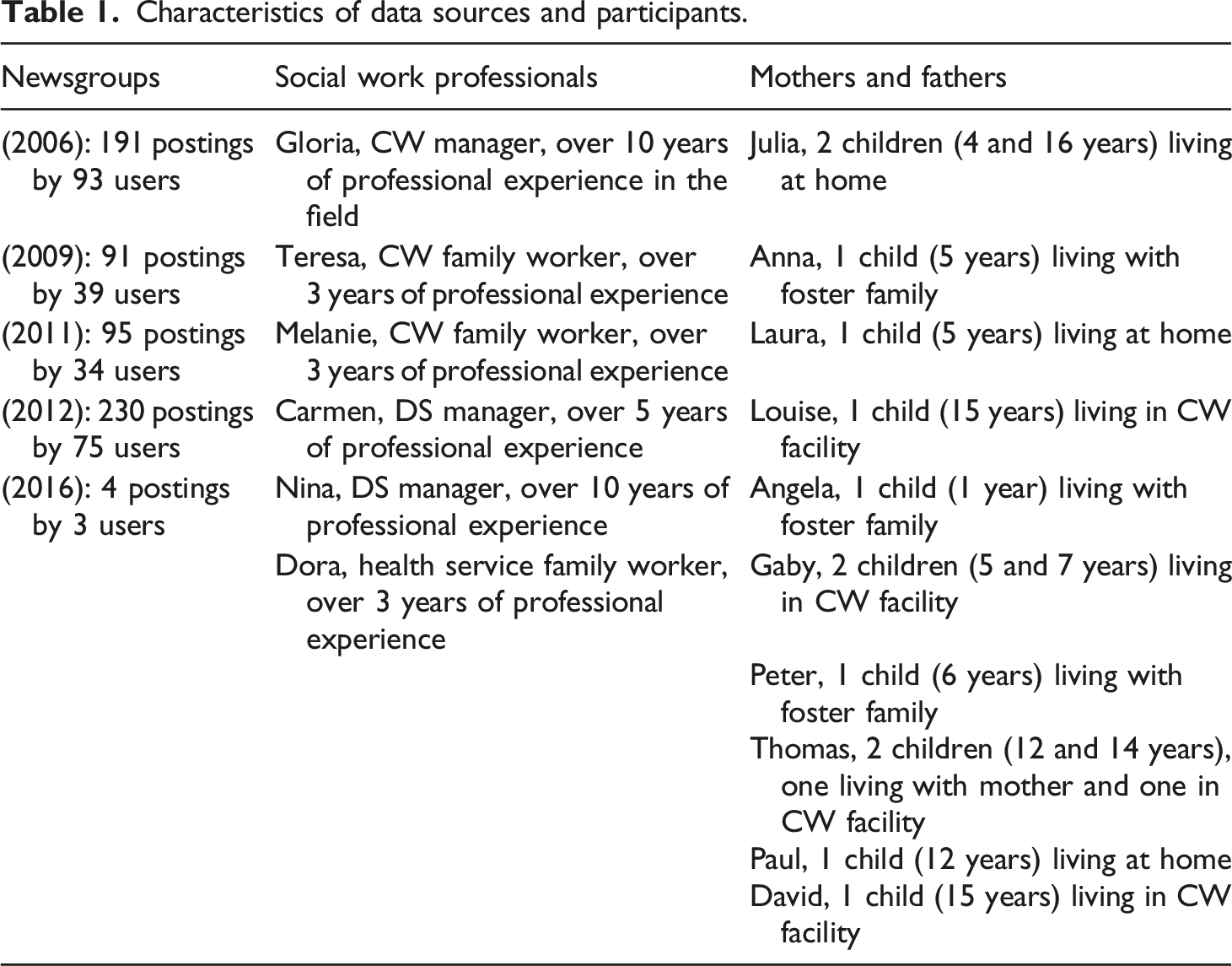
Each newsgroup has an initial source; either a news article that was then commented on in a commentary section, or a question posted on a message board. Both the initial sources and the discussions were included (Table 1).
Social work professionals who supported parents with intellectual disabilities were contacted through CW or DS. Participants had at least 3 years of professional experience and worked in cities or larger municipalities in four Austrian states. The study included semi-structured interviews with six professionals focused on the tasks, aims and challenges of supporting parents with intellectual disabilities (Table 1).
Parents with intellectual disabilities were contacted by distributing a letter in accessible language through self-advocacy networks and DS. Interviews were conducted with six mothers and four fathers with intellectual disabilities of Austrian origin, aged 30–60 years, in five states (Table 1). The interviews focused on family life, the meaning of being a mother/father with intellectual disabilities, CW involvement (given the internationally high rates of CW involvement and child removal, as explained above) and their experience of social support. Depending on the situation, questions were also asked about foster care placement and visitation contacts. To explore the relevance of their social network to their parenting role, network maps were created during the interviews, following Hollstein and Pfeffer (2008) and Pixa-Kettner and Rohmann (2012).
All interviews were audio-recorded and fully transcribed in German. Parts were translated into English by the author to validate the analysis with international colleagues, for conference presentations and publications.
Analysis
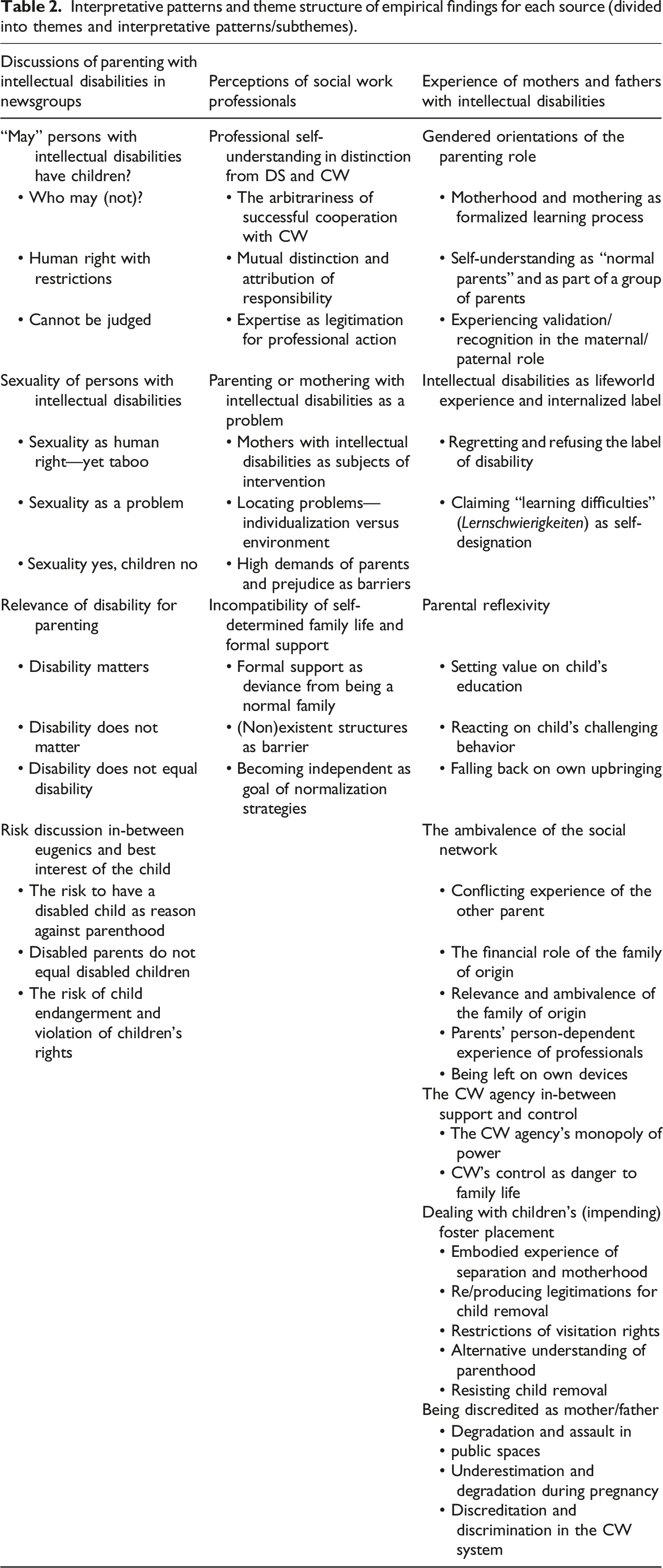
Newsgroups were analyzed following a hermeneutic sociology of knowledge (Keller, 2011). Analysis focused on collective symbols (culturally widespread and therefore legitimate illustrations, see Link, 2013), and interpretative patterns that structured users’ meaning making (Table 2).
Interviews with social work professionals were analyzed with a reference group (Flieger, 2007) consisting of two mothers and two fathers with intellectual disabilities recruited through a gatekeeper from the self-advocacy movement. Group members all lived in the same city; two lived together with their pre/school aged child/ren whilst the other twos’ children (a toddler and a teenager) were in foster care. The group received a fee for their work. We met five times to analyze quotes from the professional interviews together. In our analysis, we discussed what each professional said and how, and what this meant to them/their work/parents with intellectual disabilities. With permission, discussions were audio-recorded, then summarized and discussed again. Our discussions served as starting point for further analysis that I conducted without the group due to time and resource constraints, following the interpretative-phenomenological approach described hereafter (Table 2). The results of the reference group’s analysis were also directly incorporated (and clearly labeled as their contribution) into the findings presented in my thesis.
Interviews with mothers and fathers with intellectual disabilities (and the interviews with social work professionals) were analyzed following an interpretative-phenomenological approach (Smith, 2019; Smith et al., 2009). First, interviews were analyzed separately step-by-step: initial scanning of transcripts, exploratory commenting and defining themes for each study participant. This analysis also included the parents' network maps. Later, themes were compared, merged, contrasted, and reorganized for cross-participant analysis until the overall theme structure comprehensively represented parallels and differences in parents’ (and professionals') experience (Table 2).
I discussed and validated parts of my analysis with other researchers. For example, I brought data from newsgroups or interviews to research workshops where peers and experienced researchers participated in the analysis process. This sometimes led to differing interpretations, which caused me to revisit other parts of the data and revise specific themes. These and other critiques also pointed to important theoretical additions, such as the consideration of a more intersectional framework and a focus on parental subjectivation.
I synthesized the empirical findings from newsgroups, professional interviews and parent interviews into four main areas: (1) the non/conformation to gendered parenting roles, (2) ableism as source for the discrimination of parents with intellectual disabilities, (3) the power that professionals hold over parents’ lives and (4) the conditions for parental subjectivation in the context of CW.
Finally, I “micro-theorized” (Smith et al., 2009: 172) the findings through a process of abstraction, conceptualizing them as a figure representing de/constructions of parenting and dis/ability.
Findings: De/construction of parenting and dis/ability
Hereafter, I refer to a figure to explain how parenting with intellectual disabilities can be de/constructed on three levels. The figure illustrates these levels, which I call (1) the level of the production of norms and normality, (2) the level of deviance and disruption of normality, and (3) the level of normalization, in the form of text boxes. On each level, one text box (two on the second level) contains information about what is de/constructed on that level and what this means in the context of parenting with intellectual disabilities (Figure 2). Research design.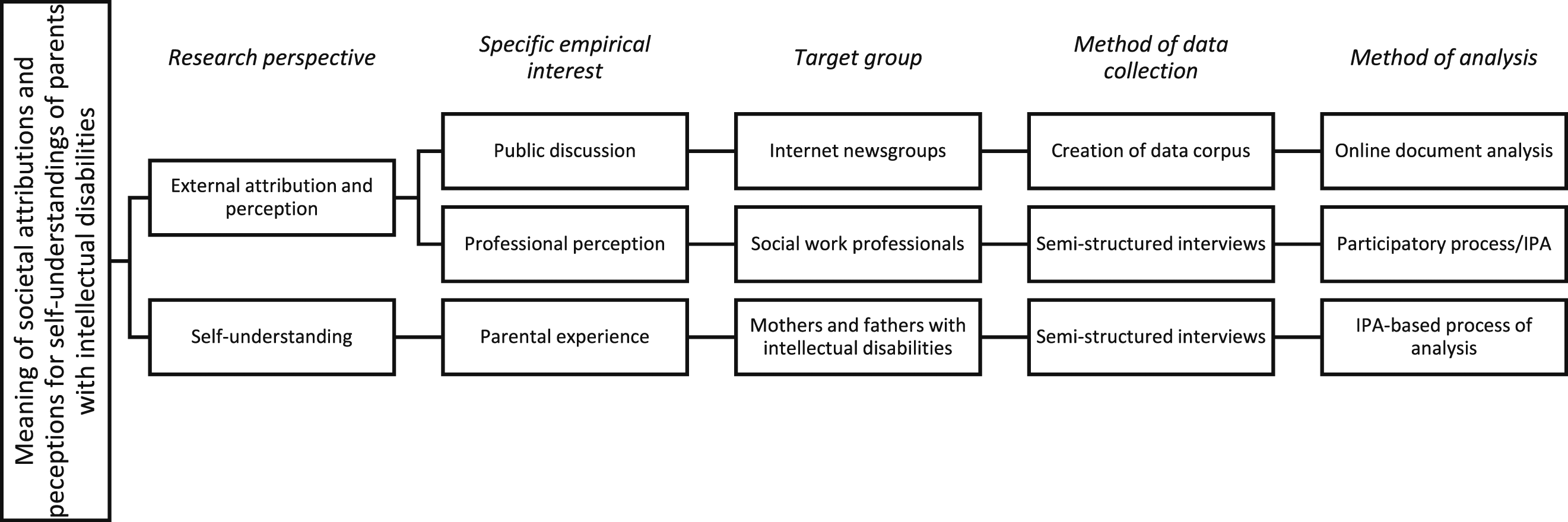
Production of norms and normality
The top level of the figure represents gendered constructions and norms of mother- and fatherhood and dis/ability produced by, for example, laws, the educational system, but also by everyday knowledge. The newsgroup analysis revealed this through users’ comments that included prejudice such as “there is nothing better than parents, who cannot take care of themselves, raising children,” but also human rights perspectives. Some newsgroup discussions centered on what disability means and how it might affect parenting. This was evidenced by comments such as “I actually know ‘healthy’ parents who have child after child but cannot take care of them” and “I do not see any problems with a purely physical disability if it is not too severe, because with a healthy mind you can always organize the optimal care for a child.”
Parenting ideals such as independence and responsibility could be consistently evidenced in interviews with social work professionals. They aimed to help families achieve the greatest possible independence from services and to reduce the presence of professionals in children’s lives. As Melanie, a CW worker, put it “That is the problem, there is no possibility to live normality, there always have to be multiple professionals present.” Professionals viewed a family life without professional support as normal and therefore perceived the family life of parents with intellectual disabilities who need long-term support as not normal. De/construction of parenting and dis/ability.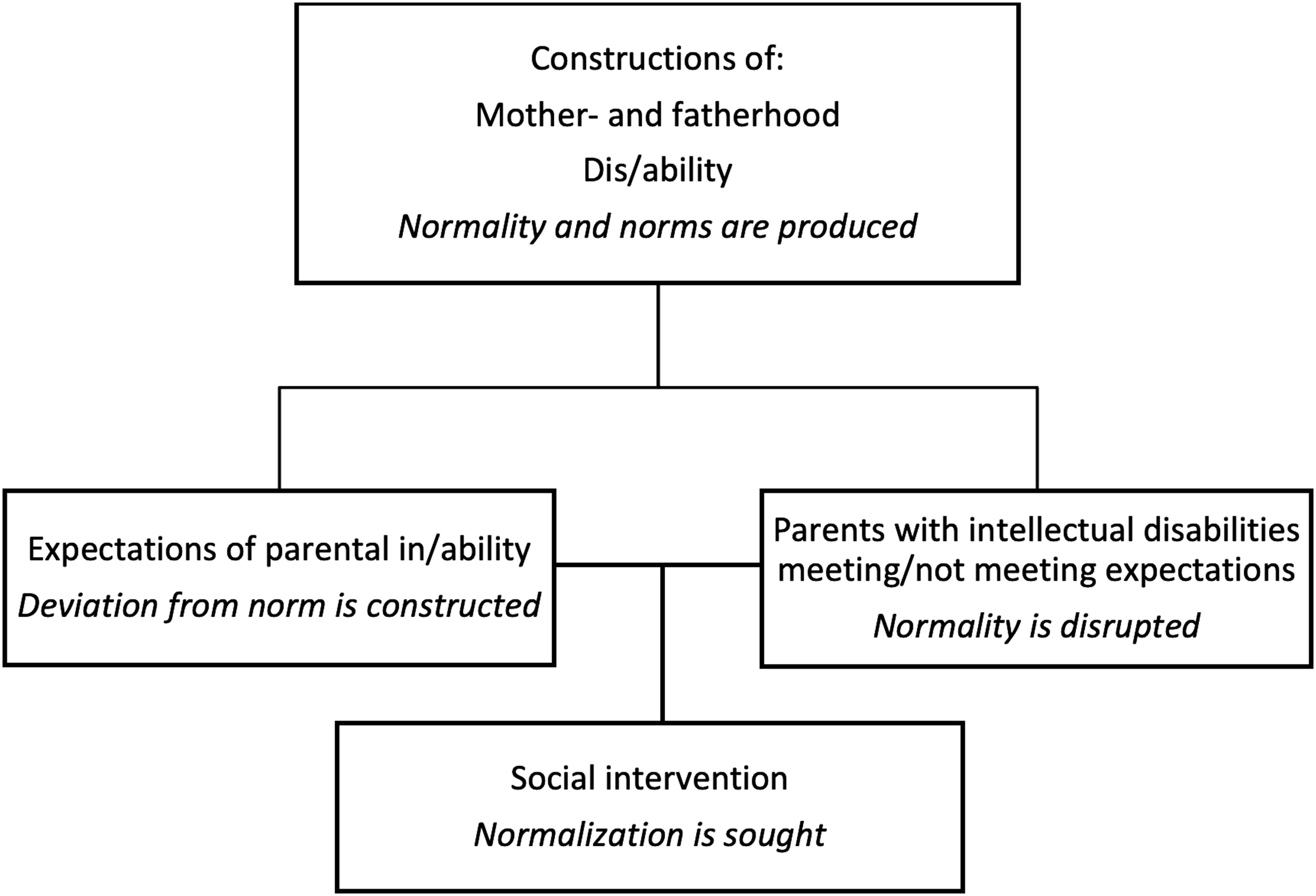
All professionals focused on support and intervention for mothers and tended to exclude fathers, rather than address them. In this context, the reference group pointed to institutionalized terminology such as mother–child facilities or professionals’ focus on the mother–child relationship. Analysis of the parent interviews also reflected matricentrism and a parallel exclusion of fathers. Mothers with intellectual disabilities saw themselves as primarily responsible for their child and fathers felt they had to “fight” for their rights.
Parents often had negative understandings of disability. Anna, for example, expressed that she was “unfortunately mentally disabled.” Gaby distanced herself from the special school she had attended and the labeling associated with it by emphasizing that she had a “real diploma.” Thomas claimed he was not disabled because he “had two legs.” Mothers and fathers with intellectual disabilities thus play an active role in the production of norms and normality. They internalize ableist norms (Campbell, 2008), as evidenced by the fact that they distanced themselves from disability and submitted to the dominant discourse.
Aware of negative stereotypes, some parents claimed a—at least in part—positive self-understanding as persons and parents with intellectual disabilities. Paul emphasized that he wanted to “show that the learning disabled can raise children, too. And maybe better than everyone else.” He was proud to be a father with intellectual disabilities and to advocate for others.
The analysis revealed that responsible, independent parenting contrasts with disability, which is understood as deficit and dependency. This contributes to a “constitutional divide” (Campbell 2009: 6) between abled and disabled, parenting ability and inability and prevents addressing the support needs of parents with intellectual disabilities.
Deviance and disruption of normality
The middle level of the figure focuses on how norms and notions of normality lead to expectations of parental in/ability and how parents with intellectual disabilities meet or fail to meet these expectations. The analysis revealed the expectation that parents without this label are responsible parents, while parents with intellectual disabilities are expected to struggle or put their child at risk. However, some professionals who felt that mothers and fathers with intellectual disabilities were judged by higher standards challenged this assumption.
Newsgroup users mostly assumed that people with intellectual disabilities were unfit for parenthood or struggled as parents because of their disability. One user commented, “I cannot imagine how mentally disabled parents could ensure a child’s wellbeing.” Some professionals saw the risk of child endangerment in what they felt were the social and/or cognitive consequences of intellectual disabilities (e.g., limited understanding of instructions or weak support networks). Newsgroup users additionally saw a eugenic irresponsibility in people with intellectual disabilities having children: “If both parties are mentally disabled or have severe genetic disorders, they should not have children voluntarily. The chance of inheriting them would be enormous. And you should not take that risk if you love children.”
The mothers and fathers did not see the risk of passing on a disability to their child as irresponsible, but some had experienced assumptions that suggested it was. Julia explained that her family tried to pressure her to have an abortion because they believed her child would also have a disability. Anna felt hurt because her mother had “talked badly” about her unborn child, which she elaborated meant assuming that she would have a disabled child.
Parents were discredited by hate crime, underestimated by relatives and professionals, attributed disinterest in their child or accused of neglect or family violence. Some mothers were already expected to have difficulties raising their child when they were pregnant. DS professionals like Nina contacted CW as a (often backfiring) prevention strategy to avoid child removal and install support. She said: If you only try to implement services when the child has arrived, it is often too late. But I also have to say that there are situations, where the decision to remove the child is made immediately if CW is involved up front.
The reference group interpreted prenatal CW involvement as part of a tight control-network and criticized the implicit assumption that parents with intellectual disabilities put their child at risk because they need support.
In some situations, mothers and fathers met expectations of “normal” parenting, but the label of intellectual disability overshadowed even these circumstances. In one everyday situation, Julia tried to calm and engage her lively young son on public transportation and thus mothered him very actively. She said strangers “outed” her as disabled, called her names and “insulted me because of my disability; why do you, like this, have a child. If you are disabled, you should not have children. I hear that a lot.” Another example came from Paul, who was praised by his children’s teacher who had said to him: “You have a learning disability, but your children behave very well.” The teacher seemed surprised that the children were “behaving well” in school, despite being raised by a father with intellectual disabilities.
Whether or not parents met expectations of ability or inability, they appeared to disrupt normality in terms of autonomous and responsible parenting ideals. Because of the complex intersections of disability, gender, and financial hardship, they were constructed as deviant. Social work professionals saw parents with intellectual disabilities as socially weak due to intersections of disability and social background/class. Parents’ experiences confirmed this to some extent, as they were all affected by the intersections of disability and poverty (no or limited access to paid work) and their social networks were characterized by ambivalence, conflict and, especially for some of the mothers, violence.
Normalization
The bottom level of the figure represents social interventions in the lives of parents with intellectual disabilities aimed at normalizing their circumstances, themselves and/or the disrupted normality. According to professionals, one strategy to normalize the family life of mothers and fathers with intellectual disabilities and keep families together is resource-activating support that takes contextual factors into account. Melanie, a CW family support worker, explained: “Our goal is to activate resources. Is there family, are there friends? Can the parents be supported without a pedagogue or social worker being there all the time?”
However, the provision of long-term support by social work professionals seemed to be in constant contradiction with the perception of support services being at odds with normal family life. CW professionals such as Gloria, due to the temporary approach of many CW services, wanted to reduce professional support over time to “reach a state where they can live without CW.” DS professionals like Carmen expressed that it was important for parents with intellectual disabilities to “take most of the responsibility” for their child, which can mean a reduction in professional support. DS professionals distanced themselves from CW responsibilities and did not feel it was their job to ensure the wellbeing of their addressees' children.
Child removal is a more invasive way of restoring the hegemonic normality in which people with intellectual disabilities are seen as incapable parents. The children of seven parents had been taken away at the time of the interview for a variety of reasons given by the parents, including lack of support services, accusations of neglect, child behavioral challenges, and exclusion of fathers on behalf of the child’s mother or CW. When a child was removed immediately after birth, the mother’s disability alone seemed to justify the assumption that a newborn would be at risk in her care.
Some mothers had adopted CW authorities’ legitimation for interventions. Louise said about her son being removed from her care: It was hard, but I had to accept it, because it was better for him. Because I could not give him, could not build up structures, because he needs regular structures. […] I struggle, I have struggled, I am practicing now, hoping that I will succeed.
In the larger context of her interview, it became clear that this mother had internalized the reasons given by professionals.
Angela said about child removal right after birth: If I had had support, it might have turned out differently. But you have to search for someone, have to pay them. If you have someone, all day? You have to pay them, right? And they would almost have to sleep at your place, move in? First, I was supposed to go to a place, but then I did not, with my child. Somewhere I would have support all day.
Angela’s insecurity showed as she repeatedly questioned the reasons given by professionals, yet she tried to adopt them. This reproduction of supposedly extensive support needs and shortcomings is another sign of internalized ableism, linked to “an entrance into the language of self-ascription” (Butler, 1997: 107) that occurs between the power of discursive practice and responsiveness of the subject.
Social interventions offer unutilized potentials to deconstruct normative parenting ideals and question the dis/ability binary. Social work as a profession could deconstruct and politicize the marginalizing structures and living conditions of many addressees (Fegter et al., 2010) while acknowledging specific, often long-term support needs. For this, social work needs human rights–based practice, as proposed by Staub-Bernasconi (2013), rather than deficit-oriented casework.
Discussion
An important finding of this study is the tension between professionals’ aim to support parents with intellectual disabilities and, at the same time, to normalize them by pursuing their independence from services. This highlights the continuing influence of the normalization principle in Austrian social work practice and reinforces what Kessl and Plößer (2010: 8, transl. by author) designate as “constitutive dilemma of social work.” According to them, interventions inherently pursue the diminishing of a specific group’s difference from the general population. Coupled with the ideal of autonomous and responsible parenting, this becomes problematic for people with intellectual disabilities, as they are perceived unable to fulfill this ideal.
In the presumption of parental inability due to disability lies the danger of discrediting and discriminating mothers and fathers with intellectual disabilities in the CW system and beyond. 21st century social work is often prevention- and risk-oriented (Bauer and Wiezorek, 2007) and, according to Biesel (2011: 52, transl. by author), threatens to limit CW to the role of “a regulatory intervention authority.” In Austria, as in Germany (Ackermann, 2017; Biesel, 2014), CW has been the subject of public criticism. Ackermann concludes that the criticism is twofold: some criticize premature child removal, while others criticize that children remain with their families for too long.
Thus, the tensions of social work interventions become more complex than what a single perspective can reveal. In this study, similarities among public discussions, professional perception and parental experience indicate the persistence of stereotypes and deficit-orientation toward disability, as manifested in parents’ internalized ableism. However, differences between perspectives suggest that social work professionals are more aware than newsgroup users of the difficulties faced by parents with intellectual disabilities. Professionals recognized to some extend the power asymmetries and surveillance of families in the CW system. Yet they rarely reflected on how their own ideas of family life contributed to the discrediting of parents with intellectual disabilities. All three perspectives combined uncover (possible) processes of de/construction of parenting and dis/ability and shed light on the situation of mothers and fathers with intellectual disabilities in Austria.
The findings also reveal systemic challenges for social work with parents with intellectual disabilities, including time and financial constraints and difficulties in cross-service cooperation. The division of services into CW and DS and their separate funding hinders cooperation that would facilitate flexible support services nationwide. This study, as well as others (e.g., Pixa-Kettner and Rohmann, 2012), show that positive examples of tailored support largely depend on the integration of different support systems. If all states or even regions in Austria commited to a holistic approach to social services, families could receive needs-based support from a single source. Legal structures must to be adapted to the requirements made in article 23 of the CRPD to reflect the right to support of all disabled parents, as has been the case in Germany since 2018 (Blochberger et al., 2019).
Conclusion: Potentials of deconstruction for shifts in meaning
Tensions between human rights–based support and individualized normalization strategies of (especially CW) social work have been acknowledged and criticized (e.g., Kessl and Plößer, 2010; Oelkers et al., 2010). Nevertheless, this study shows an imbalance in favor of invasive interventions as opposed to human rights–based services. The exploratory character of the study, in the absence of other published research from an Austrian context, and the combination of different perspectives are its main strengths.
Characteristics of data sources and participants.
Interpretative patterns and theme structure of empirical findings for each source (divided into themes and interpretative patterns/subthemes).
According to Bütow et al. (2014) social work must re-emphasize its political function and professionals must advocate for the interests of their addressees. Yet, as Staub-Bernasconi (2013) points out, social work must remain accountable to its mandate and professional standards to avoid instrumentalization on behalf of the state or addressees, the latter being rather illusionary as many CW interventions are mandatory. Following Maurer (2013), I argue for a critical theory-practice dialogue. For social work practice to be as good as possible, theory and practice need reciprocal references without losing sight of the human beings involved. To this end, the presented figure of the de/construction of parenting and dis/ability can prove beneficial, as it exposes and challenges the supposed binary of individualized gendered parenting ideals and deficit-oriented perceptions of disability. Moreover, it reveals opportunities for social work with mothers and fathers with intellectual disabilities to deconstruct their (often) long-term support needs as antithesis to hegemonic ideals. In this sense, deconstruction in the context of social work offers potentials for shifts in meaning (Fegter et al., 2010).
Footnotes
Acknowledgments
I would like to thank Fiona Kumari Campbell for her mentoring and helpful comments on an earlier version of this paper.
Declaration of conflicting interests
The author(s) declared no potential conflicts of interest with respect to the research, authorship, and/or publication of this article.
Funding
The author(s) received no financial support for the research, authorship, and/or publication of this article.
