




Abstract
Instability in the lives of young people in care is a public health concern. Placement moves and loss of relationships can have serious implications for young people’s overall functioning, as well as their future life outcomes. Despite this, research often lacks the perspective and voice of young people in care. In this qualitative research, Interpretative Phenomenological Analysis was used to provide a deeper insight into young people’s perceptions and beliefs about their care experiences to explore the impact of these on their ability to achieve a sense of stability and permanency across time. Semi-structured interviews were conducted with six males from UK foster, residential and semi-independent care homes. The main themes highlighted young people’s perceptions of their care environment, relationships with others, sense of self and future under the overarching issue of permanence. Policy and practice implications propose strategies to target instability at the micro-level and how that may facilitate positive outcomes. The study revealed insights that may be helpful for frontline professionals and highlight to policy makers the importance of ensuring environmental and relational stability. An awareness of attachment theory to implement effective caregiving, should be a priority for training parents, caregivers, professionals and policy makers.
Keywords
Introduction
The growing rates of instability in the lives of young people in care in England presents a significant public health concern. The Stability Index was introduced in 2016 to provide an annual measure of the stability of young people’s lives through their care placements, education and number of social workers (Children’s Commissioner, 2017). This identified, one in four young people in both 2018 and 2019 had two or more placement moves over 2 years (Children’s Commissioner, 2020), whilst in 2017 and 2018 one in four had two or more changes of social worker (Children’s Commissioner, 2019). Placement moves were highest for adolescents, those with identified social, emotional and mental health issues, and those with first placements in a residential home (Children’s Commissioner, 2020). Although some moves in the care system are initiated by young people, the majority occur outside of their control and are determined by the needs of the care system.
Stability and permanence
The fundamental aim of the child welfare system is to ensure permanency of care (Department for Education, 2016a). Permanency has been conceptualised as both a subjective and objective phenomenon, shaped by young people’s relationships, identity and belonging in a stable family context over time (Moran et al., 2020). This is frequently measured as the numbers of placements, relationship breakdowns and school moves.
Several extrinsic and intrinsic factors have been shown to impact on stability and permanence; organisational and systemic factors such as social worker training and support; characteristics and dynamics of foster families; factors within the family of origin and the young person themselves (Rock et al., 2015). Relational permanency (within the context of an individual’s relationships), and ‘felt security’ (an individual’s sense of belonging) have been identified as significant for young people’s well-being and outcomes (Cashmore and Paxman, 2006; Pérez, 2017). Moran et al. (2020) highlighted three themes most likely to influence permanency with young people in care: ‘relationships’, ‘communication’ and ‘social support’, all underpinned by continuity. The authors felt that more exploration was required on the discursive, historical and emotional aspects of permanence to elicit young people’s unique discourses in relation to life histories, and to demonstrate the multifaceted nature of young people’s emotional responses and care experiences.
Impact of instability
Young people in care are vulnerable and are highly prone to negative outcomes and lifetimes of disadvantage compared to their peers (Meltzer et al., 2003). Young people who remain in care in stable conditions can have similar positive outcomes as young people who are not in care (Oakley et al., 2018). However, those with disrupted placements and relationships experience barriers to obtaining permanency (Rock et al., 2015). Although young people’s experiences of early adversity contribute to poorer outcome, their experiences within care can exacerbate issues and even cause new ones, especially due to lack of permanency.
For young people in care, the adolescent and teenage years are some of the most stressful stages of life. The process of developmental change into adulthood (i.e. physical, psychological, social) is a ‘critical period’ and carries the potential of crises, as young people emotionally struggle to establish a sense of self-identity as opposed to being confused about their role as an individual in society (Erikson, 1965). Fears about loss and separation for young people in care, derived from past insecure attachments and a lack of consistent and permanent caregiving, confuses the young person’s sense of self, and need for independence, thus, inhibiting a sense of being in control. The unresolved conflict of a young person being dependent and ‘in care’ and wanting to be independent is often associated with ‘acting out’ behaviours and antisocial delinquency, as an attempt to gain control over their lives and their environment (Browne and Herbert, 1997). As such, adverse care experiences are often associated with young people mistrusting others and forming healthy attachments (Hyde et al., 2017), delayed brain development (Van Rooij et al., 2015), mental health problems (McGuire et al., 2018), substance misuse (Stott, 2012), sexual exploitation and criminality (Coy, 2009; Ryan and Testa, 2005).
Attachment theory is central in understanding the significance of relationships on the development of young people in care and their ability to achieve permanency and stability across their lifetime. Within the context of their early caregiving experiences, young people develop an internal representation of themselves, others and the world (i.e. Internal Working Model (IWM)), and use this template to guide and shape their future interactions (Ainsworth, 1990). Early trauma distorts a young person’s IWM, creating a negative sense of their self-worth, mistrust in others and fear of the world and future (Bretherton, 2013). This can have significant repercussions on young people’s ability to navigate interpersonal situations and can lead to further instability and breakdowns in placements and relationships (Gauthier et al., 2004).
Repeated damage to attachment systems can result in poor outcomes across the lifetime, given adult insecure attachment styles have origins in early caregiving experiences (Fraley and Roisman, 2019). Attachment theory is therefore highly relevant to those young people in care, evidenced in high rates of attachment disorders in this population (NICE, 2020). Child welfare policy strives to use children’s attachments as a guide to decisions about placement and recognises emotional stability and security achieved through permanence is an integral part of intervention for attachment disorders (Messer, 1999). Despite this, the demands on the system often interfere with this ideal, resulting in young people’s attachment needs being overlooked (Mennen and O’Keefe, 2005).
Economic and political context of the English care system
On the 31st of March 2020, 80,080 young people were regarded as ‘looked after’ within the care system (National Statistics, 2020). Out of them, approximately 65% of young people entered care for their own protection against abuse or neglect. Despite recognition for positive practice across the system, a report in 2018 highlighted the challenges facing young people in care and described the current climate of the welfare system as the ‘silent crisis’ (Oakley et al., 2018). Financial austerity; increased rates of young people in the system; high caseloads and frequent staff turnover; scarce support services and instability across placements characterise much of young people’s social work in local authorities. These factors influence stability and permanency at a systemic level and can hinder Local Authorities’ abilities to secure appropriate support services for young people.
Context and study rationale
The challenges of achieving permanency and stability for young people in care has been described as a ‘complex reality’ and can be dependent on different interrelated systems (Schofield et al., 2007). The Ecological Systems Model (Bronfenbrenner, 1979) would suggest that young people are central to ecological environments (microsystem, mesosystem, exosystem, macrosystem and chronosystem) whereby their growth and development are dependent on their interaction with ever-changing and ever-adapting social worlds. A vast literature exists that explores ways to improve the UK care system from systemic, organisational and individual perspectives (e.g. Antle et al., 2019; Bell and Romano, 2017; Konijn et al., 2019; Oosterman et al., 2007; Rock et al., 2015). In those, improving relationships, communication and leadership abilities of welfare professionals have been emphasised (Department for Education, 2016b).
Qualitative research has explored the experiences of placement instability from the perspective of the young people’s carers (e.g. Kercher, 2020; Khoo and Skoog, 2014; Valentine et al., 2019) and care alumni (e.g. Chambers et al., 2018; Randle, 2013; Rolock and Pérez, 2018). However, research that includes young people’s own perspectives of their care experiences is vital, given the foundational principle of childcare policy and law dictate young people’s voices to be captured in child welfare decision-making (Department for Children, School and Families, 2008; Children Act, 1989, 2004).
To date, a plethora of research with young people in care has been conducted in England to highlight issues experienced within care (i.e. Coram BAAF, Barnardos; The Children’s Commissioner; Selwyn et al., 2010). However, very few have used interpretative phenomenological methodology to provide a more in-depth account of lived experiences (Rostill-Brookes et al., 2011). Moran et al. (2020) recommended further research delve deeper into young people’s subjective accounts and focus on social theoretical conceptual approaches to permanence and stability. This can capture how young people interpret their unique realities and assign individual meaning to experiences. In the context of the background research, this study aims to provide further insights into permanence and stability across time, by exploring how young people interpret their longitudinal experiential journeys throughout the care system, using Interpretative Phenomenological Analysis (IPA). Although the wider systemic issues impacting on permanency and stability of young people in the UK care system is widely documented, more understanding is needed at the micro-system level (i.e. their immediate environment) to explore how young people internalise care experiences and how each experience interacts with future care experiences and the wider systems around them. The objective is therefore to help disentangle the complexities and intricate interplay of factors that can culminate in instability, that often cannot be understood through objective measurements.
Methods
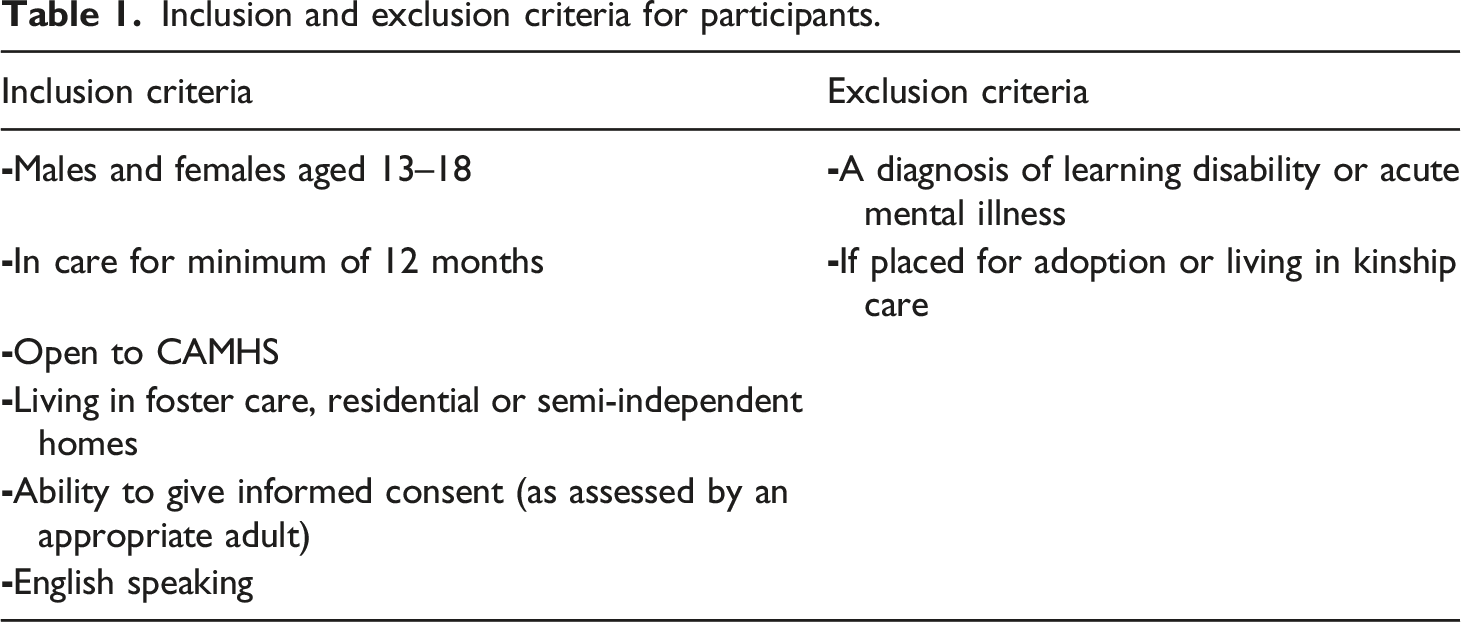
Recruitment and procedure
Inclusion and exclusion criteria for participants.
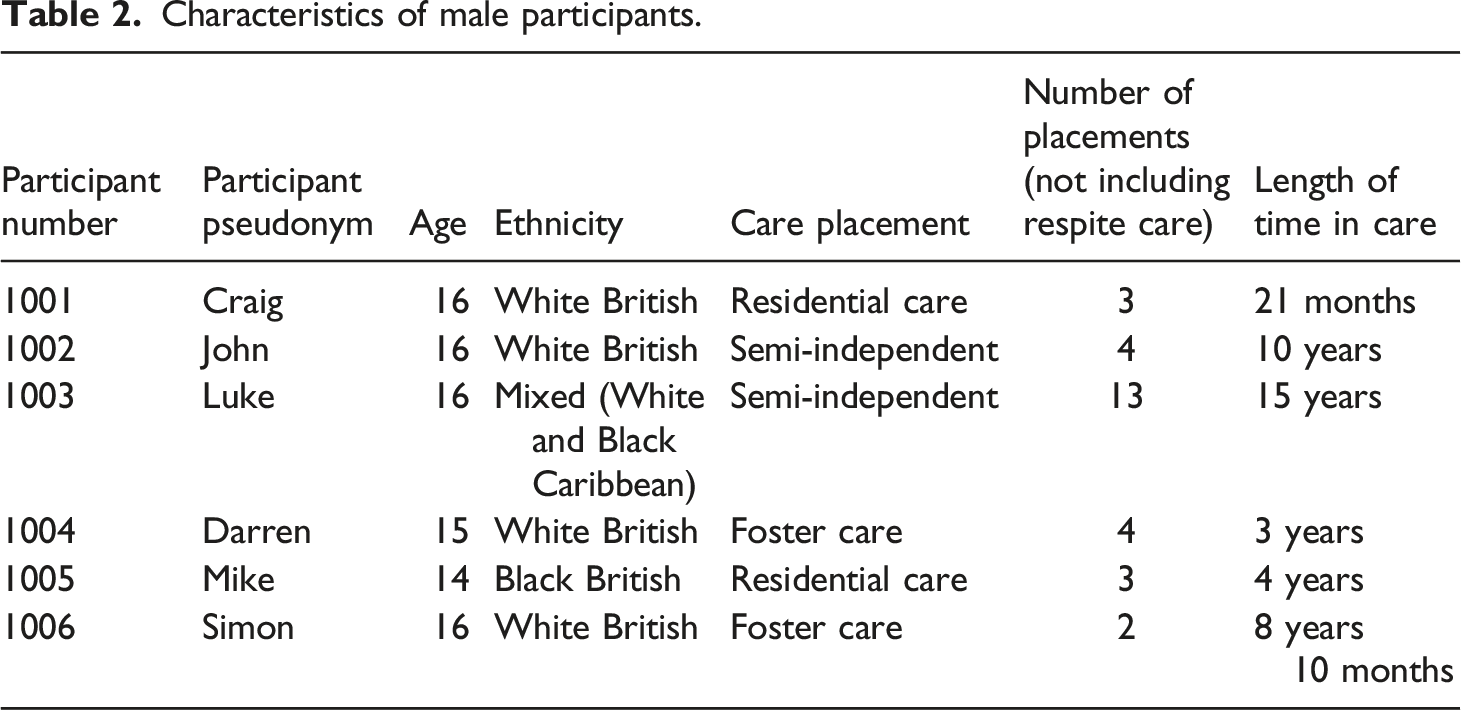
Characteristics of male participants.
Ethical considerations
Ethical approval was granted from the local NHS Ethics Committee (Ref: 18/WM/0247), whilst research governance was authorized by the Health Research Authority (Sponsorship Ref: 18,049) as well as the local NHS Trust. Additional approval was obtained from the Local Authority.
Materials
A semi-structured interview schedule was co-developed with participants to ensure involvement and suitability of questions for the sample (Smith et al., 2009). The main headings of the interview schedule included ‘care placements’, ‘carers’, ‘important staff members’ and ‘future’. The researcher introduced probes to facilitate deeper exploration of experiences (Smith et al., 2009).
Analytic strategy
This study adopts IPA approach, which requires analysis to be exploratory and inductive, with no pre-existing hypothesis (Reid et al., 2005). IPA is concerned with the ‘voice’ and individual meanings that human beings attribute to their personal lived experiences (Smith and Osborn, 2003). This is a social constructionist approach and proposes that knowledge is constructed, with individual’s subjective experiences influenced by environmental and social processes (Losantos et al., 2016).
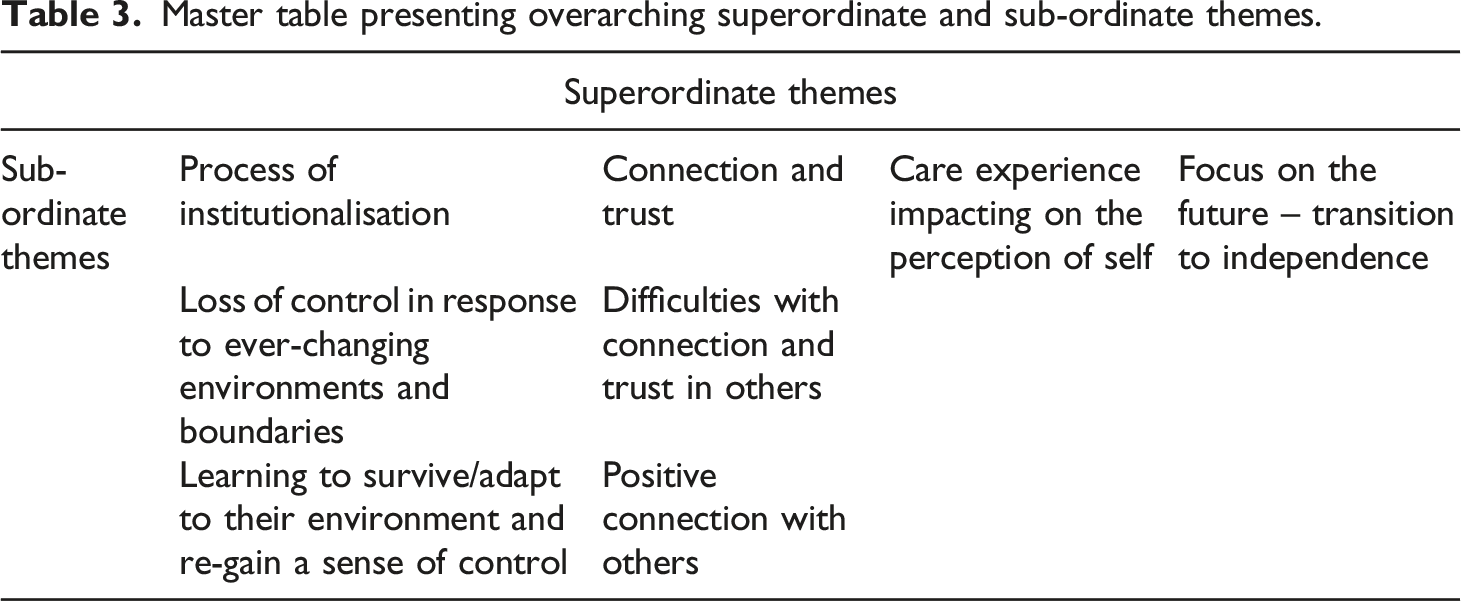
The transcripts of the research interviews were analysed in line with IPA (Smith et al., 2009). Figure 1 provides an illustrative overview of individual themes for each participant. The themes from all participants were clustered together into higher-order overarching themes and are presented in Table 3. Themes were developed based on certain contexts that made them unique. For example, frequency, polarization, temporal events and language. Visual representation of individual participant’s superordinate themes. Master table presenting overarching superordinate and sub-ordinate themes.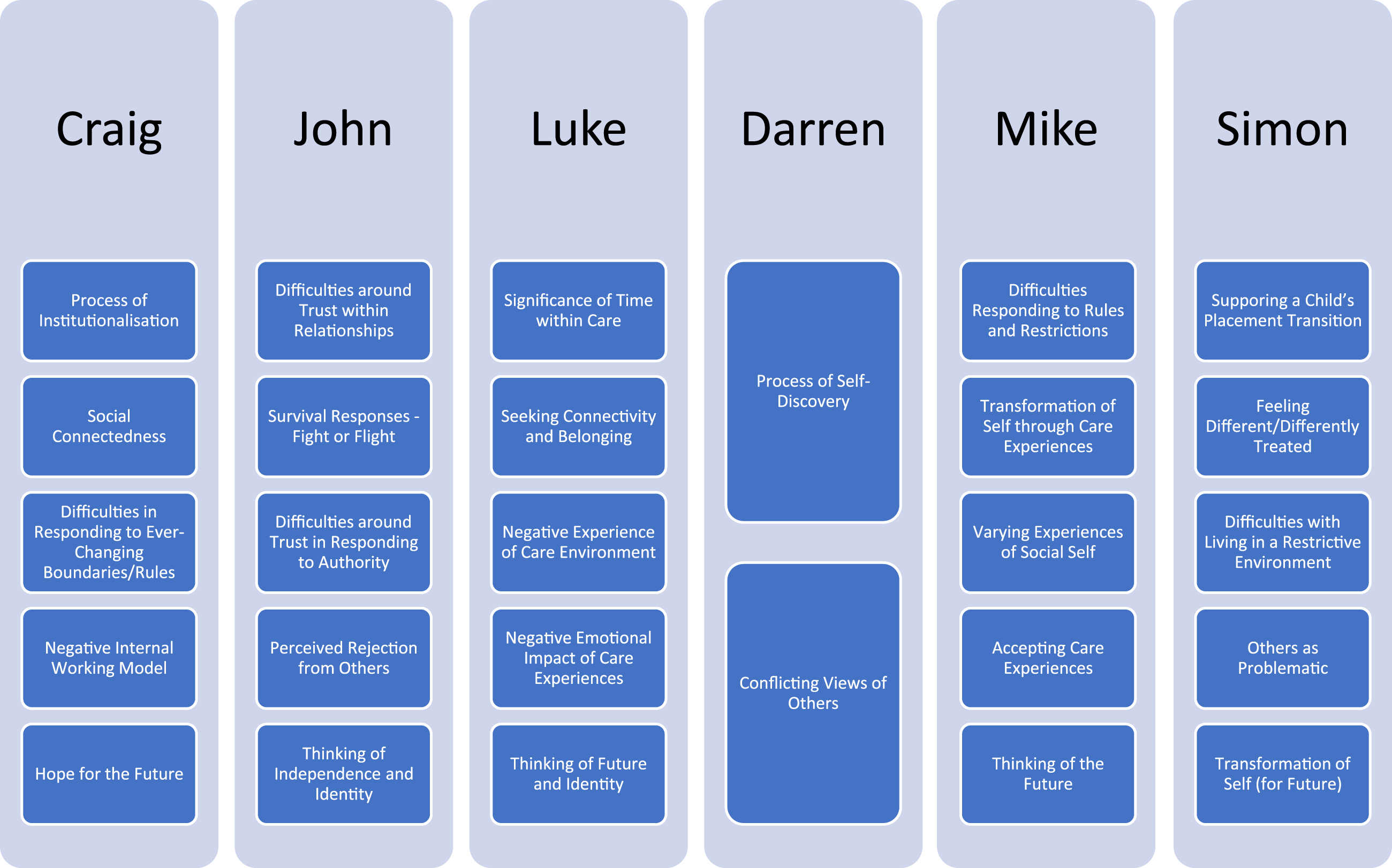
Validity and quality checks
The researcher engaged in a process of reflexivity to consider impact of personal biases on data analysis (Orange, 2016). The themes and extracts were reviewed and approved against the original data by an additional IPA researcher to ensure inter-rater reliability.
Findings and discussion
Following analysis of data, four major themes were identified. These indicate that areas relevant to young people obtaining permanency and stability are those linked to their care environment, relationships with others, sense of self and their future. The themes include (1) the ‘process of institutionalisation’ which explores young people’s struggles with control and adaption to their environments across their care journey; (2) young people’s perception of ‘connection and trust’ within the context of their relationships; (3) the impact of care experience on young people’s ‘perception of their self’ and (4) young people’s ‘hopes and fears’ for their future 1 .
Theme 1: Process of institutionalisation
The first of the major themes identified was a ‘process of institutionalisation’ which describes temporal sequences of young people’s experiences through the care system. Within this theme, participants alluded to several important concepts whereby young people moved from feeling powerless to becoming driven by a need to re-gain control and a sense of safety. This perception appears to be underpinned by anxiety and fear.
Loss of control in response to ever-changing environments and boundaries
This sub-theme encapsulates young people’s perceived loss of control over their care environment which appear to be the initial stage of young people’s process of institutionalisation. Participants discussed living in what they perceived were unpredictable environments, since most were unexpectedly moved into new care placements. Luke recalled two sudden placement endings of ‘getting dragged off the park into a car’ and being informed ‘you’re moving out in an hour’. An amalgamation of Luke’s moves and perceived loss of control within placements had a significant impact on his mental state: It got me in a state of depression at 13…..I couldn’t really control where I lived or like what happened where I lived, so it was just locking myself in a room.
Participants also alluded to restrictive care environments by using words such as ‘prison’, ‘trap’, ‘rules’ and ‘control’ which could portray their difficulties in living as free agents within their care settings. Craig reflected on his perception of young people living outside of care: ‘you have so much freedom.....it’s not all legal. There’s a lot more rules in a care home than in a parent’s house’. In comparison, within care settings, he reflected on being ‘controlled by the local authorities, city council and anything around you that can get his hands on it’. Craig amongst other participants highlighted the undesirable structure and boundaries of the care environment, including the ‘curfews’, ‘security’, ‘bedroom searches’, ‘police’, ‘1000 rules’.
Difficulties surrounding control may be linked with adversity in early childhood (Roazzi et al., 2016). Craig emphasises an enduring obsessive need for control through his reference to himself as a ‘control freak’: Me being a control freak, I f***ing hate it because I went a lot of my life without control and that’s the one thing that I sort of struggle with. So, to have that ripped away pains me…..I need it in my life.
Craig’s reportedly negative early caregiving and multiple movements through the care system appear to have exacerbated his perception that he is not in control. His language of ‘ripped away’ could symbolise that those in a position of care have torn control away from him using forcibility, leaving him emotionally wounded.
Approximately 65% of young people in care enter for their own protection following traumatic experiences (National Statistics, 2020). Unplanned moves and restrictive caregiving within placements may inadvertently be mirroring participants early adverse experiences of loss of control. Instability and disempowering experiences within placements could heighten young people’s sensitivity to a perceived loss of control, impacting on their willingness to engage and feel secure in subsequent placements. Although the environmental regulations in care are necessary to ensure young people’s safety, young people in this study perceived their environments as overtly rigid. Care placements should strive to create a therapeutic milieu, allowing the care environment to feel more like a home than an institution to reduce young people’s perceived loss of control (Gallagher and Green, 2012).
Learning to survive/adapt to their environment and re-gain a sense of control
Following multiple instabilities and loss of control, the next stage of the process of institutionalisation appeared to be adapting to a new environment and re-gain a sense of control and safety. Luke describes, ‘the best way to explain being in a kid’s home for me…..‘Institutionalisation’, which stems from negative experiences he had during his placement moves. His narration of this process appears to require him to anticipate each residential home would be better than the last, interestingly during what he defines as the ‘honeymoon period’: What I would like to say about kid’s homes is there’s a “honeymoon period” where.....even though you know it’s a kid’s home, everything is new to you.
This process occurred despite a lack of choice to move placement and a lack of control within each home. Eventually, Luke arrives at a sense of resignation and learnt helplessness (Seligman, 1972) by stating So being in a kid’s home, yeah it’s really bad.....but the environment..... the change in young people, it was like there’s a new face, cool. I think it was just a bit of re-learning not to actually trust things
From an attachment perspective, this cycle may depict how young people test or resist relationships in response to insecure attachment styles. Despite young people seeking intimacy, connection and acceptance within placements, there may remain a conflict as to whether they can trust others especially following previous placement breakdowns (Schimmenti and Bifulco, 2015). Although participants try to maintain hope for each environment they are required to live in, the lack of trust, autonomy and control is reinforced when they must move again, escalating the pre-existing damage to young people’s attachment systems.
Participants alluded to a need to re-gain control and power, which may be a consequence of the interplay between perceiving a loss of control, mistrust of others and struggling to respond to enforced boundaries. After multiple placement moves, Craig experienced a distinctive shift in his perception of the system: It made me think ‘right these people do not rule me, I can do what I want’ because at the end of the day I am going to be moving again.
Craig is re-asserting his independence as he perceives that further instability and being let down is inevitable. This results in Craig’s response to his environment: Once you understand it, you are able to twist it.....take advantage of it and make sure that your life is as great as possible.
His language of ‘twist it’ and ‘take advantage’ evidences Craig’s reliance on himself to learn ways to navigate and manipulate the system in order to re-gain control and get his needs met. Similarly, in residential care, John used threatening and destructive behaviours once he was told to move placements, ‘I threatened to kill a few people…..I barricaded my door and climbed out onto my roof’. He spoke about how these threats allowed him to protect himself from a perceivably unpredictable and unsafe environment, since ‘I just do it because they back off, they leave me alone’.
Lack of trust may drive young people’s maladaptive strategies to fight against, sabotage or manipulate boundaries and rules that others set for them. It is common for young people who experience early trauma and threat to develop fight or flight defensive strategies to adapt to their environments (Perry et al., 1995). These strategies should be seen as once functional adaptations to young people’s unpredictable and adverse environments (Wadsworth, 2015). Young people’s presentations within placements may nevertheless unleash a vicious cycle enhancing further instability and poorer outcomes (Oosterman et al., 2007). Professionals must view these presentations through a ‘trauma lens’, acknowledging the impact that each child’s traumatic experiences have had on them (Buckley et al., 2016). Providing security and understanding to young people can reduce a need for their defensive strategies, whilst increasing professional’s ability to remain compassionate and attuned to their needs.
Participants also discussed their negative emotional reactions (i.e. fear and uncertainty) to moving around the care system. Craig said ‘I hadn’t even heard of a residential home…..when I came into one I was shocked’, ......... ‘it’s scary, because you don’t know anything, it’s a fear of the unknown’, whilst Darren recalled his placement move as ‘really scary because I didn’t know where I was going or who I was going to live with’. Figure 2 illustrates a negative cycle which participants’ experiences alluded to, their anxieties and uncertainties being reinforced by their perceptions when they moved around the system. Young people’s fear may feed back into their negative perceptions of their environment, generating an expectation that they must fend for themselves. Each unexpected movement would strengthen this cycle; especially for those young people whose early upbringings were characterised by uncertainty, fear and uncontrollability. This may explain some young people in care persisting in using maladaptive strategies to re-gain control to maintain an internal sense of security and feeling unable to invest in care placements and relationships. Cyclical negative causality of young people’s perception and emotions.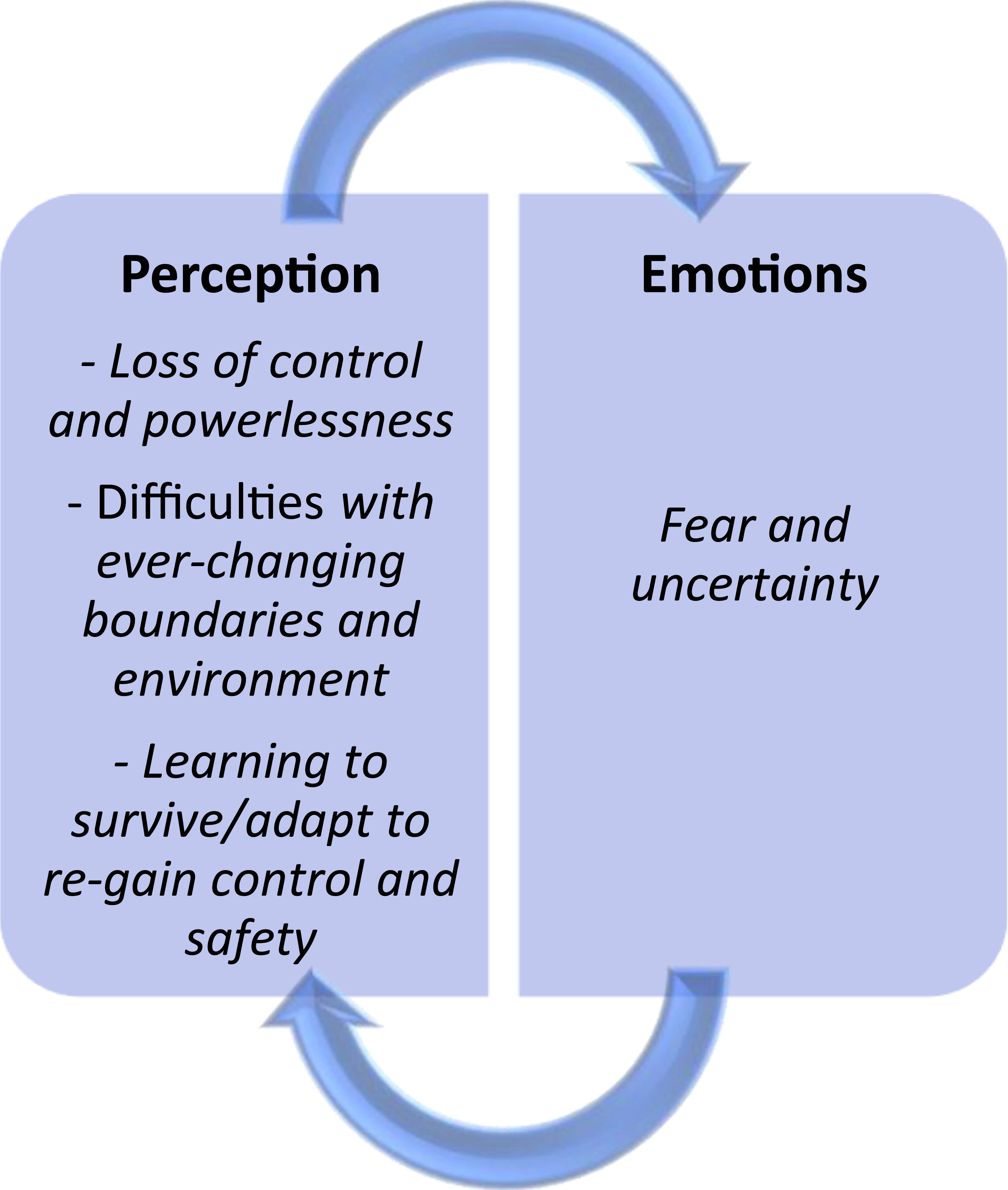
This study offered some insight into the ‘honeymoon period’. Within this period, young people may initially suppress any fears and emotions to feel accepted and avoid further movements. However, their need for control and safety may explain how negative behaviour can eventually appear and reinforce the cycle of further rejection and instability. Allowing young people some control and inclusivity in decision-making around their care may counterbalance young people’s difficulties with control and trust, improving longevity of placements (Hughes et al., 2019).
Theme 2: Connection and trust
The second major theme describes the different experiences of connection between participants and professionals involved in their care. There was a polarization of connection and disconnect whereby young people sought social connectedness and belonging yet appeared to struggle to build connections driven by mistrust and a perceived insincerity of others.
Difficulties with connection and trust in others
Throughout their care journey, all participants experienced certain difficulties in connecting with others, especially carers who they were expected to live with. Craig reflects on an enduring sense of disconnect and alienation when placed with new foster carers: You never really feel connected, you never really feel like you are a part of their lives …..they’ve got their past…..you’ve just been dropped in and you don’t know any of that.
He implies a sense of intrusiveness from being ‘dropped in’ to his carer’s lives. His repeated use of ‘never feel’ signifies a pervasive sense of thwarted belongingness. Darren’s foster placement broke down after he struggled to connect with his carer, suggesting she ‘didn’t know enough about me to bring me up and I didn’t know enough about her’.
Young people’s pervasive feelings of disconnect were likely reinforced and perpetuated by their inability to trust others and a shared lack of preparation around placement moves. Craig illustrates an inability to trust his foster carers: It made me feel like.....I don’t trust you. Are you trying to get me to trust you so that you can just hurt me?
These suspicions were likely attributed to his interpersonal sensitivity as a result of early attachment failure and harmful caregiving (Young et al., 2003), since he shared social services ‘put me in the foster placement for nurture and love because I didn’t get it at home’. After a lack of early nurturing, Craig depicts feeling unsafe in a contrasting care environment, describing it as ‘alien to me’, since ‘people are trying to tell me they love me…..they want hugs’. Craig’s mistrust of others drove him to pre-empt they would hurt him.
Similarly, John justified his lack of trust after his carer unexpectedly ended his placement without an explanation or preparation, perceiving this as ‘complete, utter abandonment’. He stated that a combination of unplanned placement endings ‘put me further and further away from people’, impacting on his ability to connect in subsequent placements.
Young people’s perceptions of the authenticity and genuineness of their caregivers felt particularly significant in determining their ability to invest in relationships. John felt foster carers ‘literally do it for the money’, whilst Craig described his foster carers as ‘performers’ after they unexpectedly ended his placement, causing him to think These people are doing their jobs, they don’t care…..they are good actors…..they’re not going to stand there by my side.
Negative early (i.e. with birth family) and late (i.e. in care) care experiences may have heightened participants’ sensitivity to feeling let down and rejected and caused them to enter new relationships with deleterious expectations. Although the emotional impact of placement experiences and endings on carers has been described (Valentine et al., 2019), young people did not acknowledge this as often no explanations were provided to them. Instead, they were left to interpret the events themselves and likely perceived endings based on their pre-existing internal working models, which, if negative, would reinforce negative self-beliefs and expectations of others, reinforcing the cycle of mistrust and low self-worth. This explains young people’s need for defensive strategies, premature reliance on self and mistrust of others.
Conversations with young people about their experiences and future expectations is crucial for nurturing young people’s sense of permanency, and is vital to them feeling safe, in control and trusting of others (Moran et al., 2020). Professionals require an attachment-based understanding of young people’s mistrust and resistance to care, and ability to demonstrate their genuine commitment to supporting young people’s individual needs.
Positive connection with others
There was some evidence of young people’s meaningful connections with professionals in residential care. Luke identified the impact of certain residential workers being on shift, ‘If my mood is all the way down there…..it can just lift it if I know…..this person’s on’. Craig’s connections with staff in his residential care home caused him to feel Important.....needed, wanted, you know it’s like having somebody there.....It makes you feel amazing to know you have that type of person. I look at those people with, as in family rather than carers.
Craig’s account offers a stark contrast to his former suspicious beliefs towards his foster carers. After fighting back against the system throughout his entire care journey, finally feeling advocated for by certain others in a consistent environment appeared to repair some of the pre-existing damaged attachment system, namely his sense of worthiness and belonging. His reference to staff as ‘family’ is heartening given his former perpetual perception of disconnect. This indicates how professional’s consistency and care can allow young people to develop trust and investment in new placements and relationships; thus, repairing damaged internal working models.
These findings support those from Cashmore and Paxman (2006) and Pérez (2017), as young people’s ‘felt security’ through authentic and trusting relationships can facilitate permanency and young people’s positive long-term outcomes. This internalised perception of ‘felt security’, if established, eventually pervades throughout their relationships, environments and sense of self (Baker et al., 2007).
Theme 3: Care experience impacting on the perception of self
The third major theme explores the influence of care experiences on participant’s perception of their sense of self. Young people’s relationships with significant others can influence their self-concept throughout their early development. The ‘self-concept’ is a complex multidimensional construct which links to one’s subjective cognitive representation of themselves, their perception of own competencies and is a core element of healthy socioemotional development (Vacaru et al., 2018). A negative self-concept is linked with adverse long-term mental health outcomes (depression, anxiety, negative emotions, conduct disorder and aggression), whereas a positive self-concept increases confidence and self-esteem, and has been linked to achieving permanency and stability (Biehal, 2014).
For some participants, care experiences had a negative impact on their sense of self. Multiple placement endings and loss of relationships appeared to significantly worsen Craig’s perception of self: You understand that you’re not actually worth anything.....you’re just something that’s there, another parcel being passed around…..a little project that people are working on but when your project doesn’t go too great…..some people think…..the project has gone sh**, throw it in the bin.
Craig’s language of ‘parcel’ and ‘project’ evidences a perception of himself as dehumanised by the cruel ‘others’; a dispensable and faulty object being passed along a conveyer belt. This offers a stark insight into the impact his care experiences have had on his worthiness and self-perception.
Restrictive care environments also negatively impacted on participants’ sense of self. Simon voiced ‘it was just a hatred of myself…..I thought I wasn’t good enough to have them things’. Although he explicitly refers to a lack of material things i.e. ‘them things’, there appears a deeper reference to his negative perception of self, namely ‘I wasn’t good enough’. In parallel, Luke identified his sense of powerlessness in his environment ‘just makes you feel kinda worthless’. Participant’s negative self-concept and low self-esteem may have initially originated from adverse early caregiving experiences and later reinforced by stigma of being in care. This likely creates an undercurrent whereby young people automatically internalise subsequent placement endings and loss of relationships as their fault, perpetuating the cycle of negative self-perception and reluctance to invest in relationships.
In contrast, some participants felt their care experiences had a beneficial impact on their sense of self. Darren felt coming into care had been a positive life transition for self-discovery by stating ‘going into care…..I have found who I really am’. Mike acknowledged he was ‘more independent’ and ‘I’m confident now’. Feeling settled in stable care environments likely allowed young people to explore their surroundings and make progress in strengthening of their identity. Young people with adverse early experiences are often unable to meet this developmental milestone of exploration and identity formation without attachment figures acting as a ‘secure base’ (Bowlby, 1988; Vacaru et al., 2018). The exploratory behavioural system, as introduced in Attachment theory, has been identified as an essential process in successful self-identity formation by allowing young people to gain mastery over their environment (Feeney et al., 2007), and develop competence, and self-reliance (Bowlby, 1988; Sroufe, 1979). This process of self-discovery likely applied to these participants, who were accepting that coming to care had removed them from a harmful environment and upbringing.
Theme 4: Focus on the future: Transition to independence
The final theme demonstrates how young people’s perceptions of the future appeared to span across a spectrum. Elements of hopefulness and positive anticipation were entwined with ambivalence and uncertainty about the transition to independence. Some participants experienced a sense of hopefulness about their future. Despite his challenging care journey, Craig’s positive perception of his future appeared to result from a successful job and further ambitions: Life is looking good in the future…..I will be doing so well that I would be surprised if it all went wrong…..I’ve got my college courses…..my job, and money, going to go Uni.
Hopefulness appeared to be built on a longing for independence. Simon stated, ‘I’ve been wanting to live by myself for so long’ whilst John acknowledged ‘I am more independent than anything else’. Given young people’s sense of a loss of control whilst in care, re-gaining control through independence was likely the strong driving force for this, as Craig states, ‘I cannot wait to.....have full control over my life’. All young people felt practically equipped for their future, either by having to be self-sufficient during early childhood or through developing life skills within placements. This may have helped young people survive in an unsafe world, compensating for a perceived loss of control.
Despite this sense of hopefulness, most participants also shared a sense of ambivalence about their future. Participants described feeling ‘half and half’, ‘nervous’ and ‘not ready’. Although feeling practically equipped for their future, participant’s emotional readiness for independence felt less complete. Luke realised that he must prioritise his mental health, ‘I just need to sort my mental health out…..That’s the main thing that actually worries me’. He later expanded by saying If I don’t do anything about it, it’s just going to stay with me and I’m not going to change or….. get better.
Moving closer to independence, Luke likely became aware that he will need to be mentally resilient to survive alone in the world.
Participant’s idealised view of re-gaining control during independence appeared different to reality. John and Luke were the only participants to have transitioned into the final stage of their care pathway (semi-independence). John discussed the negative financial aspects of becoming independent, whereas Luke felt his new placement was ‘too isolating’ and felt disconnected from staff. Despite negative perceptions of his earlier residential homes, he referred to his current semi-independent placement stating, ‘I would like it to be a kid’s home…..it’s just easier there’. John also indicates that his placement represented a secure base, as discussing his future he states, ‘I don’t want to move very far from here’.
Both Luke and John appear to prefer a perceivably restricting, but familiar environment; here they seek a sense of security and ensure their basic needs are met by being ‘looked after’. They may have become dependent on their familiar territory of the residential homes through the process of institutionalisation, whereby their environments temporarily provided physical and relative emotional security and containment. Anxieties around an unfamiliar future may thereby be experienced as an emerging existential crisis if both John and Luke become disconnected from the system. Young people’s transition to independence is a risky period when they experience smaller safety nets and numerous adversities and challenges. Liminality theory explores how young people in care can firstly become ‘stripped’ of their previous status and identity at point of transition and exist in a ‘marginal state’ of uncertainty in which they must also learn to adapt to new social circumstances (as cited in Glynn, 2021).
Young people’s uncertainties surrounding their transition to independence may therefore reinforce, and be reinforced by, the perceptions described in the three other key themes, causing a potential strengthening of participant’s existing negative bias to their sense of self, others and the environment. A sense of loss of control, connection and self-identity reinforced thereby may explain some young people’s persistent reliance on maladaptive coping strategies and vulnerability to poor outcomes in society once leaving care.
With the vulnerable transition period in mind, measures such as mentoring (Thompson et al., 2016) and personal advisory support (Department for Education, 2018) may be considered as potential protective factors. Information about these services should be actively explored and encouraged with young people in care to increase their safety nets during transition.
Theoretical implications
This study explored young people’s subjective experiences of their care journey, to highlight their interpretation of permanence and stability across time. Four major themes were identified, highlighting young people’s perceptions of their care environment, relationships with others, sense of self and future. These perceptions appear inherent and crucial in contributing to young people’s outcomes through their link with future self and social functioning.
Although the four themes warrant independent recognition, theoretically, these all appear be underpinned by the overarching construct of the ‘Internal Working Model’ from attachment theory; the ‘self’, ‘others’, ‘world/future’ (IWM; Bowlby, 1988). This study identified that in most cases, participant’s care experiences exacerbated pre-existing negative IWMs, rather than provide opportunities for reparation. Unstable placements and relationships appeared to create a cycle of self-fulfilling prophecy or self-reinforcing negative beliefs. Young people fulfilled their own expectations of being unworthy of love or being cared for by relying on maladaptive defensive strategies to survive in the care system. For some, however, positive experiences within care offered opportunities for constructive relationships and instilled hope for their future. This indicates that genuine connection and emotional security could propagate a positive shift in young persons’ IWMs.
The notion of an IWM has important implications for conceptual approaches of permanency and temporality. This paper provides evidence through young people’s accounts that the impact of their care experiences is not time limited but impacts on subsequent ones throughout their care journey. Furthermore, it appears that children’s experiences of instability, rejection and loss of control within care can have a negative cumulative effect, whereby such repeated experiences can strengthen perceptions of mistrust, low self-worth and powerlessness. This notion of multiple stressors accumulating and combining to lead to more severe negative longer-term outcomes is well documented in the developmental literature (Suliman et al., 2009), and has significant implications for the future of the care population who experience multiple traumas both prior to entering care and whilst in care (Meltzer et al., 2003).
Implications for practice
This study evidenced that young people’s care experiences, be it positive or negative, were dynamic in nature. This is in line with Moran et al. (2017) and Bronfenbrenner’s ecological systems model which propose that young people’s outcomes emerge through the continuous interplay between factors that are close to the child in their immediate systems, and contexts that work at the wider systems, which shape young people’s and families’ everyday lives. This insight can help professionals recognise young people’s individual experiences and relationships within their wider socio-ecological networks and contexts and address them at multiple levels. Given this study indicated that permanency was influenced by young people’s experiences across time, professionals must ensure they have access to as much information as possible about young people’s history both prior and after coming into care. Combined with the voice of the young person and their interpretation of their own reality, this information can inform a comprehensive assessment and formulation of a young person’s attachment and care needs. The quality of attachment relationships has also been found to predict adjustments in many domains; attention to attachment theory should therefore be essential to increase the likelihood of positive outcomes (Gauthier et al., 2004). This is in line with the current NICE guidelines which advocate for a comprehensive assessment of young people’s attachment needs and specialist training for all welfare professionals in recognising attachment difficulties (NICE, 2020).
The challenges that the care system faces in achieving stability and permanency for young people are multifaceted and complex. However, the findings from this study may offer strategies to improve care experiences at the micro-level, such as – ensuring trauma-informed therapeutic caregiving, offering positive control and empowerment to young people through involvement in decision making, adequate preparing, explaining and information sharing with young people to create a transparent and fair experience of care for young people – and enhance the potential for better outcomes in future young people in care. In addition, this study highlighted participants’ experiences were unique and individual, despite them living in similar environments. This evidences a need for a bespoke care pathway that is child-centred and focused on each child’s individual needs.
Study limitations and future direction
In this study, only young people’s views were captured to gather insight into their subjective experiences and provide them with a voice. Triangulation of data may have allowed for a more comprehensive account of the issue of stability and permanence from the perspectives of multiple stakeholders (Smith et al., 2009). However, capturing multiple views has been regarded as problematic in such a complex system (Rostill-Brookes et al., 2011). Given the exploratory nature of the study, the sample was purposively small to fit IPA principles (Smith et al., 2009). The sample were also entirely male and from three different care settings. Given participation was voluntary, there may have also been a bias in the sample in who agreed to partake and get their voices heard. Interpretations provided within the analysis were based on the researcher’s own sense-making and influenced through reflective discussions with their co-researcher; the process of social construction will have influenced this by their personal and experientially informed lens.
Future research may benefit from exploring young people’s care experiences relating to only one type of care setting, be entirely female samples, or include views of young people who have transitioned into independence. Two participants were interviewed in the presence of their carers. Although there was no objective evidence that this impacted on their answers, young people may have been hesitant to answer honestly to questions about their placement and carer experiences.
Conclusion
This research explored the lived experiences of six males in the UK care system to examine how their perceptions, beliefs and emotional reactions may link with stability and permanency within care. Using IPA methodology, findings of this study offer insight into how experiences of instability within care can increase young people’s negative perceptions of control, relationships, self-concepts and how these factors may become precursors to difficulties surrounding transition to independence and subsequent future outcomes. From an attachment perspective, negative care experiences appeared to increase the chances of reinforcing a negative IWM and creating a self-fulfilling prophecy that persists into future. Although participants mostly felt practically equipped for transition, they felt less prepared in terms of their emotional, social and identity development for a successful future. The study proposes that the care system needs to be designed in such a way that it builds up young people’s emotional and relational resilience and self-worth in the longer-term for them to survive independently, function optimally and be healthy. This, therefore, is one of the key areas where more attention needs to be paid by the clinicians, professional agencies and policy makers. Specifically, appropriate resources and interventions such as comprehensive assessments, communication with young people and inclusivity in care planning, training in attachment, trauma-informed care homes and mentors, are some of the measures considered to promote stability and facilitate permanency at the micro-level.
Footnotes
Declaration of conflicting interests
The author(s) declared no potential conflicts of interest with respect to the research, authorship, and/or publication of this article.
Funding
The author(s) received no financial support for the research, authorship, and/or publication of this article.
Data availability
Data available on request due to privacy/ethical restrictions – The data that support the findings of this study are available on request from the corresponding author. The data are not publicly available due to privacy or ethical restrictions.
